The number one single today in 1960:
Its remake 16 years later — which I had never heard of before writing this blog — finished 12 places below the original:
The number one British single today in 1962:
No comments on Presty the DJ for Feb. 22
The number one single today in 1960:
Its remake 16 years later — which I had never heard of before writing this blog — finished 12 places below the original:
The number one British single today in 1962:
Among other sites I peruse on the time-waster that is Facebook is the Vintage Emergency Vehicles page. (As with many things, my interest defies explanation.)
That site one day included this photo:
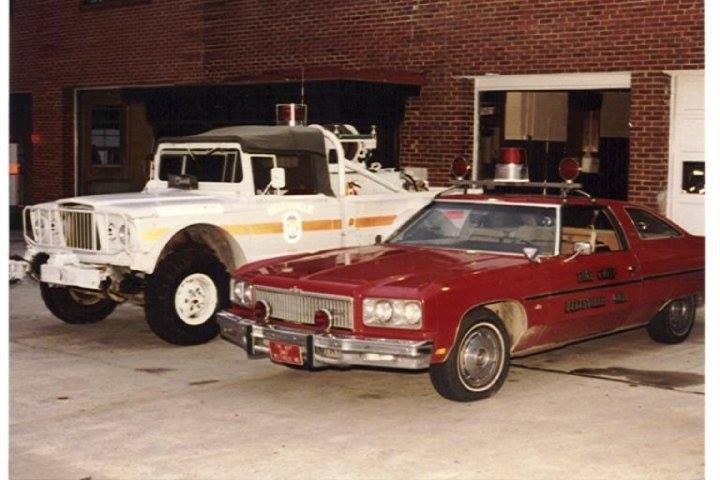
This apparently is a photo from the Beltsville, Md., Volunteer Fire Department somewhere in the mid- to late 1970s. So is this:
What is the big deal, you ask?
The big deal is the 1975 Chevrolet Caprice coupe used as the fire chief’s car. The pictured Caprice is so close to the car I drove through the 1980s that I can tell you what’s different (other than the emergency lights and door decals, that is) from mine: (1) the lack of vinyl roof (ours had a full vinyl roof, not the vinyl landau half-roof) and (2) the tan (or what appears to be tan) interior instead of our red interior.

This Caprice was dark red, like ours. You’d think a fire department would have chosen bright red (which was available). However, the owner of a fire truck manufacturer once told me his company offered 100 different shades of red for its trucks.
The poster of this photo said he got it from a friend of his. He didn’t know anything about the car; he assumed a car dealer had given the car to the department. (It apparently followed a 1966 Chevy wagon.)
A little background: Police cars (from which come taxicabs and fire department cars, such as this one) have existed since, obviously, cars have existed. After World War II, carmakers started upgrading cars for police departments with, for instance, slightly hotter engines, better brakes, heavy-duty frames, heavy-duty seats (usually of vinyl so they were easier to clean) and so on. Not all police cars were police-package cars, and if you know what you’re looking for you can tell whether a police car is actually a police-package car by looking at, for instance, tire sizes (police packages usually had bigger tires, and often had high-speed-rated tires in the days before widespread use of radials) and a speed-certified speedometer.

Carmakers that sold police-purpose vehicles usually had a name for them. Ford’s police cars were called Interceptors, Pontiac’s were called Enforcers, Chrysler’s were called Pursuit(s). Oldsmobile had an Apprehender. Chevrolet‘s police package was called the 9C1, after its option number.
There were Chevy police cars in 1975 …

… but most were the then-new Nova (including in Madison) …

… with an occasional Blazer, Suburban or van thrown in. According to Jalopnik, there were no full-size 9C1 Chevys until 1976, one year before the downsized Impala was introduced.
The Caprice fire chief’s car obviously wasn’t a police-spec vehicle, and not just because it wasn’t a 9C1. For one thing, it’s a two-door, and while there were two-door squads (usually used by state highway patrols), they were in the process of going away by 1975. It appears to have the standard-size tires (the P225/75R–15, formerly known as the HR78–15, instead of even the LR78–15, now P235/75R–15, in the Impala and Caprice’s trailer towing package), which are also whitewalls, with the standard Caprice wheel covers, not the “dog-dish” hubcaps the Chicago squad and the Nova have. And no squad car I have ever seen had fender skirts.
The Caprice was the top-of-the-line full-size Chevrolet from 1966 until 1996. (When the full-size Impala was killed in 1986, the base model became the Caprice, and the upgrade was called the “Caprice Classic.”) I once saw a drawing of a ’76 Caprice squad in a car magazine ad, but I’ve never seen one in person, and a web search won’t find one from ’75 or ’76. Police departments didn’t buy luxury cars as squads, and neither did fire departments.
So I think to myself: How would my Caprice (a car I wish I still owned most days, despite its 11 mpg and 26-gallon gas tank — do the math at $3.40 a gallon) have done as an emergency services vehicle? Before you dismiss that question, there have been a lot of police departments that had officers use their personal vehicles as squads, paying them mileage, most famously in Hawaii. (The idea of McGarrett I driving his big Mercury, or Danno II driving a Camaro at work is actually based on reality.)
Our Caprice had the base 350 2-barrel V-8 (that’s a “two-barrel carburetor,” for those who have never heard of the term), so it wasn’t really fast, but Caprices through 1976 had a 400 4-barrel V-8 and a 454 4-barrel V-8 available. The 350 came with the Turbo-Hydramatic 350 automatic transmission instead of the Turbo 400, but other than leaks, we had zero transmission issues.
Certainly a four-door sedan or station wagon would be preferable, though our Caprice’s trunk was enormous. Ours had the trailer towing package, which consisted of a bumper hitch and trailer wiring harness, and it did have the 3.08:1 rear end, which made for slightly better acceleration than taller gearing. (No Positraction, though.) It didn’t have the heavy-duty suspension, which made it ride softly and, when said enormous trunk was full, bottom out on steep driveways. It also didn’t have the gauge package, which included a trip odometer, one useful additional gauge, engine temperature, and one useless gauge, the fuel economy meter (really an engine vacuum meter). Nor did it have split bench seats, which would be an issue for two officers of different heights if the short one is driving. (Ditto tilt steering, which it also didn’t have.) The only heavy-duty cooling it would have had was the cooling system used for air-conditioned cars. (And, I must say, the Caprice’s could make ice in a few minutes.) It wouldn’t have had a heavy-duty battery (though that’s easy enough to fix) or alternator (more complicated) to run the lights and radio. It was a great long-distance car, though not many fire calls could be called long-distance trips.
On the other hand, handling wasn’t bad for an 18½-foot-long, 4,300-pound car. The car was about as reliable as any 1975 car you’ll ever see. And the doors were so long and heavy that they could qualify as a weapon.
Buzzfeed has a bunch of tests that might be termed, to quote MTV’s Kurt Loder about the ’90s song “I’m Too Sexy,” dopey but irresistible.
The tests ask a bunch of questions, and supposedly the answers determine which whatever you should be.
The test apparently most popular on Facebook of late is “What State Do You Actually Belong In?”
I think the test is bogus, though apparently at least a couple people have gotten Wisconsin out of their picks.
For one thing, the first question, your favorite fast food chain, includes only three with any Wisconsin presence at all — Sbarro (in a mall near you), Dunkin’ Donuts and Taco John’s. There is no Wisconsin-based TV show on the list, though that would admittedly be a short list — “Happy Days,” “Laverne and Shirley,” “Picket Fences,” “Step by Step” and “That ’70s Show” are all that come to immediate mind.
There is one Wisconsin musical act in that question, Bon Iver, but none of these. The “What Animal Do You Think Best Represents You” question has some obvious wrong answers (road runner?), but it’s not clear whether Wisconsin could be represented by a rooster, a squirrel, a cardinal, a bear, a beaver, an elk, a deer or a loon. The question of what quality in a partner attracts you also includes no obviously Wisconsin answer, such as “she hunts and fishes.”
The number one British album today in 1970 for the first of eight times on top of the British charts:
The number one British single today in 1976 was about a supposed event 12 years earlier:
The number one single today in 1981:
The Clinton administration’s scandals du jour created a new term — “document dump,” when Clinton’s minions got around to releasing reams of documents, usually on Friday afternoons hoping to escape media notice.
That didn’t happen yesterday, when more emails than you can read were released on the attempt by Wisconsin Democrats to derail Gov. Scott Walker’s 2014 gubernatorial and possible 2016 presidential campaigns.
This, from WisPolitics, is what passes for a bombshell:
Prosecutors suspected Scott Walker knew his aides in the Milwaukee County exec’s office were operating on a secret computer network and sought to expand their John Doe probe the day before the 2010 election, newly released documents show.
The documents also showed prosecutors subpoenaed Walker’s 2010 guv campaign to get a better handle on who was replying to the political emails his county employees sent from their public offices. They were also trying to see if Walker was involved in the activities. …
The thousands of pages, including emails, affidavits and court transcripts released Wednesday were from the case against former Walker aide Kelly Rindfleisch, one of six people convicted in a John Doe probe. Prosecutors closed that probe, but have since opened a separate, second John Doe built partially on evidence collected during the first investigation. …
The documents show prosecutors requested permission the day before the 2010 gubernatorial election to expand the Doe to four additional Walker aides.
That included: Rindfleisch, Walker’s deputy chief of staff; chief of staff Tom Nardelli; communication director Fran McLaughlin; and Dorothy Moore, the scheduler for the county exec. Out of those four, only Rindfleisch was eventually charged.
The judge overseeing the probe signed off on the request as well as one for search warrants covering the county exec’s offices in the courthouse, Rindfleisch’s homes in West Allis and Columbia County, and her car.
Among other things, the documents show prosecutors believed members of Walker’s staff worked in concert to hide the work they were doing in the public office.
Prosecutors had previously disclosed an email from Walker to Tim Russell following the troubles of former aide Darlene Wink in which he wrote, “We cannot afford another story like this one. No one can give them any reason to do another story. That means no laptops, no websites, no time away during the workday, etc.”
But according to the records, employees continued to use private email accounts to do campaign work while in their public offices. …
I should probably find a hissing-cat sound effect to add to this:
The emails also offered some unflattering commentary by Walker aides and allies on people like Milwaukee Mayor Tom Barrett and then Lt. Gov. candidate Rebecca Kleefisch.
An email from Barrett in the spring of 2010 comments on a job fair held by AirTran, saying having the airline base crew in the city was a “feather in our cap.”
Walker responded to the initial email, which copied several other campaign allies and county staffers, saying “Mayor forgot to thank the county for running one of the best airports in the country which is why Air Tran is adding jobs here.”
Walker and Barrett squared off for the guv’s office that fall.
In reply to that email, Robert Dennik, a former deputy chief of staff to Walker and, at the time, a VP for VJS Construction, said: “Small detail when you’re the abti-christ[sic]!!!”
In addition, Rindfleisch also repeatedly complained about Kleefisch. Most of the comments were in emails that dealt with Rindfleisch’s campaign work for then-state Rep. Brett Davis, who was running in a primary campaign against Kleefisch for lt. guv.
One exchange followed an invite to an event featuring a joint appearance with Kleefisch and Walker in March. Rindfleisch contacted Walker campaign manager Keith Gilkes and wrote it gave the impression that Walker was endorsing Kleefisch. When she was told that Walker was doing appearances with other lt. guv candidates as well, Rindfleisch asked if she’ll be able to use the appearance for advertising, writing in the email that Kleefisch “is the bane of your existence.”
Gilkes replied that she wouldn’t be allowed to use the appearance for advertising and “that will be made abundantly clear to her.”
Rindfleisch’s dislike of Kleefisch carried forward when she was told by Walker’s county exec spokeswoman Fran McLaughlin that Kleefisch didn’t show up to an event attended by Davis. Rindfleisch responds “I hope she keeps missing them. And topples over in her high heels.”
That is fundamentally what yesterday’s e-document dump is all about. It is not about finding Walker’s illegal actions, because, as Charlie Sykes reminds us, there were none to be found:
As the media and partisan operatives (but I repeat myself) sift through 27,000 pages of emails from that “secret” probe, we find volumes of old news, office gossip, political chatter, and unproved allegations.
But no White Whale. Only some random guppies.
Nothing in the new batch of emails incriminates Walker in any way. But we already knew that: if there was evidence of criminal activity, prosecutors would have filed charges. Instead, they shut down that probe without charges against the governor.
Now they seem intent on trying to score points in the court of public opinion that they didn’t dare try in a court of law. And Democrats have stripped even the thin of veneer of non-partisanship from the probe by going all-in to exploit it for partisan advantage.
This brings us to the latest investigation: John Doe II.
Lost amid the back and forth over the latest secret investigation of conservatives in Wisconsin is this inconvenient detail: there is no White Whale here either.
The John Doe II probe allegedly centers on charges that Scott Walker’s re-election campaign and dozens of conservative nonprofit groups known as 501(c)(4)s may have illegally coordinated their efforts during the 2012 recall campaign.
But in quashing numerous subpoenas, Judge Gregory A. Peterson, the judge presiding over the Doe, has ruled that the prosecutors had not shown “probable cause that the moving parties committed any violations of the campaign finance laws.” What the targets were accused of doing, the judge said, was in fact, protected free speech.
The order is all the more remarkable because it bluntly rejects the prosecutor’s theory of illegal coordination between the groups and the Walker campaign. Wisconsin’s campaign finance statutes ban coordination between independent groups and candidates for a “political purpose.” But a political purpose “requires express advocacy,” the judge wrote, and express advocacy means directly advocating the election or defeat of a candidate.
“There is no evidence of express advocacy” and therefore “the subpoenas fail to show probable cause that a crime was committed,” Judge Peterson wrote. Even “the State is not claiming that any of the independent organizations expressly advocated” for the election of Mr. Walker or his opponent, he added. Instead they did “issue advocacy,” which focuses on specific political issues.
So after all the pre-dawn raids, the seizure of personal computers, kitchen sink demands for records and emails, the sweeping probe turns out to be an investigation without a crime.
Let’s repeat that sentence: if there was evidence of criminal activity, prosecutors would have filed charges. They didn’t.
How do we know this is a partisan witch hunt? Media Trackers profiles the chief persecutor:
Formerly secret documents released by prosecutors and made public by a liberal advocacy group show David Budde, the chief investigator in the Milwaukee County District Attorney’s office, played a central role in the politicized John Doe investigation that concluded shortly after Gov. Scott Walker was re-elected in 2012.
On May 21, 2012, Media Trackers reported that Budde had a Democratic Party of Wisconsin “Recall Walker” sign in his front yard and an AFL-CIO union fist poster on his front door. Democrats hoped that the investigation Budde was helping lead would destroy Gov. Scott Walker’s (R) chance to win the recall election.
The released documents relate to prosecutors’ investigation of Kelly Rindfleisch, a Republican operative who struck a plea deal with the District Attorney’s office after engaging in political activity during working hours at her Milwaukee County government job. Before now the records were not public since John Doe investigations are conducted entirely in secret.
Democrats in 2011 and 2012 seized on numerous leaks about the investigation to suggest Walker’s political career would be over by the time the investigation concluded. The fact that the Milwaukee County DA John Chisholm is a Democrat and 43 members of his staff signed petitions to recall Walker raised questions about a possible political motivation to the probe.
Walker was never charged with any wrongdoing. …
In seeking to obtain an affidavit to search the home of Darlene Wink, another county employee, who was then in her late 50′s, Budde explains that he had a male investigator – Paul Bratonja – stalk the woman and track her movements before bringing his intentions before a judge.
Wink later pled guilt to two misdemeanors – not felonies – and was given probation.
On August 20, 2010, Budde wrote an affidavit backing up Assistant District Attorney Bruce Landgraf’s request to broaden the scope of the John Doe investigation. Less than a month later on October 18, Budde asked a judge to give him more investigative power to search other records for evidence to build a case.
Budde also helped orchestrate a raid of the County Executive’s office by investigators and representatives of the DA’s office in November of 2010. Three of the people mentioned as targets of the raid were never found guilty or even so much as charged with any wrongdoing.
It appears that Budde, a long time political supporter of his Democratic boss Chisholm, never faced any repercussions for allowing a recall Walker yard sign in his yard. The situation made it appear as if Budde was extraordinarily biased in his perspective and thus possibly partisan in his work on the John Doe investigation.
Let’s repeat that sentence: Walker was never charged with any wrongdoing. But don’t believe me, believe the judge, as Watchdog reports:
On a day when news headlines nationwide screamed of Gov. Scott Walker’s “apparent” knowledge of illegal campaigning going on in his office when he was Milwaukee County executive, the judge of the nearly three-year “secret” investigation into Walker’s former aides and associates summed up the meat of the matter.
“The John Doe is closed and the results of the John Doe speak for themselves in terms of who has allegedly committed a crime, who has been charged with a crime and who has been convicted of a crime,” former Appeals Court Judge Neal Nettesheim told Wisconsin Reporter on Wednesday.
Not on that conviction list, perhaps much to the dismay of the Democratic Party of Wisconsin and like-minded liberals, was Walker.
Nettesheim served as the presiding judge over a sprawling probe launched in spring 2010 by the Democrat-led Milwaukee County District Attorney’s office. He shut down the investigation in March 2013, months after the prosecution’s quest for convictions fizzled out. In the end, Democrat DA John Chisholm and his prosecution squad had compiled six convictions — only two of them related to the original scope of the John Doe, and no charges of wrongdoing by Walker. …
“The John Doe here is closed except for one lingering motion which was brought by the Journal Sentinel,” Nettesheim said, referring to the newspaper’s push for the judge to release all documents under seal in the probe. That decision has been delayed, Nettesheim said.
Nettesheim said he was not surprised by the political heat the first John Doe probe generated.
“When I was approached by director of the state court office and was asked if I’d be willing to conduct the John Doe, I knew very well the political implications on both sides of the aisle,” the judge said. “But like Harry Truman once said, I find the heat in this kitchen very comfortable.”
Nettesheim said he managed to equally aggravate the right and the left.
There appears to be something larger going on here, as Matt Kittle reports:
In advance of the court-ordered release of thousands of personal emails of a convicted former aide to Wisconsin Gov. Scott Walker when Walker served as Milwaukee County executive, liberal attack group American Bridge on Wednesday morning giddily announced it was launching a new website on Wisconsin’s not-so-secret John Doe probes.
American Bridge, the Hillary Clinton-attached, super political action committee run by former Democratic National Committee spokesman Brad Woodhouse, rolled out the website as a court lifted the seal on Kelly Rindfleisch’s emails.
The announcement of the website follows American Bridge’s breathless “memo” Tuesday reminding members of the media of the scheduled release of the documents. The group need not have bothered: Every outlet from the Milwaukee Journal Sentinel to the Washington Post seemed to eagerly anticipate the looming distribution of Rindfleish’s emails.
American Bridge’s website — dubbed JohnDoeWalker.com — drives home the point that the left appears to be doing all in its power to connect the name of Scott Walker to the politically charged John Doe investigations which have, to date, found no evidence of any wrongdoing by Walker, a bona fide threat to the Democrats’ quest to hold the White House in 2016. …
American Bridge and the Democratic Party of Wisconsin have hammered on the latest John Doe investigation, also launched by the Milwaukee County District Attorney’s office, into dozens of conservative organizations. The presiding judge in that probe has quashed several of the subpoenas and ordered the return of property to targets subjected to pre-dawn raids, arguing the prosecution failed to show evidence of alleged illegal campaign coordination reportedly between the conservative groups and Walker’s campaign during the 2012 recall elections. …
American Bridge’s coordinated effort to drag Walker’s name through the mud of an investigation that has not found the governor guilty of any wrongdoing may, in the minds of conservatives, substantiate their darkest suspicions: That the John Doe investigation is part of a national effort to cut the tongue out of conservative political speech, in the mission of taking down Walker.
The smear campaign against Walker — who was charged with nothing from the John Doe investigation — is Wisconsin’s chapter in a nationwide campaign by Democrats and their apparatchiks — including, as we know, the Internal Revenue Service — to destroy conservatives.
Kittle calls this “Wisconsin’s Secret War,” but it’s really not a secret anymore.
Assuming today’s forecasted thundersnowsleethail doesn’t wipe out the electrical or cellphone grid, I’ll be on Wisconsin Public Radio’s Joy Cardin Week in Review segment Friday at 8 a.m.
Wisconsin Public Radio’s Ideas Network can be heard on WHA (970 AM) in Madison, WLBL (930 AM) in Auburndale, WHID (88.1 FM) in Green Bay, WHWC (88.3 FM) in Menomonie, WRFW (88.7 FM) in River Falls, WEPS (88.9 FM) in Elgin, Ill., WHAA (89.1 FM) in Adams, WHBM (90.3 FM) in Park Falls, WHLA (90.3 FM) in La Crosse, WRST (90.3 FM) in Oshkosh, WHAD (90.7 FM) in Delafield, W215AQ (90.9 FM) in Middleton, KUWS (91.3 FM) in Superior, WHHI (91.3 FM) in Highland, WSHS (91.7 FM) in Sheboygan, WHDI (91.9 FM) in Sister Bay, WLBL (91.9 FM) in Wausau, W275AF (102.9 FM) in Ashland, W300BM (107.9 FM) in Madison, and of course online at www.wpr.org.
Tied to that, I suppose, is yet another Newscastic list of what we journalists supposedly love — public radio:
True Fact – nearly half of all story pitches came from a journalist listening to NPR.
We’re news addicts.
We’re addicted to news. When we’re not at our desks or looking at our phones for the latest news, we tune into our local public radio station to get the headlines. …
Because every journalist has a crush on Ira Glass.
Because this is our favorite game show.
Jeopardy! is a close second. …
Who doesn’t want an NPR tote bag?
Well, we don’t ALWAYS listen to NPR.
Hey, we’re journalists (a.k.a. broke).
Those smoothing NPR host voices
The Beatles had quite a schedule today in 1963. They drove from Liverpool to London through the night to appear on the BBC’s “Parade of the Pops,” which was on live at noon.
After their two songs, they drove back north another three hours to get to their evening performance at the Swimming Baths in Doncaster.
The number one song today in 1965:
The Milwaukee Journal Sentinel reports that a tax cut deal will be finished today:
Republicans reached a compromise late Tuesday on Gov. Scott Walker’s more than $500 million tax cut proposal, agreeing to $38 million in spending cuts in the final piece of a deal that paves the way for a key committee vote on Wednesday.
Along with two other modest changes, the cuts to take place in the next budget beginning in July 2015 were enough to win over a remaining Senate GOP holdout who had balked at passing tax cuts that would leave the state in a worse financial position in the future. The deal will preserve all of the property and income tax cuts that Walker proposed after new projections last month found the current state budget would finish in June 2015 with a $1 billion surplus. …
The deal would also keep a chunk of the surplus— more than $100 million — in the state’s main account rather than shifting it to a rainy-day fund. It would also drop a proposed sales tax exemption added by Assembly Republicans last week for construction companies doing work for local governments and churches. …
By Tuesday morning, the number of GOP holdouts in the Senate had come down to Sen. Rob Cowles (R-Allouez), who backed Walker’s tax cuts but was seeking an additional $38 million cut in state spending in the next budget to help pay for them. …
A lapse is a technical term in the state budget. It would amount to requiring agencies in the Walker administration to return that amount of money to the state’s main account during the fiscal year ending in June 2016.
The agencies could do that by dialing back their authorized spending or taking cash from separate pots of money that have built up over time.
Fitzgerald said the Walker administration was initially reluctant about the lapse, which can make it more difficult for agencies to budget because it introduces a level of uncertainty about what their actual spending will be. …
Republicans hold an 18-15 advantage in the Senate, but Sen. Dale Schultz (R-Richland Center) and all Senate Democrats are widely seen as no votes on the tax cuts. If they vote against the tax cuts, Cowles and every other GOP senator must vote for the bill to assure its passage. …
The move — and the additional $38 million cut — would also lower the shortfall expected in the 2015-’17 state budget under one way of estimating what is known as the structural deficit.
Before the new projections of unexpected new tax money last month, that shortfall had been estimated at about $707 million for the next two-year budget. Walker’s proposal would increase that projected shortfall by roughly $100 million to $807 million.
With the additional $38 million cut, the package would lower the expected shortfall to less than $660 million for the next budget.
First: Good for Cowles for insisting on more spending cuts. Even with the tax cuts, government in Wisconsin spends too much and taxes too much. (In addition to government’s other faults too numerous to list here.) There is no problem Wisconsin faces that more tax dollars will fix. The next time a unit of government in Wisconsin provides value that even matches your tax dollars will be the first time.
The aforementioned Schultz claims that no constituent of his told him they want tax cuts. (Which is a false statement, provably so if Schultz read his Senate district’s newspapers.)
In addition to their usual ranting about tax cuts for the “rich” (that is, those who actually pay income taxes), Democrats have been hypocritical about the issue of the rainy day fund, as Media Trackers reminds us:
On February 11, the state Assembly approved a $504 million property and income tax cut. The measure, promoted by Walker in his January state of the state address, also makes a payment of $117 million to the budget stabilization fund, better known in political vernacular as the “rainy day fund.”
While two Democrats joined a united Republican caucus in passing the tax cut, most Democratic members of the Assembly voted against the plan. More than a few Democrats publicly complained that the tax cut was irresponsible because more revenues were not deposited in the rainy day fund.
Rep. Penny Bernard-Schaber (D) called the tax cut package an “irresponsible and reckless plan.” As if on cue, other Democrats also called the measure “irresponsible.”
“When are we gonna stop doing irresponsible election year gimmicks?” Rep. Cory Mason, a Democrat from Racine, complained on the Assembly floor.
“Democrats believe we should take a balanced approach to the projected surplus,” Minority Leader Peter Barca said in a press statement outlining his side’s plan to double Walker’s requested contribution to the rainy day fund.
Barca subsequently expressed horror when Republicans voted down his plan and voted for what he called an ”irresponsible election-year ploy.”
What Barca, Mason and other Democrats are conveniently ignoring is just how much money Walker and legislative Republicans have put into the rainy day fund. Today, the fund has more money in it than at any other time since its creation in 1985.
According to the Legislative Fiscal Bureau, the rainy day fund had $279.3 million in it as of January 16, 2014. If the Senate agrees with Walker’s tax cut package, the $117 million sent to the fund in that legislation will boost the reserve to $396.3 million.
That’s a far cry from when Gov. Jim Doyle, a Democrat, took $57 million out of the fund in 2008, leaving it with only $1.3 million.
Prior to the 2001-2003 budget, which established a funding mechanism for the rainy day account, the fund had a paltry $35 in it: a testament to the abundant political intentions that led to its creation and the lack of political will to meaningfully fund it.
The leftwing Wisconsin Budget Project on January 15th called on Walker and lawmakers to spend the budget surplus on yet more government programs. After Walker announced his tax cut, the group blasted him for not earmarking more money for the rainy day fund. Calling tax cuts a “shortsighted move” they said lower taxes “could come back to haunt the state during future economic downturns.”
While throwing together a chart that claims the state needs around $2.25 billion in a rainy day fund, the group never credited Walker with growing the account far more than his predecessors in either party.
The tax cut remains too small because it doesn’t even match the $2.2 billion tax increase Doyle enacted in the late 2000s. That tax increase didn’t solve the state’s fiscal problems of the time, but it did wreck the state’s economy. The tax cut is not larger because Walker and legislative Republicans have refused to make actual cuts — not merely decreases in increases, but a budget in which the last number, total spending, is less than the previous budget’s number — probably because they want to remain in power. So this apparently is as good as Wisconsinites will get, and better than yet another Democratic tax increase.
EPA Abuse passes on Jonathan Chait:
The State Department Friday released its long-awaited environmental impact analysis of the Keystone XL pipeline. The analysis is key because President Obama announced last summer he would not approve the pipeline unless it was found to have no significant impact on climate change. And that’s what the analysis finds. It argues, as many other analysts have concluded, that if we block the pipeline, Canada will just ship the oil out by rail.
So, what public policy reason is there to block the pipeline? There really isn’t one. Indeed, the environmentalists’ obsession with Keystone began as a gigantic mistake. Two and a half years ago, the environmentalist James Hansen wrote a blog post alerting his readers to the pipeline, which he concluded would amount to “game over” for the climate, as it would lead to the burning of enough new oil to moot any effort to limit runaway greenhouse gases. His analysis was based on a simple back-of-the-envelope calculation that turned out to be wrong in several respects, the most important being the assumption that blocking the pipeline would keep the oil in the Canadian oil sands in the ground.
Put another way: The Canadians intend to sell their oil, whether to Americans or someone else. Pipelines have a better safety record than tankers or the railroad carrying oil. But apparently environmentalists are just fine with forcing Americans to use immensely more expensive forms of energy than oil, coal and natural gas.
On the other hand, it is amusing to watch the envirowackos spin themselves into the ground trying to justify such forms of “green” energy as wind turbines that kill birds, and now solar panels that fry birds dumb enough to fly by.
Today in 1956, Elvis Presley performed three shows at the Fort Homer Hesterly Armory in Tampa, Fla. Presley closed the final show by announcing to the crowd of 14,000, “Girls, I’ll see you backstage.”
Many of them took Presley at his word. Presley barely made it into his dressing room, losing some of his clothes and his shoes in the girl gauntlet.
The number one single today in 1961 posed the question of whether actors can sing:
(Answer: Generally, singers act better than actors sing. Read on.)


 Steve Prestegard.com: The Presteblog