• Presty the DJ for May 31

    May 31, 2014
    Music

    We started and ended with jazz yesterday, so it’s worth noting that today is the anniversary of the release of the first jazz record, “Darktown Strutters Ball”:

    The number eight single today in 1969 …

    … the same day John Lennon and Yoko Ono recorded …

    (more…)

    Share this on …

    • Share on X (Opens in new window) X
    • Share on Facebook (Opens in new window) Facebook
    • Share on LinkedIn (Opens in new window) LinkedIn
    • Email a link to a friend (Opens in new window) Email
    • Print (Opens in new window) Print
    Like Loading…
    No comments on Presty the DJ for May 31
  • Go Fish/Hats/Wolf/Ducks Go!

    May 30, 2014
    Madison, Sports

    A friend of mine said on Facebook Wednesday:

    Yeah yeah we got the Mallards. They even have a mascot that endears to me intimately. But they’re a Cape Cod team. There’s no reason we can’t have a Brewers farm team–at the very least an A-team but why not the AAA-team?

    We sure would go to a lot more games if it was a Brewers farm team.

    Those outside the Madison area may not realize that Madison does have a minor league team, the Mallards, part of the independent (that is, unaffiliated with Major League Baseball) Northwoods League. The Mallards and their other Northwoods brethren use college players, and their season runs from late May through August.

    I pointed out (after which he said, “I love how you always break things down to gravel”; I’m not sure what he meant by that) that while there are Class A teams near Madison, the obvious problem is that the Brewers already have a Class A affiliate, the Wisconsin Timber Rattlers, based in the Fox Cities. The Midwest League Rattlers, which have only been a Brewers affiliate since 2009, are the former Appleton Foxes, which had a long and distinguished history. The Foxes became the Timber Rattlers in 1995, the year they moved into Fox Cities Stadium, which hosts the WIAA spring baseball championships and the NCAA Division III College World Series.

    There have been several minor league teams in Madison, over three eras, the last of which started in 1982. Before that, the Madison Senators played in the Wisconsin-Illinois League from 1907 to 1914, as a Class D (then the lowest level of the minors) team for three years and a Class C team the remaining five years. (The league’s other teams, depending on the year, included the Appleton Papermakers, Eau Claire Tigers, Fond du Lac Webfoots, Green Bay Orphans and Bays, La Crosse Badgers, Marinette-Menominee Twins, Oshkosh Indians, Racine Belles, Wausau Lumberjacks, Aurora (Ill.) Blues, Freeport (Ill.) Pretzels and Rockford Wolverines and Wolves.)

    Minor league ball returned to Madison in 1940 when the Blues joined the Class B Illinois-Indiana-Iowa League, with the opponents the Cedar Rapids Raiders, Clinton (Ill.) Giants, Decatur (Ill.) Commodores, Evansville (Ind.) Bees, Moline Plow Boys, Springfield (Ill.) Browns and Waterloo (Iowa) Hawks. The Blues were a Cubs affiliate in their final year, 1942.

    Forty years later, the Class A Midwest League’s Madison Muskies arrived and were initially a hit beyond all expectations. The Muskies were an affiliate of the Oakland Athletics, and the Muskies had several players who would end up with the great A’s teams of the late 1980s, including Jose Canseco, Terry Steinbach and Walt Weiss, or with other teams, including outfielder Luis Polonia and pitcher Tim Belcher (who opened the 1988 World Series for the Dodgers against the A’s in what you should know as the Kirk Gibson Game). Warner Park, a high school diamond, underwent in-season expansion projects to accommodate the crush of interest. The Muskies ended up losing the Midwest League championship to Appleton, but were unquestionably the league’s biggest hit, and maybe the biggest hit in all of minor league baseball. (That was in the same year the Brewers got to the World Series, so arguably 1982 was the zenith of baseball in the state of Wisconsin, among the Brewers, Foxes and Muskies.)

    Unfortunately for the Muskies, the first year was their best year. As with nearly all minor league teams, sometimes the Muskies were good; sometimes they weren’t. Warner Park was never significantly improved, which posed a problem when the minors became popular and better stadiums started to be built. The Muskies changed owners, and the new owners moved the franchise to Grand Rapids, Mich., to become the West Michigan Whitecaps. The one-season replacement was the Madison Hatters, a Cardinals minor league team formerly located in Springfield, Ill., but they were at Warner Park for just 1994 before they moved to Battle Creek, Mich. (They are now in Midland, Mich., and called the Great Lakes Loons. Really.)

    Madison’s first independent minor league team was the Black Wolf, which played in the Northern League at Warner Park from 1996 to 2000. (Jimmy Buffett — yes, that Jimmy Buffett — was a minority owner.) After five seasons, the Black Wolf moved to Lincoln, Neb., to become the Saltdogs.

    Exit the Black Wolf, but enter Steve Schmidt, owner of The Shoe Box in Black Earth. Schmidt played baseball at Madison Area Technical College (which has one of the best junior-college baseball programs in the country, though most Madisonians probably don’t know that). Schmidt hit upon the idea of a short-season team, which conveniently eliminated the problem of playing baseball in April and May before tens of fans. The Mallards have been successful on the field (two league titles) and seem to be successful enough off the field.

    The question my friend asks, however, is about Madison’s return to what could be called Organized Baseball. The next level up, Class AA, is unlikely due to geography. The closest AA league is the Eastern League, and by “closest” I mean the closest team is in Akron, Ohio. That leaves Class AAA, and Madison sits between its two leagues — the International League has teams in Indianapolis and Columbus, Ohio, and the Pacific Coast League has teams in Des Moines and Omaha.

    As a Class AAA market, Madison would be on the small side, but with a metro area of half a million people (counting Iowa and Columbia counties) would be comparable to such markets as Durham, N.C., Scranton/Wilkes-Barre, Pa. (home of the Yankees’ top farm club), Syracuse and Toledo.

    What about the Brewers on the other end of Interstate 94? As close as they are, that wouldn’t be the shortest distance between parent club and AAA affiliate. The Tacoma Rainiers are 32 minutes south of their Mariners parents, and the Gwinnett Braves are 37 minutes north of their Braves parents. Of course, Seattle and Atlanta are considerably larger than Milwaukee.

    The Brewers are much more of a statewide team than they used to be, thanks to the Miller Park roof and Brewers marketing people who actually know something about marketing. (Their predecessors in the Bud and Wendy Selig era didn’t, or didn’t have any money for marketing outside Milwaukee.)

    These three dangerous-looking characters are my father (on the left; I look more like my mother, the Miss Wisconsin-USA finalist, though Dad and I have the same body type, and we are the first two generations of trumpet players in the family) and two of his high school friends, from Richland Center, one of whom has season tickets. It is unlikely anyone from Richland Center, unless a diehard baseball fan, would have season tickets at Milwaukee County Stadium, given Milwaukee’s bad spring weather and distance from southwest Wisconsin. The Wednesday afternoon we were there, it was 44 degrees outside. The game drew 24,000 at Miller Park; it probably would have drawn 4,000 at County Stadium.

    What obviously is a huge plus to the Brewers is a minus for competitors for the entertainment dollar. If you buy tickets for a Brewers game, wherever you are, you have absolute certainty that the game will be played. The only thing the weather will affect is the comfort level of your pregame tailgate party. To no one’s surprise, the Brewers’ attendance as a percentage of available tickets (capacity times game dates) is substantially higher than it was in the County Stadium days, even when the Brewers had good teams. (The Brewers’ attendance record in County Stadium was in 1983, 2.3 million fans, or 53 percent of capacity. The Brewers so far are averaging 76 percent of capacity, slightly better than in 2013, and the Brewers have exceeded 3 million fans, which is about 90 percent of capacity, three times since moving to Miller Park.)

    The stadium question is one of the biggest hurdles. A Class AAA stadium seats about 10,000 to 15,000. There is no obvious place in Madison to put a baseball stadium other than possibly the Dane County Fairgrounds, though Dane County has never expressed interest in building a ballpark. Schmidt has done wonders with Warner Park, but Warner Park will never really meet the standard of a quality minor league ballpark. In a perfect world, a ballpark would be built close to the UW campus so the UW baseball team and the AAA team could share it, but there is no UW varsity baseball anymore. With Madison’s reputation as the City That Won’t where business is concerned, it would almost make more sense for one of Madison’s suburbs to host the team, though that is probably a nine-digit financial commitment.

    The other hurdle is ownership of the team. The Brewers’ AAA affiliate is the Nashville Sounds. It’s not that Milwaukee has a historic commitment to Nashville; the Brewers are the Sounds’ sixth parent organization. But to get a team in Madison, you have to put together an ownership group. Since it’s always fun to speculate with other people’s money, some of the names being circulated as potential Milwaukee Bucks minority owners come to mind — Brewers owner Mark Attanasio, who is reportedly interested in having a part of the Bradley Center replacement, and Nashville Predators owner Craig Leipold, a Racine native. Beyond them, though, well, it’s nice to have rich people in your state, and Wisconsin has very few of them.

    Some may see the distance between Madison and Milwaukee as a hurdle. Others see the failure of previous minor league teams as a sign that Madison isn’t a baseball town, or that the UW overwhelms everything else sports-wise. The former may more be a commentary on Muskies ownership (the Hatters were never intended to be in Madison more than one season) than on whether Madison would support a higher-level baseball team stocked with players who next year might be playing at Miller Park. The latter ignores the fact that baseball and UW football, basketball and hockey don’t overlap.

    The key number is 700,000. That’s 10,000 spectators times 70 home games. In an area of slightly more than a half-million people, could a baseball franchise get that many ticket sales?

    Share this on …

    • Share on X (Opens in new window) X
    • Share on Facebook (Opens in new window) Facebook
    • Share on LinkedIn (Opens in new window) LinkedIn
    • Email a link to a friend (Opens in new window) Email
    • Print (Opens in new window) Print
    Like Loading…
    No comments on Go Fish/Hats/Wolf/Ducks Go!
  • 41 years ago Wednesday, Thursday and today

    May 30, 2014
    media, Sports

    ABC-TV broadcasted the Indianapolis 500 race for the 50th year Sunday.

    I’m not a big race fan, but the Indy 500 was one of the few races I always tried to watch each year, at least until high school commencements on Sunday afternoons intervened. Somewhere there is a photo of me in a race car in the Indianapolis Motor Speedway museum, and on my one and only UW Marching Band bowl game our buses took a lap on the track. Indy is not considered a very steep track, but even an 11-degree banking is noticeable, particularly in a bus.

    The race also was the final time Jim Nabors started the race by singing “Back Home Again in Indiana.” (Nabors’ singing voice is nothing like his “Gomer Pyle” voice. Surprise, surprise, surprise.)

    Nabors told a hilarious story about how he started singing the song:

    People tend to forget Nabors was actually born in Alabama. He moved to California when he started out in show business, and was performing in Lake Tahoe one day for an audience that included Bill Harrah. The casino magnate happened to be a car aficionado, and he invited Nabors to attend the Indy 500 for the first time.

    Nabors was supposed to be there as a fan, but [track owner] Tony Hulman had also seen Nabors perform in Lake Tahoe, and the speedway’s owner asked if he would sing along with the Purdue marching band prior to the race. With that, Nabors picks up the story:

    ”So to the conductor of the Purdue band, I said, ‘What key do you do this in?’ And he looked at me funny and said, ‘We only have one key.’ I said, ‘No, the ”Star-Spangled Banner” has two keys.’ And he said, ‘You’re not singing that!’ And I said, ‘Well, what the hell am I singing?’ It was only five minutes to race time, too, and there’s 500,000 people here,” Nabors said.

    ”He says, ‘It’s the traditional song that opens the race, ”Back Home Again in Indiana.”’ I kind of looked at him and go, ‘I’m from Alabama!’ And he started laughing and asked if I knew it. And I said, ‘Well, I know the melody but I don’t know all the lyrics.’ So I’m writing them on my hand. The first time I ever sang it, I wrote it on my hand.”

    Racing — animal or vehicular — is one of the events I’ve never had the opportunity to announce. It must be an enormous challenge to announce given that fans have a hard time determining who’s in first place except for the scoreboard since the lead participants often end up lapping slower participants.

    There is one more challenge specific to auto racing, though it’s something that could happen in other sporting events. No sports broadcasting program I’m aware of trains you how to cover death during a sporting event.

    I have had a couple of instances where games I was announcing were stopped because of player injuries that were serious enough to require ambulance trips for the participants. All three of the games were tape-delayed, so we’d watch for a few minutes and then turn off the camera until play resumed.

    One year before ABC started covering the 500, in 1964, drivers Dave MacDonald and Eddie Sachs were killed on the race’s second lap.

    The YouTube video merges newsreel footage with the live radio coverage of the event. Radio race coverage is interesting to observe. For races on big tracks such as Indianapolis or the Daytona 500, there are one or two main announcers, and additional announcers in each of the turns. The announcers describe what — more accurately who — is going past them.

    Nine years after the 1964 500, ABC’s broadcast of the 1973 500 demonstrated the unpredictability of live sports, even though ABC’s broadcast wasn’t live. In those days ABC tape-delayed the 500 to the evening after the race, which has been  run on the Sunday of Memorial Day weekend (weather permitting) since 1975. In 1973, the race was still on Memorial Day … or it was supposed to be on Memorial Day.

    Those who believe in omens would have been disturbed two weeks before the race was to be held, when driver Art Pollard crashed in qualifying and was killed. But drivers and hardcore race fans have always accepted death as part of what can happen in racing. (I have a high school classmate who was killed in a race car crash in 1997. Ten years before that, I was an intern at WKOW-TV in Madison, sitting in the newsroom watching the 1987 500 when the Associated Press reported the death of a spectator from Wisconsin. A wheel came off of one of the cars, another car hit the wheel — as it happened, during a commercial, as I discovered in trying to find the incident — and launched the wheel and tire the air and hit the spectator, who was sitting in the top row of the grandstand, in the head, killing him instantly.)

    ABC’s main announcer was Jim McKay, one of the most versatile announcers in the history of TV sports. There had  not been a death during the 500 since McDonald’s and Sachs’ deaths, though there had been deaths during practice or qualifying. (Including, in 1968, a driver who had been added to a team to replace legendary racer Jim Clark, who had died in a race crash one month earlier.) McKay’s on-the-job training for what he’d have to announce was the previous September, when, while covering the 1972 Munich Olympics, he had to announce the kidnapping and then murder of 11 Israeli athletes.

    The 1973 500 turned out to be both the shortest (just 133 of 200 laps) and longest (over three days) race in Indy history. The race began three hours late due to rain. That would have made things a little exciting in ABC’s production facilities with the amount of time for pre-broadcast production shrinking dramatically. However …

    … ABC carried none of the race Memorial Day. The 11-car crash seven seconds into the race, in which fuel sprayed into the crowd, severely injured driver David “Salt” Walther and at least two spectators. By the time track repairs and cleanup were under way, the rains resumed. and race officials postponed the race until Tuesday, even though ABC said it wouldn’t carry the race Tuesday.

    (Having announced a three-day-long baseball game last year, I can relate. For that matter, 25 years ago I was supposed to provide reports from a softball sectional in the same town as a baseball sectional involving the same high school. Thanks to two days of rain not dried out by the third day, I covered exactly none of it, because by the time the games were actually played, I had to be at the state track meet.)

    The action Tuesday was off the track, because the rain returned before the race was to restart. ABC reported on a heated meeting between race officials and drivers during which a driver told race officials that if the start wasn’t improved, “you’re going to get us all killed out there.” The problem was a too-slow start (which bunched up the field) combined with drivers’ not staying where they were supposed to stay before the race started, as was pointed out by driver Jackie Stewart, ABC’s analyst.

    Stewart had to be back in Europe for a race, so he wasn’t there for the final start. Nor were many of the race team crew, since many had to return to their actual jobs. Nor were most of the fans, for the same reason.

    What sportswriters were now calling “the 72 Hours of Indianapolis” got started for good Wednesday. The race got as far as 57 laps until …

    … driver David “Swede” Savage crashed and was trapped inside his burning car. A crew member of one of Savage’s teammates started running on pit row toward the crash, was hit by a fire truck responding to the crash, and was killed. Savage survived the crash, but died a month later of complications. His wife was pregnant with their second daughter.

    ABC carried the 72 Hours of Indianapolis the night the race finally ended.

    One of the unpleasant truths of wars and disasters is that they represent learning opportunities. (Much of current emergency medical practice is based on what was learned in the Korean and Vietnam wars.) Fatal crashes in prominent races usually result in safety improvements. Indy cars were slowed down until chassis and safety technology caught up with engine technology. Emergency equipment was required to be driven the same direction as race cars down pit row. The track was also improved by removing the wall Savage hit and the seats where spectators were burned in Walther’s crash.

    For instance, drivers now wear neck protection to avoid the kind of injury that killed racer Dale Earnhardt at Daytona in 2001:

    The fact, however, is that the only way to eliminate deaths from racing is to eliminate racing. If a crash in which a car going 60 mph hits something can kill the car’s occupants, a crash at triple-digit speeds will be more lethal. Which doesn’t stop drivers from racing.


    Share this on …

    • Share on X (Opens in new window) X
    • Share on Facebook (Opens in new window) Facebook
    • Share on LinkedIn (Opens in new window) LinkedIn
    • Email a link to a friend (Opens in new window) Email
    • Print (Opens in new window) Print
    Like Loading…
    No comments on 41 years ago Wednesday, Thursday and today
  • Presty the DJ for May 30

    May 30, 2014
    Music

    Two more Beatles anniversaries today: “Love Me Do” hit number one in 1964 …

    … four years before the Beatles started work on their only double album. Perhaps that work was so hard that they couldn’t think of a more original title than: “The Beatles.” You may know it better, however, as “the White Album”:

    (more…)

    Share this on …

    • Share on X (Opens in new window) X
    • Share on Facebook (Opens in new window) Facebook
    • Share on LinkedIn (Opens in new window) LinkedIn
    • Email a link to a friend (Opens in new window) Email
    • Print (Opens in new window) Print
    Like Loading…
    1 comment on Presty the DJ for May 30
  • The GOP, the middle class and our economy

    May 29, 2014
    US politics

    A new group called the YG Network observes:

    Middle-class Americans continue to suffer in the Obama economy. Costs for everyday things like gas and groceries continue to rise, and long-term expenses like tuition continue to take large chunks out of families’ budgets.

    And as far as healthcare goes, “more employees are getting hit with higher health insurance premiums and co-payments,” according to the new Aflac WorkForces Report.

    It’s not surprising then, that the American people think that the economy is on the decline. According to Gallup’s Economic Confidence Index, a majority of Americans (55 percent) believe that the economy is getting worse, while only 40 percent believe it is getting better.

    The liberal agenda isn’t working out for the middle class, because it focuses on pet projects without making any serious attempt to make life work better for hardworking Americans.

    How do we know that the economy is taking a downward turn, irrespective of what Washington wants us to believe? Traveling around over the Memorial Day weekend, one observed a large number of campers and boats, along with some motorcycles, for sale. Those are all relatively big-ticket items, but they are paid for with disposable income, and visual evidence says people are disposing of items purchased with disposable income.

    How do we know the economy hasn’t been doing well for a long time? Consider this: The financial planners say a family should buy a car whose price is no more than half of its annual income, and buy a house whose price is no more than twice of its annual income. The median income of a Wisconsin household in 2012 was $51,039 (yes, less than the national average.) The average price of a new car in March 2012 was $30,748, which is more than half of said median household income. The median price of a house in Wisconsin in 2012 was $133,900, which is closer to three years of income than two years. Since incomes have grown negligibly but prices have not since 2012, if you go by standards of responsible financial planning most Wisconsin families cannot afford to buy a new car or a house.

    One reason the economy is sucking is that by any non-hyperpartisan’s definition, the federal government is not working. Anyone who thinks ObamaCare is just misunderstood and once you try it, you’ll like it should have their beliefs disproven by every new report about VA hospitals. The Washington Post’s Jennifer Rubin observes:

    Whether it is the Department of Veterans Affairs, Medicaid, student loans or any other mismanaged and excessively expensive aspect of the liberal welfare state, the left’s answer to any reform proposal is invariably, “No, you’re trying to destroy it!” To try to reform these programs is, in the left’s eyes, an attempt to hurt the poor, sick, disadvantaged and powerless. The recipients in the current system may not get good care or students may be weighed down with huge debt and no useful degree, but liberals are content so long as more and more taxpayer money is poured into failing programs. Likewise, Medicare and Social Security can crowd out all other domestic programs and be on the road to bankruptcy, but reformers who attempt to make it sustainable for the long haul are accused of throwing Granny over the cliff. …

    Examples of the problem abound. The VA is close to a European, socialized medicine program as you are going to see in the U.S., and it is killing people. Medicaid is rife with fraud and offers care much worse than non-Medicaid patients receive (in part because the rates don’t attract the best physicians). We’ve spent hundreds of billions on education and our kids do worse in math than do children in Poland and Vietnam. The libertarian would say: “Get rid of it all, and everything will be better!” The reform conservative says, “Let’s see if we can do these things better, or better yet, move more people off Medicaid, for example, and into good-paying jobs.” A good example of the latter mindset is Medicare Part D, a GOP reform that used market forces to keep costs down and make drugs accessible to the elderly. Liberals and libertarians fought it tooth and nail, but it works and people like it.

    Liberals hate this sort of conservative talk and would rather spend more money for worse results. Why? We can be cynical and say they have a political dependence on civil servants and want those people to stay employed. Levin instead suggests that it is inherent in their vision of government: “The Left tends to champion public programs that consolidate the application of technical expertise: that try to take on social problems by managing large portions of society as if they were systems in need of better organization and direction. Again, it views government as organizing the interactions of individuals.”

    Hand in hand with this go a few liberal habits of mind. First, it’s all about inputs. How many dollars, how many meetings, how many people served. When the dollars in a budget go down (or merely fail to rise), liberals holler that you are hurting the poor, without regard to whether the current programs are doing the job. The outputs — people out of poverty, people in paying jobs – aren’t even measured in many instances. (This isn’t just in domestic policy. Ask a State Department employee what he has “accomplished,” and he’ll reel off a list of memos, meetings and trips.) Second, it imagines that the smartest technocrats can figure it all out and micromanage a vast, diverse and complex country. You get Obamacare, which has federal bureaucrats telling you what an “acceptable” insurance policy is and what is, as the president put it, a “crap” plan that shouldn’t be sold.

    The result of all this is a very big liberal welfare state that does a very bad job of addressing people’s problems. Oh, and it drives us into deeper and deeper debt. That is the bad news that contributes to the sense that government doesn’t work for anyone who really needs it. The good news is that the exhaustion of the liberal welfare state, a victim of its own flawed organizing principles, offers the opportunity for a vision of government that is better, more effective and more limited (at least at the federal level).

    So what should be done about this? Fox News reports:

    In a notable display of GOP unity in this often acrid primary season, Senate Minority Leader Mitch McConnell and House Majority Leader Eric Cantorstood alongside conservative all-star Sens. Mike Lee, R-Utah, and Tim Scott, R-S.C. for the release of “Room to Grow,” a 121-page policy manifesto aimed at attracting middle-class voters to the GOP.  The book written by the YG Network, a group of prominent conservatives with ties to Cantor, offers proposals on health care, taxes, and education. McConnell praised the work, telling the gathering the GOP needs to combat its elitist image and focus on “Americans whose daily concerns revolve around aging parents, long commutes, shrinking budgets, and obscenely high tuition bills” adding, “these hymns to entrepreneurialism are as a practical matter largely irrelevant.”

    Peter Wehner of the Ethics and Public Policy Center outlines the problem …

    In an era of rapid economic and demographic change, middle-class Americans express hope and optimism about their ability to climb the economic ladder. Yet two-thirds of Americans believe that it will be harder for them to achieve the American Dream than it was for their parents, and three-quarters believe that it will be harder still for their children and grandchildren to do the same. The chief fear of middle-class Americans is that just as it is getting harder for poor people to climb into the middle class, a stagnant economy is making it all too easy for those who have achieved middle class status to fall out of it.

    Middle-class adults are far more inclined to believe that Democrats rather than Republicans favor their interests. But middle-class dissatisfaction with both liberals and conservatives runs deep, and this creates an opportunity for conservative reformers. Conservatives must understand the concerns of the middle class and speak to their aspirations and worries. They must offer a concrete conservative agenda that tackles the barriers to upward mobility, and that renews faith in free enterprise and our constitutional system.

    … and National Affairs editor Yuval Levin outlines their solution:

    Conservatives must offer an alternative to the fundamentally prescriptive, technocratic approach inherent in the logic of the liberal welfare state. While the Left seeks to impose order on the chaos and complexity of a free society through the use of centralized government programs, the Right seeks to protect, defend, and revitalize the space between individuals and the state. This is the space in which families, communities, civic and religious institutions, and private businesses are constantly finding new solutions to new challenges, and it is the space that is most threatened by the growth of government.

    For conservatives, the role of government is to enable and sustain markets and other arenas of common action, ensuring competition, aiding the development of physical infrastructure and human capital, protecting consumers and citizens, and allowing the poor and vulnerable to participate along with everyone else. In practice, this means avoiding centralized programs that impose wholesale solutions from above in favor of those that enable a bottom-up, incremental, continuous learning process.

    The conservative reform agenda aims to replace a failing liberal welfare state with a lean and responsive 21st century government worthy of a free, diverse, and innovative society.

    National Review adds:

    Room to Grow, an essay collection published by YG Network, a conservative group, is the latest evidence that conservatism may be experiencing an intellectual resurgence as well as a political one. The book collects and distills much of the fresh conservative thinking that journals like National Affairs — and, ahem, National Review — have been featuring on health care, financial reform, higher education, and other issues. The conservative authors of the book refuse to concede any of these areas to a Left that has often seen them as its exclusive territory, and refuse as well to adopt the role of defending a dysfunctional status quo from liberals who would make it worse. Instead they argue for conservative reforms: breaking the higher-education cartel, bringing real competition to health care, making anti-poverty programs work-oriented.

    As in the late 1970s, ideas rooted in sound conservative principles and an accurate assessment of the American condition offer the opportunity to unify and elevate the Republican party. National Affairs, the American Enterprise Institute, and the YG Network co-hosted the book launch, which included supportive commentary by new tea-party stalwarts Senators Tim Scott (R., S.C.) and Mike Lee (R., Utah) and by established Republican leaders Eric Cantor and Mitch McConnell.

    There is much work to be done. The good news for the country, and the bad news for liberalism, is that this work is now beginning.

    Share this on …

    • Share on X (Opens in new window) X
    • Share on Facebook (Opens in new window) Facebook
    • Share on LinkedIn (Opens in new window) LinkedIn
    • Email a link to a friend (Opens in new window) Email
    • Print (Opens in new window) Print
    Like Loading…
    1 comment on The GOP, the middle class and our economy
  • So what’s the holiday?

    May 29, 2014
    media

    On Friday shortly after 8 a.m., I will be on Wisconsin Public Radio for the Joy Cardin Show Week in Review.

    I seem to have this thing now where I am on WPR either just before or just after a holiday. This could be my latest post-holiday appearance, or my latest pre-holiday appearance.

    As you know, Wisconsin Public Radio’s Ideas Network can be heard on WHA (970 AM) in Madison, WLBL (930 AM) in Auburndale, WHID (88.1 FM) in Green Bay, WHWC (88.3 FM) in Menomonie, WRFW (88.7 FM) in River Falls, WEPS (88.9 FM) in Elgin, Ill., WHAA (89.1 FM) in Adams, WHBM (90.3 FM) in Park Falls, WHLA (90.3 FM) in La Crosse, WRST (90.3 FM) in Oshkosh, WHAD (90.7 FM) in Delafield, W215AQ (90.9 FM) in Middleton, KUWS (91.3 FM) in Superior, WHHI (91.3 FM) in Highland, WSHS (91.7 FM) in Sheboygan, WHDI (91.9 FM) in Sister Bay, WLBL (91.9 FM) in Wausau, W275AF (102.9 FM) in Ashland, W300BM (107.9 FM) in Madison, and of course online at www.wpr.org.

    Share this on …

    • Share on X (Opens in new window) X
    • Share on Facebook (Opens in new window) Facebook
    • Share on LinkedIn (Opens in new window) LinkedIn
    • Email a link to a friend (Opens in new window) Email
    • Print (Opens in new window) Print
    Like Loading…
    No comments on So what’s the holiday?
  • On Statehood Day

    May 29, 2014
    Culture

    Today is Wisconsin’s 166th birthday as a state.

    Wisconsin became a state May 29, 1848. It’s too bad that Wisconsin’s becoming the 30th state couldn’t have waited one day to become official, but apparently Congress was unconcerned with numerical synchronicity.

    Apparently Wisconsinites — that is, residents of the Wisconsin Territory — were somewhat hesitant to join the Union, at least according to History.com:

    In 1836, after several decades of governance as part of other territories, Wisconsin was made a separate entity, with Madison, located midway between Milwaukee and the western centers of population, marked as the territorial capital. By 1840, population in Wisconsin had risen above 130,000, but the people voted against statehood four times, fearing the higher taxes that would come with a stronger central government. Finally, in 1848, Wisconsin citizens, envious of the prosperity that federal programs brought to neighboring Midwestern states, voted to approve statehood. Wisconsin entered the Union the next May.

    That’s a rather ironic paragraph given that Wisconsin has been a donor state to the feds for decades, with no national parks, no Air Force bases, no major federal installations, and, of course, no Upper Peninsula, that having been swiped from Wisconsin and given to Michigan to settle the Toledo War.

    Be all that as it may, Estately has found 27 reasons to live here, including …

    TOILET PAPER IS AMPLE

    The only thing worse than running out of toilet paper is unnecessary hyperbole. Luckily, Green Bay, Wisconsin is the Toilet Paper Capital of the World. So go ahead and wipe like you’re some kind of Charmin Bear because the T.P. is abundant.

    Snapshot 11:8:13 3:26 PM
    IT’S BEERVANA

    Wisconsin could just as easily be called The Beer State. This land of malted hops and barley welcomed German immigrants and their brewing traditions with open arms. A staggering 3.9% of the state’s GDP comes from beer, with over 60,000 people employed in the beer industry. One brewery in Milwaukee alone produces 10 million barrels of beer annually—that’s 10 million barrels of fun! Milwaukee even named their baseball team the Brewers.

    Snapshot 11:15:13 9:23 AM-2

    YOU CAN FIND OTHER DRINK WISCONSINBLY PRODUCTS AT DRINKWISCONSINBLY.COM

    GREEN BAY PACKERS

    What team has an NFL record 13 championships, 22 Hall of Famers, and is owned by the fans themselves instead of some local billionaire? The NFL’s greatest franchise—the Green Bay Packers. Being a winner feels good, too.

    Essentials-football-books-Vince-Lombardi-Packers-631
    THE WOMEN OF WISCONSIN

    1. Can outdrink men from any other state (except Alaska and North Dakota)
    2. Make denim on denim look good (sorry Canada)
    3. Wear skirts and heels when it’s 20 below and never complain about the cold
    4. Are finally over their Brett Favre crushes, except Donna in Oshkosh
    5. Open their own pickle jars
    6. Would rather clean a walleye than the kitchen
    7. Sometimes wear brassieres made of cheese, which is the inspiration behind the Dairy Queen Brazier
    8. Can throw a snowball 20 yards further than women in Minnesota
    9. Keep a photo of Donald Driver in their wallets
    10. Currently have a nice casserole baking in the oven

    ptfs333

    PHOTO SOURCE:  PACKER TIME

    THE MEN OF WISCONSIN

    1. Always oil your chainsaw before returning it
    2. Wear ponytails way better than guys in Illinois (see Clay Matthews)
    3. Propose to you while deer hunting
    4. Are happy to take your mom out for drinks on her birthday
    5. Buy a round of drinks when they win cash at pull tabs
    6. Put the toilet seat down because it’s not like they’re from Iowa
    7. Never, NEVER play the Goo Goo Dolls on a jukebox
    8. Only sit alone in their truck and cry when the dog dies
    9. Regret not making friends with Russell Wilson in college
    10. Never lie about their marathon time, even if they’re running for office

    brawny1
    ALWAYS GOT MILK

    Wisconsin earned the title of “Dairy Capital of the World” because it produces more milk than any other state, except for California, which isn’t fair because California is really big. Still, 2nd place isn’t bad, and wholesome Wisconsin doesn’t corrupt it’s milk with exposure to twerking and molly and marijuana cigarettes.

    Miley Cyrus Got Milk Ad
    SO MUCH CHEESE

    People say “Where there’s smoke there’s fire,” but nobody ever says “Where there’s milk there’s cheese.” That’s way better, and it’s totally true for Wisconsin, which produces 25% of the nation’s cheese and wears 99% of all cheese hats.

    shopping
    FRIED CHEESE CURDS

    For those who like their cheese squeaky and deep fried, Wisconsin is fried cheese curd paradise. These tasty little cheese nuggets are battered and fried, then served up with a cold beer. Wisconsin is like the county fair, except its an entire state and the fair food lasts all year long.

    3715013669_e5ef4eb881_o
    A LAND OF SECOND CHANCES

    Russell Wilson was an undersized quarterback who transferred from NC State University to Wisconsin for his final year of eligibility. While there, he took the Badgers to the Rose Bowl and now he’s the star quarterback for the resurgent Seattle Seahawks. There are magical powers at work in the Wisconsin, especially when it comes to underrated quarterbacks that other teams didn’t want (see Aaron Rodgers and Brett Favre).

    wisconsin_wilson_russell_roses

    PHOTO SOURCE:  COLLEGE SPORTS MADNESS

    FATHERS OF ANARCHY

    Wisconsin (Milwaukee) is the home of Harley Davidson Motorcycles so maybe you could work for them? Maybe you could invent a remote control that silences a neighbor revving their Harley’s engine for a solid 10 minutes at 5:30 in the morning? You might even win a Nobel Prize for that. Check out Harley Davidson’s job page HERE.

    Tour of Harley-Davidson Vehicle Operations.

    … LOCALLY PRODUCED PEOPLE

    These famous folks are all from Wisconsin…

    1. Harry Houdini, famous magician and escape artist
    2. Actress Heather Graham
    3. Frank Lloyd Wright, the country’s most famous architect
    4. Comedic actor Chris Farley
    5. Mr. Baseball (announcer Bob Uecker)
    6. Comedian Frank Caliendo
    7. Musical performer Liberace
    8. Musician Steve Miller
    9. John Matuszak (Sloth from The Goonies)

    Liberace_sitting_room_warren-1
    … MISSISSIPPI RIVER ADVENTURE

    The Mississippi River forms part of Wisconsin’s border with Minnesota. It also provides a nice jumping off point for a 1,200-mile aft trip if you want to go all Huckleberry Finn and travel to New Orleans just like ye olde French fur trappers may have once done.

    map_us_miss
    UNEMPLOYMENT

    The unemployment rate for Wisconsin is 6.7%, which is better than the national average of 7.3%, and far better than its neighbors Michigan (9.0%) and Illinois (9.2%). Try and ignore neighboring Iowa (4.9%) and Minnesota (5.1%) and just be happy Wisconsin still has manufacturing jobs.

    Snapshot 11:11:13 11:05 AM-2

    … AMERICA’S BEST MUSTACHES

    Mustaches are back en vogue right now, but in Wisconsin they never went out of style. Upper lip bristles are worn by all segments of Wisconsin society, including some the state’s most iconic people. To check the authenticity of a mustache be sure to examine it up close. If there are tiny flecks of cheese curd, beer foam, and/or powdered donut then the mustache is genuine and must be treated with respect.

    aaron-rodgers-movember-1

    PHOTO SOURCE:  TOTAL PACKERS

    Snapshot 11:11:13 8:50 AM
    … HUMBLE PEOPLE

    It’s nice to think that reason so few people in Wisconsin have set any world records is because they’re humble and don’t like to attract much attention. The state is largely free of showboats, discounting this proud Guinness Book of World Records holder, a man who’s has eaten a McDonald’s Big Mac every single day for 37 years.

    Snapshot 11:11:13 9:01 AM
    THEY’RE INTO POLITICS

    Wisconsin ranks number three in overall voter turnout with 61% over the past six elections. The state takes its politics seriously, even if they elect a confusing blend of contradictory political figures. This electoral bi-polar disorder causes the state to elect Democrat Barack Obama as President and conservative Republican Scott Walker as governor. The state has sent both socialists (Rep. Victor Berger) and rabid anti-communists (Sen. Joe McCarthy) to Congress. No matter what your politics, you’ll find someone who agrees with you in Wisconsin.

    Scott-Walker-bumper-sticker
    … THIRD-SHIFT HAPPY HOUR

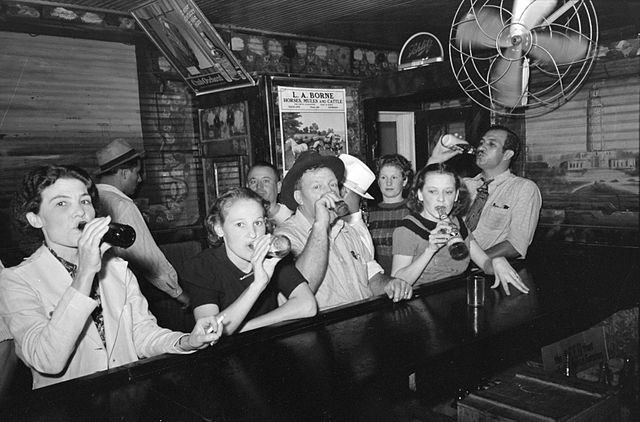
    Happy hours are great for those who enjoy discount drinks and food, but what if you work nights? Many a Wisconsin bar offers “third-shift” happy hours for nurses, firefighters and assembly-line workers, so they can still get cheap beer at 8:30am.

    640px-Raceland_Louisiana_Beer_Drinkers_Russell_Lee

    It’s not clear to me that interest in politics is a positive, and if you can find someone who agrees with your political views, you can also find someone who disagrees with your political views. The pre-statehood Wisconsinites wary of the feds were right.

    Even less serious on the subject, with the added bonus of dubious accuracy, is this blog:

    #1 Our cheese is simply better than yours.

    Wisconsin cheese is amazing. It’s hands down the best in the country. Sure, we are absorbing tons more cholesterol and saturated fat than you, but you only live once!

    #2 We have a baseball team called the friggin’ beers.

    Yeah that’s right our baseball team is called the Milwaukee Brewers. If you’ve seen the movie baseketball you know they parodied our team, but it’s so true. Our baseball team is pretty much called the beers. It’s awesome.

    #3 I eat your weight in brats every year, but i’m still in better shape than you are.

    Did you know that brats are a food group? What’s that you say? They’re not? IN WISCONSIN THEY ARE!!

    #4 We’re pretty good at football.

    Last year the packers won the superbowl, the Badgers played in the Rose Bowl, and UW Whitewater won the division 3 NCAA national championship for the second year in a row. Whitewater has played in every NCAA championship since 2004. Our high school teams aren’t bad either.

    #5 We’re pretty much immune to the cold.

    Most humans have trouble adjusting to temperatures around twenty below zero fahrenheit. We jump in the water and pretend that we’re polar bears.

    #6 We’re the home of the driftless area.

    That’s right, at one point in time we had an area of the state that was so bad ass it flipped off a glacier and told it to go flatten some other part of the country… That’s how tough Wisconsin is. …

    #8 Do not challenge someone from Wisconsin to a snowball fight.

    You will lose. Hands down. Not only do we have experience but miller light numbs pain.

    #9 Tip back your glass!

    Wisconsin has five major breweries and over 25 microbreweries. Most of them are pretty good! …

    #11 Our river will eat you. Do not go swimming.

    The Wisconsin river is dangerous. The only two rivers in the world that are more dangerous are the Nile and the Amazon, and they are dangerous because of what lives in them. The Wisconsin river has extremely swift currents and deadly whirl pools. This one is no joke, stay away from the river!

    #12 We have a lot of cows. Be jealous.

    We have approximately 1,279,000 cows here in Wisconsin. If we equipped our cows with weapons and marched them into Canada we could probably take it over. That’s what i’m talking aboot!

    #13 With great cows comes a great deal of milk.

    Any day that I don’t drink a gallon of milk is a bad day. I’m pretty much addicted.

    #14 Contrary to popular belief cows will not eat you.

    Apparently people from urban areas are scared to death of cows. Cows are pretty docile. They are like big dogs and are usually much more afraid of you than you are of them. …

    #16 If you are from another state do not… i repeat DO NOT try to out drink someone from Wisconsin.

    You may have tipped back a few in your day, but people from Wisconsin are trained professionals. Attempting to out drink someone from Wisconsin can lead to serious injury and or death.

    #17 The leading alcohol Consuming Countries in the world are as follows;

    #3 Finland, #2 Ireland, and #1 Wisconsin. Yes, Wisconsin actually becomes a country in the category of alcohol consumption. Due to the massive quantities of football, beer, cheese, and brats once a party starts it rarely stops. …

    #25 If you don’t like the weather…

    Wait five minutes.. it’ll change! Come visit us!

    Share this on …

    • Share on X (Opens in new window) X
    • Share on Facebook (Opens in new window) Facebook
    • Share on LinkedIn (Opens in new window) LinkedIn
    • Email a link to a friend (Opens in new window) Email
    • Print (Opens in new window) Print
    Like Loading…
    No comments on On Statehood Day
  • Presty the DJ for May 29

    May 29, 2014
    Music

    This is more a pop than rock anniversary: One of the two funniest songs Johnny Cash performed, “One Piece at a Time,” hit number 29 today in 1976:

    Birthdays start with Gary Brooker of Procol Harum:

    (more…)

    Share this on …

    • Share on X (Opens in new window) X
    • Share on Facebook (Opens in new window) Facebook
    • Share on LinkedIn (Opens in new window) LinkedIn
    • Email a link to a friend (Opens in new window) Email
    • Print (Opens in new window) Print
    Like Loading…
    No comments on Presty the DJ for May 29
  • Climate “science” and “consensus”

    May 28, 2014
    US politics, weather

    According to fans of man-made global climate change that will change the Earth as we know it, all scientists believe their claptrap.

    Think again, say Joseph Bast and Roy Spencer:

    Last week Secretary of State John Kerry warned graduating students at Boston College of the “crippling consequences” of climate change. “Ninety-seven percent of the world’s scientists,” he added, “tell us this is urgent.”

    Where did Mr. Kerry get the 97% figure? Perhaps from his boss, President Obama, who tweeted on May 16 that “Ninety-seven percent of scientists agree: #climate change is real, man-made and dangerous.” Or maybe from NASA, which posted (in more measured language) on its website, “Ninety-seven percent of climate scientists agree that climate-warming trends over the past century are very likely due to human activities.”

    Yet the assertion that 97% of scientists believe that climate change is a man-made, urgent problem is a fiction. The so-called consensus comes from a handful of surveys and abstract-counting exercises that have been contradicted by more reliable research.

    One frequently cited source for the consensus is a 2004 opinion essay published in Science magazine by Naomi Oreskes, a science historian now at Harvard. She claimed to have examined abstracts of 928 articles published in scientific journals between 1993 and 2003, and found that 75% supported the view that human activities are responsible for most of the observed warming over the previous 50 years while none directly dissented.

    Ms. Oreskes’s definition of consensus covered “man-made” but left out “dangerous”—and scores of articles by prominent scientists such as Richard Lindzen, John Christy, Sherwood Idso and Patrick Michaels, who question the consensus, were excluded. The methodology is also flawed. A study published earlier this year in Nature noted that abstracts of academic papers often contain claims that aren’t substantiated in the papers.

    Another widely cited source for the consensus view is a 2009 article in “Eos, Transactions American Geophysical Union” by Maggie Kendall Zimmerman, a student at the University of Illinois, and her master’s thesis adviser Peter Doran. It reported the results of a two-question online survey of selected scientists. Mr. Doran and Ms. Zimmerman claimed “97 percent of climate scientists agree” that global temperatures have risen and that humans are a significant contributing factor.

    The survey’s questions don’t reveal much of interest. Most scientists who are skeptical of catastrophic global warming nevertheless would answer “yes” to both questions. The survey was silent on whether the human impact is large enough to constitute a problem. Nor did it include solar scientists, space scientists, cosmologists, physicists, meteorologists or astronomers, who are the scientists most likely to be aware of natural causes of climate change.

    The “97 percent” figure in the Zimmerman/Doran survey represents the views of only 79 respondents who listed climate science as an area of expertise and said they published more than half of their recent peer-reviewed papers on climate change. Seventy-nine scientists—of the 3,146 who responded to the survey—does not a consensus make.

    In 2010, William R. Love Anderegg, then a student at Stanford University, used Google Scholar to identify the views of the most prolific writers on climate change. His findingswere published in Proceedings of the National Academies of Sciences. Mr. Love Anderegg found that 97% to 98% of the 200 most prolific writers on climate change believe “anthropogenic greenhouse gases have been responsible for ‘most’ of the ‘unequivocal’ warming.” There was no mention of how dangerous this climate change might be; and, of course, 200 researchers out of the thousands who have contributed to the climate science debate is not evidence of consensus.

    In 2013, John Cook, an Australia-based blogger, and some of his friends reviewed abstracts of peer-reviewed papers published from 1991 to 2011. Mr. Cook reported that 97% of those who stated a position explicitly or implicitly suggest that human activity is responsible for some warming. His findings were published in Environmental Research Letters.

    Mr. Cook’s work was quickly debunked. In Science and Education in August 2013, for example, David R. Legates (a professor of geography at the University of Delaware and former director of its Center for Climatic Research) and three coauthors reviewed the same papers as did Mr. Cook and found “only 41 papers—0.3 percent of all 11,944 abstracts or 1.0 percent of the 4,014 expressing an opinion, and not 97.1 percent—had been found to endorse” the claim that human activity is causing most of the current warming. Elsewhere, climate scientists including Craig Idso, Nicola Scafetta, Nir J. Shaviv and Nils- Axel Morner, whose research questions the alleged consensus, protested that Mr. Cook ignored or misrepresented their work.

    Rigorous international surveys conducted by German scientists Dennis Bray and Hans von Storch —most recently published in Environmental Science & Policy in 2010—have found that most climate scientists disagree with the consensus on key issues such as the reliability of climate data and computer models. They do not believe that climate processes such as cloud formation and precipitation are sufficiently understood to predict future climate change.

    Surveys of meteorologists repeatedly find a majority oppose the alleged consensus. Only 39.5% of 1,854 American Meteorological Society members who responded to a survey in 2012 said man-made global warming is dangerous.

    Finally, the U.N.’s Intergovernmental Panel on Climate Change—which claims to speak for more than 2,500 scientists—is probably the most frequently cited source for the consensus. Its latest report claims that “human interference with the climate system is occurring, and climate change poses risks for human and natural systems.” Yet relatively few have either written on or reviewed research having to do with the key question: How much of the temperature increase and other climate changes observed in the 20th century was caused by man-made greenhouse-gas emissions? The IPCC lists only 41 authors and editors of the relevant chapter of the Fifth Assessment Report addressing “anthropogenic and natural radiative forcing.”

    Share this on …

    • Share on X (Opens in new window) X
    • Share on Facebook (Opens in new window) Facebook
    • Share on LinkedIn (Opens in new window) LinkedIn
    • Email a link to a friend (Opens in new window) Email
    • Print (Opens in new window) Print
    Like Loading…
    1 comment on Climate “science” and “consensus”
  • On Wisconsin’s shooting gallery

    May 28, 2014
    Culture, media, Wisconsin politics

    Steve Spingola:

    Seemingly each year, the reporters and the editorial writers at the Milwaukee Journal Sentinel believe the shooting of a young child, the needless murder of a homeless man, or a large turnout at a candlelight vigil, is the so-called tipping-point on crime.  In this scenario, the residents of Milwaukee’s central city or the “hood,” as the area was recently dubbed by the Journal Sentinel, awake from their Rip Van Winkle-type slumber to forge a new reality — that the conduct of the criminal element will no longer be tolerated.

    And, each year, it takes all of two weeks to debunk the Journal Sentinel’s theory, as bodies, sadly, begin filling the freezers of Milwaukee County Medical Examiner’s office.

    Instead of looking to Chief Flynn and his overpriced east coast consultants for answers, the proponents of the futile Rip Van Winkle theory on Milwaukee’s inner-city violence could find solutions at Amazon.com for $10.67, a price substantially more affordable than Chief Flynn’s cabal of advisors.

    In February, retired Milwaukee Police Department (MPD) Captain Glenn Frankovis released a new book, Area Saturation Patrol: A Policing Strategy That Works, which spotlights the successful strategy used to suppress crime in MPD Districts Two, Three and Five.

    At the request of Glenn’s publisher, I penned the following:

    “During the summer of 2001, Milwaukee’s Metcalfe Park neighborhood was a virtual war zone.  Fox News 6 reporter Mara MacDonald’s investigation dubbed this troubled area a killing field.  In an effort to prevent more bloodshed, Police Chief Arthur Jones called on Captain Glenn Frankovis.

    “Glenn had previously served as the Commanding Officer at District Five, where he implemented an Area Saturation Patrol (ASP) strategy that worked wonders.  In 2002, overall major crime in District Five declined 8.1 percent, shootings plummeted 42.8 percent, and the number of homicides decreased 48.6 percent.  Within 18 months, the near north side policing sectors under Frankovis’ command had witnessed the largest one-year decline in per capita homicides in urban America.

    “But could the man with the plan, and his hard-charging foot soldiers, put a lid on the on violence in Milwaukee’s killing field?  After all, Metcalfe Park was surrounded by other neighborhoods teetering on the brink.  Instead of making excuses, requesting a huge influx of new officers, or whining about budgets, Glenn Frankovis met the challenge head-on. In his first full-year at District Three, the commander’s ASP strategy and no-nonsense policing style resulted in 15.5 percent reduction in violent crime, including a 21.7 percent reduction in robberies.”

    With such a track record of success, one would think the editorial writers at the Milwaukee Journal Sentinel, the staffs of local television news outlets, and the political-class at city hall, might take notice of Frankovis’ crime fighting strategy. But alas, the sound of crickets and excuse making are the only concepts being promulgated by the proponents of the Rip Van Winkle theory.
    So, each year, as you read the articles in the Milwaukee Journal Sentinel regarding the very tragic loss of human life, consider the source.  Then, take notice that the newspaper’s editorial board and city leaders seem more concerned with political correctness than fighting crime. And, as time passes, the public can count on one thing: that editorial board and political pontificators will continue to put their collective heads in the sand while waiting—for eternity—for the elusive inner-city Rip Van Winkle to be jostled from his slumber.

    Share this on …

    • Share on X (Opens in new window) X
    • Share on Facebook (Opens in new window) Facebook
    • Share on LinkedIn (Opens in new window) LinkedIn
    • Email a link to a friend (Opens in new window) Email
    • Print (Opens in new window) Print
    Like Loading…
    No comments on On Wisconsin’s shooting gallery
Previous Page
1 … 787 788 789 790 791 … 1,038
Next Page

Website Powered by WordPress.com.

Steve Prestegard.com: The Presteblog

The thoughts of a journalist/libertarian–conservative/Christian husband, father, Eagle Scout and aficionado of obscure rock music. Thoughts herein are only the author’s and not necessarily the opinions of his family, friends, neighbors, church members or past, present or future employers.

  • Steve
    • About, or, Who is this man?
    • Facebook
    • Twitter
    • Adventures in ruralu0026nbsp;inkBack in June 2009, I was driving somewhere through a rural area. And for some reason, I had a flashback to two experiences in my career about that time of year many years ago. In 1988, eight days after graduating from the University of Wisconsin, I started work at the Grant County Herald Independent in Lancaster as a — well, the — reporter. Four years after that, on my 27th birthday, I purchased, with a business partner, the Tri-County Press in Cuba City, my first business venture. Both were experiences about which Wisconsin author Michael Perry might write. I thought about all this after reading a novel, The Deadline, written by a former newspaper editor and publisher. (Now who would write a novel about a weekly newspaper?) As a former newspaper owner, I picked at some of it — why finance a newspaper purchase through the bank if the seller is willing to finance it? Because the mean bank lender is a plot point! — and it is much more interesting than reality, but it is very well written, with a nicely twisting plot, and quite entertaining, again more so than reality. There is something about that first job out of college that makes you remember it perhaps more…
    • Adventures in radioI’ve been in the full-time work world half my life. For that same amount of time I’ve been broadcasting sports as a side interest, something I had wanted to since I started listening to games on radio and watching on TV, and then actually attending games. If you ask someone who’s worked in radio for some time about the late ’70s TV series “WKRP in Cincinnati,” most of them will tell you that, if anything, the series understated how wacky working in radio can be. Perhaps the funniest episode in the history of TV is the “WKRP” episode, based on a true story, about the fictional radio station’s Thanksgiving promotion — throwing live turkeys out of a helicopter under the mistaken belief that, in the words of WKRP owner Arthur Carlson, “As God is my witness, I thought turkeys could fly.” [youtube=http://www.youtube.com/watch?v=ST01bZJPuE0] I’ve never been involved in anything like that. I have announced games from the roofs of press boxes (once on a nice day, and once in 50-mph winds), from a Mississippi River bluff (more on that later), and from the front row of the second balcony of the University of Wisconsin Fieldhouse (great view, but not a place to go if…
    • “Good morning/afternoon/evening, ________ fans …”
    • My biggest storyEarlier this week, while looking for something else, I came upon some of my own work. (I’m going to write a blog someday called “Things I Found While Looking for Something Else.” This is not that blog.) The Grant County Sheriff’s Department, in the county where I used to live, has a tribute page to the two officers in county history who died in the line of duty. One is William Loud, a deputy marshal in Cassville, shot to death by two bank robbers in 1912. The other is Tom Reuter, a Grant County deputy sheriff who was shot to death at the end of his 4 p.m.-to-midnight shift March 18, 1990. Gregory Coulthard, then a 19-year-old farmhand, was convicted of first-degree intentional homicide and is serving a life sentence, with his first eligibility for parole on March 18, 2015, just 3½ years from now. I’ve written a lot over the years. I think this, from my first two years in the full-time journalism world, will go down as the story I remember the most. For journalists, big stories contain a paradox, which was pointed out in CBS-TV’s interview of Andy Rooney on his last “60 Minutes” Sunday. Morley Safer said something along the line…
  • Food and drink
    • The Roesch/Prestegard familyu0026nbsp;cookbookFrom the family cookbook(s) All the families I’m associated with love to eat, so it’s a good thing we enjoy cooking. The first out-of-my-house food memory I have is of my grandmother’s cooking for Christmas or other family occasions. According to my mother, my grandmother had a baked beans recipe that she would make for my mother. Unfortunately, the recipe seems to have  disappeared. Also unfortunately, my early days as a picky, though voluminous, eater meant I missed a lot of those recipes made from such wholesome ingredients as lard and meat fat. I particularly remember a couple of meals that involve my family. The day of Super Bowl XXXI, my parents, my brother, my aunt and uncle and a group of their friends got together to share lots of food and cheer on the Packers to their first NFL title in 29 years. (After which Jannan and I drove to Lambeau Field in the snow,  but that’s another story.) Then, on Dec. 31, 1999, my parents, my brother, my aunt and uncle and Jannan and I (along with Michael in utero) had a one-course-per-hour meal to appropriately end years beginning with the number 1. Unfortunately I can’t remember what we…
    • SkålI was the editor of Marketplace Magazine for 10 years. If I had to point to one thing that demonstrates improved quality of life since I came to Northeast Wisconsin in 1994, it would be … … the growth of breweries and  wineries in Northeast Wisconsin. The former of those two facts makes sense, given our heritage as a brewing state. The latter is less self-evident, since no one thinks of Wisconsin as having a good grape-growing climate. Some snobs claim that apple or cherry wines aren’t really wines at all. But one of the great facets of free enterprise is the opportunity to make your own choice of what food and drink to drink. (At least for now, though some wish to restrict our food and drink choices.) Wisconsin’s historically predominant ethnic group (and our family’s) is German. Our German ancestors did unfortunately bring large government and high taxes with them, but they also brought beer. Europeans brought wine with them, since they came from countries with poor-quality drinking water. Within 50 years of a wave of mid-19th-century German immigration, brewing had become the fifth largest industry in the U.S., according to Maureen Ogle, author of Ambitious Brew: The Story of American Beer. Beer and wine have…
  • Wheels
    • America’s sports carMy birthday in June dawned without a Chevrolet Corvette in front of my house. (The Corvette at the top of the page was featured at the 2007 Greater Milwaukee Auto Show. The copilot is my oldest son, Michael.) Which isn’t surprising. I have three young children, and I have a house with a one-car garage. (Then again, this would be more practical, though a blatant pluck-your-eyes-out violation of the Corvette ethos. Of course, so was this.) The reality is that I’m likely to be able to own a Corvette only if I get a visit from the Corvette Fairy, whose office is next door to the Easter Bunny. (I hope this isn’t foreshadowing: When I interviewed Dave Richter of Valley Corvette for a car enthusiast story in the late great Marketplace Magazine, he said that the most popular Corvette in most fans’ minds was a Corvette built during their days in high school. This would be a problem for me in that I graduated from high school in 1983, when no Corvette was built.) The Corvette is one of those cars whose existence may be difficult to understand within General Motors Corp. The Corvette is what is known as a “halo car,” a car that drives people into showrooms, even if…
    • Barges on fouru0026nbsp;wheelsI originally wrote this in September 2008.  At the Fox Cities Business Expo Tuesday, a Smart car was displayed at the United Way Fox Cities booth. I reported that I once owned a car into which trunk, I believe, the Smart could be placed, with the trunk lid shut. This is said car — a 1975 Chevrolet Caprice coupe (ours was dark red), whose doors are, I believe, longer than the entire Smart. The Caprice, built down Interstate 90 from us Madisonians in Janesville (a neighbor of ours who worked at the plant probably helped put it together) was the flagship of Chevy’s full-size fleet (which included the stripper Bel Air and middle-of-the-road Impala), featuring popular-for-the-time vinyl roofs, better sound insulation, an upgraded cloth interior, rear fender skirts and fancy Caprice badges. The Caprice was 18 feet 1 inch long and weighed 4,300 pounds. For comparison: The midsize Chevrolet of the ear was the Malibu, which was the same approximate size as the Caprice after its 1977 downsizing. The compact Chevrolet of the era was the Nova, which was 200 inches long — four inches longer than a current Cadillac STS. Wikipedia’s entry on the Caprice has this amusing sentence: “As fuel economy became a bigger priority among Americans…
    • Behind the wheel
    • Collecting only dust or rust
    • Coooooooooooupe!
    • Corvettes on the screen
    • The garage of misfit cars
    • 100 years (and one day) of our Chevrolets
    • They built Excitement, sort of, once in a while
    • A wagon by any otheru0026nbsp;nameFirst written in 2008. You will see more don’t-call-them-station-wagons as you drive today. Readers around my age have probably had some experience with a vehicle increasingly rare on the road — the station wagon. If you were a Boy Scout or Girl Scout, or were a member of some kind of youth athletic team, or had a large dog, or had relatives approximately your age, or had friends who needed to be transported somewhere, or had parents who occasionally had to haul (either in the back or in a trailer) more than what could be fit inside a car trunk, you (or, actually, your parents) were the target demographic for the station wagon. “Station wagons came to be like covered wagons — so much family activity happened in those cars,” said Tim Cleary, president of the American Station Wagon Owners Association, in Country Living magazine. Wagons “were used for everything from daily runs to the grocery store to long summer driving trips, and while many men and women might have wanted a fancier or sportier car, a station wagon was something they knew they needed for the family.” The “station wagon” originally was a vehicle with a covered seating area to take people between train stations…
    • Wheels on theu0026nbsp;screenBetween my former and current blogs, I wrote a lot about automobiles and TV and movies. Think of this post as killing two birds (Thunderbirds? Firebirds? Skylarks?) with one stone. Most movies and TV series view cars the same way most people view cars — as A-to-B transportation. (That’s not counting the movies or series where the car is the plot, like the haunted “Christine” or “Knight Rider” or the “Back to the Future” movies.) The philosophy here, of course, is that cars are not merely A-to-B transportation. Which disqualifies most police shows from what you’re about to read, even though I’ve watched more police video than anything else, because police cars are plain Jane vehicles. The highlight in a sense is in the beginning: The car chase in my favorite movie, “Bullitt,” featuring Steve McQueen’s 1968 Ford Mustang against the bad guys’ 1968 Dodge Charger: [youtube=http://www.youtube.com/watch?v=GMc2RdFuOxIu0026amp;fmt=18] One year before that (but I didn’t see this until we got Telemundo on cable a couple of years ago) was a movie called “Operación 67,” featuring (I kid you not) a masked professional wrestler, his unmasked sidekick, and some sort of secret agent plot. (Since I don’t know Spanish and it’s not…
    • While riding in my Cadillac …
  • Entertainments
    • Brass rocksThose who read my former blog last year at this time, or have read this blog over the past months, know that I am a big fan of the rock group Chicago. (Back when they were a rock group and not a singer of sappy ballads, that is.) Since rock music began from elements of country music, jazz and the blues, brass rock would seem a natural subgenre of rock music. A lot of ’50s musical acts had saxophone players, and some played with full orchestras … [youtube=http://www.youtube.com/watch?v=9CPS-WuUKUE] … but it wasn’t until the more-or-less simultaneous appearances of Chicago and Blood Sweat u0026amp; Tears on the musical scene (both groups formed in 1967, both had their first charting singles in 1969, and they had the same producer) that the usual guitar/bass/keyboard/drum grouping was augmented by one or more trumpets, a sax player and a trombone player. While Chicago is my favorite group (but you knew that already), the first brass rock song I remember hearing was BSu0026amp;T’s “Spinning Wheel” — not in its original form, but on “Sesame Street,” accompanied by, yes, a giant spinning wheel. [youtube=http://www.youtube.com/watch?v=qi9sLkyhhlE] [youtube=http://www.youtube.com/watch?v=OxWSOuNsN20] [youtube=http://www.youtube.com/watch?v=U9U34uPjz-g] I remember liking Chicago’s “Just You ‘n Me” when it was released as a single, and…
    • Drive and Eat au0026nbsp;RockThe first UW home football game of each season also is the opener for the University of Wisconsin Marching Band, the world’s finest college marching band. (How the UW Band has not gotten the Sudler Trophy, which is to honor the country’s premier college marching bands, is beyond my comprehension.) I know this because I am an alumnus of the UW Band. I played five years (in the last rank of the band, Rank 25, motto: “Where Men Are Tall and Run-On Is Short”), marching in 39 football games at Camp Randall Stadium, the Hubert H. Humphrey Metrodome in Minneapolis, Michigan Stadium in Ann Arbor, Memorial Stadium at the University of Illinois (worst artificial turf I had ever seen), the University of Nevada–Las Vegas’ Sam Boyd Silver Bowl, the former Dyche Stadium at Northwestern University, five high school fields and, in my one bowl game, Legion Field in Birmingham, Ala., site of the 1984 Hall of Fame Bowl. The UW Band was, without question, the most memorable experience of my college days, and one of the most meaningful experiences of my lifetime. It was the most physical experience of my lifetime, to be sure. Fifteen minutes into my first Registration…
    • Keep on rockin’ in the freeu0026nbsp;worldOne of my first ambitions in communications was to be a radio disc jockey, and to possibly reach the level of the greats I used to listen to from WLS radio in Chicago, which used to be one of the great 50,000-watt AM rock stations of the country, back when they still existed. (Those who are aficionados of that time in music and radio history enjoyed a trip to that wayback machine when WLS a Memorial Day Big 89 Rewind, excerpts of which can be found on their Web site.) My vision was to be WLS’ afternoon DJ, playing the best in rock music between 2 and 6, which meant I wouldn’t have to get up before the crack of dawn to do the morning show, yet have my nights free to do whatever glamorous things big-city DJs did. Then I learned about the realities of radio — low pay, long hours, zero job security — and though I have dabbled in radio sports, I’ve pretty much cured myself of the idea of working in radio, even if, to quote WAPL’s Len Nelson, “You come to work every day just like everybody else does, but we’re playing rock ’n’ roll songs, we’re cuttin’ up.…
    • Monday on the flight line, not Saturday in the park
    • Music to drive by
    • The rock ofu0026nbsp;WisconsinWikipedia begins its item “Music of Wisconsin” thusly: Wisconsin was settled largely by European immigrants in the late 19th century. This immigration led to the popularization of galops, schottisches, waltzes, and, especially, polkas. [youtube=http://www.youtube.com/watch?v=yl7wCczgNUc] So when I first sought to write a blog piece about rock musicians from Wisconsin, that seemed like a forlorn venture. Turned out it wasn’t, because when I first wrote about rock musicians from Wisconsin, so many of them that I hadn’t mentioned came up in the first few days that I had to write a second blog entry fixing the omissions of the first. This list is about rock music, so it will not include, for instance, Milwaukee native and Ripon College graduate Al Jarreau, who in addition to having recorded a boatload of music for the jazz and adult contemporary/easy listening fan, also recorded the theme music for the ’80s TV series “Moonlighting.” Nor will it include Milwaukee native Eric Benet, who was for a while known more for his former wife, Halle Berry, than for his music, which includes four number one singles on the Ru0026amp;B charts, “Spend My Life with You” with Tamia, “Hurricane,” “Pretty Baby” and “You’re the Only One.” Nor will it include Wisconsin’s sizable contributions to big…
    • Steve TV: All Steve, All the Time
    • “Super Steve, Man of Action!”
    • Too much TV
    • The worst music of allu0026nbsp;timeThe rock group Jefferson Airplane titled its first greatest-hits compilation “The Worst of Jefferson Airplane.” Rolling Stone magazine was not being ironic when it polled its readers to decide the 10 worst songs of the 1990s. I’m not sure I agree with all of Rolling Stone’s list, but that shouldn’t be surprising; such lists are meant for debate, after all. To determine the “worst,” songs appropriate for the “Vinyl from Hell” segment that used to be on a Madison FM rock station, requires some criteria, which does not include mere overexposure (for instance, “Macarena,” the video of which I find amusing since it looks like two bankers are singing it). Before we go on: Blog posts like this one require multimedia, so if you find a song you hate on this blog, I apologize. These are also songs that I almost never listen to because my sound system has a zero-tolerance policy — if I’m listening to the radio or a CD and I hear a song I don’t like, it’s, to quote Bad Company, gone gone gone. My blonde wife won’t be happy to read that one of her favorite ’90s songs, 4 Non Blondes’ “What’s Up,” starts the list. (However,…
    • “You have the right to remain silent …”
  • Madison
    • Blasts from the Madison media past
    • Blasts from my Madison past
    • Blasts from our Madison past
    • What’s the matter with Madison?
    • Wisconsin – Madison = ?
  • Sports
    • Athletic aesthetics, or “cardinal” vs. “Big Red”
    • Choose your own announcer
    • La Follette state 1982 (u0022It was 30 years ago todayu0022)
    • The North Dakota–Wisconsin Hockey Fight of 1982
    • Packers vs. Brewers
  • Hall of Fame
    • The case(s) against teacher unions
    • The Class of 1983
    • A hairy subject, or face the face
    • It’s worse than you think
    • It’s worse than you think, 2010–11 edition
    • My favorite interview subject of all time
    • Oh look! Rural people!
    • Prestegard for president!
    • Unions vs. the facts, or Hiding in plain sight
    • When rhetoric goes too far
Privacy & Cookies: This site uses cookies. By continuing to use this website, you agree to their use.
To find out more, including how to control cookies, see here: Cookie Policy
 

Loading Comments...
 

    • Subscribe Subscribed
      • Steve Prestegard.com: The Presteblog
      • Join 197 other subscribers
      • Already have a WordPress.com account? Log in now.
      • Steve Prestegard.com: The Presteblog
      • Subscribe Subscribed
      • Sign up
      • Log in
      • Report this content
      • View site in Reader
      • Manage subscriptions
      • Collapse this bar
    %d