The number one single today in 1960:
Today in 1969 the number two single on this side of the Atlantic was the number one single on the other side …
… from the number one album:
No comments on Presty the DJ for Sept. 19
The number one single today in 1960:
Today in 1969 the number two single on this side of the Atlantic was the number one single on the other side …
… from the number one album:
The online meteorologist who refuses to succumb to climate change propaganda, Mike Smith:
Back in April I wrote a posting called Climafornication. Showtime Networks debuted a series called “Years of Living Dangerously.” It ran (and repeats still run) on Sunday evenings immediately after its series, “Californication.” In that blog post, I wrote:
Now, I guarantee you that the current drought in Texas and California will not be presented in this scientifically factual manner. It will be presented as some type of drought that has never occurred before complete with special effects to make it appear worse than it actually is.
I’d say that comment was accurate. The series (since it is still running) lasted longer than the supposedly unprecedented drought!
While reasonable people can and do disagree about global warming, the series used sleazy techniques to convey its propaganda point. For example, noted climate scientist Don Cheadle went to the small town of Plainview, Texas, to talk about the drought it was then experiencing. Nothing wrong with that. But, that is not where the producers stopped. Look at this screen capture. The brown tint in the air was added post-production to exaggerate the drought! They employed a number of these production tricks to make things look worse than they were. That is propaganda, not science.
We also heard how the west Texas (already dry) climate has “changed” and droughts were going to be more frequent. Only one problem with all of this: The drought is over. The official National Weather Service drought metric is below. I’ve placed an arrow pointing to Plainview.
Less than five months later, the drought is officially gone. That is not to say the region does not have challenges, it does. More rain is needed to fill reservoirs (so as to be prepared for the next drought) and the depletion of the Ogallala Aquifer is a huge problem.
The series also starred frequent private jet commuter Arnold Schwarzenegger and private jet owner and pilot Harrison Ford. Nothing like being lectured to decrease our carbon footprints by people whose footprints are the size of Alaska.
Instapundit’s Glenn Reynolds says,
I’ll believe global warming is a crisis when the people telling me it’s a crisis start acting like it’s a crisis.
Once again, in difficult economic times, people trying to make a living and support their families are misleadingly lectured about carbon footprints by Hollywood hypocrites who crisscross the world in private jets.
Harrison Ford in “Years” (left) and with his jet I like Harrison Ford as an actor and I would use a private jet extensively if I could afford to do so. But, he is in absolutely no position to tell me about the size of my carbon footprint.
Readers are reminded of Al Gore’s 11,000-square-foot house, where he apparently lives in between flying across the world to lecture the masses on their carbon footprints. That also applies to Secretary of State John Kerry, who married into money before he started lecturing the masses on their carbon footprints. The Kerrys are not living in an 800-square-foot apartment and taking mass transit to work.
Smith points out things the mainstream media doesn’t — for instance, the number of tornadoes and hurricanes, and the number of most violent tornadoes and hurricanes, is down, not up.
But hey, don’t let the facts get in the way of your narrative, as is reported by National Review:
According to a top environmentalist organizer, climate change is responsible for this summer’s violence in Ferguson, Missouri.
“To me, the connection between militarized state violence, racism, and climate change was common-sense and intuitive,” 350.org Strategic Partnership Coordinator Deirdre Smith wrote.
“Oppression and extreme weather combine to ‘incite’ militarized violence,” she continued. Weeks of rioting followed the killing August 9 of 18-year-old Michael Brown by Ferguson police officer Darren Wilson. Observers around the nation criticized the police for a heavy-handed response to protests in the town, but while the rioting received international attention, it did not result in any loss of life.
Smith explained that not only do poor minority communities have fewer resources to deal with the impacts of climate change, but that “people of color also disproportionately live in climate-vulnerable areas,” which makes climate change a race issue. …
According to the National Weather Service, the St. Louis area was not notably warmer this summer than it has ever been. At 80.3 degrees Fahrenheit, this August’s average temperature in the Gateway to the West was only the seventh-warmest of the last 20 years, substantially cooler than the two-decade high of 83.9 degrees in August 1995.
Smith adds:
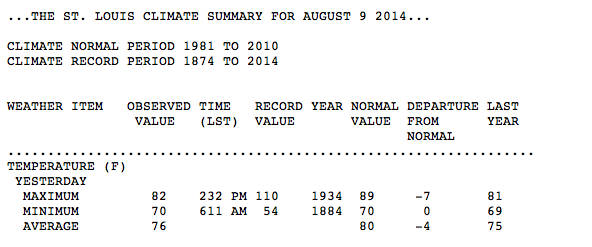
Connection between climate change and Ferguson??? Hmmm. Perhaps, because of her lack of background in climate science, she didn’t know how to research the temperature on August 9, 2014, the day of the horrible shooting of Michael Brown in Ferguson, a north suburb of St. Louis.
So, I did a little research:
The high temperature that day was a very pleasant 82° which was seven degrees cooler than usual. The record high of 110° occurred in 1934 when world climate was cooler than it is today.
To put St. Louis’ high of 82° in perspective, thousands of people pay thousands of dollars every day to fly to Honolulu to enjoy and vacation in Hawaii’s pleasant climate. What was the high in Honolulu the same day?
It was 87°, five degrees warmer than St. Louis.
Obviously, a high of 82 degrees had nothing to do with the tragic shooting and terrible events that unfolded in Ferguson. While I am tempted to make other comments, I’ll stop here.
Even though the headline is from one of the most famous Scotsmen in fiction, Chief Engineer Montgomery Scott of the U.S.S. Enterprise, this post is not about Star Trek.
(Haggis, by the way, is sheep stomach stuffed with sheep organs, oatmeal, onion and suet — think of lamb loaf — with meat stock, simmered about three hours. I used to work with a native of Scotland; I do not recall her opinion of haggis. I suppose it fits right in with other British, uh, delicacies, including spotted dick [pudding with dried fruit], Welsh rarebit [cheese on toast — no rarebit, or rabbit, in it], stargazey pie [sardine pie with, I kid you not, the sardine heads sticking through the crust], and, of course, blood pudding.)
Today, Scotland is voting on its independence from Great Britain.
The Washington Post provides some context for how rare an independence vote is:

Countries don’t like it when regions decide they want to be independent. When the American South decided it wanted to secede, the United States government spent 1861 to 1865 convincing it that it had made a bad decision. (Not everyone was convinced.) This is the history of the world: New countries are often formed only after bloodshed. …
What constitutes a secession of the sort that Scotland might experience is itself tricky to define. We turned to the CIA World Fact Book to find countries that it considers to have save been created by secession. But that, too, wasn’t clear. Take Panama. It seceded from Colombia, but (as those who’ve been watching the PBS special on the Roosevelts this week know) it was hardly as simple as their shaking hands with Colombia’s president. Or Kosovo. In the eyes of the United States, it is an independent country. That opinion is not shared. And Crimea. Did its vote count?
Proving the “tricky to define” part, the comments bring up all kinds of potential additions to the Post’s map, including all the former Warsaw Pact countries and every African country that used to be part of the Ottoman Empire.
The London Daily Mail adds this map of what Europe would be like had every European separatist movement succeeded:

As you know, my last name is Norwegian. Had Norway not successfully seceded from Sweden in 1905 (which took 90 years to accomplish), I guess I would be one-fourth Swedish. I’m not sure how I feel about that.
The better question is what effect would Scottish independence have on the U.S. Polls will be open until 10 p.m. Greenwich Mean Time, which is 5 p.m. in the Central Time Zone. The BBC reports that the result is expected to be announced between 6:30 and 7:30 a.m. Beeb time, which would be, well, overnight here, though if there’s an obvious trend in early returns that will probably be something insomniacs can read tonight.
Nile Gardiner has five reasons why Americans shouldn’t root for approval of Scottish independence:
1. The Special Relationship will be undercut.
The United Kingdom is far and away America’s biggest and most important ally. Anything that weakens Britain, and chips away at the Special Relationship, is a big negative for the United States. This fear has been amply expressed by dozens of members of the United States Congress, both Republican and Democrat, who are backing a resolution in the House of Representatives declaring that a “united, secure, and prosperous United Kingdom” is vital to US interests.
The Special Relationship is too powerful a partnership to be set adrift by a Scottish vote for independence, but there can be no denying that it will not be the same without the valuable contribution to the alliance made by Scottish soldiers, sailors, airmen and marines, as well as statesmen, scholars and entrepreneurs, who helped make it the global force it has been for the last seven decades.
2. Britain’s nuclear deterrent will have to be moved
The UK’s entire nuclear deterrent is based in Scotland, and all Britain’s nuclear bases and warheads will have to be moved out of the country, a huge headache not only for London, but also for Washington. Any threat to Britain’s status as a nuclear power is a matter of great concern for the United States. The Nato alliance was originally conceived as a nuclear alliance, one that has been underpinned since its founding by the American, British and (at times) French nuclear deterrents. Anything that undermines Britain’s position as an independent nuclear power and weakens Nato is a matter of significant concern to the United States.
3. The coalition against ISIL will be weakened
Britain is central to Washington’s strategy of building an international coalition to confront and defeat ISIL, in Iraq and Syria. The timing of the Scottish referendum could not be worse for the White House, which is depending upon Downing Street to help rally countries in Europe and the Anglosphere to contribute militarily to the air war against Isil. A defeat for the No campaign could dramatically weaken David Cameron’s position, making it harder for him to move forward with British military action, especially if there is a leadership challenge within the Conservative Party. The prime minister’s ability to win a vote in the House of Commons and take Britain to war again in the Middle East, would undoubtedly be called into question by defeat in the Scottish referendum.
4. U.S. markets will take a hit
If Scotland votes for independence, expect significant turmoil not just in the City, but on Wall Street as well. 2014 has been a year of significant volatility in American stock markets, driven in part by events in Europe. Fears over the economic fallout from Scotland breaking off from the UK, will spook US markets, frighten investors, and add to an air of uncertainty exacerbated in recent months by Russia’s invasion of Ukraine. Add to this the prospect of a Scottish economy set adrift from the pound, with potentially huge costs incurred in transitioning to an independent financial system, and you have every reason to fear more market turbulence.
5. An independent Scotland will be an insignificant ally to the U.S.
As part of the United Kingdom, Scotland is a valuable ally to the United States, home to Britain’s independent nuclear deterrent and submarine bases, as well as several British military regiments. It is also home to important NATO early warning air defenses, increasingly important in the face of Russian aggression. As an independent entity, with a meager projected defense budget of just $2.5 billion, significantly less than the $4.1 billion budget of London’s Metropolitan Police (hat tip: Luke Coffey), and just 15,000 members of the Armed Forces, Scotland’s role as a US partner would be practically non-existent. Edinburgh would struggle to gain entry to Nato, with countries such as Spain and Italy likely to veto Scottish membership for fear of encouraging nationalist movements within their own borders.
So watch the stock market Friday if independence wins.
On the other hand, not everyone agrees with Gardiner’s analysis, as the comments demonstrate (well, those that don’t make tiresome arguments comparing Ireland and Northern Ireland, as well as Canada and the U.S., or poke fun at Obama’s golf game given St. Andrews):
- All reasons given are excuses for the royalty, overthrown by Americans some 238 years ago. The Scots must decide for themselves. They do not need input from bHo of any other American.
- And on top of that, they’re not even talking about overthrowing the monarchy, just going back to the way things were before 1707, when England and Scotland were fully independent nations who shared a monarch. Scotland’s relationship to England would be more like that of Canada or Australia.
- Scotland has not even set up a monetary system…This is the first thing that needs to happen before they do this…I am all for Scotland becoming a country. But they need to set up a money system before this happens…(they have not done this…) If the separation takes place.. within 3 months, this new country will fail…
- Scotland is sending a message to the motherland they don’t like what they see happening in England. They are making a move to protect what they have.
And the last, and potentially most interesting, comment:
Agree 100%. These arguments are a pathetic example of grasping at straws. Free Scotland today, Free Texas tomorrow.
We begin with the National Anthem because of today’s last item:
The number one song today in 1961 may have never been recorded had not Buddy Holly died in a plane crash in 1959; this singer replaced Holly in a concert in Moorhead, Minn.:
Britain’s number one album today in 1971 was The Who’s “Who’s Next”:
(more…)
Your favorite blog engages in the occasionally unsportsmanlike act of reading the opposing teams’ media upon big Packer wins over archrivals — mostly the Bears and Vikings.
The New York Jets are not an archrival, but given the acid state of the New York sports media, the Jets’ snatching defeat from the jaws of victory Sunday compels one to wonder how the New York media is dealing with it.
The New York Times starts with a great headline:
Jets Build an 18-Point First-Half Lead, Which Aaron Rodgers Duly Vaporizes
GREEN BAY, Wis. — It got quiet at Lambeau Field after the Jets’ third touchdown of the first half on Sunday, so quiet that the strains of a J-E-T-S chant could be heard from the upper reaches of the old stadium. But late in the fourth quarter, after the sunlight faded and the Packers had taken the lead, there was nothing but noise, a din that swallowed up the Jets as they pursued a tying touchdown.
Some of the Jets’ receivers had just finished speaking about the need to make a big play. One of them, Jeremy Kerley, lined up in the slot. Another, David Nelson, lined up near the Jets’ sideline. When the ball was snapped, Nelson stopped, and so did the cornerback covering him. They were the only two players who did.
Nelson saw Kerley still zipping up the field, toward the end zone and deliverance, seconds from making the greatest catch he never made, scoring on the greatest pass Geno Smith never threw. Then, a whistle. It was the only sound Nelson could make out.
When Coach Rex Ryan arrived at the lectern after the Jets’ 31-24 loss, a defeat that challenged their standard for bizarreness, he said he did not know who had, however inadvertently, thwarted a 37-yard touchdown that would have tied the score. It was not him, he said. It was not Smith, either, he added. Kerley did not know. Neither did offensive lineman Willie Colon nor Nelson, who figured someone had been called for a false start, maybe a delay of game.
The confusion that reigned afterward symbolized a ragged day for the Jets, who after leading by 18 in the first half resembled the playoff team they profess they are (or will be) but after intermission lapsed into bad habits, making bad plays with bad timing and a stroke of bad luck.
The ejection of their star defensive lineman Muhammad Wilkerson for throwing punches during a skirmish in the end zone qualified as a bad habit, a lack of discipline from an even-tempered guy, that the Jets could not tolerate, or withstand.
The failure to corral Jordy Nelson, who en route to nine catches and a career-high 209 receiving yards torched Dee Milliner on the go-ahead 80-yard score with 2 minutes 8 seconds remaining in the third quarter, qualified as a bad play. It was one of many by a depleted secondary exposed by Aaron Rodgers and his corps of talented receivers.
The reversal of a David Harris interception deep in Green Bay territory, after the Jets were penalized for having too many men on the field, qualified as bad timing. Perhaps bad luck, too.
Not as bad, though, as what happened when the Jets, trailing by 31-24, had the ball at the Green Bay 37-yard line, with 5:08 remaining. Standing at the 42, the offensive coordinator Marty Mornhinweg appeared to call time. The official, stationed about 5 yards downfield, did not seem to hear him, so defensive lineman Sheldon Richardson moved behind him and — just as the ball was snapped — relayed Mornhinweg’s desire. Ryan, standing between the official and Mornhinweg, barely budged. The timeout was granted.
“It’s fourth down in Lambeau Field and there was 80,000 screaming fans,” Richardson said. “They didn’t hear Marty. So I made sure they heard him. It’s my fault.”
Well, no, it’s not Richardson’s fault, it’s Mornhinweg’s fault. He tried to explain in the New York Post:
When contacted by Yahoo! Sports on Monday morning, Mornhinweg clarified what happened.
“Due to a formation problem I was trying to get Rex [Ryan’s] attention for a TO,” he said in a text message. “[The head coach] is the only coach who should call TO, I know that. Geno fixed the problem, we were good to go. [I] did not get Rex’s attention. Ref called the TO anyway.”
It appeared the adjustment Mornhinweg wanted was running back Bilal Powell moving from one side of the formation to the other.
But, the Post’s Brian Costello reiterates:
The timeout touchdown from Sunday was far from the Jets’ only blunder in the 31-24 loss to the Packers.
One play that was somewhat overlooked was David Harris’ interception of Aaron Rodgers at the end of the third quarter that was nullified by a penalty for too many men on the field. Nose tackle Damon Harrison was just about to the Jets’ sideline when Rodgers snapped the ball, drawing the flag. The interception could have been a huge turning point in the game.
“Clearly the rule says illegal participant. He wasn’t participating. That was clear,” Jets coach Rex Ryan said. “But by the letter of the rules, I guess he was in the air as he was crossing the out-of-bounds deal.”
Ryan said it was not a miscommunication. Rodgers seemed to see Harrison and hurried the play.
“Did he pick the tempo up on that one a little bit more? He probably did,” Ryan said.
On the following play, the Jets only had 10 players on the field.
“Now everybody is scared to death to go out there,” Ryan said.
The Post’s Mike Vaccaro appears to think the Jets are cursed:
If you are lucky — and I use that term both loosely and ironically — then perhaps you go back to the originator, to the Heidi Game. Maybe you didn’t realize it then — the Jets did go on to win the Super Bowl seven weeks later, after all — but that was the start of something. Call it an ill wind. Call it a dark cloud.
Call it Indi-Jets-ion.
But you know it’s there, always lurking. Players come, players go. Coaches, executives, PR flacks — they come, they swear there is no such wind, no such cloud, they sneer at the sheer silliness of it all, they go. And yet every few years, you get Mark Gastineau hitting Bernie Kosar late. You get a Fake Spike. You get a buttfumble.
And you get a defensive tackle — keep that part of it in mind please; a DEFENSIVE tackle — calling a timeout while the offense is on the field, a few seconds before the quarterback throws what would have been a game-tying 36-yard touchdown pass. …
It’s there on the tape: Rex Ryan standing next to Richardson and then Richardson approaching the line judge. What you can also see is offensive coordinator Marty Mornhinweg waving his arms as if to say: “No!”
Referees are only supposed to grant timeouts to the head coach, but they’re also instructed to keep their eyes on the line of scrimmage so close to a snap. What he heard was Richardson’s voice. Who’s message was he relaying?
“I know for a fact it didn’t come from me,” Ryan said.
Mornhinweg isn’t permitted to offer his take until later in the week because the Jets would prefer this story linger an extra four or five days.
The New York Daily News expressed its feelings in its sports front:

Newsday has this photo that one thinks could have been taken at numerous points after the Jets got their 21–3 lead:

Today is Constitution Day, a day that should be a bigger holiday in the U.S. than it is.

Since there are no Constitution Day parades, festivals or fireworks, I suggest you read the Constitution. The whole thing, amendments and all.


Today in 1931, RCA Victor began selling record players that would play not just 78s, but 33⅓-rpm albums too.
Today in 1956, the BBC banned Bill Haley and the Comets’ “Rockin’ Through the Rye” on the grounds that the Comets’ recording of an 18th-century Scottish folk song went against “traditional British standards”:
(It’s worth noting on Constitution Day that we Americans have a Constitution that includes a Bill of Rights, and we don’t have a national broadcaster to ban music on spurious standards. Britain lacks all of those.)
Today in 1964, the Beatles were paid an unbelievable $150,000 for a concert in Kansas City, the tickets for which were $4.50.
The headline refers to something that happened 60 years ago …
… which makes what is happening in the governor’s and attorney general’s races ironic, in addition to indecent.
Start with the governor’s race and the reaction to the apparent motivation for Milwaukee County District Attorney John Chisholm’s John Doe persecution, from Right Wisconsin:
The Milwaukee Journal Sentinel fulfilled their mission Friday morning to out and smear Michael Lutz, the whistleblower who was the source for Stuart Taylor’s report on partisanship in Milwaukee County District Attorney John Chisholm’s office. The smear is indeed ugly and the reporter even went so far as to imply that Lutz’s PTSD did not make him a credible source.
But who is Michael Lutz?
Currently, Lutz is an attorney in private practice with the firm Canfield & Lutz. He served on the Millwaukee Police Department for 17 years before obtaining his law degree in 2010. During his 17 years on the force Lutz was involved in two high profile incidents…
In 2003, Lutz was involved in an incident that left Timothy Nabors paralyzed in a high profile shooting. Nabors claimed he was unarmed, but soon admitted he was indeed armed. …
In October 2005, Lutz was involved in a very high profile incident as a Milwaukee Police Officer that ended with Lutz being shot in the arm. Steve Spingola recounts the incident in the Spingola Files.
On October 3, 2005, as he had done for the past 16-years, Mike Lutz arrived for duty with the Milwaukee Police Department. Little did he know that this would be—for all practical purposes—his last official day as a street cop.
Lt. Mike Dubis, Sgt. Mike Hartert, Sandoval, Lutz, and Officer John Osowski rolled-up to execute a no-knock search warrant for weapons at 905 W. Harrison Street—an apartment building wedged between the street and the Kinnickinnic River to the south. Sgt. Hartert was in full uniform, while the other officers present were dressed in civilian attire with their badges plainly visible. A man, who was outside when the officers arrived in their unmarked squad cars and shouting “police” and “search warrant” in both English and Spanish, ran inside Apartment Four—the search warrant’s targeted location. When the officers attempted for force the door, the man tried to hold the door shut.
“I proceeded to the door. I announce ‘Milwaukee police. Milwaukee police,’ Lutz testified. “I have my gun in my right hand extended before me, and I have my left hand out to push open the door, and I start pushing open the door as I’m yelling, ‘Milwaukee Police.’
“The door gets open approximately 12 inches. And I’m able to see a refrigerator to my left, and I see Mr. Payano leaning over the refrigerator pointing a gun at me. It happened very quickly.
“Just as the door was opened and I glanced, I didn’t have the time to bring my gun over. I heard one shot fired.”
As a defense, Payano claimed he did not know that the men forcing the door were police officers.
Common sense should have kicked-in here, as the location is a rough part of the city of Milwaukee—an area where street gangs have operated for years. The officers were driving unmarked Ford Crown Victorias and Sgt. Hartert was wearing a police uniform.
But common sense is not always so common.
A Circuit Court judge shot down Payano’s claim of self-defense, although the court of appeals then overturned the lower court’s ruling.
The case then reached the Wisconsin State Supreme Court.
“We conclude,” wrote Justice Prosser for the majority, “that, because the circuit court made its ruling using the appropriate legal standards under Sullivan, sufficiently explained its rationale on the record, and came to a reasonable conclusion, we must affirm its decision to admit the other acts evidence against Payano.”
Because of this ruling, prosecutors were able to obtain a conviction of Officer Lutz’s assailant.
The shooting, however, seriously damaged Mike Lutz’s arm. He later received a duty disability. …
Micheal Lutz’s credibility and integrity have been on the line before and he has proven himself time and again. He served heroically on the Milwaukee Police Department and took a bullet in service of the community.
Chisholm could claim that Lutz was a disgruntled former employee … oh wait, he can’t:
According to a new letter obtained by RightWisconsin, Milwaukee County District Attorney John Chisholm commended former MPD officer and special prosecutor Michael Lutz for “exemplary” service to the Milwaukee County District Attorney’s office upon completion of Lutz’s short tenure with the DA.
Chisholm’s letter, dated July 27, 2011 commends Lutz, now identified as a whistleblower and source alleging partisanship in the DAs office, for his service as a Pro Bono Service Special Prosecutor. …
This letter from DA Chisholm contradicts some of the narrative that the Milwaukee Journal Sentinel provided when it outed Lutz in a Friday story. Columnist Daniel Bice wrote:
Reached Thursday, Chisholm said he was surprised that Lutz would make the allegations about the Milwaukee County district attorney’s office.
That’s because, Chisholm said, Lutz was simply an unpaid intern for five months in the county office who spent his time filling out grant applications for the community prosecution program.
At some point, the word “intern” was edited out of Bice’s column as a descriptor of Lutz, whose title was Pro Bono Public Service Special Prosecutor.
George Mitchell added, before Lutz was identified:
But the paper’s watchdog columnist Dan Bice believes he knows who Taylor’s source is. As for the source’s credibility, Bice sent a terse and stunning email yesterday:
Wow. This is the same paper where Meg Kissinger has reported extensively on issues involving mental health. Now it’s ready to disparage someone with a medically recognized condition — one apparently caused by an incident in the line of duty.
According to Taylor, the source in Chisholm’s office asked for anonymity because he feared retaliation. Those fears are now being realized. Reporters visited his family home and JS staffers threatened to publish disparaging information provided by Chisholm. …
When asked to comment on the implication of his email, Bice said, “I believe if you read my email, you will see that I am explicitly agnostic about [the source’s] credibility.”
Agnostic? We’ll see.
But Stuart Taylor isn’t buying it.
“I can’t comment on my source but if some journalist is sliming the credibility of a person he thinks is my source because the man is on disability, that is stunningly dishonest and disgusting,” said Taylor. “If I were the employer of such a journalist, I would fire him.”
Meanwhile, the attorney general’s race has had its own nastiness, which Charlie Sykes summarizes:
How badly is this going for Susan Happ?
(1) Faced with an ethics complaint from a sexual assault victim, Happ remains silent, hiding behind campaign staffers and surrogates, instead of addressing it herself.
(2) One of those surrogates is former Attorney General Peg Lautenschlager, who was ousted from that job after being busted for drunk driving. (What, Anthony Weiner wasn’t available?)
(3) Happ and Lautenschlager are reduced to attacking the credibility and motives of the victim. This comes just a day after the victim said that Happ’s office had tried to shut her up.
So: To preserve the chances of Mary Burke becoming governor and Happ becoming attorney general, Democrats slime a police officer who was shot in the line of duty (I wonder how the police unions feel about that) and a sexual assault victim.
The number one song today in 1972:
Britain’s number one album today in 1972 was Rod Stewart’s “Never a Dull Moment”:
The title track from the number one album today in 1978:
Not that they care, but the persecutors in the Milwaukee County district attorney’s office are giving Milwaukee a bad national name, as demonstrated by the Daily Signal:
The fact that such a secret persecution of citizen advocacy organizations even occurred ought to be an embarrassment to a state that prides itself on being a progressive bastion of individual freedom. It is more reminiscent of a banana republic than the world’s foremost democracy.
We interrupt this blog to point out: Wisconsin is not now, nor has it ever been, a “bastion of individual freedom.” The Progressive Era brought us the income tax. Nothing free there. And banana republics have tropical weather, which this state does not.
To allow an investigation of issue advocacy based simply on allegations of collaboration between elected officials and the public would chill core political speech. The right of citizens and their membership associations to directly engage elected leaders is all the more important on politically charged questions of public policy. Such collaboration is the norm in the political arena, where there is extensive interaction between citizens groups and elected officials about proposed legislation. In fact, such coordination is vital to a functioning democracy.
Under the warped view of the democratic process exhibited by the local prosecutors involved in this investigation, public officials would be strictly prohibited from speaking to the public about important public policy issues. Advocacy groups — no matter what their political persuasion — also would have to avoid any contact or discussion of issues with government officials and each other for fear of their conduct being considered criminal.
The public’s right to engage in issue advocacy, including coordinated activity, cannot be limited in this way and is as protected at the state level as it is at the federal level. Wisconsin is failing to draw the sharp line that the FEC and the courts have drawn between regulating express advocacy that is intended to support or oppose particular candidates running for office and grass-roots advocacy on important public policy issues. As Bob Bauer, President Barack Obama’s former White House counsel, recently said, we should “value, not distrust, collective political action and the strategies through which it is effected.” …
In fact, not a single decision by the U.S. Supreme Court or the 7th Circuit upholds the type of punishment of coordinated issue advocacy that Wisconsin prosecutors were pursuing. Why? Because the prosecutors were trying to punish political speech.
I hope that the civil rights lawsuit filed against these prosecutors is successful and results in a large judgment that deters this type of investigation from ever happening again. But this also should spur the Wisconsin Legislature to repeal the laws allowing such secret — and, frankly, un-American — political investigations and to get rid of campaign finance regulations that are unconstitutional and an insult to the First Amendment rights of Wisconsin citizens.




 Steve Prestegard.com: The Presteblog