• Presty the DJ for April 8

    April 8, 2015
    Music

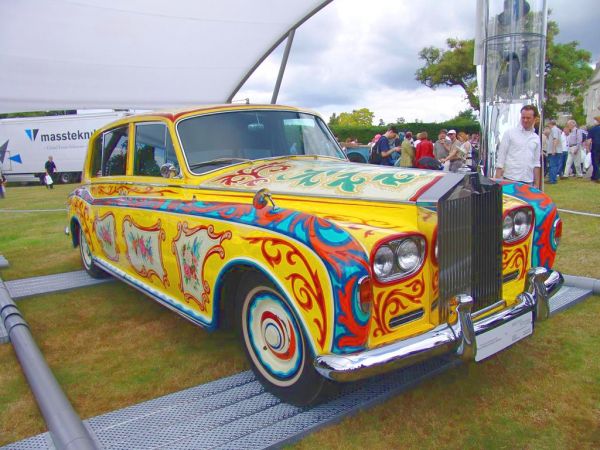
    Today in 1967, John Lennon took his Rolls–Royce to J.P. Fallon Ltd. in Surrey, England, to see if it could paint the car in psychedelic colors. The result three months later:

    The number one single today in 1973:

    (more…)

    Share this on …

    • Share on X (Opens in new window) X
    • Share on Facebook (Opens in new window) Facebook
    • Share on LinkedIn (Opens in new window) LinkedIn
    • Email a link to a friend (Opens in new window) Email
    • Print (Opens in new window) Print
    Like Loading…
    No comments on Presty the DJ for April 8
  • Whom and what to vote for today

    April 7, 2015
    Wisconsin politics

    Possibly lost in the hoopla (get it?) over the Badgers in the national men’s basketball championship game is the fact that Wisconsin’s spring election is today.

    Statewide, there are two votes — one for the Supreme Court and one about the Supreme Court. The former is Justice Ann Walsh Bradley’s attempt to succeed Shirley Abrahamson as the next chief justice. (Bradley has been on the court since 1995.)

    Normally Supreme Court races should attract little attention, except in our hyperpoliticized times, where the court system is just, to borrow von Clausewitz’s description of war, politics by other means. So when Bradley makes a statement like Act 10 being a “textbook case of unconstitutionality” when it obviously wasn’t, you should ask why she should be on the Supreme Court.

    Similarly, when Bradley is willing to let a convicted double murderer go free because of one word, you should question how tough on crime she is, particularly because of the recidivism rate of criminals.

    Tied to the Supremes is the referendum allowing justices to choose the chief justice, instead of giving the title to the longest serving justice. If you think about it, it demonstrates the perfect liberal mindset that reared its ugly head during Act 10 — that people should get things merely for showing up (i.e. getting the chief justice title by being on the court the longest) instead of having to earn it (majority vote of the court). That makes a Yes vote on the referendum obvious.

    Several school districts have referenda today for building projects or to allow spending beyond revenue caps. There is one referendum about creating a school district, in Caledonia, out of the Racine Unified School District. I don’t live there, but if I did I would certainly vote for the referendum. From what I read, Racine Unified has many of the problems of the worst school district in the state, Milwaukee Public Schools, many of which are the result of excessive size.

    Share this on …

    • Share on X (Opens in new window) X
    • Share on Facebook (Opens in new window) Facebook
    • Share on LinkedIn (Opens in new window) LinkedIn
    • Email a link to a friend (Opens in new window) Email
    • Print (Opens in new window) Print
    Like Loading…
    No comments on Whom and what to vote for today
  • Presty the DJ for April 7

    April 7, 2015
    Music

    Today in 1956, the CBS Radio Network premiered Alan Freed’s “Rock and Roll Dance Party.”

    The number one single today in 1958:

    Today in 1962, Mick Jagger and Keith Richards met someone who called himself Elmo Lewis. His real name was Brian Jones.

    (more…)

    Share this on …

    • Share on X (Opens in new window) X
    • Share on Facebook (Opens in new window) Facebook
    • Share on LinkedIn (Opens in new window) LinkedIn
    • Email a link to a friend (Opens in new window) Email
    • Print (Opens in new window) Print
    Like Loading…
    No comments on Presty the DJ for April 7
  • The postgame and pregame Badger blog

    April 6, 2015
    Badgers

    First, our national anthem, including Wisconsin’s Vitto Brown:

    Saturday’s NCAA national semifinal …

    … was to the Badgers what this was to the nation …

    … because while beating undefeated Kentucky was huge, it’s not the last game. Tonight is, against Duke.

    As you can see, the Badgers have been letting the attention get to them:

    The Sporting News recounts Sunday’s press conference:

    During media availability on Sunday afternoon at Lucas Oil Stadium, Nigel Hayes, Sam Dekker, Josh Gasser, Frank Kaminsky and Bronson Koenig sat on the stage constantly scanning the crowd of reporters below. Every minute or so, two of the players would lean back in their chairs, cover their mouths with a hand or part of their jerseys and giggle like schoolgirls.

    The entire 40-minute media session was punctuated with giggles from the players, Bo Ryan and the media, but perhaps no one moment was funnier than when sophomore forward Hayes responded to one of the only questions he was asked with this honesty:

    “I don’t really know how to answer questions. I just thought I was brought here to say some words and you might laugh,” he said with a megawatt grin. (His words to stump the stenographer on Sunday were “logorrhea” and “succedaneum,” in case you’re wondering.)

    Most coaches wouldn’t tolerate any funny business, but Ryan — who the players endearingly refer to as “Pops” — embraces his team’s looseness and camaraderie. He lets them goof around while he fields questions from the press and even joins in on occasion. For good reason too — Ryan couldn’t manufacture the team’s playful approach if he tried. And many coaches have.

    Back to the question at hand: what’s so funny?

    Turns out, each time the Badgers address the media, they’re playing a game. The game doesn’t have a name but the premise is simple. Each player scans the crowd searching for people who look like either famous people or someone who the players all know. When a player identifies a doppelgänger, he alerts his teammates and so begins a ripple of chortles across the stage.

    PHOTOS: Duke’s Final Four uniforms throughout the years

    “Vitto (Brown) started this lookalike game we do where we crowd-search to find someone who looks like someone we know or someone on our team, because Bronson (Koenig) and myself, we get asked over 101 questions per interview so we really just need to pass the time,” Hayes said with a touch of sarcasm.

    Dekker said the team found “Steve Aoki” and “Ray Lewis” twins in the horde on Sunday, and added that “every bald guy is automatically Jeff Potrykus.” Potrykus is the Badgers’ beat writer for the Milwaukee Journal-Sentinel, and Dekker said he’s aware of his legend status in the game.

    It’s hard to determine who exactly is the ringleader of the bunch. Koenig takes credit for being the self-described “funniest guy on the team” — an assessment Hayes agreed with, saying that he and Brown are “1A and 1B” when it comes to team jokester. Some may think it’s Hayes’ title for his well-documented trolling of the tournament stenographers, but Koenig says “(the team), we all think he’s corny.”

    And then there’s Frank Kaminsky.

    Kaminsky is the star of the show on the court, and off of it, too, due to his unabashed self-awareness. What you see is what you get with “Frank the Tank.”

    “He’s one to not be afraid to show his true emotions, true colors,” Dekker explained. “I think that’s what makes him such a good player. He’s learned to be himself and not care what people think about him. You see him dancing. You see him yelling. You see him giving attitude to the media because he acts like he hates it, like it’s the worst thing ever. But that’s truly how he is behind closed doors.

    “If he masks his personality, it’s going to change him as a player and as a person so I’m happy that he’s cool with being himself and not caring what the national perception of him is. I’m really proud of him for that.”

    If nothing else, the national perception of Kaminsky is that he’s captivating both in terms of skillset and wit. He cemented that status on Sunday afternoon when responding to a question about whether he considered himself “the man.”

    The Sporting News Player of the Year paused for a moment, looked over his right shoulder at Gasser, tilted his head and asked “am I?” There was a dramatic pause before he began his answer. Kaminsky was working the crowd for his shining moment.

    “I don’t know. I wasn’t prepared for a question of this magnitude,” he grinned. Another pause. “So do you want like an intellectual answer, or…?”

    Honesty. Humility. Humor. That’s what we’ll remember about these Badgers, no matter how this wild journey to the title ends. Let the mic drop.

    One media type called the Badgers possibly the most media-friendly college team of all time. Another suggested that Hayes did so well at news conferences that he might be hired as a college football coach.

    The Badgers will or will not win tonight (and that’s why you pay the big bucks for the brilliant insight found in this blog), but they won’t fall flat on their faces. Evan Flood explains why:

    After (1) Wisconsin (36-3) did the unthinkable and beat (1) Kentucky (38-1), ending the Wildcats’ perfect season, senior guard Josh Gasser quickly reminded the rest of his teammates that the win was just another step towards their ultimate goal — and nothing more.

    While the victory over Kentucky might have been the biggest in program history, the Badgers had no time to actually enjoy the moment.

    “We have another game, it’s not over,” Gasser said. “We have nothing to celebrate. It’s a huge accomplishment to make it to the National Championship, but that wasn’t our goal. We celebrated for a good five or six seconds, but we’ve got to move on.

    “It might have been the biggest win in school history and it will last for two days.”

    Here’s a list of the last 12 National Champions in College Basketball; UConn (3), Louisville, Kentucky, Duke, North Carolina (2), Kansas, Florida (2), Syracuse.

    Needless to say, Wisconsin doesn’t exactly fit in with the elite group of programs they’re trying to join in Monday’s National Championship Game versus (1) Duke (34-4). In fact, 18 of the last 19 national titles have gone to true blue blood programs, with only Maryland in 2002 able to force their way into the discussion of college basketball’s elite.

    (1) Wisconsin (36-3) will always be remembered as the team that beat Goliath and previously unbeaten (1) Kentucky (38-1). That will never be taken away from them.

    But that’s not what they’re here for.

    Seeking the program’s first national title since 1941, the Badgers find themselves one game away from forever etched in history as one of the great teams in college basketball.

    “All season we’ve had the idea of winning a national championship in our minds,” senior Duje Dukan said.

    Kentucky is Wisconsin’s Russia and Duke their Finland.

    Having knocked off the best team in college basketball, 71-64 in Saturday’s national semifinal, the team with nine McDonald’s All-Americans that many pegged unbeatable, the Badgers now have the task of coming down from certainly one of the more memorable victories in NCAA Tournament history.

    “After [the 1980 US hockey team] beat Russia, we had to beat Finland,” Wisconsin Women’s Hockey Coach and former Olympic Gold Medalist Mark Johnson told Bo Ryan.

    “Most people think that Russia was the gold medal game,” Ryan continued. “I think it was Finland, wasn’t it? I’ve been reminded on a few text messages that Finland is Duke, both really good teams.”

    If Wisconsin goes on to win the national championship, it will have been by way of the most difficult road possible and the toughest run since the tournament expanded to 68 teams.

    In the Sweet 16, the Badgers beat North Carolina 79-72 in the Sweet 16, their first-ever win over the Tar Heels in program history. Wisconsin then topped Arizona in the Elite Eight 85-78 for the second-consecutive season. Saturday’s win over Kentucky was the program’s second win against a No. 1 seed in the past two seasons and first over the Wildcats in over 30 years.

    In the third Associated Press Poll, each of Wisconsin’s last four opponents, which includes Duke, were ranked in the top six along with the Badgers.

    “To be able to beat North Carolina, Arizona, Kentucky and now have a chance at Duke, that is pretty remarkable for a school that is not considered a powerhouse,” Gasser said.

    Since Ryan’s arrival in 2001, Wisconsin has been the exception to the rule in college basketball.

    Winning without a high influx of elite high school recruits, the Badgers get things done and their own way. Beating a team with nine McDonald’s All-Americans in Kentucky, Wisconsin will have to do the same again with Duke, who also has nine McDonald’s All-Americans.

    Wisconsin has just one former five-star recruit and have had just two total in Ryan’s 14-year tenure.

    The Badgers do have something no team in the country has, however.

    “We have seven Wisconsin all-stars, and they (Duke) have none,” Gasser joked.

    But Wisconsin, especially Ryan, has never been concerned with the national perception of his program.

    “I don’t know about perception,” said Ryan. “I do know these guys have established themselves as being a pretty good group of young men that have come together.

    “Whatever this team accomplishes Monday night, one way or the other, it’s still who they are. They proudly have represented the University of Wisconsin, the Big Ten.

    “I’m never really concerned if there are people that perceive us a certain way because we are who we are. We play the way we play. We’re sure happy with it. So we can live with that.”

    While his players will play in their first-ever National Championship Game, this is not Ryan’s first rodeo. The 67-year-old won four national titles at Division 3 Wisconsin Platteville.

    While Ryan will underplay the national perception of his program, he won’t understate what a championship would mean to the state of Wisconsin, who has waited 74 years for another opportunity like the one they earned Monday night.

    “They (Badgers) know that they have a chance to make a mark in history,” he said. “They understand that. They’ve already done some of that. But when you’re an athlete and you’re competing, there’s unfinished business here.

    “It’s just like in ’91 when that Platteville won the national championship. The first thing I did is I looked at the crowd because I wanted to see how happy everybody else was, to see how happy the players were. This team affects a lot of people and their emotions.

    “For the state of Wisconsin, for them to get a national championship, yeah, I think that would have a lasting impression.”

    You might say.

    The Badgers are playing Duke, which beat Wisconsin early in the season. Wisconsin has changed a few things, and Duke probably has as well.

    There are a lot of Duke haters, for reasons I don’t get other than Duke’s perpetual success under coach Mike Krzyzewski, who got his 1,000th win earlier this season. Duke’s players play well (although they seemed nonchalant on defense the last time I watched them, but tell that to Michigan State), graduate, and are generally good representatives of their university.

    The difficult thing for both teams is that they had only Sunday to prepare, as opposed to having an entire week to get ready for the semifinal. So Wisconsin has had little time to prepare for Duke’s Jahlil Okafor, but Duke has had little time to prepare for Wisconsin’s Frank Kaminsky, winner of numerous national player-of-the-year awards, or Sam Dekker, both of whom present major matchup problems, as the teams that have lost to UW can attest.

    It should be a great game. On Wisconsin.


    Share this on …

    • Share on X (Opens in new window) X
    • Share on Facebook (Opens in new window) Facebook
    • Share on LinkedIn (Opens in new window) LinkedIn
    • Email a link to a friend (Opens in new window) Email
    • Print (Opens in new window) Print
    Like Loading…
    No comments on The postgame and pregame Badger blog
  • Presty the DJ for April 6

    April 6, 2015
    Music

    Today in 1956, Elvis Presley signed a seven-year contract with Paramount Studios.

    The movies won no Academy Awards, but sold a lot of tickets and a lot of records.

    The number one album today in 1968 was the soundtrack to “The Graduate”:

    (more…)

    Share this on …

    • Share on X (Opens in new window) X
    • Share on Facebook (Opens in new window) Facebook
    • Share on LinkedIn (Opens in new window) LinkedIn
    • Email a link to a friend (Opens in new window) Email
    • Print (Opens in new window) Print
    Like Loading…
    No comments on Presty the DJ for April 6
  • Presty the DJ for April 5

    April 5, 2015
    Music

    The number one album today in 1980 was Genesis’ “Duke”:

    Today in 1985, more than 5,000 radio stations played this at 3:50 p.m. Greenwich Mean Time, which is 9:50 a.m. Central time (but Standard or Daylight?):

    (more…)

    Share this on …

    • Share on X (Opens in new window) X
    • Share on Facebook (Opens in new window) Facebook
    • Share on LinkedIn (Opens in new window) LinkedIn
    • Email a link to a friend (Opens in new window) Email
    • Print (Opens in new window) Print
    Like Loading…
    No comments on Presty the DJ for April 5
  • Special Semifinal Saturday edition

    April 4, 2015
    Badgers

    Not since the days of Stu Jackson, Michael Finley and Rashard Griffith have Wisconsin basketball teams been known for their offense.

    Thanks, however, to defining offense and defense by ways other than the score, which reflects tempo almost as much as the ability to put the ball in the basket, the 2014-15 Badgers are believed by the stats types to be better on offense than defense.

    Tonight’s national semifinal is a battle of the number one defense, Kentucky, and the number one offense, Wisconsin, in terms of efficiency. Matt Norlander asks:

    So tell me: How can Kentucky beat Wisconsin?

    That’s no typo.

    How will Kentucky, 38-0 Kentucky, beat Wisconsin?

    Let’s get into this, because one of the big reasons this is among the most enticing and attractive Final Fours ever is this game — which has the elements for topping last weekend’s Kentucky-Notre Dame classic — and the diametric forces at work. UK-Wisconsin might end up among the best national semifinals in the history of the sport. It’s obvious why the Wildcats are the five-point favorites and rightfully being framed as presumed winners.

    But they’re not likely winners. There are arguments to be had on both sides here. This undefeated Wildcats defense is going to be remembered for its length, size, speed and skyline-high fortification. It’s without debate among the most impressive defensive units in the past decade, if not the best. Kentucky’s 85.6 adjusted defensive efficiency mark on KenPom.com ties 2013 Wisconsin’s crew, of all teams, for second-best ever. A John Calipari team, coincidentally enough, has the best per-possession defensive rating in the KenPom era (i.e. since 2002): Memphis in 2008-09 posted an 85.1 DRtg.

    “Having so many tall, athletic players, it definitely doesn’t make it easy,” Wisconsin’s Frank Kaminsky said. “At the same time we know that we’re going to be able to get some stuff just like they’re going to be able to get some stuff going on on offense. It’s going to be a battle, we know that. They have like seven guys over 6-10. … It’s going to be fun. I can’t wait. It’s not going to be easy to prepare because obviously there’s no scout team in the country that can replicate what they have on their team.”

    But for as superb as UK is on defense, it’s now facing Wisconsin, which boasts far and away the best offense in modern college basketball history. In a sentence: the Badgers are better with the ball than Kentucky is without it.

    “One of our biggest things in the Notre Dame game was giving up backdoors, easy baskets,” Cauley-Stein said. “They utilized that. They kind of pride themselves on, you know, exploiting people’s weakness and taking over from it. So that’s our biggest thing is not giving up easy baskets, not letting them play angles against us.”

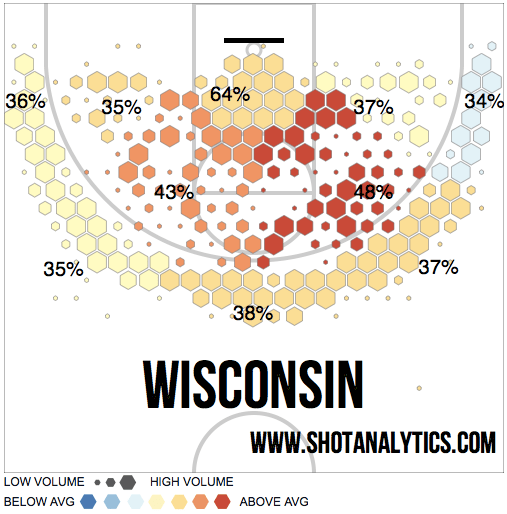
    If Notre Dame was a river for Kentucky to ford, Wisconsin is a white-capped rapid. The Badgers have an offensive rating of 127.5, meaning they are dousing foes at a blazing rate. UW’s scoring nearly 128 points per 100 possessions. Unheard of at the college level.

    Here’s how their shot chart looks. This is every basket attempted this season:

    That UW is flirting with 1.3 PPP on a per-game basis is flatly freaky. We should’ve expected a continuation from last season, when the Bucky O clocked out at 120.8, but it’s gotten ridiculous.

    And the team’s efficiency keeps rising.

    Since March began, Wisconsin’s offense has only gotten better — against better opponents in the biggest time of the season, mind you. …

    That Sconnie embarrassed Arizona’s elite defense to the point of jumping its overall O rating almost two full points in the Elite Eight has to be one of the most impressive achievements any team’s had in the NCAA Tournament — ever.

    While we don’t have data from prior teams/decades, it’s very possible no group has ever been this efficient on offense in the history of college hoops. It’s all the more likely when you consider the 3-point line didn’t come into play until the 1980s. This team has five guys averaging more than one 3-pointer made per game. …

    Kentucky’s defensive assignments are going to be fascinating. Will Cauley-Stein match up on Kaminsky, and if so, who does Karl-Anthony Towns guard? And Trey Lyles? Expect shifts by the possession.

    “I think with the guys that we have, we’re going to do a lot of switching anyway,” Cauley Stein said. “Not one person is going to be on that set player during the whole game. You know, everybody in practice has been guarding guards and bigs. We’re just kind of ready for everything.”

    Additionally, this year’s Final Four is so intriguing because it’s got the headliner of undefeated Kentucky and that wowing defense — then you see Wisconsin, Duke at 119.8 points per 100 possessions, which is third in the country, and Kentucky with a 115.6 O rating, fifth-best in the sport this season. And then you factor in how Wisconsin doesn’t slice at itself. The team’s foul-per-game rate is 12.4, the lowest in the country, and its turnover percentage sits at 12.3 percent of possessions. That’s also the lowest in the country. It’s done this against the eighth-toughest schedule nationally.

    Your offense gets much better the less you give the ball away. No one has mastered this like Wisconsin.

    Through this lens, it’s a little surprising we haven’t seen more people make a bigger deal out of what UK’s dealing with. Especially when you factor in that Kentucky and Wisconsin played each other in last year’s Final Four, and that game was a classic.

    Oh, right, and Frank Kaminsky is the Player of the Year.

    “How much better he’s gotten over a two-year period, it’s almost scary,” Calipari said.

    To ask or expect a rematch in the Final Four and for both teams to be putting up peerless numbers is a treat for fans and proof Calipari and Bo Ryan are all-time greats. It’s only fitting they’re both up for Naismith Hall of Fame nominations. (We’ll find out Monday morning if Calipari and/or Ryan earned enough votes for induction this year.)

    Kentucky’s the one with the undefeated record, but as Calipari’s repeated often this month, it’s not perfect. His guys faced their best opponent of the season last weekend in Cleveland and they barely won. Notre Dame more than likely wins that game if it scores just one basket in the final two and a half minutes.

    Wisconsin going two and a half minutes without a point would be Halley’s Comet-rare.

    The question isn’t: How is Wisconsin going to be Kentucky?

    The question is: How incredibly lucky are we to get a game of this caliber on the sport’s ultimate stage?

    James Pennington adds:

    So what does that mean when the No. 1 defense in the country and the second-best defense of any team since 2002 (Kentucky) plays against the best offense, by a wide margin, in college basketball since 2002 (Wisconsin)? Do we have a cliche to easily solve this? Is there any precedent at all for excellence at these levels in direct competition?

    That since 2002 was established because that’s when KenPom.com started tracking data in college basketball. Since then, the best offense in college basketball is this year’s Wisconsin team. The Badgers score 127.5 points per 100 possessions. The 2014 Michigan Wolverines (124.1) and 2005 Wake Forest Demon Deacons (124.0) are the only two teams to top 124 since 2002. This is a historic offense.

    Kentucky’s defense hasn’t let it down yet. The Wildcats remained undefeated in the regional final because their defense found just enough to slow down Notre Dame — the second-best offensive team in the country — despite the Irish’s near-perfect plan to pull off the upset. The Wildcats’ 85.6 points allowed per 100 possessions is the best in college basketball this year, and the only team better since 2002 was John Calipari’s 2009 Memphis team. This is a historic defense.

    The beauty of these two teams playing in the Final Four rather than the title game is that the two coaches will have been planning against each other for a full week in preparation for a direct battle between the nation’s best at each end of the floor. And both teams are great because of how well the coaches deploy their players.

    I hesitate to call either Wisconsin’s offense or Kentucky’s defense art, because the most common reaction to watching either at its best is along the lines of, How did they do that?, and the term artistry implies that technical execution is invisible. Moments of artistry-relative-to-basketball pop in and out between strict sessions of regimented offense (in Wisconsin’s case) and defense (in Kentucky’s case).

    For instance, the Wildcats: A defense as good as Kentucky’s has to be intensely structured. Calipari is a master of teaching defense on a short timetable. Whereas Jim Boeheim can allow a player to prosper for a few years and quietly master the intricacies of the 2-3 zone, Kentucky has four freshmen that each average at least 50 percent of Kentucky’s available team minutes.

    Still, Kentucky’s defense is characterized by its understanding of Calipari’s defense and commitment to execution, paired with immense size and athletic ability used creatively to react to lapses (or perhaps even to proactively take more risks). …

    Whereas Kentucky’s athleticism likely overshadows its defensive execution, Wisconsin is the other way around. The Badgers are clinicians. They perfectly mix patience and urgency, rarely taking shots too soon or not soon enough unless they are doing so with a specific end in mind. …

    Ryan’s offense is so efficient because of the open looks it creates, but Ryan also allows his players the freedom to use their athleticism and attack the basket at will. ..

    Both Dekker and Frank Kaminsky have such a handle on Ryan’s offense that reading ripples in opposing defenses and riffing off of them is a big part of why Wisconsin is so dangerous, and that both of them can move as well as they do enables Ryan to let them loose.

    Predicting which will prevail — Wisconsin’s offense or Kentucky’s defense — isn’t the point of the build-up to Saturday. No, the point is embracing the talent and unity of both teams. Neither would be in the Final Four and the best in the country at what they do if it weren’t for the right mixture of talent, unity, coaching and a hundred other factors I nor most readers would ever come up with on our own. One team will win Saturday because the rules of basketball demand it, and the other team, whether it’s Kentucky or Wisconsin, should be remembered for its excellence rather than falling short against the team designed perfectly to stop it.

    Well, my rule of postseason sports is that defense is more important than offense. And that’s why I am still picking Kentucky to win today. Sadly.

    Share this on …

    • Share on X (Opens in new window) X
    • Share on Facebook (Opens in new window) Facebook
    • Share on LinkedIn (Opens in new window) LinkedIn
    • Email a link to a friend (Opens in new window) Email
    • Print (Opens in new window) Print
    Like Loading…
    No comments on Special Semifinal Saturday edition
  • Bucky Badger’s history lesson

    April 4, 2015
    Badgers, History, media

    We begin this special national semifinal post with USA Today‘s attempt at race-baiting:

    When the Final Four is played Saturday in Indianapolis, all five starters for Kentucky, Duke and Michigan State will be African American. Wisconsin’s starting lineup, by contrast, includes one African American, forward Nigel Hayes. (Traevon Jackson, who also is African American, was a starter this season before he missed two months with a broken foot.)

    It’s a racial makeup that has been noticed, says Jordan Taylor, an African-American point guard who starred for the Badgers from 2008 to 2012. He plays for Hapoel Holon in the Israeli professional league and says he was needled by a teammate this week about Wisconsin’s chances against undefeated Kentucky.

    “He was just saying we’ve got too many white guys,” Taylor says with a chuckle. “I still get kind of poked at, teased about it, because it always seems like there are about four white guys and a black point guard all the time (in Wisconsin’s starting lineup).”

    Taylor and Kaminsky were among current and former players, former assistant coaches, authorities on the African-American experience at the University of Wisconsin and the state and others who spoke to USA TODAY Sports to answer: Why is the Badgers’ roster predominantly white?

    The average Division I men’s basketball team this season includes nine African-American players and four white players, according to data provided by the NCAA. At Wisconsin, the roster includes five African Americans, 10 whites and one Native American.

    “It’s an interesting question,” says Alando Tucker, an African American who was a forward for Wisconsin between 2002 and 2007 before playing three years in the NBA and later overseas. “It is surprising.”

    What has become familiar is the Badgers’ success under coach Bo Ryan, whose teams have made the NCAA tournament in each of his 14 seasons, reached the Sweet 16 seven times and are in Final Four for the second year in a row.

    “White, black, whatever,” says Jackson, a point guard for the Badgers. “We all worked hard, and Coach Ryan is a tough-nosed coach who gets the most out of you. We’re in back-to-back Final Fours, and we’re looking for more.”

    USA TODAY

    This year’s starting lineup is no aberration. When Wisconsin played Kentucky in the Final Four last year, it had one African American in the starting lineup. When the Badgers reached the Final Four under previous coach Dick Bennett in 2000 — in the school’s only other appearance since 1941 — it had one African-American starter.

    A number of factors contribute to Wisconsin’s predominantly white teams, including: state and university demographics; coaching at the lower levels; and Ryan’s system, which features a methodical, half-court offense that is key to his success but according to players and coaches can make it a challenge to recruit top African-American players.

    Ryan, through a Wisconsin spokesman, declined to comment.

    “I think the misconception is that Bo just likes to recruit the big, white kids,” says Howard Moore, who was an assistant coach under Ryan from 2005 to 2010, played at Wisconsin from 1990 to 1995 and is African American. “Those (assistant coaches at Wisconsin) have done a great job of recruiting to Bo’s system and staying true to what Bo believes in and going and getting the kids that believe in what they do. That’s the key.”

    THE SYSTEM

    Statistics from this season show the essence of Ryan’s system: The Badgers ranked second in Division I in assist-to-turnover ratio, 12th in scoring defense and 17th in field goal shooting percentage.

    For DeShawn Curtis, who offers private basketball lessons in the Milwaukee area and coaches on the AAU circuit, the numbers are further evidence that Ryan wants his recruits to have strong fundamentals. Curtis says that is not an emphasis on the AAU teams he has seen in the area, especially in the inner city of Milwaukee.

    “They don’t teach their kids how to play basketball,” says Curtis, who has worked with Diamond Stone, a Milwaukee product and one of the nation’s top high school seniors. “The majority of the programs, it’s about, ‘We’ve got better athletes than you.’”

    Top recruits — regardless of race — also tend to favor a uptempo style because they think it will help them get to the NBA, according to Curtis, other high school coaches and former Wisconsin players.

    Taylor, who was an all-Big Ten Conference point guard for Wisconsin, says, “I think the style of play we have doesn’t appeal to the premier athlete.”

    That’s what led Jerry Smith, a top-rated recruit from Milwaukee, to sign with Louisville in 2006, according to Smith’s high school coach, George Haas.

    “Louisville, their push is, ‘We get you ready for the pros,’” Haas says. “For a lot of those kids, that’s the most important thing.”

    Tucker, one of three players to be selected in the NBA draft during Ryan’s tenure at Wisconsin, says pro scouts complained about the Badgers’ style of play.

    “It’s just hard to watch one of those (low-scoring) games,” Tucker says. “No one really wants to see a 55-50 game. They want want to see 80, 90 points scored.”

    Yet Ryan’s style has helped elevate the program to among the elites, with the team being ranked in the Top 25 in 13 of his 14 seasons in Madison.

    Wisconsin-Milwaukee coach Rob Jeter, a former assistant to Ryan, says there is a misconception about the Badgers’ game that dates to the 2000 Final Four. That’s where Wisconsin and its slowdown offense orchestrated by Ryan’s predecessor, Dick Bennett, managed 41 points in a loss to Michigan State.

    Meanwhile, Ryan’s offense has opened up. This year the Badgers ranked fourth in scoring among the 14 teams in the Big Ten Conference at 72.4 points a game. And in its NCAA tournament victories, Wisconsin has averaged 80.5 points.

    THE DEMOGRAPHICS

    Numbers off the court might be contributing to the relative paucity of top African-American recruits at Wisconsin. African Americans represent 6.5% of Wisconsin’s population, about half the national percentage.

    By far the highest concentration of African Americans in the state — about 240,000, almost 70% of the state’s black residents — live in Milwaukee. The city’s four-year graduation rate for black students in public high schools is 58%, among the lowest graduation rates in the nation’s urban cities, according to the Wisconsin and federal departments of education.

    “We’ve got a lot of work to do on the ground level here as far as the quality of education and the coaches here preparing athletes before you get to high school,” Curtis says.

    The problem is exacerbated at Wisconsin because of the school’s high academic standards, according to Curtis and high school coaches. In January, when Gary Andersen quit as Wisconsin’s football coach to take the same position at Oregon State, he cited Wisconsin’s admissions standards as motivation.

    But even top African-American recruits from Wisconsin who are eligible out of high school elude Ryan. The latest disappointment was the loss of Stone, who had Wisconsin on his list of finalists but committed to Maryland, which has not made the Final Four since 2002.

    Kevon Looney, a five-star recruit from Milwaukee who signed with UCLA coming out of high school in 2013, told the Milwaukee Journal-Sentinel that the lure of Southern California, UCLA’s campus, Bruins coach Steve Alford and the team’s style of play led to his decision.

    J.P. Tokoto, a top-100 recruit who signed with North Carolina coming out of high school in 2012, said his decision came down to coaching style.

    THE UNIVERSITY

    The racial makeup of the student body at Wisconsin could be another underlying factor, says Ronald V. Myers Sr., founder of the University of Wisconsin’s African-American Alumni Association who remains active with the group.

    African Americans comprise about 2.2% of the student body at Wisconsin — 956 of 43,193 students, according to the university. That percentage ranks last with Nebraska among the schools in the Big Ten, according to the U.S. Department of Education.

    Myers, who was a Wisconsin undergrad and medical school student in the 1970s and ’80s, says the school’s history as an overwhelmingly white university means minority students “run into situations and circumstances where you face racism.”

    “You also have situations where people will come and support you and go to bat for you,” Myers says. “But as an alumni, you’re not really that quick to tell a young man, ‘Hey, you’re a star player from Milwaukee, I enthusiastically push you to sign up for basketball at Wisconsin.’”

    Craig Werner, chair of the school’s Afro-American studies program, says it has been difficult to attract African-American professors to his program. He notes he is one of the few white people in the country in charge of an Afro-American studies program.

    Before an influx of African-American female professors that began in the 1980s, Werner says the low number of white professors in the Afro-American studies program was as visible as the number of white basketball players.

    “Part of that is it was harder to recruit a first-rate black scholar to come to Madison,” he says. “They legitimately wanted to be somewhere where there is a large black professional class. It isn’t Madison.”

    Taylor says the racial makeup of Wisconsin’s roster created an eclectic environment. As a freshman in 2008, Taylor says, he and an African-American teammate who supported then-Sen. Barack Obama for president engaged in good-natured banter with two white players who preferred Sen. John McCain.

    “It was never anything that created dissension on our team, but we always had fun conversations,” he says. “Every Wisconsin team I played on from my freshman year to my senior year was like family.”

    Gannett, USA Today’s owner, also owns the Green Bay Press–Gazette, Appleton Post~Crescent, Oshkosh Northwestern, Fond du Lac Reporter, Sheboygan Press, Manitowoc Herald Times Reporter, Wausau Daily Herald, Stevens Point Journal, Wisconsin Rapids Daily Tribune and Marshfield News Herald. Given that all of those newspapers run pages from the previous day’s USA Today (which makes it, yes, two-day-old news), I wonder how many of those will have the guts to run this story.

    The C(r)apital Times did, but that’s no surprise, although it showed the (lack of) courage of its convictions by not allowing reader comments.

    IF the Badgers win tonight and IF they win Monday night, it will be their first NCAA men’s basketball title … since 1941 …

    … as noted by Kevin Kaduk:

    Ask any college basketball fan about the championship legacies of Duke, Kentucky and Michigan State and the odds are good they’ll be able to rattle off many of those title-winning squads.

    Ask any college basketball fan whether the fourth Final Four team — Wisconsin — has ever won an NCAA title and they’re likely to tell you the Badgers are still looking for their first crown.
    Those people would be wrong.
    Here’s an interesting piece of Final Four trivia you might be able to use to win some money this weekend:

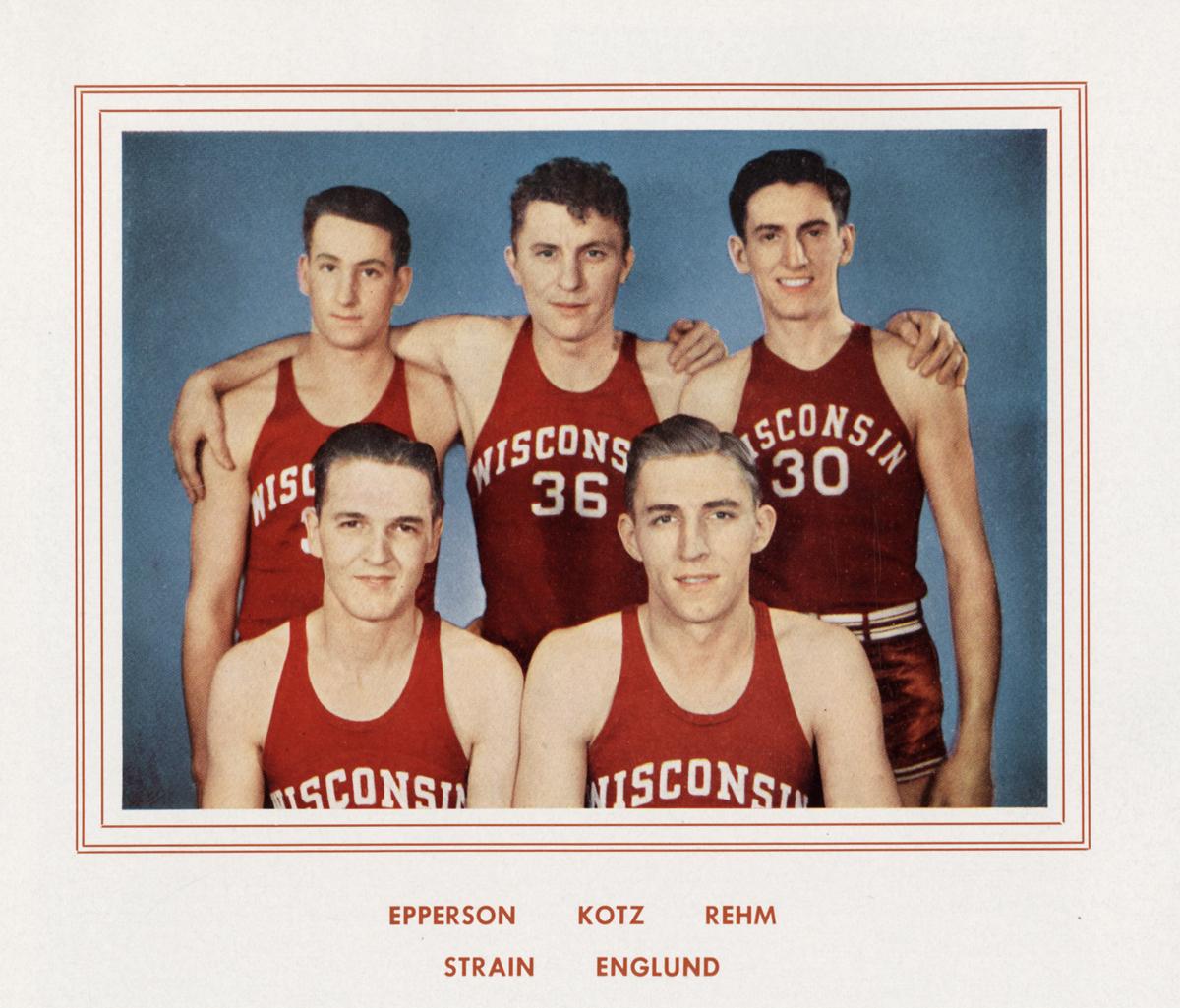
    Wisconsin actually won a NCAA title in 1941, the first of any of these four schools to do so. That’s seven years before Kentucky’s first of eight titles, 38 years before Magic Johnson led Michigan State to the first of two and 50 years before Mike Krzyzewski and Duke finally got on the board.

    The NCAA tournament was much different back in 1941, of course. Established only two years earlier, the tournament was only an eight-team affair and the terms “March Madness” and “Final Four” were still decades away. The United States’ entry into World War II, meanwhile, was just a few months off.

    That year’s Badgers were nowhere near as heralded as this year’s top-seeded squad. As researched by the Capital Times, they had gone 5-15 the previous season and their record stood at 5-3 after losing their Big Ten opener — a 44-27 road loss to Minnesota that saw Wisconsin held to zero field goals in the second half.

    Wisconsin, however, would not lose again, ripping off 12 straight wins under coach Harold “Bud” Foster to finish the regular season (including defending national champion Indiana) and enter an NCAA field consisting of Dartmouth, North Carolina, Pittsburgh, Arkansas, Creighton, Washington State and Wyoming.

    The UW Field House in 1941 (UW Library)


    After beating Dartmouth and Pittsburgh at the UW Field House in Madison (where tickets were priced at two levels — 50 and 75 cents), Wisconsin headed to Kansas City, Mo., to face Washington State at Municipal Auditorium. The Badgers were considered underdogs, just like this year’s team in Saturday night’s matchup against undefeated Kentucky.

    “Reading the newspapers, it was as though we were only going to Kansas City for the train ride,” said UW star Gene Englund, who later played for the OshKosh All-Stars in the National Basketball League before a refereeing career in the Big Ten and NBA. “That riled me up.”

    A column in the Kansas City Star the morning of the game was titled “Don’t Go Cougar-Hunting With a Badger” and Wisconsin apparently used it as bulletin-board material. The Badgers took home a 39-34 victory in front of 9,350 fans for the school’s first and only NCAA basketball title.

    Washington State uploaded footage of the game to YouTube three years ago. Needless to say, the action looks just a tad different from today’s game.

    https://www.youtube.com/watch?v=ZiYaEICAAqk

    The Badgers then celebrated while wearing some pretty sweet socks:
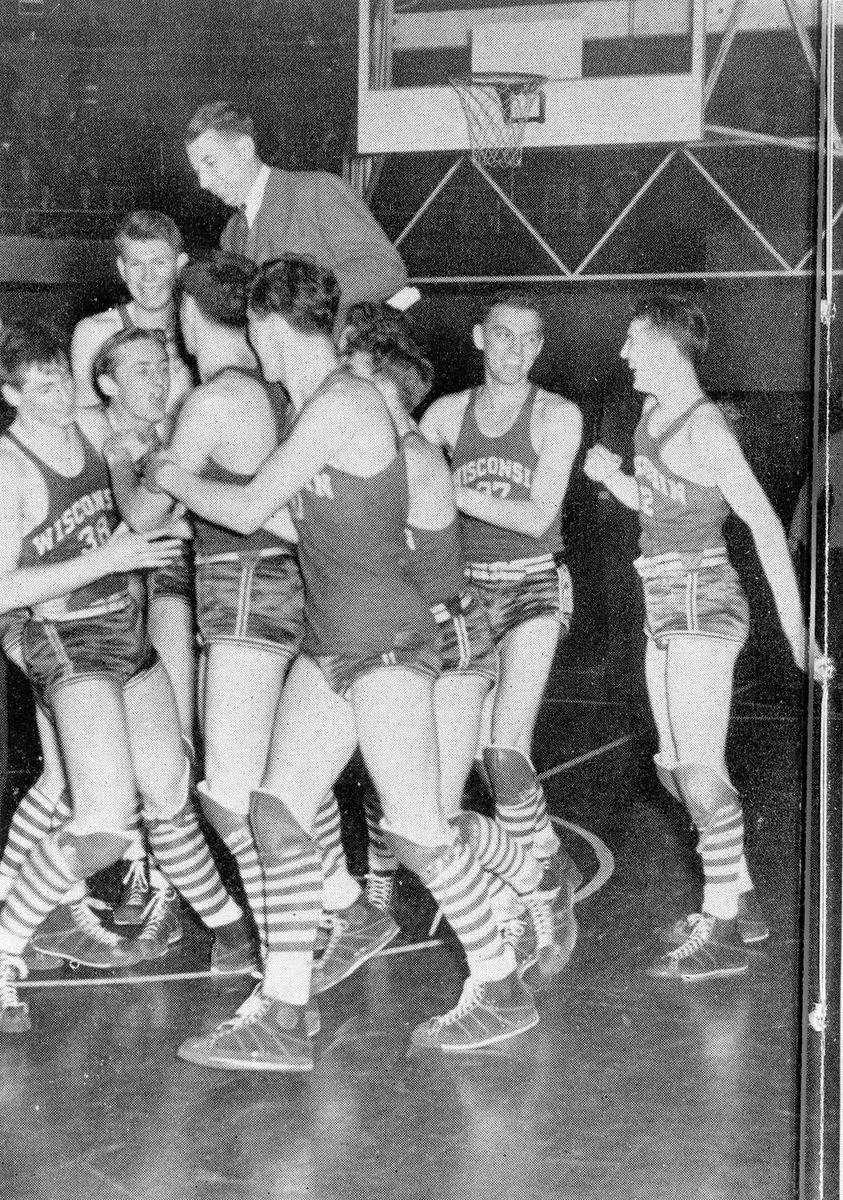
    After securing the title, the Wisconsin team returned to Madison where they were greeted at the train station at 1:20 in the morning by an estimated crowd of 10,000-12,000 people. “House mothers even suspended the rules and allowed female students to stay out for the event,” it was written.

    Not all stories have happy endings, however. According to the Cap Times, the players hopped “on a fire truck for a ride around the Capitol that was cut short when the engine caught fire.”

    Some footage of the 1941 champions (whose coach, Harold “Bud” Foster, I met back in 1986, when a Final Four berth seemed like a fantasy) can be seen here:

    More on today’s game later.
    Share this on …

    • Share on X (Opens in new window) X
    • Share on Facebook (Opens in new window) Facebook
    • Share on LinkedIn (Opens in new window) LinkedIn
    • Email a link to a friend (Opens in new window) Email
    • Print (Opens in new window) Print
    Like Loading…
    No comments on Bucky Badger’s history lesson
  • Presty the DJ for April 4

    April 4, 2015
    Music

    Today in 1960, RCA Victor Records announced it would release all singles in both mono and stereo.

    Today in 1964, the Beatles had 14 of the Billboard Top 100 singles, including the top five:

    (more…)

    Share this on …

    • Share on X (Opens in new window) X
    • Share on Facebook (Opens in new window) Facebook
    • Share on LinkedIn (Opens in new window) LinkedIn
    • Email a link to a friend (Opens in new window) Email
    • Print (Opens in new window) Print
    Like Loading…
    No comments on Presty the DJ for April 4
  • Why Wisconsin could win

    April 3, 2015
    Badgers

    Wisconsin is not favored to defeat Kentucky in the NCAA men’s basketball semifinal Saturday.

    Why might the Badgers win? It starts with coach Bo Ryan. Myron Medcalf explains:

    Freddie Owens didn’t trust Bo Ryan, who will lead Wisconsin to its second consecutive Final Four matchup against Kentucky later this week.

    Not at first.

    Ryan left UW-Milwaukee to coach Wisconsin in 2001. During his first practices with his new team, the basketball fundamentalist from Chester, Pennsylvania, instructed Owens, then a 6-foot-2 point guard for the Badgers, and Wisconsin’s other perimeter players to venture into the post for the first time in their careers.

    Um … OK, Coach?

    “I didn’t know what to think of him,” said Owens, most recently an assistant at Utah Valley University. “When he started teaching us how to post up, I thought he was crazy. I’m a point guard. I’d never posted up in my life. I’m used to coming off ball screens. And I’m in the post, and I’m working on Kevin McHale [drop-steps].”

    For more than 30 years, Ryan has espoused the same message from pulpits at UW-Platteville (Platteville, Wisconsin), UW-Milwaukee and Wisconsin. His Platteville guys will tell you the same thing that his UW-Milwaukee guys will tell you about him. And his Wisconsin guys will confirm it all.

    Ryan’s knack for developing blue-collar players such as Owens — a contrast from John Calipari’s grab-every-McDonald’s-All-American-in-sight, Minute-Rice approach — stems from his constant emphasis of the basics, his cerebral maneuvering that sprouts confidence and accountability in the locker room, and consistency.

    “He’s obviously got me much more disciplined as a player and as a person, realizing [that] the little things in life go a long way,” Sam Dekker said. “And if you wake up each morning with the mentality that you have to get better … you can do a lot in that 24-hour span to improve and build on your life. You know, if you wake up every day like that, you’re going to get a lot of things done.”

    By the end of his time at Wisconsin, Owens enjoyed the paint. He felt comfortable there, and he finally understood why Ryan taught his point guards post moves. And he benefited from an expanded skill set.

    Ryan is a purist who preaches efficiency and versatility at all positions. His practices commence with simple passing and catching drills. He demands proper ballhandling and ball rotation. Want to see Ryan spaz? Commit a turnover in practice or throw a pass from midair.

    He values stingy, hands-free defense. Sometimes, his players spend entire chunks of practice, without a basketball, shadowing one another like cornerbacks in man-to-man schemes. His father coached youth football, so Ryan has always had a jones for the gritty, gridiron types: tough, smart, relentless.

    That’s the kind of player that Ryan craves. Those are the athletes who want more for themselves than any coach could ever desire on their behalves. He convinces his players, the unheralded kids and the rare blue-chippers too, that if they fall short of their potential, they’re only failing themselves, not him.

    “I feel as though I got better as a college player, obviously, more so than in high school,” Owens said. “That’s the thing with him. You can look back during his whole time at Wisconsin. Every player that played under him left a better player, skill-wise and numbers. The main thing with him is he gets you to believe you’re capable of doing the things you want to do. He does the most to dig those goals out of you, to push you past those limits to get to the goals you have for yourself.”

    It’s unfair and inaccurate to suggest Ryan recruits only overlooked two- and three-star recruits. Devin Harris was Wisconsin’s Mr. Basketball, who committed to former coach Dick Bennett. But he blossomed into an NBA first-round draft pick under Ryan. Brian Butch was a McDonald’s All American selection. Jon Leuer was a top-100 prospect who now plays for the Memphis Grizzlies. Dekker, a five-star recruit, would have been on every powerhouse’s wish list had he not decided to commit to Wisconsin after his sophomore season in high school.

    On this season’s team, Nigel Hayes was a top-100 prospect before he arrived, and North Carolina‘s Roy Williams expressed his admiration for Bronson Koenig, whom he recruited in high school, during the buildup to last week’s Wisconsin-North Carolina meeting in the Sweet 16.

    But most of those athletes were local products who wanted to play for the Badgers and stay home. Ryan has built his legacy on the under-the-radar types who’ve developed into elite performers.

    Alando Tucker wasn’t a nationally coveted recruit, but he left Wisconsin as an All-American and NBA draftee. Jordan Taylor and Mike Bruesewitz led the Badgers to the Sweet 16 in 2012. Traevon Jackson was ranked 68th among shooting guards in the 2011 recruiting class per RecruitingNation. He was the starting point guard on last year’s Final Four squad.

    “Bo is going to get the most out of you,” said former Wisconsin guard (2005) Sharif Chambliss, now an assistant at UW-Milwaukee. “He’s not going to accept you taking breaks. He’s not going to accept you turning the ball over.”

    It started at Platteville.

    Ryan didn’t have the recruiting budget or the access to players he has now. He had to teach college courses at the non-scholarship, Division III school, too. With limited time, Ryan had to pack valuable information into his sessions. But he never force-fed those teams. They watched film. A lot of film. And they discussed and implemented Ryan’s strategies in morsels instead of mouthfuls.

    “Well, it was my first chance to be a college head coach, so I was putting together a system that I had in my mind of what I wanted to do, offensively, defensively, and then tweak it a little bit as I go along,” Ryan said. “It kept getting better because guys would buy in because they’re paying for their own education so they had to really want to be there.”

    It worked. In the 1984-85 season, Ryan’s first Platteville squad finished with a 9-17 record. Three years later, the Pioneers were 24-5 and conference champions. Platteville won the first of Ryan’s four Division III national championships in 1991.

    Rob Jeter, a captain on that 1991 squad, said Ryan’s concepts became religion to his teams. Proof? Whenever they played pickup ball together, they’d run the swing offense.

    “We just played the same way all the time,” said Jeter, head coach at UW-Milwaukee. “I think the biggest thing with Coach [Ryan], you always knew where you stood with him. There was no guessing. It was always clear.”

    Ryan’s strategic expertise has been an essential tool in his ability to help players reach their peaks, as are his psychological tactics.

    Chambliss led Penn State in scoring before he transferred to Wisconsin in 2003. Ryan often conveyed his expectations to Chambliss and his teammates via indirect criticism. If Chambliss and former Wisconsin star Kammron Taylor had botched a play, Ryan wouldn’t rip them. He’d warn the rest of the team.

    “He told somebody else, ‘If you all keep turning the ball over like [Taylor] and [Chambliss], you’re gonna be sitting on the sidelines,’” Chambliss recalled. “In a family culture like that, it definitely feels like you’re not pulling your weight. Everybody at Wisconsin, you’ve gotta pull your weight.” …

    “I’m a completely different person and player than I was four years ago, and I think a lot of that has to do with coach,” said Frank Kaminsky, the Wooden Award favorite and NBA prospect who averaged 1.8 points per game and 7.7 minutes per game as a freshman in 2011-12. “He knows how to get the best out of us, from the time we step on campus to the time we’re seniors. He really makes a commitment to us. It’s hard to put into words how much he actually does for us, because you start to realize in these times how much he has an effect on us, the way we say things, the way we do things on the court, how we interact with each other. It’s really just a true, great program.”

    The other reason is difficult-to-defend players, as Robert Mays points out:

    As Sam Dekker’s impossible 3 fell from the height of the shot clock through the bottom of the net, Rondae Hollis-Jefferson’s shoulders dropped. It was Dekker’s fifth — and the Badgers’ 10th — 3-pointer of the half, and with the lead now at eight, it was the final dagger in Wisconsin’s West Regional Final win over Arizona. After the shot went down, Badgers senior Josh Gasser turned to announcer Reggie Miller for some affirmation.

    “I said, ‘Sam’s got stones like you,’” Gasser said.

    “Kidney stones,” coach Bo Ryan interjected, trying to keep things family-friendly.

    “Kidney stones, yeah,” Gasser said. “I don’t know. He laughed. He agreed with me. He gave me a good head nod.”

    All tournament — from Frank Kaminsky hitting SportsCenter in capri sweatpants to Nigel Hayes’s stenography fascination — it’s been obvious that no one has been having more fun than Wisconsin. Saturday was proof. This was a team that’s done it before and knew what it would take to do it again. This team can turn it up, and this time, it turned it way up.

    “That was cold-blooded,” Ryan said about Dekker’s dagger. “I can tell you that.” He was talking about one shot, but he could have been talking about nine others. No matter how Arizona tried to defend Dekker and Wisconsin in the second half Saturday, the ball was going in. “I think they had two 3s at the half,” Arizona coach Sean Miller said after the game. “Think about that. Two made 3s at the half, and they had eight in the second half.” When the moderator corrected him, it still seemed hard for Miller for believe.

    Wisconsin’s offensive display — 55.6 percent from the field, a scorching 12-of-18 from 3 — would be a sight against any team this deep in the tournament, but putting on that sort of show against Arizona made it all the more remarkable. The Wildcats were among the best defensive teams in the entire country, led by a pair of excellent wing defenders and defined by constant, stifling ball pressure. In the first half, Wisconsin was scraping for buckets on just about every possession. Kaminsky, as he had so many times before, was getting his against Arizona’s defense, but the rest of the Badgers went into halftime with only 17 of Wisconsin’s 30 points.

    Despite finishing with a career-high 27 points, Dekker was quiet for most of the opening 20 minutes. His seven first-half points came in unspectacular ways — an easy lob inside, a trip to the line, a lucky putback off a bad Kaminsky miss. It wasn’t the slashing, rim-attacking version who had a career-high 23 against North Carolina two days earlier. Twice after the game, Dekker brought up the challenge of finding lanes against Hollis-Jefferson and Stanley Johnson. And with Johnson on him for much of the first half, Dekker rarely looked to put the ball on the floor.

    What he did instead was put the final touches on his most complete weekend as a college player. Offensively, Dekker’s biggest limitation, both this year and last, has been his ability as a 3-point shooter. After hitting less than 33 percent from behind the arc as a sophomore, he checked in at 33.8 percent this season. His 5-of-6 showing on Saturday was comfortably the best 3-point performance of his college career. And when that shot is falling, it turns Dekker into a serious problem for any defense.

    The game he had against North Carolina saw Dekker taking anyone he pleased off the dribble. “[I] try to be an attack-first guy,” Dekker said Saturday. “I have the ability to use my athleticism. Sometimes I don’t use it the way I should, and when I’m in tune with that and doing it and using it to my advantage, it makes the game come a lot more smoothly and naturally.” At times against the Tar Heels, he looked like a 6-foot-9 running back, tucking the ball away as he barreled toward the rim. That’s a trick typically reserved for guys built like Derrick Rose, not small forwards with a wingspan pushing seven feet.

    Even with his ability to put the ball on the floor and finish, the best part of Dekker’s game is what he does without the ball in his hands. He’s a fantastic cutter, always moving and seeking out easy buckets. It’s the exact sort of trait that makes him so valuable to his team. At the same time, Dekker knows why a lot of those cuts are open to him. “It also helps to have this guy next to me getting a lot of attention,” Dekker said, nodding Kaminsky’s way.

    Dekker was named the most outstanding player of the West regional, but for the second straight year, Frank the Tank burned Arizona’s season down. Sean Miller’s team had no answer. Three Wildcats tried their hands at guarding Kaminsky; none of them had much luck. Typically, a player with talents as varied as Kaminsky’s tries to find the perfect tool to take advantage of what a particular defender lacks. With his ability to handle the ball, opposing big men have little chance stopping him off the dribble. And with his ability on the block, smaller, quicker players just don’t have a chance down low. It’s gotten so Kaminsky doesn’t even think like that anymore. “I don’t really care who is guarding me at this point,” he said afterward.

    Concerns about whom he can guard — Kaleb Tarczewski had his way a couple of times on the block, and for all of Kaminsky’s strengths, quickness is not one of them — will persist as people ponder Kaminsky’s NBA future. But his sheer level of skill is remarkable. And it goes beyond being able to step out and shoot. At this point, he can do it all, against anyone. His game defines Wisconsin’s offense because of how he breaks defenses — even the best ones. Now, he and the Badgers will get a shot at the best defense anyone has seen in a long, long time.

    Kentucky is one of the only teams in the country better than Arizona on that end of the floor, and the difference between the Wildcats in blue and the ones in red is that Kentucky may have the array of big bodies to slow Kaminsky down.

    If they can, that’s where Wisconsin’s peaking new star may come in handy. A team that went to the Final Four a year ago and scored better than anyone in America did it without Dekker hitting the level he’s reached this week. That’s a frightening thought, and sadly for Sean Miller, one he had to experience firsthand. “When Sam Dekker does what he did — and I think some of the shots were very well defended — when he does that with Kaminsky, maybe Kentucky is that school that can beat them,” Miller said. “But I’m telling you, I don’t know if there is another one out there when they’re clicking with that one-two punch.”

    I assume Kentucky will win Saturday night. It is interesting, though, that ESPN.com‘s survey of NCAA coaches and assistant coaches predicted a Badger win.

    Share this on …

    • Share on X (Opens in new window) X
    • Share on Facebook (Opens in new window) Facebook
    • Share on LinkedIn (Opens in new window) LinkedIn
    • Email a link to a friend (Opens in new window) Email
    • Print (Opens in new window) Print
    Like Loading…
    No comments on Why Wisconsin could win
Previous Page
1 … 717 718 719 720 721 … 1,038
Next Page

Website Powered by WordPress.com.

Steve Prestegard.com: The Presteblog

The thoughts of a journalist/libertarian–conservative/Christian husband, father, Eagle Scout and aficionado of obscure rock music. Thoughts herein are only the author’s and not necessarily the opinions of his family, friends, neighbors, church members or past, present or future employers.

  • Steve
    • About, or, Who is this man?
    • Facebook
    • Twitter
    • Adventures in ruralu0026nbsp;inkBack in June 2009, I was driving somewhere through a rural area. And for some reason, I had a flashback to two experiences in my career about that time of year many years ago. In 1988, eight days after graduating from the University of Wisconsin, I started work at the Grant County Herald Independent in Lancaster as a — well, the — reporter. Four years after that, on my 27th birthday, I purchased, with a business partner, the Tri-County Press in Cuba City, my first business venture. Both were experiences about which Wisconsin author Michael Perry might write. I thought about all this after reading a novel, The Deadline, written by a former newspaper editor and publisher. (Now who would write a novel about a weekly newspaper?) As a former newspaper owner, I picked at some of it — why finance a newspaper purchase through the bank if the seller is willing to finance it? Because the mean bank lender is a plot point! — and it is much more interesting than reality, but it is very well written, with a nicely twisting plot, and quite entertaining, again more so than reality. There is something about that first job out of college that makes you remember it perhaps more…
    • Adventures in radioI’ve been in the full-time work world half my life. For that same amount of time I’ve been broadcasting sports as a side interest, something I had wanted to since I started listening to games on radio and watching on TV, and then actually attending games. If you ask someone who’s worked in radio for some time about the late ’70s TV series “WKRP in Cincinnati,” most of them will tell you that, if anything, the series understated how wacky working in radio can be. Perhaps the funniest episode in the history of TV is the “WKRP” episode, based on a true story, about the fictional radio station’s Thanksgiving promotion — throwing live turkeys out of a helicopter under the mistaken belief that, in the words of WKRP owner Arthur Carlson, “As God is my witness, I thought turkeys could fly.” [youtube=http://www.youtube.com/watch?v=ST01bZJPuE0] I’ve never been involved in anything like that. I have announced games from the roofs of press boxes (once on a nice day, and once in 50-mph winds), from a Mississippi River bluff (more on that later), and from the front row of the second balcony of the University of Wisconsin Fieldhouse (great view, but not a place to go if…
    • “Good morning/afternoon/evening, ________ fans …”
    • My biggest storyEarlier this week, while looking for something else, I came upon some of my own work. (I’m going to write a blog someday called “Things I Found While Looking for Something Else.” This is not that blog.) The Grant County Sheriff’s Department, in the county where I used to live, has a tribute page to the two officers in county history who died in the line of duty. One is William Loud, a deputy marshal in Cassville, shot to death by two bank robbers in 1912. The other is Tom Reuter, a Grant County deputy sheriff who was shot to death at the end of his 4 p.m.-to-midnight shift March 18, 1990. Gregory Coulthard, then a 19-year-old farmhand, was convicted of first-degree intentional homicide and is serving a life sentence, with his first eligibility for parole on March 18, 2015, just 3½ years from now. I’ve written a lot over the years. I think this, from my first two years in the full-time journalism world, will go down as the story I remember the most. For journalists, big stories contain a paradox, which was pointed out in CBS-TV’s interview of Andy Rooney on his last “60 Minutes” Sunday. Morley Safer said something along the line…
  • Food and drink
    • The Roesch/Prestegard familyu0026nbsp;cookbookFrom the family cookbook(s) All the families I’m associated with love to eat, so it’s a good thing we enjoy cooking. The first out-of-my-house food memory I have is of my grandmother’s cooking for Christmas or other family occasions. According to my mother, my grandmother had a baked beans recipe that she would make for my mother. Unfortunately, the recipe seems to have  disappeared. Also unfortunately, my early days as a picky, though voluminous, eater meant I missed a lot of those recipes made from such wholesome ingredients as lard and meat fat. I particularly remember a couple of meals that involve my family. The day of Super Bowl XXXI, my parents, my brother, my aunt and uncle and a group of their friends got together to share lots of food and cheer on the Packers to their first NFL title in 29 years. (After which Jannan and I drove to Lambeau Field in the snow,  but that’s another story.) Then, on Dec. 31, 1999, my parents, my brother, my aunt and uncle and Jannan and I (along with Michael in utero) had a one-course-per-hour meal to appropriately end years beginning with the number 1. Unfortunately I can’t remember what we…
    • SkålI was the editor of Marketplace Magazine for 10 years. If I had to point to one thing that demonstrates improved quality of life since I came to Northeast Wisconsin in 1994, it would be … … the growth of breweries and  wineries in Northeast Wisconsin. The former of those two facts makes sense, given our heritage as a brewing state. The latter is less self-evident, since no one thinks of Wisconsin as having a good grape-growing climate. Some snobs claim that apple or cherry wines aren’t really wines at all. But one of the great facets of free enterprise is the opportunity to make your own choice of what food and drink to drink. (At least for now, though some wish to restrict our food and drink choices.) Wisconsin’s historically predominant ethnic group (and our family’s) is German. Our German ancestors did unfortunately bring large government and high taxes with them, but they also brought beer. Europeans brought wine with them, since they came from countries with poor-quality drinking water. Within 50 years of a wave of mid-19th-century German immigration, brewing had become the fifth largest industry in the U.S., according to Maureen Ogle, author of Ambitious Brew: The Story of American Beer. Beer and wine have…
  • Wheels
    • America’s sports carMy birthday in June dawned without a Chevrolet Corvette in front of my house. (The Corvette at the top of the page was featured at the 2007 Greater Milwaukee Auto Show. The copilot is my oldest son, Michael.) Which isn’t surprising. I have three young children, and I have a house with a one-car garage. (Then again, this would be more practical, though a blatant pluck-your-eyes-out violation of the Corvette ethos. Of course, so was this.) The reality is that I’m likely to be able to own a Corvette only if I get a visit from the Corvette Fairy, whose office is next door to the Easter Bunny. (I hope this isn’t foreshadowing: When I interviewed Dave Richter of Valley Corvette for a car enthusiast story in the late great Marketplace Magazine, he said that the most popular Corvette in most fans’ minds was a Corvette built during their days in high school. This would be a problem for me in that I graduated from high school in 1983, when no Corvette was built.) The Corvette is one of those cars whose existence may be difficult to understand within General Motors Corp. The Corvette is what is known as a “halo car,” a car that drives people into showrooms, even if…
    • Barges on fouru0026nbsp;wheelsI originally wrote this in September 2008.  At the Fox Cities Business Expo Tuesday, a Smart car was displayed at the United Way Fox Cities booth. I reported that I once owned a car into which trunk, I believe, the Smart could be placed, with the trunk lid shut. This is said car — a 1975 Chevrolet Caprice coupe (ours was dark red), whose doors are, I believe, longer than the entire Smart. The Caprice, built down Interstate 90 from us Madisonians in Janesville (a neighbor of ours who worked at the plant probably helped put it together) was the flagship of Chevy’s full-size fleet (which included the stripper Bel Air and middle-of-the-road Impala), featuring popular-for-the-time vinyl roofs, better sound insulation, an upgraded cloth interior, rear fender skirts and fancy Caprice badges. The Caprice was 18 feet 1 inch long and weighed 4,300 pounds. For comparison: The midsize Chevrolet of the ear was the Malibu, which was the same approximate size as the Caprice after its 1977 downsizing. The compact Chevrolet of the era was the Nova, which was 200 inches long — four inches longer than a current Cadillac STS. Wikipedia’s entry on the Caprice has this amusing sentence: “As fuel economy became a bigger priority among Americans…
    • Behind the wheel
    • Collecting only dust or rust
    • Coooooooooooupe!
    • Corvettes on the screen
    • The garage of misfit cars
    • 100 years (and one day) of our Chevrolets
    • They built Excitement, sort of, once in a while
    • A wagon by any otheru0026nbsp;nameFirst written in 2008. You will see more don’t-call-them-station-wagons as you drive today. Readers around my age have probably had some experience with a vehicle increasingly rare on the road — the station wagon. If you were a Boy Scout or Girl Scout, or were a member of some kind of youth athletic team, or had a large dog, or had relatives approximately your age, or had friends who needed to be transported somewhere, or had parents who occasionally had to haul (either in the back or in a trailer) more than what could be fit inside a car trunk, you (or, actually, your parents) were the target demographic for the station wagon. “Station wagons came to be like covered wagons — so much family activity happened in those cars,” said Tim Cleary, president of the American Station Wagon Owners Association, in Country Living magazine. Wagons “were used for everything from daily runs to the grocery store to long summer driving trips, and while many men and women might have wanted a fancier or sportier car, a station wagon was something they knew they needed for the family.” The “station wagon” originally was a vehicle with a covered seating area to take people between train stations…
    • Wheels on theu0026nbsp;screenBetween my former and current blogs, I wrote a lot about automobiles and TV and movies. Think of this post as killing two birds (Thunderbirds? Firebirds? Skylarks?) with one stone. Most movies and TV series view cars the same way most people view cars — as A-to-B transportation. (That’s not counting the movies or series where the car is the plot, like the haunted “Christine” or “Knight Rider” or the “Back to the Future” movies.) The philosophy here, of course, is that cars are not merely A-to-B transportation. Which disqualifies most police shows from what you’re about to read, even though I’ve watched more police video than anything else, because police cars are plain Jane vehicles. The highlight in a sense is in the beginning: The car chase in my favorite movie, “Bullitt,” featuring Steve McQueen’s 1968 Ford Mustang against the bad guys’ 1968 Dodge Charger: [youtube=http://www.youtube.com/watch?v=GMc2RdFuOxIu0026amp;fmt=18] One year before that (but I didn’t see this until we got Telemundo on cable a couple of years ago) was a movie called “Operación 67,” featuring (I kid you not) a masked professional wrestler, his unmasked sidekick, and some sort of secret agent plot. (Since I don’t know Spanish and it’s not…
    • While riding in my Cadillac …
  • Entertainments
    • Brass rocksThose who read my former blog last year at this time, or have read this blog over the past months, know that I am a big fan of the rock group Chicago. (Back when they were a rock group and not a singer of sappy ballads, that is.) Since rock music began from elements of country music, jazz and the blues, brass rock would seem a natural subgenre of rock music. A lot of ’50s musical acts had saxophone players, and some played with full orchestras … [youtube=http://www.youtube.com/watch?v=9CPS-WuUKUE] … but it wasn’t until the more-or-less simultaneous appearances of Chicago and Blood Sweat u0026amp; Tears on the musical scene (both groups formed in 1967, both had their first charting singles in 1969, and they had the same producer) that the usual guitar/bass/keyboard/drum grouping was augmented by one or more trumpets, a sax player and a trombone player. While Chicago is my favorite group (but you knew that already), the first brass rock song I remember hearing was BSu0026amp;T’s “Spinning Wheel” — not in its original form, but on “Sesame Street,” accompanied by, yes, a giant spinning wheel. [youtube=http://www.youtube.com/watch?v=qi9sLkyhhlE] [youtube=http://www.youtube.com/watch?v=OxWSOuNsN20] [youtube=http://www.youtube.com/watch?v=U9U34uPjz-g] I remember liking Chicago’s “Just You ‘n Me” when it was released as a single, and…
    • Drive and Eat au0026nbsp;RockThe first UW home football game of each season also is the opener for the University of Wisconsin Marching Band, the world’s finest college marching band. (How the UW Band has not gotten the Sudler Trophy, which is to honor the country’s premier college marching bands, is beyond my comprehension.) I know this because I am an alumnus of the UW Band. I played five years (in the last rank of the band, Rank 25, motto: “Where Men Are Tall and Run-On Is Short”), marching in 39 football games at Camp Randall Stadium, the Hubert H. Humphrey Metrodome in Minneapolis, Michigan Stadium in Ann Arbor, Memorial Stadium at the University of Illinois (worst artificial turf I had ever seen), the University of Nevada–Las Vegas’ Sam Boyd Silver Bowl, the former Dyche Stadium at Northwestern University, five high school fields and, in my one bowl game, Legion Field in Birmingham, Ala., site of the 1984 Hall of Fame Bowl. The UW Band was, without question, the most memorable experience of my college days, and one of the most meaningful experiences of my lifetime. It was the most physical experience of my lifetime, to be sure. Fifteen minutes into my first Registration…
    • Keep on rockin’ in the freeu0026nbsp;worldOne of my first ambitions in communications was to be a radio disc jockey, and to possibly reach the level of the greats I used to listen to from WLS radio in Chicago, which used to be one of the great 50,000-watt AM rock stations of the country, back when they still existed. (Those who are aficionados of that time in music and radio history enjoyed a trip to that wayback machine when WLS a Memorial Day Big 89 Rewind, excerpts of which can be found on their Web site.) My vision was to be WLS’ afternoon DJ, playing the best in rock music between 2 and 6, which meant I wouldn’t have to get up before the crack of dawn to do the morning show, yet have my nights free to do whatever glamorous things big-city DJs did. Then I learned about the realities of radio — low pay, long hours, zero job security — and though I have dabbled in radio sports, I’ve pretty much cured myself of the idea of working in radio, even if, to quote WAPL’s Len Nelson, “You come to work every day just like everybody else does, but we’re playing rock ’n’ roll songs, we’re cuttin’ up.…
    • Monday on the flight line, not Saturday in the park
    • Music to drive by
    • The rock ofu0026nbsp;WisconsinWikipedia begins its item “Music of Wisconsin” thusly: Wisconsin was settled largely by European immigrants in the late 19th century. This immigration led to the popularization of galops, schottisches, waltzes, and, especially, polkas. [youtube=http://www.youtube.com/watch?v=yl7wCczgNUc] So when I first sought to write a blog piece about rock musicians from Wisconsin, that seemed like a forlorn venture. Turned out it wasn’t, because when I first wrote about rock musicians from Wisconsin, so many of them that I hadn’t mentioned came up in the first few days that I had to write a second blog entry fixing the omissions of the first. This list is about rock music, so it will not include, for instance, Milwaukee native and Ripon College graduate Al Jarreau, who in addition to having recorded a boatload of music for the jazz and adult contemporary/easy listening fan, also recorded the theme music for the ’80s TV series “Moonlighting.” Nor will it include Milwaukee native Eric Benet, who was for a while known more for his former wife, Halle Berry, than for his music, which includes four number one singles on the Ru0026amp;B charts, “Spend My Life with You” with Tamia, “Hurricane,” “Pretty Baby” and “You’re the Only One.” Nor will it include Wisconsin’s sizable contributions to big…
    • Steve TV: All Steve, All the Time
    • “Super Steve, Man of Action!”
    • Too much TV
    • The worst music of allu0026nbsp;timeThe rock group Jefferson Airplane titled its first greatest-hits compilation “The Worst of Jefferson Airplane.” Rolling Stone magazine was not being ironic when it polled its readers to decide the 10 worst songs of the 1990s. I’m not sure I agree with all of Rolling Stone’s list, but that shouldn’t be surprising; such lists are meant for debate, after all. To determine the “worst,” songs appropriate for the “Vinyl from Hell” segment that used to be on a Madison FM rock station, requires some criteria, which does not include mere overexposure (for instance, “Macarena,” the video of which I find amusing since it looks like two bankers are singing it). Before we go on: Blog posts like this one require multimedia, so if you find a song you hate on this blog, I apologize. These are also songs that I almost never listen to because my sound system has a zero-tolerance policy — if I’m listening to the radio or a CD and I hear a song I don’t like, it’s, to quote Bad Company, gone gone gone. My blonde wife won’t be happy to read that one of her favorite ’90s songs, 4 Non Blondes’ “What’s Up,” starts the list. (However,…
    • “You have the right to remain silent …”
  • Madison
    • Blasts from the Madison media past
    • Blasts from my Madison past
    • Blasts from our Madison past
    • What’s the matter with Madison?
    • Wisconsin – Madison = ?
  • Sports
    • Athletic aesthetics, or “cardinal” vs. “Big Red”
    • Choose your own announcer
    • La Follette state 1982 (u0022It was 30 years ago todayu0022)
    • The North Dakota–Wisconsin Hockey Fight of 1982
    • Packers vs. Brewers
  • Hall of Fame
    • The case(s) against teacher unions
    • The Class of 1983
    • A hairy subject, or face the face
    • It’s worse than you think
    • It’s worse than you think, 2010–11 edition
    • My favorite interview subject of all time
    • Oh look! Rural people!
    • Prestegard for president!
    • Unions vs. the facts, or Hiding in plain sight
    • When rhetoric goes too far
Privacy & Cookies: This site uses cookies. By continuing to use this website, you agree to their use.
To find out more, including how to control cookies, see here: Cookie Policy
  • Subscribe Subscribed
    • Steve Prestegard.com: The Presteblog
    • Join 197 other subscribers
    • Already have a WordPress.com account? Log in now.
    • Steve Prestegard.com: The Presteblog
    • Subscribe Subscribed
    • Sign up
    • Log in
    • Report this content
    • View site in Reader
    • Manage subscriptions
    • Collapse this bar
%d