Bucky’s Fifth Quarter reports:
Wisconsin fans will get their first opportunity to preview and purchase Badgers Under Armour merchandise on June 30 when UW hosts “Night of the New Red Threads,” it announced Monday.
Athletics director Barry Alvarez, football coach Paul Chryst, men’s basketball coach Greg Gard and men’s hockey coach Tony Granato—among other notable people in the program, the Badgers say—will be on hand at the event, which begins at 10 p.m. at Camp Randall Stadium. In addition to seeing and having the chance to purchase Wisconsin’s new Under Armour gear, fans will also get “exclusive access” to UW’s training facility.
Wisconsin and Under Armour announced a 10-year partnership in October, replacing UW’s previous 15-year deal with Adidas. The new deal begins July 1 at midnight.
“We’re thrilled to partner with an energetic, hardworking brand whose story mirrors our own,” Alvarez said at the press conference to announce the deal on Oct. 9. “I’ve followed the Under Armour story for many years. I’ve been impressed with their creativity, technological advances and their presence of mind in the market.”
At that Oct. 9 announcement event, the Badgers unveiled a number of prototypes of Wisconsin on-field apparel designed by Under Armour. While the official designs remain unknown, they provided a glimpse into what Badgers fans might be able to expect.
/cdn0.vox-cdn.com/uploads/chorus_image/image/49845479/image.0.0.jpeg)
Or not, given the likelihood of pre-unveiling subterfuge to hype the new supplier, not to mention how often prototypes don’t become the finished product. (Research the number of Corvette prototypes over the years, including those with engines mounted between the seats and rear axle, and with gullwing doors.) One could conclude the basketball uniforms are warmups and not game uniforms given how the uniforms looked under former coach Bo Ryan.


I am amused, given Ryan’s reputation as a coach for whom you will play exactly his way or not play at all, that either he didn’t care about his team’s on-floor look (although he did interrupt a timeout once to tell a player to get a haircut), or that he appreciated uniform variety so much that his teams changed their look every season (if you count the postseason).
The football uniform depicted here looks hardly different from the current design (which itself changed little when UW went to Adidas). The only detail I can tell is the smaller numbers possibly moving from the shoulder blade closer to the neck, so-called “TV numbers.” If this is the new design, it also does not incorporate the Badger number font (which looks suspiciously like Aachen) found on the basketball jerseys.


The number one question for those concerned about sports uniform aesthetics is whether the new Badger look will use the same UW color instead of the correct “cardinal,” which is darker than the scarlet now used by UW and, in the Big Ten, Nebraska, Ohio State and Rutgers. Cardinal should be darker than scarlet, though not as dark as crimson (Indiana), and not as purple as maroon (Minnesota).
The related question is how much black and gray will be added because colleges are trying to appeal to high school students who apparently now think no colors other than black or gray exist. (You will notice the words “black” and “gray” appear nowhere in the words “cardinal” and “white.” I oppose adding colors except in the case of bad original colors, such as Northwestern’s purple, to which football coach Gary Barnett had black added, or Wyoming’s brown.) This is a trend UW has resisted at least in revenue sports, except for …


… a couple of basketball instances. (Black number outlines aren’t objectionable; black stripes are when your team colors do not include black.)
Readers know I’m not a fan of the Badger football uniform look, largely because of the tacked-on semi-stripes on the arms and the haphazard placement of the side numbers, which Barry Alvarez’s uniform designers failed to see as problems. The uniforms, whose basic design (minus font changes, adding names on the back, and the occasional appearance of red pants) goes back to 1991, appear to have been designed separately from the rest of the UW uniforms, which does happen. (Michigan’s blue football jerseys, not counting their occasional special looks, haven’t materially changed in decades, but the road uniforms have had yellow — oops, “maize” — and white pants, and side numbers in different places.)
It is always a debatable point as to how much influence sports coaches have on the uniform designs of their teams in this era of bazillion-dollar uniform deals. I believe Paul Chryst’s Pitt teams wore the same uniform design as the teams of his predecessor, Dave Wannstedt — metallic gold helmets and pants and either dark blue or white jerseys — which, for those who care, was quite different from the mustard gold of the Tony Dorsett and Dan Marino days. Recall that Vince Lombardi settled the blue-vs.-green argument for the Packers by declaring that he was the coach of the Green Bay Packers. Time was when with rare cases, a uniform design change accompanied a new coach, perhaps to eliminate a previously failed coach’s influence. (One could predict the women’s basketball uniforms will change for that reason.) Alvarez got the motion W instituted (essentially to replace a Bucky Badger superimposed on an outline W), and I predict the motion W is not going away.
On the other hand, we probably have seen the end of the innovation that went nowhere, Gary Andersen’s red helmet, because we didn’t see it last year with Chryst. At least UW won some games with them, as opposed to when red helmets were last used, in the late 1960s during UW’s 23-game losing streak. I’m not necessarily opposed to red helmets except that tradition has UW wearing white helmets at home (though they did wear red helmets on the road on occasion in the 1950s, presumably when they were much less expensive than now).
Another point of possible interest is whether the UW men’s basketball jerseys change less often than they’ve been changing under Ryan (every season or two, not counting last year’s 1976 throwbacks and the postseason uniforms). The other question is the absence of names on the back, which Ryan’s uniforms never had. (Ryan’s non-interim predecessor, Dick Bennett, didn’t have NOBs at UW–Green Bay until his son, Tony, hectored him about it; conversely Bennett’s Badger teams always had NOBs). Some coaches think NOBs create egos, even though they help fans identify who is who and players generally don’t run down the floor looking at the back of their own uniforms. (Alvarez didn’t have NOBs except for bowl games until the late 1990s, when he declared the no-NOB look had achieved its purpose.)
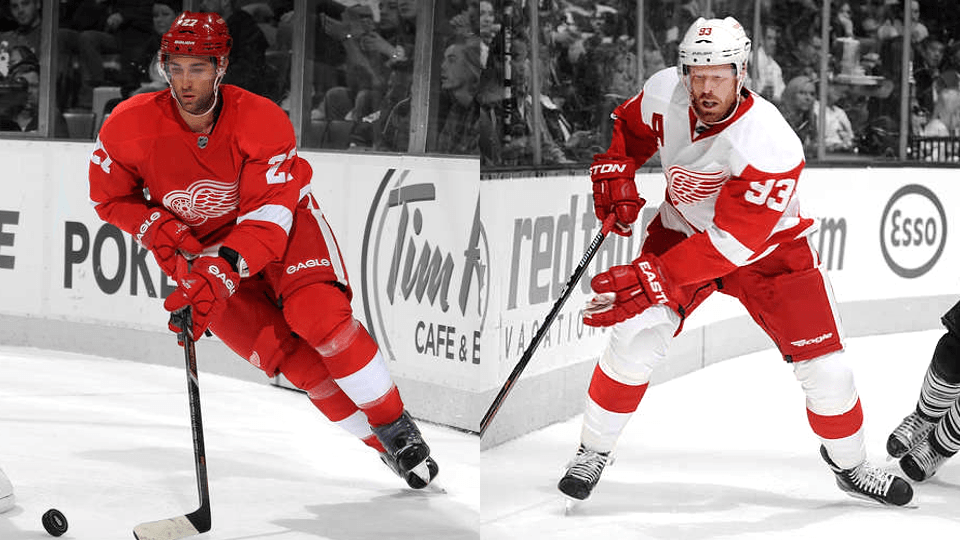
The Badger hockey team has used the same basic design, except for occasional font changes, ever since Badger Bob Johnson came to Madison from Colorado College …

… very similar to the Detroit Red Wings:
The Badger women have a different look …

… so it’ll be interesting to see if anything changes, or maybe the motion W makes it onto the men’s jersey, or the women’s jersey is redesigned to look like the men’s.
It is entirely possible there will be no noticeable changes at all other than such details as number fonts, particularly in football and men’s hockey, since they’ve had their current looks for decades. I don’t know if Gard spends any time at all pondering uniform aesthetics, but as Ryan’s top assistant for decades, perhaps he’s fine with the every-other-year new look too.
 Steve Prestegard.com: The Presteblog