No comments on Presty the DJ for June 20
-
-
-
Today in 1967 was the Monterey International Pop Festival:
Happy birthday first to Paul McCartney:
-
Most Madisonians know Dave Zweifel as the former editor of The Capital Times, Madison’s former afternoon afternoon newspaper.
Zweifel and I have a different frame of reference, though I haven’t spoken to him since leaving Madison for good in 1988. Dave’s son, Dan, was a student–athlete at Monona Grove High School, so the Monona Community Herald covered Dan’s Monona Grove teams and the Cottage Grove American Legion baseball team. In the latter setting Dave gave me a beer on a hot night when I was covering his team.
So Dave, I think, deserves a hearing on his Capital Times column:
As former UW Athletic Director Pat Richter well knows, I wrote about the demise of the men’s varsity baseball team until I was blue in the face.
Richter had the dubious honor of ending Wisconsin’s varsity baseball program 25 years ago this spring in order to get the UW’s athletic program in compliance with Title IX. The university was under scrutiny because it had substantially more male athletes on athletic scholarships than female. Richter solved the problem by dropping five sports, including baseball.
Now, 25 years later, the UW remains the only Big Ten school without a baseball program — this in a state that has long had a love affair with the sport and is also home to a Major League baseball team.
I was appalled at the demise of baseball, as were hundreds of others in the Madison area who had supported the Badgers’ team just as basketball and football boosters have backed their teams over the years. But the decision had been made and there was no way to change it.
There have been rumbles over the past 25 years — a letter to the editor here, a talk at a service club luncheon there — but nothing managed to get legs. The big impediment now, of course, is that there simply isn’t enough money to equip a team, pay for scholarships, perhaps build or rent a diamond, and cover travel expenses.
A “club” program was formed on the Madison campus in the meantime, giving aspiring baseball players at the university a place to play even if it wasn’t Big Ten Division 1 caliber.
So it was of interest recently when Jeff Block, the coach of those two club baseball teams, put together a 14-page proposal he hopes will show the Athletic Department that restoring Big Ten baseball at the UW is financially feasible.
Block told former Cap Times sports writer Dennis Punzel, who now covers sports for the State Journal, that Big Ten baseball programs average $1.4 million a year in expenses, but Madison could do it for less by using the city of Madison’s Warner Park as its home field. Plus, Block insists, there are a number of longtime baseball supporters in the area who would be interested in funding a new campus ballpark should it come to that.
Block also pointed out that there shouldn’t be any more Title IX worries because since baseball was dropped in 1991, the Athletic Department has added three women’s sports to its mix of 23 varsity sports.
The Athletic Department’s Justin Doherty didn’t exactly give Block’s suggestions a positive response, pointing out that costs already are a concern in today’s athletic environment and the department is concentrating on the competitiveness of the sports it already has.
Nevertheless, Athletic Director Barry Alvarez has dropped hints in the past that he’d be open to at least considering a return to baseball.
The bottom line is that it still is an embarrassment that the University of Wisconsin’s flagship campus is the only Big Ten school without a baseball team.
Well, yes, it is an embarrassment because of the circumstances that led to the death of UW baseball. I don’t disagree that UW had Title IX issues, but the bigger issue was the embarrassment that was former UW football coach Don Mor(t)on, whose ineptitude and resulting plunge in football attendance and revenue nearly torpedoed the entire Athletic Department, along with the department’s poor management under Richter’s predecessors running the Athletic Department.
(To prove that the world is an unjust place: After Mor(t)on was fired one year later than he should have been — ignoring briefly the fact he should never have been hired in the first place — Mor(t)on went back to North Dakota and worked for Great Plains Software, which was purchased by Microsoft, giving Mor(t)on wheelbarrows full of money, no doubt. Mor(t)on should pay all the costs for the reinstitution of UW baseball by himself.)
Block’s and Zweifel’s claim that UW doesn’t have Title IX issues anymore doesn’t mean those issues wouldn’t return if UW brought back baseball. Lacrosse, a sport growing at the high school level in this state, would be a more logical addition than sand volleyball given what passes for spring in this state.
And that brings to mind one major problem with this proposal — what passes for spring in this state. The Division I baseball season starts in February (far south of here, for obvious reasons) and runs until the weekend before Memorial Day weekend; the Big Ten tournament, the winner of which advances to the NCAA tournament, is Memorial Day weekend. Anyone who has lived in southern Wisconsin more than one year knows what “spring” in southern Wisconsin is like — any weather from winter to summer is possible. (For similar reasons summer high school baseball, played by a diminishing number of teams, is vastly preferable to spring baseball, where thanks to Mother Nature you might go a week without games and then have to jam seven games into five days.)
Certainly the fact that Miller Park is an hour or so to the east would help. (The University of Minnesota baseball team played some games at the Metrodome, but there is no more Metrodome.) But the Badgers can’t play all their games in Milwaukee, for what $hould be obviou$ rea$on$.
Money in a general sense is less of an issue at UW these days, with the huge Under Armour contract beginning July 1 and a possible new Big Ten TV contract that would dwarf the previous deal. But even if revenue is coming in like the Mississippi River in the spring after a snowy winter, UW can’t afford to ignore finances. (Given Title IX the costs of baseball would have to include the cost of whatever women’s sport is added to offset baseball.) And as we know from Don Mor(t)on and his Veer from Victory Badgers, success (or lack thereof) leads to attendance (or lack thereof) and revenue (or lack thereof).
According to Wikipedia’s UW baseball page, from the first team in 1896 until the last team in 1991, the Badgers won about 46 percent of their games. The Badgers’ last winning season was 1988, 15–13. The Badgers got to the College World Series once, 1950. From 1965, the first year of the Major League Baseball amateur draft, 38 Badgers were drafted, including two in the first round, outfielder Mark Doran by California (then Anaheim, now Los Angeles) in 1983 and pitcher Tom Fischer by Boston. Neither played a single game in the major leagues.
According to Baseball Reference, 110 former Badgers played professional baseball, and 15 position players and 15 pitchers, including Hall of Fame pitcher Addie Joss, played in the majors. The most notable Badger baseball players probably were Joss, who had 160 wins and a 1.89 ERA in the early 1900s; Harvey Kuenn, a .303 lifetime hitter who later managed the only Brewers World Series team; Paul Quantrill; who pitched for 14 seasons; Lance Painter, who pitched for 10 seasons (including with the 2001 Brewers) despite a career ERA of 5.24; pitcher Jim O’Toole, who pitched for 10 seasons, going 19–9 for the 1961 National League champion Reds; outfielder Rick Reichardt, who played for 11 seasons, three with the White Sox, with a .261 career batting average and 116 home runs; and pitcher Rodney Myers, who pitched for the 1998 wild-card Cubs.

Future major league pitcher Paul Quantrill celebrates a win during the Badgers’ last winning season, my last semester. According to classmate Rob Hernandez, 1,500 fans attended this game. There weren’t enough ex-Badgers in Major League Baseball to even create much of an all-Badgers MLB team in the 116 years of UW baseball:
Starting pitchers: Joss, Quantrill, Painter, O’Toole.
Relief pitchers: Myers, Tom “The Klaw” Klawitter (better known as the long-time Janesville Parker girls’ basketball coach).
Catcher: Robert “Red” Wilson, who played in the 1950s.
First base: Frank “Pop” Dillon, who played around the turn of the previous century.
Second base: Clay Perry (played one season in Detroit, 1908).
Shortstop: Kuenn.
Third base: John Sullivan, who played in the 1940s.
Outfield: Reichardt, John DeMerit (who was on the 1957 world champion Milwaukee Braves), Milt Bocek (two seasons with the 1930s White Sox).One feature of the UW baseball team from what I remember as a student was players from other sports, including football players Doran (a kicker) and Scott Cepicky (a punter) and Scott Sabo (a hockey player). I believe some football players run, or ran, track as well. I don’t know if football coach Paul Chryst, men’s basketball coach Greg Gard or men’s hockey coach Tony Granato would allow their players to play baseball now.
Not surprisingly given the preceding list, baseball wasn’t that popular at UW. For what it’s worth, in five years as a student I never went to a game. The sport was not promoted on campus, the team wasn’t broadcast on radio, and the only way I knew about the team was from newspaper and TV coverage of games. I don’t even recall the Daily Cardinal and Badger Herald covering the team, though they must have.
The stadium, Guy Lowman Field (to be precise, its second site), is now the site of Goodman Diamond, where the Badger softball team plays. Lowman wasn’t much of a field when UW was playing there …
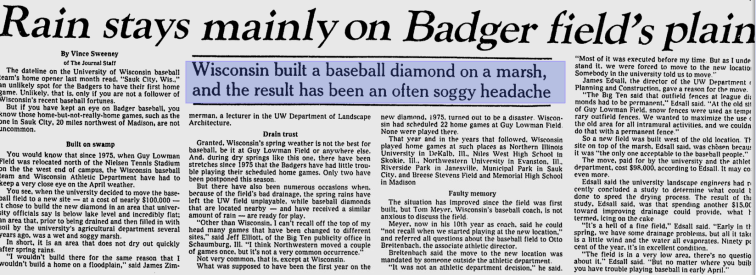
… but Warner Park, which hosted the minor-league Muskies and Black Wolf and now independent-league Mallards, is in much better shape, though it is no closer to campus than it was when the Badgers and Muskies played occasional exhibition games. (Warner Park is considerably farther from campus than the Dane County Coliseum, the previous hockey home.)
In a more perfect world, a minor league team (and I’ve argued here before that greater Madison is large enough to support a Class AAA franchise) and UW would share a baseball stadium close to, but not on, campus. (Because beer.) As it is, the Badgers’ season would end before the Mallards’ season begins, so unless the Badgers hosted NCAA tournament games (see previous paragraph about their last College World Series experience), there would be no scheduling conflicts. I have serious questions about how viable UW baseball would be so far off campus at Warner Park. And there remain questions about how successful baseball would be at Wisconsin, given its previous lack of success and previous lack of fan interest.
-
Bucky’s Fifth Quarter reports:
Wisconsin fans will get their first opportunity to preview and purchase Badgers Under Armour merchandise on June 30 when UW hosts “Night of the New Red Threads,” it announced Monday.
Athletics director Barry Alvarez, football coach Paul Chryst, men’s basketball coach Greg Gard and men’s hockey coach Tony Granato—among other notable people in the program, the Badgers say—will be on hand at the event, which begins at 10 p.m. at Camp Randall Stadium. In addition to seeing and having the chance to purchase Wisconsin’s new Under Armour gear, fans will also get “exclusive access” to UW’s training facility.
Wisconsin and Under Armour announced a 10-year partnership in October, replacing UW’s previous 15-year deal with Adidas. The new deal begins July 1 at midnight.
“We’re thrilled to partner with an energetic, hardworking brand whose story mirrors our own,” Alvarez said at the press conference to announce the deal on Oct. 9. “I’ve followed the Under Armour story for many years. I’ve been impressed with their creativity, technological advances and their presence of mind in the market.”
At that Oct. 9 announcement event, the Badgers unveiled a number of prototypes of Wisconsin on-field apparel designed by Under Armour. While the official designs remain unknown, they provided a glimpse into what Badgers fans might be able to expect.
/cdn0.vox-cdn.com/uploads/chorus_image/image/49845479/image.0.0.jpeg)
Or not, given the likelihood of pre-unveiling subterfuge to hype the new supplier, not to mention how often prototypes don’t become the finished product. (Research the number of Corvette prototypes over the years, including those with engines mounted between the seats and rear axle, and with gullwing doors.) One could conclude the basketball uniforms are warmups and not game uniforms given how the uniforms looked under former coach Bo Ryan.


I am amused, given Ryan’s reputation as a coach for whom you will play exactly his way or not play at all, that either he didn’t care about his team’s on-floor look (although he did interrupt a timeout once to tell a player to get a haircut), or that he appreciated uniform variety so much that his teams changed their look every season (if you count the postseason).
The football uniform depicted here looks hardly different from the current design (which itself changed little when UW went to Adidas). The only detail I can tell is the smaller numbers possibly moving from the shoulder blade closer to the neck, so-called “TV numbers.” If this is the new design, it also does not incorporate the Badger number font (which looks suspiciously like Aachen) found on the basketball jerseys.

UW football coach Paul Chryst is pictured as a player with his father, George. The numbers on the uniforms were hard to read … 
… so the numbers became solid for the next jersey order. Barry Alvarez ditched the old-style W, TV numbers, W-Bucky and, for several years, names on the back. The number one question for those concerned about sports uniform aesthetics is whether the new Badger look will use the same UW color instead of the correct “cardinal,” which is darker than the scarlet now used by UW and, in the Big Ten, Nebraska, Ohio State and Rutgers. Cardinal should be darker than scarlet, though not as dark as crimson (Indiana), and not as purple as maroon (Minnesota).
The related question is how much black and gray will be added because colleges are trying to appeal to high school students who apparently now think no colors other than black or gray exist. (You will notice the words “black” and “gray” appear nowhere in the words “cardinal” and “white.” I oppose adding colors except in the case of bad original colors, such as Northwestern’s purple, to which football coach Gary Barnett had black added, or Wyoming’s brown.) This is a trend UW has resisted at least in revenue sports, except for …


… a couple of basketball instances. (Black number outlines aren’t objectionable; black stripes are when your team colors do not include black.)
Readers know I’m not a fan of the Badger football uniform look, largely because of the tacked-on semi-stripes on the arms and the haphazard placement of the side numbers, which Barry Alvarez’s uniform designers failed to see as problems. The uniforms, whose basic design (minus font changes, adding names on the back, and the occasional appearance of red pants) goes back to 1991, appear to have been designed separately from the rest of the UW uniforms, which does happen. (Michigan’s blue football jerseys, not counting their occasional special looks, haven’t materially changed in decades, but the road uniforms have had yellow — oops, “maize” — and white pants, and side numbers in different places.)
It is always a debatable point as to how much influence sports coaches have on the uniform designs of their teams in this era of bazillion-dollar uniform deals. I believe Paul Chryst’s Pitt teams wore the same uniform design as the teams of his predecessor, Dave Wannstedt — metallic gold helmets and pants and either dark blue or white jerseys — which, for those who care, was quite different from the mustard gold of the Tony Dorsett and Dan Marino days. Recall that Vince Lombardi settled the blue-vs.-green argument for the Packers by declaring that he was the coach of the Green Bay Packers. Time was when with rare cases, a uniform design change accompanied a new coach, perhaps to eliminate a previously failed coach’s influence. (One could predict the women’s basketball uniforms will change for that reason.) Alvarez got the motion W instituted (essentially to replace a Bucky Badger superimposed on an outline W), and I predict the motion W is not going away.
On the other hand, we probably have seen the end of the innovation that went nowhere, Gary Andersen’s red helmet, because we didn’t see it last year with Chryst. At least UW won some games with them, as opposed to when red helmets were last used, in the late 1960s during UW’s 23-game losing streak. I’m not necessarily opposed to red helmets except that tradition has UW wearing white helmets at home (though they did wear red helmets on the road on occasion in the 1950s, presumably when they were much less expensive than now).
Another point of possible interest is whether the UW men’s basketball jerseys change less often than they’ve been changing under Ryan (every season or two, not counting last year’s 1976 throwbacks and the postseason uniforms). The other question is the absence of names on the back, which Ryan’s uniforms never had. (Ryan’s non-interim predecessor, Dick Bennett, didn’t have NOBs at UW–Green Bay until his son, Tony, hectored him about it; conversely Bennett’s Badger teams always had NOBs). Some coaches think NOBs create egos, even though they help fans identify who is who and players generally don’t run down the floor looking at the back of their own uniforms. (Alvarez didn’t have NOBs except for bowl games until the late 1990s, when he declared the no-NOB look had achieved its purpose.)
The Badger hockey team has used the same basic design, except for occasional font changes, ever since Badger Bob Johnson came to Madison from Colorado College …

… very similar to the Detroit Red Wings:
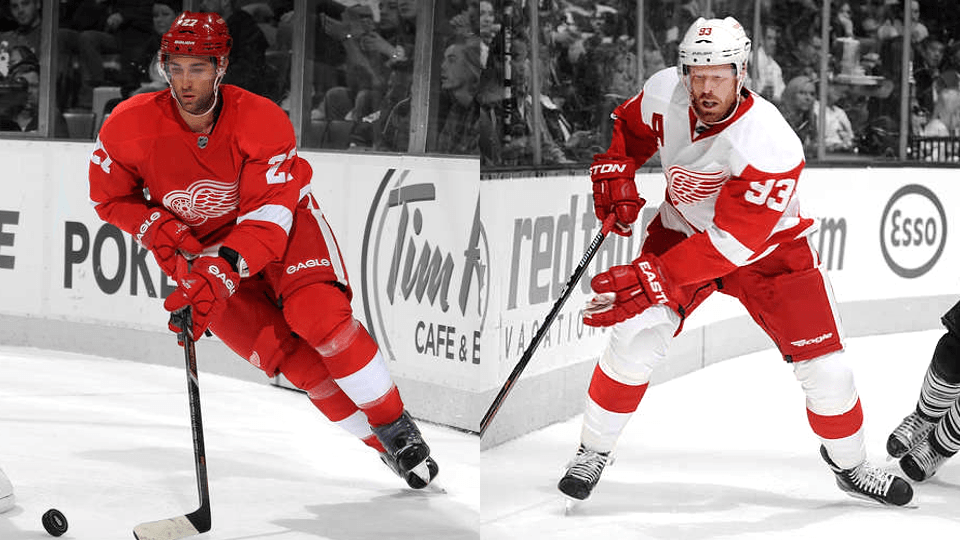
The Badger women have a different look …

… so it’ll be interesting to see if anything changes, or maybe the motion W makes it onto the men’s jersey, or the women’s jersey is redesigned to look like the men’s.
It is entirely possible there will be no noticeable changes at all other than such details as number fonts, particularly in football and men’s hockey, since they’ve had their current looks for decades. I don’t know if Gard spends any time at all pondering uniform aesthetics, but as Ryan’s top assistant for decades, perhaps he’s fine with the every-other-year new look too.
-
The number five song today in 1967 …
… was 27 spots higher than this song reached in 1978:
Birthdays start with Jerry Fielding, who composed the theme music to …
-
According to Google Translate, the headline is Latin for “Out of many, more than one,” in contrast to what is supposed to be our national motto, “E pluribus unum.”
About that, Mike Gonzalez says:
Despite signs everywhere that the Orlando massacre has failed to bring the country together, there seems to be a growing consensus on at least one point—considering a return to E Pluribus Unum.
This is a national debate that conservatives have long demanded and should relish having.
Sure, some are recalling the motto only to rebuke Donald Trump’s call for a suspension of immigration from Muslim nations. But that shouldn’t matter to conservatives, who should concentrate now on forcing the reopening of this discussion.
So, when Hillary Clinton says, “E Pluribus Unum, One—Out of Many, One—has seen us through the darkest chapters of our history,” as she did at her first major speech after Orlando, conservatives should say, “Bring it on.”
Yes, let’s by all means return to that goal. Why did we ever abandon it in the first place?
Let’s debate how an American like Omar Mateen, born in Queens, New York, and raised in Fort Pierce, Florida, can turn into a terrorist bent on executing his compatriots. How does he grow up cheering the 9/11 attack in high school, thinking that women ought not to drive, and swearing allegiance to the Islamic State?
Everybody, but especially young men, needs to feel like they’re part of something bigger than themselves, a sense that we’re all in this together. If we as a society fail to give citizens national pride, we can be sure that some outside force will come along and do it.
The founders knew that the constitutional republic they were crafting required a single nation with one national identity smelted out of different ethnicities. Right away, in 1776 in fact, they came up with the concept of E Pluribus Unum.
To instill the new creed into the immigrants already flocking to America, they set an educational system that would create a nation with one national identity.
Starting in the early 1800s with the Common Schools and continuing later through the Ellis Island period, American schools Americanized new comers. As historian Mark Edward DeForrest put it, the Common Schools had,
a large role in assimilating and educating the offspring of the immigrants then moving into the United States from Europe. The schools did not simply educate students in the basics of the English language or the Three Rs. Rather, the schools were actively involved in promoting the values and beliefs that were considered part and parcel of the American experience.
Schools taught that being an American required a belief in individual liberty and that rights are granted to us by virtue of our existence, not through government action. These principles united all people who came to this country in deeply rooted patriotism.
For the past three decades, for reasons that will also require analysis (though at a later date), we have been doing exactly the opposite. The new model, exemplified by the bestselling historian Howard Zinn, is to present America as a spectacular experiment in oppression.
Zinn’s A People’s History of the United States set the stage for the grievance mongering that passes for history classes today, and is still widely used. It has sold over 2 million copies since it was first published in 1980 and continues to sell over 100,000 copies a year because it is required reading at many of our high schools and colleges. That’s a lot of young minds.
This is how Zinn described the founding:
Around 1776, certain important people in the English colonies made a discovery that would prove enormously useful for the next two hundred years. They found that by creating a nation, a symbol, a legal unity called the United States, they could take over land, profits, and political power from favorites of the British Empire. In the process, they could hold back a number of potential rebellions and create a consensus of popular support for the rule of a new, privileged leadership.
And our educational authorities are doubling down today—even in the face of danger. The College Board’s leftist curriculum framework for Advanced Placement U.S. History—the courses that our best students take in high school—denigrates the founders’ assimilationist ethos and presses students “to think beyond national histories” and patriotic attachments.
The just released A.P. European History curriculum is no better. It presents religion only as an instrument of power, minimizes the evil of communism, and omits the importance of liberty.
As for the K-12 curriculum on the verge of being approved in the largest state in the Union, California, it is a blue print for redrawing America further still along multicultural lines. The assimilation required to attain E Pluribus Unum is “questionable by today’s standards that generally embrace having a plurality of experiences in the country.”
Assimilation, it adds, was the product of a mixture of “Social Darwinism, laissez-faire economics, as well as the religious reformism associated with the ideal of the Social Gospel.”
This is what is being taught to students, like Mateen once was, every day in our schools. So, yes, by all means, let’s have a discussion on why we should indoctrinate young minds in a way no society has ever done, why we should teach our young to “unlike” America.
Is this the approach we want to have, especially at a time when a force like the Islamic State will only be too glad to fill the patriotic vacuum, or should we teach again that America is an exceptionally free and prosperous nation that requires love and affection and constant attention?
The author Sebastian Junger, speaking at The Heritage Foundation this week about his new book, Tribe, reminded his audience that as bad as the Nazi Blitz on London was, its survivors missed afterward the sense of national pride they had felt while pitching in together.
The fact that the Orlando massacre has failed miserably to be a bond for national unity, but has only exposed our fissures, should be a mighty sign of how divided we are. This debate is well overdue.
Of course, “divisive” is an epithet hurled at politicians today who don’t do what the epithet-hurler wants done. I don’t oppose Barack Obama for being divisive; I oppose Obama because he is wrong, and because he and his toadies and apparatchiks actively hate people like me and, I suspect, most readers of this blog. There is no “unum” in politics today, and there hasn’t been in a long time.
Mateen reportedly said he decided to shoot up the Orlando nightclub to get the U.S. to stop bombing “my country” … Afghanistan, not the U.S. That’s despite the fact that Mateen is as Afghan as my grandfather, born in Minnesota, was Norwegian. (Grandpa’s parents immigrated here from Norway.) If you’re born in the U.S., you’re supposed to be an American, not from wherever your ancestors came from.
This may explain why conservatives are not impressed with the arguments for more money for schools and colleges, because they do not see American values being taught in American schools. This also may explain much of the support of Donald Trump, whether or not Trump can be trusted to do what he says (as of that particular moment) he will do.
-
James Taranto explains the term I made up for this blog:
The New York Times’s Timothy Egan thinks Donald Trump is a “pathological liar.” …
An additional irony is that Egan’s column appears in a newspaper that itself can fairly be characterized, in the institutional voice of its editorial board, as a pathological liar.
We base that admittedly harsh assessment on today’s editorial about Sunday’s Islamic terror attack on a gay bar in Orlando, in which the Times asserts this:
While the precise motivation for the rampage remains unclear, it is evident that [attacker Omar] Mateen was driven by hatred toward gays and lesbians. Hate crimes don’t happen in a vacuum. They occur where bigotry is allowed to fester, where minorities are vilified and where people are scapegoated for political gain. Tragically, this is the state of American politics, driven too often by Republican politicians who see prejudice as something to exploit, not extinguish.
In fact, the motivation is entirely clear. The Washington Post reports that during the attack, Mateen phoned a local TV station and told a producer: “I did it for ISIS. I did it for the Islamic State.” He told 911 operators the same thing.
Where might Mateen have developed an antipathy toward gays? On Monday we noted that after the attack his father posted on his Facebook page that “God himself will punish those involved in homosexuality.” Mateen père is not a Republican but an Afghan immigrant reportedly sympathetic to the Taliban.
The Times faults Republicans for opposing same-sex marriage, antidiscrimination laws (which the Times believes should be enforced without any exception for religious conscience) and the use of ladies’ rest rooms by persons whose “gender identity” does not match their sex. In itself, that’s fine. There is room for civilized disagreement about such matters. But falsely blaming your political adversaries for mass murder is hardly civilized.
There’s an additional irony to the Times’s post-Orlando jihad against Republicans: Trump, notwithstanding his total disregard for liberal pieties, has never, so far as we know, said anything remotely hostile to sexual minorities—in contrast with Mrs. Clinton, who opposed same-sex marriage until 2013. That was true at a time when society as a whole was far less tolerant: In his 1987 book, “The Art of the Deal,” Trump mentions the homosexuality of his late friend Roy Cohn and is totally blasé about it.
The editorial notes in passing that “Trump, unlike some other prominent Republicans, called the Orlando massacre what it was: an attack on gay people.” Actually he went further than that: In a speech Monday, he said: “Our nation stands together in solidarity with the members of Orlando’s LGBT community.”
Trump also was honest in acknowledging the ideology behind the attack: “A radical Islamic terrorist targeted the nightclub not only because he wanted to kill Americans, but in order to execute gay and lesbian citizens because of their sexual orientation.” He faulted the Obama administration’s “politically correct response”—meaning its steadfast refusal to acknowledge that Islamic terrorism is Islamic—which he said “cripples our ability to talk and think and act clearly.”
That prompted a response from the president himself that CNN calls a “tirade” and the Times, in another editorial today, calls “powerful words”:
[Obama] addressed the accusation—a fetishized Republican talking point, repeated by Mr. Trump after Orlando—that Mr. Obama is surrendering to the enemy by avoiding the label “radical Islam.” The idea that reciting those words would help magically defeat the terrorists is absurd, and worse. It plays into the desire of groups like ISIS and Al Qaeda to make the war, as Mr. Obama said, “a war between Islam and America, or between Islam and the West. They want to claim that they are the true leaders of over a billion Muslims around the world who reject their crazy notions.”
Obama and the Times are setting up a straw man. “The problem with Obama’s conduct isn’t that naming radical Islam would solve the problem,” Commentary’s John Podhoretz observes. “Of course, it wouldn’t solve the problem. The issue is that the refusal to name radical Islam is part of the problem.”
The Times’s slander against Republicans is nothing new: In 2011, as we noted, an editorial blamed “Republicans and particularly their most virulent supporters in the media” for the Tucson, Ariz., attack whose victims included then-Rep. Gabby Giffords. By the time that editorial ran, it had been established that the killer had no discernible ideological motivation.
In the Orlando case, however, the Times’s dishonesty is doubly despicable. The paper falsely blames its political adversaries for a grievous crime that was ideologically motivated, while furthering the official lie that the killer’s ideology amounts to nothing more than “crazy notions.”
-
Dueling ex-Beatles today: In 1978, one year after the play “Beatlemania” opened on Broadway, Ringo Starr released his “Bad Boy” album, while Paul McCartney and Wings released “I’ve Had Enough”:
The number six song one year later (with no known connection to Mr. Spock):
Stop! for the number eight single today in 1990 …
… which bears an interesting resemblance to an earlier song:
Put the two together, and you get …
-
Fellow UW-Madison grad Jeff Greenfield:
Surely this time it would be different. Surely, after the worst mass shooting in American history, the presumptive Republican presidential nominee would choose his words carefully. He would make the case for an effective response to homegrown terror; listen to the counsel of his political team, and offer reassurance to the nation and—crucially—to Republicans who are desperately seeking evidence, even now, that they can embrace the candidate their convention will nominate in a month.
Instead, in a speech riddled with misleading and flatly false statements, Donald Trump ranted incoherently Monday about the need to toughen his Muslim immigration ban, even though the Orlando shooter was born in New York City 29 years ago (at a time when Afghan emigres like his parents were fighting on America’s side against the Soviet Union). In a TV interview, Trump suggested that the president of the United States was in some undefined way sympathetic to the murderous intentions of Islamic terrorists. And in the hours immediately after the massacre, he tweeted a self-congratulatory message about his prescience.
All of it served to punctuate miserably the many doubts that had unfolded the previous weekend in a spectacle never before seen in our nation’s politics. The Republican Party’s last nominee for president, Mitt Romney, hosted a gathering of hundreds of Republican conservatives in Park City, Utah, devoted to assailing his successor, Donald Trump. Romney’s former running mate, Paul Ryan, the once-revered speaker of the House, was grilled for supporting the candidate whose recent remarks the speaker himself called “a textbook case of racism.” In another speech, a recent GOP nominee for governor of California—Meg Whitman—explicitly compared the nominee to Hitler and Mussolini.
What was so remarkable about these and other acerbic remarks made at Romney’s gathering of GOP donors and business people was that they came from inside the party Trump will soon lead into battle. And they stem from doubts not about Trump’s policies, but about his fundamental fitness for the office. Dan Senor, former Romney adviser and Bush White House national security aide, even said that Trump’s comments about Obama suggest “there should be serious concern” about sharing classified information with Trump—information presidential nominees regularly receive.
In many decades of covering national politics, I don’t recall anything like this.
True, assaulting the character and temperament of a potential president has been a feature of our politics almost literally from the beginning. In 1800, the first genuinely competitive election, allies of Vice President Thomas Jefferson said President John Adams possessed a “hideous hermaphroditical character, which has neither the force and firmness of a man, nor the gentleness and sensibility of a woman.” For his part, Jefferson was labeled “a mean-spirited, low-lived fellow, the son of a half-breed Indian squaw, sired by a Virginia mulatto father”—not to mention an “atheist” and “whoremaster.” From “Tricky Dick” Nixon to “Slick Willie” Clinton, the charge of defective character flying across the trenches is a thoroughly predictable element.
What’s emerged in recent days, however, is something we have never seen before. The hard questions about the character and temperament of the presumptive Republican nominee are coming from within his own party at precisely the time when the most important piece of business for a nominee is consolidation of that party. The weekend gathering that Romney hosted is yet one more measure of just how unmoored his candidacy is from anything remotely familiar in American politics.
In a normal intraparty contest, the fights usually take familiar forms: who best represents the party; whose ideas resonate, whose prescriptions are sound, or flawed; who has the experience (or the fresh ideas) that best serve the party. The disputes can be intense—think of Walter Mondale deriding Gary Hart’s new ideas campaign of 1984 by asking, “Where’s the beef?” or George H.W. Bush labeling Ronald Reagan’s ideas “voodoo economics,” or Hillary Clinton in 2008 deriding Barack Obama’s promises of change.
Rarely, however, does a candidate take on an intraparty foe on questions of character. For example, in 1992, with questions about Bill Clinton’s philandering and draft dodging threatening his campaign, his rivals tiptoed around the questions. The closest anyone came was when Sen. Bob Kerrey warned that in the fall, the Republicans would “open Clinton up like a soft peanut.” And once Clinton secured the nomination, even such cryptic references to his character disappeared from Democratic Party public conversations. The reason for such reluctance is intensely practical: You don’t want members of your own party who backed a defeated foe holding grudges into the general election campaign in the fall.
It’s no coincidence that here, as in so many other areas, Trump stands as The Great Exception, labeling his longest-standing opponent “Lyin’ Ted.” Even when a nominee faces deep opposition within the party, the basis for that opposition has been on policy grounds: Republican moderates and liberals shunned Barry Goldwater in 1964 because of his ideas on nuclear weapons and social policies; Democratic moderates and conservatives rejected George McGovern in 1972 because of his approach to war and social policy.
By contrast, look at what Illinois Sen. Mark Kirk said in refusing to support Trump’s candidacy: “Based on my military experience, DT does not have the temperament to command our military or our nuclear arsenal [emphasis added].” He’s not challenging Trump’s approach to the Middle East, or Russia, or ISIS. He’s implying something else: that Trump would not listen to his military, that he’d turn a diplomatic dispute into a casus belli; that he is not to be trusted with the power of the presidency not because of what he thinks, but because of how he behaves.
Or look at the widespread condemnation of Trump’s attack on Judge Gonzalo Curiel. Unlike other ethnically tinged issues—the proposed deportation of 11 million undocumented immigrants, the ban on Muslims—the dispute does not center on any notion of public policy. It is rooted in the idea that Trump has the instincts of a narcissistic bully, unable to even imagine that anyone might have a reasonable basis for disagreeing with him, and Trump’s apparent inability to distinguish between his private interests and the public interest. What is haunting a significant number of Republicans is that they are on the verge of putting someone in the Oval Office whose character and temperament make him unfit for the job.
For Trump’s supporters, this smacks of a serious double standard. Don’t most voters regard the presumptive Democratic nominee as neither honest nor trustworthy? Doesn’t Hillary Clinton have a troublesome history of false statements, ethically dubious behavior that even now hangs over her campaign? Yes, and it’s why the Trump campaign will launch a full-scale assault on her fitness for the Oval Office. That’s par for the course. But even during the most intense period of the nomination fight Sen. Bernie Sanders held his fire on character grounds. Taking too much money from Wall Street is a far cry from suggesting she would wreak havoc in the Oval Office.
There’s another reason raising character questions about a fellow party member is problematic: Firing harsh judgments about character across party lines is relatively cost-free; attacking “one of your own” can come at serious political cost.
And that’s what makes the retreat from Trump among so many Republican officeholders all the more remarkable. Even if the idea of changing the convention rules to “unbind” delegates and deprive Trump of the nomination is fanciful, the “non-endorsements,” “rescissions” and Talmudic “I’ll support but not endorse” adds up to something close to astonishing.
It is also a sharp reminder that Trump’s triumph in the primaries, and the prospect that he will lure disaffected Democrats and armies of first-time voters to the polls, may obscure a counterpoint: A striking number of committed Republicans and conservatives, including donors, operatives and foot soldiers, are prepared to withhold their support, their money and their votes that would have gone to any other Republican nominee.
Unlike so many in the GOP base, who see in Trump’s behavior a fearless willingness to take on a corrupt political system, these Republicans are seeing signs that he is a dangerous figure, not for what he thinks, but for who he is. And no amount of speeches read from a Teleprompter reciting anodyne pieties is likely to change that.
Will this drag on his candidacy doom Trump in the fall? We don’t know. Because—as is true of so much else this cycle—nothing like this has ever happened before.
It is insane to think that Barack Obama’s and Hillary Clinton’s misplaced blame for the Orlando shootings could be topped, if that’s what you want to call it, by the carrot-topped walking, talking non sequitur who is likely to lead the GOP to a catastrophic defeat in November. And yet, there it is.
 Steve Prestegard.com: The Presteblog