Skip to content
  • Shorter version: Get a job

    August 9, 2016
    Culture, US politics

    Suffice to say Brandon Smith lacks sympathy for the self-titled Social Justice Warriors (underlining and boldface his):

    I have not been writing much concerning the U.S. election this November, and with good reason – elections are always a distraction from tangible solutions.  They are an anathema to honest debate; a circus of delusions and prefabricated talking points.  They offer the illusion of choice in order to placate the masses.  They are a theater of false hopes.

    That said, elections do accomplish one thing very well — they are great for mobilizing large numbers of people into opposing camps and pitting them against each other over ideologies and political celebrities.  Sometimes, these elections can lead to internal war.  This is where we stand in 2016.

    In my article Will A Trump Presidency Really Change Anything For The Better, published in March, I outlined why I believed that the election of 2016 would revolve around a Trump vs. Hillary free-for-all.  The two sides are perfectly diametrically opposed.  At least, as far as public image is concerned, one is the exact antithesis to the other, and I don’t think this is a coincidence. …

    In this age of unstable economies and societies, there are many people who are desperate to be told what to do rather than lead themselves.  However, none are quite as horrifying as the social justice cultists.

    These people are, in my view, nearly the pinnacle of the communist ideal.  They are die hard collectivists, and are willing to rationalize almost any action as long as they believe it is being done in the name of the “greater good.”  Usually, this greater good is based on entirely arbitrary determinations rather than any inherent moral code, making it vaporous and easily changeable.  A “greater good” without principles based in inherent conscience or natural law can be shifted on a whim to suit any evil imaginable.

    They believe fervently in the purity of their world view.  Most of them are not open to even the slightest question or concern over their ethos.  Their blind faith is unshakeable, even in the face of extensive empirical evidence and superior logic.  Such people are the ultimate cannon fodder for the elites.

    Social justice cultists act on the assumption that history is on their side, and that they will one day be seen as heroes for their deeds.

    They not only seek to promote and spread their ideology — this would merely make them a new form of religion.  No, they are not just evangelists, they also want their own version of a caliphate; an all dominating cult that crushes any embers of dissent and destroys its philosophical opponents trapped within its ever expanding borders.

    A recent and starling example of this mentality can be found in the following video of a BBC show called “The Big Questions.”  The subject of the debate — “Does social media reveal men’s hatred for women?”  Milo Yiannopoulos faces off with a crowd of mouth breathing true-believers and barely gets a word in edgewise as they do what cultural Marxists do best:  use the mob to shout down their opponent and attack the person’s character rather than confront his arguments and evidence:

    Though this show is produced out of the U.K. and not the U.S., I am using it to shed light on the inevitable end game of all social justice cultists regardless of where they live — to dominate all discussion and erase conservative thought from society.  The attitudes displayed by the feminists and the rather pathetic members of the audience are truly frightening. Not only do they argue that Yiannoupoulos has no right to even be dignified  with time to respond, they are at bottom also claiming the right to assert force of law to ban ideas they disagree with and even to imprison the people that argue those ideas.

    Instead of simply ignoring or blocking the people who offend them like rational adults, or participating in a free exchange, they want the power of government to silence opposition. If their ideas were truly superior in merit then they would have no need to use force to silence or imprison their opponents.  They want to turn the whole of the web, the whole of the WORLD, into a federally enforced “safe space” for their ideology and their ideology alone.

    It is this kind of zealotry that leads to outright totalitarianism and collectivism. This is the kind of evil that is done in the name of the so-called “greater good.”

    The fact is, their feelings are irrelevant. They do not matter.  Most rational people don’t care if SJWs are offended, or afraid or disgusted and indignant. Their problems are not our problems.  Our right to free expression and freedom of association is far more important than their personal feelings or misgivings.  We do not owe them a safe space.  If they want a safe space, then they should hide in their hovels or crawl back to the rancid swamps from whence they slithered.

    A backlash is building against the social justice cult that will be unleashed sooner rather than later, and so far it is accelerating at the height of the election frenzy under the banner of Donald Trump.

    Social justice warriors seem to find themselves befuddled at the rise of Trump, but as I predicted in March, a Trump vs. Hillary face-off was inevitable.

    For conservatives, Hillary is the ultimate representation of political hell spawn.  She is a proven elitist puppet, with a criminal record that reads like a transcript from the Nuremberg trials.  She is also a part of an ongoing trend of dynasties in U.S. politics.  Americans have grown tired of the Bushes and the Clintons.  We have grown tired of the endless reign of neo-cons and neo-liberals.  We are looking something different, or what we hope is something different.  Trump at first glance at least looks like a candidate outside of the establishment norm.

    Beyond this increasing aversion to the status quo, though, is the growing American contempt for the social justice cult.  This will be a primary driver of the U.S. election.

    While many in the cult had thrown their support behind Bernie Sanders for a time, Bernie showed his true colors by bowing down to the Clinton machine.  This is typical of socialists, who regularly forgo their proclaimed principles in the name of “unity” and “victory” under a single collectivist umbrella.  Many in the social justice crowd have quickly jumped on Hillary’s bandwagon, as her campaign now rides solely on the disposition of her own sexual organs.

    That is to say, Clinton is now the new mascot for the SJW crowd, even though many of them don’t really like her.

    I’m not so sure the “vote for me because I’m a woman” theme is going to go over quite as effectively as Obama’s “vote for me because I’m black” theme.  The Hillary campaign symbol, looking strangely like a warped version of the arrowed symbol for “Male” and Mars, is emblazoned on worshipful feminist posters and cartoons everywhere.  A nice touch was the cringe-worthy display of Clinton’s giant head on the DNC mega-screen bashing through photos of past male presidents as if “shattering” the proverbial glass ceiling.  Set aside the fact that over half of American voters are women, and that there is no glass ceiling preventing women from being voted into office by other women if being a woman rather than a decent candidate was all that mattered.

    The theater of the feminist absurd aside, this election is going to tumble about wildly on all sorts of carnival sideshows.

    The so called “controversy” over comments made by Trump against the parents of a Muslim soldier killed in U.S. service in Iraq is just the beginning of the circus.  To be fair to Trump, the sheer hypocrisy of Hillary Clinton, a warmonger of the highest degree and a participant by-proxy in the death of the soldier in question, using his parents as fuel for a campaign controversy goes so far into the realm of the disturbing that I might be shocked if I didn’t understand that the whole thing is a mind game.  These kinds of distractions are meant to fuel the flames and I predict they will become frequent and overwhelming by November.

    To reiterate, it is clear that the Clinton campaign is going the route of pandering to the SJWs.  This is the script, and I as I said after the Brexit referendum vote, I believe that the script ends with a Clinton failure and a Trump victory.  Pandering to SJWs rarely leads to success.  And, a faltering economy blamed on Trump would be far preferable to one blamed on Clinton.

    My regular readers know well that I personally do not have much faith in the Trump campaign; I’ve seen too many constitutional inconsistencies and too many meetings with elitist representatives so far to give him the benefit of the doubt.  If he turns out to be a true constitutionalist, then I will be pleasantly surprised and happy to admit I was wrong.

    That said, I do understand why the public is rallying around Trump.  They see him not as a candidate, but as a vehicle to push forward a fight against a social justice juggernaut that has gone unanswered for far too long.  They don’t much care about him as a man, which is why the character attacks by the social justice cult and the media have fallen flat again and again.  They only care that he might not be the status quo.  They are looking for something radical to counter the radicalism of cultural Marxists.

    I am not here to argue over which candidate is “better,” or preferable or the “lesser of evils.”  None of this matters.  I realize that I am not going to convince anyone to vote in anyway different than how they have already decided to vote.  In fact, I am certain that most people decided exactly how they were going to vote as soon as the candidates were publicly finalized.

    The zealotry will be evident on both sides.  Democrats will accuse me of being biased in favor of Trump because I outline in articles the endless parade of horrors surrounding Clinton’s career.  Republicans will accuse me of “secretly working for the Democrats” because I refuse to throw full blind faith behind Trump.  That’s just how elections work – follow my mascot or you are my enemy.

    I really couldn’t care less.  I’m on the side of liberty and individualism and I’ll fight on this side alone if I have to.

    I will say that I KNOW exactly what will happen under Hillary Clinton – despotism in the name of “equality”, leading to outright civil war.  I only SUSPECT according to what I have seen so far that Trump is not a constitutional candidate.

    The danger is that in our search for the counterbalance to social justice despotism and Hillary Clinton’s evident communist addictions, we conservatives will fall into the old historical paradigm of fascism in the name of defeating communism, helping the elites instead of dethroning them.  The danger is that we get so caught up in trying to destroy the social justice mob that we forget our principles.

    If a President Trump shows any indications of being anti-constitution, even in the name of our own “greater good,” conservatives MUST stand by our ideals and stand against him, or we become no better than the SJW psychopaths we seek to stop.  No man, no woman, no president is more important than the liberties and heritage of this nation and its citizenry.

    As far as social justice activists are concerned, if they really want to change this country for the better, then they should consider dropping out of their little cult and finding something productive to do.  Stop spending your parents’ money on garbage gender studies classes.  Become scientists and engineers.  Become doctors and inventors. Create a better planet through ingenuity rather than manic ideology.  Make yourselves useful or something.  You’re not only wasting your own time wreaking havoc with your collectivism, you are also wasting our time, because now we have to spend it working to stop you and the elites that fund you.

    Become self sufficient instead of begging for handouts or feeding off your family and their savings accounts.  Add to the world instead of bleeding it dry.  Help people through personal action instead of trying to micro-manage their lives and their speech and their thoughts through force of government.

    Otherwise, all you are is more gasoline on a fire that will result in inevitable conflict; a conflict which you will lose.  A conflict which may only serve the interests of the very elites which you think you are fighting against.  Remember, whatever happens, it was the social justice cult that helped to create the conditions by which such a conflict became unavoidable.  Without the cultural Marxists, there would be no rationale for any division.  If they would simply leave us all alone to think and say what we feel, to choose our associations without interference or invasive conquest of “spaces” and to live in a functioning society based on merit rather than victimhood and artificial fear, there would be no fertile ground for an election circus of this magnitude.

    And finally, if EVERYONE relied less on political celebrities, if everyone stopped waiting for a knight on a white horse, or a feminist icon, or a crusade to fight, or a social justice mob to join and started determining their own futures; if everyone began looking far more carefully at the people behind the curtain, then perhaps we could finally see a change in humanity not seen in thousands of years.  Not a collectivist change, but an individualist change, which is the only kind of change everlasting or worth a damn.

    Share this on …

    • Share on X (Opens in new window) X
    • Share on Facebook (Opens in new window) Facebook
    • Share on LinkedIn (Opens in new window) LinkedIn
    • Email a link to a friend (Opens in new window) Email
    • Print (Opens in new window) Print
    Like Loading…
    No comments on Shorter version: Get a job
  • Presty the DJ for Aug. 9

    August 9, 2016
    Music

    Today should be a national holiday. That is because this group first entered the music charts today in 1969, getting three or four chart spots lower than its title:

    That was the same day the number one single predicted life 556 years in the future:

    Today in 1975, the Bee Gees hit number one, even though they were just just just …

    (more…)

    Share this on …

    • Share on X (Opens in new window) X
    • Share on Facebook (Opens in new window) Facebook
    • Share on LinkedIn (Opens in new window) LinkedIn
    • Email a link to a friend (Opens in new window) Email
    • Print (Opens in new window) Print
    Like Loading…
    No comments on Presty the DJ for Aug. 9
  • Whom to vote for Tuesday

    August 8, 2016
    US politics, Wisconsin politics

    There is, believe it or don’t, a primary election Tuesday.

    There are six races of note, three of which are Congressional races, and four of which are Democratic primaries. The race in both categories is in the Third Congressional District, where U.S. Rep. Ron Kind (D-La Crosse) is opposed by Myron Buchholz of Eau Claire, who aligns himself with Bernie Sanders (not really) Democrats. The winner will be unopposed because for some reason no Republican could be found to run against Kind.

    Kind is a mainstream Democrat. Buchholz is as leftist as Comrade Bernie. In fact, Buchholz sent a news release about his pride in getting arrested at a protest. He opposes free trade. Unusually, Buchholz didn’t blame the Orlando shootings on guns, but he did blame the shootings on our being in the Middle East. (And yet he touted the endorsement of his daughter, an Army veteran.) I’m not exactly a fan of Kind, but the last thing we need anywhere in politics is leftists like Buchholz.

    The biggest Congressional race, at least in terms of coverage, is the First Congressional District race between Speaker of the House Paul Ryan (R–Janesville) and Donald Trump Republican Paul Nehlen.

    Nehlen is running for his first office, and does it show. The Washington Post’s Amber Phillips reported:

    It’s safe to say that until a few days ago, the average consumer of political news had no idea who Paul Nehlen was.

    Actually, the average consumer of political news probably still has no idea who Paul Nehlen is. But Speaker Paul Ryan’s (R-Wis.) primary challenger is getting the kind of national media attention right now that long-shot primary challengers dream of — and that he may come to regret. …

    On Tuesday, Trump suggested that he might back the conservative business executive, who’s a long shot to upset Ryan in Tuesday’s primary.

    Trump’s comment set the political world ablaze. On Wednesday, Nehlen got the chance to introduce himself to the world — and Wisconsin’s 1st Congressional District, of course — in an interview on CNN.

    It didn’t go well. Over the course of the five or six minutes he was on air, Nehlen made several unfounded assertions about his opponent, stumbled in his talking points and came across as just generally unprepared for the spotlight.

    First, the assertions:

    “He has said he’s going to sue Mr. Trump.” (Fact check: taken out of context.)

    “We wouldn’t even have borders if it were for Paul Ryan.” (Fact check: What? “I’m pretty sure he’s never said we should abolish borders,” CNN anchor John Berman said in response. “That would be a pretty extraordinary position for him to take.” )

    When Berman and Kate Bolduan called him out on those statements, Nehlen stumbled, retreating to his talking points about Ryan’s record.

    Even his talking points didn’t go over smoothly. At one point, Nehlen used his hands to draw a “circle of trust” on camera. “Here’s the circle of trust,” he said. “Paul Ryan’s out here.”

    Nehlen_CircleOfTrust

    We get what he was trying to demonstrate — Ryan’s not a conservative, he’s too entrenched in Washington — but the moment came across as hokey. And a moment made for mocking on Twitter. …

    At one point, Berman asked Nehlen if he felt he was being used as a pawn in the broader Trump vs. establishment battle. Nehlen answered it with a metaphor about sneezing, totally missing the symbolism of Trump’s comments to The Washington Post’s Philip Rucker.

    “I wrote something that was well researched and put it out there, and Mr. Trump thanked me for that,” Nehlen said. ” … If somebody sneezes and I say ‘God bless you,’ was somebody used in that transaction?”

    (The “something” he wrote was a lengthy statement defending Trump point by point for his response to the Khan family. Nehlen has embraced Trump this campaign, though Trump hasn’t endorsed him.)

    Nehlen said Wednesday that he’d welcome Trump’s endorsement. “I am absolutely in lock step with Mr. Trump,” he said.

    Then he threw in a caveat: “But the last thing I want is for him to screw up the presidential race.” Bolduan asked how Trump’s endorsement in Wisconsin’s first congressional primary would “screw up” the race for the White House, to which Nehlen appeared to have no answer: “Why are we even talking about this? Why are you asking me about that?”

    The thing is, this could not have been more perfectly laid out for Nehlen if he had planned it himself. The national media spotlight is coming less than a week before the primary, just in time for Nehlen to ride the Trump wave — to the extent there is one. Let’s be clear that absolutely no one in political circles is predicting Nehlen to win. He is vastly underfunded and unknown.

    If you vote for Nehlen, this is what you’re supporting, as reported by Right Wisconsin:

    Paul Nehlen, who is challenging House Speaker Paul Ryan in Wisconsin’s first congressional district, said on “Chicago’s Morning Answer” that he wonders why we have any Muslims in the country.

    He actually told the that there should be a discussion of throwing Muslims out of the country. All Muslims.

    When he was asked whether he would support deporting every Muslim from the country, Nehlen told hosts Amy Jacobson and Dan Proft: “I’m suggesting we have a discussion about it. That’s for sure. I am absolutely suggesting we figure out how do we, we — here’s what we should be doing. We should be monitoring every mosque. We should be monitoring all social media.”

    Here’s a partial transcript of his comments: Starts at about 5:40 min point.

    Paul Nehlen: “So if the breakpoint is Sharia, and Islam is the only major religion that encourages lying. The Taqiyya says lie to the infidel. You lie to them if you have to. So if you look at a Muslim and say hey, are you lying, they go, no. Okay, you’re in, absolutely. Okay, you’re out. If they lie, how do you, how do you vet something like that?”

    Dan Croft: “Then how do you implement, how do you implement the test that you want to implement?”

    Paul Nehlen: “Well, then, the question is, why do we have Muslims in the country? How can you possibly vet somebody who lies?

    Dan Croft: “Well, that said, are you suggesting that we deport all of the Muslims in this country?”

    Paul Nehlen: “I’m suggesting that we have a discussion about it. That’s for sure. I am absolutely suggesting we figure out how do we, we, here’s what we should be doing. We should be monitoring every mosque. We should be monitoring all social media.”

    Croft, of course, can’t believe what he’s hearing and actually challenges Nehlen again on whether he wants to throw out all Muslims.

    Croft: “I think it’s clear that there is a threat. There’s no question. But, but I mean…”

    Nehlen: “So let’s invite more into the country.”

    Croft: “Well, well, that’s one issue. But what you’re talking about is people that are Americans that are here, and whether or not we should deport all of them. Do, do you see any Constitutional problems with the vetting, the kind that Newt Gingrich wanted to do and apparently you do as well. Much less deporting Americans who have done nothing wrong.”

    Nehlen: “Well, if somebody supports Sharia that is doing something wrong. It is.”

    Unlike apparently Nehlen, I know Muslim Americans, as well as Muslims from outside this country. None support what is purported here as sharia law. Sharia law as Nehlen apparently understands it is unenforceable in this country anyway under the U.S. Constitution. But if you vote for Nehlen, you are voting for a racial and religious bigot.

    Nehlen’s campaign has resorted to this:

    Democrats voting in Republican primaries got us Trump as the Republican presidential nominee. A vote for Nehlen therefore is a vote for the candidate working hard to destroy the Republican Party out of his own ego.

    Ryan should not have endorsed Trump, though he seems to be doing everything he can to not actually help Trump’s candidacy. Ryan is in fact what more Republicans should be — optimistic and forward-looking. Those who oppose Ryan apparently don’t get the concept of separation of powers and who controls what in the federal government. Those who oppose Ryan also want the most influential Wisconsin House Republican — possibly the most influential Congressman in Wisconsin history — booted from office. That is stupid.

    The other notable Congressional race is the Eighth Congressional District Republican primary. Terry McNulty lost a Senate Republican primary in 2014. Mike Gallagher is a Marine veteran who was a staffer for U.S. Sen. Bob Corker (R–Tennessee) and briefly the foreign policy advisor for the Walker for President campaign. Gallagher is spending, I am told, a lot of money.

    Then there’s Sen. Frank Lasee (R–De Pere), who has had a colorful legislative career. I’m a fan of Lasee’s because he has consistently supported a Taxpayer Bill of Rights, which is sorely needed in this state. He also has supported arming teachers, which apparently contrasts to a federal law banning guns in schools (which strikes me as Congressional overreach), and he supported cutting funding for the UW Law School on the grounds we have too many lawyers as it is. There also appears to be some question as to whether Lasee lives in his Senate district, and if he doesn’t live in his Senate district he doesn’t live in the Congressional district he’s seeking to support.

    Things like that ended Lasee’s Assembly career in 2008. But two years later, Lasee got elected to the state Senate. Usually when incumbents lose, that ends their political career, but not so with Lasee.

    Whoever Eighth District voters choose to replace, sadly, Rep. Reid Ribble (R–Green Bay) should be chosen on the basis of his ability to defeat the Democratic candidate, Outagamie County executive Tom Nelson, a former Democratic representative from Kaukauna who represented everything bad about the late 2000s Democratic party under Gov. James Doyle.

    There is an intriguing state Senate Democratic primary between Sen. Lena Taylor (D–Milwaukee) and Rep. Mandela Barnes (D–Milwaukee). Mikel Holt, with whom I appeared on WTMJ-TV’s “Sunday Insight with Charlie Sykes,” wrote this in the Milwaukee Community Journal, calling Barnes’ candidacy …

    …an attempt by White interests to undermine, if not destroy, independent and resourceful Black leadership.Or to be more exact, this race–and several others–is part of a continuing effort by former legislative Democratic Party leader and current state Senator Chris Larson and the Wisconsin (White) Working Families Party to control Black legislative district representation through systematic replacement of pragmatic and independent Black incumbents with White ‘representatives’ and/or Black

    Or to be more exact, this race–and several others–is part of a continuing effort by former legislative Democratic Party leader and current state Senator Chris Larson and the Wisconsin (White) Working Families Party to control Black legislative district representation through systematic replacement of pragmatic and independent Black incumbents with White ‘representatives’ and/or Black accomodationists. I first exposed this ‘conspiracy’ weeks before the recent county executive race.

    I first exposed this ‘conspiracy’ weeks before the recent county executive race. Much to the embarrassment of the Wisconsin (aka White) Working Families (misrepresented as a political party) Party and its chief architect, Larson, talk show host Sherwin Hughes and I revealed the election to be part of a conspiracy to control Milwaukee urban politics.

    Much to the embarrassment of the Wisconsin (aka White) Working Families (misrepresented as a political party) Party and its chief architect, Larson, talk show host Sherwin Hughes and I revealed the election to be part of a conspiracy to control Milwaukee urban politics. We provided a chronology that was carried out under the false flag of progressive politics (progressive in this case means ‘pimping the poor), including linking the campaign to a scheme to redirect poverty funds from Black controlled non-profits to White missionary organizations.

    We provided a chronology that was carried out under the false flag of progressive politics (progressive in this case means ‘pimping the poor), including linking the campaign to a scheme to redirect poverty funds from Black controlled non-profits to White missionary organizations.That goal would be accomplished by subverting those who put their people before the party and embrace a philosophy grounded in Black empowerment, with political pawns.

    That goal would be accomplished by subverting those who put their people before the party and embrace a philosophy grounded in Black empowerment, with political pawns.

    Absent from the Journal Sentinel article is the certainty that the Taylor/Barnes race is at the very core of this conspiracy. There is no doubt in my mind that Barnes was ‘ordered’ to take on Taylor, who has been a thorn in the side of Larson for several years, refusing to bow down to the new plantation overseer’s dictates.

    Obviously, a strong case can be made that Larson’s embarrassing defeat in the county executive race has prompted an acceleration of his plans. Larson didn’t count on the ‘Black-lash’ from African American leadership when he boldly threatened Lena in the heat of his campaign. Thus many assume that ordering Barnes to run against Lena could be grounded in revenge; a common motivator among politicians, particularly those who think they are (their) God’s chosen.

    But I contend that regardless of the outcome for the county executive’s race, Lena Taylor had a target on her back. The Larson/White Working Family Party scheme started several years ago with the coordination of the campaign for Sandy Pasch to take over the seat of Black Nationalist Polly Williams.

    Polly was at the vanguard of a movement that redefined our relationship with the Democratic Party, advocating a philosophy that we had no permanent friends and no permanent enemies. She boldly declared the Democratic Party was no more than a different wing on the same bird, and neither party had our best interest at heart.Her declarations angered party leadership, which took our vote for granted and provided nothing in return.

    Her declarations angered party leadership, which took our vote for granted and provided nothing in return.Had she known that the Larson group would orchestrate the election of Pasch as her replacement, I’m sure Polly would not have retired. Polly made no bones about the need for Black representation of Black districts.

    But by the time Black constituents woke up to what had happened, it was too late. Fortunately, pressure on Pasch from Black leadership and the Black

    Fortunately, pressure on Pasch from Black leadership and the Black Press, made her a one- term incumbent. But that wasn’t the end of the story. The following election cycle Larson engineered the elections to defeat the only remaining independent Black voices, Beth Coggs and Jason Fields.

    In a clever, and successful strategy, Coggs and Fields were made to appear as if they were in bed with Republicans who had taken over the assembly majority.The accusations were totally false and inflammatory. But you know what they say about a lie that is repeated often enough.

    Their true crime? Being shrewd politicians, who put the interests of the community above that of the Democratic Party’s ‘Regressive’ wing. As Fields has repeatedly noted since his departure, “My crime was being able to deliver legislation to my district and our community.”

    The only way you do that in a partisan, hostile environment, he explained to me recently, was through honest negotiation and political maneuvering. Politics is the art of compromise and arbitration, he explained. “They (Republicans) may not like me, but they respect me. It is on that basis that we can operate.”

    The proof is in the pudding. Fields was the only Black assemblyman during his last term to get several important pieces of legislation through. And he did so without selling his soul.“You can spit in their eye, but how does that benefit our community?” he asked rhetorically.

    “With all the problems we face as a community—crime, unemployment, poverty–it is ridiculous to do nothing but complain. “We need solutions, and can’t wait until the next decade. “

    But that pragmatic philosophy was contrary to the Democratic Caucus policy under Larson. His mandate is to not work with the Republicans, even if it meant negative consequences for the Black community. In fact, Larson’s ordered his pawns to not even look at a Republican. Or walk on the same sidewalk with one. Or drink from the same water fountain.

    At stake were not only a philosophical difference, but also the risk of Black people seeing through the insanity of spitting into a strong political wind. If other Black politicians subscribed to Taylor and Fields’ pragmatic philosophy, a link in the political chain could be broken. And who knows what could possibly happen next. An escape from the political plantation?

    The solution, in Larson’s mind, was to get rid of Fields, and Coggs. Enter Barnes, who I first met several months before his campaign against Fields kicked into high gear. I had heard rumors of the Larson plot, with Barnes’ name being mentioned as a pawn in the political plot. I asked Barnes point blank if it were true. Without  blinking he proclaimed, ‘no.’ In fact, he went so far as to say he was a big admirer of Jason and considered him among the most effective Black lawmakers.

    In fact, he went so far as to say he was a big admirer of Jason and considered him among the most effective Black lawmakers.A couple of weeks later I was shocked to see a Barnes’ campaign sign at Coffee Makes You Black.

    A couple of weeks later I was shocked to see a Barnes’ campaign sign at Coffee Makes You Black. I’m used to politicians lying to me. But one named ‘Mandela?’ That’s sacrilegious.

    What makes this entire scenario all the more interesting is that Barnes, aka Mandela, is now being cast in a similar role as an opponent against Lena, whose record of securing resources for the Black community and spearheading legislation is unprecedented. That’s why Barnes’ campaign against her is nonsensical; save for his being a pawn in the Larson/White Working Family Party scheme.

    If you believe the Journal Sentinel article, Barnes is running because he believes the district needs fresh, new leadership. Say what?Lena has been the voice of the Black community for the last decade. She has championed Black causes and took a jackhammer to the wall of educational and economic apartheid. She has helped scores of businesses—Black and White—and a member of the powerful Joint Finance Committee (until Larson removed her) she made sure Milwaukee was never neglected in the allocation of funding.

    Lena has been the voice of the Black community for the last decade. She has championed Black causes and took a jackhammer to the wall of educational and economic apartheid. She has helped scores of businesses—Black and White—and a member of the powerful Joint Finance Committee (until Larson removed her) she made sure Milwaukee was never neglected in the allocation of funding.Equally important, during her tenure, Lena has sponsored 103 pieces of legislation that have been signed into law.

    Mandela Barnes? Zero! As in none. As in number of times I can beat LeBron James in our one-on-one basketball shoot out. As in the likelihood that Hillary Clinton will lose to Donald Trump, Barack Obama will follow Michael Jackson and Tiger Woods and declare he’s White, or that Black women will stop buying extensions.

    New leadership? Interpret that to mean another step in the ‘New World Order’ takeover, and the further lost of Black empowerment.

    Think I’m off base? Consider that the first Barnes’ priority after being elected was to seek an amendment of the Black and Hispanic Caucus bylaws to allow ‘White members!’ So who would represent Black interests? Paul Ryan?

    That’s akin to the Black Congressional Caucus becoming the Black and White Caucus. So who would represent Black interests? Paul Ryan?After that idiotic attempt was scrutinized, Barnes effectively killed the caucus, which is no more, as was any hope of a coordinated attack on Black poverty, crime, and dysfunctional education.

    Think back six weeks. Where did Barnes announce his campaign? In the suburbs, not the heart of the central city he supposedly loves so much! And where is he doing most of his campaigning? Not in the Black community, but in the suburban areas of the district, accompanied by Pasch, and the bossman, Chris Larson.

    Conclude what you will about that race. I trust Holt more than I trust Larsen.

    The Dane County District Attorney race features incumbent Ismael Ozanne against one of his assistants, former Kenosha County DA Robert Jambois. Ozanne is a race-baiting political hack who refuses to prosecute assailants of police officers. Nor does Ozanne prosecute sexual offenders, as a Facebook Friend recounts:

    Tell me again how liberals care about women?

    Two years ago, last May, [his wife] was sexually assaulted in our own home, while we slept. The man took video of the assault and we brought forth charges in Dane County.

    Today, he walks free never spending a second in jail or paying a single dime in restitution (we had to move from Madison within days after he assaulted her because Jaclyn could no longer sleep in our house), and now he walks away without even anything on his official record because he was a “First-time offender”. Our liberal government, especially the DA’s office, in Dane County chose that route for us.

    Today, Jaclyn can’t sleep with a fan on because it reminds her of that night. I can’t sleep near her, because of I touch her in the night, she wakes up freaking out, and our sex life still hasn’t returned to normal.

    We received the letter this afternoon saying that he finished his program and will walk away free and clear.

    And my wife is laying in bed crying.

    This human sewage (who interestingly has a previous conviction for second-offense drunk driving, which means he’s not a first-time offender) was the criminal Ozanne let off with no consequences whatsoever. Applaud that, Madison liberals.

    There is one other DA race, in Milwaukee County, where persecutor of conservatives and non-prosecutor of criminals with guns John Chisholm is up for reelection. Another Facebook Friend had this message for Milwaukee County police officers:

    Your unions may have asked to vote for the incumbent and put up a yard sign.

    Before you do, I ask you to please remember my good friend, the late Michael Lutz, a brother in blue.

    You may recall Lutz was the whistleblower who exposed the political motivations of John Chisholm when he launched the John Doe investigations into Scott Walker and his associates.

    Lutz made national headlines when he told the world Chisholm was motivated by his wife, a teacher and union steward, who the DA said would cry after talking about Governor Walker’s Act 10 proposal.

    Lutz wasn’t just anybody. He was a highly decorated police officer who became disabled when shot in the line of duty by a drug dealer.

    His one-time partner was Johnny O, another MPD veteran who lived in his brother-in-law’s basement. That brother-in-law is Milwaukee DA John Chisholm.

    There was a time Lutz admired Chisholm, knew him well, and credited him with pushing him to go to law school.

    After graduation he went to work in the DA’s office as an unpaid assistant.

    It was through direct conversations with Chisholm and Johnny O that he learned just how partisan the DA’s office had become, and of the DA’s personal hatred of Walker.

    In the fall of 2014, Lutz went to the media as an anonymous source and blew the whistle on the political corruption he witnessed within the DA’s office.

    Lutz knew if it were ever exposed that he was the source of the story his legal career would be over.

    And soon after the story broke, a media frenzy erupted and Lutz was identified. Chisholm quickly sought to discredit him, and as Lutz predicted, ruin his career. It’s sad that Chisholm used an episode when Lutz was concerned about Johnny O’s well being to destroy his reputation.

    It demonstrated to everyone that John Chisholm will stop at nothing to advance his own political agenda. He does not have your back and never will.

    In a deposition before his tragic death last July, Lutz described the John Doe investigation as a political weapon used by Chisholm to destroy Walker and his associates.

    Michael Lutz could have been silent. But no, he risked his livelihood, reputation and future to tell the public the truth about Chisholm.

    As expected, Lutz’s career was ruined, and he was on the verge of losing everything all because of his extraordinary actions; and for telling the truth.

    Michael Lutz will always be remembered as a patriot, and fighter of freedom for political speech.

    Michael Lutz supported Verona Swanigan, who he met weeks before his death. If Michael were alive today, he would ask you, beg you, to go the polls on August 9th and vote for Verona Swanigan.

    Unfortunately, if the Milwaukee Journal Sentinel is to be believed, Chisholm’s Democratic opponent may not be qualified to be DA. (However, consider the source.) Maybe someday justice will come to Wisconsin’s two largest cities, but probably not this year.


    Share this on …

    • Share on X (Opens in new window) X
    • Share on Facebook (Opens in new window) Facebook
    • Share on LinkedIn (Opens in new window) LinkedIn
    • Email a link to a friend (Opens in new window) Email
    • Print (Opens in new window) Print
    Like Loading…
    No comments on Whom to vote for Tuesday
  • Meanwhile, back in Iran …

    August 8, 2016
    International relations, US politics

    The Washington Post’s Jennifer Rubin reports something the White House doesn’t want you to know:

    The Wall Street Journal’s blockbuster report tells us:

    The Obama administration secretly organized an airlift of $400 million worth of cash to Iran that coincided with the January release of four Americans detained in Tehran, according to U.S. and European officials and congressional staff briefed on the operation afterward.

    Wooden pallets stacked with euros, Swiss francs and other currencies were flown into Iran on an unmarked cargo plane, according to these officials. The U.S. procured the money from the central banks of the Netherlands and Switzerland, they said.

    With a straight face, administration officials declare that there was no ransom paid. (” ‘As we’ve made clear, the negotiations over the settlement of an outstanding claim … were completely separate from the discussions about returning our American citizens home,’ State Department spokesman John Kirby said.”) Nevertheless, “U.S. officials also acknowledge that Iranian negotiators on the prisoner exchange said they wanted the cash to show they had gained something tangible.” So they wanted the Iranians to think it was ransom?

    Analyst Omri Ceren points out that international banks “don’t want to touch Iran’s financial system because of years of sanctions for terrorism, money laundering, etc. The State Department and Treasury Department enlisted the Swiss and Dutch governments to route hard cash to Iran to circumvent those problems.” Once again, the administration fell all over itself to sweeten the pot and get its historic “deal,” which increasingly seems to be even more heavily titled in Iran’s favor than was known when Congress voted on it.

    Indeed, a number of foreign policy gurus have remarked on how shady the arrangement was. Michael Makovsky, CEO of JINSA, observes that “the president has gone rather rogue by circumventing sanctions restrictions on banks by laundering the money through European central banks, which is not only wrong but sends a dangerous signal to other countries and companies.” He further notes, “This payment coincided with not just the release of civilian hostages from Iran but also followed by a few days the release of American sailors who were abducted the prior week.”

    And, of course, paying ransom begets more hostage-taking. (“Since the cash shipment, the intelligence arm of the Revolutionary Guard has arrested two more Iranian-Americans. Tehran has also detained dual-nationals from France, Canada and the U.K. in recent months.”) This comes in the context of the administration’s refusal to respond in any meaningful way to Iran’s illegal missile tests, support for Bashar al-Assad and human rights abuses. “Rather than punishing the Iranian regime for its malign behavior, it appears the Administration is rewarding it,” says an official at a pro-Israel group. “That, in turn, will likely provide an incentive for even more bad actions by Tehran.”

    Elliott Abrams, former deputy national security adviser, tells Right Turn: “Now we understand why Iran goes on arresting and imprisoning Americans. The Obama administration paid a huge ransom for previous prisoners, so Iran figures it can get more cash for more of them.” He continues, “The administration and its apologists have been saying these jailings are the work of bad right-wingers in Iran, who are trying to undermine the nuclear deal. So the lesson is we need to do all we can to support ‘moderates,’ you see. But now the truth is out: The jailings are the work of Iran’s government, which enjoyed getting the cash for previous American prisoners and simply wants more — and believes Obama will give it to them.”

    Critics of the deal point out that the administration hid the ball from Congress, as it did on a number of fronts. Rep. Mike Pompeo (R-Kan.), House Foreign Affairs Committee Chairman Rep. Ed Royce (R-Calif.) and other lawmakers sent letters to the administration, all of which in one way or another demanded information about the reported $1.7 billion transfer to Iran.

    Republican members of Congress have reacted with predictable and appropriate outrage. House Speaker Paul Ryan (R-Wis.) released a statement blasting the administration. “If true, this report confirms our longstanding suspicion that the administration paid a ransom in exchange for Americans unjustly detained in Iran. It would also mark another chapter in the ongoing saga of misleading the American people to sell this dangerous nuclear deal,” he said. “Yet again, the public deserves an explanation of the lengths this administration went to in order to accommodate the world’s leading state sponsor of terrorism.”

    Sen. Mark Kirk (R-Ill.), who has been involved in virtually every Iran sanction bill, released a statement saying, “We were right in January 2016 to describe the Administration’s $1.7 billion transfer to Iran as a ransom payment. Paying ransom to kidnappers puts Americans even more at risk. While Americans were relieved by Iran’s overdue release of illegally imprisoned American hostages, the White House’s policy of appeasement has led Iran to illegally seize more American hostages, including Siamak Namazi, his father Baquer Namazi, and Reza Shahini.”

    Experts emphasize just how peculiar this arrangement was. “The White House sent pallets of cash in an unmarked plane to pay off a state sponsor of terrorism. This is what we call ‘bulk cash smuggling’ in the terrorism finance business,” Jonathan Schanzer of the Foundation for Defense of Democracies remarks. “Until recently, this kind of activity could result in punitive sanctions. Now, the Obama administration is trying to tell us that this is statecraft.”

    Other than outrage it is not clear what Congress is willing to do. Democrats have stalled on meaningful sanctions legislation, either to extend the existing sanctions due to expire at the end of the year or to authorize new sanctions. Hillary Clinton has talked tough during the campaign, but critics of the deal are skeptical she will have the nerve to pass new sanctions that the Iranians will claim “threaten the deal.” That is the problem, of course. Iran managed to get a deal out of Obama that required no permanent changes; preserved its option down the road to go nuclear; alleviated economic pressure; delivered cold, hard cash; and gave it ongoing leverage to defend its ongoing defiance, aggression and human rights abuses.

    If Clinton is elected, it will be incumbent on Republicans to work with her, pushing Democrats in the direction of a much tougher line on Iran. Passage of sanctions, a zero-tolerance policy for illegal missiles (shoot one down, perhaps) and purchase of banned materials, and renewed efforts on the ground to oust Iran’s partner Bashar al-Assad are needed. Most of all, however, it will be up to the next administration to figuratively and literally stop Iran from holding us hostage. After years of acceding to Iran’s behavior, the United States will need to convey forcefully and promptly that a new U.S. policy is in effect.

    Former Attorney General Michael Mukasey explains further:

    Some have suggested that sending the money to Iran might have run afoul of the Constitution. Spending by the executive, after all, must be authorized in an appropriation by Congress. However, the funds in question apparently came from a deposit in the 1970s on the purchase of weapons by the government of the Shah—a deposit that was the subject of a lawsuit by Iran against the U.S. No taxpayer funds were involved, and thus there was no offense to Congress’s spending authority.

    To be sure, there were at the time, and still are, sanctions in place that bar anyone from engaging in dollar transactions with the regime in Tehran. Thus if the U.S. had simply made a conventional bank transfer to Iran in dollars, the regime would have been unable to readily use the funds, because banks and others would be barred from participating in those transactions. Hence the need for a transfer in other currencies—to avoid the potential for a sanctions violation.

    But why cash, and why in an unmarked cargo plane? How come the U.S. did not simply transfer the $400 million we are told actually belonged to Iran to a foreign entity, to be converted into foreign funds for conventional banking transmission to Tehran? That would have permitted the U.S. to keep track of how Iran spent the money, at least to some extent. Here, recall the assurances given by CIA Director John Brennan that the sanctions relief Iran has received thus far has been used for infrastructure projects and shoring up the Iranian currency, to help undo some of the damage that sanctions inflicted on the country’s economy. Again, why cash?

    The apparent explanation isn’t pretty. There is principally one entity within the Iranian government that has need of untraceable funds. That entity is the Quds Force—the branch of Iran’s Revolutionary Guards Corps focused particularly on furthering the regime’s goals world-wide by supporting and conducting terrorism. This is the entity, for example, that was tied to the foiled plot to assassinate the Saudi ambassador in Washington, D.C., in 2011, as well as to the successful plot to blow up a Jewish community center in Buenos Aires in 1994.

    Notably, there is a federal statute that bars the transfer of “monetary instruments”—cash or its equivalent in bearer instruments—with the intent to promote “specified unlawful activity.” That term is defined to include a crime of violence or use of an explosive against a foreign country, a category that would include terrorism.

    Proving intent is always difficult, but federal law recognizes that conscious avoidance of knowledge can be enough. So, for example, the person who transfers a firearm to a known bank robber need not be told directly that the weapon will be used in a bank robbery in order to be held responsible when it is—particularly if he took steps to conceal the transfer.

    As it happens, though, there is more than one reason why no one in the administration will be prosecuted for consciously avoiding knowledge of how this cash likely will be used, and thereby violating the anti-money-laundering statute—even with proof that the cash was transported in an unmarked plane. For one thing, the law applies only to transfers to or from the territory of the U.S. This transfer occurred entirely abroad.

    In addition, there is a legal doctrine that bars the application of criminal statutes to government activity in furtherance of legitimate government business, unless those statutes are clearly meant to apply to such activity. So, for example, the driver of a firetruck cannot be held liable for speeding on his way to a fire.

    The cash transfer here was said to have been arranged in furtherance of conducting the foreign relations of the U.S. The conduct of foreign relations is entirely an executive function. Those involved in this transfer would have the benefit of that doctrine.

    Still, if this transfer had been made by a private person or entity—say, in payment of a debt to Iran—and the “monetary instruments” passed through the U.S., is there much doubt that a reasonable prosecutor would at least consider bringing the case?

    So we have here the spectacle of the state engaging in conduct that would expose a private citizen to the risk of jail. Considering that the government exists both to serve and to teach us, perhaps it would not be asking too much to demand an explanation: Precisely what legitimate interest of the U.S. was furthered by loading $400 million in cash in an unmarked cargo plane and delivering it to a state sponsor of terrorism?

    Share this on …

    • Share on X (Opens in new window) X
    • Share on Facebook (Opens in new window) Facebook
    • Share on LinkedIn (Opens in new window) LinkedIn
    • Email a link to a friend (Opens in new window) Email
    • Print (Opens in new window) Print
    Like Loading…
    No comments on Meanwhile, back in Iran …
  • Presty the DJ for Aug. 8

    August 8, 2016
    Music

    Two anniversaries today demonstrate the fickle nature of the pop charts. This is the number one song today in 1960:

    Three years later, the Kingsmen released “Louie Louie.” Some radio stations refused to play it because they claimed it was obscene. Which is ridiculous, because the lyrics were not obscene, merely incomprehensible:

    Today in 1969, while the Beatles were wrapping up work on “Abbey Road,” they shot the album cover:

    (more…)

    Share this on …

    • Share on X (Opens in new window) X
    • Share on Facebook (Opens in new window) Facebook
    • Share on LinkedIn (Opens in new window) LinkedIn
    • Email a link to a friend (Opens in new window) Email
    • Print (Opens in new window) Print
    Like Loading…
    No comments on Presty the DJ for Aug. 8
  • Presty the DJ for Aug. 7

    August 7, 2016
    Music

    Some might argue that this program today in 1955 started the rock and roll era:

    I have a hard time believing the Beatles needed any help getting to number one, including today in 1965:

    That was in Britain. On this side of the Atlantic, today’s number one pop song:

    Released today in 1967:

    (more…)

    Share this on …

    • Share on X (Opens in new window) X
    • Share on Facebook (Opens in new window) Facebook
    • Share on LinkedIn (Opens in new window) LinkedIn
    • Email a link to a friend (Opens in new window) Email
    • Print (Opens in new window) Print
    Like Loading…
    No comments on Presty the DJ for Aug. 7
  • Presty the DJ for Aug. 6

    August 6, 2016
    Music

    Today in 1965, the Beatles sought “Help” in purchasing an album:

    Two years later, Beatles manager Brian Epstein tried to help quell the worldwide furor over John Lennon’s “bigger than Jesus” comment:

    “The quote which John Lennon made to a London columnist has been quoted and misrepresented entirely out of context of the article, which was in fact highly complimentary to Lennon as a person. … Lennon didn’t mean to boast about the Beatles’ fame. He meant to point out that the Beatles’ effect appeared to be a more immediate one upon, certainly, the younger generation. John is deeply concerned and regrets that people with certain religious beliefs should have been offended.”

    (more…)

    Share this on …

    • Share on X (Opens in new window) X
    • Share on Facebook (Opens in new window) Facebook
    • Share on LinkedIn (Opens in new window) LinkedIn
    • Email a link to a friend (Opens in new window) Email
    • Print (Opens in new window) Print
    Like Loading…
    No comments on Presty the DJ for Aug. 6
  • The show must go on, and you must go

    August 5, 2016
    Music

    Live for Live Music:

    Unless you live in a major city, it’s not very often that all of your favorite bands come to see you. Instead, we are faced with the quest to go see them. For some, this sounds like a hassle, for others, an opportunity. And if you dedicate yourself to jumping through the hoops for one show, you might as well jump on the bus for a few more. Right?

    Road Life is a breeding environment for new experiences, and therefore, opportunities for a person to grow. Every element feeds into an adventurous merry-go-round of whimsical decisions and life lessons that, in the end, become cornerstones of your very own character. The car ride, the risks, the sights, the scenes; The company, the talks, the relationships, the memories; and The end-all point of the finish-line, the show, the band, the set; The life.

    If you ever find yourself on the cusp of adventure, or if you’re feeling held back by life… remember that it always comes back to you. Have a talk with yourself in the mirror, and remember these five things:

    5. Dedication to Music is Dedication to Quality of Life.

    It is a testament of pure dedication to motivate one’s self to traveling hundreds of miles just to see your favorite band. While decisions like these started back in the ’60s, they’ve continued well into the now – with festivals popping up in every corner of the map, drawing people in from the depths of each state, and with bands like Phish, Dead & Company, and Widespread Panic inspiring their fans to always want more.

    But a certain amount of effort goes into making such decisions, and the average citizen knows better than to embark on a journey without having all their boxes checked off first. In the moments leading up to the point in which you walk out the door, there’s a lot that needs to be done. Must finish work, must make wife/husband/mom/dad/children happy, must feed cat, must cover all bases necessary to step foot away from the life you’ve built to live. Dedication to this is dedication to all, especially when the juice is worth the squeeze.

    4. If you are Happy, Life is Happy.

    It’s about giving yourself pleasure and living without regrets. If there is a band that you like, you should go see them. If seeing them multiple times makes you happy, should figure out a way to see them multiple times. There are people that live their lives this way; and if you ask them, they are probably happier than the average Wall Street Joe.

    3. You Can’t Get the Feels Unless You Feel Them First.

    Not everyone has the same experience when listening to music. Getting the chills during your favorite part of a song is a phenomenon only some people experience; those same people also have higher percentages of a personality trait called “Openness to Experience,” according to this study, which also found that people who possess “Openness to Experience” have “unusually active imaginations, appreciate beauty and nature, seek out new experiences, often reflect deeply on their feelings, and love variety in life.” It’s no wonder those people tend to flock together like the birds of a feather.

    2. Community builds Character, just like Characters build Communities.

    … So long as you keep up with your responsibilities as a human being in a civil society, the road will always make room for you in its home.

    1. You Will Find Yourself in a Place where your Favorite Band Provides you with Life Lessons, Lessons that Can’t Be Taught.

    Every experience presents an opportunity to learn something new. You might get a flat tire, your tent might get rained on, your credit card declined; but whatever it is, you learn how to deal with it or how to do something differently. To travel in light of your favorite band presents opportunities of growth. You meet new people, you find new places, you learn what to do and what not to do in situations you otherwise wouldn’t have found yourself in … had you not taken the initial risk.

    What it all comes down to is this: We exist on this planet to produce life, whether in ourselves or in others. If music is your passion, you should go out and chase it. Happiness has a tendency to affect others, so if you call yourself the domino, you can have the effect on the trail.

    I am dubious about some of this (particularly the whole happiness thing), but it is unquestionable that live music must be supported to get more live music.

    More to the point: Chicago is in Appleton Aug. 13 and Madison Aug. 16. I haven’t checked the time, but I’m sure the concert isn’t at …

    … but …

    The Aug. 13 concert is at the Fox Cities Performing Arts Center, and not …

    I’ve seen Chicago three times, and seeing the group would …

    But if I can’t go, then I’d be …

    Think the Chicago-song-title puns are done. Oh, no, it’s …

    Share this on …

    • Share on X (Opens in new window) X
    • Share on Facebook (Opens in new window) Facebook
    • Share on LinkedIn (Opens in new window) LinkedIn
    • Email a link to a friend (Opens in new window) Email
    • Print (Opens in new window) Print
    Like Loading…
    No comments on The show must go on, and you must go
  • Bucky Under Armour

    August 5, 2016
    Badgers

    Readers recall that UW’s unveiling of its new Under Armour apparel contract was a bit underwhelming June 30.

    Perhaps surprisingly, the reveal of UW’s new football uniforms was made not in Madison, but in New York. Bucky’s 5th Quarter reports:

    The uniforms appear similar to Wisconsin’s previous look with its former apparel provider, Adidas. Honestly, this was the expectation, as many realized there wouldn’t be much modification from the brand Wisconsin has developed over the years. Yet, there are some slight differences:

    • The font of the jersey numbers appears slightly modified.
    • Instead of Adidas’s logo above the front numbers, the “Motion W” adorns the top half of the jersey.
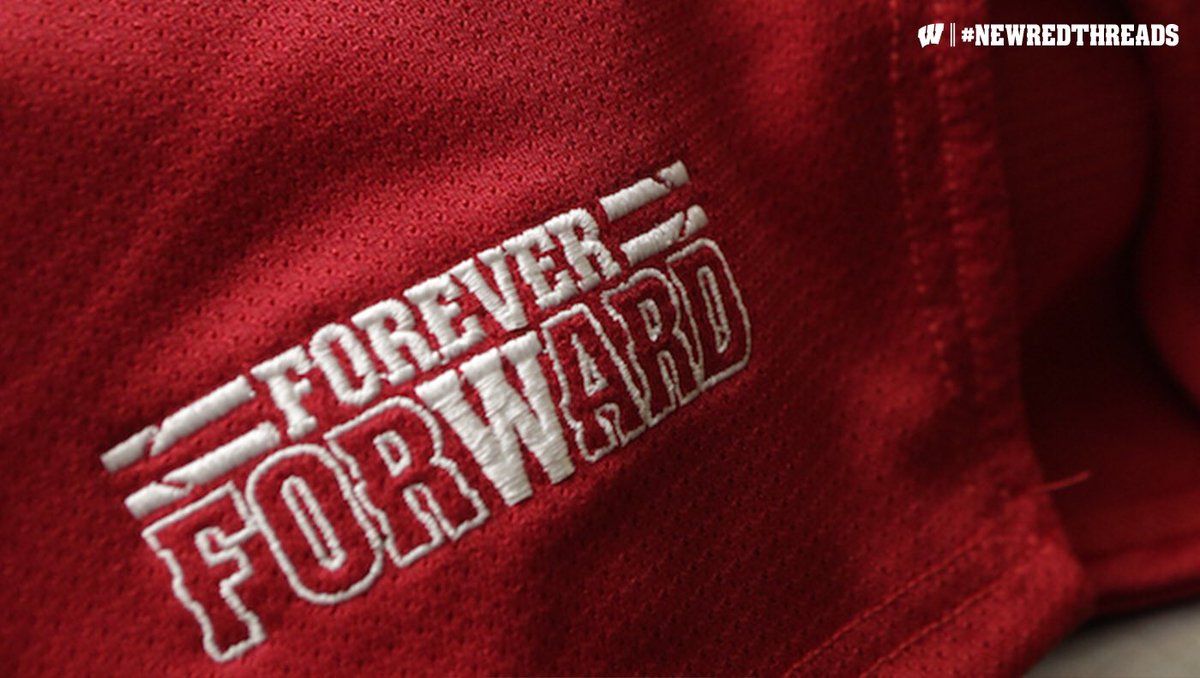
    • The “arrows on the jersey, pants, helmet reflect the idea of being ‘Forever Forward’ inspired by our state motto: Forward,” as the Badgers said on Twitter.
    • On the pants, Under Armour’s logo replaces Adidas’s.

    https://vine.co/v/5mZzI3u6Tn7/embed/simplehttps://e .vine.co/static/scripts/embed.js

    Paul Lukas helpfully shows old vs. new:

    The “forward” arrows and the state outline are a nice touch, though more than one observer has noticed the similarity between the arrows and the old Oldsmobile logo …

    … not that GM is using it anymore.

    Other than that, the changes are not revolutionary, and that was to be expected.

    Share this on …

    • Share on X (Opens in new window) X
    • Share on Facebook (Opens in new window) Facebook
    • Share on LinkedIn (Opens in new window) LinkedIn
    • Email a link to a friend (Opens in new window) Email
    • Print (Opens in new window) Print
    Like Loading…
    No comments on Bucky Under Armour
  • Our unfunny funny world

    August 5, 2016
    media, US politics

    P.J. O’Rourke was interviewed by Business Insider while (or “whilst” in Britenglish) in Australia:

    BUSINESS INSIDER: We’ve seen this radicalisation of disaffected youths around the world. And they can now cloak themselves in this mantle of radical Islam.

    P.J. O’ROURKE: What we’re seeing is mental illness, branded. You’ve got the usual moody loner with a handgun, who desires to kill a lot of people. But, especially if they fit into certain demographic categories, you have a brand for this thing. You have cheerleaders. So imagine those two horrible kids at Columbine High School, having a whole group of pretty well-organised, and pretty well-funded adults cheering them on. [Shivers]

    BI: We’re seeing it in the likes of San Bernadino and Nice, with this horrendous truck attack from a guy who apparently spent just weeks putting the whole thing together. Is there any way that the political establishment now works, and these networks of radicalisers both on the ground but also on the internet, is there any way to fight it?

    O’ROURKE: Probably no very effective way. This isn’t unprecedented. About 100 years ago, a little more, we went through a period of this with the anarchists. There were these anarchist cells, often the cell consisting of one crazy person. They had been radicalised through that relatively new and uncontrolled medium known as “print”. There were an incredible number of assassinations and terror attacks. President McKinley was killed by an anarchist. There were a couple of crown heads in corners of Europe, and most famously Sarajevo in 1914 [with the assassination of Franz Ferdinand, which eventually led to WWI]. That didn’t end well. In those days, before civil rights had been invented, as you can well imagine the police operations in places like Germany, and France, and for that matter Britain, were after these people with everything that they could get – and not being nice about it, I’m sure. It seemed to burn out of its own accord. One can’t say it was crushed – the only people that ever killed any number of anarchists were relatively harmless anarchists killed by the communists as they shared the good side in the Spanish Civil War.

    But yeah, I don’t see a very effective way to fight this. It would be helpful to nip it off at its source. That wouldn’t make it go away. But I wonder if the time has perhaps passed for any concerted effort to be made…

    BI: … given what’s happened where, for example, ISIS is actually on the run in a lot of parts of Iraq.

    O’ROURKE: They are. Which only makes them more desperate, and dangerous. But, the situation with Russia and the situation with Turkey, the situation in Iraq itself makes it very hard. I suppose one could say in an ideal world, that NATO powers get together and physically invade and put this place under administration. I don’t see current governments having the nerve for that. Do they have the budget for it? And then of course there’s the outrage and chaos that it would cause. And as we know from the invasion of Iraq, there are the unintended consequences.

    Sometimes, I think everybody who’s a journalist, let alone a humourist, must feel this: God I’m glad I don’t have to decide these things. I’m so glad I can just stand on the sidelines and tell everybody they’re wrong!

    BI: Just tell everybody that this is what’s happening in the world.

    O’ROURKE: And then take a little time to tell everybody “I told you so”.

    BI: So, over your career, you’ve been a champion for the rejection of the political establishment.

    O’ROURKE: Yes. I’m seeing my dreams come true, aren’t I?

    BI: Well this is it. We’ve had what’s happen in the UK, the Republicans have found themselves in the situation that they have…

    O’ROURKE: God.

    BI: … and in Australia we’ve just seen a record vote for independents.

    O’ROURKE: Yes, I noticed that. It’s a world-wide populist revolt against the elites going on. You have a very mild form of it here. But Zika, too, has mild symptoms.

    For those of us who have been battering the elites for their foolish policy decisions, there’s a Hilaire Belloc poem about a little boy who gets eaten by a tiger at a zoo, or a lion, and the end of it is:

    Always keep a-hold of Nurse,
    For fear of finding something worse.

    So, bad as our political leaders and elites are, at least they’re not crazy. So we must be very careful. Yes! By all means, we should get rid of them, replace them – but we’ve got to be very careful about how we do it.

    BI: I’m sure you’re going to be asked this question a million times while you’re here, but can you talk about Trump? What has happened?

    O’ROURKE: Well, it is a populist frustration. The most evident part of it would be, the ugliest part of it, is obviously there are people in the United States uncomfortable with the way the United States is changing, and not uncomfortable with the bad ways the United States is changing, which for me would be the phenomenal growth of national debt, our huge budget deficit, and some central bank policy that doesn’t make any sense to me whatsoever: not quite negative interest rates, but we’re verging on it.

    [Negative interest rates are] a great message to send society: save up, and we’ll take a little bit of it. I mean, after we’ve taken a bunch of it before you save it, then you save it, and we’ll take a little more. Great. Good idea!

    Anyway, of course America’s changing demographically, becoming more diverse, whatever that means. All sorts of behaviour that was previously sub rosa is now right out in the open. And certain people are being quite cranky about this. But I don’t think that’s the core of Trump’s support. That’s the noisiest and ugliest part of Trump’s support, and that’s what attracts our attention as reporters, from the “it bleeds, it leads” principle.

    Underlying support, and what will actually get him the votes that he will get, is just an overall frustration with the size and scope and intrusiveness of government. When I interviewed Trump supporters in New Hampshire, they went almost immediately to things like local permitting, which the President of the United States has actually zero effect on. Some guy who owned a gas station talking about his inability to get the permits to replace his old tanks, or put new tanks in. He couldn’t do anything.

    Somebody else was talking about – and this comes closer to the presidential election – such things like Obamacare. He says nobody in government, when they think up these programs, thinks about that load of paperwork that lands on my desk. He said: “It’s me and my wife. I don’t have an HR department. I don’t have a services department. I don’t have any of that. It’s time away from my business. I’ve got to sit there and figure it out.”

    And this guy, he owned a tow-truck operation. Not a paperwork sort of guy.

    The fury is partly about the weight and intrusiveness of government just being felt everywhere. You can’t turn around without endangering a species, without violating some new health regulation. And then at the same time, it’s also – and this is where I think you see it more over on the left, with Bernie Sanders – you build this bigger and bigger and bigger government that’s in charge of more and more and more things, so there are more ways for it to disappoint you. You’re looking to the government to fix everything.

    BI: You get that sense of ‘government is everywhere’, and when you have problems you run to them…

    O’ROURKE: And you can’t find them. And again, one of the Trump supporters said to me, I’ve got this problem, I’ve got that problem, and he said, “I turn on the television to see the politicians and all they’re talking about is transgender bathrooms.”

    He was a timber guy. He said: “We work in the woods. We don’t have any bathrooms! Why could this possibly be an issue?”

    BI: Do you know about our pub laws here in Sydney?

    O’ROURKE: I don’t.

    BI: A few years ago, a couple of people were killed by being punched in the head. They fell over, their heads hit the pavement and they died. The government introduced these licensing laws. You can’t go into a bar in Sydney after 1.30am, and at 3am it’s last drinks everywhere. Some people are concerned about what this says about a global city…

    O’ROURKE: So if you’re in there you can stay in there?

    BI: Yes.

    O’ROURKE: Actually don’t you think that around about 1.30am is when you’d want some new blood? The people who are in there at 1.30am should probably go home. Let the late shift come on.

    BI: You’re also not able to serve shots after 11pm and all bottle sales shut at 10pm. The government has been very insistent on this. They’re a conservative government – the state premier, Mike Baird, is a very family-oriented Christian from the Liberal party.

    O’ROURKE: Well, the left is not alone in wanting to make a political issue out of all sorts of private things. But you’re talking to a person who comes from a country with absolutely insane liquor laws which not only vary by state, but they can vary by county and township, and city, and every other jurisdiction you can think of. After our really ill-advised experiment with national prohibition, the price that the government payed for repealing that federal law was to cede local control over all the liquor laws. It’s straightened out a little bit, but from city to city you never know. There are places where the bars close at midnight; there are places where the bars close at 4am. You don’t know. There’s almost no place in the United States where you can take a bottle off a premise. You have to go to a special liquor store which is sometimes owned by the state! In New Hampshire, for instance. And it’s open all sort of hours that you don’t drink!

    Politicians cannot resist fixing things. Two people died from hitting their head on the kerb? It’s a wonder you don’t have foam kerbs. That’ll be the next idea: people don’t kill people; kerbs do.

    BI: He also banned greyhound racing a few weeks ago because there was a report that exposed cruelty in the industry.

    O’ROURKE: Yeah, dog-racing people are not known for the fabulous ways they treat their dogs. There are places in the United States where it’s banned for much the same reason. And there are also sort of rescue groups to bring home tired old greyhounds that have slowed down. Apparently they make very nice pets.

    The example, and I use this in one of the speeches I’m going to give, is that the abolition of slavery was almost entirely – of course, the British government got involved – but the campaign to abolish slavery was a private social movement. It was started by the Quakers at the end of the 18th century. Quakers, as dissenters at that time, could not stand for parliament so they possessed very little political influence. The abolition societies, the anti-slavery societies that were set up in Britain – their biggest supporters were working men from the new industrial revolution, and women. Of course, there were still property qualifications on the franchise, and of course women still didn’t have the vote, so neither of those of those groups had any political power. And yet, it moved forward. And it moved forward to the point where not only were all the slaves, at least in theory, in the British Empire were freed, but the British Navy was brought in to fight the slave trade where it was being conducted between countries where it was legal. So here was an incredibly important issue – much more important than people hitting their heads on kerbs after pubs should be closed – this was one of the crucial moral issues of all of western civilisation, and essentially the force that changed it was private, not a governmental force.

    Nowadays, anything happens – [like] there’s not enough bathrooms for people who don’t know what bathroom to go to – and there are street demonstrations. People want the government to fix this. And of course the government does have to get involved in certain issues, but people don’t look to their own power. Certain states that failed to pass gay marriage laws in the United States have found themselves being boycotted by commercial organisations… it’s incredibly effective.

    BI: You endorsed – I listened to a very funny clip from NPR…

    O’ROURKE: … Where I endorsed Hillary.

    BI: If she wins, America will have elected a black president followed by its first woman president. Now, even if they’re both Democrats, doesn’t that say something really great about the country?

    Well, with women, no, not particularly. We’ve had plenty of strong women leaders all over the world and they’ve proved to be no different in any respect that I can recall. They’re very different from each other but were they better or worse than men? Well, Indira Gandhi. Mao’s wife…

    (But) power – we know this from Queen Elizabeth I! Power doesn’t have a gender. I’m sorry. Power is power. We know this from Roman times. So I stand unimpressed.

    But, being old enough to have gone through – personally to have seen and been around for the ugliest part of the civil rights movement in the United States when churches were being bombed and little kids were being killed – it was just horrible. Horrible. To see my country move from that – and this was only the early to mid-60s – to electing a black man president: that’s pretty cool. You know, I thought that was great. I’ve no affection for the guy’s policies or ideas. Not only do I think he’s wrong about his politics but he’s also wrong about – he’s worse than rational. He’s a raciocinator. He is a great reminder of why it was that Spock was not in charge of the Starship Enterprise. You know, Spock was obviously much smarter, by magnitudes, and yet notice who was captain. It was no accident.

    But the fact of him being elected obviously indicated a sea change in the country. And so, actually, did the opposition to him, which was mostly based on his being this smart-ass, hippy-dippie, Harvard lawyer. (Well, he wasn’t hippy-dippie, but his mother – complete crackpot; raised in Hawaii, you know.) But the opposition to him really was something I had seen coming in America: is there anybody left in America so racist that they’d be worried about their child marrying one of Colin Powell’s children? Well no. Come down to it: basically not.

    BI: Your book has been an opportunity to look back at your collected works. I’m mind-reading here – crazy guess – but it gives you an opportunity to reflect on some of the changes you’ve seen. So for you, looking back over all of that, was there anything that stood out for you, in terms of the big shifts?

    O’ROURKE: No. I compiled that book before we started to undergo what seems like what seems like a fairly alarming global shift. But of course there were big things – I mean who can forget the Berlin Wall coming down? That was just amazing to have lived one’s whole life in this cold war paradigm, and to see it just crumble – literally, crumble and fall down. That was absolutely amazing.

    So I take that back. Yes, that was an obvious thing. But something is going on right now that I think is going to possibly prove as important. But we don’t fully know what it is yet. It’s still kind of early days. Maybe it will peter out. Maybe people will, sort of, come to their senses. Because, when you’re talking about populism: the government in China has got a populist edge to it; Putin, of course, even ISIS and Islamic radicalism – there’s a populist side to all of this. We’re in a moment – it’s like the whole world [is involved]. And you talk about the United States politics: we’re having our Latin American moment, and looking around for the strong man. And in typical Latin American fashion, we’re looking around for the hilarious strong man.

    People compare Trump to – Hitler of course is out of the question – but they compare him to the likes of Mussolini or Franco, or so on. Forget about it. He’s nowhere near that. Peron is the person that he should be compared to. Franco particularly had a coherent vision of the kind of Fascist, Catholic Fascist society that he wanted to produce. And Mussolini was a little bit all over the map, but he was much more politically coherent [than Trump]. Of course communists knew exactly what they wanted, and Hitler too, I suppose.

    And the hilarious thing about America, with a very large Hispanic population, having its Latin-American moment is it’s not the Hispanics’ fault! The two Hispanics involved in the race are adamantly opposed to Trump. So you can’t blame this on some sort of influence from immigrants.

    BI: Just to pick up on what you said about China. China has been on this really interesting project. In some ways they’ve downloaded the communist manual and said, “Here’s how we go about running a government and a society”. But over the last two presidents they’ve begun this process of looking at whether markets are a good thing, maybe getting foreign investment and allowing people to travel might help. And they’ve engaged in this huge urbanisation of society involving eye-watering amounts of money in order to move people from the country into the city and build this industrial society. And they’ve grown the middle class pretty successfully; GDP is still is still growing at 6.7% …

    O’ROURKE: Yeah, we should be half that lucky…

    BI: So what do you see when you look at that? Because one of the things that history teaches us is that when those big authoritarian regimes fall, it tends to be pretty spectacular.

    O’ROURKE: It wasn’t so much so in eastern Europe, central Europe. You had the velvet revolution in Czechoslovakia… it doesn’t seem to be pre-ordained that communism is followed by chaos. But I actually think it’s better to put the communism aside and look at the power dynamics. Politicians want all the wealth that freedom gives, but they want all the power that totalitarianism has. Forget Peron – here we look at Germany and Italy between the wars and we see at least for a while totalitarianism and capitalism can co-exist. And this is not a happy message. My libertarian principles tell me they can’t, but my eyes tell me that they can.

    Now, it can’t go on forever. Because, the rise of a class that has enormous commercial power, financial power, and no political power is going to cause [pauses] … trouble. And sooner or later, China’s going to have to face up to that.

    The income divide in that country: you go 50 miles outside of any Chinese city, you’re in another millennium. There are people still living there, in houses the size of this couch, with the pig! The poverty’s incredible. It’s African. Not as disorganised – because it’s China – not as disorganised or as violent, but the actual per capita income in rural China is down around Tanzania. And so, sooner or later, you’d think, that they’re headed for trouble. And they of course are trying to figure out some formula where and totalitarian power co-exist.

    BI: It’ll be interesting.

    O’ROURKE: Yeah. I wish them really ill. I really hope that doesn’t work out for them.

    BI: One of the things that Australian conservatives love is the monarchy.

    O’ROURKE: You know to an outsider – what earthly difference would it possibly make whether you were a republic or you weren’t? I mean, you’re fully self-governing. The Queen has no say on anything except I guess your honours list. Doesn’t she sign off on that or something? You know, look at some of the stupid things that other people have on their coins. You’ve got something to put on your coins. A picture of a lady – got it covered. You’ve got a cool flag – I mean, look at Canada. They gave up their flag, and what they got was a beach towel.

    So yeah, I’ve no sympathy for the republican side of things. I can’t imagine what benefit would accrue from not showing respect to this utterly powerless monarch far away.

    BI: One of the things you’ve written is that part of conservatism is about not liking change.

    O’ROURKE: As one gets older, even very left-wing people become conservatives as they get older because all change – it all comes with a price. You’ve got this damn phone you don’t know how to work, the kids won’t get their faces out of them – all change is annoying. So yeah, there’s an element of conservatism that says “be wary of change”.

    And this is one of the reasons that I’m a conservative libertarian. Precisely this rise in populism – theoretically from a libertarian point of view it could be a great thing – but I’m not seeing the actuality of greatness.

    Also, if you become a republic: “For Queen and country” – what do you replace that with? “For country and country”? “For country and som’n”? “For country and whatever”? It doesn’t make any sense.

    BI: Do you think the digital age and the way that the way that markets and consumers have been connected – including whole ability for ideas to travel – do you see there’s been any great social change out of that?

    O’ROURKE: Not any great good social change. It seems like the only ideas that travel are stupid ideas. It seems to be as hard as ever to transport intelligent ideas. I was talking to somebody last night about this: when I wrote my book about Adam Smith, which was about 10 years ago, I was arguing that people still didn’t seem to get what Adam Smith was saying. And it gets worse than that now. It’s like everybody’s going to have completely re-learn Adam Smith. They’re just. Not. Getting it. So has the internet done anything to disseminate really good ideas? Not that I can see.

    BI: So what is the main thing Adam Smith laid out that people need to re-learn?

    O’ROURKE: First and foremost, that the attempt to better one’s own condition is a good thing. And it’s amazing how many people don’t really think it’s a good thing. Bernie Sanders, just to start. The desire to improve your material condition – there’s no sin or taboo involved there. The second thing is division of labour. And again – not so much Bernie Sanders because he’s an old-fashioned Marxist – but there are a lot of idealistic young kids that think it would be great to go make your own apple sauce and grow your own goats and make your own cheese and make your own energy and so on. They’re nuts. There’s somebody out there who knows about goats. There’s electric wire, right over here.

    And of course the third is free trade. And we’re seeing this angry rebellion against free trade right now. I’ve got a friend who’s a risk manager for a big insurance company back in the United States. He thinks what’s going on in the world has to do as much with anything with not so much what has been happening in the economy and what has been happening in technology, but how fast it has been happening. He said, “We don’t want to stop it.” But he said, “Maybe we should thing about how to slow it down, because things are happening so fast that people cannot adjust to them.” And jobs can seemingly disappear, and other jobs come on. And I agree with him, but I don’t see any practical way to slow those things down. I can see how you could try to stand in their way, but we all know that trade protectionism is just disastrous. It just makes people poor.

    I’m not someone to advocate government action in most cases, but governments do have to be alert about the dislocations these things cause. And how to help is always a serious problem.

    I was down in Mexico – not really covering, because you couldn’t really find them – but hanging around in Chiapas when the Zapatistas were in rebellion. And I never did manage to get in touch with the Zapatistas, and since all they would do would be talk my ear off with harebrained Trotskyism, that was fine. The one thing I discovered, hanging around indigenous people in Chiapas, who I’ve gotta say didn’t seem very different from anybody else – but I was assured by people who were supposed to know that they were indigenous people – well, NAFTA had just crapped on them. And it was corn prices.

    Those of them who were not involved in growing drugs – the nicer, more decent, perhaps a little dumber people – were still growing their corn. And they were getting wiped out by cheap corn imports from the United States. And I thought, should they be compensated? How would you compensate them? Mexico (a) doesn’t have any money and (b) is terribly corrupt. Even if you set aside money for the Indian corn-growers in the mountains of Chiapas, it’s not going to get to them. [I realised] What they need is one of those marketers that come down from some fancy restaurant in San Francisco and talk to them about GMO food, heritage breeds of corn, loc-avore, etc. “We can make this corn so expensive… ”. That’s what they needed! But how do you get government to do that?

    BI: Economists, and the reputation of econometrics, took a huge pummelling for a few years.

    O’ROURKE: For good reason.

    BI: How do you see where the reputation of Wall Street, high finance, and economists as a species?

    O’ROURKE: Alfred Marshall said: Use mathematics only as a shorthand. Translate the mathematics into English. Use examples from daily life to illustrate the points that you’re making, in English. Burn the mathematics. We forgot to burn the mathematics.

    So many things look good on paper, and one was collateralised mortgage obligations. Great, great idea. You take this melting pot – and people have to have a house, housing prices may go up and down – but you take these higher risk mortgages, mix them all together from different regions and different economies, and you should end up with a product with a very low volatility. And you should have a high-yield product.

    Somebody wasn’t thinking about the human tendency to cheat. And the fact that, one of the problems with mixing mortgage obligations on an investment circumstance, let alone turning it into a collateralised product, is that transparency is absolutely necessary in the mortgage business. You have got to who has got that house, and what kind of care they’re taking of it…

    BI: … and what they’re doing when they’re not sleeping …

    O’ROURKE: Precisely! Everything. A mortgage is just not a good blind investment. It’s not a commodity. But because mathematically, you could treat it like a commodity, they would just – it’s a little bit like the VIX index, the volatility index. I’ve got a friend on commodity exchange in Chicago and he took down, invited me to come speak at a convention with all of these people involved in the volatility index, all the analysts and stuff. All Greek letters and [I had] no idea what they were talking about. In fact, I didn’t really realise until he explained it to me, that you could buy and sell volatility. And I said: “Jay, I didn’t understand what any of these people were saying, and all these way of measuring risk – I didn’t understand them.”

    And Jay said [in a darkened voice]: “If you could measure risk, it wouldn’t be risk.”

    Somebody forgot that where we were thinking up all these derivatives. You know people think derivatives are so complicated – it’s not complicated at all. Once you make a contract with somebody, you can then buy and sell that contract. And you and I can make a contract that’s as elaborate and complicated as contracts sometimes are. But then, once we’re done, we can sell that contract. But to start doing these deals where you don’t know where the correspondent is, they’re utterly opaque… I guess to judge from The Big Short, some bells did go off in some people’s minds, but not enough. People were just making so much money off these things.

    BI: P.J., thanks for a fascinating chat.

    O’ROURKE: You’re welcome. I’ll leave you with this. I met a guy in the States, who was another one of the few people that saw this coming. He bet heavily against the mortgage market. He made $1 billion for himself, and about $4 billion for his clients. He says next is currency collapse. I mean, he’s only been right once, but he was very, very right.

    BI: Does he mean not the US dollar but other currencies?

    He’s not even happy about the US dollar. You know, fiat currency doesn’t really make any sense whatsoever, and they’re just pumping it out. And you ask them: “Why is a dollar worth a dollar?”

    [Voice darkens again.] “Because it is. We said it was.”

    Share this on …

    • Share on X (Opens in new window) X
    • Share on Facebook (Opens in new window) Facebook
    • Share on LinkedIn (Opens in new window) LinkedIn
    • Email a link to a friend (Opens in new window) Email
    • Print (Opens in new window) Print
    Like Loading…
    No comments on Our unfunny funny world
Previous Page
1 … 608 609 610 611 612 … 1,042
Next Page

Website Powered by WordPress.com.

Steve Prestegard.com: The Presteblog

The thoughts of a journalist/libertarian–conservative/Christian husband, father, Eagle Scout and aficionado of obscure rock music. Thoughts herein are only the author’s and not necessarily the opinions of his family, friends, neighbors, church members or past, present or future employers.

  • Steve
    • About, or, Who is this man?
    • Facebook
    • Twitter
    • Adventures in ruralu0026nbsp;inkBack in June 2009, I was driving somewhere through a rural area. And for some reason, I had a flashback to two experiences in my career about that time of year many years ago. In 1988, eight days after graduating from the University of Wisconsin, I started work at the Grant County Herald Independent in Lancaster as a — well, the — reporter. Four years after that, on my 27th birthday, I purchased, with a business partner, the Tri-County Press in Cuba City, my first business venture. Both were experiences about which Wisconsin author Michael Perry might write. I thought about all this after reading a novel, The Deadline, written by a former newspaper editor and publisher. (Now who would write a novel about a weekly newspaper?) As a former newspaper owner, I picked at some of it — why finance a newspaper purchase through the bank if the seller is willing to finance it? Because the mean bank lender is a plot point! — and it is much more interesting than reality, but it is very well written, with a nicely twisting plot, and quite entertaining, again more so than reality. There is something about that first job out of college that makes you remember it perhaps more…
    • Adventures in radioI’ve been in the full-time work world half my life. For that same amount of time I’ve been broadcasting sports as a side interest, something I had wanted to since I started listening to games on radio and watching on TV, and then actually attending games. If you ask someone who’s worked in radio for some time about the late ’70s TV series “WKRP in Cincinnati,” most of them will tell you that, if anything, the series understated how wacky working in radio can be. Perhaps the funniest episode in the history of TV is the “WKRP” episode, based on a true story, about the fictional radio station’s Thanksgiving promotion — throwing live turkeys out of a helicopter under the mistaken belief that, in the words of WKRP owner Arthur Carlson, “As God is my witness, I thought turkeys could fly.” [youtube=http://www.youtube.com/watch?v=ST01bZJPuE0] I’ve never been involved in anything like that. I have announced games from the roofs of press boxes (once on a nice day, and once in 50-mph winds), from a Mississippi River bluff (more on that later), and from the front row of the second balcony of the University of Wisconsin Fieldhouse (great view, but not a place to go if…
    • “Good morning/afternoon/evening, ________ fans …”
    • My biggest storyEarlier this week, while looking for something else, I came upon some of my own work. (I’m going to write a blog someday called “Things I Found While Looking for Something Else.” This is not that blog.) The Grant County Sheriff’s Department, in the county where I used to live, has a tribute page to the two officers in county history who died in the line of duty. One is William Loud, a deputy marshal in Cassville, shot to death by two bank robbers in 1912. The other is Tom Reuter, a Grant County deputy sheriff who was shot to death at the end of his 4 p.m.-to-midnight shift March 18, 1990. Gregory Coulthard, then a 19-year-old farmhand, was convicted of first-degree intentional homicide and is serving a life sentence, with his first eligibility for parole on March 18, 2015, just 3½ years from now. I’ve written a lot over the years. I think this, from my first two years in the full-time journalism world, will go down as the story I remember the most. For journalists, big stories contain a paradox, which was pointed out in CBS-TV’s interview of Andy Rooney on his last “60 Minutes” Sunday. Morley Safer said something along the line…
  • Food and drink
    • The Roesch/Prestegard familyu0026nbsp;cookbookFrom the family cookbook(s) All the families I’m associated with love to eat, so it’s a good thing we enjoy cooking. The first out-of-my-house food memory I have is of my grandmother’s cooking for Christmas or other family occasions. According to my mother, my grandmother had a baked beans recipe that she would make for my mother. Unfortunately, the recipe seems to have  disappeared. Also unfortunately, my early days as a picky, though voluminous, eater meant I missed a lot of those recipes made from such wholesome ingredients as lard and meat fat. I particularly remember a couple of meals that involve my family. The day of Super Bowl XXXI, my parents, my brother, my aunt and uncle and a group of their friends got together to share lots of food and cheer on the Packers to their first NFL title in 29 years. (After which Jannan and I drove to Lambeau Field in the snow,  but that’s another story.) Then, on Dec. 31, 1999, my parents, my brother, my aunt and uncle and Jannan and I (along with Michael in utero) had a one-course-per-hour meal to appropriately end years beginning with the number 1. Unfortunately I can’t remember what we…
    • SkålI was the editor of Marketplace Magazine for 10 years. If I had to point to one thing that demonstrates improved quality of life since I came to Northeast Wisconsin in 1994, it would be … … the growth of breweries and  wineries in Northeast Wisconsin. The former of those two facts makes sense, given our heritage as a brewing state. The latter is less self-evident, since no one thinks of Wisconsin as having a good grape-growing climate. Some snobs claim that apple or cherry wines aren’t really wines at all. But one of the great facets of free enterprise is the opportunity to make your own choice of what food and drink to drink. (At least for now, though some wish to restrict our food and drink choices.) Wisconsin’s historically predominant ethnic group (and our family’s) is German. Our German ancestors did unfortunately bring large government and high taxes with them, but they also brought beer. Europeans brought wine with them, since they came from countries with poor-quality drinking water. Within 50 years of a wave of mid-19th-century German immigration, brewing had become the fifth largest industry in the U.S., according to Maureen Ogle, author of Ambitious Brew: The Story of American Beer. Beer and wine have…
  • Wheels
    • America’s sports carMy birthday in June dawned without a Chevrolet Corvette in front of my house. (The Corvette at the top of the page was featured at the 2007 Greater Milwaukee Auto Show. The copilot is my oldest son, Michael.) Which isn’t surprising. I have three young children, and I have a house with a one-car garage. (Then again, this would be more practical, though a blatant pluck-your-eyes-out violation of the Corvette ethos. Of course, so was this.) The reality is that I’m likely to be able to own a Corvette only if I get a visit from the Corvette Fairy, whose office is next door to the Easter Bunny. (I hope this isn’t foreshadowing: When I interviewed Dave Richter of Valley Corvette for a car enthusiast story in the late great Marketplace Magazine, he said that the most popular Corvette in most fans’ minds was a Corvette built during their days in high school. This would be a problem for me in that I graduated from high school in 1983, when no Corvette was built.) The Corvette is one of those cars whose existence may be difficult to understand within General Motors Corp. The Corvette is what is known as a “halo car,” a car that drives people into showrooms, even if…
    • Barges on fouru0026nbsp;wheelsI originally wrote this in September 2008.  At the Fox Cities Business Expo Tuesday, a Smart car was displayed at the United Way Fox Cities booth. I reported that I once owned a car into which trunk, I believe, the Smart could be placed, with the trunk lid shut. This is said car — a 1975 Chevrolet Caprice coupe (ours was dark red), whose doors are, I believe, longer than the entire Smart. The Caprice, built down Interstate 90 from us Madisonians in Janesville (a neighbor of ours who worked at the plant probably helped put it together) was the flagship of Chevy’s full-size fleet (which included the stripper Bel Air and middle-of-the-road Impala), featuring popular-for-the-time vinyl roofs, better sound insulation, an upgraded cloth interior, rear fender skirts and fancy Caprice badges. The Caprice was 18 feet 1 inch long and weighed 4,300 pounds. For comparison: The midsize Chevrolet of the ear was the Malibu, which was the same approximate size as the Caprice after its 1977 downsizing. The compact Chevrolet of the era was the Nova, which was 200 inches long — four inches longer than a current Cadillac STS. Wikipedia’s entry on the Caprice has this amusing sentence: “As fuel economy became a bigger priority among Americans…
    • Behind the wheel
    • Collecting only dust or rust
    • Coooooooooooupe!
    • Corvettes on the screen
    • The garage of misfit cars
    • 100 years (and one day) of our Chevrolets
    • They built Excitement, sort of, once in a while
    • A wagon by any otheru0026nbsp;nameFirst written in 2008. You will see more don’t-call-them-station-wagons as you drive today. Readers around my age have probably had some experience with a vehicle increasingly rare on the road — the station wagon. If you were a Boy Scout or Girl Scout, or were a member of some kind of youth athletic team, or had a large dog, or had relatives approximately your age, or had friends who needed to be transported somewhere, or had parents who occasionally had to haul (either in the back or in a trailer) more than what could be fit inside a car trunk, you (or, actually, your parents) were the target demographic for the station wagon. “Station wagons came to be like covered wagons — so much family activity happened in those cars,” said Tim Cleary, president of the American Station Wagon Owners Association, in Country Living magazine. Wagons “were used for everything from daily runs to the grocery store to long summer driving trips, and while many men and women might have wanted a fancier or sportier car, a station wagon was something they knew they needed for the family.” The “station wagon” originally was a vehicle with a covered seating area to take people between train stations…
    • Wheels on theu0026nbsp;screenBetween my former and current blogs, I wrote a lot about automobiles and TV and movies. Think of this post as killing two birds (Thunderbirds? Firebirds? Skylarks?) with one stone. Most movies and TV series view cars the same way most people view cars — as A-to-B transportation. (That’s not counting the movies or series where the car is the plot, like the haunted “Christine” or “Knight Rider” or the “Back to the Future” movies.) The philosophy here, of course, is that cars are not merely A-to-B transportation. Which disqualifies most police shows from what you’re about to read, even though I’ve watched more police video than anything else, because police cars are plain Jane vehicles. The highlight in a sense is in the beginning: The car chase in my favorite movie, “Bullitt,” featuring Steve McQueen’s 1968 Ford Mustang against the bad guys’ 1968 Dodge Charger: [youtube=http://www.youtube.com/watch?v=GMc2RdFuOxIu0026amp;fmt=18] One year before that (but I didn’t see this until we got Telemundo on cable a couple of years ago) was a movie called “Operación 67,” featuring (I kid you not) a masked professional wrestler, his unmasked sidekick, and some sort of secret agent plot. (Since I don’t know Spanish and it’s not…
    • While riding in my Cadillac …
  • Entertainments
    • Brass rocksThose who read my former blog last year at this time, or have read this blog over the past months, know that I am a big fan of the rock group Chicago. (Back when they were a rock group and not a singer of sappy ballads, that is.) Since rock music began from elements of country music, jazz and the blues, brass rock would seem a natural subgenre of rock music. A lot of ’50s musical acts had saxophone players, and some played with full orchestras … [youtube=http://www.youtube.com/watch?v=9CPS-WuUKUE] … but it wasn’t until the more-or-less simultaneous appearances of Chicago and Blood Sweat u0026amp; Tears on the musical scene (both groups formed in 1967, both had their first charting singles in 1969, and they had the same producer) that the usual guitar/bass/keyboard/drum grouping was augmented by one or more trumpets, a sax player and a trombone player. While Chicago is my favorite group (but you knew that already), the first brass rock song I remember hearing was BSu0026amp;T’s “Spinning Wheel” — not in its original form, but on “Sesame Street,” accompanied by, yes, a giant spinning wheel. [youtube=http://www.youtube.com/watch?v=qi9sLkyhhlE] [youtube=http://www.youtube.com/watch?v=OxWSOuNsN20] [youtube=http://www.youtube.com/watch?v=U9U34uPjz-g] I remember liking Chicago’s “Just You ‘n Me” when it was released as a single, and…
    • Drive and Eat au0026nbsp;RockThe first UW home football game of each season also is the opener for the University of Wisconsin Marching Band, the world’s finest college marching band. (How the UW Band has not gotten the Sudler Trophy, which is to honor the country’s premier college marching bands, is beyond my comprehension.) I know this because I am an alumnus of the UW Band. I played five years (in the last rank of the band, Rank 25, motto: “Where Men Are Tall and Run-On Is Short”), marching in 39 football games at Camp Randall Stadium, the Hubert H. Humphrey Metrodome in Minneapolis, Michigan Stadium in Ann Arbor, Memorial Stadium at the University of Illinois (worst artificial turf I had ever seen), the University of Nevada–Las Vegas’ Sam Boyd Silver Bowl, the former Dyche Stadium at Northwestern University, five high school fields and, in my one bowl game, Legion Field in Birmingham, Ala., site of the 1984 Hall of Fame Bowl. The UW Band was, without question, the most memorable experience of my college days, and one of the most meaningful experiences of my lifetime. It was the most physical experience of my lifetime, to be sure. Fifteen minutes into my first Registration…
    • Keep on rockin’ in the freeu0026nbsp;worldOne of my first ambitions in communications was to be a radio disc jockey, and to possibly reach the level of the greats I used to listen to from WLS radio in Chicago, which used to be one of the great 50,000-watt AM rock stations of the country, back when they still existed. (Those who are aficionados of that time in music and radio history enjoyed a trip to that wayback machine when WLS a Memorial Day Big 89 Rewind, excerpts of which can be found on their Web site.) My vision was to be WLS’ afternoon DJ, playing the best in rock music between 2 and 6, which meant I wouldn’t have to get up before the crack of dawn to do the morning show, yet have my nights free to do whatever glamorous things big-city DJs did. Then I learned about the realities of radio — low pay, long hours, zero job security — and though I have dabbled in radio sports, I’ve pretty much cured myself of the idea of working in radio, even if, to quote WAPL’s Len Nelson, “You come to work every day just like everybody else does, but we’re playing rock ’n’ roll songs, we’re cuttin’ up.…
    • Monday on the flight line, not Saturday in the park
    • Music to drive by
    • The rock ofu0026nbsp;WisconsinWikipedia begins its item “Music of Wisconsin” thusly: Wisconsin was settled largely by European immigrants in the late 19th century. This immigration led to the popularization of galops, schottisches, waltzes, and, especially, polkas. [youtube=http://www.youtube.com/watch?v=yl7wCczgNUc] So when I first sought to write a blog piece about rock musicians from Wisconsin, that seemed like a forlorn venture. Turned out it wasn’t, because when I first wrote about rock musicians from Wisconsin, so many of them that I hadn’t mentioned came up in the first few days that I had to write a second blog entry fixing the omissions of the first. This list is about rock music, so it will not include, for instance, Milwaukee native and Ripon College graduate Al Jarreau, who in addition to having recorded a boatload of music for the jazz and adult contemporary/easy listening fan, also recorded the theme music for the ’80s TV series “Moonlighting.” Nor will it include Milwaukee native Eric Benet, who was for a while known more for his former wife, Halle Berry, than for his music, which includes four number one singles on the Ru0026amp;B charts, “Spend My Life with You” with Tamia, “Hurricane,” “Pretty Baby” and “You’re the Only One.” Nor will it include Wisconsin’s sizable contributions to big…
    • Steve TV: All Steve, All the Time
    • “Super Steve, Man of Action!”
    • Too much TV
    • The worst music of allu0026nbsp;timeThe rock group Jefferson Airplane titled its first greatest-hits compilation “The Worst of Jefferson Airplane.” Rolling Stone magazine was not being ironic when it polled its readers to decide the 10 worst songs of the 1990s. I’m not sure I agree with all of Rolling Stone’s list, but that shouldn’t be surprising; such lists are meant for debate, after all. To determine the “worst,” songs appropriate for the “Vinyl from Hell” segment that used to be on a Madison FM rock station, requires some criteria, which does not include mere overexposure (for instance, “Macarena,” the video of which I find amusing since it looks like two bankers are singing it). Before we go on: Blog posts like this one require multimedia, so if you find a song you hate on this blog, I apologize. These are also songs that I almost never listen to because my sound system has a zero-tolerance policy — if I’m listening to the radio or a CD and I hear a song I don’t like, it’s, to quote Bad Company, gone gone gone. My blonde wife won’t be happy to read that one of her favorite ’90s songs, 4 Non Blondes’ “What’s Up,” starts the list. (However,…
    • “You have the right to remain silent …”
  • Madison
    • Blasts from the Madison media past
    • Blasts from my Madison past
    • Blasts from our Madison past
    • What’s the matter with Madison?
    • Wisconsin – Madison = ?
  • Sports
    • Athletic aesthetics, or “cardinal” vs. “Big Red”
    • Choose your own announcer
    • La Follette state 1982 (u0022It was 30 years ago todayu0022)
    • The North Dakota–Wisconsin Hockey Fight of 1982
    • Packers vs. Brewers
  • Hall of Fame
    • The case(s) against teacher unions
    • The Class of 1983
    • A hairy subject, or face the face
    • It’s worse than you think
    • It’s worse than you think, 2010–11 edition
    • My favorite interview subject of all time
    • Oh look! Rural people!
    • Prestegard for president!
    • Unions vs. the facts, or Hiding in plain sight
    • When rhetoric goes too far
Privacy & Cookies: This site uses cookies. By continuing to use this website, you agree to their use.
To find out more, including how to control cookies, see here: Cookie Policy
  • Subscribe Subscribed
    • Steve Prestegard.com: The Presteblog
    • Join 197 other subscribers
    • Already have a WordPress.com account? Log in now.
    • Steve Prestegard.com: The Presteblog
    • Subscribe Subscribed
    • Sign up
    • Log in
    • Report this content
    • View site in Reader
    • Manage subscriptions
    • Collapse this bar
%d