Watching the ongoing clown show in Washington, Americans can be forgiven for asking themselves, “Why did we give this bunch of clowns so very much power over our nation and our lives?”
Well, don’t feel so bad, voters. Because you didn’t actually give them that much power. They just took it. That’s the thesis of Columbia Law Professor Philip Hamburger’s new book, The Administrative Threat, a short, punchy followup to his magisterial Is Administrative Law Unlawful? Both deal with the extraordinary — and illegitimate — power that administrative agencies have assumed in American life.
Hamburger explains that the prerogative powers once exercised by English kings, until they were circumscribed after a resulting civil war, have now been reinvented and lodged in administrative agencies, even though the United States Constitution was drafted specifically to prevent just such abuses. But today, the laws that actually affect people and businesses are seldom written by Congress; instead they are created by administrative agencies through a process of “informal rulemaking,” a process whose chief virtue is that it’s easy for the rulers to engage in, and hard for the ruled to observe or influence. Non-judicial administrative courts decide cases, and impose penalties, without a jury or an actual judge. And the protections in the Constitution and Bill of Rights (like the requirement for a judge-issued search warrant before a search) are often inapplicable.
As Hamburger writes, “Administrative power also evades many of the Constitution’s procedures, including both its legislative and judicial processes. Administrative power thereby sidesteps most of the Constitution’s procedural freedoms. Administrative power is thus all about the evasion of governance through law, including an evasion of constitutional processes and procedural rights.”
-
No comments on The deep state
-
This was a good day for the Beatles in 1970 … even though they were breaking up.
Their “Let It Be” album was at number one, as was this single off the album:
Don’t criticize the number one album today in 1980, lest you be condemned for living in “Glass Houses”:
-
The Wisconsin State Journal’s Chris Rickert takes the possible gubernatorial run of People’s Republic of Madison premier Paul Soglin seriously:
The last person the state Democratic Party sacrificed to one of Gov. Scott Walker’s finely tuned, soulless campaigns was a fresh face with a solid business background, deep pockets and good ideas who nevertheless couldn’t inspire passion among voters who needed to feel passionate for her to win.
Say what you want about Madison “mayor for life” and potential Walker challenger Paul Soglin — he ain’t Mary Burke.
Soglin’s thinking on why he might have a shot next year is understandable in an age when a pleasant fly-over state like ours gives a major-party primary win to an irascible 74-year-old Democratic Socialist from Vermont, and its 10 electoral votes to a darling of the alt-right who brags on tape about sexually assaulting women.
If Donald Trump and Bernie Sanders mean anything, it’s that conventional is out. The louder, less scripted and more fringe, the better.
Soglin in this calculus is obviously Sanders. Both are in their 70s and unapologetically leftist. Like Soglin, Sanders was once the mayor of a liberal city in a rural state.
The usual knock against Democrats from Madison is that they can’t win statewide election. The rest of the state, say the experts, is apparently not as enamored of Madison as Madisonians are.
But Sanders’ Wisconsin success could mean Soglin’s connection to Madison isn’t as much of a knock as it was — or maybe it’s not as big a knock as the experts think.
As UW-Milwaukee professor and former Democratic lawmaker Mordecai Lee pointed out, former governors Gaylord Nelson and Jim Doyle were from Madison, and so is U.S. Sen. Tammy Baldwin.
“So it’s not insurmountable,” he said.
Soglin is also not as easily stereotyped as the typical touchy-feely, identity-politics-obsessed Madison elitist. He’s recently been something of a city budget hawk — at least by Madison standards — and he’s been less interested in coddling trouble-making homeless people, excusing crime or dismissing personal responsibility in crafting social policy.
Plus, “he’s a strong guy” and “can take on Walker and not be the least bit intimidated,” said former Democratic state Sen. Tim Cullen, who considered a run against Walker himself but said it’s too early to start handicapping challengers.
Like Sanders, Soglin is kind of a grump — a “get off my lawn liberal” in a state that just voted for a “get out of my country” president.
He also elicits strong emotions. Just ask any number of City Council members who can’t stand him. This is an era when people relish emotion in their politics. Just listen to cable news, read Twitter or watch a City Council meeting.
“There’s an enthusiasm that’s absent” among Democrats, said Madison lobbyist Brandon Scholz, although he doesn’t think Soglin brings a Sanders-like enthusiasm to the governor’s race.
Cullen’s right that it’s early, but it’s not too early to predict that if the Democratic establishment opts for a candidate who merely checks off a lot of boxes on a list of what voters are supposed to want, the candidate will lose — and bigly.
If they go with someone who can throw a little spit and vinegar at Walker’s well-oiled machine, they have a chance.
Well, anyone who runs for office theoretically has a chance. This analysis misses on several points.
Rickert’s analysis is written from the perspective of Madison, which has endured Soglin as its mayor for 20 years, due largely to knee-jerk robotic thinking and voting. How do you suppose Soglin’s act will go over up North, where they like their Second Amendment rights, or the Fox River Valley, where people work for a living without government as their employer? (Consider how many members of the Madison Common Council cannot stand Soglin, despite the fact they all vote the same in November elections.)
I have taken on Soglin not for office (who would vote for me in Madison?), but in TV debate on the late Wisconsin Public Television “WeekEnd” show. The second time before my comment was finished I heard him yelling in my ear (from Green Bay) “That’s not true! That’s just not true!” The third time, when we were in the same WHA-TV studio together, after my statement (that the way to clean up campaigns was to reduce the stakes in elections by reducing the size and scope of government), he literally sputtered a non-rejoinder that closed the show. I take this as my effort of revenge on behalf of my parents for the thousands of dollars they paid in property taxes to Soglin for my hometown’s downward-spiralling quality of life.
The comparisons of Trump to the GOP and Sanders to the Democratic Party make sense, but neither Sanders nor Trump won in Wisconsin because they were such great candidates. Sanders won the Democratic nomination, and Trump the state’s electoral votes, because Hillary Clinton was such a godawful candidate so arrogant as to think she didn’t need to visit a bunch of swing states, most of which went for Trump. Walker has taken on everything Democrats could throw at him in three statewide elections and won each.
Soglin is 0-for-1 in running for office beyond Madison, having lost to U.S. Rep. Scott Klug (R–Madison) in 1996, while Bill Clinton was being reelected president. And as much as Rickert thinks Soglin might be able to “throw a little spit and vinegar” at Walker, Walker (and his well financed supporters) can fire much more back at Soglin. I can see TV ads with …

… people a lot of Wisconsinites don’t care for, along with reports about Madison’s high taxes and increasing crime and violent crime rate. Someone also might report how Soglin got elected mayor, then made money as an attorney representing business clients in the morass that is City of Madison government that Soglin helped create. Walker has already correctly pointed out that all of Madison‘s economic growth under Soglin is completely attributable to being the state capital and hosting a world class university (run by the state, not the city) and nothing to do with anything Comrade Soglin has done.
Lee’s statement about Madison Democrats sometimes winning statewide races encompasses, in order, (1) someone who last won an election in 1974, (2) someone who ran against an acting governor and weak candidate (as the candidate, Scott McCallum, himself admitted on election night), and (3) someone who won a statewide race the same night Barack Obama was reelected against a weak candidate following a divided GOP primary. To think that people who voted for Trump last year will vote for Soglin next year is a triumph of liberal hope over experience.
Soglin may well rev up Wisconsin Democrats, who have had little to get excited about this decade. Nothing says fresh new face quite like a 72-year-old ex-hippie first elected to office 50 years ago as of next year. Of course, the Democrats may get revved up because they still haven’t gotten past losing three elections, including Recallarama, to Walker. Every time some Democrat shoots his or her mouth off about Walker, Walker’s voters take that as a direct personal insult. And three consecutive Walker wins proves that’s not working as a campaign strategy.
The likelihood of Soglin getting non-Democrat votes is about as likely as the Brewers winning the World Series this year.
-
The Wall Street Journal’s Kim Strassel asks:
What if all the painful drama over Donald Trump and Mike Flynn and Hillary Clinton and Russians wasn’t really due to Donald Trump or Mike Flynn or Hillary Clinton or Russians? What if the national spectacle the country has endured comes down to one man, James Comey ?
It was certainly all about the former FBI director on Thursday, as he testified to the nation via the Senate Intelligence Committee. Mr. Comey didn’t disappoint. He already had submitted pages of testimony detailing his every second with President Trump, complete with recollections of moments he felt “strange” or “uneasy” or “awkward.” But on Thursday he went further, wowing the media with bold pronouncements: President Trump was a liar; the president fired him to undermine the Russia investigation; the president had directed him to back off Mr. Flynn.
Mostly he pronounced on what is—and is not—proper in any given situation: when handling investigations, interacting with the president, or releasing information. By the end, something had become clear. Mr. Comey was not merely a player in the past year’s palaver. He was the player.
It was Mr. Comey who botched the investigation of Mrs. Clinton by appropriating the authority to exonerate and excoriate her publicly in an inappropriate press event, and then by reopening the probe right before the election. This gave Mrs. Clinton’s supporters a reason to claim they’d been robbed, which in turn stoked the “resistance” that has overrun U.S. politics.
We now know it didn’t have to be this way. Mr. Comey explained that he had lost faith in then-Attorney General Loretta Lynch’s ability to handle the affair, in part because she had directed him to describe the probe in public as a “matter” rather than an “investigation.” That one of President Obama’s political appointees outright directed the head of the FBI to play down an investigation is far more scandalous than any accusation aired about Mr. Trump. Mr. Comey said it gave him a “queasy” feeling. But did he call on Ms. Lynch to recuse herself? Did he demand a special counsel? No. Mr. Comey instead complied with the request. Then he judged that the only proper way to clean up the mess was to flout all the normal FBI protocols. Vive la resistance.
It was Mr. Comey who launched an investigation into Russian meddling last July and expanded it to look for possible collusion with the Trump campaign. That may well have been warranted. Yet before the election his FBI had leaked this to the press, casting an aura of illegitimacy on a new president and feeding conspiracy theories based on, in Mr. Comey’s words, “nonsense” reporting.
Mr. Comey could have spared us this by simply stating, as he acknowledged Thursday, that Mr. Trump wasn’t under investigation. One could argue he had a duty to explain, given that he’d taken the unusual step of confirming the probe, and given the leaks from his FBI and the flood of fake news that resulted. But no. James Comey judged that (in this case, at least) it would be improper to speak out. So we’ve had all Russia all the time.
Moreover, it was Mr. Comey who had the discussions with President Trump that he now describes as compromising. On Thursday he claimed to have felt that Mr. Trump was directing him to end the Flynn investigation, even as he simultaneously admitted that Mr. Trump’s words (“I hope”) expressed no such order. He said he had been deeply uncomfortable that Mr. Trump wasn’t following protocol for dealing with an FBI director.
If Mr. Comey truly had believed the president was interfering, he had a duty to report it or to resign. Instead he maintained Thursday it wasn’t his role to pronounce whether Mr. Trump had obstructed justice. Really? This may count as the only time Mr. Comey suddenly didn’t have an opinion on whether to render justice or to take things into his own hands.
And why did he agree to dinner with Mr. Trump in the first place? Why keep accepting the president’s phone calls? Asked whether he, in those early meetings, ever told the president how things ought to go, he said no. Mr. Comey did nothing to establish a relationship he felt was correct.
Instead, he kept secret memos, something he’d never done before. He wrote them in an unclassified manner, the better to make them public later. He allowed Mr. Trump to continue, while building up this dossier.
When he was fired, he leaked to the media, through a “close friend,” highly selective bits of his privileged communications with the president. And then he stayed silent and let the speculation rage. Thus, for the past month the nation has been mired in a new scandal, fueled by half-leaks. Thank you, yet again, Mr. Comey.
Yes, Russia interfered. Yes, Mr. Trump damages himself with reckless words and tweets. Yes, the Hillary situation was tricky. Yet you have to ask: How remarkably different would the world look had Mr. Comey chosen to retire in, say, 2015 to focus on his golf game? If only.
Real Clear Politics reports predictable news:
As the political world consumed the testimony of James Comey Thursday like it would a major sporting event, Republicans outside Washington gave a collective shrug.
Donald Trump‘s firing of his FBI director in the middle of his probe of the president’s associates, a slew of congressional investigations involving Russia, and Trump’s nearly daily self-inflicted distractions — including rogue tweets lambasting the mayor of London and undermining his own legal defense of his travel ban — have made life difficult for GOP lawmakers in the nation’s capital while threatening to derail the administration’s top policy priorities.
Republicans watching from afar differ from their inside-the-Beltway brethren. From a vantage point aided by geographical distance from Washington, many of these GOP professionals see a president stymied by a sustained Democratic-resistance attack (never mind that Republicans control both the House and Senate) and media narratives they perceive to be pre-ordained.
“A lot of our people view this as just a continual re-litigation of an election the Democrats lost,” said Dallas Woodhouse, executive director of the North Carolina GOP, who said 800 Republicans came to a party gathering last weekend to hear Kellyanne Conway and Lara Trump speak. “Nothing that James Comey says is going to impact whether they can put gas in their car, whether they can feed their family, whether they can take an additional day at the beach or the mountains this summer.”
While the solidity of Trump’s base isn’t surprising, the partisan lens through which events like the Comey testimony are viewed gives clues to how congressional Republicans might behave when it comes to the president. GOP lawmakers often lament Trump’s twitchy thumbs on Twitter and the ways in which he consistently distracts from the tasks at hand—this week was supposed to be dedicated to infrastructure policy, after all—but they haven’t thrown their hands up yet.
A new ABC News/Washington Post survey, for example, shows a sharp party divide on issues like the fired FBI director. While 88 percent of Democrats and a majority of independents think Trump fired Comey to protect himself, 71 percent of Republicans believe his ouster was for the good of the country.
“Honestly, they don’t seem to care too much about all this Russia mumbo jumbo,” said Kyle Hupfer, the GOP chair in Indiana, a state Trump won by 19 points and where his vice president used to be governor. “[Comey] is the same person that every Democrat wanted terminated six months ago, and now he’s the darling of the Democratic Party?”
While Republican senators on the Intelligence Committee that conducted Comey’s hearing praised the former FBI director’s service and thoroughness, some pressed him in a way that took focus off the president and put it on Comey.
Among the questions from Republicans: Why didn’t you tell the president it was inappropriate to meet alone, or flag concerns with Congress? How is it that in this leaky environment, the director’s assurance that Trump was not the subject of an FBI investigation did not trickle out? You claim Trump said he “hoped” the FBI could let go of the investigation into former National Security Adviser Michael Flynn, but how do you know that was meant as a directive and not simply a suggestion?
House Speaker Paul Ryan argued that Trump is “new at this” and is not versed in protocol as it pertains to interactions with the FBI. “When the FBI director tells him on three different occasions he is not under investigation, yet the speculation swirls around the political system that he is, that’s frustrating,” Ryan said. “I think the American people now know why he was frustrated.”
-
An interesting juxtaposition of 45 years for these two songs:
The number six single today in 1948:
Then, the number 17 song today in 1993 by Green Jellÿ (which began life as Green Jellö — and we have the CD to prove it — until the makers of Jell-O objected):
-
Today in 1964, one day after the Rolling Stones recorded their “12×5” album in Chicago, Chicago police broke up their news conference. (Perhaps foreshadowing four years later when the Democratic Party came to town?)
The Stones could look back at that and laugh two years later when “Paint It Black” hit number one:
One year later, David Bowie released “Space Oddity” …
… on the same day that this reached number one in Great Britain:
-
Today in 1964, the Rolling Stones recorded their “12×5” album at Chess Studios in Chicago:
:epat drawkcab gnisu dedrocer gnos tsrif eht “,niaR” dedrocer seltaeB eht ,6691 ni yadoT
Today in 1972, Elvis Presley recorded a live album at Madison Square Garden in New York:
-
An outstanding newspaper reports:
Sixty years after what’s been called southern Wisconsin’s first rock and roll band started playing, its founder and members of the band are holding a concert in Avoca Sunday.
The band started by Vilas Craig of Richland Center was called the Kollege Kings when it was made up of members of the Richland Center High School band cornet section.
What’s being billed as Vilas Craig and the Nu ViCounts … will perform a free concert at Legion Park in Avoca Sunday at 1 p.m. In addition to the Nu ViCounts, Craig’s son Timothy, a Nashville recording artist, will be performing.
That, of course, is …
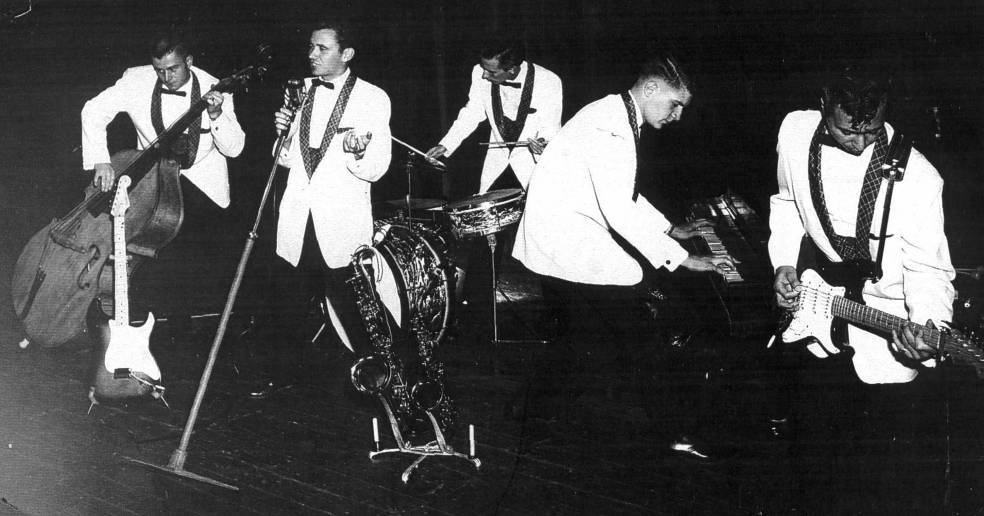
(from left) Jim Chitwood on bass, Vilas Craig on vocals, Karl Gillingham on drums, Steve Prestegard (future father of blogger) on piano and Gene “Fuzz” Mueller on guitar. … the performers of:
(Side note — get it? — the last video pictures the first iteration of the band, which didn’t record that song. So two people in the video get credit for something they didn’t do.)
I have written about this band previously on this blog. Most people, I suspect, think of their parents as something from the previous century (which is actually true in our children’s case) who have been boring old adults as long as you’ve known them. Of course, if your parents weren’t once your age, you wouldn’t be reading this now. And to find out that your parents were once cool is, well, cool.
Irrelevant side note: The piano player also plays accordion. This is National Accordion Awareness Month.
-
I will be on Wisconsin Public Radio’s Ideas Network’s Joy Cardin Week in Review segment today at 8 a.m.
Joy Cardin and all the other Ideas Network programming can be heard on WLBL (930 AM) in Auburndale, WHID (88.1 FM) in Green Bay, WHWC (88.3 FM) in Menomonie, WRFW (88.7 FM) in River Falls, WEPS (88.9 FM) in Elgin, Ill., WHAA (89.1 FM) in Adams, WHBM (90.3 FM) in Park Falls, WHLA (90.3 FM) in La Crosse, WRST (90.3 FM) in Oshkosh, WHAD (90.7 FM) in Delafield, W215AQ (90.9 FM) in Middleton, KUWS (91.3 FM) in Superior, WHHI (91.3 FM) in Highland, WSHS (91.7 FM) in Sheboygan, WHDI (91.9 FM) in Sister Bay, WLBL (91.9 FM) in Wausau, W275AF (102.9 FM) in Ashland, W300BM (107.9 FM) in Madison, and of course online at www.wpr.org.
My opponent is Eugene Kane, like myself a member of the Former Journal Communications Employees Club. (That club now totals every past Journal employee, since as you know the company doesn’t exist anymore.)
In addition to Donald Duck Day, today is National Strawberry Rhubarb Pie Day. Saturday is Iced Tea Day, and Sunday is National German Chocolate Cake Day and National Corn on the Cob Day, the latter of which is difficult to celebrate in Wisconsin given that we are several weeks away from locally grown sweet corn.
-
Melanie Phillips after yet another terrorist attack in Britain:
Even now, with Theresa May saying “enough is enough” after the London Bridge atrocities, we are still refusing to identify correctly the threat that has already claimed so many lives.
These attackers are not “evil losers”. They are not “sick cowards”. I They are not nihilists or psychiatric cases or lone wolves. They are devout and ecstatic Muslim fanatics who are waging a war of religion against us.
Mrs May correctly referred to “Islamist” terrorism. Yet she also said this was a “perversion of Islam”. How can it be a “perversion” when it is solidly rooted in religious texts and theological doctrine validated and endorsed by the world’s most powerful Islamic authorities?
In his article in The Times yesterday, the communities secretary Sajid Javid tied himself up in knots. He rightly said it wasn’t enough for Muslims merely to condemn terror attacks; they must ask themselves “searching questions”, and issue challenges.
Yet he also said the perpetrators were not “true Muslims” and that it was right to say the attacks were “nothing to do with Islam”. Well if that’s so, why should Muslims need to do anything at all?
The West views Islam through its own cultural prism, which equates religion with spirituality. The problem is that Islam is as much a political ideology as a source of spiritual guidance.
In 2010 a German study, which involved intensive questioning of 45,000 Muslim teenagers from 61 towns and regions across the country, found that the more religious they were the more likely they were to become violent.
Sheikh Mohammad Tawhidi, a Shia cleric in Australia who campaigns against Sunni extremism, has said: “The scriptures are exactly what is pushing these people to behead the infidel. Our books teach the beheading of people.”
Of course, millions of Muslims don’t subscribe to any of this. Some are merely cultural Muslims who observe no religious practices. Some, such as the Sufis or the Ahmadiyya sect, are pious Muslims who are truly peaceful (and are themselves victims of the Islamists).
But political, aggressive, jihadist Islam, constrained for so long by both the Ottoman empire and western colonialism, is now dominant once again in the Muslim world. Which is why in 2015 Egypt’s President Sisi remarkably told the imams of Al-Azhar university in Cairo — the epicentre of Islamic doctrinal edicts — that Islam’s corpus of sacred texts was “antagonising the entire world”, that it was “impossible” for 1.6 billion Muslims to “want to kill the rest of the world’s inhabitants”, and so Islam had to have a “religious revolution”.
We should be promoting and defending such Muslim reformers in the desperate hope that they succeed. Instead we knock the ground from under their feet by saying Islamist attacks have nothing to do with Islam. Until and unless Islam is reformed, we need to treat its practices on a scale ranging from extreme caution to outlawing some of them altogether.
Mrs May said we need to make people understand that our “pluralistic British values” were “superior to anything offered by the preachers and supporters of hatred”.
The problem is, though, that Islamists believe their values represent the literal word of God. So to them, no other values can possibly be superior. As a result, you can no more deradicalise them than you could have deradicalised the priests of the Inquisition.
We must require Muslims to take responsibility for the actions of all in their community. An ICM poll of British Muslims two years ago found that nearly a quarter wanted Sharia to replace British law in areas with large Muslim populations.
Four per cent — equivalent to more than 100,000 British Muslims — said they were sympathetic to suicide bombers fighting “injustice”.
In other words, we must see jihadist Islam as at the extreme end of a continuum of beliefs which are themselves incompatible with British society.
So we shouldn’t just be stopping people coming back to Britain from Syria or Libya, or detaining terrorist suspects through control orders. We should also be closing down radical mosques, deporting those born in other countries who are involved in extremism, stopping foreign funding for Muslim institutions and banning the Muslim Brotherhood.
We should also outlaw Sharia courts because, since Sharia does not accept the superior authority of secular legislation, it inescapably undermines the core British value of one law for all.
The message should be that British Muslims are welcome citizens but on the same basis as everyone else: that they subscribe to the binding nature of foundational British laws and values. If not, they will be treated as subversives.
The chances of any of these measures being taken, though, are slim. There will be inevitable claims that judge-made human rights law, which has often protected the “rights” of extremists rather than their victims, cannot be set aside without “destroying British values”.
Jihadist terrorists, however, are not trying to divide us, destroy our values or stop the general election. They are trying to kill us and conquer us.
“Us,” by the way, includes Muslims. The Religion of Peace has been keeping a daily Ramadan Bombathon count. As of this morning, the website counts 73 bombings with 809 dead, mostly Muslims.
Unlike some people I know on the right, I am not reflexively anti-Muslim or anti-Islam. Nor is Donald Trump, who unlike his predecessor is willing to condemn radical Islam by name. But there are facets of Islam that are incompatible with Western values (for instance, this), and unless you count the wack jobs at Westboro Baptist Church to be Christians (they’re not), Islam is the only major world religion with adherents killing in the name of their religion today. Like it or not, it is up to Muslims to defeat radical Islam.
 Steve Prestegard.com: The Presteblog