The number one single in Britain …
… and over here on my parents’ wedding day in 1961:
The number one single today in 1977:
No comments on Presty the DJ for Jan. 7
The number one single in Britain …
… and over here on my parents’ wedding day in 1961:
The number one single today in 1977:
First: The song of the day:
The number one album today in 1968 was the Beatles’ “Magical Mystery Tour”:
The number one single today in 1973 included a person rumored to be the subject of the song on backing vocals:
The number one British single today in 1979 was this group’s only number one:
THE PROBLEM WITH living your life under the spotlight is that the camera captures only the public eruption, not the months of silent anger. On Dec. 3, when the New England Patriots played the Buffalo Bills, Tom Brady walked to the sideline after throwing late and behind receiver Brandin Cooks on third down, ending a first-quarter drive. Brady was angrier and more irritable than usual, as has often been the case this season in the eyes of some Patriots players and staff. As he unsnapped his chinstrap, Brady passed offensive coordinator Josh McDaniels on the sideline.
“He was wide open,” McDaniels said to Brady, referring to Cooks.
Brady kept walking, and glaring at McDaniels, so the coach repeated: “We had him open.”
Brady snapped, pivoting to McDaniels and yelling at him, “I got it!” Everyone within earshot, including head coach Bill Belichick, turned to watch as Brady screamed. He removed his helmet, and as a Patriots staffer held him back — and with McDaniels’ father and legendary high school coach in Ohio, Thom, in the stands behind the bench — capped off the exchange by yelling, “F— you!”
Video of the scene went viral, with many rationalizing it as a symptom of Brady’s legendary competitiveness. Brady would later apologize to McDaniels, who dismissed the incident to reporters as “part of what makes him great.” After all, many in the Patriots’ building knew that Brady’s explosion wasn’t really about McDaniels. It wasn’t about Cooks. And it wasn’t about the Bills game. It was about the culmination of months of significant behind-the-scenes frustrations. For almost two decades, Belichick has managed to subvert the egos of his best player, his boss and himself for the good of the team, yielding historic results. This year, though, the dynamics have been different.
THE PATRIOTS ARE in uncharted territory. They haven’t just won games and titles. They’ve won at an unprecedented rate and over an unprecedented span, which makes the feelings of entitlement creeping inside Gillette Stadium unprecedented as well. The Patriots, in the only statement anyone associated with the team would make on the record for this story, responded to specific questions by saying that there are “several inaccuracies and multiple examples given that absolutely did not occur,” though they declined to go into detail. But according to interviews with more than a dozen New England staffers, executives, players and league sources with knowledge of the team’s inner workings, the three most powerful people in the franchise — Belichick, Brady and owner Robert Kraft — have had serious disagreements. They differ on Brady’s trainer, body coach and business partner Alex Guerrero; over the team’s long-term plans at quarterback; over Belichick’s bracing coaching style; and most of all, over who will be the last man standing. Those interviewed describe a palpable sense in the building that this might be the last year together for this group.
Brady, Belichick and Kraft have raised expectations and possibilities so high that virtually no other team in the Super Bowl era could truly comprehend what it’s like to be them. Brady and Belichick weren’t only pushing the boundaries of what a team could accomplish. They also were challenging basic understandings of how a group of high achievers escape the usual pulls of ego and pride. For 17 years, the Patriots have withstood everything the NFL and opponents could throw their way, knowing that if they were united, nobody could touch them. Now they’re threatening to come undone the only way possible: from within.
THE CRACKS FIRST revealed themselves in early September. The season had just started, and Guerrero was once again becoming an issue in the Patriots’ building, just weeks before the release of Brady’s first real book, “The TB12 Method.” It was more than a fitness and diet guide. For Brady, a self-described “loner” who always seemed most comfortable surrounded by family or on a football field, the book represented a move to extend his brand beyond the game — and beyond the Patriots. Until a few years ago, he seemed uninterested in ever doing so, content to be a father and husband and son and brother and transcendent quarterback, knowing there wasn’t time for much else.
Guerrero persuaded Brady to find time. The two men had worked together for years, with Guerrero having found a spot in Brady’s famously small group of advisers, eventually becoming a godfather to one of his sons. Guerrero has a history of controversial methods — in 2005, he paid a judgment to the Federal Trade Commission to settle allegations that he had claimed dietary supplements could help cure cancer — and he believed he had discovered a way to revolutionize how athletes train. In his book and in the building, Brady was offering opinions not only on training but also on lifestyle, writing that he envisioned a world populated with TB12 Sports Therapy Center franchises.
Few in the building had a problem with Brady’s method — mostly based on stretching with bands, eating lots of vegetables, drinking lots of water, getting lots of sleep and, most of all, achieving peak “pliability.” They did have a problem with what Brady and Guerrero promised the TB12 Method could do. They claimed it could absolve football of responsibility for injury: “When athletes get injured, they shouldn’t blame their sport,” Brady wrote. The method also was so consuming and unwavering in its rules and convictions that, while it helped some players, it felt “like a cult” to others, one Patriots staffer says. The way TB12 began to creep into Brady’s life worried people close to the QB, many of whom were suspicious of Guerrero. “Tom changed,” says a friend of Brady’s. “That’s where a lot of these problems started.”
Brady and Guerrero’s training beliefs introduced an unspoken pressure in the building, with players wondering where they should work out. In August, receiver Julian Edelman blew out his knee, costing him the season, and there was “hypersensitivity” among players, in the words of a Patriots coach, over who would take his place. New players felt the surest way to earn Brady’s trust was to join Rob Gronkowski, Danny Amendola and others by seeking advice from Guerrero at his TB12 clinic — and not team doctors, which Belichick preferred. Guerrero says he wasn’t pressuring players to adopt his approach. “Players have always decided to come or not come on their own,” he says now. But according to multiple sources, players openly discussed with Patriots coaches, staff and trusted advisers whether to follow Brady or the team, leaving them trapped: Do we risk alienating the NFL’s most powerful coach or risk alienating the NFL’s most powerful quarterback?
EARLY THIS SEASON, Belichick wanted to discuss all these issues with Brady.
Guerrero had been around the team for years, mostly as an unthreatening outsider who worked with former linebacker Willie McGinest and, starting in 2004, Brady. On the author page in his 2004 book, “In Balance for Life,” Guerrero says he received a degree in traditional Chinese medicine from the now-closed Samra University of Oriental Medicine in Los Angeles, and later opened a sports injury, rehabilitation and performance-enhancement center, also in Los Angeles. In 2013, Belichick had welcomed Guerrero into the New England fold, giving him free rein in the building and, sources with direct knowledge of the situation say, access to meetings in which medical records for Patriots players were discussed (Guerrero denies ever having seen any records). The coach figured that, because Guerrero had Brady’s best interests in mind, he probably had the Patriots’ best interests in mind too, and could be trusted. But Guerrero often would blame Patriots trainers for injuries, while offering few insightful opinions of his own, and Belichick quickly realized inviting him had been a mistake. And so in 2014, he eliminated Guerrero’s access to those meetings while keeping him on as a team consultant. That was the same year Brady and Guerrero decided to market their business as revolutionary; the same year that Brady began to speak unwaveringly about playing into his mid-40s; and the same year that Belichick drafted Jimmy Garoppolo out of Eastern Illinois — the first sign that Belichick was invested in a future that did not include the quarterback who had changed his life and legacy.
It was also the same year that the Patriots would go on a run toward their fourth Super Bowl win, altering the team dynamic in fundamental ways that would come to a head this fall. During their 10-year championship drought, Brady and Belichick had come up just short together and could only dive back into the redemptive power of work, trying to slim the margins between defeat and victory. In beating the Seattle Seahawks in Super Bowl XLIX, the two men drew strength from different touchstones. Belichick found virtue in his idea of the Patriot Way — the demanding, football-first culture with an emotionless pursuit of victory — and Brady found virtue in his Method, which he believed helped him thwart the inevitability of time, reinforcing his belief that he was still not on the downside of his career and deserving of a new contract. In 2016, Kraft and Brady’s agent, Don Yee, began negotiating a new deal; Belichick and other Patriots staff had to abruptly leave the NFL combine in Indianapolis to be part of the process. Brady’s two-year contract, with a $28 million signing bonus, was designed to set up 2018 as a key year, when the team could, in theory, look at a 41-year-old Brady and his $22 million cap hit and decide if it made sense to transition to Garoppolo.
A year later, after another Super Bowl win — the Brady-led, historic comeback from 28-3 to defeat the Atlanta Falcons — Brady’s stature in the organization had grown to the point that he was considered management. New players often address him as “sir.” As Brady gained power, so did Guerrero, who became an even more divisive force in the building. One player visited TB12 under what he perceived as pressure, and declined to allow Guerrero to massage his injured legs. Instead he asked to keep treatment limited to only his arm, out of fear that one of Guerrero’s famous deep-force muscle treatments would set back his recovery. The Boston Sports Journal would report on another player who was told by Patriots trainers to do squats but later instructed by Guerrero to not do them. Brady would tell teammates, “Bill’s answer to everything is to lift more weights” — a claim that many staffers and players felt was unfair, given the team’s dedication to soft-tissue science and a healthy diet.
And so after several such incidents, Belichick explained to Brady in early September that many younger players felt pressured to train at TB12 rather than with the team, and asked the quarterback what was going on. Brady said he didn’t know anything about any such pressure, according to people briefed on the exchange, and the two men left the meeting without any resolution.
Belichick felt the need to permanently clarify Guerrero’s role, drawing sharp boundaries. After the brief discussion with Brady, Belichick emailed Guerrero to let him know that while he was welcome to work with any players who sought out TB12, he was no longer permitted access to the sideline or all of the team headquarters because he wasn’t an employee of the Patriots (a point that Belichick would resoundingly make clear when reporters asked about Guerrero).
An email designed to solve problems only created more of them. Guerrero texted some of the Patriots players who were clients and specified, he says now, “that I would need to treat them at the TB12 Sports Therapy Center.” But several players told staffers and coaches that Guerrero gave them the impression that Belichick would no longer allow them to work with him. In the view of many Patriots, it was an example of Guerrero trying to split the organization by turning players against Belichick. All of this happened as Brady, serving as TB12’s test case, continued to reiterate publicly and privately his goal of playing into his mid-40s. In October, he again explained to Kraft and Belichick his plans to play a few more years. The question was whether Brady had earned long-term security from the Patriots, or if he would finish his career somewhere else.
BELICHICK HAS FAMOUSLY staked his entire career on the idea that long-term security doesn’t exist in the NFL. Fear, paranoia, the irrelevance of yesterday and tomorrow, and acceptance of Belichick as the ultimate authority are as much a part of the Patriot Way as selflessness and sacrifice. For years, Brady stood as the perfect model for Belichick’s system, a future Hall of Famer who could withstand tough and biting coaching. Brady always knew the hits were coming during Monday morning film sessions — “The quarterback at Foxborough High could make that throw,” Belichick often would say after replaying a Brady misfire — but he could take it, secure not only in the knowledge of his singular impact on Belichick’s career but also in the theater of it all, that the coach was doing it in part to send a message that nobody was above criticism. “Tommy is fine with it,” his father, Tom Brady Sr., said years ago over dinner in San Mateo, California. “He’s the perfect foil for it.”
Brady is less fine with it this year. People close to him believe that it started after last year’s playoff win over the Houston Texans, in which Brady completed only 18 of 38 passes and threw two interceptions. Belichick lit into him in front of the entire team in a way nobody had ever seen, ripping Brady for carelessness with the ball. “This will get us beat,” he told the team after replaying a Brady interception. “We were lucky to get away with a win.”
The criticism has continued this year, as Brady has been hit a lot and battled various injuries. Atypically, he has missed a lot of practices and, in the team’s private evaluations, is showing the slippage of a 40-year-old quarterback even as he is contending for MVP and is as deadly as ever with the game on the line. Injuries to his shoulder and Achilles have done more than undermine claims that the TB12 Method can help you play football virtually pain-free. Subtle changes have at times hampered the offense and affected the depth chart. On a fourth-quarter play against the Los Angeles Chargers, for instance, Brady had a clean pocket and a first read open deep, possibly for a touchdown. But Brady got rid of the ball quickly over the middle to receiver Chris Hogan, who had nowhere to run and was hit hard, injuring his shoulder. He missed all but one game of the rest of the season. “Tom was trying to get it out quick,” a Patriots staffer says. “As fragility has increased, nervousness has also increased.”
At the same time, as his age has increased, Brady has become an advocate of positive thinking. Belichick’s negativity and cynicism have gotten old, Brady has told other Patriots players and staff. He feels he has accomplished enough that he shouldn’t have to endure so much grief. Patriots staffers have noticed that, this year more than ever, he seems to volley between unwavering confidence and driving insecurity. Brady has noted to staff a few times this year that, no matter how many game-changing throws he makes, Belichick hasn’t awarded him Patriot of the Week all year.
Those who know Belichick and Brady well are amazed that they’ve co-existed this long, two ruthless and proud self-made men, both secure though still unfinished in their legacies, both loved and hated, both having received stiff penalties for cheating, both motivated by ego, humility and — as much as anything — doubt. Belichick is famously secretive, creating an entire system in which knowledge flows directly to him and only he decides how to deploy and exploit it. And Brady is famously unhelpful toward his backups — or, at least, a threat like Garoppolo. The two quarterbacks were friendly, but Brady — like Joe Montana to Steve Young and Brett Favre to Aaron Rodgers — didn’t see it as his role to advise Garoppolo, even on matters as trivial as footwork, as nobody had helped him during his climb. Garoppolo played well in 2016, starting in place of the suspended Brady, and Belichick began to see Garoppolo as the final piece of his legacy, to walk away in a few years with the Patriots secure at quarterback. But after Garoppolo was knocked out of his second start because of a shoulder injury, he set up a visit at TB12. As he later told Patriots staffers, when he arrived, the door was locked. He knocked; nobody was there. He called TB12 trainers but nobody answered. He couldn’t believe it, Garoppolo told the staffers, and that night ended up visiting team trainers instead. Guerrero vehemently denies ever refusing to see any player, and Garoppolo was eventually treated at TB12 — but it was two weeks after he showed up for his original appointment, and only after a high-ranking Patriots staffer called TB12 to inquire why Garoppolo hadn’t been admitted.
Several times this past October, Brady met with Kraft to discuss playing longer. That same month, he also met with Belichick, who was skeptical of a long-term contract extension but was content to start Brady as long as he was the best quarterback. Belichick understood how much Brady had meant to the franchise, and had always insisted privately that he wouldn’t move on from Brady unless he could convince the coaching staff of it. But the reality was that no quarterback has ever played at a championship level into his 40s. The meeting ended in a “little blowup,” according to a source. Complicating matters was that Garoppolo would be a free agent at the end of this season. Complicating matters more was that Brady and Garoppolo share Yee as an agent.
And complicating matters even more was that Belichick didn’t want to trade Garoppolo. He had passed on dealing him last spring, when Garoppolo was in high demand. In early September, Belichick did trade third-string quarterback Jacoby Brissett to the Colts for wide receiver Phillip Dorsett. “If we trade Jimmy, we’re the Cleveland Browns, with no succession plan,” one person inside the organization said earlier in the year. The Patriots repeatedly offered Garoppolo four-year contract extensions, in the $17 million to $18 million range annually that would go higher if and when he succeeded Brady. Garoppolo and Yee rejected the offers out of hand, for reasons that remain unclear, and the Patriots knew they couldn’t make any promises to Garoppolo about the timing of a transition at quarterback without it getting back to Brady.
Two weeks before the Nov. 1 trading deadline, Belichick met with Kraft to discuss the quarterback situation. According to staffers, the meeting ran long, lasting half the day and pushing back Belichick’s other meetings. The office was buzzing. The meeting ended with a clear mandate to Belichick: trade Garoppolo because he would not be in the team’s long-term plans, and then, once again, find the best quarterback in the draft and develop him. Belichick was furious and demoralized, according to friends. But in the end, he did what he asks of his players and coaches: He did his job. One morning in late October, Belichick texted San Francisco 49ers head coach Kyle Shanahan and asked him to call. Belichick had long admired Kyle’s father, Mike, who not only had been one of the NFL’s smartest tacticians but had also personally defended Belichick to commissioner Roger Goodell during the Spygate scandal. At the combine this past February, Kyle, weeks into the 49ers job after being the offensive coordinator for the Falcons, met with Belichick for hours to learn from his team’s humiliating Super Bowl loss. Belichick believed that Garoppolo would excel under Shanahan, and when he and Shanahan connected on the phone, Belichick offered the quarterback for a second-rounder.
It was a steal, leaving Patriots staffers stunned and confused. Why would the game’s shrewdest long-term strategist trade two backup quarterbacks in a two-month span when his starter was 40 years old and banged up? And why did Belichick practically give away a quarterback whom the coaches saw as a potential top-10 player for much less than he could have gotten last spring? It made no sense. Belichick handled the trade as he always does, by not explaining it to the coaches and by burying them so deep in work that they didn’t have time to gossip. Most in the organization understood that it was an extreme case, with extreme personalities, but they felt that Belichick had earned the right to make football decisions. Belichick, having always subscribed to the philosophy that it’s time to go once an owner gets involved in football decisions, left the impression with some friends that the current dynamic was unsustainable.
Brady, though, seemed liberated. Kraft hugged Brady when he saw him that week, in full view of teammates. A few days later during practice, some players and staffers noticed that Brady seemed especially excited, hollering and cajoling. Brady was once again the team’s present and future. His new backup, Brian Hoyer, was a longtime friend and not a threat. The owner was in Brady’s corner. “He won,” a Patriots staffer says.
NOBODY IS BUDGING now. Kraft, Brady and Belichick were supposed to meet in late December to clear the air, but that never happened. It probably won’t until after the season. Those interviewed describe a lingering sadness around the team, as if coaches and staff know that the end might be near. Both McDaniels and defensive coordinator Matt Patricia are expected to become head coaches; other assistant coaches might leave to join their staffs or for college jobs, or even retire. The imminent exodus raises the question going forward: Is it possible that Belichick would rather walk away than try to rebuild the staff with a 41-year-old Brady and another year of Guerrero drama — all while trying to develop a new quarterback? Belichick being Belichick, those around him know nothing of his plans. He has always been a football genius, artfully letting situations play out. The looming uncertainty has taken a toll on everyone, even as the Patriots finished 13-3 and earned the top seed in the AFC playoffs. “Bill’s done a phenomenal job of holding the building together,” one Patriots official says.
Now 76 years old, Kraft ultimately will attempt to broker a solution. He has paid both Brady and Belichick tens of millions of dollars, won and lost some of the greatest games in NFL history with them, and has stood by both at their lowest moments. He apologized in front of a room of owners for Spygate. And he stood by Brady during Deflategate, even after he backed down and accepted the NFL’s penalty. Kraft did so even though many staffers in the building believed there was merit in the allegation, however absurd the case. The team quietly parted ways with both John Jastremski and Jim McNally, the equipment staffers accused of deflating footballs — they’ve never spoken publicly — and Belichick reorganized the equipment staff. Kraft has privately told associates he knew that he went too far in his attacks against the league. “I had to do it for the fans,” he has told confidants.
A fifth Super Bowl triumph healed some of those wounds, but there’s no guarantee that a sixth will fix the rest. Something has to change, that much everyone knows. Many Patriots players and staff believe that Brady is a good man who has a hard time saying no to Guerrero. They’ve noticed that he seems to be searching this year, as if reaching the pinnacle of his profession is as fleeting as it is rewarding, manifesting itself in outbursts like the one at McDaniels. Belichick seems to be grinding harder than ever, as if more than a sixth championship is at stake. Before the Patriots played the Steelers in December, he told players, “I brought you here for games like this.”
But Belichick also has taken a longer view, as though he sees pieces of his impact leaguewide. He’s preparing assistant coaches for job interviews elsewhere, which he didn’t always do in years past. He has taken pride in Garoppolo’s 5-0 record in San Francisco — and in the fact that Kraft has confessed to people in the building that trading Garoppolo might have been a mistake. He reset a toxic relationship with the Colts with the Brissett trade. He has even become good friends with Goodell. The two men had a long and private meeting during the off week after the regular season, when the commissioner visited Foxborough.
Belichick always had a vision for how, after more than four decades in the NFL, he wanted to walk away, beyond setting up the team at quarterback. He wanted his sons, Brian and Steve, both Patriots assistants, to be established in their football careers. And he wanted the winning to continue without him, to have a legacy of always having the best interests of the franchise in mind. Both Brady and Belichick have redefined how much influence a coach and quarterback can have on a team game. But this year has shown that the legacy of football’s greatest coach, like the game itself, is beyond his control.
The claim is that the letters NFL stand for “Not for Long,” although remember that Brady became the Patriots’ starting quarterback, and the Patriots won their first Super Bowl, in 2001.
How did the Patriots respond to this? Kings of Boston Sports reports:

Facebook Friend Kevin Binversie adds:
This whole thing reads like a New England Patriot version of the Favre to Rodgers transition the Packers had. Only in Green Bay, you didn’t have an owner (or in the Packers’ case a Team President) who was so invested in his future HOF QB to forego investing in the long-term plans of the franchise.
That, and Brett Favre didn’t have a cult leader / guru feeding his body avocado smoothies and giving him massages.
Seriously, when both Brady and/or Belichick are gone, it’s hard not to predict the Patriots return to mediocrity.
As expected, the Packers fired defensive coordinator Dom Capers following their season finale loss to Detroit Sunday.
Less expected was Monday’s news from Packers.com:
Green Bay Packers Executive Vice President, General Manager and Director of Football Operations Ted Thompson will transition to a role as senior advisor to football operations, team President/CEO Mark Murphy announced Tuesday.
“I want to thank Ted for his tireless efforts as the general manager of the Green Bay Packers for these past 13 seasons. Under his guidance, the Packers enjoyed a remarkable run of success, one that included our 13th world championship, four NFC Championship appearances and eight consecutive postseason berths,” said Murphy. “The organization, our fans and our community were fortunate to have had one of the NFL’s all-time great general managers leading our football operations. On a personal note, Ted’s work ethic, humility and loyalty are nearly unparalleled, and it has been one of the great honors of my life to work beside him. Fortunately, Ted will remain involved in our personnel department as we work to win another championship. We will begin an immediate search for the next general manager of the Green Bay Packers.” …
Thompson, who just finished his 13th season as the leader of the team’s football operations, built the Packers into one of the NFL’s strongest and most consistent teams. His tenure was highlighted by a victory in Super Bowl XLV and six NFC North titles, including a franchise-record four consecutive division titles from 2011-14. The Packers’ four appearances in the NFC Championship since 2005, including two since 2014, lead the NFC.
Since taking over as general manager in 2005, Green Bay made nine playoff appearances, including a run of eight in a row (2009-16) that set a franchise record. The stretch of eight postseason berths is tied for the fourth-longest streak in NFL history behind three teams with nine (Dallas, 1975-83; Indianapolis, 2002-10; New England, 2009-17). The Packers’ nine appearances in the postseason since ’05 are tied with Seattle for the most in the NFC over that span and with Indianapolis and Pittsburgh for the second most in the NFL behind New England (12).
During Thompson’s tenure, Green Bay finished with a winning record nine times and won at least 10 games eight times. In 2011, the Packers set a franchise record with 15 regular-season wins. Since 2005, Green Bay has a regular-season record of 125-82-1 (.603), ranking No. 1 in the NFC and No. 4 in the NFL in wins and winning percentage over that time span. Of the five best single-season win totals in team history, two came under Thompson’s leadership (13 in 2007).
The Packers are tied with Pittsburgh for the third-most postseason games played (18) since 2005, trailing New England (25) and Seattle (21). Dating back to 2005, Green Bay’s 10 postseason victories are tied with Baltimore for No. 4 in the NFL (New England, 16; Seattle, 13; Pittsburgh, 12).
Thompson was named NFL Executive of the Year two times (2007, 2011) by Sporting News in a vote of his peers. Of the 53 players on Green Bay’s Super Bowl XLV championship roster, 49 were acquired by Thompson. Highlighting Thompson’s acquisitions over the years are two-time NFL Most Valuable Player Aaron Rodgers
, 2009 Defensive Player of the Year Charles Woodson, six-time Pro Bowler and franchise sack leader Clay Matthews
The fact is that Thompson is responsible for Capers’ defense, because schemes do not win games; players win or lose games. Thompson is responsible as well for the Packers’ offense, which will have a new offensive coordinator and quarterback coach after the departures of Edgar Bennett (who reportedly may be reassigned) and Alex Van Pelt (whose contract wasn’t renewed).
24/7 Sports adds:
Ted Thompson isn’t the only member of the Green Bay Packers’ front office who is taking a new role. According to Chris Mortensen of ESPN, the Packers will restructure of the entire front office. Team president and CEO Mark Murphy will define the new roles shortly and some of the front office members who could be in line for new roles are Russ Ball (VP of football administration), Brian Gutenkunst (player personnel director) and Eliot Wolf (director of football operations).
Whatever that means, those expecting a radically different approach to getting players are likely to be disappointed. The three obvious choices to replace Thompson all worked for Thompson. It’s not really clear that Murphy believes that the front office needs to be blown up, or that, for that matter, the front office needs to be blown up.
Ball seems to be the front-runner if reports are accurate. The Milwaukee Journal Sentinel reports:
Ball, 57, is among the most intriguing figures in the Packers organization simply because the general public knows nothing about a man with immense influence. He is lauded as the team’s lead contract negotiator and salary-cap guru, but his responsibilities are said to extend much further. His talents are viewed as indispensable.
He has been described by Murphy as the “unsung hero of our Super Bowl” and by coach Mike McCarthy as “the best I’ve ever been around.” He is devoutly loyal to the organization and the epitome of a company man. He will not discuss business dealings with his family. He cuts off contact with his brother during the draft and free agency each year. (Randy Ball, a former collegiate head coach, is a pro scouting assistant for the Kansas City Chiefs.)
Around the league, Ball’s peers view him as a legitimate candidate for general manager jobs and wonder why he doesn’t have one already. In Green Bay, Ball is the dark horse to take over whenever the 64-year-old Thompson retires.
“He likes what he does now,” said Russ’ oldest brother, Rick Ball, “but he would love the opportunity to be a general manager.”
Obscurity lingers because Ball has been barred from speaking to the media since his arrival from New Orleans in 2008. The Packers declined multiple requests to interview Ball for this article, citing the longstanding team policy. Even Thompson would not discuss the specifics of Ball’s responsibilities during an interview with the Journal Sentinel last week. (The media guide says his daily supervision includes the following departments: athletic training, equipment, video, corporate travel, player development, family programs and public relations.)
Instead, the story of Russ Ball is told through interviews with those around him, and more than 30 agents, team executives, current and former coaches, family members, owners and college teammates offered a window into a man whose talents extend far beyond the nebulous titles he has held. …
Ball graduated from Central Missouri in 1981 and immediately pursued strength and conditioning, the latest fad in sports. He spent eight years as the head strength coach at Missouri while earning a master’s degree in human performance. By 1989, he’d latched on with the Kansas City Chiefs and first-year coach Marty Schottenheimer.
As the assistant strength and conditioning coach, Ball worked alongside Dave Redding, better known as Redman. They were part of a staff that included future head coaches Bruce Arians, Bill Cowher and Tony Dungy. In the next three years, Herm Edwards and Mike McCarthy would arrive as well.
Redding and Ball brought opposite personalities to the weight room. In Redding the Chiefs had their bellowing taskmaster whose ferocity matched the sport itself. In Ball they uncovered a keen thinker and tireless worker whose skills were universal.
As a balancing act, it worked.
“Redman was the energy bunny, and Russ was the calming force,” said Edwards, who coached defensive backs. “Redman knew how to get them to the mountain, but you needed a plan to get them to the (top). Russ would always plan out the strategy.”
Fellow coaches said it was obvious Ball’s ambition stretched beyond the strength and conditioning program. His role expanded as Schottenheimer recognized new applications for his talents.
Schottenheimer trusted Ball with everything from player attitude problems to disputes between assistant coaches, and every successful task led to three or four more. Ball became known as a fixer who never turned down a job. His jack-of-all-trades reputation still applies today.
“That boy had his hands in more pies than anybody I’ve ever seen,” offensive line coach Alex Gibbs said. “ … It didn’t matter to him what it was, how bad it was, what he had to do. He was going to do it and he would do it better than everybody else.
“Guys like Russ save head coaches. I mean, they just save them.”
Ball started his days early and ended his nights late. He arrived at the facility long before practice began to interact with players and learn more about their lives. He spent his evenings holed up watching film. Sometimes he watched alone; sometimes he shadowed scouts or assistant coaches to see how their jobs were done.
“He was always pushing that envelope of trying to learn more to try and develop players,” Edwards said. “ … He gets a lot of respect from the players and agents alone because of what he’s done to get there. He wasn’t given the job (in Green Bay). He actually had to work for it. He ain’t part of the family that owns the team and guess what, ‘Wanna learn how to be a scout? OK, you can go over there and learn.’ No, no, no, no, no. He had to earn it. He was on the back end of it. He was in the weight room.”
Ball stayed in the weight room for eight years before crossing over to the front office in 1997, escaping before his body broke down. He spent two seasons as Schottenheimer’s administrative assistant to lay the groundwork for the remainder of his career: two years as a senior football administrator for the Minnesota Vikings; one year in Washington as director of football administration; six years and multiple job titles with the New Orleans Saints; and the last nine years with the Packers.
The constants of Ball’s administrative path have been salary-cap management and contract negotiations, which are among his chief responsibilities in Green Bay. He honed those skills in Minnesota under-then director of football administration Rob Brezezinski. He was described by former Vikings President Gary Woods as having an IQ “far above that of a strength coach.”
“He’s a mathematician,” Woods said, “and one has to be a mathematician to deal with salary cap. Many teams have PhDs dealing with salary-cap issues.”
In 2002, Ball interviewed with New Orleans on the strength of a recommendation from McCarthy, who had become the offensive coordinator of the Saints. And just as he did everywhere else, Ball made a sterling first impression on owner Tom Benson, general manager Mickey Loomis and head coach Jim Haslett.
The Saints, who declined all interview requests for this story, hired Ball as senior football administrator.
“You fall in love with everything that he did,” said Haslett, now the linebackers coach for the Cincinnati Bengals. “You see the way he works, the way he interacts with people, the way he interacts with players and agents and everybody else in the building. He’s a tireless worker; he’s a great family man; he’s a great person to deal with.”
Ball’s experience with different facets of an organization allowed for a complete understanding of the Saints’ franchise, according to Doug Marrone, who took over as offensive coordinator in 2006 and is now the head coach in Jacksonville. Ball knew the game well enough to hold his own in football discussions with players and coaches. He also flashed the requisite business savvy to run the financial arm of a professional team. …
After nine years in Green Bay and two decades of prior experience, Ball sits at an interesting point in his career. He’s proved himself at every job he’s ever had, and the only positions above him are general manager and team president — Thompson and Murphy.
The idea of Ball as a general manager is one that surfaced repeatedly during the reporting of this story. A number of former coaches believed he has earned the opportunity, and roughly 80% of the agents interviewed by the Journal Sentinel agreed. …
“We’ve talked about it,” Ball’s oldest brother Rick said. “The only thing that’s ever knocked him and he’s been underestimated on is his ability to recognize talent. He’s even concentrated more on talent the last probably five or six years, just so that he does know that (it) isn’t a hindrance to him.”
Ball’s heightened emphasis on talent evaluation has included more time observing practice, more attention to the on-field portion of the NFL scouting combine and more direct contact with players, his brother said, “even though that’s not his job.” He often works until 9 or 10 p.m. regardless of the time of year.
Those efforts align with Thompson’s yearly assertion that Ball is involved in personnel and draft meetings to absorb as much information as he can. But it’s clear Ball is proactively seeking more knowledge on his own, just as he has done throughout his career.
“He doesn’t want to have that as a reason for not being able to assume the position,” Rick Ball said.
UniWatch’s Paul Lukas has a bold question:
You hear it all the time when people are talking about college football: Schools need to keep introducing flashy uniforms to appeal to top recruits. Some schools, such as Oregon and Maryland, have used their uniform programs as a key recruiting tool, and it’s increasingly taken as a given that you can’t compete without having an equipment room stacked from floor to ceiling with alternate jerseys and helmets.
All of which would no doubt be news to Alabama and Georgia, who’ll be facing off on Jan. 8 for the College Football Playoff National Championship. The Crimson Tide has one of the most conservative visual programs in the nation, and the Bulldogs aren’t far behind. The two schools that lost in the semifinal round, Oklahoma and Clemson, also have fairly traditional uniforms. And judging from the results on the field, these schools haven’t had too much trouble attracting top-level recruits.
But is that just a one-year aberration? The CFP era is now four seasons old, so let’s take a look at the 16 teams that have qualified and rate them on a traditional-to-flashy scale of 1 to 10, with 1 representing Penn State and 10 representing Oregon. Several schools have qualified multiple times for the CFP, so we’ll weight the results accordingly and come up with a basic flashiness threshold for CFP success.
Here are the schools, listed in alphabetical order. Keep in mind that the ratings are not assessments of how good the uniforms are. We’re just trying to locate these uniform programs on the spectrum of conventional to outrageous.
Alabama (four CFP appearances): Whether you consider the Crimson Tide’s uniforms to be classic or just boring, there’s no question that they’re the most traditional-looking program this side of Penn State. On a scale of 1 to 10, let’s rate them a 2.
Clemson (three appearances): The Tigers have a very straightforward look — block numbers, traditional striping, one helmet design — but they occasionally spice things up by going mono-orange and even mono-purple. Rating: 3
Florida State: The Seminoles have a bit of natural flash thanks to the trim on their collars and sleeves and their custom number font. But their uniform program still features only one helmet design and two basic jersey-pants combinations — garnet over gold and white over gold (although they did go mono-garnet for the Independence Bowl last month). Rating: 4
Georgia: How traditional are the Bulldogs? They still refer to their pants as “britches” (and by any name, they’re gray, even when paired with the team’s white road jersey). True, they’ve occasionally worn black alternate jerseys, but not this season. Rating: 3
Michigan State: Less than a decade ago, the Spartans seemed firmly entrenched as a traditionalist team. But in recent years they’ve added several newfangled looks and alternate helmet options, along with modern pant striping, a custom number font and the occasional monochromatic look. Nobody would mistake them for Oregon, but they’re not your father’s Spartans either. Rating: 6
Oklahoma (two appearances): It seems safe to say the Sooners will not be wearing a blackout uniform anytime soon, although they’ve dabbled with the occasional modern alternate uni. Still a traditionalist team but not as steadfast about it as, say, Alabama. Rating: 3.5
Ohio State (two appearances): Much like Oklahoma, the Buckeyes are a traditionalist team that has shown a willingness to change things up, if only once per season. Their latest alternate design was apparently a big hit with recruits, for what that’s worth. Rating: 3
Oregon: Oregon is, well, Oregon. The quintessential flashy-uniform program. Rating: 10
Washington: Much like Michigan State, this is a school that was once firmly in the traditionalist camp but has tried to update its image in recent years. In the Huskies’ case, that has meant going with blackout and purple-out looks, and even their standard home jersey now features lots of black trim and that weird number font. Rating: 6
Crunch all of these numbers and weight them for the schools that have had multiple appearances and you get an average of 3.7. In other words, the average CFP team over the past four seasons has not needed flashy uniforms — at least not more than about once per year — to attract top-level recruits. Meanwhile, Oregon has gone 11-14 in the past two seasons, and Maryland has gone 33-46 since introducing its flag-based uniform program in 2011. Just sayin’.
How does this jibe with the notion that top recruits respond to outrageous uniforms? The answer might be that it’s one thing to respond to a shiny object, but it’s another thing to base your decision-making on it. Or to put it another way, it’s not surprising that 17-year-olds would get excited by a futuristic-looking uniform, but are they really going to choose a school on that basis alone?
Back in 2013, ESPN.com’s Jeremy Crabtree wrote a piece that appeared to provide answer to that question. The headline — “Trendy uniforms a differentiator” — seemed to affirm the party line that recruits demand innovative uni designs, and the piece included quotes from several coaches and athletic directors who agreed with that position. Deeper down in the story, however, was this:
“But as any good advertiser will tell you, it doesn’t matter how shiny the package is if you can’t get somebody to buy the product. ESPN.com surveyed more than 700 high school recruits from the classes of 2014 and 2015 — including 90 who self-identified as a member of the ESPN 300 for the Classes of 2014 or 2015 — and asked them where uniforms ranked in their college decision. Uniforms were the top factor for only 3 percent of players, and uniforms ranked eighth on the list of criteria behind academics, coaching, playing time, school tradition, location, experience sending players to the NFL and television exposure.”
In other words, your average recruit might get more excited about Oregon’s uniforms than he does about Alabama’s, but on balance, he’d probably still rather play for Alabama.
Despite this, people continue to parrot the line about space-age uniforms being a recruiting necessity. How many more years’ worth of traditional-looking CFP teams will it take for everyone to come to their senses and realize that this conventional wisdom simply isn’t accurate?
Wisconsin hasn’t played in the CFP (yet), but they have played in the Big Ten championship game more than any other Big Ten team. Their new Under Armour uniform design took the radical steps of moving the sleeve numbers to the shoulders (also known as “TV numbers”), modifying the stripes to point forward for the state’s motto, and changing the number and name fonts to UW’s athletic font (or a reasonable facsimile thereof), along with the half-step of white facemasks for road games. That’s it. They don’t even wear the red pants that have made occasional appearances since the early 1990s (and they need to wear them to avoid the road Michelin Man look), and they dumped the red helmets brought in by former coach Gary Andersen.
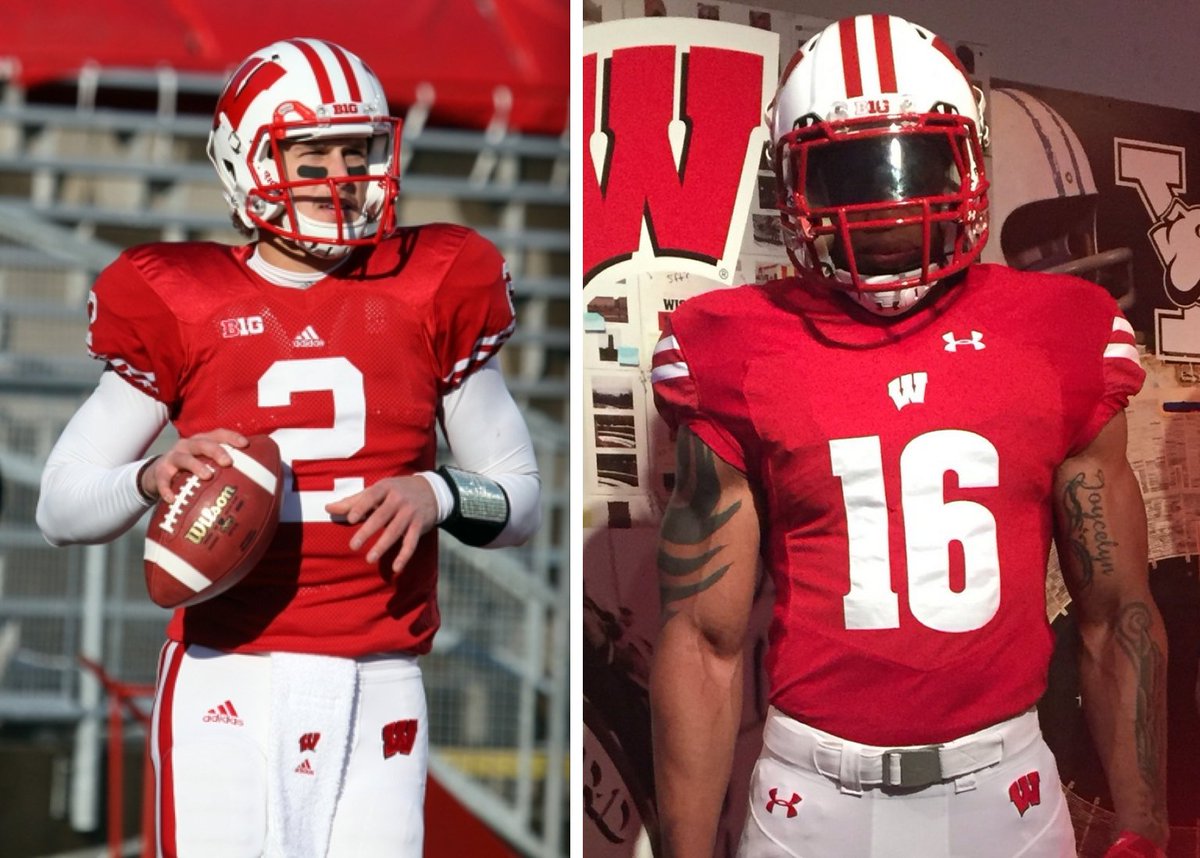
Of course, UW arguably doesn’t count in this discussion because the Badgers don’t usually bring in the nation’s top players; they just develop the nation’s top players.
Unfortunately the related trend of illegible uniforms has trickled down to the high school ranks. One area girls basketball team has dark gray numbers (in a condensed font) on dark red uniforms with a thin white outline, the opposite of another girls team nearby (which has a thin gold outline). A local high school boys basketball team has black numbers on a royal blue jersey with a thin gold outline. A football team whose game I announced earlier this year had dark gray numbers on a dark red jersey, which was almost impossible to read from a college press box. (Fortunately the team had 10 two-way starters.)
The reason for this uniform chicanery is to prevent video scouting, so that future opponents have a more difficult time figuring out who is whom. (As if that can’t be determined by such things as headbands or wristbands, shoe color, or just plain height or weight.) National and state athletic associations need to mandate legible uniforms immediately.
Today’s first song is posted in honor of the first FM signal heard by the Federal Communications Commission today in 1940:
Today in 1968, Jimi Hendrix was jailed for one day in Stockholm, Sweden, for destroying the contents of his hotel room.
The culprit? Not marijuana or some other controlled substance. Alcohol.
Today in 1973, Bruce Springsteen released his first album, “Greetings from Asbury Park, N.J.” It sold all of 25,000 copies in its first year.
David Blaska reports on his former employer:
What was your New Year’s resolution? More civility toward those with opposing views? Reaching across the aisle to find common ground? Not if you are the hyper-partisan Capital Times.
The CT takes as its sacred mission to “consign Scott Walker to the dustbin of history.”
The Blaska Policy Werkes gets policy differences. We understand rough and tumble. But The Capital Times is drowning in its own hateful bile. Its editorial today will persuade no one not already convinced that Walker drowns little puppy dogs.
Listen to this hyperbole: “There is no way that Wisconsin’s 2018 could be worse than 2017.”
Really? The year 2017 was terrible? The UW Badger football team went 13-1 and won the Orange Bowl. Construction cranes tower over Dane County. The corn harvest was good. UW tuition frozen for five straight years. Property taxes lower (on average) than when Scott Walker took office. Epic is hiring. The stock market is soaring (up 25% for the year)!
That was the one beef our liberal-progressive-socialist acquaintances had against Walker. That he had fallen short of an ambitious campaign pledge to create a huge number of jobs. The Capital Times used to publish job-creation charts showing Walker short of his goal. (Here’s one from June 2014).
Why did they quit running those charts? Because Walker is making good on his pledge. “From Foxconn to sausage makers, Wisconsin companies in expansion mode,” the Milwaukee Journal Sentinel headlined on Christmas Day. But 2017 was terrible!
Outside The Capital Times distortion zone, Wisconsin led the Midwest in job growth over the last year. Our unemployment rate of 3.2% is much better than the nation’s 4.1%. Certainly better than the teachers union-dominated state to the south, which is bleeding population, defaulting on its debts, and nearing junk bond status.
So now The CT is forced to do backflips to explain away the thousands of good-paying jobs Foxconn will bring to the state. It pretends that the $3 billion in promised tax forbearance will come out of the pockets of Wisconsin taxpayers when, in fact, that figure represents new tax income that won’t be collected. It even quibbles that Foxconn will be situated in the southeast part of the state — never mind that is the location of the largest city and most of the state’s population.
If Jim Doyle had managed to bring those jobs, you know who would be singing a different tune.
So we move on to irresponsible hyperbole. Scott Walker is “the most politically corrupt governor in the state’s history.” Except that he is not, by a long shot.
If you want history and corruption, there was William Barstow, a Democrat, who won in 1855 due to forged election returns from nonexistent precincts in the sparsely populated north, “in addition to other irregularities,” before he was removed from office. For that matter, Jim Doyle illegally raided the Patients Compensation Fund. And bought huge campaign contributions from the Indian tribes by trading them gambling rights. But Doyle was a Democrat.
Of course, the CT’s exercise in Joe McCarthyism feeds off the illegal John Doe investigation, which four separate courts ordered stopped. The prosecutors never came close to indicting Walker.
Typical of demagogues throughout the world, The Capital Times must create bogeymen. The Koch Brothers will do nicely. The editorial mentions them no fewer than six times. As if they were Idi Amin instead of free market advocates and generous philanthropists. As if they contributed even a tenth of Walker’s campaign financing. The voters who three times elected Scott Walker? “Toadies” and “political hacks.”
But then, the CT never had anything good to say about Tommy Thompson, Lee Dreyfus, or Warren Knowles — because they were all Republican.
Circling back, the phrase “consign Scott Walker to the dustbin of history” lit up Ol’ Sparky here at the Policy Werkes. Sure enough. The first to use it was the brutal Russian Bolshevik Leon Trotsky. Here is the murderous old Communist reading out the more moderate Mensheviks in 1917:
“You are pitiful, isolated individuals! You are bankrupts. Your role is played out. Go where you belong from now on – into the dustbin of history!”
Why should 2018 be any different? The comrades at The Capital Times cheered the illegal takeover of the State Capitol with bullhorns, defended the UW speech codes, covers for the speech police, demagogues business people, demands income redistribution, plays identity politics, and delegitimizes free and open elections. So it stands to reason they quote Communists.
Actually, having seen four Star Wars movies on New Year’s Day, this came to mind:
And you know how the emperor, the Empire, the Evil Empire and Trotsky all turned out.
Reportedly, the president told Myeshia Johnson that her husband, Sergeant La David Johnson, “knew what he was signing up for.” Set aside Gold Star father and retired General John Kelly’s claim that Trump spoke based on Kelly’s counsel, and hold off on the important discussions about whether this entire episode was inappropriately politicized. Instead, consider whether what President Trump reportedly said to a grieving widow is what much of the country actually believes about military service. Consider whether we are all too casual about the ultimate sacrifice that service sometimes requires.
To say that soldiers know what they’re getting into is to acknowledge that ours is an all-volunteer force. Members of our military are not conscripted, but consciously choose a profession that involves physical risk. And we, as taxpayers and citizens, hire those professionals to perform that dangerous work. We outsource the necessity of security to a subset of the population. We believe that we compensate those serving us at fair market price and that, because they accept that price, our role in the transaction is over. And we have begun to act as though we are entitled to that service by virtue of paying the bills.
But to think about our sociopolitical contract with the military in purely transactional terms dramatically limits how we understand our responsibilities to each other. This is not a customer-company relationship, but one between citizens equal before the same constitution, vulnerable to the same threats, sharing the same interests. The fact that only some Americans defend those interests at risk to their own lives in order to benefit all of us elevates national military service beyond being a mere market solution to a labor problem. It makes it a moral debt. We pay some; they pay more, and differently.
To be sure, many Americans have a sneaking sense of this uncomfortable fact. But that is why telling ourselves that “they signed up for it” is so reassuring. How many Americans have seen the names of the dead on television and paused for just a moment before changing the channel to shift from discomfort to entertainment? How many have marveled that anyone could have signed up for a job that gets them sent to Iraq? How many have read the stories about the four men killed in action in Niger on October 4 and felt badly but not known what to do and therefore done nothing? Very many. That’s the social contract we have with our all-volunteer military: They sign up, and we busy ourselves elsewhere.
It is true that they signed up. Military professionals are professionals. As a profession, it is fulfilling and sometimes demoralizing. We should not dismiss sacrifice, but neither is the point to pity those who have suffered in the course of work the country depends on. The point is that we should also feel invested in it. The point is that it is work we should acknowledge through more than just taxes. We should pay some attention. We should care about what these men and women are doing.
In the grind and rush of our daily lives at home, many of us don’t think very hard about where we are sending our fellow citizens. Many people are asking what our soldiers were even doing in Niger in the first place, as if U.S. counterterrorism efforts had never been covered by the news, discussed in congressional hearings, or explained on the Africa Command website. Why did we have to lose four soldiers before we all began to pay attention to where they’d been?
There has been a lot of debate recently about the quality of our democracy. One of the measures of that quality is whether all citizens engage in the gravest decisions our government makes. It is both ethical and healthy for those who don’t fight to reflect on the service done on their behalf. It isn’t sufficient simply to adjust our rhetoric or occasionally thank a Marine for her service. We must pay attention. We must try to understand. If there is no sense of debt nor reflection on our responsibility to the soldier and his widow and his orphan, then the service and its outcomes are taken for granted and thought of as unrelated to how we live our own lives. People in uniform do indeed know what they sign up for. So should those of us who do not serve.
The number one single today in 1959:
Today in 1970, the Who’s Keith Moon was trying to escape from a gang of skinheads when he accidentally hit and killed chauffeur Neil Boland.
The problem was Moon’s attempt at escape. He had never passed his driver’s license test.
Stephen L. Miller asks an inconvenient question about this photo from London’s Daily Mail:

The most striking images coming out of the Iran human rights protests are not of men – they are of women. And while American media was slow and even hesitant to pick up that anything at all was actually happening – this, while protests ignited for what is now six full days around Iran, nine years after the Green Movement protests began – Twitter was flooded with videos and photos on the ground, in defiance of the Iranian regime’s social media policy.
Almost none was more striking than a young Iranian woman standing atop a container and shedding her hijab – a garment mandated and enforced upon her and all women in Iran – while simultaneously waving it as a flag. It was an act of defiance much like that of the Iranian chess champion Dorsa Derakhshani, who was expelled from competition in Iran for refusing to wear a headscarf in competition.
There were unconfirmed reports that the unidentified girl was taken into custody and the spot where she stood had become a makeshift shrine, but because of the scattering of information on the ground there’s no way to confirm that.
Nevertheless, she became an immediate symbol for the growing movement now in its fifth full day. Twitter avatars were changed to an illustration capturing the moment. The drawing was spread on Facebook. But she wasn’t the only one.
Another video spread on social media shows a woman confronting security forces and proclaiming “Death to Khamenei” while crowds around her join in.
Mind you, this wasn’t inauguration protests from January of last year with celebrity activists screaming freely into microphones about how much they’ve thought about blowing up the White House. This was a woman endangering her life and possibly the lives of her loved ones to stand up to government forces of a hardline Islamic theocracy. She was risking death. And yet, nevertheless, she persisted.
Another woman was seen on tape declaring “You raised your fists and ruined our lives. Now we raise our fists. Be men, join us. I as a woman will stand in front and protect you. Come represent your country.”
Another image that managed to make its way into some mainstream coverage shows a young woman – reported to be a student – covering her face as she runs from tear gas just outside the University of Tehran, her fist raised defiantly in the air. She was a symbol of a growing secular youth movement merging with thousands of others protesting the regime’s involvement with Hezbollah, Hamas and Syria.
And as the protests entered their fifth night, another striking video on Twitter shows a woman demanding fair wages and an end to regime attempts to silence them. Women reportedly led protests in the city of Isfahan.
Every one of these searing images are of women. Women are the predominant face of this blossoming revolution. Women are risking the most to speak out against the Iranian Mullahs. So the question must be asked: Where are the women’s movement supporters in the United States and Europe, which gathered en masse to protest a newly inaugurated American president last year?
More specifically, empowered by the cultural muscle of #MeToo celebrity leaders and Women’s March organizers such as Linda Sarsour: Why are you silent? If these nameless women can speak out in the face of true tyranny, risking actual imprisonment and death, why can’t you?
Iranian women are not adorning pink knitted hats, or costumes resembling female genitalia. They won’t be attending award shows. They aren’t wearing red cloaks and bonnets inspired by their favorite Netflix show. No, these brave women are caught on videotape and in photographs for the world to see, and the women’s movements have yet to barely offer so much as a tweet or a Facebook post of support. The official Women’s March Twitter account has tweeted exactly zero times in support of women protesting in Iran. Zero.
Among such “women’s” leaders as Tamika Mallory, Carmen Perez, Janaye Ingram and Linda Sarsour, only one tweet has been offered at all about the protests, and that came from Sarsour and had nothing to do with the women at all, but President Trump. “Is it just me or is Trump praising Iranian protesters AND at the same time also banned Iranians from entering the USA?”
What seems to be lost on Ms. Sarsour is that these women are currently risking their lives and protesting – not for the right to come to the United States – but for the rights to live and thrive in their own country.
I do sympathize with Sarsour and the women’s movement of the political left and their sudden predicament with supporting these brave women. Women in Iran are shedding their hijabs while progressive women’s movements in the United States try to hold them up as a symbol of empowerment and feminism – going so far as Shepard Fairey-esque illustrations attempting to mainstream the hijab into pop culture.
What’s empowering about the hijab is the choice to don one. Muslim women in the United States have that choice. Women in Iran do not. If these pro-women groups are all about choice for deprived women around the globe, now would be a good time to speak up on behalf of them.
Women in Iran are standing in defiance of the regime’s financial support of Hezbollah and Hamas rather than fair wages and human rights. But for progressive women’s groups to oppose Hamas in the face of these protests, it would mean abandoning months of pro-Palestinian support, capped off last week when pop singer Lorde cancelled her Tel Aviv show.
Sarsour, as a self-professed leading advocate for Muslim women in the United States and around the world, should be asked to clarify her position by journalists who are all too eager to present her with awards and speaking gigs: Does she support the women of Iran or the hardline theocracy that is currently brutalizing them?
Remaining silent in the face of this growing movement is another black eye for Sarsour in particular, who is facing charges of ignoring complaints of sexual abuse while she was director of the Arab American Association.
Of the prominent supporters for progressive women’s movements in Congress, only Bernie Sanders has offered measurable support for the protestors, tweeting, “It is the right of all people to speak out against their government. The government of Iran should respect this right and heed the voices of thousands of Iranians who are demonstrating across the country for better opportunities and a better future.” Not hard stuff.
Chuck Schumer found time to tweet out support of the New York Giants football team keeping quarterback Eli Manning, but not for the women now splashed across news services worldwide.
Senators Elizabeth Warren, Kamala Harris and Kirsten Gillibrand – leading progressive women’s rights advocates all – have not only not released statements in support of these women, they’ve said nothing in support of the protests at all. Not a press release. Not a tweet. Nothing.
Hillary Clinton has not offered support of the women beyond a tweet stating she hopes “their government responds peacefully and supports their hopes.” Hate to break it to the onetime self-declared ceiling breaker, but the government is very much not responding peacefully nor are they supporting their hopes. They are, indeed, emboldened financially by an Iran Nuclear deal she herself claimed partial credit for.
Powerful women in entertainment have never been hesitant to raise their voices and organize in support of their personal beliefs. And today, because of the #MeToo wave, they have never been more influential in politics or culture. Yet they remain silent. First Lady Melania Trump and Ivanka Trump could also certainly publicly show support, but would the left then just simply write off joining them?
Political support for the women of Iran would of course contradict the careful echo chamber narrative Democrat politicians spent months crafting in support of President Obama’s nuclear deal with Iran – which is in fact a major reason for the uprising happening now. The Mullahs squandered most of their financial windfall from the Iran deal on support for terror groups such as the Assad regime, Hezbollah and Hamas after promising to invest it in the people at home. The people of Iran have had enough of these empty promises.
More importantly, the women of Iran have had enough and are leading the way, with or without public support from the self-declared women’s groups on the left around the world, who have decided they are the public voice of resistance for women – except in places where a collective voice of support could actually help women the most. Their ideas of empowerment apparently stop where their politics start.
Despite a world attempting to rationalize looking away, a solitary woman stood up in defiance of the rule of law, risked her life and removed her head scarf. She did this at the risk of arrest, or death. She did this without public support from women’s groups who claim their entire existence is to support this very act of defiance. While they remain silent, I’m with her.
 Steve Prestegard.com: The Presteblog