Today in 1967 was the Monterey International Pop Festival:
Happy birthday first to Paul McCartney:
No comments on Presty the DJ for June 18
Today in 1967 was the Monterey International Pop Festival:
Happy birthday first to Paul McCartney:
The number five song today in 1967 …
… was 27 spots higher than this song reached in 1978:
Birthdays start with Jerry Fielding, who composed the theme music to …
Dueling ex-Beatles today: In 1978, one year after the play “Beatlemania” opened on Broadway, Ringo Starr released his “Bad Boy” album, while Paul McCartney and Wings released “I’ve Had Enough”:
The number six song one year later (with no known connection to Mr. Spock):
Stop! for the number eight single today in 1990 …
… which bears an interesting resemblance to an earlier song:
Put the two together, and you get …
I’ve written before here about the most superior engine design, the V-8 engine.
Along that line, Hotcars has 20 potential V-8 car purchases for $10,000 or less, including …
Even though it seems like Americans have a monopoly on producing this epic piece of machinery, the rest of the world has an appreciation for it as well, using it only for their finest models.
However, it’s not cheap to purchase something with eight thumping pistons under the hood. Even work trucks and base trim muscle cars can be rather pricey. For cheap V8 power, one must look at the used market. While a new vehicle with such a powerplant will likely start above $30k, it’s fairly easy to find a used model with similar power at a third of the price. With that being said, it’s worth remembering how much more it will cost to insure and fuel a vehicle with eight thirsty cylinders. Although, there’s nothing else that moves a car quite like a V8, especially when such an experience can cost less than $10k.
20 CHEVROLET CORVETTE C4
The formula for building a competent sports car is rather simple. Use a strong powerplant in combination with buttoned-down suspension and a lightweight design. One of the few American offerings that follows this philosophy is the Chevy Corvette. Its body doesn’t weigh much thanks to the fiberglass panels, which pair well with its unique leaf spring suspension design. When put together, it makes for an excellent sports car. However, the most important part of a Corvette is its motor. Powered almost exclusively by Chevy small block V8s, the best Corvettes accelerate as well as they corner.
The model’s strength heavily depends on which motor resides under the hood. The C4 Corvette launched in 1984 came equipped with only 205 limp horsepower. While that V8 was later revised to produce up to 245 horsepower, the LT1, the predecessor to the legendary LS, is the engine to seek out. This motor’s 300 horsepower rating means this aging Corvette can still tear up the street. While the newer LT1 models will cost more, it’s well worth the extra cash.
The C4 is not my favorite Corvette, in large part due to the ridiculous instrument panels …

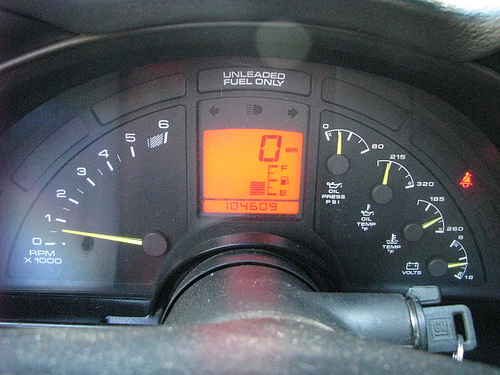
… but that can be fixed, for a price. (As with everything else.)
18 FORD MUSTANG GT
What American muscle car is more iconic than the Ford Mustang? It has been in continuous production since it was introduced in 1965. As a result, there are many Mustangs that can be had for well under $10k. For those who want some classic V8 muscle, there are many original Mustangs that are surprisingly cheap, if a bit rough around the edges. And that kind of money can also buy a very clean Fox-Body Mustang with the iconic 5.0-liter V8. However, if a buyer is willing to purchase something that’s a little less clean, they can opt for a cheaper Fox-body and use the left-over money to turn it into a track destroying monster thanks to the model’s huge aftermarket selection. While newer SN95 Mustangs are definitely cheaper, they aren’t as modifiable as the older Fox bodies or as attractive as the newer 2005 through 2009 cars.
It doesn’t hurt that these models also have a wide selection of modifications available. While Coyote 5.0-liter ‘Stangs are out of this price range, there’s still a lot of fun to be had with older examples.
17 CHEVROLET CAMARO
With the exception of the Ford Mustang, the longest running muscle car is the Camaro, having been produced uninterrupted from 1969 to 2002. The model did return once again in 2010, now sporting a retro look. However, these newer examples have yet to depreciate into affordable territory and, obviously, the classic models can get quite expensive. If there is anyone who still wants a Camaro that offers Corvette power, strong acceleration, and impressive handling for under $10k, then the fourth-generation model is a perfect choice.
This version entered production in 1993, but the one to look out for is the 1998 to 2002 model. Originally, this Camaro came with the C4 Corvette’s LT1 V8, but the way the engine was crammed under the hood made it difficult to work on and it was not as powerful, nor as fuel efficient as the motor that came after. For 1998, Chevy decided to throw in its new LS1 V8 that was more powerful, being rated at 335 horsepower and being capable of achieving decent highway fuel economy with its efficient, computer-controlled motor in conjunction with its slippery body design. While the four-speed automatic is capable of delivering powerful acceleration, it’s the six-speed manual that will really unlock this car’s performance.
16 DODGE RAM 1500
Out of the American Big Three, Ram tends to be the lowest volume seller when it comes to trucks. With Ford being the most established brand, Chevy providing a more traditional truck experience, and Toyota offering its usual undying, if outdated, experience that it’s known for, Ram has a tough time competing. On the surface, the Ram’s main appeal is its unique looks. Starting with its 1994 redesign, the Ram’s styling shifted towards its now iconic semi-truck inspired look with low headlights and a tall crosshair grille. It was further refined in 2002, and, a year later, the model received Chrysler’s new 5.7-liter Hemi V8. This new motor was good for 345 horsepower, which put the Ram’s new optional V8 shockingly close to the other brands’ performance trucks of the time. That powertrain combined with the truck’s tough looks gave the Ram 1500 a very muscular presence, and Dodge saw an opportunity.
To capitalize on its redesigned truck’s new powerplant, Dodge released a few special edition models, such as the Rumble Bee, Daytona, and GTX, all referencing classic Mopar muscle cars. As most of these were less desirable single cab models and are getting a little old, it’s easy to find such Rams for under $10k.
15 BMW 5 SERIES
If there’s one thing that BMW is known for, it’s for producing high-quality sports cars that are surprisingly practical. Despite the company generally building performance vehicles, it manages to keep its models’ styling fairly subdued while retaining an instantly recognizable look. Perhaps the company’s best combination of performance and practicality is the 5 series. For many years, it has provided owners with a driver-oriented experience with the practicality and comfort of a luxury sedan, with the M5 being the quickest option. Unfortunately, M-power is not within our budget, but there are still plenty of V8-powered 5 series available for under $10k, as long as the model is more than a decade old.
Although the 5 Series never came standard with eight cylinders, there were plenty of buyers willing to shell out the money for the extra oomph. Power was dependent on which V8 was equipped.
While any of these motors make for a quick sedan, it’s still worth remembering that this is a premium German luxury sedan and that repairs may be quite expensive should they come up, but the experience may be worth it.I drove a 1994 540 once, with, as a bonus, a six-speed. It was fast, but smooth, but fast. I recall ripping down a suburban street at 73 mph in a 35-mph zone due to my not noticing how fast I was going.
14 DODGE CHARGER R/T

Used American police cars are often a good bang for your buck, which unsurprising given that many of these vehicles have a V8, are rear-wheel-drive, and have little else. America’s most popular police car over the last decade was the Ford Crown Victoria; the last old-school American sedan.
When it comes to chassis design, the Crown Vic utilizes a ladder frame, which is only used on pickups and full-size SUVs these days. Even though such as layout certainly doesn’t help the model’s driving characteristics, it’s part of the reason of why these cars simply won’t die. This large dinosaur packs a V8 under the hood that makes up to 250 horsepower. While that’s hardly a huge number, it’ll certainly get this big car down the road easily. In its Police Interceptor form, nobody can tell between a decommissioned model and an active unit, meaning that nobody will pass you. However, for those who want a vehicle that can just float over the bumps at the cost of performance, civilian models are also quite cheap. It’s easy to buy a Crown Vic for under $5k, let alone 10.

One of the biggest hurdles that American luxury car companies have to get over is appealing to younger audiences. These brands previously offered large, inefficient, and uncompetitive land yachts that were far more attractive to old people rather than their grandchildren. The most outdated type of vehicle these companies pushed out was the personal luxury coupe; two-door cars designed to be as large, comfortable, and ostentatious as possible. These cars certainly challenged the idea that coupes were meant to be sporty. As the popularity of this segment decreased, Lincoln tried to inject some performance into its Continental Mark series.
The Lincoln Mark VIII may not look like much, but it is hiding some impressive muscle under the hood.
If that’s not enough, the engine’s time in the Mustang has resulted in a wide selection of aftermarket parts, so long as they fit in the Lincoln’s packed engine bay. The versions to search for are late-model LSC trim cars, which produce 290 horsepower and feature body-color trim rather than the ugly chrome that came standard. Regardless of year or trim, many Mark VIII’s cost less than $5k. …

The quickest selling vehicle in the world is the Ford F-Series. Jatco Dynamics studied the best-selling cars of 2017, and the F-Series was at the top of the list with over a million trucks finding owners. It even outsold models that are available in more countries than the Ford truck. Given its ridiculous popularity, the F-150 often the first truck to come to mind when thinking of light-duty pickups. Unsurprisingly, there are a lot of F-Series available on the used market with varying degrees of luxury and practicality. The biggest hurdle is the price. Trucks are highly popular in today’s automotive world, so used examples still hold a lot of value despite their age.
F-150’s from the early 2000s are the most likely models to fall within the $10k price limit. Models from this generation were offered with two V8 options, a 4.6-liter, and a 5.4-liter. As expected, the larger motor produces more power, but it may not be the best choice for those who want something long-lasting. Muscle Mustangs and Fast Fords reports that three-valve 5.4-liter motors can wear prematurely due to a bad camshaft phaser, and its spark plugs are so difficult to replace that FourWheeler wrote a how-to guide on how to change them. While the 5.4-liter may be more powerful, the 4.6-liter V8 may be the smarter choice.
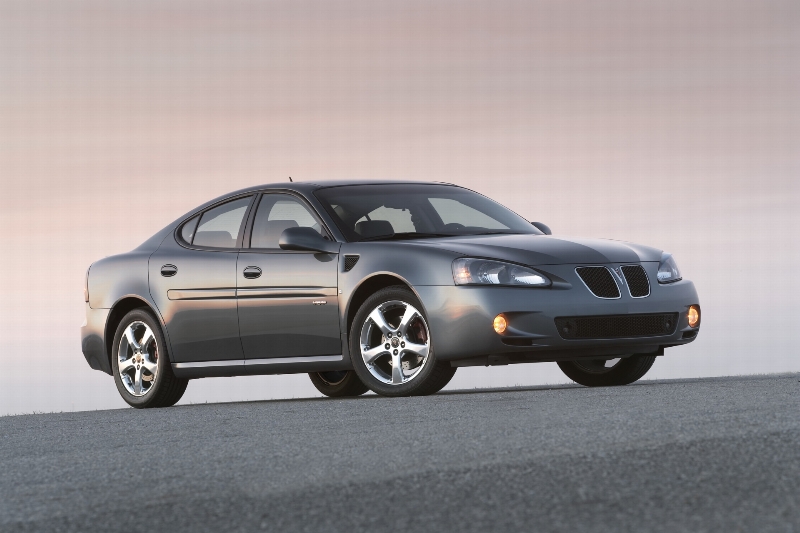
It’s not hard to find people who miss the Pontiac brand, mostly due to the company’s past models. It offered the powerful and sleek Firebird Trans Am and the muscular GTO, making it GM’s performance company. At least, that’s what it used to be. Towards the end of Pontiac’s existence, too many of its cars became rebadged Chevys and its few memorable performance models were imported from GM’s Australian Holden division. While the Aussie muscle options are excellent vehicles, they tend to run well over our price range. However, the last real performance Pontiac does fall within the price limit and it has classic American muscle under the hood. The late-model Grand Prix was generally not much to speak of. In the past, the hottest Grand Prix was a supercharged V6 GTP model. For 2005, a new GXP trim was released featuring 5.3 liters of LS horsepower.
While it is rather unfortunate that the Grand Prix was a front-wheel-drive car, and 303 horsepower is a lot for the front wheels to handle, Pontiac used high-performance shocks, and special, wider front tires to mitigate unfortunate handling effects caused by the layout, according to Car and Driver. However, these cars can suffer from transmission problems, so prospective buyers should get theirs inspected.

There are many aspects where Chevy can easily be mocked. Throughout the ‘90s and 2000s, the company was well known for producing low-quality vehicles. There are many examples of its models having laughably bad interiors and poor quality control. However, the company does build quite a few workhorses that can run for many miles just on general maintenance. Perhaps the longest lasting and best-engineered powerplant to come out of the company would be its small block motors, which go by the LS and Vortec names. Of course, it’s no surprise that Chevy uses these power plants to move its Silverado pickup. While the model comes standard with a V6, many pay extra for the reliability and power of the small block motors.
Besides producing over 300 horsepower in many of its various designs, the Vortec engine is capable of running for a couple hundred thousand miles without much trouble.
Even though brand new trucks are considerably quicker and more powerful than their ten-year-old counterparts, such aged examples still have plenty of V8 muscle under the hood. For extra power, Chevy offered the stout Vortec Max motor in various trims. However, the asking price on a used Silverado depends on the vehicle’s cab size, engine choice, and mileage, so availability will vary.

It’s no secret that the car market is shifting towards SUVs and crossovers. This process has been slowly progressing over the last few decades as buyers learned that they can use bigger, taller, and seemingly tougher vehicles to haul their family around. Perhaps the model that had the greatest influence in this change was the Chevy Suburban. Not only does it share its name with a type of residential area, but it can also seat up to eight people while providing plenty of space behind the third row. It would be easy to assume that the Suburban would only be successful while gas was cheap, but even expensive fuel didn’t stop this truck-based family hauler from selling. It’s practicality and general reliability (at least in older examples) have earned the model quite a reliable consumer base. Of course, the most important part of such a large vehicle is an equally large and torquey motor. Unsurprisingly, the Suburban has generally employed a Chevy small block V8 as its base motor.
During the 2000s, Chevy offered a heavy-duty Suburban with an optional 8.1-liter big block V8 for those who want something with a little more torque.
Of course, year and condition affect the value of a used Suburban, but it shouldn’t be difficult to find examples that fall under $10k. …
 One of the most well-known SUV companies in the world is Jeep. For many years, it has produced a wide selection of off-road oriented machines, with the Wrangler being its most capable model. That small box on wheels can easily bounce over any terrain given its extremely basic chassis and axle design. However, the Wrangler has become a classic of sorts which has driven up its value. It also doesn’t tend to be a practical vehicle, and only has six cylinders at most, making it ineligible for this list. However, the first truly modern vehicle sold by the brand was the Grand Cherokee, as it was designed to be somewhat luxurious while still being able to tackle rough trails. Jeep managed to build a vehicle that could drive well on the road and provide a sophisticated interior all while sitting on tough solid axles that have impressive articulation. For power, the original Grand Cherokee was offered several powertrains, with either a durable, but rather underpowered straight six or a 5.2-liter V8. While these motors were powerful enough for a ‘90s SUVs.
Jeep would later stuff in a 5.9-liter V8 that was good for 245 horsepower, making it one of the quickest SUVs available at launch, according to Autotrader
For the price, it’s hard to find a similarly refined and capable truck. …

For many years, the Crown Victoria reigned supreme over the police, taxi, and traditional full-size sedan markets, primarily due to it being the only ‘modern’ offering throughout the 2000s. However, that doesn’t mean that the Crown Vic was always the sole choice for interested buyers. In fact, during the ‘90s, Chevy’s Caprice was generally the preferred choice over the similarly geriatric Ford. On the surface, the Caprice is nearly identical to the Ford, as it was a giant car based on an ancient platform with a corporate V8 under the hood. However, the motor is what makes the Chevy more intriguing than the Crown Vic.
While the final generation Caprice started out with a reliable but feeble Chevy small block engine, the model received a Corvette-derived LT1 V8 for the 1994 model year.
Even though this motor was detuned to produce a comparatively low 260 horsepower, that was enough to make this big boat surprisingly quick despite its size. Given the age of these vehicles, it’s not hard to find them for well under $10k, or even $5k. Furthering its appeal, the Caprice was also available in a wagon and performance-oriented Impala SS trim, though these models can command higher prices, but will generally remain under the budget.

Toyota is often well-known for building long-lasting and tough vehicles, and its most impressive model in this regard is the Land Cruiser. In the beginning, the Land Cruiser was a Jeep-like vehicle with a strong focus on off-road capability. Over the years it became a more practical four-door SUV, but it never lost its trail tackling capabilities. While the US lost the utilitarian Land Cruiser long ago, the more modern and luxurious examples are still impressive machines. Newer examples and classics still quite valuable, but there are plenty of Land Cruisers from the late ’90s and 2000s are ripe for the taking.
While such models are becoming popular again, there are plenty of high mileage examples that can be purchased for a quite a low price. While a few hundred thousand miles on a normal car is usually something to worry about, the Land Cruiser will still have plenty of life left in it. Using Toyota’s 4.7-liter V8, this large SUV is sufficiently quick and smooth. Despite its plush interior and soft ride, the Land Cruiser is still more capable off-road than many other modern alternatives. If Land Cruisers are difficult to find, look for the Lexus LX470, as it is basically the same vehicle, just with different badges.

It’s pretty amazing how far Hyundai has come since its introduction to the American market. Even as recently as the mid-2000s, the brand was most well-known for producing cheap models with debatable quality and longevity. However, only a few years later, that same brand would release a rear-wheel-drive performance coupe, a full-size luxury car, and the Genesis sedan. Today, Genesis has become a new premium brand for Hyundai and Kia, separating the luxury models from a potentially less desirable brand image. Regardless of whether or not that’s a good idea, the original Genesis sedan is a strong offering, even if its brand isn’t known for such cars.
I drove a Genesis once. I was surprised at how nice it was, and how much like the V-8 sedans U.S. automakers used to built it was.
You might not expect National Review to write about AC/DC and other rock groups, but …
The past four years have been a time of turbulence for AC/DC. There’s been a jailbreak, if you will.
Longtime drummer Phil Rudd was sentenced to eight months of home detention after pleading guilty to threatening to kill a man. Cliff Williams, the band’s bassist since 1977, announced his retirement from music. Brian Johnson, vocalist since 1980, stepped away from touring due to hearing problems. Co-founder and rhythm guitarist Malcolm Young left to treat his dementia, and then passed away.
It appears that Angus Young, the band’s lead guitarist and sole remaining founding member, is undeterred. He will soldier on to create new music and tour with replacements, including Guns N’ Roses frontman Axl Rose. After all, there’s still a strong demand for AC/DC music and a limited supply of lead guitarists who look good in schoolboy uniforms.
Steven Hyden, in his new book Twilight of the Gods refers to the phenomenon as “shrunkgroups.” Lindsey Buckingham can’t commit to a tour? Fleetwood Mac simply recruits Mike Campbell and Neil Finn to suit up for the squad. Glenn Frey passes away? The Eagles tap country star Vince Gill and Frey’s son, Deacon, to fill in.
What’s important is that the machine stays well-lubed and the ticket-buying fans get to hear the songs they’ve been singing along with for decades.
Twilight of the Gods is simultaneously a love letter to a certain collection of artists and songs and a preemptive eulogy for the classic-rock genre, and perhaps for rock music itself. In preparation, Hyden spent a year attending classic-rock concerts across the Midwest, listening to the albums that shaped his youth, and rereading seminal books about the bands and artists. He artfully retraces the steps of a young man falling in love with this music.
The book makes clear early on its subject is not classic rock, but classic rock. What’s the difference?
Clearly, my definition of “classic rock” is shaped by classic-rock radio. . . . The overriding factor in determining who was classified as classic rock — and who was classified as folk, punk, new wave, or metal — was mainstream popularity. If you sold millions of albums, played arenas, and benefited from a major record label plying disc jockeys with cocaine and microwaves in order to get your music on the radio, you were classic rock. If you were beloved by critics, played clubs and theaters, and earned way more street cred than dollars, then you were slotted in one of the ‘cult artist’ genres.
In other words, Styx gets to be “classic rock,” and the opening lines of “Come Sail Away” are chiseled into our collective memories, waiting to be recalled whenever Dennis DeYoung’s piano intro triggers the need. Elvis Costello? Well, he’s “new wave,” so the beauty and power of “New Lace Sleeves” is reserved for those who have taken the time to seek out and explore the tour de force that is the 1981 album Trust.
But what does it all mean now that the most famous and influential purveyors of classic rock are fading away?
“You can’t talk about classic rock now without also thinking about death,” Hyden writes. And, indeed, the rock obituaries have begun to pile up. David Bowie, Tom Petty, Gregg Allman, Glenn Frey, Walter Becker, and J. Geils all have passed away in recent years. Paul Simon, Elton John, and Lynyrd Skynyrd just announced farewell tours, as they say goodbye to the road.
Could the future of classic rock look something like the modern-day incarnation of Foreigner? The band, best known for late-’70s and early-’80s classic-rock cornerstones such as “Cold As Ice” and “Urgent,” now features just one original member in Mick Jones. One other guitarist dates back to the mid ’90s, well after the band’s heyday, while everyone else has been added since 2004.
Over the past few years, Jones has missed quite a few shows due to various health issues — but the shows have not been canceled. At times, the audience is paying pretty good money to see a version of Foreigner in which every band member is, well, foreign to any of its chart success.
Father Time is undefeated; band members will continue to leave this Earth or become physically incapable of touring. Perhaps Mick Jones has stumbled upon the next breakthrough in keeping classic rock alive. At some point in 2033, might we see the officially licensed, Kevin Cronin–endorsed, all-replacement version of REO Speedwagon™ playing the county fair at a town near you? Will Rick Nielsen be lending his signature five-necked guitar to younger version of himself to keep Cheap Trick’s legacy (and money-making prowess) intact?
Hyden spends the final portion of his book grappling with the question of whether or not there will be another generation of fans who even have an interest in rock music. He blames, in large part, a gradual narrowing of the definition of the term, arguing that recent stars such as Taylor Swift and Adele have “rock in their DNA” but never are discussed as other than Top 40 pop artists.
The distribution aspect also is problematic. As Hyden writes, “Life-changing bands don’t just appear on television or the radio these days. . . . The music no longer finds you. You must find the music.” As the “rock star” archetype has faded from pop culture, so have the avenues from which listeners could experience new guitar/bass/drum-centered music.
In fact, as Hyden pointed out in a 2015 essay for Grantland, one of the most successful rock bands of the past decade, The Black Keys, sidestepped the normal channels almost entirely by licensing song after song for commercial use. Think you don’t know The Black Keys’ music? Pull up “Tighten Up” or “Howlin’ for You” and experience flashbacks to any number of television ads you’ve seen over the past few years.
Later in that essay, Hyden puts forth another keen observation, namely that dozens and dozens of bands and artists who would have been considered rock not long ago have been reclassified into the country ecosystem. After all, who is Keith Urban other than Bryan Adams with the occasional banjo or fiddle? A song like “Long Hot Summer” would have absolutely owned rock radio in a different time.
Like Hyden, I grew up on classic rock. I bought all the albums. I read Rolling Stone and spent countless hours devouring books and reference guides about music made years before I was born. I’ve experienced a whole lot of these classic-rock bands in person. In fact, there’s really only one more act I’d truly regret not seeing live before retirement (or something worse): The Rolling Stones.
Come on, Mick and Keith. Back to the U.S. for one more rodeo.
Fans of Chicago have watched guitarist Terry Kath die, bass guitarist/tenor singer Peter Cetera leave for a solo career of ballads more sappy than his former band’s, as well as Cetera’s replacement and multiple other musicians leave, to the point where only four original members are left — keyboard player/singer Robert Lamm, trumpet player Lee Loughnane, trombone player James Pankow and saxophone player Walt Parazaider (who doesn’t tour anymore). They are viewed as Chicago’s core four.
At the risk of appearing equivocal, there are core members of groups, and there are lesser members of groups. Chicago survived Kath’s death and Cetera’s departure, though the group still performs songs sung by their former members:
Led Zeppelin survived drummer John “Bonzo” Bonham’s death, but it likely would not have survived Robert Plant’s death or departure. The Who survived drummer Keith Moon’s death, but it wouldn’t survive the death or departure of Roger Daltrey or Pete Townshend. There has been a debate for years over whether Van Halen was really Van Halen with lead singer Sammy Hagar instead of David Lee Roth. Several musicians have left Electric Light Orchestra, but the only one most people know is Jeff Lynne.
Today in 1956, 15-year-old John Lennon met 13-year-old Paul McCartney when Lennon’s band, the Quarrymen, played at a church dinner.
Birthdays today start with David Rose, the composer of a song many high school bands have played (really):
Nigel Pickering, guitarist of Spanky and Our Gang:
Sen. Elizabeth Warren wants her fellow Democrats to take on what she calls the “billionaire class.” Does Warren know that many, if not most, of this tiny group of people are liberal Democrats?
On a recent podcast hosted by Mehdi Hasan of The Intercept, Hasan asked Warren if she thought Democrats lacked the “guts” to go after billionaires.
Warren response was “Yeah.” She’s particularly upset at the handful of her fellow Democrats who voted for a bill that watered down the Dodd-Frank banking regulation behemoth.
Warren went on to say: “Until we have all the Democrats who are willing to take on the billionaire class, until we have all the Democrats who are willing to fight for the American people and not for a handful of billionaires and giant corporations, then it’s going to stay an uphill fight.”
This makes little sense.
For one thing, there are only 585 of them in the U.S. today, according to Forbes. And plenty of them are big-time Democrats.
Does she intend, for example, to take on Warren Buffett, who, with a net worth of $84 billion, is the third richest man in the world? He’s a longtime Democrat who’s pushed for tax hikes on the rich, backed Hillary Clinton, and who gave 99% of his money to Democrats and liberal groups in the past four election cycles.
Maybe she means Michael Bloomberg, 11th richest man in the world (net worth $50 billion). He’s a huge gun control supporter.
What about George Soros, who’s worth $8 billion? He’s an uber liberal who finances a multitude of left-wing groups like Center for American Progress and Moveon.org. He recently invested $3 million in The New York Times.
In 2016, Soros gave at least $7 million to Hillary Clinton’s Priorities USA super-PAC. He’s donated more than $61 million to Democrats and liberals since 1989, according to OpenSecrets.org.
Does Warren want to “take on” environmental activist Tom Steyer — net worth $1.6 billion. He donated more than $91 million to Democrats in 2016 alone, and funded a $20 million ad campaign calling for President Trump’s impeachment.
Or perhaps she means Netflix CEO Reed Hastings (net worth $2.7 billion). Except that Hastings is another prominent Democrat who eagerly supported Clinton and just signed a deal with Barack Obama to produce programs for Netflix.
Other billionaires Warren says Democrats should have the “guts” take on would include liberals like Google’s Larry Page ($48.8 billion), Laurene Powell Jobs ($18.8 billion), Oprah Winfrey ($2.7 billion), Starbucks’ Howard Schultz ($2.7 billion), Facebook’s Sheryl Sandberg ($1.6 billion).
Of the 36 billionaires who made campaign contributions over the past four election cycles, 40% of their money — totaling $148 million — went to Democrats, according to data compiled by OpenSecrets.org. And this doesn’t include “dark money” donations — funds given to groups engaged in politics that don’t have to disclose their donors.
What about those greedy bankers? Turns out, plenty of them are Democratic supporters, too.
A few years ago, Yahoo Finance teamed up with Crowdpac to rank CEOs based on political donations. One of the five most liberal on the list was Goldman Sachs (GS) CEO Lloyd Blankfein, whose company made news during the election when it turned out that Goldman had paid Hillary Clinton $675,000 to appear at three Q&A sessions, two of them run by Blankfein himself.
In 6th and 7th place were James Gorman of Morgan Stanley (MS) and Jamie Dimon of J.P. Morgan Chase (JPM).
Billionaire hedge fund manager Jim Simons gave more than $7 million to Hillary Clinton’s Priorities USA Action super PAC. He gave $2.6 million to the Democratic House and Senate Majority PACs, according to OpenSecrets.org.
Laurence Fink, CEO of the investing giant BlackRock (BLK), is another prominent Democrat who wants companies he invests in to have a “positive impact on society” (i.e., support liberal causes).
Bank of America (BAC) CEO Brian Moynihan has over the years given money to Jeanne Shaheen, Patrick Kennedy, Harold Ford Jr., Ted Kennedy, Ed Markey and John Kerry. He even gave $6,300 to then Sen. Chris Dodd — he of Dodd-Frank fame.
Sure, lots of billionaires support Republicans and oppose Warren’s leftist politics. So do lots of people at all income levels.
But the idea that the “billionaire class” opposes all that is good in this country and that they must be defeated to get anything done is nothing more than sophomoric political posturing.
Those who advocate this need to explain how taking money away from billionaires is going to make the rest of us better off, especially considering how billionaires are able to hire squadrons of CPAs to keep their money away from the government.
Today in 1965, the Beatles released “Beatles VI,” their seventh U.S. album:
Twenty-five years later, Frank Sinatra reached number 32, but probably number one in New York:
Nine years and a different coast later, Carole King got her star on the Hollywood Walk of Fame:
Dan Mitchell starts with:
A balanced budget requirement is neither necessary nor sufficient for good fiscal policy.
If you want proof for that assertion, check out states such as Illinois, California, and New Jersey. They all have provisions to limit red ink, yet there is more spending (and more debt) every year. There are also anti-deficit rules in nations such as Greece, France, and Italy, and those countries are not exactly paragons of fiscal discipline.
Wisconsin has a balanced-budget requirement. Unfortunately it’s balance based on cash instead of Generally Accepted Accounting Principles, which is required of every unit of government except state government.
The real gold standard for good fiscal policy is my Golden Rule. And the best way to make sure government doesn’t grow faster than the private sector is to have a constitutional rule limiting the growth of government.
That’s why I’m a big fan of the “debt brake” in Switzerland’s constitution and Article 107 in Hong Kong’s constitution.
And it’s also why the 49 other states, assuming they want an effective fiscal rule, should look at Colorado’s Taxpayer Bill of Rights (TABOR) as a role model.
Colorado’s Independence Institute has a very informative study on how TABOR works and the degree to which it has been effective. Here’s a good description of the system.
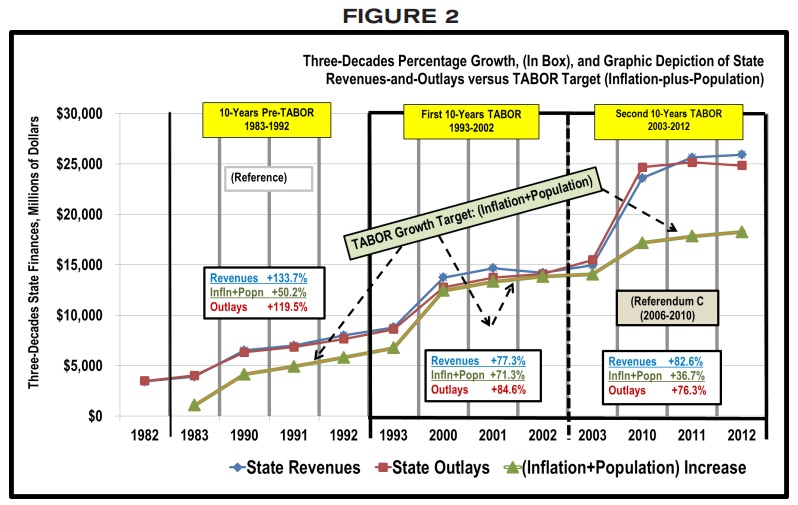
Colorado voters adopted The Taxpayer’s Bill of Rights in 1992. TABOR allows government spending to grow each year at the rate of inflation-plus-population. Government can increase faster whenever voters consent. Likewise, tax rates can be increased whenever voters consent. …The Taxpayer’s Bill of Rights requires that excess government revenues be refunded to taxpayers, unless taxpayers vote to let the government keep the revenue.
And here are the headline results.
Cumulatively, TABOR refunds have been over $800 per Coloradan, or $3,200 for a family of four. …If Colorado government had continued growing at the same high rate (8.56% compound annual rate) as in 1983-92, the average Coloradan would have paid an additional $442 taxes in 2012. The cumulative two-decade savings per Coloradan are $6,173—or more than $24,000 for a family of four.
However, the study notes that TABOR was most effective during its first 10 years. It was less effective in its second decade because voters acquiesced to a “TABOR time-out” as part of referendum C in 2005.
The final decade included the largest tax increase in Colorado history, enacted as Referendum C in 2005. Decade-2 was also marked by increasing efforts to evade TABOR by defining nearly 60% of the state budget as “exempt” from TABOR. …Rapid government growth resumed in Decade-2, mainly because of Referendum C.
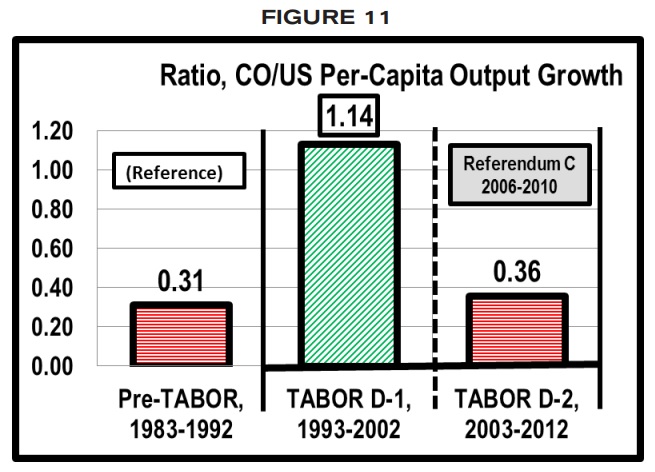
This chart from the study shows that outcomes were much better during the first decade of TABOR.
But a weakened TABOR is better than nothing. Here’s the conclusion of the report.
The Taxpayer’s Bill of Rights Amendment has worked well to achieve its stated intention to “slow government growth.” Although government has still continued to grow significantly faster than the rate of population-plus-inflation, the Taxpayer’s Bill of Rights did partially dampen excess government growth. …In terms of economic vitality, Colorado’s Decade-1 was best for Colorado. Unlike in the pre-TABOR decade, or in TABOR Decade-2 with its record increase in taxes and spending, because of Referendum C. Colorado’s first TABOR decade saw the state economy far outperform the national economy.
But keep in mind that the economic gains occurred in the first decade.
The bottom line is that spending caps are like speed limits in school zones. If they’re set too high, that defeats the purpose.
And in Colorado, the vote for Referendum C allowed a spending surge that made a mockery of TABOR.
But only temporarily, which is why that period was known as the “TABOR time-out.” The rules once again limit spending growth to population plus inflation.
For instance, TABOR made it difficult for state politicians to spend the additional tax revenues produced by marijuana legalization.
Needless to say, the political crowd hates having their hands tied. Which is why the pro-spending lobbies are agitating to once again gut TABOR. Here’s a clip from a local news report that does a good job of describing the current fight.
The battle actually started a couple of years ago. Here are some excerpts from a 2016 report by the Associated Press.
By 2030, Colorado’s population will grow from 5 million to 7 million people, thanks in part to a strong and diverse economy, the state’s famed Rocky Mountain quality of life, and its constitutionally-mandated low taxes. …The state’s Democratic governor, John Hickenlooper, is trying to find ways to squeeze more revenue for roads from the budget, while Republicans don’t want to tamper with the fabled 1992 constitutional amendment known as TABOR that keeps a tight limit on those taxes. …Under TABOR, voters must approve any state and local tax hike. Democrats are still stung by a resounding defeat of a 2013 ballot initiative to raise $1 billion for schools.
I’m amused by the fact that the above passage starts by noting the state has a “strong” economy. Too bad the reporter didn’t put 2 and 2 together and recognize that TABOR deserves some of the credit.
Likewise, this next passage cites a leftist who acknowledges growth in the state, but pretends that it’s exogenous, like the weather.
Liberals think that’s a recipe for disaster, especially in a growing state. “What we have to stop doing is pitting necessary priorities like roads against other necessary priorities like schools and colleges,” said Tim Hoover, spokesman for the Colorado Fiscal Institute, which favors dismantling the amendment. “TABOR forces us to do that.” So far the low-tax crowd is winning. Even Hickenlooper acknowledges there isn’t a popular appetite to raise taxes, and his hopes of changing the classification of an arcane fee in the budget to free up revenue are opposed by Republicans… Republicans say the real problem is growing Medicaid spending. Colorado, which expanded the program under the Affordable Care Act, is spending about $2.5 billion on the health care plan.
Note that TABOR critics object to various interest groups having to compete for money.
But that’s exactly why a spending limit is so desirable. Politicians are forced to abide by the rules that apply to every household and business in the state. In other words, they have to (gasp!) prioritize.
Let’s conclude by reviewing some passages from a pro-TABOR column published last week in the Steamboat newspaper.
Colorado’s has grown by nearly two-thirds since 1992, one of the fastest increases in the country. If you are part of the more than two million new residents who have arrived over this time, there are a few things you should know…the Taxpayer’s Bill of Rights is responsible for much of the state’s economic success, which likely drew you here in the first place. Between 1992 and 2016, median household income in Colorado grew by 30 percent, adjusted for inflation. …TABOR helped end years of economic stagnation and laid the groundwork for the state’s future success by keeping resources in the hands of Colorado residents who could put them to their highest valued use and checking overzealous government spending. …Its requirement that excess revenues must be refunded to taxpayers has also resulted in more than $2 billion being returned to the private economy… TABOR has empowered voters to reject roughly a dozen advocacy-backed tax hike proposals.
My favorite part is when they cite critics, who confirm that TABOR is successful.
A Denver Post editorial last year complained, “TABOR’s powerful check on government spending in reality has been a padlock on the purse-strings of the General Assembly.” The check on spending is exactly the point, and it still allows spending to grow in-line with inflation and population growth. If government wants more money, all it has to do is ask. Requiring consent is hardly a “padlock.”
Amen. We could use some more padlocks in the rest of the country. TABOR should be nationally emulated, not locally emasculated.
“Needless to say, the political crowd hates having their hands tied” is what the IT people would call a feature, not a bug. The U.S. Constitution’s Bill of Rights restricts what government can do to the citizens. That is exactly why Wisconsin needs a Taxpayer Bill of Rights in its constitution. The failure of Republicans, who have controlled state government most of the past two decades, to put a TABOR proposal to voters shows that the GOP is more interested in staying in office than in protecting taxpayers from politicians of either or no party.
This was a good day for the Beatles in 1970 … even though they were breaking up.
Their “Let It Be” album was at number one, as was this single off the album:
Don’t criticize the number one album today in 1980, lest you be condemned for living in “Glass Houses”:


 Steve Prestegard.com: The Presteblog