The number one country and western single today in 1956 was the singer’s number one number one:
The number one British album today in 1984 was the Thompson Twins’ “Into the Gap”:
The number one single today in 1984 was adapted by WGN-TV for its Chicago Cubs games — a good choice given that the Cubs that season decided to play like an actual baseball team:
So how did a life-long avowed socialist and someone who’s never actually won an election as a Democrat get to the top of the party’s mountain?
The simple answer is that he’s being supported by millions of younger Democratic voters, and those voters have been raised to be Sanders voters, even if their parents don’t realize it.
Here’s how it happened:
We convinced everyone college was 100% necessary, and then we made college unaffordable. Since the end of World War II, the chorus of educators, politicians, and journalists making it sound like college was essential for career success only became louder and drowned out any counterargument.
Now, millions of American young people are straddled with college loans that look impossible to repay. The total student loan debt in the U.S. now stands at more than $1.6 trillion.
Is it any wonder so many of them are attracted to a candidate who not only promises to forgive their student debts, but presents their predicament as the result of corporate greed and misplaced government priorities?
Luckily for Sanders, young voters supporting him for his college tuition forgiveness promises don’t seem to be too interested in his own family history. His wife Jane Sanders was president of the now defunct Burlington College and she and other administrators were reportedly the subjects of a long-running FBI probe that they misled bank loan officers about the real number of donations pledged to the college.
The FBI probe of the matter ended in 2018, and Jane Sanders was not charged. But the policies she oversaw, which included pushing for major campus expansions, were indicative of some of the root causes of increased college costs in America.
The establishment in both parties ignored young voters. As sacred as our politicians make college education sound, it’s nothing compared to the way leaders from both parties talk about programs for older Americans like Social Security and Medicare.
All of this focus on older voters and their retirement funds is a nice sentiment but it’s misplaced. Older Americans aren’t just doing okay. A 2017 study of age-based wealth in the U.S. shows that a typical household headed by an adult 65 and older has 47 times the net worth of a household headed by younger Americans. Yep, Papa and Granny are loaded.
Now, helping older people who happen to be poor or on the margins of poverty is something different. But the cultural assumption many of us have about elderly folks needing more financial help in America is pretty much the opposite of the truth.
Sanders talks plenty about Social Security, and he’s obviously a senior citizen himself. But he usually expands his campaign promises to include younger people, as he did when he took the lead on the Medicare for All promise in 2017.
We told them America’s house was on fire. For all the policy differences and political minutiae Democrats delve into when criticizing President Trump, the most enduring attacks on Trump from the Democratic establishment remain accusations that Trump is supporting white supremacy and is controlled by Russian President Vladimir Putin.
These are over-the-top accusations, and it’s hard to accept that even most elected Democrats actually believe them. But pushing that message on America for the last three-plus years comes at a price for both sides.
For the Democrats, the price is becoming clear: it’s made moderate presidential candidates look less viable than ever.
Think about it: if you really believe the president is a traitor and supporting violent plots against non-white Americans, is this really the time to support mainstream Democrat or Republican candidates?
Sanders may be a career politician, but he’s never been a mainstream politician. His persona and political brand fits much better into the current Democratic narrative that we’re living in desperate times.
Establishment Democrats are reaping what they sowed.
As a result, it’s looking more and more like Sanders has unstoppable momentum going into the Super Tuesday primaries and beyond. The big question now is whether that Democratic establishment will try to derail Sanders before or during the Democratic National Convention.
But either way, the party would be playing with fire and risking alienating those younger voters forever.
Sanders was on CBS-TV’s “60 Minutes” Sunday night. Giancarlo Sopo watched:
In a “60 Minutes” interview that aired Sunday night, Vermont Sen. Bernie Sanders doubled down on past comments he made in the 1980s support of late Cuban dictator Fidel Castro.
“We’re very opposed to the authoritarian nature of Cuba,” Sanders told host Anderson Cooper before pivoting to defending Castro. “But it’s unfair to say that everything is bad.”
He then began parroting talking points often cited by the country’s communist government. “When Fidel Castro came into office, you know what he did? He had a massive literacy program. Is that a bad thing even though Fidel Castro did it?”
While it is true that Castro implemented a reading program on the island after seizing power in a bloody revolution in 1959, Cuba’s literacy rate was already high for a Latin American nation at the time and its educational gains have been comparable to those of its peers in the years since.
As attorney Hans Bader noted in an August 2016 article, nearly eight out of 10 Cubans already knew how to read by 1950. This figure was similar to that of Costa Rica, which also achieved 100 percent literacy over the following decades — except Costa Rica and other countries did so without the kind of authoritarian dictatorship that Cubans have endured under the Castro regime for over 61 years.
According to UNESCO, Cuba had about the same literacy rate as Costa Rica and Chile in 1950 (close to 80%). And it has almost the same literacy rate as they do today (close to 100%). Meanwhile, Latin American countries that were largely illiterate in 1950 — like Peru, Brazil, El Salvador, and the Dominican Republic — are largely literate today, closing much of the gap with Cuba. El Salvador had a less than 40% literacy rate in 1950, but has an 88% literacy rate today. Brazil and Peru had a less than 50% literacy rate in 1950, but today, Peru has a 94.5% literacy rate, and Brazil a 92.6% literacy rate. The Dominican Republic’s rate rose from a little over 40% to 91.8%. While Cuba made substantial progress in reducing illiteracy in Castro’s first years in power, its educational system has stagnated since, even as much of Latin America improved.
Reached by TheBlaze on Sunday evening, Dr. Andy Gomez, a retired University of Miami professor who led the school’s Cuban Studies department for decades, said the democratic socialist presidential candidate is misinforming voters about the true motives behind Castro’s literacy campaign.
“Contrary to what Senator Bernie Sanders said, the literacy campaign used by the Castro regime was part of their strategic plan to indoctrinate the Cuban people by using education at all levels in support of a Marxist ideology,” Gomez said.
Claims of Castro’s health care, education, and social achievements have been a common talking point of the Castro regime for decades.
As National Review’s Jay Nordlinger noted, in 1986 former Cuban political prisoner Armando Valladares was asked at a Harvard forum about Cuba’s literacy rate and other supposed accomplishments of the island’s communist revolution. He responded by noting that not only are many of the regime’s claims false, even if they were true, they came at the expense of basic human freedoms and dignity.
Say all those things are true. They’re not, but just say they are. Can’t you have those things without torturing people? Can’t you have them without wrongly imprisoning them? Can’t you have them without killing them? Without denying them rights? Without forbidding them to speak freely, without forbidding them to worship, without forbidding them to vote and have a normal political life and pursue their own destinies, and so on? Why is material well-being — not that Cuba has it, or anything remotely like it — but why is material well-being incompatible with freedom? Or not even with freedom: with the absence of a stifling, horrid dictatorship? Why?
Michael Smith adds:
Bernie: “We didn’t like the authoritarian aspects of Castro’s Cuban government but the first thing he did was start a literacy program!”
Castro was a man of the people!
But actually the first thing Castro did was have Che hunt down and murder anyone who opposed the regime – THEN they started a literacy program.
Commies like Bernie always say they don’t like the authoritarianism – that their collectivism is the kinder and gentler flavor – but this is a massive non sequitur because you can’t have their form of national collectivism WITHOUT it. Those who oppose the regime must be pacified – controlled, imprisoned or killed.
Let’s see how Bernie plans to keep the “billionaires” in line when they realize he plans to confiscate their wealth to fund his communist regime. Someone needs to ask him how that is going to work – will he arrest them if they move to Switzerland or Monaco?
As I watched his 60 Minutes interview, I kept thinking that this man is so steeped in his doctrinaire communism, he has become detached from reality. He thinks that just calling communism by another name or avoiding talking about the downside makes thing peachy keen. This is a true believer who can’t envision any circumstance where his ideology is wrong.
Weapons grade commie.
Some Republicans and conservatives are cheering on Bernie under the assumption Trump will win by so large a margin in November that the Democratic Party will suffer down-ballot losses. That seems like potentially irrational exuberance. Those who think that Sanders is the Democrats’ answer to Trump are looking at Comrade Bernie’s supporters disaffected with “the system,” whatever system that is.
Others believe Comrade Bernie will be derailed by the Democratic Party and its rich donors will intervene to make sure someone else gets the nomination, sticking it once again to Sanders and his supporters. It’s starting to get a little late for that.
I think the key is to watch what the stock market does. A sustained dive would be a sign that the big money is worried about a Sanders win in November. A continued bull market would be a sign the big money isn’t concerned.
Spend any time with people who supported presidential candidate Donald Trump in 2016 and you quickly find out that the reasons they voted for Trump had very little to do with him.
It is likely one of the most misunderstood threads among this new conservative populist coalition. To get the real reasons for their support for Trump, you have to be where they are, have no preconceived ideas about who they are and have no prejudice for what you think their motivations are.
Tom Schaub, Ralph Petersheim, Donna Leum, Kris Amundson, and Ben Klinkner are all sitting around a large conference table at the Westby Cooperative Creamery in this Vernon County town. There is a pot of coffee and an oversized box of doughnuts. The aroma that only bakery-fresh doughnuts can provide radiates throughout the room.
All four are dairy farmers. Schaub is president of the co-op. Petersheim has been recognized for his water and land conservation efforts by the county, earning him the Outstanding Conservation Farmer Award for his impeccable land efforts. Leum’s family owns a 53-cow dairy, and both of her adult children are in different aspects of the dairy agriculture industry. Amundson’s family produces 17,200 pounds of milk per cow each year for the cooperative. Klinkner is a sixth-generation farmer on his family’s organic dairy farm.
They are all board members of a co-op that was formed more than 117 years ago by local dairy farm families searching for a way to develop a sustainable market for their milk and dairy products in their creamery.
Individually, they are superhumans. Not only do they work the dawn-to-dusk hours required to bring you cheese, yogurt, milk, sour cream, and any other dairy delight that fills refrigerators (cows are milked twice a day every day of the year), they are devoted conservationists of the soil and water, and are tireless volunteers dedicating countless hours to the 4-H club, local schools, their churches, and the co-op board.
They all said their vote for Trump wasn’t for him but rather for their communities.
It was an abstract and complicated decision that rarely makes sense to people who don’t walk in their shoes, live in their ZIP code, or understand how long establishments within both parties have let them down, their parents down, their grandparents down, and their children down.
“People who don’t know farmers or live near or in a farm community have little idea of why we feel so connected to our place,” said Leum. “But they do seem to have strong opinions about who we are, and when they find out we supported Trump, they look at us as that dumb farmer who doesn’t know any better.”
“Well those dumb farmers, they’re an electrician. They’re a plumber. They are mechanics, scientists, conservationists. They take care of the crops that fill their cupboards, [who] love and care for the animals who provide dairy and meat for their feasts. They are also vets and engineers,” she says with pride and a broad smile. “I mean, we have all these skills because you cannot keep calling repair people, so you do it yourself. So actually, I think we are pretty darn smart.”
Overall, there are 68,700 farms in Wisconsin covering 14.4 million acres of land. They provide nearly $90 billion for the state economy every year and employ more than 400,000 people statewide.
There are nearly 8,500 dairy farms in Wisconsin. Hundreds of them shuttered in 2019, continuing a 10-year trend the co-op board members said is largely based on a complex pricing system and fixed costs being spread over a wide swath of production.
“On the co-op level, we’re given an advance price of what the milk is supposed to be for the month, so we base all of our prices on the products that we’re making and selling,” explained Schaub. “And then when the final price comes in, it can be a $2 difference.”
“Well, that $2 difference. … There’s no way to make that up, so, then you have a loss for that month. Then, you string too many months like that in a row, and that’s when things get rough,” he said, adding that the eventual result could be bankruptcy.
All five farmers like Trump’s policies. His demeanor? Not so much. But they knew Trump would come through with better trade deals, which he did with the United States-Mexico-Canada Agreement.
Vernon County is one of the 23 counties that voted for then-President Barack Obama in 2012 and switched to Trump in 2016.
While many national outlets have parachuted into the Vernon Counties of the last presidential race to ask voters about Trump when the trade deal dragged on, when special counsel Robert Mueller’s report was released and when Trump was impeached (and acquitted), few journalists ask voters how they got here in the first place. Furthermore, few members of the Republican and Democratic establishments who mock farmers behind closed doors (or openly on social media) have reflected meaningfully about why farmers picked Trump over their establishment candidates.
Despite moans from the chattering class saying there have been too many stories on Trump voters, farmers such as these have a story to tell about lives focused on faith, family, and farming. Few who actually know them could argue they’re not creating a profound benefit for the entire country.
Today in 1998, the members of Oasis were banned for life from Cathay Pacific Airways for their “abusive and disgusting behavior.”
Apparently Cathay Pacific knew it was doing, because one year to the day later, Oasis guitarist Paul Arthurs was arrested outside a Tommy Hilfiger store in London for drunk and disorderly conduct.
Its remake 16 years later — which I had never heard of before writing this blog — finished 12 places below the original:
The number one British single today in 1962:
The number one single today in 1975
Proving there is no accounting for taste, even among the supposedly cultured British, I present their number one single today in 1981:
The number one British single today in 1997:
The short list of birthdays begins with one-hit-wonder Ernie K. Doe (whose inclusion certainly does not express my opinion about my own mother-in-law):
Bobby Hendricks of the Drifters:
Michael Wilton of Queensryche:
One non-musical death of note today in 1987: The indescribable Andy Warhol, who among other things managed the Velvet Underground:
One musical death of note today in 2002: Drummer Ronnie Verrell, who drummed as Animal on the Muppet Show:
The phrase “bargain Corvette” might seem as much an oxymoron as “jumbo shrimp” or “(insert branch of armed services here) intelligence.”
And yet that phrase has crossed my online reading twice recently. First, in manufacturing chronological order, Scott Oldham:
Chevrolet had the stones to call it the most advanced production car on the planet. The TV commercial said the all-new 1984 Corvette was superb in its engineering and technology and defiant in its performance. Sure, the advertising was lame, but the car was extraordinary.
The C4 Corvette was among the fastest cars you could buy during President Ronald Reagan’s first term, and its handling and braking redefined street performance at the time. The media swooned, and sales erupted. Chevy sold more than 51,000 units the first year, making 1984 the Corvette’s second-highest-volume model year ever.
It was a car we were all waiting for. Yearning for. The C3 had been around since 1968, and its chassis dated to the split-window Sting Ray of 1963. Design sketches for the fourth generation of the “plastic fantastic” were drawn as early as 1978, and its first clay models were produced in ’79.
Despite rumors of a mid-engine design, Chevy stuck with the front-engine layout that had served America’s sports car well since 1953. Chevy also kept the transverse leaf spring suspension that debuted with the C2 in 1963. But there was an all-new structure, aluminum A-arms, and 16-inch 50-series Goodyear Gatorback tires so massive we couldn’t believe our eyes. A targa-style, removable roof panel was standard, as was the busy, ahead-of-its-time digital instrument panel.
The C4 debuted with the anemic 205-hp L83 V-8 carried over from 1982, complete with Cross-Fire injection. (There was no 1983 Corvette.) A retuned suspension and real power arrived in 1985, when the Corvette got the 230-hp L98 that shared its tuned port injection with the Camaro and Firebird. Now the Corvette could top 150 mph.
In 1986, after an 11-year hiatus, Chevy reintroduced a Corvette convertible. A year later, the L98’s output climbed to 240 horsepower, but the transmission options remained the odd Doug Nash “4+3” four-speed manual (with three overdrives) or the four-speed automatic. Quarter-mile times dipped into the high 13s.
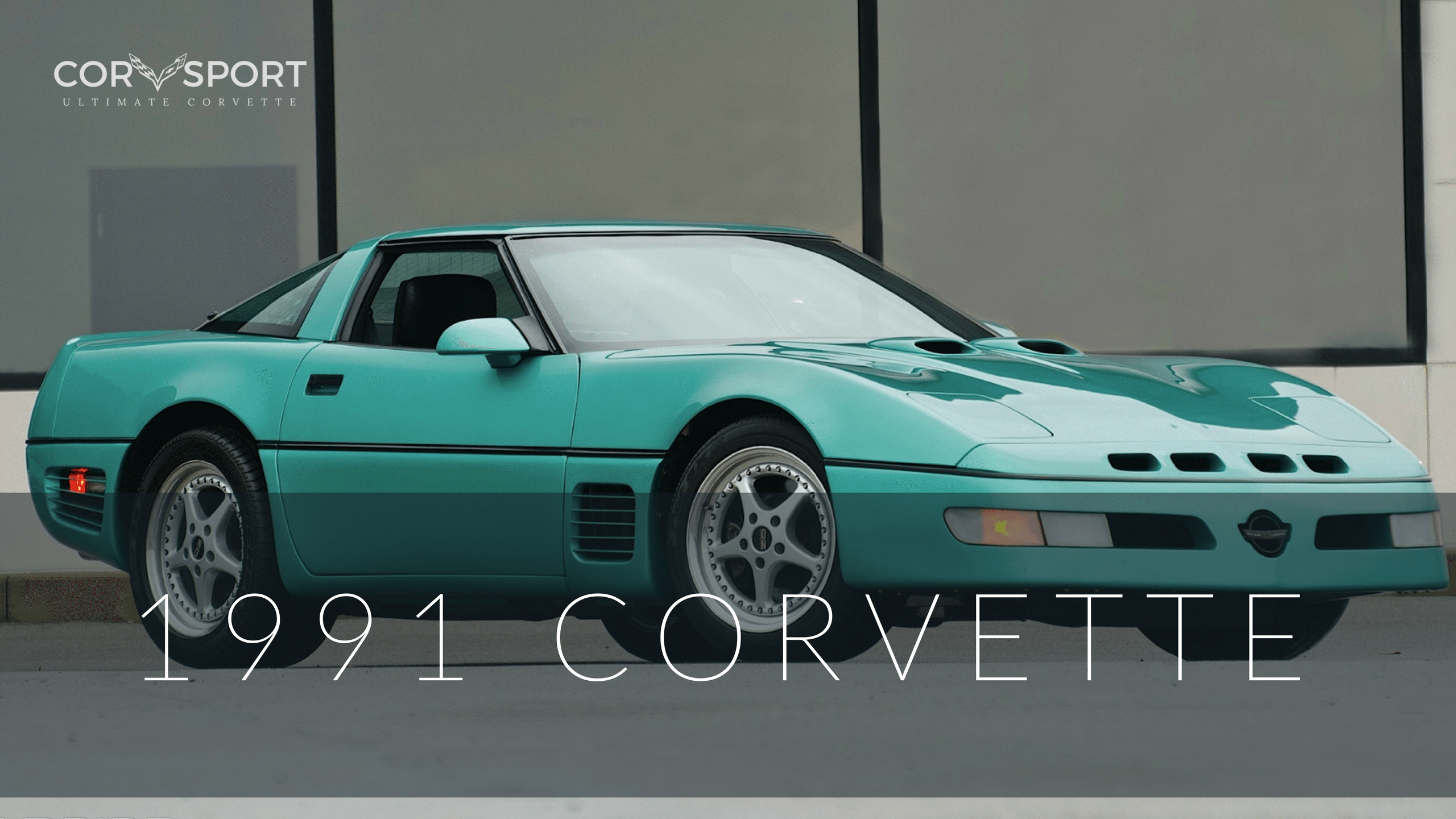
In 1989, Chevy added 17-inch wheels and tires and replaced the Doug Nash 4+3 with a ZF six-speed manual. The following year, the C4 got a new cockpit-style interior with airbags and plenty of gray, hard plastic. Most of the digital gauges were gone, too. New exterior styling with more-rounded lines came in 1991, and in ’92 the L98 was replaced with the second-generation small-block, the LT1. That engine made 300 horsepower, and although its Optispark ignition proved delicate, aftermarket solutions are readily available.
This engine family peaked in 1996 with the 330-hp LT4, optional on all Corvettes equipped with the six-speed. It also powered the Collector Edition and Grand Sport models, both of which exceed the $15,000 mandate of this page. We haven’t even mentioned the 1990–95 ZR-1 or the twin-turbo Callaway models.
They’re spendy, too. But other C4s remain cheap. Of note are the 1985–89 cars that feature the L98 paired with the retro charm of the harder-edged exterior lines and original interior design. They offer heady performance for little money, and they’re old enough to be retro cool. C4 Corvette prices are flat, but they’re starting to tick up as Gen Xers begin to seek out the cars they wanted in high school. As always, buy the absolute best one your budget can afford.
Road & Track adds an owner interview:
I’ve always liked the compact look of the C4 Corvette. I finally bought one—a 1988 convertible—in 2009 and have put about 4000 miles on it since. It shares the garage with an ’87 Camaro I bought new and a trio of ’57 Chevys. The C4 had 62,000 miles on it, and the body and the interior were perfect. But it had been neglected mechanically, so I replaced the clutch and the radiator and rebuilt the pop-up headlight buckets. Now that it isn’t nickel-and-diming me anymore, it’s the perfect car to go out and cruise in on a nice day. I love the Doug Nash 4+3 transmission, with overdrive in second, third, and fourth gears. It’s like having a seven-speed. Compared to my Camaro, the Corvette is a whole different animal and outperforms it in every way.
I’m sitting in a 1984 C4. Not mine, unfortunately.
I have a few problems with the C4. Two would be right in front of me if I owned one:
The first photo is of the 1984–1990 C4 instrument cluster, known derisively as the “Star Wars” dashboard. That would bug me no end if I owned an early C4. The other problem is that, to no surprise, that cluster is known to die without warning. Chevy replaced it with the instrument cluster in the second photo, which for some reason still included a digital speedometer.
Since the second cluster was part of an interior redesign, no, you can’t swap one into the other. There are other alternatives …
… for a price, of course.
I’m not enamored with the original wheels either, which to me look like the wheel covers of my former 1975 Chevy Caprice.
They do look appropriate somehow for those interested in the last-generation Caprice. (These are actually the next wheel design, which looks better.)
Poor wheel aesthetics can be fixed, too, for a price.
The C4 lasted from the spring of 1983 (as a 1984 model) to 1996, when it was replaced by the C5. Which leads us to Jack Baruth:
It was the first modern Corvette to challenge the world’s best sports cars on truly level ground, the first Corvette to take a class victory at Le Mans, and the last Corvette to feature those oh-so-cool hidden headlamps. But the fifth-gen Vette (C5) came very close to not existing at all. According to Russ McLean, platform manager for the model, General Motors management made the decision to “sunset” America’s most iconic sports car in the Nineties. McLean and a group of rebels ignored the decision and continued development of the Corvette, much of it off the books and on their own time.
Eventually, the big wigs came back around to the idea of building the C5. Celebrated as world-class upon its debut, it would go on to win everywhere from the SCCA Solo Nationals in Topeka to the Mulsanne straight in France. Now caught in that uncomfortable middle ground between new-car smell and classic-car kudos, the C5 is arguably the greatest performance bargain on the market. It can still cut the mustard on a road course, at the drag strip, or at a Saturday night cruise-in.
If you’re looking for chrome trim, bronze-tinted T-tops, or ashy door handles that disappear into the horizontal surfaces, you won’t find them here, but much of the traditional Vette ownership experience persists, from the stubborn sag of the massive doors to the copious heat blasting from the transmission tunnel. At least there’s plenty of power. Fire up the V-8 and marvel at the lazy torque that can roll the car forward from a standstill in the (optional!) manual six-speed’s fourth gear.
The C5’s shoestring development shows through in the mismatched interior controls, the perishable nature of the interior trim, and the hilarious necessity of leaving a door open when you close the rear hatch, because there isn’t enough passive venting to let the air escape otherwise. But there’s plenty of smart engineering under the fiberglass skin. (Corvettes have always been known for having fiberglass body panels, but since 1973, General Motors has steadily increased the amount of plastic resin in what is now called sheet molding compound, or SMC, such that the h-generation Vette’s body panels used just 20 percent fiberglass.) Its hydroformed steel structure is four and a half times as stiff as the previous Corvette’s. Elsewhere, the use of aluminum, magnesium, and even balsa wood (in the door sections) cut weight. The aluminum LS1 V-8 was a clean-sheet design, sharing only bore spacing with earlier Chevy small-blocks. A few minutes at speed will dispel any doubts. Considering that some modern six-cylinders outpower a ’97 Corvette’s 345 hp, the C5 is no longer truly rapid by modern standards, but a well-driven example can still see off a challenge from today’s hot hatches, and a mint-condition Z06 is almost a match for a new Stingray.
We’ve most likely passed the bottom of the market for manual-transmission C5 Corvettes in good condition. Early coupes and convertibles with automatics can sometimes be had for 10 grand or even less, but expect to pay $15,000 and up for six-speed coupes and FRCs. The 405-hp Z06s sit at the top of the price spectrum, with transaction prices for clean 2004 Z06 variants often approaching $30,000. If you’re buying for the long term, don’t consider anything but a Z06. But if you’re looking for a daily driver, keep in mind that $5000 in upgrades to a coupe or convertible will enable it to leave a stock Z06 in the dust. …
The C5’s performance came as a surprise to many owners, so look carefully for crash damage and be sure that the car’s steel backbone is intact. Despite having plastic body panels, Corvettes can corrode underneath, which makes a full inspection worth your time. The first few years used fussy tire-pressure sensors and key fobs, so budget $500 or so to bring them up to 2001–2004 spec. If you aren’t sure about the condition of the clutch or transaxle, get it looked at before purchase, because they are labor-intensive to repair.
The LS1 and LS6 engines are renowned for durability and ease of tuning. Swapping the heads, cam, and intake can yield as much as 500 hp at the crank. There are also well-tested supercharger upgrades.
The C5 was raced extensively in the SCCA T1 class and elsewhere, so there are virtually limitless options for firming up the handling. If you’d rather improve the street usability of your Corvette, there are aftermarket solutions, from upgraded seats to complete interior swaps. For about $1000, you can replace a tired targa top with a tinted aftermarket variant that recalls the spirit of 1970s Vettes.
The C5 has one particular feature no Corvette afterward has — hidden headlights, which are for me a requirement. (The first Corvette I ever saw was a C3.) The C5 also fixed the C4’s bad-instrument-panel-design issue, though as you read fit and finish are a problem. (As with every GM car I have ever seen, including the two we own.)
Some people don’t like the C5s because of their (in their opinion) generic styling. The C4s look more like the C3, and I find it interesting how much the C6 looks like the C4. The C5s, however, have more horsepower than any C4 other than the ZR1, with its 32-valve V-8 built by Mercury Marine’s stern drive division.
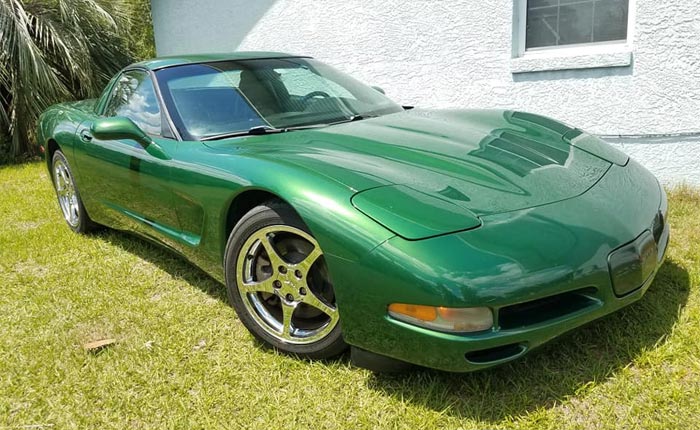
The C4 and C5 eras also have cars available in my favorite color:
Whether a particular car is “affordable” depends on your definition of that word. It also recalls the aphorism that you get what you pay for.
Years ago I interviewed a classic car dealer, and he said that a lot of people wanted a Corvette from the year of their high school graduation. Corvette aficionados know that means I won’t own a Corvette. (For those who aren’t: I graduated in 1983. There is no 1983 Corvette because the 1984 Corvette, the first C4, came out in the spring of 1983.)
I suppose I could buy a 1988 Corvette to represent the year of my college graduation. Or I could buy a red 1999 Corvette to represent my two favorite Prince songs …
The Bloomberg and Bernie battle is almost like a comic book come to life. The two combatants cover almost every cliché on the right-wing scorecard.
The right couldn’t have invented a better candidate than Bernie Sanders. In 1971, he was kicked out of a commune for talking too much. In 1987(!) he recorded a folk album. The following year he got married and left the next day for a combination fact-finding delegation and honeymoon in the Soviet Union. When he returned, he sounded a bit like Lincoln Steffens, the famous journalist who had said of the USSR, “I have seen the future and it works.” In Steffens’ defense, he visited in 1919, two years after its founding and before most of the inconvenient mass murder and starvation. Sanders thought the Soviet Union was the future three years before it collapsed.
Of course, this isn’t why most of his fans like him. He was on the right side of the civil rights movement when it really mattered. He’s been a consistent advocate of what he calls democratic socialism here at home all his life. And, he’s an unreconstructed enemy of the economic elites, particularly the hated “billionaire class.”
Which brings us to Michael R. Bloomberg, who sits atop the 1% of the 1%. Bloomberg is a perfect stand-in for a completely different kind of liberalism, one that doesn’t even like to call itself liberal. He headlined the launch of No Labels, an organization dedicated to getting ideology out of politics. A lifelong Democrat, he switched labels to become a Republican to run for mayor in 2001. By his third term he was an independent. Now he’s a Democrat because he’s running for president.
As mayor of New York, he was a poster boy for a kind of arrogant progressive-post-partisan technocratic government that prizes data over feelings. The data showed that obesity cost the healthcare system money, sugary sodas contributed to obesity, so Bloomberg said let’s clamp down on them. The data showed that young black men committed most of the gun homicides, so Bloomberg said, let’s clamp down on them with stop and frisk. “Ninety-five percent of murders, murderers and murder victims fit one M.O. You can just take a description, Xerox it, and pass it out to all the cops,” he explained in 2015.
In a new video going around, Bloomberg offers a quasi-endorsement of “death panels.” “If you show up with prostate cancer, you’re 95 years old, [we] should say go and enjoy, you’ve lived a long life, there’s no cure. We can’t do anything,” Bloomberg says. “If you’re a young person, we should do something about it. Society’s not willing to do that, yet.”
This isn’t why his fans like him. For a long time he was an icon of the credentialed upper class who saw ideological culture war fights as so much boob-bait. More recently, he’s become the liberal’s “Chicago way” response to Trump. If the right comes at you with a billionaire would-be Putin, you come back with a bigger billionaire and would-be Lee Kuan Yew.
Both men represent two strands of liberalism with very long pedigrees. Sanders can trace his lineage back to antiwar socialists and populists like William Jennings Bryan and Eugene Debs, as well as to reformers like Jane Addams. Bloomberg’s antecedents can be found in the democracy-skeptical “disinterested” progressive pragmatists like Walter Lippmann, Oliver Wendell Holmes and the Wisconsin school economists. Usually these two strands intertwine and overlap, (Barack Obama had a foot in both camps. He was both the anointed leader of a mass movement and the overseer of the Affordable Care Act, with all of its data driven rationing). But when stripped to their purest elements, one camp is all about solidarity and people power and the other is about technocratic expertise.
Like Trump, both men are beneficiaries of our hollowed-out political parties, which are incapable of performing the gatekeeper function of the nomination process.
And that raises the stakes of their contest. Trump has transformed much of the GOP in his image. Too weak to protect their own brand, the Republicans have adopted his.
If either Sanders or Bloomberg wins the nomination, it will be interesting to see if the same thing happens to Democrats. If it’s Sanders, will they become a populist party of Social Democrats? Or if it’s Bloomberg, will the Democrats become the party of bureaucratic authoritarianism?
Again, normally Democratic politicians straddle these two tendencies. There are, of course, still other options for primary voters. But the choice between these two is zero-sum, and if either man wins, the Democratic Party could end up making a choice that will define it as much as Trump has come to define the GOP.






 Steve Prestegard.com: The Presteblog