Skip to content
  • Capitalism, without hyphens

    March 4, 2020
    US politics

    Daniel J. Mitchell:

    The most obvious threat to free enterprise is Bernie Sanders, though other prominent leftists are giving “Crazy Bernie” plenty of competition.

    But I sometimes wonder whether the more tangible threat to capitalism comes from self-described conservatives who say they support markets but embrace trendy ideas that would expand the size and scope of the federal government.

    • Common-good capitalism
    • Nationalist conservatism
    • Reform conservatism
    • Kinder-and-gentler conservatism
    • Compassionate conservatism

    The people who gravitate to these ideas inevitably argue that a Reagan-style agenda of free markets and limited government is somehow inadequate.

    They even make the laughable claim that the Republican Party in recent decades has been dominated by libertarian economic thinking. I’m not joking.

    And they come up with creative justifications for bad ideas.

    For instance, Oren Cass has concocted a “cost of thriving index” that purports to show ever-increasing economic pressure on families.

    Cost-of-Thriving Index (COTI): the number of weeks of the median male wage required to pay for rent on a three-bedroom house at the 40th percentile of a local market’s prices, a family health insurance premium, a semester of public college, and the operation of a vehicle.…The COTI shows a declining capacity of a worker to meet the major costs of a typical middle-class household. As the COTI basket has become unaffordable, families have found workarounds, like having more household members work more hours, making do without, borrowing, and relying on government support. Each of these comes with its own costs, undermines the stability of families and the rationale for their formation, and creates high levels of stress and uncertainty. …The U.S. economy of recent decades has eroded, rather than reinforced, the American model of thriving, self-sufficient fami­lies.

    Here’s his COTI graph, which supposedly shows that a breadwinner would have to work 53 weeks per year to buy what was easily affordable back in 1985.

    A number of experts have identified serious methodological problems with his work (see Scott Winship, Mark Perry, Robert Verbruggen, Stan Veuger, Matt Yglesias, Don Boudreaux, and Andrew Biggs).

    I want to make a different point. So I’m going to ignore all the problems that exist with the methodology and data, and I’m going to assume – for the sake of argument – that Cass’ chart is accurate.

    And the reason I’m willing to make that heroic assumption is that Cass inadvertently shows why bigger government and more intervention is a bad idea.

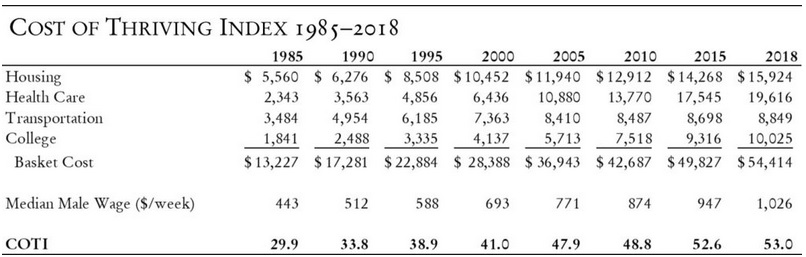
    Here are the numbers he used to create his chart.

    If you examine what’s happened with the different categories, you’ll quickly notice that almost all the increase in his index is the result of ever-high costs for health care and college.

    Yet those are precisely the areas where there the role of government has increased.

    More specifically, we have a massive third-party-payer problem with health carecaused by Medicare, Medicaid, and the tax code’s healthcare exclusion.

    And we have a massive third-party-payer problem in higher education thanks to a big expansion of loans, grants, and other subsidies.

    In both cases, providers have responded to government intervention with higher prices and massive inefficiency.

    The bottom line is that the chart should be modified to show the harmful impact of government.

    The challenge for Cass is to somehow explain why more government is a good idea when his own numbers show that we’re getting bad results in the sectors where we already have lots of government.

    Maybe, just maybe, there’s a lesson to be learned. Or a principle that should be applied.

    Share this on …

    • Share on X (Opens in new window) X
    • Share on Facebook (Opens in new window) Facebook
    • Share on LinkedIn (Opens in new window) LinkedIn
    • Email a link to a friend (Opens in new window) Email
    • Print (Opens in new window) Print
    Like Loading…
    No comments on Capitalism, without hyphens
  • Presty the DJ for March 4

    March 4, 2020
    Music

    The Grammy Awards premiered today in 1959. The Record of the Year came from a TV series:

    Today in 1966, John Lennon demonstrated the ability to get publicity, if not positive publicity, when the London Evening Standard printed a story in which Lennon said:

    Christianity will go. It will vanish and shrink. I needn’t argue with that; I’m right and I will be proved right. We’re more popular than Jesus now; I don’t know which will go first — rock and roll or Christianity. Jesus was all right, but his disciples were thick and ordinary. It’s them twisting it that ruins it for me.

    Lennon’s comment prompted Bible Belt protests, including burning Beatles records. Of course, as the band pointed out, to burn Beatles records requires purchasing them first.

    The number one single today in 1967:

    Today in 1973, Pink Floyd began its 19-date North American tour at the Dane County Coliseum in Madison.

    (more…)

    Share this on …

    • Share on X (Opens in new window) X
    • Share on Facebook (Opens in new window) Facebook
    • Share on LinkedIn (Opens in new window) LinkedIn
    • Email a link to a friend (Opens in new window) Email
    • Print (Opens in new window) Print
    Like Loading…
    No comments on Presty the DJ for March 4
  • Two votes against Sanders

    March 3, 2020
    US politics

    David Brooks, one of those Never Trumpers:

    A few months ago, I wrote a column saying I would vote for Elizabeth Warren over Donald Trump. I may not agree with some of her policies, but culture is more important than politics. She does not spread moral rot the way Trump does.

    Now I have to decide if I’d support Bernie Sanders over Trump.

    We all start from personal experience. I covered the Soviet Union in its final decrepit years. The Soviet and allied regimes had already slaughtered 20 million people through things like mass executions and intentional famines. Those regimes were slave states. They enslaved whole peoples and took away the right to say what they wanted, live where they wanted and harvest the fruits of their labor.

    And yet every day we find more old quotes from Sanders apologizing for this sort of slave regime, whether in the Soviet Union, Cuba or Nicaragua. He excused the Nicaraguan communists when they took away the civil liberties of their citizens. He’s still making excuses for Castro.

    To sympathize with these revolutions in the 1920s was acceptable, given their original high ideals. To do so after the Hitler-Stalin pact, or in the 1950s, is appalling. To do so in the 1980s is morally unfathomable.

    I say all this not to cancel Sanders for past misjudgments. I say all this because the intellectual suppositions that led him to embrace these views still guide his thinking today. I’ve just watched populism destroy traditional conservatism in the G.O.P. I’m here to tell you that Bernie Sanders is not a liberal Democrat. He’s what replaces liberal Democrats.

    Traditional liberalism traces its intellectual roots to John Stuart Mill, John Locke, the Social Gospel movement and the New Deal. This liberalism believes in gaining power the traditional way: building coalitions, working within the constitutional system and crafting the sort of compromises you need in a complex, pluralistic society.

    This is why liberals like Hubert Humphrey, Ted Kennedy and Elizabeth Warren were and are such effective senators. They worked within the system, negotiated and practiced the art of politics.

    Populists like Sanders speak as if the whole system is irredeemably corrupt. Sanders was a useless House member and has been a marginal senator because he doesn’t operate within this system or believe in this theory of change.

    He believes in revolutionary mass mobilization and, once an election has been won, rule by majoritarian domination. This is how populists of left and right are ruling all over the world, and it is exactly what our founders feared most and tried hard to prevent.

    Liberalism celebrates certain values: reasonableness, conversation, compassion, tolerance, intellectual humility and optimism. Liberalism is horrified by cruelty. Sanders’s leadership style embodies the populist values, which are different: rage, bitter and relentless polarization, a demand for ideological purity among your friends and incessant hatred for your supposed foes.

    A liberal leader confronts new facts and changes his or her mind. A populist leader cannot because the omniscience of the charismatic headman can never be doubted. A liberal sees shades of gray. For a populist reality is white or black, friend or enemy. Facts that don’t fit the dogma are ignored.

    A liberal sees inequality and tries to reduce it. A populist sees remorseless class war and believes in concentrated power to crush the enemy. Sanders is running on a $60 trillion spending agenda that would double the size of the federal government. It would represent the greatest concentration of power in the Washington elite in American history.

    These days, Sanders masquerades as something less revolutionary than he really is. He claims to be nothing more than the continuation of Franklin Roosevelt and the New Deal. He is 5 percent right and 95 percent wrong.

    There was a period around 1936 or 1937 when Roosevelt was trying to pack the Supreme Court and turning into the sort of arrogant majoritarian strongman the founders feared. But this is not how F.D.R. won the presidency, passed the New Deal, beat back the socialists of his time or led the nation during World War II. F.D.R. did not think America was a force for ill in world affairs.

    Sanders also claims he’s just trying to import the Scandinavian model, which is believable if you know nothing about Scandinavia or what Sanders is proposing. Those countries do have generous welfare states, but they can afford them because they understand how free market capitalism works, with fewer regulations on business creation and free trade.

    There is a specter haunting the world — corrosive populisms of right and left. These populisms grow out of real problems but are the wrong answers to them. For the past century, liberal Democrats from F.D.R. to Barack Obama knew how to beat back threats from the populist left. They knew how to defend the legitimacy of our system, even while reforming it.

    Judging by the last few debates, none of the current candidates remember those arguments or know how to rebut a populist to their left.

    I’ll cast my lot with democratic liberalism. The system needs reform. But I just can’t pull the lever for either of the two populisms threatening to tear it down.

    Charlie Sykes, like Brooks no fan of Trump:

    Let’s stipulate the profound unseriousness of a Republican Party that has morphed into a Trumpist cult. But the Democrats have pretensions; they want us to believe they are the serious party, the party of grownups.
    But would a serious party nominate Bernie Sanders?

    The real problem with Sanders is his platform, which even his fans seem to suspect is the stuff of fevered fantasies and fiscal unicorns. Outside of the Bernie Bros themselves, the best case for Sanders is that his proposals are so lavishly extreme that there is little or no chance they will ever be adopted.
    In other words, the implausibility of his ideas is actually a selling point.
    Perhaps that explains why none of his Democratic rivals seemed especially interested in pushing Sanders to show how his math works. Spoiler alert: they know it doesn’t. Hell, Bernie knows it doesn’t work. So his fellow Democrats gave him a pass the other night.
    The result of their passivity, writes Ron Brownstein in Atlantic was that “the blustery and disorderly session once again failed to fully explore what could be the Vermont senator’s greatest general-election weakness: the massive size and scope of his spending and tax proposals, which, depending on the estimate, would cost $50 trillion to $60 trillion over the next 10 years. ”
    Sanders’s proposals, notes Brownstein, “would roughly double the size of the federal government, an unprecedented increase outside of wartime.”
    On the eve of the debate, Sanders released a document that purported to detail how he would pay for all of the free stuff he was promising – Medicare for All, College for All and Canceling Student Debt, Housing For All, Universal Childcare/Pre-K, Eliminating Medical Debt, Increasing Social Security, and the Green New Deal. The numbers did not even come close to adding up.
    As Brownstein notes: Sanders has also proposed “other expensive spending plans that he did not list, notably: increased funding for K–12 education, which has been estimated to cost $800 billion to $1 trillion; a federally funded paid-medical-and-family-leave program for workers, which the Congressional Budget Office recently scored at about $500 billion over a decade; a $1 trillion infrastructure initiative; and a federal guaranteed-jobs program whose cost estimates vary widely but that could run into the trillions”
    Depending on which numbers you use, this raises federal spending somewhere around $50 to $60 trillion dollars over the next decade — or roughly double the current rate of spending. To pay for this, Sanders has proposed at least $30 trillion in new taxes on business and the rich, along with another $12 trillion in ‘”revenue and savings.” Those tax hikes, Brownstein notes, “would increase federal taxes as a share of GDP by as much as 11 percentage points.”
    Sanders’s tax hikes would be the largest peacetime increases in history. And they would inevitably hit the middle class hard.
    But they would still not be enough. A fact-check by the Progressive Policy Institute’s Center for Funding America’s Future, found that Sanders’s “pay-for” would still leave a massive $25 trillion hole.

    Sanders’ proposed pay-fors don’t even come close to covering these costs. The document Sanders published last night, along with others released earlier in his campaign, claim to collectively raise less than $43 trillion in new revenue—meaning that he’s at least $10 trillion short. But the revenue projections Sanders uses for his tax proposals are well outside the mainstream of what independent analysts at the Committee for a Responsible Federal Budget, Congressional Budget Office, Tax Policy Center, Penn Wharton Budget Model, and others have estimated.

    After reconciling Sanders’ latest list of pay-fors with these independent estimates, PPI concludes that even if Congress were to adopt every single revenue option Sanders has offered for consideration, it would fall almost $25 trillion short of his proposed spending increases over the next decade—leaving a gap nearly equal to the total value of all goods and services produced by the U.S. economy in one year.

    Brownstein quotes Jared Bernstein, an economist and senior fellow at the liberal Center on Budget and Policy Priorities, who admits: “You would need even more revenue than he is proposing to fully offset those costs. It is not realistic to believe you can get all those revenues from the top 1, 5, or 10 percent [of households]. You would have to go down further than that. The rest of it has to come from a broader base of taxpayers or it has to go on the deficit.”

    But Bernstein insists that we need to take Sander’s numbers seriously, but not literally. He says that Bernie’s proposals are more “aspirational than realistic.”

    This, of course has become a familiar feature of our politics. Politicos who indulge in the politics of aspiration make “bold” proposals that they have no intention of actually enacting. Donald Trump claimed that he would build a big, beautiful wall and that Mexico would pay for it. Elizabeth Warren proposes a plan for everything and says that her new “wealth tax” will cover the tab. Bernie and the others embrace sweeping environmental schemes that are unconnected with reality.

    And no one takes them literally. Of course. Because the fundamental unseriousness is baked in.

    So now the question is whether the Democrats as a whole will embrace the mantle of fiscal frivolity, by nominating a man who is making promises that they know he can never possibly keep.

    Share this on …

    • Share on X (Opens in new window) X
    • Share on Facebook (Opens in new window) Facebook
    • Share on LinkedIn (Opens in new window) LinkedIn
    • Email a link to a friend (Opens in new window) Email
    • Print (Opens in new window) Print
    Like Loading…
    No comments on Two votes against Sanders
  • Presty the DJ for March 3

    March 3, 2020
    Music

    Today in 1966, Neil Young, Stephen Stills and Richie Furay formed the Buffalo Springfield.

    The number one British single today in 1967:

    Today in 1971, the South African Broadcasting Corp. lifted its ban on broadcasting the Beatles.

    Perhaps SABC felt safe given that the Beatles had broken up one year earlier. (SABC was South Africa’s radio broadcaster, by the way. TV didn’t get to South Africa until 1976.)

    (more…)

    Share this on …

    • Share on X (Opens in new window) X
    • Share on Facebook (Opens in new window) Facebook
    • Share on LinkedIn (Opens in new window) LinkedIn
    • Email a link to a friend (Opens in new window) Email
    • Print (Opens in new window) Print
    Like Loading…
    No comments on Presty the DJ for March 3
  • Democrats support bleeding you dry

    March 2, 2020
    US politics, weather

    Paul Bedard:

    The Green New Deal is going to put a lot of Americans in the red.

    According to a new analysis, the liberal plan backed by Sen. Bernie Sanders and Rep. Alexandria Ocasio-Cortez will cost households an average of $75,000 in the first year and $40,000 extra every year after.

    The study of 11 states found that the initial year of the program will be especially high because businesses and households will have to get new equipment. The price tag includes increased costs for electricity, upgrading vehicles and housing, and shipping.

    Screen Shot 2020-02-27 at 1.34.11 PM.png

    Source: CEI

    Alaska would be hit the hardest, with an initial first-year price tag per household at over $84,000.

    “The Green New Deal is a politically motivated policy that will saddle households with exorbitant costs and wreck our economy. Our analysis shows that, if implemented, the Green New Deal would cost for American households at least tens of thousands of dollars annually on a permanent basis,” said Competitive Enterprise Institute President Kent Lassman.

    “The Green New Deal would effectively destroy America’s energy industry, and with it, our entire economy,” added Daniel Turner, executive director of Power the Future.

    And Wisconsin Institute for Law and Liberty research director Will Flanders said, “The Green New Deal would eliminate that, driving middle class families into poverty by imposing staggering annual costs of more than $40,000 per household.”

    All three groups joined in producing the report, “What the Green New Deal Could Cost a Typical Household.”

    Liberals and progressives have galvanized around the plan to end the use of fossil fuels. But many centrists have avoided it because of the costs.

    Several groups have studied the potential high costs, and the new report is the latest.

    According to DataUSA the median annual household income in Wisconsin is $60,773. The first-year costs of the Green New Deal would thus suck up all of the income of most families in Wisconsin in its first year, three-fourths for the next four years, and two-thirds every year thereafter.

    Anyone who supports this stupidity is your enemy.


    Share this on …

    • Share on X (Opens in new window) X
    • Share on Facebook (Opens in new window) Facebook
    • Share on LinkedIn (Opens in new window) LinkedIn
    • Email a link to a friend (Opens in new window) Email
    • Print (Opens in new window) Print
    Like Loading…
    No comments on Democrats support bleeding you dry
  • On the latest crisis

    March 2, 2020
    International relations, US politics

    Eric Boehm:

    As politicians react to the coronavirus outbreak, more than a few seem to be following the old adage that you should never let a good crisis go to waste.

    Since it is only a matter of time before Democrats and Republicans start accusing the other side of using a public health crisis for political gain, let’s be blunt about something: Both sides are going to use the crisis for political gain. Indeed, both already are.

    Much of President Donald Trump’s briefing about the coronavirus on Wednesday night was incoherent, but he nevertheless managed to brag about how the stock market had risen after his election. More to the point, he repeatedly claimed that his administration had slowed the spread of the disease into America by cutting off air travel from China, and he suggested that further restrictions could be coming. That’s a natural response from an administration whose signature non-coronavirus policies have included travel bans, immigration restrictions, and a general hostility to the free movement of goods and people across national borders.

    But building walls doesn’t stop the spread of disease. In fact, “travel restrictions can cause more harm than good by hindering info-sharing, medical supply chains and harming economies,” advised Tedros Adhanom Ghebreyesus, secretary-general of the World Health Organization, earlier this month. Slowing the spread of disease allows more time for hospitals to prepare, but historical evidence shows that travel bans don’t actually reduce the number of people who get sick during disease outbreaks.

    China hawks are seizing on the outbreak too. Sen. Josh Hawley (R–Mo.) plans to introduce a bill requiring American medical device manufacturers to provide detailed information about their supply chains to the Food and Drug Administration. The agency would use that info to “assess the security of the U.S. medical product supply chain.”

    While it is presented as a way for the government to ensure America is prepared for a public health crisis, Hawley’s bill is also a step toward greater central planning. It’s not difficult to see how Hawley or Trump could, sometime in the future, claim that America’s medical supply chain is too dependent on China—in the same way that Trump used a fictional “national security” risk to justify tariffs on steel and aluminum. Those tariffs haven’t worked, but Hawley—who believes Trump’s trade war is a long-term proposition—is barely disguising his attempt to lay the groundwork for more protectionism.

    Democrats, too, are using the coronavirus as a new argument for old political objectives. Like defeating Trump, for example. While they offered little in the way of alternatives during Tuesday’s primary debate, each of the candidates onstage were happy to blast the president for bungling the response to the coronavirus—even though it’s still far too soon to conclude whether Trump’s responses, or lack thereof, have made the outbreak worse in America.

    Specifically, former Vice President Joe Biden has ripped the current administration for making “draconian cuts” to the National Institutes of Health (NIH) and the Centers for Disease Control and Prevention (CDC). The Obama administration “increased the budget of the CDC. We increased the NIH budget,” Biden said Tuesday night. “He’s wiped all that out. He cut the funding for the entire effort.”

    Except he didn’t. Trump has proposed budget cuts for the CDC and NIH in each of his budgets since taking office, but Congress never approved those proposals. That’s a pretty important distinction.

    If the NIH and the CDC aren’t adequately prepared to handle a disease outbreak, it’s probably their own fault. There is always going to be a finite amount of money for any government agency to use, so it’s best not to waste your shares. Yet the CDC spent $15 billion during the Obama administration to nudge Americans towards healthier eating habits, and millions more on the creation of a “Hollywood liaison office” with funds that were supposed to be used to counter the threat of bioterrorism. Sure, it’s possible that more funding would result in greater preparedness to face new and deadly diseases. So would making better choices about the money you already have.

    But that’s not going to stop Democrats from using the coronavirus outbreak to argue for spending more money that we don’t have—and heaven forbid we actually pay for emergency coronavirus funding with budget cuts elsewhere. Just like it won’t stop Republicans from using the disease to push their anti-trade agenda. No matter how bad the outbreak might turn out to be, you can bet that politicians will find a way to make it worse.

    Share this on …

    • Share on X (Opens in new window) X
    • Share on Facebook (Opens in new window) Facebook
    • Share on LinkedIn (Opens in new window) LinkedIn
    • Email a link to a friend (Opens in new window) Email
    • Print (Opens in new window) Print
    Like Loading…
    No comments on On the latest crisis
  • Presty the DJ for March 2

    March 2, 2020
    Music

    The number one British single today in 1961:

    The number one single today in 1963:

    Today in 1964, the Beatles began filming “A Hard Day’s Night,” and George Harrison met Patti Boyd, who became Harrison’s wife.

    Boyd later would become the subject of an Eric Clapton song (in fast and slow versions), and then Clapton’s wife, and then Clapton’s ex-wife.

    (more…)

    Share this on …

    • Share on X (Opens in new window) X
    • Share on Facebook (Opens in new window) Facebook
    • Share on LinkedIn (Opens in new window) LinkedIn
    • Email a link to a friend (Opens in new window) Email
    • Print (Opens in new window) Print
    Like Loading…
    No comments on Presty the DJ for March 2
  • Presty the DJ for March 1

    March 1, 2020
    Music

    Today in 1961, Elvis Presley signed a five-year movie deal with producer Hal Wallis.

    (more…)

    Share this on …

    • Share on X (Opens in new window) X
    • Share on Facebook (Opens in new window) Facebook
    • Share on LinkedIn (Opens in new window) LinkedIn
    • Email a link to a friend (Opens in new window) Email
    • Print (Opens in new window) Print
    Like Loading…
    No comments on Presty the DJ for March 1
  • Presty the DJ for Feb. 29

    February 29, 2020
    Music

    As you can imagine with a date that occurs only every four years, not much happened today in music.

    Today in 1968, the Beatles’ “Sgt. Pepper’s Lonely Hearts Club Band” won album of the year at the Grammys:

    The number one single today in 1992:

    Besides our fat chihuahua Leo, birthdays begin with Jimmy Dorsey …

    … and end with Gretchen Christopher of the Fleetwoods:

    Two deaths of note today: Songwriter Wes Farrell in 1996 …

    …and Mike Smith of the Dave Clark Five in 2008:

    Share this on …

    • Share on X (Opens in new window) X
    • Share on Facebook (Opens in new window) Facebook
    • Share on LinkedIn (Opens in new window) LinkedIn
    • Email a link to a friend (Opens in new window) Email
    • Print (Opens in new window) Print
    Like Loading…
    No comments on Presty the DJ for Feb. 29
  • An author of my youth

    February 28, 2020
    media

    The New York Times:

    Clive Cussler, the author and maritime adventurer who captivated millions with his best-selling tales of suspense and who, between books, led scores of expeditions to find historic shipwrecks and lost treasures in the ocean depths, died on Monday at his home in Scottsdale, Ariz. He was 88.

    His death was confirmed by a spokeswoman for his publisher, Penguin Random House. No specific cause was given.

    Mayan jungles, undersea kingdoms, ghost ships, evil forces out to destroy the world, beautiful women, heroes modeled on himself — Mr. Cussler’s vivid literary fantasies and his larger-than-life exploits swirled together for four decades, spinning off more than 85 books and locating almost as many shipwrecks.

    A college dropout who once pumped gas and wrote advertising copy, Mr. Cussler resorted to a hoax to get his first book published. But his work — mostly action thrillers of the James Bond-Indiana Jones kind, plus nonfiction accounts of his marine quests and a few children’s books — made him a global celebrity.

    His book sales have been staggering — more than 100 million copies, with vast numbers sold in paperback at airports. Translated into 40 or so languages, his books reached The New York Times’s best-seller lists more than 20 times, as he amassed a fortune estimated at $80 million.

    Mr. Cussler looked like the hero of Hemingway’s “The Old Man and the Sea.” You had to imagine the battered straw hat and the tired shoulders hunched over a gunwale, but after years of roaming oceans and diving for wrecks, he had that seafarer’s husky build and sunburned cheeks, and his face, more sea dog than bibliophile, was flecked with gray: the grizzled beard, the mustache, the eyes, the gray-white hair.

    Often compared to the thrillers churned out by Tom Clancy, Robert Ludlum and Ian Fleming, the Cussler novels featured formulaic plots, one- or two-word titles (“Cyclops,” “Dragon,” “Inca Gold,” “Poseidon’s Arrow”) and frequently a recurring hero, Dirk Pitt, an undersea explorer who cheats death and saves the world as he foils the diabolical plots of megalomaniac villains, while satisfying his taste for exotic cars and lusty women.

    For the aforementioned reasons, I inhaled Cussler novels for years in high school and college, as with Clancy’s and Ludlum’s works. I also read Fleming’s works until I figured out that his novels didn’t match the movies that much.

    Mr. Cussler was hardly a stylist. Critics called his characters wooden, his dialogue leaden and his prose clichéd (“the cold touch of fear,” “a narrow brush with death”), while praising his descriptions of marine hardware, underwater struggles and salvage operations. But readers were swept along on the page-turning tides, and after his commercial breakthrough, “Raise the Titanic!” (1976), his books were frequently on the best-seller lists for months.

    Mr. Cussler also connected with readers by turning his love for scuba diving into an oceanic lifestyle that paralleled and validated his superhero.

    He first created the National Underwater and Marine Agency as a fictional government organization that employed his hero in the Dirk Pitt books. Then, in 1979, he founded an actual National Underwater and Marine Agency as a private nonprofit group committed to “preserving maritime heritage through the discovery, archaeological survey and conservation of shipwreck artifacts.” It underwrote his maritime ventures.

    With Mr. Cussler leading expeditions and joining dives, the organization eventually located some 60 wrecks. Among them were the Cunard steamship Carpathia, first to reach survivors of the lost Titanic on April 15, 1912, then itself sunk by German torpedoes off Ireland in 1918; Commodore Cornelius Vanderbilt’s coastal steamer Lexington, which caught fire and went down in Long Island Sound in 1840; and Manassas, the Confederacy’s first Civil War ironclad, sunk in battle in the Lower Mississippi in 1862.

    His first nonfiction book, “The Sea Hunters” (1996, with Craig Dirgo), was an account of his NUMA exploits, some of which were portrayed in television documentaries featuring Mr. Cussler as narrator. Valuable artifacts raised by his expeditions were given to museums or governments.

    Mr. Cussler, who named his franchise hero after his son Dirk, acknowledged that Dirk Pitt’s character was his own alter ego. His later novels, many co-written by his son or others, often included himself as a character who saves the day. His son, a daughter and friends were also used as characters in his books.

    “I’ve been doing Dirk Pitt for 30 years,” Mr. Cussler told The Times in 2000. “Maybe I can find another writer down the line to take him over. It’s not the money; it’s the fans.

    “I’d like to retire,” he continued. “I’m toying with the idea of Pitt having a son who shows up. He’s getting a little long in the tooth. When we started out, we were both 36 years old. Now he’s a little over 40, and I’m pushing 70.”

    But 20 years later, he was still churning out books, sometimes two a year. His 85th, “Journey of the Pharaohs: A Novel From the NUMA Files,” written with Graham Brown, is scheduled to be published in March. The Penguin Random House spokeswoman said there are others to be published after that.

    Cussler came up with an interesting way to change the Dirk Pitt novels. Though The Mediterranean Caper was his first published novel (which I think I read in middle school), the first novel he wrote was Pacific Vortex! (Exclamation point not mine.) As the publisher’s website puts it, “In a furious race against time, Pitt’s mission swirls him into a battle with underwater assassins-and traps him in the arms of Summer Moran, the most stunningly exotic and dangerous toward disaster, onto an ancient sunken island—the astonishing setting for the explosive climax of Pacific Vortex!”

    Spoiler alerts: Summer dies … or so the reader thinks. Several novels later, at the end of Valhalla Rising, “though many lives will be lost, and many saved, it is Pitt’s own life that will be changed forever …” (which itself is a tipoff that Pitt isn’t really in danger of dying in this book) by the appearance of Dirk and Summer Pitt, the old Dirk’s twin children who were conceived during Pacific Vortex! with mother Summer. They then are part of the following novels with old Dirk having learned the unintended consequences of associating with “lusty women” and settling down with one of those lusty women, who appeared first in Vixen 03. (Again, you can see why “exotic cars and lusty women” would appeal to a high school reader.)

    Clive Eric Cussler was born in Aurora, Ill., on July 15, 1931, the only child of Eric and Amy Hunnewell Cussler. His father was an accountant. Clive grew up in Alhambra, Calif., a poor student but an avid reader of adventure stories.

    “I detested school,” he told Publishers Weekly in 1994. “I was always the kid who was staring out the window. While the teacher was lecturing on algebra, I was on the deck of a pirate ship or in an airplane shooting down the Red Baron.”

    He attended Pasadena City College briefly, but left to join the Air Force when the Korean War began in 1950. He became a mechanic, flew supply missions in the Pacific but never saw combat. While stationed in Hawaii, he learned scuba diving and explored underwater wrecks. He mustered out as a sergeant.

    In 1955, he married Barbara Knight. They had three children, Teri, Dirk and Dayna. His wife died in 2003. He later married Janet Horvath, who survives him, along with his children, four grandchildren and four great-grandchildren.

    In California, Mr. Cussler pumped gas, wrote advertising copy and, from 1961 to 1965, co-owned Bestgen & Cussler Advertising in Newport Beach. Later, at the D’Arcy agency in Hollywood, he won several awards.

    From 1967 to 1969 he was advertising director of Aquatic Marine Corporation in Newport Beach. In 1970, he joined Mefford, Wolff and Weir Advertising in Denver, where he became a vice president and creative director.

    He began writing fiction at home in the late 60s, but his first two books, “Pacific Vortex” and “The Mediterranean Caper,” were repeatedly rejected. Unable even to get an agent, he staged a hoax. Using the letterhead of a fictitious writers’ agency, he wrote to the agent Peter Lampack, posing as an old colleague about to retire and overloaded with work. He enclosed copies of his manuscripts, citing their potential.

    It worked. “Where can I sign Clive Cussler?” Mr. Lampack wrote back. In 1973, “The Mediterranean Caper” was published, followed by “Iceberg” (1975) and “Raise the Titanic!” (1976).

    Despite an improbable plot and negative reviews, “Raise the Titanic!” sold 150,000 copies, was a Times best seller for six months and became a 1980 film starring Richard Jordan and Jason Robards Jr.

    While Dirk Pitt books appeared throughout his career, Mr. Cussler also wrote other series: “The NUMA Files,” featuring the hero Kurt Austin and written with Graham Brown or Paul Kemprecos; “The Fargo Adventures,” about husband-and-wife treasure hunters, written with Grant Blackwood or Thomas Perry; “The Oregon Files,” set on a high-tech spy ship disguised as a freighter, written with Jack DuBrul or Mr. Dirgo; and “The Isaac Bell Adventures,” about an early-20th-century detective, written with Justin Scott.

    His nonfiction included “Clive Cussler and Dirk Pitt Revealed” (1998, with Mr. Dirgo) and “Built for Adventure: The Classic Automobiles of Clive Cussler and Dirk Pitt” (2011). Mr. Cussler, who had homes in Arvada, Colo., and Paradise Valley, Ariz., restored vintage cars and had about 100 in his museum in Arvada, including a 1906 Stanley Steamer, a 1913 Marmon and a 1921 Rolls-Royce Silver Ghost.

    It’s interesting how superheroes are now big in fiction (particularly on the screen), when Pitt represents, if not a superhero, then someone who can do far more than most people, not merely due to intelligence and strength, but because of a lack of such weaknesses as fear, pain and fatigue, while being immune to legal consequences. Lee Child’s Jack Reacher is possibly similar, though in the novels Reacher appears to be somewhereon the autism spectrum in human-interaction skills.

    Cussler, Ludlum and Clancy represent a subset of novelist who blends action and well-researched detail. The trend today in such writers as Mark Dawson seems to be toward action at the expense of anything else, including very much character development. Cussler also was part of the trend of being a brand-name author, something that has been taken to considerable lengths by James Patterson. (Then again, Tom Clancy still gets author credit on new books even though he is dead.)

    Cussler’s novels were you-can’t-put-this-down-once-you-start-reading books, first, in a sort-of near-future setting. Anyone who can successfully write fiction has to have a great imagination. Perhaps that’s why I remain unable to write fiction, though I have written probably tens of millions of words since I started writing for a living. (That and, as I’ve bemoaned before, my inability to create a plot for said fiction. If the plot points for a novel are lined up like the alphabet, I always get stuck around F.)

    Authors are always told to write what they know. I know journalism, but journalists are not superheroes (nor are bloggers or part-time sports announcers), and they are certainly not Men of Action!

    Share this on …

    • Share on X (Opens in new window) X
    • Share on Facebook (Opens in new window) Facebook
    • Share on LinkedIn (Opens in new window) LinkedIn
    • Email a link to a friend (Opens in new window) Email
    • Print (Opens in new window) Print
    Like Loading…
    No comments on An author of my youth
Previous Page
1 … 331 332 333 334 335 … 1,057
Next Page

Website Powered by WordPress.com.

Steve Prestegard.com: The Presteblog

The thoughts of a journalist/libertarian–conservative/Christian husband, father, Eagle Scout and aficionado of obscure rock music. Thoughts herein are only the author’s and not necessarily the opinions of his family, friends, neighbors, church members or past, present or future employers.

  • Steve
    • About, or, Who is this man?
    • Facebook
    • Twitter
    • Adventures in ruralu0026nbsp;inkBack in June 2009, I was driving somewhere through a rural area. And for some reason, I had a flashback to two experiences in my career about that time of year many years ago. In 1988, eight days after graduating from the University of Wisconsin, I started work at the Grant County Herald Independent in Lancaster as a — well, the — reporter. Four years after that, on my 27th birthday, I purchased, with a business partner, the Tri-County Press in Cuba City, my first business venture. Both were experiences about which Wisconsin author Michael Perry might write. I thought about all this after reading a novel, The Deadline, written by a former newspaper editor and publisher. (Now who would write a novel about a weekly newspaper?) As a former newspaper owner, I picked at some of it — why finance a newspaper purchase through the bank if the seller is willing to finance it? Because the mean bank lender is a plot point! — and it is much more interesting than reality, but it is very well written, with a nicely twisting plot, and quite entertaining, again more so than reality. There is something about that first job out of college that makes you remember it perhaps more…
    • Adventures in radioI’ve been in the full-time work world half my life. For that same amount of time I’ve been broadcasting sports as a side interest, something I had wanted to since I started listening to games on radio and watching on TV, and then actually attending games. If you ask someone who’s worked in radio for some time about the late ’70s TV series “WKRP in Cincinnati,” most of them will tell you that, if anything, the series understated how wacky working in radio can be. Perhaps the funniest episode in the history of TV is the “WKRP” episode, based on a true story, about the fictional radio station’s Thanksgiving promotion — throwing live turkeys out of a helicopter under the mistaken belief that, in the words of WKRP owner Arthur Carlson, “As God is my witness, I thought turkeys could fly.” [youtube=http://www.youtube.com/watch?v=ST01bZJPuE0] I’ve never been involved in anything like that. I have announced games from the roofs of press boxes (once on a nice day, and once in 50-mph winds), from a Mississippi River bluff (more on that later), and from the front row of the second balcony of the University of Wisconsin Fieldhouse (great view, but not a place to go if…
    • “Good morning/afternoon/evening, ________ fans …”
    • My biggest storyEarlier this week, while looking for something else, I came upon some of my own work. (I’m going to write a blog someday called “Things I Found While Looking for Something Else.” This is not that blog.) The Grant County Sheriff’s Department, in the county where I used to live, has a tribute page to the two officers in county history who died in the line of duty. One is William Loud, a deputy marshal in Cassville, shot to death by two bank robbers in 1912. The other is Tom Reuter, a Grant County deputy sheriff who was shot to death at the end of his 4 p.m.-to-midnight shift March 18, 1990. Gregory Coulthard, then a 19-year-old farmhand, was convicted of first-degree intentional homicide and is serving a life sentence, with his first eligibility for parole on March 18, 2015, just 3½ years from now. I’ve written a lot over the years. I think this, from my first two years in the full-time journalism world, will go down as the story I remember the most. For journalists, big stories contain a paradox, which was pointed out in CBS-TV’s interview of Andy Rooney on his last “60 Minutes” Sunday. Morley Safer said something along the line…
  • Food and drink
    • The Roesch/Prestegard familyu0026nbsp;cookbookFrom the family cookbook(s) All the families I’m associated with love to eat, so it’s a good thing we enjoy cooking. The first out-of-my-house food memory I have is of my grandmother’s cooking for Christmas or other family occasions. According to my mother, my grandmother had a baked beans recipe that she would make for my mother. Unfortunately, the recipe seems to have  disappeared. Also unfortunately, my early days as a picky, though voluminous, eater meant I missed a lot of those recipes made from such wholesome ingredients as lard and meat fat. I particularly remember a couple of meals that involve my family. The day of Super Bowl XXXI, my parents, my brother, my aunt and uncle and a group of their friends got together to share lots of food and cheer on the Packers to their first NFL title in 29 years. (After which Jannan and I drove to Lambeau Field in the snow,  but that’s another story.) Then, on Dec. 31, 1999, my parents, my brother, my aunt and uncle and Jannan and I (along with Michael in utero) had a one-course-per-hour meal to appropriately end years beginning with the number 1. Unfortunately I can’t remember what we…
    • SkålI was the editor of Marketplace Magazine for 10 years. If I had to point to one thing that demonstrates improved quality of life since I came to Northeast Wisconsin in 1994, it would be … … the growth of breweries and  wineries in Northeast Wisconsin. The former of those two facts makes sense, given our heritage as a brewing state. The latter is less self-evident, since no one thinks of Wisconsin as having a good grape-growing climate. Some snobs claim that apple or cherry wines aren’t really wines at all. But one of the great facets of free enterprise is the opportunity to make your own choice of what food and drink to drink. (At least for now, though some wish to restrict our food and drink choices.) Wisconsin’s historically predominant ethnic group (and our family’s) is German. Our German ancestors did unfortunately bring large government and high taxes with them, but they also brought beer. Europeans brought wine with them, since they came from countries with poor-quality drinking water. Within 50 years of a wave of mid-19th-century German immigration, brewing had become the fifth largest industry in the U.S., according to Maureen Ogle, author of Ambitious Brew: The Story of American Beer. Beer and wine have…
  • Wheels
    • America’s sports carMy birthday in June dawned without a Chevrolet Corvette in front of my house. (The Corvette at the top of the page was featured at the 2007 Greater Milwaukee Auto Show. The copilot is my oldest son, Michael.) Which isn’t surprising. I have three young children, and I have a house with a one-car garage. (Then again, this would be more practical, though a blatant pluck-your-eyes-out violation of the Corvette ethos. Of course, so was this.) The reality is that I’m likely to be able to own a Corvette only if I get a visit from the Corvette Fairy, whose office is next door to the Easter Bunny. (I hope this isn’t foreshadowing: When I interviewed Dave Richter of Valley Corvette for a car enthusiast story in the late great Marketplace Magazine, he said that the most popular Corvette in most fans’ minds was a Corvette built during their days in high school. This would be a problem for me in that I graduated from high school in 1983, when no Corvette was built.) The Corvette is one of those cars whose existence may be difficult to understand within General Motors Corp. The Corvette is what is known as a “halo car,” a car that drives people into showrooms, even if…
    • Barges on fouru0026nbsp;wheelsI originally wrote this in September 2008.  At the Fox Cities Business Expo Tuesday, a Smart car was displayed at the United Way Fox Cities booth. I reported that I once owned a car into which trunk, I believe, the Smart could be placed, with the trunk lid shut. This is said car — a 1975 Chevrolet Caprice coupe (ours was dark red), whose doors are, I believe, longer than the entire Smart. The Caprice, built down Interstate 90 from us Madisonians in Janesville (a neighbor of ours who worked at the plant probably helped put it together) was the flagship of Chevy’s full-size fleet (which included the stripper Bel Air and middle-of-the-road Impala), featuring popular-for-the-time vinyl roofs, better sound insulation, an upgraded cloth interior, rear fender skirts and fancy Caprice badges. The Caprice was 18 feet 1 inch long and weighed 4,300 pounds. For comparison: The midsize Chevrolet of the ear was the Malibu, which was the same approximate size as the Caprice after its 1977 downsizing. The compact Chevrolet of the era was the Nova, which was 200 inches long — four inches longer than a current Cadillac STS. Wikipedia’s entry on the Caprice has this amusing sentence: “As fuel economy became a bigger priority among Americans…
    • Behind the wheel
    • Collecting only dust or rust
    • Coooooooooooupe!
    • Corvettes on the screen
    • The garage of misfit cars
    • 100 years (and one day) of our Chevrolets
    • They built Excitement, sort of, once in a while
    • A wagon by any otheru0026nbsp;nameFirst written in 2008. You will see more don’t-call-them-station-wagons as you drive today. Readers around my age have probably had some experience with a vehicle increasingly rare on the road — the station wagon. If you were a Boy Scout or Girl Scout, or were a member of some kind of youth athletic team, or had a large dog, or had relatives approximately your age, or had friends who needed to be transported somewhere, or had parents who occasionally had to haul (either in the back or in a trailer) more than what could be fit inside a car trunk, you (or, actually, your parents) were the target demographic for the station wagon. “Station wagons came to be like covered wagons — so much family activity happened in those cars,” said Tim Cleary, president of the American Station Wagon Owners Association, in Country Living magazine. Wagons “were used for everything from daily runs to the grocery store to long summer driving trips, and while many men and women might have wanted a fancier or sportier car, a station wagon was something they knew they needed for the family.” The “station wagon” originally was a vehicle with a covered seating area to take people between train stations…
    • Wheels on theu0026nbsp;screenBetween my former and current blogs, I wrote a lot about automobiles and TV and movies. Think of this post as killing two birds (Thunderbirds? Firebirds? Skylarks?) with one stone. Most movies and TV series view cars the same way most people view cars — as A-to-B transportation. (That’s not counting the movies or series where the car is the plot, like the haunted “Christine” or “Knight Rider” or the “Back to the Future” movies.) The philosophy here, of course, is that cars are not merely A-to-B transportation. Which disqualifies most police shows from what you’re about to read, even though I’ve watched more police video than anything else, because police cars are plain Jane vehicles. The highlight in a sense is in the beginning: The car chase in my favorite movie, “Bullitt,” featuring Steve McQueen’s 1968 Ford Mustang against the bad guys’ 1968 Dodge Charger: [youtube=http://www.youtube.com/watch?v=GMc2RdFuOxIu0026amp;fmt=18] One year before that (but I didn’t see this until we got Telemundo on cable a couple of years ago) was a movie called “Operación 67,” featuring (I kid you not) a masked professional wrestler, his unmasked sidekick, and some sort of secret agent plot. (Since I don’t know Spanish and it’s not…
    • While riding in my Cadillac …
  • Entertainments
    • Brass rocksThose who read my former blog last year at this time, or have read this blog over the past months, know that I am a big fan of the rock group Chicago. (Back when they were a rock group and not a singer of sappy ballads, that is.) Since rock music began from elements of country music, jazz and the blues, brass rock would seem a natural subgenre of rock music. A lot of ’50s musical acts had saxophone players, and some played with full orchestras … [youtube=http://www.youtube.com/watch?v=9CPS-WuUKUE] … but it wasn’t until the more-or-less simultaneous appearances of Chicago and Blood Sweat u0026amp; Tears on the musical scene (both groups formed in 1967, both had their first charting singles in 1969, and they had the same producer) that the usual guitar/bass/keyboard/drum grouping was augmented by one or more trumpets, a sax player and a trombone player. While Chicago is my favorite group (but you knew that already), the first brass rock song I remember hearing was BSu0026amp;T’s “Spinning Wheel” — not in its original form, but on “Sesame Street,” accompanied by, yes, a giant spinning wheel. [youtube=http://www.youtube.com/watch?v=qi9sLkyhhlE] [youtube=http://www.youtube.com/watch?v=OxWSOuNsN20] [youtube=http://www.youtube.com/watch?v=U9U34uPjz-g] I remember liking Chicago’s “Just You ‘n Me” when it was released as a single, and…
    • Drive and Eat au0026nbsp;RockThe first UW home football game of each season also is the opener for the University of Wisconsin Marching Band, the world’s finest college marching band. (How the UW Band has not gotten the Sudler Trophy, which is to honor the country’s premier college marching bands, is beyond my comprehension.) I know this because I am an alumnus of the UW Band. I played five years (in the last rank of the band, Rank 25, motto: “Where Men Are Tall and Run-On Is Short”), marching in 39 football games at Camp Randall Stadium, the Hubert H. Humphrey Metrodome in Minneapolis, Michigan Stadium in Ann Arbor, Memorial Stadium at the University of Illinois (worst artificial turf I had ever seen), the University of Nevada–Las Vegas’ Sam Boyd Silver Bowl, the former Dyche Stadium at Northwestern University, five high school fields and, in my one bowl game, Legion Field in Birmingham, Ala., site of the 1984 Hall of Fame Bowl. The UW Band was, without question, the most memorable experience of my college days, and one of the most meaningful experiences of my lifetime. It was the most physical experience of my lifetime, to be sure. Fifteen minutes into my first Registration…
    • Keep on rockin’ in the freeu0026nbsp;worldOne of my first ambitions in communications was to be a radio disc jockey, and to possibly reach the level of the greats I used to listen to from WLS radio in Chicago, which used to be one of the great 50,000-watt AM rock stations of the country, back when they still existed. (Those who are aficionados of that time in music and radio history enjoyed a trip to that wayback machine when WLS a Memorial Day Big 89 Rewind, excerpts of which can be found on their Web site.) My vision was to be WLS’ afternoon DJ, playing the best in rock music between 2 and 6, which meant I wouldn’t have to get up before the crack of dawn to do the morning show, yet have my nights free to do whatever glamorous things big-city DJs did. Then I learned about the realities of radio — low pay, long hours, zero job security — and though I have dabbled in radio sports, I’ve pretty much cured myself of the idea of working in radio, even if, to quote WAPL’s Len Nelson, “You come to work every day just like everybody else does, but we’re playing rock ’n’ roll songs, we’re cuttin’ up.…
    • Monday on the flight line, not Saturday in the park
    • Music to drive by
    • The rock ofu0026nbsp;WisconsinWikipedia begins its item “Music of Wisconsin” thusly: Wisconsin was settled largely by European immigrants in the late 19th century. This immigration led to the popularization of galops, schottisches, waltzes, and, especially, polkas. [youtube=http://www.youtube.com/watch?v=yl7wCczgNUc] So when I first sought to write a blog piece about rock musicians from Wisconsin, that seemed like a forlorn venture. Turned out it wasn’t, because when I first wrote about rock musicians from Wisconsin, so many of them that I hadn’t mentioned came up in the first few days that I had to write a second blog entry fixing the omissions of the first. This list is about rock music, so it will not include, for instance, Milwaukee native and Ripon College graduate Al Jarreau, who in addition to having recorded a boatload of music for the jazz and adult contemporary/easy listening fan, also recorded the theme music for the ’80s TV series “Moonlighting.” Nor will it include Milwaukee native Eric Benet, who was for a while known more for his former wife, Halle Berry, than for his music, which includes four number one singles on the Ru0026amp;B charts, “Spend My Life with You” with Tamia, “Hurricane,” “Pretty Baby” and “You’re the Only One.” Nor will it include Wisconsin’s sizable contributions to big…
    • Steve TV: All Steve, All the Time
    • “Super Steve, Man of Action!”
    • Too much TV
    • The worst music of allu0026nbsp;timeThe rock group Jefferson Airplane titled its first greatest-hits compilation “The Worst of Jefferson Airplane.” Rolling Stone magazine was not being ironic when it polled its readers to decide the 10 worst songs of the 1990s. I’m not sure I agree with all of Rolling Stone’s list, but that shouldn’t be surprising; such lists are meant for debate, after all. To determine the “worst,” songs appropriate for the “Vinyl from Hell” segment that used to be on a Madison FM rock station, requires some criteria, which does not include mere overexposure (for instance, “Macarena,” the video of which I find amusing since it looks like two bankers are singing it). Before we go on: Blog posts like this one require multimedia, so if you find a song you hate on this blog, I apologize. These are also songs that I almost never listen to because my sound system has a zero-tolerance policy — if I’m listening to the radio or a CD and I hear a song I don’t like, it’s, to quote Bad Company, gone gone gone. My blonde wife won’t be happy to read that one of her favorite ’90s songs, 4 Non Blondes’ “What’s Up,” starts the list. (However,…
    • “You have the right to remain silent …”
  • Madison
    • Blasts from the Madison media past
    • Blasts from my Madison past
    • Blasts from our Madison past
    • What’s the matter with Madison?
    • Wisconsin – Madison = ?
  • Sports
    • Athletic aesthetics, or “cardinal” vs. “Big Red”
    • Choose your own announcer
    • La Follette state 1982 (u0022It was 30 years ago todayu0022)
    • The North Dakota–Wisconsin Hockey Fight of 1982
    • Packers vs. Brewers
  • Hall of Fame
    • The case(s) against teacher unions
    • The Class of 1983
    • A hairy subject, or face the face
    • It’s worse than you think
    • It’s worse than you think, 2010–11 edition
    • My favorite interview subject of all time
    • Oh look! Rural people!
    • Prestegard for president!
    • Unions vs. the facts, or Hiding in plain sight
    • When rhetoric goes too far
Privacy & Cookies: This site uses cookies. By continuing to use this website, you agree to their use.
To find out more, including how to control cookies, see here: Cookie Policy
  • Subscribe Subscribed
    • Steve Prestegard.com: The Presteblog
    • Join 195 other subscribers
    • Already have a WordPress.com account? Log in now.
    • Steve Prestegard.com: The Presteblog
    • Subscribe Subscribed
    • Sign up
    • Log in
    • Report this content
    • View site in Reader
    • Manage subscriptions
    • Collapse this bar
%d