The number one single today in 1956:
Today in 1962, the Everly Brothers, on leave from the U.S. Marine Corps, appeared on CBS-TV’s Ed Sullivan Shew:
The number one British single today in 1965:
No comments on Presty the DJ for Feb. 18
The number one single today in 1956:
Today in 1962, the Everly Brothers, on leave from the U.S. Marine Corps, appeared on CBS-TV’s Ed Sullivan Shew:
The number one British single today in 1965:
Todd Starnes:
The Centers for Disease Control is grappling with a massive outbreak of Trump Derangement Syndrome among Democrats and the Mainstream Media following pre-race festivities on Sunday at the Daytona 500.
President Trump was named grand marshal of “The Great American Race” and his appearance sent leftists scampering to their designated safe spaces.
Tens of thousands of race fans cheered, “USA, USA” as Air Force One flew about 800 feet over the speedway as “America the Beautiful” played over the public address system.
When the president arrived he was greeted with spectators waving “Make America Great Again” flags and chants of “four more years.”
“It doesn’t get more American than this,” NASCAR driver Joey Logano said.
And then he did what no other sitting president has done – he took a lap around the track. “The Beast” was the official pace car of the race.
Despite the fact “The Beast” is actually a diesel truck with a limousine body.
Among those breaking out into a flop-sweat was New York Times White House correspondent Maggie Haberman. She accused the president of “using the official apparatus of government for what appears to be a political event.”
It’s as if she’s already writing the first draft of another round of Articles of Impeachment: Abuse of the White House Motor Pool.
NBC White House Correspondent Kelly O’Donnellnoted that the trip to Daytona was an “official White House event.” Meaning, that the president’s appearance and trip around the track in “The Beast,” was paid for by the “taxpayers.”
And as near as I could tell the American taxpayers overwhelmingly approved of the president’s visit.
So why were so many Pajama Boy Snowflakes and Mexican Man Shoe Feminists so bothered by the Daytona 500?
Could it be that the race started with an invocation that included a preacher praying in the name of Jesus? Or was it the fact that no one took a knee during the singing of the Star-Spangled Banner? Or maybe it was the display of so much red-blooded “toxic masculinity”?
I contend Ms. Haberman and Ms. O’Donnell were more upset with the people in the stands. President Trump explained why in his address to the fans.
“NASCAR fans never forget that no matter who wins the race, what matters most is God, family and country,” he declared.
The reason why Democrats and the Mainstream Media suffered a sudden onset of Trump Derangement Syndrome is because NASCAR values are the antithesis of everything the leftists stand for – freedom, liberty, patriotism.
The president’s lap around the Daytona International Speedway was a victory lap for gun-toting, Bible-clinging, flag-waving patriots. Well done, Mr. President.
And if you’ve got a problem with that, might I kindly suggest you blow it out your tailpipe.
Perhaps those NASCAR hicks (as Trump non-fans have been saying on social media today) realize that Democrats are the party that would like to ban auto racing for being unsafe and harmful to the environment, and private vehicle ownership. Democrats, after all, foisted on us Cash for Clunkers, in which workable cars were deliberately destroyed. Plus, of course, hunting and fishing, gun ownership, meat-eating, animal agriculture and other red-blooded-American activities.
Ironically the race itself was rained out and rescheduled to today. Liberal tears are blamed.
As the 2020 presidential primaries continue trudging on, Michael Bloomberg has entered the fray. Mr. Bloomberg has long been a participant in American society. His history as a software entrepreneur brought him to the forefront of wealth and fame as the Bloomberg name became synonymous with finance and he became the world’s 12th richest man. In 2002, he became a member of the political discourse, becoming Mayor of New York for the next 11 years. Now he’s come back wanting to be president, but the truth is there’s just too much riding against Mike. Although an excellent businessman, he has little going for him in the way of being the Presidential beacon this country will need… and here’s why.
#1: He has no followers, no fans, no support, his base is as tiny as he is.
Let’s face it, who is Michael Bloomberg representing? The man has poll ratings of only 14.2% (at the time of writing for the pedantry practitioners among you), and with the hype around Buttigieg it’s hardly likely to let up as the younger “moderate” appeals to Bloomberg’s more mainstream Democratic base. He also needs to post up against Bernie Sander’s “revolution”, a very serious threat compared to Bloomberg’s meager following, and even President Trump knows it. And his actual reach is abysmal too. The man might have the money but he certainly doesn’t have the movement like Trump or Bernie. The man is hardly representative of America for Republicans or Democrats. To Republicans, he is just another political elite buying off elections just to snuff out their rights. And in the eyes of Democrats the man is an old, prejudiced billionaire white guy, which is even worse than Bernie’s million-dollar conundrum. The former mayor is going to have a hard time appealing to an ever-younger American public, disillusioned by the rich and the powerful like himself.
Non-tall readers may think that cracks at Bloomberg’s height are cheap shots. But history says that the average height of presidents is 5–11, and we haven’t had a president shorter than 6 feet tall since Richard Nixon.
#2: His policies are abysmal, and won’t work for Democrats either.
For starters, the man wants to ban e-cigarettes and vapes, and I don’t know how many college-aged leftists you know that vape near constantly, but I for one know that he has just lost a large percentage of that pie. He’s also historically been an opponent to marijuana legalization, limiting his ability to drive votes home on that civil liberty, given the desire nationally for legalization. On economics, while he may be less egregious than some Democrats, his taxes are too rich for any liberty warrior’s blood, and too little for your typical progressive alphabet warriors. His college education plan is along the same lines of big government opportunity distribution programs that Democrats see as pandering and the rest of America see as “wasted tax dollars”. Furthermore, the man has a history of being tough on crime to many Democrats’ dismay, and you can bet that his policy outline uses his ability to reduce crime through this as a “positive” to behold rather than a shameful part of his past, that being said-
#3: He can’t ever hope to escape stop and frisk, and he knows that.
Michael Bloomberg has worked very hard to try and escape his past decision of stop and frisk, but it seems to never escape him. Although some will argue back and forth on the effectiveness of this policy, ultimately it was a privacy ignorant invasive search policy, one which saw unparalleled use under his years as the Mayor of New York. And it’s probably occurred to him now that this was too big of a mistake to just simply undo, and is likely fearing how it will inevitably compare to Trump’s softer approach to crime. Not only is this something the communities most affected by his decision to engage in predatory policing also happen to be groups that are now essential to securing his victory. This was not a good call back in the day, and he seems to have admitted to that now, but although he may try to say he’s moved on, evidence only 5 years old has come forward on him supporting the method and the actions he took. There is evidence in this that his claims of change and growth could simply be political pandering, after all I’d hardly be one to change my ways at his age.
#4: While you can definitely buy elections, this one’s going to go a little differently.
As much as Bloomberg’s money may win elections, curb civil liberties, and supposedly buy his way into heaven, this time he’s going to have to do a lot more to get ahead in the race. While even presidencies have generally been decided by the largest pocketbooks, Trump has largely been an exception to this rule. As it stands, he was largely outperformed by Hillary Clinton and the Democratic Party in 2016, with the Clinton campaign raising 1.2 billion dollars, roughly double that of Trump’s. This is quite an atypical outcome, and even though Hillary Clinton may have won by popular vote, the fact remains that Trump was voted by this country’s law as President of the United States. Yes, the political topography may have changed as well, but as Trump has allowed all of us to find out, anything can happen on the presidential race track. Can someone just trying to swing around their pocketbook really make a dent against a case like that, and can that really be the person who unifies America?
#5: Late entry candidates don’t win, he won’t even make it past the primary.
Let’s face it, as it stands the man isn’t going to even make it past the primary. There’s the bevy of aforementioned issued mounting against him, which will prove difficult to overcome given the reliance on Democrats to pull minority voting blocs within their party. There’s Bloomberg’s toxic past (and present) policies towards them and his inability to identify. Most fatal of all, he also decided to join the primaries late, on top of announcing his candidacy late. This decision will ultimately prove to be his gravest error of the entire electoral cycle, as late-entry candidates rarely (if ever) manage to achieve victory in the primaries. As it stands, there’s just too much setting Bloomberg back from breaking Bernie and Buttigieg’s ballot bonanza.
There are more than five reasons, though. M. Dowling:
His background isn’t glorious. He made a lot of his money off Red China, which he praises often, and he thinks it’s okay to throw black kids up against a wall to frisk them. What is getting little attention, however, is his sexist pig past, which he has always denied having.
The work environment he has set up over the years is described as deeply sexist, even as he claims to be Progressive fighting for minorities and women.
Mike Bloomberg’s stories of misogyny and sexism appear in lawsuits and journalistic accounts. He doesn’t physically abuse women; he’s more insidious than that, concentrating on disparaging comments and demeaning jokes.
“In December 2015, employees at Everytown for Gun Safety, the gun-control organization funded by Bloomberg, arrived at work to find a holiday gift on their desks from their employer: the former mayor’s 1997 autobiography, Bloomberg by Bloomberg. Flipping through the book, staffers found themselves uncomfortably reading their billionaire founder’s boasts about keeping “a girlfriend in every city” and other womanizing exploits as a Wall Street up-and-comer,” far-left GQ reported.
There are some 40 sex discrimination and sexual harassment lawsuits brought against him and his organizations by 64 women over the past several decades.
Sekiko Garrison didn’t meet his criteria for respectful treatment.
Sekiko Sakai Garrison, a former sales representative at Bloomberg LP, alleged in a 1997 lawsuit that when then-CEO Mike Bloomberg found out she was pregnant, he told her, “Kill it!” He also said, “Great! Number 16!” There were 16 women on maternity leave at the time.
When Bloomberg saw her engagement ring, he commented, “What is the guy dumb and blind? What the hell is he marrying you for?”
He once pointed to another female employee and told Garrison, “If you looked like that, I’d do you in a second.” Bloomberg denied having said most of those things, but reportedly left Garrison a voicemail saying that if he did make the comments, he “didn’t mean it.”
Bloomberg reportedly did concede that he had said of Garrison and other women, “I’d do her.” In making the concession, however, he insisted that he had believed that to “do” someone meant merely “to have a personal relationship” with them.
HAHAHAHAHAHAHA! Nice try.
In a 1998 filing, Mary Ann Olszewski reported that “male employees from Mr. Bloomberg on down” routinely belittled women at the company. It culminated in her being raped in a Chicago hotel room by a Bloomberg executive who was also her direct superior. The case was dismissed because Olszewski’s attorney had missed the deadlines to respond to a motion to end the case.
Before the dismissal, in a deposition relating to the suit, Bloomberg testified that he wouldn’t consider Olszewski’s rape allegation to be genuine unless there was “an unimpeachable third-party witness” to corroborate her claims.
Once, he told a journalist and her friend, “Look at the ass on her,” while gazing at a party.
The rising presidential candidate, according to a top aide, seeing attractive women. reflexively remarked, “Nice tits.”
Bloomberg, mocked Christine Quinn, the then-speaker of New York’s City Council, for waiting too long between hair colorings.
The billionaire businessman, quoted by colleagues as saying, “If women wanted to be appreciated for their brains, they’d go to the library instead of to Bloomingdale’s.”
Bloomberg was asked in a deposition, “Have you ever made a comment to the effect that you would like to ‘do that piece of meat,’ or I’d ‘do her in a second’?” Bloomberg replied, “I don’t recall ever using the term meat at all.”
“Mini Mike” Bloomberg once described his life as a single billionaire bachelor in New York City to a reporter as being a “wet dream.” “I like theater, dining, and chasing women,” he said.
On a radio show in 2003, he said that he would “really want to have” Jennifer Lopez. He later explained it away as wanting to “have dinner” with her.
Employees of his in 1990 put together an entire booklet of some of his more egregious comments. One of the comments included the computer terminal that made him a billionaire. He said, “It will do everything, including give you [oral sex]. I guess that puts a lot of you girls out of business.”
He’s so arrogant that he can make these comments while pretending he is something else. However, he does deny it all, every last bit of it.
Democrats have been criticizing Donald Trump for his bad behavior with women. There are more examples of Bloomberg’s bad behavior toward women. Of course, Democrats have for a long time excused bad behavior toward women as long as said bad actor has the correct attitude about abortion rights. (See Clinton, Bill.)
Then there’s this, which started flying around the Internet Sunday, here from William Addison:
A resurfaced discussion is coming back to haunt billionaire Mike Bloomberg in his bid for the White House.
In the video, which took place at the Said Business School summit in November 2016, Bloomberg chalked up farmers and tradesmen as individuals with brainless careers that “anybody” can do.
He argued that the new “information economy” actually requires skillsets of “how to think and analyze.”
“Anybody, even those in this room — no offense intended — can be a farmer. It’s a process. You dig a hole, you put the seed in, you put dirt on it, add water, and up comes the corn,” Bloomberg said. “You could learn that.”
He made a similar comment about tradesmen in the industrial age before jumping to the real kicker: “Now comes the information economy … it’s built around replacing people with technology, and the skillsets you have to learn are how to think and analyze. And that is a whole degree level different.”
He concluded by saying that you have to have “a lot more grey matter.” …
Ironically, these comments come from a billionaire businessman who’s probably never sweat it out in the fields and is clueless about the grueling logistical aspect of farming/tradesman-ship.
Nobody is impressed with pompous remarks made at a leadership summit. Everyone is grateful to God that hard-working Americans work day and night to feed an entire nation.
That will go over well in flyover country.
The number one one one single today-day-day in 1962:
The number one British single today in 1966:
Today in 1969, Bob Dylan and Johnny Cash recorded the album “Girl from the North Country.”
Never heard of a Dylan–Cash collaboration? That’s because the album was never released, although the title track was on Dylan’s “Nashville Skyline” album.
Today in 1964, the Beatles appeared on CBS-TV’s Ed Sullivan Shew, for the first time since last week.
The number one British single today in 1967 was written by Charlie Chaplin:
Today in 1974, members of Emerson, Lake and Palmer were arrested for swimming naked in a Salt Lake City hotel pool. They were fined $75 each.
Today in 1961, singer Jackie Wilson got a visit from a female fan who demanded to see him, enforcing said demand with a gun. Wilson was shot when he tried to disarm the fan.
The number one album today in 1964 encouraged record-buyers to “Meet the Beatles!”
Today’s blog is about a member of my family who died earlier this month. A gathering of a group of his friends is taking place Saturday, when I cannot be there due to sportscasting commitments.
Even though I come from a relatively small family, I had a lot of relatives in my parents’ generation, some of whom are still living. My father was the oldest boy in his family, and my mother was the youngest of three, so I had aunts and uncles older and younger than my parents.
On my father’s side, I have three aunts I could describe as the “cool aunts.” Two are younger than my father, and the one who is older lives in California and New Mexico, which makes her automatically cool. Whatever fashion look I got from middle school Christmas gifts came from them.
Greg was one of the uncles who married into the family. With one exception, all the uncles in my family married into the family. After I started watching movies. I decided that Greg was like having Steve McQueen as your uncle, and the uncle I’m related to was like having Burt Reynolds as your uncle. (He died in 2016.)
Greg went into the Army after high school and then the Special Forces in Vietnam, was injured there and then spent nearly a year at an Army hospital in Okinawa. He almost never talked about his Vietnam experience. He was one of those people you had to work on to get him to open up, but when you did, he could be hilarious.
He talked quite a bit about his experience immediately after Vietnam, which was three years at UW–Madison as an engineering student on the GI Bill in the height of the protests against the war in which he had just fought. Greg had a second-floor apartment on State Street, and would watch the daily antiwar protest start on the Library Mall and then proceed up State Street to the Capitol, with the protestors/mob smashing business windows along the way. He knew Paul Soglin when Soglin was a UW Law School student and a leader of the protesters.
One day, Greg went to a class. This happened to be the day of a student strike protesting the war, which was to close the campus. As he told the story, he found his access to the classroom blocked by a student who announced he couldn’t go in. Greg said he had a class. The student said he couldn’t go in. The student found out that getting in the way of an ex-Green Beret was a poor decision on the student’s part. As Greg told the story, he was the only student who actually went to class that day, which made him easy to find when the police came to arrest him for assault, which was later amended down to disorderly conduct.
My uncle and aunt lived in Auburn, N.Y., for a few years. (That was where, as Greg told the story, their motorcycle broke down.) Then they came back to Wisconsin so Greg could take over his father’s building business. Thereafter he was a stockbroker and then started a machine shop in Appleton, which made him a reader of Marketplace Magazine back in a previous life of mine. He was a fan of my work.
Greg was never a parent, so he probably didn’t really know how to deal with little kids. I do recall that he would take quarters and hold them in his fists, and my brother and I would work to get the quarters out. That was difficult, because he was a strong guy.
One of the purposes of cool uncles is for them to introduce you to activities your parents may not necessarily endorse. That included driving their truck in a field a couple of years before I was legally able to do so. A couple of decades later, in their basement following the Packers’ clinching their second consecutive Super Bowl berth, I sat in their basement and smoked the only tobacco product I have ever smoked in my life — a Cuban cigar.
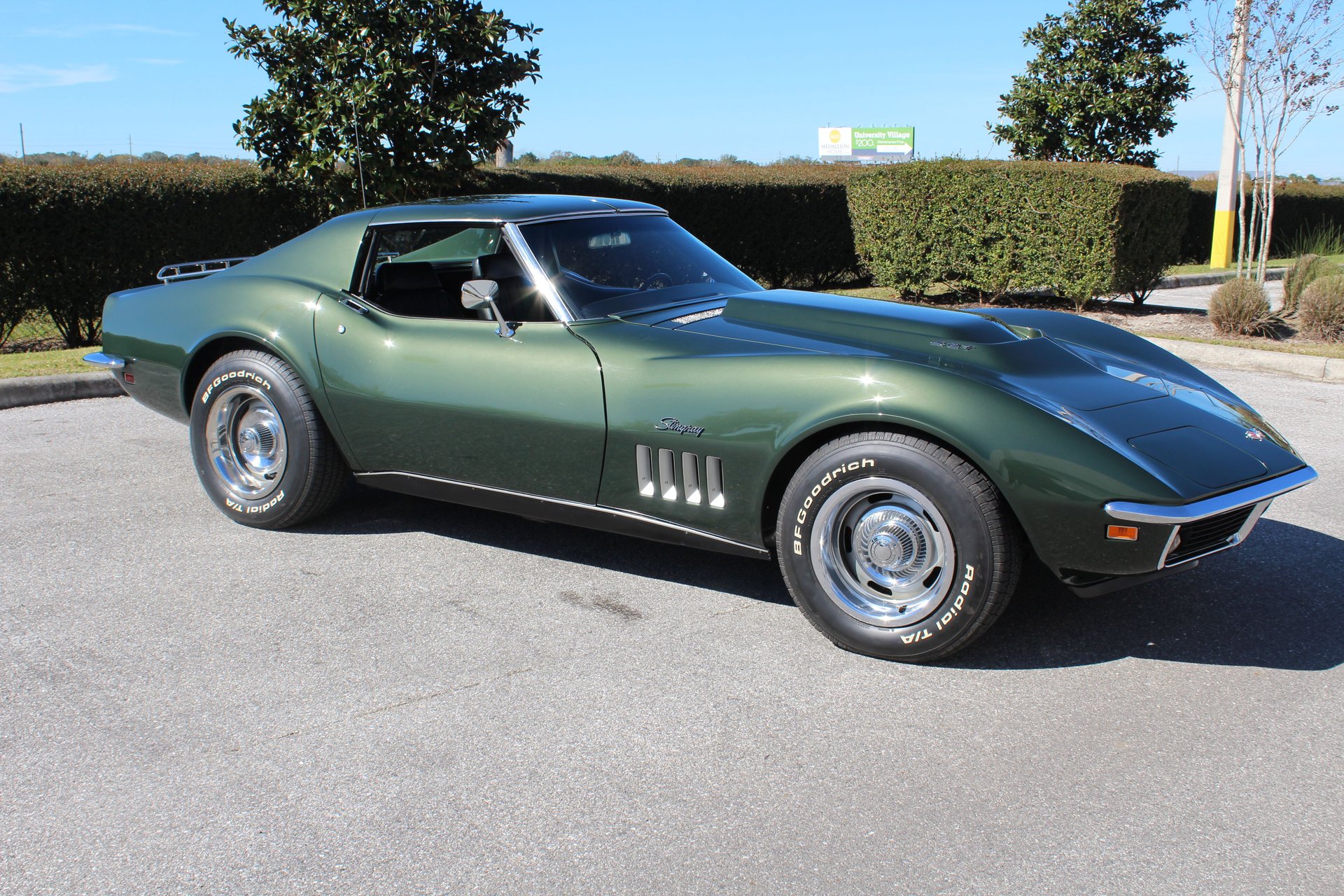
Before that, he purchased a dark green 1969 Corvette. (Which replaced a Harley–Davidson motorcycle.) I’m not sure which 427 V-8 engine it had, but I do know it had the M-22 “rock crusher” four-speed manual transmission. It did not, however, have power steering or brakes. He took it out with me one day, and we reached, shall we say, extralegal speeds. And then he let me drive it. I had never driven a stick before, nor had I ever driven a car without power steering before. (They’re easier to drive while moving.) He was amazingly patient while I figured out how to take off without killing the engine. Later on he bought another one he was going to rebuild, but I don’t believe he ever finished it.
He was single-minded in his pursuit of his hobbies. The first I remember was photography. He had more lenses and filters than I previously seen in 1970s-vintage photography (before zoom lenses became a thing). He also thought it was fun to take his flash and fire it in people’s faces to temporarily blind them. Sometime later he took up pool, and then after his vision made it hard (in his opinion) to play he dropped that for piano.
They had a succession of dogs. The first I remember was Brandy, a golden retriever that might have been the best-trained dog I have ever seen. If you snapped your finger, she would stick out a front paw for a handshake. She went bird-hunting, even when she was old enough to need painkiller shots before she went out. On the day of the bicentennial Independence Day, Greg, Brandy, my dad, my brother and I all went out on the Madison lakes in a boat he owned, on one of those perfect summer days. Earlier that day our new puppy, Dolly, followed Brandy around so close that she kept getting hit in the face by Brandy’s tail.
Brandy was followed by Kelly, an Irish setter. I went out with them as he was training her, and nearly collapsed laughing when she started barking at a bulldozer blade that was just sitting in the woods. Greg thought that was less funny than I did.
About a decade later, when Mrs. Presteblog and I were living in Appleton, they went to a Caribbean island for a diving vacation. My brother was tasked with caring for Kelly and their other dog (I believe she was Susie the black-and-white setter), but he had to be out of town that weekend, so he asked me to feed them and let them out. I got to their house, and of course the dogs were overjoyed to see humans and seemed quite sad at the prospect of my leaving them alone. And so I brought them back to our house, where we had our two dogs and one cat, for the rest of the weekend.
Nick the male spaniel thought having three girl dogs around was the greatest thing ever. Puzzle the female spaniel did not agree, and decided to follow me around even more than usual out of jealousy we had never seen before from her. The cat, meanwhile, got up on our fish mounted in our loft, a place we never would have guessed she could have reached due to her girth, to stay away from the dogs while monitoring their presence. We have a photo of my feeding four dogs treats, all of them at rapt attention.
They also had, for a while, big birds. I got an introduction to one of them when he let out a macaw (Tigger, I think, was his name) and said macaw flew up onto my back, and then walked up to my shoulder.
I didn’t hunt with Greg, but cars were a common interest, as were the Packers, in their Gory Years and then in the 1990s when they returned to the top of the NFL. So was music.
One day we visited them in Richland Center. They had what appeared to be a state-of-the-then-art sound system with big speakers and a reel-to-reel tape player. For whatever reason he decided to play Chicago’s “Ballet for a Girl from Buchannon,” which included “Make Me Smile.” I had heard the latter, but not the whole thing. And never as loudly as he played it that day.
Did that make an impression? Well, I have seen Chicago four times in concert, most recently in Madison in May, with our trumpet- and trombone-playing sons.
I always looked forward to going to their house. He started presenting us with Bloody Marys you could chew and beer chasers. We watched Super Bowl XXXI there, with my parents and a group of their friends. (Afterward we decided in a snowstorm to drive to Lambeau Field, but that’s another story.)
One Sunday we decided to visit Frank’s Pizza Palace in Appleton. He wasn’t dressed for the day when we got there, and so someone made a comment about that. He didn’t say anything, but went upstairs and returned a half-hour later, wearing a suit, outdressing everyone else in the restaurant.
An even more epic night than that was Dec. 31, 1999, when the family determined the best way to depart 1999 and welcome 2000 was a course-per-hour dinner. We went along with our oldest son, who couldn’t see anything because he was four months in utero. I remember driving home after 2 a.m., listening, for one of the few times in my life, to Art Bell to see if any of the more dire predictions of Y2K were coming true. The next day — actually later that day — we drove back to watch the 2000 Rose Bowl.
These are my experiences with Greg that stand out. I hadn’t seen him for a few years after my uncle and aunt divorced. I now regret not having reached out to him since then. We’ll have to schedule a Bloody Mary you can chew sometime this weekend in his memory.
On Valentine’s Day, this song, tied to no anniversary or birthday I’m aware of, nonetheless seems appropriate …
… as does …
… and (though perhaps in a general, not romantic, sense, or if you worked at the former WLVE, “Love Stereo 95,” in the 1980s) …
… unless you have determined that …
The number two single, believe it or don’t, today in 1961:
In an unrelated development that day, Frank Sinatra began Reprise Records, which included artists beside Sinatra:
Now that Democrats have failed in their attempt to remove the president from power, it’s worth asking why they haven’t seriously considered the reverse: removing power from the president.
We have seen, over the 33 months since Donald Trump took the unusual step of firing FBI Director James B. Comey, any number of behavior-specific explanations for why the 45th president must go: For coordinating with the Kremlin, obstructing the Russia investigation, making “racist comments” about four congresswomen, saying he would accept “dirt” from foreign governments about his domestic political opponents and finally the House’s two impeachment articles: abuse of power and obstruction of Congress.
But what we have not seen is anything like a structural critique of ever-accumulating executive branch power itself. Democrats don’t like the way Trump uses his authority, but that doesn’t mean they want any less of the stuff in the White House, particularly when they get back the keys. To the contrary.
In his response to Trump’s State of the Union address Tuesday night, leading presidential candidate Sen. Bernie Sanders (I–Vt.) lamented that the tariff-happy president wasn’t being punitive enough toward American companies. “The NAFTA 2.0 deal that he recently signed,” Sanders said, “will not prevent a single corporation from shutting down factories in the United States and moving them to Mexico.”
In her official Democratic Party response, Michigan Gov. Gretchen Whitmer focused not on Trump’s monarchical gestures during the speech — granting a scholarship, promoting a veteran, presenting a Medal of Freedom on the spot, theatrically reuniting a military family — but rather, on all the things Democratic governors are accomplishing by executive fiat in defiance of their legislatures.
“Wisconsin Gov. Tony Evers unilaterally increased school funding by $65 million last year,” Whitmer bragged.
A lawsuit is in the works over Evers’ illegal veto.
The Democratic presidential field, with the notable exception of faltering front-runner Joe Biden, has been engaging in a race to see who can make the most elaborate promises of immediate executive action. Forget 100 days; we’re now talking 100 hours to see what that magical Oval Office pen and phone can do.
On Day One, President Elizabeth Warren would wipe out student loans for 42 million people, ban fracking “everywhere” and block any future fossil fuel leases on public lands and offshore. We are still awaiting the full Day One list from a future President Sanders, but we know it includes an executive order to “legalize marijuana in every state in this country.”
Legalizing marijuana is a wonderful and long-overdue idea, but Sanders’ way of getting there is not. Federal law, including the odious Controlled Substances Act, is constitutionally required to originate from or be struck down by either Congress or constitutional amendment. A presidency with enough power to legalize Activity X irrespective of Congress or the desires of states is a presidency with enough power to criminalize that same activity when the other team wins. It’s a seesaw of authoritarianism, and we should all want to get off.
What’s remarkable about the personal response to Trump’s imperial actions is how completely different it is compared with the structural reaction against President Nixon’s. Democrats (and some Republicans) in the wake of Watergate went on a spree of pruning back the runaway executive branch.
The 1973 War Powers Resolution reasserted the legislative branch’s authority to declare war and approve emergency military actions. The 1974 Congressional Budget and Impoundment Control Act — which, fun fact, is the law Trump violated by withholding appropriated aid to Ukraine — sought to reestablish congressional power of the purse. The 1974 upgrade of the Freedom of Information Act was designed to prevent governments from hiding their activities. The 1978 Foreign Intelligence Surveillance Act was supposed to block warrantless snooping of U.S. citizens.
Even reciting the names of those reforms helps explain why anti-Trump animus has not translated into renewed skepticism of executive power. Presidents of both major parties, particularly during this century, have fought doggedly to break free from their institutional shackles. George W. Bush, with his high-ranking veterans from the Nixon administration, made rolling back the Watergate reforms a key philosophical aim. Barack Obama, after campaigning as a constitutionalist, made a mockery of war powers in Libya.
And the more tribal Congress has become, the more willing it has been to forfeit anything like the consistent application of constitutional prerogatives, particularly concerning the wielding of life-and-death military power.
For anyone who would like to once again see an independent legislature, the 99% partisan impeachment process in both chambers of Congress is cause for despair. As is the Democratic presidential field’s will to executive power. If ever America is to get off the populist seesaw, we’re going to need to root less for politicians, and more for the rules and mores than can restrain them.
The problem with Walsh’s point is: Would you rather, now, see Donald Trump with more power or Nancy Pelosi? Would you rather have, in the 1980s, seen Ronald Reagan with more power or Tip O’Neill? There is, however, an obvious flip side: Would you rather have, in the 1990s, seen Bill Clinton with more power or Newt Gingrich? Would you rather have, in the late 2010s, seen Barack Obama with more power or Paul Ryan?
 Steve Prestegard.com: The Presteblog