No comments on Presty the DJ for April 15
-
-
The New York Times tut-tus about Wisconsin’s political climate:
The Wisconsin State Legislature couldn’t agree on who to honor for Black History Month. It couldn’t hold a special session on gun violence that lasted more than a few seconds. It had stalled for weeks on releasing money to help farmers struggling with mental health issues.
So Brad Pfaff wasn’t all that shocked that, because of a partisan standoff over postponing the election, thousands of mask-wearing citizens made their way outside during the global coronavirus pandemic to vote last Tuesday.
The rest of the country was seeing Wisconsin’s political dysfunction on display, but Mr. Pfaff has already lived it.
“I was surprised how personal it got,” he said, recalling a different fight: The divisions that kept him from being confirmed as the state’s agriculture secretary. “I never wanted it to be like that.”
A brutal type of scorched-earth political warfare is flaring in America’s Dairyland.
It shows how partisanship pushed to its most strategic outer limits can ensnare not only primary election voters but also cow manure, a Christmas tree, a tourism agency and, in particular, farmers who need help.
“The Wisconsin coal mine is knee deep in dead canaries,” said Ben Wikler, the Wisconsin Democratic Party chairman. “Every possible alarm bell about a partisan divide so extreme to be potentially lethal in a literal sense has been rung.”
Mr. Pfaff inadvertently became one of those warning bells.
No blame accepted by Winkler, we see.
Low milk prices and a long global trade war have put farmers in Wisconsin and elsewhere in crisis mode for months — even before a pandemic that produced demand so low that some farmers have dumped their milk. Farms have been going bankrupt at alarming rates, and farmers facing financial ruin have killed themselves.
Late last year, 11 months after he was first named as agriculture secretary, the Republican-led State Senate voted down Mr. Pfaff’s nomination, effectively firing the Democratic nominee who nearly everyone agreed was amply qualified for the task of helping farmers navigate one of the worst farming crises in decades.
“Somebody fired in the middle of a dairy crisis, an agriculture crisis, when he publicly advocated for farmers’ mental health,” said Gov. Tony Evers, a Democrat who was elected by fewer than 30,000 votes, still in disbelief five months later. “God forbid.”
Says the governor of Milwaukee and Dane counties.
Mr. Pfaff did carry out some of his duties last year, while waiting for confirmation. He hosted an Uzbek delegation studying best practices in potato cultivation and crowned Tequila Naomi, a seven-year-old Jersey, as Cow of the Year.
He wrote a dozen entries in a blog, saying in one post, “In a time of greater and greater polarization, dairy brings us together.”
But even in Wisconsin, America’s Dairyland, where thousands of farmers own more than one million cows, the cows couldn’t overcome partisanship.
The political battle in Wisconsin became particularly heated during the tenure of Gov. Scott Walker, who outraged Democrats by taking on a key liberal tenet: organized labor. After he lost the Statehouse in 2018, Wisconsin Republicans, who now control both chambers of the Statehouse, pushed through measures to strip the powers of newly elected Democrats. In November, Republicans opened a special session the governor had called to take up gun control measures — and then pounded the gavel to close the session after only a few seconds.
Wisconsin’s capital is surrounded by perfect squares of farmland dotted with red barns and grain silos. Out there, roads are named after farmers because the land has been in the family for so long.
“We’re not as Wisconsin nice as we used to be,” said Sachin Chheda, a Democratic consultant based in Milwaukee. “Farms are the badminton shuttlecock being pushed back and forth over the net.”
Brian Fraley, a local Republican strategist, said the divisiveness on display in the decision on the agriculture secretary was nearly universal, whatever the topic. Everyone wants to help farmers, but the political climate complicated things.
“Society in general is becoming more cynical and abrasive,” he said. “The filters are off and people just express themselves more crudely and quickly. They hit send too easily. The rejection of Brad Pfaff was as much about sending a signal to the governor as it was about his qualifications.”
On both sides of the aisle in Wisconsin, the current crisis can seem even more cynical and abrasive. Democrats have argued that pushing forward with the election last Tuesday — after the Republican-dominated Legislature refused to entertain the governor’s request to mail absentee ballots to all voters or reschedule the primary — put voters’ lives at risk.
Brian Reisinger, a Republican strategist, said that line of thinking “fires up our base and turns people off.” He argued that Democrats were “focusing on the flash points.”
When he was first nominated to be agriculture secretary, it didn’t seem inevitable that Mr. Pfaff, the son of dairy farmers who still pitches in on his parents’ farm on the weekends, would become one of those flash points.
“Oh, I loved the job,” he gushed one afternoon. “I knew the seriousness of the situation taking place in the countryside, and I took it very seriously when I traveled and listened and heard what was going on out there.”
There is a large part of the problem right there. Government employees — who still are paid better and have far better benefits than the people they are supposed to serve, by the way — are supposed to serve the public, not love their jobs./
Even events that were supposed to be fun played against an inescapable backdrop of economic trouble in the industry. In September, Mr. Pfaff traveled to Milk-n-More Farms in Cecil, Wis., to name Tequila Naomi the state’s Cow of the Year.
“Her udder is extremely well attached,” said Nicolle Wussow, who raises Tequila Naomi as she did the cow’s mother, grandmother and great-grandmother on the farm she took over from her parents, Even before the coronavirus crisis, she said, keeping the farm of 100 dairy cows afloat was difficult.
“The expenses just don’t go down,” Ms. Wussow said.
Across the state all last year, Mr. Pfaff was hearing similar stories. Wisconsin lost 10 percent of its dairy farms in 2019, the largest decline in the state’s history. An agriculture-centric motivational speaker started a lecture circuit. Government statistics reported that the suicide rate was higher than ever; farmer deaths were part of the reason. One farmer carved the number for a suicide hotline in his popular 11-acre corn maze.
Phones were ringing at Mr. Pfaff’s agency’s Farm Center, an advice hotline where five workers field calls. Frank Friar, a retired farm loan executive, started answering calls 12 years ago when farmers were mostly seeking help navigating leasing and fencing disputes. Now, they wanted help saving their farms from financial ruin.
Mr. Friar remembered picking up the phone in the fall to hear one caller say: “I have a gun. I have it hidden, and I have shells.”
The help center was offering farmers who seemed stressed or talked of suicide $100 vouchers they could use in the offices of mental health professionals across the state, a program that had been in place for several years and was paid for through a grant.
The vouchers soon became a touchstone in the partisan battle in the Capitol.
Several years ago, the center issued few vouchers — only 26 were distributed in 2014. But as the farm economy worsened, the need increased; seven times as many vouchers were issued just last year.
One farmer who received vouchers was David Owen, who had been struggling to keep afloat the same farm in Pulaski, Wis., where he grew up. He knew of farmers nearby facing similar hardships who had committed suicide.
“I’m not going to say I wasn’t that far-off,” he said. “I can say it didn’t bother me anymore to die.”
Mr. Owen said he and his wife had yet to cash in the vouchers when they decided to auction off their entire herd of 125 Holsteins. The help center says last year it had a 42 percent redemption rate.
“Once we made the decision to sell, it got a little easier,” Mr. Owen said.
A few days later, just before the auction, he had a heart attack. He earned money this winter doing small carpentry jobs, and on Tuesday he ventured out to vote, casting an all-Republican ballot at the town hall.
At the help center, officials had been granted $200,000 for the vouchers and other programs through the state’s budget process. But members of the Republican-controlled Joint Finance Committee had yet to officially release the money to the center and cash was running low. A fight over information on the program’s effectiveness ensued.
“What we were trying to do is be helpful to the agency and helpful to farmers who needed help,” said Representative Joan Ballweg, a Republican who is co-chairwoman of a task force on suicide prevention.
My former state representative, by the way.
As lawmakers fought, Mr. Pfaff said he thought back to the frosty morning a year ago when he stood outside a giant dairy barn and marveled at the wreckage from an ice storm. Heaps of snow had crumpled the roof. Animals were wounded, or worse.
“I saw dead cows stacked up like cordwood,” Mr. Pfaff said.
Helplessness was all he felt that day, especially when he saw a teenager hop down from his tractor to join his father surveying the tattered farm that had been in the same family for generations.
That boy might never inherit the family farm, Mr. Pfaff thought. Only $500 was left in the mental health fund, enough for five vouchers. He couldn’t stay quiet.
“If the Joint Finance Committee doesn’t want to move this funding forward immediately, then they have a choice to make: Which five farmers will it be?” Mr. Pfaff complained publicly.
Republicans were outraged at the suggestion their inaction was hurting farmers. The Republican Senate majority leader, Scott Fitzgerald, fired off a letter to Mr. Pfaff, calling his comments “offensive and unproductive.”
Republicans began rallying against Mr. Pfaff. A legislative committee at the start of the year had unanimously voted to support his nomination for agriculture secretary, but Mr. Pfaff had yet to be confirmed by the entire Senate. Rumors buzzed that Republicans might vote to reject him.
The governor quickly scrambled to save his nominee. He held private meetings with Republican senators. They were not swayed. He hosted a euchre party at the governor’s mansion. One Republican showed up.The day of the vote on his position, Mr. Pfaff knew what was coming. He holed up in his office and ignored the action on the Senate floor. Mr. Evers doubled down, causing a stir by taking a seat in the public gallery of the Senate, an extraordinary move for a sitting governor.
One after another, Democratic senators stood to defend Mr. Pfaff. They noted his record helping farmers as the Wisconsin executive director of the Farm Service Agency under President Barack Obama. He was in 4-H as a youth, they said. Farming was in his DNA. He bleeds manure, one senator said.
From behind the lectern, Mr. Fitzgerald, the majority leader, said he had warned the governor that he didn’t have enough votes for Mr. Pfaff’s nomination to succeed. The governor could have withdrawn the nomination and spared an embarrassing vote.
Frustrated with the situation, Jennifer Shilling, the Senate minority leader, said, “We need statesmen and women to figure out a way that we de-escalate this legislative nuclear war that we are in.”
If you read Shilling’s emails, which are sent to news media not from her Senate district, you would find that statement hypocritical.
The votes were counted, and Mr. Pfaff’s nomination was defeated. It was the first time since at least 1987 that the Senate had turned down a cabinet nominee. The governor swore in anger. He appointed a new agriculture secretary. Mr. Pfaff got a job at the State Department of Administration, as director of business and rural development.
The next thing the Senate should do is end the employment of Health Services secretary Andrea Palm, whose sociology degree makes her unqualified for a pandemic or anything else health-related, anbd tourism secretary-designate Sara Meaney.
Mr. Pfaff cast his ballot early a few weeks ago, before Republicans had asked for an exception to the governor’s stay-at-home orders so citizens could golf and hold Easter services. He didn’t have to venture out Tuesday into what was the culmination of recent partisan bickering — voters lining up during a pandemic.
But Mr. Pfaff recently learned a seat in his district came open in the State Senate. He is considering a candidacy.
It is unclear to me why Wisconsinites seem to think Wisconsin should be different from other states. Wisconsin has, in fact, one of the largest blobs of government in the nation — 3,120, second only to Illinois. And our political culture dating back to statehood ensures that there is never a discussion about cutting government. In such an atmosphere, in politics, winning is everything, regardless of the collateral damage.(P.S. I met Pfaff. I wasn’t impressed. I wasn’t necessarily unimpressed either, but he struck me as just another Tony Evers bureaucrat who will never stand up to his boss.)
-
A former boss of mine was a huge fan of the Rolling Stones. His wife was a huge fan of the Beatles. The two bands crossed paths today in 1963 at the Crawdaddy Club in Richmond, England.
The number one British single today in 1966:
Today in 1971, the Illinois Crime Commission released its list of “drug-oriented records” …
You’d think given the culture of corruption in Illinois that the commission would have better and more local priorities. On the other hand, the commission probably was made up of third and fourth cousins twice removed of Richard Daley and other Flatland politicians, so, whatever, man.
-
Six physicians explain why #SaferatHome needs to end:
We have already flattened the curve
We have gone from predictions of millions of deaths, to hundreds of thousands and now we are predicting about 60 thousand deaths. This is with the likely over reporting of death. Dr. Birx admitted the attribution of death to COVID-19 has been liberal (her word). If the death count were limited to deaths directly caused by COVID-19, it would likely be even lower than this.


The most effective time for social distancing is early in a pandemic. Lockdowns also slow the development of herd immunity, which helps a society move past the virus.
We can still practice good hand hygiene, wear masks in public, and continue social distancing for the elderly and high risk, while we develop protective herd immunity for those most at risk. By the time the lockdowns began, COVID-19 had already been seeded in the US for months, limiting the effectiveness of the lockdowns in the first place as the virus was already widespread.
Economic collapse and unemployment are destroying families
Each day the shutdown continues, we are losing approximately one million jobs, as evidenced by 16.5 million initial weekly jobless claims in three weeks (since March 26). Many of these lost jobs will never return. If the lockdowns continue through April (essentially, a best-case scenario), we’ll be lucky if job losses are limited to 25 million. Many people see 6.6 million people as just a number , as Len Kieffer put it, it is the size of the state of Missouri. Twenty five million is almost the size of the state of Texas!

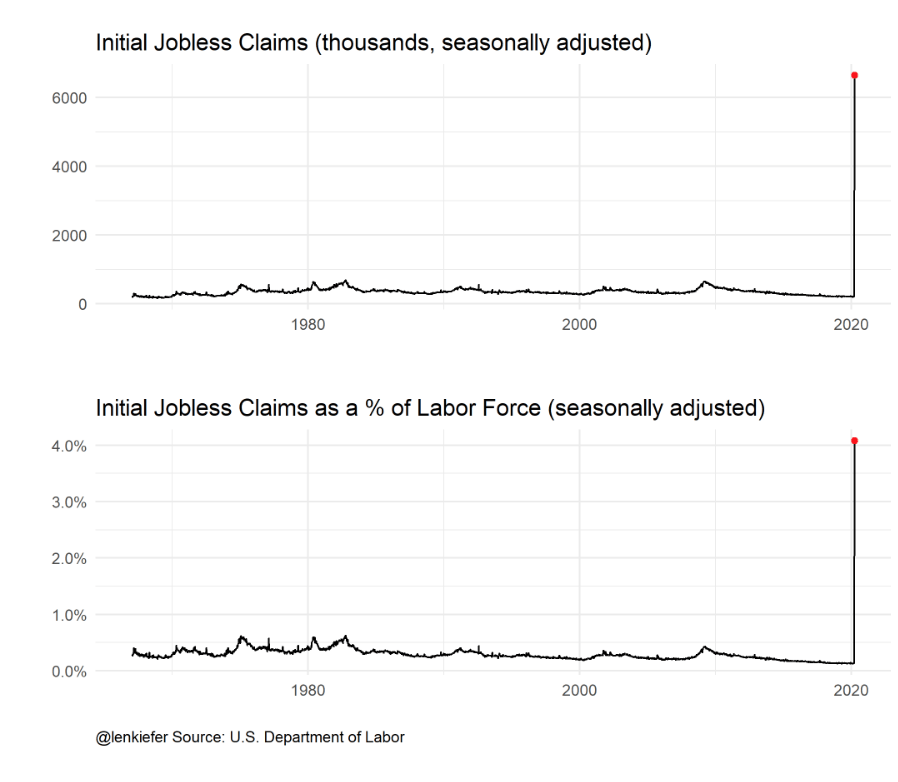
The 16.5 million jobs lost thus far are only counting people who have filed jobless claims that were processed through April 8, 2020; it’s likely that the real number is quite a bit higher than this. In addition, there are millions of people not-technically-unemployed who have seen their incomes plummet. One example would be so-called gig workers, such as Uber and Lyft drivers. It’s almost certain that realtors are suffering the same fate.
We have not overburdened the health care system.


Our Although, the ER and ICU capacity has increased in many locations, overall healthcare system capacity has decreased dramatically, as all non-COVID and non-emergent care is being neglected. This has led to layoffs of healthcare workers and delays in care for countless patients, which will result in a range of negative consequences. Assuming the need for healthcare services has remained constant while availability of such services has plummeted, countless patients are not receiving the care they need in a timely manner. In medicine, timing is of the essence, so even receiving the same exact in the future comes at a price. Many important services are being delayed: blood donations, organ donations, screening colonoscopies, and many other elective procedures. It is very important to note that elective medical care is not useless medical care; rather, it’s simply meaningful and necessary medical care that is scheduled in advance and not performed on an emergency basis.
Suicide may kill almost as many people as COVID-19 this year.
In 2018, there were 48,344 recorded suicides. Economic ruin results in a wide range of health problems, suicide, mental health issues, loss of health insurance, reluctance to visit doctors in light of financial hardship, and increases in substance abuse. This is on top of the delay in non-COVID care.
The mortality was overestimated
The IHME model, as well as Dr. Fauci have recently decreased the likely deaths from this pandemic to around 60,000 from earlier estimates of 1–2 million.The early reports of 3–4% case fatality rate (CFR) are likely misleading. The numbers miss those who are asymptomatic or recovered at home without seeking testing. What we really need to know is the infection mortality rate (IFR). Fortunately we have some good clues. Looking at the data from the Diamond Princess cruise ship, the infection fatality rate on the cruise ship was 1%. However, the average age of people on the cruise ship was much higher than the age of the average American. When you adjust for the differences in age between the cruise ship and America, you see that the IFR should be about 0.1%. There was a recent study out of Germany in the city of Gangelt where they tested 80% of the population, the IFR there was about 0.37%. The way we are testing now, we cannot know how many people have been infected with COVID-19 since we are missing those who had the disease and recovered. Antibody testing is needed to know the true number of people who have been infected. There is a good chance this number is well above 10 million, which drives the IFR down even further.
Children are at almost no risk from this disease.
The CDC estimates 37 to 187 children die every year, not from Covid-19, from the flu. This year we have lost 105 children from the flu. Yet, we have closed every school in America. Education is vitally important and a whole generation will miss a fourth of this school year. Closing schools also goes a long way towards limiting the development of herd immunity.
PPE was limited but is now becoming more available
This article is not meant to diminish the pain and horror this disease can bring to those who get it. I am a physician in one of the highest risk specialties for contracting the disease in the hospital. The lack of personal protective equipment (PPE) facing US healthcare workers is unfair and wrong. Yet, as the curve has flattened, it seems more hospitals have found adequate PPE. The CDC estimates a possible second wave would be at least 150 days from the end of the lockdown, possibly this fall. Ending the lockdowns would have no effect on the PPE for the current crisis. We would have plenty of time to prepare for a possible second wave.
Authorities should show clear evidence regarding the benefits of indefinite lockdown
Those who want to continue the lockdown indefinitely should show clear evidence regarding the benefits of indefinite lockdown. There needs to be a clear reliable model that shows how many additional lives will be saved considering we have already flattened the curve and there is essentially no further risk of overwhelming the health care system. The previous models were wrong. The consequences of indefinite lockdown are quite staggering, to the tune of one million jobs lost per day.
-
Two conservative lawmakers are warning of “civil disobedience” and “revolt” against restrictions imposed by Gov. Tony Evers’ administration to curb the spread of coronavirus — comments the governor suggested could damage the state’s effort to contain the virus.
State Sens. Steve Nass of Whitewater and Duey Stroebel of the Town of Cedarburg said Friday the latest order by Evers to close dozens of state parks could result in significant pushback if Evers’ orders to stay at home, which have closed scores of businesses, bars and restaurants, continue.Both also suggested it’s unfair that public employees are not being subject to pay cuts as owners and employees of private companies are losing work — an idea Evers also rejected Friday.
“I hope the Governor and other officials in the administration understand the closing of 40 state parks for dubious reasoning at best is only one flashpoint in a growing revolt to how the Covid-19 response has been handled in Wisconsin,” Nass wrote in an email to Evers’ legislative liaison.
“This week has been a turning point in how the public now views some of the decisions made by this administration under the Governor’s Emergency Declaration and the uneven exercise of those emergency powers,” he said.
Evers suggested Friday the comments from Nass and Stroebel could create more division and take focus off keeping people healthy.
“C’mon folks, the rhetoric around this topic is escalating in a direction that is not helpful,” he told reporters Friday. “We hope we can continue to defeat the virus instead of defeating each other.”
Some Wisconsin Republicans have questioned whether Evers’ decision to close schools, bars, restaurants, and other businesses not considered to be providing essential services, was necessary given the number of cases of the virus in Wisconsin.
Department of Health Services Secretary Andrea Palm said without the Evers administration’s order to stay at home, the agency projected cases of the virus to be 22,000 as of this week. As of Friday, there are 3,068 cases in the state.
Palm said the number of cases is directly related to the restrictions.
“Until we have a vaccine, or until we have medical intervention … we are going to have to very actively manage this outbreak and safer at home (order) is the current tool we are using,” Palm told reporters Friday.
U.S. Surgeon General Jerome Adams said Friday “most of the country” will not be able to reopen by May 1, despite suggestions from some Trump administration officials that next month may be a time to revisit strict social distancing guidelines.
And projections by the Homeland Security and Health and Human Services show lifting stay-at-home orders, school closures and social distancing restrictions after 30 days would lead to a dramatic infection spike this summer and death tolls that would rival doing nothing, according to a New York Times report.
Stroebel said Evers’ orders should be re-evaluated and involve a “cost/benefit analysis.”
“Every sickness and death is a tragedy, but so are businesses and livelihoods ruined by shelter in place orders,” he said in a statement. “Besides being counterproductive, indefinite sheltering orders will eventually lead to civil disobedience.”
Stroebel also raised alarm bells about the state’s finances, saying the promises of the current state budget— which provides funding through 2021 — won’t be able to be kept under the current economy. He and Nass pointed out in their statements public employees haven’t been subject to pay cuts like others.
“It is irresponsible to conceal the truth from Wisconsinites that we will likely be unable to live up to all the promises of the current state budget,” he said. “I am not going to tell constituents, who are losing their businesses, getting laid off and seeing their nest eggs dip with the stock market to pay higher taxes so that state and local employees can avoid unpaid furloughs, or so that government programs can grow at twice the rate of inflation.”
When asked whether he would consider imposing pay cuts for public employees, Evers said the idea was insulting to public workers.
“The tens of thousands of state employees who are doing work for the state of Wisconsin are doing essential work,” Evers said, citing examples of workers processing unemployment claims, working in long-term care facilities for military veterans and overseeing state prisons. “To suggest that somehow state employees are not valued … I value them and the people of Wisconsin value them.”
-
Holman W. Jenkins Jr. covers the coronavirus’ history and likely future:
• The spread. From the time the first case emerged in Wuhan on Nov. 17 to the moment when China/the World Health Organization acknowledged human-to-human transmission on Jan. 20, Wuhan exported between eight and 16 undetected cases to the U.S. through air travel, giving rise to 1,000 to 9,000 cases in the U.S. by March 1, according to a U.S.-Chinese modeling project. Another modeling group estimates that other Chinese cities exported 2.9 cases for each case exported from Wuhan. As first reported by USA Today, many of the virus strains circulating in New York appear to have arrived by way of Europe.
Bottom line: It doesn’t get Donald Trump and other politicians off the hook for goofy statements and slow responses, but a global pandemic was likely unstoppable by Jan. 20.
• Testing. The CDC develops tests for its own internal use. The Food and Drug Administration requires that tests offered to the public be proved safe and effective. Government might have said “have at it, boys” and allowed anyone to make and sell anything and call it a Covid-19 test. This wouldn’t have been government.
Though the Trump administration is guilty of testing stumbles, unrealistic is the notion that enough testing could have been made available to contain a novel flu-like virus once it was widely established.
• The lockdowns. Imagine a problem that can be solved by holding your head underwater but stops being solved when you lift your head out. This is no solution. How can any society lift its stay-at-home order if there’s no vaccine and most people remain uninfected? Not even the Chinese, as we are about to learn, really have an answer. Yet it’s amazing how much congratulatory press coverage of the lockdowns doesn’t acknowledge this obvious Catch-22. By now even the most tunnel-visioned epidemiologist must admit the lockdown cure will soon be worse than the disease, imposing social destruction beyond imagining.
• Testing, again. A MacGuffin that many countries, including the U.S., are converging on is constant and widespread testing to quarantine new cases. Testing will allow us to “flatten the curve” while lifting the stay-at-home orders and permit commerce to revive.
This probably is a polite fiction but it will let us get the economy mostly open. In reality, we will end up throwing a variety of strategies at a persistent epidemic (testing, treatments, voluntary social distancing) and accept what nature gives us. For instance, policy makers or their own legal departments will not be encouraging the NBA or other sports leagues to begin playing to packed crowds anytime soon. And government will keep pouring resources into health care so we can at least believe every victim is getting a fair shot at survival.
I doubt a large number of deaths would deter the public from forging this path but if the hospital system is overloaded and non-Covid patients are not getting adequate treatment for their own conditions, that could be a wild card.
• The death rate. Given asymptomatic cases and many mild cases that are indistinguishable from the cold or flu, experts have long suspected Covid-19 is more widespread than we know. At the same time, the fatality rate is affected by both undercounts and overcounts. The most up-to-date estimate by the Oxford Center for Evidence-Based Medicine suspects the death rate is a flu-like 0.1% to 0.39%. Now don’t choke on your Cheerios just yet—I will return to this point.
• Herd immunity. Levels of honesty vary, but a fair approximation is that most countries expect the initial epidemic to burn itself out before a vaccine is available. Sweden is perhaps the most candid in anticipating wide infection of its populace. One country, New Zealand, is resolute in committing itself to a different path. It intends to exterminate the virus domestically and then forbid or so strictly regulate foreign travel that the disease cannot re-enter until a vaccine is available.
• Value proposition. Getting back to the death rate, the average risk for each of us may be small but when an entire population is subjected to the same newly emergent small risk at the same time, it can overwhelm emergency rooms. The panicked governmental responses and clampdowns we’ve seen are best understood in this vein: A very low risk of death for a very large number of people has created a global crisis. Not helping is the reality described in detail by the world’s newspapers: Recovery of the most severely affected patients on ventilators is rare and involves a great deal of personal suffering.
The arrival of Covid-19 in our world has not been an easy policy problem for our politicians to finesse. Sometimes that’s the job they signed up for: to do what needs to be done and take on their backs the public’s unhappiness with it.
-
You might think the number one British single today in 1967 is …
The number one single today in 1974:
Today in 1980, Grease was no longer the word: The musical closed in New York, after 3,883 performances.
-
Today in 1966, Jan Berry of Jan and Dean crashed his Corvette into a parked truck in Los Angeles, suffering permanent injuries.
The number one single today in 1969:
Today in 1975, David Bowie announced, “I’ve rocked my roll. It’s a boring dead end, there will be no more rock ‘n’ roll records from me.”
-
The number one single today in 1954:
Today in 1964, the Billboard Hot 100 could have been called the Beatles 14 and the non-Beatles 86, topped by …
The number one single today in 1970:
-
The Wisconsin Newspaper Association:
William “Bill” Hale, former owner of the Grant County Herald Independent in Lancaster and several other community newspapers, died April 1, in Florida, following a long battle with cancer. He was 78.
A Missouri native, Hale was born Feb. 16, 1942. He came to Wisconsin from Pleasant Hill, Mo., where he ran The Times, which won state and national awards during his tenure.
Hale owned and published the Herald Independent for 18 years before selling his newspaper group to Morris Newspapers in 2002. At the time of the sale, he also owned The Boscobel Dial, (Gays Mills)Crawford County Independent, Fennimore TImes, and the Tri-County Press in Cuba City.
In a story published today by the Herald Independent, former employees and colleagues remembered Hale as a great publisher, community supporter and friend. These qualities were reflected in an editorial Hale wrote for his first issue of the Herald Independent. The editorial stated that while a newspaper is a business, it also must earn the public’s trust by providing the news, both good and bad.Hale’s full obituary will be published at a later date. The pre-written obit was stored in a safe in Hale’s apartment in his senior living community, which is under lockdown due to the COVID-19 pandemic.
Long-time readers of this blog know that I got my full-time start in journalism at the Herald Independent, because Bill hired me before I graduated from UW–Madison in 1988. At the time of the interview, I had worked at the Monona Community Herald (whose owner also has passed on, as well as the owner of the newspaper where I worked next), part-time for almost three years, and had a reasonably impressive set of clips with my name on them to prove that I could do the job.
(Side note: On the other hand, I almost backed out of the job. I had also applied to be the editor of the Chilton Times–Journal, and got turned down. And then whoever got hired backed out or quit early, so the owner called and asked if I wanted the job. Two of my Herald coworkers thought I could do the job, and I scheduled an interview. And then, for some reason, I decided to do some pre-interview research, and I called the previous editor, who passed on a detail that immediately made me decide to not pursue that job.)
Read “Adventures in rural ink” (which was written before my current rural employer, where I have now worked longer than my 1980s and 1990s Grant County experiences), and you’ll see the sorts of things my first full-time job and my first editor job got me into doing. There was the night I stood up in front of a school board and a crowd of around 200 people and told them they were violating the state Open Meetings Law, which brought the disapproval of the school board president, not that I cared. (That turned out to be good experience for my future encounter with Bishop Morlino.) There was my first murder trial.
Bill was an interesting guy. As the obituary reported, he had come to Wisconsin from Missouri (pronounced “miz-zur-UH”) to buy the Herald Independent, and he injected a large amount of modern newspaper into a newspaper that was stuck in a previous decade. He had a very distinctive voice, which I found out (and he later found out) I was pretty good at imitating. He (and some of his employees) smoked like a chimney, a feature of past and future coworkers as well. He also locked neither his house nor his car, and he always left his keys in the ignition switch of his cars. (Which prompted me one night, coming back from a date with the future Mrs. Presteblog, to move his car in the parking lot of the restaurant he was at, from one end to the other. I never found out if he noticed.)
It is safe to say that my life would have gone a different direction had I not started at the Herald Independent. I knew what I was doing (though one must improve with experience, perhaps contrary to what I thought at the time.) I also showed up, to be honest about it, somewhat immature, perhaps his most high-maintenance employee with, for lack of a better term, a roller-coaster attitude about my work, which, lacking much else, I probably took too personally, something that took a while to grow out of. (You’re sure about that? readers ask.)
I suspect that when my work started showing up in the Herald Independent (which was after my first appearance in the newspaper — the speeding ticket I got coming home after a stop at my grandmother’s following the interview), I was not exactly what Herald Independent readers were expecting to read. I gathered that he got a lot of feedback about my work from some people that was less than glowing, not because of lack of quality, but because I pushed some people’s buttons in the process.
I wrote a story about a hair salon that had purchased an exercise machine on which the user could lay there while the machine exercised the customer. The added touch was that they would smear upon your torso a formula that included animal placenta (I forget which animal) and then wrap you up in an Ace bandage so that you could sweat out your fat. The salon marketed at it as “The workout that won’t wear you out.” I went through the whole “workout,” and suffice to say it wasn’t the story the salon owner was expecting, though neither Bill nor the editor changed very much about the story. (To be fair, the salon’s target demographic was not a 23-year-old recent college graduate who had yet to put on the 15 pounds I gained within the first three months of graduation. More on that later.)
Not long after I started, I spent an afternoon in the courthouse during misdemeanor intake, and wrote about what the judge and the defendants did over two hours. When I was the last person there the judge asked if I had business in front of the court, and I said I didn’t. (My ticket was a couple of months earlier.) I never heard what the judge felt about my quoting a former journalism instructor of mine who observed that judges have a “God complex” while on the bench.
One year later, lacking a feature story for that week, I threw out an idea that intrigued me from National Geographic magazine, where a writer would do an in-depth piece about a community, or a road from end to end. Thus begat The Wanderer, where I tried to take that kind of approach — describe an area as if I’d never been there before — for communities within our circulation area, beginning with Cassville.
The day the newspaper reached subscribers, I got an anonymous phone call (those are the best kinds) from a reader who accused me of bias, by mentioning one of the village’s power plants, but not the other. I pointed out the only reason I mentioned the one was because it was on one end of the village, with the other end being the airport. Then she said I mentioned only one church and not the others. To which I said that was incorrect; I didn’t mention any church.
“Well, you did between the lines!” And then she hung up. Which made me reread the article to see what she was referring to. She was referring to my mention of the view of the village from the cemetery on St. Charles Road.
A few weeks later I went to Bloomington. That story didn’t go over so well among the 11 people in Bloomington who jointly signed a letter to the editor, claiming, among other things, that my mentioning the fire department’s yellow trucks was making fun of their yellow trucks. Another story about Beetown prompted the accusation I made the unincorporated community appear as if it was dumpy with nothing to do there. (If the shoe fits …)
Then there was my special relationship with the high school principal. (Who was Mrs. Presteblog’s high school principal.) I first got his attention by trying to find out the identity of the new high school boys basketball coach before his hiring was approved by the school board. Then I wrote, as part of our fall sports previews, an interview with the new high school volleyball coach in which I asked what was different between herself and her predecessor. She didn’t have an answer and suggested I talk to one of her players. I did, and got the answer that the new coach was more open and the players communicated better with her. Which I reported.
Then I got called into the principal’s office and was told that that was an inappropriate question that made himself and both coaches unhappy. He further asserted that we were supposed to only report positive news about the high school in the newspaper. I had yet to learn my defense mechanism against mandates I wasn’t going to follow — mumble something that sounded like assent and then do exactly what I was intending to do — so we had some words and went on our way for my next meeting in the principal’s office.
There was a weird aspect to this. (In my life that always seems to be the case.) At the time I had just started announcing sports for the local radio station. (Which I am still doing more than three decades later, but you knew that.) And he complimented me several times on my work, possibly because he may have confused me with someone else. (He called me “Dave” a few times.)
I wouldn’t say that I was left alone to do my own thing at the Herald Independent, but in retrospect that’s pretty much what happened. Bill would do some editing on the layout table, which never made me happy, only partly because it screwed up the page layouts. But on the other hand it is possible that doing a story about Potosi and quoting my father on the poor quality of Potosi beer toward the demise of the brand wasn’t a good idea. (The brewery and the beer returned 25 years later, and both are now doing quite well.) I wasn’t told to, for instance, cool it with the high school principal.
For three years the newspaper was most of my life, not because I was working obscenely long hours, but because I didn’t have much of a life outside of work. Being a college graduate and a former resident of comparatively cosmopolitan Madison, I had very little in common with anyone in the area besides my coworkers. So much of my social life was tied to work — dinner with Bill and his wife or Bill and the editor, adult beverages at the soon-to-be-demolished hotel, softball on the newspaper softball team (where we battled a team made up of high school students or recent graduates for last place every season), getting golf lessons (which evidently didn’t take) with Bill’s visiting son, etc.
Every election night, for instance, I called in county results to the Associated Press, for which I got extra money. We would go out to dinner beforehand. Bill’s son, who lived during the school year with his mother, visited every summer because he liked the things he could do in Southwest Wisconsin, including, I think, hanging around with the equivalent of someone’s cool relatives. Bill’s mother visited every so often. She was a fantastic cook. Then there was lunch at the Arrow Inn, which had bacon cheeseburgers and desserts. During five years at UW–Madison I gained 10 pounds. Four months after moving to Lancaster, there was 15 more pounds of Steve.
Working in Lancaster considerably changed my worldview, though I didn’t realize it at the time. Had you asked me at the time I probably would have said that I planned on being there maybe a year and before I intended to find a larger-market job and put Lancaster in the rear-view mirror. I wasn’t going to be there forever because I didn’t have anywhere I could be promoted to (say, editor, since the editor was a Lancaster native), but I was there for three years, doing some award-winning work in the process. I discovered that, unlike what surrounded me in Madison, these were people who had real lives centered on their families and their communities, and, though they may have lacked college degrees, they were smarter and certainly more wise than some people I knew with multiple degrees back in Madison. Three decades later, there is not enough money to pay me to move back to Madison, and I am not the least interested in living in any urban area.
This story would not be complete without mention of my interview with a Lancaster High School graduate who after graduation from Ripon College went to Guatemala with the Peace Corps. (Who was, though I didn’t know it at the time, friends with Bill’s stepdaughter, with whom I went to Bill’s wedding reception.) I was assigned to interview her when she came back halfway through her two-year term, and then again when she came back to stay. Upon returning to the office Bill asked me if I had asked her out. (Possibly because he was tired of hearing me bitch about my lack of social life involving women.) I thought that was ridiculous, if for no other reason than the last line of the story, that she was leaving in the fall for Washington, D.C. to find a federal government job. To make a long story short, this is the result. (Along with three children, four dogs and four cats.)
If you read “Adventures in rural ink” you know I returned for a year and a half to be a weekly newspaper co-publisher and editor. Bill was the business partner in the mention of “business partner problems.” We parted, less than happily on my end, and I didn’t see him for a decade, until on vacation I wandered back to the old newspaper office, and there he was, a year after having sold the Herald Independent to my future employer. We had a nice chat, I expressed my sympathy for the death of his wife some time earlier, and that was that.
Almost a decade later was return number two to Southwest Wisconsin. Bill came to the office a few months after I started, and he said that when my boss mentioned that he was going to hire me that Bill knew I’d do a good job. He even subscribed to the newspaper from Florida. That was the last time I saw him.
Bill’s story ends sadly, though if you consider death sad everyone’s story ends sadly. Bill’s son, my former golf (lesson) partner and softball teammate, died at 40. I am looking forward to reading Bill’s obituary, which as you noticed at the beginning he wrote himself. (Note to self …)
The sands of time tend to erode bad memories that don’t reach the level of trauma, and might polish how things used to be more than you felt at the time. There are, I believe, five of us hired by Bill who still work for the company. (Four of them are quoted here.) The new guys are now the old guys, and there is one who still might be higher-than-average-maintenance and take his work too personally, who insists on doing things correctly (as defined by himself), though he might communicate better now.
Bill hired well, and I don’t say that because he hired me. He hired a lot of local people, many of whom had no background in journalism, and trained them in quality (small-town) community journalism. He also brought in people who weren’t from the area to improve on what was already there. (Ahem.) There are a lot of awards on the walls of the newspapers he once owned as proof. He knew what a quality community newspaper was supposed to do, even if readers and advertisers sometimes didn’t grasp that.
Thanks to changes in the newspaper industry, there are fewer people like Bill in it. (The Lyke family, which ran the Ripon Commonwealth Press more like a community treasure than a newspaper, recently sold to new owners.) In addition to Bill, seven families owned newspapers in the area. One family now remains; the other newspapers are owned by my employer.
Were it not for the fact that the restaurants I used to go to are now closed (including the one with the Friday fish buffet that served as our rehearsal dinner location), it would be a good night for a few drinks and dinner in Bill’s memory.
 Steve Prestegard.com: The Presteblog