Skip to content
  • The coronavirus tyrants

    April 15, 2020
    US politics, Wisconsin politics

    John Daniel Davidson demonstrates Lord Acton’s observation that “power corrupts”:

    There’s nothing like a crisis to bring clarity. The response of some mayors and governors to the coronavirus pandemic in recent days has made it clear they think they have unlimited and arbitrary power over their fellow citizens, that they can order them to do or not do just about anything under the guise of protecting public health.

    We’ve now witnessed local and state governments issue decrees about what people can and cannot buy in stores, arrest parents playing with their children in public parks, yank people off public buses at random, remove basketball rims along with private property, ticket churchgoers, and in one case try—and fail—to chase down a lone runner on an empty beach. All of this, we’re told, is for our own good.

    The most egregious example of this outpouring of authoritarianism was an attempt by Louisville, Kentucky, Mayor Greg Fischer to ban drive-in church services on Easter. On Holy Thursday, one day before Christians were to begin their most important religious celebrations of the year, Fischer declared that drive-in Easter services would be illegal.

    To remove all doubt about his seriousness, he also threatened arrest and criminal penalties for anyone who dared violate his order, and in an Orwellian twist, invited people to snitch on their fellow citizens. Fischer justified this by saying it was “to save lives.”

    Thankfully, a federal judge made short work of the mayor’s idiotic power-grab, issuing a temporary restraining order against the city of Louisville on Saturday, writing so as to remove all doubt, “The Mayor’s decision is stunning. And it is, ‘beyond all reason,’ unconstitutional.”

    The mayor shouldn’t have needed a federal judge to tell him that. Anyone with a passing familiarity with the U.S. Constitution should know the government can’t single out religious worship for special regulations and prohibitions, which is precisely what the clueless Fischer did here. His order would have barred Christians from driving to their church parking lots and sitting in their vehicles for Easter services—all while maintaining proper social distancing—while imposing no such restrictions on drive-up and drive-through restaurants, liquor stores, grocery stores, or parking lots generally.

    Mayors or governors—or even presidents—can no more single out Christians on Easter than they can single out Muslims during Ramadan or Jews on Yom Kippur. If you’re going to ban parking in parking lots, it has to apply to everyone everywhere.

    But this didn’t just happen in Louisville. Two churches in Greenville, Mississippi, that were holding drive-in services for Holy Week said police showed up and ordered churchgoers to leave or face a $500 fine.

    In a video posted on Twitter from Pastor Hamilton of King James Bible Baptist Church in Greenville, a police officer tells Hamilton that because of the governor’s order, “your rights are suspended.” To the good pastor’s credit, he correctly notes that the governor cannot suspend his rights because his rights come from God, not the government.

    Video from Pastor Hamilton of King James Bible Baptist Church in Greenville, MS. Church tried the “drive-in” method of holding services & were targeted due to the Mayor issuing an order prohibiting such services. Watch as an officer tells the Pastor that his rights are suspended. pic.twitter.com/zLdT6Qd8ew

    — Nick Short 🇺🇸 (@PoliticalShort) April 11, 2020

    Pandemic or not, this stuff has no place in American society. Petty tyranny of the kind these mayors and local officials are scheming is wholly alien to our customs and way of life, and destructive to the social contract on which our nation is built.

    Thankfully, the Department of Justice has taken notice of this fledgling authoritarian streak among the country’s mayors and governors. A DOJ spokesman said Saturday Attorney General William Barr is “monitoring” government regulation of religious services and may take action against local governments as early as this week.

    That’s a good start, but the targeting of churches, while undoubtedly the most offensive overreach by state and local governments, is hardly the only instance of government gone wild. In Michigan, Gov. Gretchen Whitmer has taken it upon herself to declare what items are and are not “essential,” dictating to grocery stores what they can and cannot sell as part of a sweeping order issued Friday.

    Among the nonessential, and therefore banned, items are fruit and vegetable plants and seeds. Never mind that growing fruits and vegetables at home right now would help maintain social distancing during the pandemic, the governor has spoken and her word is law. (Lottery tickets, on the other hand, are still permitted.)

    Beyond the fruit and vegetable ban, the governor’s order is an object lesson in the absurdity and inconsistency of arbitrary power and rule by fiat. Michiganders are banned from traveling “between residences” if they own a cottage or a summer home, but the ban only applies to Michigan residents, so an out-of-stater with a cottage in the Upper Peninsula could presumably still visit. The ban also still allows travel between states, so if a Michigander has a cottage in Wisconsin or Ohio, he can travel without fear of being arrested or fined by state police.

    Why did Whitmer tailor her order this way? Probably because she knows she has no authority to ban travel between states, or issue orders to Americans generally—no more than a mayor has the authority to shut down drive-in Easter services in his city.

    That these officials need to be reminded of that, and in some cases restrained by federal judges, bodes very ill for America. Now more than ever, we need leaders who don’t just care about protecting us from the pandemic, but also care about preserving liberty in a time of crisis.

    The flaw in this piece is that it doesn’t include Wisconsin Gov. Tony Evers, who has issued a record number of executive orders, several of which are illegal and/or unconstitutional, though the state Legislature apparently lacks the guts to challenge him.


    Share this on …

    • Share on X (Opens in new window) X
    • Share on Facebook (Opens in new window) Facebook
    • Share on LinkedIn (Opens in new window) LinkedIn
    • Email a link to a friend (Opens in new window) Email
    • Print (Opens in new window) Print
    Like Loading…
    No comments on The coronavirus tyrants
  • Presty the DJ for April 15

    April 15, 2020
    Music

    The song of the day:

    The number one single today in 1972:

    (more…)

    Share this on …

    • Share on X (Opens in new window) X
    • Share on Facebook (Opens in new window) Facebook
    • Share on LinkedIn (Opens in new window) LinkedIn
    • Email a link to a friend (Opens in new window) Email
    • Print (Opens in new window) Print
    Like Loading…
    No comments on Presty the DJ for April 15
  • Divided America’s Dairyland

    April 14, 2020
    Wisconsin politics

    The New York Times tut-tus about Wisconsin’s political climate:

    The Wisconsin State Legislature couldn’t agree on who to honor for Black History Month. It couldn’t hold a special session on gun violence that lasted more than a few seconds. It had stalled for weeks on releasing money to help farmers struggling with mental health issues.

    So Brad Pfaff wasn’t all that shocked that, because of a partisan standoff over postponing the election, thousands of mask-wearing citizens made their way outside during the global coronavirus pandemic to vote last Tuesday.

    The rest of the country was seeing Wisconsin’s political dysfunction on display, but Mr. Pfaff has already lived it.

    “I was surprised how personal it got,” he said, recalling a different fight: The divisions that kept him from being confirmed as the state’s agriculture secretary. “I never wanted it to be like that.”

    A brutal type of scorched-earth political warfare is flaring in America’s Dairyland.

    It shows how partisanship pushed to its most strategic outer limits can ensnare not only primary election voters but also cow manure, a Christmas tree, a tourism agency and, in particular, farmers who need help.

    “The Wisconsin coal mine is knee deep in dead canaries,” said Ben Wikler, the Wisconsin Democratic Party chairman. “Every possible alarm bell about a partisan divide so extreme to be potentially lethal in a literal sense has been rung.”

    Mr. Pfaff inadvertently became one of those warning bells.

    No blame accepted by Winkler, we see.

    Low milk prices and a long global trade war have put farmers in Wisconsin and elsewhere in crisis mode for months — even before a pandemic that produced demand so low that some farmers have dumped their milk. Farms have been going bankrupt at alarming rates, and farmers facing financial ruin have killed themselves.

    Late last year, 11 months after he was first named as agriculture secretary, the Republican-led State Senate voted down Mr. Pfaff’s nomination, effectively firing the Democratic nominee who nearly everyone agreed was amply qualified for the task of helping farmers navigate one of the worst farming crises in decades.

    “Somebody fired in the middle of a dairy crisis, an agriculture crisis, when he publicly advocated for farmers’ mental health,” said Gov. Tony Evers, a Democrat who was elected by fewer than 30,000 votes, still in disbelief five months later. “God forbid.”

    Says the governor of Milwaukee and Dane counties.

    Mr. Pfaff did carry out some of his duties last year, while waiting for confirmation. He hosted an Uzbek delegation studying best practices in potato cultivation and crowned Tequila Naomi, a seven-year-old Jersey, as Cow of the Year.

    He wrote a dozen entries in a blog, saying in one post, “In a time of greater and greater polarization, dairy brings us together.”

    But even in Wisconsin, America’s Dairyland, where thousands of farmers own more than one million cows, the cows couldn’t overcome partisanship.

    The political battle in Wisconsin became particularly heated during the tenure of Gov. Scott Walker, who outraged Democrats by taking on a key liberal tenet: organized labor. After he lost the Statehouse in 2018, Wisconsin Republicans, who now control both chambers of the Statehouse, pushed through measures to strip the powers of newly elected Democrats. In November, Republicans opened a special session the governor had called to take up gun control measures — and then pounded the gavel to close the session after only a few seconds.

    Wisconsin’s capital is surrounded by perfect squares of farmland dotted with red barns and grain silos. Out there, roads are named after farmers because the land has been in the family for so long.

    “We’re not as Wisconsin nice as we used to be,” said Sachin Chheda, a Democratic consultant based in Milwaukee. “Farms are the badminton shuttlecock being pushed back and forth over the net.”

    Brian Fraley, a local Republican strategist, said the divisiveness on display in the decision on the agriculture secretary was nearly universal, whatever the topic. Everyone wants to help farmers, but the political climate complicated things.

    “Society in general is becoming more cynical and abrasive,” he said. “The filters are off and people just express themselves more crudely and quickly. They hit send too easily. The rejection of Brad Pfaff was as much about sending a signal to the governor as it was about his qualifications.”

    On both sides of the aisle in Wisconsin, the current crisis can seem even more cynical and abrasive. Democrats have argued that pushing forward with the election last Tuesday — after the Republican-dominated Legislature refused to entertain the governor’s request to mail absentee ballots to all voters or reschedule the primary — put voters’ lives at risk.

    Brian Reisinger, a Republican strategist, said that line of thinking “fires up our base and turns people off.” He argued that Democrats were “focusing on the flash points.”

    When he was first nominated to be agriculture secretary, it didn’t seem inevitable that Mr. Pfaff, the son of dairy farmers who still pitches in on his parents’ farm on the weekends, would become one of those flash points.

    “Oh, I loved the job,” he gushed one afternoon. “I knew the seriousness of the situation taking place in the countryside, and I took it very seriously when I traveled and listened and heard what was going on out there.”

    There is a large part of the problem right there. Government employees — who still are paid better and have far better benefits than the people they are supposed to serve, by the way — are supposed to serve the public, not love their jobs./

    Even events that were supposed to be fun played against an inescapable backdrop of economic trouble in the industry. In September, Mr. Pfaff traveled to Milk-n-More Farms in Cecil, Wis., to name Tequila Naomi the state’s Cow of the Year.

    “Her udder is extremely well attached,” said Nicolle Wussow, who raises Tequila Naomi as she did the cow’s mother, grandmother and great-grandmother on the farm she took over from her parents, Even before the coronavirus crisis, she said, keeping the farm of 100 dairy cows afloat was difficult.

    “The expenses just don’t go down,” Ms. Wussow said.

    Across the state all last year, Mr. Pfaff was hearing similar stories. Wisconsin lost 10 percent of its dairy farms in 2019, the largest decline in the state’s history. An agriculture-centric motivational speaker started a lecture circuit. Government statistics reported that the suicide rate was higher than ever; farmer deaths were part of the reason. One farmer carved the number for a suicide hotline in his popular 11-acre corn maze.

    Phones were ringing at Mr. Pfaff’s agency’s Farm Center, an advice hotline where five workers field calls. Frank Friar, a retired farm loan executive, started answering calls 12 years ago when farmers were mostly seeking help navigating leasing and fencing disputes. Now, they wanted help saving their farms from financial ruin.

    Mr. Friar remembered picking up the phone in the fall to hear one caller say: “I have a gun. I have it hidden, and I have shells.”

    The help center was offering farmers who seemed stressed or talked of suicide $100 vouchers they could use in the offices of mental health professionals across the state, a program that had been in place for several years and was paid for through a grant.

    The vouchers soon became a touchstone in the partisan battle in the Capitol.

    Several years ago, the center issued few vouchers — only 26 were distributed in 2014. But as the farm economy worsened, the need increased; seven times as many vouchers were issued just last year.

    One farmer who received vouchers was David Owen, who had been struggling to keep afloat the same farm in Pulaski, Wis., where he grew up. He knew of farmers nearby facing similar hardships who had committed suicide.

    “I’m not going to say I wasn’t that far-off,” he said. “I can say it didn’t bother me anymore to die.”

    Mr. Owen said he and his wife had yet to cash in the vouchers when they decided to auction off their entire herd of 125 Holsteins. The help center says last year it had a 42 percent redemption rate.

    “Once we made the decision to sell, it got a little easier,” Mr. Owen said.

    A few days later, just before the auction, he had a heart attack. He earned money this winter doing small carpentry jobs, and on Tuesday he ventured out to vote, casting an all-Republican ballot at the town hall.

    At the help center, officials had been granted $200,000 for the vouchers and other programs through the state’s budget process. But members of the Republican-controlled Joint Finance Committee had yet to officially release the money to the center and cash was running low. A fight over information on the program’s effectiveness ensued.

    “What we were trying to do is be helpful to the agency and helpful to farmers who needed help,” said Representative Joan Ballweg, a Republican who is co-chairwoman of a task force on suicide prevention.

    My former state representative,  by the way.

    As lawmakers fought, Mr. Pfaff said he thought back to the frosty morning a year ago when he stood outside a giant dairy barn and marveled at the wreckage from an ice storm. Heaps of snow had crumpled the roof. Animals were wounded, or worse.

    “I saw dead cows stacked up like cordwood,” Mr. Pfaff said.

    Helplessness was all he felt that day, especially when he saw a teenager hop down from his tractor to join his father surveying the tattered farm that had been in the same family for generations.

    That boy might never inherit the family farm, Mr. Pfaff thought. Only $500 was left in the mental health fund, enough for five vouchers. He couldn’t stay quiet.

    “If the Joint Finance Committee doesn’t want to move this funding forward immediately, then they have a choice to make: Which five farmers will it be?” Mr. Pfaff complained publicly.

    Republicans were outraged at the suggestion their inaction was hurting farmers. The Republican Senate majority leader, Scott Fitzgerald, fired off a letter to Mr. Pfaff, calling his comments “offensive and unproductive.”

    Republicans began rallying against Mr. Pfaff. A legislative committee at the start of the year had unanimously voted to support his nomination for agriculture secretary, but Mr. Pfaff had yet to be confirmed by the entire Senate. Rumors buzzed that Republicans might vote to reject him.

    The governor quickly scrambled to save his nominee. He held private meetings with Republican senators. They were not swayed. He hosted a euchre party at the governor’s mansion. One Republican showed up.The day of the vote on his position, Mr. Pfaff knew what was coming. He holed up in his office and ignored the action on the Senate floor. Mr. Evers doubled down, causing a stir by taking a seat in the public gallery of the Senate, an extraordinary move for a sitting governor.

    One after another, Democratic senators stood to defend Mr. Pfaff. They noted his record helping farmers as the Wisconsin executive director of the Farm Service Agency under President Barack Obama. He was in 4-H as a youth, they said. Farming was in his DNA. He bleeds manure, one senator said.

    From behind the lectern, Mr. Fitzgerald, the majority leader, said he had warned the governor that he didn’t have enough votes for Mr. Pfaff’s nomination to succeed. The governor could have withdrawn the nomination and spared an embarrassing vote.

    Frustrated with the situation, Jennifer Shilling, the Senate minority leader, said, “We need statesmen and women to figure out a way that we de-escalate this legislative nuclear war that we are in.”

    If you read Shilling’s emails, which are sent to news media not from her Senate district, you would find that statement hypocritical.

    The votes were counted, and Mr. Pfaff’s nomination was defeated. It was the first time since at least 1987 that the Senate had turned down a cabinet nominee. The governor swore in anger. He appointed a new agriculture secretary. Mr. Pfaff got a job at the State Department of Administration, as director of business and rural development.

    The next thing the Senate should do is end the employment of Health Services secretary Andrea Palm, whose sociology degree makes her unqualified for a pandemic or anything else health-related, anbd tourism secretary-designate Sara Meaney.

    Mr. Pfaff cast his ballot early a few weeks ago, before Republicans had asked for an exception to the governor’s stay-at-home orders so citizens could golf and hold Easter services. He didn’t have to venture out Tuesday into what was the culmination of recent partisan bickering — voters lining up during a pandemic.

    But Mr. Pfaff recently learned a seat in his district came open in the State Senate. He is considering a candidacy.

    It is unclear to me why Wisconsinites seem to think Wisconsin should be different from other states. Wisconsin has, in fact, one of the largest blobs of government in the nation — 3,120, second only to Illinois. And our political culture dating back to statehood ensures that there is never a discussion about cutting government. In such an atmosphere, in politics, winning is everything, regardless of the collateral damage.

    (P.S. I met Pfaff. I wasn’t impressed. I wasn’t necessarily unimpressed either, but he struck me as just another Tony Evers bureaucrat who will never stand up to his boss.)

    Share this on …

    • Share on X (Opens in new window) X
    • Share on Facebook (Opens in new window) Facebook
    • Share on LinkedIn (Opens in new window) LinkedIn
    • Email a link to a friend (Opens in new window) Email
    • Print (Opens in new window) Print
    Like Loading…
    No comments on Divided America’s Dairyland
  • Presty the DJ for April 14

    April 14, 2020
    Music

    A former boss of mine was a huge fan of the Rolling Stones. His wife was a huge fan of the Beatles. The two bands crossed paths today in 1963 at the Crawdaddy Club in Richmond, England.

    The number one British single today in 1966:

    Today in 1971, the Illinois Crime Commission released its list of “drug-oriented records” …

    You’d think given the culture of corruption in Illinois that the commission would have better and more local priorities. On the other hand, the commission probably was made up of third and fourth cousins twice removed of Richard Daley and other Flatland politicians, so, whatever, man.

    (more…)

    Share this on …

    • Share on X (Opens in new window) X
    • Share on Facebook (Opens in new window) Facebook
    • Share on LinkedIn (Opens in new window) LinkedIn
    • Email a link to a friend (Opens in new window) Email
    • Print (Opens in new window) Print
    Like Loading…
    No comments on Presty the DJ for April 14
  • … unless the #EversEdicts end now

    April 13, 2020
    US politics, Wisconsin politics

    Six physicians explain why #SaferatHome needs to end:

    We have already flattened the curve

    We have gone from predictions of millions of deaths, to hundreds of thousands and now we are predicting about 60 thousand deaths. This is with the likely over reporting of death. Dr. Birx admitted the attribution of death to COVID-19 has been liberal (her word). If the death count were limited to deaths directly caused by COVID-19, it would likely be even lower than this.

    The most effective time for social distancing is early in a pandemic. Lockdowns also slow the development of herd immunity, which helps a society move past the virus.

    We can still practice good hand hygiene, wear masks in public, and continue social distancing for the elderly and high risk, while we develop protective herd immunity for those most at risk. By the time the lockdowns began, COVID-19 had already been seeded in the US for months, limiting the effectiveness of the lockdowns in the first place as the virus was already widespread.

    Economic collapse and unemployment are destroying families

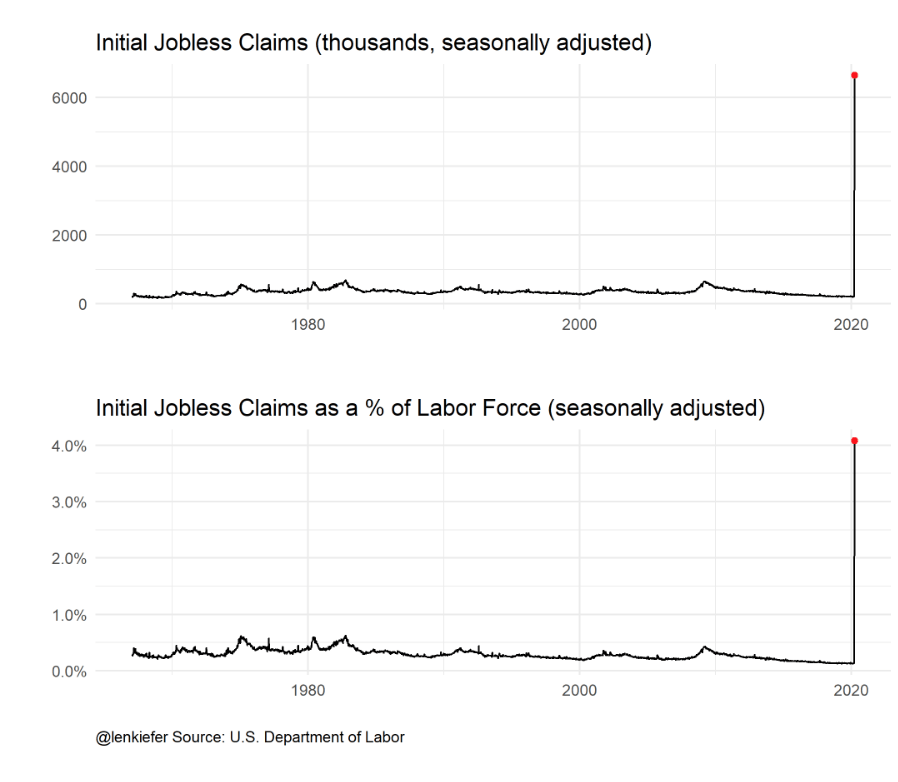
    Each day the shutdown continues, we are losing approximately one million jobs, as evidenced by 16.5 million initial weekly jobless claims in three weeks (since March 26). Many of these lost jobs will never return. If the lockdowns continue through April (essentially, a best-case scenario), we’ll be lucky if job losses are limited to 25 million. Many people see 6.6 million people as just a number , as Len Kieffer put it, it is the size of the state of Missouri. Twenty five million is almost the size of the state of Texas!

    The 16.5 million jobs lost thus far are only counting people who have filed jobless claims that were processed through April 8, 2020; it’s likely that the real number is quite a bit higher than this. In addition, there are millions of people not-technically-unemployed who have seen their incomes plummet. One example would be so-called gig workers, such as Uber and Lyft drivers. It’s almost certain that realtors are suffering the same fate.

    We have not overburdened the health care system.

    Our

    Although, the ER and ICU capacity has increased in many locations, overall healthcare system capacity has decreased dramatically, as all non-COVID and non-emergent care is being neglected. This has led to layoffs of healthcare workers and delays in care for countless patients, which will result in a range of negative consequences. Assuming the need for healthcare services has remained constant while availability of such services has plummeted, countless patients are not receiving the care they need in a timely manner. In medicine, timing is of the essence, so even receiving the same exact in the future comes at a price. Many important services are being delayed: blood donations, organ donations, screening colonoscopies, and many other elective procedures. It is very important to note that elective medical care is not useless medical care; rather, it’s simply meaningful and necessary medical care that is scheduled in advance and not performed on an emergency basis.

    Suicide may kill almost as many people as COVID-19 this year.

    In 2018, there were 48,344 recorded suicides. Economic ruin results in a wide range of health problems, suicide, mental health issues, loss of health insurance, reluctance to visit doctors in light of financial hardship, and increases in substance abuse. This is on top of the delay in non-COVID care.

    The mortality was overestimated

    The IHME model, as well as Dr. Fauci have recently decreased the likely deaths from this pandemic to around 60,000 from earlier estimates of 1–2 million.The early reports of 3–4% case fatality rate (CFR) are likely misleading. The numbers miss those who are asymptomatic or recovered at home without seeking testing. What we really need to know is the infection mortality rate (IFR). Fortunately we have some good clues. Looking at the data from the Diamond Princess cruise ship, the infection fatality rate on the cruise ship was 1%. However, the average age of people on the cruise ship was much higher than the age of the average American. When you adjust for the differences in age between the cruise ship and America, you see that the IFR should be about 0.1%. There was a recent study out of Germany in the city of Gangelt where they tested 80% of the population, the IFR there was about 0.37%. The way we are testing now, we cannot know how many people have been infected with COVID-19 since we are missing those who had the disease and recovered. Antibody testing is needed to know the true number of people who have been infected. There is a good chance this number is well above 10 million, which drives the IFR down even further.

    Children are at almost no risk from this disease.

    The CDC estimates 37 to 187 children die every year, not from Covid-19, from the flu. This year we have lost 105 children from the flu. Yet, we have closed every school in America. Education is vitally important and a whole generation will miss a fourth of this school year. Closing schools also goes a long way towards limiting the development of herd immunity.

    PPE was limited but is now becoming more available

    This article is not meant to diminish the pain and horror this disease can bring to those who get it. I am a physician in one of the highest risk specialties for contracting the disease in the hospital. The lack of personal protective equipment (PPE) facing US healthcare workers is unfair and wrong. Yet, as the curve has flattened, it seems more hospitals have found adequate PPE. The CDC estimates a possible second wave would be at least 150 days from the end of the lockdown, possibly this fall. Ending the lockdowns would have no effect on the PPE for the current crisis. We would have plenty of time to prepare for a possible second wave.

    Authorities should show clear evidence regarding the benefits of indefinite lockdown

    Those who want to continue the lockdown indefinitely should show clear evidence regarding the benefits of indefinite lockdown. There needs to be a clear reliable model that shows how many additional lives will be saved considering we have already flattened the curve and there is essentially no further risk of overwhelming the health care system. The previous models were wrong. The consequences of indefinite lockdown are quite staggering, to the tune of one million jobs lost per day.

    Share this on …

    • Share on X (Opens in new window) X
    • Share on Facebook (Opens in new window) Facebook
    • Share on LinkedIn (Opens in new window) LinkedIn
    • Email a link to a friend (Opens in new window) Email
    • Print (Opens in new window) Print
    Like Loading…
    No comments on … unless the #EversEdicts end now
  • The coming coronavirus insurrection …

    April 13, 2020
    Wisconsin politics

    Molly Beck:

    Two conservative lawmakers are warning of “civil disobedience” and “revolt” against restrictions imposed by Gov. Tony Evers’ administration to curb the spread of coronavirus — comments the governor suggested could damage the state’s effort to contain the virus.

    State Sens. Steve Nass of Whitewater and Duey Stroebel of the Town of Cedarburg said Friday the latest order by Evers to close dozens of state parks could result in significant pushback if Evers’ orders to stay at home, which have closed scores of businesses, bars and restaurants, continue. 

    Both also suggested it’s unfair that public employees are not being subject to pay cuts as owners and employees of private companies are losing work — an idea Evers also rejected Friday. 

    “I hope the Governor and other officials in the administration understand the closing of 40 state parks for dubious reasoning at best is only one flashpoint in a growing revolt to how the Covid-19 response has been handled in Wisconsin,” Nass wrote in an email to Evers’ legislative liaison.

    “This week has been a turning point in how the public now views some of the decisions made by this administration under the Governor’s Emergency Declaration and the uneven exercise of those emergency powers,” he said. 

    Evers suggested Friday the comments from Nass and Stroebel could create more division and take focus off keeping people healthy. 

    “C’mon folks, the rhetoric around this topic is escalating in a direction that is not helpful,” he told reporters Friday. “We hope we can continue to defeat the virus instead of defeating each other.” 

    Some Wisconsin Republicans have questioned whether Evers’ decision to close schools, bars, restaurants, and other businesses not considered to be providing essential services, was necessary given the number of cases of the virus in Wisconsin. 

    Department of Health Services Secretary Andrea Palm said without the Evers administration’s order to stay at home, the agency projected cases of the virus to be 22,000 as of this week. As of Friday, there are 3,068 cases in the state.

    Palm said the number of cases is directly related to the restrictions.

    “Until we have a vaccine, or until we have medical intervention … we are going to have to very actively manage this outbreak and safer at home (order) is the current tool we are using,” Palm told reporters Friday.

    U.S. Surgeon General Jerome Adams said Friday “most of the country” will not be able to reopen by May 1, despite suggestions from some Trump administration officials that next month may be a time to revisit strict social distancing guidelines. 

    And projections by the Homeland Security and Health and Human Services show lifting stay-at-home orders, school closures and social distancing restrictions after 30 days would lead to a dramatic infection spike this summer and death tolls that would rival doing nothing, according to a New York Times report. 

    Stroebel said Evers’ orders should be re-evaluated and involve a “cost/benefit analysis.”

    “Every sickness and death is a tragedy, but so are businesses and livelihoods ruined by shelter in place orders,” he said in a statement. “Besides being counterproductive, indefinite sheltering orders will eventually lead to civil disobedience.” 

    Stroebel also raised alarm bells about the state’s finances, saying the promises of the current state budget— which provides funding through 2021 — won’t be able to be kept under the current economy. He and Nass pointed out in their statements public employees haven’t been subject to pay cuts like others.

    “It is irresponsible to conceal the truth from Wisconsinites that we will likely be unable to live up to all the promises of the current state budget,” he said. “I am not going to tell constituents, who are losing their businesses, getting laid off and seeing their nest eggs dip with the stock market to pay higher taxes so that state and local employees can avoid unpaid furloughs, or so that government programs can grow at twice the rate of inflation.”

    When asked whether he would consider imposing pay cuts for public employees, Evers said the idea was insulting to public workers. 

    “The tens of thousands of state employees who are doing work for the state of Wisconsin are doing essential work,” Evers said, citing examples of workers processing unemployment claims, working in long-term care facilities for military veterans and overseeing state prisons. “To suggest that somehow state employees are not valued … I value them and the people of Wisconsin value them.”

    Share this on …

    • Share on X (Opens in new window) X
    • Share on Facebook (Opens in new window) Facebook
    • Share on LinkedIn (Opens in new window) LinkedIn
    • Email a link to a friend (Opens in new window) Email
    • Print (Opens in new window) Print
    Like Loading…
    No comments on The coming coronavirus insurrection …
  • Coronavirus 101

    April 13, 2020
    International relations, US politics

    Holman W. Jenkins Jr. covers the coronavirus’ history and likely future:

    • The spread. From the time the first case emerged in Wuhan on Nov. 17 to the moment when China/the World Health Organization acknowledged human-to-human transmission on Jan. 20, Wuhan exported between eight and 16 undetected cases to the U.S. through air travel, giving rise to 1,000 to 9,000 cases in the U.S. by March 1, according to a U.S.-Chinese modeling project. Another modeling group estimates that other Chinese cities exported 2.9 cases for each case exported from Wuhan. As first reported by USA Today, many of the virus strains circulating in New York appear to have arrived by way of Europe.

    Bottom line: It doesn’t get Donald Trump and other politicians off the hook for goofy statements and slow responses, but a global pandemic was likely unstoppable by Jan. 20.

    • Testing. The CDC develops tests for its own internal use. The Food and Drug Administration requires that tests offered to the public be proved safe and effective. Government might have said “have at it, boys” and allowed anyone to make and sell anything and call it a Covid-19 test. This wouldn’t have been government.

    Though the Trump administration is guilty of testing stumbles, unrealistic is the notion that enough testing could have been made available to contain a novel flu-like virus once it was widely established.

    • The lockdowns. Imagine a problem that can be solved by holding your head underwater but stops being solved when you lift your head out. This is no solution. How can any society lift its stay-at-home order if there’s no vaccine and most people remain uninfected? Not even the Chinese, as we are about to learn, really have an answer. Yet it’s amazing how much congratulatory press coverage of the lockdowns doesn’t acknowledge this obvious Catch-22. By now even the most tunnel-visioned epidemiologist must admit the lockdown cure will soon be worse than the disease, imposing social destruction beyond imagining.

    • Testing, again. A MacGuffin that many countries, including the U.S., are converging on is constant and widespread testing to quarantine new cases. Testing will allow us to “flatten the curve” while lifting the stay-at-home orders and permit commerce to revive.

    This probably is a polite fiction but it will let us get the economy mostly open. In reality, we will end up throwing a variety of strategies at a persistent epidemic (testing, treatments, voluntary social distancing) and accept what nature gives us. For instance, policy makers or their own legal departments will not be encouraging the NBA or other sports leagues to begin playing to packed crowds anytime soon. And government will keep pouring resources into health care so we can at least believe every victim is getting a fair shot at survival.

    I doubt a large number of deaths would deter the public from forging this path but if the hospital system is overloaded and non-Covid patients are not getting adequate treatment for their own conditions, that could be a wild card.

    • The death rate. Given asymptomatic cases and many mild cases that are indistinguishable from the cold or flu, experts have long suspected Covid-19 is more widespread than we know. At the same time, the fatality rate is affected by both undercounts and overcounts. The most up-to-date estimate by the Oxford Center for Evidence-Based Medicine suspects the death rate is a flu-like 0.1% to 0.39%. Now don’t choke on your Cheerios just yet—I will return to this point.

    • Herd immunity. Levels of honesty vary, but a fair approximation is that most countries expect the initial epidemic to burn itself out before a vaccine is available. Sweden is perhaps the most candid in anticipating wide infection of its populace. One country, New Zealand, is resolute in committing itself to a different path. It intends to exterminate the virus domestically and then forbid or so strictly regulate foreign travel that the disease cannot re-enter until a vaccine is available.

    • Value proposition. Getting back to the death rate, the average risk for each of us may be small but when an entire population is subjected to the same newly emergent small risk at the same time, it can overwhelm emergency rooms. The panicked governmental responses and clampdowns we’ve seen are best understood in this vein: A very low risk of death for a very large number of people has created a global crisis. Not helping is the reality described in detail by the world’s newspapers: Recovery of the most severely affected patients on ventilators is rare and involves a great deal of personal suffering.

    The arrival of Covid-19 in our world has not been an easy policy problem for our politicians to finesse. Sometimes that’s the job they signed up for: to do what needs to be done and take on their backs the public’s unhappiness with it.

    Share this on …

    • Share on X (Opens in new window) X
    • Share on Facebook (Opens in new window) Facebook
    • Share on LinkedIn (Opens in new window) LinkedIn
    • Email a link to a friend (Opens in new window) Email
    • Print (Opens in new window) Print
    Like Loading…
    No comments on Coronavirus 101
  • Presty the DJ for April 13

    April 13, 2020
    Music

    You might think the number one British single today in 1967 is …

    The number one single today in 1974:

    Today in 1980, Grease was no longer the word: The musical closed in New York, after 3,883 performances.

    (more…)

    Share this on …

    • Share on X (Opens in new window) X
    • Share on Facebook (Opens in new window) Facebook
    • Share on LinkedIn (Opens in new window) LinkedIn
    • Email a link to a friend (Opens in new window) Email
    • Print (Opens in new window) Print
    Like Loading…
    No comments on Presty the DJ for April 13
  • Presty the DJ for April 12

    April 12, 2020
    Music

    Today in 1966, Jan Berry of Jan and Dean crashed his Corvette into a parked truck in Los Angeles, suffering permanent injuries.

    The number one single today in 1969:

    Today in 1975, David Bowie announced, “I’ve rocked my roll. It’s a boring dead end, there will be no more rock ‘n’ roll records from me.”

    (more…)

    Share this on …

    • Share on X (Opens in new window) X
    • Share on Facebook (Opens in new window) Facebook
    • Share on LinkedIn (Opens in new window) LinkedIn
    • Email a link to a friend (Opens in new window) Email
    • Print (Opens in new window) Print
    Like Loading…
    No comments on Presty the DJ for April 12
  • Presty the DJ for April 11

    April 11, 2020
    Music

    The number one single today in 1954:

    Today in 1964, the Billboard Hot 100 could have been called the Beatles 14 and the non-Beatles 86, topped by …

    The number one single today in 1970:

    (more…)

    Share this on …

    • Share on X (Opens in new window) X
    • Share on Facebook (Opens in new window) Facebook
    • Share on LinkedIn (Opens in new window) LinkedIn
    • Email a link to a friend (Opens in new window) Email
    • Print (Opens in new window) Print
    Like Loading…
    No comments on Presty the DJ for April 11
Previous Page
1 … 307 308 309 310 311 … 1,042
Next Page

Website Powered by WordPress.com.

Steve Prestegard.com: The Presteblog

The thoughts of a journalist/libertarian–conservative/Christian husband, father, Eagle Scout and aficionado of obscure rock music. Thoughts herein are only the author’s and not necessarily the opinions of his family, friends, neighbors, church members or past, present or future employers.

  • Steve
    • About, or, Who is this man?
    • Facebook
    • Twitter
    • Adventures in ruralu0026nbsp;inkBack in June 2009, I was driving somewhere through a rural area. And for some reason, I had a flashback to two experiences in my career about that time of year many years ago. In 1988, eight days after graduating from the University of Wisconsin, I started work at the Grant County Herald Independent in Lancaster as a — well, the — reporter. Four years after that, on my 27th birthday, I purchased, with a business partner, the Tri-County Press in Cuba City, my first business venture. Both were experiences about which Wisconsin author Michael Perry might write. I thought about all this after reading a novel, The Deadline, written by a former newspaper editor and publisher. (Now who would write a novel about a weekly newspaper?) As a former newspaper owner, I picked at some of it — why finance a newspaper purchase through the bank if the seller is willing to finance it? Because the mean bank lender is a plot point! — and it is much more interesting than reality, but it is very well written, with a nicely twisting plot, and quite entertaining, again more so than reality. There is something about that first job out of college that makes you remember it perhaps more…
    • Adventures in radioI’ve been in the full-time work world half my life. For that same amount of time I’ve been broadcasting sports as a side interest, something I had wanted to since I started listening to games on radio and watching on TV, and then actually attending games. If you ask someone who’s worked in radio for some time about the late ’70s TV series “WKRP in Cincinnati,” most of them will tell you that, if anything, the series understated how wacky working in radio can be. Perhaps the funniest episode in the history of TV is the “WKRP” episode, based on a true story, about the fictional radio station’s Thanksgiving promotion — throwing live turkeys out of a helicopter under the mistaken belief that, in the words of WKRP owner Arthur Carlson, “As God is my witness, I thought turkeys could fly.” [youtube=http://www.youtube.com/watch?v=ST01bZJPuE0] I’ve never been involved in anything like that. I have announced games from the roofs of press boxes (once on a nice day, and once in 50-mph winds), from a Mississippi River bluff (more on that later), and from the front row of the second balcony of the University of Wisconsin Fieldhouse (great view, but not a place to go if…
    • “Good morning/afternoon/evening, ________ fans …”
    • My biggest storyEarlier this week, while looking for something else, I came upon some of my own work. (I’m going to write a blog someday called “Things I Found While Looking for Something Else.” This is not that blog.) The Grant County Sheriff’s Department, in the county where I used to live, has a tribute page to the two officers in county history who died in the line of duty. One is William Loud, a deputy marshal in Cassville, shot to death by two bank robbers in 1912. The other is Tom Reuter, a Grant County deputy sheriff who was shot to death at the end of his 4 p.m.-to-midnight shift March 18, 1990. Gregory Coulthard, then a 19-year-old farmhand, was convicted of first-degree intentional homicide and is serving a life sentence, with his first eligibility for parole on March 18, 2015, just 3½ years from now. I’ve written a lot over the years. I think this, from my first two years in the full-time journalism world, will go down as the story I remember the most. For journalists, big stories contain a paradox, which was pointed out in CBS-TV’s interview of Andy Rooney on his last “60 Minutes” Sunday. Morley Safer said something along the line…
  • Food and drink
    • The Roesch/Prestegard familyu0026nbsp;cookbookFrom the family cookbook(s) All the families I’m associated with love to eat, so it’s a good thing we enjoy cooking. The first out-of-my-house food memory I have is of my grandmother’s cooking for Christmas or other family occasions. According to my mother, my grandmother had a baked beans recipe that she would make for my mother. Unfortunately, the recipe seems to have  disappeared. Also unfortunately, my early days as a picky, though voluminous, eater meant I missed a lot of those recipes made from such wholesome ingredients as lard and meat fat. I particularly remember a couple of meals that involve my family. The day of Super Bowl XXXI, my parents, my brother, my aunt and uncle and a group of their friends got together to share lots of food and cheer on the Packers to their first NFL title in 29 years. (After which Jannan and I drove to Lambeau Field in the snow,  but that’s another story.) Then, on Dec. 31, 1999, my parents, my brother, my aunt and uncle and Jannan and I (along with Michael in utero) had a one-course-per-hour meal to appropriately end years beginning with the number 1. Unfortunately I can’t remember what we…
    • SkålI was the editor of Marketplace Magazine for 10 years. If I had to point to one thing that demonstrates improved quality of life since I came to Northeast Wisconsin in 1994, it would be … … the growth of breweries and  wineries in Northeast Wisconsin. The former of those two facts makes sense, given our heritage as a brewing state. The latter is less self-evident, since no one thinks of Wisconsin as having a good grape-growing climate. Some snobs claim that apple or cherry wines aren’t really wines at all. But one of the great facets of free enterprise is the opportunity to make your own choice of what food and drink to drink. (At least for now, though some wish to restrict our food and drink choices.) Wisconsin’s historically predominant ethnic group (and our family’s) is German. Our German ancestors did unfortunately bring large government and high taxes with them, but they also brought beer. Europeans brought wine with them, since they came from countries with poor-quality drinking water. Within 50 years of a wave of mid-19th-century German immigration, brewing had become the fifth largest industry in the U.S., according to Maureen Ogle, author of Ambitious Brew: The Story of American Beer. Beer and wine have…
  • Wheels
    • America’s sports carMy birthday in June dawned without a Chevrolet Corvette in front of my house. (The Corvette at the top of the page was featured at the 2007 Greater Milwaukee Auto Show. The copilot is my oldest son, Michael.) Which isn’t surprising. I have three young children, and I have a house with a one-car garage. (Then again, this would be more practical, though a blatant pluck-your-eyes-out violation of the Corvette ethos. Of course, so was this.) The reality is that I’m likely to be able to own a Corvette only if I get a visit from the Corvette Fairy, whose office is next door to the Easter Bunny. (I hope this isn’t foreshadowing: When I interviewed Dave Richter of Valley Corvette for a car enthusiast story in the late great Marketplace Magazine, he said that the most popular Corvette in most fans’ minds was a Corvette built during their days in high school. This would be a problem for me in that I graduated from high school in 1983, when no Corvette was built.) The Corvette is one of those cars whose existence may be difficult to understand within General Motors Corp. The Corvette is what is known as a “halo car,” a car that drives people into showrooms, even if…
    • Barges on fouru0026nbsp;wheelsI originally wrote this in September 2008.  At the Fox Cities Business Expo Tuesday, a Smart car was displayed at the United Way Fox Cities booth. I reported that I once owned a car into which trunk, I believe, the Smart could be placed, with the trunk lid shut. This is said car — a 1975 Chevrolet Caprice coupe (ours was dark red), whose doors are, I believe, longer than the entire Smart. The Caprice, built down Interstate 90 from us Madisonians in Janesville (a neighbor of ours who worked at the plant probably helped put it together) was the flagship of Chevy’s full-size fleet (which included the stripper Bel Air and middle-of-the-road Impala), featuring popular-for-the-time vinyl roofs, better sound insulation, an upgraded cloth interior, rear fender skirts and fancy Caprice badges. The Caprice was 18 feet 1 inch long and weighed 4,300 pounds. For comparison: The midsize Chevrolet of the ear was the Malibu, which was the same approximate size as the Caprice after its 1977 downsizing. The compact Chevrolet of the era was the Nova, which was 200 inches long — four inches longer than a current Cadillac STS. Wikipedia’s entry on the Caprice has this amusing sentence: “As fuel economy became a bigger priority among Americans…
    • Behind the wheel
    • Collecting only dust or rust
    • Coooooooooooupe!
    • Corvettes on the screen
    • The garage of misfit cars
    • 100 years (and one day) of our Chevrolets
    • They built Excitement, sort of, once in a while
    • A wagon by any otheru0026nbsp;nameFirst written in 2008. You will see more don’t-call-them-station-wagons as you drive today. Readers around my age have probably had some experience with a vehicle increasingly rare on the road — the station wagon. If you were a Boy Scout or Girl Scout, or were a member of some kind of youth athletic team, or had a large dog, or had relatives approximately your age, or had friends who needed to be transported somewhere, or had parents who occasionally had to haul (either in the back or in a trailer) more than what could be fit inside a car trunk, you (or, actually, your parents) were the target demographic for the station wagon. “Station wagons came to be like covered wagons — so much family activity happened in those cars,” said Tim Cleary, president of the American Station Wagon Owners Association, in Country Living magazine. Wagons “were used for everything from daily runs to the grocery store to long summer driving trips, and while many men and women might have wanted a fancier or sportier car, a station wagon was something they knew they needed for the family.” The “station wagon” originally was a vehicle with a covered seating area to take people between train stations…
    • Wheels on theu0026nbsp;screenBetween my former and current blogs, I wrote a lot about automobiles and TV and movies. Think of this post as killing two birds (Thunderbirds? Firebirds? Skylarks?) with one stone. Most movies and TV series view cars the same way most people view cars — as A-to-B transportation. (That’s not counting the movies or series where the car is the plot, like the haunted “Christine” or “Knight Rider” or the “Back to the Future” movies.) The philosophy here, of course, is that cars are not merely A-to-B transportation. Which disqualifies most police shows from what you’re about to read, even though I’ve watched more police video than anything else, because police cars are plain Jane vehicles. The highlight in a sense is in the beginning: The car chase in my favorite movie, “Bullitt,” featuring Steve McQueen’s 1968 Ford Mustang against the bad guys’ 1968 Dodge Charger: [youtube=http://www.youtube.com/watch?v=GMc2RdFuOxIu0026amp;fmt=18] One year before that (but I didn’t see this until we got Telemundo on cable a couple of years ago) was a movie called “Operación 67,” featuring (I kid you not) a masked professional wrestler, his unmasked sidekick, and some sort of secret agent plot. (Since I don’t know Spanish and it’s not…
    • While riding in my Cadillac …
  • Entertainments
    • Brass rocksThose who read my former blog last year at this time, or have read this blog over the past months, know that I am a big fan of the rock group Chicago. (Back when they were a rock group and not a singer of sappy ballads, that is.) Since rock music began from elements of country music, jazz and the blues, brass rock would seem a natural subgenre of rock music. A lot of ’50s musical acts had saxophone players, and some played with full orchestras … [youtube=http://www.youtube.com/watch?v=9CPS-WuUKUE] … but it wasn’t until the more-or-less simultaneous appearances of Chicago and Blood Sweat u0026amp; Tears on the musical scene (both groups formed in 1967, both had their first charting singles in 1969, and they had the same producer) that the usual guitar/bass/keyboard/drum grouping was augmented by one or more trumpets, a sax player and a trombone player. While Chicago is my favorite group (but you knew that already), the first brass rock song I remember hearing was BSu0026amp;T’s “Spinning Wheel” — not in its original form, but on “Sesame Street,” accompanied by, yes, a giant spinning wheel. [youtube=http://www.youtube.com/watch?v=qi9sLkyhhlE] [youtube=http://www.youtube.com/watch?v=OxWSOuNsN20] [youtube=http://www.youtube.com/watch?v=U9U34uPjz-g] I remember liking Chicago’s “Just You ‘n Me” when it was released as a single, and…
    • Drive and Eat au0026nbsp;RockThe first UW home football game of each season also is the opener for the University of Wisconsin Marching Band, the world’s finest college marching band. (How the UW Band has not gotten the Sudler Trophy, which is to honor the country’s premier college marching bands, is beyond my comprehension.) I know this because I am an alumnus of the UW Band. I played five years (in the last rank of the band, Rank 25, motto: “Where Men Are Tall and Run-On Is Short”), marching in 39 football games at Camp Randall Stadium, the Hubert H. Humphrey Metrodome in Minneapolis, Michigan Stadium in Ann Arbor, Memorial Stadium at the University of Illinois (worst artificial turf I had ever seen), the University of Nevada–Las Vegas’ Sam Boyd Silver Bowl, the former Dyche Stadium at Northwestern University, five high school fields and, in my one bowl game, Legion Field in Birmingham, Ala., site of the 1984 Hall of Fame Bowl. The UW Band was, without question, the most memorable experience of my college days, and one of the most meaningful experiences of my lifetime. It was the most physical experience of my lifetime, to be sure. Fifteen minutes into my first Registration…
    • Keep on rockin’ in the freeu0026nbsp;worldOne of my first ambitions in communications was to be a radio disc jockey, and to possibly reach the level of the greats I used to listen to from WLS radio in Chicago, which used to be one of the great 50,000-watt AM rock stations of the country, back when they still existed. (Those who are aficionados of that time in music and radio history enjoyed a trip to that wayback machine when WLS a Memorial Day Big 89 Rewind, excerpts of which can be found on their Web site.) My vision was to be WLS’ afternoon DJ, playing the best in rock music between 2 and 6, which meant I wouldn’t have to get up before the crack of dawn to do the morning show, yet have my nights free to do whatever glamorous things big-city DJs did. Then I learned about the realities of radio — low pay, long hours, zero job security — and though I have dabbled in radio sports, I’ve pretty much cured myself of the idea of working in radio, even if, to quote WAPL’s Len Nelson, “You come to work every day just like everybody else does, but we’re playing rock ’n’ roll songs, we’re cuttin’ up.…
    • Monday on the flight line, not Saturday in the park
    • Music to drive by
    • The rock ofu0026nbsp;WisconsinWikipedia begins its item “Music of Wisconsin” thusly: Wisconsin was settled largely by European immigrants in the late 19th century. This immigration led to the popularization of galops, schottisches, waltzes, and, especially, polkas. [youtube=http://www.youtube.com/watch?v=yl7wCczgNUc] So when I first sought to write a blog piece about rock musicians from Wisconsin, that seemed like a forlorn venture. Turned out it wasn’t, because when I first wrote about rock musicians from Wisconsin, so many of them that I hadn’t mentioned came up in the first few days that I had to write a second blog entry fixing the omissions of the first. This list is about rock music, so it will not include, for instance, Milwaukee native and Ripon College graduate Al Jarreau, who in addition to having recorded a boatload of music for the jazz and adult contemporary/easy listening fan, also recorded the theme music for the ’80s TV series “Moonlighting.” Nor will it include Milwaukee native Eric Benet, who was for a while known more for his former wife, Halle Berry, than for his music, which includes four number one singles on the Ru0026amp;B charts, “Spend My Life with You” with Tamia, “Hurricane,” “Pretty Baby” and “You’re the Only One.” Nor will it include Wisconsin’s sizable contributions to big…
    • Steve TV: All Steve, All the Time
    • “Super Steve, Man of Action!”
    • Too much TV
    • The worst music of allu0026nbsp;timeThe rock group Jefferson Airplane titled its first greatest-hits compilation “The Worst of Jefferson Airplane.” Rolling Stone magazine was not being ironic when it polled its readers to decide the 10 worst songs of the 1990s. I’m not sure I agree with all of Rolling Stone’s list, but that shouldn’t be surprising; such lists are meant for debate, after all. To determine the “worst,” songs appropriate for the “Vinyl from Hell” segment that used to be on a Madison FM rock station, requires some criteria, which does not include mere overexposure (for instance, “Macarena,” the video of which I find amusing since it looks like two bankers are singing it). Before we go on: Blog posts like this one require multimedia, so if you find a song you hate on this blog, I apologize. These are also songs that I almost never listen to because my sound system has a zero-tolerance policy — if I’m listening to the radio or a CD and I hear a song I don’t like, it’s, to quote Bad Company, gone gone gone. My blonde wife won’t be happy to read that one of her favorite ’90s songs, 4 Non Blondes’ “What’s Up,” starts the list. (However,…
    • “You have the right to remain silent …”
  • Madison
    • Blasts from the Madison media past
    • Blasts from my Madison past
    • Blasts from our Madison past
    • What’s the matter with Madison?
    • Wisconsin – Madison = ?
  • Sports
    • Athletic aesthetics, or “cardinal” vs. “Big Red”
    • Choose your own announcer
    • La Follette state 1982 (u0022It was 30 years ago todayu0022)
    • The North Dakota–Wisconsin Hockey Fight of 1982
    • Packers vs. Brewers
  • Hall of Fame
    • The case(s) against teacher unions
    • The Class of 1983
    • A hairy subject, or face the face
    • It’s worse than you think
    • It’s worse than you think, 2010–11 edition
    • My favorite interview subject of all time
    • Oh look! Rural people!
    • Prestegard for president!
    • Unions vs. the facts, or Hiding in plain sight
    • When rhetoric goes too far
Privacy & Cookies: This site uses cookies. By continuing to use this website, you agree to their use.
To find out more, including how to control cookies, see here: Cookie Policy
  • Subscribe Subscribed
    • Steve Prestegard.com: The Presteblog
    • Join 197 other subscribers
    • Already have a WordPress.com account? Log in now.
    • Steve Prestegard.com: The Presteblog
    • Subscribe Subscribed
    • Sign up
    • Log in
    • Report this content
    • View site in Reader
    • Manage subscriptions
    • Collapse this bar
%d