• The nattering nabobs

    April 6, 2020
    media, US politics

    Richard Nixon’s attack dog, Spiro Agnew, described the late 1960s news media as ”nattering nabobs of negatives.”

    Five decades later, former presidential press secretary Ari Fleischer:

    If President Trump is a wartime president, does that make Washington reporters wartime correspondents?
    Even before coronavirus, I often wondered if today’s press corps had covered the allied landing at D-Day in June 1944, if their stories would have led with the disastrous American landing on Omaha Beach, the paratroopers who dropped miles away from their targets and the submersible tanks that sunk to the bottom of the English Channel before ever touching land.

    Indeed, if each of these genuine military setbacks had been the lead story, the American people might have lost the will to fight the rest of the war.

    Which brings me to today’s press corps.

    Since Vietnam and Watergate, the Washington press corps has earned its chops by taking on those in power, relentlessly questioning what they are told, particularly when they’re told it by a Republican President, and doing their best to expose mistakes, misstatements and problems.  When something goes wrong, the press shines a light on it.

    “It’s not news when an airplane lands” goes the old journalistic saw.  “It’s only news when a plane crashes.”

    This helps explains NBC reporter Peter Alexander’s now infamous clash with President Trump over the efficacy of a drug meant to treat malaria for which the president expressed hope that it might (not will, but might) be able to treat the coronavirus as well.

    Reporters, who routinely publish worst-case estimates about the impact of coronavirus, took a firm stand against the president’s hopeful point of view, led by Alexander, who took particular umbrage.

    “Is it possible — it possible that your impulse to put a positive spin on things may be giving Americans a false sense of hope, and misrepresenting the preparedness right now?” Alexander asked.  

    After the president again, even-handedly, said the drug might work and it might not, Alexander’s pessimism peaked.

    “Nearly 200 dead. What do you say to Americans who are scared, though? I guess, nearly 200 dead; 14,000 who are sick; millions, as you witness, who are scared right now. What do you say to Americans who are watching you right now who are scared?”

    To which the president in his usual subtle style replied, “You’re a terrible reporter.” 

    On March 25, the Gallup organization released a poll that was good for the President and bad for the press.

    60% of the American people approve of the way President Trump is handling his response to this crisis and only 38% disapprove. But only 44% approve of the way the news media is handling its response, with 55% disapproving.

    As the president’s approval goes up, several prominent columnists and talking heads have called for the televised briefings to come down. Don’t show the briefings live, cried MSNBC’s Rachel Maddow, along with the Washington Post’s Margaret Sullivan and Karen Tumulty. In WW II, the government censored reporters. Now, these reporters want to censor the government.

    NBC’s Chuck Todd sunk to a new low when he asked Joe Biden on “Meet the Press” if Biden thought there was “blood on the president’s hands considering the slow response.” He caught himself mid-sentence and added, “or is that too harsh a criticism?” 

    In all times, reporters have a vital role to play in keeping our country free. The First Amendment gives reporters the right to ask whatever they want, however they want.

    Too many journalists are fighting the last war, and they’re only hurting themselves. Many reporters do ask tough, non-accusatory questions about how to fix problems, fight the illness and get America back on its feet.

    But if this becomes a fight between a president who realistically represents hope and reporters who reject it, that’s a fight the press can’t win.

    The media’s job is to cover all sides of a story. They are not.

    Share this on …

    • Share on X (Opens in new window) X
    • Share on Facebook (Opens in new window) Facebook
    • Share on LinkedIn (Opens in new window) LinkedIn
    • Email a link to a friend (Opens in new window) Email
    • Print (Opens in new window) Print
    Like Loading…
    No comments on The nattering nabobs
  • Presty the DJ for April 6

    April 6, 2020
    Music

    Today in 1956, Elvis Presley signed a seven-year contract with Paramount Studios.

    The movies won no Academy Awards, but sold a lot of tickets and a lot of records.

    The number one album today in 1968 was the soundtrack to “The Graduate”:

    (more…)

    Share this on …

    • Share on X (Opens in new window) X
    • Share on Facebook (Opens in new window) Facebook
    • Share on LinkedIn (Opens in new window) LinkedIn
    • Email a link to a friend (Opens in new window) Email
    • Print (Opens in new window) Print
    Like Loading…
    No comments on Presty the DJ for April 6
  • Presty the DJ for April 5

    April 5, 2020
    Music

    The number one album today in 1980 was Genesis’ “Duke”:

    Today in 1985, more than 5,000 radio stations played this at 3:50 p.m. Greenwich Mean Time, which is 9:50 a.m. Central time (but Standard or Daylight?):

    (more…)

    Share this on …

    • Share on X (Opens in new window) X
    • Share on Facebook (Opens in new window) Facebook
    • Share on LinkedIn (Opens in new window) LinkedIn
    • Email a link to a friend (Opens in new window) Email
    • Print (Opens in new window) Print
    Like Loading…
    No comments on Presty the DJ for April 5
  • A tale of two areas

    April 4, 2020
    Uncategorized

    Michael Smith:

    There sure seems to be an undercurrent of worry that the more sparsely populated areas of this country might advance economically while the more densely populated cities languish as a result of the physical reality of disease transmission.Cities have a transmission modality that simply cannot be overcome absent a vaccine for this virus. The reality is that the only reason any “curve flattening” is happening today is that the virus is being deprived of fresh victims, that solution provides little more than a temporary respite and a false sense of security – because the underlying condition promoting spread – the population density – has not changed.

    National policy is being driven by a fear that originated in our major population centers.

    I get it. Nobody wants to spread this disease – but the fact is that New York state’s 2900 deaths would have to increase by 27 times to equal the 79,000 annual deaths due to heart disease and cancer the CDC reported for the state in 2017 (the latest I could find at the CDC website).

    At 7900 deaths nationwide so far, this pandemic doesn’t crack the top 50 for mortality classifications in the nation.

    I understand the pandemic deaths are concentrated in a short period of time and when things happen over a short period, they have more impact – but I still question the need for Kansas or Utah to be driven by situations in New York.

    The real pandemic is not the SARS-CoV-2 virus, it’s fear.

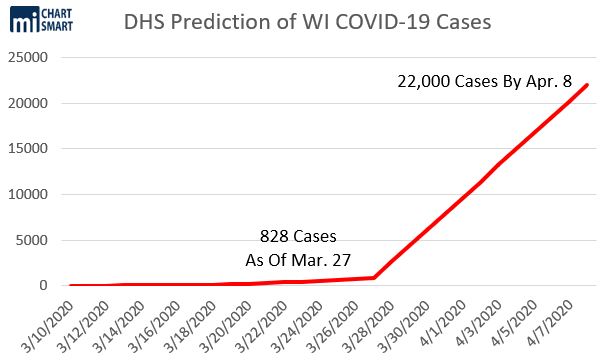
    Wisconsin is a perfect example of what Smith is talking about. As of Friday out of Wisconsin’s 1,916 cases, 955 are in Milwaukee County and 244 are in Dane County. Some counties have not had a single case, and other counties’ measure in the single digits. Yet state government is stupidly treating every part of Wisconsin the same, mandating, for instance, statewide school closings when school administrators could have told you that was a really bad idea.

    If politicians weren’t being profiles in cowardice maybe after this ends they could figure out that the state should not treat, for instance, Milwaukee and Marathon the same. And perhaps small towns could market themselves as superior places to live over crime-plagued and now disease-riddled urban areas.

    Share this on …

    • Share on X (Opens in new window) X
    • Share on Facebook (Opens in new window) Facebook
    • Share on LinkedIn (Opens in new window) LinkedIn
    • Email a link to a friend (Opens in new window) Email
    • Print (Opens in new window) Print
    Like Loading…
    No comments on A tale of two areas
  • Presty the DJ for April 4

    April 4, 2020
    Music

    Today in 1960, RCA Victor Records announced it would release all singles in both mono and stereo.

    Today in 1964, the Beatles had 14 of the Billboard Top 100 singles, including the top five:

    (more…)

    Share this on …

    • Share on X (Opens in new window) X
    • Share on Facebook (Opens in new window) Facebook
    • Share on LinkedIn (Opens in new window) LinkedIn
    • Email a link to a friend (Opens in new window) Email
    • Print (Opens in new window) Print
    Like Loading…
    No comments on Presty the DJ for April 4
  • When you’ve lost your own party

    April 3, 2020
    Wisconsin politics

    Politico Thursday:

    Wisconsin Gov. Tony Evers’ refusal to push for a delay of his state’s Tuesday primary has infuriated fellow Democrats in the state, who are now openly accusing him of failing to prevent an impending train wreck.

    As the nation hurtles toward 5,000 coronavirus deaths and governors across the country take extreme steps to keep people at home, Wisconsin is forging ahead with the election despite having its own stay-at-home order. The likely outcome is that Wisconsinites will wake up on election day being told to stay put at the same time they’re greenlighted to head to crowded polling sites.

    Other Democrats in the state say the conflicting signals will disenfranchise voters. Already, the sanctity of the vote has been called into question by snafus with early voting: In Milwaukee, some voting sites were closed for a period of the designated voting before being reopened.

    “There’s this enormous conflict between what we need to do in a democracy in the midst of a pandemic. You can’t have a stay-at-home order but then tell millions of people to go stand in line and congregate near one another across the state,” said Racine Mayor Cory Mason. “Having an election in the middle of a stay-at-home order makes no sense. It did not have to be this way.”

    The intraparty conflict in Wisconsin is a bad look in a state that’s central to the party’s hopes of beating President Donald Trump in November. It also doesn’t bode well for a unified message in the run-up to the Democratic convention in Milwaukee, an event that was just pushed back a month to August.

    While Democrats across Wisconsin have called for postponing the election, pointing to health concerns and the inability to staff polling sites, Evers has cited his limited authority to impose a delay against Republican resistance in the Legislature.

    Evers has advocated that residents vote by mail and called on lawmakers to ease up on election day requirements to allow more flexibility on when ballots could be turned in and counted.

    On Thursday, a federal judge provided some relief. While refusing to move the primary, U.S. District Judge William Conley extended the deadline by one day to request absentee ballots and is allowing voters six additional days after Election Day to return them. Conley in a Wednesday ruling said his hands were tied to postpone the election and called out both Evers and the legislature for not taking the action themselves.

    Oops — this needs rewriting:

    While refusing to move the primary, U.S. District Judge William Conley extended the deadline by one day to request absentee ballots and is allowing voters six additional days after Election Day to return them in order to promote voter fraud by Democrats.

    There. Fixed it. Now back to our original piece:

    And in interviews with POLITICO, more than a dozen Democratic officials in the state expressed frustration that Evers didn’t act sooner. They argue that he hasn’t tapped the full range of his powers, such as calling for a special legislative session or announcing an election delay and forcing someone to stop him. That’s essentially what Ohio Gov. Mike DeWine did last month, even in the face of an adverse court ruling.

    Mason, a Democrat who served in the Wisconsin state Legislature for 11 years, described local officials as “exasperated” over trying to carry out an election amid the pandemic. Milwaukee Mayor Tom Barrett had urged people not to go the polls on election day to vote for him — but instead to do so by mail ahead of time.

    Polling places across the state are down at least 7,000 poll workers already. Only a fraction of polling sites are expected to be open in Milwaukee, an area that serves large African American and minority populations.

    But Evers’ office said the governor is unlikely to change course.

    “Our democracy is essential, it must go on. Keeping people safe is the governor’s top priority but we want people to participate in this election. We want as many people as possible to vote from home,” Evers spokeswoman Melissa Baldauff told POLITICO. “We hope the Legislature would work with the governor to extend the time for [ballots] to be counted and to be received.”

    She dismissed the possibility of the governor attempting to halt the election like DeWine did. “It’s not going to happen,” Baldauff said. “He doesn’t want to do it and he also doesn’t have the authority to do it.”

    The governor’s office has argued that there’s no certain future date when the health crisis would relent. Officials also said that a delay would put at risk hundreds of nonpartisan positions on the ballot — including the mayor of Milwaukee — that under statute would be vacant if the election does not take place on Tuesday. That scenario, the governor’s office said, would create even more chaos amid a public health emergency. But critics say it is a gray area that Evers could have exploited through the Legislature or the courts to find a bridge solution until the health crisis abates. …

    While Evers has advocated that residents vote by mail, complaints are streaming in from people across the state that they haven’t received absentee ballots in the mail. Evers’ decision to bring in the National Guard to assist with election day is introducing its own concerns, from questions about how to expedite training to fears that a military presence will turn off hordes of potential voters.

    The cowards got their wish this afternoon. Evers signed his 109,667th executive order calling the Legislature into session Saturday at 4 p.m. to help the Democrats commit voter fraud. Republicans apparently more often vote the day of the election, whereas Democrats are more likely to vote absentee. So delaying the election allows Democrats to prevent day-of-election voters from voting.

    (I usually vote absentee because I’m busy on election day, and I want to make sure my vote counts even if someone attempts to kill me to prevent my vote from counting. If politics is everything, then you will do anything to win.)

    This blog has exclusively obtained the Republicans’ agenda Saturday:
    4 p.m.: Call to order.

    4:00:10: Adjourn.

    There is no legal way to move the election until you get over the statutory fact that every county board seat and one-fourth to one-third of every city council, village board, town board and school board automatically becomes vacant after the election. Too bad Politico didn’t bother to research state law before writing this piece. (As is increasingly the case, the mainstream media is now merely stenographers and not reporters.)

    The only conclusion one can make is that Democrats want the election postponed so they can gin up enough fraudulent votes to make sure that Jill Karofsky, not Daniel Kelly, gets elected to the state Supreme Court. There is no other explanation.

    There is one thing Politico reports correctly:

    “It’s been a cataclysmic failure,” said one Wisconsin-based Democratic strategist who supported Evers’ 2018 campaign. “It has been disappointment after disappointment. I do not believe that he’s shown leadership or good judgment during this crisis.”

    On that, we agree.

    Share this on …

    • Share on X (Opens in new window) X
    • Share on Facebook (Opens in new window) Facebook
    • Share on LinkedIn (Opens in new window) LinkedIn
    • Email a link to a friend (Opens in new window) Email
    • Print (Opens in new window) Print
    Like Loading…
    No comments on When you’ve lost your own party
  • Presty the DJ for April 3

    April 3, 2020
    Music

    Today in 1956, Elvis Presley appeared on ABC-TV’s “Milton Berle Show” live from the flight deck of the U.S.S. Hancock, moored off San Diego.

    An estimated one of every four Americans watched, probably making it ABC’s most watched show in its history to then, and probably for several years after that.

    (more…)

    Share this on …

    • Share on X (Opens in new window) X
    • Share on Facebook (Opens in new window) Facebook
    • Share on LinkedIn (Opens in new window) LinkedIn
    • Email a link to a friend (Opens in new window) Email
    • Print (Opens in new window) Print
    Like Loading…
    No comments on Presty the DJ for April 3
  • How to avoid a fiscal pandemic

    April 2, 2020
    Wisconsin politics

    David Fladeboe:

    Wisconsin, like the rest of the nation, is facing an unprecedented crisis as we battle COVID-19. With large swaths of the economy shut down or reduced to fight the pandemic, governments at all levels are working to address the fallout. Now that Congress has passed a series of bills to address the emergency, Wisconsin lawmakers are considering next steps.

    Gov. Tony Evers released proposed legislation at the end of March and asked legislators to act quickly. While the Badger Institute has already pointed out positive policy prescriptions in his executive orders and proposed legislation, Wisconsin lawmakers need to ensure that the cure isn’t worse than the disease.

    Below are a series of guiding principles that should act as a framework for the coming Extraordinary Session of the Legislature.

    First, lawmakers should hesitate to take any actions that grow the size and scope of government permanently. Ongoing appropriations, permanent full-time equivalent positions and new layers of red tape should be avoided at all costs.

    While the structures of government can help fight a crisis, policymakers need to avoid new layers of bureaucracy that can be just as damaging to public and economic wellbeing. Numerous states and the federal government have been relaxing requirements, regulations and licensing complications to help combat the coronavirus, and these efforts should be continued. Too often the tool created to help serves only to tie our hands in the future.

    Next, elected officials need to be careful not to create a long-lasting, one-size-fits-all solution for future health emergencies. Recent policy statements from Wisconsin lawmakers indicate a desire to extend changes made to fight COVID-19 to future crises. But each challenge brings its own unanticipated difficulties, requiring unique approaches and tools.

    Future policymakers, communities, businesses and residents will need the flexibility to respond to emergency situations without encountering rigid, imposed “solutions” that could make problems worse. Be wary of policies that automatically trigger the next time an emergency is declared.

    Finally, don’t plunge the state into a sea of debt that might make matters worse over the long term. Responsible policies contributed to a state budget surplus that has helped soften the blow of this economic crisis. We need to maintain sound economic thinking and fiscal prudence while supporting those who have lost their jobs through no fault of their own. New spending must be weighed against the reality that tax revenues are going to be down sharply in 2020 and possibly beyond.

    The Badger Institute estimates that Wisconsin could face a $100 million deficit in the transportation budget alone due to a decrease in gas tax collections. Reductions in sales and income tax revenues could be even more severe. Wisconsin’s economy will recover, but before we know the true cost and recovery curve, legislators need to be cautious about signing a check they can’t cash. The empty promises of a bankrupt government won’t help anyone.

    If lawmakers keep in mind the long-term consequences of their actions, they can help Wisconsin navigate this storm. Significant policy reforms will be needed, but they can’t come at the expense of our future. A lot of damage already has been done to try to stop the spread of COVID-19; now is our opportunity to stem the tide and prepare ourselves for a vibrant and lasting recovery.

    Share this on …

    • Share on X (Opens in new window) X
    • Share on Facebook (Opens in new window) Facebook
    • Share on LinkedIn (Opens in new window) LinkedIn
    • Email a link to a friend (Opens in new window) Email
    • Print (Opens in new window) Print
    Like Loading…
    No comments on How to avoid a fiscal pandemic
  • A small voice of sanity in Madison

    April 2, 2020
    media, US politics

    Vicki McKenna, whose on-air presence in Madison and Milwaukee must infuriate their liberals:

    How is everyone doing in this time of The Great Pandemic?

    I am not taking this coercion well at all. And it’s just beginning.

    Now despite what you may think, I am NOT “low risk” for coronavirus complications or death. I am considered moderate risk to ‘at risk’ depending on the “expert” opining. So even though I am a natural skeptic (and cynic) about the press, when I read the stories, occasionally it scares the hell out of me. I am not cavalier about this disease.

    But I still want my freedom. I want it more than I ever have. I confess, it never dawned on me how physical my desire for freedom really was — until I started seeing taken away, little by little, piece by piece.

    I also never had to fathom the real meaning of “the economy is life” until I saw our government rip it apart business by business, job by job and family by family.

    Destroying our economy destroys our nation because it destroys our people’s ability to be free. No amount of “for your own good” proselytizing changes that reality. Freedom isn’t transactional.

    How much more can we take before America doesn’t look much like America any longer? I don’t know. We’re a resilient bunch, but every nation has a breaking point. Taking away the choice to live free, even if it’s little by little surely doesn’t make us stronger.

    Right now, we’re all slaves to fear. For how long?

    Our families must be able to choose to be together. Our citizens must be able to choose to continue their civil and social lives.

    I want to choose for myself whether to risk shaking someone’s hand, or seeing my family and friends. I want to choose for myself take the risk of going to church and taking Holy Communion. If I choose poorly, that’s on me. If you choose to reject my handshake, that’s OK, too.

    The longer this goes on with no end in sight, the harder it is to see a future unblemished by the soft tyranny we’ve invited into our lives. And it’s only been a month. Imagine 6 months. 12 months.

    I want to see kids running around in the neighborhoods again and shrieking in glee so loud the sound pierces through my windows. I want to see groups of friends smiling and laughing as they walk into the local pub on a Friday night after work. I want my best friend’s elderly mom not to be lonely anymore. I want to see my family. I want to go to church.

    One thing I can say about this awful mess is that it focused my mind on the things I used to take for granted about this amazing experiment in ordered LIBERTY.

    I am not a child in need of protection from the idiocracy we call government. I am grown woman with more than 5 decades of life behind me. I know how to wash my hands and sanitize my environment.

    I want to be free to choose–and I trust others to choose as well. Some choose poorly, some choose well. But it’s the freedom to choose in the first place that makes us America. The Great American Experiment CAN fail. It just depends on whether we are willing to let it fail.

    Let’s not let “for your own good” become our new motto.

    Share this on …

    • Share on X (Opens in new window) X
    • Share on Facebook (Opens in new window) Facebook
    • Share on LinkedIn (Opens in new window) LinkedIn
    • Email a link to a friend (Opens in new window) Email
    • Print (Opens in new window) Print
    Like Loading…
    1 comment on A small voice of sanity in Madison
  • Presty the DJ for April 2

    April 2, 2020
    Music

    Today in 1955, the Louisiana Hayride TV show broadcast this concert live from Shreveport, La.:

    (more…)

    Share this on …

    • Share on X (Opens in new window) X
    • Share on Facebook (Opens in new window) Facebook
    • Share on LinkedIn (Opens in new window) LinkedIn
    • Email a link to a friend (Opens in new window) Email
    • Print (Opens in new window) Print
    Like Loading…
    No comments on Presty the DJ for April 2
Previous Page
1 … 302 303 304 305 306 … 1,034
Next Page

Website Powered by WordPress.com.

Steve Prestegard.com: The Presteblog

The thoughts of a journalist/libertarian–conservative/Christian husband, father, Eagle Scout and aficionado of obscure rock music. Thoughts herein are only the author’s and not necessarily the opinions of his family, friends, neighbors, church members or past, present or future employers.

  • Steve
    • About, or, Who is this man?
    • Facebook
    • Twitter
    • Adventures in ruralu0026nbsp;inkBack in June 2009, I was driving somewhere through a rural area. And for some reason, I had a flashback to two experiences in my career about that time of year many years ago. In 1988, eight days after graduating from the University of Wisconsin, I started work at the Grant County Herald Independent in Lancaster as a — well, the — reporter. Four years after that, on my 27th birthday, I purchased, with a business partner, the Tri-County Press in Cuba City, my first business venture. Both were experiences about which Wisconsin author Michael Perry might write. I thought about all this after reading a novel, The Deadline, written by a former newspaper editor and publisher. (Now who would write a novel about a weekly newspaper?) As a former newspaper owner, I picked at some of it — why finance a newspaper purchase through the bank if the seller is willing to finance it? Because the mean bank lender is a plot point! — and it is much more interesting than reality, but it is very well written, with a nicely twisting plot, and quite entertaining, again more so than reality. There is something about that first job out of college that makes you remember it perhaps more…
    • Adventures in radioI’ve been in the full-time work world half my life. For that same amount of time I’ve been broadcasting sports as a side interest, something I had wanted to since I started listening to games on radio and watching on TV, and then actually attending games. If you ask someone who’s worked in radio for some time about the late ’70s TV series “WKRP in Cincinnati,” most of them will tell you that, if anything, the series understated how wacky working in radio can be. Perhaps the funniest episode in the history of TV is the “WKRP” episode, based on a true story, about the fictional radio station’s Thanksgiving promotion — throwing live turkeys out of a helicopter under the mistaken belief that, in the words of WKRP owner Arthur Carlson, “As God is my witness, I thought turkeys could fly.” [youtube=http://www.youtube.com/watch?v=ST01bZJPuE0] I’ve never been involved in anything like that. I have announced games from the roofs of press boxes (once on a nice day, and once in 50-mph winds), from a Mississippi River bluff (more on that later), and from the front row of the second balcony of the University of Wisconsin Fieldhouse (great view, but not a place to go if…
    • “Good morning/afternoon/evening, ________ fans …”
    • My biggest storyEarlier this week, while looking for something else, I came upon some of my own work. (I’m going to write a blog someday called “Things I Found While Looking for Something Else.” This is not that blog.) The Grant County Sheriff’s Department, in the county where I used to live, has a tribute page to the two officers in county history who died in the line of duty. One is William Loud, a deputy marshal in Cassville, shot to death by two bank robbers in 1912. The other is Tom Reuter, a Grant County deputy sheriff who was shot to death at the end of his 4 p.m.-to-midnight shift March 18, 1990. Gregory Coulthard, then a 19-year-old farmhand, was convicted of first-degree intentional homicide and is serving a life sentence, with his first eligibility for parole on March 18, 2015, just 3½ years from now. I’ve written a lot over the years. I think this, from my first two years in the full-time journalism world, will go down as the story I remember the most. For journalists, big stories contain a paradox, which was pointed out in CBS-TV’s interview of Andy Rooney on his last “60 Minutes” Sunday. Morley Safer said something along the line…
  • Food and drink
    • The Roesch/Prestegard familyu0026nbsp;cookbookFrom the family cookbook(s) All the families I’m associated with love to eat, so it’s a good thing we enjoy cooking. The first out-of-my-house food memory I have is of my grandmother’s cooking for Christmas or other family occasions. According to my mother, my grandmother had a baked beans recipe that she would make for my mother. Unfortunately, the recipe seems to have  disappeared. Also unfortunately, my early days as a picky, though voluminous, eater meant I missed a lot of those recipes made from such wholesome ingredients as lard and meat fat. I particularly remember a couple of meals that involve my family. The day of Super Bowl XXXI, my parents, my brother, my aunt and uncle and a group of their friends got together to share lots of food and cheer on the Packers to their first NFL title in 29 years. (After which Jannan and I drove to Lambeau Field in the snow,  but that’s another story.) Then, on Dec. 31, 1999, my parents, my brother, my aunt and uncle and Jannan and I (along with Michael in utero) had a one-course-per-hour meal to appropriately end years beginning with the number 1. Unfortunately I can’t remember what we…
    • SkålI was the editor of Marketplace Magazine for 10 years. If I had to point to one thing that demonstrates improved quality of life since I came to Northeast Wisconsin in 1994, it would be … … the growth of breweries and  wineries in Northeast Wisconsin. The former of those two facts makes sense, given our heritage as a brewing state. The latter is less self-evident, since no one thinks of Wisconsin as having a good grape-growing climate. Some snobs claim that apple or cherry wines aren’t really wines at all. But one of the great facets of free enterprise is the opportunity to make your own choice of what food and drink to drink. (At least for now, though some wish to restrict our food and drink choices.) Wisconsin’s historically predominant ethnic group (and our family’s) is German. Our German ancestors did unfortunately bring large government and high taxes with them, but they also brought beer. Europeans brought wine with them, since they came from countries with poor-quality drinking water. Within 50 years of a wave of mid-19th-century German immigration, brewing had become the fifth largest industry in the U.S., according to Maureen Ogle, author of Ambitious Brew: The Story of American Beer. Beer and wine have…
  • Wheels
    • America’s sports carMy birthday in June dawned without a Chevrolet Corvette in front of my house. (The Corvette at the top of the page was featured at the 2007 Greater Milwaukee Auto Show. The copilot is my oldest son, Michael.) Which isn’t surprising. I have three young children, and I have a house with a one-car garage. (Then again, this would be more practical, though a blatant pluck-your-eyes-out violation of the Corvette ethos. Of course, so was this.) The reality is that I’m likely to be able to own a Corvette only if I get a visit from the Corvette Fairy, whose office is next door to the Easter Bunny. (I hope this isn’t foreshadowing: When I interviewed Dave Richter of Valley Corvette for a car enthusiast story in the late great Marketplace Magazine, he said that the most popular Corvette in most fans’ minds was a Corvette built during their days in high school. This would be a problem for me in that I graduated from high school in 1983, when no Corvette was built.) The Corvette is one of those cars whose existence may be difficult to understand within General Motors Corp. The Corvette is what is known as a “halo car,” a car that drives people into showrooms, even if…
    • Barges on fouru0026nbsp;wheelsI originally wrote this in September 2008.  At the Fox Cities Business Expo Tuesday, a Smart car was displayed at the United Way Fox Cities booth. I reported that I once owned a car into which trunk, I believe, the Smart could be placed, with the trunk lid shut. This is said car — a 1975 Chevrolet Caprice coupe (ours was dark red), whose doors are, I believe, longer than the entire Smart. The Caprice, built down Interstate 90 from us Madisonians in Janesville (a neighbor of ours who worked at the plant probably helped put it together) was the flagship of Chevy’s full-size fleet (which included the stripper Bel Air and middle-of-the-road Impala), featuring popular-for-the-time vinyl roofs, better sound insulation, an upgraded cloth interior, rear fender skirts and fancy Caprice badges. The Caprice was 18 feet 1 inch long and weighed 4,300 pounds. For comparison: The midsize Chevrolet of the ear was the Malibu, which was the same approximate size as the Caprice after its 1977 downsizing. The compact Chevrolet of the era was the Nova, which was 200 inches long — four inches longer than a current Cadillac STS. Wikipedia’s entry on the Caprice has this amusing sentence: “As fuel economy became a bigger priority among Americans…
    • Behind the wheel
    • Collecting only dust or rust
    • Coooooooooooupe!
    • Corvettes on the screen
    • The garage of misfit cars
    • 100 years (and one day) of our Chevrolets
    • They built Excitement, sort of, once in a while
    • A wagon by any otheru0026nbsp;nameFirst written in 2008. You will see more don’t-call-them-station-wagons as you drive today. Readers around my age have probably had some experience with a vehicle increasingly rare on the road — the station wagon. If you were a Boy Scout or Girl Scout, or were a member of some kind of youth athletic team, or had a large dog, or had relatives approximately your age, or had friends who needed to be transported somewhere, or had parents who occasionally had to haul (either in the back or in a trailer) more than what could be fit inside a car trunk, you (or, actually, your parents) were the target demographic for the station wagon. “Station wagons came to be like covered wagons — so much family activity happened in those cars,” said Tim Cleary, president of the American Station Wagon Owners Association, in Country Living magazine. Wagons “were used for everything from daily runs to the grocery store to long summer driving trips, and while many men and women might have wanted a fancier or sportier car, a station wagon was something they knew they needed for the family.” The “station wagon” originally was a vehicle with a covered seating area to take people between train stations…
    • Wheels on theu0026nbsp;screenBetween my former and current blogs, I wrote a lot about automobiles and TV and movies. Think of this post as killing two birds (Thunderbirds? Firebirds? Skylarks?) with one stone. Most movies and TV series view cars the same way most people view cars — as A-to-B transportation. (That’s not counting the movies or series where the car is the plot, like the haunted “Christine” or “Knight Rider” or the “Back to the Future” movies.) The philosophy here, of course, is that cars are not merely A-to-B transportation. Which disqualifies most police shows from what you’re about to read, even though I’ve watched more police video than anything else, because police cars are plain Jane vehicles. The highlight in a sense is in the beginning: The car chase in my favorite movie, “Bullitt,” featuring Steve McQueen’s 1968 Ford Mustang against the bad guys’ 1968 Dodge Charger: [youtube=http://www.youtube.com/watch?v=GMc2RdFuOxIu0026amp;fmt=18] One year before that (but I didn’t see this until we got Telemundo on cable a couple of years ago) was a movie called “Operación 67,” featuring (I kid you not) a masked professional wrestler, his unmasked sidekick, and some sort of secret agent plot. (Since I don’t know Spanish and it’s not…
    • While riding in my Cadillac …
  • Entertainments
    • Brass rocksThose who read my former blog last year at this time, or have read this blog over the past months, know that I am a big fan of the rock group Chicago. (Back when they were a rock group and not a singer of sappy ballads, that is.) Since rock music began from elements of country music, jazz and the blues, brass rock would seem a natural subgenre of rock music. A lot of ’50s musical acts had saxophone players, and some played with full orchestras … [youtube=http://www.youtube.com/watch?v=9CPS-WuUKUE] … but it wasn’t until the more-or-less simultaneous appearances of Chicago and Blood Sweat u0026amp; Tears on the musical scene (both groups formed in 1967, both had their first charting singles in 1969, and they had the same producer) that the usual guitar/bass/keyboard/drum grouping was augmented by one or more trumpets, a sax player and a trombone player. While Chicago is my favorite group (but you knew that already), the first brass rock song I remember hearing was BSu0026amp;T’s “Spinning Wheel” — not in its original form, but on “Sesame Street,” accompanied by, yes, a giant spinning wheel. [youtube=http://www.youtube.com/watch?v=qi9sLkyhhlE] [youtube=http://www.youtube.com/watch?v=OxWSOuNsN20] [youtube=http://www.youtube.com/watch?v=U9U34uPjz-g] I remember liking Chicago’s “Just You ‘n Me” when it was released as a single, and…
    • Drive and Eat au0026nbsp;RockThe first UW home football game of each season also is the opener for the University of Wisconsin Marching Band, the world’s finest college marching band. (How the UW Band has not gotten the Sudler Trophy, which is to honor the country’s premier college marching bands, is beyond my comprehension.) I know this because I am an alumnus of the UW Band. I played five years (in the last rank of the band, Rank 25, motto: “Where Men Are Tall and Run-On Is Short”), marching in 39 football games at Camp Randall Stadium, the Hubert H. Humphrey Metrodome in Minneapolis, Michigan Stadium in Ann Arbor, Memorial Stadium at the University of Illinois (worst artificial turf I had ever seen), the University of Nevada–Las Vegas’ Sam Boyd Silver Bowl, the former Dyche Stadium at Northwestern University, five high school fields and, in my one bowl game, Legion Field in Birmingham, Ala., site of the 1984 Hall of Fame Bowl. The UW Band was, without question, the most memorable experience of my college days, and one of the most meaningful experiences of my lifetime. It was the most physical experience of my lifetime, to be sure. Fifteen minutes into my first Registration…
    • Keep on rockin’ in the freeu0026nbsp;worldOne of my first ambitions in communications was to be a radio disc jockey, and to possibly reach the level of the greats I used to listen to from WLS radio in Chicago, which used to be one of the great 50,000-watt AM rock stations of the country, back when they still existed. (Those who are aficionados of that time in music and radio history enjoyed a trip to that wayback machine when WLS a Memorial Day Big 89 Rewind, excerpts of which can be found on their Web site.) My vision was to be WLS’ afternoon DJ, playing the best in rock music between 2 and 6, which meant I wouldn’t have to get up before the crack of dawn to do the morning show, yet have my nights free to do whatever glamorous things big-city DJs did. Then I learned about the realities of radio — low pay, long hours, zero job security — and though I have dabbled in radio sports, I’ve pretty much cured myself of the idea of working in radio, even if, to quote WAPL’s Len Nelson, “You come to work every day just like everybody else does, but we’re playing rock ’n’ roll songs, we’re cuttin’ up.…
    • Monday on the flight line, not Saturday in the park
    • Music to drive by
    • The rock ofu0026nbsp;WisconsinWikipedia begins its item “Music of Wisconsin” thusly: Wisconsin was settled largely by European immigrants in the late 19th century. This immigration led to the popularization of galops, schottisches, waltzes, and, especially, polkas. [youtube=http://www.youtube.com/watch?v=yl7wCczgNUc] So when I first sought to write a blog piece about rock musicians from Wisconsin, that seemed like a forlorn venture. Turned out it wasn’t, because when I first wrote about rock musicians from Wisconsin, so many of them that I hadn’t mentioned came up in the first few days that I had to write a second blog entry fixing the omissions of the first. This list is about rock music, so it will not include, for instance, Milwaukee native and Ripon College graduate Al Jarreau, who in addition to having recorded a boatload of music for the jazz and adult contemporary/easy listening fan, also recorded the theme music for the ’80s TV series “Moonlighting.” Nor will it include Milwaukee native Eric Benet, who was for a while known more for his former wife, Halle Berry, than for his music, which includes four number one singles on the Ru0026amp;B charts, “Spend My Life with You” with Tamia, “Hurricane,” “Pretty Baby” and “You’re the Only One.” Nor will it include Wisconsin’s sizable contributions to big…
    • Steve TV: All Steve, All the Time
    • “Super Steve, Man of Action!”
    • Too much TV
    • The worst music of allu0026nbsp;timeThe rock group Jefferson Airplane titled its first greatest-hits compilation “The Worst of Jefferson Airplane.” Rolling Stone magazine was not being ironic when it polled its readers to decide the 10 worst songs of the 1990s. I’m not sure I agree with all of Rolling Stone’s list, but that shouldn’t be surprising; such lists are meant for debate, after all. To determine the “worst,” songs appropriate for the “Vinyl from Hell” segment that used to be on a Madison FM rock station, requires some criteria, which does not include mere overexposure (for instance, “Macarena,” the video of which I find amusing since it looks like two bankers are singing it). Before we go on: Blog posts like this one require multimedia, so if you find a song you hate on this blog, I apologize. These are also songs that I almost never listen to because my sound system has a zero-tolerance policy — if I’m listening to the radio or a CD and I hear a song I don’t like, it’s, to quote Bad Company, gone gone gone. My blonde wife won’t be happy to read that one of her favorite ’90s songs, 4 Non Blondes’ “What’s Up,” starts the list. (However,…
    • “You have the right to remain silent …”
  • Madison
    • Blasts from the Madison media past
    • Blasts from my Madison past
    • Blasts from our Madison past
    • What’s the matter with Madison?
    • Wisconsin – Madison = ?
  • Sports
    • Athletic aesthetics, or “cardinal” vs. “Big Red”
    • Choose your own announcer
    • La Follette state 1982 (u0022It was 30 years ago todayu0022)
    • The North Dakota–Wisconsin Hockey Fight of 1982
    • Packers vs. Brewers
  • Hall of Fame
    • The case(s) against teacher unions
    • The Class of 1983
    • A hairy subject, or face the face
    • It’s worse than you think
    • It’s worse than you think, 2010–11 edition
    • My favorite interview subject of all time
    • Oh look! Rural people!
    • Prestegard for president!
    • Unions vs. the facts, or Hiding in plain sight
    • When rhetoric goes too far
Privacy & Cookies: This site uses cookies. By continuing to use this website, you agree to their use.
To find out more, including how to control cookies, see here: Cookie Policy
  • Subscribe Subscribed
    • Steve Prestegard.com: The Presteblog
    • Join 198 other subscribers
    • Already have a WordPress.com account? Log in now.
    • Steve Prestegard.com: The Presteblog
    • Subscribe Subscribed
    • Sign up
    • Log in
    • Report this content
    • View site in Reader
    • Manage subscriptions
    • Collapse this bar
%d