Here’s an odd anniversary: Four days after Cher divorced Sonny Bono, she married Gregg Allman. Come back to this blog in nine days to find out what happened next.
Birthdays start with Florence Ballard of the Supremes …
One of the things you know if you were brought up as a Catholic in a Protestant country, as I was, is how the attempted extirpation of England’s historic Catholic faith was enforced not just by executions, imprisonments, and public burnings but also by the destruction of monuments, statues, artifacts, paintings, buildings, and sacred sculptures. The shift in consciousness that the religious revolution required could not be sustained by words or terror alone. The new regime — an early pre-totalitarian revolution imposed from the top down — had to remove all signs of what had come before. The items were not merely forms of idolatry in the minds of the newly austere Protestant vision; they also served to perpetuate the rule of the pope. They could be occasions for treason, heresy, and sin.
The impulse for wiping the slate clean is universal. Injustices mount; moderation seems inappropriate; radicalism wins and then tries to destroy the legacy of the past as a whole. The Taliban’s notorious destruction of the great Buddhas of Bamian in Afghanistan was a similar attempt to establish unquestioned Islamic rule. “Muslims should be proud of smashing idols. It has given praise to Allah that we have destroyed them,” Mullah Mohammed Omar explained. This was the spirit of Paris in 1789 as well. “If we love truth more than the fine arts,” the Enlightenment figure Denis Diderot remarked, “let us pray to God for some iconoclasts.” (He was also the lovely chap who insisted that “humankind will never be free until the last king is strangled with the entrails of the last priest.” And in the French Revolution, of course, he almost got his way.) The Romans, for their part, eventually decided that the only way to govern Jews was to physically destroy their Temple in Jerusalem.
Iconoclasm is not just vandalism and violence. It is a very specific variety that usually signifies profound regime change. That’s why the toppling of old Soviet monoliths in the 1989 liberation of Eastern Europe was so salient. They were important symbols of that sclerotic Soviet empire’s power. And for true revolutionary potential, it’s helpful if these monuments are torn down by popular uprisings. That adds to the symbolism of a new era, even if it also adds to the chaos. That was the case in Mao’s Cultural Revolution, when the younger generation, egged on by the regime, went to work on any public symbols or statues they deemed problematically counterrevolutionary, creating a reign of terror that even surpassed France’s.
And Mao’s model is instructive in another way. It shows you what happens when a mob is actually quietly supported by elites, who use it to advance their own goals. The Red Guards did what they did — to their friends, and parents, and teachers — in the spirit of the Communist regime itself. They murdered and tortured, and subjected opponents to public humiliations — accompanied by the gleeful ransacking of religious and cultural sites. In their attack on the Temple of Confucius, almost 7,000 priceless artifacts were destroyed. By the end of the revolution, almost two-thirds of Beijing’s historical sites had been destroyed in a frenzy of destruction against “the four olds: old customs, old habits, old culture, and old ideas.” Mao first blessed, then reined in these vandals.
Similarly, in late-19th-century Russia, much of the intellectual elite also found themselves incapable of drawing a line when it came to revolutionary behavior — and so they tolerated violence that eventually swept everything away in terror. Even though they were the elite, the intelligentsia regarded the wealthy as the real rulers and salivated at the prospect of dethroning them. As the Russian-history professor Gary Saul Morson toldThe Wall Street Journal: “The idea was that since they knew the theory, they were morally superior and they should be in charge, and that there was something fundamentally wrong with the world when ‘practical’ people were.” Welcome to the New York Times newsroom in 2020.
Revolutionary moments also require public confessions of iniquity by those complicit in oppression. These now seem to come almost daily. I’m still marveling this week at the apology the actress Jenny Slate gave for voicing a biracial cartoon character. It’s a classic confession of counterrevolutionary error: “I acknowledge how my original reasoning was flawed and that it existed as an example of white privilege and unjust allowances made within a system of societal white supremacy … Ending my portrayal of ‘Missy’ is one step in a life-long process of uncovering the racism in my actions.” For Slate to survive in her career, she had to go full Cersei in her walk of shame. If you find this creepy, but don’t want to say that out loud, just know that you are not alone.
Ibram X. Kendi, the New York Times best seller who insists that everyone is either racist or anti-racist, now has a children’s book to indoctrinate toddlers on one side of this crude binary. Or take this position voiced on Twitter by a chemistry professor at Queen’s University in Canada this week: “Here’s the thing: If whatever institution you are a part of is not COMPLETELY representative of the population you can draw from, you can draw only two conclusions. 1) Bias against the underrepresented groups exists or 2) the underrepresented groups are inherently less qualified.” Other factors — such as economics or culture or individual choice or group preference — are banished from consideration.
Revolutions also encourage individuals to take matters in their own hands. The distinguished liberal philosopher Michael Walzer recently noted how mutual social policing has a long and not-so-lovely history — particularly in post–Reformation Europe, in what he has called “the revolution of the saints.” “The ‘saints’ were very strong on the work of neighborhood committees. In Calvin’s Geneva, law and order were maintained through ‘mutual surveillance.’ Church members (ideally all Genevans were church members) ‘watched, investigated, and chastised’ each other.” Imagine what these Puritans could have done with cell phones and Twitter histories.
Revolutionaries also create new forms of language to dismantle the existing order. Under Mao, “linguistic engineering” was integral to identifying counterrevolutionaries, and so it is today. The use of the term “white supremacy” to mean not the KKK or the antebellum South but American society as a whole in the 21st century has become routine on the left, as if it were now beyond dispute. The word “women,” J.K. Rowling had the temerity to point out, is now being replaced by “people who menstruate.” The word “oppression” now includes not only being herded into Uighur reeducation camps but also feeling awkward as a sophomore in an Ivy League school. The word “racist,” which was widely understood quite recently to be prejudicial treatment of an individual based on the color of their skin, now requires no intent to be racist in the former sense, just acquiescence in something called “structural racism,” which can mean any difference in outcomes among racial groupings. Being color-blind is therefore now being racist.
And there is no escaping this. The woke shift their language all the time, so that words that were one day fine are now utterly reprehensible. You can’t keep up — which is the point. (A good resource for understanding this new constantly changing language of ideology is “Translations From the Wokish.”) The result is an exercise of cultural power through linguistic distortion.
So, yes, this is an Orwellian moment. It’s not a moment of reform but of a revolutionary break, sustained in part by much of the liberal Establishment. Even good and important causes, like exposing and stopping police brutality, can morph very easily from an exercise in overdue reform into a revolutionary spasm. There has been much good done by the demonstrations forcing us all to understand better how our fellow citizens are mistreated by the agents of the state or worn down by the residue of past and present inequality. But the zeal and certainty of its more revolutionary features threaten to undo a great deal of that goodwill.
The movement’s destruction of even abolitionist statues, its vandalism of monuments to even George Washington, its crude demonization of figures like Jefferson, its coerced public confessions, its pitiless wreckage of people’s lives and livelihoods, its crude ideological Manichaeanism, its struggle sessions and mandated anti-racism courses, its purging of cultural institutions of dissidents, its abandonment of objective tests in higher education (replacing them with quotas and a commitment to ideology), and its desire to upend a country’s sustained meaning and practices are deeply reminiscent of some very ugly predecessors.
But the erasure of the past means a tyranny of the present. In the words of Orwell, a truly successful ideological revolution means that “every record has been destroyed or falsified, every book rewritten, every picture has been repainted, every statue and street building has been renamed, every date has been altered. And the process is continuing day by day and minute by minute. History has stopped. Nothing exists except an endless present in which the Party is always right.” We are not there yet. But unless we recognize the illiberal malignancy of some of what we face, and stand up to it with courage and candor, we soon will be.
There was a definite horn rock theme today in 1968, as proven by number seven …
… six …
… two …
… and one on the charts:
Today in 1971, Mick Jagger and Keith Richards were sentenced on drug charges. And, of course, you could replace “1971” with any year and Jagger’ and Richards’ names with practically any rock musician’s name of those days.
Or other people: Today in 2000, Eminem’s mother sued her son for defamation from the line “My mother smokes more dope than I do” from his “My Name Is.”
Birthdays start with LeRoy Anderson, whose first work was the theme music for many afternoon movies, but who is best known for his second work (with which I point out that Christmas is less than six months away):
For some reason, the Beatles’ “Sie Liebt Dich” got only to number 97 on the German charts:
The English translation did much better, yeah, yeah, yeah:
Today in 1968, Elvis Presley started taping his comeback special:
Today in 1989, The Who performed its rock opera “Tommy” at Radio City Music Hall in New York, their first complete performance of “Tommy” since 1972:
This would have never happened in the People’s Republic of Madison, but … in Milwaukee today in 1993, Don Henley dedicated “It’s Not Easy Being Green” to President Bill Clinton … and got booed.
Nothing evokes a nice gloomy feel like the German language. The Germans, a people forged under the gray skies and dark shadows of the Black Forest, are a gloomy people, which is why they have such wonderful words to describe gloomy things.
(For instance, there’s schadenfreude, taking pleasure in the misfortune of others. And fremdschamen, the feeling of being embarrassed for someone else who doesn’t have the good sense of being embarrassed for themselves (think of that feeling you get watching Michael Scott humiliate himself in The Office, or President Trump answering a question from Sean Hannity. See below). And there’s my favorite: futterneid—that feeling of jealousy you get when someone is eating something you want to eat. When I go out to dinner with my wife and she orders better than me, my futterneid fuels the Fair Jessica’s schadenfreude.)
So let’s consider the word Einfühlungsvermögen.
Einfühlungsvermögen means “empathy.” And that English word is just over a century old. It entered the English language in 1909 as a translation of Einfühlungsvermögen. It’s an adaptation of the shorter term Einfühlung, a concept pioneered by the German historicist Johann Herder, one of the founders of German nationalism. Einfühlung literally means “feeling one’s way in.” And it was one of the core concepts of the German historicist school, which is responsible for many bad ideas we won’t discuss here.
But Einfühlung, in isolation, is not a bad idea. What Herder meant by “feeling one’s way in” was that for a historian to understand a particular society, one must grasp on both an intellectual and emotional level the cultural currents of the time. One cannot just look from outside the fishbowl using the scorecards of the moment and judge a society from some modern, abstract, standard. You must dive in and understand people and cultures on their own terms first. This is something the best historians do. They make the reader feel like they understand why people did the things they did without the benefit of knowing how events turned out.
For example, when people condemn the Founders for keeping slavery intact in slave states, they tend to ignore the context the Founders were living in. The choice they faced wasn’t a Constitution with slavery or a Constitution without it. The choice was a Constitution with slavery—or no Constitution at all.
I’m open to arguments that this isn’t true, but not from someone who doesn’t understand that this is the way the Founders—many of whom opposed slavery—understood their choice.
Societies are complex things: Most of the rules that govern them cannot be found in legal texts. These rules are embedded in customs, norms, traditions, and manners that are as often as not unwritten—and even when they are written, most people don’t refer to those texts for guidance. Most of us know not to talk with our mouths full because our parents taught us basic manners, not because we read some Dear Abby column.
A certain kind of modern feminist looks at a stereotypical housewife of, say, the 1920s and feels a kind of contempt or pity for her plight, but not empathy. I understand the feeling. But to understand the housewife you need to understand that she didn’t necessarily share your attitudes about what constitutes a meaningful and rewarding life. Condemning her for falling short of standards she did not hold can be a kind of bigotry.
One thing I find remarkable is that many progressives understand all of this quite intuitively when it comes to other countries. Many of the same people who have contempt for the 1920 housewife will comment about a 2020 housewife in, say, Gaza, “Who are you to judge them? It’s their culture!”
Well, the past is another country, too. And given that the American past is part of your own country, maybe you can have just a bit more Einfühlungsvermögen for it.
Anyway, what got me thinking about all this was something I tweeted about last night.
What particularly annoyed me is the use of the word “scandal.” A scandal is “an action or event regarded as morally or legally wrong and causing general public outrage.” The actions by Tina Fey and Jimmy Kimmel were not scandals when they happened. They were comedy bits on television that went, to my knowledge, unremarked upon at the time. If unremarkable events of the past—not secret events, not unknown events, but simply run-of-the-mill events of daily life—can retroactively be turned into scandals by a mob of moral scolds, we’re in store for some rough times.
Think of it this way, men dressing as women for comedic effect is a very old staple. Milton Berle, Bob Hope, Flip Wilson, Tom Hanks, Robin Williams, Adam Sandler, Dustin Hoffman, Eddie Murphy, Jamie Foxx: The list goes on and on. It is not unimaginable, given the role of transgenderism in our culture today, that in the years—or days—ahead, we’ll have a similar moral panic over dressing in drag (at least by cis-men) and be told that this is—and was—some kind of hate crime. Will Dustin Hoffman ask AFI to take Tootsie off its 100 best films list? Will Tom Hanks get embroiled in a “scandal” because someone dug up an old VHS of Bosom Buddies? Will Mrs. Doubtfire go the way of Gone with the Wind or Birth of a Nation? And don’t get me started on the intersectional chimera that is White Chicks.
It’s one thing to say, “We should stop doing X.” It’s quite another to say the people who did X when X was entirely normal are now pariahs.
There is something vaguely Maoist about the mood out there. During the Cultural Revolution the young firebrands attacked and humiliated older Communist leaders for the sin of not being sufficiently imbued with the spirit of revolution, or something. The “Black Line” theory of artistic interpretation—which led to the deaths and imprisonment of countless artists and intellectuals —basically held that if you once wrote or painted something “wrong” by the current revolutionary standard, you should be forcibly reeducated, even though what you wrote or painted wasn’t wrong when you painted it.
My German side should appreciate this: Today in 1870, Richard Wagner premiered “Die Valkyrie”:
Today in 1964, the Beatles released their album “A Hard Day’s Night”:
Today in 1975, Sonny and Cher decided they didn’t got you (that is, them) babe anymore — they divorced, which meant it was no longer true that …
(Interestingly, at least to me: Sonny and Cher revived their CBS-TV show after their divorce. Also, Cher did a touching eulogy at Sonny Bono’s funeral.)
Today in 1990, eight Kansas and Oklahoma radio stations decided to boycott singer KD Lang because she didn’t have a constant craving for meat, to the point she did an anti-meat ad:
Birthdays start with Billy Davis Jr. of the Fifth Dimension:
Jean Knight, who was dismissive of Mr. Big Stuff:
Rindy Ross, the B-minor-favoring singer of Quarterflash:
Since the Wisconsin Legislature v. Palm decision ended Gov. Tony Evers’ statewide shelter-in-place order on May 13, local governments across the state have been attempting to pass their own emergency public health ordinances, giving unelected bureaucrats vast authority and unrestrained powers to combat disease.
Some officials claim that state law gives them the express authority to enact an ordinance identical to the unconstitutional Safer At Home order, but local residents all over the state are voicing their concern. Residents are alarmed by the unprecedented command and control these ordinances would have over their lives and livelihoods.
The Wisconsin Supreme Court ruled last month that DHS Secretary-Designee Andrea Palm violated the government rulemaking process when she unilaterally extended Wisconsin’s Safer at Home lockdown order. The Court determined that Palm’s order, because it was applied generally to all Wisconsinites and not in a targeted fashion, was actually a rule and needed to follow the standard rules process with legislative oversight.
Some local units of government apparently have contacted Evers’ office since the ruling, looking for help on what can be done at the county level.
“We’ve received a number of requests from public health officers for guidance on this and so we provided information, including examples of what they can look at,” said Evers’ chief legal council Ryan Nilsestuen the day after the state Supreme Court ruling. “But this will be a local decision.”
A day after Nilsestuen’s statement, Attorney General Josh Kaul released a legal opinion on how the Court decision might affect the powers of local public health officials.
Kaul’s opinion said that the powers of local health officials are unaffected because “the court decision addressed a different statute applicable to a state agency, and not the statute applicable to local authorities.” Kaul highlighted the powers that local health officials already have under Wis. Stat. 252.03 and cautioned counties to tread carefully on making criminal penalties for violating a public health ordinance.
Now, a wave of county ordinances are being taken up across Wisconsin that give local public health officials great power.
The Marathon County ordinance is specifically tailored to controlling COVID-19. Others are more broad, applying to any communicable disease.
All of the ordinances allow the local health official to “take all measures necessary to prevent, suppress and control communicable diseases,” and “forbid public gatherings when deemed necessary to control outbreaks or epidemics.”
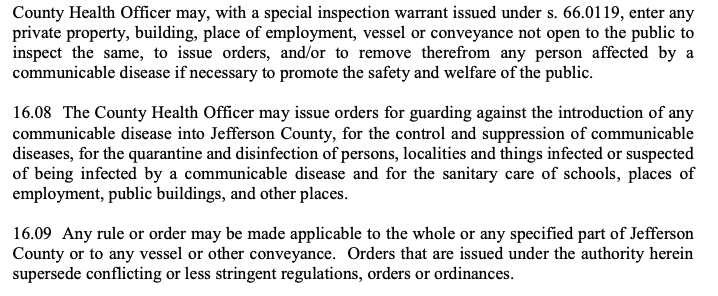
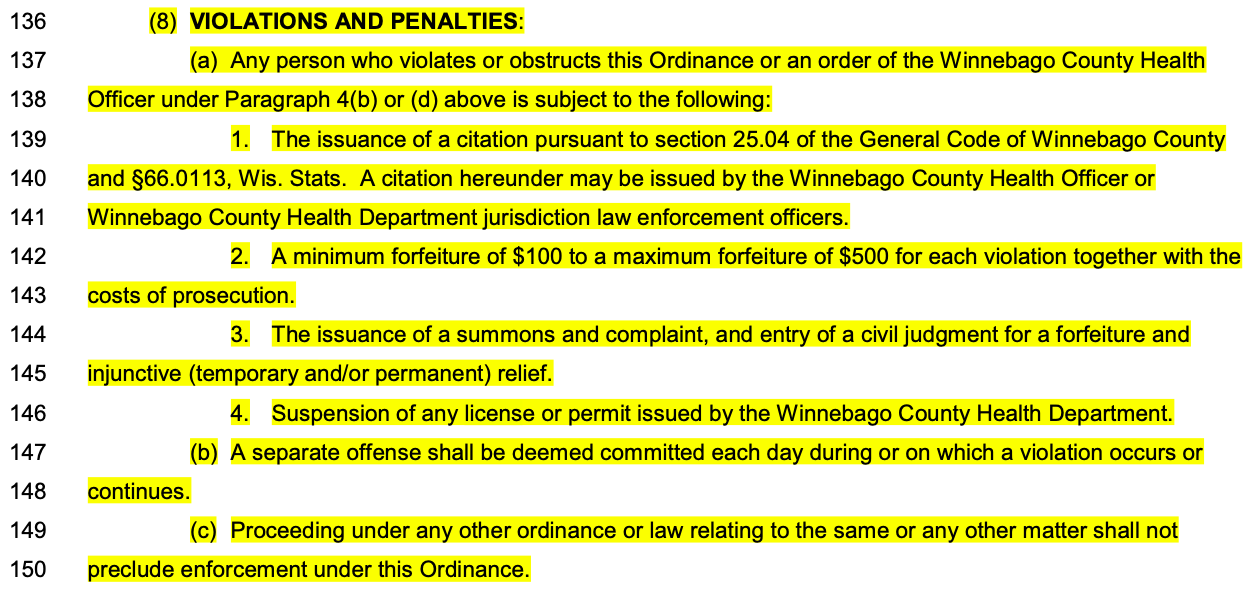
Jefferson County’s Proposed OrdinanceThe Jefferson and Winnebago County ordinances would allow the public health officer, with a special warrant, to “enter any private property, building, place of employment, vessel or conveyance not open to the public” to investigate “the presence” of any communicable disease.
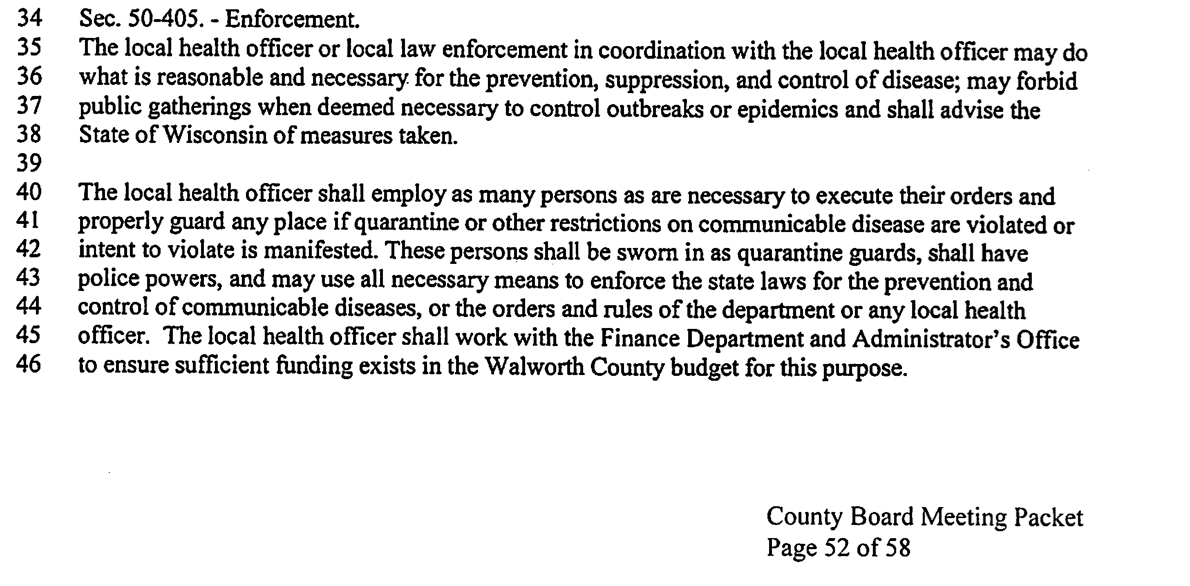
Walworth County’s Proposed OrdinanceOrdinances from Marathon, Walworth, and Oconto Counties explicitly allow public health officials to “employ as many persons as are necessary to execute his or her orders and properly guard any place if quarantine.” Those new employees include “quarantine guards,” non-police officers given police powers to stand watch over an isolation location or individual.
Dodge County references in their ordinance that these powers given to public health officers come from Wis. Stat. Chapter 252, which includes the power to hire quarantine guards. Dodge doesn’t mention quarantine guards by name in their ordinance.
Marathon County’s Proposed Ordinance
The orders don’t say what specifically qualifies as a “place of quarantine.” For all we know, these could be hired security guards standing outside of your home or business.
One Marathon County supervisor actually floated the idea using this broad power to force infected people to wear an ankle bracelet. The idea was not included in their final proposal. According to one source, however, forcing an infected individual to wear an ankle bracelet is already legal if the county corporation counsel issues an injunction and the infected person still refuses to self-quarantine.
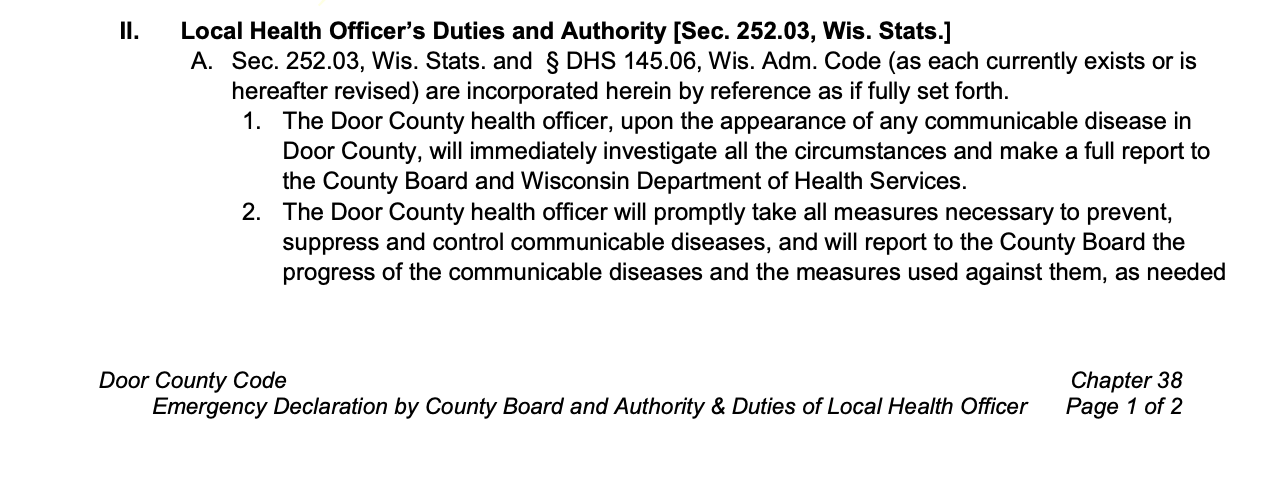
Some ordinances, like Door County’s ordinance, don’t directly say officers can hire quarantine guards. Implementing guards, though, would fall under the “take all measures necessary to prevent, suppress and control communicable diseases” umbrella.
Door County’s Proposed Ordinance“Police powers do not belong with public health administrators,” said state Rep. Cody Horlacher (R-Mukwonago). “Police powers are rightfully delegated to law enforcement officials and that is where those powers should stay.”
All of these ordinances appear to give local health officials unlimited and unchecked spending authority to fight a public health emergency.
All of the proposals would include fines for people who disobey their local health officials. Fines range from a minimum of $25 in Walworth County to a maximum $25,000 per violation in Marathon County.
Winnebago County’s Proposed OrdinanceIn the proposals from Marathon and Winnebago Counties, business owners could have health-related licenses and permits revoked for non-compliance with a health order.
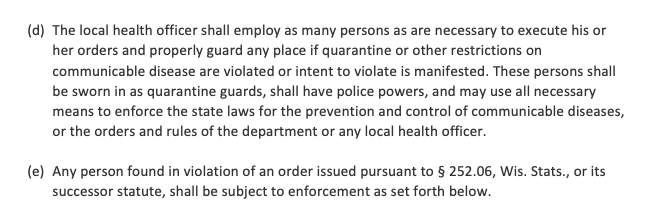
Proposals from Jefferson and Dodge Counties include a prison sentence for violations of the public health order. This idea of criminalizing legal behavior goes against both AG Kaul’s legal advice and against Wisconsin Supreme Court Justice Rebecca Bradley’s position during the State Legislature v. Palm oral arguments.
Dodge County’s Proposed Ordinance. See Section (d) for penalties including imprisonment.“Isn’t it the very definition of tyranny, for one person to order people to be imprisoned for going to work among other ordinarily lawful activities?” Bradley had asked the Evers Administration’s legal counsel. “Where does the Constitution say that’s permissible?”
State Rep. Rick Gundrum (R-Slinger) has weighed in on this same issue. “In the recent supreme court decision, justices stated that an unelected official, like DHS Secretary Designee Andrea Palm, does not have the authority to issue fines and jail sentences. That authority belongs to elected officials.
“It makes even less sense that appointed county health officials should now be granted that authority,” says Gundrum. “Appointed officials should never have more power over our lives than elected officials. “
Some of these local emergency public health ordinances have actually been rejected in a few counties – Marathon, Walworth, Jefferson, and Winnebago County.
Marathon and Jefferson County will send their proposals back to a COVID-19 ordinance working group with the Wisconsin Counties Association (WCA). The group will recommend best practices. The Greater Wausau Chamber of Commerce, Marathon County’s Chamber, opposed the ordinance as written, saying that businesses can’t be weighed down with overburdensome public policy while they’re still recovering from the statewide lockdown.
Walworth County’s proposal was rejected by the public before it was tabled. Winnebago County retracted their proposal and replaced it with a public presentation. … Dodge County’s proposal attracted over 250 people opposed.
State Sen. Dave Craig (R-Town of Vernon) has his own concerns about the proposals. “Local governments chasing their own illegal orders would be an avoidable and unforced error which will result in huge legal fees and no upside for taxpayers,” he said. “The only reason for local officials to pursue these shutdown powers is a naked desire for big-government control over the lives of citizens and businesses. It is wrong, and it is unconstitutional.”
While citizens are concerned about the broad “new” powers these ordinances give to local health officials, the local health officials say the proposals are not giving new authority. The county health officials of Marathon and Winnebago Counties have both said that language in the proposals comes directly from state statute. Wis. Stat. 252.03 and 252.06 give health officials the power to use any means necessary to control diseases. 252.06 allows officials to hire non-police quarantine guards.
Oconto County’s Proposed OrdinanceOn inspection, many of these proposals are written similarly, with the exact same language in some cases. They all cite some of the same statutes, the same abilities of the public health officer. They all cite that unchecked powers are activated when there is the presence of a communicable disease.
All proposals that MacIver has reviewed reference 252.03, some reference 252.06. Some proposals cite the powers that DHS Administrative Rule 145.06 gives to public health officials.
The similarities raise the question, was there a coordinated effort to adopt a master ordinance with broad and sweeping powers all over the state?
Health officials from Marathon and Winnebago Counties have pointed directly to AG Kaul’s legal opinion. They say that his opinion is what caused the counties to write their proposed ordinances.
Dodge County’s Corporation Counsel says they drafted their proposal because Dodge County didn’t have any public health laws on how a health official can address a communicable disease. They claimed Dodge County needed an ordinance after the State Supreme Court ruled on the Palm case. The Counsel admitted that Dodge, like many other counties, had up until then “relied on relevant state statutes” to address diseases.
Other sources have pointed to the WCA. In early March, the Association released a health emergency declaration template, as well as a legal analysis on the powers of local public health officials. On May 14, the WCA released a set of considerations for counties to follow after Safer at Home was invalidated. They encouraged counties to “communicate and, to the extent possible, coordinate local public health efforts and other COVID-19 activities with neighboring counties.”
They believed that a regional approach is preferable to counties working on strategies alone. “WCA encourages counties to schedule regular communication with regional neighbors to consider and share COVID-19 strategies.” Their recommendations did not mention anything about quarantine guards or other sweeping powers that are now being called into question.
Protesters tore down two historic statues outside the Capitol Tuesday evening — one that has come to represent women’s rights and the other honoring an abolitionist — leaving many people wondering what purpose their removal served to advance the Black Lives Matter movement.
The destruction comes amid a national reckoning over police brutality and systemic racism toward Black people following the killing of George Floyd by a Minneapolis cop. Local leaders in other cities have removed statues of Confederate soldiers and other symbols of slavery and racism in recent weeks.
In Madison, a group of several hundred protesters on Tuesday evening took down a replica of “Forward,” an 1893 bronze statue of a woman with her right arm extended. Protesters also decapitated and dragged into Lake Monona a statue representing Hans Christian Heg, a Wisconsin abolitionist who bled out in a Civil War battle. Both statues have since been recovered.
Protesters defended their toppling of the statues, framing their actions as a “strategic” move to force politicians and the public to pay attention to problems and inequities that have persisted for centuries.
But University of Connecticut professor Manisha Sinha, a leading authority on the history of slavery, the Civil War and Reconstruction, called the removal of these particular statues “misguided” because it opens the door for Confederate statue supporters to ask where the line in historical recognition will ever be drawn.
“Taking down statues of people who represent values we want to uphold is not the way to go,” she said. “These were purely disruptive acts.”
Sinha, who has been outspoken in the need to take down statues of white supremacists, said protesters have a right to be angry over racial injustice. The events in Madison, however, indicated to her that protesters were less focused on any symbolism associated with knocking down a particular statue and more interested in channeling their anger over the arrest of a Black activist onto whatever landmark was found within the vicinity.
Mark Elliott, a University of North Carolina-Greensboro historian who studies the Civil War, said most of the Confederate statues coming down in recent years have been hotly debated for decades. Neither of the Madison statues appeared to be symbols of white supremacy, he said, which makes protesters’ overnight removal of them more risky in terms of sustaining momentum for the Black Lives Matter movement.
The danger in that is losing people’s support and having the action be seen as rash instead of as a well-chosen target,” he said.
Part of what spurred the anger and destruction on display Tuesday evening is a refusal by state and local officials to listen to demonstrators’ calls for change, according to protester Ebony Anderson-Carter.
While Anderson-Carter acknowledged the Forward and Heg statues stood for good causes and movements, those in power are not taking that same stand with the Black Lives Matter movement. Having those statues prominently displayed in Madison creates a “false representation of what this city is,” she said.
“I just hope some people realize that sometimes you need to talk to people in a language that only they understand,” Anderson-Carter said. “Stop trying to make us speak to you in your language.”
Protester Micah Le told The Associated Press in a text that the two statues paint a picture of Wisconsin as a racially progressive state when in reality slavery has continued in the form of a corrections system built around incarcerating Black people.
“The fall of the statues is a huge gain for the movement, though I think that liberal and conservative media outlets will try to represent last night as senseless violence rather than the strategic political move it really was,” Le wrote.
Apparently vandalizing a statue representing Wisconsin progressivism and a Civil War hero on the side of the Union (you know, the side 12,000 Wisconsinites died in, the side that opposed slavery) as well as doing at least tens of thousands of dollars of damage to the State Capitol — funded by us taxpayers — is just this morning’s old news. As is the beating by a mob of Sen. Tim Carpenter (D–Madison), who is no one’s idea of a conservative.
I took this pic- it got me assaulted & beat up. Punched/kicked in the head, neck, ribs. Maybe concussion, socked in left eye is little blurry, sore neck & ribs. 8-10 people attacked me. Innocent people are going to get killed. Capitol locked- stuck in office.Stop violence nowPlz!
Meanwhile, what do you suppose this breaking news means?



 Steve Prestegard.com: The Presteblog