Today in 1956, Elvis Presley had his first number one song:
Today in 1965, Ford Motor Co. began offering eight-track tape players in their cars. Since eight-track tape players for home audio weren’t available yet, car owners had to buy eight-track tapes at auto parts stores.
Today in 1970, Vice President Spiro Agnew said in a speech that the youth of America were being “brainwashed into a drug culture” by rock music, movies, books and underground newspapers.
Since the Vikings thumped a 23-year-old Brett Favre and denied the upstart Packers a playoff berth with a 27-7 win in the 1992 season finale, the buildings on the corner of Chicago Ave. and 4th Street have been the site of more harrowing experiences than two Green Bay MVP quarterbacks would care to count.
Favre won four of his last five games against the Vikings in the Metrodome, breaking Dan Marino’s all-time passing TD record in 2007, but went 6-10 in the building while he was the Packers QB, losing nine of his first 11 in its tympanum-ratting environment.
Aaron Rodgers feasted on feeble Vikings defenses during the Metrodome’s final years, and won twice in the Vikings’ two years at TCF Bank Stadium. But his first three trips to U.S. Bank Stadium included three losses — none of which saw the Packers QB throw for more than 216 yards — and one broken collarbone.
The Packers left the building to chants of “Go Pack Go” last December, though, after beating the Vikings to claim their first NFC North title since U.S. Bank Stadium’s opening year. And on a surreal Sunday afternoon, in a building where the Vikings were once able to construct their home-field advantage with the help of sensory overload, Rodgers enjoyed something Favre could have only wished for during all those years: near-total serenity in a 43-34 Packers win.
The 36-year-old quarterback operated his offense in front of only the two teams and just under 500 cardboard cutouts that fans had purchased in the west end zone, with the stadium closed to spectators for at least the first two games of the season.
Rodgers didn’t have to worry about the Vikings’ pass rush, either, with Danielle Hunter on injured reserve for at least three weeks. He wasn’t sacked, was pressured infrequently and had plenty of time overall to test a remade Vikings secondary that was trying to coalesce without the benefit of a preseason.
Sunday’s end result doesn’t figure to define a Vikings team that will be a work in progress this season. But it does represent a jarring opening to the season for a defense that had enjoyed six years of battling Rodgers to a virtual stalemate.
Green Bay hadn’t gained more than 383 yards in a single game against the Vikings; it posted 524 on Sunday, more than any team had gained against a Zimmer-led Vikings team other than the Rams’ 556-yard day in 2018.
The Packers held the ball for more than 40 minutes. Rodgers became just the fifth QB to surpass 350 passing yards against a Zimmer-led defense, with 364 and four touchdowns. And Green Bay’s 43 points (with the help of a safety on a Jaire Alexander sack) were the most the Vikings had allowed since Zimmer took over in 2014.
After the game, Zimmer lamented mistakes, lack of pressure from the defensive line and a handful of false-start penalties on third and short.
“We didn’t cover them very good,” he said.
Rodgers spent much of the day looking for Pro Bowl receiver Davante Adams, who caught 14 passes for 156 yards and two scores, but tested the Vikings’ young corners with deep shots to Marquez Valdes-Scantling, who caught four passes for 96 yards and dropped another deep ball from Rodgers.
“It’s frustrating,” safety Harrison Smith said. “It’s not what we’re used to here.”
After Kirk Cousins threw behind Adam Thielen for an interception in the final minute of the first half, Valdes-Scantling got a step on rookie cornerback Cameron Dantzler hauling in a 45-yard touchdown from Rodgers to give Green Bay a 22-7 lead.
The lead grew to 29-10 entering the fourth quarter, when Cousins connected with Thielen for a 37-yard touchdown with 13:53 left in the game. The Vikings scored three fourth-quarter touchdowns, but could not keep the Packers out of the end zone to complete a comeback.
The fourth-quarter surge helped Cousins amass 259 yards on 19 of 25 passing, but in the first half had only five passing attempts, completing three.
The Vikings had the ball for only 7 minutes 15 seconds in the first half, and the Packers dominated time of possession overall, 41:16-18:44.
“We didn’t have the ball. We didn’t control the ball,” Zimmer said.
A day after signing a lucrative contract extension, Dalvin Cook rushed for 50 yards and two touchdowns in 12 carries.
Let’s see, $63 million divided by five years divided by 16 games equals $787,500 per regular-season game. That is $15,750 per yard Sunday.
The Strib’s Chip Scoggins:
The Vikings approached their 2020 season with a palpable sense of optimism about their offense and their rebuilt defense.
Yeah, good talk.
Green Bay 43, Vikings 34.
It was a lot worse than the final score might suggest.
Mike Zimmer’s defense had a disastrous debut, and the offense didn’t do much of anything until garbage time before 70,000 empty seats at U.S. Bank Stadium.
Based on first impressions, Zimmer has a lot of work on his hands to make that statement hold up. His defense’s performance was beyond bad Sunday. The Vikings had no chance against Aaron Rodgers who made it look easy in dissecting Zimmer’s young secondary.
The Vikings gave up big pass plays. They had trouble containing the run. They got zero pressure on Rodgers without injured Danielle Hunter. And they had two offsides penalties on third down that gave the Packets a fresh set of downs.
The whole thing was a mess.
Here are three things that caught my eye …
Sloppy tackling
The Vikings missed two tackles on the Packers opening drive and more after that, which highlighted the lack of preseason games. Teams rarely tackle in training camp so that area figured to be a little sloppy early in the season.
Offense sleepy until late
Kirk Cousins and the offense made some plays in the fourth quarter, but it was too little too late. The offense couldn’t sustain anything in the first half, causing the time of possession to become lopsided in favor of Green Bay.
Weird play call
Vikings offense coordinator Gary Kubiak had a strange play call at a key moment in the second half. Trailing 22-10 late in the third quarter, the Vikings faced fourth-and-3 at the Packers’ 39. After a timeout, Cousins threw a deep pass down the sideline to Tajae Sharpe, their No. 4 wide receiver.
Vikings coach Mike Zimmer told the NFL Network last month that he’s “never had a bad defense.” Well, he’s got some work to do now.
In Sunday’s season opener at U.S. Bank Stadium, Green Bay shredded the Vikings’ once-vaunted defense to win 43-34. It was the most points ever scored against a Zimmer team in his seven seasons as Vikings’ head coach. The previous most came in the Packers’ 42-10 rout in 2014 at Lambeau Field.
With no fans allowed inside the stadium because of the coronavirus pandemic, it made for an eerie atmosphere. The Vikings did have one very impressive defensive showing on a goal-line stand early in the second quarter, when they led 7-3, but there were no fans to urge them on and perhaps shift momentum.
A few plays later, after the Vikings took possession of the ball at their own 1-yard line, Packers cornerback Jaire Alexander tackled quarterback Kirk Cousins in the end zone for a safety and they reeled off 19 straight points for a 22-7. The Vikings did get within 22-10 at halftime, but the second half provided few worries for the Packers.
Vikings coach Mike Zimmer likely did not recognize his team as the normally strong defense looked absolutely atrocious. Nobody expected this defense to be great from Day 1, considering all the changes it has undergone, but the Vikings were a mess on that side of the ball. Some thoughts and observations from the Vikings’ 43-34 loss to the Packers.
The 43 points against were the most a Zimmer-coached defense has given up since he took the job in 2014. The Packers had the previous high of 42 against the Vikings on Oct. 2, 2014 at Lambeau Field. That was Zimmer’s first season, this is his seventh and these were all of his guys.
The Vikings gave up 522 yards (364 passing, 158 rushing), the second-most by a Zimmer-coached defense in Minnesota behind the 556 yards (456 passing, 100 rushing) the Rams accumulated in a 38-31 victory on Sept. 27, 2018 in Los Angeles.
Jeff Gladney, the Vikings’ second first-round pick in April, was not part of the cornerback rotation that had Mike Hughes and Holton Hill starting and Cameron Dantzler outside, with Hughes going inside, in the nickel. Either Gladney really disappointed Zimmer in training camp or the Vikings still have concerns about the meniscus surgery he had in the spring.
That rotation of corners all got picked on by Packers quarterback Aaron Rodgers at different times and looked awful. Rodgers looked like the Rodgers of old — in part because the Vikings defense looked like it did before Zimmer arrived — and completed 32 of 44 passes for 364 yards and four touchdowns. Wide receiver Davante Adams had 14 receptions, on 17 targets, for 156 yards and two touchdowns.
It should come as no surprise that the Vikings had issues protecting quarterback Kirk Cousins and in the third quarter the veteran decided to do something about it. On back-to-back plays, he ran for 16 and 14 yard gains. Cousins talked about using his feet more often this season and on those two plays he did exactly that.
Cousins threw his first pick of the season late in the second quarter on a poorly thrown ball behind Adam Thielen that cornerback Jaire Alexander picked off at the Vikings 45-yard line. That led to this …
The Packers took a 22-7 lead with 21 seconds left in the quarter on a 45-yard TD pass from Rodgers to Marquez Valdes-Scantling. Dantzler was running stride-for-stride with Valdes-Scantling but Rodgers made a perfect throw to the front corner of the end zone and Dantzler is, well, a rookie.
Valdes-Scantling also caught a 39-yard pass from Rodgers on a third-quarter play in which Hughes was beaten. That put the ball at the 1-yard line and Rodgers threw a touchdown pass to Adams to give Green Bay a 29-10 lead.
The key point in this game might have come in the second quarter when the Vikings defense stopped the Packers on fourth-and-goal from the Minnesota 1. The Vikings led 7-3 and had a chance to grab any momentum that might have existed. But that didn’t last long as Cousins was sacked on a corner blitz by Alexander for a safety. The Packers got a 43-yard field goal from Mason Crosby on the ensuing drive to take a one-point lead.
The Vikings scored three meaningless touchdowns in the fourth quarter. Cousins found Thielen for a 37-yard touchdown to make it 29-18, Cook scored on a 3-yard run to make it 36-26 and Thielen caught another scoring pass, this one from 19 yards, to make it 43-34. All three Vikings touchdowns followed Packers scores.
Wide receiver Justin Jefferson, the Vikings’ first pick in the first round in April, caught his first NFL pass in the third quarter, gaining 9 yards on third-and-16. Jefferson finished with two catches for 26 yards.
The Vikings had an issue with missed tackles, beginning early with Dantzler and linebacker Eric Wilson both failing to wrap up Packers. You would expect an NFL player to be able to tackle, but even during an ordinary season tackling can be suspect early on. In this case, with no preseason games and limited practice time, the tackling was worse than usual. Zimmer won’t be happy but it couldn’t be considered a complete surprise.
It was a given the Vikings would lose a significant home-field advantage with no fans in U.S. Bank Stadium. The question was how much? It turned out to be huge. One of the NFL’s best rivalries had the feeling that it was a youth football game being played on a Saturday morning and at least those games have parents in attendance. The piped in noise was barely noticeable, and the Packers’ offense had zero issues operating.
Ask the Milwaukee Bucks what not playing at home and in the “bubble” instead meant.
No one other than the shooter is responsible for the gunfire ambush Saturday of two Los Angeles County sheriff’s deputies as they sat in their patrol car. But the same can’t be said for the protesters who blocked the entrance to the hospital where the two are being treated, and chanted “we hope they die.” The latter is a cultural poison nurtured by the left-wing anti-police movement sweeping the country.
The two deputies were “ambushed by a gunman in a cowardly fashion” in the Compton neighborhood, said Sheriff Alex Villaneuva at a press conference. The deputies hadn’t been identified by name as we write this, but press reports say one is a 31-year-old mother and the other a 24-year-old man. Both have been with the department a little more than a year.
Police haven’t identified a suspect, but the randomness of the ambush suggests someone looking for any available police target. We’ve seen this before when anti-police fever is hot. A gunman shot and killed two officers in their car in New York in 2014 following the death of black suspects being arrested in Ferguson, Mo., and New York.
The protests are worse this year following the death of George Floyd in Minneapolis, and the anti-police violence is more widespread. An officer was stabbed in the neck in Flatbush in New York City in an ambush in June. The officer survived.
Democratic mayor Eric Garcetti called the chants and protests at the hospital “unacceptable” and “abhorrent,” but he and other Democrats need to do more to condemn and ostracize these protesters. Democrats may fear the wrath of Black Lives Matter, but the backlash elsewhere in America will be far greater if pleasure at cop killing becomes common on the left.
Policing reform is impossible amid a war on police. Mr. Garcetti and other mayors should abandon their cuts to law-enforcement budgets and express regular solidarity for cops on the beat. Without such a signal, police will continue to retreat from enforcing the law in crime-ridden neighborhoods, and those who suffer most will be the law-abiding in the likes of Compton and Flatbush.
The sports industry now has a negative image, on balance, among Americans as a whole, with 30% viewing it positively and 40% negatively, for a -10 net-positive score. This contrasts with the +20 net positive image it enjoyed in 2019, when 45% viewed it positively and 25% negatively.
This slide in the sports industry’s image comes as professional and college leagues are struggling, and not always successfully, to maintain regular schedules and playing seasons amid the pandemic. Professional football, baseball and basketball games have also become focal points for public displays of support for the Black Lives Matter movement.
While it’s not clear how much the various challenges and controversies swirling around the industry are each responsible for its slide in popularity, it is notable that sports has lost more support from Republicans and independents than from Democrats. In fact, Democrats’ view of the sports industry has not changed significantly in the past year, while Republicans’ has slipped from a +11 net-positive score in 2019 to a net -35 today, and independents’ from +26 to -10.
The sports industry’s image has also deteriorated more among women than men, and among older adults than those younger than 35. Sports has also lost more support from non-White than White Americans, but given the extraordinarily high ratings from non-White adults a year ago, this group continues to view the sports industry positively on balance today. That is not the case with White adults, who now view the sports industry more negatively than positively, and by a 22-point margin.
Here’s a graphic:
That is remarkable. Sports used to be a unifying phenomenon in American life, but no more — not since athletes got woke.
I can’t find the crosstabs for Gallup’s results about the media and the entertainment industry, but we know from other polls that conservatives feel quite negatively about them.
Look what the Madden video game announced yesterday:
Colin Kaepernick can’t get a job on a professional football team, but he has been affirmative-actioned into virtual football by the woke capitalists at Madden. Insane.
What does it portend for American life to have so many millions of Americans alienated from pop culture institutions (sport, entertainment, media)? Sports, of course, is the big one, because sports never before was politically charged. Now it is. The NFL season is going to be the big one. If conservatives and independents turn off the TV because they don’t want to be preached at by woke football players, it will signal a sea change in American life.
Today in Great Britain in the first half of the 1960s was a day for oddities.
Today in 1960, a campaign began to ban the Ray Peterson song “Tell Laura I Love Her” (previously mentioned here) on the grounds that it was likely to inspire a “glorious death cult” among teens. (The song was about a love-smitten boy who decides to enter a car race to earn money to buy a wedding ring for her girlfriend. To sum up, that was his first and last race.)
The anti-“Tell Laura” campaign apparently was not based on improving traffic safety. We conclude this from the fact that three years later, Graham Nash of the Hollies leaned against a van door at 40 mph after a performance in Scotland to determine if the door was locked. Nash determined it wasn’t locked on the way to the pavement.
Sept. 11, 2001 started out as a beautiful day, in Wisconsin, New York City and Washington, D.C.
I remember almost everything about the entire day. Sept. 11, 2001 is to my generation what Nov. 22, 1963 was to my parents and Dec. 7, 1941 was to my grandparents.
I had dropped off our oldest son, Michael, at Ripon Children’s Learning Center. As I was coming out, the mother of one of Michael’s group told me to find a good radio station; she had heard as she was getting out with her son that a plane had hit the World Trade Center.
I got in my car and turned it on in time to hear, seemingly live, a plane hit the WTC. But it wasn’t the first plane, it was the second plane hitting the other tower.
As you can imagine, my drive to Fond du Lac took unusually long that day. I tried to call Jannan, who was working at Ripon College, but she didn’t answer because she was in a meeting. I had been at Marian University as their PR director for just a couple months, so I didn’t know for sure who the media might want to talk to, but once I got there I found a couple professors and called KFIZ and WFDL in Fond du Lac and set up live interviews.
The entire day was like reading a novel, except that there was no novel to put down and no nightmare from which to wake up. A third plane hit the Pentagon? A fourth plane crashed somewhere else? The government was grounding every plane in the country and closing every airport?
I had a TV in my office, and later that morning I heard that one of the towers had collapsed. So as I was talking to Jannan on the phone, NBC showed a tower collapsing, and I assumed that was video of the first tower collapse. But it wasn’t; it was the second tower collapse, and that was the second time that replay-but-it’s-not thing had happened that day.
Marian’s president and my boss (a native of a Queens neighborhood who grew up with many firefighter and police officer families, and who by the way had a personality similar to Rudy Giuliani) had a brief discussion about whether or not to cancel afternoon or evening classes, but they decided (correctly) to hold classes as scheduled. The obvious reasons were (1) that we had more than 1,000 students on campus, and what were they going to do if they didn’t have classes, and (2) it was certainly more appropriate to have our professors leading a discussion over what had happened than anything else that could have been done.
I was at Marian until after 7 p.m. I’m sure Marian had a memorial service, but I don’t remember it. While I was in Fond du Lac, our church was having a memorial service with our new rector (who hadn’t officially started yet) and our interim priest. I was in a long line at a gas station, getting gas because the yellow low fuel light on my car was on, not because of panic over gas prices, although I recall that one Fond du Lac gas station had increased their prices that day to the ridiculous $2.299 per gallon. (I think my gas was around $1.50 a gallon that day.)
Two things I remember about that specific day: It was an absolutely spectacular day. But when the sun set, it seemed really, really dark, as if there was no light at all outside, from stars, streetlights or anything else.
For the next few days, since Michael was at the TV-watching age, we would watch the ongoing 9/11 coverage in our kitchen while Michael was watching the 1-year-old-appropriate stuff or videos in our living room. That Sunday, one of the people who was at church was Adrian Karsten of ESPN. He was supposed to be at a football game working for ESPN, of course, but there was no college football Saturday (though high school football was played that Friday night), and there was no NFL football Sunday. Our organist played “God Bless America” after Mass, and I recall Adrian clapping with tears down his face; I believe he knew some people who had died or been injured.
Later that day was Marian’s Heritage Festival of the Arts. We had record attendance since there was nothing going on, it was another beautiful day, and I’m guessing after five consecutive days of nonstop 9/11 coverage, people wanted to get out of their houses.
In the 19 years since then, a comment of New York City Mayor Rudy Giuliani has stuck in my head. He was asked a year or so later whether the U.S. was more or less safe since 9/11, and I believe his answer was that we were more safe because we knew more than on Sept. 10, 2001. That and the fact that we haven’t been subject to another major terrorist attack since then is the good news.
Osama bin Laden (who I hope is enjoying Na’ar, Islam’s hell) and others in Al Qaeda apparently thought that the U.S. (despite the fact that citizens from more than 90 countries died on 9/11) would be intimidated by the 9/11 attacks and cower on this side of the Atlantic Ocean, allowing Al Qaeda to operate with impunity in the Middle East and elsewhere. (Bin Laden is no longer available for comment.) If you asked an American who paid even the slightest attention to world affairs where a terrorist attack would be most likely before 9/11, that American would have replied either “New York,” the world’s financial capital, or “Washington,” the center of the government that dominates the free world. A terrorist attack farther into the U.S., even in a much smaller area than New York or Washington, would have delivered a more chilling message, that nowhere in the U.S. was safe. Al Qaeda didn’t think to do that, or couldn’t do that. The rest of the Middle East also did not turn on the U.S. or on Israel (more so than already is the case with Israel), as bin Laden apparently expected.
The bad news is all of the other changes that have taken place that are not for the better. Bloomberg Businessweek asks:
So was it worth it? Has the money spent by the U.S. to protect itself from terrorism been a sound investment? If the benchmark is the absence of another attack on the American homeland, then the answer is indisputably yes. For the first few years after Sept. 11, there was political near-unanimity that this was all that mattered. In 2005, after the bombings of the London subway system, President Bush sought to reassure Americans by declaring that “we’re spending unprecedented resources to protect our nation.” Any expenditure in the name of fighting terrorism was justified.
A decade later, though, it’s clear this approach is no longer sustainable. Even if the U.S. is a safer nation than it was on Sept. 11, it’s a stretch to say that it’s a stronger one. And in retrospect, the threat posed by terrorism may have been significantly less daunting than Western publics and policymakers imagined it to be. …
Politicians and pundits frequently said that al Qaeda posed an “existential threat” to the U.S. But governments can’t defend against existential threats—they can only overspend against them. And national intelligence was very late in understanding al Qaeda’s true capabilities. At its peak, al Qaeda’s ranks of hardened operatives numbered in the low hundreds—and that was before the U.S. and its allies launched a global military campaign to dismantle the network. “We made some bad assumptions right after Sept. 11 that shaped how we approached the war on terror,” says Brian Fishman, a counterterrorism research fellow at the New America Foundation. “We thought al Qaeda would run over the Middle East—they were going to take over governments and control armies. In hindsight, it’s clear that was never going to be the case. Al Qaeda was not as good as we gave them credit for.”
Yet for a decade, the government’s approach to counterterrorism has been premised in part on the idea that not only would al Qaeda attack inside the U.S. again, but its next strike would be even bigger—possibly involving unconventional weapons or even a nuclear bomb. Washington has appropriated tens of billions trying to protect against every conceivable kind of attack, no matter the scale or likelihood. To cite one example, the U.S. spends $1 billion a year to defend against domestic attacks involving improvised-explosive devices, the makeshift bombs favored by insurgents in Afghanistan. “In hindsight, the idea that post-Sept. 11 terrorism was different from pre-9/11 terrorism was wrong,” says Brian A. Jackson, a senior physical scientist at RAND. “If you honestly believed the followup to 9/11 would be a nuclear weapon, then for intellectual consistency you had to say, ‘We’ve got to prevent everything.’ We pushed for perfection, and in counterterrorism, that runs up the tab pretty fast.”
Nowhere has that profligacy been more evident than in the area of homeland security. “Things done in haste are not done particularly well,” says Jackson. As Daveed Gartenstein-Ross writes in his new book, Bin Laden’s Legacy, the creation of a homeland security apparatus has been marked by waste, bureaucracy, and cost overruns. Gartenstein-Ross cites the Transportation Security Agency’s rush to hire 60,000 airport screeners after Sept. 11, which was originally budgeted at $104 million; in the end it cost the government $867 million. The homeland security budget has also proved to be a pork barrel bonanza: In perhaps the most egregious example, the Kentucky Charitable Gaming Dept. received $36,000 to prevent terrorists from raising money at bingo halls. “If you look at the past decade and what it’s cost us, I’d say the rate of return on investment has been poor,” Gartenstein-Ross says.
Of course, much of that analysis has the 20/20 vision of hindsight. It is interesting to note as well that, for all the campaign rhetoric from candidate Barack Obama that we needed to change our foreign policy approach, president Obama changed almost nothing, including our Afghanistan and Iraq involvements. It is also interesting to note that the supposed change away from President George W. Bush’s us-or-them foreign policy approach hasn’t changed the world’s view, including particularly the Middle East’s view, of the U.S. Someone years from now will have to determine whether homeland security, military and intelligence improvements prevented Al Qaeda from another 9/11 attack, or if Al Qaeda wasn’t capable of more than just one 9/11-style U.S. attack.
Hindsight makes one realize how much of the 9/11 attacks could have been prevented or at least their worst effects lessened. One year after 9/11, the New York Times book 102 Minutes: The Untold Story of the Fight to Survive Inside the Twin Towers points out that eight years after the 1993 World Trade Center bombing, New York City firefighters and police officers still could not communicate with each other, which led to most of the police and fire deaths in the WTC collapses. Even worse, the book revealed that the buildings did not meet New York City fire codes when they were designed because they didn’t have to, since they were under the jurisdiction of the Port Authority of New York and New Jersey. And more than one account shows that, had certain people at the FBI and elsewhere been listened to by their bosses, the 9/11 attacks wouldn’t have caught our intelligence community dumbfounded. (It does not speak well of our government to note that no one appears to have paid any kind of political price for the 9/11 attacks.)
I think, as Bloomberg BusinessWeek argued, our approach to homeland security (a term I loathe) has overdone much and missed other threats. Our approach to airline security — which really seems like the old error of generals’ fighting the previous war — has made air travel worse but not safer. (Unless you truly believe that 84-year-old women and babies are terrorist threats.) The incontrovertible fact is that every 9/11 hijacker fit into one gender, one ethnic group and a similar age range. Only two reasons exist to not profile airline travelers — political correctness and the assumption that anyone is capable of hijacking an airplane, killing the pilots and flying it into a skyscraper or important national building. Meanwhile, while the U.S. spends about $1 billion each year trying to prevent Improvised Explosive Device attacks, what is this country doing about something that would be even more disruptive, yet potentially easier to do — an Electromagnetic Pulse attack, which would fry every computer within the range of the device?
We have at least started to take steps like drilling our own continent’s oil and developing every potential source of electric power, ecofriendly or not, to make us less dependent on Middle East oil. (The Middle East, by the way, supplies only one-fourth of our imported oil. We can become less dependent on Middle East oil; we cannot become less dependent on energy.) But the government’s response to 9/11 has followed like B follows A the approach our culture has taken to risk of any sort, as if covering ourselves in bubblewrap, or even better cowering in our homes, will make the bogeyman go away. Are we really safer because of the Patriot Act?
American politics was quite nasty in the 1990s. For a brief while after 9/11, we had impossible-to-imagine moments like this:
And then within the following year, the political beatings resumed. Bush’s statement, “I ask your continued participation and confidence in the American economy,” was deliberately misconstrued as Bush saying that Americans should go out and shop. Americans were exhorted to sacrifice for a war unlike any war we’ve ever faced by those who wouldn’t have to deal with the sacrifices of, for instance, gas prices far beyond $5 per gallon, or mandatory national service (a bad idea that rears its ugly head in times of anything approaching national crisis), or substantially higher taxes.
Then again, none of this should be a surprise. Other parts of the world hate Americans because we are more economically and politically free than most of the world. We have graduated from using those of different skin color from the majority as slaves, and we have progressed beyond assigning different societal rights to each gender. We tolerate different political views and religions. To the extent the 9/11 masterminds could be considered Muslims at all, they supported — and radical Muslims support — none of the values that are based on our certain inalienable rights. The war between our world, flawed though it is, and a world based on sharia law is a war we had better win.
In one important sense, 9/11 changed us less than it revealed us. America can be both deeply flawed and a special place, because human beings are both deeply flawed and nonetheless special in God’s eyes. Jesus Christ is quoted in Luke 12:48 as saying that “to whomsoever much is given, of him shall be much required.” As much as Americans don’t want to be the policeman of the world, or the nation most responsible for protecting freedom worldwide, there it is.
Readers know I have been, shall we say, skeptical about the C8 Corvette, a mid-engine design GM is unfamiliar with, which lacks a proper (manual) transmission and is grossly overpriced.
A quarter-century ago, though, GM had an idea for the Corvette that would have been bigger, in one sense, than anything in the C8. R&T (the upgraded Road & Track, or something) tells the story:
The original Dodge Viper was a game-changer. With its outrageous proportions and massive 8.0-liter V-10 engine, it outclassed pretty much anything else out of Detroit at the time. Except maybe this one-off V-12-powered Corvette.
Chevy built this experimental Corvette in the early Nineties as its answer to the Viper, and it’s a beast. Called the ZR-12, it uses the C4-generation ZR-1 as a base. The entire nose was stretched to accommodate the 600 cubic-inch V-12, built by Ryan Falconer Racing Engines. The all-aluminum engine was rated at 686 hp and 680 lb-ft of torque when new—far more than the then-new Viper’s output of 400 horsepower and 450 lb-ft of torque.
Of course, the ZR-12 never made it to production. The sole example languished at GM’s Heritage center for a number of years before being moved to the Corvette Museum, where it currently resides, according to LSX Magazine. The car used to have side-pipes and a different set of wheels, but has since been converted into a more subtle specification.
The DtRockstar1 YouTube channel was lucky enough to get insider access to the Museum while the ZR-12 was started and driven around, giving us a chance to listen to the unique engine note (above). Unsurprisingly, it doesn’t sound like your average Corvette.
This was far from GM’s first attempt at a V-12. Cadillac had one in the 1930s, along with a V-16. In World War II Rolls–Royce’s Merlin and the Allison V-1710 powered planes. Packard’s V-12 was placed (three each) in PT boats.
Each bank of a V12 engine essentially functions as a straight-six engine, which by itself has perfect primary and secondary engine balance. By using the correct V-angle, a V12 engine can therefore have perfect balance. The even firing order for a four-stroke V12 engine has an interval of 60 degrees, therefore a V12 engine can be perfectly balanced if a V-angle of 60 degrees, 120 degrees or 180 degrees is used. Many V12 engines use a V-angle of 60 degrees between the two banks of cylinders. …
At any given time, three of the cylinders in a V12 engine are in their power stroke, which increases the smoothness of the power delivery by eliminating gaps between power pulses.
The weirdest V-12, perhaps, was GMC’s, and I have seen an example of one reported by Driving.ca:
When you think of a V12 engine, your mind runs immediately to the high-tech, rev-happy, screamers made by Ferrari and Lamborghini. But did you know that between 1960 and 1965 GMC made a V12 of their own? And it was the size of two Ferrari 599 V12s combined.
It’s outrageous now to think of a gasoline-powered semi-truck but, in the 1960s when fuel was cheaper, a sizeable percentage of operators preferred gasoline power. Chevrolet offered a heavy-duty version of its famous 427 V8 to truck operators, but GMC knew they could do one better. They needed an engine with cubic inches, and lots of them. So they took the basic design from their 5.7L V6 and made a monstrous 11.5L V12.
This was not just two V6s bolted or welded together. The V12 had its own block, cam, a special oil pan that held 15L of oil, and a special crankshaft that weighed 82 kilograms. The engine was an absolute monolith. It was 1.3 metres long and weighed more than 680 kg fully assembled. Due to its inherent weight and girth, it wasn’t an engine you could simply bolt into a Chevy C10 pickup and drive around in. It was installed in full-on semi-trucks, and also as standalone power units for irrigation. It was never installed into a passenger car or truck by GMC, but many hot-rodders have shoved it into service for hot rods, and custom pickup-trucks.
For all its size and displacement, the V12 wasn’t a horsepower king, it was made for torque. It made just 275 hp at 2,400 rpm but produced a freight-train-like 625-lb.-ft. of torque at just 2,100 rpm. If those numbers aren’t enough for you, a Florida-based shop called Thunder V12 will happily sell you a rebuilt one in any specification from bone stock to tractor-pull stormer. Prices start at US$10,800 for a complete engine, so get your chequebook ready. Beat-up originals can be found on eBay for around $5,000, but buyer beware as no more spare parts are being made for these beasts.
The GMC V12 was made between 1960 and 1965 and, in that time, they made about 5,000 of them. Nobody’s sure quite how many are left but most guess that there can’t be any more than 1,500 in semi-serviceable condition. After the big V12 ran out of production the writing was on the wall for gasoline-powered trucks. At 11.5L it remains one of the largest gas engines that ever powered a road vehicle, and we’ll never see a dinosaur like it again.
Sure, you’ve got a V8 in your Chevy, but you could’ve had a V12.
At least now you can.
A new Australian outfit called V12LS has created a 12-cylinder version of the venerable General Motors LS1 V8 and is putting it on sale.
The company started out by taking two LS blocks, lopping off a couple of cylinders and melding them together to create a V12, but has now developed its own single cast block that is compatible with many LS parts. The last time GM made its own V12 was the GMC “twin six” truck engine in 1966.
V12LS is currently offering a 9.0-liter crate engine with an iron block good for 717 hp for $35,000, but is working on an aluminum version. Various kits in different states of dress run from $21,300 for a basic builder package to a dyno-tested turnkey engine for $46,200.
Those prices include shipping to the USA.
For that matter, while GMC was producing V-12s, Cadillac was contemplating a V-12 for its new front-drive Eldorado personal luxury car. Caddy never built a V-12 Eldorado, but Popular Mechanics reported in 1988 that since BMW was developing a V-12, other luxury carmakers would, including Cadillac.
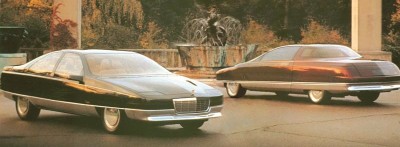
Cadillac worked to develop a V-12 with Lotus for its Solitaire concept car, the two-door version of its Voyagé concept car.
The Voyagé (left), which looked similar to the 1991 Chevy Caprice, Buick Roadmaster and Cadillac Fleetwood, had a mere V-8, while the Solitaire had a proposed V-12 with 436 horsepower.
As an aficionado of big coupes, as you know, I would definitely drive that.
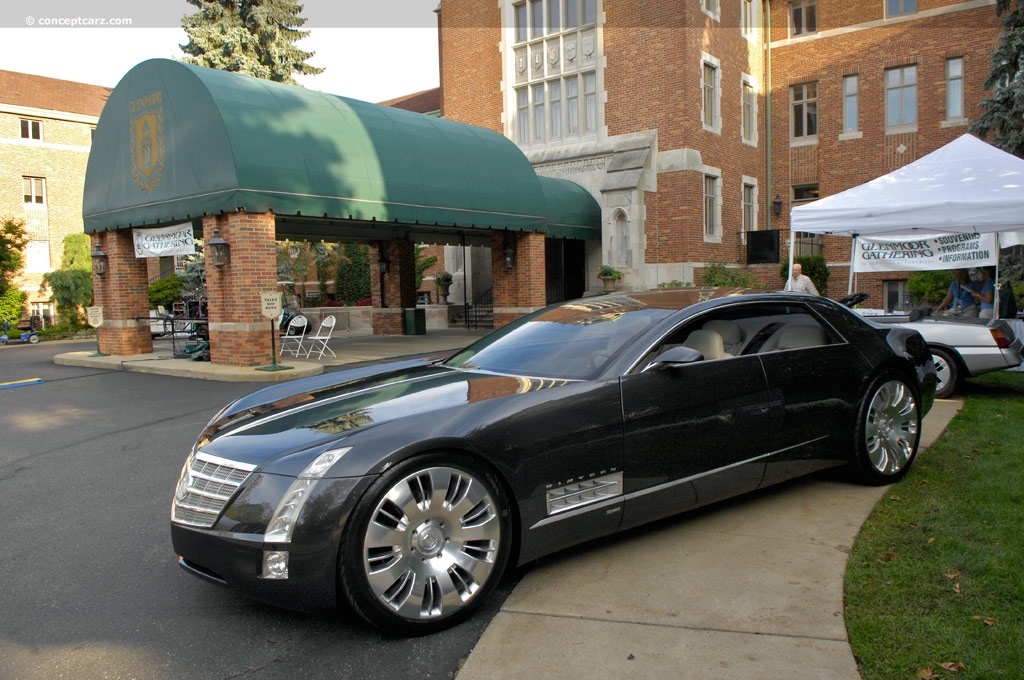
Not to be outdone, Cadillac proposed in 2003 the Sixteen, powered by, of course, a V-16.
“Would you like to drive our 13.6-liter/1000-horsepower V-16 sedan?” asked GM’s Jeff Holland. Even though we knew there’d be extra-sticky driving rules and caveats regarding the $2 million concept’s mechanical polish, there was only one possible answer: “Duh.” Next thing we knew, we were piloting Caddy’s sexy showstopper around GM’s Milford, Michigan, Proving Ground. The Sixteen has been literally the biggest thing to roll onto the auto-show circuit this season. Bob Lutz, GM’s vice chairman of product development and chairman of GM North America, says it’s “a modern interpretation of everything that made Cadillac the standard of the world.” But is it merely a lavish reminder of a once-glorious past or a relevant vision of the future? Enough scene-setting. What’s it like to drive almost 19 feet and 16 cylinders of handbuilt concept car?
Remarkably sweet. Entering the Sixteen requires punching a button on the key fob or lightly squeezing a microswitch inside the top of the front door. There are no door handles to clutter the Sixteen’s lyrically curving body sides. Once inside, you’re surrounded by the rich scent of fine leather, glints from polished walnut and aluminum, and thick carpets–woven of silk, no less.
The driver’s leather bucket is large, soft, and gently contoured. It power-adjusts to a comfortable position, surprising given the lack of ergonomic work that usually goes into a turntable toy. Likewise, the leather and polished-wood steering wheel can be powered into a just-right spot, which lets you easily read the speedo/tachometer gauge in the center of the dash.
To start, step on the brake pedal and push a green button to the right of the wheel. You’ll hear a strange, aircraft-style starter whine, then the mammoth V-16 erupts in a raggedy roar that quickly settles down to a somewhat bumpy idle (virtually no tuning was done on the powertrain’s five engine mounts). As the engine starts, the instruments–including the clock–cycle and sweep their needles to calibrate themselves, emitting odd ticking and ratcheting clicks.
From inside the cabin, the engine’s sound is neither the jungle murmur of a Mercedes-Benz SL55 AMG nor the near-silent thrum of a Bentley or Rolls. It’s slightly rowdy and clearly coming from something in large displacement, particularly as you blip the throttle. Asked if they’d done any exhaust tuning, one powertrain engineer shrugs and says, “Well, we had four mufflers, and we threw two away.”
Ease into the throttle, and the car moves with a quickness that belies its mass and size. The automatic transmission has four gears, but we feel only two shift surges during our drive. This huge sedan glides precisely, with a catlike balance that puts us at ease. The steering feels light, and the car drives smaller than it looks. Give it more gas, and the result is a Mississippi River’s worth of torque that surges the car forward. We back off to listen for crunching, grinding, or banging. Nothing–impressive for a machine whose primary purpose is to dazzle a show crowd. The Sixteen’s ride is a bit jiggly, which doesn’t say anything positive about the suspension, since the pavement is billiard-table smooth.
The brakes don’t feel up to the engine’s grunt. Despite six-piston calipers and 16-inch rotors, not much happens when the brake pedal is depressed. Perhaps that’s because the master cylinder is remote-mounted in the trunk and operated via a tangle of electronics. We remember that our GM support crew warned us about “green” brake pads.
There isn’t much turnaround room for us at the end of one particular Proving Ground road, but four-wheel steering comes to the rescue. Turning in opposite phase to the front wheels at low speeds, the rear wheels tighten the car’s long turning circle to approximately that of a midsize sedan.
The Sixteen isn’t as polished as a production car; understandable, as that’s not its mission. But it’s easily the most refined concept car we’ve driven, which further teases us about what sort of production potential it, or some of its componentry, might have. The car’s design represents an updated, and somewhat more elegant, variation on Cadillac’s crisp-edged design language; perhaps some of the Sixteen’s themes will show up on the upcoming Seville/STS and the next-generation DeVille.
Does anyone need 16 cylinders or 1000 horsepower? No. But the idea–like the engine itself–sounds simply wondrous.
Of course it does.
Back to the original premise: What about a V-12 Corvette?
Remember that this was right after Chevrolet debuted the King of the Road, a Corvette with a double-overhead-cam 32-valve-per-cylinder V-8 designed by Lotus and built by Mercury Marine in Stillwater, Okla.
Given GM’s history with the Northstar V-8 — an unfamiliar engine design (also DOHC, built for Cadillacs and Oldsmobiles) that became notorious for head gasket (actually head bolt) failures, which result in antifreeze in the cylinder walls and engine oil in the radiator, with really bad result (If you’re driving when it’s, say, 10 below zero and your car starts to overheat, that’s not good) — the thought GM could have successfully designed a V-12 that would have worked as designed for every Corvette is, well, optimistic. A V-12 designed by someone else, as the King of the Road V-8 was, might have made more sense.
Whether a V-12 Corvette could have performed better sales-wise than the King of the Road (whose sales slowed after the first year) is a better question. For years Corvettes have seemed to pale in comparison with more exotic Ferraris, Lamborghinis and Porsches (even though they are powered by mere flat-sixes) in part because of interiors perceived to be subpar, despite the Corvette’s superior horsepower-per-dollar. (The mid-engine C8 is GM’s attempt to compete with more expensive supercars, though ironically the C8’s V-8 still uses pushrods, as every Corvette except for the first two years of the C1 and the King of the Road.)
It’s not clear that the wealthy snobs who apparently drive supercars would be interested in a V-12 Corvette any more than they were interested in the DOHC Corvette. People who appreciate American-made performance and value might have had a different opinion.
Today in 1956, London police were called to break up a crowd of teenagers after the showing of the film “Rock around the Clock” at the Trocadero Cinema.
That prompted a letter to the editor in the Sept. 12, 1956 London Times:
The hypnotic rhythm and the wild gestures have a maddening effect on a rhythm loving age group and the result of its impact is the relaxing of all self control.
The British demonstrated their lack of First Amendment by banning the film in several cities.




 Steve Prestegard.com: The Presteblog