No comments on Presty the DJ for Oct. 24
-
-
Mark Berg couldn’t find his football team. Literally. On the first day of the practice for the 1983 Platteville High School football team the head ball coach questioned whether his players had forgotten about practice. He walked up to the field anyway.
“Oh my gosh,” Berg said as he approached the hill near the practice field. “They slept here all night.”
The team hadn’t been late. In reality they couldn’t wait. Some of the seniors, quarterback Paul Chryst included, organized a tent sleepover on the practice field the night before the start of their season.
“It wasn’t the greatest practice because they probably weren’t sleeping all night either,” Berg told Badger247 through a chuckle recently. “But you know that was kind of the thing…Paul was very concerned about including everybody and being a good teammate. Just a real people person and he got that naturally.”
Long before Chryst was the head coach of the Wisconsin Badgers, he was simply Paul: The quarterback of the local high school football team. He wasn’t vastly different than anyone else that’ll suit up for a game under the lights this Friday. Sure, he threw a pretty ball, and threw it pretty far too. Sometimes, he even called plays. But he walked the halls of Platteville High School no different than anybody else and sat in the same cafeteria surrounded by brick walls and wood boarding.
After a long awaited delay, Wisconsin opens its Big Ten season this Friday night against Illinois at 7 p.m. CT. At that same time, schools around the state will also kick-off for a game under the lights. As barely anyone fills the stands at Camp Randall Stadium and Chryst calls plays for an inexperienced quarterback, parts of the game won’t be much different than his Friday night lights experiences nearly 40 years ago.
“(He was) not the quickest guy in the world,” said former Platteville defensive coordinator Dennis Kueter. “Probably mentally more with it and knew what was going on in a game more than any kid I coached there or helped coach there in 37 years. He was a lover of the game.”
Platteville played over at the stadium built by the University of Wisconsin Platteville. As Kueter puts it, the bigger stadium pushed the screaming parents and local critics a little further from the field than most high schools but people still piled into the stands. They even covered a hill in one of the endzones, including a game Chryst’s senior year that had about 6,000 people.Chryst moved to Platteville before high school in 1979, when his father, George, became the head football coach at University of Wisconsin Platteville. With dad a head coach, Chryst had long been interested in the X’s and O’s as well.
Chryst quarterbacked the Hillmen for three seasons. Though lined up in a Wing-T offense, Berg liked to sling the ball. It worked out well because Berg’s quarterback liked to study the intricacies of the game almost as much, if not more, than his coach liked to throw the ball.
As a junior the pair had discussions about what plays or formations looked good before Chryst called plays in the huddle. So senior year, Berg loosened the leash a bit more. During his senior year, Chryst called a large portion of the plays. He’d signal over at the sideline. Berg would either nod him on or wave him off and send a different signal back.
“It was kind of neat just because he just had such a good grasp,” Berg remembered. “And he understood what we were trying to do and he understood the kids that we were playing.”
Chryst sat a large portion of his senior year with a thigh injury. During that time, after starting since his sophomore year, Chryst helped friend Jace Martens go undefeated while calling the plays alongside Berg from the sideline.
The big thing in the Hillmen’s passing offense back then was reading the safety, Berg said. Out of the Wing-T the Hillmen often ran a traditional Waggle rollout. A tight end came across on an intermediate route. If the safety ran up to cover that tight end, there’d be a running back streaking on a post or another deep route uncovered over the top of the defense.
Chryst hit a pass like this that Berg still remembers today. It was in the state championship at Camp Randall Stadium, the game after Chryst led his team over the defending state champions DeForest while completing 25-of-37 passes for 338 yards. The Hillmen clung to a touchdown lead as the end of the first half approached. They picked up chunk gains on a draw play and a quick throw to the tight end. Then the safety came up too far and Chryst hit the big one. The ball traveled about 50 yards in the air, per a Wisconsin State Journal 1983 game story, before falling into the hands of future Badgers receiver Scott Bestor.
The 57-yard touchdown provided the buffer Platteville needed as the Hillmen won the 1983 Division 4 WIAA State Championship over Mosinee. Chryst completed 14-of-25 passes for 213 yards in his final high school game.
“He could just pick it apart really quick and realize there’s a guy and he would hit him,” Berg said.
Chryst is splattered all over the area surrounding the cafeteria at Platteville high school. There’s a picture of the signal caller to honor his All-State selection. Walk further down the hall and there’s a young, hair-flowing Chryst smiling with the 1983 team. He’s in two trophy cases too. One shrine is shared with Nikki (Taggart) Colleen, who coaches the WNBA’s Atlanta Dream. Then there’s the state championship trophy with Chryst’s and his teammates’ names engraved forever in high school glory.
The following winter the UW Band had a concert in Platteville, at which Chryst was introduced (as if he needed to be introduced) as a new UW recruit. He played several positions at UW because two coaching staffs didn’t think he was better than the not-very-successful quarterbacks who did play. He and I were political science majors; he graduated a semester after I did, and someday I will have to find out if we were in the same classes.
Chryst joins a long line of football coaches bred by Platteville High School. Seven Platteville High School coaches have been inducted into the Wisconsin Football Coaches Association Hall of Fame, an honor Chryst has not yet received.
Oh, he will.
The school’s nickname itself, the Hillmen, comes from a head coach. Wilfred Hill worked for Platteville for 44 years and coached over 100 seasons of athletics in various sports. Early on the players were referred to as “Hill’s Men” and the name eventually stuck.
Chryst followed, of course, advanced through the coaching ranks himself. Still he always came back to Wisconsin. He even kept calling plays for the Hillmen, though indirectly.
When Chryst was the coach with the American Football League’s San Antonio Riders from 1991-92, he visited with Berg. Chryst drew a play, a “rocket screen,” on a napkin. Berg installed the play the next Monday.
“We started scoring touchdowns with that son of a gun,” Berg said of the play. “That was kind of our relationship. He would say try this, it’s really good.”
Chryst’s name still comes up at Platteville frequently, said current athletic director Mike Foley. The school preaches the “Hillmen Way,” a pursuit of excellence rooted in being respectful, responsible and ready to succeed.
There are many students that fit the mold. It just so happens to epitomize one student who teachers and coaches remember as a leader of his classmates. It just so happens that a student ended up coaching football games about 75 miles east for a team students care about quite a bit. So it just so happens that back where it all started for Chryst, his glory never ends.
“When we talk to our kids in athletics and our activities Paul Chryst’s name comes up every time,” Foley said.
-
IT IS 2010. Aaron Rodgers is going into his third season as the starting quarterback for the Green Bay Packers. He is a Pro Bowler, a superstar on the rise. Graham Harrell is new to the Packers, signed to be the third-stringer. Harrell is a friendly, fast-talking Texan from Brownwood, and he develops a real rapport with Rodgers. The banter between the two starts right away and never stops.
One day, Rodgers tells Harrell he thinks they are basically fraternity brothers. This becomes a running joke. The pair bro-talk constantly, and very quickly Harrell becomes amazed at the depth of Rodgers’ investment in this (completely imaginary) universe. The Packers’ other quarterback, Matt Flynn, is now in an “enemy fraternity,” Rodgers tells Harrell, and whenever Harrell does well in a drill, Rodgers compliments him by saying, “It’s about time you did something for the brothers.” Likewise, if Flynn is better than Harrell on a particular day, Rodgers laughs and tell Harrell, “Bro, you’re getting paddled when we get back to the house.”
Rodgers even names their fraternity: Tau Kappa Epsilon, or TKE.
All of this is going along fine until one afternoon at Packers training camp, which is held on the campus of nearby St. Norbert College. During drills, one of the ball boys overhears the banter between Harrell and Rodgers. “Hey, what fraternity are you guys in?” the ball boy asks Harrell after practice ends. After weighing whether to come clean about how he and the Packers’ franchise player have created an elaborate fictitious scenario involving two 20-something men being in a fraternity, Harrell simply says, “Oh, uh … we’re TKEs?” He hopes that will end the conversation.
It does not end the conversation.
“No way, I’m a TKE!” the ball boy erupts. Harrell is stunned. “Yeah, uh … TKEs, man,” he says weakly, looking around helplessly. Rodgers is giddy. The ball boy’s smile is ripping his own face apart.
The ball boy invites Harrell and Rodgers to a mixer that the St. Norbert chapter of TKE is hosting that fall. The mixer is known as the “Carnation Crush,” because it also involves the women of Delta Phi Epsilon, one of the college’s sororities. Harrell is certain this is where they will draw the line and explain that they’re not, you know, actually TKEs, but Rodgers is defiant. “There is no way in the world we’re missing this,” he tells Harrell.
They go to the mixer. It is like most college parties. Rodgers and Harrell sit with the fraternity’s president, Stephen Schumacher, and some of the brothers. Schumacher asks everyone at the party to respect that Rodgers and Harrell just want to hang out and not to take cellphone photos or videos. Somehow, everyone listens. Inside, Rodgers asks lots of questions about the fraternity and is very interested in all the small details. Schumacher, who is a Packers fan, tries to keep his heart from exploding out of his chest. As they talk, Schumacher notices that Rodgers and Harrell are eyeing a table where flip cup is being played. He asks if they want to play. Rodgers and Harrell jump up.
Flip cup involves two teams of multiple players flipping plastic cups in order. Rodgers and Harrell are on a team with Schumacher and some other brothers. They play against a team of women from one of the school’s social clubs. Schumacher and the brothers are very skilled. The women are even better. Rodgers isn’t very good, but he finally gets his cup over. Harrell is a complete disaster. He is struggling to find the sweet spot between weakly knocking his cup down and overflipping it four times in the air. The TKE team loses. Rodgers is frustrated. He tells Harrell he needs to “be better,” but then he brightens when a ceremony begins during which one of the sorority sisters will be crowned as a queen.
As part of the ritual, all of the brothers in attendance get down on a knee and sing a song while holding up one hand, as if offering the queen a flower. Harrell has no idea what is going on. He spins around and realizes he is suddenly surrounded by a bunch of teenage boys kneeling and shouting verses to a teenage girl who is up on a stage, and he assumes that now, surely now, is the moment when he and Rodgers — two professional football players who are, again, grown men — will finally make their exit.
Except then he looks to his right and sees Rodgers down on one knee with his hand up.
“This isn’t even real life, bro,” Harrell says to Rodgers, who gestures wildly for Harrell to get down beside him. Harrell sighs and kneels next to Rodgers. They raise their hands. They mouth words to a song they do not know. The queen is crowned.
Shouts and cheers ring out from all corners of the room. The queen beams. Rodgers giggles uncontrollably.
Harrell has never seen him happier.
IF HARRELL’S STORY about Rodgers and their (pretend) fraternity seems weird, well, fair enough — it definitely is. But the truth is that it is also squarely in character for Rodgers, whose athletic prowess has always been rooted in an equally intense desire to push and prod and challenge and question. To take things to such a degree as to be, at times, uncomfortable.
For Rodgers, nothing is irrelevant and everything is subject to review. He wants to know about people and places and things. He wants to understand motivations. While almost every high-level athlete is ambitious and determined to kick down doors, Rodgers is among the few who also want to know why the door was closed in the first place and, while they’re at it, where the hinges came from.
Now, it should be said: Plenty of that unconventionality is channeled toward Rodgers’ actual job. His ability to scramble out of plays, to see throwing lanes that aren’t there, is fabled. He has passed for nearly 50,000 yards and 377 touchdowns (including 13 so far this season). There are scads of highlights showcasing his ingenuity — the miracle Hail Mary against the Lions in 2015, the roll-left-throw-back 48-yarder to win the game against the Bears in 2013, among many others — and the magic is absolutely an everyday thing.
Joe Callahan, who was a rookie quarterback in 2016, recalls an otherwise nondescript drill from early that year that has always stuck with him. It was a quick drop drill, Callahan says, and Rodgers backpedaled. He saw two defenders blanketing the tight end from both sides. Instead of chucking the ball away, Rodgers simply dropped his elbow and unleashed a wicked 15-yard pass that curved in the air like a golfer hitting an intentional slice around a tree. The ball bent at an angle, then dived sharply into the tight end’s belly.
Callahan was slack-jawed by the play and even now shakes his head as he describes it. “Coach [Mike] McCarthy turns to us and he’s like, ‘You need multiple MVPs to be able to make that throw,’” Callahan says. “I’m still not sure how he was able to pull it off.”
Extrapolate that out — a seemingly obvious conclusion to throw the ball away, completely unpacked and turned on its head. That is what it’s like being around Rodgers, Callahan says. Often this would happen on subjects unrelated to football: Rodgers is unabashed about his belief in the existence of UFOs, for example, and frequently engages with teammates in long, drawn-out discussions about who actually built the Egyptian pyramids. (“We can’t reveal what we know,” Callahan says when I inquire about any conclusions.)
Brett Hundley, who was a Packers backup from 2015 to 2018, also had discussions about UFOs with Rodgers, as well as the existence of aliens. “His brain is just always processing so much information,” Hundley says. And then there was the time in 2013 when Rodgers stopped in the middle of practice, pulled aside then-backup Seneca Wallace and pointed to an airplane that was flying overhead.
“‘What do you think all that stuff is flying behind that jet stream?’” Wallace recalls Rodgers asking. “‘Do you think that has anything to do with maybe why everybody’s getting cancer?’”
Wallace snorts. Rodgers “marches to the beat of his own drum,” he says, “always looking for loopholes” or things that “set people apart.”
Bizarrely, many of these potpourri discussions actually originate from a football staple: the weekly quarterback scouting tests. Each week, as happens on many clubs, one of the backups is responsible for putting together a 45-minute exam for the starter and the other backup to take.
Naturally, Rodgers’ instructions about the exam are pointed: There should be questions that cover strategy related to Green Bay’s upcoming opponent (Sample: What is the correct audible if the Bears come with an all-out blitz?), but there must also be a lengthy section devoted to pretty much anything else (Who really assassinated President Kennedy?).
Rodgers has high standards for the tests, and Hundley conceded that his exams “went from a B-minus to an A-plus” when he began focusing his off-field questions around conspiracy theories. Rodgers is also a trivia freak, and he appreciates a quarterback who can hew to a strong theme. Geographic questions about the team’s next road trip can be fertile ground for the test composer, as can pop culture.
“He’s good at history, good at music, good at movies,” Harrell says. But it’s possible to stump him by leaning into extremely niche subject areas. Rodgers — despite his famous championship-belt celebration — is actually weak on professional wrestling knowledge, for instance, so Harrell, who is a die-hard WWE fan, would enrage Rodgers by constantly peppering his tests with questions about, say, WrestleMania V.
As an alternative for those who prefer to avoid challenging Rodgers’ general knowledge acumen, Rodgers allows the second part of the quiz to also feature tongue-in-cheek “questions” about top opposing players, as long as there is some component to the question that Rodgers might be able to use on the field. Like everything else, Rodgers wants to challenge the traditional notion of trash-talking — give me something different I can use, he tells the test makers. Find me something new.
That can be difficult too, though, particularly because Rodgers has played for so long. There are only so many embarrassing photos of Matt Stafford to be found, Callahan says, meaning that often “you had to go deep back into the mid-2000s to find some old MySpace picture that they still have floating around.”
Callahan shrugs. With Rodgers, originality is prized above almost all else, so the pressure to learn the offensive scheme in any given week is frequently overshadowed by the pressure to dig up a new, entertaining nugget about Kirk Cousins. “We got pretty good at searching the internet for funny pictures of opposing teams,” Callahan says.
EARLIER THIS YEAR, the Packers used their first-round draft pick on Jordan Love, a quarterback seen as a strong contender to be Rodgers’ eventual successor. Many wondered whether Rodgers would be offended — Wallace suggested Rodgers might have been “a little butt-hurt about it” — and speculated that the selection could have led Rodgers to become overly competitive.
For those who have been in the position of backing up Rodgers before, the notion that the selection would change anything about the way Rodgers approaches his job is absurd. It isn’t about competitiveness (after all, Rodgers is already plenty competitive) — it is, once again, pushing back on the idea that has been accepted. Putting in work on something that seems decided. Rodgers is not simply going to cede his place because it seems that the Packers might have decided the time is coming.
So there will still be tests. There will still be trivia. There will still be moments of extreme social discomfort, like when Callahan was a rookie and Rodgers invited him and the other quarterbacks over for a friendly hang and then brought out his own personal karaoke machine, which tracked and rated each participant. Suddenly, Callahan found himself being forced to try to hit the high notes of Adam Levine on Maroon Five’s “She Will Be Loved” (it didn’t go well), while Rodgers cackled and then selected a song for himself with a much more reasonable range.
“You could definitely tell that he practiced,” Callahan says. “I would also definitely double-check the calibration on that microphone because his score seemed a little too high that day.”
Not all quarterbacks would assert their superiority through karaoke contests or authoritatively answering questions about the population density of the greater Houston area (Harrell learned all about that before a Texans game once). But what Love will find, the former backups say, is that those experiences are intensely valuable, if only because they put on display a critical part of what makes Rodgers the star that he is. Thinking counterintuitively is a skill that can be honed just like a seven-step drop, and so whether or not you personally believe that airplanes cause cancer or that there are residents of Mars who are longtime Packers fans, the simple act of pondering — even for a second — the possibility that those things might be true uses roughly the same muscle that Rodgers uses when he looks at a disintegrated offensive line and still sees a way to make a play.
Making our brains more elastic, more open to things that are not exactly the way we assume them to be, is the most basic path to creativity. And for Rodgers, creativity is his light.
“He loves seeing guys get outside their comfort zone,” Wallace says, “and pushing them to a point where it’s, ‘Oh, man, I don’t do this so well.’ Then he wants to see what happens.”
That is definitely what took place with Wallace and Hundley in the testing room and Callahan at the karaoke party and Harrell at the Carnation Crush. It is what will happen, over and over, with Love. Rodgers might be deeply cerebral (if not deeply weird), but he is also deeply talented, and there is no doubt those things are connected.
Will being around that help Love’s development? Will it change the way he sees the quarterback position? Will it affect his perspective on how to run an offense?
It is difficult to see how it won’t. And, knowing Rodgers, it is also difficult to imagine Rodgers not pushing to make Love’s learning period last for as long as possible.
“He’ll learn,” Hundley says. “But I’ll tell you what: Jordan is going to be sitting for a while.”
Hundley laughs. “Aaron’s not going to give up that position, that’s for sure.”
-
The number one song today in 1961 told the previous week’s number one, Ray Charles, to hit the road, Jack:
A horrible irony today in 1964: A plane carrying all four members of the group Buddy and the Kings crashed, killing everyone on board. Buddy and the Kings was led by Harold Box, who replaced Buddy Holly with the Crickets after Holly died in a plane crash in 1959:
Today in 1976, Chicago had its first number one single, which some would consider the start of its downward slope to sappy ballads:
-
The good news is that the election season is almost over. The bad news is that we’ll have a president next year who does not embrace classical liberal principles of free markets and social tolerance.
But that doesn’t mean Trump and Biden are equally bad. Depending on what issues you think are most important, they’re not equally bad in what they say. And, because politicians often make insincere promises, they’re not equally bad in what they’ll actually do.
Regarding Trump, we have a track record. We know he’s pro-market on some issues (taxes and red tape) …

… and we know he’s anti-market on other issues (spending and trade).
Regarding Biden, we have his track record in the United States Senate, where he routinely voted to expand the burden of government.
But we also have his presidential platform. And that’s the topic for today’s column. We’re going to review the major economic analyses that have been conducted on his proposals.
We’ll start with a report from Moody’s Analytics, authored by Mark Zandi and Bernard Yaros, which compares the economic impacts of the Trump and Biden agendas.
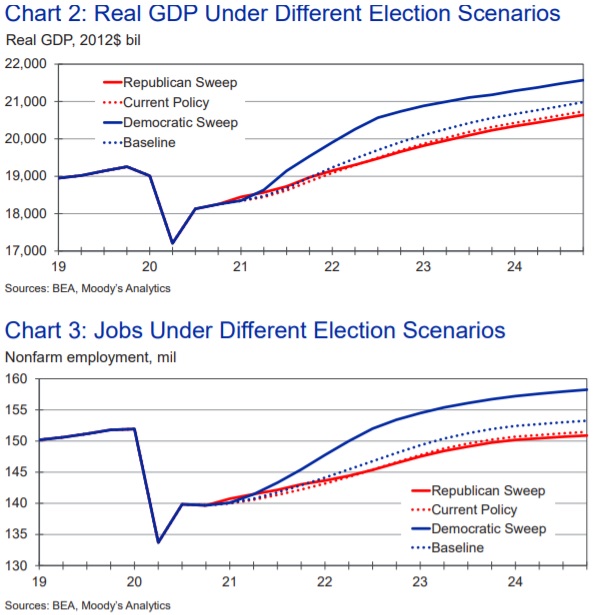
The economic outlook is strongest under the scenario in which Biden and the Democrats sweep Congress and fully adopt their economic agenda. In this scenario, the economy is expected to create 18.6 million jobs during Biden’s term as president, and the economy returns to full employment, with unemployment of just over 4%, by the second half of 2022. During Biden’s presidency, the average American household’s real after-tax income increases by approximately $4,800, and the homeownership rate and house prices increase modestly. Stock prices also rise, but the gains are limited. …Near-term economic growth is lifted by Biden’s aggressive government spending plans, which are deficit-financed in significant part. …Greater government spending adds directly to GDP and jobs, while the higher tax burden has an indirect impact through business investment and the spending and saving behavior of high-income households. …The economic outlook is weakest under the scenario in which Trump and the Republicans sweep Congress and fully adopt their economic agenda. …Trump has proposed much less expansive support to the economy from tax and spending policies.
Here’s the most relevant set of graphs from the report.

The Moody’s study is an outlier, however. Most other comprehensive analyses are less favorable to Biden.
For instance, a study for the Hoover Institution by Timothy Fitzgerald, Kevin Hassett, Cody Kallen, and Casey Mulligan, finds that Biden’s plan will weaken overall economic performance.
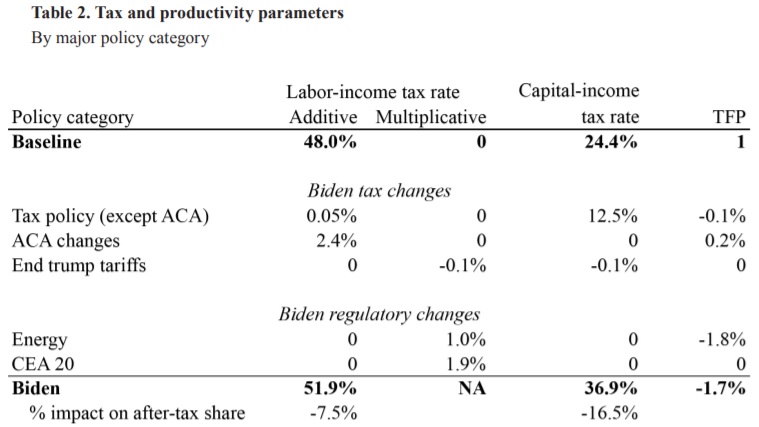
We estimate possible effects of Joe Biden’s tax and regulatory agenda. We find that transportation and electricity will require more inputs to produce the same outputs due to ambitious plans to further cut the nation’s carbon emissions, resulting in one or two percent less total factor productivity nationally. Second, we find that proposed changes to regulation as well as to the ACA increase labor wedges. Third, Biden’s agenda increases average marginal tax rates on capital income. Assuming that the supply of capital is elastic in the long run to its after-tax return and that the substitution effect of wages on labor supply is nontrivial, we conclude that, in the long run, Biden’s full agenda reduces fulltime equivalent employment per person by about 3 percent, the capital stock per person by about 15 percent, real GDP per capita by more than 8 percent, and real consumption per household by about 7 percent.
Wonkier readers may be interested in these numbers, which show that there’s a modest benefit from unwinding some of Trump’s protectionism, but there’s a lot of damage from the the other changes proposed by the former Vice President.

In a report authored by Garrett Watson, Huaqun Li, and Taylor LaJoie, the Tax Foundation estimated the impact of Biden’s proposed policies. Here are some of the highlights.
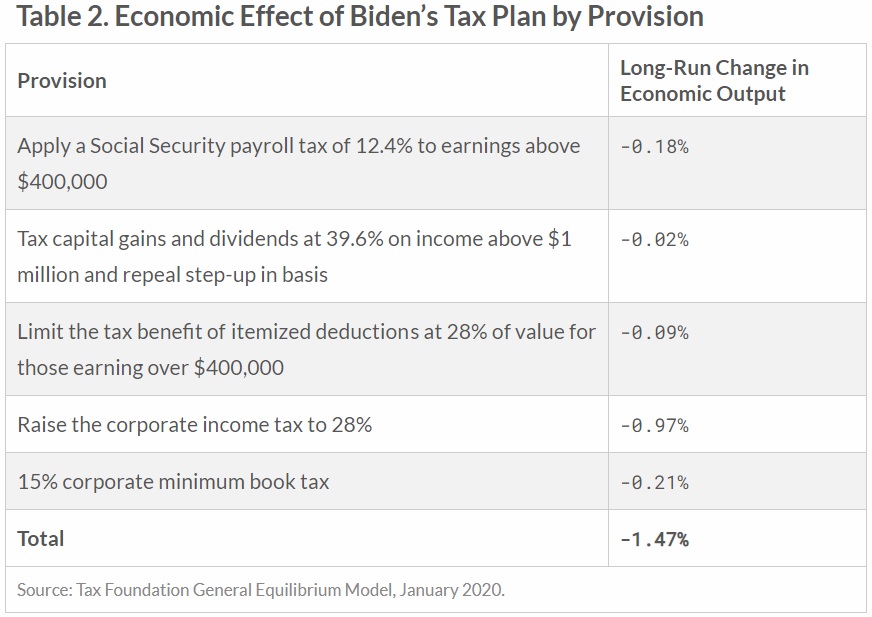
According to the Tax Foundation General Equilibrium Model, Biden’s tax plan would reduce the economy’s size by 1.47 percent in the long run. The plan would shrink the capital stock by just over 2.5 percent and reduce the overall wage rate by a little over 1 percent, leading to about 518,000 fewer full-time equivalent jobs. …Biden’s tax plan would raise about $3.05 trillion over the next decade on a conventional basis, and $2.65 trillion after accounting for the reduction in the size of the U.S. economy. While taxpayers in the bottom four quintiles would see an increase in after-tax incomes in 2021 primarily due to the temporary CTC expansion, by 2030 the plan would lead to lower after-tax income for all income levels.
Table 2 from the report is worth sharing because it shows what policies have the biggest economic impact.

The bottom line is that it’s not a good idea to raise the corporate tax burden and it’s not a good idea to worsen the payroll tax burden.
Here are some excerpts by a study authored by Professor Laurence Kotlikoff for the Goodman Institute.
The micro analysis is based on The Fiscal Analyzer (TFA), which uses data from the Federal Reserve’s Survey of Consumer Finance to calculate how much representative American households will pay in taxes net of what they will receive in benefits over the rest of their lives. …The key micro issues…are the degree to which the Vice President’s reforms alter relative remaining lifetime net tax burdens and lifetime spending of the rich and poor within specific age cohorts and the impact of the reforms on incentives to work, i.e., remaining lifetime marginal net tax rates. The macro analysis is based on the Global Gaidar Model (GGM)…a dynamic, 90-period OLG, 17-region general equilibrium model. …The analysis includes three sets of findings. The first is the change in lifetime net taxes defined as the change in lifetime net taxes. The second is the percentage change in lifetime spending, defined as the change in the present value of outlays on all goods and services as well as bequests, averaged across all survivor path. The third is the lifetime marginal net tax rate from earning an extra $1,000. TFA’s lifetime marginal net tax rate measure takes full account of so-called double taxation. …The GGM predicts a close to 6 percent reduction in the U.S. capital stock. The GGM predicts close to a 2 percent permanent reduction in annual U.S. GDP. The GGM predicts a roughly 2 percentage-point reduction in wages of U.S. workers, with a larger reduction in the wages of high-skilled workers.
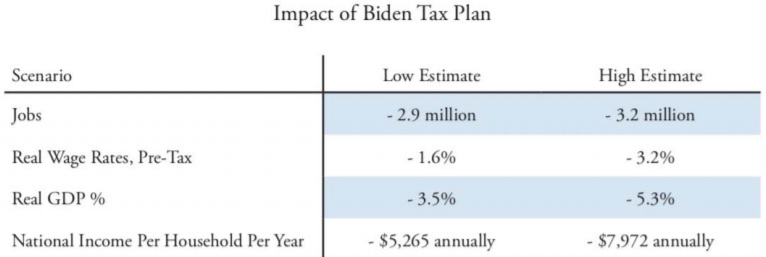
In a study for the Committee to Unleash Prosperity, Professor Casey Mulligan estimated the following effects.
This study addresses the impact of these tax rate changes on economic behavior – work, investment, output and growth. This study finds that the Biden tax agenda will reduce production, incomes, and employment per capita by increasing taxation of both labor and business capital. Employment will be about 3 million workers less in the long run (five to ten years). This employment effect is primarily due to the agenda’s expansion of health insurance credits, which raises the average marginal tax rates on labor income by 2.4 percentage points. Biden also plans to increase taxes on businesses and their owners by a combined 6 to 10 percentage points. These taxes will reduce long-run wages, GDP per worker, and business capital per worker in the long run. By decreasing both the number of workers per capita and GDP per worker, respectively, these two key elements of Biden’s agenda reinforce to significantly reduce GDP per capita and average household incomes. I estimate that, as a result of Biden’s tax agenda, real GDP per capita would be 4 to 5 percent less, which is about $8,000 per household per year in the long run. The two parts of the tax agenda combine to reduce real per capita business capital by 7 to 12 percent in the long run.
Here’s a table from the study.

I’ll add two points to the above analyses.
First, the reason that the Moody’s study produces wildly different results is that its model is based on Keynesian principles. As such, a bigger burden of government spending is assumed to stimulate growth.
For what it’s worth, I think borrowing and spending can lead to short-run increases in consumption, but I’m very skeptical that Keynesian policies can generate increases in national income (i.e., what we produce rather than what we consume) over the medium-run or long-run.
All of the other studies rely on models that estimate how government policies impact incentives to engage in productive behavior. They don’t all measure the same things (some of the studies look solely at taxes, some look at overall fiscal policy, and some also include a look at regulatory proposals) but the methodologies are similar.
Second, I’ll re-emphasize the point I made at the beginning about how politicians routinely say things during campaigns that are either insincere or impractical.
For instance, Trump promised to restrain domestic discretionary spending by $750 billion and he actually increased it by $700 billion.
Likewise, I don’t expect Biden (assuming he prevails) to deliver on his campaign promises. In this case, that’s good news since he won’t increase taxes and spending by nearly as much as what he’s embraced during the campaign (in my fantasy world, he turns out be like Bill Clinton and actually delivers a net reduction in the burden of government).
P.S. For those on the losing side of the upcoming election, I’ll remind you that Australia is probably the best option if you want to escape the United States. Though you may want to pick Switzerland if you have a lot of money.
-
Today in 1964, EMI Records rejected a group called the Hi-Numbers after its audition. Who? That’s the group’s current name:
-
Even in the Year of the Pandemic, or maybe because of the Year of the Pandemic, things happen that earn the WTF badge.
Megan Fox writes about the viewer-discretion-advised incident of Monday:
Jeffry Toobin, a CNN contributor and writer at The New Yorker, got caught tickling his pickle on a work Zoom call. This wasn’t a situation where he thought he had hung up but hadn’t. Oh no. Toobin was purposefully masturbating during a work call.
He claims he thought he had “muted the video” but left it on “accidentally.” But that’s not believable, because when turning the camera off on Zoom, there is an avatar where the video used to be. How does he expect us to believe he did not check this before deciding to whip out wee Willie? And worse, why is that a good excuse for flogging the dolphin during a work call? Do we need congressional intervention to tell us that being an Army of One on a Zoom call is the wrong thing to do? Do we need a new criminal code for 2020 specifying that hoisting your own petard while attending a conference call is offensive to others? It’s sad that humans can’t just self-police.
Toobin is rabidly anti-Trump as any famous journalist must be. He’s also already well-known for running afoul of the #MeToo crowd when Patty Hearst blasted him for sensationalizing her rape in his book American Heiress in 2018. Fox canceled plans for a movie based on the book after Hearst got through with Toobin.
And now Toobin wants the world to accept that he made a “mistake” and “accidentally” sexually harassed everyone in a Zoom call. That’s what we’re really talking about here. If MeToo has taught me anything it’s that consent matters and if a man exposes himself to anyone without their consent it’s akin to rape. Remember that Louis C.K. was dragged for engaging in this same activity on phone calls with women. So was Harvey Weinstein, who was reported to have sprinkled his house plant in plain view of witnesses. …
This is no different than Charlie Rose or Matt Lauer groping coworkers or having automatic locks installed on the office door. Why should Toobin get a pass because his crime is embarrassing and rather hilarious? It’s still harassment. Every single one of those people on the Zoom call who witnessed it was sexually harassed, if not assaulted. …
This needs to be a firing offense if the big networks are really concerned about making workplace environments sexual harassment-free. I don’t expect he will be fired, but he should be. …
The other troubling part of this story is the call itself, which reads like some kind of Deep-State media plotting session. Did anyone catch that? While everyone is distracted by Toobin’s lubin’, the description of this Zoom meeting is going largely uncommented on.
Vice reported:
Two people who were on the call told VICE separately that the call was an election simulation featuring many of the New Yorker’s biggest stars: Jane Mayer was playing establishment Republicans; Evan Osnos was Joe Biden, Jelani Cobb was establishment Democrats, Masha Gessen played Donald Trump, Andrew Marantz was the far right, Sue Halpern was left wing democrats, Dexter Filkins was the military, and Jeffrey Toobin playing the courts. There were also a handful of other producers on the call from the New Yorker and WNYC.
An election simulation? What are these people playing at? Coup 2? I’m a reporter and my newsroom doesn’t hold conference calls simulating what we want to happen and gaming different scenarios. We just report what happens. What is the purpose of this “simulation”?
Maybe this is why we lose the media game and we should start doing these simulations and get our narrative together ahead of time, but we’ve literally never even thought of doing this. That’s how honest and naive we are! I think I need to see this Zoom call. In the interest of finding out what the media is doing to undermine our Republic, I think we need the tape (and no one believes this was not being recorded). Let’s see what the media is plotting for November 4. They can edit out the Toobin show. I want to know what Jane Mayer, Masha Gessen, Andrew Marantz, Sue Halpern, Dexter Filkins, and Toobin are cooking up for November.
One day earlier, Fox Sports’ Joe Buck and Troy Aikman exchanged thoughts that they thought were off the air but weren’t:
USA Today reports on the aftermath:
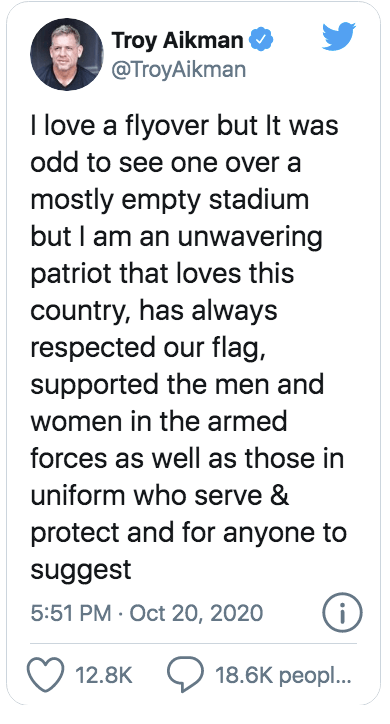
On Monday, we learned that Fox NFL broadcasters Joe Buck and Troy Aikman were not the biggest fans of stadium flyovers. And like many topics in 2020, their remarks were seen as divisive.
Defector Media posted a hot-mic video from Sunday’s Fox NFL broadcast of the Packers and Buccaneers that showed Buck and Aikman mocking a military flyover of four A-10 aircraft at Raymond James Stadium.
Aikman joked that a lot of jet fuel was getting wasted for a flyover of a football game that was being played at a mostly empty stadium. Buck also sarcastically said that it was our tax dollars at work.
The comments, though, were evidently seen by some as anti-military (which they really weren’t). So come Tuesday, Aikman took to Twitter to clarify that his joke was not meant to disrespect the military.

Regardless of their opinion, you would think that after Reds and Fox announcer Thom Brennaman was fired for a hot mike moment that sports announcers would be more careful. Then again, you might think people would be more careful around Zoom.
Noon update: Jimmy Traina of Sports Illustrated:If you’ve been on the internet over the past 48 hours, you most likely saw the video of Joe Buck and Troy Aikman talking about military flyovers.
The internet, as it always does, ran with the video with no context and spun it to paint Buck and Aikman as super liberal, anti-military people. …
There are many things about this ridiculous story that need to be cleared up. First, it seemed pretty clear if you listened to the audio, that Buck and Aikman were goofing around and being sarcastic.
Two, and most important, they were not caught on a hot mic. This did not take place during a break in the Packers-Bucs game.
This was done before the game, during a rehearsal. That means someone who works at FOX, either in a truck or a broadcast studio, pulled the clip on purpose and then leaked it on purpose to make Buck and Aikman look bad. And the fact that one of their co-workers would leak this clip to make the broadcast duo look bad really sucks.
You can be sure Fox is doing some sort of internal investigation to find the culprit.
There is no question, however, that Buck and Aikman said what they said, whether that should have been exposed by a duplicitous coworker. This will certainly add to the general narrative of Buck and Aikman, who have been criticized for going out of their way to make negative comments about, among other teams, the Packers.
-
The number one song today in 1957 …
… came from a just-opened movie:
The number one song today in 1967:
-
A student at an Ivy League university just wrote to me:
I’m a senior college student at [X] and back in March when we shut down, I was genuinely concerned about COVID.
However, I study hospitality and as I read about layoffs at restaurants and hotels, my heart broke for the staff there. By May, I was fully skeptical. At first, I thought we’d be done with this by now. Back home in NY, my high school friends are terrified and the one time we saw each other, we sat in my backyard 6+ ft apart from each other. As a business student, I hope that I understand how the markets work and how every single week of lockdown affects our society in every shape and form.
Where I live, we are a wealthy town and most parents are businessmen/lawyers and can afford to stay home. However, having worked in the hospitality industry, I understand how so many people are being affected while families in my community are ordering for $100+ delivery and $200+ Instacart orders. They’re so phony — they think that the federal government could snap their fingers for small businesses and its employees and they’ll be saved. Whether it’s Trump or Biden, these people are not being helped.
One interesting anecdote: my friend’s sister has really, really bad eyesight. Both of her parents are doctors and she’s still scared to go get her eyes checked. When I was with her, I had to read her the menu from her phone when we were ordering in. She’s 22 years old. 22!
Trust me, I know I’m privileged but was disgusted by the lack of empathy. I worked in restaurants and hotels and I know that these workers are suffering. Meanwhile, my high school friends think that the federal government will help them. They don’t understand how it works. They keep thinking that we’re going to have a vaccine or treatments by next year. I tried to explain that the US population is over 300 million across the country and that you can’t vaccinate everyone overnight. Somehow all my friends go to Ivy League schools and they don’t understand that logic. And trust me, my major at [X] is known to be the “dumb” major and compared to the engineers, they have no clue.
Now, for some good news. I’m now back at [X] University. Some challenges is having to wear masks everywhere and having twice weekly tests. Aside from that, it’s almost like being back in college. I’ve hosted parties with my best friends hosting pong, getting drunk, and being a college student. The first few days back, my friends and I were a bit scared to hug and all. Since then, we’ve had so many great social events. We even played spin the bottle and had such great experiences. While when I meet another friend that I haven’t seen for a while, we don’t hug or do anything… Soon after, after a drink or two, we’ve all hugged. I talked to my friends about COVID and we’re all under the impression that by March 2021, somehow life has to go on.
Lastly, I do not understand this conversation about waiting until a vaccine or treatment. How long can we go on? Luckily, I’m a senior and will have had most of my college years. But how will education be affected? When I was in high school, I worked with students on the spectrum and with autism; I can’t imagine what they are living.
Now much of this is quite discouraging: the 22-year-old woman who’s terrified to get her eyes checked, even though she quite literally has a greater chance of dying in a car accident on the way to the eye exam than she does of COVID, is beyond ridiculous.
At the same time, I’m glad to hear that when push comes to shove, college students are being college students, regardless of the hysteria, and that they seem to have decided on a date in their minds beyond which the insanity simply cannot go on. -
Today in 1960, Roy Orbison had his first number one single:
Today in 1962, the number one single in the U.S. was a song banned by the BBC:
The number one single today in 1973 …
… which bumped off this classic …
… which made an eight-year-old TV viewer’s eyes nearly pop out of his head.
Today in 1977, four members of Lynyrd Skynyrd and two others were killed when their plane crashed near McComb, Miss.:
 Steve Prestegard.com: The Presteblog