The Beatles had quite a schedule today in 1963. They drove from Liverpool to London through the night to appear on the BBC’s “Parade of the Pops,” which was on live at noon.
After their two songs, they drove back north another three hours to get to their evening performance at the Swimming Baths in Doncaster.
Today in 1956, Elvis Presley performed three shows at the Fort Homer Hesterly Armory in Tampa, Fla. Presley closed the final show by announcing to the crowd of 14,000, “Girls, I’ll see you backstage.”
Many of them took Presley at his word. Presley barely made it into his dressing room, losing some of his clothes and his shoes in the girl gauntlet.
The number one single today in 1966 here (on the singer’s birthday) …
If any media folk are still interested in “fact-checking” presidents after the Trump era, they’ll have plenty of fodder from Tuesday night’s appearance by President Joe Biden on CNN. A favorite Biden habit is to appeal to the authority of economists, many of whom remain unnamed, to suggest that his policies are wildly popular among experts. And what would we do without anonymous experts?
Newsweek has a transcript of the event in which CNN’s Anderson Cooper hosted our 46th president at Milwaukee’s Pabst Theater. Here’s an excerpt:
COOPER: You’ve made passing a COVID relief bill the focus of your first 100 days. Those on the right say the proposal is too big. Some on the left say it’s not big enough. Are you committed to passing $1.9 trillion bill or is that final number still up for negotiation?
BIDEN: I’m committed to pass — look, here’s — some of you are probably economists or college professors or you’re teachers in school. This is the first time in my career — and as you can tell, I’m over 30 — the first time in my career that there is a consensus among economists left, right, and center that is over — and including the IMF and in Europe, that overwhelming consensus is, in order to grow the economy a year, two, three, and four down the line, we can’t spend too much.
Thank goodness this statement is not accurate. There is not an “overwhelming consensus” among economists that no amount of federal spending is excessive. This column is often skeptical of conventional expert opinion. But even for those who aren’t, the Biden economic plan is notable for the way it has drawn criticism not just from economists in the center and on the right but from Mr. Biden’s own former colleagues on the left. Many of the critiques specifically warn that he is indeed spending too much taxpayer money on a recovering economy which does not need another massive intervention.
Last month this column noted the criticism of Bidenomics from veterans of the Obama economic team. More recently one of the Biden plan’s enthusiastic backers also acknowledged the resistance coming from liberal economists. John Cassidy wrote in the New Yorker:
If there were any doubt that Joe Biden’s economic proposals represent a big break with the policies of the Obama and Clinton Administrations, the debate about Biden’s $1.9 trillion covid-19 relief plan dispelled it. For good or ill—and, in my view, it is very positive—the Biden White House is pursuing a bold and aggressive program of Keynesian economic management, the likes of which Washington hasn’t seen since the nineteen-sixties.
The argument began, last week, with a warning about the Biden plan from Lawrence Summers, the Harvard economist who served as the Secretary of the Treasury toward the end of the Clinton Administration and as the director of the White House National Economic Council during Obama’s first term. Whatever good the Biden spending package might do in boosting output, wages, and profits, Summers wrote in the Washington Post, it was so large that it could also “set off inflationary pressures of a kind we have not seen in a generation, with consequences for the dollar and financial stability.” Over the weekend, Olivier Blanchard, a former chief economist at the International Monetary Fund, seconded Summers’s concerns, tweeting, “The 1.9 trillion program could overheat the economy so badly as to be counterproductive.”
One can usually count on massive federal programs to be counterproductive, such as the one Mr. Biden helped oversee as Vice President in 2009 and which he reasonably described on Tuesday as “the last experiment we had with stimulus.” Unreasonably for taxpayers, the experiment failed as the plan burned through more than $800 billion and failed miserably to reach its employment goals.
An honest Biden pitch for his current plan would acknowledge that it’s a much more costly experiment based on premises contradicted by both expert opinion and empirical data.
There’s no crisis in the economy other than the pain still being inflicted by Biden allies in teachers unions and state government. A naturally rebounding economy, further juiced by the last massive federal relief bill enacted in December, continues to improve. On Wednesday the Federal Reserve reported the fourth consecutive month of rising U.S. industrial production. And it’s clear from a separate bit of Wednesday news that producers are not having trouble finding consumers. Retail sales surged in January.
If the president wants to insist that America needs unlimited federal spending, he should at least stop pretending it’s a consensus view and admit that it’s his own wacky idea.
Conservative radio icon Rush Limbaugh died Wednesday at the age of 70 after being diagnosed with stage-four lung cancer last year, his family announced.
Limbaugh’s wife, Kathryn, made the announcement on his radio show.
“For over 32 years, Rush has cherished you, his loyal audience, and always looked forward to every single show,” Kathryn Limbaugh said. “It is with profound sadness I must share with you directly that our beloved Rush, my wonderful husband, passed away this morning due to complications from lung cancer.”
The radio legend received Stage IV lung cancer diagnosis in January 2020. President Trump awarded Limbaugh the Presidential Medal of Freedom days later at the State of the Union address.
“This is not good news,” Trump said then of Limbaugh’s diagnosis. “But what is good news is that he is the greatest fighter and winner that you will ever meet. Rush Limbaugh: Thank you for your decades of tireless devotion to our country.”
After launching The Rush Limbaugh Show in 1988, Limbaugh grew to become one of the most influential media figures in America, eventually hosting the most listened-to radio show in the U.S., airing on more than 600 stations.
Limbaugh spoke to some 27 million people who tuned into his show on a weekly basis from behind his Golden EIB (Excellence in Broadcasting) Microphone. He dubbed his fans “Dittoheads,” as they would say “ditto” when they agreed with him.
In December, Limbaugh revealed on his show that he had already outlived his prognosis.
“I wasn’t expected to be alive today,” he said. “I wasn’t expected to make it to October, and then to November, and then to December. And yet, here I am, and today, got some problems, but I’m feeling pretty good today.”
Over his decades-long career, Limbaugh received a number of honors, including entry into the Radio Hall of Fame and the National Association of Broadcasters Hall of Fame.
He was a five-time winner of the National Association of Broadcasters Marconi Award for “Excellence in Syndicated and Network Broadcasting” and a No. 1 New York Times bestselling author. In 2008, he was named one of Barbara Walters’ 10 Most Fascinating People. One year later he was included in TIME’s 100 Most Influential People in the World.
Limbaugh was forced to go off the air beginning February 2 as his health worsened, though he continued his penchant for controversy in his final days of broadcasting.
Weeks after President Joe Biden won the election, Limbaugh questioned the validity of the results saying: “You didn’t win this thing fair and square, and we are not just going to be docile like we’ve been in the past and go away and wait ’til the next election.”
I rarely listened to Limbaugh because I was usually working while he was on. I rarely listen to talk radio, though I was an occasional contributor (radio and TV) for Charlie Sykes, as you know:
We recall how bracing the Rush Limbaugh Show was in its early days. For decades the airwaves had been governed by the Fairness Doctrine, a federal regulation requiring stations to balance “controversial” claims with “contrasting viewpoints.” The rule gave incumbent candidates and mainstream news outlets a near-monopoly on public discourse. Ronald Reagan scrapped the Fairness Doctrine in 1987. By the 1992 presidential campaign, the radio star’s first name was known across the U.S.
Limbaugh, whose show ran on weekdays from noon to 3 p.m. East Coast time, was invaluable to the conservative movement in the 1990s. He would spend an hour explaining supply-side tax policy or making the case for deregulation. Millions of Americans had never heard a coherent argument against the welfare state or Roe v. Wade until they tuned in to Limbaugh’s show. He played an enormous role in popularizing conservative ideas and policies.
His critics called him a racist and about everything else, which was always unfair. His real offense was to gain millions of weekly listeners by mocking the left’s pieties. He dissected environmental scare campaigns, and he ridiculed the news media for finding epidemics of homelessness only during Republican administrations. In 1994 Bill Clinton called the show from Air Force One to complain about the host’s criticisms—not for the last time blaming scrappy radio hosts for his own political woes.
In recent years, with the rise of more acerbic competitors and a general souring of public discourse, Limbaugh took on a more exasperated tone. He also moved to the Trumpian right on issues such as trade, immigration and foreign policy.
But unlike others on the talk-radio right, he kept his sense of humor and rarely let anger drown his fundamental optimism about the United States. His great strength was never to take himself too seriously. Limbaugh knew he was an entertainer, not an intellectual or politician, and he said so many times. He was popular because he was superb at his craft and represented traditional American values that the dominant culture too often demeans.
About Trump, Limbaugh correctly observed something most Democrats and some Republicans don’t or won’t grasp:
“Donald Trump represents an uprising of the people of this country against Washington, against the establishment, and it had been brewing for a long time. It had been building since [Ross] Perot in 1992.”
Limbaugh is not the father of conservative talk radio, but he lasted longer than anyone in conservative talk radio, even in markets you would never think of, including Madison. During his midday show in his first years on WTDY in Madison, there were “Rush Rooms” where people could listen. Limbaugh then moved to WIBA, preceding current afternoon host Vicki McKenna.
Limbaugh’s death was predictably celebrated by liberals in social media Wednesday, because some people believe the words “criticism” and “hate” are synonyms. That obviously didn’t bother Limbaugh, nor, apparently, did it bother his advertisers enough for very many of them to pull out of his show. As is often the case Limbaugh was prone to bombast (he called himself “talent on loan from God”), but controversy attracts listeners to a point.
Limbaugh gave himself credit for saving AM radio in the 1980s after music formats switched to FM radio, leaving people wondering what the point of AM radio now was. And then came Limbaugh and other radio talkers (including, later last century, sports talk). Those conversations about AM’s future are still taking place, because conversations are taking place about the future of radio. Some might blame Limbaugh for the increasing drought in live and local radio broadcasting, but Limbaugh didn’t make decisions for radio station owners or general managers or program directors.
Limbaugh’s success helps demonstrate how liberals hate markets. Sykes isn’t on Milwaukee radio anymore, but Mark Belling, who preceded Sykes on the air, still is. Sykes’ old station, WTMJ, still carries Jeff Wagner, who followed Sykes, as well as Steve Scaffidi, who ended up with Sykes’ time slot. McKenna has shows in both Milwaukee and Madison. If you get listeners, you get advertisers, and if you get and keep advertisers, your employment is assured.
The answer to Limbaugh and other conservative talkers was supposed to be the Air America network, which lasted less than six years. Liberal talk stations come and go, most recently WRRD in Milwaukee, because they can’t generate enough advertising. Sly is still on WBGR in Monroe and WIBA-FM in Madison, but as a DJ of, respectively, oldies and classic rock, not liberal talk. There is one liberal talk station in Madison at 92.7 FM. For now.
A lot of people in talk radio owe their careers to Limbaugh because Limbaugh showed that conservative talk is something people would listen to and advertisers would buy. Like Paul Harvey, Limbaugh’s advertisers sold high-end products and services, which was one reason he stayed on the air as long as he did.
James Wigderson:
In 1992, I still had dreams of being a political consultant. I had just left grad school a little earlier than planned (graduate school, where you gradually learn you don’t really want to be there).
As luck would have it, I found my first political race where I could do more than just lick envelopes. (I’ll let the older readers explain that to the younger readers.) It was managing a congressional race in a hopelessly Democratic district. There were primaries on both sides as it was an open seat. I got the solidly pro-life Republican in a five-way primary.
If you remember the 1992 election, it was a horrible year for Republicans. So much hope generated by the popularity of the 1st Gulf War vanished in a recession economy. Republicans were divided and Pat Buchanan challenged an incumbent GOP President George H. W. Bush in the primaries. Bush lost to Bill Clinton, a draft-dodging womanizer.
Managing that congressional campaign was not a happy experience for me. I learned then that my patience for dumb people is about zero. I mentally checked out. We won the primary but we lost the general election – badly. The only good thing I can say about the experience is that I didn’t become an alcoholic.
The day after the election, I was down. I had no idea what I was going to do with my life. My girlfriend was about to dump me (she did on my birthday – true story). I had burned a bridge with my last college job. It was bad.
That afternoon, Rush came on the radio. Instead of forecasting doom for the country and allowing conservatives to feel sorry for themselves, Rush told us that the best revenge, the best thing we could do at that point, was just live our lives as best as we could in the way that we believed.
That advice from Rush has always stuck with me, and I’ve tried to pass that advice along after every election. I will always be grateful for those words from Rush.
I know he changed over the years, and there will be others that will write complete obituaries with the good and the bad of Rush Limbaugh and his effect on politics.
But today I’m going to remember how that golden microphone sending out advice to a mourning Republican audience somehow spoke directly to me. That’s the Rush Limbaugh I want to remember. Maybe some of you will read this and Rush’s advice from 1992 will stay with you, too.
Limbaugh turned himself into a franchise, selling cigars and ties. I own a couple of the ties, which were very colorful and bold. He doesn’t appear to sell ties anymore at RushLimbaugh.com (written in the present tense since like dead actors and musicians he is still making money), so apparently I have collector items.
The number one one one single today-day-day in 1962:
The number one British single today in 1966:
Today in 1969, Bob Dylan and Johnny Cash recorded the album “Girl from the North Country.”
Never heard of a Dylan–Cash collaboration? That’s because the album was never released, although the title track was on Dylan’s “Nashville Skyline” album.
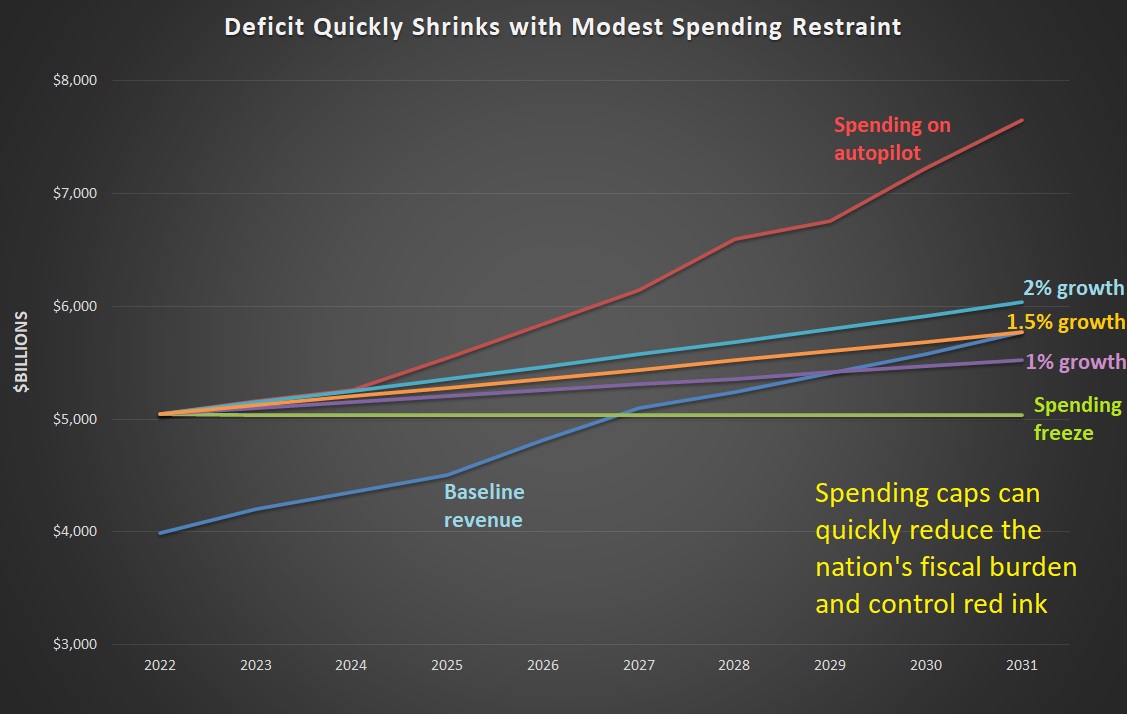
The good news is that there is still a simple solution to America’s fiscal problems. According to the just-released Budget and Economic Outlook from the Congressional Budget Office, tax revenues will grow by an average of 4.2 percent over the next decade. So we can make progress, as illustrated by this chart, if there’s some sort of spending cap so that outlays grow at a slower pace.
But even if we have more modest aspirations (avoiding future tax increases, avoiding a future debt crisis), it’s worth noting how modest spending restraint generates powerful results in a short period of time. And the figures in the chart assume the spending restraint doesn’t even start until the 2023 fiscal year.
The main takeaway is that the budget could be balanced by 2031 if spending grows by 1.5 percent per year.
But progress is possible so long as the cap limits spending so that it grows by less than 4.2 percent annually. The greater the restraint, of course, the quicker the progress.
In other words, there’s no need to capitulate to tax increases (which, in any event, almost certainly would make a bad situation worse).
P.S. The solution to our fiscal problem is simple, but that doesn’t mean it will be easy. Long-run spending restraint inevitably will require genuine reform to deal with the entitlement crisis. Given the insights of “public choice” theory, it will be a challenge to find politicians willing to save the nation.
P.P.S. Here are real-world examples of nations that made rapid progress with spending restraint.
There was no interest in fiscal restraint after 9/11. Nor was there during the Great Recession. Nor has there been during the pandemic. The only way to get closer to balancing the budget (I doubt it will be balanced in the lifetime of anyone reading this) is, as Mitchell points out, mandatory, as in constitutional, spending restraint.
If you read the headline of a blockbuster, 6,000-word-plus story in Time magazine, you might think former President Donald Trump wasn’t so wrong about the election, after all.
Despite the tease, Molly Ball’s “Secret History of the Shadow Campaign That Saved the 2020 Election” doesn’t allege widespread voter fraud in what some Trump supporters still insist was a “stolen” election. Nor is the essay an exposé of illegal activity that would justify the Trumpian challenges to the results that threatened to tear the country apart.
But what Time did uncover is disturbing enough, even if most of those involved are proud of what they did to help elect President Biden: underhanded methods made all the more galling by the preening self-righteousness of those who deployed them.
As the magazine reports, a secret alliance of left-wing activists, union leaders and corporate CEOs worked together to help craft unprecedented changes in the rules governing the way America votes. They did their best to encourage and facilitate mail-in voting on an unprecedented scale.
That wasn’t cheating or illegal, but it was enormously consequential.
With funding from federal sources as well as private moguls like Facebook founder Mark Zuckerberg, this cabal of anti-Trump forces mobilized an enormous number of first-time voters who despised Trump
Using pandemic fears about voting in person — less dangerous, in fact, than a trip to the supermarket — and without a national debate or any meaningful oversight by legislators or the courts, the anti-Trump alliance managed to make it easy for people who don’t normally bother to vote.
That this also involved discarding rules intended to safeguard the integrity of elections was a side benefit.
That the cabal operated successfully in plain sight highlights the impotence of Republicans, who, though they saw the threat coming and in some cases sued to prevent the changes, ultimately failed to prevent the shift. But there’s more here than just a case of the Democrats out-organizing the GOP.
This also involved getting Americans used to the idea that in a country with the most advanced technology in the world, the vote count would last days, rather than being settled in one night.
What Time also documents is a campaign to pressure internet and social media companies as well as press outlets to censor “disinformation” about the election, especially with respect to fraud allegations. While some of the material that was targeted was false, the tech bros also blocked the dissemination of legitimate reporting and commentary that could have undermined Biden.
The best example was The Post’s reporting about Hunter Biden’s influence-peddling, which was tossed down the Orwellian “memory hole” by both Twitter and all non-conservative media outlets; to boot, 50 former intelligence officials baselessly claimed that the Hunter Files was Russian disinformation. Yet to this day, neither Hunter nor his father has disputed the authenticity of the emails uncovered by The Post or the provenance of the laptop they were recovered from.
Though Time claims the censorship was “defending democracy,” it was actually just the opposite. In a campaign that was represented as a counterattack against Trumpian lies, what the anti-Trump group pulled off was perhaps the biggest lie in modern American political history.
The collusion between Big Tech and biased legacy media prevented the public from learning more about a candidate who largely spent 2020 in hiding. In this way, the anti-Trump forces did help stage an election that was, in a sense, rigged against the incumbent.
There’s nothing wrong with getting more people to vote, as long as the votes are legal. But there is something profoundly wrong with a system in which Silicon Valley oligarchs, big business, union bosses and lefty agitators can effectively shut down free discourse and freedom of the press during a presidential election in order to ensure their candidate wins.
That means the challenge facing the country is not what to do about Trump’s sore-loser tantrum, which resulted in a disgraceful riot (swollen into an “insurrection” by Democrats and media keen to discredit all Republicans). The real problem is whether Americans are prepared to let the same forces that tilted the 2020 election in Biden’s favor get away with it again.
Today in 1961, singer Jackie Wilson got a visit from a female fan who demanded to see him, enforcing said demand with a gun. Wilson was shot when he tried to disarm the fan.
The number one album today in 1964 encouraged record-buyers to “Meet the Beatles!”

 Steve Prestegard.com: The Presteblog