Skip to content
  • Presty the DJ for Aug. 22

    August 22, 2021
    Music

    Today in 1964, the Supremes reached number one by wondering …

    Today in 1968, the Beatles briefly broke up when Ringo Starr quit during recording of their “White Album.” Starr rejoined the group Sept. 3, but in the meantime the remaining trio recorded “Back in the USSR” with Paul McCartney on drums and John Lennon on bass:

    (more…)

    Share this on …

    • Share on X (Opens in new window) X
    • Share on Facebook (Opens in new window) Facebook
    • Share on LinkedIn (Opens in new window) LinkedIn
    • Email a link to a friend (Opens in new window) Email
    • Print (Opens in new window) Print
    Like Loading…
    No comments on Presty the DJ for Aug. 22
  • Presty the DJ for Aug. 21

    August 21, 2021
    Music

    We begin with two forlorn non-music anniversaries. Today in 1897, Oldsmobile began operation, eventually to become a division of General Motors Corp. … but not anymore.

    (more…)

    Share this on …

    • Share on X (Opens in new window) X
    • Share on Facebook (Opens in new window) Facebook
    • Share on LinkedIn (Opens in new window) LinkedIn
    • Email a link to a friend (Opens in new window) Email
    • Print (Opens in new window) Print
    Like Loading…
    No comments on Presty the DJ for Aug. 21
  • Go watch what’s Brewing

    August 20, 2021
    Brewers

    Five Thirty Eight:

    MLB’s top three World Series contenders in our forecast — the Los Angeles Dodgers (29 percent chance to win it all), Houston Astros (14 percent) and Tampa Bay Rays (12 percent) — have all been there before, and quite recently. The Dodgers won the championship last season over the Rays, while the Astros made the Fall Classic in 2019 (losing to the Washington Nationals). But you can’t say the same for the fourth team on the list: the Milwaukee Brewers (8 percent). The Brew Crew haven’t been to a World Series since 1982, when they lost a heartbreaker to the St. Louis Cardinals in seven games. Since then, Milwaukee has had a few near-misses — dropping the NLCS in both 2011 and 2018 — but it hasn’t quite been able to get so close again to earning the franchise its first-ever title.

    This could very well be the year that changes. Earlier in the season, we wrote about the Brewers’ dominant rotation as a secret weapon in their bid for a fourth consecutive playoff appearance. That’s still true: Milwaukee ranks first among all teams in wins above replacement1 from starting pitchers in 2021.2 But on top of that, the team has also doubled down on a familiar winning formula and shored up some of its biggest weaknesses as the season has evolved. As a result, the Brewers own MLB’s best record (45-23) since June 1 and are looking about as strong as they have at any point since that 1982 pennant-winning performance.

    Last year’s Brewers had a similar pitching profile to the 2021 version, with both a strong rotation (No. 9 in WAR) and bullpen (No. 6). They also made the postseason, which is something this year’s team has a 99 percent probability of doing — but only because MLB expanded its playoff field amid a pandemic-shortened schedule. (Milwaukee became one of only three teams in league history to make the playoffs with a sub-.500 record, joining the 2020 Astros and 1981 Kansas City Royals.) In truth, the 2020 Brewers were a mediocre team despite their impressive pitching, with a weak offense and an uncharacteristic lack of success in terms of defense and base running, two areas that had been hallmarks of the club’s ascendancy over the previous few seasons.

    This year’s Brew Crew have rededicated themselves to those practices, and it’s paying dividends. A year after dropping from ninth in MLB in fielding runs above average3 to 24th, Milwaukee is back up to fourth — thanks in part to a much better season with the glove from left fielder Christian Yelich and to some defensive reshuffling, enabled by the acquisitions of center fielder Jackie Bradley Jr. and second baseman Kolten Wong before the season  …

    And they’ve been even better since picking up shortstop Willy Adames from the Rays in late May, which allowed Luis Urías to move to third base and later split time there with versatile All-Star Eduardo Escobar, who was acquired at the trade deadline. Suddenly, a team whose defense had been a weakness has turned it into a strength once again.

    The same applies to Milwaukee’s performance on the base paths. After falling from No. 7 in base running value4 in 2018 to No. 14 in 2019 and, shockingly, dead last (30th) in 2020, the Brewers are back up to 10th so far in 2021. Milwaukee’s opportunistic runners have a 43 percent rate of taking extra bases when chances present themselves, tying them for seventh-best in MLB, with Adames (71 percent), second baseman Jace Peterson (65 percent) and Bradley Jr. (57 percent) particularly standing out. Between their revitalized performances on defense and between the bases, the Brewers are back to following the formula that had defined the franchise’s recent rise.

    Hitting remains something of a weakness for Milwaukee; it ranks just 19th in batting runs above average and 16th in weighted runs created plus. Not coincidentally, Yelich, who won the National League MVP in 2018 (his first season as a Brewer) and finished second in 2019, has now had two consecutive seasons of subpar play by his standards, the second of which has also been marred by a back injury. He had been carrying the Brewers’ offense with his bat, but Milwaukee’s output has understandably suffered without Yelich producing at an MVP level.

    Other hitters have picked up the slack some, though. Right fielder Avisaíl García, catcher Omar Narvaez and Peterson all have wRC+ marks north of 120. And nobody has gotten more out of their in-season pickups than the Brewers, whose offense would be much worse without the additions of Adames, Escobar and first baseman Rowdy Tellez since Opening Day. According to WAR, batters who started the 2021 season on other teams but were later acquired by Milwaukee have produced 6.2 WAR per 162 team games for the Brewers — by far the most of any team in MLB this season, and a number on pace to be one of the highest totals of any team in the divisional era (since 1969) …

    Adames in particular has been stellar after arriving in Milwaukee. The 25-year-old was already one of baseball’s best-kept secrets in Tampa, producing the full-season equivalent of 4.7 WAR last year as the Rays marched to the World Series. But after he got off to a cold start in 2021 — one perhaps fueled by an inability to see the ball at Tropicana Field, where he hit .156 this year — Tampa Bay shipped Adames to the Brewers for a couple of pitchers. The Rays’ loss has been Milwaukee’s gain, as Adames has emerged as an MVP candidate for the Brewers, with 17 home runs, a 150 wRC+ and 4.9 WAR per 162 games after the deal.

    Penciling Adames into the lineup at short, the Brewers have been one of — if not the — best teams in baseball these past few months. With a dominating rotation, quality bullpen, resurgent defense, good heads-up base running and a retooled lineup, Milwaukee appears to check off all the boxes of an October contender.5 We’ll just have to see if that ultimately proves good enough to get the Brewers to greater heights than the franchise has reached in a long time.

    That would be 1982 …

    … Harvey’s Wallbangers, whose model to win the AL pennant was essentially the opposite of this year’s team. The 1982 Brewers finished 18th in the 26-team MLB in team ERA (despite having the 1981 and 1982 American League Cy Young winners on the team), 10th in fielding, 11th in fewest errors, and 21st in runs allowed. They were, however, number one in runs scored, second in batting average, first in home runs, first in slugging percentage, and first in a stat that didn’t exist at the time, OPS (on-base percentage plus slugging). And so the 1982 Brewers — despite, or perhaps because of, playing games like a slow-pitch softball team (average score 5.47–4.4) — were number one in another stat — wins, until they ran into St. Louis in the World Series.

    How about the 2018 Brewers, which got to the seventh game of the National League Championship Series before their season ended? They were 12th in runs scored, fourth in home runs, ninth in OPS, fifth in team ERA, eighth in runs allowed, 26th in fielding percentage, fifth worst in errors, and with all that fifth best in wins.

    For those not up on advanced metrics, this year’s Brewers are 11th in the 30-team MLB in runs scored, 14th in home runs, and 18th in OPS. On the other hand, they are also third in ERA (which might be their highest ranking in team history given their historically mediocre pitching) and third in runs given up, though they are 25th in fielding and fourth from worst in errors. Somehow the extra base runners that are the result of fielding failures haven’t led to giving up many runs compared with their opponents.

    I am not convinced the Brewers are going very far in the 2021 postseason, largely because of the teams in their way later in the postseason — notably three NL West teams, the Dodgers, San Francisco and San Diego. The one optimistic intangible in the Brewers’ favor — and it’s really a stretch — is that finally the sports gods might have sent their Mo to Wisconsin given the Bucks’ world championship and the Packers’ being one of the next Super Bowl favorites. At least the Brewers have a better chance of winning the World Series than the Cubs do.


    Share this on …

    • Share on X (Opens in new window) X
    • Share on Facebook (Opens in new window) Facebook
    • Share on LinkedIn (Opens in new window) LinkedIn
    • Email a link to a friend (Opens in new window) Email
    • Print (Opens in new window) Print
    Like Loading…
    No comments on Go watch what’s Brewing
  • An unlikely sermon subject for Sunday

    August 20, 2021
    Culture, History

    Mark Malvasi:

    My uncle made book for a living. That is, he took money from those who wagered on sporting events, presidential elections, anything whereby they thought they could make a fast and easy dollar. I suppose then it was inevitable that, as a young man, I felt a certain affinity for the thought of Blaise Pascal (1623-1662). Pascal, of course, gambled on stakes much higher than my uncle ever imagined. At the same time, my uncle knew something that Pascal never understood or, in any event, never admitted. You can’t beat the house.

    Pascal’s mind was among the finest of the seventeenth century. He was a prodigy, perhaps a genius, who, at fifteen, published a distinguished essay on conic sections. He invented the first calculating machine, which he called La Pascaline, and his experiments with the vacuums that nature abhors led to the creation of the barometer.   Pascal was also a first-rate mathematician whose fascination with, and success at, the gaming table enabled him to contribute to the development of probability theory. To test his hypotheses, he devised the roulette wheel.

    On November 23, 1654, at the age of thirty-one, Pascal underwent an emotional conversion that stirred him to abandon his worldly metier and to become an apologist for Christianity. He is best remembered today as a religious thinker, which he was, and a mystic, which he was not.   Like the nineteenth-century Danish theologian Søren Kierkegaard, Pascal approached God with “fear and trembling.” A mystic seeks and expects union with God. Pascal, by contrast, despaired of ever finding Him. His conversion did not bring him clarity of vision. God remained distant and unfathomable; the will of God was inscrutable and His design for the cosmos mysterious. “For in fact,” Pascal asked, “what is man in nature?” He answered his question, writing:

    A Nothing in comparison with the Infinite, an All in comparison with the Nothing, a mean between nothing and everything. Since he is infinitely removed from comprehending the extremes, the end of things and their beginning are hopelessly hidden from him in an impenetrable secret; he is equally incapable of seeing the Nothing from which he is made, and the Infinite in which he is swallowed up.

    Yet, alone and without God, humanity was lost, frightened, and miserable in vast and desolate universe.

    To calm his anxiety that God was, at best, remote and, at worst, illusory, Pascal conceived his famous wager. He urged skeptics, atheists, and free-thinkers to live as if they believed in God. Critics then and since have denounced what seemed to be Pascal’s sneering disdain in urging people to affirm that God was real and existence meaningful. It was disingenuous, if not cynical, of Pascal to play the odds and to bet on the reality of God and eternal life when he suspected both were false. The critique, although carefully aimed, misses the target. It is no small irony given Pascal’s attacks on the Jesuits that, like Ignatius Loyola, he rejected predestination, convinced that men and women, through their own efforts, could earn God’s saving grace. Good habits and sincere piety, even in the absence of real belief, thus became indispensable to salvation. “Custom is our nature,” Pascal declared. “He who is accustomed to the faith believes it, can no longer fear hell, and believes in nothing else.” As Augustine taught, the routine practice of faith might in time lead to genuine faith.

    Difficulties arise not from Pascal’s intentions but from his premises. Pascal argued that a man, perhaps in utter desperation, must speculate that God exists. If he wins, he wins big and for all eternity. If he loses, he loses almost nothing, since he will be in no worse condition than before. A prudent man thus has no alternative but to roll the dice or to turn over the next card. He’s gambling with house money. But in reality, in history, those who have denied God have often won glory, wealth, and power; according to scripture, they have gained the whole world. Satan took Jesus to a mountain and there “showed him all the kingdoms of the world and the glory of them; and he said to him, ‘All these I will give you, if you will fall down and worship me.’” (Matthew, 4:8-9) It is equally mistaken that a man loses nothing by hazarding that God is real. A man who worships God may sacrifice all he has, all he is, and all he loves in the vindication of his faith.   Consider Job.

    Pascal’s tragedy originated in his embrace of Jansenism, which introduced Calvinist doctrines and attitudes into the Catholic world of seventeenth-century France and Western Europe. The Jansenists had revived the Manichean dualism, which characterized humanity as divided between good and evil. For the Jansenists, every soul was a battleground, its fate determined by whichever conflicting impulse was strongest. The Jansenists insisted, therefore, that virtue must be imposed on rebellious and perverse human beings. Only an exacting and solemn authority could direct individuals toward rectitude and purity. The Jansenists also prescribed such discipline for the churches they controlled and the local governments in France over which they exercised some influence. The flesh must be compelled to yield to the spirit. It takes no great leap of historical imagination to see that the Jansenist admiration for order, management, restraint, bureaucracy, and surveillance could be made to attend the requirements of the totalitarian state. The Jansenists determined to administer the “greatness and misery of man,” (“grandeur et misère de l’homme”), which was the foremost theme of Pascal’s work, though compulsion.

    Jansenism, asserted Friedrich Heer, endowed Pascal with “an enormous capacity for hatred and over-simplification.”  Stressing the enthusiasm and certainty that governed the residents of Port Royal, the spiritual and theological capital of the Jansenist movement, Heer doubtless exaggerates the charges against Pascal. He ignores not the complexity of Pascal’s thought, but the complexity of the man himself.   Pascal was both austere and worldly, both rational and intuitive. When he partitioned the mind into l’esprit géométrique and l’esprit de finesse, he was mapping the course that a single mind—his own—could take. Pascal may have felt the zeal of a convert, but he never seems to have acquired the conviction that he possessed absolute truth or a sure method by which to attain it. For Pascal, God alone provided the antidote to the twin maladies of doubt and insecurity.

    To alleviate his own misgivings, Pascal set out to compose a systematic defense of Christianity. The Pensées contain the remnants of the greater work that he never lived to complete. If these fragments and aphorisms suggest the character of the volume that Pascal meant to write, then it seems the Pensées would have been less an apologia for Christianity than the spiritual autobiography of a thinker attempting to explain to his intellect how his faith was possible.

    In the Pensées, Pascal intimated that skepticism may transcend reason, and the doubts that reason awakens, leading not to certainty but to affirmation. By acknowledging the limits of reason, the thoughtful man, he hoped, could accept the mystery of life without also yielding to its absurdity. “The last proceeding of reason,” he wrote, ”is to recognize that there is an infinity of things which are beyond it. It is but feeble if it does not see so far as to know this. But if natural things are beyond it, what will be said of supernatural?” Yet, perhaps at this moment of vital insight, Pascal exhibited some of the odium that Friedrich Heer had detected in his thought and character. Like many intensely passionate and astute natures, Pascal disdained the society in which he lived—a disdain that reinforced his displeasure with his fellow human beings and, at times, with life itself. Most men, he assumed, were intellectually lazy and emotionally tepid. Desultory, incurious, and stupid, they were incapable of profound thought, searching doubt, or vibrant faith. The majority preferred not to bother about any subject, whether intellectual or theological, that would jolt them out of their passivity, lassitude, and indifference. Pascal’s disillusioned analysis of human nature may, as Heer suggests, have issued from the Jansenist view that human beings are both helpless and degraded. He could not avoid exposing the rancor, the insincerity, the conceit, the dishonesty, the self-deception, the cowardice, and the pettiness that circumscribed and disfigured the lives of most ordinary men, and made him despise them.

    For Pascal, as for Kierkegaard and other, later existentialist philosophers and theologians, unending dread may well have been the cost of existence. “The eternal silence of these infinite spaces frightens me,” he proclaimed.  There is at times the echo of a terrible nihilism that reverberates though the otherwise silent spaces of Pascal’s infinite universe, as he gazed into the abyss. T. S. Eliot wrote that Pascal’s despair is “perfectly objective,” corresponding “exactly to the facts” and so “cannot be dismissed as mental disease.” In the end, Pascal concluded, the rational proof of God’s existence, such as Descartes had tried to construct with the ontological argument, was useless and unconvincing to those disinclined to believe. Essential questions about the meaning and purpose of human existence could never be resolved through the application of reason or logic. In fact, for Pascal, they could not be resolved at all. They could only be felt in all of their contradiction and paradox. The experience of such utter confusion and despair alone made faith possible and necessary, but offered no assurance that it would come.

    Voltaire judged Pascal to be restless soul and a sick mind. Pascal agreed, confirming Voltaire’s assessment long before he had rendered it. During his final illness, Pascal often refused the care of his physician, saying: “Sickness is the natural state of Christians.” He believed that human beings had been created to suffer. Misery was the condition of life in this world. His was a hard doctrine.

    But to what end did people suffer? What did their suffering accomplish? Did it exalt the spirit? Were they to suffer unto truth or, as was more likely, did they suffer because the flesh was evil and needed to be punished? Pascal had gambled for ultimate stakes. When he rolled the dice, it came up snake eyes, not once, not the last time, but every time. His tragedy, and potentially ours, is that he could discover no purpose in his encounters with creation, his fellow human beings, life itself. Philosophy, science, and reason offered no assurance of truth, and were of little comfort against anguish and hopelessness. Some could even use elaborate rational arguments to defy the will of God and to excuse sin, as had the Jesuits whom Pascal denounced in The Provincial Letters.

    Love was equally vain and worthless. It prompted only deception and contempt for truth. Human beings are so flawed and imperfect that they are wretched and detestable. Loving themselves and desiring others to love them, they conceal their transgressions and deformities. Since no one is inviolate, no one deserves to be loved just as, were strict justice to prevail, no one deserves to be saved. Man, Pascal complained:

    cannot prevent this object that he loves from being full of faults and wants. He wants to be great, and he sees himself as small. He wants to be happy, and he sees himself miserable. He wants to be perfect, and he sees himself full of imperfections. He wants to be the object of love and esteem among men, and he sees that his faults merit only their hatred and contempt. This embarrassment in which he finds himself produces in him the most unrighteous and criminal passion that can be imagined; for he conceives a mortal enmity against the truth which reproves him, and which convinces him of his faults. He would annihilate it, but, unable to destroy it in its essence, he destroys it as far as possible in his own knowledge and in that of others; that is to say, he devotes all his attention to hiding his faults both from others and from himself, and he cannot endure that others should point them out to him, or that they should see them.

    All “disguise, falsehood, and hypocrisy,” men are ignorant, brazen, and delusional. Preferring lies to truth, they should not be angry at others for pointing out their shortcomings. “It is but right that they should know us for what we are,” Pascal insisted, “and should despise us.”

    Elsewhere Pascal acclaimed the dignity of man. He was a reed, but “a thinking reed,” more noble than the insensible universe that would destroy him. But the damage had been done. In the centuries to come, the same revulsion for humanity that Pascal had articulated, the same regimentation and tyranny that the Jansenists had endorsed, transformed life on earth into a living hell. In the early twentieth-century, the Roman Catholic philosopher Gabriel Marcel came face to face with the tragedy of the human condition. Shattered by his experiences in the Great War, during which he had served with the French Red Cross identifying the dead and accounting for the missing, Marcel sought an alternative to grief and desolation.

    He contended that in the modern world a person was no longer a person, but “an agglomeration of functions.” According to this functional definition, human beings were valued solely for the work they did and the goods they produced. Death became “objectively and functionally, the scrapping of what has ceased to be of use and must be written off as a total loss.” Such a vision of life deprived people of their spirituality and their faith, and robbed them of any joy that they might feel. Consumed by rancor, malice, and ingratitude, they suffered an “intolerable unease,” as they descended into the void that engulfed them.

    Love was the answer. If people could overcome selfishness and egocentricity, if they could love one another, Marcel was confident that they could fulfill themselves as human beings. Such involvement with, and such fidelity to, others afforded a glimpse of the transcendent and was, in Marcel’s view, the most persuasive argument for the existence of God. Faith consoled and inspired the downtrodden, the persecuted, the oppressed, and the brokenhearted. It cultivated and enhanced all human relationships. For if people refused any longer to treat others merely as objects performing a function, if they came at last to recognize that all persons, however deficient, imperfect, errant, or sinful, mattered to God, then those persons were also more likely to matter to them.

    I have come to the conclusion that each of us is capable of doing the right thing or the wrong thing at any one time. Your ratio of right decisions to wrong decisions shows the type of person you are, and whether or not your life will be successful (as in avoiding controllable bad things from happening to you).
     

    Share this on …

    • Share on X (Opens in new window) X
    • Share on Facebook (Opens in new window) Facebook
    • Share on LinkedIn (Opens in new window) LinkedIn
    • Email a link to a friend (Opens in new window) Email
    • Print (Opens in new window) Print
    Like Loading…
    No comments on An unlikely sermon subject for Sunday
  • From the GREEN Bay Packers

    August 20, 2021
    History, Packers

    Packers.com:

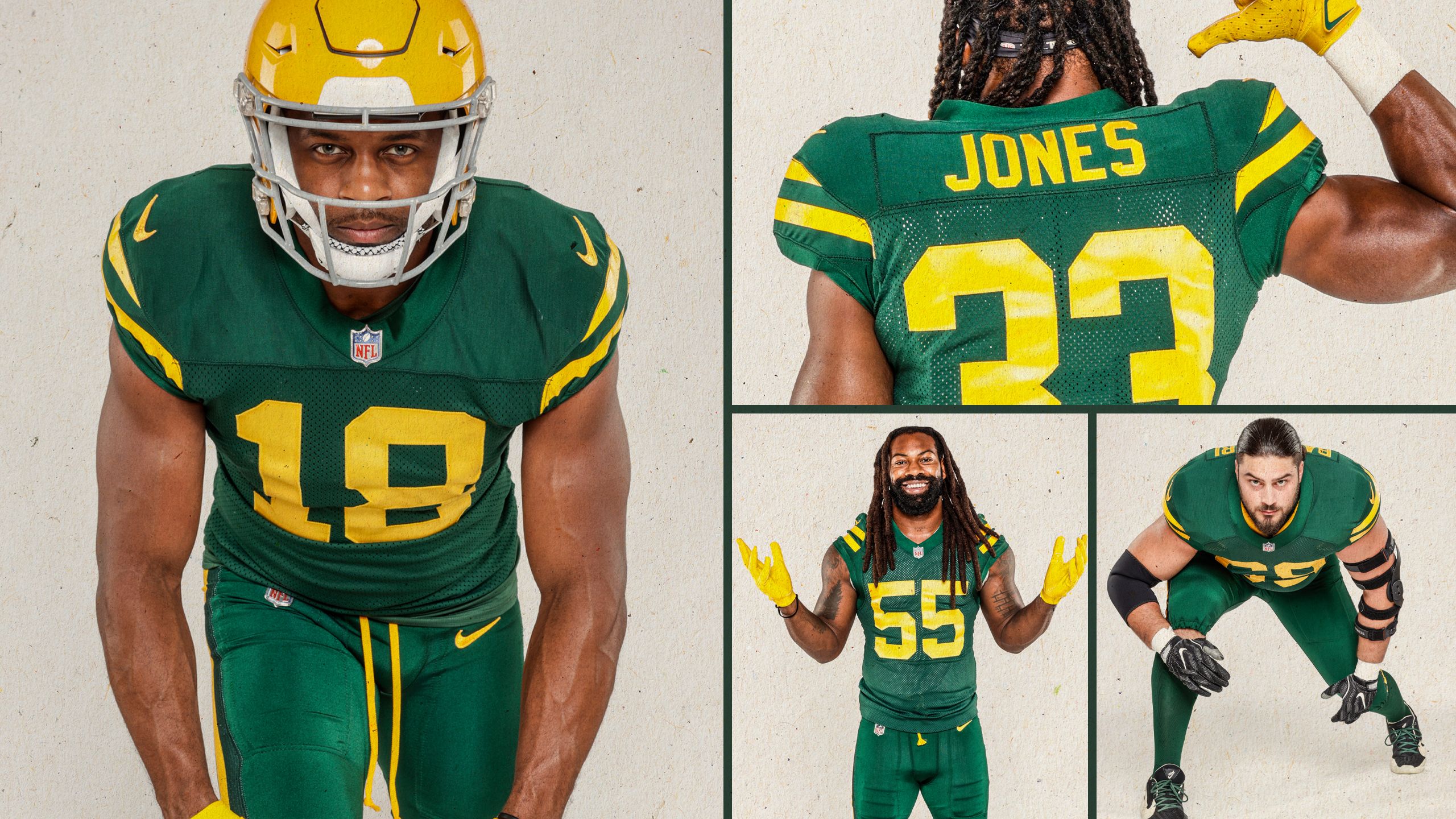
    The Green Bay Packers on Thursday introduced their new, history-inspired third uniform: the 50s Classic Uniform. The new uniforms will debut at Lambeau Field on Oct. 24 against Washington.

    The 50s Classic Uniform is inspired by the team’s uniforms from 1950-1953, which was the second time the team wore green and gold in its history. The Packers first wore green in the mid-to-late 1930s.

    The uniforms are all green, with gold numbers and stripes similar to the jerseys worn in the 1950s. In those days, the green was a Kelly green and the team alternated between wearing it with green or gold pants. This alternate jersey, which is the Packers’ traditional green color, with gold numbers and stripes, will be worn with matching green pants with gold stripes, and matching green socks.

    “The 1950s were one of the most interesting times in our organization’s rich history, creating the bridge between two of the greatest eras in pro football,” said Packers President/CEO Mark Murphy. “With the NFL growing rapidly, this time period set the stage for the construction of Lambeau Field and for the team’s success in the 1960s and beyond. We hope our fans enjoy celebrating our history with this new alternate uniform.”

    First: How does it look?
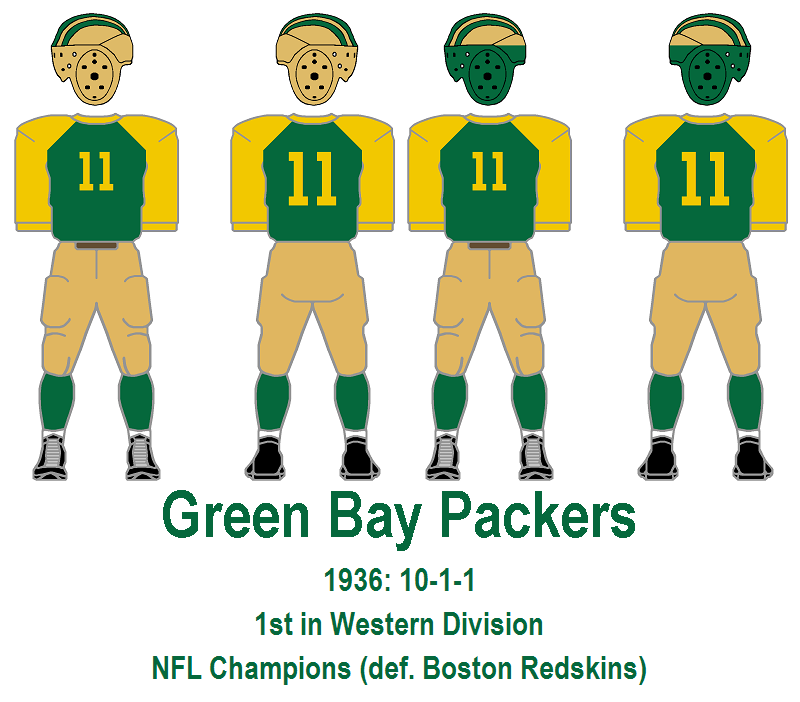
    This new uniform is based on this old uniform …
    … which, though the new uniforms are forest green, not the kelly green of the earlier uniforms …
    Green Bay Press–Gazette
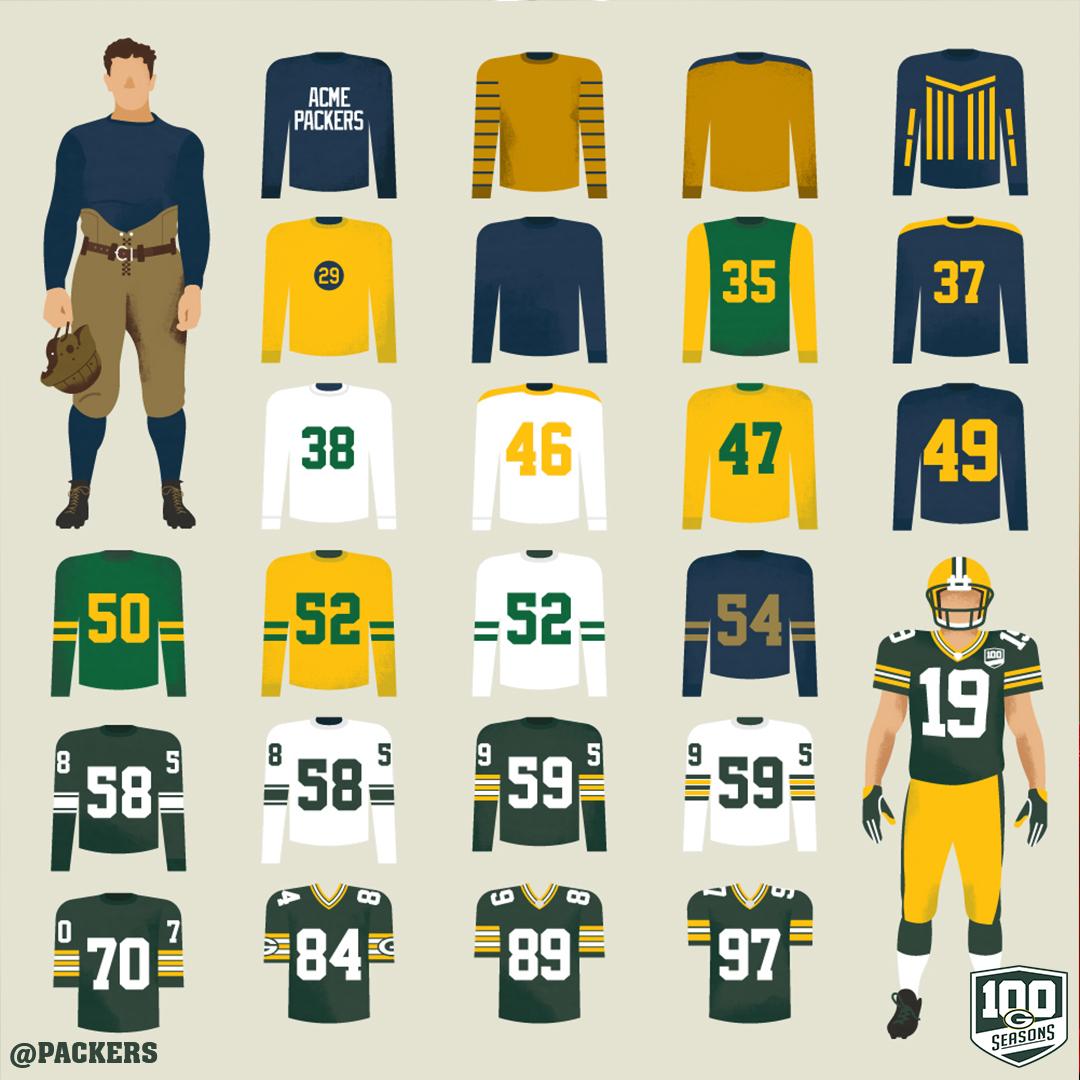
    … makes it a departure from the Packers’ previous throwbacks that were based on their navy-blue-and-gold days from founder (and one-year Notre Dame student) Curly Lambeau.
    Once the Packers unveiled green uniforms in 1935 …
    … they went back and forth between blue and green until Vince Lombardi said the Packers were the GREEN Bay Packers and would remain as such.
    As someone who hates the Blue Bay Packers look, not to mention the White Bay Packers look (for the Nike-mandated Color Rush, though white isn’t really a color for purposes of clothing), I believe these are superior for that reason alone, though I am not usually a fan of monochrome uniforms. The Packers should, in fact, redesign their road look to replace the gold pants with green pants when wearing the white jersey.

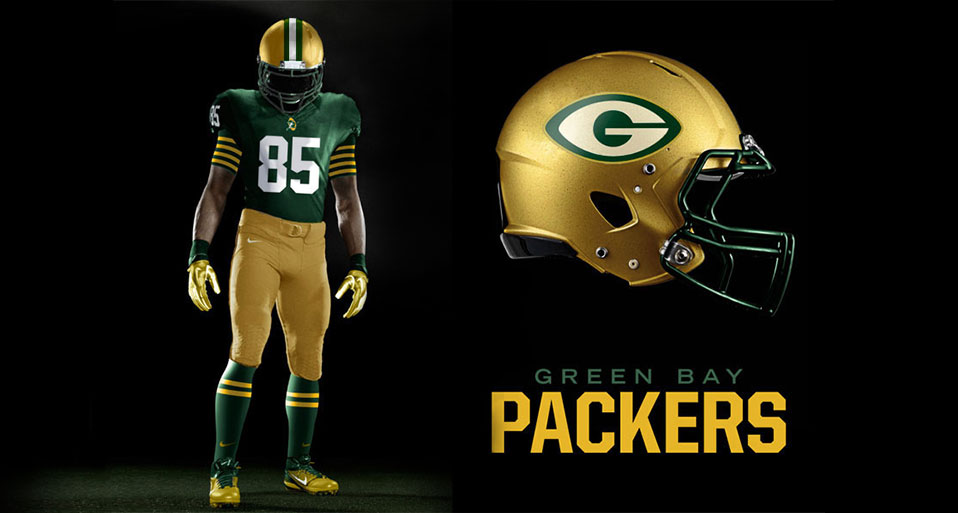
    I assert this (because I’m always right in this blog, and if you agree with me you’re right too) as someone who is not necessarily enamored with the green and gold look — specifically the “gold” part, which is more accurately described as “athletic gold” or “yellowgold,” basically a little bit darker than yellow. During the early 1950s apparently the Packers used a more metallic look …

    … which is preferable to me from their current yellowgold.

    (A Twin Cities sportswriter once described the Packers’ look as lemon and spinach. I have no problem with either description, but the writer should have included the Vikings colors — bruises and pus.)Other than the monochrome look, I have another issue:

    While the early 1950s were not a particularly successful time for the Packers on the field, it was the dawn of an extraordinarily eventful decade off the field, a decade that began with the departure of the team’s founder Curly Lambeau and ended with the arrival of Vince Lombardi. In the 1950s, the NFL was growing quickly and gaining nationwide interest through television exposure. The Packers organization was at a turning point and a franchise-saving stock sale helped lay the groundwork for the eventual construction of Lambeau Field and set up the team to stay in Green Bay through modern times.

    The first two seasons of green ended with the Packers’ 1937 title. The four seasons of the 1950–53 look that the Packers will debut against the don’t-call-them-Redskins-anymore were 3–9, 3–9, 6–6 and 2–9–1, which seems an era not worth commemorating. The rule of caring about how your team looks is that quality of look and quality of play are inextricably linked.

    Share this on …

    • Share on X (Opens in new window) X
    • Share on Facebook (Opens in new window) Facebook
    • Share on LinkedIn (Opens in new window) LinkedIn
    • Email a link to a friend (Opens in new window) Email
    • Print (Opens in new window) Print
    Like Loading…
    No comments on From the GREEN Bay Packers
  • Presty the DJ for Aug. 20

    August 20, 2021
    Music

    Today in 1965, the Rolling Stones released the song that would become their first number one hit, and yet Mick Jagger still claimed …

    Today in 1967, the New York Times reported on a method of reducing the noise recording devices make during recording. The inventor, Ray Dolby, had pioneered the process for studio recordings, but the Times story mentioned its potential for home use.

    Ray Dolby, by the way, is no known relation to the other Dolby …

    Today in 1987, Lindsey Buckingham refused to go out on tour with Fleetwood Mac for its “Tango in the Night” album, perhaps thinking that the road would make him …

    The band probably told him …

    … but look who came back a few years later …

    … only to be told don’t stop at the studio door.

    (more…)

    Share this on …

    • Share on X (Opens in new window) X
    • Share on Facebook (Opens in new window) Facebook
    • Share on LinkedIn (Opens in new window) LinkedIn
    • Email a link to a friend (Opens in new window) Email
    • Print (Opens in new window) Print
    Like Loading…
    No comments on Presty the DJ for Aug. 20
  • Vaccines and facemasks, and being wrong

    August 19, 2021
    US politics

    Jacob Sullum:

    Like many Americans, I do not like wearing a face mask, which hurts my ears, fogs my glasses, and makes my bearded face itch. And while I think businesses should be free to require face coverings as a safeguard against COVID-19, I am skeptical of government-imposed mask mandates, especially in K-12 schools.

    At the same time, I recognize that my personal peeves and policy preferences are logically distinct from the empirical question of how effective masks are at preventing virus transmission. From the beginning, however, the Great American Mask Debate has been strongly influenced by partisan and ideological commitments, with one side exaggerating the evidence in favor of this precaution and the other side ignoring or downplaying it.

    Last September, Robert Redfield, then the director of the Centers for Disease Control and Prevention (CDC), described masks as “the most important, powerful public health tool we have,” going so far as to say they provided more protection than vaccines would. In a 2020 New York Times op-ed piece, Michigan Gov. Gretchen Whitmer asserted that “wearing a mask has been proven to reduce the chance of spreading Covid-19 by about 70 percent”—a claim that even the CDC said was not scientifically justified.

    The CDC invited skepticism about the value of general mask wearing by dismissing ituntil April 2020, when the agency suddenly began recommending the practice as an important weapon against the pandemic. Although that memorable reversal supposedly was justified by evolving science, the main concern that the CDC cited—asymptomatic transmission—was a danger that had been recognized for months.

    When the CDC changed its advice, research on the effectiveness of face masks in preventing virus transmission was surprisingly sparse and equivocal. Although laboratory experiments supported the commonsensical assumption that almost any barrier to respiratory droplets, including DIY cloth coverings, was better than nothing, randomized controlled trials (RCTs) generally had not confirmed that intuition.

    A January 2021 review of the evidence in the Proceedings of the National Academy of Sciences found “no RCT for the impact of masks on community transmission of any respiratory infection in a pandemic.” The article, which also looked at observational studies, said “direct evidence of the efficacy of mask use is supportive, but inconclusive.”

    The authors then considered “a wider body of evidence,” including epidemiological analyses, laboratory studies, and information about COVID-19’s transmission characteristics. “The preponderance of evidence,” they concluded, “indicates that mask wearing reduces transmissibility per contact by reducing transmission of infected respiratory particles in both laboratory and clinical contexts.”

    In a “science brief” last updated on May 7, the CDC says “experimental and epidemiological data support community masking to reduce the spread of SARS-CoV-2.” But it acknowledges that “further research is needed to expand the evidence base for the protective effect of cloth masks.”

    Where does that leave Americans who are unpersuaded by the existing evidence? Banned from major social media platforms, if they are not careful.

    YouTube recently suspended Sen. Rand Paul’s account because of a video in which the Kentucky Republican said “most of the masks that you can get over the counter” have “no value.” Those statements ran afoul of YouTube’s ban on “claims that masks do not play a role in preventing the contraction or transmission of COVID-19,” which is similar to policies adopted by Facebook and Twitter.

    While conceding that “private companies have the right to ban me if they want to,” Paul said he was troubled by the fact that the leading social media platforms, partly in response to government pressure, seem to be insisting that users toe the official line on COVID-19. He has a point.

    Paul’s criticism of cloth masks was stronger than the science warrants, reflecting a broader tendency on the right to dismiss them as mere talismans without seriously addressing the evidence in their favor. But rational discourse entails rebutting arguments by citing contrary evidence instead of treating them as too dangerous for people to consider.

    Robby Soave:

    Officials at the Centers for Disease Control and Prevention (CDC) now think that many Americans will need booster shots in the coming months, and the Biden Administration has plans to make that happen. While the vaccines still provide remarkable protection against severe disease and death, recent studies suggest that an additional shot will help decrease transmission of the more infectious delta variant and prevent breakthrough cases.

    For vaccine-hesitant rightwing people—who constitute a substantial proportion of the anti-vax movement, though by no means the whole thing—the need for booster shots has been met with considerable opprobrium and even suggestions that this means the vaccines don’t work. Former President Trump called booster shots a “crazy” idea.

    “The whole thing is just crazy,” he said in a recent interview on Fox News. “It doesn’t—you wouldn’t think you would need a booster.”

    These comments will undoubtedly contribute to vaccine hesitancy and undermine confidence in booster shots; as such, this sort of talk is deeply irresponsible. It’s as if the former president doesn’t know any better, or just can’t help himself.

    So what’s The New York Times‘ excuse?

    Astonishingly, the paper of record has opted to give support to this Trumpian denial of vaccine efficacy. A recent news story by Times reporter Apoorva Mandavilli—whose articles on the pandemic have constituted some of the most fear-driven and pro-restriction writing appearing anywhere in the mainstream media—cast doubt on the need for boosters and suggested that people could “easily” obtain the same level of protection by wearing a mask instead.

    Mandavilli quotes Boston University epidemiologist Ellie Murray in opposition to booster shots for the general population:

    Dr. Murray said boosters would undoubtedly boost immunity in an individual, but the benefit may be minimal — and obtained just as easily by wearing a mask, or avoiding indoor dining and crowded bars.

    The administration’s emphasis on vaccines has undermined the importance of building other precautions into people’s lives in ways that are comfortable and sustainable, and on building capacity for testing, she and other experts said.

    “This is part of why I think the administration’s focus on vaccines is so damaging to morale,” she added. “We probably won’t be going back to normal anytime soon.”

    Note the agenda here: The “experts”—i.e., overly cautious epidemiologists picked by The New York Times to give weight to Team Blue’s quixotic COVID-19 mitigation preferences—think the focus on vaccines is damaging because it comes at the expense of a pro-lockdown, pro-masking, pro-social-distancing strategy. Vaccination, broadly speaking, lets most people live their lives like normal again; this is somehow viewed as a bad thing.

    These policy preferences are completely contrary to the reality of the human social experience. The health benefit of a booster shot is not “obtained just as easily by wearing a mask or avoiding indoor dining or crowded bars,” because wearing masks and eschewing conversation with other people is much more taxing than getting a shot. Many normal people actually like talking to people in bars and seeing human faces, so forgoing this indefinitely is not a trivial matter. (Note that the Times recently ran an op-ed piece titled: “Actually, Wearing a Mask Can Help Your Children Learn.”)

    If Trump deserves criticism for failing to urge his base to get their shots—and he does—then why should The New York Times get a pass for suggesting to its readers that regular masking is an effective substitute for booster shots? The Biden Administration frets constantly about COVID-19 misinformation being spread by right-wing accounts on social media. But Mandavilli is guilty of the same: She called the delta variant “as contagious as chicken pox” in an article that preached doom and gloom about the current state of the pandemic. It later turned out that this claim, sourced to an internal CDC document, originally appeared in an inaccurate NYT infographic.

    I wrote previously that the media’s enthusiasm for mask mandates is so strong that it occasionally seems as if some liberal and mainstream writers prefer masks to vaccines, even though the latter is a vastly superior tool for defeating COVID-19. Now The New York Times has said it quite explicitly: Who needs booster shots when experts say we can just wear masks forever?

    Share this on …

    • Share on X (Opens in new window) X
    • Share on Facebook (Opens in new window) Facebook
    • Share on LinkedIn (Opens in new window) LinkedIn
    • Email a link to a friend (Opens in new window) Email
    • Print (Opens in new window) Print
    Like Loading…
    No comments on Vaccines and facemasks, and being wrong
  • And you thought Trump was bad

    August 19, 2021
    International relations, US politics

    James Jay Carafano:

    Before President Joe Biden addressed the nation on the crisis in Afghanistan, someone should have reminded him of the adage “When you are in a deep hole, stop digging.” Because on top of his strategic failures in Afghanistan, he has now made a massive political misjudgment.

    Here is the problem with a White House rebuttal that just blames anybody other than Biden for the collapse in Afghanistan: Every claim can be fact-checked. Military and intelligence leaders can be asked to testify. Documents can be reviewed. None of this will make the administration or Biden’s abrupt and irresponsible decision look good.

    Remember when certain politicians found out that just blaming President George W. Bush for 9/11 and believing Michael Moore’s documentary didn’t work so well after the September 11 commission started calling witnesses and showing there was plenty of blame to go around for both Republicans and Democrats? Likewise, the Biden team will discover that truth finds a way, and a cover-up won’t cut it.

    Biden’s speech was a categorical disaster. His remarks were the equivalent of President Reagan claiming that Iran-Contra never happened. Of course, Reagan didn’t do that. He took responsibility. He fired people. He tried to be as transparent as possible and to cooperate with the subsequent investigation. He structured the crisis so he could move on and govern.

    By denying responsibility, Biden solidly made his decision-making the issue. He will have to live with the tsunami of inquiry that will follow.

    Now that Biden has put himself in the cross-hairs, he doesn’t have a lot of options. He can’t easily shift responsibility and fire people or have them resign. Anyone he tries to throw under the bus might well turn and point out the obvious—it was the president’s call to run away, not theirs.

    Biden will have to keep the team members he has. That’s also a problem because they’re terrible. This is not like the Jimmy Carter presidency, where inexperienced advisors made rookie mistakes. This is an experienced team of Obama veterans.

    Unfortunately, they are making the exact same kinds of missteps they made under Obama, ignoring risks, underestimating enemies, and being unprepared for the whirlwind that followed. The crisis mismanagement we are seeing play out in real-time today looks like an instant replay of Iraq, Syria, and Libya—where we got ISIS, a genocide, and a dead ambassador as payback for bad calls by the White House.

    Sure, Biden can now go back to his vacation, but the nightmare scenario will be waiting when he returns to the Oval Office. The failure in Afghanistan won’t look any better then. He will face massive political blowback. And he will have a demoralized, defeated team that doesn’t know how to turn defeat into victory.

    This is fixable. Biden could admit he screwed up and immediately commit to fixing his failures. He could start by dealing with the very real possibility of a near-term resurgence of transnational terrorism. There are demonstrable steps he can take right now to show he is getting ahead of the next 9/ll—like instead of demonizing Trump supporters, have the Homeland Security Department focus on its real job of hunting real terrorists.

    Unfortunately, the odds of a Biden presidency opting to fix problems instead of just shifting blame and dodging responsibility are pretty low. Months after making disastrous decisions triggering the worst border crisis in modern history, the Biden team is still in denial. The president has still not fixed THAT problem. In fact, the Oval Office has simply been a bystander while the border problem gets bigger.

    The White House may have thought abandoning Afghanistan was low-risk. Biden may have thought Americans didn’t care—but he forgot that Americans also don’t like to be lied to. They don’t like to be humiliated. They don’t like to have their safety and security jeopardized.

    Maybe they didn’t care before Biden’s folly, but they care now. If Biden does not address their concerns and deliver real fixes to the real mayhem he has created, they may conclude he’s just not up to the job.

    Share this on …

    • Share on X (Opens in new window) X
    • Share on Facebook (Opens in new window) Facebook
    • Share on LinkedIn (Opens in new window) LinkedIn
    • Email a link to a friend (Opens in new window) Email
    • Print (Opens in new window) Print
    Like Loading…
    No comments on And you thought Trump was bad
  • Presty the DJ for Aug. 19

    August 19, 2021
    Music

    How much money would you have paid for tickets for this concert at the Cow Palace in San Francisco today in 1964:

    (more…)

    Share this on …

    • Share on X (Opens in new window) X
    • Share on Facebook (Opens in new window) Facebook
    • Share on LinkedIn (Opens in new window) LinkedIn
    • Email a link to a friend (Opens in new window) Email
    • Print (Opens in new window) Print
    Like Loading…
    No comments on Presty the DJ for Aug. 19
  • Afghandisasterstan

    August 18, 2021
    International relations, US politics

    U.S. Rep. Dan Crenshaw (R–Texas), a U.S. Navy SEAL in Afghanistan:

    Almost everyone agrees that what’s happening in Afghanistan is an unmitigated disaster. There is no way to whitewash it, and few are trying. The scenes from Kabul speak for themselves, casting shame and embarrassment on the world’s greatest superpower. There is plenty of blame being passed around, including to the “neocons,” the generals and the Afghans themselves. But what got us here was the widespread belief that American foreign policy should be dictated by a simple slogan: “No more endless wars.” The current spokesman for that belief is President Biden.

    The argument for bringing the troops home is an emotional one, arising from exhaustion with overseas conflict. Most people don’t understand the situation in Afghanistan, and that causes distrust and anger. Few deny we needed to take action after 9/11, but few understood what our strategy would be after we got there. Leaders failed to explain that simply leaving would allow the Taliban to re-emerge and again provide safe haven for terrorists. Americans felt stuck and became exhausted over the years with the vast sums of money spent and lives lost, seemingly in a futile attempt to build democracy.

    With this growing impatience, the case for cutting our losses grew stronger. But it fails to acknowledge trade-offs—and this simple question: If we evacuate Afghanistan, what will happen? The “no more endless wars” crowd always refused to answer. They prefer to live in a dream world rather than face the reality that our enemies are ideologically opposed to Western civilization and will gladly stage another 9/11 if they have the opportunity and means. They are at war with us whether or not we are at war with them. Leaving Afghanistan would inevitably create a terrorist safe haven.

    That simple reality was never properly explained to the public. When Quinnipiac asked in a May survey, “Should we leave Afghanistan?” 62% of respondents said yes. But what if the question was framed more completely: “Should we leave Afghanistan even if it means an increased threat of terrorism to the homeland?”

    The “no more endless wars” position has another blind spot: Its advocates are unable to distinguish between wasteful nation building and a small residual force that conducts occasional counterterror operations. As a result, when many Americans hear that there is a single soldier on the ground in Afghanistan, they interpret it to mean “nation building” and “world police.”

    That’s wrong. There are a lot of foreign policy options between nation building and giving up. We found the proper balance in recent years—maintaining a small force that propped up the Afghan government while also giving us the capability to strike at Taliban and other terrorist networks as needed. When Echelon asked about the troop presence this way in July, more Americans, Republican and Democratic, supported a small military presence in Afghanistan than ending our presence entirely.

    The U.S. presence in Afghanistan was meeting the original strategic goal of denying a safe haven for terrorists and preventing another 9/11. The 18 months before withdrawal saw no U.S. combat deaths. Does that really sound like “endless war” in any traditional sense? More important, does it sound better or worse than the current outcome?

    Mr. Biden’s decision was reckless and unnecessary. Policy aside, there wasn’t even political pressure to take such thoughtless action. The facts on the ground didn’t warrant a hasty withdrawal, and intelligence predicted the Taliban would eventually take over. Even worse, this decision was made as the spring fighting season began, all but guaranteeing a Taliban offensive emboldened by the knowledge of an imminent U.S. withdrawal and a collapse of morale by our Afghan allies in uniform and in government.

    America didn’t lose a war, or even end one. We gave up on a strategic national-security interest. We gave up on our Afghan allies, expecting them to stave off a ruthless insurgency without our crucial support, which came at minimal cost to us. This administration’s actions are heartless, its justifications nonsensical. The consequences are dire for innocent Afghans and for America’s prestige. Twenty years after 9/11, I pray they don’t become equally dire for Americans at home.

    Share this on …

    • Share on X (Opens in new window) X
    • Share on Facebook (Opens in new window) Facebook
    • Share on LinkedIn (Opens in new window) LinkedIn
    • Email a link to a friend (Opens in new window) Email
    • Print (Opens in new window) Print
    Like Loading…
    No comments on Afghandisasterstan
Previous Page
1 … 230 231 232 233 234 … 1,056
Next Page

Website Powered by WordPress.com.

Steve Prestegard.com: The Presteblog

The thoughts of a journalist/libertarian–conservative/Christian husband, father, Eagle Scout and aficionado of obscure rock music. Thoughts herein are only the author’s and not necessarily the opinions of his family, friends, neighbors, church members or past, present or future employers.

  • Steve
    • About, or, Who is this man?
    • Facebook
    • Twitter
    • Adventures in ruralu0026nbsp;inkBack in June 2009, I was driving somewhere through a rural area. And for some reason, I had a flashback to two experiences in my career about that time of year many years ago. In 1988, eight days after graduating from the University of Wisconsin, I started work at the Grant County Herald Independent in Lancaster as a — well, the — reporter. Four years after that, on my 27th birthday, I purchased, with a business partner, the Tri-County Press in Cuba City, my first business venture. Both were experiences about which Wisconsin author Michael Perry might write. I thought about all this after reading a novel, The Deadline, written by a former newspaper editor and publisher. (Now who would write a novel about a weekly newspaper?) As a former newspaper owner, I picked at some of it — why finance a newspaper purchase through the bank if the seller is willing to finance it? Because the mean bank lender is a plot point! — and it is much more interesting than reality, but it is very well written, with a nicely twisting plot, and quite entertaining, again more so than reality. There is something about that first job out of college that makes you remember it perhaps more…
    • Adventures in radioI’ve been in the full-time work world half my life. For that same amount of time I’ve been broadcasting sports as a side interest, something I had wanted to since I started listening to games on radio and watching on TV, and then actually attending games. If you ask someone who’s worked in radio for some time about the late ’70s TV series “WKRP in Cincinnati,” most of them will tell you that, if anything, the series understated how wacky working in radio can be. Perhaps the funniest episode in the history of TV is the “WKRP” episode, based on a true story, about the fictional radio station’s Thanksgiving promotion — throwing live turkeys out of a helicopter under the mistaken belief that, in the words of WKRP owner Arthur Carlson, “As God is my witness, I thought turkeys could fly.” [youtube=http://www.youtube.com/watch?v=ST01bZJPuE0] I’ve never been involved in anything like that. I have announced games from the roofs of press boxes (once on a nice day, and once in 50-mph winds), from a Mississippi River bluff (more on that later), and from the front row of the second balcony of the University of Wisconsin Fieldhouse (great view, but not a place to go if…
    • “Good morning/afternoon/evening, ________ fans …”
    • My biggest storyEarlier this week, while looking for something else, I came upon some of my own work. (I’m going to write a blog someday called “Things I Found While Looking for Something Else.” This is not that blog.) The Grant County Sheriff’s Department, in the county where I used to live, has a tribute page to the two officers in county history who died in the line of duty. One is William Loud, a deputy marshal in Cassville, shot to death by two bank robbers in 1912. The other is Tom Reuter, a Grant County deputy sheriff who was shot to death at the end of his 4 p.m.-to-midnight shift March 18, 1990. Gregory Coulthard, then a 19-year-old farmhand, was convicted of first-degree intentional homicide and is serving a life sentence, with his first eligibility for parole on March 18, 2015, just 3½ years from now. I’ve written a lot over the years. I think this, from my first two years in the full-time journalism world, will go down as the story I remember the most. For journalists, big stories contain a paradox, which was pointed out in CBS-TV’s interview of Andy Rooney on his last “60 Minutes” Sunday. Morley Safer said something along the line…
  • Food and drink
    • The Roesch/Prestegard familyu0026nbsp;cookbookFrom the family cookbook(s) All the families I’m associated with love to eat, so it’s a good thing we enjoy cooking. The first out-of-my-house food memory I have is of my grandmother’s cooking for Christmas or other family occasions. According to my mother, my grandmother had a baked beans recipe that she would make for my mother. Unfortunately, the recipe seems to have  disappeared. Also unfortunately, my early days as a picky, though voluminous, eater meant I missed a lot of those recipes made from such wholesome ingredients as lard and meat fat. I particularly remember a couple of meals that involve my family. The day of Super Bowl XXXI, my parents, my brother, my aunt and uncle and a group of their friends got together to share lots of food and cheer on the Packers to their first NFL title in 29 years. (After which Jannan and I drove to Lambeau Field in the snow,  but that’s another story.) Then, on Dec. 31, 1999, my parents, my brother, my aunt and uncle and Jannan and I (along with Michael in utero) had a one-course-per-hour meal to appropriately end years beginning with the number 1. Unfortunately I can’t remember what we…
    • SkålI was the editor of Marketplace Magazine for 10 years. If I had to point to one thing that demonstrates improved quality of life since I came to Northeast Wisconsin in 1994, it would be … … the growth of breweries and  wineries in Northeast Wisconsin. The former of those two facts makes sense, given our heritage as a brewing state. The latter is less self-evident, since no one thinks of Wisconsin as having a good grape-growing climate. Some snobs claim that apple or cherry wines aren’t really wines at all. But one of the great facets of free enterprise is the opportunity to make your own choice of what food and drink to drink. (At least for now, though some wish to restrict our food and drink choices.) Wisconsin’s historically predominant ethnic group (and our family’s) is German. Our German ancestors did unfortunately bring large government and high taxes with them, but they also brought beer. Europeans brought wine with them, since they came from countries with poor-quality drinking water. Within 50 years of a wave of mid-19th-century German immigration, brewing had become the fifth largest industry in the U.S., according to Maureen Ogle, author of Ambitious Brew: The Story of American Beer. Beer and wine have…
  • Wheels
    • America’s sports carMy birthday in June dawned without a Chevrolet Corvette in front of my house. (The Corvette at the top of the page was featured at the 2007 Greater Milwaukee Auto Show. The copilot is my oldest son, Michael.) Which isn’t surprising. I have three young children, and I have a house with a one-car garage. (Then again, this would be more practical, though a blatant pluck-your-eyes-out violation of the Corvette ethos. Of course, so was this.) The reality is that I’m likely to be able to own a Corvette only if I get a visit from the Corvette Fairy, whose office is next door to the Easter Bunny. (I hope this isn’t foreshadowing: When I interviewed Dave Richter of Valley Corvette for a car enthusiast story in the late great Marketplace Magazine, he said that the most popular Corvette in most fans’ minds was a Corvette built during their days in high school. This would be a problem for me in that I graduated from high school in 1983, when no Corvette was built.) The Corvette is one of those cars whose existence may be difficult to understand within General Motors Corp. The Corvette is what is known as a “halo car,” a car that drives people into showrooms, even if…
    • Barges on fouru0026nbsp;wheelsI originally wrote this in September 2008.  At the Fox Cities Business Expo Tuesday, a Smart car was displayed at the United Way Fox Cities booth. I reported that I once owned a car into which trunk, I believe, the Smart could be placed, with the trunk lid shut. This is said car — a 1975 Chevrolet Caprice coupe (ours was dark red), whose doors are, I believe, longer than the entire Smart. The Caprice, built down Interstate 90 from us Madisonians in Janesville (a neighbor of ours who worked at the plant probably helped put it together) was the flagship of Chevy’s full-size fleet (which included the stripper Bel Air and middle-of-the-road Impala), featuring popular-for-the-time vinyl roofs, better sound insulation, an upgraded cloth interior, rear fender skirts and fancy Caprice badges. The Caprice was 18 feet 1 inch long and weighed 4,300 pounds. For comparison: The midsize Chevrolet of the ear was the Malibu, which was the same approximate size as the Caprice after its 1977 downsizing. The compact Chevrolet of the era was the Nova, which was 200 inches long — four inches longer than a current Cadillac STS. Wikipedia’s entry on the Caprice has this amusing sentence: “As fuel economy became a bigger priority among Americans…
    • Behind the wheel
    • Collecting only dust or rust
    • Coooooooooooupe!
    • Corvettes on the screen
    • The garage of misfit cars
    • 100 years (and one day) of our Chevrolets
    • They built Excitement, sort of, once in a while
    • A wagon by any otheru0026nbsp;nameFirst written in 2008. You will see more don’t-call-them-station-wagons as you drive today. Readers around my age have probably had some experience with a vehicle increasingly rare on the road — the station wagon. If you were a Boy Scout or Girl Scout, or were a member of some kind of youth athletic team, or had a large dog, or had relatives approximately your age, or had friends who needed to be transported somewhere, or had parents who occasionally had to haul (either in the back or in a trailer) more than what could be fit inside a car trunk, you (or, actually, your parents) were the target demographic for the station wagon. “Station wagons came to be like covered wagons — so much family activity happened in those cars,” said Tim Cleary, president of the American Station Wagon Owners Association, in Country Living magazine. Wagons “were used for everything from daily runs to the grocery store to long summer driving trips, and while many men and women might have wanted a fancier or sportier car, a station wagon was something they knew they needed for the family.” The “station wagon” originally was a vehicle with a covered seating area to take people between train stations…
    • Wheels on theu0026nbsp;screenBetween my former and current blogs, I wrote a lot about automobiles and TV and movies. Think of this post as killing two birds (Thunderbirds? Firebirds? Skylarks?) with one stone. Most movies and TV series view cars the same way most people view cars — as A-to-B transportation. (That’s not counting the movies or series where the car is the plot, like the haunted “Christine” or “Knight Rider” or the “Back to the Future” movies.) The philosophy here, of course, is that cars are not merely A-to-B transportation. Which disqualifies most police shows from what you’re about to read, even though I’ve watched more police video than anything else, because police cars are plain Jane vehicles. The highlight in a sense is in the beginning: The car chase in my favorite movie, “Bullitt,” featuring Steve McQueen’s 1968 Ford Mustang against the bad guys’ 1968 Dodge Charger: [youtube=http://www.youtube.com/watch?v=GMc2RdFuOxIu0026amp;fmt=18] One year before that (but I didn’t see this until we got Telemundo on cable a couple of years ago) was a movie called “Operación 67,” featuring (I kid you not) a masked professional wrestler, his unmasked sidekick, and some sort of secret agent plot. (Since I don’t know Spanish and it’s not…
    • While riding in my Cadillac …
  • Entertainments
    • Brass rocksThose who read my former blog last year at this time, or have read this blog over the past months, know that I am a big fan of the rock group Chicago. (Back when they were a rock group and not a singer of sappy ballads, that is.) Since rock music began from elements of country music, jazz and the blues, brass rock would seem a natural subgenre of rock music. A lot of ’50s musical acts had saxophone players, and some played with full orchestras … [youtube=http://www.youtube.com/watch?v=9CPS-WuUKUE] … but it wasn’t until the more-or-less simultaneous appearances of Chicago and Blood Sweat u0026amp; Tears on the musical scene (both groups formed in 1967, both had their first charting singles in 1969, and they had the same producer) that the usual guitar/bass/keyboard/drum grouping was augmented by one or more trumpets, a sax player and a trombone player. While Chicago is my favorite group (but you knew that already), the first brass rock song I remember hearing was BSu0026amp;T’s “Spinning Wheel” — not in its original form, but on “Sesame Street,” accompanied by, yes, a giant spinning wheel. [youtube=http://www.youtube.com/watch?v=qi9sLkyhhlE] [youtube=http://www.youtube.com/watch?v=OxWSOuNsN20] [youtube=http://www.youtube.com/watch?v=U9U34uPjz-g] I remember liking Chicago’s “Just You ‘n Me” when it was released as a single, and…
    • Drive and Eat au0026nbsp;RockThe first UW home football game of each season also is the opener for the University of Wisconsin Marching Band, the world’s finest college marching band. (How the UW Band has not gotten the Sudler Trophy, which is to honor the country’s premier college marching bands, is beyond my comprehension.) I know this because I am an alumnus of the UW Band. I played five years (in the last rank of the band, Rank 25, motto: “Where Men Are Tall and Run-On Is Short”), marching in 39 football games at Camp Randall Stadium, the Hubert H. Humphrey Metrodome in Minneapolis, Michigan Stadium in Ann Arbor, Memorial Stadium at the University of Illinois (worst artificial turf I had ever seen), the University of Nevada–Las Vegas’ Sam Boyd Silver Bowl, the former Dyche Stadium at Northwestern University, five high school fields and, in my one bowl game, Legion Field in Birmingham, Ala., site of the 1984 Hall of Fame Bowl. The UW Band was, without question, the most memorable experience of my college days, and one of the most meaningful experiences of my lifetime. It was the most physical experience of my lifetime, to be sure. Fifteen minutes into my first Registration…
    • Keep on rockin’ in the freeu0026nbsp;worldOne of my first ambitions in communications was to be a radio disc jockey, and to possibly reach the level of the greats I used to listen to from WLS radio in Chicago, which used to be one of the great 50,000-watt AM rock stations of the country, back when they still existed. (Those who are aficionados of that time in music and radio history enjoyed a trip to that wayback machine when WLS a Memorial Day Big 89 Rewind, excerpts of which can be found on their Web site.) My vision was to be WLS’ afternoon DJ, playing the best in rock music between 2 and 6, which meant I wouldn’t have to get up before the crack of dawn to do the morning show, yet have my nights free to do whatever glamorous things big-city DJs did. Then I learned about the realities of radio — low pay, long hours, zero job security — and though I have dabbled in radio sports, I’ve pretty much cured myself of the idea of working in radio, even if, to quote WAPL’s Len Nelson, “You come to work every day just like everybody else does, but we’re playing rock ’n’ roll songs, we’re cuttin’ up.…
    • Monday on the flight line, not Saturday in the park
    • Music to drive by
    • The rock ofu0026nbsp;WisconsinWikipedia begins its item “Music of Wisconsin” thusly: Wisconsin was settled largely by European immigrants in the late 19th century. This immigration led to the popularization of galops, schottisches, waltzes, and, especially, polkas. [youtube=http://www.youtube.com/watch?v=yl7wCczgNUc] So when I first sought to write a blog piece about rock musicians from Wisconsin, that seemed like a forlorn venture. Turned out it wasn’t, because when I first wrote about rock musicians from Wisconsin, so many of them that I hadn’t mentioned came up in the first few days that I had to write a second blog entry fixing the omissions of the first. This list is about rock music, so it will not include, for instance, Milwaukee native and Ripon College graduate Al Jarreau, who in addition to having recorded a boatload of music for the jazz and adult contemporary/easy listening fan, also recorded the theme music for the ’80s TV series “Moonlighting.” Nor will it include Milwaukee native Eric Benet, who was for a while known more for his former wife, Halle Berry, than for his music, which includes four number one singles on the Ru0026amp;B charts, “Spend My Life with You” with Tamia, “Hurricane,” “Pretty Baby” and “You’re the Only One.” Nor will it include Wisconsin’s sizable contributions to big…
    • Steve TV: All Steve, All the Time
    • “Super Steve, Man of Action!”
    • Too much TV
    • The worst music of allu0026nbsp;timeThe rock group Jefferson Airplane titled its first greatest-hits compilation “The Worst of Jefferson Airplane.” Rolling Stone magazine was not being ironic when it polled its readers to decide the 10 worst songs of the 1990s. I’m not sure I agree with all of Rolling Stone’s list, but that shouldn’t be surprising; such lists are meant for debate, after all. To determine the “worst,” songs appropriate for the “Vinyl from Hell” segment that used to be on a Madison FM rock station, requires some criteria, which does not include mere overexposure (for instance, “Macarena,” the video of which I find amusing since it looks like two bankers are singing it). Before we go on: Blog posts like this one require multimedia, so if you find a song you hate on this blog, I apologize. These are also songs that I almost never listen to because my sound system has a zero-tolerance policy — if I’m listening to the radio or a CD and I hear a song I don’t like, it’s, to quote Bad Company, gone gone gone. My blonde wife won’t be happy to read that one of her favorite ’90s songs, 4 Non Blondes’ “What’s Up,” starts the list. (However,…
    • “You have the right to remain silent …”
  • Madison
    • Blasts from the Madison media past
    • Blasts from my Madison past
    • Blasts from our Madison past
    • What’s the matter with Madison?
    • Wisconsin – Madison = ?
  • Sports
    • Athletic aesthetics, or “cardinal” vs. “Big Red”
    • Choose your own announcer
    • La Follette state 1982 (u0022It was 30 years ago todayu0022)
    • The North Dakota–Wisconsin Hockey Fight of 1982
    • Packers vs. Brewers
  • Hall of Fame
    • The case(s) against teacher unions
    • The Class of 1983
    • A hairy subject, or face the face
    • It’s worse than you think
    • It’s worse than you think, 2010–11 edition
    • My favorite interview subject of all time
    • Oh look! Rural people!
    • Prestegard for president!
    • Unions vs. the facts, or Hiding in plain sight
    • When rhetoric goes too far
Privacy & Cookies: This site uses cookies. By continuing to use this website, you agree to their use.
To find out more, including how to control cookies, see here: Cookie Policy
Loading Comments...
  • Subscribe Subscribed
    • Steve Prestegard.com: The Presteblog
    • Join 193 other subscribers
    • Already have a WordPress.com account? Log in now.
    • Steve Prestegard.com: The Presteblog
    • Subscribe Subscribed
    • Sign up
    • Log in
    • Report this content
    • View site in Reader
    • Manage subscriptions
    • Collapse this bar
%d