David Bowie fans might remember today for two reasons. In 1974, his “Diamond Dog” tour ended in New York City …
… six years before he appeared in Denver as the title character of “The Elephant Man.”
No comments on Presty the DJ for July 19
David Bowie fans might remember today for two reasons. In 1974, his “Diamond Dog” tour ended in New York City …
… six years before he appeared in Denver as the title character of “The Elephant Man.”
Two Beatles anniversaries of note today: The movie “Yellow Submarine” premiered in London …
… six years before John Lennon was ordered to leave the U.S. within 60 days. (He didn’t.)
The 1970 Summerfest started today with a pretty good lineup:

Birthdays today start with pianist Vince Guaraldi. Who? The creator of the Charlie Brown theme (correct name: “Linus and Lucy”):
I have been too busy (including vacation) to comment on the Bucks’ trip to the NBA Finals before now.
But Wednesday night’s 109–103 win that tied the Finals at two wins each requires me to post this from the Arizona Republic:
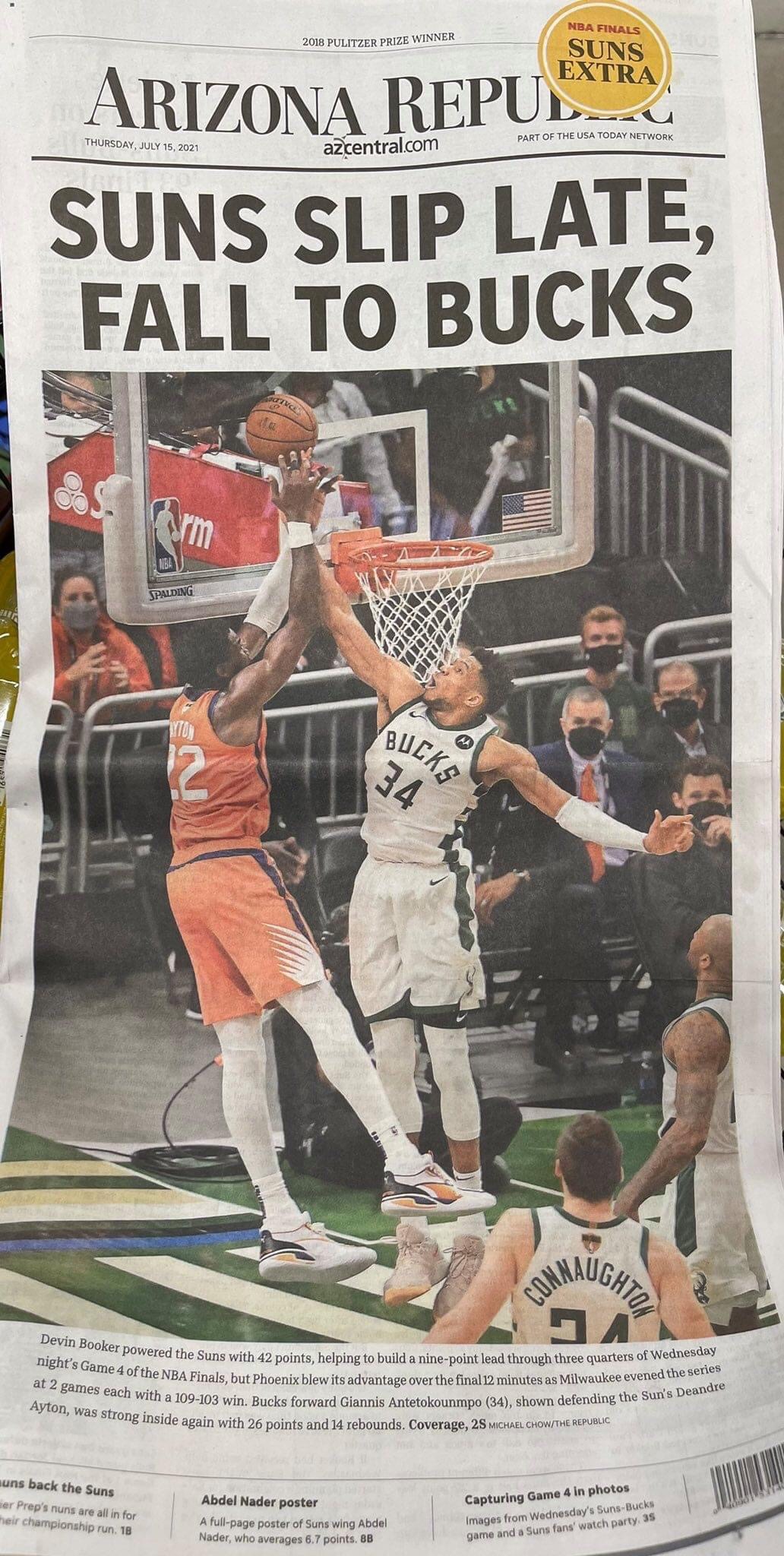
The Phoenix Suns had turned each of their previous three playoffs series in their favor with Game 4 victories on the road.
Not this time in the NBA Finals.
The Milwaukee Bucks withstood a mega 42-point effort from Devin Booker by forcing 17 turnovers that led to 24 points in topping the second-seeded Suns, 109-103, in Wednesday’s Game 4 to even the series before a charged sellout crowd of 16,911 at Fiserv Forum.
“The turnovers just crushed us tonight,” said Suns coach Monty Williams as the third-seeded Bucks also got 17 offensive rebounds and 19 second-chance points.
“We shot 50% from the field, but they got 19 more possessions. Over the course of the game when you just give it up that many times, the turnovers and offensive rebounding was a bit of a hill for us to climb.”
The fans chanted “Bucks in 6!” as Game 5 is set for Saturday at Phoenix Suns Arena.
“How bad do you want it? How bad do you really want it,” Bucks All-Star Giannis Antetokounmpo said. “And just leave-the-game-swinging kind of mentality. Try to be aggressive. Try to get stops. Try to set screens. Do everything physically possible to put yourself in a position to win this game. I think everybody was feeling that. That’s what we did.”
Phoenix had won its previous Game 4s in its journey to the finals.
- at Los Angeles Lakers: Won 100-92. Tied series at 2-2 (Won in six).
- at Denver Nuggets: Won 116-102. Took 3-0 series lead (Won in four).
- at Los Angele Clippers: Won 84-80. Took 3-1 series lead (Won in six).
Again, not this time.
Khris Middleton scored a team-high 40 points with 14 coming in the fourth quarter while Antetokounmpo added 26 points, 14 rebounds and eight assists to just one turnover as the Bucks won Game 3 and 4 at home in this best-of-7 series.
“You need somebody who can make those shots,” Bucks coach Mike Budenholzer said. “He and Giannis in a pick-and-roll, Giannis setting great screens. Khris, I thought he had some good looks kind of early. But then he just stayed with it. Credit to him. A lot of big, tough shots, and then the tough finish in transition. He was special. A lot of good stuff from Khris. And defensively, too, I think he’s given us a lot on that end.”
The Bucks overcame a seven-point deficit with 8:39 left in the fourth quarter to even the series. Game 6 will be back in Milwaukee on Tuesday.
Game 7, if necessary, will be July 22 in Phoenix.
“When you have that kind of a lead in the fourth, if we can just hold on to the ball and get good possessions, you feel like you can at least hold it there,” Williams said. “So I got to look at the film and see, was it schematics or was it just their defense, I’m not quite sure yet, but we certainly had a lot of self-inflicted stuff tonight.”
The Bucks closed the game on a 27-14 run as Middleton gave the Bucks the lead for good, 101-99, on a jumper with 1:28 left.
Fourteen seconds later, Antetokounmpo, the 2019-20 NBA Defensive Player of the Year, followed that up with a massive block of Deandre Ayton’s lob dunk.
“I thought I was going to get dunked on, to be honest with you,” the two-time MVP said. “But you know, going down the stretch, just do whatever it takes to win the game. Just put yourself in a position that can win the game. I saw the play coming. I saw that Chris was going to throw the lob and I was just going to jump vertical toward the rim. Hopefully I can be there in time, and I was there in time and was able to get a good block.
The loss puts a damper of the performance of Booker, who bounced back from a career playoff-low 10-point effort in Game 3 to post his third 40-point game this postseason.
“You knew it was going to happen,” Suns wing Cam Johnson said. “You knew he wasn’t going to have another tough night. You know he’s going to get to it and he’s going to get buckets. That’s just what he does. He’s a great player. He’s one of the best players in our league.”
Booker set a record for most points scored in his first postseason run as he has 542 in the playoffs, but didn’t find much comfort in his special Game 4 performance.
“It doesn’t matter at all,” Booker said. “I said that after last game too, when I struggled shooting it. The main objective is to win the game. So anything that goes on throughout the game, it doesn’t matter, for real.”
Phoenix led 82-76 going into the fourth quarter as Booker had 18 points in the third quarter on a perfect 7-of-7 shooting.
The Suns shot 70.6% from the field in the quarter (12-of-17).
However, Booker picked up his fifth foul with 10:50 left in the fourth.
The Suns were up six, 85-79, when Cameron Payne replaced Booker and led, 93-90, when Booker returned with 5:55 remaining.
“He could have gone for 50-plus tonight,” Williams said. “I wanted to get him in maybe a minute earlier than I did, you’re just holding on trying to get as many stops and solid possessions as you can, but it’s not an ideal situation, but I thought we managed it well.”
Booker didn’t get called for another foul, but had two instances when the whistle could’ve easily blown against him. He grabbed Jrue Holiday in transition with 3:38 left in the game, but wasn’t called for the foul.
After the game, lead official James Capers said Booker should’ve been called for the foul on that play.
“During live play, I saw a clean sweep of the ball and thought it was a no call,” Capers said. “However, after seeing the replay, I now realize that I missed Booker’s right arm around the waist of Holiday, and it should have been a defensive foul on the play.”
The Suns went into halftime tied at 52-52 as Booker led all scorers with 20 on 8-of-15 shooting after scoring just 10 in Game 3 on 3-of-14 shooting.
Mikal Bridges added seven points in the first half as the Suns led by as many as nine in the first half. Chris Paul managed just two points in the first half on 1-4 shooting.
Paul finished the game with 10 points and a game-high five turnovers.
The Bucks, as a team, had five total turnovers.
“It was me, I had five of them,” said Paul about the turnovers. “It was bad decision making. That time we were down two and I tried to cross over right there, slipped, turned it over. I had some bad passes in the first half. They got a significant amount more shots than us, so for me I got to take care of the ball.”
His last turnover led to a Middleton layup on the other end to put Milwaukee ahead, 103-99, with 27.2 seconds left.
Usually so careful with the ball, Paul has totaled 15 turnovers in the last three games. When asked if Paul was physically OK, Williams said the 16-year veteran was fine.
“Great players have games like that,” Williams said. “We expect him to bounce back. He had five (turnovers), but we had 17 and they scored 24 points, you know what I mean? That was pretty much the game right there. Then you double that up with the offensive rebounding, so it wasn’t just Chris. As a team tonight, we got to take better care of the ball.”
Bridges didn’t score again after halftime as he took just four shots for the game, marking the second straight game he didn’t score double figures after posting a career playoff-high 27 in a Game 2 win in Phoenix.
This is a slow day in rock music, save for one particular birthday and one death.
It’s not Tony Jackson of the Searchers …
… or Tom Boggs, drummer for the Box Tops …
Benny Avni:
When I first got a whiff a while back of the plot, I thought, no way: Even the Iranian regime wouldn’t undermine the nuclear talks in Vienna by kidnapping a journalist as distinguished as Masih Alinejad. Then another thought nagged me: What if the Biden administration, eager to cut a deal with Tehran, would prevent the Feds from indicting, and airing the case in public.
Turns out I was wrong — up to a point — on both counts.
All I knew earlier was that FBI agents had shown Ms. Alinejad high-resolution photographs and videos that were taken by someone that might have worked for, or with, the Iranian camarilla. The G-men told her she was in danger. She and her husband, the journalist Kambiz Foroohar, were hustled to safe houses for their protection and told to cancel all planned international travel. Later, when they returned home to Brooklyn, an NYPD squad car was stationed constantly in front of their house.
On Tuesday night the Justice Department unsealed an indictment against five Iranian agents. Although FBI Assistant Director William F. Sweeney, Jr., was quoted in the indictment as saying “this is not some far fetched movie plot,” it sure sounded like one.
The pictures and videos I heard of included depictions of Ms. Alinejad and Mr. Foroohar, their daily routines, their Brooklyn home, the garden in front of it — the works. They were shot by an apparently unsuspecting American detective, hired by Iranian agents. They’s said he’d aid an investigation into an uncollected debt from someone who escaped to Dubai.
Other details were even more ominous. One of the conspirators researched military-type speed boats to learn which, after an abduction of Ms. Alinejad, could transport her by sea from the Brooklyn waterfront to Venezuela, where she’d be speedily transferred to Iran. Similar abductions of dissidents, including one from France, have ended up in death.
The Iranian regime has attempted to kidnap Ms. Alinejad before. In her autobiographical book, “The Wind In My Hair,” the Iranian-born Brooklynite details how she canceled a trip to Turkey, where she was told she could meet family members. Just in time she realized the plan was merely a setup by Iran to abduct her.
When Ms. Alinejad first learned of the new plot eight months ago, she was really scared, she told Voice of America’s Farsi Service, where she has a radio show.
Then she concluded that the mullahs are now more scared of her than she is of them. That is because her simple but powerful message, combined with an engaging personality and unparalleled on-air charisma, are so subversive to a rigid regime like Iran’s. It means that she really does threaten its hold on power.
I witnessed Ms. Alinejad’s ability to engage audiences and rouse feelings a while back, in one of our first meetings. She constantly fiddled with her iPhone, posting endless messages and videos to her millions of followers on Telegram, Facebook, and other social media — all without missing a beat on our conversation.
At one point she even managed to get a whole flock of Long Island wild turkeys to answer her bird call loudly, and approvingly. (I suggested she should enter, and win, Kentucky’s annual turkey calling contest.)
While the entire world was busy arguing about resolving Tehran’s nuclear threat, Ms. Alinejad, a journalist who escaped Iran after calling out regime officials, developed a much simpler message: Why should any woman hide a beautiful shock of hair like hers under a hijab, as the Iranian law dictates.
That query became a powerful symbol of the clerical regime’s oppression of women (and also of men). Her followers regularly post selfies as they remove mandatory hair coverings in public squares or defy the ban on women entering sports stadiums. Many of the women get arrested but, inspired by Ms. Alinejad, they remain defiant.
Ms. Alinejad says the kidnapping plot will not deter her from fighting for human rights in Iran. Will America now back her? President Biden vowed to place human rights on top of his foreign policy. Ms. Alinejad’s campaign, however, got no recognition from the administration.
Unlike Secretary of State Pompeo, who warmly and publicly hosted her at the State Department in 2019, Secretary Blinken has yet to meet or acknowledge her feminist message. On Tuesday night the State Department issued a bland statement, generically calling on the Iranian regime to respect human rights and freedom of expression, adding that the kidnapping plot “is a law enforcement matter and we refer you to the Department of Justice for any further inquiries.”
Really? As the FBI’s Mr. Sweeney said in the indictment, “We allege a group, backed by the Iranian government, conspired to kidnap a U.S. based journalist here on our soil and forcibly return her to Iran.” What part of “backed by the Iranian government” is no “matter” for our top diplomats? At least Washington could now demand the release of Alireza Alinejad, who was arrested, convicted in a show trial and sentenced to eight years in Iranian dungeons for the “crime” of being Masih Alinejad’s brother.
To add insult to injury, the administration announced, on the day Justice unsealed the indictment, the removal of Iranian oil executives from a list of sanctioned regime officials. It was almost as if Washington rewarded Tehran for a failed plot to seize an American woman on our own soil.
Sure enough, administration officials are making clear to reporters who ask about the indictment fallout that they remain eager to renew a nuclear deal that, if nothing else, fail to end the ayatollah’s nuclear ambitions while making Tehran’s oppressors flush with cash and assuring their survival in power.
A new poll finds a majority of voters are ready for Gov. Tony Evers to hit the road, with 60 percent of those surveyed saying Wisconsin is on the wrong track.
The statewide survey from pollster Cygnal, conducted July 6-8, finds voters have a net-unfavorable view of the Democrat’s performance. Cygnal surveyed 640 general election voters in the Badger State, and found 52 percent oppose a second term for Evers. The governor last month announced that he is running for re-election.
Evers runs just behind a generic GOP challenger (the poll didn’t pit Evers against possible Republican candidates) — with 47.5 percent supporting a Republican contestant, and 46.9 percent saying they would vote for Evers.
The poll finds Evers is vulnerable on some key issues — problems that he has made worse. Seventy-six percent of respondents have heard about or have experienced trouble filling jobs. Evers recently vetoed a Republican bill that would end the federal unemployment bonus payment. At $300 weekly, businesses and economic experts say the subsidy is keeping jobless Wisconsinites from looking for work during a worker shortage crisis.
More than half of voters are less likely to support Evers because of his lack of action on unemployment benefits. The Evers administration’s slow response to last year’s flood of unemployment claims has been roundly criticized.
Voters are split on whether they’d vote for him or “a Republican candidate” if the gubernatorial election was held today, according to the poll.
President Joe Biden is under water in Wisconsin, too. The poll finds the Democrat has a -6 net favorable rating and 50 percent don’t approve of the job he’s doing. Inflation is a key concern. Eighty percent of respondents say they are worried about rapidly rising prices.
Evers has been bragging about how much money he’s raised. Maybe he should be more concerned with, you know, votes. One poll does not a trend make, but maybe the Democratic Party should think about whether Evers is the candidate they want as their puppet next year.
The 2022 election won’t merely be interesting for the governor’s race. Lt. Gov. Mandela Barnes is widely rumored to be running for U.S. Senate (a race with seven Democrats so far), meaning there could be a new lieutenant governor candidate. If I were one of those seven Democrats, I’d be very concerned with Biden’s negative approval rating.
Matt Taibbi, not a conservative:
On Monday, June 28th, Fox host Tucker Carlson dropped a bomb mid-show, announcing he’d been approached by a “whistleblower” who told him he was being spied on by the NSA.
“The National Security Agency is monitoring our electronic communications,” he said, “and is planning to leak them in an attempt to take this show off the air.”
The reaction was swift, mocking, and ferocious. “Carlson is sounding more and more like InfoWars host and notorious conspiracy theorist, Alex Jones,” chirped CNN media analyst Brian Stelter. Vox ripped Carlson as a “serial fabulist” whose claims were “evidence-free.” The Washington Post quipped that “in a testament to just how far the credibility of Tucker Carlson Tonighthas cratered,” even groups like Pen America and the Reporters Committee on the Freedom of the Press were no-commenting the story, while CNN learned from its always-reliable “people familiar with the matter” that even Carlson’s bosses at Fox didn’t believe him.
None of this was surprising. A lot of media people despise Carlson. He may be Exhibit A in the n+2 epithet phenomenon that became standard math in the Trump era, i.e. if you thought he was an “asshole” in 2015 you jumped after Charlottesville straight past racist to white supremacist, and stayed there. He’s spoken of in newsrooms in hushed tones, like a mythical monster. The paranoid rumor that he’s running for president (he’s not) comes almost entirely from a handful of editors and producers who’ve convinced themselves it’s true, half out of anxiety and half subconscious desperation to find a click-generating replacement for Donald Trump.
The NSA story took a turn on the morning of July 7th last week, when Carlson went on Maria Bartiromo’s program. He said that it would shortly come out that the NSA “leaked the contents of my email to journalists,” claiming he knew this because one of them called him for comment. On cue, hours later, a piece came out in Axios, “Scoop: Tucker Carlson sought Putin interview at time of spying claim.”
In a flash, the gloating and non-denial denials that littered early coverage of this story (like the NSA’s meaningless insistence that Carlson was not a “target” of surveillance) dried up. They were instantly replaced by new, more tortured rhetoric, exemplified by an amazingly loathsome interview conducted by former Bush official Nicolle Wallace on MSNBC. The Wallace panel included rodentine former Robert Mueller team member Andrew Weissman, and another of the networks’ seemingly limitless pool of interchangeable ex-FBI stooge-commentators, Frank Figliuzzi.
Weissman denounced Carlson for sowing “distrust” in the intel community, which he said was “so anti-American.” Wallace, who we recall was MSNBC’s idea of a “crossover” voice to attract a younger demographic, agreed that Carlson had contributed to a “growing chorus of distrust in our country’s intelligence agencies.” Figliuzzi said the playbook of Carlson and the GOP was to “erode the public’s trust in their institutions.” Each made an identical point in the same words minus tiny, nervous variations, as if they were all trying to read the same statement off a moving teleprompter.
The scene was perfectly representative of what the erstwhile “liberal” press has become: collections of current and former enforcement types, masquerading as journalists, engaged in patriotic denunciations of critics and rote recitals of quasi-official statements.
Not that it matters to Carlson’s critics, but odds favor the NSA scandal being true. An extraordinarily rich recent history of illegal, politically-directed leaks has gone mostly uncovered, in another glaring recent press failure that itself is part of this story.
It’s admitted. Go back to December, 2015, and you’ll find a Wall Street Journal story by Adam Entous and Danny Yadron quoting senior government officials copping to the fact that the Obama White House reviewed intercepts of conversations between “U.S lawmakers and American-Jewish groups.”
The White House in that case was anxious to know what congressional opponents to Obama’s Iran deal were thinking, and peeked in the electronic cookie jar to get an advance preview at such “incidentally” collected info. This prompted what one official called an “Oh, shit” moment, when they realized that what they’d done might result in “the executive branch being accused of spying.”
After Obama left office, illegal leaks of classified intercepts became commonplace. Many, including the famed January, 2017 leak of conversations between Michael Flynn and Russian ambassador Sergei Kislyak, were key elements of major, news-cycle-dominating bombshells. Others, like “Russian ambassador told Moscow that Kushner wanted secret communications channel with Kremlin,” or news that former National Security Adviser Susan Rice unmasked the identities of senior Trump officials in foreign intercepts, were openly violative of the prohibition against disclosing the existence of such surveillance, let alone the contents.
These leaks tended to go to the same small coterie of reporters at outlets like the Washington Post, New York Times, and CNN, and not one prompted blowback. This was a major forgotten element of the Reality Winner story. Winner, a relatively low-level contractor acting on her own, was caught, charged, and jailed with extraordinary speed after leaking an NSA document about Russian interference to the Intercept. But these dozens of similar violations by senior intelligence officials, mainly in leaks about Trump, went not just unpunished but un-investigated. As Winner’s lawyer, Titus Nichols, told me years ago, his client’s case was “about low-hanging fruit.”
The key issue in those cases was not even so much that someone in government might have been improperly accessing foreign surveillance intercepts — revelations to that effect have been a regular occurrence since the Bush years, with the FBI a serial violator — but that such intercepts were being leaked for public effect, with the enthusiastic cooperation of reporters, often in stories involving American citizens. They got away with it in the Trump years, because it was Trump, but the arrogance to think they can keep getting away with it by power-smearing everyone who objects is mind-blowing.
During Trump’s first run for president, I nearly lost my mind trying to explain to fellow reporters that he was succeeding in part because of us, that the prestige media’s ham-handed, hysterical, anti-intellectual approach to covering the Trump phenomenon was itself massively fueling it, making a case for establishment corruption and incompetence more eloquently than he could.
Something similar now is happening with the collapse of traditional media and the rise of Carlson, the current #1 voice on cable, who is rapidly stealing the audience MSNBC somehow believed it could corral with spokesgoons like Wallace. It seems impossible that Carlson’s haters don’t realize how easy they’ve made it for him, turning themselves into such caricatures of illiberalism that they’re practically handing him the top spot.
The inspiration for his current show seemingly came when Carlson watched his former colleagues among the GOP Brahmins make a show of reacting with horror to Trump’s arrival. These were people who had no problem wantonly bombing poor and mostly nonwhite countries all over the world, made a joke of the rule of law (and America’s reputation abroad) with policies like torture, rendition, and mass surveillance, and shamelessly whored themselves out to Wall Street even after the 2008 crash. Yet they pretended to severe moral anguish before Trump even took office.
Carlson grasped that the sudden piety of the Kristols and Max Boots and David Frenches was rooted in the same terror the Democratic Party nomenklatura felt at the possibility of a Bernie Sanders presidency in 2020, i.e. fear of a line-jumping outsider tearing away their hard-fought consultancies and sinecures.
“He was threatening their rice bowl,” Carlson says. “That’s all it was. I was like, ‘Fuck these people.’”
Biden’s minions, including those in the news media, need to remember the words of Theodore Roosevelt:
“Patriotism means to stand by the country. It does not mean to stand by the president or any other public official, save exactly to the degree in which he himself stands by the country. It is patriotic to support him insofar as he efficiently serves the country. It is unpatriotic not to oppose him to the exact extent that by inefficiency or otherwise he fails in his duty to stand by the country. In either event, it is unpatriotic not to tell the truth, whether about the president or anyone else.”
Today in 1963, Paul McCartney was fined 17 pounds for speeding. I’d suggest that that may have been the inspiration for his Wings song “Hell on Wheels,” except that the correct title is actually “Helen Wheels,” supposedly a song about his Land Rover:
Imagine having tickets to this concert at the Anaheim Civic Center today in 1967:
Today in 1984, John Lennon released “I’m Stepping Out.” The fact that Lennon stepped out of planet Earth at the hands of assassin Mark David Chapman 3½ years before this song was released was immaterial.
This being Bastille Day, it seems appropriate to bring you some French rock music. (Despite my 2.5 years of middle school and four years of high school French, I understand none of the words.)
Outside of France, today in 1967, the Who opened the U.S. tour of … Herman’s Hermits.
Today in 1986, Paul McCartney released his “Press” album:
Other than Woody Guthrie, who was not a member of the rock or pop music worlds, the only birthday of today is Jos Zoomer, drummer for Vandenberg:
Today in 1984, Philippe Wynne, former member of the Spinners, died of a heart attack while performing in Oakland:
 Steve Prestegard.com: The Presteblog