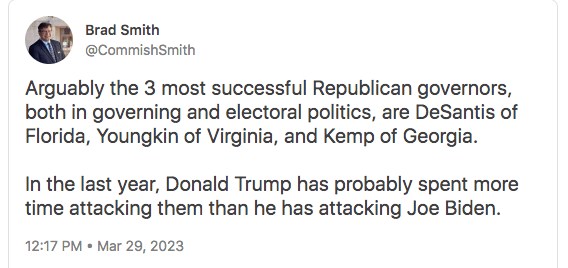
Smith could have added South Dakota Gov. Kristi Noem and Iowa Gov. Kim Reynolds to his list, as well as Texas Gov. Greg Abbott and New Hampshire Gov. Chris Sununu. And, by the way, all of the governors in this post except Youngkin (who was elected in 2021) got reelected, unlike Trump.
John Blake at CNN wants you to get really upset about the use of “digital blackface,” which he describes as white people sharing images or gifs of members of minority groups on social media.
But while some people want you to spend valuable time and neurons contemplating whether it is moral for white people to share images and gifs of minority groups on social media, the world keeps turning; real news keeps occurring; real life-and-death situations keep developing, starting, and resolving themselves.
Ukraine is the world’s biggest news story that somehow only pops up above the noise of the news cycle once every two weeks or so. Russian dictator Vladimir Putin is now saying he intends to move some of Russia’s tactical nuclear weapons to Belarus, which has been used as a staging ground for Russian forces invading Ukraine:
Moscow will complete the construction of a special storage facility for tactical nuclear weapons in Belarus by the beginning of July, Putin told state broadcaster Russia 1.
He said Moscow had already transferred an Iskander short-range missile system, a device which can be fitted with nuclear or conventional warheads, to Belarus.
During the interview, Putin said Russia had helped Belarus convert 10 aircraft to make them capable of carrying tactical nuclear warheads and would start training pilots to fly the re-configured planes early next month.
The Biden administration doesn’t seem particularly worried, and perhaps this is just more of the nuclear saber-rattling we’ve seen from Putin, on and off, since the invasion began. Yesterday, National Security Council spokesman John Kirby said on CBS News’ Face the Nation that, “We have not seen any indication that he’s made good on this pledge or moved any nuclear weapons around. We’ve, in fact, seen no indication that he has any intention to use nuclear weapons period inside Ukraine.”
The Nuclear Nonproliferation Treaty is not vague about moving nuclear weapons to other countries. “Under Article I of the NPT, nuclear-weapon states pledge not to transfer nuclear weapons or other nuclear explosive devices to any recipient or in any way assist, encourage or induce any non-nuclear-weapon state in the manufacture or acquisition of a nuclear weapon.” Russia signed the treaty, and now it sounds like Putin intends to ignore it.
Putin’s Russia has been a troublemaker for a long time — “our number one geopolitical foe” as Mitt Romney put it in 2012, to the laughter and scoffing of most of America’s Democrats, including the Obama administration. It is effectively a rogue state — or “state of concern,” to use the late Madeline Albright’s preferred term. About eleven months ago, I wrote, “Whatever happens next, the Russia we knew, or thought we knew, throughout much of the post–Cold War period is now long gone. What remains is something closer to a territorially giant North Korea with a much larger nuclear arsenal — paranoid, irrational, illogical, unpredictable, with serious questions of whether the leadership is getting accurately briefed on any issue.”
During the Cold War, the Soviet Union and KGB were arguably the world’s preeminent supporters of international terrorism, offering training and arms to just about any band of miscreants who opposed the U.S. and its allies. There’s some evidence that the German Red Army Faction, a far-left terrorist group in West Germany that sowed terror in that country in the Seventies and Eighties, was supported by a young KGB officer stationed in Dresden … by the name of Vladimir Putin.
The West is in this mess in large part because a wide variety of Western leaders underestimated the danger of Putin, year after year, decade after decade. Barack Obama dismissed Putin and Russia in 2016: “The Russians can’t change us or significantly weaken us. They are a smaller country, they are a weaker country, their economy doesn’t produce anything that anybody wants to buy except oil and gas and arms. They don’t innovate.”
The thing is, lots of places want to buy oil and gas and arms. And as we’ve seen for the past year, that “weaker” Russia can still generate chaos on the world stage.
Late last week, while thinking about the potential ban of TikTok, I noted that social media is effectively an attention economy. (Arguably, all forms of media are an attention economy.) It runs on your willingness to pay attention to things. Institutions and platforms that cannot get you to pay attention are doomed, at least financially. (This morning brings news that the 68-year-old liberal publication The Texas Observer is closing its doors for good.)
On a lot of social-media platforms, normal or healthy human behavior does not get you very much attention. Abnormal, unhealthy behavior gets you a great deal of attention. Young women drinking milkshakes out of toilets is the sort of thing that turns a lot of heads — and stomachs — in the world of TikTok.
TikTok, and perhaps social media as a whole, have created an entire incentive structure to spotlight the most abnormal behavior people can imagine, particularly among young people. If you do the things you’re supposed to do in life — love your family, be a good friend, work hard, play by the rules, help others when they need it — the TikTok algorithm just isn’t that interested. Maybe once in a while, your social-media algorithms will serve up something heartwarming, like those two toddlers who were so overjoyed to see to each other on the sidewalk. But by and large, your social-media feed is there to tell you, “This stinks, that stinks, look at this freak, look at what this weirdo is doing, aren’t human beings just the worst, we’re all doomed, the world is going to heck in a handbasket.” No wonder people think social media causes depression.
Now, look, it’s your life, and you’re free to pick whatever entertainment and news sources you like. (And hey, thanks for reading this newsletter.) A few years back, Tom Nichols was quite irked to learn some people enjoy watching other people play video games. My sense was and is that there isn’t that much difference between paying to watch people play electronic versions of stuff and paying to watch a CGI-filled movie, and that the world is always going to have people who choose to spend their disposable income and free time in ways you find dumb, wasteful, boring, or inane. If they’re not harming others or themselves, let them be.
But your attention is a valuable thing. Your time and attentiveness are finite, and each thing you read or watch is a choice. You might even think of it as a resource to be invested. Those social-media algorithms are designed to steer you in a particular direction. Contemplate whether you want to go down the path that the algorithms prefer.
The number one British single today in 1956 is an oxymoron, or describes an oxymoron:
Today in 1965, Rolling Stones Mick Jagger, Brian Jones and Bill Wyman were all shocked by a faulty microphone at a concert in Denmark. Wyman was knocked unconscious for several minutes.
“That thing was like lightning in a bottle,” begins our Bobby Whitlock interview in 2015 of his short-lived band with Eric Clapton, Derek and the Dominos. “We did one club tour, we did one photo session, then we did a tour of a bit larger venues. Then we did one studio album in Miami. We did one American tour. Then we did one failed attempt at a second album.” And all within about a year’s time in 1970.
So in this case, the oft-overused flash of lightning description is right on the money. And Whitlock was a key part of the kinetic energy behind what’s considered a genuine landmark in not just Clapton’s career but the entire classic rock genre: the 1970 album Layla and Other Assorted Love Songs, co-writing six of the double album’s 10 original songs (plus… read on), and bringing his soul-soaked Deep South keyboard skills to the musical mix, taking the vocal lead on two tracks and doubling/trading off with Clapton throughout the rest of the album.
Now, five decades later, he is the keeper of the Dominos legacy. And the dedicated survivor of a star-crossed band if there ever was one. Although today Clapton reigns as the major domo of 1960s rock guitar heroes alongside being a pop star, after the band’s short flash as a working act, he descended into some three years of heroin adduction and seclusion. Duane Allman, who played on most of Layla, was killed in a motorcycle crash on October 29, 1971. Bassist Carl Radle recorded and played with Clapton later in the ’70s and died of a kidney infection, exacerbated by his alcohol and drug abuse, in 1980 (see our On This Day item on him here). Drummer Jim Gordon as well continued to engage in substance abuse, damaging his career with behavioral issues. In 1983, he murdered his mother, claiming a voice in his head had told him to do so. He was diagnosed with paranoid schizophrenia and remained incarcerated until his death on March 13, 2023.
Although Whitlock, only 22 years old at the time, helped Clapton all but define anguished unrequited love in the most profound rock ‘n’ roll terms and tunes on songs like “Why Does Love Got to Be So Sad,” “Tell the Truth” and “I Looked Away,” his own ultimate love story is something quite different, and a rather delightful one at that. Though his post-Domino years were not without their struggles, today he’s blissfully married and in musical partnership with singer, bassist, guitarist, sax player, songwriter, recording engineer and producer CoCo Carmel. …
What dampened the lightning of the Dominos was “Everybody was doing entirely too much drugs and alcohol,” bemoans Whitlock, born on March 18, 1948. “And then Jimmy Gordon wanted everything that Eric had, he wanted to be a big superstar and wasn’t content and happy to be just the greatest drummer on the planet and in the very best band on the planet.”
Whitlock stresses that last point. “We were better than anybody.” One of the key elements that made them what he feels were the World’s Greatest Rock ‘n’ Roll Band for that all-too-brief time was Whitlock’s deep Southern musical soul. Growing up a preacher’s kid in a family poor as a church mouse, he was weaned on spiritual music (and did some cotton picking in his youth). Coming of age in Memphis, Whitlock was steeped in R&B in the city where white rock ‘n’ roll was born at Sun Studio.
By his teens Bobby was singing and playing Hammond B-3 organ around the region in his soul band The Counts, learning what really connects with an audience. He also started hanging around Stax Studio and was taken under the wings of the house band, Booker T. and the M.G.’s. He honed his organ skills watching Booker T. Jones play from over his shoulder. His first recording session “was [Issac] Hayes and [David] Porter” – then a Stax Records songwriting team – “and me doing handclaps on ‘I Thank You’” (Sam & Dave’s last Stax single and a 1968 #9 pop hit). “Everything had handclaps on it back then,” he notes.
“If you didn’t know ‘Midnight Hour’ or ‘Knock on Wood’ I didn’t wanna know about it.”
Whitlock was the first white act signed to Stax/Volt’s Hip label, but nothing came of it. “They didn’t have the same idea that I did about what I wanted to be,” he tells Best Classic Bands. “Stax was trying to get in on that English Invasion thing. They tried to develop me into that kind of artist, and that lasted about 15 seconds.” The next three years, however, launched him into a whirlwind within the rock music stratosphere and landed Whitlock amidst some top British Invasion stars.
Delaney & Bonnie came to Memphis to cut their first album, Home, at Stax, and afterwards Whitlock headed out to Los Angeles with them, becoming the first member of their “Friends” band, which came to include Radle and Gordon as well as other top players like drummer Jim Keltner, Leon Russell, horn players Bobby Keys, Jim Horn and King Curtis, both Gregg and Duane Allman at various points, singer Rita Coolidge and some English stars like Clapton, Harrison and Dave Mason. Nearly (and woefully) all but ignored today, Delaney & Bonnie and Friends at the juncture of the 1960s and ’70s were the most thrilling, red-hot rocking blue-eyed soul revue on the planet, tearing a page from the Ike & Tina Turner playbook and stamping it with their own imprint.
They so impressed Clapton that he took them on tour opening for Blind Faith. And when that short-lived supergroup broke up, he began playing with the group as just another member and had them play on his debut solo album. “That was a revolving door of musicians,” Whitlock explains of the band. Much as the music was awesome, “One thing with that band – nobody ever got fired. Everyone would quit… as soon as they could. I was the only one who waited until I couldn’t stand it any longer and then I quit.
“You can only take so much nonsense when people’s egos are running their lives,” he explains. “Being with them was an experience I wouldn’t ever want to do again. But it was great until the drugs and alcohol got involved.”
On the other hand, “I learned more from Delaney Bramlett than I can ever possibly recount. If I need something I can go to the well and there it is,” Whitlock stresses.
After Bobby left D&B in 1970, Clapton then invited him to come stay at his English country manor and collaborate on songs. “I asked my mentor Steve Cropper if I should do it, and he was like, ‘yeah!’”
“We were hanging out and writing songs and not even thinking, like, hey, let’s put a rock band together and get so and so and so and so. Nobody was making any plans. It was all about right now.
“Then George called….”
Whitlock, Clapton, Radle and Gordon became part of the core crew on the sessions for Harrison’s post-Beatles debut, All Things Must Pass. When Harrison had business elsewhere for a few days, he told the four to use the studio time with producer Phil Spector to cut some tracks, which yielded the debut Dominos 45, “Tell the Truth” b/w “Roll It Over.”
Whitlock says of Clapton, “He wanted to be Derek not Eric. He wasn’t ready to step into his role of as a solo artist at that time.” The four musicians did a show at London’s Lyceum Theater, and then set off on a tour of small English venues as Derek & the Dominos where the admission was £1, and Clapton’s name was forbidden to be used in any advertising.
In late August of ’70, the Dominos arrived at Criteria Studios in Miami to record with producer Tom Dowd. He took them to see the Allman Brothers Band, Clapton and Duane Allman bonded, and the latter joined the Layla sessions to help create some of the most incendiary dual guitar rock ever recorded. The album was suffused with Clapton’s passionate longing for his best friend Harrison’s wife Pattie Boyd – interestingly, while in England Whitlock dated her sister Paula – and even though it was only a middling hit on its release, over time its stature grew to become considered a rock ‘n’ roll masterpiece.

 Steve Prestegard.com: The Presteblog