We started and ended with jazz yesterday, so it’s worth noting that today is the anniversary of the release of the first jazz record, “Darktown Strutters Ball”:
The number nine …
… seven …
… and five singles today in 1969:
We started and ended with jazz yesterday, so it’s worth noting that today is the anniversary of the release of the first jazz record, “Darktown Strutters Ball”:
The number nine …
… seven …
… and five singles today in 1969:
J.D. Tuccille:
For all of the posturing over the debt ceiling, it’s easy to forget that a statutory limit to federal borrowing isn’t the real issue; the real problem is that the federal government habitually spends more money than it brings in. The fact that the feds are currently collecting less tax revenue than anticipated demonstrates that spending is the one component that government officials can, but rarely attempt to, control. Raising the debt ceiling, again, just kicks the can down the road towards disaster. The real trick is to cut expenditures, which politicians hate to do because largesse from Uncle Sugar is an effective way to court constituents and buy votes.
“The debt limit—commonly called the debt ceiling—is the maximum amount of debt that the Department of the Treasury can issue to the public or to other federal agencies,” the Congressional Budget Office helpfully explains. “The Congressional Budget Office projects that if the debt limit remains unchanged, there is a significant risk that at some point in the first two weeks of June, the government will no longer be able to pay all of its obligations…. If the debt limit is not raised or suspended before the Treasury’s cash and extraordinary measures are exhausted, the government will have to delay making payments for some activities, default on its debt obligations, or both.” …
“The deadline to raise the nation’s debt ceiling is closer than previously thought because tax receipts in April fell below projections,” the University of Pennsylvania’s Penn Wharton Budget Model noted this month. “PWBM estimates that receipts are running $150 billion below government projections for fiscal year 2023, most likely due to a decline in capital gains income and weakening corporate profit margins.”
Government officials can’t make the American people be more prosperous than economic conditions allow (though the state is good at worsening those conditions so that jobs and profits evaporate). Even if individuals and businesses are scrupulously honest about reporting income and paying taxes (and there’s always a gap when people think government claims too much), that means there are no guarantees when it comes to collecting revenue. To balance the books, politicians can hope the tax system will yield more, but they only control spending. And they will do almost anything to avoid cutting spending.
People aren’t blind to politicians’ failings. “Gallup finds between 34% and 38% of U.S. adults expressing a ‘great deal’ or ‘fair amount’ of confidence in President Joe Biden, Federal Reserve Chair Jerome Powell, Treasury Secretary Janet Yellen and congressional leaders in both major parties to do or recommend the right thing for the economy,” the polling firm announced May 9.
Fortunately, there are some online tools that let Americans try their hand at making the tough spending (and tax) decisions the political class would like to ignore.
First up is The Washington Post‘s budget game. As these online tools go, it’s a blunt instrument that allows little choice for guiding tax-and-spending policy over the next decade. While I was able to substantially cut the projected debt, every possible set of permitted choices leaves tens of trillions of dollars in red ink in 2033. The Post‘s preferred message seems to be that balancing the books is too hard, so we need to raise the debt ceiling.
Federal Balancing Act 2023, from the Bipartisan Policy Center, allows a lot more room for detailed choices by users. You can control spending across Education, Health Care, Defense, and other sectors, and raise or lower taxes on corporations, individuals of different income levels, gasoline, and the like.
By slashing military spending, getting the federal government out of education, raising the retirement age, and eliminating whole areas of spending, I was able to run a budget surplus starting in 2023 and move the federal government 163.2 percent of the way towards a sustainable budget.
Hmmm. Looks like I have some room for tax cuts.
The Debt Fixer tool from the Committee for a Responsible Federal Budget also encourages users to “make the hard budget choices to stabilize debt at 98% of the economy by 2033 by identifying $8.1 trillion of deficit reduction and bring it down to 60% by 2050.” You can even save your choices as a PDF to revisit the issue later.
Again, by focusing on cuts and reducing or eliminating areas of federal activity, I reduced debt as a percentage of GDP to 83 percent by 2033 and 30 percent by 2050.
All of these tools are imperfect. They limit options in ways that can be frustrating—it would be handy to be able to gut certain agencies, or even whole departments. They also make assumptions about costs and benefits that are at best arguable.
Two more Beatles anniversaries today: “Love Me Do” hit number one in 1964 …
… four years before the Beatles started work on their only double album. Perhaps that work was so hard that they couldn’t think of a more original title than: “The Beatles.” You may know it better, however, as “the White Album”:
The interesting thing about the Green New Deal,” admitted Saikat Chakrabarti, the former chief of staff to Representative Alexandria Ocasio-Cortez, “is it wasn’t originally a climate thing at all.” It was, in fact, “a how-do-you-change-the-entire-economy thing.” He wasn’t kidding.
The Green New Deal’s literature called for mobilizing “every aspect of American society” to eliminate greenhouse-gas emissions from “every sector of the economy.” It called for upgrades and retrofits to “every building in America,” “charging stations everywhere,” the shuttering of “every” fossil-fuel or nuclear power plant, the forced obsolescence of “every combustion-engine vehicle.” Its architects’ ambitions knew no limits. And while the Green New Deal may be dead, the universalism to which its advocates adhered is very much alive.
Armed with unchecked self-confidence and possessed of an abiding faith in the idea that you must be coerced into altruism, the activists seem to be coming for almost everything you own. In the process, they are waging a crusade against convenience, an assault on comparative advantage, and a war on things that work.
Securing the fossil-fuel-free future that President Joe Biden imagines for us sometime in the 2030s will not be a pain-free proposition — at least that appears to be the conceit of the more radical wing of the environmentalist Left. The scale of the challenge, as they see it, demands sacrifice from us all. One of their most controversial moves is to give up natural-gas-powered appliances, your gas kitchen range foremost among them.
The relentless lobbying of local governments to forbid natural-gas hookups in new buildings had already succeeded in a number of municipalities when the U.S. Consumer Product Safety Commission (CPSC) sought public comment earlier this year on a proposal to impose a ban nationwide. By then, California had announced its own ban, to begin in the next decade, on the sale of new natural-gas-powered appliances, and New York State was set to follow suit.
The logic of this proscription was twofold. First, it was justified by dubious research, one example of which suggested that cooking with gas in an “airtight” room sealed by “clear plastic sheets” can cause adverse health effects over the long term. It is, indeed, best to avoid preparing meals in a level-four biocontainment facility. Other studies purporting to prove that gas-stove pollution increases the risk of childhood asthma screened out contradictory findings or, as the American Gas Association later observed, “conducted no measurements or tests based on real-life appliance usage.” Ultimately, Rocky Mountain Institute manager Brady Seals admitted to the Washington Examiner that his organization’s highly publicized summary of past studies, which concluded that gas stoves were responsible for a 12.7 percent increase in asthma among kids, “does not assume or estimate a causal relationship.” The second, more honest rationale concerned a general desire to rid the world of the roughly 13 percent of U.S.-produced heat-trapping emissions that residential and commercial structures contribute. Of course, your own preference plays no role in the bureaucrats’ deliberations. “Products that can’t be made safe can be banned,” CPSC commissioner Richard Trumka Jr. warned.
Since they hoped to conserve the status quo, those who objected to this sweeping proposal were summarily dismissed as blinkered promoters of philosophical conservatism. The pro-gas-stove dissidents were accused of either succumbing to a right-wing fever dream or nefariously contriving what Axios called “a new culture war.” But the environmentalists failed to account for one reason people do not wish to replace their gas range with an electric one: The first appliance does things the second cannot.
Or what if you value, you know, value? In most American states, natural-gas appliances cost between 10 and 30 percent less to operate on a regular basis than electric alternatives. What if you can’t afford to switch to the induction ranges — which can cost 60 percent more than gas stovetops — proposed by many anti-gas activists?
The offhand rejection of these arguments set the stage for a real pushback from the public. A cacophonous outcry during the commission’s open-inquiry period drowned out the activists and scuttled its initiative — at least on the national scale. But the effort to relegate natural-gas-powered appliances to history’s ash heap persists in places such as New York, where Governor Kathy Hochul’s spokeswoman bragged that the ban on new natural-gas hookups would “not have any loopholes.” And, she added, “there will not be any option for municipalities to opt out.”
A policy that bans natural-gas hookups in new residential construction suggests that more appliances than just gas stoves have found themselves in the bureaucrats’ crosshairs. Gas furnaces and gas water heaters, too, would become things of the past if the meddlers had their way. Indeed, that is the plan in some of America’s bluest states.
There are pros and cons to both gas and electric heating units. Despite the slower recovery times (e.g., how long it takes for your shower to get hot and stay hot) and higher average costs of electric heating, some consumers may prefer it. Others may not. But individual preference should play no role here, according to the green activists, because climate-friendly alternatives are more ethical.
And it’s not just about how you cook your food or stay warm. Radicals who resent how you live your life behind closed doors are coming for your air conditioner, too. The Environmental Protection Agency (EPA) recently published a proposed rule designed to prohibit hydrofluoro-carbons (HFCs) with significant global-warming potential (GWP) over 100 years in new air-conditioning and refrigeration systems. This alphabet soup of initialisms complicates much of the literature on the initiative, perhaps by design. Put simply, the rule increases the cost of refrigerants, and those costs are passed on to the consumer. Even the anticipation of that increase has already made it more expensive to install new climate-control units. Here, too, society’s green engineers have a ready alternative for apprehensive consumers: heat pumps.
“I am drunk on Schadenfreude … There is nothing better, not in this world or the next.” Those were not the words of Donald J Trump on Wednesday night, reviewing the shambles of Ron DeSantis’ presidential campaign launch on Twitter. They were Jonathan V Last’s — of the “Never Trump” site, The Bulwark.
He wasn’t alone. The MSM chorus dedicated to obliterating the only currently viable alternative to Trump as the GOP nominee was close to deafening. “DeSantis’s Big Moment Goes Awry With a Twitter Meltdown,” crowed the NYT. The New Yorker’s Susan Glasser exulted that DeSantis was “an out-of-his-depth forty-four-year-old who was going to get eaten alive.” Bulwark mucky-muck Charlie Sykes mused, “Surely there have been worse clusterfucked campaign launches than the one we saw last night, but so far, no one can remember any of them.”
Sykes also called DeSantis “Meatball” (a Trump insult) and “Florida Beta Man.” Bill Kristol wryly noted how the name DeSantis could generate lots of puns along the lines of “DeSaster,” or “DeBacle.” He also praised Trump as the “Alpha” of the primary race. JVL referred to Ron’s “Tiny-D Energy.” The Lincoln Project summed up the mood by directly speaking to DeSantis: “We’re sure going to love watching you crash and burn.”
And, to be fair, they weren’t wrong on the launch. Using Twitter for it was bizarre — horrid visuals, useless optics, on a platform loved by very online elites but alien to the vast majority of normie Americans DeSantis needs to reach. And although I once had some small hopes for Elon Musk’s Twitter, I sure don’t now. His platform is a shit-show, in all meanings of that word, and so was the DeSantis event. A shrewd pol would have kept Musk far away. Yet DeSantis effectively made his own announcement a hostage to the tech tyrant’s amour propre. Sad!
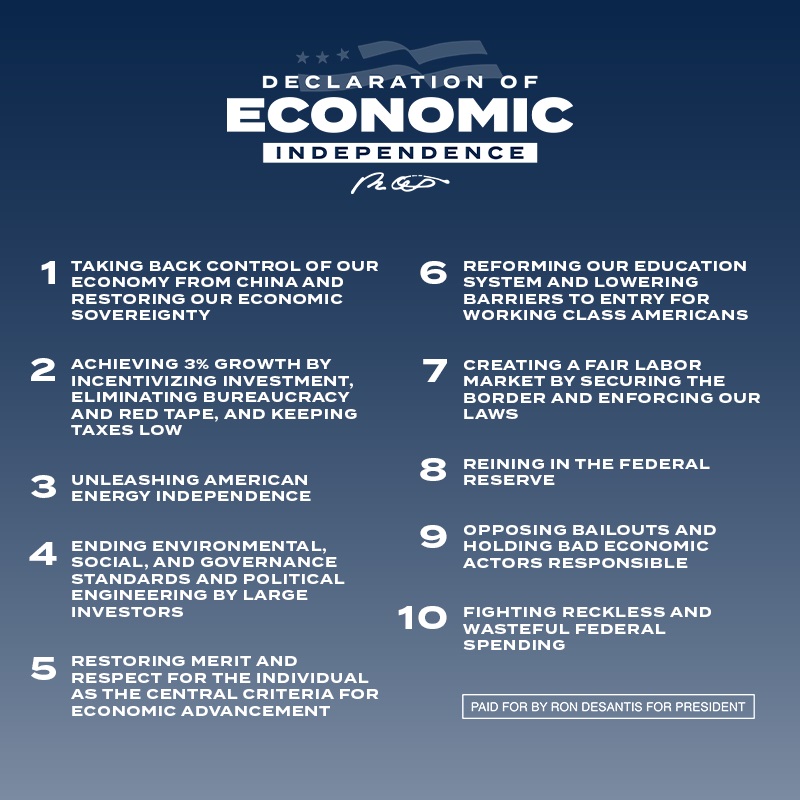
And if DeSantis wants to be the anti-woke candidate, he has to do better than telling us that DEI and SEL and ESG are just as bad as CRT. That’s an insane amount of insidery jargon. He has to do more than simply repeating the word “woke.” He has to appeal beyond the GOP base to the moderates and independents who still believe in individual freedom, merit, colorblind racial policy, personal responsibility and letting kids grow up shielded from progressive fanatics.
DeSantis has to engage the majority who are fine with trans adults but don’t believe young children can consent to sex changes and who think sports are sex-segregated for a good reason; those who support non-discrimination laws but don’t believe in hiring people because of their race and sex; those who want their kids taught the basics of math and reading — not that America is a white supremacist country and must be dismantled; those who oppose police abuse but not the police themselves; those who supported a short-term lockdown but not open-ended social death.
And DeSantis has to remind people, as Peggy Noonan puts it today, that “his calling card [is] that in a time of true national crisis — a historic pandemic, the sharp rise of woke ideology — he provided strong leadership under which his state thrived.”
Is DeSantis capable of this? Judging from Wednesday night, no. Perhaps this was because he’s in a primary campaign and thinks a narrow, online, wingnut focus is the safest bet. But key to his primary bid is his ability to convince Republican voters that he can reach beyond the Trump base in ways that Trump cannot. So far: not happening.
Does that mean his campaign is over before it’s begun? I don’t know, but I doubt it. There’s a long way to go. He has raised a lot of money. He retains a couple of strong cards: against Trump, he’s fresh, and against Biden, he’s young. Those advantages will continue to matter. He has a strong record in Florida — on Covid (not as brutal a shutdown), the economy (two percent unemployment), immigration (mandatory E-Verify!) and the fight against successor ideology. He built a 20-point majority in his state, which has to count for something. And I find myself rooting for him against Trump not out of any affection or much admiration, but simply because I believe Biden is a lot weaker than many Democrats seem to think, and because my primary goal is preventing a second Trump term. I fear that Biden is fast becoming the Yuri Andropov of the Democratic Party — and can’t actually beat Trump next time.
I also believe that the rapid corrosion of the core beliefs that sustain liberal democracy is the deepest underlying crisis we face. Wokeness is incompatible with a free society as we know it; it is in fact designed to destroy it, and replace it with identity-based collectivism. Biden will accelerate this, we now know. And Trump’s record in ensuring the cultural dominance and legitimacy of the far left is clear.
So why are so many center-right Never Trumpers celebrating what appears to be a major positive development for Trump? David Frum finally felt the need to explain why he and others are so keen to clear the way for Trump’s return:
What kind of alternative would DeSantis be? We did not want Trump’s abuse of power for selfish advantage replicated by a president who differed from Trump only by arriving at the office on time instead of watching television until 11 a.m.
Seriously? Trump attempted a coup; he committed obstruction of justice; he was impeached twice; he abused the separation of powers; he has vowed to pardon criminals who support him; he is utterly irrational; he lies with staggering abandon; he vows to execute drug dealers without a trial; he supports war crimes; he has enriched himself at the public trough. DeSantis has done and said nothing like any of this; he has governed aggressively within the bounds of his constitutional limits but he is not a sociopath and not a wannabe dictator-for-life. The notion that there is no difference between him and Trump except punctuality makes a mockery of everything Frum has written about Trump in the past.
He continues: “We did not want more strenuous disdain for allies — Ukraine today, who knows who else tomorrow?” Did I miss DeSantis’ vowing to get rid of NATO, like Trump? And what does “disdain for allies” mean? Yes, DeSantis is not a neoconservative in the Frum mode. But who on earth is anymore? And compared to Kim Jong Un’s pen-pal who has vowed to end the Ukraine war in 24 hours, and who personally trashed almost every democratic leader in the West? Please. Frum again:
We did not want a more systematic and shrewd exploitation of tensions in American society, more deft manipulation of resentments along lines of race, faith, sex, region, and educational attainment.
How, I wonder, would David describe the imposition of critical race, queer and gender theory in public high school curricula? The enforcement of systemic race and sex discrimination across the entire federal government and much of corporate America? The creation of sanctuary cities for illegal immigrants? The introduction of sex changes for children before puberty — and mandatory pronoun choice in pre-K? Or the enabling of mass fraudulent migration? These culture war initiatives are apparently not “deft manipulation of resentments.” But opposing them is. Heads the far left wins. Tails the right loses.
David French tries to make a similar argument for rejecting DeSantis:
I believe we can walk and chew gum at the same time, opposing Trump while upholding a vision of state power that limits its ability to “reward friends and punish enemies” so that all Americans enjoy the same rights to speak, regardless of their view of the government.
How Frum puts it: “Never Trump Republicans want a free trade, free market economics conservative.” But unless Ronald Reagan returns from the dead, or we magically get transported back to 1987, this isn’t anything close to a realistic option. French — someone who knows much better — even equates a state legislature setting public school curricula with a violation of free speech — and ignores every free speech challenge from the left. Then there is the specious argument that since DeSantis is not beating Trump right now, he cannot beat Trump ever. But that’s absurdly premature — a piece of rationalization, not analysis.
With Frum and French and many alleged Never Trumpers, it seems, they’d rather risk a second Trump term than compromise an iota of their defunct neocon vision of what conservatism should be. That has zero practical relevance for today’s Republican Party, and suggests they’ve learned absolutely nothing from how Trump came to dominate the American right, and how best to counter him. Putting up another Jeb Bush or Marco Rubio isn’t going to cut it. Which is to say: I love both Davids, but, on this topic, they are not serious people.
And so Trump’s chances of returning just increased dramatically this week. And the “resistance” is near drunk with joy. Tells you something, no? And nothing hopeful.
If Trump is the nominee, Joe Biden or some other Democrat will be president after the 2024 election. Period. At this point I don’t know if I would vote for DeSantis or Tim Scott or Nikki Haley, but either of those three would be a better GOP nominee than Trump.
This is more a pop than rock anniversary: One of the funniest songs Johnny Cash performed, “One Piece at a Time,” hit number 29 today in 1976:
Birthdays start with Gary Brooker of Procol Harum:
Paul McCartney must like releasing albums in May. Today in 1971, he released his second post-Beatles album, “Ram,” which included his first post-Beatles number one single:
Birthdays today include Papa John Creech of the Jefferson Airplane:
Gladys Knight:
Today in 1975, Paul McCartney released “Venus and Mars” (not to be confused with “Ebony and Ivory”):
Birthdays include Ramsey Lewis:
April Wine drummer Jerry Mercer:
Best Classic Bands reports on one of brass rock’s pioneers:
Blood, Sweat & Tears, known for such hits as “Spinning Wheel,” “And When I Die” and “You’ve Made Me So Very Happy,” are the subject of a new documentary, What the Hell Happened to Blood, Sweat & Tears? The film is described as “the incredible never-before-told story about a top rock band that was unknowingly embroiled in a political rat’s nest involving the U.S. State Department, the Nixon White House and a controversial concert tour of Yugoslavia, Romania and Poland, countries that were behind what was then known as the Iron Curtain.”
When they returned from the June-July 1970 tour and visit, the band itself was caught in the crossfire from both the right and the left and the group suffered as a result. Suddenly, they were no longer hip and cool and lost support from fans, the media, concert bookers and the recording industry. As a result, they found themselves in the crosshairs of a polarized America–as divided then as it is now–and became an early victim of cancel culture. The feature-length film will be released theatrically in New York and Los Angeles on March 24, 2023, before expanding across North America and Canada via Abramorama.
In 1969, the band played the legendary Woodstock Festival and in 1970 won the Grammy Award for Album of the Year for its self-titled, second LP, besting The Beatles’ Abbey Road and Crosby, Stills and Nash’s debut, among others.
Weeks after returning from the Iron Curtain tour, Blood, Sweat & Tears played New York’s Madison Square Garden. Outside the venue, the leftist radical Abbie Hoffman and the Yippies (Youth International Party) led a protest against what they called “Blood, Sweat & Bullshit,” accusing them of being tools of the CIA, and urging people to boycott the band’s records and concerts.
Written, produced and directed by award-winning filmmaker John Scheinfeld (The U.S. vs. John Lennon, Chasing Trane, Who Is Harry Nilsson…?) and produced by Dave Harding (Herb Alpert Is…), the film was created with the full cooperation of Blood, Sweat & Tears. The documentary features never-before-seen film and photos of the band, as well as present-day interviews with then-Columbia Records president Clive Davis and five of the nine band members: lead singer David Clayton-Thomas, sax player and musical arranger Fred Lipsius, bass player Jim Fielder, drummer Bobby Colomby, and guitarist Steve Katz, who says, “We were blackmailed.”
“It has been fascinating for me to relive these incidents of some 50 years ago,” said Colomby, “through the footage, documentation and, incredibly, the live performance tapes John and his team discovered through some very deep and tireless digging. I believe the music we made then holds up today.”
The truth-is-stranger-than fiction film blends political intrigue, social commentary and a mystery involving one of the biggest rock bands of the late ’60s and early ’70s.
Another Beatles anniversary today: Their “Beatles 1967–1970” album (also known as “the Blue Album”) reached number one today in 1973: