Not that my parents were paying attention, but the number one song two days into my life was:
Twenty-eight years later, the number one song was by a group that sang about aging nearly two decades earlier:
Birthdays start with Floyd Butler, who sang for the Fifth Dimension …
… and the Friends of Distinction:
For fans of the movie “Pulp Fiction,” Don Reid of the Statler Brothers has a birthday today:
Reid was born one year before the triumvirate of Fred Stone of Sly and the Family Stone:
… Fuzzy Fuscaldo of Captain Beefheart …
… and Michael Monarch of Steppenwolf:
And if you are from the ’80s, you know that Berlin (whose Teri Nunn has a birthday today) is not merely the home of the football team that Ripon beats like a drum:
Today is my birthday. (In case you couldn’t figure that out from one hour ago.) And as with my previous 45 birthdays, there is no Corvette in my driveway. Life is unfair.
There are, however, Corvettes in other driveways. (Probably few in journalists’ driveways, although I was surprised to see the kinds of cars parked in the media parking at Road America when I was last there.) And there will be more Corvettes in more driveways given that GM is reportedly designing the next Corvette, the seventh generation of America’s sports car. GM is spending $131 million on improvements to the Corvette plant in Bowling Green, Ky., which also is the home of the National Corvette Museum.
First, a photographic tour of generations one through six:
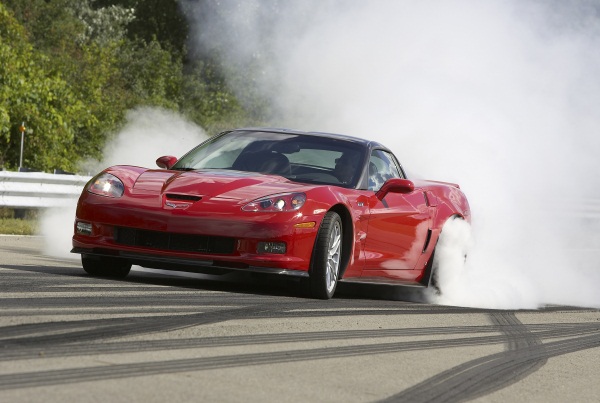
This is the first Corvette design; C1s are considered to have been built from 1953 to 1962.The C2 was built from 1963 to 1967.The C3, the first Corvette I remember, was built from 1968 to 1982.The C4 was built from 1984 to 1996.The C5, whose creation was the subject of the book All Corvettes Are Red, was sold from 1997 to 2004.Chevrolet has been selling the C6 — this is the 616-horsepower ZR1 — since 2005.
The current Corvette is one of the most accomplished cars on the planet. For between $49,045 (base coupe) and $110,300 (the ZR1), you can buy a car that will go from standing stop to 60 mph in no slower than 4.3 seconds, will race one-quarter mile in no slower than 12.6 seconds, will reach top speed of at least 190 mph, and will get up to 26 mpg on the highway. You can take your significant other and a weekend’s worth of luggage wherever you can reach in a day’s drive.
For those who want numbers: The base Corvette costs $114.06 per horsepower, and the ZR1 costs $172.88 per horsepower. A Porsche Boxster costs $188.63 per horsepower, and a Ferrari California costs $423.84 per horsepower. The most expensive Corvette is more of a performance bargain than the least expensive Porsche.
But don’t take my word, watch the videos:
Corvettes have always been front-engine rear-drive two-seat coupes or convertibles. They have been powered by V-8s (all, except for the four-cam LT-5 built at Mercury Marine’s Stillwater, Okla., plant of the overhead-valve variety) in all but their first two model years, and they have had at least an available manual transmission (and with some engines it was the only available transmission) in all but three model years. Hidden headlights were featured in generations two through five, a triumph of styling over function.
As noted in my previous Corvette writings, the automobile media swoons (I was going to use another metaphor, but given what’s happened in the past week or so, give me some credit for taste) every time GM appears to be about to roll out a new Corvette.
The first heavy breathing about a new Vette that I remember was in 1973, when Motor Trend, the first car magazine I ever read, announced GM was going to introduce not one, but two new Corvettes, both powered by the then-exotic rotary engines. One was going to be a two-rotor Corvette …
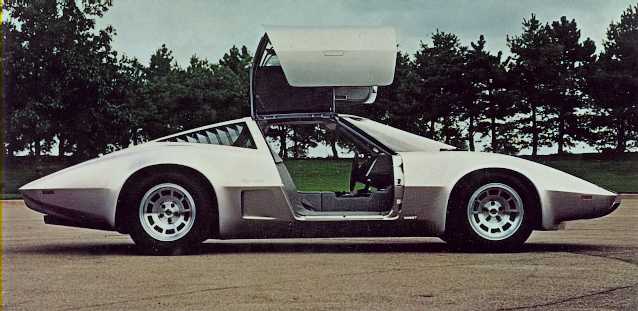
… and the other was going to be a ground-shaking four-rotor Corvette:
Neither of those predictions was correct, nor was the prediction nine months later:
For one thing, GM (and everyone else except Mazda) abandoned rotary engines due to their poor fuel economy and emissions and other problems. The silver gull-wing-doored Vette had its four-rotor replaced by a 400 V-8 and, voila, became the Aerovette. And pretty much since then (and even before then), some Vette enthusiasts have pined for a mid-engine Vette, and auto publications have predicted that the “next” Corvette will be mid-engined.
(Motor Trend has a reputation for not being particularly critical about the cars it reviews. Motor Trend also has a reputation of making Corvette predictions into cover stories, as these covers demonstrate:
Many Corvette drawings over the years were drawn by designer Harry Bradley. Dean’s Garage helpfully put many of them in one spot. All of these were, to quote the December 1976 cover blurb, Vettes you’ll never see. But the issues sold well at the newsstands, I’m sure.)
Mid-engine cars (that is, cars whose engines are between the axles, whether in front of the rear axle or behind the front axle) are claimed to have better handling since the engine is closer to the drive axle (assuming it’s a rear-drive car) and there is less weight on the steering axle. (Anyone who has driven, say, a C3 with a big-block iron-block V-8 but without power steering can sympathize.) The Ford GT, built in 2005 and 2006, was mid-engined as was the Ford GT-40, the ’60s LeMans racer from which it was derived.
This strikes me as one of those be-careful-what-you-ask-for propositions. Yes, mid-engine cars are more exotic. GM’s experience with exotic technology over the years has been, shall we say, not entirely positive. (Four words: “Cadillac V8-6-4.” I also refer to my experience of briefly being locked inside a C6 at the Greater Milwaukee Auto Show, given that the C6 has no interior or exterior door handles.) GM also has worked mightily to make today’s Corvette a potential everyday-driver, including actual (though not much) storage space. Can golf clubs or a couple of overnight bags fit into the front trunk of, say, a Porsche 911? And imagine the reaction the first time you drive your mid-engine Vette to an oil change store, or the bill for an oil change at your favorite Chevy dealership.
The same warning about exotic tech could apply to other items on the Vette wish list such as all-wheel drive, features seen in the supercar class. (GM North America president Mark Reuss was quoted as saying he wants the next Corvette to be “a truly global competitor.”) I enjoy technology as much as anyone, but I’ve also owned enough cars to know that the more things the car can do, the more things on the car can break. Owners of C4 Corvettes, cars equipped with digital instrument panels, have discovered the digital dashes don’t work so well (as in, in some cases, not at all) as the cars reach their third decade.
The Corvette rumor mill started running in overdrive when the movie “Transformers: Revenge of the Fallen” was released with the Corvette Stingray concept, which includes, of all things, the one-year split rear window:
Back in December, Rick “Corvette” Conti repeated Motor Trend’s report about the next-generation Corvette’s styling:
I’m not sure I like this. Corvettes have always had flowing lines (particularly the C3), and “flowing” is not how I’d describe this design, although from the A-pillar forward it does remind one of a C3, which is good. The reason the romantic split-window design was a one-year-only design was that, regardless of how owners thought it looked, drivers found it obstructed rear vision.
Then in March, Conti passed on Car & Driver magazine’s rendition of the C7 Vette, which is certainly preferable:
In addition to the Corvette’s being America’s most enduring sports car, the Corvette is also America’s most modified sports car, in concept and reality. One thing you may have noticed by now is that few enthusiasts ever seem satisfied with the looks of the car, and to borrow the old Ford phrase, they seem to have a better idea. (The Aerovette could never have been built, for instance, because of the federal 5-mph-bumper requirement, the reason the C3 lost its chrome bumpers. We won’t get into how consumers would have felt about gull-wing doors.)
Then there’s the issue of the engine. Reports for more than a year have claimed that the next Corvette will have a turbocharged V-6 and not a V-8 due to fuel economy concerns. (Which seems silly; even though the current Corvette is rated at 26 highway mpg, people do not buy Corvettes for their gas-sipping qualities.) The V-6 rumors have fallen back in favor of a more interesting rumor: a choice of a smaller version of the current V-8 (whose 405 horsepower propels the base model from 0 to 60 mph in 4.2 seconds), or a much smaller multiple-cam V-8, perhaps half the size of the current engine but with some kind of forced induction for maximum horsepower at higher rpm.
Either engine choice sounds intriguing, with two caveats. Conti’s Motor Trend report indicated GM was trying to get its cylinder-deactivation software to work on the engine, which should be anathema even if it works better than the aforementioned V8-6-4. All of the engines I’m aware of with cylinder-deactivation are hooked up to automatics. I have read about sequential gearboxes and automated manuals and other supposedly superior alternatives to sticks, but if there is a Park gear and not a clutch pedal, it seems to me to not belong in a sports car, at least not as the only transmission choice.
There is one more issue about creating a Corvette to compete with high-end Ferraris, Porsches, etc. Recall that the list price of the 2011 ZR1 is $110,300. The Porsche Carrera Turbo S coupe, with a 530-horsepower flat-6, lists for $160,700. The Lamborghini Gallardo, with a 550-horsepower V-12 engine, starts at $212,000. The Ferrari 458 Italia, with a 570-horsepower V-8, lists for $225,325. The base model Corvette is a performance bargain; so is the ZR1 when compared with its supercar brethren. But the Corvette lacks the international cachet of the Porsche, Ferrari, etc., and is unlikely to get more merely by adding more supercar stuff. One also wonders how many people would be willing to pay, say, $200,000 for a Corvette.
The old Army tagline was: “Be all that you can be.” At some point you were probably given the advice to be yourself. The current Corvette is not a “truly global competitor” not because of its performance (there is not a single car in this blog entry with a better power-to-weight ratio than the ZR1), but because of its poor quality interior more than anything else. So improve the interior. But if GM thinks someone in the market for a 458 Italia will switch instead to whatever the better-than-ZR1 is, I’m not sure that’s going to be happen. And GM will be making a mistake if in its attempt to be world-class it ends up losing potential customers because the Corvette has a world-class price tag out of the reach of potential customers.
There is a specific event of note today. See if you can find it in this list of today in …
350 A.D.: Nepotianus proclaims himself emperor of Rome, backed up by the parade of gladiators who accompany him into Rome.
1083: Henry IV of Germany storms Rome, capturing St. Peter’s Cathedral.
1509: Henry VIII married Catherine of Aragon, his first (but not last) wife.
1539: Hernando de Soto lands at Ucita, Fla., and claims Florida for Spain.
1540: Having taken a year to get there, de Soto is the first European to cross the Appalachian Mountains in North Carolina — a trip that now takes about 11½ hours by car.
1621: The Dutch West India Company receives a charter for New Netherlands, known today as New York City.
1800: President John Adams moves to Washington, D.C., and lives in a tavern, because the White House isn’t finished yet. Adams moved in later in 1800, only to move out after he lost the 1800 presidential election to Thomas Jefferson.
1804: Richard Cobden, British economist and statesman known as the Apostle of Free Trade, is born.
1808: Jefferson Davis, the only president of the Confederacy, is born.
1851: The New York Knickerbockers baseball team wears a straw hat, white shirt and long blue trousers — the first recognized baseball uniform. (Presumably previous teams wore clothes, but not uniform clothes.)
1861: Stephen A. Douglas, who defeated Abraham Lincoln for the U.S. Senate in 1858 after the Lincoln–Douglas debates, but was defeated for president by Lincoln in 1860, dies. (Here’s a historical what-if for you: Douglas, the Northern Democratic candidate for president, received just 12 electoral votes, finishing fourth. But what if Douglas had won, and then died three months after taking office, in the midst of tensions that led to the Civil War? The Civil War began before Douglas’ death, but one wonders if an insurrection wasn’t inevitable regardless of who was elected president, given that Southern Democrats bolted both Democratic conventions — the first one was adjourned after 57 ballots for the presidential nomination — and nominated their own candidate, Vice President John Breckinridge. The 1860 northern Democrats’ vice presidential candidate was Georgia Gov. Herschel Vespasian Johnson, chosen to balance the ticket.)
1864: On Confederate President Jefferson Davis’ 56th birthday, Confederate Gen. Robert E. Lee wins his last victory of the Civil War at the Battle of Cold Harbor, Va., where more than 6,000 Union soldiers were killed or wounded in one hour. (Perhaps that’s why June 3 is Confederate Memorial Day in Kentucky, Louisiana and Tennessee.) That same day, Ransom Eli Olds, who created the Oldsmobile car and REO truck (for which the rock group REO Speedwagon) was born.
1876: Harper’s Weekly publishes a front-page cartoon by Thomas Nast about Congress’ attempt to impeach President Ulysses Grant. Congress had just impeached Grant’s war secretary, William Belknap, despite the fact that Belknap resigned before the impeachment vote. Other Congressional attempts to impeach Grant focused around an accusation that Grant had used public funds for his 1872 reelection campaign, an accusation that foundered when the accuser was discovered to be an escapee from an insane asylum, and a complaint that Grant had been out of Washington an excessive number of times. (You cannot make these things up.) A century later, Richard Nixon was impeached, an impeachment attempt was made against Ronald Reagan, Bill Clinton was impeached, and impeachment attempts were made against George W. Bush.
1880: Alexander Graham Bell transmitted the first wireless phone message from the top of the Franklin School in Washington, D.C., on his new “photophone,” which transmits sound via light beams.
1881: A 55-year-old Japanese giant salamander, believed to have been the oldest amphibian, dies in a Dutch zoo.
1888: Ernest Lawrence Thayer’s “Casey at the Bat” is published in the San Francisco Examiner.
1904: Charles Richard Drew, who pioneered blood plasma research, is born.
1929: Producer Chuck Barris, creator of The Gong Show, is born. (If you’ve never heard of The Gong Show, or you think TV is bizarre now, watch this and this.)
1937: Edward VIII marries American Wallis Warfield Simpson. That same day, Negro Leagues baseball player Josh Gibson hits a 580-foot home run at Yankee Stadium.
1939: Steve Dalkowski, on whom the Nuke LaLoosh character in “Bull Durham” and the Steve Nebraska character in “The Scout,” is born. In an era before radar guns, the left-handed Dalkowski could regularly throw over 100 mph, but not necessarily over the plate, which is why Dalkowski never pitched the majors. He did have the reported distinction of having the highest number of strikeouts and walks per nine innings of any pitcher in pro baseball history.
1940: While the German Luftwaffe bombs Paris, Allied forces exit Dunkirk, France, saving their troops but losing all their equipment.
1944: German forces exit Rome.
1946: Members of three iconic classic rock groups are born today — Ian Hunter of Mott the Hoople, bassist John Paul Jones of Led Zeppelin, and drummer Michael Clarke of The Byrds
1949: “Dragnet” premieres on radio in Los Angeles, the start of a franchise that included four TV series and two movies, and those are just the facts.
1954: Dan Hill, who foisted the horrifyingly bad “Sometimes When We Touch” on radio listeners, is born.
1957: Howard Cosell’s first TV show premieres. Complaints about Cosell begin approximately 12 seconds after the show begins.
1963: Pope John XXIII dies, taking one pope off St. Malachy’s list.
1965: Body-builder Suzan Kaminga, actor and singer Jeff Blumenkranz, actor Daniel Selby and Phish bass player Mike Gordon are born. American astronaut Edward White, having flown into space on Gemini 4 earlier in the day, makes the first U.S. spacewalk.
In a hospital room in Madison, a nun shoos the people watching the spacewalk out of the only room on the nursery floor with a TV, so that the new mother inside can get some rest before her constantly hungry newborn son wants to eat again.
1967: Anderson Cooper of CNN is born.
1969: The last, and arguably worst, episode of “Star Trek” airs on NBC.
1973: The Soviet supersonic jet era ends shortly after it begins when the Tupolev TU-144 crashes at an air show in Paris:
1980: Seven tornadoes hit the Grand Island, Neb., area, killing five, injuring 357 and causing $300 million in damages. A movie, “Night of the Twisters,” is made based on the tornado outbreak.
1989: Chinese troops kill hundreds of pro-democracy students in Beijing. The same day, Ayatollah Ruhollah Khomeini of Iran dies.
1992: A newspaper geek celebrates his 27th birthday by buying half of the Tri-County Press in Cuba City.
2001: Mel Brooks’ “The Producers” wins a record 12 Tony Awards. CBS-TV, which carries the Tony Awards, anticipates the big day for “Springtime for Hitler” by having Bialystock & Bloom (actually, Nathan Lane and Matthew Broderick) emcee the awards.
There are two ways to improve a state’s business climate as compared with other states.
One is to take the necessary steps in your own state: Cut taxes, defang regulators, cut taxes, improve schools and infrastructure in cost-efficient ways, cut taxes, eliminate unnecessary government spending (the presence of which leads to higher taxes), and cut taxes. The other is to do nothing while other states around you make their own business climates worse.
Thanks to the Nov. 2 election results, Wisconsin is working to improve its business climate (which is much more important than the collective bargaining “rights” of public employees), yet we are able to take advantage of poor decisions of other states. An example of the latter is to our south, where Illinois not only raised income taxes, but instituted a new “Amazon tax,” a sales tax on online purchases. The California Assembly passed its own Amazon tax this week.
The issue of online sales taxes is slightly more complicated than it may seem, analogous to the debate over shopping locally vs. going to the out-of-town big-box store for lower prices. It is, however, yet another example of government’s trying to suck more money out of our wallets.
Shoppers pay sales taxes at brick-and-mortar stores based on where they live. (If you live in Fond du Lac County, you pay the 5 percent state sales tax plus an additional 0.5-percent sales tax as part of the package for keeping Mercury Marine in Fond du Lac.) Wisconsin residents are supposed to pay sales taxes on out-of-state purchases, but that is up to the resident to pay them because a state cannot assess taxes on an out-of-state business.
Currently, a Supreme Court decision prevents states from collecting sales-tax revenues from companies with no physical presence in the state. For example, if a Virginia resident buys a product online from a company in Oklahoma, unless that Sooner vendor has a store, warehouse or anything else that qualifies as “nexus” in the commonwealth, Virginia can’t collect sales tax on the transaction.
This arrangement benefits consumers by promoting tax competition.It also protects interstate commerce by sparing sellers the burdensome task of remitting sales taxes to about 7,400 different state and local taxing jurisdictions across the country. Finally, it preserves the principle of “no taxation without representation” by preventing states from reaching outside their borders to tax businesses to which they are not accountable.
If, however, the business in question has a “nexus,” or location, within the state, then that business becomes an in-state business and is required to collect sales taxes from its customers. The “Amazon tax” applies to online sellers that have affiliates within a certain state.
Illinois, whose voters blundered by giving their acting governor the job full time (but don’t tell them that), passed an Amazon tax earlier this year. And several online retailers with Illinois affiliates promptly severed the affiliations. Which means — surprise! — a likely loss of jobs due to a lack of business for those affiliates.
As usually happens in debates over business taxes, the wrong things get attention. The argument over online business taxes is often portrayed as a battle between Main Street businesses and their online or out-of-town competition. A newspaper publisher I know had to eat some newsprint- and ink-flavored crow when, after he wrote an editorial about how local shoppers should prefer local businesses to the evil from out of town and the Internet, the owner of an online business reminded him that his business and its worldwide clientele was based in that very community.
Building owners pay property taxes — that is, the cost of property taxes is added to the products and services consumers buy — to fund such local government services as police and fire protection. Amazon.com will not use, for instance, the Ripon Fire Department because Amazon.com doesn’t have a facility in Ripon. (For now.) To assess taxes on companies that aren’t actually physically here is indeed taxation without representation. You may recall that a war of independence was fought over that concept.
That concept is either forgotten or ignored by the U.S. senators who have introduced the Main Street Fairness Act, which would allow the 44 states that have signed the Streamlined Sales and Use Tax Agreement — which, of course, includes Wisconsin thanks to our previous governor — to tax each others’ businesses. In order to increase state and local tax revenues by 0.3 percent, the 44 states are willing to impose costs of 16 cents per dollar of revenues for companies of $1 million or less in revenue. (Regulations are taxes too.)
CEI adds:
Consumers also will suffer. Customers benefit from the downward pressure healthy tax competition puts on tax rates and rules. The tax simplification assumed in this legislation surely will mean overall increases in taxes paid. “Assumed” is the right word for the simplification because the so-called “streamlined” agreement document is still 200 pages of loopholes and exceptions.
Most important, the principle of federalism will lose, too. The “states’ rights” battle cry from proponents of this legislation is only half of what the Founding Fathers intended with their brand of federalism.They also meant to preserve the healthy tension among states competing for citizens and commerce. For this reason, they granted Congress authority to protect the free flow of interstate commerce – the antithesis of the bill’s blessing for interstate tax collusion. We’ve seen what happens when states’ rights include protectionism and discrimination against out-of-state entities; it was called the Articles of Confederation, and we all know how that ended.
There is, most importantly, the benefit of having a business within your state — employment, purchasing of goods and services, contributions to the community, and so on — which far exceeds tax revenues sucked from businesses. No economy anywhere is strong enough, particularly now, to be able to raise taxes on business and then, at a minimum, watch as consumers pay more for products and services or, at worst, watch businesses leave for more tax-friendly environments. Every new tax levied on a business is an encouragement for a business to leave. One assumes, based on Illinois’ Amazon tax, that Illinois thinks it has enough businesses employing people and can afford to have some leave the state. (We’ll see how Illinois voters feel about that in November 2012.)
TG Daily points out the real purpose of Amazon taxes, which has nothing to do with supporting Main Street businesses:
Nope, to fix the problem their big government spending causes they just turn successful parts of the private sector into the scapegoat. They make claims that Amazon is just a bunch of greedy bastards who don’t want to pay their fair share.
Amazon is good at what they do and they should continue to fight the states who want them to pay all of these new taxes. The tax system needs to be reformed because the way it is now is causing companies to leave states and the US altogether.
Big government spending and taxation is responsible for California’s budget woes, not Amazon. If you are getting tired of being taxed to pay for government waste then it is in your best interest for Amazon to win this battle. Believe it or not, it has huge implications for the rest of us.
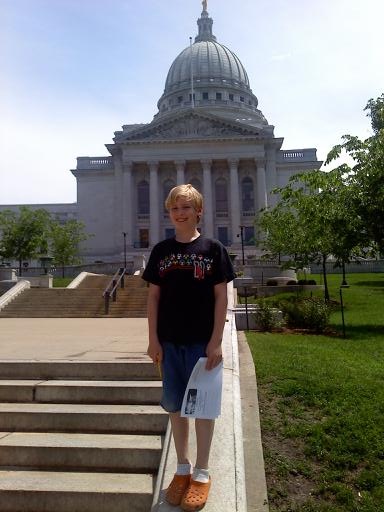
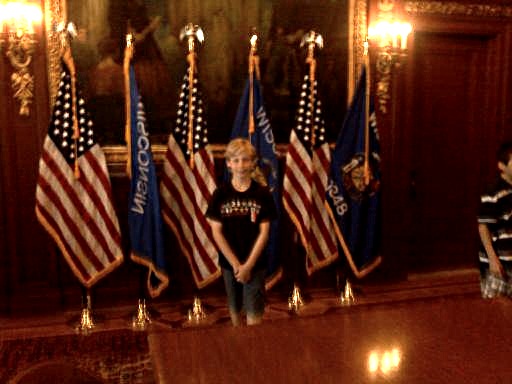
One advantage (really) of my present employment situation is that I’ve been able to go on field trips with all our kids this spring. That included the Ledge View Nature Center in Chilton for Dylan, the Wild Air Play Zone and bowling for Shaena, and, yesterday, the state Capitol in Madison for Michael.
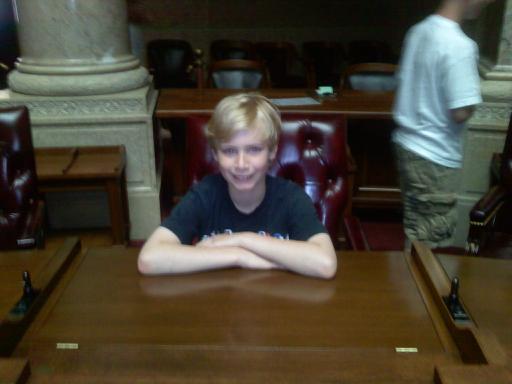
Michael sits in the Senate seat — literally — of Sen. Luther Olsen (R–Ripon). Luther should be very worried.
Being from Madison, I’ve been to the Capitol more times than I can remember. Two instances I do remember are visiting as part of my high school political science class (and my teacher is on Facebook), and attending the inauguration of state legislators who had won elections in 1984. (And those who know my political bent would never believe whose campaign I had worked on in the summer and fall of 1984.) Everyone in Madison lives within eyesight of the Capitol. It is smack in the middle of the Isthmus, and it is by city ordinance the tallest building in Madison. I’ve never been to Washington, D.C., but I have to believe that state government looms over Madison — Dane County, in fact — as much proportionally as the federal government looms over Washington. That came to mind when I came upon buildings I didn’t recognize as state office buildings that apparently now are, whether or not the state actually owns the buildings.
Michael’s teacher warned us that getting into the Capitol is now a laborious experience, thanks to the metal detectors now manned by Capitol police and the Wisconsin State Patrol. (For those wondering how police overtime during Protesterama could near $8 million — the equivalent of about 110 state employees’ total yearly compensation — I think I saw the answer Tuesday.) One wonders how much the increased security has to do with credible threats and how much has to do with legislators’ sense of self-importance. And in case of the latter, shame on the majority party in the Capitol.
Speaking of protesters, yes, I saw a few. (I saw a whole bunch of them, apparently fans of former Supreme Court candidate Joanne Kloppenburg, a couple blocks northeast of the Square apparently gathering for some kind of protest.) One person was either protesting or going on his daily walk holding his unreadable (from the Capitol building) neon green sign. Someone claiming to be from AFSCME had a similarly colored shirt announcing his opposition to whatever Gov. Scott Walker is doing now. Another protester carried a sign with the communist-looking fist in the shape of the state of Wisconsin. (Which shows what he thinks of non-liberals, doesn’t it?) Another held up a sign that said “Republicans are WMDs.” (An interesting phrase given what WMDs mean to the anti-Iraq War crowd. For those not fans of the protesters, perhaps it means “We Must Downsize,” say, by 110 state employees.) A woman had a clear umbrella that had cards that claimed that election fraud starts with election officials, perhaps an early arrival for the first protesters mentioned in this paragraph.
(Later Tuesday, the Wisconsin State Journal reported, or tweeted, that a blood drive being held in the Capitol shut down more than three hours early because the daily noontime protest was too loud to ensure confidentiality of donors. What a positive contribution by the protesters Tuesday.)
I wrote on Facebook Monday night that I was going to stop by Gov. Walker’s office and do some protesting myself about Memorial Union parking, the lack of which, for those not on Facebook, caused us to not purchase Babcock Hall ice cream and go to a private-sector ice cream vendor instead. Well, Walker wasn’t in, although we did get to see his press conference room:
Prestegard for governor!
Time was when I could look at the state Capitol (even after the Carter administration’s toxic brew of ineptitude, incompetence and malign intent) and marvel about laws being created and the political process taking place. If you’re about my age, you remember …
Then, once I started getting twice-weekly paychecks, I started noticing how much was coming out of my paychecks for taxes, even at $3.35 per hour. Later I noticed that politicians don’t give a damn about you if you’re not one of their people — their voters, their supporters, their contributors, their favored interest groups — and yet they act like they feel your pain. (See Clinton, Bill.) Unfortunately, neither my La Follette political science class (though taught by a great teacher) nor my UW political science major (and, I think, not my wife’s Ripon College politics and government major either) taught me the ugly reality of politics at any level, which is that politics is a zero-sum game where one side wins (gets power and/or control and/or goodies, from the taxpayers and/or the losers) and the other side(s) loses.
And that is why the older I get, the more libertarian I become. (As H.L. Mencken once said, “Every decent man is ashamed of the government he lives under.” Or, put more nicely — or maybe not — on Tuesday, “Most of us are not political crack-heads, jonesing for our daily fix of victimhood, partisan spin, overhype, and payback. We prefer to focus on our families, homes, businesses, jobs, neighborhoods, churches, clubs, hobbies, schools, sports teams, meals, clothes, entertainment, charities, and friends.”)
We went to the Senate and Assembly chambers, and my thought was: Too many seats for senators and representatives. (Definitely too much security.) And there are too many suits walking in and out of the Capitol, whether they have offices in the building or not. And there are too many state office buildings because at some point in our state’s history — perhaps May 30, 1848, one day after statehood — the people we vote for decided that government should be an employer, a wealth-redistribution machine, a distributor of carrots and sticks instead of performing essential government services and nothing else.
The afternoon, one day after Memorial Day, was spent at the Wisconsin Veterans Museum, where it is easy for a World War II buff (somehow the term “fan” seems inappropriate) to get lost in the World War II section. One wonders what those who died for their country would think of the country they died for. (Is it unpatriotic to write that?)
I think I’ll skip future state Capitol trips. Unfortunately, the history is overwhelmed by the present-day reality.
1963: The number one song is Ray Baretto’s “El Watusi”:
1967: The Beatles release “Sgt. Pepper’s Lonely Hearts Club Band”:
1968: The number one song is Simon & Garfunkel’s “Mrs. Robinson”:
1970: The number one song is Ray Stevens’ “Everything is Beautiful”:
1973: Paul McCartney and Wings release “Live and Let Die,” from my favorite James Bond movie:
1975: Ron Wood celebrates his 28th birthday by replacing Mick Taylor on guitar for the Rolling Stones:
1985: The number one song is David Lee Roth’s “Just a Gigolo/I Ain’t Got Nobody”:
Birthdays today include band leader and composer Nelson Riddle, a name famous even for those who didn’t listen to his five decades of composing because he wrote these two songs:
(What, other than Riddle, do those two shows have in common? Martin Milner, who starred in “Route 66” and then “Adam-12,” whose character made an appearance in the “Emergency!” pilot.)
Keyboardist and bassist Mike Levine of Triumph:
Alan Wilder of Depeche Mode:
Alanis Morrisette:
Today is also the anniversary of the death of Temptations singer David Ruffin of a drug overdose at 50:





 Steve Prestegard.com: The Presteblog