Today in 1956, Elvis Presley made his second appearance on CBS-TV’s Ed Sullivan Show, with Sullivan presenting Presley a gold record for …
One year later, Presley’s appearance at the Pan Pacific Auditorium in Los Angeles prompted police to tell Presley he was not allowed to wiggle his hips onstage. The next night’s performance was filmed by the LAPD vice squad.
One year later, Buddy Holly filmed ABC-TV’s “American Bandstand”:
It would be Holly’s last TV appearance.
Today in 1964, the T.A.M.I. show began in Santa Monica, Calif., emceed by Jan and Dean:
The number one album today in 1967 was “The Supremes: Greatest Hits”:
In 1972, something called the United States Council for World Affairs selected this as its official theme song (which is ironic given the Roger Daltrey vs. Pete Townshend fights over the years):
The number one album today in 1989 was Janet Jackson’s “Rhythm Nation 1814”:
Birthdays begin with Charlie Daniels:
Randy Newman:
Wayne Fontana:
Tommy Dolbeck played drums for the Michael Stanley Band:
The original headline for this piece was going to be from one of my favorite guilty-pleasure movies, “Desperado,” in which a meeting takes place in a Catholic church confessional:
EL MARIACHI (Antonio Banderas): Bless me father, for I have just killed quite a few men.
BUSCEMI (Steve Buscemi): No shit.
(I should apologize for the foul language, but (1) I’m just quoting from the movie and (2) we already lowered the bar through the blog’s first example of nudity earlier this week.)
The reason I would choose either of those headlines is because of this Wisconsin Reporter item, headlined “Some worry state entering reprisal by recall”:
The Democratic Party of Wisconsin and the liberal political action committee United Wisconsin next month plan to launch a petition drive to force Walker to stand for election — only a year into Walker’s four-year term. They’ll need to collect more than 540,000 valid signatures.
Democrats and organized labor are livid about the Walker-led Act 10, which reformed collective bargaining for most unionized public employees.
Some in Democratic leadership have suggested Walker won’t be the only Republican to face a recall threat; they say some GOP senators could be targeted.
Some see it as a reprisal by recall.
“I would classify it as type of warfare,” said Joe Heim, a professor of political science at the University of Wisconsin-La Crosse. “To me, there’s got to be some rational sense at some point.”
While he said he can understand the anger of Democrats and union members over Walker’s policies, Heim said he is no fan of easy recalls.
“Recalls should be like impeachments; they should be for high crimes, malfeasance and corruption. They should be used minimally,” Heim said.
This is by far the most disingenous comment:
Jim Camery is a bit conflicted, but he said he’s adamant that he wants Walker out for what he calls the governor’s “egregious” policies.
Camery, chairman of the Pierce County Democratic Party, said he goes back and forth on whether the recall system is a good tool. He said he believes it will be a breeze to get the 540,000 signatures to recall the governor, or 25 percent of the total vote in the 2010 gubernatorial election.
The Democrat said he knows it could all be “tit-for-tat,” that Republicans could champion recall causes when they are in the minority. But, he said, he’s hopeful the current spate of election challenges doesn’t lead to a continuous recall campaign.
You have to be Cleopatra, the queen of denial, to believe that Republicans will not work to recall a Democratic governor in the unlikely event Walker loses a recall election, or if Democrats take control of the state Senate through another recall campaign. The Recallarama of earlier this year shows that, as Camery predicts, you can get enough signatures, but that doesn’t mean you’re going to win a recall election.
We have now arrived at the most toxic political atmosphere in the history of this state. Democrats and their apparatchiks didn’t like the Nov. 2 election results — for which blame they should look in the mirror at their capital punishment-level incompetence — and now want to hold taxpayers hostage for their electoral temper tantrum. And this over taking a small step to move control of state finances to where it belongs — with taxpayers, not government employees.
Remember, Democrats, that Newton’s Third Law of Motion does not apply. For every political action, there is a bigger and opposite reaction. And I couldn’t hazard a guess as to what that might be.
A decade or so ago, MSNBC’s Chris Matthews used the terms “the mommy party” and “the daddy party” to describe the Democratic and Republican parties, respectively.
That context helps you understand this observation by the Wall Street Journal’s James Taranto:
Here’s ABC News, reporting on the speech the president gave in Fog City: “At a million-dollar San Francisco fundraiser today, President Obama warned his recession-battered supporters that if he loses the 2012 election it could herald a new, painful era of self-reliance in America.”
Oh no! Horror of horrors! Obama is the only thing standing between us and having to rely on ourselves! And do you know what they call people who rely on themselves?
Adults.
Oddly, the White House website doesn’t have the text of this speech, but here’s a passage from ABC: “The one thing that we absolutely know for sure is that if we don’t work even harder than we did in 2008, then we’re going to have a government that tells the American people, ‘you are on your own. If you get sick, you’re on your own. If you can’t afford college, you’re on your own. If you don’t like that some corporation is polluting your air or the air that your child breathes, then you’re on your own. That’s not the America I believe in. It’s not the America you believe in.”
Obama explicitly rejects the American ethos of self-reliance. He sees dependence on government not as an evil, if sometimes a necessary one, but as a goal to be pursued. It reminded us of Peggy Noonan‘s observation last week that there’s something not fully adult about the president himself: “Sorry to do archetypes, but a nation in trouble probably wants a fatherly, or motherly, figure at the top. What America has right now is a bright, lost older brother. It misses Dad.”
Four days before Halloween was the world premiere of the more recognizable version of Modest Mussorgsky’s “Night on Bald Mountain”:
The song was an appropriate theme for the Friday-bad-horror-flick-show “The Inferno” on WMTV in Madison:
Britain’s number one song today in 1957:
The number one song today in 1963 was the Four Tops’ only number one:
The number one song today in 1973:
Today in 1975, Time and Newsweek demonstrated journalistic groupthink when they chose the same cover story on a then-obscure musician, Bruce Springsteen:
The number one British album today in 1990 was Paul Simon’s “The Rhythm of the Saints”:
Presenting, in order, the Best British Group and Worst Female Singer in the 1991 Smash Hits Poll:
The small list of birthdays starts with Byron Allred, who played keyboards for the Steve Miller Band:
Simon Le Bon of Duran Duran …
Peter Dodd played guitar for the Thompson Twins:
Scott Weiland of the Stone Temple Pilots:
Finally, today in 1980, Steve Took, a former member of T Rex, choked to death on a cherry pit. He choked to death because the magic mushrooms he had taken numbed all sensation in his throat.
On the day of game six of the World Series (think we’ll have another pitcher brought in to issue an intentional walk, and then pulled?), Forbes.com’s Stuart Anderson compares baseball to today’s politics:
The number of foreign-born players in the major leagues has more than doubled since 1990. In the general economy, the number of jobs rises and falls based on factors that include consumer spending, population growth, capital investment, labor laws, and startup businesses. New entrants to the labor market can create and fill new jobs, rather than replace a current jobholder. In contrast, a fixed number of jobs exists on active major league rosters, with only 25 baseball players permitted per team or 750 players total in the major leagues.
Still, it is noteworthy one never hears complaints about “immigrants taking away jobs” from Americans in the major leagues. Baseball players consider the competition for roster spots to be fair, a meritocracy. And, as Tom Hanks once said, “There’s no crying in baseball.” …
The next time someone complains about immigrants “taking jobs” from Americans, tell them to try playing major league baseball, where, unlike the rest of the economy, the number of jobs are fixed and limited, yet no one ever complains about immigrants.
Baseball is not the real economic world, of course, and the work world is not a pure meritocracy. (Nor, probably, is baseball.) But baseball would not get better by excluding productive players who didn’t come from the 50 states. (Or, for that matter, non-whites; imagine baseball without, for starters, Jackie Robinson, Willie Mays and Hank Aaron.) And our economy will not get better by keeping out people not born here who could contribute positively to our economy given an opportunity.
As usual given the state of our politics, dealing with illegal immigration (to the extent it’s been dealt with at all) means we haven’t dealt with our need to let in more immigrants — scientists, engineers, computer programmers and others covered under the H1B and L1 visas — who can become, say, the father of the next Steve Jobs, or make other positive contributions to our country and its economy.
On Tuesday, I spoke to a Marian University Sport and Recreation Management class on sport facility management. My subject was the sports broadcasting side of sport facility management, using my favorite weird media story, The Case of the Falling Announcer, except with me, a freelancer, as the subject.
The class wrestled with the question of whether or not the school district that “maintained” (so to speak, given what happened) would be liable for negligence should I, the independent contractor, become injured from my fall through the press box stairs. It also extended to various other points of my broadcasting career, such as announcing games from press boxes during gale-force winds (Kewaskum, 2010) and epic drives to announce games (Midwest Conference, 1998–2001). The conundrum is that independent contractors don’t get paid for games they don’t do regardless of the reason, but should an independent contractor become injured and be unable to do future games, that is future income the announcer won’t have.
(Think that sounds overdramatic? Consider that Bill Stern, one of the pioneers of radio sports, announced a football game between Centenary and Texas, then was in a car crash on the way back from the game. Due to bad medical care, Stern’s leg had to be amputated, which certainly ended his season. One of the victims of the Marshall University football team plane crash in 1970 was the team’s radio announcer, a local TV sports director. The victims of the Evansville University men’s basketball plane crash in 1977 and the Oklahoma State University men’s basketball plane crash in 2001 included the teams’ radio announcers.)
At the end, the professor said that because of fiscal issues, most facility owners won’t make health or safety improvements until they have to — for instance, after a user of the press box takes out the stairs — so the only recourse for us independent contractors is to, as he put it, “Pray to Mother Agnes” (the founder of the Congregation of Sisters of St. Agnes, Marian’s sponsoring organization) that one doesn’t become the victim.
That seems hard-hearted, but it is true even for organizations that care for their various constituent groups more than might be discerned from that statement. School districts and colleges formerly allowed their student–athletes to drive or be driven from game to game. Now, after fatal crashes involving even college-owned vans, school districts always, and colleges more often than not, take buses or charters. Safety improvements follow nearly every fatal race crash. The concept of emergency medicine owes considerable credit to the Vietnam War.
After the professor’s closing statement, I said that if fatal misfortune befell me before, during or after a game I was announcing, I’d hope the press box would be named after me. To which one of the students said, “You can call it the Prestebox.”
That student must read this blog. I predict he will go far.
Britishers with taste bought this single when it hit the charts today in 1961:
Today in 1965, the four Beatles were named Members of the Order of the British Empire by Queen Elizabeth. The Beatles’ visit reportedly began when they smoked marijuana in a Buckingham Palace bathroom to calm their nerves.
The Beatles’ receiving their MBEs prompted a number of MBE recipients to return theirs. “Lots of people who complained about us receiving the MBE received theirs for heroism in the war — for killing people,” said John Lennon, previewing the public relations skills he’d show a year later when he would compare the Beatles to Jesus Christ. “We received ours for entertaining other people. I’d say we deserve ours more.”
Lennon returned his MBE in 1969 as part of his peace protests.
The number one album today in 1974 was Barry White’s only number one album, “Can’t Get Enough”:
Britain’s number one album today in 1985 was a George Benson greatest hits compilation:
Proving that there is no accounting for taste (you have been warned), I present the number one British single today in 1997:
Today in 2004, Forbes magazine listed the top five dead musicians in order of postmortem earnings, starting with number five:
Birthdays begin with Keith Hopwood, one of Herman’s Hermits:
David Was of Was (Not Was):
Keith Strickland of the B-52s:
Natalie Merchant, formerly one of the 10,000 Maniacs:
I’ve been reading the book Nofziger, about Nixon and Reagan administration political operative/spokesman Lyn Nofziger. And that makes me think that’s the job I want — to be employed to get out the Republican Party’s story (which the media can choose to use, or not) instead of relying on the not-especially-unbiased news media.
The Walker administration appears to have taken a page from Nofziger by creating a web site, reforms.wi.gov, to measure what it claims are the savings from the changes in public employee collective bargaining enacted earlier this year. The website even has a precise dollar figure — $460,844,146, as I write this.
The site is, as always, a mixture of fact and assertion, such as:
Honestly Balancing the Budget
Wisconsin faced a $3.6 billion deficit in January and now has a budget with a surplus. Moody’s (one of the national rating agencies) calls Wisconsin’s budget “credit positive.”
Unlike past budgets filled with raids on segregated accounts or one-time stimulus money, Governor Walker’s budget made structural changes aimed at the next generation, not the next election. …
Well, perhaps the budget is “credit positive,” but we won’t know until the end of the budget cycle whether the budget was balanced correctly — as in according to Generally Accepted Accounting Principles, the honest measurement of finances, not on a cash basis. It remains insane to measure the fiscal health of an enterprise that spends more than $30 billion each year on a cash basis.
On the other hand, we do know the fiscal record Walker inherited — a $2.9 billion GAAP deficit, and GAAP deficits in every year in the 2000s, and sinking bond ratings.
Protecting Property Taxpayers
Schools and local governments across Wisconsin are saving money. Unlike other states that balanced their budgets with massive layoffs or tax increases, Governor Walker’s reforms protect middle class jobs and property taxpayers.
All across Wisconsin, local officials are able to hold the line on property taxes.
In order to balance the budget, without the reforms in Act 10 and the property tax controls in the budget, the average homeowner could have seen their property taxes rise by hundreds of dollars.
Some governments are even seeing a decrease in the tax rate. …
Being a Fond du Lac County resident, I checked the county on the interactive map, and I find:
Fond du Lac County
Taxpayers will save $300,000 due to Act 10 reforms, according to media reports.
Moraine Park Technical College
Taxpayers will save $670,000 due to Act 10 reforms, according to media reports.
Ripon Area School District
Taxpayers will save $600,000 due to Act 10 reforms, according to media reports.
The proof of that will be in the property tax bills arriving in the next month or so. We do know, however, that the only places where extensive layoffs occurred were in municipalities and school districts where public employees were not required to contribute more to their benefits, most notably the Milwaukee Public Schools. I’m not quite clear why large-scale layoffs are preferable to making everyone pay more for benefits like the people who pay their salaries have had to do for several years, but I’m not a supporter of teacher unions, you might say.
Improve Government
Schools and local governments can now hire and fire based on merit. They can pay for performance. They can put our best and brightest in the classrooms and workplaces. They can change insurance companies and adjust health plans to save money. Without reforms, none of these were options for most school districts. …
These reforms allow government to improve customer service. They allow government to do the things it should do – and do them well.
What a novel concept — hiring and firing based on performance. (However, I will believe that when I see stories about teachers being fired for poor performance.)
Meanwhile, the Democratic Party, the party of grotesque fiscal failure in the first decade of the 2000s, isn’t happy, reports their People’s Republic of Madison mouthpiece, The Capital Times:
The Party plans to file a complaint with the state Government Accountability Board Tuesday, claiming Walker is using taxpayer money for political purposes, according to party spokesman, Graeme Zielinski.
“It is political propaganda,” Zielinski says. “And for taxpayers to shoulder the burden for what is clearly a campaign website is ridiculous.”
The “campaign website” doesn’t refer to Walker’s 2014 reelection campaign, of course; it refers to the stupid effort to undo the Nov. 2 election, which didn’t treat Zielinski’s party very well.
This is where I claim to be shocked — shocked! — that politics is going on. Zielinski apparently didn’t see the state website when Walker’s predecessor, James Doyle, was governor. The entire governor’s website was a paean to the brilliance of Doyle and his lieutenant governor, Barbara Lawton. For that matter, check out the Department of Public Instruction‘s website, which reminds you:
Last fall, the DPI proposed “Fair Funding for Our Future,” to reform school finance in Wisconsin. The plan would move away from property wealth being the primary determiner for aid, instead providing a base level of state aid for every student. The “Fair Funding for Our Future” school finance reform package was not included in the 2011-13 state budget.
Nothing political in that paragraph, right? Right down to the bullet points, except that the bullet point “screw the taxpayer” is strangely missing.
Let’s recall as well that the Democrats’ response to the fiscal crisis they created was to (1) deny that there was a fiscal crisis and (2) propose fixing it by raising taxes. The Democrats’ response to Walker’s doing what he said he was going to do well before the election is to attempt to recall him. That, taxpayers, is what the Democratic Party and its apparatchiks think of you.
Today in 1963, the Beatles played two shows in Sundstavagen, Sweden, to begin their first tour of Sweden. The local music critic was less than impressed, claiming the Beatles should have been happy for their fans’ screaming to drown out the group’s “terrible” performance, asserting that the Beatles “were of no musical importance whatsoever,” and furthermore claiming their local opening act, the Phantoms, “decidedly outshone them.”
Three thoughts: Perhaps the Beatles did have a bad night. But have you heard a Phantoms song recently? It is also unknown whether the Beatles’ “Norwegian Wood” was intended as revenge against the Swedes.
One year later, a demonstration of why the phrase “never say never” holds validity: Today in 1964, the Rolling Stones made their first appearance on CBS-TV’s Ed Sullivan Show.
A riot broke out in the CBS studio, which prompted Sullivan to say, “I promise you they’ll never be back on our show again.” “Never” turned out to be May 2, 1965, when the Stones made the second of their six performances on the rilly big shew.
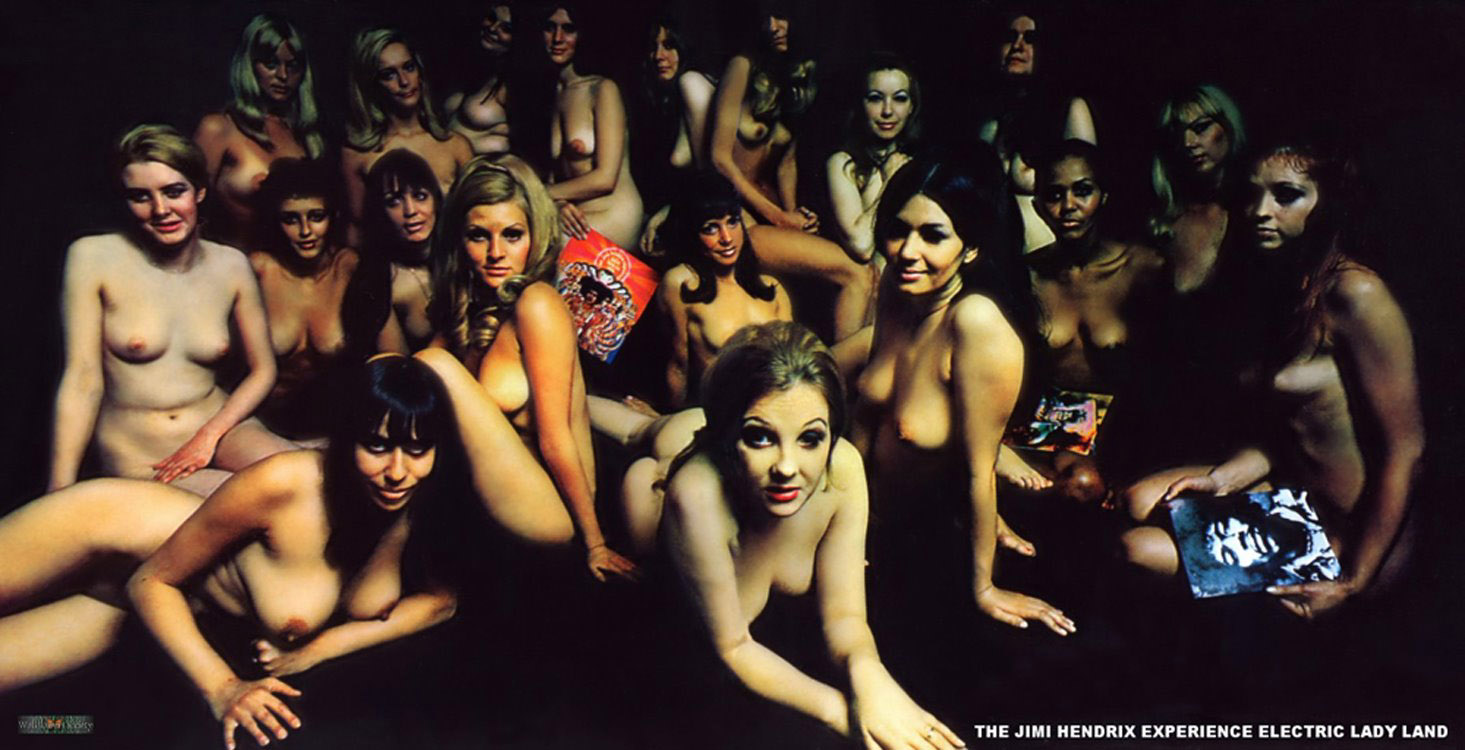
Today in 1968, the Jimi Hendrix Experience released “Electric Ladyland”:
The most controversial part of the album was its cover, which featured Hendrix’s head …
… instead of what the record label had in mind:
Today in 1970, President Richard Nixon asked radio station programmers to (to coin a phrase from the next decade) just say no to playing songs with drug references. Which would have taken, by one measure, one out of every seven rock songs off the air, before and after Nixon’s request.
The number one single today in 1975:
The number one single today in 1980 comes from the number one album today in 1980, Barbra Streisand’s “Guilty”:
The number one album today in 1986 was Bon Jovi’s “Slippery When Wet”:
Birthdays start with Helen Reddy:
Jon Anderson of Yes:
John Hall of Orleans:
Glenn Tipton of Judas Priest:
Matthias Jabs played guitar for the Scorpions:
Robbie Macintosh of the Pretenders and other bands:
Chad Smith of the Red Hot Chili Peppers:
Two deaths of note today: Roger Miller today in 1992 …
St. Clement Catholic Church, Lancaster, Oct. 24, 1992. Taken before the wedding, which we highly recommend.
What does that headline mean? It means that today (more precisely, around 2:30 p.m.), Jannan and I have been married 19 years.
Nineteen years isn’t one of those anniversaries with a specified gift attached, like silver for 25 or gold for 50. But given the divorce rate, and considering that people we know who have been longer than that are now divorced, this seems like an accomplishment.
I repeat the story of how we met because it strikes me as one of the more unusual ways to meet people — by interviewing them as part of your job. Back in my rural journalism days, I was assigned to interview an area woman back briefly after a year in the Peace Corps in Guatemala. The interview produced the best lead paragraph I have written before or since: “One day, Jannan Roesch was on the bus, when two men in front of her got into a machete fight.” You read that, and I guarantee you you will read the rest.
She then returned to Guatemala for her last year, and I returned to my pastime of the previous several months — complaining about the lack of social life for myself because of the lack of people like myself in Lancaster — mid-20s, college-educated and unattached.
A year and a few months later, I found out from the newspaper publisher (whose stepdaughter was best friends with Jannan) that she was coming back the next Monday. I called her mother (who remembered me from the first interview) and we arranged an interview at 10 on Tuesday, 10 hours after she got off the airplane at O’Hare International Airport in Chicago.
That was a similarly good interview, which ended with her saying that she was going to Washington in the fall to take advantage of her one year’s preferential hiring status with the federal government, which she got for doing the two-year Peace Corps hitch. Which I pointed out to my boss when she asked upon my return to the office if I had asked her out. That would have been not merely unprofessional (though I doubt unprecedented), but, I assumed, pointless.
But small towns contain opportunities to keep running into people — the grocery store, the Monday night community band concert on the courthouse lawn, and, yes, the murder trial. (A colleague of her brother-in-law was the victim.) At some point the day the verdict was reached, I must have mentioned to her that a baseball playoff game was being held later that day, and she came to the game. (A come-from-behind 20–3 Lancaster win over Platteville.) I mentioned to her that the next playoff game was three days later, and she came to that, too. (Gale–Ettrick–Trempealeau 8, Lancaster 7 in 12 innings, the story about which won me a Wisconsin Newspaper Association Better Newspaper Contest first-place award.)
I then mustered up what little courage I had to ask her on a date, the next night — dinner at Mario’s Restaurant in Dubuque and the movie “Pretty Woman.” Fun night, but again, nothing was going to come to it because she was going to D.C. in a couple of months.
She started coming to my games with the Grant County Herald Independent softball team, which made up for poor hitting with poor pitching and defense. One particular night, she saw me hit my one and only triple (a highly unlikely event) in my four-year slow-pitch career. And suddenly, if there was a social gossip column in the Herald Independent, we would have been in the same sentence.
She never went to D.C., or at least not to get a job. I assume it was because after two years of traveling, she was tired of being far away from her family. (Which, I must point out, has now been feeding me for more than 20 years.) She claims it’s because I didn’t unbutton my shirts to my navel and spoke English. I assume that she might be the only person on the planet who could stand being with me this long. (I’m not the easiest person to live with, I must confess.)
Our wedding was pretty large, and definitely musical, with my chiropractor singing and a brass quintet (with her high school band director) performing. I think everyone who went to the wedding had a good time, although I’m pretty sure some people who went to the reception didn’t remember much about the reception. (Two words: Open bar.) Unfortunately, the restaurant where we had our rehearsal dinner and the banquet hall where we had our reception are now closed. Also unfortunately, the wedding videos are filling with people who are no longer with us — my grandparents, her grandmother, her father and her oldest sister and brother-in-law.
We had two celebrants, the Catholic church priest and our friend the Methodist-trained minister/radio DJ. (And now high school football coach and nondenominational pastor.) Something the latter said in the homily has stuck in my mind: When you hear that marriage is a 50/50 proposition, that’s wrong; it should be a 100/100 proposition.
I think one’s marriage’s success has a lot to do with one’s parents’ marriage and its success or lack thereof. My parents celebrated their 50th wedding anniversary Jan. 7. My in-laws were married 58 years before my father-in-law died in 2004.
Our 19 years includes several jobs, three houses, two dogs and one cat now passed on to Rainbow Bridge, and, most importantly, our three children. We don’t have the same tastes (I didn’t watch the chick flicks she used to watch Sunday mornings in our pre-children days) or opinions, but we have, I’d say, similar opinions about things. She’s indulged my interest in sports announcing, even though that means my being at games on nights and weekends, since that’s when the games are. (Added bonus: She can keep score in football and basketball.)
I hope she doesn’t think she’s missed out on doing bigger and better things because she’s been with me, even though she probably has. Since the day before this blog began, I get an F in being a family provider. You don’t want to know the list of things around the house that I haven’t gotten to in the past nearly seven months. Even when things are going well, my list of personality traits includes adult vocabulary during unfavorable portions of Packer and Badger games, bad temper, expressing opinions without being asked, impatience, procrastination, stubbornness and yelling … and, of course, being a journalist. Had she known all of this in the summer of 1990, and had my persuasive powers not been what they apparently were on one occasion in my life, I hope I would have had the grace to not be a bitter, lonely middle-aged man, but I doubt it.
Jannan, on the other hand, is (not in any particular order) smart, bilingual, a great mother, and a fine cook (in keeping with her farm background). She puts others before herself, and she’s put up with me for 21 years.
The best thing about being married is its intimacy in ways far beyond those about which you really need to get your mind out of the gutter. Early in relationships, you have someone with whom to do things. But as your relationship lengthens and deepens, there is more to share. Any time we’re at a wedding or otherwise in church and hear our wedding’s first reading, which includes Song of Solomon 2:9 (look it up yourself), there will be two people in the church quietly, yet hysterically, laughing. We enjoy finding typographical errors in publications. I hear her say things I would say, which means she’s been around me a really long time. (Either that, or I repeat myself repeatedly.) Being married also means you have to think about someone besides yourself, which is good for the self-centered.
I look at this way: This morning, the love of my life was next to me in our bed. Tonight, the love of my life will be next to me in our bed. In a world where divorce seems more common than marriage, perhaps I should say in public: I love my wife.



 Steve Prestegard.com: The Presteblog