(I wonder if this will come up at my charter school meeting this afternoon. If it does, I hope it won’t take long; I have to pick up our kids from swimming.)
Fox Business Channel’s John Stossel has done some research, and come to similar conclusions:
Some teachers are more effective than others – yet the union frowns on giving the best teachers extra pay for excellence. They even frown on paying lousy teachers less. They snarl at the idea of ever firing a teacher. Public school teachers typically get tenure once they’ve taught for about 3 years. After that, the union and civil service protection make it just about impossible to fire them. They basically have a job for life. …
This is not how it works in real life: the private sector. Remember when GE was a phenomenal growth company, rather than the bloated “partner” with Big Government it is now? Its CEO at the time, Jack Welch, said what was crucial was “identifying the bottom 10 percent of employees, giving them a year to improve, and then firing them if they didn’t get better.” …
But the unions say that failing teachers should be given chances to improve. Lots of chances. “We need to lift up the low performers and help them do better,” Nathan Saunders, head of the DC teachers union told me. “There’s a cost of firing teachers… the quality of life of that person is deeply affected by that termination.”
Boo-hoo. Notice that he didn’t mention the kids who are stuck in that class with the teacher being a second, third, or fourth chance?
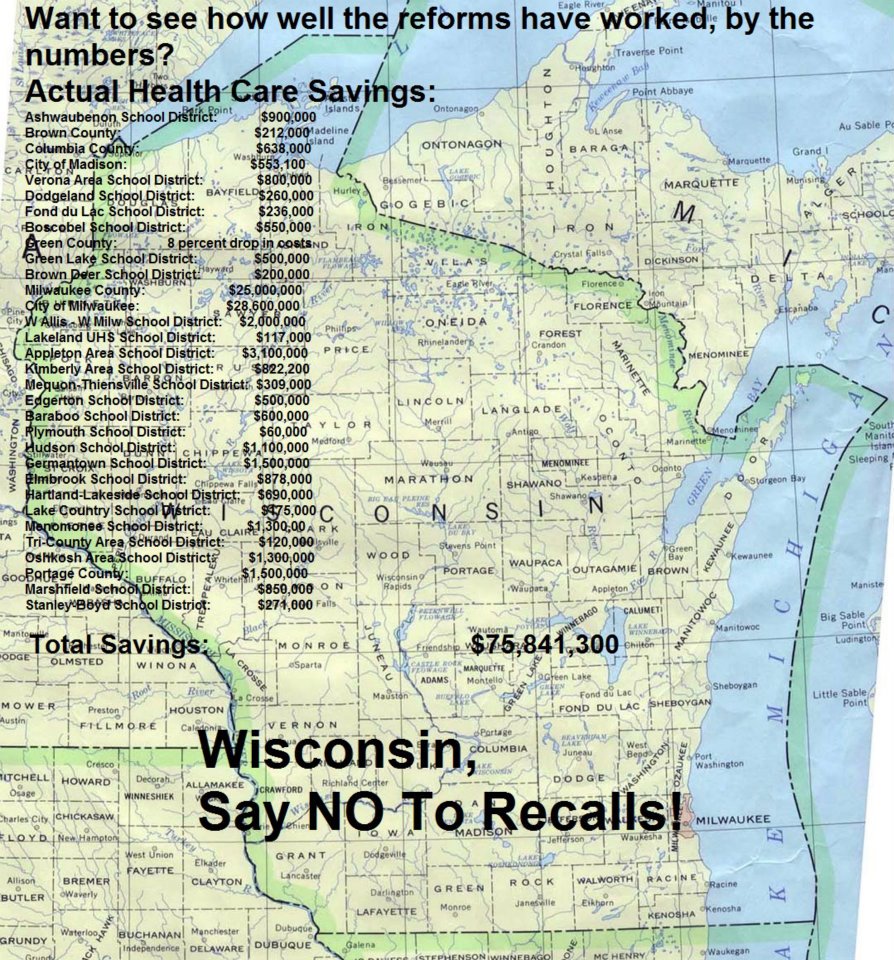
It is not enough to make teachers and other public employees pay more for their benefits, even though public employees still pay considerably less for their benefits than private-sector employees. Of course, the savings can now be mapped (from Facebook):
Good teachers must be rewarded better, and bad teachers need to find another line of work.
Anyway, today in 1814, Adolph Sax was born in Belgium. Sax would fashion from brass and a clarinet reed the saxophone, a major part of early rock and jazz.
Number one in 1961:
Number one in 1965:
Number one in 1968:
The number one single …
… and album today in 1971:
Number one in 1976:
The short list of birthdays starts with Bill Henderson of Chilliwack:
Today in 1956, Nat King Cole became the first black man to host a TV show, on NBC:
The number one single today in 1966:
Today in 1971, Elvis Presley performed at the Met Center in Bloomington, Minn. To get the fans to leave after repeated encore requests, announcer Al Dvorin announced, “Elvis has left the building.”
Britain’s number one single today in 1977 is …
Today in 1988, the song “Locomotion” set a record by becoming the first song to reach the top five for three different artists: Little Eva …
… Grand Funk Railroad …
… and Kylie Minogue:
Birthdays start with Art Garfunkel:
Bryan Adams:
Three death of notes: First, today in 1960, Johnny Horton:
Today in 2003, Bobby Hatfield of the Righteous Brothers, and a former Beaver Dam resident, was found dead in his hotel room:
Finally, today in 2006, Link Wray, the guitarist credited with creating fuzz guitar by punching a hole in a speaker, died at 76. Wray reached number 16 with “Rumble,” which was banned by several radio stations for allegedly encouraging juvenile delinquency.
You might ask how a song with no words encourages anything. You’ll find no answer here.
Chevrolet is celebrating its 100th anniversary (which was Thursday) this year. (In fact, a Chevrolet centennial ad was on TV as I started typing this, announcing the Chevy Open House at a Chevy dealer near you through Monday.)
In the year Chevrolet was born, there were 270 auto companies operating in the United States. Although Chevrolet was started by one of the best-known and most prolific names in the fledgling industry, its survival was not ensured. But Chevrolet not only endured, it prospered. It went on to become one of the few American auto brands to reach the century mark, and it was the number-one-selling brand in the United States in the majority of those years.
Chevrolet’s success in the past century probably hinges on two things: value and choices. Chevy took off in the marketplace when Alfred E. Sloan, who eventually became chairman of GM, hit on the strategy of using Chevy to take on the Ford Model T’s higher-end customers — “a higher-quality low price car,” as Automobile puts it. The Free Press calls Chevrolet “the brand that became a giant by giving Americans more car for their money.”
Here’s an example: In 1955, Chevy came out with its new full-size car …
… which looked similar to that year’s Cadillac, for much less money:
The cars had similar, though separately designed, engines. Six years after Cadillac’s overhead-valve V-8, the ’55 full-size and Corvette offered an optional V-8, Chevy’s first in almost 40 years. The same basic design is available today in Corvettes, Camaros, pickups and the Suburban and Tahoe. The Chevy small-block V-8, which powered by my count four of our Chevys, is considered perhaps the best mass-production engine ever produced.
Twenty years later, those who wanted a full-size Chevrolet had three choices — the base Bel Air, the middle-range Impala and the high-end Caprice — in two-door coupe, four-door sedan (with or without B-pillar in the case of the Caprice), station wagon and Caprice convertible. The cars were available with the buyer’s choice of three V-8 engines, four radios, and manual- or automatic-control air conditioning, or neither. Buyers could choose from cloth or vinyl bench or split-bench seats in several colors. Buyers could choose, or not, cruise control, tilt steering wheel, power windows, power door locks, two kinds of wheel covers, two sizes of tires, and so on. The option list used to take up one to two pages in a car catalog.
The first several cars of my parents were Chevrolets. My grandparents owned nothing but Chevys as far as I know. My in-laws owned Chevys until Chevy stopped building the kind of Chevy they wanted to own. (More on that later.)
The Chevy thing with my parents and maternal grandparents is a bit ironic given that my aunt and uncle (on my mother’s side) were Ford owners, at least until my aunt bought a couple of Suburbans to replace the Ford Club Wagons they used to own. My uncle would call our preferred brand of car “Shove It or Leave It,” and his smartass nephew would reply with either “Fix Or Repair Daily” or “Found On Road Dead.” (So of course I replaced my last Chevy with a Ford, but more on that later too.)
My father’s first car was a 1951 Chevy with a six-cylinder engine and the Powerglide two-speed automatic, whose engine-power-sucking attributes gave it the name “Powerslide.”
Chronologically speaking model-year-wise, the first Chevy I remember is my grandparents’ 1959 El Camino, in this Aspen Green (although theirs did not have the chrome wheels or whitewalls). My grandparents bought it for my grandmother’s next-door second-hand store. After they closed the store, my grandfather drove it to work at the Department of Natural Resources nursery just outside Boscobel.
My parents supplanted my father’s collection of used and fancy, but not always reliable, cars with a Chevrolet Nova (known as a “Chevy II”) after they got married. By the time I arrived, the first Chevy II was replaced with a dark red wagon, the first car of theirs I remember. I apparently lived in Chevy neighborhoods while in Madison. The next door house (where our babysitters came from) owned a Corvair. Up the street, the father of friends of ours drove a 1969 Impala coupe. And when we moved to the house my parents built, two houses down was the first Corvette I ever saw. In the days when many people replaced cars around 40,000 miles (which was 28,000 miles past warranty and around the time when things started to go wrong), my parents then decided they needed something larger, and replaced a compact Chevy wagon with a mid-size Chevy wagon, a 1969 Nomad. The Nomad was LeMans Blue, not this green, and it had a roof rack. It didn’t have many options besides that — AM radio and a power tailgate window. It could move quite smartly, given that my father selected one from an Oregon Chevy dealer with the most powerful available V-8, 255 horsepower and 365 lb-ft of torque, attached to a two-speed automatic. (I sat behind my father, so I can tell you how fast it could go.)
On my previous blog (and probably on this blog in a few weeks) I mentioned the Christmas albums my parents got from a tire dealer. Chevy also distributed an album shortly after my parents got the Nomad:
Perhaps sitting in the second seat of station wagons is where I got my affinity for station wagons, given that the second one I’ve owned is sitting in front of my house right now. (Though it is not a Chevy, because Chevy doesn’t build the kind of wagon I wanted. You may notice a theme developing here.)
When my parents owned a blue 1969 Nomad, my grandparents owned a black 1968 Nomad. (The latter lacked the front headrests and steering-column-mounted ignition switch of the former.) So one day apparently I suggested to my grandparents that they should buy a new wagon in our Nomad’s color. So imagine my surprise when the next time I saw them, they pulled up to our house driving …
(Theirs had the dog-dish hubcaps, but not the roof rack.)
About that time (ironically, in the town where my grandparents lived) my father bought our first second car, a burgundy 1965 Bel Air sedan, powered by a 283 V-8 and Powerglide. The Bel Air was built in the days before seat belts were required to be installed in the back seat. My parents’ solution was to have my mother sit in back and my brother and I share the lap belt on the passenger side of the front seat. My father never hit anything (though someone backed into the left rear side once) while we were in the car, which was good, because the lap belt would not have prevented our faces from being rearranged once our unrestrained upper halves made contact with the dashboard.
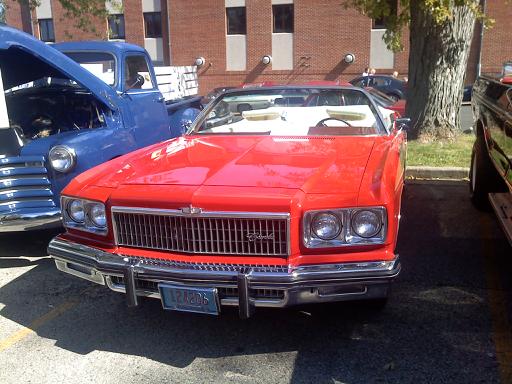
My parents and grandparents then went in different vehicular directions. The newer blue Nomad was replaced by the first of two Novas … … while my parents moved up to the full-size level, a 1975 Caprice: This was a car. (Dark red, not black, and without the color-keyed hubcaps and with a full vinyl roof.) It was 18 feet 1 inch long, weighed 4,300 pounds, and required careful parking. (Note the huge front bumper guards; the way to get it into the garage was to drive slowly until the front bumper hit the concrete steps into the house.) On the other hand, it ate up the miles in Chevrolet-level luxury. And it was built down Interstate 90 at the GM Janesville plant, which employed one of my neighbors. This is undoubtedly where I developed my affinity for land yachts.
Our Caprice had the base-level V-8 (the same as this car), which gave it enough power for me to get two speeding tickets driving it. (Perhaps it was the fact the car was so large that its radar signature could be seen by AWACS planes flying in the Middle East.) I believe the 350 V-8 is an engine that is impossible to kill, based on my experience with the Caprice. It survived its two drivers’ thinking the other had been checking the oil (two quarts too low, not that you could tell), various brown, red and green fluid leaks, and a bird’s nest that a bird had planted overnight in the Caprice’s air cleaner. It was our first car with air conditioning, an AM/FM (but not stereo) radio and cruise control. It was the quietest car I’d ever been in, quieter than my other grandparents’ Cadillac Coupe de Ville, surprisingly. (The de Ville had those fiberoptic lamp monitors on the fenders, however.)
Old Car Memories‘ description of a Caprice convertible applies to our coupe too:
To most observers with today’s frame of mind the Caprice Classic convertible seems almost outlandish in proportions compared to today’s much smaller cars. The hood is so very long and even the shorter trunk (in comparison to the hood) looks big. The car has elegant curves and bumps unlike today’s aerodynamic sheet metal. One look at the 1975 Caprice convertible is like looking at a two-door 1957 Chevy, you know this type of styling will never be seen again on a new car. …
One can talk about the elegance of the exterior of this full-size Chevy but this car’s purpose was its large wide open space in the interior for both the front and rear seat passengers. First thing an observer will notice before entering the interior is the massive side doors on this car. These heavy doors feel stronger than a steel girder acting as a main support for a skyscraper. It’s a feeling of peace of mind for it makes you realize this car is built as strong and sturdy as a Sherman tank. … Once the side door is opened the interior space seems as big as a large hotel lobby. With seating for 6 large adults (3 up front and 3 in the back), and this is not shoulder touching shoulder type space as is the case with the modern (so called full-size) 6 passenger cars – like 3-in-a-row tight airline coach seating. There was plenty of free space between each of the 6 occupants – it was just like 3-in-a-row first class airline seating giving all occupants full elbow room. For anyone who came of age during the 1970s and 1980s when full-size cars the size of the 1975 Caprice were driven by teens, it was a common site to see 4 or even 5 teens seated in the rear seat row. Try this in a current full-size car and that car will be more crowded than the clown filled VW Beetle at the circus. And trunk space with even a full-size spare tire is nothing short of enormous. It’s a trunk when the convertible top is up, can fit a surfboard and loads of luggage and still be able to completely close the trunk lid. There are a few big trunks available today however none are as wide and long as the Caprice’s trunk space.
I have a lot of fond memories of that car. I might have had a lot of fond memories of my first car made by anyone. But I sat in the back seat of that car on family vacations to Michigan, Florida, Salt Lake City and Las Vegas, not once breathing my brother’s air (or vice versa). The trunk swallowed up groceries, luggage, fresh Boy Scout pizzas for immediate delivery, my grandmother’s garden supplies, and enough other things to make you think it was a four-seat El Camino with a trunk lid. And then I got it with my driver’s license, my ticket to vehicular freedom and high-school and college social mobility. I got a thrill out of just starting the car (though the starter was deafening to anyone standing just outside the car), seeing the Gen and Oil lights with the ignition switch at On change to the Temp and Oil lights when the starter fired, then hearing the car start and seeing the busybody FASTEN SEAT BELTS light go off. The V-8 throb and the radio coming on was Chevy’s way of saying it’s time to go somewhere, Presty.
When I got my driver’s license, I drove the Caprice until I purchased my first car. I should have kept it instead of purchasing my first car. (That’s what the literary types call “foreshadowing.”)
While I was driving this Caprice, my wife was driving her family’s 1976 Impala, the last of the Chevy land yachts. Neither of these cars had today’s safety features such as air bags or antilock brakes. Both cars were involved in accidents with, respectively, a one-ton van that had to be towed away and a Renault that was totaled. The total damage to our Chevys was, respectively, a bent rear bumper and a dent.
Up until now, you’ll notice all of our Chevy experiences were positive ones. And then they started becoming not so positive. When the number of drivers in the house grew to three, my parents bought a 1981 Malibu, a demonstrator, black with wire wheel covers and a red interior.
It was a demonstration of how poorly the United Auto Workers could “assemble,” to use the term loosely, a car. We took it on what I called the Industrial Blight Tour — Chicago/Gary, Detroit, Toronto, Buffalo and Cleveland. By the time we returned, I had compiled, independent of the damage from a hit-and-run rear-end collision in Toronto, a page-long list of things wrong with the car — the Check Engine light going on and off for no apparent reason, thumping noises from the air conditioning (a concern in a humid summer), and, most comically, a broken front seat, which slid back every time Dad hit the gas and slid forward every time he hit the brake. We took it on another vacation a year and a half later, and it ran fine … every other day.
The Malibu was the second wave of GM’s downsizing its cars. The first one, the 1977 Impala and Caprice (along with the full-size Pontiacs, Oldsmobiles, Buicks and Cadillacs), lasted, with a restyling in 1991, until GM (wrongly) killed its rear-drive large cars in 1996. (More on that later.)
The midsize downsizing was less than successful. The rear doors, for instance, did not have roll-down windows; GM removed the window mechanisms to gain rear-seat elbow room. (Which didn’t help the tall rear-seat passengers, I can personally attest.) The demo had the base V-6, which gave it leisurely acceleration without appreciably improved gas mileage. (One reason is that some genius at GM decided one way to get better gas mileage was to install incredibly tall rear-end ratios, which is similar to starting from a stop in your highest gear; you’ll eventually get to speed, several minutes from when you start.) I’m guessing in the six years the car cursed our garage, I’m guessing it ran right a total of one of those six years.
Around this time, my next-door neighbor had a 1981 Citation, Chevy’s first front-drive car, the result of round three of downsizing. GM’s front-drive compacts (which replaced the aforementioned Nova) were called X-body cars — the X standing for “execrable” quality. When his daughter from his first marriage came to live with them, they drove us to high school. I put my hand on the B-pillar to get into the back seat, just in time for his daughter to shut her door on three of my fingers. It didn’t hurt my hand (which says something about the quality of the door, doesn’t it?), but my hand was stuck until I got her attention to open the door.
The appalling Malibu ownership experience did not end my parents’ Chevrolet ownership. My mother owned a 1985 Camaro, the first car she got to own and drive herself with no other driver. My father bought a S-10 4-wheel-drive pickup when they were building their house in Waupaca.
And for a few years, my father owned a 1962 Impala convertible, the only Anniversary Gold (commemorating Chevy’s 50th anniversary) non-SS convertible we had seen before or since. Somewhere there are photos of me driving the convertible with my grandmother as the passenger, as well as with my then-girlfriend (now wife) as the passenger. Driving a convertible is a cool experience, with the unrestricted outdoors going by you as you motor down the road.
Meanwhile, I concluded after 130,000 miles, and given that gas prices were at the ridiculous level of $1.40 or so a gallon, I should get something more economical. So I gave up the Caprice and bought a 1988 Beretta GT. I conclude that it was built by the same UAW “workers” who (mis)assembled the aforementioned Malibu.
During my two years of ownership, it would occasionally peg the temperature gauge at H, making one think the engine was melting down in front of me. Several mechanics could neither prove nor disprove that it was overheating. It also had electrical gremlins that left my then-girlfriend (now wife) impressed at my colorful vocabulary when I had to stop somewhere in Iowa to get a new fuse, only to have the new fuse pop immediately upon installation. (If I remember correctly, the fuse controlled a minor function, the turn signals, and something else.)
When I had to replace the front brakes at 68,000 miles because they were rusting from the inside, that concluded my interest in owning the car. When you are simultaneously making car payments and paying repair bills, you have made a poor vehicular choice.
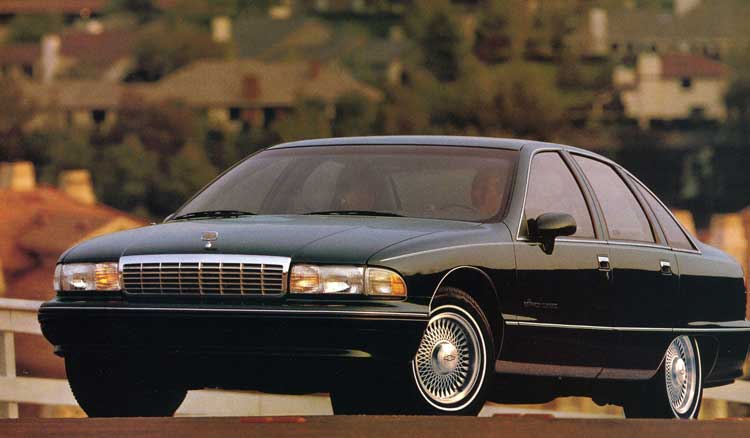
The last family Chevrolet I got to drive very much was my in-laws’ 1991 Caprice, the last of their several large Chevys, and a car very analogous to our old Caprice (down to the dark red color). Certainly the ’91 Caprice’s looks were an acquired taste, but it was a solid car that accelerated pretty well, handled better than you’d think, got decent gas mileage, and was comfortable, with, again, gargantuan trunk space.
Chevy has made some decisions during my vehicle ownership lifetime that have been incompatible with my ownership needs of the time. I replaced the Beretta with a 1991 Ford Escort GT. Chevy didn’t make anything like an Escort in those days — a three-door hatchback where actual adults could sit in the back seat. (Jannan owned two Pontiac Sunbirds, Pontiac’s version of the Chevy Cavalier, whose two-door back seats were meant only for the vertically challenged.) The Escort was replaced by the first of our two Subaru Outbacks. Chevy did not then and does not now make a mid-sized all-wheel-drive station wagon. The second Sunbird was replaced by a Honda Odyssey. Chevy has never made a minivan designed one-fourth as well as the Odyssey is designed. (Chevy’s first attempt at a minivan, the Lumina APV, has been called the “Dustbuster” due to its visual similarity to a hand-held vacuum cleaner.)
The irony is that Chevy does sell traditional rear-wheel-drive sedans. Just not in the U.S. If you live in the Middle East, you can buy a midsized Lumina, which in Australia is called the Holden Commodore (even with a wagon). You can buy a Caprice in the Middle East or Australia, but Chevy hasn’t sold a Caprice in the U.S. since 1996. (The Caprice is starting to be sold here as a police car, however, partly in response to Ford’s dumb decision to discontinue its rear-drive cars, including the Crown Victoria Police Interceptor.)
Today, other than the Corvette and Camaro (neither of which we’ll be buying any time soon), Chevrolet really sells no car I feel compelled to even look at. The current trend is what are called “crossover vehicles,” which, as compromises, probably don’t do anything particularly well. My interest in Chevy’s small cars is less than zero, and when it comes to the Volt, my one experience in a hybrid car (Lexus’ answer to the Toyota Prius) makes me most disinterested.
The Chevy we probably should own, but are not likely to anytime soon, is the Suburban, the longest running nameplate in the world’s auto industry, having been built since 1935. It seats up to nine, which is more than minivans can seat. (One problem of being a family of five is the limits on the number of people beyond your family that you can take in your vehicle.) It has V-8 power, which compared to some engines of today is like owning your own nuclear power plant. It can be purchased with four-wheel drive for our always interesting winters. The Suburban is listed at 15 city and 21 highway mpg, which is close to our minivan (and better than the Caprice and Impala we drove, even though it’s the same size), and it can run on E85. Unfortunately, it cannot be ordered with a diesel engine, since Chevy hasn’t seen fit to develop its diesels beyond its heaviest-duty pickups.
The other Chevy we should have is a car I saw at the 2010 Green Lake car show. I don’t know who owns it, I didn’t see it there last year, and of course I don’t have enough money to buy it. But when the weather gets nicer …
A group of UW students has put together something they believe is missing from Packer fandom — the Packer Rock Anthem.
The only thing about the song is that it doesn’t sound like my definition of rock — note the absence of guitar and bass — but sounds more like late ’80s or early ’90s pop — rather techno. Which is fine. Perhaps “Packer Techno Anthem” doesn’t sound as good.
Apparel, not in the Packers’ (dark) green and gold since this isn’t an official Packer project, is available as well:
Today in 1963, John Lennon showed his ability to generate publicity at the Beatles’ performance at the Royal Variety Show at the Prince of Wales Theatre in London. The Queen Mother and Princess Margaret were in attendance, so perhaps they were the target of Lennon’s comment, “In the cheaper seats you clap your hands. The rest of you, just rattle your jewelry.”
The number one single today in 1965:
The number one single today in 1972:
Today in 1990, Melissa Ethridge and her “life partner” Julie Cypher appeared on the cover of Newsweek magazine for its cover story on gay parenting.
I bring this up only to point out that Etheridge and Cypher no longer are life partners, Cypher (the ex-wife of actor Lou Diamond Phillips) is now married to another man, and Etheridge became engaged to another woman, but they split before their planned California wedding. And, by the way, Cypher had two children from the “contribution” of David Crosby, and Etheridge’s second woman had children from another man. Draw your own conclusions.
Birthdays start with Ike Turner, Tina’s ex-husband, who some claim sang the first rock record:
Harry Elson was one of the Friends of Distinction:
Chuck Mangione:
Delbert McClinton:
Chris Difford played guitar for Squeeze:
James Honeyman-Scott, who played guitar for the Pretenders …
… was born the same day as Jeff Watson, who played guitar for Night Ranger:
[Marion] Kuster quickly pulled up to the scene of a violent crash, a 10-50 in police-speak. Two vehicles had collided more or less head-on. The scene was a mess.
From one car, Kuster could hear the wails of an injured woman. At the car in front of her, she saw a young man, a teenager judging by the letter jacket in the back seat, slipping in and out of consciousness.
She did what we’ve all been trained to do.
Kuster punched in 9-1-1 on her cell.
What ensued frustrated her.
But, as she found out later, the situation that followed may have been unavoidable. …
“I said [to the Fond du Lac County dispatcher], ‘I’m between Ripon and Green Lake and I need an ambulance,’” Kuster said. “She said, ‘What county are you in?’ I said, ‘No.’ She said, ‘I have to know what county you’re in.”
The story reports on the delay of nearly two minutes in dispatching emergency personnel because the dispatcher Kuster called was unable to pinpoint whether the crash was in Fond du Lac County or Green Lake County. A crash on the east side of the Fond du Lac–Green Lake county line means either the Town of Ripon Police Department or the Fond du Lac County Sheriff’s Department should respond; a crash on the west side of the county line means the Green Lake County Sheriff’s Department should respond.
That almost-two-minute delay was basically dismissed by Fond du Lac County officials. That is the wrong response. For one thing, Ripon Guardian Ambulance, whose service area runs approximately from Green Lake to Rosendale to Brandon, is not a full-time ambulance service. EMTs take several minutes to get to the ambulance garage at City Hall in Ripon. The same applies to the Ripon and Green Lake fire departments, whose firefighters are volunteers.
I can see how something like this might happen. In the year when I was commuting daily from Ripon to New London, there was a car crash on U.S. 45 south of New London. That stretch of U.S. 45 is basically the Outagamie–Waupaca county line. When I called 911, I wondered which county would answer the call. Perhaps because I was driving south, Waupaca County answered. (Ironic in a sense since Waupaca County has the stupid ordinance prohibiting cell phone use while driving.)
An even better example is any crash or incident in the Fox Cities, which comprises parts of three counties, four cities, three villages and six (depending on how you count) towns. Which adds up to three sheriff’s departments, seven police departments and nine fire departments. (But only one ambulance service, which was not set up by government, but by the Fox Cities’ hospitals.) Before moving to Ripon, we lived in a house in the Winnebago County part of Appleton, next to a house in the Town of Menasha. The City of Menasha was at the end of our street. A drive on Wisconsin 441 to U.S. 41 would take me back into the Town of Menasha, then into Outagamie County and the Town of Grand Chute, then to either of my offices in the Outagamie County part of the City of Appleton. If you are unfortunate enough to get into a crash at the intersection of South Oneida Street and Calumet Street in Appleton, you will simultaneously be in three different counties.
The fact that you can understand how this could happen doesn’t mean it should happen. It frankly adds fuel to those who suggest, sometimes in jest and sometimes not, that Ripon should be in Green Lake County instead of Fond du Lac County. And as Kuster pointed out, “It could be life or death for somebody. … I could have been from Minnesota, and I would not have known what county we were in.” In fact, the existing procedure is to send units from both Fond du Lac County and Green Lake County, according to Fond du Lac County’s emergency government director, something Fond du Lac County has been “re-emphasizing” after this crash.
Another issue was brought up by Ripon Police Chief Dave Lukoski — emergency service agencies can’t send units to any call and decide jurisdictional questions later, because “It’s a jurisdictional concern. When we got out to an agency’s [call], we have to have a mutual aid agreement to cover us in case something happens. We lose liability protection [if] we are out of our jurisdiction. … If I get rammed by a semi and I [don’t have insurance coverage], insurance companies will run away from me.”
I’m sure Lukoski’s correct about that. That brings to mind, however, two incidents, one I covered in my weekly newspaper days, the other I personally witnessed. In March 1990, when a Grant County sheriff’s deputy was shot to death, police and sheriff’s departments from all over southwest Wisconsin responded. Technically, every officer who wasn’t employed by Grant County, including the Dane County K-9 dog who captured the killer, was out of his jurisdiction.
That also was the case in the Camp Randall Stampede in November 1993, when 70 Badger fans were caught against a fence and injured celebrating a UW win over Michigan. Every ambulance from Dane County was called, and again, every ambulance except Madison Fire Department ambulances or private ambulances was out of its agency’s jurisdiction. If emergency responses are being delayed or not happening at all because of insurance concerns, something needs to be done about that, whether legislatively or otherwise.
The last point, a point not brought up at all in the story, is that this is great evidence that Wisconsin’s 3,120 units of government are far, far, far, far, far too many. The Fox Cities has one police department serving the three villages and one fire department serving two of the four cities, but those are just baby steps toward what should have happened years ago — a Fox Cities police department and a Fox Cities fire department (similar to what is being proposed in Green Bay). Here in Ripon, our property tax dollars pay for the Ripon Police Department, but our state income tax dollars, through the dubious miracle of state shared revenue, help pay for the Town of Ripon Police Department, whose contribution to public safety is writing speeding tickets outside the city. (While still, I’ve been told, being a net money-loser for the Town of Ripon.)
We live in a state that ran state budget deficits, when correctly measured by Generally Accepted Accounting Principles, every year in the first decade of the 21st century. Only one other state also ran GAAP deficits every year in the past decade — Illinois, which has 6,994 units of government, the most of any state in the country. Having, in Wisconsin’s case, one unit of government for every 1,823 Wisconsinites (a lower ratio than Illinois, believe it or not) leads to neither responsible government finance nor quality government service.
Widespread disenchantment with both the governor and Obama makes the highly polarized state the perfect stage for a debate over the role of government
Wisconsin is the republic of political unhappiness. Six of 10 voters disapprove of Republican Governor Scott Walker, who picked a fight with public-sector unions by curbing their collective-bargaining rights. Labor mobilized, and voters bounced two state senators in recall elections in August. A campaign to oust Walker gets under way in November. …
Voter grumpiness knows no party lines: Obama, who carried Wisconsin with 56 percent of the vote, now faces widespread disenchantment. A statewide poll by SurveyUSA in late August found 50 percent disapproved of his performance in office, though his approval rating, at 45 percent, was higher than in most national soundings. …
Although Wisconsin is often caricatured as a hotbed of left-wing activism, thanks to university town Madison, the state in fact is complex and polarized. “The extreme right wing and extreme left wing have become more and more entrenched,” says J.B. Van Hollen, Wisconsin’s Republican attorney general. “I think people in the middle of the road are more disgusted than anything with politics, but not necessarily with government.”
The Midwestern state is the perfect stage for a debate over the role of government. On one side is its heritage of progressivism embodied by Robert La Follette, the fiery U.S. senator who opposed World War I, railroad interests, and child labor. On the other is the modern-day vision of smaller government and reduced entitlements articulated by U.S. Representative Paul Ryan, a Wisconsin Republican and chairman of the House Budget Committee.
If Walker enraged organized labor, Obama’s health-care reforms and economic stimulus programs “helped mobilize the conservative base and contribute to their resurgence in ’09 and ’10,” says Charles Franklin, a political scientist at the University of Wisconsin at Madison. “You’ve got an unhappy middle class, unhappy with their situation. They were looking for someone to improve it, and then they were disappointed when that didn’t happen.”
The state is up for grabs, says Franklin, adding that Obama’s 2008 margin of victory was an aberration. “It is Democrat with a small d,” he says.
I’m not sure how you can describe as “Democrat-with-a-small-d” a state whose electoral votes haven’t gone for a Republican presidential candidate since Ronald Reagan. Yes, one year ago voters swept out Democrats left and, well, left, and declined to elect Gov. James Doyle’s would-be successor, but I assume that to be disgust over the grotesque failure that was the 2009–10 Legislature controlled by Doyle’s party.
Speaking of Doyle, Bloomberg asked him (as it asked politicians from each of those six states) “How to win my state.” I wonder if there’s a veiled message in Doyle’s response:
“Get your base out and do everything you can to get the independents to break your way. People are stressed and the election will be a very contentious election, but I think people will recognize it’s not an easy thing to do to govern in difficult times, and that it takes someone who is looking for good, reasonable, middle-of-the-road solutions to problems.”
Independent of the laughable first sentence given the continuous slander machine that was the 2006 Doyle campaign against former U.S. Rep. Mark Green — who has more character in one finger than Doyle will see in his entire life — Doyle’s reference to “good, reasonable, middle-of-the-road solutions to problems” cannot possibly refer to his party. That does not describe Democrats’ three-part response to the $2.9 billion in red ink Doyle and Democrats left the state, which was (1) to deny that the problem existed and (2) to propose substantially raising taxes even beyond the $2.1 billion tax increase Doyle and Democrats shoved down taxpayer throats while (3) doing absolutely nothing about cutting government spending.
Assuming we will have to endure a recall election against Walker this coming year, it will be interesting to hear what those who couldn’t be bothered (except for Milwaukee Mayor Tom Barrett) to run for governor answer how they would be a better governor than Walker. It will also be amusing to not hear the two words that propelled Recallarama, but were never uttered by Democrats: “Collective bargaining.”
Wisconsin’s inclusion on Bloomberg’s list is another depressing sign that we will be cursed any second now with an unending parade of presidential campaign advertising, to go with the unending parade of U.S. Senate campaign advertising, to go with the unending parade of House of Representatives campaign advertising in at least three House districts (the Second, where U.S. Rep. Tammy Baldwin (D–Madison) is running for the Senate, and the Seventh and Eighth, with their new Republican reps), to go with the unending parade of recall campaign advertising. I should buy a TiVo.
The lead story in the Bloomberg Government Insider (what a depressing title) includes this subhead: “The 2012 election will hinge on whether voters will blame Barack Obama for the weak economy.” I’ll answer Bloomberg’s rhetorical question: Of course voters will blame Obama for the weak economy if the economy is still weak one year from now. Voters have credited or blamed the incumbent party in the White House for the economy every presidential election since 1976. One would think it would require substantial economic improvement, noticeable by everyone, for Obama to win reelection in 2012. But voters have made poor choices before — for instance, the last presidential election.
Today in 1964, a fan at a Rolling Stones concert in Cleveland fell out of the balcony. That prompted Cleveland Mayor Ralph Locker to ban pop music concerts in the city, saying, “Such groups do not add to the community’s culture or entertainment.” Kind of ironic that the Rock and Roll Hall of Fame ended up in Cleveland.
Thirty-three years to the day later, Metallica reached an out-of-court settlement with one of its fans who claimed he had lost his sense of smell after he was dropped on his head at a concert four years earlier.
The number one single today in 1979 will be familiar to early viewers of MTV:
Birthdays start with British composer John Barry, who composed 11 James Bond soundtracks, won five Academy Awards, and who wrote themes for a lot of other British TV:
Nick Simper was an original member of Deep Purple:
Lulu sang not just “The Man with the Golden Gun,” but …
Who is Stuart Goddard? You know him better as Adam Ant:
One death of note: Lonnie Donegan, writer of this, uh, interesting song, died today in 2002 at 71:

 The cars had similar, though separately designed, engines. Six years after Cadillac’s overhead-valve V-8, the ’55 full-size and Corvette offered an optional V-8, Chevy’s first in almost 40 years. The same basic design is available today in Corvettes, Camaros, pickups and the Suburban and Tahoe. The
  Chronologically speaking model-year-wise, the first Chevy I remember is my grandparents’ 1959 El Camino, in this Aspen Green (although theirs did not have the chrome wheels or whitewalls). My grandparents bought it for my grandmother’s next-door second-hand store. After they closed the store, my grandfather drove it to work at the Department of Natural Resources nursery just outside Boscobel.
 I apparently lived in Chevy neighborhoods while in Madison. The next door house (where our babysitters came from) owned a Corvair. Up the street, the father of friends of ours drove a 1969 Impala coupe. And when we moved to the house my parents built, two houses down was the first
  The Nomad was LeMans Blue, not this green, and it had a roof rack. It didn’t have many options besides that — AM radio and a power tailgate window. It could move quite smartly, given that my father selected one from an Oregon Chevy dealer with the most powerful available V-8, 255 horsepower and 365 lb-ft of torque, attached to a two-speed automatic. (I sat behind my father, so I can tell you how fast it could go.)
 That was quite an album for its day, featuring performers you would have heard of in 1970 —
  (Theirs had the dog-dish hubcaps, but not the roof rack.)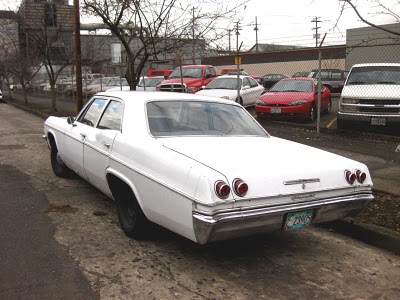
 … while my parents moved up to
  This was a car. (Dark red, not black, and without the color-keyed hubcaps and with a full vinyl roof.) It was 18 feet 1 inch long, weighed 4,300 pounds, and required careful parking. (Note the huge front bumper guards; the way to get it into the garage was to drive slowly until the front bumper hit the concrete steps into the house.) On the other hand, it ate up the miles in Chevrolet-level luxury. And it was built down Interstate 90 at the GM Janesville plant, which employed one of my neighbors. This is undoubtedly where I developed my affinity for




 Steve Prestegard.com: The Presteblog