Since district attorneys in Milwaukee and Dane counties can’t be bothered with actual crimes, the MacIver Institute has to do their work for them:
After a failed legal battle with the John K. MacIver Institute for Public Policy, Sen. Jon Erpenbach (D-Middleton) turned over 1,571 separate emails containing over 2,100 total pages from public employees across the state and country who contacted him about Act 10.
The MacIver Institute filed an open records request in early 2011 with Erpenbach looking for correspondence his office received regarding “Wisconsin’s collective bargaining laws for public employees” sent between January and March of 2011.
Erpenbach initially turned over 25,000 pages of emails but redacted the names, email addresses and other identifying information of the senders. This prevented MacIver from determining whether the individual contacting Erpenbach was a government employee using taxpayer resources on taxpayer time or if the individual was a private citizen using his or her own resources.
After Erpenbach refused to turn over unredacted emails, the Wisconsin Institute for Law and Liberty filed a lawsuit on behalf of the MacIver Institute in February 2012, asking if it was legal under the state’s open records law for a politician to decide if public data can be redacted.
After a lower court sided with Erpenbach, a three-judge panel in the Wisconsin District Two Court of Appeals reversed the decision, ruling against Erpenbach in April 2014. …
While the MacIver Institute continues to investigate some of the information found in the emails, we have finished our initial analysis that shows 1,020 of the 1,522 emails sent by Wisconsin state government employees were sent during normal business hours.
For the purposes of this analysis, MacIver used the standard of 8am to 5pm as normal business hours. A government employee’s work week can vary and may be different than 8am to 5pm. Without access, however, to departmental records that show each government employee’s individual work hours, it is impossible to make that assessment.
UW-Madison led the way with 487 total emails sent to Erpenbach, 60 percent of which were sent during normal business hours. UW Health followed with 142 total emails, 75 percent of which were sent during normal business hours. Waunakee School District took the number three spot, sending 123 total emails, 87 percent being sent during business hours.
Several emails from the UW-System asked if there was anything they could do to support the 14 Democratic senators who fled the state in an effort to stall a vote on the Budget Repair Bill.
One emailer from the UW-System asked if there was “any legal way of giving financial donations” to support the 14 Democratic senators as they stayed in Illinois. The employee also asked if they could be added to a “mailing list for action.” Another wrote about “sponsoring a 50 state bus tour” for the 14 AWOL senators.
Though a majority of the emails called on the senator to vote no on Walker’s reforms, many mentioned they were not opposed to increased contributions for health care and retirement but supported collective bargaining.
The issue here is less about when they were sent (note the paragraph about “normal business hours”), but where they were sent from — that is, whose email account. It would be one thing if a state employee used a state computer during “normal business hours” to email Erpenbach from his or her personal Gmail, Hotmail or Yahoo account. That would be technically using state resources, but non-Republicans might not get exercised over that.
When, however, emails are sent from such addresses as, using MacIver’s list, _____@wisc.edu, _____@uwhealth.org or _____@waunakee.k12.wi.us, there isn’t any question about whether taxpayer-provided resources are being used. That would include …
Erpenbach spent more than $170,000 of taxpayer funds on private attorneys defending his desire to redact public information after he disagreed with Attorney General J.B. Van Hollen’s legal strategy.
President Obama headlined a $25,000 a head Seattle fundraiser in July hosted by former Costco CEO Jim Sinegal for the liberal Senate Majority SuperPac. Perhaps you didn’t notice the lack of media outrage. That’s the context in which to understand the breathless reporting about court documents showing that Wisconsin Governor Scott Walker encouraged donations to the Wisconsin Club for Growth. The horror, the horror!
On Friday the Seventh Circuit Court of Appeals responded to a media request and released documents that had been sealed as part of a John Doe probe into Mr. Walker’s fund-raising. The court’s clerk also bungled and released, for a brief period, some documents that weren’t supposed to be unsealed, including donor names and references to bank records. Unless you’re a political Bambi, the only news in the documents is further evidence that the prosecutors are operating on an unconstitutional interpretation of campaign-finance law.
Their view is that it is illegal “coordination” for Mr. Walker to raise money for allied groups like the Wisconsin Club for Growth. But if that’s true every politician in the country had better lawyer-up.
Raising money for a political action committee or a party committee or 501(c)(4) is legal and common for politicians. In addition to his soiree at Mr. Sinegal’s, President Obama this year has made his Cabinet members available for fundraisers for Priorities USA, a SuperPac founded by two former White House aides to elect Democrats.
In 2011 Senate Majority Leader Harry Reid wrote to donors that “I’m writing to introduce you to a group solely devoted to leveling the playing field and protecting the Democratic majority in the Senate: Majority PAC.” Should he be prosecuted?
SuperPacs and 501(c)(4)s are barred from turning over the money they raise to candidates. But not even prosecutors are claiming that happened with the Wisconsin Club for Growth. The Club didn’t even advertise on behalf of Mr. Walker, devoting its spending to issue ads more relevant to defending GOP state senators who were targeted for defeat in recall elections.
The documents have already been examined by two judges who have ruled against prosecutors Francis Schmitz and John Chisholm. John Doe Judge Gregory Peterson quashed their subpoenas in January, and federal judge Rudolph Randa has issued a preliminary injunction stopping the investigation. Prosecutors are appealing, but it would be nice if the media didn’t bury their legal defeats.
Democrats and their media allies are also making much of an April 2011 email written by fundraising consultant Kate Doner noting that Mr. Walker was “encouraging all to invest in the Wisconsin Club for Growth.” The Club for Growth, she added, “can accept corporate and personal donations without limitations and no donors disclosure.”
The Milwaukee Journal Sentinel describes Ms. Doner as a “Walker campaign consultant,” implying nefarious illegal coordination. But at the time she wrote the email she was working for the Wisconsin Club for Growth and had a legal right to seek donations. She wasn’t hired as a consultant for Friends of Scott Walker until November 2011.
The press corps is also hyperventilating over names released as potential fund-raising targets—such as the Koch brothers, casino magnate Sheldon Adelson and Donald Trump. There’s another shocker: Political groups seek money from rich people who might agree with them. Hide the children.
Gov. Scott Walker pledged the creation of 250,000 jobs during his first term in office, a number the state has not reached.
What is Walker’s response?
As I have predicted here and elsewhere, Walker is not going to lose one vote because of not reaching the 250,000-job self-pledge. Walker could cure cancer and not get the vote of this state’s liberals.
Today it is easy to see why Wisconsin’s capital city was named for James Madison, father of the U.S. Constitution and our fourth president, who guided the country through its second war for independence. He was a national hero.
But we have the luxury of looking backward through history. Had we lived 200 years ago, as the War of 1812 was unfolding, our view would have been dramatically different. In fact, on Aug. 24, 1814, as British troops laid waste to Washington, D.C., we likely would have been prepared to condemn Madison for causing the death of the United States before it reached its 40th birthday.
What happened next changed U.S. history and Madison’s legacy. Throughout, Madison and his wife, Dolley, displayed the grit and leadership their country needed to rise up from humiliating defeat. Our community, as Madison’s namesake, should learn from the Madisons’ example as we face the challenges of the future. …
In 1814 Britain defeated Napoleon and turned more attention to America. In mid-August a British fleet landed 35 miles from Washington, D.C. Madison left the capital, not to flee but to face the moment head on. He met with his generals in Maryland, where American forces would make their stand. He remained there the next day as the British routed the Americans.
In Washington, Dolley Madison’s evacuation of the Executive Mansion became an iconic tale of bravery and patriotism. Just before leaving, she grabbed a copy of the Declaration of Independence and supervised the rescue of a copy of Gilbert Stuart’s portrait of George Washington, to save them from British hands.
Three days after the British burned most of the government buildings in Washington, the Madisons returned to the capital, moving into a private home. The public rallied behind the first couple, who personified America’s courage.
Whatever his missteps, Madison — though only 5 feet, 4 inches in height — stood tall through perilous times. Then, when it looked as if the war would end in a lopsided British victory, the tide turned. On Sept. 11 American forces defeated the British at Lake Champlain. Two days later a British attack on Baltimore’s Fort McHenry failed, inspiring Francis Scott Key to write the poem that became our national anthem.
The British, still concerned about France, now wanted to end the fighting with the United States. The two sides signed a treaty in Belgium, restoring the pre-war status quo. Neither side won, befitting a war that both should have avoided.
But before news of the treaty reached America, Major General Andrew Jackson defeated an attacking British force at New Orleans. Jackson’s conclusive victory made it appear that the United States won the war. Madison became the president who won the second war for independence.
Leap ahead to 1836. James Doty, a politician and profiteer, was successfully lobbying to have Wisconsin’s territorial capital moved to a city he planned around four lakes. He named the city Madison, after the former president, who died that year. He could hardly have made a better choice.
That editorial prompted this response …
I find this a very inspiring message about pulling victory out of the claws of defeat.
As I look at the massive messes We The People face (many still denied), I can easily get distraught and discouraged.
… which makes me think that either someone was doing the wacky weed early on Sunday, or has no idea what the Declaration of Independence or Constitution is about. (Both are possible.)
The issue here is not the State Journal’s history. The issue is that there is anything about Madison the People’s Republic that compares to Madison the president, or for that matter any of the Founding Fathers.
To fall prey to every stupid, though popular, left-wing impulse does not demonstrate “grit and leadership.” To rely on government for your economy (which is like turning on a faucet and announcing that you’ve discovered water) isn’t either. And, of course, “bravery and patriotism” describes no one in city government, at least not since about 1973.
Besides that, I thought Madison changed its name to Ho Chi Minh City in 1975. To that slander came this response:
Moscow on the Yahara.
At least one other person gets it. Maybe the State Journal ought to take off the rose-colored glasses and look at Madison as what it really is … grossly overrated.
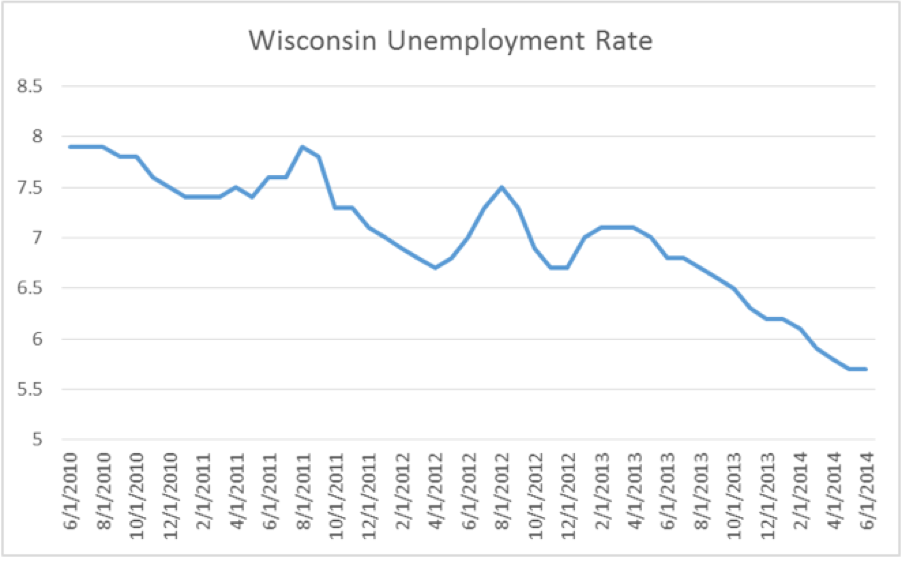
Americans for Prosperity unveiled its 2014 Wisconsin Economic Report, which states …
Pro-growth policies signed into law by Wisconsin governor Scott Walker have helped bring renewed economic prosperity to Wisconsin. During Governor Walker’s time in office, job growth has increased, unemployment has fallen, taxes have been cut, state revenue has increased, and the quality of education has improved. The state is back on stable financial footing, and job creators overwhelmingly believe Wisconsin is headed in the right direction.
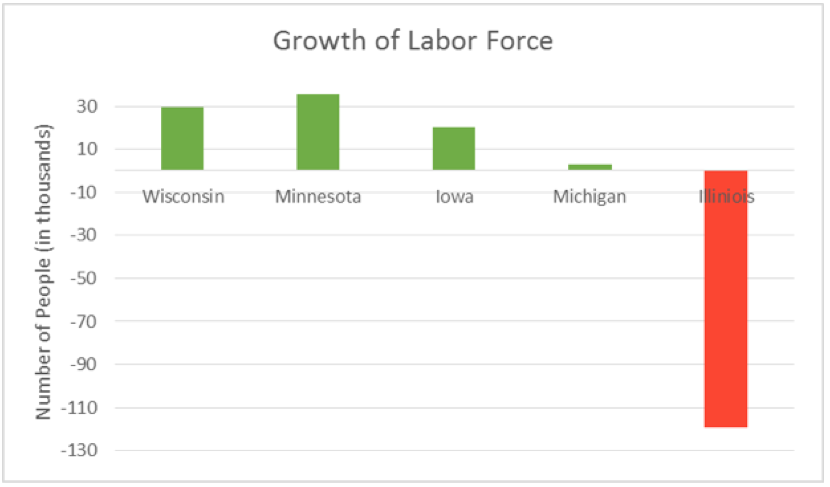
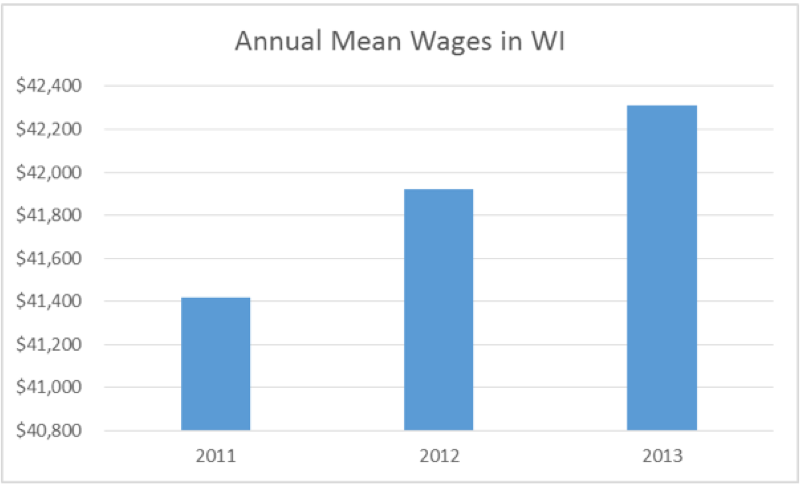
AFP’s evidence is found in these charts:
You would think it would be hard to make the tiresome Democratic argument about job growth (particularly when it’s not accompanied by a plan to improve job growth beyond what’s happened since Scott Walker became governor) when Wisconsin’s job growth is better than our Midwestern neighbors.
This actually is not much of an improvement — about 2.2 percent from 2011 to 2013. It looks better, though, when compared with this Tax Foundation graphic …
… that shows that the cost of things in Wisconsin is less than all our neighbors except Iowa and Indiana.
This graphic is both a positive and a negative. Tax revenue growth as a result of economic growth as a positive. It also shows, however, that our taxes are still too high, which AFP grants:
However, there is still more work to do. Wisconsin’s income tax remains too high, with almost 12 percent of individuals’ income – $118 out of every $1,000 earned—going to paying local and state taxes. Wisconsin has seen billions of dollars leave the state because of these high tax rates, an outflow that benefits lower-income tax states, many of which enjoy even greater growth and prosperity than Wisconsin does.
The good news is that Governor Walker and Wisconsin lawmakers have made significant headway by cutting taxes by some $2 billion. Just this past May, amid a billion dollar surplus, Walker and the legislature provided additional tax relief in the form of a $541 million income and property tax cut.
As Walker stated when he signed the cut into law, “You deserve to keep as much of your hard-earned money as possible — because after all, it is your money.” More work still needs to be done in order for the state to increase its competitiveness, but Walker’s tax cuts are a great start.
However, not only are the tax cuts not enough, something else needs to happen. Wisconsin is, not surprisingly, according to The Street, the 10th most socialist state in the U.S. (way to go, Fighting Bob, or should the namesake of my high school be called Bolshevik Bob?):
Total State Expenditures (FY 2013): $42.8 Billion
Gross Domestic Product (2013): $254.1 Billion
Expenditures as Proportion of GDP: 16.2%
“America’s Dairyland” is the 10th most socialist state in America on this list with its economy largely driven by manufacturing, agriculture, and health care. Wisconsin is known for high property taxes and ranks fourth nationally in this category.
Its residents have voted for Democrats in nine of the last 10 presidential elections.
The Street’s rationale:
Socialism at its core is a political term applied to an economic system in which individual property, like money, is held and used in common, within a state or a country as an attempt to equalize the standard of living for the average citizen.
In a completelysocialistsociety, there would be no money. Basic needs such as food, shelter, education and healthcare would be available and provided to everyone, so division of classes based on wealth would not exist.
But if America is really turning into a more socialist country, then where can we see evidence of this happening? Are any states becoming socialist before our eyes? And if so, how do we define the most socialist state, you ask?
In order to measure the degree to which different states reflect socialist principles, we determined state expenditures and state GDP as the best indicators because socialist states tax and spend a higher percentage of their GDP. We used data on the total state expenditures for fiscal year 2013 from the most recent National Association of State Budget Officers report and pulled 2013 gross domestic product by state data from the Bureau of Economic Analysis.
The math? Simple. The FY2013 state expenditure divided by the state’s 2013 GDP.
By this criteria, the states you’d think would be most socialist are not, and the states you’d think would be least socialist are not. The rampant excessive government in Illinois, for instance, is overcome by that state’s much larger economy.
The fate of the Soviet Union and the Warsaw Pact should have proven that government does not create prosperity for its citizens. But in this state, some people fail to learn.
WISN radio’s Dan O’Donnell has a suggestion if you’re in the Milwaukee area and haven’t planned dinner yet:
I think you should head to Maria’s Pizza.
You know, the place at 51st and Forest Home with all the crazy lights and decorations on the walls?
I think you should go there.
Seriously, go there for dinner tonight. Or tomorrow night. Or whenever you can.
Especially if you’ve never been there before. Especially if you’ve never thought of going there before.
And even if you’re not a fan of their pizza; even though I personally think it’s great.
Heck, even if you’re not a fan of pizza, you should go there tonight.
Because I’m betting you are a fan of the First Amendment. I’m betting you’re a fan of being able to express yourself freely, without fear of retribution.
And I’m betting you aren’t a fan of Stalinist intimidation tactics by the left.
Mark Belling first broke this yesterday, but he didn’t make explicit mention of the business because he didn’t want to cause any more problems for them than they might already be facing.
Some guy, whose name I won’t share because unlike him, I actually have a shred of decency and class, posted a picture of his neighbor’s house with a Scott Walker sign in front of it.
And this was the caption:
“I thought I would share this photo and I hope it goes viral. You see the woman who owns and lives in this home owns Maria’s Pizza. She lives up the block from me. The fact she supports a Governor who has hurt my family and many people I am close too [sic] and displays this. I will never eat another Maria’s Pizza Again. ihope this is shared! Done Done Done!!!!!”
Now normally I wouldn’t care about what some idiot liberal posts on his Facebook page, but before this coward took down his post—or Facebook removed it because it was harassing this woman—it had more than 100 shares.
That means all sorts of liberals were planning to boycott Maria’s Pizza—all because the woman dared to put a Scott Walker sign in front of her home.
All because she dared to express her First Amendment right to political speech in her personal life. Not in her professional life, mind you. There are no political signs whatsoever outside of Maria’s, or inside, for that matter. I don’t think there’d be room with all of the lights and Virgin Mary pictures anyway.
But these liberals couldn’t stand this. The same liberals who put “Coexist” bumper stickers on their cars and constantly tell us how tolerant they are couldn’t stand that a woman had a Scott Walker sign in front of her house, so they had to attack her business.
They had to attack her livelihood.
That’s not only offensive to me professionally. That’s offensive to me personally. …
Not just because this is the sort of vindictive bullying that I hate most about the left in this country, but because this time they were bullying someone I care about.
So I called up Bonnie, who’s the owner of Maria’s, and we had a long talk about this.
She’s devastated and she’s dismayed that someone would do this to her, especially one of her neighbors. She can’t believe that putting a yard sign up for a political candidate she supports would ever prompt someone to ever try to organize an effort to damage her business; her livelihood; her, in essence.
But before she said any of that, she answered the phone and said, “Oh Dan, how’s that new little baby?”
Because that’s what kind of person Bonnie is, and so is Joan, who works there, too. Joan is probably the biggest WISN fan we have there and every time my family comes in she asks about Mark and Jay and Vicki and tells me how much she loves all of us.
So will she be a target of the left’s hate, too?
Will someone try to target her because she dares to be a fan of a politically conservative radio station?
Because that’s apparently what the left does now. They’re so tolerant that if you dare have a disagreement with them politically, they’ll try to destroy you professionally or personally. …
Seriously, in Iraq, ISIS has been spray painting the homes of Christians with the letter N, for Nasrani, the Arabic word for Christian, to identify them.
In Southeast Wisconsin, Facebook liberals will spray paint a scarlet letter on your business if you have a Scott Walker sign in front of your home.
Because that’s what the left does now when they disagree with you politically. They obviously don’t try to physically harm you like ISIS has been doing to Christians, but they’ll try their best to professionally harm you.
And all because you dare to support a politician they don’t like. All because you dare to think differently from them.
They want to “Coexist,” alright, so long as you’re intimidated enough to not dare to try and disagree with them.
That’s what’s happening to Bonnie. They’re trying to intimidate her. They’re trying to bully her. They’re trying their best to harm her business.
And this is about as quintessential a Milwaukee business as there is. You know why it’s called Maria’s? Because Bonnie’s mom Maria started it 57 years ago. It’s been in this city for 57 years, and it’s a small, family-owned—make that, woman-owned—business that’s just trying to compete with the big corporations like Pizza Hut and Little Caesar’s and Dominos.
Now that’s precisely the type of business that the left says it supports, but only if that business bows down and thinks exactly the way the left wants it to think.
You know what I think? I think this is part of the left’s ongoing War on Women. Here you have a business that was started by a woman 57 years ago at a time when almost no women owned businesses, and now it’s owned by two women, Bonnie and her business partner, and liberals want them shut down.
Liberals will never eat there because one of those women had a Scott Walker sign in front of her house. I shudder to think what they’d do if Bonnie had a Sarah Palin sign in front of her house.
But this isn’t just a War on Women, or a War on Pizza; this is a War on Free Expression. This is a War on Free Thought.
Speaking of which … you may be interested to find that the person who wrote the original post encouraging the boycott — which you can see by clicking here — cannot be found on Facebook. Perhaps he lacks the courage of his original convictions. What’s that phrase about heat and kitchens?
Regular readers know that this feature follows Wisconsin elections. It’s based on the tradition of the late Wisconsin Public Television show “WeekEnd,” which ran an “Election Hangover Show” to which it invited all its pundits, including me, the Friday after a November election.
The last Election Hangover Show, I believe, was in November 2000. The show technically violated its own premise because, as we all know, the 2000 presidential election took one month to finish. One of my fellow pundits announced he was leaving the show after the 2000 election, but showed up at the show and said he couldn’t leave the show if the election wasn’t over. (The show was canceled shortly after I left due to my new non-media job, but we certainly went out with a bang.)
This primary election appears to be not quite over either, given that there are likely recounts in the Sixth Congressional District, where at last report state Sen. Glenn Grothman (R–West Bend) led Sen. Joe Leibham (R–Sheboygan) by 214 votes, and in the 17th Senate District, where at last report Ernie Wittwer defeated Pat Bomhack by two votes. Yes, two.
Those two races, as well as the 15th Senate District Democratic primary (margin 300 votes) and the 87th Assembly District GOP primary (margin 17 votes) might not be decided for a few weeks. The vote totals aren’t official until absentee votes are counted, and as long as they’re postmarked by election day, they have to be counted by no later than Friday at 4 p.m. Then come the city, village and town canvasses Monday, followed by county canvasses, which have to be completed by Aug. 22. After all that, according to the Government Accountability Board, losing candidates can request recounts, and your best guess is there will be at least three of those. (Yes, this is testable material.)
Older readers may remember the days when the fall primary was in September and not August, and it may be September before we know for sure who is running against whom in those areas. That, of course, puts the eventual primary winner at a theoretical disadvantage, unless candidates start campaigning for November before knowing if they’ll be on the ballot Nov. 4.
Assuming Grothman holds onto his lead, I foresee major problems for Republicans keeping the Sixth in GOP hands. Grothman has said enough things that are Democratic fodder over the years. That wasn’t a problem in his safe Senate district; it is a problem in a less-conservative Congressional district. His Democratic opponent, Winnebago County executive Mark Harris, hasn’t been attracting those kinds of headlines.
The Republican strategy needs to be to attach that Democrat label to Harris, as in every dumb thing Barack Obama and his (mis)administration has done, and telling voters that if you vote for Harris, you’re voting for that, regardless of what Harris says.
On the other hand, Republicans might have a pickup opportunity in the Third Congressional District. GOP primary winner Tony Kurtz uses Ronald Reagan as inspiration, and Reagan of course created the GOP’s 11th Commandment, “Thou shalt not speak ill of a fellow Republican.” And indeed Kurtz spent the campaign taking on U.S. Rep. Ron Kind (D–La Crosse), not his two GOP opponents, correctly attaching every bad thing Obama has done to Kind, along with longer-term trends since Kind has been in Congress, such as the metastasizing federal debt.
The additional point to be made about the Third and the Sixth is that only the most optimistic Democrat believes the Republicans are going to lose the House. That will put Kurtz and either Grothman or Leibham in a bigger position of power immediately, in the dictatorship of the majority that is the House, than Kind now has or Harris would have.
The state media fell all over themselves proclaiming the great history that occurred, approximately 12 seconds after the polls closed Tuesday, of a woman candidate for governor winning her party’s nomination. Well, we’ve had the nation’s first mixed-race president the past six years, and how has that worked out for us? (“Он работал чудесно,” says Vladimir Putin.)
Jefferson County District Attorney Susan Happ possibly surprisingly won the Democratic nomination for attorney general, perhaps because she was located between the two poles of the Democratic Axis of Evil. (That’s Madison and Milwaukee, for new readers.) That prompted the occasionally ditzy Jessica McBride to proclaim that Republican strategists were tearing up their game plans about predicted winner Jon Richards having not prosecuted one single criminal case.
Or not. The campaign of Republican Brad Schimel sent out a news release Wednesday morning claiming…
While I’ll bring nearly 25 years as a frontline prosecutor and 150 jury trials to the Wisconsin Department of Justice, at the time she announced, my opponent had served as a prosecutor on just seven jury trials.
You read right – at the time Susan Happ announced her candidacy for Attorney General, she had prosecuted just seven jury trials.
Moreover …
Throughout the primary my Democrat opponents have been clear about their vision for the Department of Justice. They intend to use the power of the attorney general to advance a partisan activist agenda including blocking a proposed mine in Northern Wisconsin, restricting our 2nd Amendment rights, and reinstating the failed Office of the Public Intervenor.
Independent of how well that Second Amendment thing will go over outside Madison and Milwaukee, Schimel says he’s going to act like an actual attorney general (as opposed to the previous Democratic attorneys general, James Doyle and Peg Lautenschlager) and enforce the law, regardless of which party controls the Legislature and which party’s candidate for governor wins in November.
The Republican race for state treasurer served as a referendum on whether the office should continue. The candidate who takes the position the current treasurer used to have before he went native, Matt Adamczyk, won. That wasn’t the case for secretary of state since both candidates wanted their $70,000 paychecks, but I will continue asking why state taxpayers should spend $5.5 million every year so that Fighting Doug La Follette can continue to collect a state paycheck and, like Democratic candidates for attorney general, follow only the laws he wants to follow.
Who was the biggest winner of the night? Milwaukee County Sheriff David Clarke. That’s because Clarke defeated Milwaukee police Lt. Chris Moews in the Democratic primary despite what the Milwaukee Journal Sentinel reports:
Outside groups led by former New York Mayor Michael Bloomberg’s political action committee, spent hundreds of thousands of dollars in an attempt to oust Clarke.
Another political action committee, the Greater Wisconsin Committee, poured more than $400,000 into the campaign. The committee is believed to have been backed by [Milwaukee County executive Chris] Abele. …
In all, outside groups spent more than $550,000 to try to defeat Clarke in what became a political battle of gun control forces vs. Clarke, who received support from the National Rifle Association and other groups.
Clarke received the backing from the National Rifle Association which sent out a solicitation to members to contribute to Clarke’s campaign.
Then earlier this month, the ad war began when a Madison group called the Greater Wisconsin Committee purchased more than $400,000 worth of broadcast ads to oppose Clarke and support Moews. Although it’s not clear who contributed to the committee, some speculate it could be Abele, a multimillionaire who has clashed with Clarke.
And last week Bloomberg’s political action committee, Independence USA, bought more than $150,000 in television ads and took aim at Clarke and his pro-gun stance that encourages residents to arm themselves for their own protection.
The local conservative Citizens for Responsible Government entered the race by buying more than $55,000 in TV time to support Clarke.
A local grass-roots group — Citizens for Urban Justice — bought more than $15,000 in radio ads targeted to African-American voters, to criticize Moews and support Clarke and thank him “for supporting our urban community.” And the NRA said it spent $30,000 in support of Clarke.
Clarke was overwhelmingly outspent, and yet won. This brings to mind Obi-Wan Kenobi’s line from the first Star Wars movie:
Matt Kittle sees an additional winner in Clarke’s race — our constitutional rights:
“Sheriff Clarke deserves the credit for his victory. He worked hard and he stood on his principles and the voters responded,” Cox told Watchdog Wednesday. “The truth is Michael Bloomberg came in in the 11th hour trying to buy a sheriff’s seat and headlines, but there was just one problem: Voters weren’t buying his agenda.
“What this shows is one individual with billions of dollars can’t purchase freedom in this country,” Cox said. “I applaud NRA supporters in Milwaukee County for sending that message to Michael Bloomberg that freedom is not for sale.”
That idea — that people vote, not money — also is strong counter argument to the left’s obviously hypocritical narrative that big, outside “dark” money is thwarting representative democracy. Left-bending organizations like the Madison-based Center for Media and Democracy have long pitched their “dark money” conspiracy about conservative big spenders such as David and Charles Koch, even as the Center for Responsive Politics reports that liberal organizations have accounted for 40 percent of spending by groups that do not disclose their donors in this election cycle. …
The NRA’s Cox said the left spent a lot of time and money criticizing the outspoken sheriff for being honest.
“Self-defense is a basic human right,” he said, asserting that message resonated in a county where violence in Milwaukee’s inner city has become all too common. “Elected officials put their hand on the Bible and swear to uphold the Constitution. They don’t get to pick and choose, or at least they shouldn’t.”
Cox said Clarke’s victory will resonate nationally in the battle to uphold Second Amendment rights.
“It shows that the hearts and minds of the American people can’t be bought by a billionaire with a radical agenda,” he said. “Average American don’t want to be told what they can eat and drink and whether they can own a gun by some elitist billionaire.”
If Clarke won, then his opponents, including Abele, lost. Abele had a particularly bad night, having endorsed, and contributed to, two state Assembly Democratic candidates only to see them both lose. Indeed, the Milwaukee County Democrats wanted Clarke to lose, as did Mayor Tom Barrett, because having a sheriff unwilling to knuckle under to the thugs makes both Barrett and his police chief look weak. And in this instance appearances are not deceiving.
Cindy Kilkenny notices the reporting of the Milwaukee Journal Sentinel’s Dan Bice:
I suspect the reason Daniel Bice from the Milwaukee Journal Sentinel is fanning the flames of Burke’s wealth again is that desire to sell papers, I.e., feign relevance in a seriously slow election. Incredibly slow. One certainly wouldn’t guess there’s a gubernatorial election in Wisconsin in less than three months.
Records show Burke, her mother and three siblings living in Wisconsin paid a total of $1.77 million in personal income taxes in 2012. That would mean the five Burke family members reported a total adjusted gross income of at least $22.8 million during that year.
Once again, no wonder we have such trouble enticing good candidates to run in Wisconsin. Burke’s wealth a target; now her mother and siblings get a thorough examination, too.
However, Bice does provide credence to the argument that not only is Burke rich, but that wealth isn’t exactly new money. Nor is she self made. Though Democrats in the state are pushing back that Burke wasn’t born with a silver spoon – her father started the company when she was a teenager – it’s rather difficult to argue that daddy’s money didn’t pay for her snowing sabbatical when he guaranteed every child a job with Trek.
“Far too often in the political realm, we demonize success, we demagogue against it,” Johnson added. “What we should be doing is incentivizing success.”
Ya think? No seriously, Johnson is playing this just right, after all he is by implication defending his own right to be rich. If he happens to score a quick political Bazinga! in Governor Scott Walker’s direction, well, those are called bonus points.
Kilkenny’s tweet makes a point few seem to catch:
@Burke4WI ‘s filthy-rich tag by opponents is only useful because @WisDems have demonized wealth.
Kilkenny makes a point Wisconsin Republicans should pick up on:
That’s not news, of course. But it’s where the core of Walker’s campaign should focus. Democrats in Wisconsin have brutalized the wealthy here. That did not stop them from proffering what is likely the wealthiest gubernatorial candidate the state has ever met.
That is the hypocrisy the campaign should take to the voting polls. Not Burke, per se, but the WisDem policy of saying one thing to garner votes, but doing another when it comes to political survival.
Kilkenny’s contention is interesting because there are probably more really wealthy Democrats in the U.S. — to name three, Warren Buffett, Bill Gates and George Soros, and before them Franklin Roosevelt and all the Kennedys — than really wealthy Republicans. But to Democrats, wealth is OK if you support the correct political things, and if you don’t, you are the scum of the earth. (That’s why Democrats think Burke is OK and Johnson is not.) There are very, very, very few Wisconsinites that have enough family money to go off on a year-long sabbatical to find themselves, or whatever Burke was able to do with her family’s money.
I maintain, as you know, that the state GOP is wrongheaded with its attacks on Trek Bicycle, a company Republicans would be lauding from Superior to Kenosha were it not for Mary Burke’s political views. The GOP should be pointing out that the policies Mary Burke espouses would be, in fact, bad for Wisconsin businesses, because they would increase costs (by opposing tax cuts and espousing minimum-wage increases) without making Wisconsin businesses more profitable.
Having gotten a big paycheck funded by us taxpayers for the past four years, state treasurer Kurt Schuller believes you need him, or at least his office, after all:
Four years ago, I never thought I would say these words.
I no longer believe the state treasurer’s office should be eliminated. I have changed my mind. …
To continue to attempt eliminating this office defines “insanity,” which is trying the same thing over and over again but expecting a different outcome. It also wastes state time and money.
So let’s stop talking about eliminating the treasurer’s office and start talking about restoring it. It is time to map out a plan that returns programs to the treasurer’s office — programs that are failing dismally after being hastily moved elsewhere. …
My staff and I have gone about the business that the people elected a treasurer to do. That included returning nearly $90 million in unclaimed property rightfully belonging to the people. We returned record amounts in 2011 and 2012, in large part because of our brilliant and dedicated marketing and claims staff.
We were on pace to surpass our own record of $36 million the previous year, and to hit $40 million in 2013. Then the unclaimed property program was moved to the state Department of Revenue.
To my dismay, recent news reports show the unclaimed property program now is failing not being properly managed. DOR blames us for handing them a defective program. But that just doesn’t add up if you track the performance of the program while under the watchful guardianship of our office the past four decades.
Just six months after I took office, the Local Government Investment Pool and the state’s college savings program called EdVest also were transferred out of the treasurer’s office. It created a disruption to Wisconsin taxpayers, sounded alarm bells with our county and municipal treasurers, and occurred for no good reason.
I once envisioned a reasonable process for eliminating the treasurer’s office in which all the requirements to amend the constitution took place. Then, and only then, would it make any sense to disperse the office’s duties in an orderly and thoughtful way.
I now realize the most suitable place for these programs and many others is under the watchful eye of an elected official, rather than an appointed bureaucrat. We need a person the people choose to guard their money, their children’s college investments, their local government investments, their state investment pool and statewide banking contract.
The failings Schuller points out demonstrate why government is always inferior to the private sector. Employees who don’t do their jobs get fired in the real world. Employees who don’t do their jobs in government keep doing their jobs, and we’re all paying their salaries.
There is a better solution than keeping Schuller’s office or, worse, the office of secretary of state, which has allowed Douglas La Follette to suck up taxpayer dollars when apparently he has been incapable of private-sector work his entire adult life. The solution is to eliminate the state treasurer and secretary of state positions, and whatever staff and duties need to remain should be shifted into the lieutenant governor’s office. It is unclear to me why the state should waste $5.5 million every year to run those two offices for minimal work.
Tuesday is primary election day, and there are full ballots all over the state.
Of course, you can only vote on one party’s ballot. That’s because, despite the Progressive Era reform of primary elections replacing smoke-filled rooms (actually room, since the Republican Party was dominant in Wisconsin at the turn of the 20th century), voters cannot, for instance, vote for a Democratic candidate in the 17th Senate District and a Republican candidate in the Third Congressional District. That proves that the primary election is still about the parties and not the voters.
It remains similarly wrong that candidates for sheriff and other county elected positions have Ds or Rs after their name. In three counties in the great Southwest, there are candidates for sheriff only on the Republican ticket while the aforementioned 17th Senate District Democratic primary is taking place. As I’ve argued here before, county elected positions should not be partisan positions. The Milwaukee County Democratic district attorney’s John Doe partisan witchhunt demonstrates that you cannot trust partisan elected officials to do the right thing when partisan politics is concerned.
Making the sheriff position nonpartisan would end the charade of Milwaukee County Sheriff David Clarke as a Democrat in Name Only. The Democratic Party used to have, well, more conservative members, but Wisconsin Democrats have shunned from their numbers anyone who doesn’t support 100-percent tax rates on business, gun confiscation and taxpayer-funded abortion on demand.
Those who claim Clarke is lying about his party membership should really blame the governor who appointed him sheriff. That would be Gov. James Doyle, who is no one’s idea of a Republican. As it is, whether Clarke is a Democrat, DINO or anything else, he stands out because he lacks the blame-the-victim-or-society mindset of Milwaukee Mayor Tom Barrett and his police chief, Ed Flynn, and unlike those two Clarke actually believes in constitutional rights, to wit Milwaukee County citizens’ Second Amendment rights.
Of the Democrats I’m aware of running Tuesday, Clarke is the only one I would vote for. (I didn’t, since I don’t live in Milwaukee County.) Two of the three running for attorney general, Milwaukee County District Attorney Ismael Ozanne and Jefferson County District Attorney Susan Happ, don’t deserve the jobs they currently have. Happ gives sweetheart deals to multiple-offense drunk drivers. Ozanne has enacted the same catch-and-release law “enforcement” that has made Milwaukee such a wonderful place to live. (Not.) Happ, Ozanne and Rep. Jon Richards (D-Milwaukee) all said in a most illuminating Isthmus story the laws they wouldn’t enforce as attorney general because they don’t agree with the law. (Richards appears confused about the difference between making the law, which he now does as a member of the Assembly, and enforcing the law, which is what attorneys general and district attorneys are supposed to do.)
There is one interesting Democratic Senate primary, in the aforementioned 17th District to replace Republican-When-It-Suits-Me Sen. Dale Schultz. (Who, as I’ve said here before, deserves credit for pulling off the feat of voting against Republican initiatives that pass anyway.) The first candidate, chronologically speaking, was former Wisconsin Department of Transportation employee Ernie Wittwer, who excited the Democratic state leadership so much that they recruited a younger, more photogenic candidate, Pat Bomhack, despite the fact that Bomhack lost the only election he’s run in before, the 51st Assembly District Democratic primary two years ago, and initially announced he was running in the 51st. (The winner of that 2012 primary went on to lose to Rep. Howard Marklein (R-Spring Green), whose announcement he was running for Schultz’s seat helped push Schultz out the door.)
Democrats in the 17th have been writing letters to newspapers supporting Wittwer, not Bomhack, including the candidate who beat Bomhack but lost to Marklein. One assumes the Democrats will dutifully march behind Bomhack after he probably wins tomorrow, since Democrats abdicated fiscal responsibility of any sort once U.S. Sen. William Proxmire (D-Wisconsin) retired, but as a non-Democrat it’s been fun to watch that race. I have yet to see any substantive difference between the two; Wittwer spewed hatred of Gov. Scott Walker and Republicans not named Schultz, though with a pleasant demeanor.
Those who plan to vote in Democratic primaries should ask themselves which candidate will tell state Democratic Party leadership where they can go in the most unpleasant way possible. Democrats forfeited their right to lead this state because of Doyle’s grotesque mismanagement of the late 2000s, and Democrats’ refusal to admit anything was wrong, or that employees of government might need to pay for their benefits as the people paying their salaries have to do (for much lower quality benefits).
There is one interesting Republican Senate primary, in southeast Wisconsin’s 21st Senate District, between former Sen. Van Wangaard and Jonathan Stietz. The primary campaign has focused on two issues — which is the true conservative (a term that depends on whom you ask, of course), and whose backers are more obnoxious. I don’t live in that district either, but Republicans’ fear should be that one side’s backers have alienated the other side’s backers so much that the latter’s failure to vote will deliver the Senate district to the Democrat despite the district reportedly being Republican-leaning.
As with all primaries, one of the two most important criteria is who is most likely to win in November. The other is whose views are closest to yours.
Along that line, the only state treasurer candidate who deserves your vote is Matt Adamczyk, because he is campaigning to eliminate the office, unlike the other candidate, Randy Melchert, who I would have voted for otherwise. Neither of the candidates for secretary of state, former Rep. Garey Bies (R-Sister Bay) or Julian Bradley of La Crosse, want to eliminate the office. The way of thinking of those two and Melchert gets us such mediocrities as former treasurer Dawn Marie Sass, the Democratic candidate with this stupid idea, and current secretary of state Douglas La Follette, who should have been recalled instead of Walker. There are approximately 5.5 million reasons to get rid of those two offices.
There are two interesting Republican Congressional primaries. The first is in the Sixth Congressional District, where I used to live, to replace retiring U.S. Rep. Tom Petri (R-Fond du Lac). The winner is likely to be one of three legislators, Rep. Duey Strobel (R-Cedarburg) or Sens. Joe Leibham (R-Sheboygan) or Glenn Grothman (R-West Bend).
If I lived in the district, I would vote for Leibham. I don’t know much about Strobel. I do know a fair amount about Grothman, who is either so popular or in a Senate district so safe that an Act 10-inspired recall effort against Grothman failed to get enough signatures. I enjoy seeing how the mere mention of Grothman’s name turns Democrats into spittle-flinging obscenity-shouting maniacs. Grothman would be fun to watch in Congress, but Leibham is more likely to get elected to Congress since there are some Democratic pockets in the Sixth.
The other interesting Congressional primary is where I do live, in the Third Congressional District. One of the Republican candidates couldn’t be bothered to explore the southern end of the district she would represent, so your choice is between Army veteran Tony Kurtz and contractor Ken Van Doren.
I voted for Van Doren, who is probably the most libertarian Republican in this state, largely because I believe the Republican Party (of which I am not a member, I remind you) needs to be more libertarian. I would vote for Kurtz, whose GOP inspiration is Ronald Reagan, in November if he wins Tuesday.
Those who get to vote in Legislature or Congressional primaries need to remember that the offices they are voting for make more money by themselves than the vast majority of Wisconsin families. (State legislators make almost $50,000 per year, the secretary of state and state treasurer are paid nearly $70,000 per year, and you can multiply that by almost three for Congressional pay. Given those outsized salaries compared with the real world, you have the right to demand that candidates do what you want them to do.



 Steve Prestegard.com: The Presteblog