Expanding their violent political playbook, liberals have started doxing conservatives who don’t support Gov. Tony Evers’ constitutionally suspect state lockdown orders.
Perhaps not surprisingly, their hateful efforts are brimming with ignorance.
Well-known Wisconsin conservative grassroots leader Matt Batzel posted photos on his Facebook page praising a rally in Brookfield last weekend opposing Evers’ extended Safer at Home edict. His page quickly exploded with left-wing rage.
Beyond the usual filthy name-calling and the silly claims of racism and Nazism, the “progressive” wits incorrectly accused Batzel of organzing the rally. Their Fake News claims are part of the faulty assertion pushed by liberal news outlets that local protest movements against government shelter-at-home orders are being led and fed by a handful of right-wing organizations.
Batzel, executive director of American Majority, a national nonprofit organization that trains conservative activists and political candidates, is no stranger to sparring with leftists. And he’s seen plenty of liberal lies and bad behavior over his years in politics.
But the vitriol and bile that greeted him on his social network account crossed the line into harassment and threats of violence, Batzel said.
“I am able to work from home, but if I had to travel for my job and leave my wife and five kids here, that would be very concerning,” he said.
The threats began after someone named Kay Spaude jumped online and accused Batzel of organizing the Brookfield protest. Kathleen McIlraith chimed in that she hopes if Batzel “has a job, he’s fired. And NO ONE hires him.”
Nick Iannone advised her to contact the Harris Policy Center at the University of Chicago, where Batzel is a lecturer for a political science course, to “get him fired.” Apparently, some fulfilled that threat. Batzel said the university received calls demanding he be removed from his part-time position.
They also threatened to go after his law license, asserting they would contact law regulators to try to get him disbarred.
Then the online mob turned decidedly violent.
“He’s got that face you want to punch,” someone wrote.
“Now we need his home address so he can be barricaded in,” Bill Brink commented.
Matthew Voit, apparently equal parts cowardly and grammatically impaired, wrote, “Somebody go get em. He protesting like a idiot.”
Keith Thompson mused, “Wouldn’t it be awful if the wrong people learned” that Batzel lived at an address in West Salem? Thompson noted the address. He was wrong on all counts. He had the wrong Matt Batzel, and the location was off by about 200 miles. That didn’t stop the liberal rage.
“Anyone want to waste a bullet. Target leg wound,” Deb Nelson wrote to the online mob.
Batzel said he called the police. They told him to block his violent “friends” on Facebook and call back if things escalate. Facebook, too, did nothing, despite the fact that its policies clearly don’t allow “Targeting someone with threats.”
Batzel, who has dedicated much of his life to conservative grassroots causes, worries that some will see what he has gone though and back away from the peaceful fight for liberty.
“We cannot be silenced. We cannot stand by and let the other side win by intimidation tactics. We have to continue to speak out,” he said. “Our rights are being eroded and attacked. We have to speak out. We can’t lose our freedom because we sat by idly or were threatened.”
New York City has been on lockdown for about a month. Up until this past week the effect has been stark and nearly universal. Most mornings, weather permitting, I sit in my small Brooklyn backyard as the day begins. For weeks the loudest sound has been the silence, quiet streets forming a backdrop for distant sirens and harbor boat horns. That is changing, the white noise of car traffic, like an ocean lapping on a beach has returned.
On my “essential walks” which I take daily to the grocery or the bodega, I traverse an overpass above the Brooklyn Queens Expressway. For the past month traffic has been spare, an emergency vehicle here and there, not much more. That too has changed. While it has not returned to the soul crushing bumper-to-bumper standstill that makes the BQE infamous, the number of cars coursing to and from Staten Island has built up everyday.
What is important and telling about the differences in people’s behavior this week is that no city or state government policies have actually changed. The people of New York themselves, and from accounts across the country in other places as well, have simply decided to loosen the guidelines for themselves. We tend to think of the idea of the government existing through the consent of the governed as being about elections, but it is about more than that, the successful lockdown of New York City was not enforced as much as it was consented to.
This phenomenon is something that New York Gov. Andrew Cuomo seems to understand. Cuomo was asked during one of his daily press conferences this week if he is worried that his steady stream of good news about the number of deaths stabilizing instead of increasing and the decrease in coronavirus cases and hospitalizations could give New Yorkers a false sense of security. His answer was basically that he has to tell citizens the truth or he loses his credibility.
Furthermore, Cuomo has admitted on several occasions that with 19 million people living in the New York City metro area, he really is not capable of enforcing many lockdown and social distancing measures. As he puts it, “we can’t arrest 19 million people.” Where that leaves us is in a democratic dance, a push and pull between elected officials and the people who elected them, both sides respectful of the other, but both also possessed of the power shape the virus response.
The state and local government in New York City can see what is happening They know the streets are filling back up. This week it was announced that starting Friday all riders on New York subways and busses must wear masks. This on some level is a concession that New Yorkers are once again descending below Gotham to the turnstiles and edging closer back to their normal lives.
The purpose of the lockdown was made very clear a month ago. It was to flatten the curve of cases in order to ensure that our hospitals were not overrun. That has been achieved, makeshift hospitals and the USS Comfort have thankfully turned out to be precautions we didn’t need. In a story that will disappear from the news media faster than a cockroach under kitchen lights, the Trump administration was proven correct about having the ventilators the nation needed. We achieved the goal at catastrophic economic expense to millions of Americans, and now Americans know it is time to start the return to our new normal.
The country has reason to be proud of its response to the Wuhan virus. If not for the fact that much of our corporate media sees its entire job as trashing Donald Trump and his administration, there would be a more celebratory feeling about this shared success. But even though a well-deserved moment of national pride is probably impossible, the American people know the tide is turning and they are anxious to get back to their lives.
Over the next week or two this balance between the power of the government and the will of the people will continue to shape the coronavirus response. But that balance is beginning to shift in favor of the population, this is America, and it is Americans, not our government that will ultimately decide when this cloud lifts. That is as it should be, and thankfully leaders like Trump and Cuomo understand this. The United States began in earnest with the words “We the people.” The coronavirus lockdown will end as a result of that very same authority.
Legitimacy of government is based in large part on whether the people consent to be governed. Gov. Tony Evers’ decision to arbitrarily extend Safer at Home to May 26 sparked protests across the state last weekend, with a big protest planned for Madison Friday at 1 p.m. The turnout there will be revealing.
State Sen. Van Wanggaard (R–Racine) wrote a letter to ask Gov. Tony Evers these questions:
This is a much different letter than I had been intending to write you prior to yesterday. Out of respect for your office, the difficult decisions you or your staff are making and the unprecedented time facing this country, I have largely avoided publicly criticizing your decisions during the pandemic. However, your unilateral decision yesterday to extend your “Safer at Home” order has forced a different approach.
In publicly announcing your extension of your “Safer at Home” order, you stated, as you have in the past, that you were relying on “science” to make the decision to shutter the state for six more weeks. As a former police officer, I too rely on science, specifically, evidence and data to make conclusions.
Therefore, to properly evaluate the wisdom of your unilateral decision to extend the economic hardship in Wisconsin past Memorial day, I would ask you to answer the following questions citing the current Wisconsin data and evidence you used to reach to your decision.
1. When putting in place your order for the initial four weeks, it was explained that this time period was chosen for the purpose of preventing the disease’s spread for two, 2-week, incubation periods. What in the science of the disease has changed that now recommends four-and-a-half, 2-week, incubation periods?
2. How many people in Wisconsin that tested positive for the disease no longer test positive for the disease? That is to say, how many people have “recovered”, according to testing results?
3. What are the specific criteria used to determine if someone has died specifically because of COVID-19, as opposed to an underlying health condition?
4. How many people have required hospitalization specifically for COVID-19 and not underlying health conditions and how many have required treatment in ICUs or with ventilators? What is the current (as of the day of your response) number of people a) hospitalized, b) in ICU, and c) on ventilators in Wisconsin? What percentage of Wisconsin’s health care capacity does that represent?
5. You have extended “Safer at Home” until May 26, 2020. What evidence do you have that a 9-week quarantine order will decrease the infection and death rate from COVID-19?
6. You extended your “Safer at Home” order only 3-weeks into its initial period. Given that the initial order was not concluded before your extension, the data from the initial order is incomplete. How did you conclude from incomplete data that the quarantine must be more than doubled?
7. Your extended “Safer at Home” order expires on May 26, 2020, yet you cancelled school for the remainder of the school year, which is generally the first or second week on June. Why did you cancel school for an additional 2-3 weeks following the expiration of the Safer at Home order? Why is it safe for people to “start going back to normal” on May 26, but not safe for children to go to school until September? Again, please use science and data in your answer.
8. How many “elective” surgeries have been postponed or delayed during your Public Health Emergency? Has there been any quantification of the economic costs of the delays to hospitals and patients? How many deaths have occurred because of these delays? To the extent you have any documentation, please provide it under Wisconsin’s Open Records Law.
9. How many colonoscopies have been forced to be cancelled because of our public health emergency? Given the typical rate of cancer discovery during colonoscopies, how many people do you estimate have colon cancer but are unaware because of a delayed or postponed colonoscopy?
10. There is anecdotal evidence of the increase in suicides during the public health emergency. How many people have taken their own lives, or attempted to, since Emergency Order #12, and how does that number compare with the same time period last year?
11. How many police calls for domestic abuse and child abuse have been made since Emergency Order #12, and how does that compare to the same time period last year?
12. The evidence provided by your Department of Health Services finds that 84% of Wisconsin’s COVID-19 cases and 85% of COVID-19 deaths come from 9 of Wisconsin’s 72 counties, and that most of these counties are located in southeastern Wisconsin. What is the rationale for keeping the remaining 63 counties and 4 million people homebound and out of work given their miniscule infection rate?
13. What do the COVID-19 rates in Ohio, Michigan, Indiana, Illinois, Kentucky and Minnesota have to do with reopening Wisconsin’s economy and allowing Wisconsinites to travel as they wish?
14. What Wisconsin-based metric are you using to evaluate the end-date for the Safer at Home Order and restart the strong Wisconsin economy you inherited?
15. Given that a vaccine is unlikely to be produced within a year, with mass-production taking even longer, and that humankind has never cured a virus, what faith should Wisconsinites have that you will reopen the state given your public comments about needing a vaccine or cure?
16. How many businesses does your administration estimate will be forced to close permanently due to the Safer at Home order? To the extent your office has written documentation, please provide it under Wisconsin’s Open Records Law.
17. How many Wisconsin businesses have applied for the 2020 or PPP program, and how many employees are employed by those businesses?
18. How many jobs does your administration estimate will be lost due to the Safer at Home order? To the extent you have written documentation, please provide it under Wisconsin’s Open Records Law.
19. You have closed 40 state parks. How many state workers are employed at those 40 parks, and how many have been furloughed since the parks have been closed?
20. How does prohibiting the use of public boat launches and individual fishermen stop the spread COVID-19?
21. What is your plan for reopening the state’s economy?
22. Have you specifically shared your reopening plan with ANY Wisconsin legislator? If so, who? If not, why not?
The questions I have asked are not unreasonable or “trap” questions. In fact, the questions I have asked should have been considered long before both making and then extending your Safer at Home order.
The questions I have asked are direct. That is because the people of Wisconsin deserve direct answers. I ask that you answer them as directly as I have asked them.
I look forward to your response, preferably prior to your original “Safer at Home” end date of April 25, 2020.
“Since the beginning of Wisconsin’s Covid-19 response we have repeatedly witnessed an uneven leadership from Governor Tony Evers and DHS Secretary-Designee Andrea Palm in regards to their use of public health orders. In early March, they utilized modeling developed by DHS with dire projections of cases and deaths to justify enactment of harsh restrictions on the people and businesses of Wisconsin. That model was proven to be flawed since it relied heavily on questionable data from China and Italy.
Each passing week, Secretary-Designee Palm increasingly stoked fears in her briefings of pending and unavoidable spikes in Covid-19 cases statewide, even though actual data on Covid-19 has been stable and the so-called “curve” has flattened.
Governor Evers and DHS have shown no concerns regarding the highly negative impacts of their orders on the economy and the ability of the public to access health care treatments for other serious medical concerns. That lack of addressing broader health care access for non-Covid-19 issues in fact jeopardizes the health of many citizens in need of care.
[Thursday], Governor Evers and Secretary-Designee Palm extended the order but claimed there were significant loosening of the rules. However, upon closer inspection of the new order it has key parts that are in reality tightening of the current rules for many businesses. The new order even seems to encourage local governments to close their parks and public spaces if a small number of citizens don’t cooperate.
It is now abundantly clear that Governor Evers’ administration will not act reasonably in developing a phased plan to safely reopen Wisconsin without being forced to by the people, the legislature and the courts.
I recommend the following actions should be taken in response:
1.) Impacted citizens, businesses and the legislature should consider filing lawsuits challenging elements of the order and the constitutionality of provisions of Chapter 252 of the Wisconsin Statutes (the power of DHS and local health departments to issue public health orders).
2.) An extraordinary session of the legislature should be convened to pass legislation limiting the expansive powers of the DHS and local health departments in issuing public health orders without proper justification and a process for reasonable legislative oversight and ability to end orders by joint resolution.
3.) During the same extraordinary session the State Senate should consider the executive appointment of Andrea Palm as DHS Secretary and reject it.
4.) Call upon Governor Evers to work with the legislature to craft a plan to address public health in response to Covid-19 and safely reopen Wisconsin utilizing CDC guidelines on social distancing, operation of businesses, K-12/higher education and churches/religious entities. The plan should prioritize compliance with constitutional limitations on government, provide the necessary Covid-19 testing resources and enhancing the supply of PPE.”
In these unprecedented times, citizens and business across our state have been drastically impacted by the government shutdown of our economy during the COVID-19 crisis. However, the Executive Branch does not have unchecked authority in such a crisis. To impair fundamental rights – as gathering bans, etc. do – the government must have a compelling state interest to do so AND must do so in a narrowlytailored and least restrictive means possible under the constitution. Without additional clarity by the executive branch, it is clear that this authority has been exceeded. During this and future times of crisis, the people of Wisconsin need the surety, specificity, and constitutional consideration that would come from actions of the Legislature done in coordination with the Executive Branch. In an effort to alleviate the uncertainty surrounding the cascade of Emergency Orders and the negative impacts they have had on our fundamental civil liberties and the state’s economy, I am introducing legislation to provide legislative oversight of the Executive Branch during times of emergency or pandemic. The measures include: – Requiring legislative approval of any statewide “shelter-in-place” order for reasons of pandemic or infectious disease – Requiring legislative passive review of any “Emergency Declaration” after 30 days, with affirmative approval needed for a state of emergency lasting longer than 60 days – Requiring a written report detailing the satisfaction of strict scrutiny concerns be given to the legislature prior to a ban of gatherings of 50 or fewer is to be in effect – Requiring an immediate report to the legislature of arrests for mass gathering violations These are measured and appropriate checks which re-assert the Legislature’s role in establishing the appropriate, constitutionally-required balance between public safety, economic impact, and constitutional rights in times of emergency.
Remember when legislators were concerned about the role of the legislative branch in balance of power in government? Notice how silent Democrats in the Legislature have been about their governor’s usurping power? (Republicans didn’t bring that up either under Gov. Scott Walker.)
Palm needs to go, and Evers and whoever replaces Palm needs to be reigned in. No one elected a DHS secretary — or, for that matter, county health departments — to have dictatorial power.
As we complete the fourth week of lockdown, many Wisconsinites are wondering how long this extraordinary state of affairs can continue and how it might end. And what happens if the Governor and Legislature cannot agree on what happens next?
These questions were given fresh urgency [Thursday] after DHS Secretary-designee Angela Palm unilaterally determined that the “Safer at Home” order would continue through May 26, 2020, beyond the expiration of the Governor’s emergency declaration. But does the Evers administration really have the authority to order the widespread closure of churches, schools and businesses for another month without legislative input?
The following is an analysis of whether the Governor has that authority. While a stay-at-home order is subject to various constitutional limitations, it does not address what particular combination of legally permissible social-distancing provisions would be best.
Wisconsin under a Public Health Emergency
On March 24, Governor Evers issued Emergency Order #12, the so-called “Safer at Home” Order. The Order currently expires on its own terms at 8:00 a.m. on Friday, April 24, 2020, and cites two sources of legal authority. While it is on the joint letterhead of Governor Evers and Secretary-designee Andrea Palm, the Acting Secretary of the Department of Health Services (“DHS”), it is signed solely by Secretary-designee Palm, who claims the authority under Wis. Stat. 252.02(3) and (6). The Order also relies upon Governor Evers’ Executive Order #72 (declaring a public health emergency).
Then, with the expiration of Order #12 looming, on April 16, 2020, Secretary-designee Palm issued an updated version of the Order, Order #28, which takes effect upon the expiration of the first order and is itself set to expire at 8:00 a.m. on Tuesday, May 26, 2020. Like Order #12, Order #28 is on joint letterhead and signed solely by Secretary-designee Palm. Unlike Order #12, however, it does not rely on Governor Evers’ Executive Order #72; it relies on Wis. Stat. 252.02(3), (4), and (6).
The legal authority of Governor Evers and Acting Secretary-designee Palm
The Governor’s Emergency Declaration. Governor Evers issued Executive Order #72 on March 12, 2020. In that Order, he declared that a public health emergency existed in Wisconsin due to COVID-19 and designated the Department of Health Services (DHS) as the lead agency to respond to this emergency. Once an emergency is declared, the Governor has apparently broad power under Chapter 323 of our statutes. For example, Wis. Stat. 323.12(4)(b) says that, upon the declaration of a state of emergency, the Governor may issue “such orders as he or she deems necessary for the security of persons and property.” But these powers are not as extensive as they might first appear to be. They are subject to limits imposed by the state constitution and may be construed narrowly by the courts. For example, the Wisconsin Supreme Court recently held that Chapter 323 does not authorize the Governor to rewrite or suspend statutes and, therefore, ruled that he may not postpone an election set by state statute. Wisconsin Legislature v. Evers, Case №2020AP608-OA (Wis. Apr. 6, 2020)
In addition, declarations of an emergency have a shelf life. They may continue for sixty days unless they are revoked by a joint resolution of the Legislature. They may be extended beyond those sixty days only by a joint resolution of the Legislature. In other words, the emergency can be ended by the Legislature at any time and can continue after sixty days only if the Legislature votes to extend it. For this reason, the emergency declared by Executive Order #72 will end on May 11, 2020. Unless the Legislature passes a joint resolution extending the emergency, the Governor’s emergency powers under Chapter 323 will expire. The second Safer at Home order appears to recognize this fact; gone is any reliance on authority provided under Order #72.
DHS Powers Under Chapter 252. But that is not the end of the matter. As noted earlier, Order #12 ordering Wisconsin residents to stay home subject to certain sections also invokes powers granted to it by Sections 252.02(3) and (6). And Order #28 adds reliance on 252.02(4).
Section 252.02(3) states that “[t]he department may close schools and forbid public gatherings in schools, churches, and other places to control outbreaks and epidemics, and Section 252.02(6) states that “[t]he department may authorize and implement all emergency measures necessary to control communicable diseases.” Finally, sub. (4) authorizes Secretary-designee Palm to “promulgate and enforce rules or issue orders for guarding against the introduction of any communicable disease into the state, for the control and suppression of communicable diseases, for the quarantine and disinfection of persons, localities and things infected or suspected of being infected by a communicable disease and for the sanitary care of jails, state prisons, mental health institutions, schools, and public buildings and connected premises.”
The powers of DHS without a Public Health Emergency declaration
To begin, we must engage in some close legal reasoning. Courts must construe the powers conferred on the Governor by Chapter 323 and those conferred by on DHS by chapter 252 together. They cannot read one (chapter 252 giving DHS the power to, among other things, forbid public gatherings) in a way that renders the other (chapter 323 giving the Governor the power to declare a public health emergency) superfluous. If chapter 252 allows a gubernatorial appointee (Secretary-designee Palm) to do everything that the Governor can do under Chapter 323, only without the limits imposed on the declaration of a public emergency, then Chapter 323 becomes meaningless. That won’t happen.
So, we begin with at least a very strong presumption that the powers conferred by Chapter 252 are different than those authorized by Chapter 323. What might that mean? We have almost no case law construing these statutes. But if the Legislature ends the state of emergency, it is reasonable to conclude that DHS would lose its powers under section 252.02(6), since that section only refers to “emergency” measures. In fact, DHS may also lose its authority under section 252.02(3) and (4) to close schools and forbid public gatherings and the like because, even though those provisions do not reference an “emergency,” it would make no sense to grant broader powers to DHS than to the Governor. In addition, if there is no longer a public health emergency, there is no longer a legal basis to conclude that closing schools or forbidding public gatherings or issuing similar orders is required to “control outbreaks and epidemics” or to “control and suppress[] . . . communicable diseases.” Whether the Legislature would be correct to decline to extend the public health emergency is a different question. It is a matter of policy and not law which courts are very unlikely to second guess.
Thus, the bases for the Safer at Home Order (or any similar order) would likely not survive an end to the Governor’s emergency declaration.
Second, even if it could be argued that DHS’s powers under Section 252.02(3)-(4) could survive the Legislature’s refusal to extend a state of emergency, there would still be significant constitutional and statutory limitations on what DHS could lawfully do.
Let’s begins with limits imposed by the statute itself. Under sub. (3), DHS’s powers are specifically limited to closing schools and forbidding “public gatherings in schools, churches and other places.” Closing schools is relatively straightforward but what is a “public gathering?” The statute doesn’t tell us and the term has not been considered by the courts. At minimum, it cannot apply to small groups of friends and family.
Nor does it seem likely to apply to the operation of many businesses. Patronage of a retail store or business providing personal services would not normally be considered a “public gathering.” The functioning of an office or a factory would not typically be called a public gathering. A landscaper or painter coming to a home does not create a public gathering. In addition, under standard rules of statutory construction, the “other places” referred to must be places like schools and churches. Residences and private businesses are not in that category.
While counter-arguments can and will be made, it seems likely that, even if Secretary-designee Palm can continue to issue orders under Chapter 252 after Governor Evers may no longer issue them under Chapter 323, the public gatherings that she can forbid are likely to be limited to large assemblies.
At first glance, sub. (4) might appear to be a more open-ended grant of authority in terms of what it allows Secretary-designee Palm to regulate. But the power delegated by sub. (4) is bounded by the requirement that Secretary-designee Palm “promulgate and enforce rules or issue orders.” The promulgation of a rule involves substantial legislative oversight and an opportunity for public comment. And it would be absurd to allow Secretary-designee Palm to circumvent these safeguards by simply issuing orders. Consequently, the ability to issue an order is best read to allow Secretary Palm to enforce compliance with existing laws or rules, not to create new administrative powers out of whole cloth. In addition, the provision permitting DHS to take steps “for the control and suppression of communicable diseases” must itself be read consistently with sec. 252.03 and, to the extent that DHS seeks to forbid assemblages of persons, it may not go beyond the limitations implicit in the latter section.
Constitutional limits on emergency powers
That’s just the statutory analysis. In addition, any order issued by either Governor Evers or Acting Secretary-designee Palm are subject to constitutional limitations. As a general matter, the interest that the government seeks to advance must be balanced against the restriction on liberty and must be sufficiently narrow. That balancing will be most exacting when a restriction — here the forbidding of a public gathering, for example — burdens a fundamental constitutional right such as the freedom of speech and assembly, the right to worship, and the ability to maintain family relationships. Closing of schools in a way that impairs the right to a free and uniform public education may also be more closely scrutinized. Other fundamental rights may be implicated as well. This judicial scrutiny will ask not only if some restriction is warranted, but also whether the particular restriction is narrowly tailored to what is necessary to control the spread of the virus.
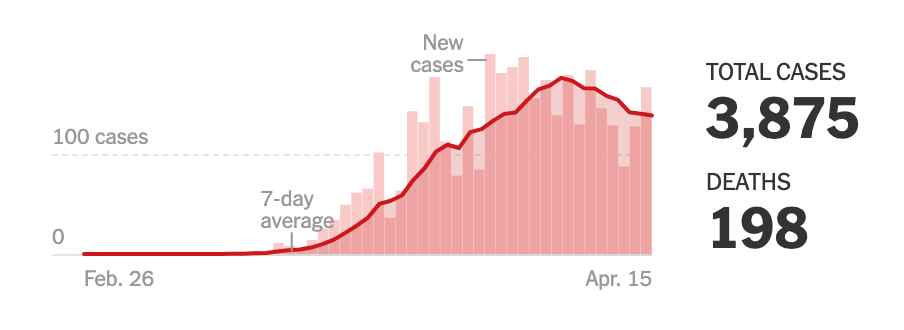
While courts will be more deferential to restrictions on public gatherings that do not implicate fundamental rights, the state will have to offer some justification. Whether a fundamental right is implicated or not, as time goes on, the underlying circumstances of the pandemic may limit whatever authority DHS retains. For example, when the Safer at Home Order was issued the number of COVID-19 cases in Wisconsin was rising rapidly. That is no longer true. Per the graph published by the New York Times on April 16, 2020, the curve in Wisconsin has flattened and even bent downward:
Whether or not the trend in the spread of the virus is due to social distancing or what turned out to be an overly pessimistic view of the virus’ likely course, the situation on the ground will eventually impact the constitutional analysis. While this may not be true today — courts are likely to be broadly deferential — a continuation of what seems to be the current trend will matter.
Finally, something must be said about the Legislature’s ability to delegate authority to Secretary-designee Palm and the Department of Health Services. Under what is known as the nondelegation doctrine, the Legislature may not simply give away its legislative power to an executive branch agency. It must either provide strict standards on its exercise or adequate procedural safeguards to ensure that the agency does not become a miniature Legislature. DHS’ ability to issue sweeping orders only vaguely authorized by broadly-worded statutes is far from clear.
Conclusion
My purpose here is not to suggest what “should” happen in the coming weeks. That question is separate from the legal analysis which goes to who decides and what constitutional limits they face. Nor is this a law review article or a brief to a court. I have provided a broad and general summary about which more can and will be said. But claims that the Governor — or his appointee — can unilaterally extend the current state of affairs indefinitely may very well be wrong. If that’s so — and I think it is — then the next phase of Wisconsin’s response to the virus not only has to comport with our Constitution, but has to be agreed to by the Governor and the Legislature. It has to enjoy bipartisan support. And in extraordinary times such as these, that is how it should be. Unfortunately, Governor Evers’ new Safer at Home Order eliminates that possibility.
None of these are questions the state media have been asking. The state media has been a giant steaming heap of failure during the coronavirus crisis, failing to ask such Journalism 101 questions as “how” and “why,” and failing to question premises.
Times were tough down on the farm before the COVID-19 outbreak. Now, each new day is filled with dread, filled with collapsing markets, looming bankruptcies and ruined lives.
“At this point, we’re all looking at a train barreling over a cliff, not really sure if anyone is going to survive when we hit the bottom,” Brodhead-area farmer Rob Riemer told Vicki McKenna this week on NewsTalk 1310 WIBA.
The pasture-raised cattle and egg Riemer Family Farm dates back nearly a century. The third generation now wonders if their southcentral Wisconsin farm will survive the coming months.
The pandemic and Gov. Tony Evers’ sweeping Safer at Home order locking down much of Wisconsin has hit America’s Dairyland particularly hard.
Dan Smith, president and CEO of Cooperative Network, said the agriculture industry in general was just beginning a slow recovery from a painful downturn over the last four or five years. The severity of the coronavirus shutdown of the economy at large was like “pouring gasoline on a fire,” Smith said.
Overnight, the dairy industry lost about 40 percent of its marketplace — the food service industry. A big chunk of that market includes schools, which began closing en masse a month ago. Markets instantly changed, as Evers ordered most consumers to stay home. Food processors couldn’t turn on a dime to meet the changes, and everything seemed to slow to a crawl.
Riemer said last year was bad enough. His farm suffered a “six-figure loss.” The reserves are gone. Now, if the economic shutdown continues, his family farm, like so many family farms, won’t make it.
“We’re just talking a matter of months basically. Most of us will probably survive a month or two, some will not. But if this goes on extended, by the end of the summer, fall, or later, I don’t think you’re going to have more than a handful of farms survive this,” the farmer said.
A report earlier this month, Institute for Reforming Government lays out the rising challenges confronting Wisconsin farmers and calls on the Legislature to finish the business of passing reform legislation that will help bring back prosperity to the Dairyland’s farms.
Smith said farmers do need help, but just throwing money at the problem isn’t going to cut it. He said it’s time for systemic changes to sustain agriculture and promote a safe and reliable food system.
But things are going to have to change quickly if Wisconsin wants to save its family farms, the ag expert said.
“Agriculture was already the at-risk patient, to put it in the language of the pandemic,” Smith said. “This really hits at the worst possible time.”
Listen to the Vicki McKenna’s interview with Rob Riemer here.
Given the most recent mortality rates and modeling, it appears that the death toll in America from coronavirus will end up looking a lot like the annual fatality numbers from the flu. The Institute for Health Metrics and Evaluation in Washington state is now projecting 68,841 potential deaths in America. It is also estimating lower ranges than that. The flu season of 2017-2018 took 61,099 American lives. For this we have scared the hell out of the American people, shut down the economy, ended over 17 million jobs, taken trillions of dollars out of the economy, closed places of worship, and massively disrupted civic life as we know it. Some of our major public officials tell us, still, that there will be no returning to a status quo, that we will have to get used to a new normal. We strongly disagree with that mindset.
A panic and hysteria over a pandemic that does not look to be what so many frightened us into thinking has radically degraded this country. What should be the major lessons learned here? How did we go from an ethos of “Let’s Roll!” when America was hit by a major attack from outside forces two decades ago to “Let’s roll up in a ball”?
First, New York City is where the epidemic has struck the hardest. The media is centered in New York City. Although sensationalism is not new, something in the 21st century media landscape is: Reporting the news has been replaced with raising alarms, heightening political tensions, and funneling information through a strictly partisan lens. Lost is the notion that if something is too bad to be true — or too good to be true — it probably is not true. Conspiracy theories and extreme rhetoric have replaced fact and reason, as well as reasonableness. These dark impulses have been aided and abetted by a series of left-wing notions that have come to dominate our politics, giving us a new “paranoid style in American politics.”
In the 1970s, professor Paul Ehrlich, author of The Population Bomb, gained a huge following for predicting, incorrectly, that “hundreds of millions of people will starve to death.” In the 1980s, we were scared into believing a nuclear winter would create a human and climatic catastrophe, killing over one billion people because of “a precipitous drop in the Earth’s temperatures and widespread failure of crops, leading to deadly famine.” In the 1990s up through Greta Thunberg’s “Person of the Year” designation, climate change (no longer a warming or a cooling, just “change”) presaged “no tomorrow,” while “entire ecosystems are collapsing.” We have seen much the same fright-inducing extreme rhetoric with our domestic politics.
Aided and abetted by its mainstream media enablers and ideological soulmates, the left has warped our political rhetoric to a point beyond reason, impeding our ability to make calm and rational assessments. President Trump, for example, is not wrong or too conservative — he’s an “existential threat to America” and “worse than Hitler,” and, of course, responsible for all the deaths from COVID-19. From the left’s social to political rhetoric of extremism and worst-case scenarios, we’ve been conditioned to hyperbolic exaggeration; we’ve been numbed into implausible raving.
Thus, when the virus came to our shores, Americans were primed enough to accept and cower in front of models of death telling us that two million of us would be killed. Now, after the damage was ignited by shutdowns and panic, the social destruction of this irresponsible fearmongering will take a long time to undo. Whipping the population into a frenzy and panic, is, as Abraham Lincoln warned us long ago, not healthy for the perpetuation of our political institutions.
Or any other institution. As part of our national affright, we engaged in a shuttering of our best forces of composition — such as churches, synagogues, schools — and our venues for physical exercise. Just at the time of their greatest needs, these services were ordered to be shut down. Thus, no surprise: over the course of the past six weeks, suicide hotline calls, alcohol abuse, and other instances of substance abuse and domestic violence have increased. More social destruction will ensue.
Lesson Two: Although houses of worship were closed this past weekend, the message of strength, courage, and “be not afraid” should be our first instincts as Americans.
Ronald Reagan popularized the notion of “Trust, but verify.” Americans need to use that approach with our own leaders, and with the “experts” who issue dire warnings. Even those who are well-meaning and highly credentialed are not omniscient. We should listen, but verify. Medical patients given a grim prognosis usually want a second opinion. We should want that as a polity, too.
Lesson Three: Disaggregate the data. If there is a vulnerable population — and there is here — encourage appropriate and reasonable measures. Resist zealous generalizations that lead to vast distributions of misery and hardship. The chances of a younger person and an older person acquiring this disease, much less dying from it, are not the same. And both are small. No doctor would treat a 40-year-old from Boise the same way he or she would treat an 80-year-old from Queens. Neither should our nation treat the body politic the same way.
Lesson Four: Understand there is public health, and there is public health. Does a virus that may take as many Americans as the seasonal flu require an upending of literally everything in our life, work, and recreational activity, affecting so much more of our other health, including mental health? Does it require a response that will lead to other deaths and diseases of despair from substance abuse and suicide ideation to domestic violence, all while curbing of our civic health and constitutional rights as well?
Lesson Five: Do not be impervious to good or hopeful news. Compare this virus’ numbers and prognoses to other numbers and prognoses we have taken for granted without even knowing it. When data reveals that there is a .007% chance of dying from this disease in America, report that. When evidence shows there may be extant medicines that can treat the virus, encourage rather than anathematize that.
If there is one over-arching lesson uniting all others, it is to remember our Lincoln. Early on, he asked, “At what point then is the approach of danger to be expected?” He answered that if danger ever reaches our shores, “it must spring up amongst us. It cannot come from abroad. If destruction be our lot, we must ourselves be its author and finisher. As a nation of freemen, we must live through all time, or die by suicide.”
Ignoring these lessons will augur poorly for us in the near term and perhaps severely in our next crisis, setting precedents we may never be able to overcome.
Americans generally and Wisconsinites specifically have been great big steaming piles of … well, failure during the coronavirus pan(dem)ic. Most Wisconsinites and all of the state-level news media have accepted the Evers Edicts without protest or even questioning, and have questioned nothing coming out of the Department of Health Services, which, contrary to public belief, is as political a state agency as any. The supposedly Republican-controlled Legislature has failed to even debate one of Evers’ executive orders when at least some of them are blatantly unconstitutional at both the federal and state levels. Church leaders have also knuckled under to the Evers Edicts, as if going to church really isn’t as important as church leadership has been claiming all these decades.
John Daniel Davidson demonstrates Lord Acton’s observation that “power corrupts”:
There’s nothing like a crisis to bring clarity. The response of some mayors and governors to the coronavirus pandemic in recent days has made it clear they think they have unlimited and arbitrary power over their fellow citizens, that they can order them to do or not do just about anything under the guise of protecting public health.
We’ve now witnessed local and state governments issue decrees about what people can and cannot buy in stores, arrest parents playing with their children in public parks, yank people off public buses at random, remove basketball rims along with private property, ticket churchgoers, and in one case try—and fail—to chase down a lone runner on an empty beach. All of this, we’re told, is for our own good.
The most egregious example of this outpouring of authoritarianism was an attempt by Louisville, Kentucky, Mayor Greg Fischer to ban drive-in church services on Easter. On Holy Thursday, one day before Christians were to begin their most important religious celebrations of the year, Fischer declared that drive-in Easter services would be illegal.
To remove all doubt about his seriousness, he also threatened arrest and criminal penalties for anyone who dared violate his order, and in an Orwellian twist, invited people to snitch on their fellow citizens. Fischer justified this by saying it was “to save lives.”
Thankfully, a federal judge made short work of the mayor’s idiotic power-grab, issuing a temporary restraining order against the city of Louisville on Saturday, writing so as to remove all doubt, “The Mayor’s decision is stunning. And it is, ‘beyond all reason,’ unconstitutional.”
The mayor shouldn’t have needed a federal judge to tell him that. Anyone with a passing familiarity with the U.S. Constitution should know the government can’t single out religious worship for special regulations and prohibitions, which is precisely what the clueless Fischer did here. His order would have barred Christians from driving to their church parking lots and sitting in their vehicles for Easter services—all while maintaining proper social distancing—while imposing no such restrictions on drive-up and drive-through restaurants, liquor stores, grocery stores, or parking lots generally.
Mayors or governors—or even presidents—can no more single out Christians on Easter than they can single out Muslims during Ramadan or Jews on Yom Kippur. If you’re going to ban parking in parking lots, it has to apply to everyone everywhere.
But this didn’t just happen in Louisville. Two churches in Greenville, Mississippi, that were holding drive-in services for Holy Week said police showed up and ordered churchgoers to leave or face a $500 fine.
In a video posted on Twitter from Pastor Hamilton of King James Bible Baptist Church in Greenville, a police officer tells Hamilton that because of the governor’s order, “your rights are suspended.” To the good pastor’s credit, he correctly notes that the governor cannot suspend his rights because his rights come from God, not the government.
Video from Pastor Hamilton of King James Bible Baptist Church in Greenville, MS. Church tried the “drive-in” method of holding services & were targeted due to the Mayor issuing an order prohibiting such services. Watch as an officer tells the Pastor that his rights are suspended. pic.twitter.com/zLdT6Qd8ew
Pandemic or not, this stuff has no place in American society. Petty tyranny of the kind these mayors and local officials are scheming is wholly alien to our customs and way of life, and destructive to the social contract on which our nation is built.
Thankfully, the Department of Justice has taken notice of this fledgling authoritarian streak among the country’s mayors and governors. A DOJ spokesman said Saturday Attorney General William Barr is “monitoring” government regulation of religious services and may take action against local governments as early as this week.
That’s a good start, but the targeting of churches, while undoubtedly the most offensive overreach by state and local governments, is hardly the only instance of government gone wild. In Michigan, Gov. Gretchen Whitmer has taken it upon herself to declare what items are and are not “essential,” dictating to grocery stores what they can and cannot sell as part of a sweeping order issued Friday.
Among the nonessential, and therefore banned, items are fruit and vegetable plants and seeds. Never mind that growing fruits and vegetables at home right now would help maintain social distancing during the pandemic, the governor has spoken and her word is law. (Lottery tickets, on the other hand, are still permitted.)
Beyond the fruit and vegetable ban, the governor’s order is an object lesson in the absurdity and inconsistency of arbitrary power and rule by fiat. Michiganders are banned from traveling “between residences” if they own a cottage or a summer home, but the ban only applies to Michigan residents, so an out-of-stater with a cottage in the Upper Peninsula could presumably still visit. The ban also still allows travel between states, so if a Michigander has a cottage in Wisconsin or Ohio, he can travel without fear of being arrested or fined by state police.
Why did Whitmer tailor her order this way? Probably because she knows she has no authority to ban travel between states, or issue orders to Americans generally—no more than a mayor has the authority to shut down drive-in Easter services in his city.
That these officials need to be reminded of that, and in some cases restrained by federal judges, bodes very ill for America. Now more than ever, we need leaders who don’t just care about protecting us from the pandemic, but also care about preserving liberty in a time of crisis.
The flaw in this piece is that it doesn’t include Wisconsin Gov. Tony Evers, who has issued a record number of executive orders, several of which are illegal and/or unconstitutional, though the state Legislature apparently lacks the guts to challenge him.
The New York Times tut-tus about Wisconsin’s political climate:
The Wisconsin State Legislature couldn’t agree on who to honor for Black History Month. It couldn’t hold a special session on gun violence that lasted more than a few seconds. It had stalled for weeks on releasing money to help farmers struggling with mental health issues.
So Brad Pfaff wasn’t all that shocked that, because of a partisan standoff over postponing the election, thousands of mask-wearing citizensmade their way outside during the global coronavirus pandemic to vote last Tuesday.
The rest of the country was seeing Wisconsin’s political dysfunction on display, but Mr. Pfaff has already lived it.
“I was surprised how personal it got,” he said, recalling a different fight: The divisions that kept him from being confirmed as the state’s agriculture secretary. “I never wanted it to be like that.”
A brutal type of scorched-earth political warfare is flaring in America’s Dairyland.
It shows how partisanship pushed to its most strategic outer limits can ensnare not only primary election voters but also cow manure, a Christmas tree, a tourism agency and, in particular, farmers who need help.
“The Wisconsin coal mine is knee deep in dead canaries,” said Ben Wikler, the Wisconsin Democratic Party chairman. “Every possible alarm bell about a partisan divide so extreme to be potentially lethal in a literal sense has been rung.”
Mr. Pfaff inadvertently became one of those warning bells.
No blame accepted by Winkler, we see.
Low milk prices and a long global trade war have put farmers in Wisconsin and elsewhere in crisis mode for months — even before a pandemic that produced demand so low that some farmers have dumped their milk. Farms have been going bankrupt at alarming rates, and farmersfacing financial ruin have killed themselves.
Late last year, 11 months after he was first named as agriculture secretary, the Republican-led State Senate voted down Mr. Pfaff’s nomination, effectively firing the Democratic nominee who nearly everyone agreed was amply qualified for the task of helping farmers navigate one of the worst farming crises in decades.
“Somebody fired in the middle of a dairy crisis, an agriculture crisis, when he publicly advocated for farmers’ mental health,” said Gov. Tony Evers, a Democrat who was elected by fewer than 30,000 votes, still in disbelief five months later. “God forbid.”
Says the governor of Milwaukee and Dane counties.
Mr. Pfaff did carry out some of his duties last year, while waiting for confirmation. He hosted an Uzbek delegation studying best practices in potato cultivation and crowned Tequila Naomi, a seven-year-old Jersey, as Cow of the Year.
He wrote a dozen entries in a blog, saying in one post, “In a time of greater and greater polarization, dairy brings us together.”
But even in Wisconsin, America’s Dairyland, where thousands of farmers own more than one million cows, the cows couldn’t overcome partisanship.
The political battle in Wisconsin became particularly heated during the tenure of Gov. Scott Walker, who outraged Democrats by taking on a key liberal tenet: organized labor. After he lost the Statehouse in 2018, Wisconsin Republicans, who now control both chambers of the Statehouse, pushed through measures to strip the powers of newly elected Democrats. In November, Republicans opened a special session the governor had called to take up gun control measures — and then pounded the gavel to close the session after only a few seconds.
Wisconsin’s capital is surrounded by perfect squares of farmland dotted with red barns and grain silos. Out there, roads are named after farmers because the land has been in the family for so long.
“We’re not as Wisconsin nice as we used to be,” said Sachin Chheda, a Democratic consultant based in Milwaukee. “Farms are the badminton shuttlecock being pushed back and forth over the net.”
Brian Fraley, a local Republican strategist, said the divisiveness on display in the decision on the agriculture secretary was nearly universal, whatever the topic. Everyone wants to help farmers, but the political climate complicated things.
“Society in general is becoming more cynical and abrasive,” he said. “The filters are off and people just express themselves more crudely and quickly. They hit send too easily. The rejection of Brad Pfaff was as much about sending a signal to the governor as it was about his qualifications.”
On both sides of the aisle in Wisconsin, the current crisis can seem even more cynical and abrasive. Democrats have argued that pushing forward with the election last Tuesday — after the Republican-dominated Legislature refused to entertain the governor’s request to mail absentee ballots to all voters or reschedule the primary — put voters’ lives at risk.
Brian Reisinger, a Republican strategist, said that line of thinking “fires up our base and turns people off.” He argued that Democrats were “focusing on the flash points.”
When he was first nominated to be agriculture secretary, it didn’t seem inevitable that Mr. Pfaff, the son of dairy farmers who still pitches in on his parents’ farm on the weekends, would become one of those flash points.
“Oh, I loved the job,” he gushed one afternoon. “I knew the seriousness of the situation taking place in the countryside, and I took it very seriously when I traveled and listened and heard what was going on out there.”
There is a large part of the problem right there. Government employees — who still are paid better and have far better benefits than the people they are supposed to serve, by the way — are supposed to serve the public, not love their jobs./
Even events that were supposed to be fun played against an inescapable backdrop of economic trouble in the industry. In September, Mr. Pfaff traveled to Milk-n-More Farms in Cecil, Wis., to name Tequila Naomi the state’s Cow of the Year.
“Her udder is extremely well attached,” said Nicolle Wussow, who raises Tequila Naomi as she did the cow’s mother, grandmother and great-grandmother on the farm she took over from her parents, Even before the coronavirus crisis, she said, keeping the farm of 100 dairy cows afloat was difficult.
“The expenses just don’t go down,” Ms. Wussow said.
Phones were ringing at Mr. Pfaff’s agency’s Farm Center, an advice hotline where five workers field calls. Frank Friar, a retired farm loan executive, started answering calls 12 years ago when farmers were mostly seeking help navigating leasing and fencing disputes. Now, they wanted help saving their farms from financial ruin.
Mr. Friar remembered picking up the phone in the fall to hear one caller say: “I have a gun. I have it hidden, and I have shells.”
The help center was offering farmers who seemed stressed or talked of suicide $100 vouchers they could use in the offices of mental health professionals across the state, a program that had been in place for several years and was paid for through a grant.
The vouchers soon became a touchstone in the partisan battle in the Capitol.
Several years ago, the center issued few vouchers — only 26 were distributed in 2014. But as the farm economy worsened, the need increased; seven times as many vouchers were issued just last year.
One farmer who received vouchers was David Owen, who had been struggling to keep afloat the same farm in Pulaski, Wis., where he grew up. He knew of farmers nearby facing similar hardships who had committed suicide.
“I’m not going to say I wasn’t that far-off,” he said. “I can say it didn’t bother me anymore to die.”
Mr. Owen said he and his wife had yet to cash in the vouchers when they decided to auction off their entire herd of 125 Holsteins. The help center says last year it had a 42 percent redemption rate.
“Once we made the decision to sell, it got a little easier,” Mr. Owen said.
A few days later, just before the auction, he had a heart attack. He earned money this winter doing small carpentry jobs, and on Tuesday he ventured out to vote, casting an all-Republican ballot at the town hall.
At the help center, officials had been granted $200,000 for the vouchers and other programs through the state’s budget process. But members of the Republican-controlled Joint Finance Committee had yet to officially release the money to the center and cash was running low. A fight over information on the program’s effectiveness ensued.
“What we were trying to do is be helpful to the agency and helpful to farmers who needed help,” said Representative Joan Ballweg, a Republican who is co-chairwoman of a task force on suicide prevention.
My former state representative, by the way.
As lawmakers fought, Mr. Pfaff said he thought back to the frosty morning a year ago when he stood outside a giant dairy barn and marveled at the wreckage from an ice storm. Heaps of snow had crumpled the roof. Animals were wounded, or worse.
“I saw dead cows stacked up like cordwood,” Mr. Pfaff said.
Helplessness was all he felt that day, especially when he saw a teenager hop down from his tractor to join his father surveying the tattered farm that had been in the same family for generations.
That boy might never inherit the family farm, Mr. Pfaff thought. Only $500 was left in the mental health fund, enough for five vouchers. He couldn’t stay quiet.
“If the Joint Finance Committee doesn’t want to move this funding forward immediately, then they have a choice to make: Which five farmers will it be?” Mr. Pfaff complained publicly.
Republicans were outraged at the suggestion their inaction was hurting farmers. The Republican Senate majority leader, Scott Fitzgerald, fired off a letter to Mr. Pfaff, calling his comments “offensive and unproductive.”
Republicans began rallying against Mr. Pfaff. A legislative committee at the start of the year had unanimously voted to support his nomination for agriculture secretary, but Mr. Pfaff had yet to be confirmed by the entire Senate. Rumors buzzed that Republicans might vote to reject him.
The governor quickly scrambled to save his nominee. He held private meetings with Republican senators. They were not swayed. He hosted a euchre party at the governor’s mansion. One Republican showed up.The day of the vote on his position, Mr. Pfaff knew what was coming. He holed up in his office and ignored the action on the Senate floor. Mr. Evers doubled down, causing a stir by taking a seat in the public gallery of the Senate, an extraordinary move for a sitting governor.
One after another, Democratic senators stood to defend Mr. Pfaff. They noted his record helping farmers as the Wisconsin executive director of the Farm Service Agency under President Barack Obama. He was in 4-H as a youth, they said. Farming was in his DNA. He bleeds manure, one senator said.
From behind the lectern, Mr. Fitzgerald, the majority leader, said he had warned the governor that he didn’t have enough votes for Mr. Pfaff’s nomination to succeed. The governor could have withdrawn the nomination and spared an embarrassing vote.
Frustrated with the situation, Jennifer Shilling, the Senate minority leader, said, “We need statesmen and women to figure out a way that we de-escalate this legislative nuclear war that we are in.”
If you read Shilling’s emails, which are sent to news media not from her Senate district, you would find that statement hypocritical.
The votes were counted, and Mr. Pfaff’s nomination was defeated. It was the first time since at least 1987 that the Senate had turned down a cabinet nominee. The governorswore in anger. He appointed a new agriculture secretary. Mr. Pfaff got a job at the State Department of Administration, as director of business and rural development.
The next thing the Senate should do is end the employment of Health Services secretary Andrea Palm, whose sociology degree makes her unqualified for a pandemic or anything else health-related, anbd tourism secretary-designate Sara Meaney.
Mr. Pfaff cast his ballot early a few weeks ago, before Republicans had asked for an exception to the governor’s stay-at-home orders so citizens could golf and hold Easter services. He didn’t have to venture out Tuesday into what was the culmination of recent partisan bickering — voters lining up during a pandemic.
It is unclear to me why Wisconsinites seem to think Wisconsin should be different from other states. Wisconsin has, in fact, one of the largest blobs of government in the nation — 3,120, second only to Illinois. And our political culture dating back to statehood ensures that there is never a discussion about cutting government. In such an atmosphere, in politics, winning is everything, regardless of the collateral damage.
(P.S. I met Pfaff. I wasn’t impressed. I wasn’t necessarily unimpressed either, but he struck me as just another Tony Evers bureaucrat who will never stand up to his boss.)
We have gone from predictions of millions of deaths, to hundreds of thousands and now we are predicting about 60 thousand deaths. This is with the likely over reporting of death. Dr. Birx admitted the attribution of death to COVID-19 has been liberal (her word). If the death count were limited to deaths directly caused by COVID-19, it would likely be even lower than this.
The most effective time for social distancing is early in a pandemic. Lockdowns also slow the development of herd immunity, which helps a society move past the virus.
We can still practice good hand hygiene, wear masks in public, and continue social distancing for the elderly and high risk, while we develop protective herd immunity for those most at risk. By the time the lockdowns began, COVID-19 had already been seeded in the US for months, limiting the effectiveness of the lockdowns in the first place as the virus was already widespread.
Economic collapse and unemployment are destroying families
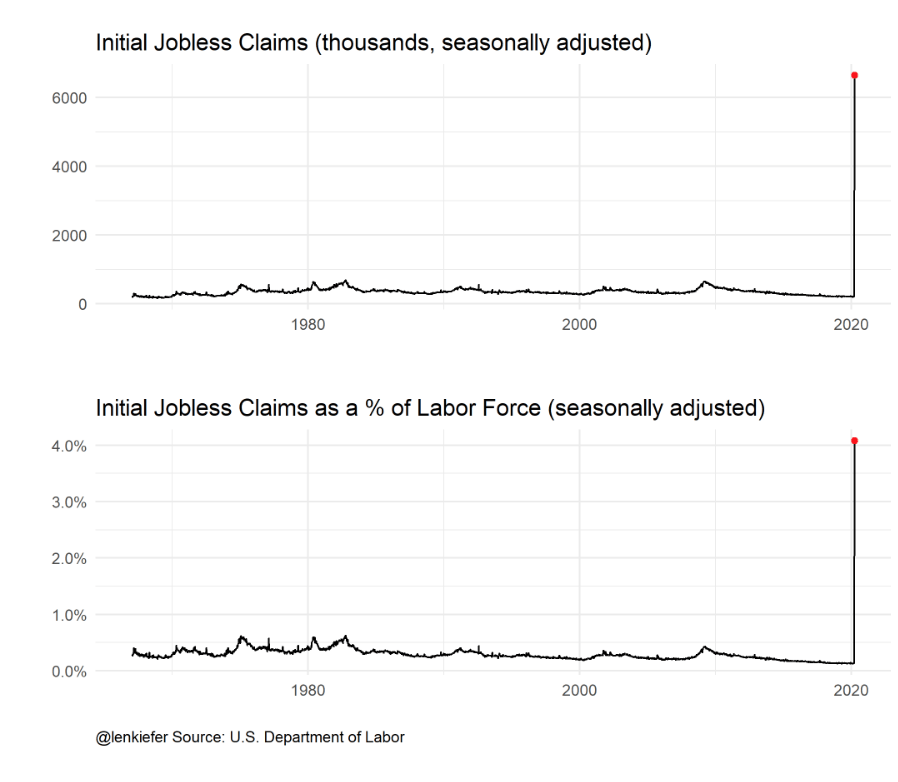
Each day the shutdown continues, we are losing approximately one million jobs, as evidenced by 16.5 million initial weekly jobless claims in three weeks (since March 26). Many of these lost jobs will never return. If the lockdowns continue through April (essentially, a best-case scenario), we’ll be lucky if job losses are limited to 25 million. Many people see 6.6 million people as just a number , as Len Kieffer put it, it is the size of the state of Missouri. Twenty five million is almost the size of the state of Texas!
The 16.5 million jobs lost thus far are only counting people who have filed jobless claims that were processed through April 8, 2020; it’s likely that the real number is quite a bit higher than this. In addition, there are millions of people not-technically-unemployed who have seen their incomes plummet. One example would be so-called gig workers, such as Uber and Lyft drivers. It’s almost certain that realtors are suffering the same fate.
We have not overburdened the health care system.
Our
Although, the ER and ICU capacity has increased in many locations, overall healthcare system capacity has decreased dramatically, as all non-COVID and non-emergent care is being neglected. This has led to layoffs of healthcare workers and delays in care for countless patients, which will result in a range of negative consequences. Assuming the need for healthcare services has remained constant while availability of such services has plummeted, countless patients are not receiving the care they need in a timely manner. In medicine, timing is of the essence, so even receiving the same exact in the future comes at a price. Many important services are being delayed: blood donations, organ donations, screening colonoscopies, and many other elective procedures. It is very important to note that elective medical care is not useless medical care; rather, it’s simply meaningful and necessary medical care that is scheduled in advance and not performed on an emergency basis.
Suicide may kill almost as many people as COVID-19 this year.
In 2018, there were 48,344 recorded suicides. Economic ruin results in a wide range of health problems, suicide, mental health issues, loss of health insurance, reluctance to visit doctors in light of financial hardship, and increases in substance abuse. This is on top of the delay in non-COVID care.
The mortality was overestimated
The IHME model, as well as Dr. Fauci have recently decreased the likely deaths from this pandemic to around 60,000 from earlier estimates of 1–2 million.The early reports of 3–4% case fatality rate (CFR) are likely misleading. The numbers miss those who are asymptomatic or recovered at home without seeking testing. What we really need to know is the infection mortality rate (IFR). Fortunately we have some good clues. Looking at the data from the Diamond Princess cruise ship, the infection fatality rate on the cruise ship was 1%. However, the average age of people on the cruise ship was much higher than the age of the average American. When you adjust for the differences in age between the cruise ship and America, you see that the IFR should be about 0.1%. There was a recent study out of Germany in the city of Gangelt where they tested 80% of the population, the IFR there was about 0.37%. The way we are testing now, we cannot know how many people have been infected with COVID-19 since we are missing those who had the disease and recovered. Antibody testing is needed to know the true number of people who have been infected. There is a good chance this number is well above 10 million, which drives the IFR down even further.
Children are at almost no risk from this disease.
The CDC estimates 37 to 187 children die every year, not from Covid-19, from the flu. This year we have lost 105 children from the flu. Yet, we have closed every school in America. Education is vitally important and a whole generation will miss a fourth of this school year. Closing schools also goes a long way towards limiting the development of herd immunity.
PPE was limited but is now becoming more available
This article is not meant to diminish the pain and horror this disease can bring to those who get it. I am a physician in one of the highest risk specialties for contracting the disease in the hospital. The lack of personal protective equipment (PPE) facing US healthcare workers is unfair and wrong. Yet, as the curve has flattened, it seems more hospitals have found adequate PPE. The CDC estimates a possible second wave would be at least 150 days from the end of the lockdown, possibly this fall. Ending the lockdowns would have no effect on the PPE for the current crisis. We would have plenty of time to prepare for a possible second wave.
Authorities should show clear evidence regarding the benefits of indefinite lockdown
Those who want to continue the lockdown indefinitely should show clear evidence regarding the benefits of indefinite lockdown. There needs to be a clear reliable model that shows how many additional lives will be saved considering we have already flattened the curve and there is essentially no further risk of overwhelming the health care system. The previous models were wrong. The consequences of indefinite lockdown are quite staggering, to the tune of one million jobs lost per day.






 Steve Prestegard.com: The Presteblog