Good lord, I wish Facebook had way to block posts about masks instead of blocking friends; somehow this has turned into a caring contest, and so if you really care, consider what else you can do that is far more effective at protecting others than wearing a mask (which I do BTW).
Data and science, baby. The cloth mask does not protect you from the little covid bastards, and nobody has ever claimed it would. If you are outside of the range of transmission they have no effect whatsoever; you can’t hit a deer at half a mile with your bow and arrow, and that is why they don’t wear flack jackets and flip you the middle hoof if you scold them about it. European experts have set the perimeter at 1 meter outside and 2 meters inside don’t know why our folks don’t make the distinction – same data, same science.
What the cloth mask does is restrict the velocity of exhaled air flow to reduce the range of droplets which carry the shed viruses out of your body. If you are infected, you can reduce your risk of infecting others by 30% by wearing a mask to reduce your effective range. But that is not very much caring compared to what else you can do care a lot more.
When you pass someone at a walking speed, hold your breath – that reduces your risk of infecting others by 100%. Don’t talk to strangers, just like your mom said – that reduces your risk to others by 80%. Breathe through your nose – about 50% less velocity than mouth breathing. And (duh) cover your coughs and sneezes and wash your hands and don’t touch your face, again just like your mom said without a doctorate in virology. Stay home if you sick or contact-traced or return from travel to a place where it makes sense to play it safe for two weeks.
The data and science has said for a century that one little covid virus isn’t going to cause you any problems, it takes an army of the little bastards to storm the beaches and establish a foothold. After seven months and millions of cases, the covidian data and science says that 2 seconds passing by someone isn’t enough time for covids to get the job done; a couple of minutes at the checkout or drive-through window won’t either, and most now have plexiglass anyway – the worst Typhoid Mary could do is fog it up. Of course there can be exceptions and outliers – you could get TB or Polio or Ebola tomorrow too.
The data and science (courtesy of the local public health department in my German county) suggests that 10-15 minutes of direct face-to-face close quarters conversation with an infected person who is within 48 hours of showing symptoms puts you in range of the covid army. Maybe those kids texting each other on a date in the booth at a restaurant had it right all along – who knew? Elevators and crowded public transport puts in the right in the middle of several potential covid armies from all sides, so it is like going to covid Aleppo. Take the stairs and call an Uber if you can.
Near proximity for longer periods, say 1-2 hours, is also a risky move, so reconfigure your workplace and try to avoid the social security office. That is the problem with bars – we tend to stop caring after a few black russians with beer chasers, a pre-covid observation from my days back on the tour. Too close to too many people for too long. People my age already had our fun in taverns, let’s not muck it up for the young people who are unlikely to get severe symptoms by dying and giving the fun police a reason to shut the joints down over and over again.
Data and science tells us our risk of infection is more dependent on our own choices than what someone else chooses to do or not do; it is unreasonable to expect someone else to care about you more than you care about yourself. Personally, I do not find it to be a great inconvenience to wear a mask, although it does defeat its purpose when I have to pull it down to read the “must wear a mask in this establishment” sign because my glasses are all fogged up. A $9 neck gaiter solves that problem and my fellow humans are worth nine bucks to me.
But I find it even less of a bother to hold my breath when passing, not talking to people I don’t know, and breathing through my nose for a couple of minutes before returning to my normal mouth-breathing, knuckle dragging bad self. A few flights of stairs to avoid a crowded elevator is good for me – I was supposed to be doing that for the past 20 years anyway.
So to all my facebook friends who I love dearly, please don’t be selfish, don’t be unkind, and don’t be ignorant about the data and science. If you want to win the caring contest then, in order, practice good hygiene, keep your distance, hold your breath, don’t talk to strangers, and mask up when necessary, but remember to unmask as soon as it is not necessary. Don’t wear the damn thing around like it’s a jersey proclaiming your favorite team or a garlic necklace to keep the vampires away. It’s cloth, not kryptonite, and it is the least you can do to protect others – literally the very least thing you can do, so don’t expect a medal.
The data and science has been pretty clear and consistent since early February that flattening the curve meant stretching it out to 18 months or so. It would be nice to still have some friends left when this is over, don’t you think?
How do we know Wisconsin’s mask mandate is a stupid idea (besides being illegal and unconstitutional)? Reuters reports:
The Dutch government on Wednesday said it will not advise the public to wear masks to slow the spread of coronavirus, asserting that their effectiveness has not been proven.
The decision was announced by Minister for Medical Care Tamara van Ark after a review by the country’s National Institute for Health (RIVM). The government will instead seek better adherence to social distancing rules after a surge in coronavirus cases in the country this week, Van Ark said at a press conference in The Hague.
“Because from a medical perspective there is no proven effectiveness of masks, the Cabinet has decided that there will be no national obligation for wearing non-medical masks” Van Ark said. …
RIVM chief Jaap van Dissel said that the organization was aware of studies that show masks help slow the spread of disease but it was not convinced they will help during the current coronavirus outbreak in the Netherlands.
There are questions about the numbers in Wisconsin’s coronavirus count.
The state’s Department of Health Services on Monday once again reported see-saw numbers when it comes to the number of people being treated in the hospital.
DHS said 250 people were hospitalized as of Monday afternoon. That’s a jump of almost 60 people in 24 hours. It is also the latest in what has been a series of up-and-down spikes.
The moving number of hospitalizations also comes with a warning. DHS posted an explanation on its website the data regarding hospitalizations is likely to change.
“Changes were made to the way hospitals report data by the U.S. Department of Health and Human Services (HHS), effective July 22. As adjustments are made to meet reporting requirements, data may appear different from expected,” DHS wrote. “We are working to make any disruption as short and minimal as possible.”
Those are, however, not the only changes to the state’s data.
Sen. Steve Nass, R-Whitewater, said under-reporting and late reporting from public health managers in Dane County have put Wisconsin’s coronavirus count under a cloud.
“After the stunning revelation that Dane County had 17,000 unreported Covid-19 negative results that dramatically skewed the positivity rates in that county for at least three weeks, the public can no longer be assured that all state and local data is reliable without greater transparency and honesty from public health bureaucrats,” Nass said Monday.
The new broke last week that Public Health Madison & Dane County, the capital city’s joint public health department, did not report its negative tests results dating back to at least July 10.
Nass said Madison is Wisconsin’s second largest city, and a problem with the numbers there causes problems for the coronavirus numbers statewide.
“There is no doubt in my mind that the state positivity rate and many local county positivity rates are skewed significantly higher by the backlogs in reporting negative results,” Nass said. “While the development of backlogs was not intentional, the decision by public health officials to stay quiet about the existence of the backlogs was clearly intentional and terribly inappropriate.”
Nass said DHS need to make it clear that the backlogs are affecting the numbers the department reports each day.
There was no clarification with Monday’s report wherein DHS reported 590 positive tests and 6,356 negative tests. Wisconsin’s daily positive-test rate was at 8.5 percent.
A Fond du Lac man was charged [July 9] with a hate crime after authorities said he intentionally crashed his pickup truck into a motorcyclist on July 3 killing the driver.
Daniel Navarro, 27, is charged with first-degree intentional homicide, using a dangerous weapon and first-degree recklessly endangering safety, all as hate crimes. Fond du Lac County Circuit Court Judge Robert Wirtz set bail at $1 million during an initial court appearance.
Fond du Lac County sheriff’s deputies responding to a report of the crash at Winnebago Drive and Taycheedah Way in the town of Taycheedah found the motorcyclist, 55-year-old Phillip A. Thiessen of Fond du Lac, dead in the roadway.
Thiessen was a former Marine and a retired special agent with Wisconsin Division of Criminal Investigation. He had previously been a police officer in Fairfax, Virginia.
“We do not believe that the suspect knew Phillip, had ever met with Phillip or had targeted him because of his background in law enforcement,” Sheriff Ryan Waldschmidt said during a press conference Thursday.
According to the criminal complaint, police determined Navarro was driving east on Winnebago Drive when his pickup crossed the centerline and hit Thiessen.
A deputy at the scene asked Navarro if he heard him correctly about the crash being intentional and Navarro responded “yes, it was intentional, sir.” The deputy described Navarro’s demeanor as calm as he appeared to stare into the distance.
During interviews with detectives, Navarro said he believed he had been intentionally contaminated with a chemical sterilizer on his jacket by an employment supervisor in Ripon approximately a year and a half ago.
He went on to say, according to the complaint, that a friend poisoned him a year and a half ago, that he is still being poisoned by a neighbor and that he could hear one of his neighbors making racist comments through the walls of this residence.
Navarro told detectives that those who are poisoning him, giving him acid, and making racist comments are all Caucasian and targeting Navarro because he is Mexican.
He told investigators he took his red pickup, which is registered to his father, out for a drive in order to charge up the truck battery because he only leaves his parent’s house about once per week, the complaint states. He said he drove out in the county and saw the motorcycle, which he targeted because he believed it was a Harley Davidson driven by a white person.
However, Navarro was not aware of specifically who was driving the motorcycle because the headlight of the motorcycle was so bright.
Navarro’s parents said their son had been isolating himself and spent most of his time watching the news.
To many, the sound of a roaring Harley is iconic — an audible symbol of American freedom and ingenuity. To Wisconsinites especially, seeing a Harley on the road is a source of pride, as Milwaukee serves as the company’s global headquarters. Yet to Daniel Navarro, the sight and sound of a Harley represented white supremacy. As a result of that misplaced rage, over the July 4 weekend Navarro allegedly decided to take out his prejudice on Phillip Thiessen, swerving his pickup truck head-on into Thiessen. With the exception of a few local news outlets, the incident has received little attention. It simply does not fit with the national media narrative, so there will be no marches or protests commemorating Thiessen’s service-oriented life.
Wisconsin, like every state, is experiencing a great deal of economic uncertainty amid the COVID-19 pandemic. States will need to use caution as they make revenue and spending decisions amid the ongoing public health crisis, but tax policy can play a valuable role in a state’s economic recovery, and policymakers ought to give careful consideration to tax policy changes that would help the state recover faster. Several structural tax changes are worth considering that would both promote a stronger economic recovery now while promoting stronger economic growth in Wisconsin for decades to come.
Wisconsin’s Current Economic Landscape
Wisconsin’s unemployment rate currently stands at 12 percent, which is both higher than the state’s peak unemployment rate during the Great Recession peak (9.2 percent) and higher than the current U.S. unemployment rate (11.1 percent). While the state saw 75,000 jobs return in May, the Wisconsin Department of Revenue has issued a forecast estimating it will take approximately two years for the state to reach its pre-pandemic employment levels.
From a revenue standpoint, Wisconsin does have a notable advantage in that the state originally expected a sizable budget surplus for the current biennium (fiscal years 2020 and 2021). As a result, the revenue growth that occurred prior to the pandemic will help offset some of the state’s pandemic-related revenue declines that occurred this spring and will continue into the current fiscal year and likely beyond.
While Wisconsin’s April and May sales tax collections came in below last year’s April and May collections by 9.9 percent and 10.1 percent, respectively, as of May, total sales tax collections for FY 2020 were already 2.2 percent ahead of FY 2019 collections. Similarly, revenue from various business taxes, like the corporate income tax and the franchise tax, has already come in ahead of the Legislative Fiscal Bureau’s January 2020 forecast.
Now that Tax Day has come and gone, Wisconsin will soon have a better idea how much of the state’s individual income tax collections shortfalls were attributable to the delayed tax deadline and will thus be recovered in short order. While sales tax collections took an immediate hit during stay-at-home orders, they are likely beginning to stabilize. Corporate and individual income tax revenues, however, are expected to face steeper declines and take longer to recover, due to jobs and wages that will take longer to be restored.
After the CARES Act was enacted on March 27th, the Wisconsin Assembly and Senate passed A.B. 1038, a bill that accepts some of the CARES Act’s tax changes but rejects others. Gov. Tony Evers (D) signed this bill into law on April 15th.
This law brought several of the CARES Act’s taxpayer-friendly tax changes into Wisconsin’s tax code, including the following:
An above-the-line deduction of up to $300 for charitable contributions made in 2020 (available for taxpayers who claim the standard deduction).
For Tax Year 2020, a lifting of the limit by which the deduction for charitable contributions can reduce taxable income (available to taxpayers who itemize).
An exclusion from income of certain employer-provided student loan assistance that is granted in 2020.
A waiver of penalties for certain coronavirus-related early IRA distributions, with distributions taxed over three years instead of all at once.
It is also important to note that, after the federal tax reform law was enacted in 2017, Wisconsin enacted legislation (2017 Wisconsin Act 231) decoupling from two of the TCJA’s revenue-increasing provisions: the limitation on the deductibility of business net interest under § 163(j) and the limitation on the deductibility of excess business losses under § 461(l). As such, Wisconsin currently treats certain business interest expenses and losses more favorably than the federal government, so the CARES Act provisions that temporarily relieve certain federal limitations under those two sections need not be considered in Wisconsin.
While Wisconsin conforms to several of the CARES Act’s taxpayer-friendly provisions, there are some federal provisions to which the state does not conform that are worth considering in order to promote a stronger economic recover
NOL Carryback Allowance
Wisconsin does not conform to the federal tax code’s treatment of net operating losses (NOLs). In Wisconsin, if a business has NOLs, those losses can be carried forward up to 20 years to reduce future taxable income, but they may not be carried back to reduce past taxable income.
Prior to enactment of the Tax Cuts and Jobs Act (TCJA) in late 2017, the federal tax code allowed businesses to deduct current losses against up to two years’ worth of past income taxes paid, but the TCJA repealed NOL carrybacks in order to offset some of the law’s rate reductions and other pro-growth reforms. The CARES Act, however, allows businesses that incurred losses in 2018, 2019, or 2020 to deduct those losses against up to five years’ worth of past income taxes paid. This allows taxpayers to file an amended return and receive a near-immediate refund of some of their past income taxes paid, which will be the lifeline many businesses need to survive this economic crisis and return to profitability in future years.
In many ways, NOL carrybacks are designed specifically for recessions, and Wisconsin should consider conforming to the federal NOL carryback allowance or offering an NOL carryback of its own in order to help more in-state businesses survive the current recession.
Unlimited NOL Carryforward Allowance
Wisconsin allows NOLs to be carried forward 20 years, and it does not conform to the TCJA’s cap that limits carryforwards to 80 percent of taxable income in any given year. However, some businesses have losses that extend beyond 20 years, which is one of the reasons the TCJA lifted the 20-year cap. The more generous a state’s carryforward policies, the more likely it will be that the state income tax will fall on the business’s average profitability over time.
Full Expensing Under § 168(k)
One of the most pro-growth tax reforms in the TCJA was a provision that allows investments in machinery and equipment to be deducted in the year those investments are made rather than incrementally over the depreciable life of the asset. The Tax Foundation’s General Equilibrium model shows that, at the federal level, full expensing can have a larger pro-growth effect per dollar of revenue forgone than even reducing the corporate income tax rate, and we can assume a similar effect at the state level.
As of July 1, 2019, 16 states conformed to the TCJA’s 100 percent bonus depreciation allowance under § 168(k), but Wisconsin is not one. Enacting such a policy would encourage in-state investment while removing a bias in the tax code that discourages investment, which would be a particularly powerful post-pandemic recovery tool.
Improving Wisconsin’s Income Tax Competitiveness
As Wisconsin looks ahead to the future, there are many tax policy changes worth considering that would make the state more competitive for decades to come. For instance, Wisconsin forgoes a significant amount of revenue each year by exempting many consumer goods and services from its sales tax base. Modernizing the sales tax base would make the tax code more neutral, and it would generate revenue that could be used to bring down some of the state’s less-competitive tax rates, including income tax rates. Wisconsin boasts the fourth-lowest combined state and average local sales tax rate in the country, but its income tax rates, including the corporate income tax rate and the top individual income tax rate, are among the highest in the Midwest region. Sales tax base broadening would allow Wisconsin’s sales tax rate to stay low and competitive while improving Wisconsin’s competitiveness in the other areas of the tax code where the state is falling behind.
Conclusion
Tax policy has an important role to play in helping states recover from the current crisis while paving the way for stronger economic growth for years to come. From a revenue standpoint, Wisconsin was better off than many states going into this crisis, but the policy decisions—including tax policy decisions—state policymakers make in the months ahead will have far-reaching implications for how quickly jobs and wages are restored in Wisconsin.
Whatever is done in taxes (and the answer will be “nothing” as long as the governor and the majority party in the Legislature are not the same) is insufficient unless accompanied by permanent (as in constitutional) spending controls.
The MacIver Institute supplies these coronavirus numbers:
I (who have already been tested and found negative) meet two of these qualifications. The one thing MacIver doesn’t include (because the state Department of Health Services apparently isn’t measuring the percentage of diagnosed or hospitalized people who test positive, or those who die after diagnoses, who have preexisting health conditions.
Gov. Tony Evers signaled Tuesday he might try to require Wisconsin residents to wear face masks to address a new surge of coronavirus cases — after previously taking the position he didn’t have the authority to do so.
Evers, who wore a face mask during a briefing with reporters, said he’s considering a mask mandate but said it’s unclear whether it would stick after a state Supreme Court ruling in May that tossed out much of his stay-at-home order and put his authority to issue statewide orders in question.
Evers has taken the position until now that the ruling stripped him of the authority to issue such statewide orders, but some legal experts don’t agree. On Tuesday, he said an unnamed business owner told him to try even if Republicans sue.
“We really don’t know if I have the authority to do that,” Evers told reporters, noting such a mandate could be “unlikely” after the Supreme Court ruling made the task of responding to the virus outbreak more complicated.
Later in the briefing, Evers also said he was “looking at all options” and said a “business leader” called him recently asking him to mandate masks to ensure outbreaks don’t get out of hand and force more business closures.
“I talked to him about the possibilities of it being challenged in court by the Republicans, which is probably 100%, and our chances of losing in the Supreme Court which are probably very close to 100%, and he said ‘Do it anyway,’ ” Evers said.
Republican legislative leaders sued Evers earlier this year over his stay-at-home order which closed schools, businesses, bars and restaurants for two months.
The conservative-controlled state Supreme Court in May issued a ruling in the case, tossing out the order with the exception of its limits on schools.
But the court’s conservative majority tightens to 4-3 in August with the addition of liberal justice Jill Karfosky. Conservative justice Brian Hagedorn sided with the liberal minority in the May ruling tossing out the governor’s order.
That means a potential lawsuit over similar statewide orders may be unsuccessful once Karofsky joins the court.
Senate Majority Leader Scott Fitzgerald said last month he does not support mask mandates, but a spokesman did not answer whether he would support a lawsuit challenging an order requiring them.
A spokeswoman for Assembly Speaker Robin Vos also did not respond.
Until Dane County implemented its mask requirements on Tuesday, Wisconsin was in a minority of states that did not have any orders requiring face coverings.
In June, California Gov. Gavin Newsom ordered residents there to wear masks indoors and in settings that put people at a higher risk of contracting the virus, like health care facilities and using public transportation.
Illinois Gov. J.B. Pritzker and Michigan Gov. Gretchen Whitmer have issued face mask mandates and Minnesota Gov. Tim Walz requires employees in certain positions wear masks. …
The spread of the virus among Wisconsin’s younger residents pushed Dane County officials to pull back their plans to gradually reopen businesses and allow larger gatherings since shutting down most of the county in March.
On Tuesday, the county’s health officials went a step further and required everyone over the age of 5 to wear a mask when indoors except at home or at a restaurant, which are only allowed to cater to 25% of their capacity.
Milwaukee city leaders are working on an ordinance to require face coverings after Ald. Marina Dimitrijevic introduced a proposal that would require city residents to wear masks when they are in public — including when they are indoors and outside if they are in a public place and within 30 feet of another person who is not living with them.
The mandate would apply to anyone who is 2 years old or older.
The 30-foot requirement is modeled after San Francisco, Dimitrijevic said. That city’s face mask requirement includes, “walking or running outside and you see someone within 30 feet (about the length of a Muni bus).”
The plan would require Milwaukee businesses to enforce the mask requirement or risk being shut down by the Health Department.
If implemented, it would be among the stricter mask ordinances in the country.
But Milwaukee Mayor Tom Barrett and city Health Commissioner Jeanette Kowalik said they were working with Dimitrijevic and others to update the proposal.
“We want to make sure it withstands a legal challenge if there is one,” he said. “It’s a work in progress. It’s not done yet.”
Dimitrijevic said the proposal aims to help stop the recent surge of coronavirus cases.
“I don’t think anyone can ignore that data show we’re heading in the wrong direction,” she told the Journal Sentinel.
Dimitrijevic added that enforcement is focused on indoor public places, while rules for outdoor areas allow for “self-enforcement” in an effort to keep people from passing too close to each other.
“You’re being the judge of it,” she said.
Most of the mask mandates around the country require wearing masks while indoors in public places or when outdoors in public places and unable to maintain a 6-foot distance.
While some mask ordinances provide detailed guidelines about when a mask should be worn, others are much more vague.
Some places are willing to enforce their mandates with fines, including Texas and Phoenix, while other places like New York state, Illinois, Los Angeles and San Jose are not imposing fines for violating their mandates.
None of the 10 largest cities had a rule requiring people to wear face coverings outdoors whenever they are within 30 feet of someone who is not a member of your family or household.
Some of the jobs lost to Wisconsin’s coronavirus shutdown will not come back.
The state’s economic development office, the WEDC, sent a report to lawmakers that outlines the economic impact of the coronavirus.
“Although this report can only capture a snapshot in time and further monitoring will be required to fully understand and refine recommendations, several clear themes were identified that clearly have the potential to shape Wisconsin’s recovery,” the report states.
WEDC found:
Tourism, retail and service businesses are still closed, are open in voluntary limited capacity or are struggling for customers. Most have seen substantial declines in their business and are unsure of their long-term prospects.
Agriculture and food and beverage, which have been identified as essential businesses, are seeking to anticipate the markets and manage disruptions to the supply chain.
Manufacturing and construction saw less immediate disruption but anticipate the long-term economic impact with slower consumer spending and overall activity as well as declining capital investment.
Forest products have had perhaps the starkest divide, with consumer paper goods at record highs while the decline in printed advertising has seriously impacted the catalog and magazine industry.
Education and health care – both huge economic engines in their own right – have also been disrupted or nearly brought to a halt by the pandemic.
“If anything, this report reflects the complexity of a crisis that hits every person, every region, every economy in our state and beyond our borders,” WEDC CEO Missy Hughes wrote in the report.
But some aspects of the report are brutally simple.
“Many jobs simply disappeared overnight, especially among service workers,” Hughes noted. “The reality today is many of the jobs previously held in the service industry will not recover.”
Hughes doesn’t have a number for how many jobs will never return, but the report does have some estimates about the number of jobs lost and the amount of money the coronavirus lock down cost businesses.
The report says businesses reported $22.2 billion in income losses, and another $37.8 billion in other economic losses. Those same businesses reported 2,648 lost positions.
Some of those business losses were offset by nearly $14 billion in federal aid. The vast majority of that federal money went to farmers and businesses in the state through programs like PPP and farm payments.
WEDC’s report notes that both income and sales tax revenue to the state dipped during the worst of the coronavirus lock down. But the report states it is too early to tell just how much state government will lose by the time 2021 rolls around.
Recall, however, that Gov. Tony Evers tried his best to shut down the state by dividing businesses, and therefore their employees, and therefore Wisconsinites, into “essential” and “nonessential” (including the businesses whose employment is nowhere near normal). Keep that in mind when you assess fault.
Since the Wisconsin Legislature v. Palm decision ended Gov. Tony Evers’ statewide shelter-in-place order on May 13, local governments across the state have been attempting to pass their own emergency public health ordinances, giving unelected bureaucrats vast authority and unrestrained powers to combat disease.
Some officials claim that state law gives them the express authority to enact an ordinance identical to the unconstitutional Safer At Home order, but local residents all over the state are voicing their concern. Residents are alarmed by the unprecedented command and control these ordinances would have over their lives and livelihoods.
The Wisconsin Supreme Court ruled last month that DHS Secretary-Designee Andrea Palm violated the government rulemaking process when she unilaterally extended Wisconsin’s Safer at Home lockdown order. The Court determined that Palm’s order, because it was applied generally to all Wisconsinites and not in a targeted fashion, was actually a rule and needed to follow the standard rules process with legislative oversight.
Some local units of government apparently have contacted Evers’ office since the ruling, looking for help on what can be done at the county level.
“We’ve received a number of requests from public health officers for guidance on this and so we provided information, including examples of what they can look at,” said Evers’ chief legal council Ryan Nilsestuen the day after the state Supreme Court ruling. “But this will be a local decision.”
A day after Nilsestuen’s statement, Attorney General Josh Kaul released a legal opinion on how the Court decision might affect the powers of local public health officials.
Kaul’s opinion said that the powers of local health officials are unaffected because “the court decision addressed a different statute applicable to a state agency, and not the statute applicable to local authorities.” Kaul highlighted the powers that local health officials already have under Wis. Stat. 252.03 and cautioned counties to tread carefully on making criminal penalties for violating a public health ordinance.
Now, a wave of county ordinances are being taken up across Wisconsin that give local public health officials great power.
The Marathon County ordinance is specifically tailored to controlling COVID-19. Others are more broad, applying to any communicable disease.
All of the ordinances allow the local health official to “take all measures necessary to prevent, suppress and control communicable diseases,” and “forbid public gatherings when deemed necessary to control outbreaks or epidemics.”
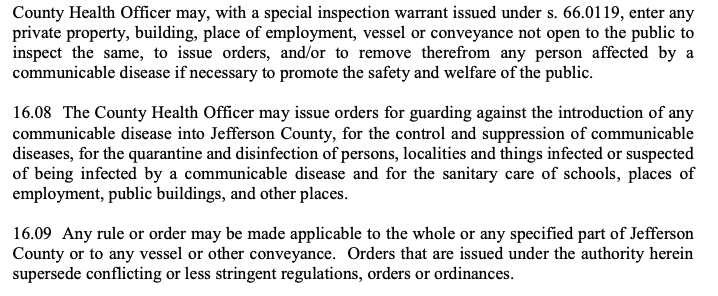
Jefferson County’s Proposed OrdinanceThe Jefferson and Winnebago County ordinances would allow the public health officer, with a special warrant, to “enter any private property, building, place of employment, vessel or conveyance not open to the public” to investigate “the presence” of any communicable disease.
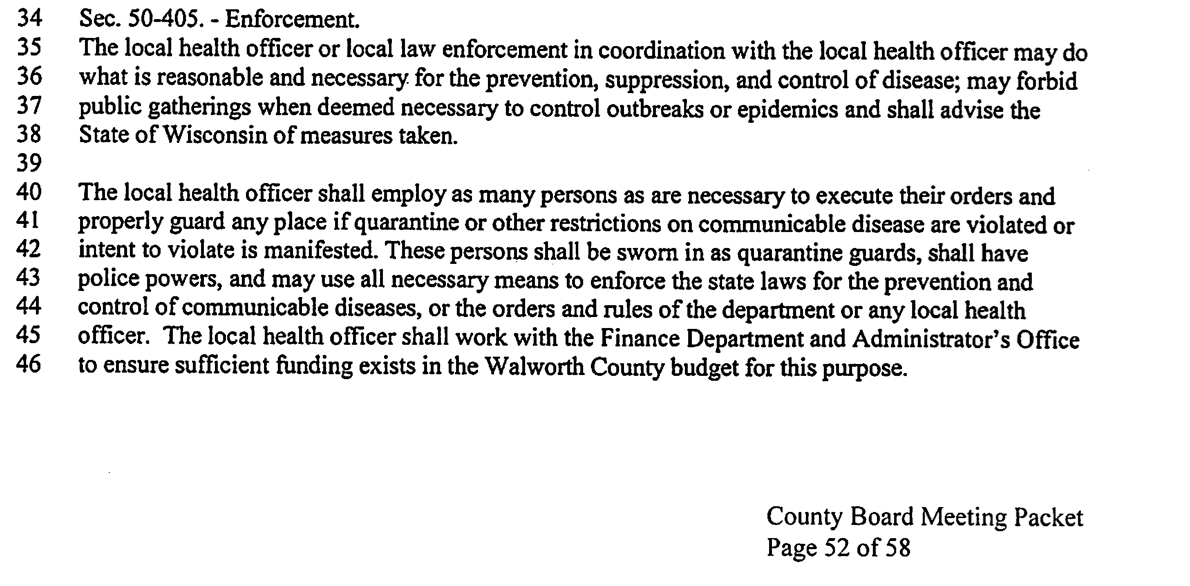
Walworth County’s Proposed OrdinanceOrdinances from Marathon, Walworth, and Oconto Counties explicitly allow public health officials to “employ as many persons as are necessary to execute his or her orders and properly guard any place if quarantine.” Those new employees include “quarantine guards,” non-police officers given police powers to stand watch over an isolation location or individual.
Dodge County references in their ordinance that these powers given to public health officers come from Wis. Stat. Chapter 252, which includes the power to hire quarantine guards. Dodge doesn’t mention quarantine guards by name in their ordinance.
Marathon County’s Proposed Ordinance
The orders don’t say what specifically qualifies as a “place of quarantine.” For all we know, these could be hired security guards standing outside of your home or business.
One Marathon County supervisor actually floated the idea using this broad power to force infected people to wear an ankle bracelet. The idea was not included in their final proposal. According to one source, however, forcing an infected individual to wear an ankle bracelet is already legal if the county corporation counsel issues an injunction and the infected person still refuses to self-quarantine.
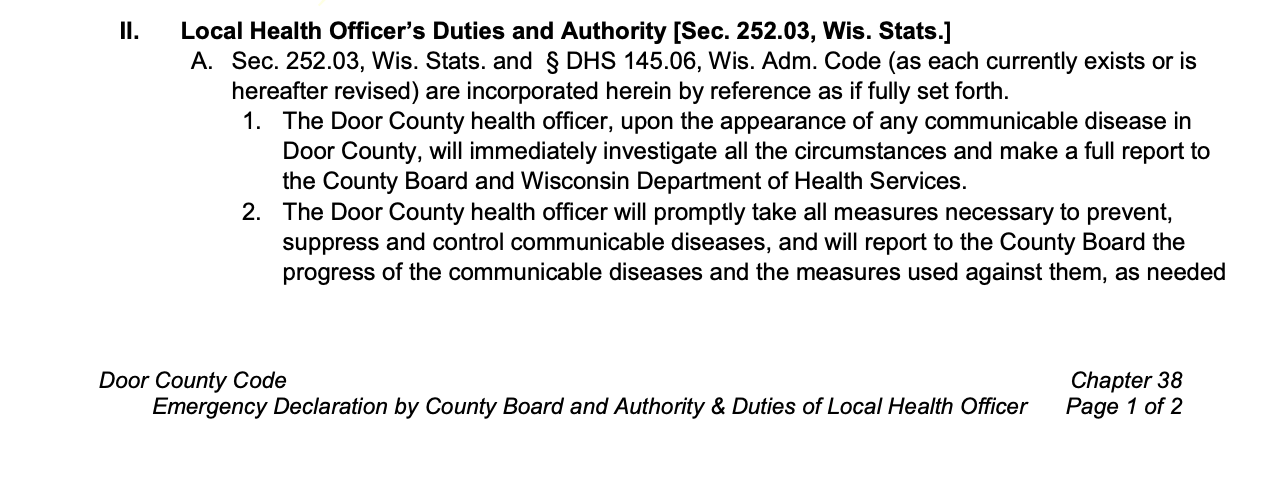
Some ordinances, like Door County’s ordinance, don’t directly say officers can hire quarantine guards. Implementing guards, though, would fall under the “take all measures necessary to prevent, suppress and control communicable diseases” umbrella.
Door County’s Proposed Ordinance“Police powers do not belong with public health administrators,” said state Rep. Cody Horlacher (R-Mukwonago). “Police powers are rightfully delegated to law enforcement officials and that is where those powers should stay.”
All of these ordinances appear to give local health officials unlimited and unchecked spending authority to fight a public health emergency.
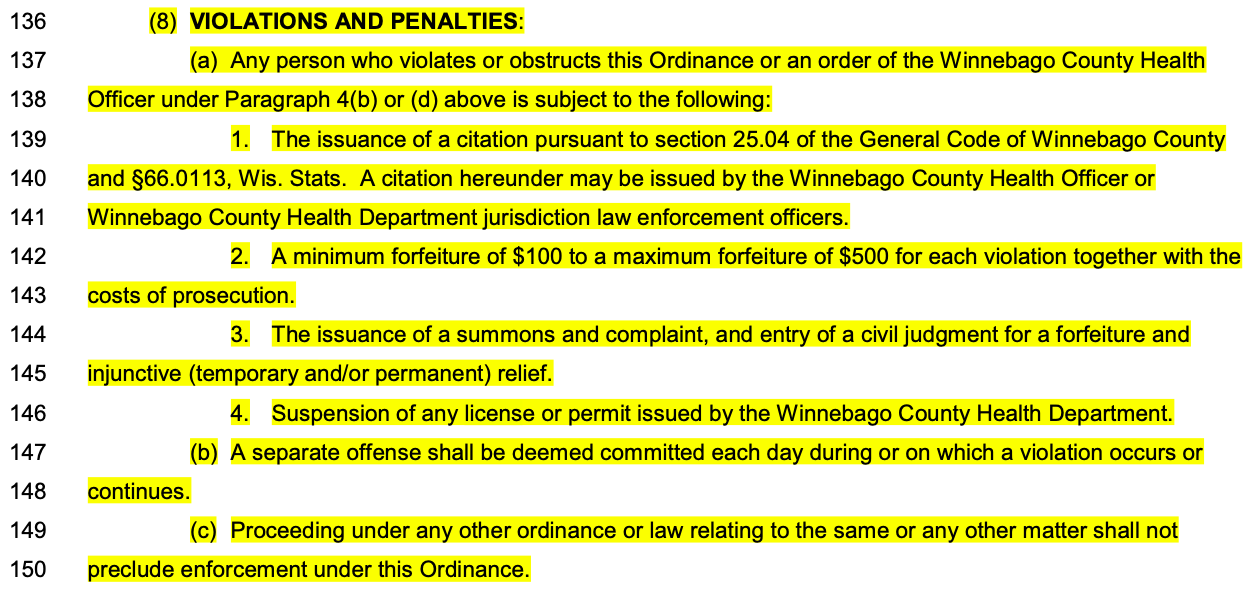
All of the proposals would include fines for people who disobey their local health officials. Fines range from a minimum of $25 in Walworth County to a maximum $25,000 per violation in Marathon County.
Winnebago County’s Proposed OrdinanceIn the proposals from Marathon and Winnebago Counties, business owners could have health-related licenses and permits revoked for non-compliance with a health order.
Proposals from Jefferson and Dodge Counties include a prison sentence for violations of the public health order. This idea of criminalizing legal behavior goes against both AG Kaul’s legal advice and against Wisconsin Supreme Court Justice Rebecca Bradley’s position during the State Legislature v. Palm oral arguments.
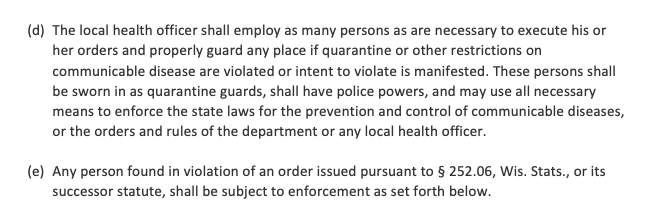
Dodge County’s Proposed Ordinance. See Section (d) for penalties including imprisonment.“Isn’t it the very definition of tyranny, for one person to order people to be imprisoned for going to work among other ordinarily lawful activities?” Bradley had asked the Evers Administration’s legal counsel. “Where does the Constitution say that’s permissible?”
State Rep. Rick Gundrum (R-Slinger) has weighed in on this same issue. “In the recent supreme court decision, justices stated that an unelected official, like DHS Secretary Designee Andrea Palm, does not have the authority to issue fines and jail sentences. That authority belongs to elected officials.
“It makes even less sense that appointed county health officials should now be granted that authority,” says Gundrum. “Appointed officials should never have more power over our lives than elected officials. “
Some of these local emergency public health ordinances have actually been rejected in a few counties – Marathon, Walworth, Jefferson, and Winnebago County.
Marathon and Jefferson County will send their proposals back to a COVID-19 ordinance working group with the Wisconsin Counties Association (WCA). The group will recommend best practices. The Greater Wausau Chamber of Commerce, Marathon County’s Chamber, opposed the ordinance as written, saying that businesses can’t be weighed down with overburdensome public policy while they’re still recovering from the statewide lockdown.
Walworth County’s proposal was rejected by the public before it was tabled. Winnebago County retracted their proposal and replaced it with a public presentation. … Dodge County’s proposal attracted over 250 people opposed.
State Sen. Dave Craig (R-Town of Vernon) has his own concerns about the proposals. “Local governments chasing their own illegal orders would be an avoidable and unforced error which will result in huge legal fees and no upside for taxpayers,” he said. “The only reason for local officials to pursue these shutdown powers is a naked desire for big-government control over the lives of citizens and businesses. It is wrong, and it is unconstitutional.”
While citizens are concerned about the broad “new” powers these ordinances give to local health officials, the local health officials say the proposals are not giving new authority. The county health officials of Marathon and Winnebago Counties have both said that language in the proposals comes directly from state statute. Wis. Stat. 252.03 and 252.06 give health officials the power to use any means necessary to control diseases. 252.06 allows officials to hire non-police quarantine guards.
Oconto County’s Proposed OrdinanceOn inspection, many of these proposals are written similarly, with the exact same language in some cases. They all cite some of the same statutes, the same abilities of the public health officer. They all cite that unchecked powers are activated when there is the presence of a communicable disease.
All proposals that MacIver has reviewed reference 252.03, some reference 252.06. Some proposals cite the powers that DHS Administrative Rule 145.06 gives to public health officials.
The similarities raise the question, was there a coordinated effort to adopt a master ordinance with broad and sweeping powers all over the state?
Health officials from Marathon and Winnebago Counties have pointed directly to AG Kaul’s legal opinion. They say that his opinion is what caused the counties to write their proposed ordinances.
Dodge County’s Corporation Counsel says they drafted their proposal because Dodge County didn’t have any public health laws on how a health official can address a communicable disease. They claimed Dodge County needed an ordinance after the State Supreme Court ruled on the Palm case. The Counsel admitted that Dodge, like many other counties, had up until then “relied on relevant state statutes” to address diseases.
Other sources have pointed to the WCA. In early March, the Association released a health emergency declaration template, as well as a legal analysis on the powers of local public health officials. On May 14, the WCA released a set of considerations for counties to follow after Safer at Home was invalidated. They encouraged counties to “communicate and, to the extent possible, coordinate local public health efforts and other COVID-19 activities with neighboring counties.”
They believed that a regional approach is preferable to counties working on strategies alone. “WCA encourages counties to schedule regular communication with regional neighbors to consider and share COVID-19 strategies.” Their recommendations did not mention anything about quarantine guards or other sweeping powers that are now being called into question.




 Steve Prestegard.com: The Presteblog