Regular readers know that state finances were worse than the Doyle administration admitted during its eight years of fiscal incompetence. But state finances are also worse than the Walker administration admits now.
The proof is the state’s Comprehensive Annual Fiscal Report, an inch-thick annual tree-killer that summarizes the differences between politicians’ claims about the state’s fiscal health, and the reality of the state’s fiscal health.
When does an expenditure occur — when a credit card is used to make a $10 purchase, or when the $10 charge on the credit card bill is paid? Elected state officials would say the latter: No cash transaction occurs until the credit card bill is paid. CPAs who follow generally accepted accounting principles (GAAP) in preparing the CAFR would disagree: When an item is charged is key, for it creates an obligation that must be paid. In technical terms, the difference between the two viewpoints is the difference between cash and accrual accounting.
What this means practically is that governors and lawmakers can “balance” a budget—as state law requires—even when the relevant CAFR later shows a deficit for the same period.
State law requires that the state budget be balanced on a cash basis. It is, to put it bluntly, insane for an enterprise that spends nearly $35 billion every year to balance its books with the same accounting method as a four-employee business. (Shareholders of a $35 million business would fire its CEO if he claimed that cash accounting was OK for a business of that size.)
Failure to correctly balance the state budget violates, at least in spirit, Article I, section 22 of the state Constitution:
The blessings of a free government can only be maintained by a firm adherence to justice, moderation, temperance, frugality and virtue, and by frequent recurrence to fundamental principles.
Keep this in mind before you read on: Between the 1999 and 2009 fiscal years, only 15 states had a GAAP deficit in any of those fiscal years. But between the 1990 and 2011 fiscal years, Wisconsin had a GAAP deficit every single fiscal year, starting at $740 million in 1989–90, to $1.08 billion in 1990–91, to $2.24 billion in 2002–03. The GAAP deficit grew every fiscal year during the Doyle administration from 2004–05 onward.
At the end of the 2008–09 fiscal year, Wisconsin’s GAAP deficit was $2.71 billion, better than only California, Illinois and New York, four of the 12 states that had GAAP deficits in 2008–09, according to the WTA. The 2008–09 GAAP deficit was $479.53 per capita and 1.11 percent of GDP, better than only Illinois. Wisconsin was one of only 15 states to have GAAP deficits in any year between the 1999 and 2009 fiscal years, but Wisconsin and Illinois were the only two states in the nation to have GAAP deficits in every one of those fiscal years.
On June 30, 2010, the end of the 2009–10 fiscal year, the state had a cash balance of $89.6 million. But measured by the more accurate Generally Accepted Accounting Principles, the state had a deficit of $2.94 billion, or $517 per capita.
So how is the state doing after a year of the Walker administration? By at least two measures, worse.
The general fund balance deficit of $2.94 billion in the last full fiscal year of the Doyle administration has grown, as listed on page 44 of the CAFR, to $2.995 billion. The only good thing about that number is that it is a smaller percentage of state government spending, 13.5 percent vs. 13.8 percent in the previous fiscal year.
Eight months ago, I wrote that the state’s Unrestricted Net Assets (gross assets minus money owed on those assets) was a negative number, $9.46 billion, better than only seven states in dollar amounts and, at 3.7 percent of GDP, better than only five states. The WTA’s report noted that “this means ‘no funds were available for discretionary purposes,’ such as paying off creditors.” One fiscal year later, the definition of “no funds were available” expanded to a bigger (in absolute value) negative number, $9.7513 billion.
It should be pointed out that the state was operating on its 2009–11 budget, crafted (if that’s what you want to call it) by the Doyle administration and enacted into law (with, remember, $2.1 billion in tax increases) by the Democratic-controlled 2009–10 Legislature. It also should be pointed out that Walker and the 2011–13 Legislature passed the controversial (to say the least) budget repair bill early in 2011 to address the $136 million deficit in the existing 2009–11 budget. It also should be pointed out that the 2011–13 budget was enacted to eliminate the $3.6 billion structural deficit the 2009–11 budget created for the 2011–13 budget cycle.
The WTA adds:
The good news is that the descent into debt slowed. The state added more than $200 [million] to the GAAP deficit in each of the prior two years but only about $50 [million] in 2010-11. Moreover, with few, if any, budget-balancing maneuvers used in the new 2011-13 budget, the deficit reported on the CAFR appears to have “bottomed out.” Whether the trend can now be reversed is up to the state’s current and future elected officials.
There is no question that the 2011-13 state budget is a tight and painful one that cuts most major programs, except Medicaid, but it will not erase the deficit reported on state financial statements next year at this time. It will, however, accomplish something not done since the mid-1990s: Lay the foundation for a new state budget (in 2013) that does not first require paying off budget-balancing IOUs from the prior year.
What this means according to state budget experts is that, entering the 2013-15 budget period, Wisconsin would have no “structural deficit” for the first time since the mid-1990s. Lawmakers would be able to prepare a budget with an eye to future opportunities, rather than past obligations.
Before state legislators and lobbyists begin planning future spending increases, however, they would be wise to remember that underlying state fiscal problems remain. State financial statements will still have large general fund deficits that require repair.
As a bipartisan state legislative committee (on which I served) urged 10 years ago, now is the time to begin scaling back the deficits on these financial statements. Those evaluating state bonds will respond with higher ratings, and markets will respond with lower interest rates that the state must pay. Then Wisconsin citizens can say that state finances are truly “back on an even keel.”
It boggles the mind that most states are able to balance their budgets on a GAAP basis, but Wisconsin has not been able to for more than two decades, with Republican and Democratic governors, and with Republican, Democratic and split party control of the Legislature. Any state legislator or commentator who claims state government is lean is not telling the truth.
Berry claims the 2011–13 budget was “a tight and painful one,” but truth be told, it was not nearly “tight and painful” enough. The Walker administration credits itself for having eliminated the 2007–09 deficit through making government employees pay more for their benefits without large-scale state employee layoffs. All that did was to reduce the GAAP deficit on a percentage-of-state-spending basis, not in an actual dollar amount.
If eliminating the GAAP deficit means cutting state general-fund spending by 13.5 percent, that is what is required, and that is what should have happened in the 2011–13 state budget. If that means permanently laying off thousands of state employees and eliminating state programs, that is what is required. (The only jobs worth creating are private-sector jobs.) Every budget cycle state legislators put off actually balancing the state budget, state finances get progressively worse.
Fortunately, some people realize the ugly state of state finances. Walker created the Governor’s Commission on Waste, Fraud and Abuse, whose mandated report came out this week. The fourth of the commission’s five recommendations, according to the MacIver Institute:
The State of Wisconsin should be doing business on a GAAP basis. In my opinion the modified cash basis currently in place allows for cutoff issues and could be used to circumvent the State’s balanced budget requirement.
“Could be used” should have been written instead as “is being used” to make a mockery of the state’s balanced-budget requirement. That should be fixed in two ways — the state law that requires only cash balancing should be changed to require GAAP balancing, and then that GAAP-balance requirement should be added to the state Constitution. (Along with constitutional limits on year-to-year spending increases and supermajority or referendum requirements for tax increases.)
The state of state finances — whether you’re slightly optimistic about the current direction or not — demonstrates once again the necessity of protecting us taxpayers from our elected officials.
The commission was created by the Legislature as part of the 2011–13 state budget to …
… examine issues related to the future of transportation finance in Wisconsin, including the following:
Highway maintenance, rehabilitation and expansion projects
Local aid and assistance programs, including general transportation aids (GTA)
Transportation fund revenue projections
Transportation fund debt service
Options to achieve balance between revenues, expenditures and debt service
Impact of highway project planning on abutting property
The commission is meeting in Madison Thursday, Milwaukee March 22, Appleton April 26 and Eau Claire May 31 to get public input as part of the process of creating a report the Legislature is requiring the commission to complete by March 1, 2013. The commission will also take public input at dottfpcommission@dot.wi.gov.
(Want some public input? Here goes: Wisconsin 23 between Ripon and Fond du Lac needs to be four lanes ASAP. I am tired of being stuck on 23 behind someone who cannot differentiate between a 4 and a 5 either on the lower left of speed limit signs or that person’s car speedometer.)
As it happens, I know, or know of, a few of the members. I’m pleased to see Barb Fleisner, executive director of Centergy, the Central Wisconsin regional economic development effort, and a former Marketplace Magazine cover subject. A representative of Schneider National, one of the nation’s largest trucking firms, is in the group, as are a couple of companies related to road construction. The head of the Transportation Development Association of Wisconsin, a group that advocates for road construction even if it requires higher taxes, is in the group too. I am not pleased to see former Madison mayor Dave Cieslewicz in the group, although I suppose he’s there to represent the cars-suck constituency.
One of the most visible pieces of evidence that suggests that former Gov. and current U.S. Senate candidate Tommy Thompson was a big-government conservative is the vast expansion of freeways over Wisconsin since I’ve gotten my driver’s license. I grew up a mile south of where Interstate 90 goes to Chicago, Interstate 94 goes to Milwaukee and then Chicago, and I–90/94 head north until they split near Tomah to go to, respectively, La Crosse and the Twin Cities. Interstate 43 between Milwaukee and Green Bay, the snippet of Interstate 535 that connects Superior and Duluth, the snippet called Interstate 794 down Milwaukee’s lakefront, and Interstate 894 through Milwaukee’s southern suburbs were the only other Interstate highways in Wisconsin. I only knew of I–90 and I–94 through Madison because if you live in Madison, you’re unlikely to go to Milwaukee to go somewhere north and south.
Looking at Wisconsin’s Interstate mileage vs. other states may have been the first time I wondered what the hell our elected officials were doing in Washington. Some of U.S. 41 and U.S. 51 was four-lane, though with intersections instead of interchanges in many spots. There was also the Beltline Highway, much of which was freeway, but the most dangerous parts, East Broadway in Monona, were not. Most Wisconsin roads had just two lanes, including the high-traffic roads such as U.S. 151, along with, once I moved northeastward, U.S. 10 and Wisconsin 29.
Now, three decades after I got that piece of freedom called a driver’s license, freeways and four-lanes cover much more of Wisconsin’s landscape. U.S. 51 north of I–90/94 is now Interstate 39 to Wausau. I’m not sure why Wisconsin 15 between Beloit and Milwaukee’s west side was built as a freeway, but it is now part of I–43. U.S. 41 from Milwaukee to Green Bay via Fond du Lac, Oshkosh and the Fox Cities will be Interstate 41, 55 or 243 (or so speculation goes) in 2014. U.S. 10 is no longer known as “Highway Hell” (or so WGBA-TV called it) now that 10 is four lanes from the Fox Cities to Stevens Point and will be four lanes west of Stevens Point. Wisconsin 29 lost its “Bloody 29” nickname now that it is four lanes from Green Bay through Wausau to I–94. U.S. 53 is four lanes from Eau Claire north to Superior. My one-year commute to New London was made more tolerable because of U.S. 45, which is four lanes from Oshkosh to U.S. 10. And U.S. 151, the four-lane I’ve spent the most time on over the years, is four lanes from Fond du Lac through Madison to Dubuque.
That’s a lot of road construction, some of which started in the 1980s, more of which started in the 1990s. Some argue that is the result of the excessive political influence of the road-builders. Former state Sen. Brian Burke (D–Milwaukee) used to complain about “building four-lane roads to nowhere,” a place presumably not called Milwaukee. (Burke’s political career ended badly, let’s just say.) The Sierra Club, the leaders of Wisconsin’s Plants Before People movement, bemoaned the death of the $822-million pseudo-high-speed-rail project, calling projects that, unlike Madison-to-Milwaukee train projects, benefit a majority of travelers a “boondoggle.”
(I knew two people who died and one person who was permanently injured on roads that weren’t upgraded soon enough. You can conclude that environmental groups don’t bother to contact me for donations.)
The fact remains, however, that more Wisconsinites use roads than any other mode of transportation by a large margin. Road projects, after all, only benefit those who want to get themselves or get something from one place to another in this state on their own schedule. That includes travelers from point A to B and businesses that sell products. The former benefit from trains, buses and commercial aircraft only if they’re following the train’s or bus’ or airline’s schedule. Freight trains are fine for the latter if their products are large enough to make the cost economical, except that something has to get the product from the train to where it’s sold, and that will not be a train.
One subject the commission will deal with is how to fund transportation projects. Gov. James Doyle raided segregated funds, including the transportation fund, to “balance” his unbalanced budgets. That has been stopped by state Constitutional amendment. The problem, though, is that gas and diesel tax receipts drop when people buy less fuel from a combination of driving less (a byproduct of a weak economy) and driving more economical vehicles. That being the case, fuel taxes tax those who use more fuel, which results when you drive more.
One partial solution is to use sales tax proceeds from transportation purchases — for instance, car purchases — to augment the transportation fund. That is a partial solution, but it has the benefit of forcing state government to prioritize its spending of the total state tax dollar.
Another is to be more selective about which projects get done. The DOT’s Connections 2030 plan involves projects in every mode of transportation you can think of, including transportation modes in places that don’t presently have them (for instance, passenger rail). I am not an opponent of roundabouts (in fact, I prefer them to stoplights, and I vastly prefer them to four-way stops), but one sometimes gets the impression that road projects are chosen based on the opportunity to install roundabouts instead of installing roundabouts as part of regularly scheduled road projects.
A third is to spend money generated by road users only on roads, and not on little-used projects that don’t benefit most people’s first transportation method. I occasionally bike (when I can pry my bike out of our oldest son’s hands), but I would not argue that spending money on, for instance, converting abandoned railbeds to bike trails is a particularly efficient use of scarce tax dollars. You want mass transit? Pay for it yourself, Madison and Milwaukee. You want trains? Most people disagree with you.
The four-letter word “toll” inevitably will come up. Tollways would be immensely unpopular in Wisconsin. Most people who have had the misfortune of traveling the old Illinois tollways think of stopping every 20 miles or so to throw coins in baskets. (Not to mention the patronage machine known as the Illinois Tollway Authority.) The wireless toll transmitter is more convenient, but also easier to abuse, given that a few keystrokes create a rate increase.
For my money, road improvements are one of the few provably valuable uses of our tax dollars. I think about that every time I drive on Madison‘s South Beltline, which goes south of the old, bad East Broadway, which was simultaneously crowded, slow and dangerous, and took too much time to be replaced. (East Broadway is still there, but with about one-tenth of the traffic.) With road projects, you get to see what you’ve paid for.
The last Presteblog of 2011 is called That Was the Year That Was 2011, a tradition of the Marketplace of Ideas column from 1994 to 2000 and then of the Marketplace of Ideas blog from 2008 to 2010.
The title comes from the British TV series “That Was the Week that Was,” a weekly satirical series that made David Frost and Roy Kinnear popular:
While the TWTYTW 2010 blog no longer exists (ask my former employer what happened to it), a video version of sorts does still exist courtesy of FDL Podcasting:
There was one prediction that I didn’t make — the creation of this blog for the reason you all know. For what it’s worth, this blog is nine months old today. This was not how I planned to spend three-fourths of 2011, but someone once said that if you want to make God laugh, tell him your plans.
I also didn’t predict that I’d be on Facebook, and I don’t believe Google+ existed when this blog began. The former has been more satisfying than the latter, largely because Facebook has allowed me to reconnect with people I’d lost track of, in one case, from middle school. (That, I should point out, includes the one Facebook Friend I deFriended, and the one Facebook Friend who deFriended me. The latter was because my political views angered him for the last time; the first was because he was as much of an idiot on Facebook — unless you think a 45-year-old fan of “The Jersey Shore” is not incredibly strange, that is — as he was in high school. C’est la vie.)
This is an opinion blog, which means readers get opinions here every day, whether about federal or state politics, American or Wisconsin business, food and drink (I’m in favor of both), motor vehicles, the media, music, sports (particularly the Packers and Badgers), and whatever else comes to my mind. As I’ve written before, after the best thing someone can tell a reader — something like “I enjoy your work and I agree with you” — the second best thing someone can tell a writer is something along the line of “I read your stuff, and you are absolutely wrong.” (I’m getting a lot of that recently; can’t imagine why.) The worst thing someone can tell a writer is something like “You write? I’ve never read your stuff.” My blog software tells me that people are reading this blog, whether they agree with what I write or not.
I continue to be what (at least) two people have called me: a “media ho’.” I occasionally appear on WTMJ-TV’s “Sunday Insight with Charlie Sykes” …
… and Wisconsin Public Radio’s Friday Week in Review, and, twicethis month, WTDY in Madison. That is the logical result of never saying no to a media invitation, I guess. This is also a personal blog, so readers have gotten to read (or, if you like, have had to endure) the unusual facets of my past in small-town newspapers (including my biggest story), radio and sports announcing.
I’m pretty sure the largest number of blog entries this year (other than the daily “Presty the DJ” pieces) involved state politics. We endured several state Senate recalls (all but two of which were unsuccessful) because of the efforts of Gov. Scott Walker and Republicans to undo the disaster area that was state finance under the Doyle (mis)administration and the 2009–10 Legislature. The 15 percent of state workers who work for government had a different opinion, as Christian Schneider notes:
The year began with an appeal for more civility in politics, in the wake of the shooting of Arizona Democratic Congresswoman Gabrielle Giffords. Yet when the Capitol explosion began in mid-February, Walker and legislators of both parties started receiving death threats. State Sen. Spencer Coggs called Walker’s plan “legalized slavery,” and state Sen. Lena Taylor (along with dozens of protesters) compared Walker to Adolf Hitler. A Democratic Assemblyman yelled “you’re fucking dead” to a Republican colleague on the chamber floor following debate on Walker’s plan. Protesters targeted Walker’s children on Facebook, and Republican Rep. Robin Vos was assaulted with a flying pilsner.
So shocking was Walker’s plan that President Barack Obama criticized the governor, deeming it an “assault” on unions. Yet if Walker was a first-time union assailant, Obama continues to be a serial offender — federal employees aren’t allowed to collectively bargain for wages and benefits. …
During the summer, unions spent over $20 million to unseat six Republican state senators who voted for Walker’s plan. This exposed exactly why it’s about the money. Government employees merely serve as conduits for taxpayer funds to work their way to the unions, who then spend money electing obeisant legislators to negotiate favorable contracts. Shockingly, lefty “good government” groups appear not to have a problem with this blatant purchase of favors.
It was a year that granted the definition of the word “democracy” a previously unimaginable elasticity. While bullhorns around the Capitol blared “this is what democracy looks like,” 14 Democratic state senators fled to Illinois to prevent democracy from occurring. Later, a single Dane County judge would overturn Walker’s law, which irony-deficient Assembly Minority Leader Peter Barca called “a huge win for democracy in Wisconsin.” The law would later be reinstated by an incredulous state Supreme Court. …
2011 was the year that public-sector bargaining became a fundamental human right, bestowed on the people of Wisconsin from the heavens. “We will not be denied our God-given right to join a real union,” thundered Marty Beil, head of the Wisconsin State Employees Union, in February.
Yet God apparently first appeared in Wisconsin in 1959, when Democratic Gov. Gaylord Nelson signed the nation’s first public-sector collective bargaining law. It was a shrewd political move — four years earlier, unions had financed 55% of unsuccessful Democrat William Proxmire’s gubernatorial campaign. The year before Nelson created the law, Democrats had a $10,000 deficit in their state account; four years later, that had turned into a $50,000 surplus. At the time, it looked a lot less like a divine right and more like a naked political favor. (God has yet to visit 24 other states, which either have limited or no public-sector collective bargaining at all.)
Public-sector unions want you to believe that they are synonymous with public-sector employees. They are not. No self-respecting professional teacher should want to have anything to do with teacher unions, the biggest blight upon our educational system. That’s my opinion, but that was also the opinion of the late Steve Jobs.
One should never expect the unvarnished truth during the political process, but unions and their apparatchiks took falsehoods to new depths during Recallarama. Unfortunately for unions, evidence contrasting their assertions existed online. Unfortunately for Democrats and unions and other lefties, the more than $40 million they spent succeeding in reducing the state Senate Republican margin from 19–14 to 17–16, or 16 Republicans, 16 Democrats and one RINO, Dale Schultz.
One should never expect ideological or philosophical consistency from human beings, so keep that in mind when you read tributes to the Occupy ______ types. Most of the same people falling all over themselves praising the protesters were singing quite a different tune when the tea party movement began in 2009. Other than the obvious ideological differences, the biggest difference between Occupy _____ and the tea party movement is that the tea party movement succeeded in electing its candidates in November 2010. Occupy _____ has not one single electoral win and not one single political accomplishment yet. That includes Red Fred Clark, who a majority of 14th Senate District voters foundwanting.
One should never expect politicians to do what they say they’re going to do immediately (or perhaps not at all), but Walker doesn’t deserve an A grade yet. The state’s business climate rankings are better than they were a year ago, but 24th, 25th, 38th and 40th, with a C grade, is not nearly good enough. Until Wisconsin gets consistent top five rankings, Wisconsin will continue to trail the nation in business creation and per capita personal income growth, Wisconsinites will continue to suffer from excessive unemployment and insufficient income, and state and local governments will continue to lack the kind of revenue that comes from a healthy economy.
Speaking of the economy, it is in “recovery,” if that’s what you want to call it. The brilliance of the Obama administration is demonstrated in the current national unemployment rate of 8.6 percent, after nearly three years of the stimulus that stimulus supporters guaranteed would reduce unemployment below 8 percent. Since everyone who was paying attention knew that one major argument for the stimulus was to trade job creation now for higher unemployment (during a theoretically recovered economy) later, you can safely conclude there will be no improvement in unemployment for the foreseeable future. The “jobless recovery” has been predicted for three decades; well, it’s here now, which means that the economy will not be noticeably better in consumer spending generally or purchasing of big-ticket items specifically.
As usually happens, a number of stories didn’t get the attention they should, as WND.com notes:
1. The true rate of unemployment and inflation and the real state of the U.S. economy, which is far worse than reported.
The figure was five times the 2010 gross domestic product of the United States and exceeded the estimated gross domestic product for the world by approximately $14.4 trillion, according to economist John Williams.
The difference between the $1.3 trillion “official” 2010 federal budget deficit numbers and the $5.3 trillion budget deficit is that the official budget deficit is calculated on a cash basis, where all tax receipts, including Social Security tax receipts, are used to pay government liabilities as they occur.
“The government cannot raise taxes high enough to bring the budget into balance,” Williams said. “You could tax 100 percent of everyone’s income and 100 percent of corporate profits and the U.S. government would still be showing a federal budget deficit on a GAAP accounting basis.”
What’s more, the seasonally-adjusted rate adjusted for long-term discouraged workers – who were defined out of official existence in 1994 – was more than 22 percent in November.
The Bureau of Labor Statistics broadest measure of unemployment, which includes the short-term discouraged and other marginally attached works, along with part-time workers who can’t find full-time employment is more than 15 percent.
Methodological shifts in government reporting also have depressed reported inflation. If inflation were calculated the way it was in 1990, the annual rate would be nearly 7 percent. …
7. The real impact on the U.S. economy of Obama’s $787 billion stimulus.
While the Recovery Act boosted the economy in the short term, the extra debt generated by the stimulus “crowds out” private investment and “will reduce output slightly in the long run – by between 0 and 0.2 percent after 2016.”
The Obama administration had promised that at the peak of spending, 3.5 million jobs would be produced. …
8. The harmful impact of unions on the American economy.
“The most fundamental fact about labor unions is that they do not create any wealth,” he said.
Sowell pointed to a bill the Obama administration is trying to push through Congress, called the “Employee Free Choice Act,” as the best example of “the utter cynicism of the unions and the politicians who do their bidding.”
“Employees’ free choice as to whether or not to join a union is precisely what that legislation would destroy,” he said. …
While private-sector workers, using secret-ballot elections, have increasingly voted against being represented by unions in secret-ballot elections, government unions continue to thrive as taxpayers “provide their free lunch.” …
In September, Teamsters union President James Hoffa, addressing a large Labor Day rally, brazenly proclaimed that labor unions – especially the huge government employee unions like the 3-million-member National Education Association and 2-million-member Service Employees International Union – provide the ground troops in the ongoing war to “fundamentally transform” America into a socialist utopia.
“President Obama, this is your army! We are ready to march! Let’s take these son-of-a-b*tches out and give America back to an America where we belong,” he shouted, referring to the tea party movement.
The Obama administration has been generously “funding” the union army since the inauguration, from the General Motors bailout, which blatantly favored union workers, to Obamacare, whose burdensome new regulations don’t apply to many unions thanks to special White House waivers. Obama’s early executive order required all federal agencies to accept construction bids only from contractors who agree to use union workers, and he packed the D.C. bureaucracy with union officials.
Thank heavens for the current state of sports in Wisconsin. The Brewers got into the National League Championship Series (a place I predict they will not revisit soon), the Badgers are playing in their second consecutive Rose Bowl Monday (for my prediction, see this space Monday morning), and the Packers are the number one seed in the NFC playoffs a season after their fourth Super Bowl win. (I’ll have more to write about their next Super Bowl opportunity in January.) For those of us who endured such football as in 1988 (the Packers were 4–12 and the Badgers were 1–10), this still has an air of unreality to it.
Other interesting (and better) things happened in 2011. Our family set a personal record by heading for the basement three times as the tornado sirens went off for a non-test. The first happened while our German/French (now Italian) foreign exchange student was here. My, uh, freer schedule allowed me to go on field trips with our kids, including a church camp.
On to the year to come. I predict that the current economy will not be enough to get a majority of voters to fire Obama and his toadies. (Even if I run.) Too many Americans are still enthralled with the promise of Obama, even though the performance is best noted by his failures, and even though his biggest accomplishment (if that’s what you want to call it), ObamaCare, is tremendously unpopular with voters. (Perhaps they’ll start noticing when their employers drop employee health insurance, which will begin happening this coming year.)
The second reason for my prediction is that the Republicans are not exactly blowing the socks off voters through the interminable presidential-candidate-selection process, are they? There is no way in hell I will vote for Obama, and nor should you, but I can’t say there is a single GOP candidate I support for any reason than the fact that that candidate is not Obama. The fact that other voters feel like I do will be shown by support for a third-party — maybe more than one, in fact — candidate for president, including possibly Republican-turned-Libertarian Gary Johnson, Republican-about-to-turn-Libertarian Ron Paul, and Donald Trump.
Democrats shouldn’t jump for joy, though, because Republicans will not only retain the House of Representatives, but they will win the Senate in November. The demographic realities of the 2012 and 2014 Senate races will mean that, if my prediction (Obama’s winning with less than 50 percent of the popular vote) is correct, the gridlock you see in Washington will continue for most of this decade. I hope you enjoy it.
By the end of 2012, Wisconsin Democrats and their comrades will discover that Recallarama part deux was bad strategy, because whatever money they spend on defeating Walker in a recall election (which will result in Walker’s winning, by the way) cannot be used for (1) the U.S. Senate election, featuring socialist U.S. Rep. Tammy Baldwin (D–Madison); (2) efforts to unseat freshman U.S. Reps. Sean Duffy (R–Ashland) and Reid Ribble (R–Sherwood); efforts to win back (3A) the state Senate and (3B) Assembly by recall or by the November election; and, oh, by the way, (4) Obama’s campaign in this supposedly swing state.
It would be nice if Democratic and Republican office-holders and candidates would engrave in their brains article 1, section 22 of the state Constitution, which I repeat here for those Wisconsinites ignorant of it:
The blessings of a free government can only be maintained by a firm adherence to justice, moderation, temperance, frugality and virtue, and by frequent recurrence to fundamental principles.
My longer-term prediction is that this scorched-earth politics of ours will be reality for the foreseeable future, both at the national and state levels. Politics today is a zero-sum game — one side wins, the other side loses. How do you get past that, particularly when one side seeks to steal from the other? (That is exactly what Occupy ______ wants to do, either because they believe that’s how to solve unsolvable income and wealth inequality, or because they’re thieves at heart.) The 2011 Legislature is the direct result of the 2009–10 Legislature and its abuses of taxpayers, and whenever Democrats regain control of the Legislature, they will stick it to Republicans and their allies however, whenever and wherever they can. That wasn’t how politics worked when I was a UW Political Science student, but it is now.
The way I always end That Was the Year That Was is with these words: May your 2012 be better than your 2011. That may seem to be a low standard. That may also not be possible.
CEOs will create jobs if 2 policies are enacted: Wham Bam DONE! Next Problem, please…
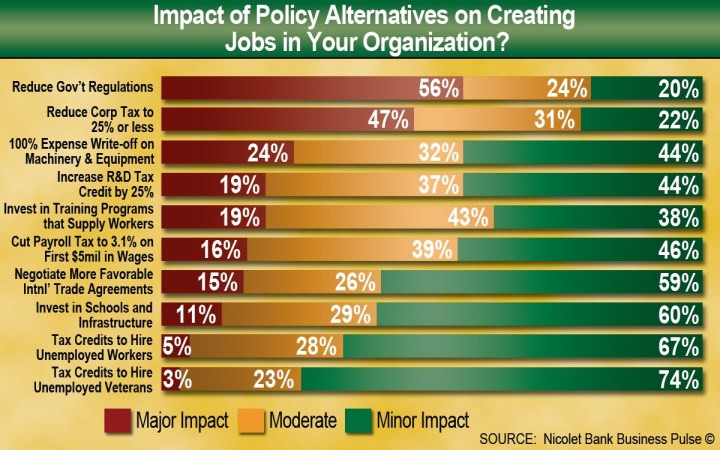
The Nicolet Bank Business Pulse is a quarterly study of CEOs & Business Owners up on the Frozen Tundra – around Green Bay, Wi. The Q4/2011 Study focused like a laser on JOBS!
56% of CEOs and Business Owners said, 1.) “Reducing government regulation would have a Major Impact on job creation.” 24% of the CEOs said it would have a Moderate Impact.
47% said, 2.) “Reducing corporate taxes to 25% – or less – would have a Major Impact on job creation.”
31% of CEOs said, aModerate Impact.
These are the TOP 2 policy changes CEOs said they would like to see if you would like to see more jobs. [DUH!]
Notice in the chart …
… the margin between the first two options and the other options. (Options three and four can be dealt with by modifying option two to reduce the corporate income tax by 100 percent.)
Based on the questions, this survey was mostly about what can be done for business at the federal level. But the state also assesses corporate income taxes. And every business owner knows that this state is a regulation hell in addition to a tax hell.
Business-friendly government policy is a foreign concept in Wisconsin, of course. That explains why Wisconsin’s business climate rankings are as bad as they traditionally are, and why the state trails in business health measures such as per capita personal income growth, business startups and incorporations, and venture capital investment. If you don’t like the current state job numbers, this survey should tell you that the Walker administration hasn’t done enough.
Madison’s Sly in the Morning — on which you can find me at 8:35 a.m. — had an item last week about the 200 job cuts at Fisher Hamilton in Two Rivers, adding, in addition to his obligatory slam of Gov. Scott Walker, “This is a company that used to manufacture all of its products in Wisconsin.”
Those with an appreciation for the immeasurable contributions of Wisconsin’s industrial icons of 1910 will find the list of Wisconsin’s top ten employers of 2010 appalling:
Walmart, University of Wisconsin–Madison, Milwaukee Public Schools, U.S. Postal Service, Wisconsin Department of Corrections, Menards, Marshfield Clinic, Aurora Health Care, City of Milwaukee, and Wisconsin Department of Veterans Affairs.
This is what a century of progressivism will get you. Wisconsin is the birthplace of the progressive movement, the home of the Socialist Party, the first state to allow public sector unions, the cradle of environmental activism, a liberal fortress walled off against common sense for decades. Their motto, Forward Wisconsin, should be changed to Downward Wisconsin if truth in advertising applies to slogans.
There is no shortage of activists, advocates, and agitators in this State. If government were the answer to our problems, we would have no problems. The very same people – or people just like them – who picketed, struck, sued, taxed, and regulated our great companies out of this state are now complaining about the unemployment and poverty that they have brought upon themselves. They got rid of those old rich white guys and replaced them with…nothing.
Wisconsin ranks 47th in the rate of new business formation. We are one of the worst states for native college graduate exodus; our brightest and most ambitions graduates leave to seek their fortunes elsewhere. Why shouldn’t they? Our tax rates are among the worst in the nation and our business climate, perpetually in the bottom of the rankings, has only recently moved up thanks to a Governor who now faces a recall for his trouble. …
But, as Kurt Bauer of Wisconsin Manufacturers & Commerce points out, Washington deserves credit (if that’s what you want to call it) too:
In fact, federal laws, policies and proposals are by far the biggest cause of uncertainty for manufacturers.
For example, Paul Driessen from the Washington Times recently called the Environmental Protection Agency “the biggest single job-killing agency in government.” Wisconsin manufacturers would agree. EPA’s war on fossil fuels hits Wisconsin harder than most other states because nearly 70% of our energy for residential, commercial and industrial use comes from coal-fired plants.
Pending new or expanded EPA rules include Industrial Boiler MACT rule, Cross State Air Pollution rule, Utility MACT rule, proposed new ozone standard and greenhouse gas regulations.
The Boiler MACT rule alone could lead to the closing of 11 paper mills in Wisconsin and the loss of up to 7,500 jobs by forcing companies to pay more than $400 million to meet new emissions standards.
During a visit to Madison in November, EPA Administrator Lisa Jackson was asked about the devastating impact of her agency’s rules on Wisconsin factory jobs. She responded that regulations create “thousands and thousands of jobs” for workers who must be hired to comply with the new requirements.
One of the many flaws in Jackson’s “job creation through regulatory burden theory” is that she assumes companies will just automatically spend the millions of dollars needed to update older factories. In many cases, the compliance costs are simply prohibitively high, especially in a weak economy. That means factories will close and existing jobs will be lost.
Manufacturers also complain about the aggressiveness of the National Labor Relations Board, particularly as it relates to streamlining union elections, and the Dodd-Frank financial regulatory reform law, which is tightening credit availability.
Kind of ironic, isn’t it, that those who complain about shrinking manufacturing are aligned with those working to shrink manufacturing.
Wisconsin ranked 40th. That is an improvement from last year’s ranking, 43rd.
In the Midwest, Wisconsin trailed Iowa (1oth), Minnesota (15th), Missouri (31st), Indiana (34th) and Ohio (38th), and led Illinois (41st) and Michigan (47th). Utah ranked first and Maine ranked worst.
Business climate is a favorite subject of this blog. Whether a state is a good place to do business, or not, is important only to the 85 percent of Wisconsinites who do not work for government, because, particularly in an era in which businesses are more mobile than ever before, business climate affects people’s ability not just to get jobs, but to get better jobs and earn more income. There has been some improvement in some rankings (24th according to Chief Executive, and 25th in CNBC’s America’s Top States for Business 2011), but Forbes’ 40th ranking is closer to Development Counsellors International’s 38th ranking than Chief Executive’s or CNBC’s rankings. And any politician who thinks being a C state (Ball State University Center for Business Research) is sufficient should be fired by the voters at the first electoral opportunity.
Business climate rankings compare the states on the factors businesses use in deciding where to open new facilities or close existing facilities, as well as how businesses’ employees are doing, since if a business does well, its employees do well. Business climate rankings are therefore a measure of the success of both short-term legislative efforts to improve and long-term trends affecting a state’s portion of the national economy. Each ranking measures and weights different criteria, although there are several common measures. The key is to look at all the current rankings, not just one, to notice trends. To rank 24th and 25th is better than to rank, respectively, 41st and 29th, but to rank 38th and 40th and get a C grade is simply not good enough.
Forbes’ rankings are based on business costs (including labor, energy and taxes), labor supply (high school and college degrees, net inmigration over the past five years and projected population growth over the next five years), the regulatory environment (which includes Pollina Corporate Real Estate’s measure of business tax incentives and economic development efforts), a state’s economic climate (the past five years of job, income and gross state product growth, unemployment from 2005 to this year and the number of large publicly traded and privately owned companies in the state) and growth prospects (five-year forecasts of job, income and gross state product growth, U.S. Small Business Administration business startup and closing statistics, and venture capital spending), and quality of life (poverty and crime rankings, cost of living, school test performance, culture and recreational opportunities, the number of top-ranked colleges in Forbes’ top colleges listing, and the weather).
Quality of life was the only place where Wisconsin ranked in the top 10 (eighth, to be exact.) Wisconsin ranked 34th in business costs, 39th in labor supply, 35th in regulatory environment, 35th in economic climate, and 31st in growth prospects.
The worst statistic is Wisconsin’s growth in gross state product from 2005 to 2010: 0.2 percent, which compares unfavorably to the country’s Gross Domestic Product growth from 2005 to 2010: 6.8 percent. Anemic GSP growth would be the legacy of Gov. James Doyle and the Legislature of the late 00s, which featured a Democrat-controlled Senate and control of the Assembly split between Republicans and Democrats.
Forbes’ and other comparisons show that taxes are important, but taxes are not the only criterion affecting business climate. (For one thing, Wisconsin ranked fourth in state and local business tax competitiveness according to the Council on State Taxation, but that was before the 2009–10 Legislature raised taxes by $2.1 billion.) As of 2010 (and there’s no indication it’s any better now), Wisconsin continued to rank as a regulatory hell. As of 2010, there is no indication that the Doyle administration’s effort to push regional economic development efforts, such as the New North, has made the state’s economy noticeably better. And Wisconsin’s ranking in venture capital continues to be abysmal, which should give pause to those who condemn legislative efforts to promote venture capital.
Forbes previously did a top-10 ranking of the Best States for Jobs. As you might expect from a bottom-quarter state in business climate, Wisconsin isn’t on the top-10 jobs list. Forbes’ story demonstrates what states that are top-10 in job prospects do right, starting with the number one state, Texas:
Texas offers a low tax, business friendly climate with a surging population that offers a nearly unlimited supply of young labor. Texas ranks sixth in our look at the Best States for Business and Careers. The state has aggressively courted companies to come to Texas to take advantage of these attributes. “Everyone is singing from the same hymn book at the Austin Chamber of Commerce,” says Moody’s Analytics chief economist Mark Zandi. …
The state uses its Texas Enterprise Fund to sweeten economic development deals for companies that are looking to relocate or expand. General Electric, eBay, Electronic Arts, 3M and TD Ameritrade have all announced expansion plans this year with help from the Texas Enterprise Fund. …
Most of the states expecting strong job gains have one thing in common: all but two (New Mexico and Oregon) are right-to-work states. These states give employees the right to decide if they want to join a union or not. There are 22 right-to-work states.
Economist Arthur Laffer pulled together economic data on states as part of a new book, Eureka! How to Fix California, being published in February by California think tank Pacific Research Institute. Laffer found that in the past decade right-to-work states outperformed their union-shop counterparts in almost every metric. Gross state product growth was 53% versus 42%. Personal incomes rose 50% compared to 39% for union states. Job growth was 2.8 % versus -1.3% and the population increase was 12% opposed to 6%.
Companies are increasingly shunning union-shop states.
That last sentence is certainly inconvenient for a state where, as we’ve seen during Recallarama, unions are as strong as they are in this state. Cars and engines, built by United Auto Workers members, used to be constructed in this state. UAW abuses led to the bankruptcies of Wisconsin’s two car manufacturers, GM and Chrysler. And now the numbers of car and engine manufacturers in Wisconsin equal the contribution of unions to the state’s business climate: Zero.
Democrats’ general reaction to business climate rankings is to rhetorically shoot the messenger. Sen. Robert Jauch (D–Poplar) once called those who called attention to Wisconsin’s poor business climate “traitors.” (One would think that term would apply more appropriately to those who flee the state to prevent a vote, which included Jauch, but never mind.) The common general theme of the business climate comparisons is that those states that tax as much, regulate as onerously and fund government as large as they can politically get away with are the states that economically underperform. Since taxing as much, regulating as onerously and funding government as large as they can get away with are the three main planks of the Wisconsin Democratic Party platform, you can understand why Democrats don’t like their policy failures publicly exposed.
But if the economy of this state was doing well compared to other states even in this current national economy, 2010 voters wouldn’t have had several economic development studies to choose from that came to the same conclusion — that Wisconsin’s economy wasn’t doing well regardless of how it’s measured. (The most damning of the studies, the Wisconsin Policy Research Institute’s Refocus Wisconsin, noted that Wisconsin per-capita personal income growth has trailed the national average since the late 1970s.) Even Democratic gubernatorial candidate Tom Barrett didn’t attempt to defend his would-be predecessor’s economic record.
Given the timeline of the Forbes business climate comparison, it’s clear that the blame for the poor rankings lies with the Doyle administration and those in the Legislature (Democrats and Republicans) during the ’00s. That does not take the Walker administration off the hook at all. Creating the Wisconsin Economic Development Corp. to replace the (ineffective) economic development efforts of the state Department of Commerce was a positive step, but only a step. Reducing the net cost of government employees to taxpayers by making them pay more for their benefits was a positive step, but only a step.
It’s clear that Walker wasn’t aggressive enough — and needs to be more aggressive after he survives the stupid recall attempt — in reducing the size and scope of government and improving the state’s business climate. Something is clearly wrong when the state has spent far more than the per capita national average for decades on education without improvement in Wisconsinites’ incomes. Walker has done nothing to neuter the bureaucrats who have given this state a deserved reputation as a regulatory hell, and nothing to reduce the cost of government reflected in the 3,120 units of government in this state. Every dollar of taxes on business reduces a business’ ability to pay its employees, reinvest in itself, or provide dividends to its owners (which include half the households in the U.S.). Every dollar of taxes on individuals reduces an individual’s ability to spend money on the necessities or luxuries of life, both of which are reflected in economic statistics.
You cannot expect to meet job creation goals in a bad business climate. You also cannot expect to have solvent government finances in a bad business climate. And you cannot people to move into, or stay in, Wisconsin with a bad business climate.
Tim Nerenz again nails this comparison between Wisconsin’s Progressives of the 20th century and the people who should really get credit:
We used to make things here in Wisconsin.
We made machine tools in Milwaukee, cars in Kenosha and ships in Sheboygan. We mined iron in the north and lead in the south. We made cheese, we made brats, we made beer, and we even made napkins to clean up what we spilled. And we made money.
The original war on poverty was a private, mercenary affair. Men like Harnishfeger, Allis, Chalmers, Kohler, Kearney, Trecker, Modine, Case, Mead, Falk, Allen, Bradley, Cutler, Hammer, Bucyrus, Harley, Davidson, Pabst, and Miller lifted millions up from subsistence living to middle class comfort. They did it – not “Fighting Bob” La Follette or any of the politicians who came along later to take the credit and rake a piece of the action through the steepest progressive scheme in the nation.
Those old geezers with the beards cured poverty by putting people to work. Generations of Wisconsinites learned trades and mastered them in the factories, breweries, mills, foundries, and shipyards those capitalists built with their hands. Thousands of small businesses supplied these industrial giants, and tens of thousands of proprietors and professionals provided all of the services that all those other families needed to live well. The wealth got spread around plenty.
The profits generated by our great industrialists funded charities, the arts, education, libraries, museums, parks, and community development associations. Taxes on their profits, property, and payrolls built our schools, roads, bridges, and the safety net that Wisconsin’s progressives are still taking credit for, as if the money came from their council meetings. The offering plates in churches of every denomination were filled with money left over from company paychecks that were made possible because a few bold young men risked it all and got rich. Don’t thank God for them; thank them that you learned about God.
Their wealth pales in comparison to the wealth they created for millions and millions of other Wisconsin families. Those with an appreciation for the immeasurable contributions of Wisconsin’s industrial icons of 1910 will find the list of Wisconsin’s top ten employers of 2010 appalling:
Walmart, University of Wisconsin–Madison, Milwaukee Public Schools, U.S. Postal Service, Wisconsin Department of Corrections, Menards, Marshfield Clinic, Aurora Health Care, City of Milwaukee, and Wisconsin Department of Veterans Affairs.
This is what a century of progressivism will get you. Wisconsin is the birthplace of the progressive movement, the home of the Socialist Party, the first state to allow public sector unions, the cradle of environmental activism, a liberal fortress walled off against common sense for decades. Their motto, Forward Wisconsin, should be changed to Downward Wisconsin if truth in advertising applies to slogans.
There is no shortage of activists, advocates, and agitators in this State. If government were the answer to our problems, we would have no problems. The very same people – or people just like them – who picketed, struck, sued, taxed, and regulated our great companies out of this state are now complaining about the unemployment and poverty that they have brought upon themselves. They got rid of those old rich white guys and replaced them with…nothing.
Wisconsin ranks 47th in the rate of new business formation. We are one of the worst states for native college graduate exodus; our brightest and most ambitions graduates leave to seek their fortunes elsewhere. Why shouldn’t they? Our tax rates are among the worst in the nation and our business climate, perpetually in the bottom of the rankings, has only recently moved up thanks to a Governor who now faces a recall for his trouble. …
Look again at the list of our famous industrialists and the list of our current employers. Who would you wish your child or grandchild to grow up to be? Who do you think will do more good on this earth — Jerome I Case and his tractors, or the Coordinator of Supplier Diversity at MPS.
I would not like to go back to the days before computers, antibiotics, microwave ovens or air conditioning. But you look at the contributions of those listed in Nerenz’s third paragraph, except for the last name, and the contributions of Fighting Bob and his ilk, including union leaders, and there is no comparison. I’m not sure if “Downward Wisconsin” or “Backward Wisconsin” is more appropriate, but don’t hold your breath waiting for what now are Wisconsin Democrats to own the damage they have done to this state.
Want to make the “rich” pay more taxes in a way that benefits everyone? John Shiely, retired chairman of Briggs & Stratton, has a suggestion:
Does “soaking the rich” by increasing individual income tax rates really produce more tax revenue? The answer may surprise you. …
In his April 14, 2011, Wall Street Journal article, Alan Reynolds of the Cato Institute shared his research, which showed that despite wide swings in the highest tax rates over the years, the ratio of individual income tax receipts to Gross Domestic Product (basically total U.S. revenues) has always remained at about 8%.
President Barack Obama’s hope that increasing tax rates on high earners will increase revenues well above that 8% is just that – hope. It’s not reality. It has been tried repeatedly over the last six decades and always failed.
From 1952 to 1979, when top rates ranged from 70% to 92%, the individual income tax brought in only 7.8% of GDP. So, whether the motivation for raising taxes is income redistribution or deficit reduction, it doesn’t work.
Why is this the case? Given certain tax rates, taxpayers will organize their affairs in a way that manages the amount of taxes they pay. Currently, top tax rates are as follows: individual income (35%), capital gains (15%), qualified dividends (15%), and corporate income (35% – highest of the developed countries). Business owners can choose to operate as normal corporations or partnerships, they can claim a large salary or they can take the compensation for their efforts as capital gains or dividends. If all else fails, they can defer income until later years in hopes that the tax rates will be lower. And there’s this: Raising taxes inevitably drives down GDP. …
All of these choices have consequences in terms of tax economics.
Some folks like to point to the Clinton administration as the shining star of federal economics. In fact, individual income tax revenues reached an unprecedented 9.6% of GDP from 1997 to 2000. So what happened? Stock prices soared with the market bubble, Congress reduced the capital gains tax rate from 28% to 20%, and, in response, a lot of taxpayers sold their stock and paid substantial taxes. The greatest contribution Bill Clinton made in his second term was that he did not veto the capital gains tax reduction legislation. …
So if raising taxes on the rich does not work, how do we increase tax revenues, create jobs and reduce the federal deficit? The answer is clear. If individual income tax revenues average 8% of GDP, and GDP drives job creation, what we need to do is increase GDP.
One of the most effective ways of driving output is to add investment capital to the economy. There are currently trillions of dollars in cash on the balance sheets of U.S. corporations. Some of this cash is in America and some is held offshore. All of this cash could be turned into investment capital if corporations were so inclined. The offshore dollars are not being brought back into the U.S. because to do so would expose them to the highest corporate tax rate in the world. This is effectively an incentive to invest capital in other countries. The enemy of investment capital is uncertainty. As long as politicians are talking about high taxes, bigger government and more stifling regulations, that money will continue to sit on the sidelines.
So if increasing tax revenues is dependent upon increasing GDP, what strategies would be most effective? We should reduce or eliminate the prohibitive tax on bringing cash back into the U.S. That done, we should reduce taxes while eliminating loopholes and subsidies (the Solyndra debacle has proved that government does a poor job of picking winners). Finally, we should trim the size of government and reduce regulations (including government-run health care) that discourage capital investments. Capital is the fuel that powers the economy, and we should do everything in our power to get it in the tank if we want to increase tax revenues and job creation.
I saw a recent poll of Occupy Wall Street protesters that found that the vast majority of them could not identify the top individual tax rate. I am sure almost none of them realize that raising that rate is not likely to produce more revenue for the government. So while “soak the rich” pleas may be more emotionally satisfying, demands to “drive GDP now” would be more effective.
Shiely mentions Warren Buffett, who espouses increasing taxes on himself and others in the “rich.” That would be a more compelling point of view were it not for the fact that Buffett and others in the “rich” employ people to create strategies to avoid taxes. (As do corporations, those 0.1 percent of businesses that are publicly traded, as well as the 99.9 percent that are not.) There is no evidence that Buffett or anyone else in the “rich” will discontinue hiring people to create tax-avoidance strategies regardless of what tax rates become.
My counterpart on WPR Friday doesn’t believe that uncertainty prevents business from investing. That would put him at odds with not just business leaders, but economists as well. That is unquestionably what is happening today not just nationally, with President Obama’s continual verbal war against the “rich,” but with Recallarama Part Deux, which is clearly hurting the state by inhibiting the investment of business over business uncertainty over Recallarama’s potential results.
So the next time you see a petitionmonger, tell him or her that the attempt to recall Gov. Scott Walker is economically damaging Wisconsin. See what kind of reaction you get.
Regardless of your political views, one should always strive to correct inaccuracies whenever you see them.
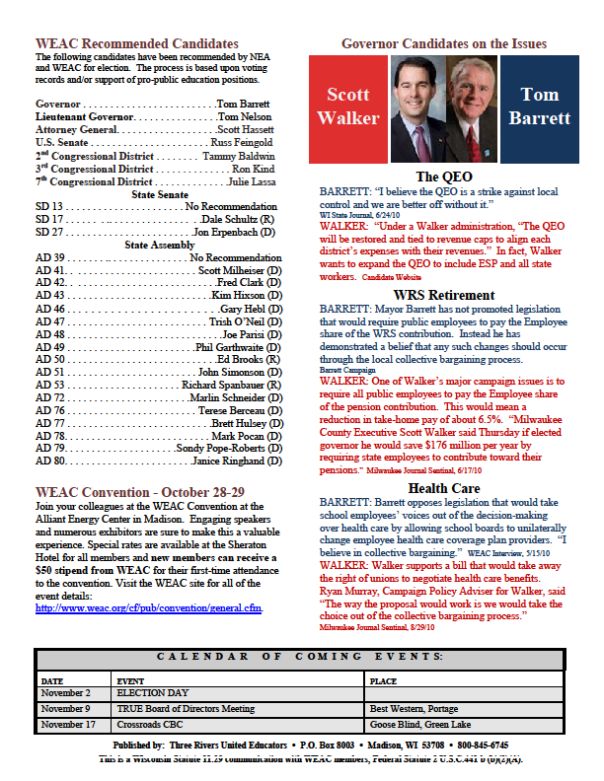
Readers will recall that I called outJoe Vanden Plas of Madison’s In Business over his claim that Gov. Scott Walker never mentioned his plans for public employee collective bargaining “rights” before he was elected. That claim is, as you know, not only false, but provably false:
Vanden Plas has now stepped up and revised his view in a blog titled “Touché, Mr. Prestegard”:
Conservative blogger Steve Prestegard has convinced me that I’m spreading a myth, a yarn that contends Gov. Scott Walker did not campaign on changes to collective bargaining for unionized state employees. …
My old view, flawed that it was, actually is shared by many, perhaps because Walker didn’t exactly blare his intentions from loudspeakers. The press accounts I allude to noted that he thought the state could save $176 million a year by requiring state employees to contribute to their pensions, something I did not object to.
Another passage notes that Walker supported a bill to take away the rights (privileges, actually) of workers to negotiate health care benefits.
So there it is. You could argue that it was in the fine print, but it was there.
Vanden Plas also channeled his inner John Cleese, which is preferable to channeling his inner Brenda Lee:
I would quibble with one thing Vanden Plas wrote:
Mr. Prestegard and I exchanged several emails, the first of which wondered how the editor of a business magazine could take the side of government employees instead of those whose excessive taxes pay their salaries, or why I was taking the side of government employee unions over my readers.
I responded that our business readers depend on public employee unions to deliver services, including preparing the next generation workforce, so I try to refrain from making it an “us-versus-them thing.” I noted that I’ve also criticized certain union supporters for their harassment of businesses, in Madison and beyond, that wanted to remain neutral.
In so doing, I’ve tried to point out how much Madison businesses support the livelihoods of public employees with the tax base they create in a town chock-full of tax-exempt property.
It’s not his summary of our email exchange, which was accurate. It’s that public employee unions do not deliver government services. Government delivers government services, and those services are delivered by public employees, who are (unfortunately) members of public employee unions. If public employee unions didn’t exist, government would still provide government services and still employ people. Public employee unions contribute absolutely, positively nothing to this state, other than their contribution to this state’s reputation and reality as a tax and regulatory hell.
I don’t expect this to change anyone’s opinion about Walker or Recallarama. I read on Facebook Tuesday morning assertions that it’s not about public employee collective bargaining, it’s about “the sale of Wisconsin to the highest corporate bidder, across the board,” “the coming abuses to our natural resources,” how Walker “ran on a platform of Jobs, not on the things he began doing the moment he took office, namely the will of the Koch Bros and making sure all of his cronies and funders were taken care of,” blah, blah, blah.
The important thing here is that Vanden Plas helped dispel a misconception that the media doesn’t care about whether what it writes or broadcasts is accurate. Every time I speak to groups about the media (for instance, Thursday at the Marian University Appleton Center), I point out that of course the media makes mistakes, but those mistakes become perpetuated if alert readers don’t seek to have them corrected.
It must be difficult to be a business publication editor in the People’s Republic of Madison.
Either that, or Joe Vanden Plas, senior editor of In Business, has fallen victim to the Stockholm Syndrome. Vanden Plas claims “I don’t really mind a gubernatorial recall” against Gov. Scott Walker, who is only the most pro-business Wisconsin governor of the 21st century:
Before I get into my reasoning, let me state the following: I voted for Walker because I thought the policies he spelled out during the 2010 campaign would improve the business climate in Wisconsin. While there is always room for improvement — we still need to enact a Wisconsin-centric approach to boosting venture capital deployment — I believe the governor has delivered on that promise.
Walker also promised to get the state’s fiscal house in order, and even though we have more challenges with future budgets, we now have a balanced budget. Here’s the rub: he never told us, while campaigning in 2010, that he would limit collective bargaining in order to get there. That little bomb was dropped a couple of days after the election, after victory had been secured.
This is where Vanden Plas’ entire argument falls apart before it really gets going. Readers of this blog know that Walker has done exactly what he said he was going to do, as reported by the Milwaukee Journal Sentinel in June and August 2010, and as repeated by a teacher union publication last fall.
That fact makes Vanden Plas’ next assertions dubious:
Republicans calling for recall reform want malfeasance in office to be the main criterion under which recall elections can be considered. That should certainly be one of them, but what about politicians who promise one thing during a campaign and do just the opposite while in office? Or those who camouflage their real intentions during a campaign and then spring a surprise once the votes are counted?
As much as I appreciate the Governor’s attempts to help job creators, he was guilty of the latter and it was immensely unfair to voters.
Let me amend that: Vanden Plas’ assertions are not dubious if the governor he’s referring to is Walker’s predecessor, James Doyle, who said, “We should not, we must not and I will not raise taxes,” and then raised taxes by $2.1 billion. Voters never got a chance to vote on that since the tax increase was passed right after the 2008 election … except that that tax increase added on to Democrats’ gross incompetence helps explain the 2010 election results. Perhaps Vanden Plas was thinking of the 2009–10 Legislature in his last sentence, “A defeat would send a message to people in both parties — no post-campaign surprises or you could also be recalled.” And as for camouflaging “real intentions,” as far as I know not a single Democratic candidate in Recallarama uttered the words “collective bargaining,” which was disingenuous at best.
I have to wonder why a business magazine would take the side of (1) government employees over those whose (excessive) taxes pay their salaries and (2) government employee unions over the magazine’s own readers, but that’s what Vanden Plas does:
We will have an opportunity to weigh the benefits of a balanced budget and more taxpayer-friendly property tax bills this December (another Walker promise) versus what I hope will be Walker’s opponent outlining an alternative fiscal path.
I have no problem negotiating with public employees, during a budget crunch, to have them contribute more to their health care and pension benefits, so long as they have the opportunity to recoup what has been lost through collective bargaining when economic conditions improve. Diminishing collective bargaining power removes that possibility.
Voters had an “alternative fiscal path” to choose from in November 2010. That path included multi-billion-dollar tax increases, and multi-billion-dollar state budget deficits. Voters emphatically chose the path Walker and Republicans represented. Since January, opponents of Walker have responded by (1) denying that grotesquely large deficits (as in the second largest per capita deficits in the nation) are a problem and (2) proposing to raise taxes.
Vanden Plas’ praise of public employee collective bargaining belies the fact that unions are seen as a negative in nearly every state business climate comparison — comparisons in which Wisconsin has advanced from bad under Doyle to mediocre under Walker and will undoubtedly slide back toward the basement should Walker lose a recall election.
The correct time to object to an elected official’s or party’s political direction is at the next regularly scheduled election, which is less than a year from now. Voters can throw out the entire Assembly and switch control of the Senate back to Democrats if they like. The current path guarantees that the next Democratic governor and members of a Democratic-controlled Legislature will be recalled at the first politically expedient opportunity, which will make this state ungovernable for anybody. (Unless something far worse happens.)
The Dane County economy is more influenced by government — state government, the University of Wisconsin, and the state’s second largest county and city government — then any other metropolitan area in this state. (Imagine if Walker, instead of requiring state employees to pay more for their benefits, had laid off a couple thousand state employees.) But businesses in the People’s Republic of Madison are not immune from the economic laws and forces that affect every other business in Wisconsin. Anything that makes businesses less profitable (as in excessive taxes to fund excessive government employee pay and benefits) is bad for the entire state.

 Steve Prestegard.com: The Presteblog