As I warned last week, I spent Saturday at the Greater Milwaukee Auto Show.
Which has nothing to do with possibly the craziest thing I’ve ever seen in sports two days later, except that it too involved four-wheeled vehicles:
Well, there was a NASCAR-like race car at the car show, and Edgerton’s own Matt Kenseth won the race.
The first thing I noticed about this year’s show was the continuing encroachment of less-than-new vehicles — or, as the show literature put it, the “Manufacturer-Certified Pre-Owned Showcase.” Some of this is understandable simply because Lamborghini isn’t in the habit of sending its cars across the planet to car shows:
This is the 6.2-liter V-12 from a 2005 Lamborghini Murcielago, for which Harry Kaufmann Motorcars is asking $149,998. That presumably includes the mileage premium, since it has just 12,971 miles. Happily, it has a six-speed manual transmission and all-wheel drive, just the thing for later today’s apocalyptic forecast.
The opposite of the Lamborghini, I suppose, is this Fiat 500, Fiat’s answer to the Mini Cooper, my daughter’s favorite car. The common thing of the Mini and the 500 beyond their diminutive size is their surprising room for the driver. On the other hand, I’m pretty sure I wouldn’t want to be a passenger in either.
(The Mini irony is that the Mini display was across from the Freightliner Sprinter, a van so large that it appeared able to swallow the Mini whole.)
Porsche had a new car display. But every Porsche was locked. However, the second floor had a section of lightly used cars, including this 2009 Porsche Carrera S. You can barely see from the photo that this silver Porsche had a butterscotch-colored interior. At least I fit in the car, which my German side approves of. But this Porsche had an automatic, which rather ruins the experience, particularly, I imagine, of the squirrelly handling of a rear-engine rear-drive car.
One reason for the appeal of less-than-new cars beyond their more reasonable prices (in exchange for the uncertain previous owner experience) is that manufacturer improvements are not necessarily improvements in the eye of the consumer. I own a 2005 Subaru Outback, a definite improvement from its previous iteration. (Before the 2005 Outback I owned a 1998 Outback, so I skipped iterations.) The current Outback doesn’t look to me like an improvement from what I own, in that it looks more like an SUV and less like a station wagon. (The Legacy line, from whence came the Outback, doesn’t offer a station wagon anymore.) The Outback no longer offers a turbocharged four-cylinder, and someone buying an Outback probably thinks the Impreza and Forester (which do offer turbo fours) are too small. (In case you haven’t noticed by now, the official positions of this blog are that (1) there is no such thing as too much horsepower and (2) automatic transmissions are necessary evils at best.)
The other thing about older cars is that they’re more likely to have manually adjustable seats instead of power seats. Both our cars have power seats, so I don’t object to owning them. But most power-seat-equipped cars in a car show don’t have their batteries connected, so the seat will be wherever it’s left, so you don’t get a good idea of whether the car would fit you or not. And when you’re 6-foot-4, that is not an insignificant issue.
Car shows are great for displaying manufacturers’ answers in search of questions. Want an SUV and a convertible, but can’t afford one of each? Buy a Nissan Murano, and you can have both in one vehicle, if you’re OK with, from what I read, poor acceleration and handling. (On the other hand, since Land Rover is reportedly introducing a convertible, perhaps there is a market for SUV convertibles after all.)
One of the displays was of an old-car trend I like — “restomods,” old cars with more modern engines and suspensions. The styling of yesterday’s cars is mostly superior, but their performance and accouterments (for instance, air conditioning) are not. Schwartz Performance of Woodstock, Ill., was there with a modern chassis and several cars, including this Pontiac Trans Am with, if I recall correctly, about 600 horsepower under the hood. To its right was a 1970s Trans Am with, according to the sign, a 1,200-horsepower V-8 under the hood. In front of it was a 1967 Chevy Nova with a 675-horsepower V-8.
The car Schwartz didn’t bring was a 1982 Cadillac Fleetwood Brougham that the owner had taken to Road America, after installing a heavily modified 500-cubic-inch V-8 and a suspension from his fabricated parts. Since early ’80s Caddys met no one’s definition of race car, one can imagine the surprise of those he passed on the track.
As an owner of a Subaru Outback, I of course checked out the Subaru display. This is the upcoming Subaru BRZ, a sports car developed with Toyota (20-percent owner of Subaru) without Subaru’s usual all-wheel-drive. It’s certainly cool looking, and it has Subaru’s boxer engine, but it’ll be interesting to see how potential owners react to the lack of all-wheel-drive. (Of course, if you want all-wheel-drive, you can get an Impreza WRX STI, with a 305-horsepower flat four.)
The ponycar wars of the ’60s continue with the Chevy Camaro …
… and the Ford Mustang:
The new competition in this category is, of all things, a Hyundai — the Genesis coupe, available with either a 210-horsepower turbocharged four or a 306-horsepower V-6.
I drove one of these at a Bergstrom Susan G. Komen Driver for the Cure event two years ago. I believe I wrote it was more fun than a box of puppies that had just been fed. Other than my usual issue of my height vs. the car’s (lack of) height, it would be a fun ownership experience.
I drove the sedan version, which has a V-8 like the Detroit big cars of old (and unlike the Detroit big cars of today save the Cadillac CTS-V, Dodge Charger and Chrysler 300), at last year’s Drive for the Cure. I was impressed by its turbine-like power, its heated and cooled seats, and its 528-watt sound system, more power than some radio stations put out.
For those who like their V-8s from domestic manufacturers, you can choose the Cadillac CTS-V sedan, coupe (above) …
… and station wagon. I’m not sure how usable the wagon’s storage space is, but getting the kids to their current sports team would be a stylish, yet fast, trip. (We’d have to get the wagon because the coupe has one fewer seat than we need.)
What? You ask if something’s missing?
You didn’t think I’d forget a Corvette, did you? (The ZR1 was locked, but the convertible wasn’t. I still fit.)
Republican presidential candidate Mitt Romney narrowly won the Michigan primary Tuesday.
Romney won despite his supposedly heretical opposition to the bailouts of General Motors and Chrysler.
The Wall Street Journal suggests that Romney’s opposition to the bailouts was not wrong:
By 2007, after decades of deferral, Detroit was making some progress in rationalizing many of its problems, namely the long-term promises it had made to its workers. Gold-plated wages, benefits and work rules put the companies at a cost disadvantage. But the United Auto Workers made concessions on two-tier wages, insurance coverage and retirement plans when the private-equity group Cerebus recapitalized Chrysler and GM divested its health-care costs to a union-run trust fund. Management was investing to revamp product lines with better quality and features.
At the same time, however, government was busy diverting cash flow into cars that Americans don’t want to buy. Thirty years of fuel-economy rules ensured that Detroit couldn’t specialize in its most profitable models—pickups, minivans, SUVs—and had to continue making smaller sedans at high-cost UAW-organized factories that it sold at a loss. Congress and President Bush made this uneconomic mandate much worse with the 2007 energy bill that significantly increased mileage standards.
Then the recession hit, and the Big Three started lobbying for a taxpayer lifeline in summer 2008, after Bear Stearns but before the credit panic. …
Ordinary bankruptcy would have been a trauma, no question. It would have meant pain for laid-off workers and exacerbated the recession, even if the auto makers posed no systemic risk. The taxpayer tab for guaranteed pensions would have been expensive.
But the key point is that Chapter 11 would have provided an orderly workout, giving the auto makers the legal protection to clean up balance sheets, modify contracts and restructure under due process. The steel industry reorganized itself through bankruptcy a little over a decade ago, rationalizing its capacity and labor agreements. American Airlines is the latest legacy carrier to enter bankruptcy, and the planes are still in the air. …
At any rate, even if GM and Chrysler had been liquidated in Chapter 11, Americans could still buy Toyotas, Nissans and other cars that the transplants usually make in the South and Midwest. Those companies might have bought the assets that would have been sold in an economically rational way. All this would have been done under the supervision of a neutral bankruptcy judge or receiver.
That was the real issue for the White House because of its potential damage to union labor. So it proceeded to orchestrate an out-of-court prepackaged bankruptcy. Bond holders would have taken a severe haircut no matter what, but Mr. Obama’s force majeure subordinated their rights to the UAW’s. Even Steve Rattner, who led the auto task force and is its most ardent defender, conceded to the Detroit News in December that “We didn’t ask any active worker to cut his or her pay, we didn’t ask them to sacrifice any of their pension and we maybe could have asked them to do a little bit more.”
Thus the bailout become a tool for less discipline, not more, when Chrysler entered bankruptcy with $8.1 billion in government financing and GM with $30.1 billion. The government became the majority shareholder in the latter and the UAW in the former. Taxpayers still own 26% of GM, and shares will need to rise to $53 from their current $26 to recoup the Bush-Obama investment.
However things shake out, it will be only a fraction of the true costs in precedent and politicized investment. The bailouts signaled that major companies with union labor are too politically big to fail and undermined confidence in the rule of law. More troubling, the conversion of Detroit from an indirect to transparent Washington client continues to distort the auto market.
Last November, Mr. Obama’s enviroteers tightened fuel economy regulations again, jacking them up to 54.5 miles per gallon by 2025—well beyond the standards Congress set in 2007. The auto makers agreed despite their misgivings because as wards of the state they had no political choice. So Chrysler, GM and Ford will still be forced to make cars that dealers struggle to sell profitably, only many more of them.
***
These companies are not run by morons. They make small cars profitably overseas and are among the biggest-selling brands in China and Latin America. In the U.S. by contrast, cars are a minority of the top 20 models, while Ford and Chevy pickups are among the top three sellers year after year. But if American consumers don’t want to sacrifice horsepower and size for fuel efficiency, Washington won’t take no for an answer. The new Obama budget includes a $10,000 tax credit for consumers to buy the green cars that they otherwise wouldn’t. Will mandated purchases be next?
Mandated purchases? What a silly idea … as silly as the government’s buying up perfectly serviceable cars to be permanently taken off the roads. The feds wouldn’t do anything as stupid and wasteful as Cash for Clunkers, right? Right?
Michelle Malkin adds that what you hear from the White House about the shared sacrifice of autoworkers is false:
Bondholders standing up for their property and contractual rights got shortchanged and demonized personally by the president. Dealers and suppliers faced closures based on political connections and lobbying clout, rather than neutral efficiency evaluations. And as I first reported in September 2010, in the rush to nationalize the auto industry and avoid contested court termination proceedings, the White House auto team schemed with Big Labor bosses to preserve UAW members’ costly pension funds by shafting their nonunion counterparts.
These forgotten nonunion pensioners (who worked for the Delphi/GM auto parts company) lost all of their health and life insurance benefits. Hailing from the economically devastated Rust Belt — northeast Ohio, Michigan and neighboring states — the Delphi workers had devoted decades of their lives as secretaries, technicians, engineers and sales employees.
Some have watched up to 70 percent of their pensions vanish. They’ve banded together to seek justice in court and on Capitol Hill under the banner of the Delphi Salaried Retiree Association.
Through two costly years of litigation and investigation, the Delphi workers have exposed how the stacked White House Auto Task Force schemed with union bosses to “cherry pick” (one Obama official’s own words) which financial obligations the new Government Motors company would assume and which they would abandon based on their political expedience. Obama’s own former auto czar Steve Rattner admitted in his recent memoir that “attacking the union’s sacred cow” could “jeopardize” the auto bailout deal. …
One union’s government-subsidized, government-manipulated “success story” is the rest of the workforce’s nightmare.
Not to mention taxpayers’ collective nightmare, since the federal government will be out at least $23.6 billion.
And how do taxpayers feel about the bailouts? According to a National Journal poll, 55 percent of those surveyed believe “these companies should have been allowed to succeed or fail on their own.”
In the summer of 2008, gas prices in my corner of Wisconsin reached $4.129 per gallon, 6 cents per gallon less than the all-time state record of $4.189 per gallon.
That was in June and July 2008, when gas prices are usually at their highest. WisconsinGasPrices.com show what gas prices have done from then to now:
On Monday, I put gas in my car at $3.629 per gallon. It is nowhere near tourist season.
Gas prices are already at $4.36 per gallon in California. (That’s for regular self-serve; ABC-TV was doing a story from a California gas station last week where prices were already over $5 per gallon, and during the live report gas went up another 10 cents per gallon.) Nationwide, unleaded costs almost $3.67 per gallon. And the summer tourism driving season is three months away.
We know from our 2008 experience what happens when gas prices jump over $4 per gallon and diesel fuel nears $5 per gallon. It’s not just that vacation plans get curbed or canceled. We discover how much fuel prices affect the cost of everything that requires transportation from producer to seller, beginning with food. We also discover how many things come from petroleum, including plastics and rubber. And since police cars use gas and fire trucks use diesel, even the cost of providing government services increases. It seems rather obvious that $5-per-gallon gas is the surest path to tanking our fragile-at-best economy.
Someone therefore should tell President Obama that public impotence is not a winning campaign strategy (see Carter, Jimmy, 1980). From the Associated Press:
“We know there’s no silver bullet that will bring down gas prices or reduce our dependence on foreign oil overnight,” Obama said Saturday in his weekly radio and Internet address. “But what we can do is get our priorities straight and make a sustained, serious effort to tackle this problem.” …
Obama said Republicans have one answer to the oil pinch: Drill.
“You know that’s not a plan, especially since we’re already drilling,” Obama said, echoing his remarks earlier in the week. “It’s a bumper sticker.”
Obama is pushing what he calls an “all-of-the-above” approach to the problem of limited energy resources, meaning an attempt to seek out alternative energy sources while reducing consumption of traditional fuels.
That’s not an all-of-the-above approach. An “all-of-the-above approach” would reduce dependence on foreign oil by developing more domestic energy, including oil, natural gas and Obama’s definition of evil, coal.
And Obama’s claims about drilling are false, according to University of Maryland Prof. Peter Morici:
The liberal theocracy in academia, the media and the Democratic Partyleadership relentlessly expounds that drilling for oil in the United States won’t much affect U.S. gas prices, because petroleum prices are set in global markets. And, more domestic oil production or U.S. access to Canadian petroleum won’t much change global supplies, or the pace of economic recovery and unemployment.
Balderdash!
Oil prices paid by U.S. refineries in the Gulf do move with global prices but not in lockstep. Despite a recent reduction in U.S. refinery capacity, increasing North American production would lower refinery acquisition costs.
U.S. refineries, like others around the world, are built to handle the special characteristics of oil produced by their primary sources of supply. And gasoline produced by individual refineries is not wholly fungible either—differing fuel characteristics are required across the United States and Europe to meet environmental standards. …
For years, prices for West Texas Intermediate and North Sea Brent moved closely, but now WTI is selling for $17 less than its North Sea counterpart.
This indicates the U.S. market is becoming somewhat separate and less wholly determined by global conditions; hence, more domestic production and increased access to Canadian oil would lower U.S. oil and prices—more drilling in the Gulf and elsewhere in North America, and the Keystone pipeline would significantly affect gas prices and employment.
More importantly, whether Americans pay $115 a barrel for oil from Saudi Arabia and Nigeria or obtained from the Gulf of Mexico and other domestic deposits makes a huge difference.
The annual trade deficit on petroleum is about $300 billion. Raising U.S. oil production to its sustainable potential of 10 million barrels a day would cut import costs in half, directly create 1.5 million jobs, and applying administration economic models for stimulus spending, create another 1 million jobs indirectly.
Overall, attaining U.S. oil production potential would boost GDP about $250 billion. Not bad, because it could be accomplished by increasing federal revenues from royalties and reducing the federal deficit, instead of adding to it through additional stimulus spending and subsidies to questionable solar and wind projects.
Obama’s concern over gas prices is limited to how voter anger over gas prices will affect Obama’s reelection. Investors Business Daily points out:
Nothing quite divides the elites from regular working folks like a spike in the price of gasoline. To the latter, it’s a blow to the household budget. To the former, it’s a teachable moment.
The lesson always seems to be twofold. One theme is that there’s no fighting higher gas prices. The other is that there is plenty you can do to adjust and, in the process, help build a better world. …
But most Americans are car-dependent and will remain so for at least a few more decades.
Bicycling to work, for instance, is an idea that might make sense in a few college towns with good year-round weather. That’s a short list.
Waiting years for a rail line to be built to your neighborhood doesn’t exactly meet your short-term needs. And, contrary to much wishful thinking, hybrids still carry a steep premium.
For most of the 99%, the only solution to high gas prices is lower gas prices.
So what can be done about gas prices? Contrary to Obama, far from nothing, says Steve Maley:
1. Commit to a strategic goal of North American energy security.That includes reasonable and responsible domestic drilling. That includes taking the lead on the Keystone XL Pipeline; we could find a way to make it happen while addressing the legitimate environmental concerns of Nebraskans. It includes a commitment to maintaining the Trans-Alaska Pipeline System and opening ANWR. 2. Ditch the anti-industry, anti-capitalist rhetoric.It is not the President’s or the government’s place to decide when an industry’s profitability is “high enough”. High oil company profits fund more drilling; more drilling means more future supply and lower prices. Besides, American oil companies are not owned by a cabal of wealthy executives, but by America’s pension funds, mutual funds and private investment accounts. “They” are “us”. … 4. Realize that Uncle Sam is in the energy business and is a partner in industry’s success.Oil and gas royalties are the federal government’s #2 source of revenue, after the income tax. Offshore slowdowns hurt not only industry and jobs, but government revenue. … 6. Trust that no oil operator wants to be the “next BP”.The BP spill cost that company something on the order of $40 billion. Industry safety and environmental commitment is motivated more out of self-interest and less out of fear of the government. … 8. Declare hydraulic fracturing & well design to be the regulatory domain of the states, not the EPA.Geology and environment vary widely; Pennsylvania is not Louisiana is not North Dakota is not California. It is insanity to think that one broadly-applied set of rules can be applied to regulate industry without suffocating development. 9. Rescind the recently-enacted royalty rate increase for new onshore Federal oil and gas leases.Secretary [of the Interior Ken] Salazar’s stated rationale for increasing the government’s take by a whopping 50% – from 12.5% to 18.75% of gross production – was to equate onshore royalties with the offshore royalty rate. That makes no sense. Higher royalties mean less drilling, poorer economics of production and premature abandonment of wells. Besides, an IHS-CERA Study recently showed that the federal government’s total take of offshore cash flows makes the Gulf of Mexico the second-most punitive fiscal regime in the world, after Hugo Chavez’s Venezuela. … Bonus #11: Get real about the promise of alternative fuels. Recently you said: “You’ve got a bunch of algae out there; If we can figure out how to make energy out of that, we’ll be doing alright.” Maybe so, but I will stick my neck out and say it ain’t gonna happen, at least not in my lifetime, not on a scale that will impact pump prices.
Not widely known is the fact that, when you put gas into your car, the federal and state governments get more money out of that tank in taxes than the oil companies get in profits. That would explain why you don’t hear anyone suggest lowering gas taxes.
The particular state contribution to the aforementioned $3.629 is the state’s minimum markup law, which requires that gas prices be set at the higher of 6 percent more than costs or 9.18 percent more than the average wholesale price. A U.S. district judge blocked enforcement of the law in February 2009, but a three-judge panel of the U.S. Court of Appeals reinstituted the law in September 2010.
Notice Wisconsin gas prices from February 2009 (far left) to September 2010, and what’s happened since then:
The state’s biggest auto show, on through next weekend, shows off the work of the world’s automakers, present and past. It usually demonstrates how much more capable cars are now than they used to be, if you’re OK with your being unable to identify carmakers anymore.
Wisconsin has a relatively limited automotive manufacturing history. (But a lot of fire truck manufacturers.) General Motors closed its Janesville assembly plant, the birthplace of my 1975 Chevrolet Caprice, in 2008. American Motors Corp. had plants in Milwaukee and Kenosha, which were assumed by Chrysler Corp. in its 1987 purchase of AMC. Johnson Controls is one of the biggest suppliers of things like car interiors, seats and doors, and the state has other auto suppliers.
AMC was the result of Nash (from whence came the Milwaukee and Kenosha plants) purchasing Hudson. Republican presidential candidate Mitt Romney is the son of George Romney, former governor of Michigan, and before that, president of AMC.
That makes this Automotive News article interesting, starting with the younger Romney’s defense of his 2008 New York Times column suggesting that having GM and Chrysler declare bankruptcy was preferable to their federal bailouts:
Mitt Romney wrote: “Cars got in my bones early. And not just any cars, American cars. When the President of American Motors died suddenly in 1954, my dad … was asked to take his place. I was 7 and got my love of cars and chrome and fins and roaring motors from him.”
Father and son may have shared a love of autos, but George Romney was the prototypical anti-“chrome and fins and roaring motors” guy. He popularized the phrase “gas-guzzling dinosaurs” while competing with the excessively finned Big 3 behemoths of the 1950s. He claimed to have coined the term “compact car” to describe AMC’s Rambler.
Romney said he considered the Rambler “the car of the future” and said in a 1993 interview that he believed “it would revolutionize thinking about cars in America and others would have to copy it.” He even dropped AMC’s Nash and Hudson lines in 1957 to concentrate on the tiny car. When Romney left AMC in 1962 to run for governor, the Rambler grew larger.
“My successors didn’t stick with the Rambler concept,” he said. “They spent $200 million in tooling to try to make the car more like the Big 3’s cars. Later, they began to tool up sports cars, the Javelin and the AMX, to copy the Corvette and the Mustang and its imitators at the Big 3. They literally threw away the biggest opportunity in the auto industry since GM overtook Ford.”
Romney, who died in 1995, said: “The Big 3 were all pushing style, size and power.” He said the Rambler “was like Ford’s original approach, a practical car.”
This seems like a bit of revisionist history on the elder Romney’s part. The Big 3 were pushing style, size and power because that’s what was selling in the marketplace. (Hudson had one of the most successful early NASCAR racers, back in the days when NASCAR cars were close to what you could buy at your local dealer. Hudson was acquired by Nash after the failure of Hudson’s compact Jet.) Romney green-lighted the development of AMC’s first V-8 engine. At 30 cents a gallon for gas, only the thrifty were concerned with gas mileage.
In those days well before computer design, if you bought a small car, everything was small — interior space, trunk space and performance. AMC sold its Metropolitan, built by Britain’s Austin Motor Co., to only 94,986 North American buyers over 10 years. And AMC never had enough money, because it never had enough sales, to change its cars as often as GM, Ford and Chrysler restyled theirs, nearly every year from the mid-’50s into the 1970s. Romney may have been 15 years ahead of his time in pushing compact cars, but he ran AMC until 1962, not in the mid-1970s.
The opposite to the George Romney philosophy, I guess, is the high-performance engine. But as Jalopnik points out, not all high-performance engines were created equal:
Porsche 924 4-cylinder …
Porsche’s four-cylinders are rarely engines to complain about. This one is. Essentially a dressed-up Audi engine back when that wasn’t anything special in the first place, the two-liter four was criticized as much for its vibrations as its soft power output. …
Subaru/Motori Moderni Formula One engine …
Formula One is the most ridiculously harsh competition series in motorsports, but every now and then some well-funded Don Quixote finds a way to get in and be openly humiliated. The 3.5 liter flat-12 was significantly down on power, a bitch to package in the car, and suffered repeatedly from klutzy reliability problems. It never got past the prequalifying stage used at the time. (Many more fun details here.) …
Until I read this, I never knew Subaru had tried Formula 1. This was in the days when relatively few Americans had heard of Subaru, so Subaru presumably would have gotten little American benefit unless it had overwhelmed F1, and possibly not even then. It’s kind of strange to read of 600 horsepower as “significantly down on power,” but there it is. Too bad they couldn’t have figured out how to package a flat-12 — or, for that matter, a flat-8 — into a Subaru.
Volkswagen G60 …
The scroll-type G-lader supercharger was an interesting concept, but in reality it combined the worst of both traditional mechanically-driven supercharging and turbocharging: parasitic drag, a peaky power band, soft low-speed response. This motor helped doom the otherwise-capable Corrado and likely made life all that much harder for VW’s American marketing people. …
I drove a Corrado once, not with the supercharged four, but with VW’s VR6. A lot of power, horrible torque steer, and I almost needed the Jaws of Life to get out.
BMW M70 V-12 …
Some high-performance engines are complex, some are heavy, and some have roots in soft luxury-car applications. Few if any others combine these traits to the dizzying heights that BMW achieved with its first production V-12 auto engine. The M70 was huge, heavy, and featured one complete ECU system for each cylinder bank among other gratuitous complexities. The BMW 8-series never shed its lardy image. …
I drove a 12-cylinder BMW as part of the Susan Komen Drive for the Cure at Bergstrom’s Enterprise Motorcars. After driving it, I found I preferred the previous year’s BMW 540i six-speed — fast, but smooth, but fast.
Ford 4.2 V8 …
Ford’s Windsor V8 is one of the really great engines of all time. It’s done everything from cruise Woodward to win at Le Mans. However, if you try hard enough (say, when you choke down displacement to 255 cubic inches and force the works to breathe through a miserly head design and a two-barrel carburetor) you can indeed create an effective boat anchor from one. Available in the Mustang in 1980 and 1981 exclusively with, yes, a three-speed automatic. …
Cosworth Vega 4-cylinder …
The Cosworth-tuned two-liter inline-four was an engine ahead of its time — too far ahead of its time. To read the specs it sounds like something designed last month: all aluminum, sixteen valves, electronic fuel injection, and a really nice stainless-steel exhaust header. All of this produced 110 horsepower. Serious numbers and drivability would have to wait until EFI systems evolved with computer tech in the Eighties.
The fact that this engine went into a Vega did it no favors, either. …
The Cosworth Vega engine was similar to the 1.8-liter four in my 1991 Ford Escort GT — 16 valves, double overhead cam, and much better EFI. As with four-valve-per-cylinder engines, they’re not great from a dead start, but wind them up, and they will go, with gas mileage in the low 30s. Unlike the Vega, the Escort did not rust when you stared at it for a few seconds.
PRV/DeLorean 2.8 V6 …
John DeLorean’s eponymous gullwing GT car deserved better. The Peugeot-Renault-Volvo ZMJ-159 V6 coughed out an anemic 130 horsepower, far less than what was intended for that dazzling Giugiaro shape. No one disputes that the car had other issues, but the pedestrian power level was a massive handicap that did no end of damage to the car’s desirability. …
Chevrolet 305 H.O. V8 …
Little modified internally from station-wagon service, the 305 is a harsh lesson in that most important of engine characteristics: breathing. Camaros, Firebirds, and Monte Carlos all received the underachiever small-block in a variety of intake configurations, none of which came close to doing what a five-liter V8 should do.
The aforementioned 305 was from the early days of smog-control-choked engines of the early computer control era, when the Check Engine light went off regularly for no discernible reason. (Which is different from today because … uh, let me think a moment …) Detroit was only starting to figure out that instead of killing acceleration by installing tall rear ends behind their three-speed automatics, adding a fourth overdrive gear improved mileage at cruising speeds without the car’s needing 60 seconds to get to cruising speeds. By the time I got to drive my father-in-law’s two fuel-injected 305s, they were adequate, although a 350 had improved horsepower and torque for little gas-mileage penalty.
The cars in Milwaukee will have as many as eight forward gears (although you can’t tell from the transmission shifter). Computer controls are much better, and such improvements as direct injection and more use of aluminum in engine blocks and cylinder heads give drivers if not the best of all worlds, then the better of most worlds.
Conservatives believe Mitt Romney is insufficiently conservative. One issue he hasn’t been heard on to my knowledge is the Environmental Protection Agency’s stupid 54.5-mpg standard, which, if it’s not overturned, will result in the construction of vehicles that will not be able to carry anyone besides the driver or any cargo at all, which will be OK because they’ll be too expensive for anyone to buy. That makes you wonder if the Greater Milwaukee Auto Show, which also has a collection of collector cars, will someday become the Greater Milwaukee Old Auto Show.
The Super Bowl has become one of the few mass-audience appointment TV events left, to the extent that for several years the Super Bowl commercials have been avidly watched and scrutinized.
The title of best commercial is a matter of personal opinion. The title of most controversial commercial undoubtedly was the halftime Chrysler ad.
Neither Chrysler nor NBC is saying how much the 2-minute spot cost, but 30-second ads were going for $3.5 million. Suffice it to say that the ad cost Chrysler — which, remember, took more than $13 billion of our tax dollars — several million dollars.
I believe this counts as Eastwood’s first media experience with Chrysler products:
Rugged Hollywood icon Clint Eastwood proclaimed it was “Halftime in America” in the spot that did not mention a Chrysler car or truck but intoned that the automaker’s successful turnaround could be used as an example for the United States as it struggles with high unemployment and a slow economic growth rate.
“Detroit’s showing us it can be done,” Eastwood said.
Eastwood — or, more accurately, the script writer — left out the rest of Eastwood’s sentence — “by a bailout funded by non-Chrysler owners to benefit President Obama’s buddies, the United Auto Workers, in time for Fiat of Italy to buy Chrysler.”
(This probably is a good place to explain the headline: The Volaré and Dodge Aspen was the highest-rated, if you want to call it that, Chrysler product on Edmunds Inside Line‘s 100 Worst Cars of All Time list, described as “terribly built and rust-prone” while “subject to a long series of recalls.” One of my Boy Scout Scoutmasters was a Madison police officer, and he told me of an squad that had Aspen logos on one side of the car and Volaré logos on the other wide. I could have included two higher-rated AMC products, the Pacer or Gremlin, but they we”re built before Chrysler bought AMC in 1987.)
If Obama advisor David Axelrod felt compelled to tweet what a wonderful spot it was, then it counts as propaganda, irrespective of the White House’s and Obama campaign’s denials — and for that matter, the denials of Sergio Marchionne, Fiat’s (which means Chrysler’s) CEO, whose company is sticking the taxpayers with billions of dollars that won’t be paid back.
It particularly counts as propaganda on behalf of the unions, who worked hard to destroy their Detroit employers, as Christian Schneider points out:
While most cheeseheads saw the Super Bowl as a rare night off from the sucking hole of union politics, there it was in the ad — an image of the state capitol occupation by union protesters nearly a year ago.
While the video of the capitol’s illuminated east wing plays, Eastwood growls, “I’ve seen a lot of tough eras, a lot of downturns in my life. [Edit. note: “Huh?”] And, times when we didn’t understand each other. It seems like we’ve lost our heart at times. The fog of division, discord, and blame made it hard to see what lies ahead.”
Of course, the “division, discord, and blame,” in Wisconsin began when unions tried the burn the state down over Governor Scott Walker’s plan requiring them to begin paying into their own pension accounts, and to pay a little more toward their health insurance (although still half the private-sector average.) Walker scaled back their ability to collectively bargain, although they still retained more bargaining rights than federal workers, who can’t bargain for wages and benefits.
Everyone knows the results. Union protesters calling the Lieutenant Governor a “f***ing whore” to her husband’s face after a Walker speech. Screeching demonstrators being dragged out while attempting to disrupt Walker’s State of the State address. WWII veterans being greeted with Nazi salutes at a capitol Christmas-tree-lighting ceremony. Protesters disrupting a Walker-led ceremony for Special Olympics award recipients. Forged recall petition signatures. Lawmakers having beers dumped on their heads. The list goes on and on.
According to Chrysler, these are times when we just “didn’t understand each other,” and where both sides can be ascribed “blame.” In fact, it was the union protesters that understood perfectly — that their boorish behavior would probably one day land them in an ad lauding their activism. …
It also seems somewhat incongruous that Chrysler would lionize the Wisconsin union movement in such a way. Organized labor’s pay and benefit demands are what brought U.S. auto makers to their knees in the first place. As George Will is fond of saying, American car companies actually became health-insurance companies that happened to sell automobiles. It’s no coincidence that the American entities who have struggled the most in recent years — car companies, the American educational system — are the ones that are the most heavily unionized. (Wisconsin, of all places, should recognize this, as a major GM plant in Janesville closed in 2008, tearing the heart out of that union town.)
Schneider could have mentioned Milwaukee and Kenosha, which used to have Chrysler plants, but now do not. Wisconsin has no auto assembly plants, which means the $23.6 billion we will lose on the GM and Chrysler bailouts were of no real value to Wisconsin.
Eastwood had his own, uh, clarification Monday to Fox News:
Following the fall out over the controversial Chrysler Super Bowl halftime ad, Clint Eastwood spoke exclusively with O’Reilly Factor producer Ron Mitchell…
“I just want to say that the spin stops with you guys, and there is no spin in that ad. On this I am certain.
l am certainly not politically affiliated with Mr. Obama. It was meant to be a message about just about job growth and the spirit of America. I think all politicians will agree with it. I thought the spirit was OK.
I am not supporting any politician at this time.
Chrysler to their credit didn’t even have cars in the ad.
Anything they gave me for it went for charity.
If any Obama or any other politician wants to run with the spirit of that ad, go for it.”
Evidently Eastwood, formerly known as a conservative/libertarian, misjudged the reaction to the ad. His reaction came out before the late Monday news that Eastwood opposed the Chrysler bailout, according again to Reuters:
“We shouldn’t be bailing out the banks and car companies,” actor, director and Academy Award winner Eastwood told the Los Angeles Times in November 2011. “If a CEO can’t figure out how to make his company profitable, then he shouldn’t be the CEO.” …
Eastwood’s manager Leonard Hirshan said the actor has not changed his views on the auto bailout.
“He did a commercial that had nothing to do with politics,” Hirshan said. “What he did was talk about America. If anything, this was a pro American commercial not a Chrysler commercial. Chrysler just sponsored what he had to say.”
(And if you believe any of these denials, I have a 1970 Plymouth Road Runner Superbird with a 426 Hemi to sell you. It was driven only to church on Sundays.)
Truth be told, the most outrageous part of the ad doesn’t have to do with Chrysler, but with Detroit:
“People are out of work and they’re hurting and they’re all wondering what they’re going to do to make a comeback,” Eastwood said. “The people of Detroit know a little something about this. They almost lost everything. But we all pulled together, now Motor City is fighting again.”
That would be the same Detroit with, as a National Review comment put it, “a downtown that looks like a bombed-out ruin, large tracts of land and ornate buildings in a state of advanced decay, an indicted mayor, and a mass exodus of everyone with the means to escape.”
This ad is, in the words of Karl Rove, who was to George W. Bush what Axelrod is to Obama, “a sign of what happens when you have Chicago-style politics and the president of the United States and his political minions are, in essence, using our tax dollars to buy corporate advertising and the best wishes of the management, which is benefitted by getting a bunch of our money that they’ll never pay back.” Yet it’s unlikely to make much difference in November. It won’t even make a difference in sales of Chrysler products, given that no one is buying cars or other big-ticket items these days unless absolutely necessary.
A former actor whose birthday was yesterday poses the correct question for November:
Jalopnik is embarking on a campaign all vehicle owners should support:
It’s pretty easy to dismiss the “check engine” light as just stupid, because, well, it is. I suppose if you thought that the cause of smoke coming from under your hood had something to do with the floor mats, then, sure, the “check engine” light is handy, but beyond that, it’s useless. But that’s not the real problem. The real problem is that the “check engine” light is a tool for the propagation of consumer ignorance about their cars. Which is why it needs to die. Now.
If it sounds like I’m making a big deal out of this, it’s because I am. The continued use of a generic, uninformative “check engine” light in cars keeps car owners in the dark about the condition of their vehicle, and ensures they stay dependent and subordinate to car dealers and mechanics.
You know from previous blogs that “idiot lights” (in most cars, indicating low oil pressure or voltage, and in some cars high engine temperature) are a poor substitute for gauges that show actual engine readings. (“Idiot lights” are one of Cadillac’s improvements that were not improvements.)
The yellow Check Engine light is tied to your (1996 or newer) car’s computer. The Check Engine light indicates that which (unless you own a diagnostic computer) is only revealed at a car repair place, for a fee, of course. And owners of older cars know that the Check Engine light becomes, in essence, another map light, unless you cover it with a small piece of electrical tape.
Your car is capable of much more, says Jalopnik:
It contains an advanced system to diagnose itself, but the actual information from that diagnosis is not available to the car’s owner; the average owner must pay a dealer or mechanic to provide him or her with the codes, and what those codes mean. This is absurd. …
Now, pretty much every new car has some sort of alphanumeric display that could show both OBD codes and a short English description, but no manufacturer does this. I’ve heard of some cars over the years that employed weird, Nintendo-cheat-code-like procedures to display codes (I think Neons had something with turning the car on and off rapidly in succesion) but nobody does this by default. And they should.
There’s no good reason not to. By not letting the car’s owner know what’s going on in the engine, a regular driver, one who may not be particularly interested in cars, is entirely beholden to a paid professional to get hidden information from a machine they own. That goes against the great Owner’s Manifesto and puts the owner in a very vulnerable position if a mechanic or dealer was dishonest. I think — nay, I hope — most are honest, but without good information on both sides, how can a given owner know? And why should they not know?
Or what about this: if your resources are tight, and you rely on your car to work, and the “check engine” light comes on, you’d have no way of knowing if it’s indicating a massive repair or a minor sensor issue. You’d have to guess, either ignoring it and hoping it’s nothing, or taking it to a shop and hoping you’ll be able to pay for whatever the repair turns out to be, a repair performed by a for-profit enterprise based on information you as an owner have never seen. Making valuable information about a person’s own property inaccessible only enables uninformed judgement and the possibility of fraud.
Basically, the generic “check engine” light makes it easier for dishonest mechanics to take advantage of unknowing customers. Considering other car features that are federally-mandated — like tire pressure sensors and airbag warning lights — wouldn’t adding one to actually help the consumer make sense? It may be the only type of federal-required feature that makes sense.
This kind of protect-you-from-yourself attitude — there’s something wrong with your car, but we’re not going to tell you what it is — is just the latest in the sort-of conspiracy among carmakers, the auto repair industry and Washington to take control of cars from their owners. Another is the disappearance of manual transmissions, which are incompatible with start–stop technology and cylinder deactivation, two of the worse ideas to supposedly improve gas mileage. Another not (yet) mandated by the feds is the waste of energy known as Daytime Running Lights, installed on most GM cars and unfortunately my Subaru Outback. DRLs cause the engine to work harder, resulting in a loss of fuel economy, but DRLs also require much more frequent replacement of headlights. (Replacing and correctly aiming halogen headlights is a pain given that halogen bulbs are as sturdy as 100-year-old crystal.)
The Check Engine light dates back to the 1981 model year, when computers first started being installed in cars in large numbers to control various engine functions. We were cursed with a 1981 Chevy Malibu whose Check Engine light went on for no apparent reason for the entire 5½ years my parents were sentenced to own the car. It is impressive to note that cars today have more computer power than the ships that took astronauts to the Moon and back, but not when your car doesn’t apparently function correctly for no apparent reason.
Jalopnik suggests you sign a petition asking the feds to ban Check Engine lights and require that the feds require carmakers to actually spell out the problem the Check Engine light is supposed to indicate.
Yes, a display message could be that easy. It could also be that easy to add voltmeter and oil pressure gauges so that you can see your battery or alternator die and get it fixed before getting stranded in the former case, or to see that your engine is in danger of seizing up in the latter (and much more expensive to fix) case.
There are some warning lights that can’t be replaced by gauges — for instance, the airbag-failing-to-inflate light or the antilock-brakes-don’t-work lights. But similar to fuel and temperature gauges, voltmeters and oil pressure gauges allow you to deal with a problem before it sticks you immobile in the middle of nowhere.
Since the original blog came out earlier this week, the author got some feedback and replied with more feedback:
• People don’t care: There’s a lot of truth to this one. Lots of people genuinely don’t care to know how their cars work, and the check engine light is more than enough for them to ignore. But, trust me, a skillful check engine light ignorist will have no trouble ignoring an engine diagnostic message. Why, I bet they can even use the same ignoring skills for both! This idea will not help these people, but that’s ok, because they don’t care. I understand my clumsy writing may have led people to think I’m advocating a spring-loaded knife that shoots out of the dash and holds the blade to the driver’s neck until he or she gives a shit, but that’s not so. If you want the information, great. If not, it’s no different.
• People don’t want to know this stuff: This one is similar to the above, and the same rules apply. They can ignore whatever they want. But I think more people want to know some technical details than we think. Car advertisers must think so, as many car ads are full of technical details. Hell, even catchphrases like “Does that thing have a Hemi?” are actually referring to arcane details like the shape of the engine’s combustion chambers; clearly, people are not repulsed by technical automotive details, at least to some degree.
Speaking of Jalopnik: Jalopnik has a fairly mind-blowing piece about a much more famous Subaru owner (of the unusual BRAT) than me:
The odd little proto-SUV caught the eye of one of President Ronald Reagan’s advisers that same year, not long before Reagan made his second presidential run. Richard V. Allen, a Japan expert who served as Reagan’s National Security Advisor for a short time after the Gipper took over the White House in 1981, arranged through one of his contacts at Fuji Heavy Industries (the company of which Subaru is a subsidiary) for the car to be given to the then former California governor and failed 1976 presidential candidate. …
Allen got word that BRATs were being tested to destruction at a proving ground in the desert somewhere out west. He said his Fuji contact told him they were having trouble destroying the jump-seated warriors.
“I said, ‘I have a friend with a ranch. You could give him one of the destructed ones and see how much longer he could use it,’” Allen recalls.
That’s how a Subaru BRAT ended up at Reagan’s ranch in the mountains west of Santa Barbara, Calif. (after being sprayed with a fresh coat of fire engine red paint). The only condition Subaru had was that the car’s new owner file a report on its performance every six months, making Reagan a test driver of sorts for the company.
Rancho del Cielo was (and still is) an apt home for for the BRAT, and for a time, Reagan was a big fan of the diminutive sport ute.
“It was a tough little dude on the ranch and Reagan loved it,” Allen says.
Political realities being what they were, it’s too bad that Reagan or his advisors lacked the courage to use Reagan’s Subie ownership to tout free trade. On the other hand, all’s well that ends well, since Subarus now are assembled in Lafayette, Ind.
The presidential BRAT has been restored and is on display at the Reagan presidential museum.
That lever between the seats and the instrument panel is a shifter for a manual transmission. Yes, Reagan could drive a stick. Anyone think the current occupant of the Oval Office could do the same?
The commission was created by the Legislature as part of the 2011–13 state budget to …
… examine issues related to the future of transportation finance in Wisconsin, including the following:
Highway maintenance, rehabilitation and expansion projects
Local aid and assistance programs, including general transportation aids (GTA)
Transportation fund revenue projections
Transportation fund debt service
Options to achieve balance between revenues, expenditures and debt service
Impact of highway project planning on abutting property
The commission is meeting in Madison Thursday, Milwaukee March 22, Appleton April 26 and Eau Claire May 31 to get public input as part of the process of creating a report the Legislature is requiring the commission to complete by March 1, 2013. The commission will also take public input at dottfpcommission@dot.wi.gov.
(Want some public input? Here goes: Wisconsin 23 between Ripon and Fond du Lac needs to be four lanes ASAP. I am tired of being stuck on 23 behind someone who cannot differentiate between a 4 and a 5 either on the lower left of speed limit signs or that person’s car speedometer.)
As it happens, I know, or know of, a few of the members. I’m pleased to see Barb Fleisner, executive director of Centergy, the Central Wisconsin regional economic development effort, and a former Marketplace Magazine cover subject. A representative of Schneider National, one of the nation’s largest trucking firms, is in the group, as are a couple of companies related to road construction. The head of the Transportation Development Association of Wisconsin, a group that advocates for road construction even if it requires higher taxes, is in the group too. I am not pleased to see former Madison mayor Dave Cieslewicz in the group, although I suppose he’s there to represent the cars-suck constituency.
One of the most visible pieces of evidence that suggests that former Gov. and current U.S. Senate candidate Tommy Thompson was a big-government conservative is the vast expansion of freeways over Wisconsin since I’ve gotten my driver’s license. I grew up a mile south of where Interstate 90 goes to Chicago, Interstate 94 goes to Milwaukee and then Chicago, and I–90/94 head north until they split near Tomah to go to, respectively, La Crosse and the Twin Cities. Interstate 43 between Milwaukee and Green Bay, the snippet of Interstate 535 that connects Superior and Duluth, the snippet called Interstate 794 down Milwaukee’s lakefront, and Interstate 894 through Milwaukee’s southern suburbs were the only other Interstate highways in Wisconsin. I only knew of I–90 and I–94 through Madison because if you live in Madison, you’re unlikely to go to Milwaukee to go somewhere north and south.
Looking at Wisconsin’s Interstate mileage vs. other states may have been the first time I wondered what the hell our elected officials were doing in Washington. Some of U.S. 41 and U.S. 51 was four-lane, though with intersections instead of interchanges in many spots. There was also the Beltline Highway, much of which was freeway, but the most dangerous parts, East Broadway in Monona, were not. Most Wisconsin roads had just two lanes, including the high-traffic roads such as U.S. 151, along with, once I moved northeastward, U.S. 10 and Wisconsin 29.
Now, three decades after I got that piece of freedom called a driver’s license, freeways and four-lanes cover much more of Wisconsin’s landscape. U.S. 51 north of I–90/94 is now Interstate 39 to Wausau. I’m not sure why Wisconsin 15 between Beloit and Milwaukee’s west side was built as a freeway, but it is now part of I–43. U.S. 41 from Milwaukee to Green Bay via Fond du Lac, Oshkosh and the Fox Cities will be Interstate 41, 55 or 243 (or so speculation goes) in 2014. U.S. 10 is no longer known as “Highway Hell” (or so WGBA-TV called it) now that 10 is four lanes from the Fox Cities to Stevens Point and will be four lanes west of Stevens Point. Wisconsin 29 lost its “Bloody 29” nickname now that it is four lanes from Green Bay through Wausau to I–94. U.S. 53 is four lanes from Eau Claire north to Superior. My one-year commute to New London was made more tolerable because of U.S. 45, which is four lanes from Oshkosh to U.S. 10. And U.S. 151, the four-lane I’ve spent the most time on over the years, is four lanes from Fond du Lac through Madison to Dubuque.
That’s a lot of road construction, some of which started in the 1980s, more of which started in the 1990s. Some argue that is the result of the excessive political influence of the road-builders. Former state Sen. Brian Burke (D–Milwaukee) used to complain about “building four-lane roads to nowhere,” a place presumably not called Milwaukee. (Burke’s political career ended badly, let’s just say.) The Sierra Club, the leaders of Wisconsin’s Plants Before People movement, bemoaned the death of the $822-million pseudo-high-speed-rail project, calling projects that, unlike Madison-to-Milwaukee train projects, benefit a majority of travelers a “boondoggle.”
(I knew two people who died and one person who was permanently injured on roads that weren’t upgraded soon enough. You can conclude that environmental groups don’t bother to contact me for donations.)
The fact remains, however, that more Wisconsinites use roads than any other mode of transportation by a large margin. Road projects, after all, only benefit those who want to get themselves or get something from one place to another in this state on their own schedule. That includes travelers from point A to B and businesses that sell products. The former benefit from trains, buses and commercial aircraft only if they’re following the train’s or bus’ or airline’s schedule. Freight trains are fine for the latter if their products are large enough to make the cost economical, except that something has to get the product from the train to where it’s sold, and that will not be a train.
One subject the commission will deal with is how to fund transportation projects. Gov. James Doyle raided segregated funds, including the transportation fund, to “balance” his unbalanced budgets. That has been stopped by state Constitutional amendment. The problem, though, is that gas and diesel tax receipts drop when people buy less fuel from a combination of driving less (a byproduct of a weak economy) and driving more economical vehicles. That being the case, fuel taxes tax those who use more fuel, which results when you drive more.
One partial solution is to use sales tax proceeds from transportation purchases — for instance, car purchases — to augment the transportation fund. That is a partial solution, but it has the benefit of forcing state government to prioritize its spending of the total state tax dollar.
Another is to be more selective about which projects get done. The DOT’s Connections 2030 plan involves projects in every mode of transportation you can think of, including transportation modes in places that don’t presently have them (for instance, passenger rail). I am not an opponent of roundabouts (in fact, I prefer them to stoplights, and I vastly prefer them to four-way stops), but one sometimes gets the impression that road projects are chosen based on the opportunity to install roundabouts instead of installing roundabouts as part of regularly scheduled road projects.
A third is to spend money generated by road users only on roads, and not on little-used projects that don’t benefit most people’s first transportation method. I occasionally bike (when I can pry my bike out of our oldest son’s hands), but I would not argue that spending money on, for instance, converting abandoned railbeds to bike trails is a particularly efficient use of scarce tax dollars. You want mass transit? Pay for it yourself, Madison and Milwaukee. You want trains? Most people disagree with you.
The four-letter word “toll” inevitably will come up. Tollways would be immensely unpopular in Wisconsin. Most people who have had the misfortune of traveling the old Illinois tollways think of stopping every 20 miles or so to throw coins in baskets. (Not to mention the patronage machine known as the Illinois Tollway Authority.) The wireless toll transmitter is more convenient, but also easier to abuse, given that a few keystrokes create a rate increase.
For my money, road improvements are one of the few provably valuable uses of our tax dollars. I think about that every time I drive on Madison‘s South Beltline, which goes south of the old, bad East Broadway, which was simultaneously crowded, slow and dangerous, and took too much time to be replaced. (East Broadway is still there, but with about one-tenth of the traffic.) With road projects, you get to see what you’ve paid for.
The inspiration for this post came from Curbside Classics‘ “The Short and Odd Life of the Two-Door Station Wagon,” which begins by asking:
Whose idea was that? Along with the business coupe and the Ranchero/El Camino utility pickups, large two door station wagon ranks right up there in the Pantheon of American car oddities. One can even make a pretty good argument that it towers above them, given its questionable heritage and utility. The business coupe’s origins go back to the earliest coupes, like the Model T, when roadsters and two-passenger coupes were common. And the utilities were just an update on those same coupes and roadsters with little beds grafted onto them, the pickup’s precursor. But for about a dozen years or so, Detroit graced Americans with something they had no idea they needed: the two door wagon.
Well, Detroit has a deserved reputation for producing answers in search of questions. (Two words: Pontiac Aztek.) Station wagon aficionados recall GM’s ’70s alternatives to everyone else’s tailgate that swung down or to the right. The Chevrolet Vega and Pontiac Astre wagons had hatchbacks. So did the midsize Chevy Malibu, Pontiac LeMans, Oldsmobile Cutlass and Buick Century wagons. (Until their 1978 downsizing, when they went to tailgate glass that swung upward and tailgates that swung downward.) The Chevy Impala/Caprice, Pontiac Catalina/Bonneville/Grand Ville, Olds Custom Cruiser and Buick Estate Wagon took Rube Goldbergian complexity a step farther with tailgates whose window glass swung upward into the roof while the rest of the tailgate swung into the floor. (The latter worked better than the former, from what a former owner tells me.)
1939 Plymouth Business Coupe
The business coupe was originally designed for, as you’d think from the title, businessmen, specifically on-the-road salesmen who needed trunk space more than they needed passenger space. You can see from the photo that the ’30s business coupes were designed this way; the coupes with back seats and the sedans were more square:
I don’t know if my grandfather the salesman ever had a business coupe; by the time I knew him, he had a succession of station wagons with everything behind the front seats stuffed with farm implement literature. Even by the standards of the day, business coupes were stripper cars, because apparently their customers weren’t interested in creature comforts going from sales call to sales call.
The next step, I suppose, from business coupes were what are called “coupe utilities” by some, but are more often known by their model names — essentially a car from the B-pillar forward, but with a pickup box behind the B-pillar, all usually mounted on station wagon chassis. They’re called “utes” in their country of origin, Australia, where a farm wife asked Ford to build “a vehicle to go to church in on a Sunday and which can carry our pigs to market on Mondays.”
The first U.S. coupe utility was the 1937–39 Studebaker Coupe Express:
Since the Big Three carmakers built one size of car in the 1950s — large (except for specialty projects like the Corvette) — the first coupe utilities were that one size, the 1957 Ford Ranchero …
… and the 1959 Chevrolet El Camino:
These were popular because pickup trucks had no creature comforts at all, not even power steering or brakes. My grandmother owned a second-hand store next door to my grandparents’ house, and they bought a ’59 El Camino for the store. After they closed their store, my stepgrandfather drove it to work until his retirement a year before his death in 1984.
Ford and Chevy then diverged before meeting again. Ford switched the Ranchero to its compact Falcon chassis in 1960 …
… then to its midsized Fairlane chassis in 1966 …
… before canceling the Ranchero in 1979 …
… while Chevy terminated the El Camino in 1960, but brought it back onto its midsized Chevelle chassis in 1964 …
… where it stayed until its last model year in 1987:
One of the more famous El Camino owners was Bill Clinton, who once told GM workers in Shreveport, La.: “When I was a younger man and had a life, I owned an El Camino pickup in the ’70s. It was a real sort of Southern deal. I had Astroturf in the back. You don’t want to know why, but I did.” Clinton obviously covered the box with Astroturf to protect it from the elements. Or to practice putting.
Since the mid-’60s and later El Caminos and Rancheros were based on Chevy’s and Ford’s mid-size cars, when muscle cars — mid-sized cars with engines out of full-size cars — were created, their coupe utility brethren could be equipped with most of the same go-fast parts as the Malibu and Fairlane two-doors. The zenith probably was the 1970 El Camino SS, which could be ordered with a 450-horsepower V-8.
Chrysler Corp. was late to the coupe utility game in the U.S., turning its Plymouth Horizon and Dodge Omni into the Plymouth Scamp and Dodge Rampage in the early ’80s:
AMC never built one, although it did build a prototype, the Cowboy, from its Hornet:
The U.S. death of the coupe utility was from several causes. (GM’s Holden and Fordstill sell utes in Australia.) Full-size pickups started to become better equipped. GM and Ford introduced the Chevy S-10 and Ford Ranger compact pickups around the time they redesigned their mid-sized cars, and neither apparently felt El Camino and Ranchero sales warranted adding them to their new mid-sized lines.
Being a Subaru owner, I do have to point out Subaru’s two coupe utilities, the BRAT (which stood for Bi-drive Recreational Auto Transport, and yes, those are seats in the box), imported from 1978 to 1987 in time for, of all people, Ronald Reagan to own one …
… and the 2003–06 Baja:
The original inspiration of this post was the two-door station wagon, known as a “shooting brake” in Europe. Curbside Classics notes that station wagons were generally commercial vehicles until World War II. Two-door wagons started as the wagon equivalent of business coupes at least in use, including the rear-window-delete panel deliveries.
But then came the 1955 Chevy Nomad, which was an expansion of a Corvette station wagon concept car.
The Nomad and the Bel Air convertible led the Chevy line in 1955, with Chevy’s new V-8 engine. Even though the two-door Nomad lasted just three years, it’s an iconic ’50s car, combining the coolness factor of coupes with the utility of wagons. Because imitation is the sincerest form of flattery, the Nomad was followed quickly by the Pontiac Safari …
… the Ford Parklane …
… and the Mercury Commuter hardtop (note the lack of B-pillar), which included the option of, believe it or don’t, two or four headlights:
It should be obvious by now that two-door wagons were the brief triumph of style over utility. People didn’t buy two-door wagons because they couldn’t afford the extra $100 for the extra two doors. I can see fathers agreeing to buy the two-door wagon because at least it was a wagon, but not quite a station wagon. (Similar to the animus today against minivans.) And the driver could always tell objecting passengers that the alternative to going over the front seat into the back seat was to walk.
The last two-door wagon bigger than a Chevy Vega was the 1964–65 Chevelle:
Proving that American ingenuity knows few bounds, the end of Detroit production of two-door wagons does not mean the end of the two-door wagon. As you know from last week, I’m a fan of big Cadillacs, in addition to land yachts and station wagons. Put them together, and you have a 1974 Cadillac Eldorado wagon conversion.
Someone created a Buick two-door station wagon that includes the Vista Roof also found on the Olds Vista Cruiser:
What’s that? You prefer Ford products? How about a 1978 Lincoln Continental Mark V wagon conversion?
Most, if not all, of these cars demonstrate the biggest reality of carmaking today — cars are more capable than ever before, but less interesting than they used to be. I read in Automobile Magazine back in the 1990s a comment about the Big Three carmakers’ standardizing their chassis and drivetrains, with the added suggestion that maybe the Big Three could therefore offer more variety in body styles. That unfortunately has not happened — for the most part, you can have a sedan and, to a much smaller extent, a coupe or wagon.
As long as we’re talking about automotive nonsequiturs …
… this also belongs in the oddball category — the original Pontiac Grand Am, a midsized car sold from 1973 to 1975. According to How Stuff Works:
The 1973 Pontiac Grand Am started out in the development stages as a GTO. But the muscle era was drawing to a close and, very much aware of that, Pontiac decided to change the car’s character. Instead of continuing to make the GTO a stoplight drag star, the next iteration was to be more European — more along the lines of a luxury sport sedan. With that in mind, Pontiac designers and engineers examined Mercedes, BMW, Audi, and Volvo as likely targets. …
Pontiac’s product planners, under assistant chief engineer William T. (Bill) Collins, got behind the ’73 Grand Am because they knew something different was needed to replace the GTO. By 1973, the GTO was breathing its last breath; dying by cubic inches, it had been done in by low compression and GM’s need to meet fuel and smog mandates. Any politically correct car could no longer run around delivering eight miles per gallon between stoplights. And yet Pontiac had no intention of giving up its “excitement” image.
So the Grand Am offered a new opportunity. This was a car that Pontiac saw as the division’s entree into the European sport-luxury-sedan field. Pontiac chassis engineers, under John Seaton, would de-emphasize straight-line performance in favor of crisp handling and overall responsiveness. Seaton based the Grand Am’s readability on the division’s trade-marked Radial Tuned Suspension, which in turn was based on new GM-spec steel-belted radial tires. Ten-inch front disc brakes gave the car wonderful stopability, and Saginaw Division set up the power steering with a quicker ratio and plenty of positive feedback. …
Inside, the Grand Am driver and the front passenger settled into supportive bucket seats equipped with recliners and lumbar adjustments. All doors had pull straps, not molded-in plastic grab handles, while the fully instrumented gauge panel and console presented touches of real African crossfire mahogany laminated onto a plastic substrate. …
Unfortunately, Pontiac launched the Grand Am at exactly the wrong time. The first energy crisis shook the world in October 1973, and Americans bailed out of large Detroit cars into smaller imports, especially Japanese models. Even intermediates like GM’s A-cars languished on dealer lots. By 1975, according to the Environmental Protection Agency, a Grand Am with the 400 V-8 could return only 11 mpg in the city and 18 mpg on the highway. (The 455 was the same.) Prices went the other way, thanks to a new round of inflation, and at just a smidge under $5000 to start, the ’75 Grand Am was not exactly cheap.
So while Pontiac did well to move 43,136 Grand Ams for 1973, sales slipped to 17,083 for ’74, then to a disappointing 10,679 for ’75. With that, the Grand Am became expendable and would not be continued. Another reason was that rectangular headlights were coming in, which would have meant retooling the model’s unique hood and front fascia. With sales low and not likely to recover, Pontiac felt it wasn’t worth the expense.
A friend of mine and the brother of a friend of mine had two of those 70,898 Grand Ams. I’ve never driven one, but it was certainly a cool-looking car. (A wagon version was proposed, but not built.) And it was cool looking even before you ask yourself how a car bigger than almost every European car with a much larger engine than almost every European car could be considered European-like. It should also make you shake your head to think that GM’s idea of innovation in the early 1970s was radial tires, which had been used on French cars since the late 1940s.
Do a photo search on your favorite search engine and you’ll find that many of these misfit cars are still owned and driven today, some in their original form, others (particularly business coupes) modified for more modern touches such as wider radial tires. Maybe the business coupe, the coupe utility and the two-door wagon were answers in search of questions, but I have a hard time imagining that the 2042 Iola Old Car Show will feature lovingly maintained or modified Toyota Camrys.
The last Presteblog of 2011 is called That Was the Year That Was 2011, a tradition of the Marketplace of Ideas column from 1994 to 2000 and then of the Marketplace of Ideas blog from 2008 to 2010.
The title comes from the British TV series “That Was the Week that Was,” a weekly satirical series that made David Frost and Roy Kinnear popular:
While the TWTYTW 2010 blog no longer exists (ask my former employer what happened to it), a video version of sorts does still exist courtesy of FDL Podcasting:
There was one prediction that I didn’t make — the creation of this blog for the reason you all know. For what it’s worth, this blog is nine months old today. This was not how I planned to spend three-fourths of 2011, but someone once said that if you want to make God laugh, tell him your plans.
I also didn’t predict that I’d be on Facebook, and I don’t believe Google+ existed when this blog began. The former has been more satisfying than the latter, largely because Facebook has allowed me to reconnect with people I’d lost track of, in one case, from middle school. (That, I should point out, includes the one Facebook Friend I deFriended, and the one Facebook Friend who deFriended me. The latter was because my political views angered him for the last time; the first was because he was as much of an idiot on Facebook — unless you think a 45-year-old fan of “The Jersey Shore” is not incredibly strange, that is — as he was in high school. C’est la vie.)
This is an opinion blog, which means readers get opinions here every day, whether about federal or state politics, American or Wisconsin business, food and drink (I’m in favor of both), motor vehicles, the media, music, sports (particularly the Packers and Badgers), and whatever else comes to my mind. As I’ve written before, after the best thing someone can tell a reader — something like “I enjoy your work and I agree with you” — the second best thing someone can tell a writer is something along the line of “I read your stuff, and you are absolutely wrong.” (I’m getting a lot of that recently; can’t imagine why.) The worst thing someone can tell a writer is something like “You write? I’ve never read your stuff.” My blog software tells me that people are reading this blog, whether they agree with what I write or not.
I continue to be what (at least) two people have called me: a “media ho’.” I occasionally appear on WTMJ-TV’s “Sunday Insight with Charlie Sykes” …
… and Wisconsin Public Radio’s Friday Week in Review, and, twicethis month, WTDY in Madison. That is the logical result of never saying no to a media invitation, I guess. This is also a personal blog, so readers have gotten to read (or, if you like, have had to endure) the unusual facets of my past in small-town newspapers (including my biggest story), radio and sports announcing.
I’m pretty sure the largest number of blog entries this year (other than the daily “Presty the DJ” pieces) involved state politics. We endured several state Senate recalls (all but two of which were unsuccessful) because of the efforts of Gov. Scott Walker and Republicans to undo the disaster area that was state finance under the Doyle (mis)administration and the 2009–10 Legislature. The 15 percent of state workers who work for government had a different opinion, as Christian Schneider notes:
The year began with an appeal for more civility in politics, in the wake of the shooting of Arizona Democratic Congresswoman Gabrielle Giffords. Yet when the Capitol explosion began in mid-February, Walker and legislators of both parties started receiving death threats. State Sen. Spencer Coggs called Walker’s plan “legalized slavery,” and state Sen. Lena Taylor (along with dozens of protesters) compared Walker to Adolf Hitler. A Democratic Assemblyman yelled “you’re fucking dead” to a Republican colleague on the chamber floor following debate on Walker’s plan. Protesters targeted Walker’s children on Facebook, and Republican Rep. Robin Vos was assaulted with a flying pilsner.
So shocking was Walker’s plan that President Barack Obama criticized the governor, deeming it an “assault” on unions. Yet if Walker was a first-time union assailant, Obama continues to be a serial offender — federal employees aren’t allowed to collectively bargain for wages and benefits. …
During the summer, unions spent over $20 million to unseat six Republican state senators who voted for Walker’s plan. This exposed exactly why it’s about the money. Government employees merely serve as conduits for taxpayer funds to work their way to the unions, who then spend money electing obeisant legislators to negotiate favorable contracts. Shockingly, lefty “good government” groups appear not to have a problem with this blatant purchase of favors.
It was a year that granted the definition of the word “democracy” a previously unimaginable elasticity. While bullhorns around the Capitol blared “this is what democracy looks like,” 14 Democratic state senators fled to Illinois to prevent democracy from occurring. Later, a single Dane County judge would overturn Walker’s law, which irony-deficient Assembly Minority Leader Peter Barca called “a huge win for democracy in Wisconsin.” The law would later be reinstated by an incredulous state Supreme Court. …
2011 was the year that public-sector bargaining became a fundamental human right, bestowed on the people of Wisconsin from the heavens. “We will not be denied our God-given right to join a real union,” thundered Marty Beil, head of the Wisconsin State Employees Union, in February.
Yet God apparently first appeared in Wisconsin in 1959, when Democratic Gov. Gaylord Nelson signed the nation’s first public-sector collective bargaining law. It was a shrewd political move — four years earlier, unions had financed 55% of unsuccessful Democrat William Proxmire’s gubernatorial campaign. The year before Nelson created the law, Democrats had a $10,000 deficit in their state account; four years later, that had turned into a $50,000 surplus. At the time, it looked a lot less like a divine right and more like a naked political favor. (God has yet to visit 24 other states, which either have limited or no public-sector collective bargaining at all.)
Public-sector unions want you to believe that they are synonymous with public-sector employees. They are not. No self-respecting professional teacher should want to have anything to do with teacher unions, the biggest blight upon our educational system. That’s my opinion, but that was also the opinion of the late Steve Jobs.
One should never expect the unvarnished truth during the political process, but unions and their apparatchiks took falsehoods to new depths during Recallarama. Unfortunately for unions, evidence contrasting their assertions existed online. Unfortunately for Democrats and unions and other lefties, the more than $40 million they spent succeeding in reducing the state Senate Republican margin from 19–14 to 17–16, or 16 Republicans, 16 Democrats and one RINO, Dale Schultz.
One should never expect ideological or philosophical consistency from human beings, so keep that in mind when you read tributes to the Occupy ______ types. Most of the same people falling all over themselves praising the protesters were singing quite a different tune when the tea party movement began in 2009. Other than the obvious ideological differences, the biggest difference between Occupy _____ and the tea party movement is that the tea party movement succeeded in electing its candidates in November 2010. Occupy _____ has not one single electoral win and not one single political accomplishment yet. That includes Red Fred Clark, who a majority of 14th Senate District voters foundwanting.
One should never expect politicians to do what they say they’re going to do immediately (or perhaps not at all), but Walker doesn’t deserve an A grade yet. The state’s business climate rankings are better than they were a year ago, but 24th, 25th, 38th and 40th, with a C grade, is not nearly good enough. Until Wisconsin gets consistent top five rankings, Wisconsin will continue to trail the nation in business creation and per capita personal income growth, Wisconsinites will continue to suffer from excessive unemployment and insufficient income, and state and local governments will continue to lack the kind of revenue that comes from a healthy economy.
Speaking of the economy, it is in “recovery,” if that’s what you want to call it. The brilliance of the Obama administration is demonstrated in the current national unemployment rate of 8.6 percent, after nearly three years of the stimulus that stimulus supporters guaranteed would reduce unemployment below 8 percent. Since everyone who was paying attention knew that one major argument for the stimulus was to trade job creation now for higher unemployment (during a theoretically recovered economy) later, you can safely conclude there will be no improvement in unemployment for the foreseeable future. The “jobless recovery” has been predicted for three decades; well, it’s here now, which means that the economy will not be noticeably better in consumer spending generally or purchasing of big-ticket items specifically.
As usually happens, a number of stories didn’t get the attention they should, as WND.com notes:
1. The true rate of unemployment and inflation and the real state of the U.S. economy, which is far worse than reported.
The figure was five times the 2010 gross domestic product of the United States and exceeded the estimated gross domestic product for the world by approximately $14.4 trillion, according to economist John Williams.
The difference between the $1.3 trillion “official” 2010 federal budget deficit numbers and the $5.3 trillion budget deficit is that the official budget deficit is calculated on a cash basis, where all tax receipts, including Social Security tax receipts, are used to pay government liabilities as they occur.
“The government cannot raise taxes high enough to bring the budget into balance,” Williams said. “You could tax 100 percent of everyone’s income and 100 percent of corporate profits and the U.S. government would still be showing a federal budget deficit on a GAAP accounting basis.”
What’s more, the seasonally-adjusted rate adjusted for long-term discouraged workers – who were defined out of official existence in 1994 – was more than 22 percent in November.
The Bureau of Labor Statistics broadest measure of unemployment, which includes the short-term discouraged and other marginally attached works, along with part-time workers who can’t find full-time employment is more than 15 percent.
Methodological shifts in government reporting also have depressed reported inflation. If inflation were calculated the way it was in 1990, the annual rate would be nearly 7 percent. …
7. The real impact on the U.S. economy of Obama’s $787 billion stimulus.
While the Recovery Act boosted the economy in the short term, the extra debt generated by the stimulus “crowds out” private investment and “will reduce output slightly in the long run – by between 0 and 0.2 percent after 2016.”
The Obama administration had promised that at the peak of spending, 3.5 million jobs would be produced. …
8. The harmful impact of unions on the American economy.
“The most fundamental fact about labor unions is that they do not create any wealth,” he said.
Sowell pointed to a bill the Obama administration is trying to push through Congress, called the “Employee Free Choice Act,” as the best example of “the utter cynicism of the unions and the politicians who do their bidding.”
“Employees’ free choice as to whether or not to join a union is precisely what that legislation would destroy,” he said. …
While private-sector workers, using secret-ballot elections, have increasingly voted against being represented by unions in secret-ballot elections, government unions continue to thrive as taxpayers “provide their free lunch.” …
In September, Teamsters union President James Hoffa, addressing a large Labor Day rally, brazenly proclaimed that labor unions – especially the huge government employee unions like the 3-million-member National Education Association and 2-million-member Service Employees International Union – provide the ground troops in the ongoing war to “fundamentally transform” America into a socialist utopia.
“President Obama, this is your army! We are ready to march! Let’s take these son-of-a-b*tches out and give America back to an America where we belong,” he shouted, referring to the tea party movement.
The Obama administration has been generously “funding” the union army since the inauguration, from the General Motors bailout, which blatantly favored union workers, to Obamacare, whose burdensome new regulations don’t apply to many unions thanks to special White House waivers. Obama’s early executive order required all federal agencies to accept construction bids only from contractors who agree to use union workers, and he packed the D.C. bureaucracy with union officials.
Thank heavens for the current state of sports in Wisconsin. The Brewers got into the National League Championship Series (a place I predict they will not revisit soon), the Badgers are playing in their second consecutive Rose Bowl Monday (for my prediction, see this space Monday morning), and the Packers are the number one seed in the NFC playoffs a season after their fourth Super Bowl win. (I’ll have more to write about their next Super Bowl opportunity in January.) For those of us who endured such football as in 1988 (the Packers were 4–12 and the Badgers were 1–10), this still has an air of unreality to it.
Other interesting (and better) things happened in 2011. Our family set a personal record by heading for the basement three times as the tornado sirens went off for a non-test. The first happened while our German/French (now Italian) foreign exchange student was here. My, uh, freer schedule allowed me to go on field trips with our kids, including a church camp.
On to the year to come. I predict that the current economy will not be enough to get a majority of voters to fire Obama and his toadies. (Even if I run.) Too many Americans are still enthralled with the promise of Obama, even though the performance is best noted by his failures, and even though his biggest accomplishment (if that’s what you want to call it), ObamaCare, is tremendously unpopular with voters. (Perhaps they’ll start noticing when their employers drop employee health insurance, which will begin happening this coming year.)
The second reason for my prediction is that the Republicans are not exactly blowing the socks off voters through the interminable presidential-candidate-selection process, are they? There is no way in hell I will vote for Obama, and nor should you, but I can’t say there is a single GOP candidate I support for any reason than the fact that that candidate is not Obama. The fact that other voters feel like I do will be shown by support for a third-party — maybe more than one, in fact — candidate for president, including possibly Republican-turned-Libertarian Gary Johnson, Republican-about-to-turn-Libertarian Ron Paul, and Donald Trump.
Democrats shouldn’t jump for joy, though, because Republicans will not only retain the House of Representatives, but they will win the Senate in November. The demographic realities of the 2012 and 2014 Senate races will mean that, if my prediction (Obama’s winning with less than 50 percent of the popular vote) is correct, the gridlock you see in Washington will continue for most of this decade. I hope you enjoy it.
By the end of 2012, Wisconsin Democrats and their comrades will discover that Recallarama part deux was bad strategy, because whatever money they spend on defeating Walker in a recall election (which will result in Walker’s winning, by the way) cannot be used for (1) the U.S. Senate election, featuring socialist U.S. Rep. Tammy Baldwin (D–Madison); (2) efforts to unseat freshman U.S. Reps. Sean Duffy (R–Ashland) and Reid Ribble (R–Sherwood); efforts to win back (3A) the state Senate and (3B) Assembly by recall or by the November election; and, oh, by the way, (4) Obama’s campaign in this supposedly swing state.
It would be nice if Democratic and Republican office-holders and candidates would engrave in their brains article 1, section 22 of the state Constitution, which I repeat here for those Wisconsinites ignorant of it:
The blessings of a free government can only be maintained by a firm adherence to justice, moderation, temperance, frugality and virtue, and by frequent recurrence to fundamental principles.
My longer-term prediction is that this scorched-earth politics of ours will be reality for the foreseeable future, both at the national and state levels. Politics today is a zero-sum game — one side wins, the other side loses. How do you get past that, particularly when one side seeks to steal from the other? (That is exactly what Occupy ______ wants to do, either because they believe that’s how to solve unsolvable income and wealth inequality, or because they’re thieves at heart.) The 2011 Legislature is the direct result of the 2009–10 Legislature and its abuses of taxpayers, and whenever Democrats regain control of the Legislature, they will stick it to Republicans and their allies however, whenever and wherever they can. That wasn’t how politics worked when I was a UW Political Science student, but it is now.
The way I always end That Was the Year That Was is with these words: May your 2012 be better than your 2011. That may seem to be a low standard. That may also not be possible.
The headline is literary license: I have never owned a Cadillac, but I have driven my parents’ Cadillac CTS, and I was a passenger in my grandparents’ two Cadillac Coupes de Ville. (That would be the French way to describe the plural of “Coupe de Ville.”) The choice was either that headline or a favorite phrase of my sons, “Cadillac whack,” in which a Caddy sighting is followed by a punch.
The difference between my grandparents’ Cadillacs — a 1971 and 1973 Coupe de Ville, both light yellow, one with a black vinyl top, the other with a white vinyl top — and my parents’ Cadillac shows how the American auto industry has changed in four decades.
Cadillac is the second oldest car manufacturer (behind Buick), created, ironically, from the remnants of Henry Ford’s first car company. The Cadillac brand (named for the founder of Detroit, by the way) has a long line of innovations, beginning with interchangeable parts, and including the first commercially available V-8 engine, the first mass-produced enclosed body, a modern electrical system with lights and starter, shatter-resistant glass, a body designed by stylists, synchromesh manual transmission (they should have stopped there), V-16 engine, modern high-compression overhead-valve V-8 engine, automatic dimming headlights, power memory seats, and automatic temperature control heating and air conditioning, among numerous others.
Cadillac’s history includes Nicholas Dreystadt, General Motors’ national service manager, who in 1933 convinced GM management to abandon the brand’s policy of not selling to blacks. (Black boxers, singers, lawyers and doctors were buying Cadillacs anyway; they were paying whites to buy them for them, which was money that could have gone to GM.) One year later, Cadillac sales increased by 70 percent, and GM made Dreystadt Cadillac’s general manager; Dreystadt responded by figuring out how to reduce production costs so that building Caddys cost as much as building Chevys, despite the huge price difference. (That’s called “profit.”) The Phillips screw was first used on 1937 Cadillacs. Cadillacs have been the most popular source of hearses (built by companies not named Cadillac) for decades, and until ambulances began to be built on truck and van bodies, Cadillacs were popular ambulance conversions.
Through the 1960s and 1970s, Cadillac stopped innovating, and GM was content to have Cadillac the “standard of the world” in size. Our next-door neighbor owned a late-’60s Caddy.
I had a math teacher in middle school who owned a British roadster that could have fit into the trunk of his ’69 Coupe de Ville.
My grandparents’ Coupes de Ville made our 1975 Chevrolet Caprice look … smaller. (Nothing could really make the Caprice look “small.”) By the mid-’70s, Cadillacs had 500-cubic-inch V-8s sitting between their front wheels, although said V-8s weren’t all that powerful in the smog-control pre-computer days.
Other than their sheer size, I remember my grandparents’ Coupes de Ville for the gadgets I’d never seen in a car before then. I’d never seen power windows or power seats on a car before then. Instead of just one cigarette lighter, the passenger door and the armrests for the two outside rear seats had cigarette lighters and ashtrays as well. (Which I suppose was convenient for my stepgrandmother, who smoked.) The back seat had two lamps for young back-seat passengers to play with (there were lamps all over the interior), as well as a pull-out armrest. The windshield wiper and washer controls (including a control called “Mist,” the precursor, I suppose, to intermittent wipers) were mounted on the driver’s-side door. Both had air conditioning (the latter at least had Automatic Climate Control), and I believe both had the signal-seeking AM/FM stereo radio, and that was the first time I’d ever seen a power antenna. A night trip also revealed the fiberoptic lights mounted on the front fenders and at the top of the rear window to show whether the headlights, turn signals and taillights were working. How did you know you were in a luxury car? The electric clock had Roman numerals! (Since the de Villes were purchased used, I don’t know if the original owners spent the $85 for the Medici Velour Lap Robe and Pillow.)
That’s what I could see. What I heard, other than the four-note horn (not sure what the chord was, but it certainly sounded better than the usual F horn), wasn’t much due to the pounds and pounds of sound insulation. I never got to drive the newer Coupe de Ville, but one can draw conclusions based on my once seeing an Eldorado drive across a rail crossing in Madison; half a block later, the Eldo was still rolling up and down.
Complex created a list of the top 100 Cadillacs (real and concept), including, in chronological order:
The 1912 Model Thirty was the first car with an electric starter.The 1927 La Salle was the first American car designed by a stylist and not an engineer.1928 Series 341 with the 341 L-head V-8.A V-12-powered Series 370A roadster was the 1931 Indianapolis 500 pace car.If that wasn’t enough power for you, there was the V-16-powered 452A.The 1946 Series 62 …… and the Sixty Special were the first post-World War II Cadillacs.The 1948 Series 61 Sedanette was the first new postwar Cadillac. Note the first tailfins.The 1949 Coupe de Ville featured Cadillac’s new overhead-valve V-8. GM is still using that basic engine in the CTS-V today.This custom 1952 Coupe de Ville was shortened by 10 inches with a prototype metal roof to make it "part Cadillac and part sports car."The 1953 Series 62 Eldorado.1954 Series 62 convertible.The 1957 Eldorado Brougham was more expensive than a Rolls–Royce Silver Cloud.The 1959 Eldorado Biarritz featured the highest tailfins in Detroit history. (The 1969 Dodge Charger and 1970 Plymouth Superbird don’t count.)1959 bubble-top limousine, about which Complex says, "Perhaps Kennedy should have stuck with the Caddy, as the Lincoln he was shot in offered much clearer sight-lines to the passengers."The 1967 Eldorado, the first front-drive Eldorado.The 1970 Coupe de Ville convertible was the last convertible de Ville.The 1976 Eldorado convertible was GM’s last big convertible. (The previous iteration looked better.)The 1976 Seville was 1,000 pounds lighter than the de Ville of the same model year. An aunt and uncle of mine owned one.The 1979 Eldorado was part of GM’s late-’70s downsizings, at the same time as the Buick Riviera and Oldsmobile Toronado.1980 Fleetwood Brougham coupe. (Needs fender skirts.)The 1987 Allante would have been more successful had it not been front-wheel-drive.The last of the big rear-drive Caddys, the Corvette engine-powered 1996 Fleetwood Brougham.2002 Cien concept, a V-12 roadsterRear-wheel drive returned with the 2002 CTS, the first Caddy with the "Art and Science" design.2003 Sixteen concept, powered by, yes, a V-16.The 2003 XLR, Cadillac’s answer to the Corvette.The 400-horsepower 2004 CTS-V.A 2005 DTS with the Northstar V-8 and Magnetic Ride Control.The 2005 STS added all-wheel-drive.The 2008 CTS reintroduced Cadillac into markets it hadn’t sold in in years.The 2009 CTS-V added 156 horsepower to the first-edition CTS-V.2010 CTS-V coupe, with a 556-horsepower V-8 and available six-speed manual transmission.2011 Ciel concept, a four-door convertible.The 2011 CTS-V wagon, the ultimate grocery-getter.
The opposite of Complex’s list proves my favorite saying that change is inevitable, but progress is not. Cars used to have gauges for the basic engine functions — fuel level, engine temperature, oil pressure and whether the battery is charging or discharging.
Cadillac replaced the last three gauges with lights indicating dysfunction, known shortly thereafter as “idiot lights.”
Cadillacs were available with Oldsmobile-sourced diesel engines in the late ’70s and early ’80s. Given that the Olds diesels were adapted from gas engines instead of designed from scratch as diesels, the resulting bad performance (however you define “performance”) has been accused of souring American car buyers off diesels ever since then. The next great idea was the “V-8-6-4,” which shut off two or four cylinders when they were not needed. Most V-8-6-4 buyers had the systems disconnected because of the crudeness of computer car controls of the day. Someone at Cadillac thought Caddying-up a Chevrolet Cavalier was a good idea, resulting in the Cimarron, which was not. After the Cimarron bit the dust, Cadillac imported an Opel and called it a Catera, “the Caddy that zigs.” Right idea, wrong application.
The aforementioned Seville points to a direction Cadillac finally aimed at after years of aimlessness. The “internationally sized” Seville was similar in size to luxury BMWs and Mercedes–Benzes, whose sales were growing. Today’s CTS and CTS-V are more successful competitors to BMW, Mercedes and Audi, as in better performance at a lower price. It’s too bad for GM that it took GM as long as it did to figure out how to compete.
The last Caddy on Complex’s list is the car I’d own if I was in position to buy a Cadillac. The CTS-V is what Cadillac calls “the world’s fastest family of vehicles,” and there is something appealing about a 556-horsepower vehicle to transport the kids to their various activities or me to a game. The only thing it probably could use is all-wheel drive, but that is a small price to pay to get a 556-horsepower wagon with a manual transmission. (All the CTS-Vs are available with the proper transmission.)


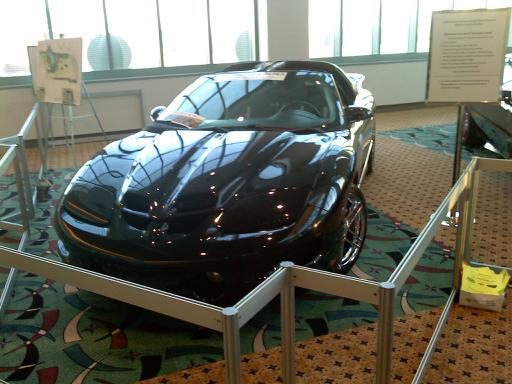

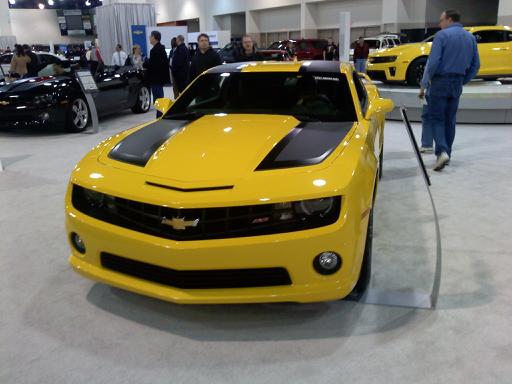

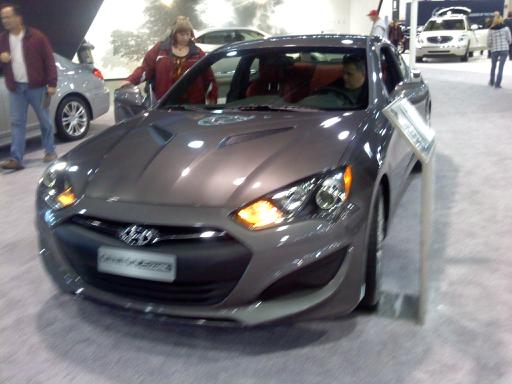
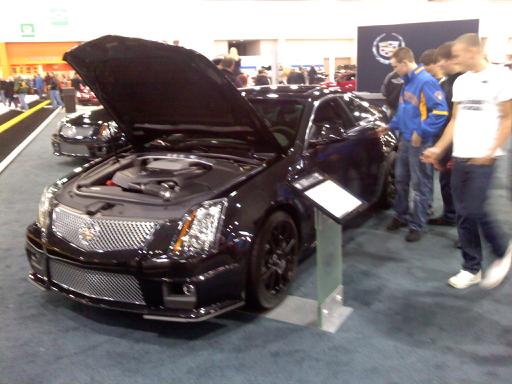

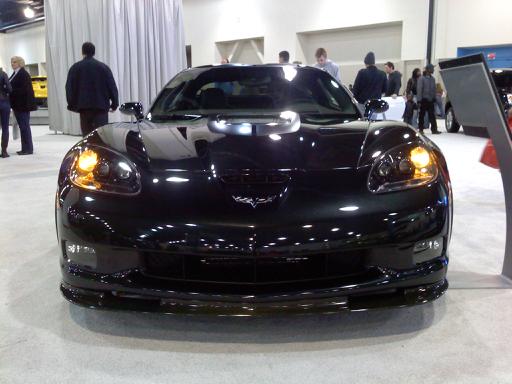


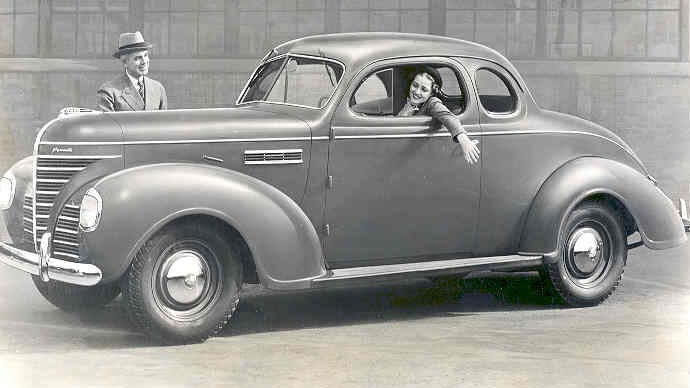


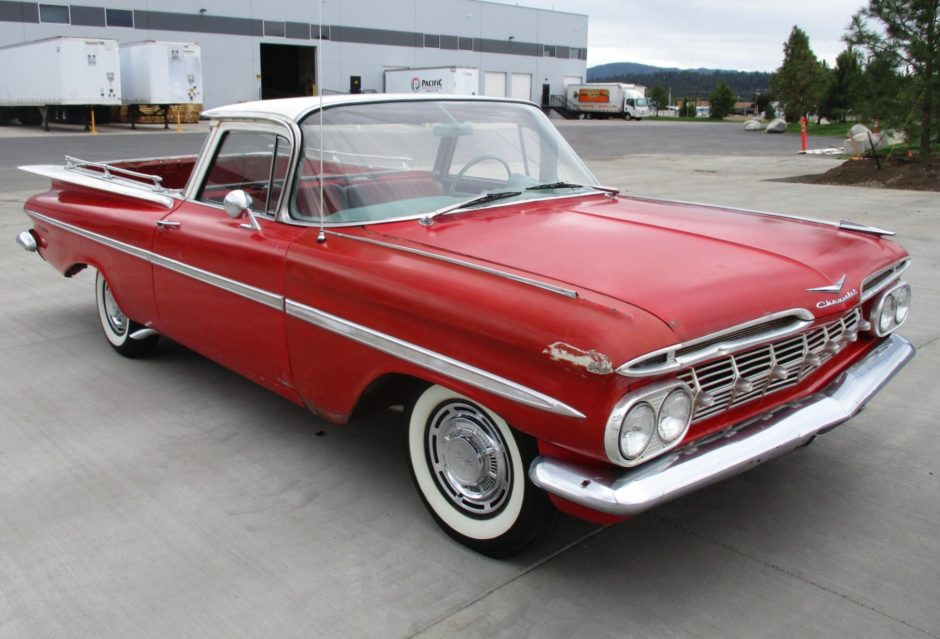


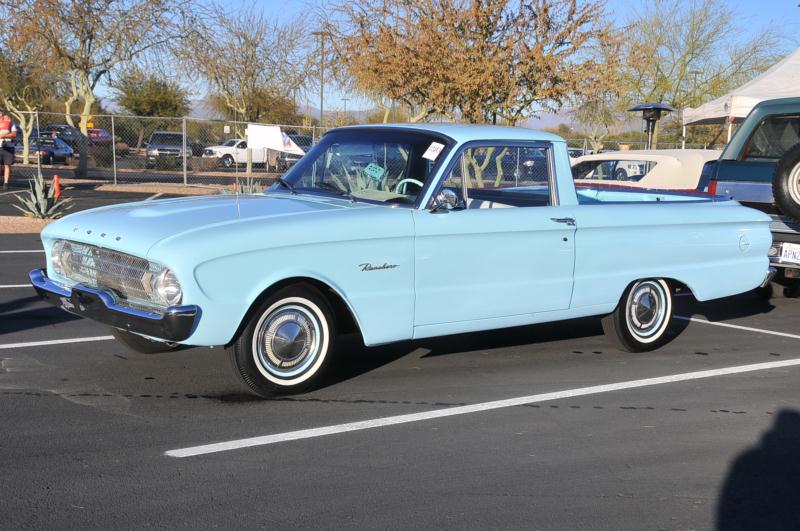
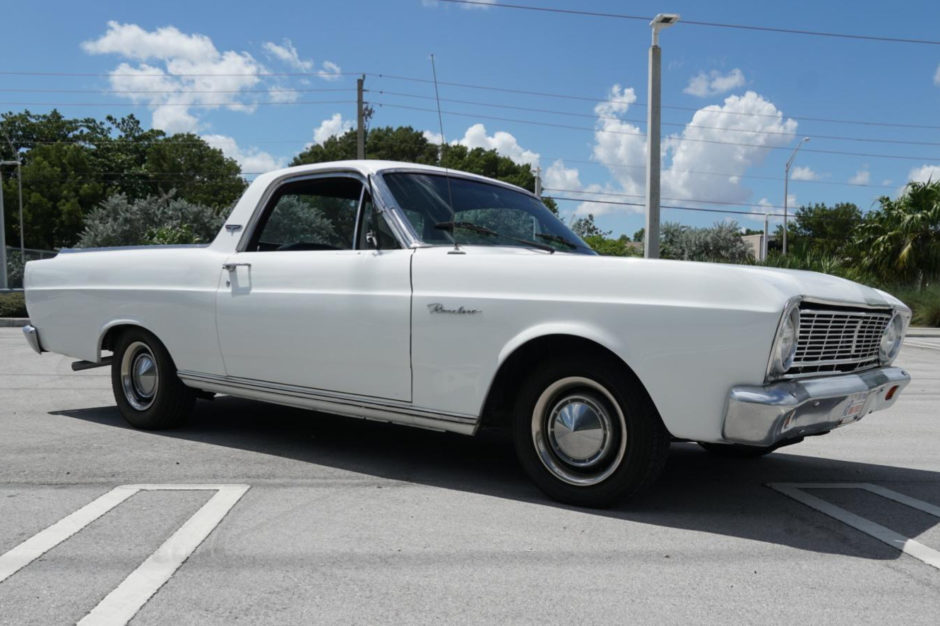

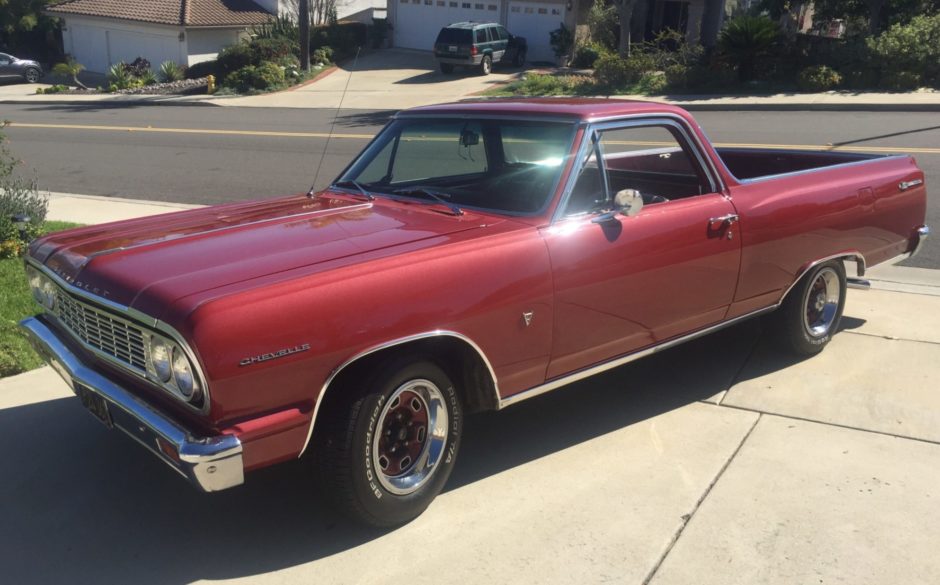

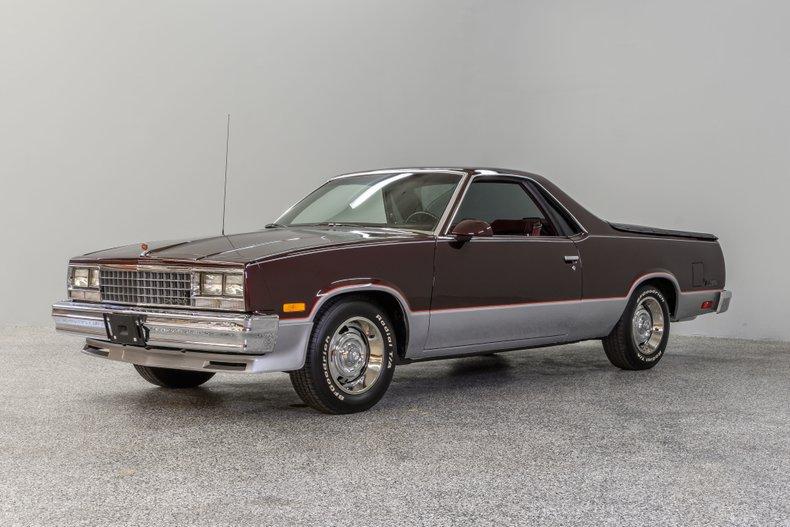

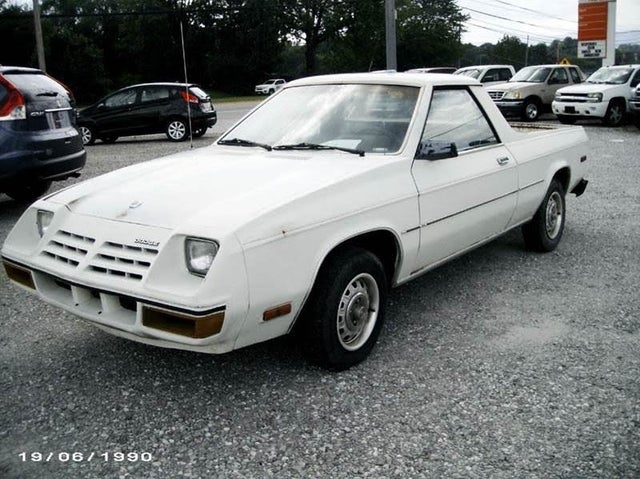

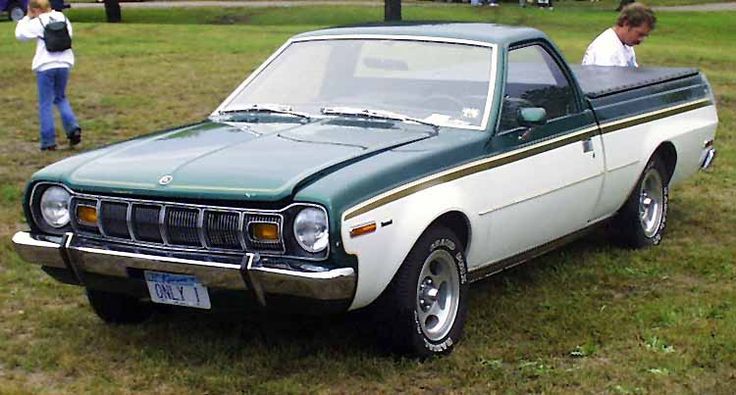

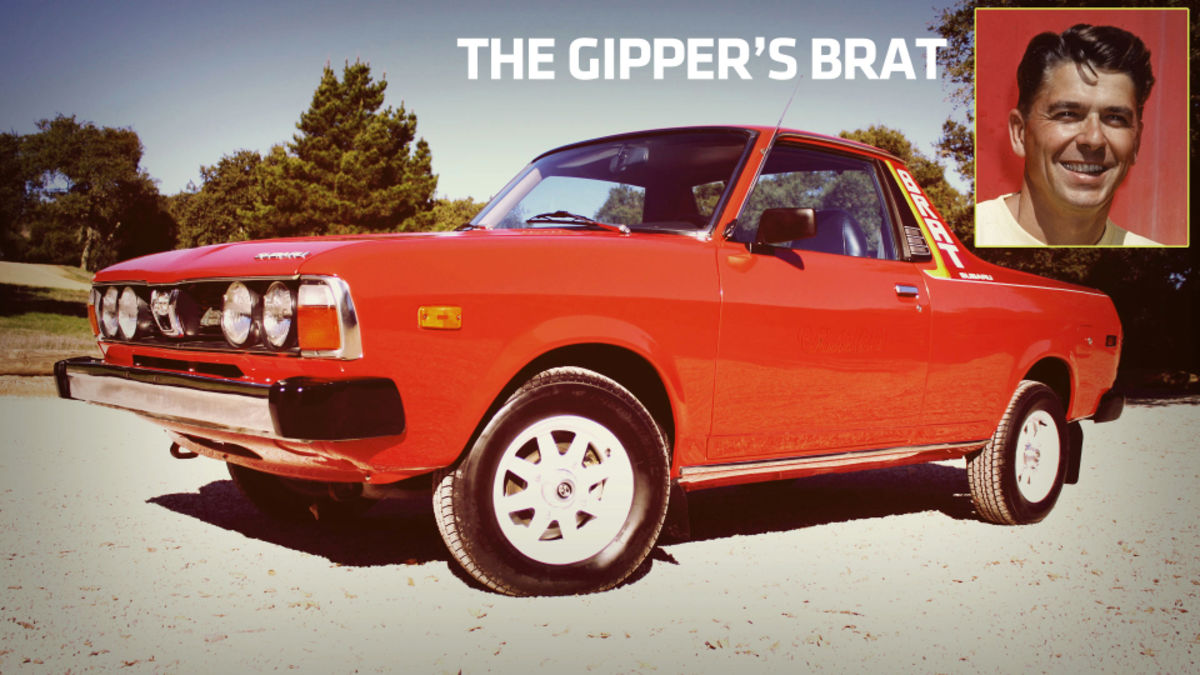


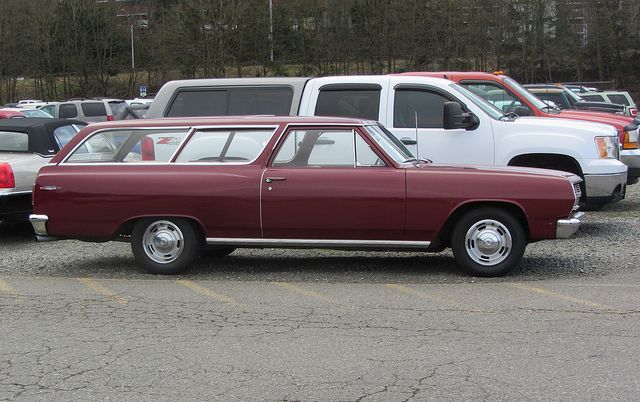

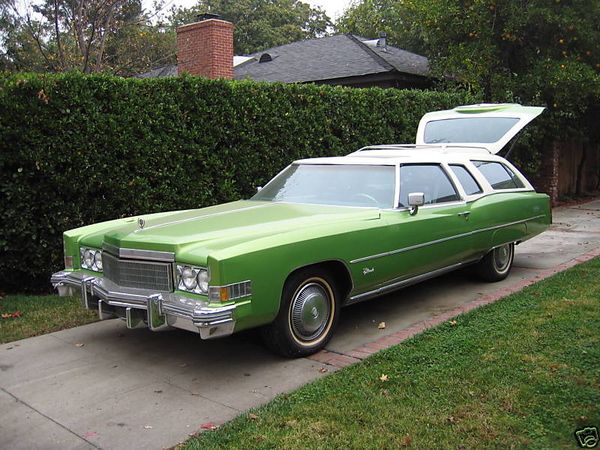
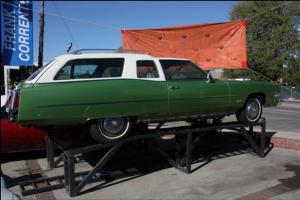
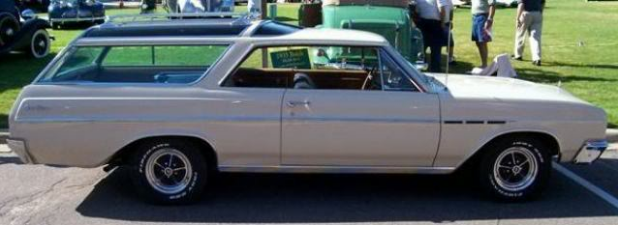


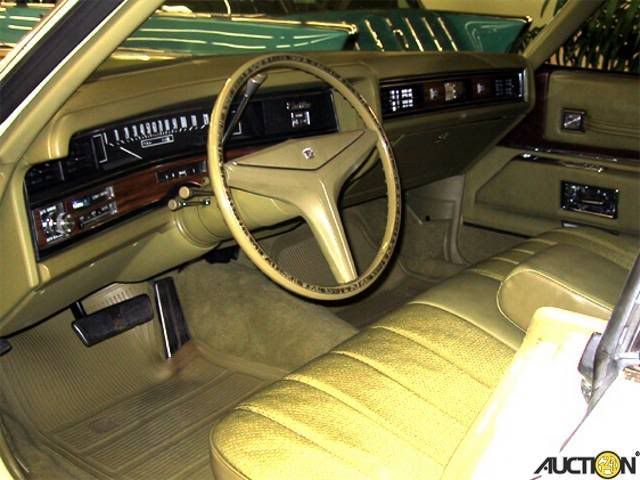


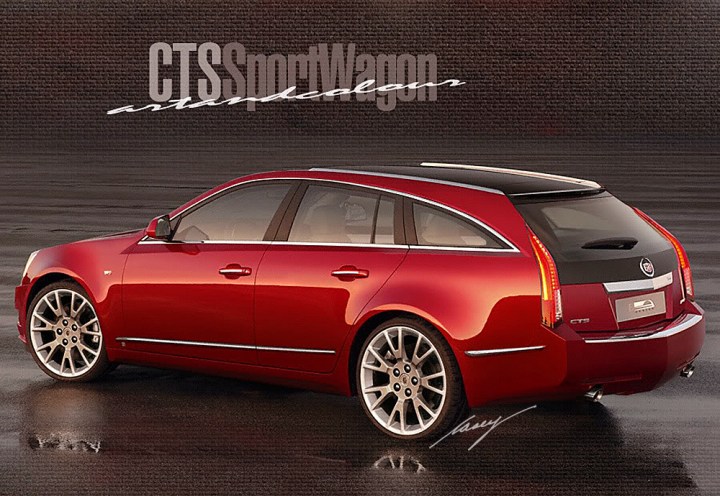


 Steve Prestegard.com: The Presteblog