Had George W. Bush not won the 2000 election (that is, the only way presidential elections count, in the Electoral College), this would have been our president (from The Gateway Pundit):
FIVE YEARS AGO TODAY [Dec. 13]—
Al Gore predicted the North Polar Ice Cap would be completely ice free in five years. Gore made the prediction to a German audience in 2008. He told them that “the entire North ‘polarized’ cap will disappear in 5 years.”
This wasn’t the only time Gore made his ice-free prediction. Gore’s been predicting this since 2007. That means that this year the North Pole should be completely melted by now.

And now, the facts from Mike Smith:
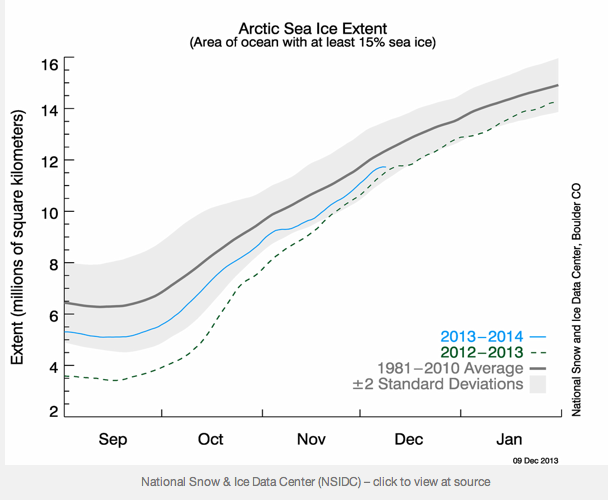
Record cold (including the coldest temperature ever recorded on earth a few days ago), above average early season snows and — yes, Arctic ice back into normal (the blue line back within the gray tinting below) —
record harvests, fewer than normal tornadoes, fewer than normal hurricanes, and a record interval since the U.S. has experienced a major hurricane. Most of all, temperatures haven’t risen for 15 years. What’s not to like?!
Breitbart adds:
Polar sea ice increased 50% over last year, growing from 6,000 to 9,000 cubic kilometers when compared to the same period in 2012. Moreover, this year’s multi-year ice is 30 cm thicker than last year, and scientists claim that thick, multi-year ice indicates healthy Arctic sea-ice cover.
The results were revealed by the European Space Agency (ESA) CryoSat satellite mission. The CryoSat-2 was launched in April 2010 and is designed to measure sea-ice thickness across the entire Arctic Ocean. The satellite’s findings indicate that the volume of Arctic sea ice has increased substantially.
These findings prove to be at odds with Al Gore’s predictions back in 2009 when he spoke at the United Nations Climate Change Conference. Gore stated that computer models reflect “that there is a 75% chance that the entire north polarized cap during some of the summer months could be completely ice free during the next 5-7 years.”
Past satellite missions showed a decline in Arctic Ocean ice over the last few decades. However, the actual volume of sea ice has proven difficult to determine because it moves around, so its thickness can change. The CryoSat-2 satellite has provided Scientists with information that, for the first time, allows them to accurately measure ice thickness.
The converse (not opposite) of Gore is, according to Smith, this:
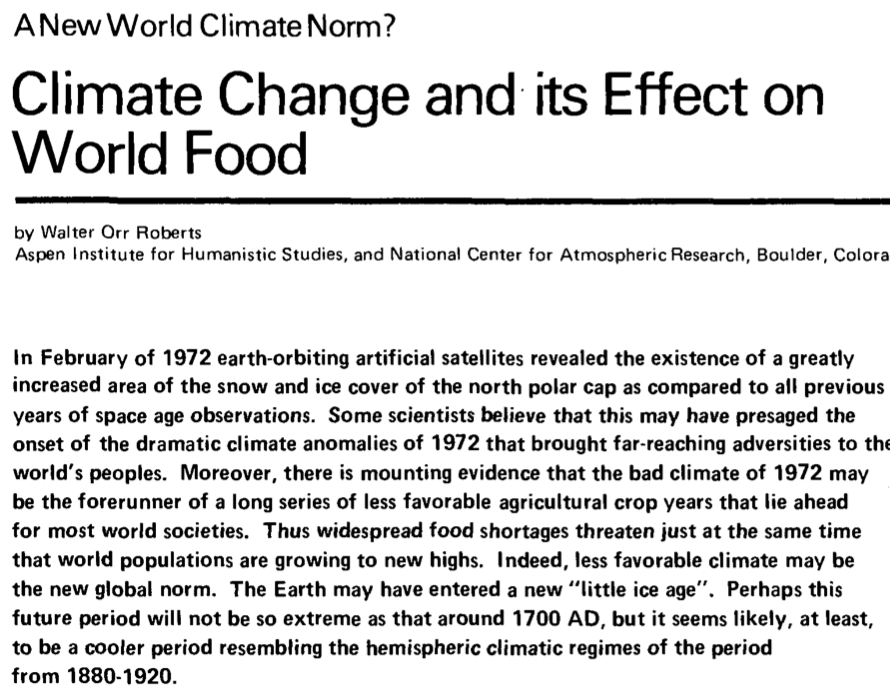
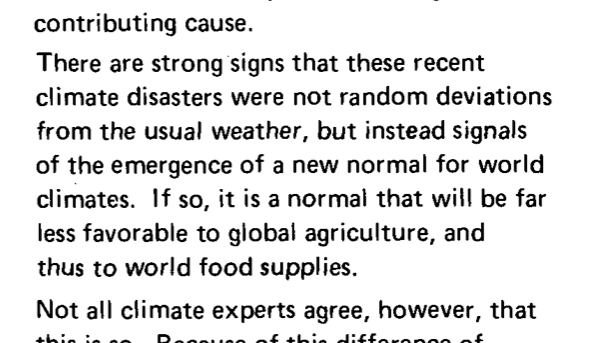
Dr. Roberts was the founder of the National Center for Atmospheric Research (NCAR) which is leading the charge against global warming. The paragraph below could have been written by NCAR’s scientists today:
But, Dr. Roberts was more correct than his contemporaries in 2013, cold weather is far worse for humanity than warm weather. Dr. Roberts’ article in its entirety is here.
What this means is that the “science” of weather prediction is science only in the sense of the study of climate to try to predict it. Gore, of course, is motivated only by his desire to illegitimately exercise power over people, while making millions of dollars as part of the humans-cause-climate-change crowd.
The inconvenient larger truth is that the Earth is not as fragile as people think it is, because man cannot possibly compare to Mother Nature’s destructive abilities. Walter Williams observes:
The 1883 eruption of the Krakatoa volcano, in present-day Indonesia, had the force of 200 megatons of TNT. That’s the equivalent of 13,300 15-kiloton atomic bombs, the kind that destroyed Hiroshima in 1945.
Preceding that eruption was the 1815 Tambora eruption, also in present-day Indonesia, which holds the record as the largest known volcanic eruption. It spewed so much debris into the atmosphere, blocking sunlight, that 1816 became known as the “Year Without a Summer” or “Summer That Never Was.”
It led to crop failures and livestock death in much of the Northern Hemisphere and caused the worst famine of the 19th century. An A.D. 535 Krakatoa eruption had such force that it blotted out much of the light and heat of the sun for 18 months and is said to have led to the Dark Ages.
Geophysicists estimate that just three volcanic eruptions, Indonesia (1883), Alaska (1912) and Iceland (1947), spewed more carbon dioxide and sulfur dioxide into the atmosphere than all of mankind’s activities in our entire history.
How has our fragile Earth handled floods? China is probably the world capital of gigantic floods. The 1887 Yellow River flood cost between 900,000 and 2 million lives. China’s 1931 flood was worse, yielding an estimated death toll between 1 million and 4 million.
But China doesn’t have a monopoly on floods. Between 1219 and 1530, the Netherlands experienced floods costing about 250,000 lives.
What about the impact of earthquakes on our fragile Earth? There’s Chile’s 1960 Valdivia earthquake, coming in at 9.5 on the Richter scale, a force equivalent to 1,000 atomic bombs going off at the same time.
The deadly 1556 earthquake in China’s Shaanxi Province devastated an area of 520 miles. There’s the more recent December 2004 magnitude 9.1 earthquake in the Indian Ocean that caused the deadly Boxing Day tsunami, and a deadly March 2011 magnitude 9.0 earthquake that struck eastern Japan.
Our fragile Earth faces outer-space terror. Two billion years ago, an asteroid hit Earth, creating the Vredefort crater in South Africa. It has a radius of 118 miles, making it the world’s largest impact crater.
In Ontario, Canada, there’s the Sudbury Basin, resulting from a meteor strike 1.8 billion years ago, which has an 81-mile diameter, making it the second-largest impact structure on Earth. Virginia’s Chesapeake Bay crater is a bit smaller, about 53 miles wide. Then there’s the famous but puny Meteor Crater in Arizona, which is not even a mile wide.
I’ve pointed out only a tiny portion of the cataclysmic events that have struck the Earth — ignoring whole categories, such as tornadoes, hurricanes, lightning strikes, fires, blizzards, landslides and avalanches. Despite these cataclysmic events, the Earth survived.
My question is: Which of these powers of nature can be matched by mankind? For example, can mankind duplicate the polluting effects of the 1815 Tambora volcanic eruption or the asteroid impact that wiped out dinosaurs? It is the height of arrogance to think that mankind can make significant parametric changes in the Earth or can match nature’s destructive forces.
(By the way: Gore reportedly has become a vegan, as has his former boss, Bill Clinton. So eat meat.)




 Steve Prestegard.com: The Presteblog

