After the New York Times published their latest smear of Brett Kavanaugh, the left began foaming at the mouth, claiming that the article proved that Brett Kavanaugh lied during his confirmation hearing, that he is a proven rapist, etc., etc., etc. Those of us who actually read the article saw it for what it was: another unsubstantiated smear. Well, it looks like even the New York Times is admitting their article was fake news.
The article, “Brett Kavanaugh Fit In With the Privileged Kids. She Did Not” was adapted from The Education of Brett Kavanaugh: An Investigation, the forthcoming book from Robin Pogrebin and Kate Kelly. Most of the article focused on Deborah Ramirez’s accusation against Supreme Court Justice Brett Kavanaugh and attempted to make it sound corroborated, even though it has not been. But, the most significant part of the article was the revelation of a new accusation by Max Stier, a former classmate of Brett Kavanaugh. Stier claims he saw Kavanaugh “with his pants down at a different drunken dorm party, where friends pushed his penis into the hand of a female student.”
Category: US politics
-
No comments on On Constitution Day, the First Amendment
-
On “No Interruption,” Fox Nation host Tomi Lahren sat down with Andrew Pollack, father of Parkland shooting victim Meadow Pollack.
Pollack became an outspoken advocate for school safety since the Parkland shooting, and he has now written a new book detailing his own investigation into the events that led to the massacre.
“I wanted to look into it, I wanted to honor my daughter to see what happened, and how it could happen that I put my daughter in a school, in a nice neighboorhood, and then I’m never going to see her again,” Pollack said. “I wanted to know the facts. I didn’t just listen to mainstream media, I didn’t jump on that bandwagon — and I found out that there was a multitude of failures and policies that lead up to my daughter getting murdered, that the mainstream media didn’t want to cover.”
In Why Meadow Died: The People and Policies That Created The Parkland Shooter and Endanger America’s Students, Pollack discusses his views on gun control, why he blames Democratic policies for his daughter’s murder, and precautions that parents can take to ensure the safety of their children.
Pollack argued that new gun control laws are an ineffective solution to the school shooting epidemic, in part because current laws are not being enforced. For example, the Parkland shooter had a violent record, but he was not arrested and therefore able to obtain a weapon legally.
“To me, gun control would’ve been if they arrested him for punching his mother’s teeth out and he got a background,” explained Pollack. “Democrats put these policies in place that don’t believe in holding kids accountable or arresting them while they’re juveniles…so if they don’t arrest them and they don’t get a background, then they’re able to purchase weapons legally and a background check is useless,” he said.
In an interview with “Fox & Friends” Monday, Pollack said that banning guns is not the solution, and he encouraged people to look at the “underlying causes for these shootings.”
“They’re not addressing mental health…or arresting these people when they make threats…those are the real issues,” he explained.
Responding to a recent video featuring 2020 Democratic candidates promoting tighter gun control as a safety precaution in schools, Pollack said it made him “ill.”
“My daughter paid the ultimate sacrifice because of those Democratic policies and I’ve been hurt by the Democrats more than anybody in this country — and I hold them responsible,” Pollack said.
Pollack met with President Trump five times, he explained, and applauded the President’s initiation of a federal school safety commission to investigate what steps need to be taken to ensure safety in schools across the country.
In his new book, Pollack said he wanted to create a guide for parents to spot warning signs of potential shooters and to explain that Meadow’s death was avoidable.
“[The book is] like a manual or a guide for parents and grandparents to read it and actually look at what happened in Parkland and compare it — these policies are throughout the whole country,” Pollack told Fox News’ Neil Cavuto in an earlier interview.
“Uncovering all of this,” said Pollack, “it did a lot for me so other parents now can learn from it and that’s what brought me to this book. And the book started as just an investigation, but there was so many jaw-dropping failures that I had to educate other parents.”
Discussing the book, Cavuto “dared” viewers to “read this book without a box of tissues,” calling it “stunning and raw.”
Pollack is just getting started, he explained. He is committed to educating parents across the country on being alert and responsive to potential dangers surrounding their children, so no parent has to experience the pain and grief that continues to haunt him more than a year later.
“Every time that there’s a mass shooting,” he explained, “I think about these victims. Like the ones in Walmart or the ones in Virginia at the building where these animals are coming through and they’re shooting … and I picture my daughter being a victim.”
-
Last week was quite a week for the gun control lobby.
First, according to Magamedia:
Whether it’s NRA protests, anti-gun protests, live-streams protesting gun violence Alyssa Milano is front and center, attending them all. What she hasn’t revealed until just recently, is the fact that she owns two guns for self defense.
The debate was held in Cruz’s Capitol Hill office, where Milano and Fred Guttenberg — whose 14-year-old daughter Jaime was killed in the Marjory Stoneman Douglas High School mass shooting in Parkland, Florida — pressed the senator on various gun control proposals.
Milano proposed universal background checks, restricting access to AR-15s, and background checks for bullet purchases, while insisting, “We all believe in the Second Amendment.” Despite that claim, she pleaded, “We have to try everything, and figure out what works. Isn’t that worth it?”
Around 13 minutes into the discussion, Guttenberg said he was offended by Cruz’s argument that these gun controls would erode Americans’ rights to self-defense. “That’s a load of BS,” he said. “Nobody’s trying to remove your right to self-defense.”
“By the way,” Milano interjected, “I have two guns in my household for self-defense, just so you know.”I guess she thinks she’s special because she’s a celebrity. She doesn’t have to practice what she preaches because she’s a celebrity. Gun control doesn’t apply to her because she’s a celebrity.
I’ve got news for you, Alyssa. It’s folks like you and David Hogg that continue to sky rocket gun sales all across the country.
Guttenberg claimed that “Nobody’s trying to remove your right to self-defense.” Which is not the same thing as saying “nobody’s trying to take your guns away.”
Which is also a lie, as reported by Jim Geraghty:
He almost certainly doesn’t realize it, but Beto O’Rourke is likely to be the worst thing to happen to the gun-control movement in decades — and, if he continues in this mode, he may turn out to be the worst thing to happen to the Democratic party in a long time, too. In Houston last night, O’Rourke abandoned his cloying euphemisms (“mandatory buybacks”) and delivered a deliberate, carefully scripted endorsement of gun confiscation, which, within minutes, his campaign began to sell on t-shirts. “Hell yes,” Beto said, “we’re going to take your AR-15.”
Thus, upon the instant, did two decades’ worth of Democratic rhetoric go up in a puff of smoke.
Beto’s increasingly unhinged rhetoric is not only at odds with political reality — is he unaware that the Democratic House failed this week to marshall enough votes for ban on the sale of “assault weapons,” let alone for confiscation? — it also chronically undermines the assurances on which the Democratic party’s more modest gun-control proposals have been built. For years, Democrats have insisted that “nobody is coming for your guns,” and they have used that line to explain why their coveted registry and desired licensing systems do not pose a threat to anyone but criminals. The current push for an expansion of the background check system rests heavily upon this assurance: “Don’t worry about the de facto registry,” advocates like to argue, “it won’t affect you at all.” With reckless abandon, O’Rourke just blew straight through that, screaming, “yes, it will!”
And in the worst possible way, too. When O’Rourke first decided that he was in favor of confiscation, he was at pains to promise that enforcement would be unnecessary because Americans would comply, and that the punishment would be a fine and nothing worse. With his “Hell yes, we’re going to take your AR-15” language, O’Rourke has abandoned even that. And for what? So that he might increase a few percentage points in a poll that he is never, ever going to win, and then disappear from electoral politics forever?
A year from now, when O’Rourke is a contributor on MSNBC, the people who stayed in the arena are going to look back on this period and curse his name. “Did that guy help us?” they will ask. “Hell, no.”Then there is this video …
… which was (occasionally profanely) rebutted by this video:
This is why I do not reflexively thank veterans for their service unless I know whether their service was honorable (most) or not (John Kerry). The soldiers in the first video did not serve their country; they served the government. They do not respect the Second Amendment rights of anyone besides themselves. Like other liberals they are perfectly fine with being armed themselves, but not with anyone with different views being armed.
-
Sept. 11, 2001 started out as a beautiful day, in Wisconsin, New York City and Washington, D.C.
I remember almost everything about the entire day. Sept. 11, 2001 is to my generation what Nov. 22, 1963 was to my parents and Dec. 7, 1941 was to my grandparents.
I had dropped off our oldest son, Michael, at Ripon Children’s Learning Center. As I was coming out, the mother of one of Michael’s group told me to find a good radio station; she had heard as she was getting out with her son that a plane had hit the World Trade Center.
I got in my car and turned it on in time to hear, seemingly live, a plane hit the WTC. But it wasn’t the first plane, it was the second plane hitting the other tower.
As you can imagine, my drive to Fond du Lac took unusually long that day. I tried to call Jannan, who was working at Ripon College, but she didn’t answer because she was in a meeting. I had been at Marian University as their PR director for just a couple months, so I didn’t know for sure who the media might want to talk to, but once I got there I found a couple professors and called KFIZ and WFDL in Fond du Lac and set up live interviews.
The entire day was like reading a novel, except that there was no novel to put down and no nightmare from which to wake up. A third plane hit the Pentagon? A fourth plane crashed somewhere else? The government was grounding every plane in the country and closing every airport?

I had a TV in my office, and later that morning I heard that one of the towers had collapsed. So as I was talking to Jannan on the phone, NBC showed a tower collapsing, and I assumed that was video of the first tower collapse. But it wasn’t; it was the second tower collapse, and that was the second time that replay-but-it’s-not thing had happened that day.
Marian’s president and my boss (a native of a Queens neighborhood who grew up with many firefighter and police officer families, and who by the way had a personality similar to Rudy Giuliani) had a brief discussion about whether or not to cancel afternoon or evening classes, but they decided (correctly) to hold classes as scheduled. The obvious reasons were (1) that we had more than 1,000 students on campus, and what were they going to do if they didn’t have classes, and (2) it was certainly more appropriate to have our professors leading a discussion over what had happened than anything else that could have been done.
I was at Marian until after 7 p.m. I’m sure Marian had a memorial service, but I don’t remember it. While I was in Fond du Lac, our church was having a memorial service with our new rector (who hadn’t officially started yet) and our interim priest. I was in a long line at a gas station, getting gas because the yellow low fuel light on my car was on, not because of panic over gas prices, although I recall that one Fond du Lac gas station had increased their prices that day to the ridiculous $2.299 per gallon. (I think my gas was around $1.50 a gallon that day.)
Two things I remember about that specific day: It was an absolutely spectacular day. But when the sun set, it seemed really, really dark, as if there was no light at all outside, from stars, streetlights or anything else.
For the next few days, since Michael was at the TV-watching age, we would watch the ongoing 9/11 coverage in our kitchen while Michael was watching the 1-year-old-appropriate stuff or videos in our living room. That Sunday, one of the people who was at church was Adrian Karsten of ESPN. He was supposed to be at a football game working for ESPN, of course, but there was no college football Saturday (though high school football was played that Friday night), and there was no NFL football Sunday. Our organist played “God Bless America” after Mass, and I recall Adrian clapping with tears down his face; I believe he knew some people who had died or been injured.
Later that day was Marian’s Heritage Festival of the Arts. We had record attendance since there was nothing going on, it was another beautiful day, and I’m guessing after five consecutive days of nonstop 9/11 coverage, people wanted to get out of their houses.
In the decade since then, a comment of New York City Mayor Rudy Giuliani has stuck in my head. He was asked a year or so later whether the U.S. was more or less safe since 9/11, and I believe his answer was that we were more safe because we knew more than on Sept. 10, 2001. That and the fact that we haven’t been subject to another major terrorist attack since then is the good news.
Osama bin Laden (who I hope is enjoying Na’ar, Islam’s hell) and others in Al Qaeda apparently thought that the U.S. (despite the fact that citizens from more than 90 countries died on 9/11) would be intimidated by the 9/11 attacks and cower on this side of the Atlantic Ocean, allowing Al Qaeda to operate with impunity in the Middle East and elsewhere. (Bin Laden is no longer available for comment.) If you asked an American who paid even the slightest attention to world affairs where a terrorist attack would be most likely before 9/11, that American would have replied either “New York,” the world’s financial capital, or “Washington,” the center of the government that dominates the free world. A terrorist attack farther into the U.S., even in a much smaller area than New York or Washington, would have delivered a more chilling message, that nowhere in the U.S. was safe. Al Qaeda didn’t think to do that, or couldn’t do that. The rest of the Middle East also did not turn on the U.S. or on Israel (more so than already is the case with Israel), as bin Laden apparently expected.
The bad news is all of the other changes that have taken place that are not for the better. Bloomberg Businessweek asks:
So was it worth it? Has the money spent by the U.S. to protect itself from terrorism been a sound investment? If the benchmark is the absence of another attack on the American homeland, then the answer is indisputably yes. For the first few years after Sept. 11, there was political near-unanimity that this was all that mattered. In 2005, after the bombings of the London subway system, President Bush sought to reassure Americans by declaring that “we’re spending unprecedented resources to protect our nation.” Any expenditure in the name of fighting terrorism was justified.
A decade later, though, it’s clear this approach is no longer sustainable. Even if the U.S. is a safer nation than it was on Sept. 11, it’s a stretch to say that it’s a stronger one. And in retrospect, the threat posed by terrorism may have been significantly less daunting than Western publics and policymakers imagined it to be. …
Politicians and pundits frequently said that al Qaeda posed an “existential threat” to the U.S. But governments can’t defend against existential threats—they can only overspend against them. And national intelligence was very late in understanding al Qaeda’s true capabilities. At its peak, al Qaeda’s ranks of hardened operatives numbered in the low hundreds—and that was before the U.S. and its allies launched a global military campaign to dismantle the network. “We made some bad assumptions right after Sept. 11 that shaped how we approached the war on terror,” says Brian Fishman, a counterterrorism research fellow at the New America Foundation. “We thought al Qaeda would run over the Middle East—they were going to take over governments and control armies. In hindsight, it’s clear that was never going to be the case. Al Qaeda was not as good as we gave them credit for.”
Yet for a decade, the government’s approach to counterterrorism has been premised in part on the idea that not only would al Qaeda attack inside the U.S. again, but its next strike would be even bigger—possibly involving unconventional weapons or even a nuclear bomb. Washington has appropriated tens of billions trying to protect against every conceivable kind of attack, no matter the scale or likelihood. To cite one example, the U.S. spends $1 billion a year to defend against domestic attacks involving improvised-explosive devices, the makeshift bombs favored by insurgents in Afghanistan. “In hindsight, the idea that post-Sept. 11 terrorism was different from pre-9/11 terrorism was wrong,” says Brian A. Jackson, a senior physical scientist at RAND. “If you honestly believed the followup to 9/11 would be a nuclear weapon, then for intellectual consistency you had to say, ‘We’ve got to prevent everything.’ We pushed for perfection, and in counterterrorism, that runs up the tab pretty fast.”
Nowhere has that profligacy been more evident than in the area of homeland security. “Things done in haste are not done particularly well,” says Jackson. As Daveed Gartenstein-Ross writes in his new book, Bin Laden’s Legacy, the creation of a homeland security apparatus has been marked by waste, bureaucracy, and cost overruns. Gartenstein-Ross cites the Transportation Security Agency’s rush to hire 60,000 airport screeners after Sept. 11, which was originally budgeted at $104 million; in the end it cost the government $867 million. The homeland security budget has also proved to be a pork barrel bonanza: In perhaps the most egregious example, the Kentucky Charitable Gaming Dept. received $36,000 to prevent terrorists from raising money at bingo halls. “If you look at the past decade and what it’s cost us, I’d say the rate of return on investment has been poor,” Gartenstein-Ross says.
Of course, much of that analysis has the 20/20 vision of hindsight. It is interesting to note as well that, for all the campaign rhetoric from candidate Barack Obama that we needed to change our foreign policy approach, president Obama changed almost nothing, including our Afghanistan and Iraq involvements. It is also interesting to note that the supposed change away from President George W. Bush’s us-or-them foreign policy approach hasn’t changed the world’s view, including particularly the Middle East’s view, of the U.S. Someone years from now will have to determine whether homeland security, military and intelligence improvements prevented Al Qaeda from another 9/11 attack, or if Al Qaeda wasn’t capable of more than just one 9/11-style U.S. attack.
Hindsight makes one realize how much of the 9/11 attacks could have been prevented or at least their worst effects lessened. One year after 9/11, the New York Times book 102 Minutes: The Untold Story of the Fight to Survive Inside the Twin Towers points out that eight years after the 1993 World Trade Center bombing, New York City firefighters and police officers still could not communicate with each other, which led to most of the police and fire deaths in the WTC collapses. Even worse, the book revealed that the buildings did not meet New York City fire codes when they were designed because they didn’t have to, since they were under the jurisdiction of the Port Authority of New York and New Jersey. And more than one account shows that, had certain people at the FBI and elsewhere been listened to by their bosses, the 9/11 attacks wouldn’t have caught our intelligence community dumbfounded. (It does not speak well of our government to note that no one appears to have paid any kind of political price for the 9/11 attacks.)
I think, as Bloomberg BusinessWeek argued, our approach to homeland security (a term I loathe) has overdone much and missed other threats. Our approach to airline security — which really seems like the old error of generals’ fighting the previous war — has made air travel worse but not safer. (Unless you truly believe that 84-year-old women and babies are terrorist threats.) The incontrovertible fact is that every 9/11 hijacker fit into one gender, one ethnic group and a similar age range. Only two reasons exist to not profile airline travelers — political correctness and the assumption that anyone is capable of hijacking an airplane, killing the pilots and flying it into a skyscraper or important national building. Meanwhile, while the U.S. spends about $1 billion each year trying to prevent Improvised Explosive Device attacks, what is this country doing about something that would be even more disruptive, yet potentially easier to do — an Electromagnetic Pulse attack, which would fry every computer within the range of the device?
We have at least started to take steps like drilling our own continent’s oil and developing every potential source of electric power, ecofriendly or not, to make us less dependent on Middle East oil. (The Middle East, by the way, supplies only one-fourth of our imported oil. We can become less dependent on Middle East oil; we cannot become less dependent on energy.) But the government’s response to 9/11 has followed like B follows A the approach our culture has taken to risk of any sort, as if covering ourselves in bubblewrap, or even better cowering in our homes, will make the bogeyman go away. Are we really safer because of the Patriot Act?
American politics was quite nasty in the 1990s. For a brief while after 9/11, we had impossible-to-imagine moments like this:
And then within the following year, the political beatings resumed. Bush’s statement, “I ask your continued participation and confidence in the American economy,” was deliberately misconstrued as Bush saying that Americans should go out and shop. Americans were exhorted to sacrifice for a war unlike any war we’ve ever faced by those who wouldn’t have to deal with the sacrifices of, for instance, gas prices far beyond $5 per gallon, or mandatory national service (a bad idea that rears its ugly head in times of anything approaching national crisis), or substantially higher taxes.
Then again, none of this should be a surprise. Other parts of the world hate Americans because we are more economically and politically free than most of the world. We have graduated from using those of different skin color from the majority as slaves, and we have progressed beyond assigning different societal rights to each gender. We tolerate different political views and religions. To the extent the 9/11 masterminds could be considered Muslims at all, they supported — and radical Muslims support — none of the values that are based on our certain inalienable rights. The war between our world, flawed though it is, and a world based on sharia law is a war we had better win.
In one important sense, 9/11 changed us less than it revealed us. America can be both deeply flawed and a special place, because human beings are both deeply flawed and nonetheless special in God’s eyes. Jesus Christ is quoted in Luke 12:48 as saying that “to whomsoever much is given, of him shall be much required.” As much as Americans don’t want to be the policeman of the world, or the nation most responsible for protecting freedom worldwide, there it is.

-
Michael W. Chapman:
Talk-show host, attorney, and best-selling author Larry Elder said the breakdown of the family — fatherless families — is the number one problem in America, not racism or discrimination or bad cops. He added that when it comes to murder, nearly half of the homicides each year are black-on-black killings.
Commenting on The Rubin Report, Larry Elder said there is a liberal agenda at work and “the goal is to tell black people that we’re victims, that discrimination, racism remain major problems in America when, in fact, they don’t. And they want black people to vote for the Democratic Party.”
“The Democratic Party gets 95% of the black vote, and the reason they get it is blacks are convinced that the number one issue facing the country is social justice, racist white cops, discrimination, systemic racism, micro-aggression – whatever new word they come up with – and it’s a bunch of nonsense,” he said.
“The number one problem domestically facing this country is the breakdown of the family,” said Elder. “And President Obama said it, I didn’t. A kid raised without a dad is five times more likely to be poor and commit crimes; nine times more likely to drop out of school; and 20 times more likely to end up in jail.”
“So, you’re far more likely to end up in jail without having a dad, than you are because of a white racist cop,” said Elder.
When host Dave Rubin brought up the issue of “systemic” discrimination against blacks, Elder repeatedly asked him to provide a specific example. “Give me the most blatant racist example you can come up with right now,” he said.
Rubin then said, “I think you could probably find evidence that, in general, cops are more willing to shoot if the perpetrator is black than white.”
Elder said, “What’s your data, what’s your basis for saying that? I’m talking about what the facts are. Nine hundred sixty-five people were shot by cops last year and killed. Four percent of them were white cops shooting unarmed blacks. In Chicago, in 2011, 21 people were shot and killed by cops. In 2015, there were seven.”
“In Chicago, which is a third black, a third white, a third Hispanic, 70% of the homicides are black on black – about 40 per month, almost 50 per year – last year in Chicago and 75% of them are unsolved,” he said. “Where is Black Lives Matter on that?”
“The idea that a racist white cop shooting unarmed black people is a peril to black people is BS,” said Elder. “It’s complete and total BS. And the reason for these so-called activists saying this is the assumption that racism remains a major problem in America, and the media, CNN and especially MSNBC, runs down whenever a black cop shoots somebody, and it’s [then] some march in Washington. It’s ridiculous.”
“Half the homicides in this country are committed by and against black people,” said Elder. “Last year there were 14,000 homicides – not talking about suicides, I’m talking about homicides — half of them were black [and] 96% of them were black on black of that 7,000. Where’s the Black Lives Matter on that?”
Larry Elder, 65, is the author of the best-seller, The 10 Things You Can’t Say in America. He is the son of a janitor. He was reared in South Central Los Angeles. He earned his B.A. from Brown University and his JD from the University of Michigan School of Law. He has a star on the Hollywood Walk of Fame and is the host of the radio program, “The Larry Elder Show.”
-
Nick Gillespie watched Wednesday’s CNN town hall with the 296 Democratic presidential candidates on climate change, which …
… wasn’t just long (seven hours!). It was deeply revealing about how Democratic presidential candidates think about government’s power to regulate virtually all aspects of human behavior and how they approach policy and cultural change.
The Democratic contenders have laid out plans costing anywhere from about $1 trillion (Pete Buttigieg) to $16 trillion (Bernie Sanders) in direct federal spending on climate change over the next decade. About half of the candidates have endorsed the Green New Deal proposed by Rep. Alexandria Ocasio-Cortez (D–N.Y.) and Sen. Ed Markey (D–Mass.), which could cost as much as $90 trillion to implement. As important as any specific policy or position outlined last night were the general attitudes that were widely shared by the participants.
A number likened fighting climate change to the effort to win World War II, a metaphor that perhaps says more about their comfort with regimenting society than the speakers intended. During World War II, all industrial production was overseen by the federal government, food and fuel were rationed, and civil liberties were sharply curtailed in the interest of defeating the Axis powers.
In a related way, the candidates all bought into the apocalyptic premises of the questioners, who took for granted the idea that the world is likely to end in a decade or so unless massive, transformational change takes place. The resulting conversations were thus long on the need for action and short on the need to build consensus or to fully assess the costs and benefits of particular actions.
Here are four memorable moments involving the leading candidates:
1. Joe Biden: Here’s Blood in Your Eye.
Whatever the former vice president and Delaware senator actually said last night will forever be a footnote to the fact that his left eye apparently filled with blood during his time on the stage, leading Hot Air‘s Allahpundit to suggest that “individual Biden body parts are now generating their own gaffes.”
Former VP @JoeBiden‘s eye fills with blood during @CNN #climatetownhallhttps://t.co/Jm6lhWzLHz
— Washington Examiner (@dcexaminer) September 5, 2019
The bloody eye won’t help a campaign that has been plagued with questions about the 76-year-old’s mental and physical health, but the less we remember about what Biden actually says on the campaign trail, the better. Indeed, the nation’s only fully satisfied Amtrak rider had barely started talking when he announced, “We can take millions of vehicles off the roads if we have high-speed rail.” That’s a callback to President Barack Obama’s high-speed rail plans, which went nowhere even when the Democrats controlled the White House and Congress. There’s simply no reason to believe that high-speed rail will ever be successfully built in America (California alone has spent a decade and billions of federal, state, and local tax dollars while making effectively zero progress on its high-speed rail project)—and even if it does get built, there’s little reason to expect it to yield meaningful environmental benefits.
2. Elizabeth Warren: “We only have 11 years to cut our emissions in half.” So let’s … stop using nuclear power?
Sen. Elizabeth Warren (D–Mass.) famously has a plan for everything. While the former Harvard Law School prof sidestepped questions about whether the government would continue to dictate what light bulbs Americans can buy (so that’s a yes), she stressed that we’ve “got, what, 11 years, maybe, to reach a point where we’ve cut our emissions in half.” In suggesting that the world will end in 2030 unless we dramatically reduce greenhouse gas emissions, Warren is invoking Ocasio-Cortez’s stunning misreading of a 2018 Intergovernmental Panel on Climate Change report. Far from declaring that the planet would soon be fried, the report theorizes that, as Reason‘s Ronald Bailey writes, “if humanity does nothing whatsoever to abate greenhouse gas emissions, the worst-case scenario is that global GDP in 2100 would be 8.2 percent lower than it would otherwise be.”
Whether or not such a projection is reliable, Warren clearly believes in the 2030 apocalypse. That makes the stance she took last night against nuclear power puzzling, since nuclear is much cleaner than fossil fuels or coal. “In my administration, we won’t be building new nuclear plants,” she said. “We will start weaning ourselves off nuclear and replace it with renewables.” Which is to say, she’s in line with many progressives (including Bernie Sanders, Ed Markey, and AOC), who say simultaneously that the world is ending but nuclear power should remain off the table, even as they push “solar panels, [which] produce 300 times more waste for the amount of energy created than do nuclear plants,” according to environmentalist researcher Michael Shellenberger. Staring down a supposed existential threat, Warren and her anti-nuke allies still have principles, or something.
Sen. Elizabeth Warren: “The fossil fuel industry… want[s] to be able to stir up a lot of controversy around lightbulbs, around your straws, and around your cheeseburgers when 70% of the pollution of the carbon that we’re throwing into the air comes from 3 industries.” pic.twitter.com/DhQXbLJO3P
— The Hill (@thehill) September 5, 2019
3. Bernie Sanders: Aggressively fighting the phantom menace of global overpopulation.
A teacher at the town hall said world population was growing beyond the planet’s carrying capacity and asked Bernie Sanders the following:
“Empowering women and educating everyone on the need to curb population growth seems a reasonable campaign to enact. Would you be courageous enough to discuss this issue and make it a key feature of a plan to address climate catastrophe?”
“Well, Martha, the answer is yes,” Sanders said.
Bernie backs using taxpayer money to fund abortions in other countries to control population growthhttps://t.co/hoiwrDS1YV pic.twitter.com/waIdk2Y3Di
— RNC Research (@RNCResearch) September 5, 2019
Pro-life right-wingers are hot and bothered over the Vermont senator’s willingness to support taxpayer-supported birth control, including abortions, in his quest to defeat climate change. For those of us who believe in female autonomy and reproductive rights, that’s far less troubling than watching him buy into the idea that global overpopulation is in any way a problem.
As the folks at Our World in Data note, “global population growth reached a peak in 1962 and 1963 with an annual growth rate of 2.2%….For the last half-century we have lived in a world in which the population growth rate has been declining.” The United Nations has changed its projections for population growth; it now even suggests a 27 percent chance that global population will peak and start to decline by 2100. And there’s this:
Demographer Wolfgang Lutz and his colleagues at the International Institute of Applied Systems Analysis (IIASA) believe that the United Nations’ projections are likely to be too high. In their 2018 demographic assessment, IIASA calculates a medium fertility scenario that would see world population peak at 9.8 billion people at around 2080 and fall to 9.5 billion by 2100.
If worries about the world ending by 2030 are overstated, so too are fears of a planet that can’t support its population, especially given the incredible strides we’ve recently made in reducing global poverty and increasing general living standards.
4. Kamala Harris: “I think we should” ban plastic straws.
“Plastic straws are a big thing right now,” said CNN’s Erin Burnett to Kamala Harris. “Do you ban plastic straws?” “I think we should, yes,” replied the California senator, who then proceeded to laugh uneasily as she said paper straws were not very good.
The moral panic about plastic straws exemplifies how discussions of environmental issues go off the rails. As Reason‘s Christian Britschgi revealed in January 2018, the erroneous idea that Americans used 500 million straws a day was based on a school project done in 2011 by a nine-year-old boy in California. America in fact contributes only a small portion of the world’s plastic pollution problem, and straws represent just a tiny fraction of that. And yet by the end of last year, plastic straws were “an endangered species” around the country due to outrage over a made-up number.
But Harris wasn’t simply trash-talking plastic straws. She also spent time attacking the eating of red meat, calling for the end of land sales for oil and gas drilling, and pledging to end fracking, the very technology that helped lower U.S. greenhouse gas emissions to record-low levels.
Democrat presidential candidate Kamala Harris wants to ban plastic straws, says about paper straws: “If you don’t gulp it down immediately it starts to bend” pic.twitter.com/cnIddUuj1s
— Ryan Saavedra (@RealSaavedra) September 4, 2019
The libertarians might gloss over Sanders’ views about abortion as population control. Leah Barkoukis did not:
President Trump’s re-election campaign already took advantage of the content and made some great videos of all the crazy things Democrats said during the program—from vowing to get rid of plastic straws, banning offshore drilling, and ending all fracking, to disincentivizing meat eating. But some Democrats, including Sen. Bernie Sanders, took the issue of population control to new levels.
A member of the audience, Martha Readyoff, who was identified as a teacher, told Sanders the planet has experienced a doubling of human population growth in the last 50 years and this is unsustainable.
“I realize this is a poisonous topic for politicians but it’s crucial to face,” she said. “Empowering women and educating everyone on the need to curb population growth seems a reasonable campaign to enact. Would you be courageous enough to discuss this issue and make it a key feature of a plan to address climate catastrophe?”
“The answer’s yes,’” Bernie answered. “Women in the United States of Americas, by the way, have a right to control their own bodies and make reproductive decisions.”
“And the Mexico City agreement — which denies American aid to those organizations around the world that allow women to have abortions or even get involved in birth control — to me is totally absurd,” he continued. “So, I think, especially in poor countries around the world where women do not necessarily want to have large numbers of babies and where they can have the opportunity through birth control to control the number of kids they have, it’s something I very strongly support.”The response shook Twitter users. Democrat Voter: There are too many humans on earth.
Bernie: I agree. We need to fund abortions to poor, third world countries.
This is absolutely horrifying. pic.twitter.com/B2SBT053mz
— Benny (@bennyjohnson) September 5, 2019
Oh my goodness! Oh my goodness!!!
An American presidential candidate speaks about how important it is for America to fund the abortion in poor third world countries.
I repeat, @BernieSanders wants America to fund the killing of Africa’s unborn babies!pic.twitter.com/7CBHS2nG09
— Obianuju Ekeocha (@obianuju) September 5, 2019
Let’s just state for the record: talking about needing “population control” through ABORTION for the sake of CLIMATE is talking about EUGENICS. The fact that @BernieSanders is willing to entertain this vile idea is not only disgusting, it should be disqualifying.
— S.E. Cupp (@secupp) September 5, 2019
A woman asks Bernie Sanders how he would help curb overpopulation of the earth. Sanders replies—I kid you not—that we need increased access to ABORTION to curb population growth in order to prevent climate change.
Killing babies in utero is now the answer to climate change? https://t.co/ZTOfUnAwwv
— Denny Burk (@DennyBurk) September 5, 2019
Whether or not ending abortion is likely, or whether you support or oppose abortion rights, the concept of abortion as population control should be beyond the pale. It’s as if Margaret Sanger is Sanders’ eugenics advisor.
-
A groundbreaking study by Just Facts has discovered that after accounting for all income, charity, and non-cash welfare benefits like subsidized housing and food stamps, the poorest 20 percent of Americans consume more goods and services than the national averages for all people in most affluent countries. This includes the majority of countries in the prestigious Organization for Economic Cooperation and Development (OECD), including its European members. In other words, if the US “poor” were a nation, it would be one of the world’s richest.
Notably, this study was reviewed by Dr. Henrique Schneider, professor of economics at Nordakademie University in Germany and the chief economist of the Swiss Federation of Small and Medium-Sized Enterprises. After examining the source data and Just Facts’ methodology, he concluded: “This study is sound and conforms with academic standards. I personally think it provides valuable insight into poverty measures and adds considerably to this field of research.”
In a July 1 New York Times video op-ed that decries “fake news” and calls for “a more truthful approach” to “the myth of America as the greatest nation on earth,” Times producers Taige Jensen and Nayeema Raza claim the US has “fallen well behind Europe” in many respects and has “more in common with ‘developing countries’ than we’d like to admit.”
“One good test” of this, they say, is how the US ranks in the OECD, a group of “36 countries, predominantly wealthy, Western, and Democratic.” While examining these rankings, they corrupt the truth in ways that violate the Times’ op-ed standards, which declare that “you can have any opinion you would like,” but “the facts in a piece must be supported and validated,” and “you can’t say that a certain battle began on a certain day if it did not.”
A prime example is their claim that “America is the richest country” in the OECD, “but we’re also the poorest, with a whopping 18% poverty rate—closer to Mexico than Western Europe.” That assertion prompted Just Facts to conduct a rigorous, original study of this issue with data from the OECD, the World Bank, and the US government’s Bureau of Economic Analysis. It found that the Times is not merely wrong about this issue but is also reporting the polar opposite of reality.
The most glaring evidence against the Times’ rhetoric is a note located just above the OECD’s data for poverty rates. It explains that these rates measure relative poverty within nations, not between nations. As the note states, the figures represent portions of people with less than “half the median household income” in their own nations and thus “two countries with the same poverty rates may differ in terms of the relative income-level of the poor.”
The upshot is laid bare by the fact that this OECD measure assigns a higher poverty rate to the US (17.8 percent) than to Mexico (16.6 percent). Yet World Bank data show that 35 percent of Mexico’s population lives on less than $5.50 per day, compared to only 2 percent of people in the United States.
Hence, the OECD’s poverty rates say nothing about which nation is “the poorest.” Nonetheless, this is exactly how the Times misrepresented them.
The same point applies to broader discussions about poverty, which can be measured in two very different ways: (1) relative poverty or (2) absolute poverty. Relative measures of poverty, like the one cited by the Times, can be misleading if the presenter does not answer the question: Poor compared to who? Absolute measures, like the number of people with income below a certain level, are more straightforward and enlightening.
To accurately compare living standards across or within nations, it is necessary to account for all major aspects of material welfare. None of the data above does this.
The OECD data is particularly flawed because it is based on “income,” which excludes a host of non-cash government benefits and private charity that are abundant in the United States. Examples include but are not limited to:
- Health care provided by Medicaid, free clinics, and the Children’s Health Insurance Program
- Nourishment provided by food stamps, school lunches, school breakfasts, soup kitchens, food pantries, and the Women’s, Infants’ & Children’s program
- Housing and amenities provided through rent subsidies, utility assistance, and homeless shelters
The World Bank data includes those items but is still incomplete because it is based on government “household surveys,” and US low-income households greatly underreport both their income and non-cash benefits in such surveys. As documented in a 2015 paper in the Journal of Economic Perspectives entitled “Household Surveys in Crisis”:
- “In recent years, more than half of welfare dollars and nearly half of food stamp dollars have been missed in several major” government surveys.
- There has been “a sharp rise” in the underreporting of government benefits received by low-income households in the United States.
- This “understatement of incomes” masks “the poverty-reducing effects of government programs” and leads to “an overstatement of poverty and inequality.”
Likewise, the US Bureau of Economic Analysis explains that such surveys “have issues with recalling income and expenditures and are subject to deliberate underreporting of certain items.” The US Census Bureau says much the same, writing that “for many different reasons there is a tendency in household surveys for respondents to underreport their income.”
There is also a wider lesson here. When politicians and the media talk about income inequality, they often use statistics that fail to account for large amounts of income and benefits received by low- and middle-income households. This greatly overstates inequality and feeds deceptive narratives.
The World Bank’s “preferred” indicator of material well-being is “consumption” of goods and services. This is due to “practical reasons of reliability and because consumption is thought to better capture long-run welfare levels than current income.” Likewise, as a 2003 paper in the Journal of Human Resources explains:
- “[R]esearch on poor households in the U.S. suggests that consumption is better reported than income” and is “a more direct measure of material well-being.”
- “[C]onsumption standards were behind the original setting of the poverty line,” but governments now use income because of its “ease of reporting.”
The World Bank publishes a comprehensive dataset on consumption that isn’t dependent on the accuracy of household surveys and includes all goods and services, but it only provides the average consumption per person in each nation—not the poorest people in each nation.
However, the US Bureau of Economic Analysis published a study that provides exactly that for 2010. Combined with World Bank data for the same year, these datasets show that the poorest 20 percent of US households have higher average consumption per person than the averages for all people in most nations of the OECD and Europe:

The high consumption of America’s “poor” doesn’t mean they live better than average people in the nations they outpace, like Spain, Denmark, Japan, Greece, and New Zealand. This is because people’s quality of life also depends on their communities and personal choices, like the local politicians they elect, the violent crimes they commit, and the spending decisions they make.
For instance, a Department of Agriculture study found that US households receiving food stamps spend about 50 percent more on sweetened drinks, desserts, and candy than on fruits and vegetables. In comparison, households not receiving food stamps spend slightly more on fruits & vegetables than on sweets.
Nonetheless, the fact remains that the privilege of living in the US affords poor people more material resources than the averages for most of the world’s richest nations.
Another important strength of this data is that it is adjusted for purchasing power to measure tangible realities like square feet of living area, foods, smartphones, etc. This removes the confounding effects of factors like inflation and exchange rates. Thus, an apple in one nation is counted the same as an apple in another.
To spot-check the results for accuracy, Just Facts compared the World Bank consumption figure for the entire US with the one from the Bureau of Economic Analysis. They were within 2 percent of each other. All of the data, documentation, and calculations are available in this spreadsheet.
In light of these facts, the Times’ claim that the US has “more in common with ‘developing countries’ than we’d like to admit” is especially far-fetched. In 2010, even the poorest 20 percent of Americans consumed three to 30 times more goods and services than the averages for all people in a wide array of developing nations around the world.
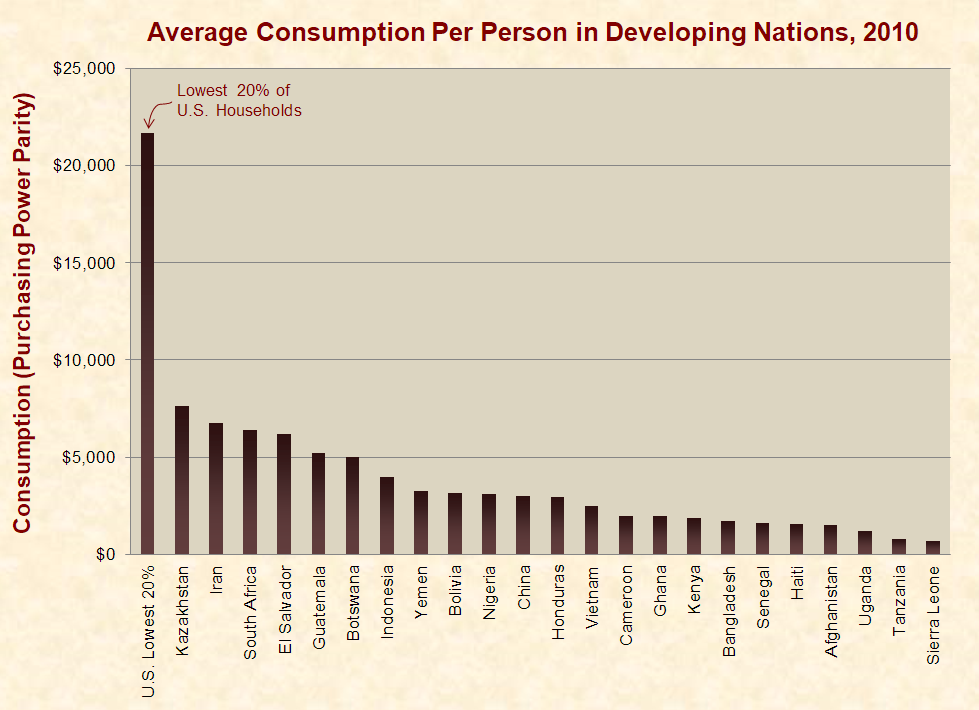
These immense gaps in standards of living are a major reason why people from developing nations immigrate to the US instead of vice versa.
Instead of maligning the United States, the Times could have covered this issue in a way that would help people around the world improve their material well-being by replicating what makes the US so successful. However, that would require conveying the following facts, many of which the Times has previously misreported:
- High energy prices, like those caused by ambitious “green energy” programs in Europe, depress living standards, especially for the poor.
- High tax rates reduce incentives to work, save, and invest, and these can have widespread harmful effects.
- Abundant social programs can reduce market income through multiple mechanisms—and as explained by President Obama’s former chief economist Lawrence Summers, “government assistance programs” provide people with “an incentive, and the means, not to work.”
- The overall productivity of each nation trickles down to the poor, and this is partly why McDonald’s workers in the US have more real purchasing powerthan in Europe and six times more than in Latin America, even though these workers perform the same jobs with the same technology.
- Family disintegration driven by changing attitudes toward sex, marital fidelity, and familial responsibility has strong, negative impacts on household income.
- In direct contradiction to the Times, a wealth of data suggests that aggressive government regulations harm economies.
Many other factors correlate with the economic conditions of nations and individuals, but the above are some key ones that give the US an advantage over many European and other OECD countries.
The Times closes its video by claiming that “America may once have been the greatest, but today America, we’re just okay.” In reality, the US is so economically exceptional that the poorest 20 percent of Americans are richer than many of the world’s most affluent nations.
Last year, the Times adopted a new slogan: “The truth is worth it.” Yet, in this case, and others, it has twisted the truth in ways that can genuinely hurt people. The Times makes other spurious claims about the US in this same video, which will be deflated in future articles.
-
Jeff Jacoby disagrees with this headline (which hopefully readers realize was displayed in the sarcasm font):
When your only tool is a hammer, every problem looks like a nail to be pounded. When you’re Bernie Sanders and your only tool is socialism, every problem looks like a capitalist to be bashed.
The septuagenarian senator from Vermont is an unabashed lifelong socialist, whose solutions to most problems involve more government, less freedom, and higher taxes. This week, in a 1,700-word essay published in the Columbia Journalism Review, he proposed a “plan for journalism” involving — can you guess? — more government, less freedom, and higher taxes. The capitalist-bashing begins in the second sentence: “Today’s assault on journalism by Wall Street, billionaire businessmen, Silicon Valley, and Donald Trump presents a crisis — and [is] why we must take concrete action.”
But Sanders, like Trump, is quick to impugn journalists’ motives. And much of the “action” he proposes would interfere with media companies that try to save themselves.
If elected, Sanders says, he would use the power of the federal government to crack down on media mergers that would lead to layoffs, consolidate news outlets under fewer owners, or “adversely affect” women and minorities. He would “reinstate and strengthen” the old cross-ownership rule that blocked TV and radio stations from owning newspapers in the same market. And he would require the Justice Department and Federal Trade Commission to “more stringently” pursue antitrust litigation against Facebook and Google, whose success has come in part at the expense of traditional media outlets.
Sanders also raises the prospect of taxing online ads and using the revenue to fund “nonprofit civic-minded media” and to “substantially increase” government subsidies for public journalism. That won’t do anything for struggling private newspapers and magazines, but it will certainly boost the power of PBS and NPR and their decidedly left-wing worldview.Nothing in Sanders’ plan is fresh or novel. How and whether to rein in Big Tech, to expand racial and gender diversity in the media, to tax advertising and Internet services, to underwrite nonprofit media — all of these have been perennial topics of debate when the agenda turns to the ailments of the news business. In his essay, the senator vowed to impose an “immediate moratorium” on corporate media mergers like the proposed combination of Viacom and CBS. But media consolidation has been a left-wing bugbear forever. “Remember back in 2000 when the merger of AOL and Time Warner spelled the absolute doom of an independent press?” asks Reason magazine’s Nick Gillespie. “Better yet, can you even remember AOL or Time magazine, once massive presences in media that are now desiccated ruins of their former selves?”
Sanders acknowledges the ravaging of the news industry in recent decades. “Over the past 15 years, more than 1,400 communities across the country have lost newspapers, which are the outlets local television, radio, and digital news sites rely on for reporting,” he writes. “Since 2008, we have seen newsrooms lose 28,000 employees — and in the past year alone, 3,200 people in the media industry have been laid off.” But Sanders seems far less interested in the plight of journalists than in exploiting their excruciations to score ideological points.Like so much of what America’s best-known socialist says and writes, his media plan drips with hostility for capitalists and capitalism. He repeatedly decries the lack of “real journalism” in America, and blames it on his standard villains: the “forces of greed that are pillaging our economy,” the “corporate conglomerates and hedge fund vultures,” the “oligarchic business models,” the “billionaires who … use their media empires to punish their critics and shield themselves from scrutiny.” Sanders is particularly hostile to Jeff Bezos, the billionaire who owns The Washington Post. He suggested recently that his criticism of Bezos is the reason the Post “doesn’t write particularly good articles about me.” At times, his attacks on the integrity of publishers and the motives of reporters have been almost indistinguishable from President Trump’s.
Lord knows the news business is in dire straits these days, but socialist nostrums aren’t going to stop the cataclysmic changes unleashed by the digital revolution. As someone who has worked in newsrooms for more than three decades, I mourn the lost era when nearly every home subscribed to a newspaper. I wince at every newspaper shutdown or round of layoffs. But the media aren’t in extremis because they weren’t regulated enough. If anything, some daily papers might yet be alive if, for example, the cross-ownership rule hadn’t deprived them of a potential lifeline.
Trashing the entrepreneurs and investors who are keeping some of the nation’s legacy news organizations alive may suit Sanders’ anti-capitalist shtick, but it will do nothing to save the business of journalism. “We cannot sit by and allow corporations, billionaires, and demagogues to destroy the Fourth Estate,” says Sanders. That’s the way he always talks — the tiresome rhetoric of a one-tool politician with the same scapegoat for everything.
One solution that would work better than the status quo is to allow, not ban, cross ownership of newspapers and broadcast properties. It worked great for Journal Communications (until the fateful decision to go public, and now Journal is no more).
In addition to the tiresome call for more taxes, the regulations Comrade Bernie suggests — preventing mergers he doesn’t like and creating new media outlets with federal money) would make the feds in charge of media companies. Maybe Sanders wants that. (Maybe Trump wants that too.) No one else should.
-
Since I have worked every Labor Day for at least seven years (and probably most of my adult life, because people who pay to get newspapers don’t like it when they don’t show up on time, irrespective of what the calendar says), the writers of all those memes about how weekends and holidays were brought to you by unions can go straight to hell.
No business, no jobs, and no tax money to pay government employees’ salaries. You’d think liberals would someday learn that.
Some people have the correct perspective about work. For instance, Tom Woods …
… It’s Labor Day, which means your Facebook feed is full of propaganda about labor unions giving us the weekend.
Oh, really?
Then I guess all Bangladesh needs to get weekends off is a bunch of labor unions?
(And if that’s all they need, why do we send foreign aid to the Third World? Shouldn’t labor unions suffice to do the trick?)
Or how about the 99% of human history in which more than 99% of the population was desperately poor: those societies just needed some labor unions?
Until society grows wealthy enough, all the labor unions in the world can’t make it possible to take two days a week off from work.
Can you imagine, in the primitive economies of 300 years ago, agitating for a shorter work week? People would have thought you insane.
With little capital, and with most goods produced by hand, it takes all the labor power all the hours it can spare just to make life barely livable.
Something did bring you the weekend, but it sure as heck wasn’t labor unions.
Same for better working conditions and shorter hours.
What was it?
The very capitalism the propagandists despise.… and Daniel Mitchell:
I’ve periodically explained that capital formation (more machines, technology, etc) is necessary if we want higher wages.
Simply stated, workers get paid on the basis of what they produce and the most effective way of boosting productivity is to have more saving and investment.
This is (one of the reasons) why I have so much disdain for politicians who try to foment discord and division between workers and capitalists.
To be sure, there will always be a tug of war between investors and employees over which group gets bigger or smaller slices. But so long as we have the right policies, they’ll be bickering over how to divide an ever-growing pie.
That’s a nice problem to have. Especially compared to what happens when politicians intervene – for the ostensible purpose of helping workers – and adopt policies that create economic stagnation.
Larry Reed of the Foundation for Economic Education wrote with great insight about the link between labor and capital a few years ago. He starts with some basic economics.
…as complementary factors of production, labor and capital are not only indispensable but hugely dependent upon each other as well. Capital without labor means machines with no operators, or financial resources without the manpower to invest in. Labor without capital looks like Haiti or North Korea:plenty of people working but doing it with sticks instead of bulldozers, or starting a small enterprise with pocket change instead of a bank loan. …There may be no place in the world where there’s a shortage of labor but every inch of the planet is short of capital. There is no worker who couldn’t become more productive and better himself and society in the process if he had a more powerful labor-saving machine or a little more venture funding behind him. It ought to be abundantly clear that the vast improvement in standards of living over the past century is not explained by physical labor (we actually do less of that), but rather to the application of capital.
He concludes that we should be celebrating Labor Day and Capital Day.
I’m not “taking sides” between labor and capital. I don’t see them as natural antagonists in spite of some people’s attempts to make them so. Don’t think of capital as something possessed and deployed only by bankers, the college-educated, the rich, or the elite. We workers of all income levels are “capital-ists” too—every time we save and invest, buy a share of stock, fix a machine, or start a business. …I’ve traditionally celebrated labor on Labor Day weekend—not organized labor or compulsory labor unions, mind you, but the noble act of physical labor to produce the things we want and need. …on Labor Day weekend, I’ll also be thinking about the remarkable achievements of inventors of labor-saving devices, the risk-taking venture capitalists who put their own money (not your tax money) on the line and the fact that nobody in America has to dig a ditch with a spoon or cut his lawn with a knife. …Labor Day and Capital Day. I know of no good reason why we should have just one and not the other.
Courtesy of Mark Perry at the American Enterprise Institute, here’s a nice depiction of how labor and capital are interdependent.

P.S. When economists write about the relationship between capital and labor (savings => investment => productivity => wages), some critics assert this is nothing other than “trickle-down economics.”
Yet this is the mechanism for growth under every economic theory – even Marxism and socialism. The only thing that changes under those approaches is that politicians and bureaucrats control investment decisions. And we know that doesn’t work very well.
-
No, this post isn’t about Seinfeld, it’s about what Elizabeth Vaughn reports:
Since 2004, Gallup has conducted a monthly party affiliation pollparty. They ask voters, “In politics, as of today, do you consider yourself a Republican, a Democrat or an independent?” Results from a November 1-6, 2016 poll showed that 31% of voters identified as Democrats, 27% as Republicans and 36% as Independents. A recently conducted poll indicates a significant shift in those numbers. Currently, 27% of voters consider themselves to be Democrats, 29% as Republicans and 38% as Independents.
What to make of the 4% plus in those identifying as Democrats? Did half of these voters make the switch to the Republican column and the other half to the Independent column? That would account for the two point increase in those two categories.
Also, while there have been many fluctuations along the way, a glance at the number of those who identify as Democrats show those figures peaking between October 2018 and February/March 2019. The results ranged between 30 and 35 during those months. A major drop to 26% was seen following the release of the Mueller report and it has failed to recover.
Conversely, those calling themselves Republicans dipped in January of 2019 to a low point of 25%.
A comparison of what was going on in Washington at that time vs. now explains these changes.
Winter 2018/2019:1. Special Counsel Robert Mueller was still riding high and Republicans were bracing for the horrors of what his long awaited report might reveal.
2. Democrats were riding high after winning back the House majority in the 2018 midterms. The incoming chairmen of the powerful House committees, such as Reps. Jerry Nadler (Judiciary), Adam Schiff (Intelligence), Maxine Waters (Finance) and Elijah Cummings (Oversight), were feverishly preparing their investigations which they were sure would reveal the high crimes and misdemeanors they needed to get rid of Trump once and for all.
3. We saw the ascendancy of the exciting, audacious new Congresswoman from New York City, Alexandria Ocasio-Cortez as well as the first two Muslim women ever elected to Congress.
4. A huge new crop of Democrats were kicking off their 2020 presidential campaigns with radical new ideas to transform the US into a “kinder, gentler” socialist republic. All were touting the Green New Deal, the masterpiece introduced by freshman firebrand AOC, telling voters we only had 12 years left to save the planet.
5. Presidential candidates have shifted farther to the left than at any other period in US history. Ideas which had been considered “radical” and “socialist” when first proposed in 2016 by Bernie Sanders have been adopted by most of the 2020 hopefuls.
August 2019:
1. The Mueller report was released and as hard as he and his team of angry, Hillary-supporting Democrats tried, they failed to find sufficient evidence of collusion or obstruction of justice by the President. Then, Mueller reluctantly appeared before Congress to answer questions about his 22-month-long investigation. His disastrous, humiliating testimony immediately reduced the once feared special counsel to a weary old man who had long ago handed over the reigns to his subordinates.
2. The efforts of House Democrats to impeach President Trump have become, if not a joke, then at least a mere side show. Most amusing is that the average voter couldn’t tell you if Nadler has begun impeachment proceedings or even an impeachment inquiry against Trump if their lives depended on it. No one is paying attention to what he is doing. Both Nadler and his efforts have become irrelevant.
3. Similar to Robert Mueller, the three radical freshmen reps, who had initially taken Washington by storm, have seen their rockstar status fizzle. Their reckless rhetoric, their bigoted statements, and their transparent lust for power have turned them into pretty unsympathetic characters. They forged ahead carelessly without bothering to first acquaint themselves with the ways of Washington believing that by sheer audacity, they could achieve their goals. Better yet, Trump has managed to make these women the face of the Democratic Party.
4. Deeper analysis of the Green New Deal has turned AOC’s signature proposal into a joke. Outside of the far left fringes of the Democratic party, most voters understand that the GND (and other plans based on the GND) is nothing more than a power grab designed to turn America into a socialist nation.
5. The majority of Americans oppose the policies the 2020 Democratic candidates have embraced. Voters are against late term abortion, open borders, free healthcare for illegal immigrants, and they don’t see climate change as an existential threat.
The political landscape has changed dramatically between January, when 32-34% of voters identified as Democrats and the present, when only 27% do. The Democrats may want to rethink their strategy going forward because Americans aren’t buying what they’re selling. Additionally, William Barr’s appointment as Attorney General has upended the Democrat’s Russian collusion narrative to the point where the investigators have now become the investigated. And while the results of one poll don’t tell a story, Democrats have lost a lot of battles in 2019. And it sure looks like the advantage has shifted to the Republicans.
Some of this seems strange. How many people change their party affiliation based on election results? (As opposed to the results of the election results, the second five points.) It’s one thing if, like Ronald Reagan, you didn’t leave the Democratic Party, the Democratic Party left you. If you claim to be a member of whichever political party did better in the last election, then we must wonder about your principles. (I suppose “winning” is a principle by someone’s definition.)
On the other hand, for those who despair about whatever GOP leadership is doing, well, Democratic leadership has apparently lost The Cap Times:
The Democratic National Committee will never be accused of having its act together, especially when it comes to Wisconsin. The DNC’s long history of misreading Wisconsin almost cost Democratic nominees the state’s electoral votes in 2000 and 2004, and the bureaucrats in D.C. finally did enough damage in 2016 to tip the state into the GOP column.
So it should probably come as no surprise that the party is bumbling arrangements for the Democratic National Convention in 2020. Yet it is somehow shocking to see the Democratic insiders blow the simplest of tasks: hotel arrangements.
The party made the right decision when it chose to hold the convention in Milwaukee, a great American city that is ready to be mobilized to end Donald Trump’s presidency. But now, the party bureaucrats have decided that thousands of delegates and alternates and convention guests will be spend much of the convention week in Illinois.
The DNC has determined that while 31 delegations will be housed in Milwaukee area hotels, 26 delegations will be staying in northern Illinois. In fact, so many large delegations are being sent across that state line that Wisconsin will barely house the majority of delegates. According to the Milwaukee Journal Sentinel, “In all, 2,926 hotel rooms will be used for delegates in Wisconsin while 2,841 hotel rooms will be used in Illinois, according to the list.” In reporting the assignments, the Journal Sentinel explained, “It turns out the 2020 Democratic National Convention in Milwaukee is going to be very good for the Illinois hotel industry.”
It will not be so good for the hoteliers of Madison, Racine, Kenosha, Sheboygan and other Wisconsin cities that are as close or closer to Milwaukee than northern Illinois. Make no mistake, all of these cities have excellent hotels that would be outstanding bases for delegations. They are also more affordable than Chicago area hotels, which is no small consideration for a party that is supposed to maintain at least a minimal interest in attracting working-class voters.
We do not deny that there are fine hotels in the Chicago area, and we are aware that the Milwaukee bid for the convention proposed that some delegations would be housed in Illinois. That’s cool. What is not cool is that almost half of the delegates will be spending convention nights outside Wisconsin. And what is simply stunning is the decision to prioritize airport hotels in Illinois over outstanding hotels in Wisconsin cities that are more easily reached than the congested O’Hare area.
But this is about more than logistics. This is about something the Democratic National Committee should understand, but apparently does not: politics.
From a political standpoint is difficult to fully describe the scorching stupidity of the DNC’s approach. But let’s try.
In 2016, Illinois gave 56 percent of its support to Democrat Hillary Clinton and just 38 percent to Republican Donald Trump. In 2020, the state is expected to maintain that pattern.
Illinois is not a battleground state, not by any measure. But Wisconsin is.
In fact, it is a classic battleground. When Wisconsin’s electoral votes moved from the Democratic to the Republican column in 2016, along with those of Michigan and Pennsylvania, the Democrats lost the presidency.
Of the last five presidential elections in Wisconsin, three were exceptionally close calls. In 2000, Democrat Al Gore won the state by 5,708 votes out of roughly 2.6 million cast. In 2004, Democrat John Kerry won by 11,384 votes out of almost 3 million cast. Democrat Barack Obama won the state with ease in 2008 (taking 56 percent) and 2012 (with almost 53 percent), as he did the rest of the country, making him the first Democratic president since Franklin Roosevelt to win two consecutive national elections with over 50 percent of the vote.
But in 2016, Trump took Wisconsin by 22,748 votes out of just under 3 million cast. For the first time since 1984, a Republican carried a Wisconsin presidential vote. Fly-by-night pundits imagined that the state had tipped to the GOP. But two years later, Democrats won every statewide race — for U.S. Senate, governor, lieutenant governor, attorney general, state treasurer and secretary of state. Several of those results were exceptionally close, however, confirming what anyone who knows anything about Wisconsin politics knows: This is a closely competitive state. And it is likely to be that in 2020.
So how will the race be decided? By generating lots of excitement in Democratic bases such as Milwaukee County and Dane County and by capturing counties that Democrats have won in the past but where they ran poorly in 2016. Such as: Racine County and Kenosha County to the south of Milwaukee on the Lake Michigan shore, and Sheboygan County to the north. Obama carried Racine and Kenosha counties in 2008 and fell just 400 votes short in Sheboygan County; in 2012, the Democrat again took Kenosha and Racine counties and was at a competitive 45 percent in Sheboygan County. In 2016, all three counties backed Trump.
So let’s review: To win Wisconsin, Democrats need a huge turnout in Madison and they need to carry or at least remain competitive in the lakeshore counties north and south of Milwaukee. And which communities has the Democratic National Committee decided to give the cold shoulder when making 2020 Democratic National Convention hotel assignments? Madison, Racine, Kenosha and Sheboygan.
The DNC could have created good will and electoral excitement in the places it needs to win the battleground state of Wisconsin in 2020. Instead, it decided to head for Illinois. Good luck with that.
Of course, heading for Illinois what minority Democrats in the state Senate did in attempting to engineer their coup d’etat against Republican Gov. Scott Walker. That not only failed to prevent Act 10 from passing, it failed to defeat Walker and it failed to wrest control of either house of the Legislature in 2012, the same election in which Barack Obama was reelected president and Tammy Baldwin was elected to the U.S. Senate.
Recall Will Rogers’ statement “I’m not a member of an organized political party; I’m a Democrat.” Or perhaps national Democrats are afraid of Madison.


 Steve Prestegard.com: The Presteblog