George Santayana famously said that “Those who forget their history are condemned to repeat it.
That appears to include Democrats now campaigning as if Trump were on the ballot, along with a lot of Republicans, as Hugh Hewitt writes:
George Santayana famously said that “Those who forget their history are condemned to repeat it.
That appears to include Democrats now campaigning as if Trump were on the ballot, along with a lot of Republicans, as Hugh Hewitt writes:
The midterms are six weeks away. There appears to be a consensus that Republicans, currently with 210 seats, will win a House majority (218), although there’s a good deal of debate about the margin. The Senate is up for grabs, partly because in several closely divided states, Republicans have nominated seemingly non-optimal candidates, and partly because of simple math: Republicans have many more seats overall to defend.
Paul will tell you that I’m nobody’s version of an optimist. Since we met in law school 50 years ago, I’ve been regaling him with one jeremiad after the next about impending doom. But I’m optimistic about the coming election, in which I think Republicans will have a net gain of 27-30 seats. I see it this way basically for two reasons.
First, Biden is way underwater, and the “in” party for decades has had a very rough road when its incumbent President is below 50% approval, losing an average of 37 seats. Second, the dominant issue, the economy, is in worse shape than is ordinarily reported. We are in a recession, and over the next month and a half I expect it to get visibly worse and more painful in ways the press will be unable to conceal. Already, we see the stock market diving deeper in the tank almost every day; interest rates high and climbing; real wages plummeting; labor force participation at pitiful levels (which is why you see Help Wanted signs everywhere you go); and housing prices headed through the roof.
(1) The overall political landscape is toxic for the Democrats.
None other than the Washington Post delivered the news two days ago. Here are some of the juiciest items from the poll it reported:
BIDEN and the MIDTERMS – The president’s standing customarily is critical to his party’s fortunes in midterms – and Biden is well under water. Thirty-nine percent of Americans approve of his job performance while 53 percent disapprove, about where he’s been steadily the past year. Specifically on the economy, with inflation near a 40-year high, he’s at 36-57 percent, a 21- point deficit.
Each election has its own dynamic. But in midterm elections since 1946, when a president has had more than 50 percent job approval, his party has lost an average of 14 seats. When the president’s approval has been less than 50 percent – as Biden’s is by a considerable margin now – his party has lost an average of 37 seats.
Oooooooops. At 39 percent approval, Biden isn’t even within shouting distance of breaking even.
If Donald Trump is the face of the Republican Party, as the MSM relentlessly (and hopefully) tells us he is, then Joe Biden is even more clearly the face of the Democratic Party — which in an odd way is good news for it, since it could easily be Nancy Pelosi or Bernie or AOC. But the “good news” is only so good, as the Post poll makes painfully clear (emphasis added):
Looking two years off, just 35 percent of Democrats and Democratic-leaning independents favor Biden for the 2024 nomination; 56 percent want the party to pick someone else. Republicans and GOP-leaning independents, for their part, split 47-46 percent on whether Donald Trump should be their 2024 nominee….
In a head-to-head rematch, the poll, produced for ABC by Langer Research Associates, finds a 48-46 percent Biden-Trump contest, essentially tied. Among registered voters, the numbers reverse to 46-48 percent. That’s even while 52 percent of Americans say Trump should be charged with a crime in any of the matters in which he’s under federal investigation, similar to views after the storming of the U.S. Capitol on January 6.
Translation: The odds are that Trump would win a head-to-head contest with Biden even though the MSM constantly, loudly and viciously (although quite possibly accurately in a sense) paints Trump as a predatory, democracy-bashing criminal.
But wait! Looking at the the House races specifically, the news for the Democrats goes from grim to lethal. Buried far down in the report of the Post/ABC poll is this lonely but dynamite sentence:
Among those living in congressional districts that are rated as at least somewhat competitive by ABC’s FiveThirtyEight (neither solid Republican nor solid Democratic), registered voters favor Republican candidates by a wide 55-34 percent – nearly as big as the Republican lead in solid GOP districts (+24 points).
It’s a commonplace by now that control of Congress depends on which party wins the swing districts. When the Republicans are twenty-one points ahead in those districts, as the Post poll says they are, they’ll be winning all of them or very close to all of them. And that as much as anything will tell the tale of this election.
(2)The economy and inflation — the most important issues to voters — are at DefCon 5 for the Democrats.
National Review has the news, and it’s worse than grim. I perforce quote it at length.
“Based on what I’m hearing throughout all the industries that I work with, this month’s job report might be brutal. People are getting skinny everywhere they can, so that they don’t lose their [butts]. Unfortunately, that means huge groups of people getting fired….”
Meta — you know, Facebook — plans “to cut expenses by at least 10 percent in the coming months, in part through staff reductions.” Google is eyeing similar cuts, with CEO Sundar Pichai characterizing it as “being a bit more responsible through one of the toughest macroeconomic conditions underway in the past decade.” Twilio has announced plans to lay off 11 percent if its workforce, and Snap has announced plans to lay off 20 percent of its workforce.
A lot of big companies, even outside the tech sector, are announcing the elimination of executive positions. The Gap is eliminating 500 corporate jobs. Boeing has announced that it will eliminate about 150 positions in finance and accounting in October. Last month, Walmart announced that it would eliminate 200 corporate jobs.
FedEx is enacting a hiring freeze and closing more than 90 FedEx Office locations.
It’s not just big brand companies: It’s also an ice-cream plant in New York; it’s also a slew of hospitals nationwide. God help you if you work in real estate: “Some of the biggest players in the real estate industry, including RE/MAX, Redfin and Wells Fargo, have announced layoffs in recent months totaling thousands of jobs. Industry analysts are projecting the cuts could eventually be on par with what was seen during the housing crash of 2008.”
None of these individual company moves, by themselves, are likely to make a big difference in the national jobs numbers, and you can find companies announcing layoffs in any month. But cumulatively, these announcements suggest that we’re in a period of not-so-subtle belt-tightening. Businesses doesn’t know what to expect in the coming months, except higher costs to heat their facilities this winter. The stock markets are jittery. Sooner or later, those rising interest rates will reduce customer demand — which should reduce inflation, but will also lower sales, profits, and eventually, jobs.
This is not to mention the certainty of rising energy prices as cold weather spikes demand for heating oil, and the increasing grip of Biden’s anti-growth policies takes effect. Nor have I scratched the surface of the housing shortage, and consequent climbing prices, both for rental and owner-occupied dwellings.
Yes, there are drags on how well Republicans will do on November 8. Donald Trump keeps talking and talking (most recently with the observation that he can declassify documents through telepathy), and there is evidence that the backlash against Dobbs is real. But both longstanding historical trends and the current political and economic realities point to to a resounding Republican win.
Paul Mirengott adds a Wisconsin touch:
I agree with Bill’s analysis of the battle for control of the U.S. House of Representatives. It seems highly likely, FiveThirtyEight notwithstanding, that the GOP will retake the House.
However, I question whether Election Day will truly be a happy one for America if Republicans are unable to gain control of the Senate. I like to think I’m a glass-half-full guy. But a half-full glass is only half satisfying.
Bill’s election analysis correctly focuses on well-founded concerns about the economy. Another factor helping Republicans is well-founded concern about crime.
That concern certainly concerns Democrats. The Washington Post acknowledges this in a front-page article called, in the paper edition, “GOP focus on crime stirs fears among Democrats.”
According to the Post, Democratic candidates and their media cheerleaders have a two-prong response to the GOP’s focus on crime. First, the candidates argue that they are tough on crime. Second, their surrogates claim the GOP’s focus on the issue is racist.
These two contentions aren’t logically inconsistent. In the real world, however, they cannot be reconciled.
It is precisely because Democratic candidates subscribe to BLM’s view that a focus on fighting crime through traditional tough measures is racist — or are afraid to resist this line — that Democrats have not been, and still are not, tough enough on crime.
The Post’s prime example of a Democrat under fire for softness on crime is Mandela Barnes, the Dems’ candidate for the Senate in Wisconsin. According to the Post, Barnes is running ads “seeking to assure voters he will fight crime and support law enforcement.”
Barnes accuses Republicans of lying when they say he wants to abolish ICE and defund the police. Yet, as the Post admits, Barnes was photographed wearing a T-shirt that said “Abolish ICE.” You can’t be much more clear than that. Barnes also advocated cutting what he called “over-bloated budgets in police departments.”
Johnson’s focus on the issue of crime appears to be helping him. Polling in August had Barnes in front by 2-7 points. (Trafalgar was the poll that showed a lead of only two points). In September, four of the five polls reported by Real Clear Politics have Johnson ahead. The other poll, by Democrat-leaning PPP, has the two candidates tied.
The worsening economy, especially the declining stock market, undoubtedly has contributed to this turnaround. However, the director of the Marquette Law School poll tells the Post that Johnson’s crime-focused ads have come “fast and furious” and have probably contributed to the worsening of Barnes’ numbers.
Naturally, the Post sympathizes with the Democrats’ claim that the GOP’s focus on the crime issue is racist. It quotes a black pollster who worked for Barack Obama’s presidential campaigns. He calls the GOP’s ads “Willie Horton 2.0.”
This, of course, refers to a highly successful attack ad against Michael Dukakis in the 1988 presidential campaign. Horton was an inmate at a Massachusetts corrections facility serving a life sentence for murdering a man when he received a weekend pass thanks to a prison furlough program maintained by then-governor Michael Dukakis over the objection of the state legislature. While out of prison, Horton twice raped a Maryland woman after pistol-whipping, knifing, binding, and gagging her fiancé.
Democrats howled “racism” and have been invoking the Horton spot for decades in order to ward off ads attacking them for being soft on crime. This amounts to an attempt by Democrats to escape the dire consequences of their lenient social engineering projects by shouting “racism.”
The stunt has succeeded in part because of Republican cowardice, but mostly because crime receded dramatically thanks to tough-on-crime policies adopted after Dukakis’ defeat.
Now that crime is again rampant — thanks in large part to the abandonment of tough-on-crime policies — invoking Willie Horton isn’t going to deter any sensible Republican candidate.
Nor should it. The Willie Horton was neither illegitimate nor racist. Dukakis’ decision to release Horton, in violation of the wishes of a liberal state legislature, directly led to multiple felonies and serious injuries.
Dukakis endlessly claimed credit for “the Massachusetts miracle.” This was an economic upsurge due mainly to national trends and Reaganite policies. (The alleged economic miracle would end while Dukakis was still governor.) Why shouldn’t he have been held accountable for the consequences of his unilateral decision to release a convicted murderer for a weekend?
Nor was the use of Horton’s picture in the ad racist. Horton was a scruffy-looking black man. There’s little room for doubt that the ad would have used his picture if he had been a scruffy-looking white man.
If the 2022 campaign finally ends more than three decades of Republicans being cowed by unfair blowback against the Willie Horton ad, this will be a happy biproduct of what, I hope, will be a happy midterm election.
Americans don’t much like each-other and many are willing to fight each other over their differences. But what do the opposing factions believe in? When it comes to economic systems and whether production and consumption should be dictated from above or guided by free exchange, a growing number of Americans don’t seem to believe in much at all. Both capitalism and socialism are losing support, especially among Democrats.
“Today, 36 percent of U.S. adults say they view socialism somewhat (30 percent) or very (6 percent) positively, down from 42 percent who viewed the term positively in May 2019,” Pew reports. “And while a majority of the public (57 percent) continues to view capitalism favorably, that is 8 percentage points lower than in 2019 (65 percent).”
Among Republicans, support for capitalism declined from 78 percent to 74 percent, and for socialism from a rock-bottom 15 percent to a slightly rock-bottomier 14 percent. With Democrats, capitalism became a minority taste, dropping from 55 percent support to 46 percent, while socialism’s favorable standing eroded from 65 percent to 57 percent.
“Much of the decline in positive views of both socialism and capitalism has been driven by shifts in views among Democrats and Democratic-leaning independents,” acknowledges Pew. That still leaves the GOP as a market-oriented political party (despite the oddball 14 percent lobby for adding Lenin to the partisan pantheon alongside Lincoln and Reagan). The Democrats have become a lukewarm socialist party, to judge by the sentiments of supporters.
“Americans see capitalism as giving people more opportunity and more freedom than socialism, while they see socialism as more likely to meet people’s basic needs, though these perceptions differ significantly by party,” Pew notes in partial explanation of the disagreement. OK, but that’s aspirational; do Americans really understand the differences between the economic systems?
Fortunately, in 2019 Pew asked respondents more detailed questions about their opinions of capitalism and socialism. Unfortunately, that poll was also terrible about defining terms, but at least it allowed people to describe their impressions of the systems in their own words.
Supporters of free markets “mention that capitalism has advanced America’s economic strength, that America was established under the idea of capitalism, or that capitalism is essential to maintaining freedom in the country,” the 2019 report offered. “Critics of socialism point to Venezuela as an example of a country where it has failed. People with positive views of socialism cite different countries, such as Finland and Denmark, as places where it has succeeded.”
That’s helpful because Venezuela’s government has largely seized the means of production and dominates the economy; it’s socialist. The country is ranked at 176 in the 2022 Index of Economic Freedom as a “repressed” economy. By contrast, Finland is ranked at ninth as a “mostly free” economy, along with Denmark (10th), and the United States (25th); all are countries where private enterprise prevails. Yes, both Scandinavian countries are considered somewhat more capitalist than the U.S.; but they have expensive welfare states and tax the hell out of their private economies to pay for them.
“I know that some people in the U.S. associate the Nordic model with some sort of socialism. Therefore I would like to make one thing clear. Denmark is far from a socialist planned economy. Denmark is a market economy,” then-Danish Prime Minister Lars Lokke Rasmussen commented in 2015. “The Nordic model is an expanded welfare state which provides a high level of security for its citizens, but it is also a successful market economy with much freedom to pursue your dreams and live your life as you wish.”
“So, what is the catch you might ask. The most obvious one, of course, is the high taxes. The top income tax in Denmark is almost 60 percent. We have a 25 percent sales tax and on cars the incise duties are up to 180 percent. In total, Danish taxes come to almost half of our national income compared to around 25 percent in the U.S.”
In Reason, historian Johan Norberg pointed out that Sweden, in particular, dabbled with state economic control. The experiment was abandoned after the economy tanked. Then the country “deregulated, privatized, reduced taxes, and opened the public sector to private providers.” Impressions of socialist Scandinavia are “stuck in the 1970s,” he added. Sweden also has a welfare state and very high taxes.
Americans probably mostly understand capitalism because they live in a generally market-oriented society, even if it’s often cronyist and overregulated. Flaws, including politically favored businesses, and companies supporting ideological goals under regulatory pressure, undoubtedly tarnish impressions of the system. It wouldn’t be surprising if recent arguments over “woke” corporations explain mildly cooling enthusiasm for capitalism on the right. But when it comes to socialism, too many advocates want a unicorn; they ask for socialism but point to capitalist models. Other sources offer some insight.
“The vast majority of Republican voters—85 percent—believe anyone who works hard can get ahead, while 53 percent of Democrats feel that way,” a recent Wall Street Journal poll reveals. “Democrats often say that hard work isn’t sufficient for all Americans to advance, partly due to systemic hurdles based on class or race, and that the government should help. … Republicans, by contrast, say the government should as often as possible get out of the way of efforts by individuals, businesses and charities to help people advance economically.”
Republicans, then, retain faith in individual effort, which is fundamental to free-market capitalism. Democrats want some sort of government thumb on the scale, which isn’t socialist state control of the economy (and perhaps this helps explain declining support for socialism), but which is welfare-state-ish. So maybe they do want Scandinavia as a model—at least for favored groups.
“There are so many socioeconomic differences in the country,” one Democratic voter complained to the Wall Street Journal. “It really depends where you were born on the strata.”
But the same poll suggests grounds for more strife. The Journal found 61 percent of Republicans and 53 percent of independents agree they are “one of the people the elites in this country look down upon.” Just 40 percent of Democrats concur. So, Democrats don’t trust capitalism, are losing faith in socialism, but want government to play a bigger role. Against them are Republicans and independents who think the ruling class that would pick winners and losers despise them; they’re unlikely to envision themselves among those a hostile government would help.
In terms of capitalism and socialism, Americans may not entirely know what they’re talking about, but it seems clear that many of us have very different visions for the country in which we want to live. If there’s one thing on which we can agree, it’s that we’ll continue to strongly disagree.
But James Freeman points out one area of agreement:
This column is still waiting for someone to name a great civilization built by progressive leftists. But just because the wokesters don’t create anything of enduring value, that doesn’t mean they aren’t highly competent when it comes to transmitting their grievances via modern media. In fact, so successful have they been in promoting the false idea that America is an unjust society that these days one can feel almost subversive expressing unapologetically patriotic views.
So it’s nice to get a regular reality check. The latest to arrive is a Wall Street Journal poll showing a solid majority of Democrats, Republicans and independents who understand that we live in an exceptional meritocracy. Yes, it’s important to note the usual caveat that polling is not an exact science, if it’s even a science. But these results appear to be well outside the margin of error.
Specifically, the survey found that a full 74% of participants agreed with the following statement:
America is the greatest country in the world.
Not just above average, not just great, but the greatest.
According to the WSJ survey results, nearly as many people also think that the right to rise is alive and well in the U.S. A sturdy 68% of respondents agreed with the following statement:
If people work hard, they are likely to get ahead in America.
Some readers may be distressed that the number isn’t even higher. Still, given the number of voluble politicos and pundits who’ve spent so much of the last several years claiming that U.S. society is rigged and racist, it’s notable how decisively they have failed to persuade. The logical conclusion is that the progressive left’s critique of the free society doesn’t square with the experience of people who live in it.
Perhaps patriotic Americans are just too numerous to cancel!
The 25th Amendment, ratified in 1967, is one of the most important amendments to the Constitution. It establishes the procedures for presidential succession and fills a critical gap that was left open by the Founding Fathers.
The amendment was prompted by the assassination of President John F. Kennedy in 1963. Vice President Lyndon Johnson became president, but there was no clear line of succession if something happened to him. The amendment addresses this by stating that the vice president would become president if the president died, resigned or was removed from office.
The 25th Amendment also allows for the appointment of a new vice president if the office becomes vacant. This was necessary because there had been several instances in which the vice president had died or resigned.
Since ratification, the 25th Amendment has been used several times. In 1974, Vice President Gerald Ford became president when Nixon resigned in the wake of the Watergate scandal. In 1981, Vice President George H.W. Bush became president (temporarily) when Ronald Reagan was shot by a would-be assassin.
The amendment has also been invoked when a president is incapacitated. In 1985, Reagan underwent surgery and was temporarily unable to perform his duties. Vice President Bush became acting president during that time. The 25th Amendment is an important part of our Constitution that ensures the continuity of our government in the event of a presidential vacancy.
Something interesting is happening in President Biden’s tenure. The same Joe Biden — no more or less capable, as CNN points out — looks different:
“But suddenly, images of Biden as a feeble septuagenarian atop a mismanaged White House have given way to those of an experienced leader, smiling behind aviator sunglasses, whose battle-tested team has delivered on a range of national priorities. A winning streak does that for you.”
The thing with any winning streak is that it eventually ends. While public perceptions and approval ratings of any president can ride one or more nice waves during their four or eight years in office, eventually the waves dissipate and voters see the president in a new light … one that might still shine the light on some key wins but also the reality of the cyclical tough times that every president and every administration deals with.
The reality remains that the median age of a U.S. president at his inauguration is 55. Biden became the oldest president at his inauguration at 78 years and 61 days. Biden was, in fact, older at inauguration day than the previous oldest president, Reagan, was when he left office: 77 years and 349 days.
Suppose we reach the point during Biden’s administration when people are again focusing on perceptions of him as older, weaker and frail, there is no doubt that some will again raise the specter of the constitutional amendment that addresses replacing a president when she or he is unable to serve. Yet there are important reasons the 25th Amendment is used so infrequently.
First, the amendment is designed to address situations in which the president is unable to perform his or her duties, and most presidents can fulfill their duties without issue. Public perception is one thing; the actual inability to perform the job daily is entirely another.
Second, the amendment requires the support of the vice president and a majority of the Cabinet, which can be difficult to obtain. Finally, invoking the amendment can be seen as an admission of failure, which presidents are often reluctant to do.
History has taught us what a serious thing it is to invoke the 25th Amendment. Doing so not only sends a signal to Americans about the health of their president, it sends a message to the world that this is a moment in which the American government may be vulnerable, and this is something no one in Congress should want to do.
Tim Nerenz:
An interesting article in Army Times on September 15 provided insights into reasons that the services are struggling (to put it mildly) to hit troop strength targets this year.
On the input side, the numbers of high school graduates who contact recruiters with interest has remained steady at 110k per year, but the numbers who are disqualified in initial 48 hour background screening have jumped from historical 30-40% rejection rates to 70% in 2022 due to low test scores, obesity, drug use, and delinquency records.
On the back end, overachievement in 2021 retention masked the drop-off in recruitment, but retention has fallen off in 2022 for a variety of reasons, although the article does not mention vaccine mandates or investigations of “wrong think”.
Parent’s attitudes about military service have also turned increasingly negative, as media coverage of controversies is not balanced by stories that convey the benefits of military service, benefits that carry forward into civilian life. Fewer and fewer extended families have a member in the military of live near a military base.
Only 5% of high schools offer JROTC programs, which provide an important avenue of self-development and “right path” that is increasingly lacking as broken homes have increased and church attendance has decreased in recent generations, scouting has fallen into disfavor, and vocational education had been eliminated.
The Army will end the fiscal year with more than 10k open unfilled positions, just as employers in other sectors are unable to fill their open positions with qualified candidates – has anyone else connected those dots yet? The implications of the recruiting crisis for military readiness are obvious, but the downstream ramifications need to be pointed out.
In a survey of CEOs taken a few years ago, the most common undergraduate and graduate degrees were identified as was the first full-time job, and military service was among the most cited. A separate study of billionaires found similar commonalities. The choices they made at 20 set the trajectory that opened up the topside at 60. Those who have served and those who have served the military community were not surprised by this.
The traits and skillsets and values developed in military service – character, discipline, teamwork, diversity, mission-orientation, unit cohesion, competence, a sense of duty beyond oneself – translate into business leadership and leadership in all other walks of civilian life. In my MBA classes, the military students stand out term after term.
A generation not suitable for military service will not be any more ready to enter the labor force or tackle the rigors of college. Dumbing it all down to make the bad numbers go away is not the answer, and the decision-makers who created this circumstance for Gen Z have a lot to answer for.
These kids are not Democrats or Republicans; they did not choose to be disadvantaged – that was done to them and we all know by whom. It is a tragedy of compounded error whose effects are just beginning to be recognized in proficiency scores, military recruiting, skyrocketing rates of mental health issues, and crime statistics.
The negative consequences of closing schools and socially isolating children and teens in their formative years will linger for decades.
The MSM did not find the Army’s recruiting report newsworthy, although I can’t think of a more important matter of public interest than the controlled demolition of a generation in the name of Covid – the panic, not the disease.
J.D. Tuccille on the polling from this:
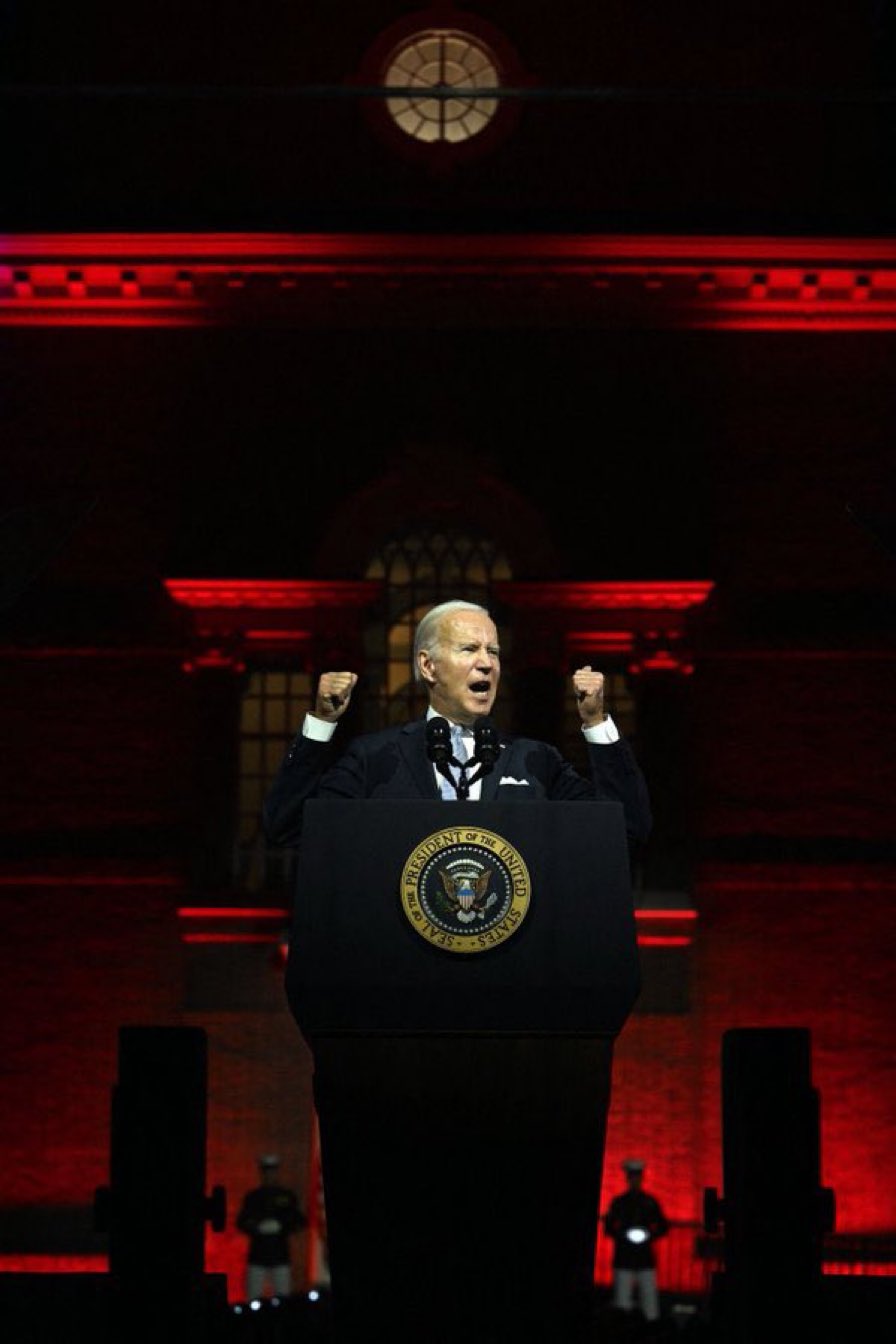
President Biden is discovering the hard way that standing at a podium bathed in blood-red light, flanked by marines, and denouncing your political opponents as threats to the country is not as popular a move as he hoped. Poll after poll finds Americans repulsed by the September 1 fear-fest in Philadelphia, which drew comparisons to V for Vendetta and Star Wars for its over-the-top authoritarian tone. The president tried to convince the country that his critics are dangerous, but he seems to have convinced many, instead, that the real peril lives in the White House.
“It represents a dangerous escalation in rhetoric and is designed to incite conflict among Americans” was the choice of 56.8 percent of respondents asked by the Trafalgar Group to characterize Biden’s speech. Another 35.5 percent called it “acceptable campaign messaging” and 7.7 percent weren’t sure.
Sixty percent of respondents told the Harvard CAPS/Harris poll that the speech “divides [the country] and holds it back” while 54 percent added that it “was an example of fear mongering.”
“62 percent of Americans believed Biden’s comments about Trump and his MAGA followers ‘increases division in the country,’” chimes in the I&I/TIPP poll. “Perhaps surprisingly, Democrats—at 73 percent—were more likely to say that Biden’s MAGA comments increased division than either Republicans (50 percent) or independents (57 percent).”
That really is a bit of a surprise, though it might be that those who weren’t already on Team Blue started with such low expectations that the president’s exercise in frothing at the mouth didn’t offer much more room for disappointment. After all, the Philadelphia speech came after Biden had already accused his political enemies of flirting with “semi-fascism.”
It’s true that President Biden’s approval rating bounced back in recent weeks. The FiveThirtyEight average has him at merely 11 points underwater rather than the laughable 20 points he hit back in July. But the reaction to his “threats” speech suggests he’s either poised to send his popularity back off a cliff, or that he’s just firmed up his standing among the true believers while horrifying everybody else. Both Trafalgar and Harvard CAPS/Harris found a majority of Democrats favoring the speech in contrast to I&I/TIPP, so make of that what you will. Everybody found the event unpopular with the general public.
That said, Joe Biden isn’t the entire Democratic Party. His foot-stomping doesn’t necessarily mean bad news for co-partisans as they prepare for the midterm elections. But he’s certainly not doing the brand any favors when he tears up his 2020 promises to act as a unifier.
“I don’t look at this in terms of the way he does, blue states and red states,” Biden insisted during the final debate of the campaign as he contrasted himself with then-President Donald Trump. “They’re all the United States. … I’m running as a proud Democrat, but I’m going to be an American president.”
An American president except for the half the country he calls out as representing “extremism that threatens the very foundations of our republic” it appears. That he’s not impressing anybody is clear when people are asked what really worries them.
“Do you think that the president Biden is fairly raising issues around MAGA Republicans or is the President trying to avoid talking about inflation, immigration, crime and other issues?” Harvard CAPS/Harris asked in its poll. A majority (59 percent) of respondents said the president is trying to change the subject at a time when people have serious concerns about the state of the country and the world beyond and his administrations is drawing lousy ratings pretty much across the board.
Even more concerning to the president and the ascendant progressive wing of the Democratic Party is where those polled see the real danger when it comes to political movements in the United States. Fifty-five percent of respondents in the Harvard CAPS/Harris survey said they’re more concerned about “the socialist left” while 45 percent answered that they’re more concerned about “MAGA Republicans.”
Of course, it makes sense to focus on the “extremism that threatens the very foundations of our republic” that you see actually controlling the White House and Congress, rather than an alternate extremism that’s out of power. But the sizeable percentage worried about MAGA Republicans along with the looming midterm elections raise an important question: Why not both?
Authoritarian factions have taken dominant positions in both major political parties. Which faction is more dangerous is a matter of who is in a position to implement their policies and demonstrate how much harm they can do. At the moment, the Democrats control the presidency, the House, and (barely) the Senate and get to reap the lack of rewards for Americans’ unhappiness with inflation, crime, and the general direction of the country. After the GOP inevitably gets back into a position of authority in D.C., it will have another opportunity to show how much damage it can inflict and maybe Americans will reconsider their assessment of relative perils.
But, right now, Joe Biden is president, and his party wields the power of the federal government. That includes the FBI, which raided the home of the last president, as well as the IRS, which just received an infusion of funds to extract more taxes from the population. Both vastly powerful agencies suffer declining public trust (as does the government overall). That leaves Americans, outside of the Democratic Party’s core loyalists, deeply unimpressed when the person with the greatest authority over that vast apparatus tries to smear opponents as the real danger.
Keep in mind that a significant majority of Americans (67 percent as of 2017, according to Gallup) view big government as the greatest threat to the country. Standing at the head of that government and lashing out at your political enemies isn’t how the president of the United States convinces people otherwise. Instead, it makes an already unpopular political figure look desperate, unhinged, and potentially the very danger he insists is posed by others.
Joe Biden did himself no favors with that inflammatory speech in Philadelphia. He almost certainly worsened political strife in an already divided country that certainly could have used the moderate unifier he promised to be on the campaign trail far more than the inarticulate demagogue he’s been since taking office. Whether he damaged his party’s prospects in the process is something we’ll discover only when voters cast their ballots in November.
Democrats who joined in reckless political attacks on police need voters to forgive and forget the crime surge that followed. Don’t count on it, especially when it comes to candidates who continue to attract the enthusiastic support of defunders.
Eric Bradner, Omar Jimenez and Donald Judd report for CNN:
Republicans in Wisconsin have in recent weeks hammered Lt. Gov. Mandela Barnes on crime, casting the Democratic nominee to take on GOP Sen. Ron Johnson as “dangerous” as they seek to reach the small swath of suburban voters who could decide one of the nation’s most competitive Senate races.
Public safety is not just an issue for suburban voters. Today it’s difficult to find any jurisdiction in Wisconsin—or anywhere in America for that matter—where citizens want fewer police officers on the streets. Therefore even leftists like Mr. Barnes have been sticking to a consistent script in the 2022 election cycle. CNN reports:
In Wisconsin, Barnes, in his own ad launched two weeks ago, said Republicans are trying to scare voters, calling the charge that he wants to defund the police “a lie.”
“I’ll make sure our police have the resources and training they need to keep our communities safe and that our communities have the resources to stop crime before it happens,” Barnes says in the spot.
But even CNN can’t completely ignore his record, reporting:
The attacks so far have focused on Barnes’ efforts as a state lawmaker to end cash bail, as well as a 2020 interview with PBS Wisconsin — weeks after the police killing of George Floyd in neighboring Minnesota — in which Barnes suggested that funding should be redirected from police budgets to other social services.
“We need to invest more in neighborhood services and programming for our residents, for our communities on the front end,” he said then. “Where will that money come from? Well, it can come from over-bloated budgets in police departments.”
“Wisconsin saw a 70% increase in murders from 2019 to 2021,” notes CNN, and voters should hold politicians who supported defunding accountable. In February, Daniel Bice wrote in the Milwaukee Journal Sentinel:
… Barnes is now distancing himself from two unpopular, far-left political movements — defunding police and abolishing ICE — despite support from groups backing these efforts and past social media activity referencing these causes.
Indeed, in the case of “Abolish ICE,” the 35-year-old Milwaukee Democrat even got the T-shirt.
“Don’t know how I missed this reply, but I need that,” Barnes tweeted July 4, 2018, when a Madison activist offered him a red “Abolish ICE” shirt from the Democratic Socialists of America in his size.
Mr. Bice noted a different message in the current election cycle, although its meaning could be open to interpretation:
“I am not a part of the Abolish ICE movement because no one slogan can capture all the work we have to do,” Barnes said in the statement.
Mr. Bice reported more of the disturbing history:
Barnes has received the endorsement of five national groups that have called for defunding the police… In November, Barnes was a speaker at a major meeting of the Center for Popular Democracy, which is a supporter of defundpolice.org. The center tweeted last year, “Defund police. Defund police states. Defund militarized occupation. Defund state-sanctioned violence.”
… As for the numerous groups that favor defunding police but are backing him, Barnes had little to say.
His campaign declined to provide the Journal Sentinel with his answers to the endorsement questionnaires from the Center for Popular Democracy, Democracy for America, Indivisible, MoveOn.org or the Working Families Party. Each of these groups also supports the movement to eliminate ICE.
As radical as the defunders are, it’s hard to say they haven’t made progress in achieving their goal. A recent report for PBS Wisconsin by the nonprofit Badger Project notes:
The number of law enforcement officers in the state ticked down again in 2022, setting a new record for the lowest statewide total since the Wisconsin Department of Justice started tracking the numbers in 2008.
To relieve some of the burden on law enforcement agencies, and attempt to de-escalate encounters between police and civilians, some cities and counties across the state are experimenting with sending non-police employees to answer some 911 calls.
Nothing scares criminals like a non-police presence in response to 911 calls. The idea is to dispatch the non-cops to take information about low-level offenses. But in no way does this mean that serious offenses are getting the attention they deserve.
These days even when budgets are available to hire more cops, it’s harder than ever to find people willing to do a dangerous job that too many Democrats love to demonize when it suits them.
In Wisconsin, the resulting tragedies are not concentrated in the suburbs but in the state’s largest city. The PBS report continues:
Milwaukee has taken the brunt. In 2020, the city set a record for its highest number of homicides in one year: 190. In 2021, it broke that new record by reaching 197. And with 160 homicides recorded by the end of August 2022, the city is on pace to break that record again.
The Milwaukee Journal Sentinel maintains a website tracking the data and now reports:
There have been 163 homicides in 2022.
This is 30 more than last year at this date.
The PBS Wisconsin report adds:
Instead of “Defund the police,” some law enforcement reformers have promoted a different slogan: “Solve every murder.”
Amen.
At the risk of over-simplifying, there are three types of Republicans/conservatives today (at least from an economic perspective).
- Reaganites – principled supporters of smaller government and individual liberty.
- Trumpkins – populists or national conservatives who don’t care about the size of government
- Bushies – the establishment crowd that often supports a bigger burden of government
Regular readers know which option I prefer, but I can appreciate anyone who has a consistent point of view (hence, my Ninth Theorem of Government).
Today’s column, however, is about how right-leaning organizations deal with the different strains of conservatism. Particularly when they have to deal with politicians.
I’m motivated to cover this topic since the Heritage Foundation (where I worked from 1990-2006) is under attack.
We’ll start with some excerpts from an article in the Dispatch by Audrey Fahlberg Charlotte Lawson.
…some former employees believe Dr. Kevin Roberts, president of the Heritage Foundation since December 2021, and other senior leaders have lost sight of the think tank’s original mission. Where it used to function as a haven for conservative intellectuals to shape the Republican Party’s agenda, many worry that the institution is attaching itself to a faction of the conservative movement that prioritizes partisanship over policy. …Several former employees cited Heritage’s departure from its foundational commitments—without the knowledge or consent of the scholars hired to translate them into policy positions—as their reason for leaving. Others pointed to one-on-one confrontations with the members of the leadership team over the organization’s ideological trajectory. Fights over who sets Heritage’s “one-voice policy”—which requires that all staff be publicly aligned on any given issue—have caused much of the friction. …Whereas scholars at right-leaning 501(c)(3) research institutions like Cato Institute, the Hudson Institute, and the American Enterprise Institute (AEI) are permitted and often encouraged to disagree with each other about policy issues, Heritage prides itself in projecting the same voice on every policy issue.
The main bone of contention is whether to give full support to Ukraine.
The disputes extended beyond the debate over Ukraine and preceded Roberts’ leadership. Several former experts and researchers detailed limitations on their intellectual freedom beginning in the Trump era… “There were several instances where I was asked to scrub the phrase ‘President Trump’ from my pieces. I think it was to tamp down any suspected criticism,” said one former Heritage employee, speaking on the condition of anonymity to speak candidly about internal dynamics. “We were definitely discouraged from mentioning the Biden administration by name as well, unless we were attacking them.” …At the tail end of the Trump presidency, one former communications staffer said, the media team shut down requests to schedule economics scholars for television appearances about the U.S.-Mexico-Canada Agreement to preemptively quash any public criticism of Trump’s support for the trade deal. …Some tension has emerged between establishment conservatives and the national conservatives on Capitol Hill, though national conservatives are from the dominant force in the GOP today. That’s not necessarily the case at Heritage. Tori Smith—a former trade policy analyst at Heritage…observed that a similar “tension is playing out at Heritage, and the nationalist conservatives are winning, it’s abundantly clear.”
In a column for the Washington Post, Josh Rogin opined about this controversy inside the conservative movement.
The Heritage Foundation’s turn toward the “new right” is the clearest symbol yet that the MAGA movement’s foreign policy is becoming institutionalized… Some former staffers told me Roberts has prioritized political messaging over policy formation. As Heritage becomes beholden to the MAGA movement’s political whims, these analysts allege, the organization is now following the mob rather than leading it… On Ukraine, Heritage has broken with center-right think tanks such as the American Enterprise Institute and the Hudson Institute and is now aligned with the Center for Renewing America (run by Donald Trump’s former budget director Russ Vought), the Koch Institute, and conservatives at the Quincy Institute, who all argue for “restraint,” meaning the opposite of the long-standing internationalist bipartisan D.C. foreign policy consensus. …at the National Conservatism Conference, Roberts said, “I come not to invite national conservatives to join our conservative movement, but to acknowledge the plain truth that Heritage is already part of yours.” …on Fox News, Roberts said it’s time for the United States to declare independence from the “liberal world order.”
I’m not an expert on foreign policy, but I fully agree with the folks at Heritage that non-military foreign aid will not help Ukraine.
But I am wholly sympathetic to that country’s fight against Putin’s aggression. And I’m not sure if Heritage’s opposition to the “liberal world order” means standing aside while Ukraine is attacked.
I’ll close with a broader point about Trump, so-called national conservatism, and think tanks. Heritage’s president said that his organization is “already part of yours” in a speech to national conservatives.
This worries me. At the risk of understatement, national conservatives don’t seem very interested in controlling the size and scope of government.
I’m a believer in “fusionism,” the idea that conservatives and libertarians can be strong allies on economic issues. But that won’t be the case if groups like the Heritage Foundation throw in the towel.
As previously noted I consider myself a “conservatarian,” an economic conservative and somewhere between a social conservative and social libertarian. Another way to put it might be to be a “Wall Street Journal conservative,” since the Wall Street Journal editorial page’s five-word mission statement has always been “free men (people) and free markets.”
Reagan wanted to reduce the size of government, but political forces got in the way. The common feature of Mitchell’s Bushism (or “compassionate conservatism”) and Trumpism is that neither cares about reducing the size and scope of government as long as they are in charge of government. (That’s also a Wisconsin GOP feature.) That is the wrong approach.
Mitchell wrote in August 2020:
I’m skeptical of “common-good capitalism” in the same way I’m suspicious about “nationalist conservatism” and “reform conservatism” (and it should go without saying that I didn’t like the “kinder-and-gentler conservatism” and “compassionate conservatism” we got from the Bushes).
Here’s what I prefer.
Whether you call it libertarianism or small-government conservatism, this is the approach I wish Republicans would follow (or Democrats, if the spirit of Grover Cleveland still exists in that party).
But there are many self-styled conservatives who disagree. They think Reagan and his successful policies are passé.
Interestingly, the desire to move beyond Reaganism comes from pro-Trump and anti-Trump outlets.
David Brooks, a never-Trumper with a column in the New York Times, thinks Reagan’s anti-government approach is misguided.
If you came of age with conservative values and around Republican politics in the 1980s and 1990s, you lived within a certain Ronald Reagan-Margaret Thatcher paradigm. It was about limiting government, spreading democracy abroad, building dynamic free markets at home and cultivating people with vigorous virtues… For decades conservatives were happy to live in that paradigm. But as years went by many came to see its limits. It was so comprehensively anti-government that it had no way to use government to solve common problems. …Only a return to the robust American nationalism of Alexander Hamilton, Henry Clay and Theodore Roosevelt would do: ambitious national projects, infrastructure, federal programs to increase social mobility. The closest National Greatness Conservatism came to influencing the party was John McCain’s 2000 presidential bid. He was defeated by a man, George W. Bush, who made his own leap, to Compassionate Conservatism. …The Reformicons tried to use government to build strong families and neighborhoods. …Most actual Republican politicians rejected all of this. They stuck, mostly through dumb inertia, to an anti-government zombie Reaganism long after Reagan was dead and even though the nation’s problems were utterly different from what they were when he was alive. …there is a posse of policy wonks and commentators supporting a new Working-Class Republicanism… But if there is one thing I’ve learned over the decades, it is never to underestimate the staying power of the dead Reagan paradigm.
Maybe I’m just an “anti-government zombie,” but my response is to ask why Brooks thinks the federal government should be in charge of state and local infrastructure.
Even more important, it would be nice if he could identify a government program that successfully promotes social mobility. There are several hundred of them, so the fact that he doesn’t offer any examples is quite revealing.
By contrast, the Reagan approach of of free markets and limited government works anywhere and everywhere it is tried. And he was right that big government is bad government.
But at least Brooks’ column reminds me to add “national greatness conservatism” to my list of failed philosophical fads.
Now let’s shift to an article from the Trump-friendly American Conservative. Rod Dreher also argues that Reaganism is no longer relevant.
Reagan nostalgia has long been a bane of contemporary conservatism, because it prevented conservatives from recognizing how much the world has changed since the 1980s and how conservatism needed to change with it to remain relevant. …by the time Trump came down that escalator, Reagan conservatism was about as relevant to the real world as FDR’s New Deal liberalism was in 1980. It is no insult to Reagan to say so. Until Trump arrived on the scene, it was difficult for right-wing dissenters from orthodox Reaganism—critics of free trade, immigration skeptics, antiwar conservatives, and others—to break free of the margins to which establishment conservatives had exiled them. …It is impossible to see the clear outlines of a post-Trump future for the Republicans, but…Reaganism—the ideology of globalized free markets, social and religious conservatism, and American military and diplomatic domination—is never coming back.
Sadly, I don’t think Dreher is correct about “New Deal liberalism” being irrelevant.
How else, after all, would someone categorize Obama’s policies? Or Biden’s platform? It’s “We shall tax and tax, and spend and spend, and elect and elect,” just as FDR advisor Harry Hopkins stated.
And Reagan’s policies are definitely still relevant, at least if the goal is to improve the well-being of the American people.
Yes, Dreher is right that “the world has changed since the 1980s,” but that doesn’t mean that good policy in 1980 is no longer good policy in 2020.
I think the problem may be that people think Reaganomics is nothing more than lower tax rates, perhaps combined with a bit of inflation fighting. And it’s definitely true that Reagan’s tax rate reductions and his restoration of sound money were wonderful achievements.*
But the Reagan economic agenda was also about spending restraint, deregulation, trade liberalization (he got the ball rolling on NAFTA and the WTO), and other pro-market reforms.
To be sure, Reagan’s policy record wasn’t perfect. But the policies he preferred were the right ones to restore American prosperity in the 1980s.
And while there are different problems today (the need for entitlement reform, for instance), the Reaganite approach of smaller government is still the only good answer.
*Let’s also remember to applaud Reagan for the policies that resulted in the unraveling of the Soviet Empire.
P.S. As explained in the Fourth Theorem of Government, pro-growth, Reagan-style policy can be smart politics.
Trump-style conservatism got rejected in 2020. Reagan won two presidential elections with it. The evidence is clear that voters don’t vote for gloom-and-doom candidates, even if that candidate would have been a far better choice (see 2020).
Erick Erickson updates this morning’s post:
Railroad companies and union leaders averted a national strike that would have sent fragile supply chains into disarray and hiked energy prices. The negotiations were concluded early this morning with a tentative handshake agreement that is expected to hold. While Labor secretary Marty Walsh handled the negotiations, Transportation secretary Pete Buttigieg was touring the Detroit Auto Show.
Buttigieg’s habit of missing important moments on the job was previously highlighted when he took an extended paternity leave and no know noticed he was gone.
Rail workers will soon vote on the tentative deal, and if any of the unions reject it, the nation will once again brace for a railroad strike.
Workers had largely opposed the presidential board’s contract recommendations, which ignored their demands for better quality of life and working conditions.
A recent survey from the SMART Transportation Division found that 78 percent of the union’s railroad workers would have rejected that contract. Another survey from grassroots group Railroad Workers United found that 9 in 10 railroad workers opposed it.
The International Association of Machinists and Aerospace Workers said Wednesday that its 4,900 railway workers voted to reject the Biden administration-appointed board’s contract. It delayed a strike until Sept. 29 to allow more time for negotiations.
It’s unclear whether the revamped contract announced Thursday does enough to win over workers, who eagerly awaited the specific terms of the deal.
Meanwhile, speaking of the Detroit auto show, Road & Track reports on this tweet:

President Joe Biden paid a visit to the Detroit Auto Show floor Wednesday, taking the time to see the latest from America’s automakers up close. Among the most interesting parts of his stroll was when he got behind the wheel of the new 2023 Chevrolet Corvette Z06, started it, and gave it some revs. Later that day Biden’s official Twitter account published a tweet talking about the electric vehicles he saw firsthand that gave him “so many reasons to be optimistic about our future,” alongside a picture of the Z06. Unsurprisingly, car Twitter went mad.
In case you’re unaware, the Corvette Z06 is not an electric vehicle. It’s far from one, actually. Behind the cabin sits a 5.5-liter naturally aspirated flat-plane-crank V-8 that can rev all the way to 8600 rpm while making 670 hp and 460 lb-ft of torque. Unlike an electric car, it burns gasoline and makes a wonderful noise.
That is an egregious mistake. Biden’s tweet also claimed “As you know, I’m a car guy.” That is a lie given his administration’s policies that made gas prices skyrocket and made everything, including, cars, more expensive and less affordable. Biden’s Federal Reserve Board’s increasing interest rates, an effort to stop inflation that hasn’t been this bad in four decades, will make vehicles even less affordable by increasing borrowing costs.
We live in a country where the (currently) ruling political party and most of the national media have a symbiotic relationship. (Jen Psaki started work at NBC News this week.) One of the problems with this dynamic is that when the ruling class decides something is important — say, emphasizing the issue of abortion as the midterm elections approach — it tends to squeeze out everything that the ruling party doesn’t want emphasized. …
But there are a lot of other things going on in this world, and one issue that seems spectacularly under-covered — a ticking time bomb, if you will — is that starting at 12:01 a.m. Friday, about a day and a half from now, if there isn’t a new labor deal between freight-rail unions and employers, the U.S. economy will be . . . derailed.
Maybe there will be an eleventh-hour deal; I suspect many casual observers simply assume that a deal will get done because the consequences of even a brief work stoppage would be so far-reaching. But freight companies are already halting certain shipments in preparation for a potential strike, so in some ways, the consequences of a strike are already here.
The American Association of Railroads said this week that it’s begun taking steps to secure the shipments of hazardous and security-sensitive materials, such as chlorine used to purify drinking water and chemicals used in fertilizer. It also warned that “other freight customers may also start to experience delayed or suspended service over the course of [this] week, as the railroads prepare for the possibility that current labor negotiations do not result in a resolution and are required to safely and securely reduce operations.”
At noon [Wednesday], Norfolk Southern will close all gates to intermodal traffic — that means anything using multiple modes of transportation such as rail, ship, aircraft, and truck. BSNF Railway, one of the largest freight railroads in North America, stopped accepting intermodal traffic as of 12:01 a.m. this morning.
Amtrak has already suspended most cross-country routes and announced that, “It will only operate trains that can reach their final destination by 12:01 a.m. on Friday, when a freight rail strike or lockout could begin.” Without a deal, most Amtrak operations in California will be suspending operations starting on Thursday.
A freight-rail strike will also bring commuter-rail services to a halt in some areas: “Virginia Railway Express said if there is a strike it would immediately stop all of its commuter train service because Norfolk Southern owns the tracks for VRE’s Manassas Line, and CSX owns the tracks for its Fredericksburg Line.” Across the Potomac in Maryland, “Since CSX owns and maintains the Camden and Brunswick lines in addition to dispatching MARC trains, any labor strike would result in the immediate suspension of all MARC Camden and Brunswick Line service until a resolution is reached.” It’s the same story for Metra, the commuter-rail system serving the city of Chicago and its surrounding suburbs, and Metrolink, the commuter-rail service that serves southern California.
The U.S. Department of Transportation estimated that a freight-rail strike would cost the economy about $2 billion a day, but that’s just a big, abstract figure in most people’s minds. What Americans will notice is all kinds of products getting scarcer and more expensive (again). As our Dominic Pino notes, crude oil, natural-gas liquids, refined products, petrochemicals, and plastics are transported by rail, meaning that a disruption in freight-rail service is likely to spur a gas-price increase (again). The average price for a gallon of regular unleaded gas nationwide is currently $3.70, which is better than the $5 per gallon price of mid June, but it’s still high by historical standards.
Once again, if you read local press or trade publications, you realize how many things in this country grind to a halt if there’s a freight-rail strike. From EnergyWire:
Chemicals make up the second-largest category of rail freight after coal — 55,000 carloads a week — and there aren’t enough trucks and barges to handle the volume, said Jason Miller, a professor in the department of supply chain management at Michigan State University.
A prolonged strike would have a bigger impact on the economy than the shutdowns during the Covid-19 pandemic, Miller said.
“At least during Covid, you able to keep [chemical] production going, oil production going,” he said. “You can’t do that with a rail strike.”
Farmers have a limited window to get their harvested crops to buyers before the food spoils, and for many crops, this is harvest time; farmers are now wondering if the usual rail options will be available after Friday:
A painful example of supply chain concern can be found in soybean farming. Hungry markets in Asia and elsewhere count on soybeans to make the ships in the Gulf of Mexico and the west coast.
“It’s gonna be devastating because just about all of the soybeans that are produced here go to a crush plant, and that crush plant is in Hastings, and they send two unit trains of soybean meal per week to the Pacific Northwest,” Greving said. He sits on the USDA United Soybean Board. “That is loaded on bulk vessels there and shipped to Southeast Asia.”
The price of oil affects everybody, farmers included. A rail shutdown would also stop the delivery of corn to most ethanol plants.
Remember, many of the world’s food markets are still reeling from the effects of the Russian invasion of Ukraine and the near-complete shutdown of Ukraine’s food exports.
[Tuesday], I briefly mentioned that a strike could disrupt the flow of coal to power plants. Grist lays out why there aren’t any realistic alternatives to get coal to those plants:
Because the fuel is so heavy and takes up so much space, rail is the only economical way to transport it from mines to power plants: The average coal train consists of 140 cars that each hold about as much coal as could fit on ten trucks. Even if coal could be shifted onto trucks, the trucking industry itself has also been experiencing labor shortages, and there’s not much excess truck capacity to absorb rail freight. . . .
“Coal stockpiles are already at historic lows in the United States,” said [John Ward, the executive director of the National Coal Transportation Association, a trade group representing coal shippers and buyers]. “Any further interruptions could be disastrous for power generation.
In the good old days, it wasn’t uncommon for utilities to have a 60- or 90-day supply of fuel, but I don’t know anybody who has that luxury now. If it became an extended strike, the consequences could be dire.” Should utilities burn through their stockpiles, they’ll have to slow down generation to save supply, which could lead to power shortages during times of peak demand. Prices would jump for as long as the supply backlog lasted.
The worst-affected places would be states like West Virginia and Missouri, which generate around 90 percent of their electricity from coal and don’t have the opportunity to switch to natural gas on short notice. Even states with large gas supplies will struggle, though, since gas markets are also tight as producers export large quantities of gas to Europe.
In case you’re wondering, no, trucks cannot pick up the slack. The American Trucking Association says it simply doesn’t have the spare trucks or manpower. “Idling all 7,000 long distance daily freight trains in the U.S. would require more than 460,000 additional long-haul trucks every day, which is not possible based on equipment availability and an existing shortage of 80,000 drivers,” ATA president and CEO Chris Spear wrote in a letter to Congress. “As such, any rail service disruption will create havoc in the supply chain and fuel inflationary pressures across the board.”
In other words, the strike scheduled to begin in, what, 36 to 40 hours after you read this, would be a far-reaching economic calamity.
And, in the eyes of some analysts, the country is in this spot because of the Biden administration’s decision-making, which aimed to maximize the leverage of its union allies:
“That this might occur right before the midterm elections is entirely self-inflicted by the Biden administration, where two of President Biden’s National Mediation Board [NMB] members took the bizarre step in June of terminating board-guided mediation two months early and starting the 90-day countdown to a possible rail strike,” Scribner told FOX Business, calling the move “unprecedented.”
If the NMB had stuck to the original schedule, Scribner says, the cooling-off period would have ended in mid-November. But instead, the board decided to cut things short.
If this was indeed some deliberate Biden administration strategy, you must wonder how well it thought this through, or whether the administration’s plan counted on a deal being reached by now. Because if there’s anything we know Joe Biden is loath to do, it’s suspending Amtrak service.
By the way, the potential railroad strike is mentioned in the 29th paragraph of today’s newsletter over at Politico. Today’s Axios newsletter does not mention the potential strike at all.
Here’s how we got to the precipice of a nationwide freight-rail strike: These negotiations began in November 2019. The Railway Labor Act is a special set of rules, separate from the National Labor Relations Act that most industries operate under, which applies to railroads and airlines. Contracts under the RLA do not have set deadlines, and negotiations are open-ended.
There are, however, mechanisms within the RLA that can be used to force deadlines. After over two years of negotiations, the unions requested that the National Mediation Board, an independent federal agency, get involved to help settle the dispute earlier this year. They got what they wanted — the NMB got involved — but it was still unable to yield a resolution. The NMB offered arbitration as an option, which the carriers accepted, but the unions rejected.
On June 17, the NMB, which has a 2–1 Democratic majority, released the parties from mediation without an agreement after only two months. The NMB’s two Democrats are a former flight-attendants-union president and a former Teamsters attorney, respectively. (Two of the twelve unions covered by national freight-rail bargaining are Teamsters affiliates.) The board’s lone Republican voted against releasing the parties from mediation.
Once the parties were released, which is what the unions wanted, deadlines under the RLA started to come into effect. There’s a 30-day cooling-off period after mediation, during which strikes and lockouts are illegal. The president then has the power to appoint a presidential emergency board (PEB) to help resolve the dispute. President Biden did that on July 18. Both the unions and the carriers thought Biden’s appointees were fair and experienced.
The PEB, on August 17, issued a report containing non-binding independent recommendations, which started another 30-day cooling-off period for parties to negotiate a deal. Carriers wanted a 17 percent raise, unions wanted a 31.3 percent raise, and the PEB recommended a 24 percent raise. Carriers wanted to significantly restructure health benefits, which are very generous for rail workers; the PEB recommended largely keeping the benefits status quo. Unions requested three additional holidays; the PEB recommended against them, though it did recommend on additional personal day of paid leave.
The day after the report came out, carriers said they would accept deals that followed the PEB report’s recommendations. They have kept their word, and they have made agreements with nine of the twelve unions.
The agreements include the 24 percent pay increase (the largest in the history of national bargaining), maintaining the status quo on health benefits, the additional day of paid leave, and, in the case of maintenance-of-way workers, a more generous travel-expenses policy that the union president praised in glowing terms. Even unions that had previously voted to approve strikes, such as the American Train Dispatchers Association, saw the PEB’s recommendations as reasonable and made deals with the carriers based on them.
But SMART-TD and the Brotherhood of Locomotive Engineers and Trainmen (BLET), the two largest unions, are still unsatisfied. The cooling-off period that started when the PEB report was released has almost expired, and strikes and lockouts are permitted beginning at 12:01 a.m. on Friday.
SMART-TD and the BLET say they are more concerned about working-conditions issues, not wages. But the unions have essentially asked for concessions from carriers through national bargaining that are not typically part of national bargaining. The PEB addressed this multiple times in its report.
Unions asked for a minimum of 15 days of paid sick leave. The PEB said that would be “best resolved in the grievance and arbitration process, not by an overly broad and very costly proposal.”
SMART-TD and the BLET asked for changes to attendance policies and meal allowances. The PEB said, “We agree that updating is needed, but the submissions do not clearly indicate the particular update that we should recommend.” It remanded the issue back to the parties to negotiate.
SMART-TD and the BLET asked for changes to rules pertaining to scheduling. The PEB found merit both in their arguments and the carriers’ arguments to the contrary, and it did not make a recommendation. Instead, the members of the board said, “We believe that a six-month period for bargaining, beyond which time any Party may invoke arbitration, is sensible.”
Some issues are negotiated locally, not at the national level. The PEB said the issue of crew size, for example, should be negotiated at the local level. Local unions can negotiate with individual carriers to secure concessions for their members regardless of what the PEB says about national bargaining.
In other words, accepting the recommendations from the PEB report would not preclude the unions from getting what they want in further negotiations and possible arbitration. What it would do, however, is avoid a crippling rail strike.
The recommendations can’t be all that bad for labor since nine of the twelve unions have already made deals based on them. Remember: It was the unions that wanted to be released from mediation; it was the unions that rejected arbitration; and it was the unions that wanted the PEB.
Also remember: It was the two Democrats on the NMB who released the parties from mediation after only two months; it was President Biden who appointed the PEB, with his appointments praised by unions and carriers alike; and it was Secretary of Labor Marty Walsh who was supposed to have a handle on this situation and coax the unions to an agreement.
If there’s a nationwide freight-rail work stoppage on Friday and the economy grinds to a halt, sending gas prices up and stranding cargo all over the country, remember that the ball has been in labor’s court to accept independent recommendations from a board appointed by President Biden.
That board recommended a 24 percent pay increase over five years, which would be the largest such increase ever. It recommended the preservation of platinum health benefits. It recommended an additional day of paid leave and the preservation of eleven paid holidays, which is two more than the average union-represented worker receives and four more than the average transportation-sector worker receives. And it allowed parties to continue to negotiate or go to arbitration on other issues that were still outstanding.
Congress can step in and prevent a strike. Senator Roger Wicker (R., Miss.), the ranking member of the Commerce, Science, and Transportation Committee, has been calling for the adoption of the PEB’s recommendations. Senator Richard Burr (R., N.C.) has introduced a joint resolution that would adopt the recommendations of the PEB as binding and avert a strike. All Congress has to do is pass it.
Democrats control both houses of Congress and the White House. An eleventh-hour deal is still possible, and parties could elect to extend the cooling-off period again, but if unions and carriers are unable to make a deal, and Congress doesn’t step in to prevent a strike, the economic consequences that follow will be on the Democrats and their union allies.
Curious, isn’t it, that labor unions misbehave while Democrats in charge. (Except for the air traffic controllers strike, which Ronald Reagan ended by firing the strikers, and the Act 10 protests, which Gov. Scott Walker should have responded to by firing state employees.)