Stephen L. Miller asks an inconvenient question about this photo from London’s Daily Mail:
The most striking images coming out of the Iran human rights protests are not of men – they are of women. And while American media was slow and even hesitant to pick up that anything at all was actually happening – this, while protests ignited for what is now six full days around Iran, nine years after the Green Movement protests began – Twitter was flooded with videos and photos on the ground, in defiance of the Iranian regime’s social media policy.
Almost none was more striking than a young Iranian woman standing atop a container and shedding her hijab – a garment mandated and enforced upon her and all women in Iran – while simultaneously waving it as a flag. It was an act of defiance much like that of the Iranian chess champion Dorsa Derakhshani, who was expelled from competition in Iran for refusing to wear a headscarf in competition.
There were unconfirmed reports that the unidentified girl was taken into custody and the spot where she stood had become a makeshift shrine, but because of the scattering of information on the ground there’s no way to confirm that.
Nevertheless, she became an immediate symbol for the growing movement now in its fifth full day. Twitter avatars were changed to an illustration capturing the moment. The drawing was spread on Facebook. But she wasn’t the only one.
Another video spread on social media shows a woman confronting security forces and proclaiming “Death to Khamenei” while crowds around her join in.
Mind you, this wasn’t inauguration protests from January of last year with celebrity activists screaming freely into microphones about how much they’ve thought about blowing up the White House. This was a woman endangering her life and possibly the lives of her loved ones to stand up to government forces of a hardline Islamic theocracy. She was risking death. And yet, nevertheless, she persisted.
Another woman was seen on tape declaring “You raised your fists and ruined our lives. Now we raise our fists. Be men, join us. I as a woman will stand in front and protect you. Come represent your country.”
Another image that managed to make its way into some mainstream coverage shows a young woman – reported to be a student – covering her face as she runs from tear gas just outside the University of Tehran, her fist raised defiantly in the air. She was a symbol of a growing secular youth movement merging with thousands of others protesting the regime’s involvement with Hezbollah, Hamas and Syria.
Every one of these searing images are of women. Women are the predominant face of this blossoming revolution. Women are risking the most to speak out against the Iranian Mullahs. So the question must be asked: Where are the women’s movement supporters in the United States and Europe, which gathered en masse to protest a newly inaugurated American president last year?
More specifically, empowered by the cultural muscle of #MeToo celebrity leaders and Women’s March organizers such as Linda Sarsour: Why are you silent? If these nameless women can speak out in the face of true tyranny, risking actual imprisonment and death, why can’t you?
Iranian women are not adorning pink knitted hats, or costumes resembling female genitalia. They won’t be attending award shows. They aren’t wearing red cloaks and bonnets inspired by their favorite Netflix show. No, these brave women are caught on videotape and in photographs for the world to see, and the women’s movements have yet to barely offer so much as a tweet or a Facebook post of support. The official Women’s March Twitter account has tweeted exactly zero times in support of women protesting in Iran. Zero.
Among such “women’s” leaders as Tamika Mallory, Carmen Perez, Janaye Ingram and Linda Sarsour, only one tweet has been offered at all about the protests, and that came from Sarsour and had nothing to do with the women at all, but President Trump. “Is it just me or is Trump praising Iranian protesters AND at the same time also banned Iranians from entering the USA?”
What seems to be lost on Ms. Sarsour is that these women are currently risking their lives and protesting – not for the right to come to the United States – but for the rights to live and thrive in their own country.
I do sympathize with Sarsour and the women’s movement of the political left and their sudden predicament with supporting these brave women. Women in Iran are shedding their hijabs while progressive women’s movements in the United States try to hold them up as a symbol of empowerment and feminism – going so far as Shepard Fairey-esque illustrations attempting to mainstream the hijab into pop culture.
What’s empowering about the hijab is the choice to don one. Muslim women in the United States have that choice. Women in Iran do not. If these pro-women groups are all about choice for deprived women around the globe, now would be a good time to speak up on behalf of them.
Women in Iran are standing in defiance of the regime’s financial support of Hezbollah and Hamas rather than fair wages and human rights. But for progressive women’s groups to oppose Hamas in the face of these protests, it would mean abandoning months of pro-Palestinian support, capped off last week when pop singer Lorde cancelled her Tel Aviv show.
Sarsour, as a self-professed leading advocate for Muslim women in the United States and around the world, should be asked to clarify her position by journalists who are all too eager to present her with awards and speaking gigs: Does she support the women of Iran or the hardline theocracy that is currently brutalizing them?
Remaining silent in the face of this growing movement is another black eye for Sarsour in particular, who is facing charges of ignoring complaints of sexual abuse while she was director of the Arab American Association.
Of the prominent supporters for progressive women’s movements in Congress, only Bernie Sanders has offered measurable support for the protestors, tweeting, “It is the right of all people to speak out against their government. The government of Iran should respect this right and heed the voices of thousands of Iranians who are demonstrating across the country for better opportunities and a better future.” Not hard stuff.
Chuck Schumer found time to tweet out support of the New York Giants football team keeping quarterback Eli Manning, but not for the women now splashed across news services worldwide.
Senators Elizabeth Warren, Kamala Harris and Kirsten Gillibrand – leading progressive women’s rights advocates all – have not only not released statements in support of these women, they’ve said nothing in support of the protests at all. Not a press release. Not a tweet. Nothing.
Hillary Clinton has not offered support of the women beyond a tweet stating she hopes “their government responds peacefully and supports their hopes.” Hate to break it to the onetime self-declared ceiling breaker, but the government is very much not responding peacefully nor are they supporting their hopes. They are, indeed, emboldened financially by an Iran Nuclear deal she herself claimed partial credit for.
Powerful women in entertainment have never been hesitant to raise their voices and organize in support of their personal beliefs. And today, because of the #MeToo wave, they have never been more influential in politics or culture. Yet they remain silent. First Lady Melania Trump and Ivanka Trump could also certainly publicly show support, but would the left then just simply write off joining them?
Political support for the women of Iran would of course contradict the careful echo chamber narrative Democrat politicians spent months crafting in support of President Obama’s nuclear deal with Iran – which is in fact a major reason for the uprising happening now. The Mullahs squandered most of their financial windfall from the Iran deal on support for terror groups such as the Assad regime, Hezbollah and Hamas after promising to invest it in the people at home. The people of Iran have had enough of these empty promises.
More importantly, the women of Iran have had enough and are leading the way, with or without public support from the self-declared women’s groups on the left around the world, who have decided they are the public voice of resistance for women – except in places where a collective voice of support could actually help women the most. Their ideas of empowerment apparently stop where their politics start.
Despite a world attempting to rationalize looking away, a solitary woman stood up in defiance of the rule of law, risked her life and removed her head scarf. She did this at the risk of arrest, or death. She did this without public support from women’s groups who claim their entire existence is to support this very act of defiance. While they remain silent, I’m with her.
One assumes that U.S. liberals think being on the side of Barack Obama and his disastrous Iran policy is more important than being on the side of oppressed Muslim women. And apparently we can also conclude that Iranian men are either cowards or perfectly fine with being less oppressed than Iranian women are.
The rapture was supposed to happen on September 13, 1988. A few fringe pastors were screaming that the end was nigh, that the righteous would soon disappear into the air while the rest of humanity was doomed to suffer a quite literal hell on earth. Forget the biblical admonition that no man knows the day nor hour of Christ’s return, these men had figured it out. It was time to prepare yourself.
I was a sophomore at a Christian college in Nashville, and it was the talk of the campus. No one likes to make fun of crazy Christian preachers more than irreverent Christian college students, and we couldn’t stop dividing the student body between the saved and the damned.
When the alarm clock rang the morning after the scheduled rapture, I hit snooze, and said, triumphantly, to my roommate, “We’re still here!” There was no response. “Hello?” Still no response. I looked down at his bed, and no one was there. For about nine seconds I was gripped by sheer panic. I’d been left behind. The lake of fire awaits! Then my roommate walked in from the shower, and the crisis passed.
I thought of this story as I watched Rush Limbaugh’s Al Gore “armageddon” clock expire. In January, 2006 — when promoting his Oscar-winning (yes, Oscar-winning) documentary, An Inconvenient Truth — Gore declared that unless we took “drastic measures” to reduce greenhouse gasses, the world would reach a “point of no return” in a mere ten years. He called it a “true planetary emergency.” Well, the ten years passed today, we’re still here, and the climate activists have postponed the apocalypse. Again.
There’s a veritable online cottage industry cataloguing hysterical, failed predictions of environmentalist catastrophe.
Gore’s prediction fits right in with the rest of his comrades in the wild-eyed environmentalist movement. There’s a veritable online cottage industry cataloguing hysterical, failed predictions of environmentalist catastrophe. Over at the American Enterprise Institute, Mark Perry keeps his list of “18 spectacularly wrong apocalyptic predictions” made around the original Earth Day in 1970. Robert Tracinski at The Federalist has a nice list of “Seven big failed environmentalist predictions.” The Daily Caller’s “25 years of predicting the global warming ‘tipping point’” makes for amusing reading, including one declaration that we had mere “hours to act” to “avert a slow-motion tsunami.”

But for sheer vivid lunacy, nothing matches this Good Morning America report from 2008:
The images show Manhattan shrinking against the onslaught of the rising seas — in 2015. Last year. Gasoline was supposed to be $9 per gallon. Milk would cost almost $13 per gallon. Wildfires would rage, hurricanes would strike with ever-greater intensity. By the end of the clip I was expecting to see the esteemed doctors Peter Venkman, Egon Spengler, and Ray Stantz step forward to predict, “Rivers and Seas boiling!” “Forty years of darkness!” And of course the ultimate disasters: “Human sacrifice, dogs and cats living together . . . Mass hysteria!”
Can we ignore them yet? Apparently not. Being a climate hysteric means never having to say you’re sorry. Simply change the cataclysm — Overpopulation! No, global cooling! No, global warming! No, climate change! — push the apocalypse back just a few more years, and you’re in business, big business.
Being a climate hysteric means never having to say you’re sorry.
In reality, I respect the wild-eyed rapture-pastors far more than the climate hysterics. They merely ask me to believe, they don’t use the power of government to dictate how I live. Pastors aren’t circumventing the democratic process to impose dangerous and job-killing environmental regulations. Draconian fuel-economy standards have actually cost American lives. And now the coal industry is reeling in part because of stringent EPA standards. Overall, the EPA’s climate-change regulations are set to impose enormous economic costs.
Even worse, the hysterics are hypocrites. It’s austerity for thee but not for me as they jet around the globe to speak to adoring audiences about the need for sacrifice. As Good Morning America broadcast its shrieking warning about Manhattan’s imminent doom, how many environmentalist liberals were selling their Park Avenue apartments and moving to higher ground? They’re like a drunk preacher screaming about the evils of demon rum. They refuse to walk their talk. As Instapundit’s Glenn Reynolds often says, we should believe there’s a crisis when the alarmists start acting like there’s a crisis.
There are indeed scientists laboring away in good faith to understand more about our climate, and I applaud their work. But climate activists all too often are the close cousins of politically correct campus race hucksters — they cloak their raw will to power in the self-righteous cloak of the great and glorious cause. We’ve taken them seriously for far too long. Now, it’s time to laugh.
For, let’s see, about the 18th year and the 11th consecutive year, it’s time for That Was the Year That Was 2017, patterned on …
In contrast to the ’60s British TV series “That Was the Week That Was,” rarely has been a year of so many things that defied rational description. Some of them had nothing to do with America’s First Tweeter, either.
Let’s start with the worst trend of 2017, a continuation of the last few years — tribalism and people’s stubborn refusal to judge things on their merits. That includes unthinking praise of everything Donald Trump does, and knee-jerk criticism of anything Donald Trump does.
Worst trend number 1B is also a continuation of the last few years — hypersensitivity and, on the left, unthinking accusations of racism, sexism, misogyny and every other -ism they hate, and on the right, unthinking accusations of disloyalty, particularly when confronted by ideas they don’t agree with but cannot say why or what’s wrong with those ideas.
I saw an example of that Sunday — the latest Star Wars movie, which some conservatives have been complaining about because of what they claim to be too much diversity. As if normal viewers should care one way or another about that.
I’m certainly fine with the self-demolition of Harvey Weinstein, Kevin Spacey, Al Franken, Garrison Keillor, Matt Lauer, U.S. Senate candidate Roy Moore, etc., whose past bad acts ended their careers this year. Due process was completely ignored, of course, which will make for interesting days depending on which liberal icon is next claimed to be a sexual harasser like Bill Clinton. (Who skated, as did Hillary, because of their positions on abortion rights.)
How did The Donald do? Rob Saker posted this list …
… I expected Jeff Sessions to be beyond horrible. I think I am on the record as saying I believe him to be an authoritarian religious zealot who isn’t very bright. To date, I can’t think of anything he has done that I disagree with (Any suggestions on how to prepare crow would be appreciated).
My list of great accomplishments…
1. Signed an Executive Order demanding that two regulations be killed for every new one creates. He cut 16 regulations for every one created, saving $8.1 billion.
2. Gorsuch on the SCOTUS.
3. Tax cut bill.
4. Jerusalem announcement, ending a game of delaying tactics and signaling our firm support for Israel (after they were attacked by Obama’s administration).
5. Revoking the EPA’s navigable waters interpretation, which was an egregious seizure of property rights.
6. Nominated 73 federal judges. Trump is filling up lower courts with lifetime appointees.
7. Recognized opioids as a national epidemic and putting resources against it. This is possibly Obama’s greatest failure.
8. Removed the gloves on the fight with ISIS. What was believed a year ago to be a war that would last years is now in its last stages.
9. Eliminating the Obamacare individual mandate.
10. Generating such confidence in the economy that a mature market saw record gains (Yes, Obama saw large gains but on an artificially low market thanks to the crash).
11. Respect for law making process. Attorney General Jeff Sessions announced the Department of Justice will cease the practice initiated by President Obama of issuing “guidance memos” to enact new regulations that sometimes have had the effect of changing federal laws.
12. Diversity of opinions. EPA Director Scott Pruitt placed 66 new experts on three different EPA scientific committees who espouse more conservative views than their predecessors.
13. Manufacturing. During Trump’s first six months, the manufacturing index was the highest it had been since 1983 under President Reagan. Michigan’s ISM reported its June barometer of manufacturing rose to 57.8, the fastest pace in three years (50 is flat).
14. Withdrawal from a Paris climate treaty that would have required huge sums on the US with no appreciable beneficial impact on the climate.
15. Rescinded Title IX “dear colleague” letter that led to kangaroo courts and the denial of due process. There are numerous general benefits such as VA reform, reducing waste in government spending, and a healthy uptick in government job attrition.
… to which was added:
Arctic wildlife drilling, keystone pipeline, UN budget cut
Hiring freeze at State.
Placing a Secretary of HUD who has lived in public housing.
With respect to policy toward North Korea, no longer kicking the can down the road.
How did the stock market do?
Based on admittedly a small sample size, Trump could be said to be the most pro-business president in the nation’s history. The Dow Jones Industrial Average has gained one-third in the 14 months since Trump was elected president.
As someone who did not vote for Trump but has vowed to praise Trump when praise is due and condemn Trump when condemnation is due (see previous comment about tribalism), I find that to be a pretty good list of accomplishments, whether Trump actually accomplished them or regular old Republicans did. Trump’s various idiotic tweets and public statements make some people forget those actual accomplishments, while other question, with some validity, who deserves credit — Trump or “establishment” Republicans — for those accomplishments.
Meanwhile, how was Gov. Scott Walker’s year?
The project at the top made Kevin Binversie comment:
You know who I feel sorry for sometimes? The children of deeply-committed Scott Walker haters who due to their parents’ obsessions will never own either an iPhone, Nintendo Switch or 3DS.
All three products are assembled by Foxconn.
The MacIver Institute assembled its own top 10 list, which included:
#10 – WISDOT Audit
It was a bad sign when Wisconsin Department of Transportation Secretary Mark Gottlieb resigned just weeks before the Legislative Audit Bureau was set to release a report on the State Highway Program. When the report came out in January, it was in a word – devastating.
The auditors found the DOT regularly breaks state law in budgeting, negotiating, communicating, and managing contracts. Among these statutory violations: the department does not always solicit bids from more than one vendor, it does not spread out solicitations throughout the year, it does not post required information on its website, its cost estimates to the governor are incomplete, and it skips steps in the evaluation process for selecting projects. These practices manifest themselves through an inescapable reality: the cost of major projects tends to double after the DOT gets approval from the governor and Legislature to proceed. The auditors looked at 16 current highway projects and found they are over-budget by $3.1 billion.
Some public officials tried to spin the report, claiming it indicated the state is not spending enough on transportation. That didn’t fly. Instead the audit became an insurmountable obstacle for those seeking to raise the gas tax. It also sparked a series of reforms that aimed to make the DOT more transparent and accountable to the taxpayers of Wisconsin.
#8 – UW Regents Protect Free Speech
As protests and demonstrations gripped campuses across the country, the University of Wisconsin Board of Regents took a stand for free expression this year. In October, the Regents voted to allow any UW campus to expel students who repeatedly disrupt speakers or stifle speech.
The sole dissenting vote was that of Superintendent of Public Instruction Tony Evers, who is running for governor.
Jose Delgado, a UW Regent who came to America from his native Cuba in 1961 at the age of 13, spoke to MacIver about his yes vote. Delgado’s family fled the oppressive Castro regime, which brutally struck down dissenting speech. Delgado said that back then, the Cuban government would simply arrest and murder anyone who disagreed with it. For that reason, the 70-year-old said, he has always been passionate about his freedom of speech as an American. He’s been deeply troubled by the decline of peaceful dialogue, especially on university campuses.
Summing up his reason for the vote, Delgado said “I cannot make you listen, but I can certainly prevent others from preventing you from listening. You have the right to listen.”
#7 – Gas Tax Battle Heats Up
Predictably, the forces behind a push to increase the state gas tax, vehicle registration fee, or other source of revenue for transportation saddled up in 2017.
Gov. Walker – insistent he would not sign a budget that raised the gas tax or registration fees – made the first move when he appointed Dave Ross to be secretary of the Department of Transportation after the resignation of Mark Gottlieb. Since he took over in January, Ross has been steadfast in insisting the department doesn’t need new revenue, it needs to find savings in the multibillion dollar budget it already has.
Members of the Legislature spent the summer sparring over the issue. A protracted public relations battle raged across the state – possibly manifesting itself in a series of phony letters to the editor that appeared in newspapers from Janesville to Rice Lake begging lawmakers to increase taxes. All along, MacIver was suspicious that more revenue was truly needed – and we found plenty of examples to back us up.
Proponents of an increased gas tax have advocated putting more money into a department with a record of wasting it. We, at MacIver, refuse to just go along with this ‘increase taxes first, ask questions later’ mentality. We’ve suggested instead that Secretary Ross should have the opportunity to scour the department for savings before Madison lawmakers foist a permanent tax increase on Wisconsinites.
#6 – Russia, Russia, Russia!
Unless you’ve been living under a rock with no human contact throughout all of 2017, you’ve likely heard the words “Russia” and “collusion” on a near-daily basis.
Ever since President Donald Trump defeated Hillary Clinton, liberals – still in shock that they lost – have been charging that the Trump campaign was working with Russian agents behind the scenes to hack the election, propagate fake news, and swing the election. Throughout 2017, a special investigation being run by former FBI Director Robert Mueller has produced nonstop daily headlines that might sound nefarious to the casual observer. But other than nabbing Michael Flynn for lying to the FBI (never do that, by the way) the probe has so far come up mostly empty-handed.
We saw the birth of this story all the way back in December 2016, when members of Wisconsin’s electoral college cast their ballots for Donald Trump at the state Capitol – the first time Wisconsin Republicans did so since Ronald Reagan’s 1984 landslide. While they voted, they were serenaded by protesters screaming about selling out the country to Russia and Putin and ushering in fascism. …
#4 – Foxconn
At the beginning of 2017, it’s likely the vast majority of Wisconsinites had never heard of Foxconn, but most had likely used their products.
Then earlier this year, President Trump hinted that the state would soon get good economic news when visiting a Snap-on plant in Kenosha in April. The mystery soon was lifted, and a months-long saga of negotiations, deal-making, and legislative action ended in a contract signing between the electronics manufacturing giant and the State of Wisconsin.
The deal that was inked is the largest development agreement of its kind in American history, offering Foxconn up to $3 billion in tax incentives if the company invests $10 billion in a massive manufacturing campus and creates 13,000 jobs. Foxconn’s Wisconsin operation — now on track to begin construction in 2018 — won’t just be a plant, it will be a small city unto itself in southern Racine County.
Emerging over the course of a few months in 2017, the Foxconn deal will surely be a transformational project for the entire state of Wisconsin. The company’s leaders have signaled their goal is to establish a high-tech manufacturing hub right here in Wisconsin to rival (and supply hardware to) Silicon Valley.
From groundbreaking ceremonies to other new announcements related to the massive new development, we expect 2018 to bring lots more news about Foxconn.
#3 – Wisconsin State Budget: Entire Taxes Eliminated, No Tax Increase
What would a list of the top stories of the year be without talking about the state budget? It might’ve crossed the finish line months late, but the 2017-19 budget included some historic reforms, including completely eliminating two taxes.
Under the new budget, the state Forestry Mill Tax and Alternative Minimum tax are both deleted from the books. The budget also holds the line on income taxes and continues the push to reduce the property tax burden, while increasing spending in classrooms.
It’s easy to forget the old days when Jim Doyle and the Democrats were raising every tax imaginable and increasing spending by leaps and bounds. It’s also easy to take today’s momentum for reducing taxes for granted.
It’s for exactly that reason that here at MacIver, we work hard to celebrate these conservative wins. It’s certainly not every day that entire taxes are eliminated, and it’s certainly not every state that is determined to walk down a path of lowering taxes and shrinking government. On, Wisconsin.
#2 – John Doe Returns
In last year’s annual roundups, we had hoped that 2017 would bring a new era of toleration for ideas from all sides of the debate, including for the victims of the John Doe probes. With the Supreme Court officially declaring the efforts illegal and ordering that they be shut down immediately, we hoped that those victims would see some justice.
After all, those individuals had their private information illegally seized, their homes searched in pre-dawn raids, their rights to free speech trampled, and their names dragged through the mud, all while an unsympathetic media continued to cover the story with an eye on Gov. Walker.
Unfortunately, in 2017, that new era did not come. Rather, we learned that government employees had continued their unconstitutional search through private records. The very watchdog meant to uphold the government’s standard of ethics seized even more personal records – including private text messages between a Senator and her daughter – and put them in a file labeled “opposition research.”
This all came to light after the state’s Department of Justice looked into leaks, suspecting that private records had been illegally handed off by members of the Ethics Commission – the old Government Accountability Board. In the end, the DOJ declined to press charges in the leak, saying that the wrongdoing was so widespread and the data so mishandled that they couldn’t determine who exactly was the source of the leak.
In many ways, John Doe returned to headlines this year…but in reality, we found out that it never went away at all. In its report, the DOJ itself refers to the new probe as “John Doe 3.” Just before Christmas, the Senate Committee on Organization voted to authorize the DOJ to dig deeper into the wrongdoing. While we hoped that the saga would come to an end, we now know that the last chapter of this story has not yet been written.
Without further adieu, the biggest story of 2017…
#1 – Time to Cut Taxes – the federal government’s first go at significant tax reform since ‘86
The last time they did this, Top Gun was the highest-grossing movie in America, the world met Ferris Bueller, and Whitney Houston’s self-titled album was at the top of the charts. That’s right — it was 1986 the last time the federal government took on tax reform. Boy, has the world changed.
This year, congress made good on its promise to pass a tax reform bill and get it signed into law by Christmas. Among many (many) other things, the bill cuts both individual and corporate rates, cleans the tax code, and nearly doubles the standard deduction. According to the Department of Revenue, the average Wisconsin family will see a tax cut of more than $2,500. That’s more than $200 every month that hard-working families won’t have to turn over to the IRS.
Not only will individuals be able to file their taxes on a form the size of a postcard, our economy will take notice, too. By lowering the tax burden on everyday Americans and unlocking the secret to economic success, the plan is undeniably pro-growth.
Sean Davis has a list of the top 10 undercovered stories, including …
2. The economy roared
The U.S. economy came roaring back in 2017. GDP growth is strong and steady, and the unemployment rate now approaches lows not seen since the early 2000s. The economy has added over 1.9 million payroll jobs this year. Consumer confidence is at a 17-year high. The 2017 economic recovery is nonetheless a major story widely ignored by the political press. …
4. Islamic State was crushed in Raqqah and Mosul
A year ago, the Islamic State wasn’t just on the rise in the Middle East, it was firmly in charge, with wide swaths of the region under its control. But in October, U.S.-backed forces completed the total liberation of Raqqah, the Islamic State’s Syrian capital. That followed the liberation of Mosul, a major Iraqi city captured by the Islamic State in 2014. In less than a year, Trump and his national security team accomplished what the previous administration suggested was impossible.
5. Thanks to James Comey, the FBI’s reputation is in tatters
This year we learned that the FBI’s top ranks were infested with political actors eager to use the agency to settle scores. Not only did former Director James Comey abscond with confidential documents, he leaked them to his friends and the press, then refused to give those documents to Congress. In addition, his top deputies — those responsible for investigating both Hillary Clinton and Trump — were sharing text messages about how important it was to defeat Trump. One of these Comey deputies even mused about deploying a secret “insurance policy” to keep Trump out of the White House. Comey’s biggest accomplishment wasn’t equitable enforcement of the law; it was the corrupt politicization of the agency’s leadership ranks and the destruction of its reputation.
6. We still know nothing about what motivated the Vegas shooter
Months after the deadliest mass shooting in American history, we don’t know why the gunman fired on a crowd of innocent concertgoers. If law enforcement authorities have any leads or theories, they’re not sharing them with citizens eager for answers. Perhaps the feds don’t have a clue, either. Either way, it’s shocking that, months later, the country is still in the dark about what happened.
7. The Iran deal’s facade collapsed
Despite the Obama administration’s assurances that Iran would be a reliable partner for peace, the opposite has proved true. By deliberately funding and fomenting terror against the U.S. and its allies in the region, Iran has shown that it cannot be trusted, and the Obama administration’s claims about the peaceful intentions of the top terror sponsor on Earth had no basis in reality.
8. Persecution of religious minorities continues across the globe
In the U.K., Jews were targeted in record numbers in 2017. Just weeks ago, a synagogue in Sweden was firebombed. Throughout India, Christians continue to be targeted by violent religious extremists. In North Korea and China, totalitarian atheist governments regularly imprison and torture those who openly worship and proselytize. And in the Middle East, Muslims remain the No. 1 target of radical jihadists hell-bent on purging from the Earth anyone who rejects the authority of the Islamic State’s caliphate. …
10. Due process and rule of law were restored to college campuses
Education Secretary Betsy DeVos finally restored the rule of law to college campuses and put an end to disastrous campus courts. Prior to her much-needed rule change, campuses across the country declared that secret proceedings, bereft of due process, were the best way to handle sexual assault allegations. That kangaroo system, justifiably gutted by DeVos, resulted in predators who were allowed to avoid law enforcement, victims who never received justice, and innocent people who were denied basic rights such as jury trials and access to attorneys.
As far as football was concerned, to quote Charles Dickens, it was the best of times, it was the worst of recent times. The Badgers had their best season that didn’t include a Rose Bowl berth, winning a record 13 games and their first Orange Bowl. With a young team, this season might not be the best season of the decade.
The Badgers’ season was particularly good because the Packers’ season was quite bad, thanks to the second broken collarbone of quarterback Aaron Rodgers’ career, which served to expose all the holes the Packers have on both offense (including backup quarterback) and defense (for which defensive coordinator Dom Capers will be sacrificed). Every football problem today can be traced back to the players, but the person responsible for getting those players, general manager Ted Thompson, hasn’t shown signs of departure, voluntarily (he could retire) or not.
As always, may your 2018 be better than your 2017. It can’t be stranger … can it?
William McGurn has one point of view about The Donald’s first year as president …
This time one year ago, the assumption dominating political coverage was that the only people more stupid than Donald Trump were the deplorables who elected him.
Since then, of course, President-elect Trump has become President Trump. Over his 11 months in office, he has put Neil Gorsuch on the Supreme Court and four times as many judges on the appellate courts as Barack Obama did his first year; recognized Jerusalem as the capital of Israel; withdrawn from the Paris climate accord; adopted a more resolute policy on Afghanistan than the one he’d campaigned on; rolled back the mandate forcing Catholic nuns, among others, to provide employees with contraception and abortifacients; signed legislation to open up drilling for oil in the Arctic National Wildlife Refuge; initiated a bold, deregulatory assault on the administrative state—and topped it all off with the first major overhaul of the tax code in more than 30 years.
And yet that Mr. Trump is a very stupid man remains the assumption dominating his press coverage.
Let this columnist confess: He did not see Mr. Trump’s achievements coming, at least at first. In the worst sense, populism means pandering to public appetites at the expense of sound policy. Too often populists who get themselves elected find either that they cannot implement what they promised, or that when they do, there are disastrous and unexpected consequences.
Add to this the sorry experience America had recently had with men, also outside conventional politics, who ran successfully for governorships: former pro wrestler and Navy SEAL Jesse Ventura in Minnesota and actor Arnold Schwarzenegger in California. Their respective administrations each began with high enthusiasm but ended in defeat and disillusionment. What would make anyone think Mr. Trump would do better?
Start with Mr. Ventura. His populism, like Mr. Trump’s, featured open ridicule of the press. At one point he issued press cards listing them as “official jackals.” Also like Mr. Trump, he was treated as simple-minded because he was not a professional pol. When David Letterman listed his top 10 campaign slogans for Mr. Ventura, No. 1 was “it’s the stupidity, stupid.”
In his first year Mr. Ventura’s approval rating soared to 73%, and while in office he did manage to push through tax rebates and a property-tax reform. By his last year, however, his vetoes were regularly overridden, spending had shot up, and the magic was gone. In the end, he decided against seeking a second term.
Next came Mr. Schwarzenegger, who in 2003 announced his run for governor on “The Tonight Show.” Mr. Schwarzenegger’s pitch was essentially Mr. Trump’s: The state’s politics had been so corrupted by the political class that Californians needed a strongman from the outside to shake it up.
The Governator did succeed in getting himself re-elected three years later, which is more than Mr. Ventura did. In the end, however, he was defeated by those he’d denounced as the “girlie men” of Sacramento, and his package of reforms went nowhere. The man who entered office promising to cut spending and revive the state’s economy ended up signing a huge tax increase, while debt nearly tripled under his watch.
Now we have President Trump. In one sense he is not unique: Almost all GOP presidents are stereotyped as not very bright. Ask Ike, or George W. Bush, or even Lincoln. Nor is it uncommon, in the headiness of a White House, for even the lowliest staffer to come to regard himself as the intellectual superior of the president he works for.
In Mr. Trump’s case, critics equate lowbrow tastes (e.g., well-done steaks covered in ketchup) as confirmation of a lack of brainpower. It can make for great sport. But starting out with the assumption that the president you are covering is a boob can prove debilitating to clear judgment.
Quick show of hands: How many of those in the press who continue to dismiss Mr. Trump as stupid publicly asserted he could never win the 2016 election—or would never get anyone decent to work for him in the unlikely miracle he did get elected?
The Trump presidency may still go poof for any number of reasons—if the promised economic growth doesn’t materialize, if the public concludes that his inability to ignore slights on Twitter is getting the best of his presidency, or if Democrats manage to leverage his low approval ratings and polarizing personality into a recapture of the House and Senate this coming November. And yes, it’s possible to regard Mr. Trump’s presidency as not worth the price.
But stupid? Perhaps the best advice for anti-Trumpers comes from one of their own, a Vermont Democrat named Jason Lorber. Way back in April, in an article for the Burlington Free Press, the retired state politician wrote that “while it may be good for a chuckle, calling or even thinking someone else stupid is virtually guaranteed to give them the last laugh.”
Is that not what Mr. Trump is now enjoying at the close of his first year?
Contrary to what many predicted, President Trump’s end-of-year accomplishment list isn’t that skimpy.
That’s an analytical observation. For many, particularly liberals and Democrats, Trump’s first year hasn’t been merely bad. It’s a great evil, a grievous wound to the American body politic.
But even that is a kind of partisan tribute to what’s been accomplished on his watch: a record number of judicial appointments, including a Supreme Court justice; the defeat of Islamic State; repeal of the Obamacare individual mandate; tax reform; and major rollbacks of various regulations, from arctic drilling to net neutrality.
It hasn’t exactly been smooth sailing. Trump is the most unpopular first-year president in American history, for reasons far beyond mere bad press.
Still, among conservatives, the tally of “wins” has sparked some intramural debates. The most prominent one is how Trump skeptics and avowed Never Trumpers should respond to those wins. For writers such as the Washington Post’s Jennifer Rubin and The Atlantic’s David Frum, the only legitimate response is either to ignore these successes or denigrate them, lest people lose sight of the threat Trump poses to the country. Others, including myself, argue instead that one needn’t deny the merits of a policy victory simply because the president might get credit for it.
This debate skips over the larger question of whether these victories happened because of Trump or despite him.
On one level, the president always gets the credit — or blame — for anything that happens on his watch. But Trump poses a challenge to such superficial scorekeeping. No president in American history has rejected Harry Truman’s “The buck stops here” motto as vehemently or consistently as this one. He never accepts responsibility for his own mistakes, never mind those of his administration or party. When American troops die, the commander in chief blames “the generals.” When legislation fails, Senate Majority Leader Mitch McConnell and the “establishment” are at fault.
Trump boosters agree. Conservative writer Roger Simon argues that all “remaining Never Trumpers” must apologize for being wrong about the president. He chalks up Trump’s “astoundingly successful” first year to the fact the president is a “quick study.”
But what evidence is there that Trump has actually learned the art of presidential management?
Aside from the mandatory flattery required of Republican elected officials, there’s remarkably little testimony that Trump has involved himself in the process of governing. Tax reform was carried across the finish line by the GOP congressional leadership. Net neutrality was repealed by independent Republicans at the Federal Communications Commission.
Foreign policy is a more mixed bag. If the president deserves credit for the defeat of Islamic State, it’s because he let “the generals” do their thing. On the other hand, credit (or blame) for recognizing Jerusalem as the capital of Israel or pulling out of the Trans-Pacific Partnership and the Paris accord on climate change certainly goes to him.
In general, it seems to me that Trump’s success (such as it is) is less attributable to sudden mastery of the issues than to staying out of the way of rank-and-file Republican policymakers, activists, and bureaucrats.
For instance, the task of selecting judicial appointees, starting with Supreme Court Justice Neil Gorsuch, has largely been outsourced to the Federalist Society. When the president revealed his new national-security strategy last week, his speech — the usual campaign blather — had only a passing resemblance to the underlying document. The tax bill is clearly more in line with House Speaker Paul Ryan’s ideology than candidate Trump’s supposed populism. As for a counter-example: When Trump was “hands-on” with Obamacare repeal, he often revealed he didn’t even know what was in the legislation.
In 2016, some conservatives argued that Republicans should vote as if we live in a parliamentary democracy, electing a party, not a person. Trump’s 3,000 political appointees would be better than Hillary Clinton’s. That argument had its flaws, not least that voters tend not to compartmentalize that way — which is why the GOP faces a potential bloodbath in the 2018 midterms.
But there’s merit to it as well. To listen to Trump’s cheerleaders, the biggest obstacle to conservative victories is the party establishment, when in reality it looks more like it’s running the show.
Congress passed the most sweeping tax reform since 1986 on Wednesday, and with any luck that success for the country will trigger a new reform debate in many states. To wit, how much will they have to cut income-tax rates to retain and attract the high-income earners who finance so much of their state budgets?
You can figure out who most needs reform by the decibels of protest. Amid other apocalyptic warnings, New York Gov. Andrew Cuomo last weekend declared that the GOP bill’s limit on the state-and-local tax deduction will trigger “an economic civil war” between high- and low-tax states. California Governor Jerry Brown has likened Republicans to “mafia thugs” while Mr. Cuomo calls the bill a “dagger at the economic heart of New York.” By heart, he apparently means the state’s top earners who pay for Albany’s ever-higher spending.
The truth is that few taxpayers even in high tax states will be hurt because they won’t need a deduction beyond the $10,000 state-and-local cap in the bill. Tax writers estimate that only about 5% of households will even itemize their deductions because the bill nearly doubles the standard deduction to $24,000. Most affluent households who do itemize will also be held harmless because of tax-rate reductions.
But the tax math will be tricky for many high-earners in states with the highest tax rates. The bill reduces the top federal tax rate to 37% from 39.6% and increases the threshold at which it kicks in to $600,000 from $470,000 for couples filing jointly. Our friend Don Luskin did the math and says that high earners in states with top rates exceeding 6.56% could see their tax bills increase.
The nearby table shows the 17 states with top income-tax rates exceeding 6.56%. The four with the highest income tax rates have Democratic Governors—California, New York, Oregon and Minnesota—and liberal political cultures heavily influenced by public unions. The 12.7% rate is for New York City and the rate for the rest of the state is still high at 8.82%. But Republicans control the governorships and legislatures in six of the 17 states.
Iowa ranks fifth with a top rate of 8.98% that hits at a mere $70,785 for married couples, which is more punitive than even New Jersey’s 8.97% that hits households making more than $500,000. Wisconsin (7.65%), Idaho (7.4%), South Carolina (7%), Arkansas (6.9%) and Nebraska (6.84%) are among Donald Trump -voting states that also make the high-tax list.
Remarkably enough, some high earners in Illinois will experience a cut in their marginal rate, at least as long as GOP Gov. Bruce Rauner can stop his Democratic legislature from raising taxes above the state’s 4.95% flat rate. Yet taxpayers in Indiana will get a bigger net tax cut because the state’s top income-tax rate is 3.23%.
This ought to put pressure on high-tax Midwestern states such as Wisconsin, Iowa and Minnesota to reduce their rates. If Governor Scott Walker wants another policy victory as he runs for re-election next year, he should propose an across-the-board tax-rate cut in January to keep Wisconsin competitive.
Messrs. Brown and Cuomo know that limiting the deduction will increase the existing rate divide between high- and low-tax states. New York, New Jersey and Connecticut have been losing billions of dollars each year in adjusted gross income from high earners fleeing to lower tax climes like Florida. Nevada will become an even more attractive tax haven for wealthy Californians.
The problem is more acute when you consider that the top 1% of earners pay nearly 50% of state income taxes in California and New York, and 37% in New Jersey. States may experience significant budget carnage if more high earners defect. To head off a high-earner revolt, Mr. Cuomo could seek to eliminate the millionaire’s tax he campaigned against in 2010 but has repeatedly extended. Mr. Brown could campaign to repeal the 3% surcharge on millionaires he championed in 2012.
On the political evidence so far, they will do no such thing. Democrats instead plan to use the elimination of the state-and-local tax deduction to bludgeon Republicans in the 2018 elections, even as they continue to drive their high earners out of state. But the smarter states and politicians will recognize reality and reform their tax codes to make their states more taxpayer friendly.
To this, the Badger Institute says;
Wisconsin’s tax code “is one of the worst-structured state tax systems in the country,” the Tax Foundation’s Scott Drenkard told the Badger Institute. That’s why we’re partnering with the Tax Foundation in 2018 to identify the tax mix and rates that will ease the burden on residents and make Wisconsin more competitive.
Well, that’s good, not to mention overdue. The way the state’s budget process works means that the Journal’s request to cut taxes this coming year won’t happen. The budget, as we know from Budgetorama 2017, gets created after the fall elections, and the budget includes both spending and taxes, along with policy that doesn’t belong in a budget but has been put there by both parties since approximately 1849.
As readers know, had state and local government spending been limited to inflation plus population growth, government would be half the size it is today, and Wisconsinites would be infinitely better off. That is why Republican claims of fiscal prudence will ring hollow until they enact constitutional limitations (which require voter approval, and if not now, when?) on state and local government spending and taxation, to prevent future Republicans and Democrats and non-partisans from growing government.
State taxes could, however, be an issue in the November elections, both for governor and the Legislature. Republicans can point to the tax cuts that have taken place (including the elimination of the state property tax), though those tax cuts are not large enough. Democrats who claim the federal tax cuts aren’t middle-class friendly can suggest their own state tax cuts and what budget cuts they would make to pay for them. (Raising taxes is never a correct answer.)
Former U.S. Ambassador to the United Nations John Bolton:
As an assistant secretary of state in the George H.W. Bush administration, I worked vigorously to repeal a hateful United Nations General Assembly resolution equating Zionism with racism. Foreign diplomats frequently told me the effort was unnecessary. My Soviet counterpart, for example, said Resolution 3379 was only a piece of paper gathering dust on a shelf. Why stir up old controversies years after its 1975 adoption?
We ignored the foreign objections and persisted because that abominable resolution cast a stain of illegitimacy and anti-Semitism on the U.N. It paid off. On Dec. 16, 1991, the General Assembly rescinded the offensive language.
Now, a quarter-century later, the U.N. has come close to repeating Resolution 3379’s original sin. Last week the U.N. showed its true colors with a 128-9 vote condemning President Trump’s recognition of Jerusalem as Israel’s capital.
This seemingly lopsided outcome obscured a significant victory and major opportunity for the president. Thirty-five countries abstained, and 21 didn’t vote at all. Days earlier the Security Council had endorsed similar language, 14-1, defeated only by the U.S. veto. The margin narrowed significantly once Mr. Trump threatened to penalize countries that voted against the U.S. This demonstrated once again that America is heard much more clearly at the U.N. when it puts its money where its mouth is. (In related news, Guatemala announced Sunday it will move its embassy to Jerusalem, a good example for others.)
While imposing financial repercussions on individual governments is entirely legitimate, the White House should also reconsider how Washington funds the U.N. more broadly. Should the U.S. forthrightly withdraw from some U.N. bodies (as we have from UNESCO and as Israel announced its intention to do on Friday)? Should others be partially or totally defunded? What should the government do with surplus money if it does withhold funds?
Despite decades of U.N. “reform” efforts, little or nothing in its culture or effectiveness has changed. Instead, despite providing the body with a disproportionate share of its funding, the U.S. is subjected to autos-da-fé on a regular basis. The only consolation, at least to date, is that this global virtue-signaling has not yet included burning the U.S. ambassador at the stake.
Turtle Bay has been impervious to reform largely because most U.N. budgets are financed through effectively mandatory contributions. Under this system, calculated by a “capacity to pay” formula, each U.N. member is assigned a fixed percentage of each agency’s budget to contribute. The highest assessment is 22%, paid by the U.S. This far exceeds other major economies, whose contribution levels are based on prevailing exchange rates rather than purchasing power parity. China’s assessment is just under 8%.
Why does the U.S. tolerate this? It is either consistently outvoted when setting the budgets that determine contributions or has joined the “consensus” to avoid the appearance of losing. Yet dodging embarrassing votes means acquiescing to increasingly high expenditures.
The U.S. should reject this international taxation regime and move instead to voluntary contributions. This means paying only for what the country wants—and expecting to get what it pays for. Agencies failing to deliver will see their budgets cut, modestly or substantially. Perhaps America will depart some organizations entirely. This is a performance incentive the current assessment-taxation system simply does not provide.
Start with the U.N. Human Rights Council. Though notorious for its anti-Israel bias, the organization has never hesitated to abuse America. How many know that earlier this year the U.N. dispatched a special rapporteur to investigate poverty in the U.S.? American taxpayers effectively paid a progressive professor to lecture them about how evil their country is.
The U.N.’s five regional economic and social councils, which have no concrete accomplishments, don’t deserve American funding either. If nations believe these regional organizations are worthwhile—a distinctly dubious proposition—they are entirely free to fund them. Why America is assessed to support them is incomprehensible.
Next come vast swaths of U.N. bureaucracy. Most of these budgets could be slashed with little or no real-world impact. Start with the Office for Disarmament Affairs. The U.N. Development Program is another example. Significant savings could be realized by reducing other U.N. offices that are little more than self-licking ice cream cones, including many dealing with “Palestinian” questions. The U.N. Relief and Works Agency for Palestine Refugees could be consolidated into the U.N. High Commissioner for Refugees.
Many U.N. specialized and technical agencies do important work, adhere to their mandates and abjure international politics. A few examples: the International Atomic Energy Agency, the Food and Agriculture Organization and the World Health Organization. They shouldn’t be shuttered, but they also deserve closer scrutiny.
Some will argue incorrectly that unilaterally moving to voluntary contributions violates the U.N. Charter. In construing treaties, like contracts, parties are absolved from performance when others violate their commitments. Defenders of the assessed-contribution model would doubtless not enjoy estimating how often the charter has been violated since 1945.
If the U.S. moved first, Japan and some European Union countries might well follow America’s lead. Elites love the U.N., but they would have a tough time explaining to voters why they are not insisting their contributions be used effectively, as America has. Apart from risking the loss of a meaningless General Assembly vote—the Security Council vote and veto being written into the Charter itself—the U.S. has nothing substantial to lose.
Thus could Mr. Trump revolutionize the U.N. system. The swamp in Turtle Bay might be drained much more quickly than the one in Washington.
Or the U.S. could tell the UN to leave. The UN includes countries that are not friends of the U.S., and could be said to be enemies of the U.S. — for instance, Iran. Indeed, it could be argued that the U.S. and actual democracies should form their own national organization and leave the Muslim theocracies and other enemies of the U.S. to stew in their own hatreds. The moral relativism of the UN is one reason why Donald Trump is president.
Proof that Republicans know the proper role of the UN and Democrats do not can be found in the list of UN ambassadors appointed by GOP presidents — Jeane Kirkpatrick by Ronald Reagan, Madeline Albright by Bill Clinton, Bolton by George W. Bush, Susan Rice and Samantha Power by Barack Obama, and now Nikki Haley by Trump. Democratic UN ambassadors bend over to the UN; Republican U.S. ambassadors (including Kirkpatrick, who was actually a Democrat) stand up to the UN and its collecting of America-haters and anti-Semites.
Kennedy (as she was known as an MTV VJ during the 1990s, from which came the statement in the headline):
Sometimes it seems the president can do no right, but that doesn’t matter as long as business is booming, wages are up and people are working. …
Love him or hate him, worship or despise him, for all his missteps, foibles, ticks, tantrums and flaws, if the economy continues to do well not only will he not be impeached, he’ll get re-elected in a landslide in 2020.
People didn’t vote for a Republican last November. They voted for a parachute from a burning plane that was the dragging economy, stagnant wages and decades of broken promises from self-serving politicians. People aren’t tethered to a party. They’re looking out for their own bottoms and bottom lines.
The Dow is up 5,000 points this year, GDP growth has had two consecutive quarters of at least 3% growth, wages are up 2.5%, unemployment is down to 4.1% and consumer confidence is at a 17-year high. This isn’t theoretical. People are feeling it. If this tax plan does half of what’s promised, the economic engine is primed to go from zero to 60 by midterms.
This is not by virtue of what government has gotten right: Congressional Republicans are a parliament of drooling boobs, the president is like some unhinged babbling grandpa, and the groping perverts from both parties have their handful of resignations. Perhaps the best thing this president has created is a deregulatory environment that proves not only is the sky not falling, it might be boosted and blue from fewer nitpicky distractions and regulatory handcuffs that stifle growth and squash dreams.
Handcuffs are for bondage and bachelorette parties, and it would be utter sadism to try to change people through force of government. If only the pencil pushers could find a way to cut spending and further limit their scope, they have to be disappointing to illustrate the great contrast between optimistic individuals and hopeless politicians.
We’ve known Donald Trump since the Eighties. A pompous, egotistical jerk, obsessed with marble, gilt, and pretty ladies. A first-class BS artist, complete with multiple bankruptcies and a “reality” TV show. The Donald.
We were all surprised when he upended a deep Republican bench. And stunned when he won the presidency. But he also kind of felt like the president we deserved, after years of “baseless hatred”.
It’s now a year later. The economy is booming, our enemies fear us again, and stifling regulations are being removed.
…
Trump may actually be exactly the right unpresidential boor to strip off the veneer of unreality that is poisoning us.
1) Wishing Mexicans a happy Cinco de Mayo is racist, while bringing a murderous pogrom leader from Crown Heights to the White House passes without comment.
2) Providing billions to nuclear-obsessed enemies in Iran and North Korea is safer than confronting them.
3) Transgenders are a protected class who should share bathrooms with our daughters. Children who believe they are transgender should receive powerful drugs and surgery to align their bodies and minds. Anyone noting mentally ill people suffering a 40% suicide rate need compassionate care is bigoted.
4) Illegal immigrants are no different than legal immigrants and generous native-born Americans who invite others to share our blessings. Statistics showing 20% of murderers are immigrants should be suppressed.
5) Treating a Jewish country with the basic diplomatic courtesy extended to all other nations, by all other nations, would harm peace.
6) A climate model that has been contradicted by reality is “settled science”.
7) Hateful ideas are so abhorrent we must violently suppress them and promote free speech for good ideas only.
8) America is not a beacon of morality and hope to the world. As it was founded when all nations around the world were racist, it carries the stain of slavery forever.
9) Running billions of dollars for the benefit of teachers’ unions is more just than allowing the parents to choose which schools benefit their children.
10) Providing money and sanctions relief to nuclear-obsessed countries which openly wish to destroy us and our allies will further peace, while confrontation can only harm the more powerful country.
…
Make America Great Again? I’d settle for Make America Truthful Again. The rest will follow.
Certainly “It’s a Wonderful Life,” which NBC stations will carry Sunday at 7 p.m. Central time, is a Christmas movie. What’s somewhat unexpected about it is that it was considered a box office failure when it first came out, as in making approximately half its production costs at the box office. (Some of that was due to stiff competition around Christmas 1946.)
What’s more interesting is the story behind the movie, particularly its star, James Stewart, as reported by the London Daily Mail:
Jimmy Stewart suffered such extreme PTSD after being a [bomber] pilot in World War II that he acted out his mental distress during ‘It’s a Wonderful Life’.
Stewart played George Bailey in the classic movie and channeled his anger and guilt into the scenes where he rages at his family.
Stewart was haunted by ‘a thousand black memories’ from his time as an Air Force commanding officer that he took with him back to Hollywood after the war.
Pilots who flew with him said that became ‘Flak Happy’ during World War II, a term to describe what is now known as Post Traumatic Stress Disorder, or PTSD.
Stewart wrestled with the guilt of killing civilians in bomb raids over France and Germany including one instance where they destroyed the wrong city by mistake.
Stewart felt responsible for the death of his men and especially one bloodbath where he lost 13 planes containing 130 men who he knew well.
Stewart never spoke about it, even to other veterans, and bottled up his emotions that came out in the acting parts he chose when he returned to Hollywood.
He acted it out during It’s a Wonderful Life, where character George Bailey unravels in front of his family – the emotional core of the film after a lifetime of setbacks, including being unable to go to war while his brother becomes a decorated hero.
Films like Shenandoah and Winchester 73 allowed Stewart to explore his dark side which was never there before he went to war.
Matzen writes that Stewart’s decision to join the military was less surprising than his decision to become an actor; his grandfather fought in the Civil War and more distant relatives fought in the Revolutionary War
Stewart was finally called up shortly before the assault on Pearl Harbor in 1941 which forced America into the World War II.
Asked by a studio boss why he wanted to give up his life in Hollywood, Stewart said: ‘This country’s conscience is bigger than all the studios in Hollywood put together, and the time will come when we’ll have to fight’.
Stewart was initially put in the Air Force Motion Picture Division because commanders wanted to use him to make films to convince more airmen to sign up.
He was also used for PR stunts until he demanded that he see combat like other airmen.
Stewart’s chance came with the creation of a B-24 bomber group, the 445th, and he was appointed commander of the 703rd squadron.
Matzen writes that the ‘key moment in Jim’s life had arrived. There would never be another like this, not before, not after’.
Speaking to DailyMail.com, Matzen said that Stewart signed up because he ‘felt he had to prove himself, especially with women, to prove he was attractive enough, charming enough’.
He said: ‘He wanted to prove he was responsible enough, that’s the key with him. He wanted to prove he was responsible enough to be an officer, that he could handle this, he could make his dad proud of him’.
According to ‘Mission’, Stewart and the 445th were deployed to Tibenham in East Anglia in England where they would carry out bombing raids on German targets.
Stewart did not stay on the ground and flew with his men.
Unlike other commanding officers Stewart, who was a Captain, took time to get to know his men as he wanted a team atmosphere.
The tactic worked but at a huge personal cost – when they started to be killed off it hit him harder.
Their first mission was to bomb a Nazi submarine facility in the city of Kiel and went off better than Stewart had expected.
As the flight got underway Stewart’s dream was finally realized – he was in combat.
Matzen writes that he ‘became part of something vital, something like the phalanx of the Roman legions’.
The biggest shock was the flak from anti-aircraft guns.
Matzen writes that the training about it ‘bore no resemblance to the experience’ and their bombers yawed left and right and pitched up and down as explosions went off all around them in the sky.
None of Stewart’s planes were shot down during the raid – but soon the bodies began fall.
During a raid on Bremen, the second largest port in Germany, enemy fighters took down a bomber called ‘Good Nuff’. Of the crew of ten, just three parachuted out.
Not for the first time, Stewart had to write a letter to the parents of the dead airmen saying they were missing and presumed dead.
A mission over Mannheim ended in catastrophe when they lost two planes with 20 men inside.
And as the weeks went on, this all began to weigh heavily on Stewart.
Matzen said: ‘He was a perfectionist and he was so hard on himself. It wasn’t just that he had responsibility for his plane, if he was in a group it was 15-20 planes and it was sometimes 75-100 planes.
‘It just got to him and it got to him pretty fast.
‘Every decision he made was going to preserve life or cost lives. He took back to Hollywood all the stress that he had built up.’
In total Stewart flew 20 missions and the stress manifested itself physically and mentally.
Stewart could not keep his food down which became a problem when he was embarking on draining eight or nine hour missions.
Stewart survived the war on peanut butter and ice cream which meant his diet consisted of just protein and sugar.
Unable to sleep, he became more and more wore down by the demanding flights – that became more and more bloody.
The worst was one that Stewart did not actually fly on, but his squadron did.
The raid on the city of Gotha, Germany, led to the loss of 13 planes, or 130 men all in one go.
Those who survived told horrific tales of bodies flying through the air and planes exploding in front of them.
More more than two hours Nazi fighters ‘poured death and destruction’ at Stewart’s men from every direction.
They used cables with bombs attached to them to bring their bombers down, fired rockets ‘like the Fourth of July’ and fired rockets at will.
Nazi pilots followed the planes as they went down to make sure there were no survivors.
Stewart heard all this and knew that the next day he had to lead the next nearly identical mission.
That night he did not sleep – miraculously his flight was nowhere near as bad.
Perhaps the episode which disturbed Stewart the most was a raid which went terribly wrong.
The 453rd were assigned to bomb a V-1 rocket facility in the northern French village of Siracourt.
The instruments in Stewart’s cockpit malfunctioned and 12 bombers deployed their payloads on the city of Tonnerre instead.
At least 30 tons of general purpose bombs rained down causing unknown numbers of civilian casualties.
Stewart’s pilots tried to cover for him but he took the blame himself, something which earned him their ultimate respect.
In all Stewart had served four-and-a-half years during World War II and was awarded the Air Medal with oak leaf clusters, Distinguished Flying Crosses and the Croix de Guerre.
Matzen told DailyMail.com that he interviewed one of the pilots who flew with Stewart who told him that Stewart once said that he had gone ‘flak happy’ and was sent to the ‘flak farm’.
‘Flak happy’ refers to what has now become known as PTSD but was little understood at the time, while the ‘flak farm’ was a treatment center for soldiers.
For Stewart his soul had been ‘ground down to nothing’ and his ‘youth had died’.
When Stewart’s mother Bessie and his father Alex saw him for the first time they were ‘shocked by what they saw – their boy had aged what seemed decades’.
Matzen writes that he was a decorated war hero, was rake thin and had gray hair and a ‘command authority’ that made his father uneasy.
Stewart faced a grim reality: He was 37 but looked 50 and his career as a romantic lead was over. He struggled to find work until director Frank Capra hired him for It’s A Wonderful Life.
Matzen said that it was a lifeline for Stewart and rehabilitated him in the eyes of Hollywood, showing directors that he could still act.
Speaking to DailyMail.com, Matzen said: ‘Jim came back from hell on earth and groped around for a movie to make, and his only offer he had was for what would become the most beloved motion picture in all American culture.
‘In an unlikely life full of unlikely things -this gangly stringbean becoming a movie star and then a war hero -this was the unlikeliest.’
The movie also provided an unlikely outlet for his still raw emotions.
Matzen said: ‘I don’t think he had that kind of capacity before the war. It enabled him to be ferocious and to have that raw emotion.
‘You see it time and time again; I think he would look for scripts where he could demonstrate that rage. I think that was the side of him that in there all the time and that’s how he would let it out.’
Stewart did not leave the military and continued to serve until May 1968 when he retired after 27 years of service during which time he was a bomber pilot during the Vietnam War.
But the memories of World War II never left him and he would see people in the street who reminded him of the airmen who had died under his command.
In ‘Mission’, Matzen writes: ‘Was he still flak happy, on a flak farm? Who could tell what was real after all that had happened over five long years.
‘The nightmares come every night.
‘There was on oxygen at 20,000 feet with 190s zipping past, spraying lead and firing rockets, flak bursting about the cockpit. B-24s hit, burning, spinning out of formation.
‘Bail out! Bail out! Do you see any chutes? How many chutes? Whose ship was it? Oh God, not him?
Not them! Bodies, pieces of bodies smacking off the windshield.
‘And the most frequent dream, an explosion under him and the plane lifted by it and the feeling that this was the end.’
The movie was directed by Frank Capra, of whom University of Nevada Prof. John Marini writes:
Frank Capra was born in Sicily in 1897 and came to America in 1903. Yet by the 1930s, his movies—movies like Mr. Deeds Goes to Town, Mr. Smith Goes to Washington, and Meet John Doe—were said to embody the best in America. Capra’s films were nominated for 35 Academy Awards and won eight, including two for best picture and three for best director. But Capra’s star faded after the Second World War, and by the end of the revolutionary decade of the 1960s, the actor and director John Cassavettes could say: “Maybe there never was an America in the thirties. Maybe it was all Frank Capra.” By that time, Capra’s films were widely viewed as feel-good fantasies about a country that never was. But is that view correct?
Capra, like Lincoln, believed that our inherited political edifice of liberty and equal rights is a fundamental good. He believed that if our treasure is in the ideas of our fathers, it is the duty of each generation to make those ideas live through the proper kind of education—including through literature and art, including his own art of filmmaking. Accordingly, he believed it is important to celebrate the deeds of those ordinary individuals who continue to exercise the virtues necessary to maintain those ideas.
In celebrating these deeds in his movies, Capra rejected social or economic theories based on progressivism or historicism—theories in which the idea of natural right is replaced with struggles for power based on categories such as race and class. Such theories had taken root not only in Soviet Russia and Nazi Germany, but elsewhere in the West—especially in the universities. …
Capra was often thought to be a populist. But Capra did not assume that a virtuous opinion existed in the people, or that the people simply needed mobilizing. He was aware that the modern public is created by modern mass media whose techniques spawn mass society, posing a danger to individual freedom. Capra wrote that his films “embodied the rebellious cry of the individual against being trampled into an ort by massiveness—mass production, mass thought, mass education, mass politics, mass wealth, mass conformity.” He did not believe in the use of mass power to improve society or to right historical wrongs. Reform, he thought, must take place through moral regeneration—thus through moral education.
Consider Capra’s 1939 film, Mr. Smith Goes to Washington, in which an idealistic man goes to Congress, runs into rampant corruption, becomes despondent, is later inspired at the Lincoln Memorial, decides against hope to stand on principle, and prevails. Capra had doubts about making Mr. Smith. While in Washington preparing for the film, he attended a press conference in which President Roosevelt outlined the great problems facing the nation. Capra wondered whether it was a good time to make a dramatic comedy about Washington politics. In his troubled state he visited the Lincoln Memorial, where he saw a boy reading Lincoln’s words to an elderly man. He decided, he later wrote, that he “must make the film, if only to hear a boy read Lincoln to his grandpa.” He left the Lincoln Memorial that day, he recalled,
with this growing conviction about our film: The more uncertain are the people of the world . . . the more they need a ringing statement of America’s democratic ideals. The soul of our film would be anchored in Lincoln. Our Jefferson Smith [the film’s lead character, played by Jimmy Stewart] would be a young Abe Lincoln, tailored to the rail-splitter’s simplicity, compassion, ideals, humor. . . . It is never untimely to yank the rope of freedom’s bell.
When watching Mr. Smith, it is important to notice where Capra locates the corruption. FDR customarily attacked “economic royalists,” or the private corruption of corporations and monopolies. For FDR, the solution to corruption was to be found through the government and through the unions, which would combat the economic forces of the private sphere. But in Mr. Smith, Capra located the corruption not in the private but in the political sphere—it was the politicians who had usurped the institutions of government on behalf of their own interests and the special interests. When Smith goes to Washington he reveres a Senator from his state who had been a friend of his father. Smith’s father, a newspaperman, had been killed while defending an independent prospector against a mining syndicate that was likely in cahoots with the union. Capra, like Smith and his father, understood America in terms of a common good—a good established by the principles of equality and liberty as the foundation of individual rights.
The setting of Mr. Smith is deliberately timeless. There is no mention of the Depression or of impending war. There is no indication of partisanship. What Capra hopes to bring to life are the words that have been carved in stone on Washington, D.C.’s monuments, but which are now forgotten. That is Jefferson Smith’s purpose as well. In a central scene in the movie, gazing at the lighted dome of the Capitol, Smith says:
… boys forget what their country means by just reading “the land of the free” in history books. Then they get to be men, they forget even more. Liberty is too precious a thing to be buried in books. … Men should hold it up in front of them every single day … and say, “I’m free to think and to speak. My ancestors couldn’t. I can. And my children will.”
What Smith is advocating in the film is the establishment of a boys camp that will teach them about the principles of their country. Moreover, it is not to be paid for by the taxpayers, but with a loan from the government to be paid for by the boys themselves. At the climax of Smith’s battle in the Senate, he says this:
Get up there with that lady that’s up on top of this Capitol dome—that lady that stands for liberty. Take a look at this country through her eyes. … You won’t just see scenery. You’ll see … what man’s carved out for himself after centuries of fighting … for something better than just jungle law—fighting so he can stand on his own two feet, free and decent—like he was created, no matter what his race, color, or creed. That’s what you’d see. There’s no place out there for graft or greed or lies—or compromise with human liberties. And if that’s what the grown-ups have done with this world that was given to them, then we better get those boys camps started fast and see what the kids can do. It’s not too late. … Great principles don’t get lost once they come to light. They’re right here. You just
have to see them again.
For Capra, like Lincoln, the problem is how to make people see the principles again.
The politicians in Washington in 1939 did not like their portrayal in Mr. Smith. Many tried to keep the movie from being shown. Capra thought it to be a ringing defense of democracy—and the people agreed. It was a tremendous success, not only in America, but throughout the world. In 1942, a month before the Nazi occupation of France was to begin, the Vichy government asked the French people what films they wanted to see before American and British films were banned by the Germans. The great majority wanted to see Mr. Smith. One theater in Paris played the movie for 30 straight nights.
By the time America entered World War II, Capra had become America’s most popular director and was president of the Screen Directors Guild. Yet four days after Pearl Harbor he left Hollywood to join the Armed Forces. He was sent to Washington and was given an office next to the Army Chief of Staff, General George Marshall. Marshall was worried that millions of men would be conscripted, many right off of the farm, having little idea of the reason for the war. He assigned Capra to make “a series of documented, factual-information films—the first in our history—that will explain to our boys in the Army why we are fighting, and the principles for which we are fighting.” Capra was nearly cowed by the assignment. He had never made a documentary. But after giving it some thought, he brilliantly dramatized the difference between the countries at war by using their own films and documentaries, in this way illustrating the character and danger of tyranny.
After the war, with the danger gone, it became increasingly clear that American intellectuals, who had rejected the political principles of the American Founding, had not understood the phenomenon of tyranny. For them, it was simply historical conditions that had established the distinction between right and wrong—or between friend and enemy—during the war. For them, in fighting the Nazis, America had simply been fighting a social movement. Subsequently, they looked on those who still revered America’s Founding principles as representing a reactionary economic and social movement to be opposed here at home. For the same reason, Capra’s wartime documentaries—known collectively as Why We Fight—came to be seen merely as propaganda.
Capra never thought of his documentaries as propaganda. He saw them as recognizing the permanent human problems—those problems that reveal the distinction between right and wrong, good and evil, justice and injustice. The fundamental distinction in politics is between freedom and slavery or democracy and tyranny. Winston Churchill said of Capra’s wartime documentaries, “I have never seen or read any more powerful statement of our cause or of our rightful case against the Nazi tyranny.” In his view, they were not propaganda at all. Churchill insisted that they be shown to every British soldier and in every theater in England. At the end of the war in 1945, General Marshall awarded Capra the Distinguished Service Medal. And on Churchill’s recommendation, Capra was awarded the Order of the British Empire Medal in 1962.
Capra’s last great movie, It’s a Wonderful Life, was made in 1946. Shortly before making it, he said, “There are just two things that are important. One is to strengthen the individual’s belief in himself, and the other, even more important right now, is to combat a modern trend toward atheism.” This movie, he wrote, summed up his philosophy of filmmaking: “First, to exalt the worth of the individual; to champion man—plead his causes, protest any degradation of his dignity, spirit or divinity.” Capra understood that Hollywood would be changing, because the culture and society had begun to change. The historical and personal categories of class and race had become political, and self-expression and self-indulgence had replaced those civic virtues that require self-restraint. In his 1971 autobiography—imagine what he would think today—he wrote that “practically all the Hollywood filmmaking of today is stooping to cheap salacious pornography in a crazy bastardization of a great art to compete for the ‘patronage’ of deviates.”
In 1982, when he was in his 85th year, Capra was awarded the American Film Institute’s Life Achievement Award. In his acceptance speech, he touched on the things that had been most important in his life. He spoke of celebrating his sixth birthday in steerage on a 13-day voyage across the Atlantic. He recalled the lack of privacy and ventilation, and the terrible smell. But he also remembered the ship’s arrival in New York Harbor, when his father brought him on deck and showed him the Statue of Liberty: “Cicco look!” his illiterate peasant father had said. “Look at that! That’s the greatest light since the star of Bethlehem! That’s the light of freedom! Remember that. Freedom.” Capra remembered. In his speech to the Hollywood elite so many years later, he revealed his formula for moviemaking. He said: “The art of Frank Capra is very, very simple. It’s the love of people. Add two simple ideals to this love of people—the freedom of each individual and the equal importance of each individual—and you have the principle upon which I based all my films.”
It is hard to think of a better way to describe Frank Capra’s view of the world, and America’s place in fulfilling its purpose, than to turn to another great American who made his living in the world of motion pictures. Ronald Reagan was a friend and admirer of Frank Capra. They were very much alike. The inscription that Reagan had carved on his tombstone could have been written by Capra: “I know in my heart that man is good. That what is right will always eventually triumph. And there is purpose and worth to each and every life.” Both Capra and Reagan looked to a benevolent and enduring Providence, and the best in man’s nature, as the ultimate grounds of political right. For them, as for Lincoln, America was more than a geographical location or a place where citizens shared a common blood or religion, or belonged to a common culture or tradition. America was a place where an enlightened understanding of “the Laws of Nature and of Nature’s God” had made it possible to establish those principles of civil and religious liberty that gave “purpose and worth to each and every life.”
Capra was aware that the moral foundations established by those principles, as well as belief in God, had become endangered by the transformations in American life following World War II. He saw the necessity of reviving the moral education necessary to preserve the conditions of freedom, because he understood that in a democracy, the people must not only participate in the rule of others, they must also learn to govern themselves.
In his last and most personal tribute to his adopted country, Capra recalled his family’s arrival at Union Station in Los Angeles after their long journey across America in 1903. When they got off the train, his mother and father got on their knees and kissed the ground. Capra’s last words to his assembled audience were these: “For America, for just allowing me to live here, I kiss the ground.” Capra did not believe that he had a right to be a citizen of America. Rather he was grateful for the privilege of living in America. He understood that freedom not only offers economic opportunity, but establishes a duty for all citizens—a duty to preserve the conditions of freedom not only for themselves, but for their posterity. Only those willing to bear the burdens of freedom have a right to its rewards.
For Capra, the real America was to be understood in terms of its virtues, which are derived from its principles. In his view, his art was dedicated to keeping those virtues alive—by making those principles live again in the speeches and deeds of that most uncommon phenomenon of human history, the American common man. It was the simple, unsophisticated, small-town common American that Capra celebrated in his films. But for Capra, as for his friend John Ford, no one epitomized this phenomenon better than Abraham Lincoln.
For those on the political right bewailing Congress’ inability to get very much accomplished this year, enjoy your bigger take-home pay starting in your first 2017 paycheck. Though this tax cut is not large enough, and isn’t even close to the size of 1980s tax cuts, I’m with Nobel Prize-winning economist Milton Friedman:
And yes, most of you reading this will be getting a tax cut, contrary to the demagoguery of the Democrats (none of whom voted for the tax cut) and their leftist apparatchiks. But don’t believe me; check for yourself on this tax cut calculator. Guy Benson notes:
The Democrats’ central attack against the GOP tax reform bill is all too familiar: It’s a giveaway to corporations and “the rich” that hurts the middle class. They’ve falsely called the plan a tax increase on the middle class, and demagogued it as a “massive attack” on middle income taxpayers — not to mention the “end of the world.” Throughout this debate, we’ve shared data-driven analyses from three separate nonpartisan organizations: The Joint Committee on Taxation (JCT), which is an official Congressional scorekeeper, the Tax Foundation (which leans to the right), and the Tax Policy Center or TPC, (which leans to the left). In spite of the deceptive rhetoric flying around social media and the airwaves, all three outfits agreed that the GOP proposal would, on average, reduce the tax burdens of every income group in America. We’ve showcased the TPC findings because that group is typically home to Democrats’ preferred experts. Well, TPC is out with their fresh analysis of the finalized tax bill, and guess what? As we’ve been saying for weeks, it will slash taxes for the vast, vast majority of American taxpayers. … The average tax cut will be $1,600, according to TPC’s data (Republicans cite a different statistic: A tax cut of more than $2,000 for a median income family of four). Let those numbers marinate for a moment. We’ve been caught in a blizzard of misinformation claiming that this bill hurts the middle class. But even the Republican-hostile Tax Policy Center couldn’t escape the empirical conclusion that 80 percent of all Americans will see their taxes reduced under the bill — and the “losers” are limited to just five percent (largely upper income filers from high-tax blue states). And no, the “one-percenter” rich do not disproportionately benefit from the cuts.
Brian Riedl of the Manhattan Institute brings out a chart: Riedl points out that the bottom 80 percent of U.S. families income-wise, which pay 30 percent of federal income taxes, will get 35 percent of the tax cuts, and the top 1 percent of families, who pay 27 percent of federal taxes, will get just 21 percent of the tax cuts. Instead of being eliminated as was originally proposed, the state and local tax deduction is being limited to $10,000 in sales, property and income taxes, and the home mortgage interest deduction is being limited to $750,000 in principal. (The average house value in Wisconsin is $166,100 according to Zillow, and according to SmartAsset the average Wisconsin home property tax bill is $4,923.) The Wisconsin Gazette amuses me by reporting:
Perhaps not coincidentally, the top 10 states with the highest average state and local tax deductions all voted for Democrat Hillary Clinton in last year’s election. New York led the way with an average state and local tax deduction of more than $22,000, followed by Connecticut, California, New Jersey and Massachusetts.
Well, to quote Charlie Sykes and others, elections have consequences. Maybe constituents of Sen. Charles Schumer and Kirsten Gillibrand (D–New York), Richard Blumenthal and Chris Murphy (D–Connecticut), House Minority Leader Nancy Pelosi (D–California). Sens. Cory Booker and Bob Mendenez (D–New Jersey), and Sens. Elizabeth Warren and Edward Markey (D–Massachusetts) should start voting differently. For that matter, maybe their constituents should start voting differently in state and local elections. David French chronicles other Democratic stupidity:
I’m starting to think that all too many Democrats believe that private citizens and private corporations don’t actually own their private income or their private property. Otherwise, how can we explain the Democratic insistence, repeated endlessly over the last 24 hours, that Republicans somehow are poised to execute a grand “heist” by cutting corporate and individual tax rates, granting an estimated 80.4 percent of taxpayers an average tax break of $2,140.
The rhetoric was remarkable, and the hysterics weren’t confined to fringe figures on the left.
Here’s House Democratic leader Nancy Pelosi:
Shamefully, Republicans were cheering against the children as they rob from their future and ransack the middle class to reward the rich #GOPTaxScam
Democratic presidential frontrunners Elizabeth Warren and Bernie Sanders weighed in:
The bill that the Republicans jammed through the Senate tonight isn’t tax reform. It’s a heist. Let’s call this out for what it is: Government for sale. #GOPTaxScam
Note the key words. A tax cut is a “heist.” It’s “looting” the government’s money. You’re “robbing” and “ransacking” the middle class. Schumer is the most measured, and even he acts like the government is “giving” people money by granting a tax break. Yes, part of this is just talking points. They’re words chosen to win a news cycle. But they also betray a deeper problem. Taken at face value they represent a fundamental redefinition of private property. It’s part of the Democratic march towards socialism, and it doesn’t just have implications for tax rates, it has grave consequences for civil liberties as well. The traditional view of private income and private property is clear. You own and control the money you make or the property you possess. By the consent of the governed the state can tax a portion of that money and regulate your use of your property, but the fundamental presumption remains — it’s your property. It’s your money. To put it in legal terms, the government bears the burden of establishing the need for your funds or the necessity for regulation. Indeed, the Constitution establishes the primacy of individual rather than state ownership by noting that the government can take your property only for “public use” — and only after paying “just compensation.” Increasingly, however, the American Left is flipping the proposition. What’s “yours” is the array of government goods and services established by the vast and growing federal bureaucracy. What’s “yours” is the bundle of bureaucratic and regulatory rights created by an increasingly regulatory state. Thus, private property is in reality a public resource. Private businesses are “public accommodations” that can easily be commandeered to become instruments of social policy — just ask the Christian business owners required to furnish free abortifacients to their employees or to use their artistic talents to celebrate immoral events. Read through that lens, and you can easily see why Democrats use the rhetoric of theft. In Barney Frank’s memorable phrase, “Government is simply the name we give to the things we choose to do together.” It’s the core expression of American community and the primary expression of American values. It’s the centerpiece of American life. In other words — as with so many other elements of our public debate — we’re back to first principles. We’re back to culture war. Red and Blue America are once again like ships passing in the night. A conservative hears the language of “theft” and laughs. I’m not stealing from anyone if I’m allowed to keep more of my own cash. The progressive hears the same word and nods. After all, the government must fund “our” welfare state, and the more money a person has, the greater the government’s moral and legal claim on his resources.
Business owner and Facebook Friend Michael Smith observes:
I think I finally understand why the people who oppose the GOP reform oppose it. At first, I didn’t get it. I mean, even if you accept their premise that the cuts were for “the rich” and corporations, the complainants were not getting penalized – they weren’t having anything taken away from them and they weren’t being asked to fill the gap. Other than envy, why would you begrudge your neighbor or his employee getting to keep more of what they earned, especially since neither of those circumstances changed your circumstances?
Then I got it. The complainants really do think that money belongs to them. They actually do think they are losing ground and that money that they expected to be theirs is being “given” to someone else at their expense. That’s the progressive mind for you – what’s mine is mine and what’s yours is mine, too.
The tax cut bill also gets rid of one of the most onerous provisions of ObamaCare — the penalty for not having health insurance, though not until Jan. 1, 2019. Getting rid of the penalty is not the same thing as getting rid of ObamaCare, but it does defang it to some extent, which may be all Republicans can accomplish given that they can’t seem to decide to fix it (which isn’t possible) or get rid of it entirely. Some fiscal conservatives are alarmed at ballooning of the federal deficit. I am completely unimpressed with any bewailing of the deficit and debt on the left, since they said nothing while their president was generating more debt than every previous president combined, and they’re only interested in deficit and debt reduction when they’re not in power. Increasing taxes will do nothing to reduce the deficit. The only thing that will reduce the deficit, now at about 16.7 percent of spending and 20.2 percent of revenues, is to cut 16.7 percent of the budget. There are, in fact, allkinds of proposals on how to cut the deficit without raising taxes. And everyone who believes this tax cut will balloon the deficit needs to put up his or her deficit-reduction proposals that do not include tax increases, or shut up. (Even Comrade Sanders has a deficit reduction proposal, though it is predictably stupid and socialist. The tax cut bill cuts taxes on business, though not enough, since the correct business tax rate is zero. However, the tax cut already is producing dividends, as CNBC reports:
Telecom giant AT&T was quick to respond to news of U.S. tax reform, announcing it would give some employees bonuses once the legislation is signed into law. AT&T said in a press release Wednesday that it would give more than 200,000 of its U.S. workers who are union members a special bonus of $1,000. The company also increased its capital expenditures budget by $1 billion in the U.S. “Congress, working closely with the President, took a monumental step to bring taxes paid by U.S. businesses in line with the rest of the industrialized world,” CEO Randall Stephenson said in a statement. “This tax reform will drive economic growth and create good-paying jobs. In fact, we will increase our U.S. investment and pay a special bonus to our U.S. employees.” AT&T had previously said that it would invest $1 billion in the U.S. if “competitive” tax reform legislation was passed, and has said that the tax reform framework could increase demand for AT&T’s services.
Fifth Third Bancorp will pay more than 13,500 employees a bonus and raise the minimum wage of its workforce to $15 an hour after the passage of the Republican tax plan that will cut the bank’s corporate tax rate. … Wells Fargo, meanwhile, also said it would be boosting its minimum wage for employees to $15 an hour, which was prompted by the tax plan. The San Francisco-based bank also said it would target $400 million in donations to community and nonprofit organizations next year.
Boeing announced an “immediate commitment” to investing an additional $300 million in three areas that will directly benefit their employees:
$100 million for corporate giving, with funds used to support demand for employee gift-match programs and for investments in Boeing’s focus areas for charitable giving: in education, in our communities, and for veterans and military personnel.
$100 million for workforce development in the form of training, education, and other capabilities development to meet the scale needed for rapidly evolving technologies and expanding markets.
$100 million for “workplace of the future” facilities and infrastructure enhancements for Boeing employees.
Dennis Muilenburg, President, and CEO of Boeing praised the new tax reform bill, saying that it is critical for Boeing sustained long-term growth. … Comcast announced that they will give $1,000 bonuses to over 100,000 “eligible frontline and non-executive employees” & invest $50 billion over the next five years in infrastructure “based on the passage of tax reform.”
It turns out that employee pay and benefits are affected by how the business is doing. It also turns out that corporate charitable contributions are also affected by how the business is doing. More profits are better. The Tax Foundation claims:
According to the Tax Foundation’s Taxes and Growth Model, the plan would significantly lower marginal tax rates and the cost of capital, which would lead to a 1.7 percent increase in GDP over the long term, 1.5 percent higher wages, and an additional 339,000 full-time equivalent jobs.
The Tax Cuts and Jobs Act is a pro-growth tax plan, which would spur an additional $1 trillion in federal revenues from economic growth, with approximately $600 billion coming from the bill’s permanent provisions and approximately $400 billion from the bill’s temporary provisions over the budget window. These new revenues would reduce the cost of the plan substantially. Depending on the baseline used to score the plan, current policy or current law, the new revenues could bring the plan closer to revenue neutral.
Over the next decade, the Tax Cuts and Jobs Act would increase GDP by an average of 0.29 percent per year; GDP growth would be, on average, 2.13 percent, compared to 1.84 percent. In 2018, GDP growth would be 0.44 percent over the baseline forecast.
Even if all the benefits of this tax cut were not happening, there is one overriding reason to support this tax cut: It’s your money. Whether you spend it or put it away for future use, what you do with your tax cut will work for you far better than government ever will. There is, in fact, no unit of government in this nation that works even at a mediocre level of competence. There is no problem in this nation that more government and more government spending will fix.





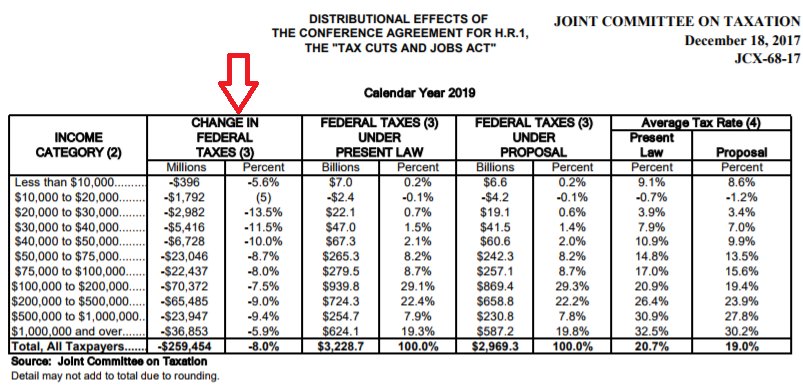 Riedl points out that the bottom 80 percent of U.S. families income-wise, which pay 30 percent of federal income taxes, will get 35 percent of the tax cuts, and the top 1 percent of families, who pay 27 percent of federal taxes, will get just 21 percent of the tax cuts. Instead of being eliminated as was originally proposed, the state and local tax deduction is being limited to $10,000 in sales, property and income taxes, and the home mortgage interest deduction is being limited to $750,000 in principal. (The average house value in Wisconsin is $166,100 according to
  The tax cut bill cuts taxes on business, though not enough, since the correct business tax rate is zero. However, the tax cut already is producing dividends, as
  Steve Prestegard.com: The Presteblog