Skepticism toward the media is most often associated with conservatives in Middle America, some of whom eat something other than artisanal sandwiches. But this week brings more evidence that investors worldwide have become very reluctant to buy what many established news organizations are selling. How else to explain the collective shrug of the shoulders in financial markets to the latest breathless media reports about alleged collusion between the 2016 Trump campaign and Russia?
Such reports have dominated this week’s news as much of the professional commentariat has pondered out loud whether treason has been committed in the President’s inner circle. Yet after an ever-so-slight hiccup on Tuesday following Donald Trump Jr.’s release of emails regarding a meeting he took last June with a Russian lawyer, stocks drifted higher. Since then, investors have spent much of their time parsing the remarks of Federal Reserve Chair Janet Yellen.Reassured by her questionable suggestion that interest rates won’t have to rise very fast or very far in the years ahead, they continue to keep market indexes near record levels.
Investors in the aggregate obviously don’t believe that the republic is coming to an end, nor do they seem to expect a wrenching change in U.S. leadership. There have been similar episodes over the last several months of sharp divergence between the collective analytical judgment of journalists and that of investors. This era of reported turmoil has been marked by a striking lack of volatility in the financial markets. Stocks aren’t cheap by historical standards and corrections do happen.
Yet the world’s investors still like U.S. equities, despite constant media reports that U.S. constitutional governance is hanging in the balance. Now let’s look at the general population in the U.S. A new report from the Pew Research Center also suggests that the news media’s credibility problem reaches well beyond the hard-core MAGA crowd. A full 85% of Republicans and those who lean Republican have a negative view of the national news media. And even among Democrats and those who lean Democratic, the press corps is underwater, with 46% holding a negative view compared to 44% holding a positive one.
Each respondent may distrust the media for a different reason. And perhaps investors are not so much ignoring the reported news as they are trying to strike a balance between conflicting reports. For example, let’s say that an investor has concluded that the New York Times and the Washington Times are equally trustworthy. A reader of this story from the New York paper is bound to take away a very pessimistic view of the current White House:
As Air Force One jetted back from Europe on Saturday, a small cadre of Mr. Trump’s advisers huddled in a cabin helping to craft a statement for the president’s eldest son, Donald Trump Jr., to give to The New York Times explaining why he met last summer with a lawyer connected to the Russian government. Participants on the plane and back in the United States debated how transparent to be in the statement, according to people familiar with the discussions.
Ultimately, the people said, the president signed off on a statement from Donald Trump Jr. for The Times that was so incomplete that it required day after day of follow-up statements, each more revealing than the last. It culminated on Tuesday with a release of emails making clear that Mr. Trump’s son believed the Russian lawyer was seeking to meet with him to provide incriminating information about Hillary Clinton as “part of Russia and its government’s support for Mr. Trump.”
The Russia story has become the brier patch from which the president seemingly cannot escape.
But an investor reading this Washington Times story published the same day may conclude that the real danger to the republic was narrowly avoided last November:
While the mainstream news media hunts for evidence of Trump-Russia collusion, the public record shows that Democrats have willfully used Moscow disinformation to influence the presidential election against Donald Trump and attack his administration.
The disinformation came in the form of a Russian-fed dossier written by former British intelligence agent Christopher Steele. It contains a series of unverified criminal charges against Mr. Trump’s campaign aides, such as coordinating Moscow’s hacking of Democratic Party computers.
Some Democrats have widely circulated the discredited information. Mr. Steele was paid by the Democrat-funded opposition research firm Fusion GPS with money from a Hillary Clinton backer. Fusion GPS distributed the dossier among Democrats and journalists. The information fell into the hands of the FBI, which used it in part to investigate Mr. Trump’s campaign aides.
Mr. Steele makes clear that his unproven charges came almost exclusively from sources linked to the Kremlin and Russian President Vladimir Putin. He identified his sources as “a senior Russian Foreign Ministry figure,” a former “top level Russian intelligence officer active inside the Kremlin,” a “senior Kremlin official” and a “senior Russian government official.”
While investors may be unnerved to learn how many political operators of both parties seem eager to glean opposition research from Russian sources, they apparently still don’t see it as a threat to American prosperity, or the rule of law on which it depends.
Category: US business
-
No comments on The media vs. the market
-
The biggest news in sports media this week was Wednesday’s layoffs of 100 ESPN employees.
As someone who was told not to go to work the next day or any future day by an employer (which event started this blog six years ago), I have sympathy for those laid off. It seems highly unlikely that ESPN’s business problems are the fault of, for instance, Ed Werder, ESPN’s 17-year NFL reporter, or Jayson Stark, ESPN’s 17-year baseball reporter. Evidence that life is unfair is that the worker bees get laid off instead of those on the executive floor whose bad decisions caused bad financial results that led to the need for those layoffs.
ESPN’s problems are driven by economics, in two directions. Former ESPN, well, whatever he was Colin Cowherd opined, and Awful Announcing heard him say …
Speaking on 92.3 The Fan in Cleveland, Cowherd said he knew things were going to change at ESPN when he learned of the news that the network had signed a huge megadeal to keep the NBA:
“I told my producers … ‘fellas, it’ll never be the same here.’ You can not pay four times for the house what you paid for the house last year. And I said this company will never be the same.
“It was at that point I started looking, and this is not going to end today. They have really cost-prohibitive contracts, combined with cord-cutting.
“I said this when they cut 850 people, I said it the next day, it’s awful, and it will happen annually for the next decade. You have to have contracts …”
And regarding the layoffs, Cowherd noted that the overpayment for the NBA and in particular, the NFL has come back to bite ESPN and it’s forced the company into layoffs:
“These firings are awful. It makes me sick.
“The good news is – most of the people let go are really talented, but this is all about business, and when you have overpaid for products, sometimes six and seven hundred million more than you had to pay, certainly with the NBA that’s the case, they just pay way too much for it. This is the result, it’s awful, and I think unfortunately this was the first of a 10-year deal with the NBA and I just feel awful – there’s are a lot of good people.”
But he added that he feels that ESPN has let go of the most expensive people at the company and that “a lot of them are going to land in really good places.”
The other half is that ESPN charges cable operators more than $7 per subscriber per month, and of course those charges are passed on to cable customers. Cable companies’ failure to get viewers the channels they want and not pay for the channels they don’t want has prompted cancellation of cable TV. ESPN has lost about 10 million subscribers over the past three years.
ESPN has a website, and has an app. But if you’re not a cable subscriber, you can’t see live games on either, including WatchESPN. (You also can’t see live games even if you are a cable subscriber if your cable company doesn’t offer WatchESPN.)
Even if you’re a sports fan there are a lot of ESPN “sports” not worth watching, including so-called “extreme” sports, Mixed Martial Arts (imagine boxing with no rules) and poker, and has replaced them with far too many debate shows. Part of it is that ESPN has lost a few properties, including the baseball postseason, the National Hockey League, and NASCAR auto racing, and according to viewers (of which I am not), its news coverage of sports it doesn’t cover has dropped precipitously.
What viewers may find somewhat ridiculous is who is still at ESPN — namely, Chris Berman, whose best days are well past him, and Stephen A. Smith. The latter got rather defensive about his job status, as reported by Alex Putterman:
In the midst of ESPN’s massive round of layoffs Wednesday, more than a few people brought up Stephen A. Smith as evidence of how the Worldwide Leader had gone astray. How, people wondered, could ESPN fire so many great reporters while keeping a loudmouth hot-take artist like Stephen A. Smith around to appear on First Take and numerous other shows?
Among the legions making some version of that argument was former Sports Illustrated writer and best-selling author Jeff Pearlman, who called Smith’s employment in the face of layoffs “an assault on the profession.” …
Well Stephen A. Smith puts up with a lot of crap, but he apparently wasn’t willing to put up with that. On his radio show Thursday, he addressed Pearlman’s criticism, as well as the general perception that he is unqualified for such a lofty position at ESPN.
Smith began the segment by saying he didn’t like to respond to criticism but that he felt compelled to in this case. He then described the layoffs as business-related and implied that he was protected because his show is popular and well-rated. Then he really got going:
I’m going to ask Mr. Jeff Pearlman and all the Jeff Pearlmans of the world a simple question: Why are you focusing on me? There are people in our business who actually get paid more, who do less and produce less. Why are you not talking about them?
…
Like when they call me ‘Screamin’ A?’ I’m the only dude on the air who’s loud? I know plenty of white dudes who are screaming and going off. They’re called passionate. I’m called loud. … The real issue at hand is, what you’re bringing into question are my qualifications.
Smith then listed out his career history, from graduating from Winston-Salem State University to holding numerous internships to working at several newspapers, including the Philadelphia Inquirer, where he was promoted again and again until he became on of the only black sports columnists in the country.
His point was simple: He worked hard to earn the position he’s currently in.
Some people will surely balk at Smith’s invocation of race, but he wasn’t really calling Pearlman racist or suggesting all criticism of him is due to his skin color (though undoubtedly some fraction of it is). This was his main idea:
I used to be a journalist? Mr. Pearlman, you used to be a college student. You used to be a high-school student. Last time I checked, there’s a level of elevation that took place because you graduate to certain levels. I’m not a blogger. I came up in this industry where you had to be a journalist. You had to break stories. You had to break news in order to elevate your career to get to a certain point to get to a certain level before you even had the license to give your opinion, especially if you were a black man.
Mr. Pearlman’s not black, maybe that’s why he doesn’t understand where I’m coming from. Maybe that’s why he’s so quick to talk about what I have deserved. I gave ya’ll my resume. I transferred from newspaper to television, from television to television and radio. I’ve done this. My credentials speak for themselves. I’m so sick and tired of people coming at me. If you want to talk credentials, name the time and place. Tell me what level I didn’t work on.
Smith repeatedly complimented Pearlman, saying he would never dare question another writer’s credentials.
Stephen A. is absolutely 100 percent correct that he has the resume for the position he’s in, that he worked his way up the ladder and earned bigger and bigger roles, and that it’s not easy to get to where he is now. Without question, his critics lose sight of that all the time, unfairly depicting him as a brainless carnival barker.
However, it’s certainly fair to wonder why Smith uses his hard-earned position to propagate a high-pitched, disagreement-centered, occasionally offensive model of television that risks undermining the more journalistic aspects of the industry—and to question why that’s the model ESPN chooses to reward.
The 800-pound gorilla in the room, however, is ESPN’s conscious decision to insert politics into its sports coverage. Those who approve of this have sworn up and down all week that that has nothing to do with ESPN’s current financial problems. Certainly it’s not the primary cause, but if cable subscribers are dropping you, and some number of your viewers are not fans of the liberal politics you’re espousing, one would logically seem connected to the other.
ESPN quotes a fellow La Follette Lancer (we were in the same journalism class) on its editorial policy:
ESPN has issued new political and election guidelines for its employees that, while allowing for political discussion on the network’s platforms, recommend connecting those comments to sports whenever possible. The new policies also provide separate guidelines for ESPN staffers working on news and those engaging in commentary. …
“Given the intense interest in the most recent presidential election and the fact subsequent political and social discussions often intersected with the sports world, we found it to be an appropriate time to review our guidelines,” said Patrick Stiegman, ESPN’s vice president of global digital content and the chairman of the company’s internal Editorial Board, which drafted the new guidelines.
Stiegman said no single issue or incident led to the change, but Craig Bengtson, ESPN’s vice president and managing editor of newsgathering and reporting, said the nation’s tense political climate did play a role.
“We have the convergence of a politically charged environment and all these new technologies coming together at once,” he said. “Based on that, we wanted the policy to reflect the reality of the world today. There are people talking about politics in ways we have not seen before, and we’re not immune from that.”
Stiegman said the new election guidelines are no longer just targeted at presidential elections. “We simply extended our approach to covering presidential elections every four years to major elections, in general, believing all the same principles should apply,” Stiegman said.
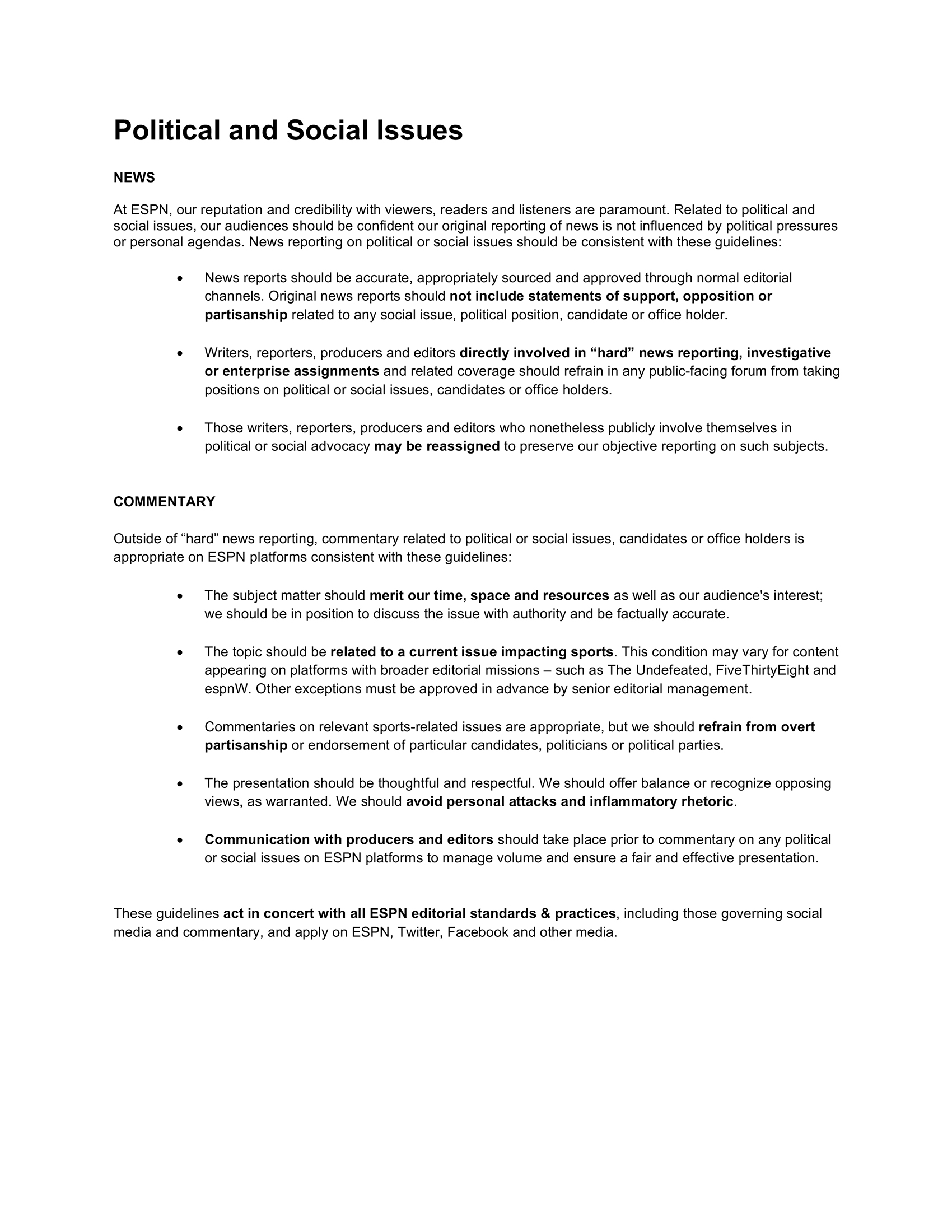
So what’s different in the new policies? Let’s start with the Political and Social Issues guidelines. Its first line lays out ESPN’s challenge quite accurately:
“At ESPN, our reputation and credibility with viewers, readers and listeners are paramount. Related to political and social issues, our audiences should be confident our original reporting of news is not influenced by political pressures or personal agendas.”
As I wrote in November, not all ESPN consumers — or employees, for that matter — feel the company has lived up to this ideal. Stiegman said that the buzz around the topic of ESPN and politics — also written about by The New York Times, Awful Announcing, the Orlando Sentinel and many conservative sites criticizing ESPN’s perceived leftward tilt — didn’t play a significant role in the revision of the guidelines.
The two most notable changes from the Political Advocacy policy are the delineation of guidelines between news and commentary, and allowing for increased political discussion on ESPN platforms, as warranted and connected to sports. This isn’t a surprising development, it’s just new.
“We wanted to err on the side of transparency and trust with our reporting,” Stiegman said, “but also give our columnists and commentators the freedom to discuss topics relevant to those sports fans who visit our platforms, even if the issues are political or social in nature.”
Here are other notable points in the Political and Social Issues policy, with my thoughts:
“Original news reports should not include statements of support, opposition or partisanship related to any social issue, political position, candidate or office holder.”
This one seems straightforward and achievable, at least within ESPN’s platforms. The one place on ESPN in which you don’t see straight opinion is on the hard news side of the operation.
“Writers, reporters, producers and editors directly involved in ‘hard’ news reporting, investigative or enterprise assignments and related coverage should refrain in any public-facing forum from taking positions on political or social issues, candidates or office holders.”
The three key words here are “public-facing forum.” That expands this policy beyond ESPN’s borders and brings the Wild West of social media into play. In fact, later in the memo, it is said directly that the policy applies to “ESPN, Twitter, Facebook and other media.”
This is where the potential for problems exists. ESPN news reporters tweeting political opinions from their own social accounts would technically violate this policy. Again, hard news reporters are less likely to use social media for this purpose than commentators, but how effective this policy is will depend on how hard executives choose to look at social media. Let’s be honest: It’s not too hard to find ESPN employees tweeting political opinions. Yes, much of that activity does fall within the new guidelines, which also note that those who do publicly express political views could be reassigned when covering stories. But the propriety of other posts is a tad murkier.
“Outside of ‘hard’ news reporting, commentary related to political or social issues, candidates or office holders is appropriate on ESPN platforms consistent with these guidelines.”
This is meaningful because, unlike the company’s previous policy, it states that commentary on political and social issues is OK. The previous policy not only didn’t say that but also conveyed a tone that suggested that dipping into political waters carried more danger than reward. Put another way, the new policy has gone from “It’s dangerous out there, so probably best to stay home” to “It’s dangerous out there, so here are some tools to best keep you safe.” …
“The presentation should be thoughtful and respectful. We should offer balance or recognize opposing views, as warranted. We should avoid personal attacks and inflammatory rhetoric.”
What is a “personal attack” and what’s considered “inflammatory”? As with many journalistic policy questions, those are subjective. And in policies like these, that can lead to caution.
“There is always a layer of subjectivity in such areas,” Stiegman said. “Editors and producers will work with those offering opinions on these topics to ensure the dialogue and debate is thoughtful, respectful and as fair as possible.”
That is not happening, according to Ben Shapiro back in November:
From giving Caitlyn Jenner a heroism award to stumping for Black Lives Matter, from pushing gun control to praising Kaepernick’s heroism, from firing Curt Schilling for expressing anti-radical Islam sentiments to threatening Chris Broussard for taking a religious view of homosexuality while doing nothing about Kevin Blackistone for calling the national anthem a “war anthem,” ESPN has become – as I’ve long said – MSNBC with footballs.
Now, ESPN’s public editor is admitting that the network has a problem. As Newsbusters reports, Jim Brady admitted, “One notion that virtually everyone I spoke to at ESPN dismisses is what some have perceived as unequal treatment of conservatives who make controversial statements vs. liberals who do the same.” He added:
ESPN is far from immune from the political fever that has afflicted so much of the country over the past year. Internally, there’s a feeling among many staffers — both liberal and conservative — that the company’s perceived move leftward has had a stifling effect on discourse inside the company and has affected its public-facing product. Consumers have sensed that same leftward movement, alienating some…. For most of its history, ESPN was viewed relatively apolitically. Its core focus was — and remains today, of course — sports. Although the nature of sports meant an occasional detour into politics and culture was inevitable, there wasn’t much chatter about an overall perceived political bias. If there was any tension internally, it didn’t manifest itself publicly.
Brady talked to anchor Bob Ley, who admitted that ESPN has no “diversity of thought.” A conservative employee told Brady that “If you’re a Republican or conservative, you feel the need to talk in whispers.” Jemele Hill, naturally, said “I would challenge those people who say they feel suppressed. Do you fear backlash, or do you fear right and wrong?”
This is the problem. And this is why ESPN and the media more generally fail. It is suppression to label those who disagree with you politically morally evil because they disagree. Yet that’s what Hill does. That’s what ESPN does, too. The left believes its opinions and feelings are facts; those who disagree are therefore either morons or fascists. That’s why Hill thinks Schilling should have been fired for putting up a meme expressing that transgender people should go to the bathroom in the restroom that matches their biological sex. Schilling must be evil.
That perspective comes across in ESPN’s casual leftism. And it alienates viewers. I’m one of them. I used to watch ESPN every time I worked out. Now I’d rather have the television off. I’m not interested in hearing talking heads who know less about politics than they do about water polo take for granted that they are morally righteous, and everyone on the right is morally obtuse. Screw them. I’d rather cut the cord entirely.
Sean Davis says:
The industry insider I spoke to said the focus on politics was a symptom, rather than a root cause, of all these current issues. According to this insider, ESPN executives saw the writing on the wall — higher costs, subscriber losses, lower ratings — and decided that it needed a bigger content pie to attract more content consumers. Sports is too small, so why not try for a real mass audience by broadening the network’s focus to include news and politics? If X number of people like sports, and Y number of people like politics, then surely combining sports and politics will lead to a much bigger audience, thereby solving the company’s financial dilemma.
This view, of course, ignores how people consume political news. The diehards who love political news don’t turn on the TV or open the laptop and navigate to sites with zero bias that just play it straight. Why? Because those kinds of political news and commentary providers don’t exist. Because that’s not what political junkies want. Liberals want news from liberals, and conservatives want news from conservatives. The Balkanization of political news and commentary didn’t happen by accident. People in this business know you have to pick a side. That works in political news. It doesn’t work if you have a bipartisan mass media audience.
Instead of expanding its pie by combining two types of mass media content, ESPN ended up communicating to half its audience that it didn’t respect them. How? By committing itself entirely not to political news, but to unceasing left-wing political commentary.
You want to watch the Lakers game? Okay, but first you’re going to hear about Caitlyn Jenner. Want some NFL highlights? We’ll get to those eventually, but coming up next will be a discussion about how North Carolina is run by racist, homophobic bigots. You want to see the box scores of today’s baseball games? You can watch those at the bottom of the hour, but right now some D-list network talent would like to lecture you about gun control. After that we’ll have a panel discussion about how much courage it takes to turn your back on the American flag.
The most interesting aspect of the mass layoffs on Wednesday isn’t that they happened, it’s who the network targeted. Not the high-priced carnival barkers and the know-nothing loudmouths doing their best to make Rachel Maddow proud. Nope. ESPN targeted sports reporters. In an effort to cut some fat from its bottom line, ESPN exchanged a scalpel for a chainsaw, skipped the fat entirely, and went straight to cutting out muscle.
If ESPN wants to once again be the worldwide leader in sports, it should refocus on covering sports, which used to be a refuge from politics and the news. America is politicized enough already, and if its citizens want political news, several cable outlets do political news far better than ESPN ever could. Instead of doing sports and politics poorly, perhaps the network could return to the thing that it used to do better than everyone else in the world: cover live sports.
Unlike those with nothing more than opinions, Deep Root Analysis looks at data:
The FOX blog “Outkick the Coverage” has attributed ESPN’s decline to the rising partisanship coming out of Bristol, labeling the network “MSESPN” in pieces like this one, headlined “ESPN Profit Plummets As Network Turns Left”. “Outkick the Coverage’s” Clay Travis supports his argument with Scarborough data showing most sports fans are conservative politically. With the news of today’s layoffs, Travis argues that the network’s leftward turn is “more a symptom of the collapse than it is a cause of the collapse.”
Naturally, the news out of Bristol has led to a variety of “takes” across the Internet. The National Review Online wrote a warning about politicizing sports. Others have scoffed at the idea that partisanship has kept people from watching ESPN, even as ESPN’s public editor concedes that it is among “a set of smaller causes” harming ESPN. Perhaps the hottest take of the day claimed that “sports fans really don’t like anyone who stands up for civil rights.”
WHAT DOES THE DATA SAY?
But is there data to support the notion that Republicans are turning off ESPN as the network ramped up its political commentary during the 2016 election and beyond?
Deep Root Analytics specializes in local television measurement by segmenting the population into political, advocacy and commercial groups and matching those segments into observed TV viewership data via set-top boxes and smart TV data. This allows Deep Root to produce customized ratings and indices for every program and daypart on broadcast and cable TV – including data on ESPN’s viewership among loyal Democrats and Republicans.
We analyzed viewership data in a large media market in a swing state (Cincinnati, OH) for the entirety of 2015 and 2016. Also, to control for any changes in partisan identification between 2015 and 2016, Deep Root Analytics analyzed viewership among the same audiences across both years.
In our analysis, a clear trend emerges: ESPN’s viewership in this key swing state market became less Republican during 2016.
Specifically, in 2015, the ESPN audience on average skewed Republican across all dayparts, ranging from 12% more Republican (Early News, Late Fringe, Overnight) to 21% more Republican than Democratic (Early Morning).
In 2016, every daypart on ESPN became less conservative, with Daytime being only 2% more Republican than Democratic, while Late Fringe and Overnight programming became 10% and 12% more Democratic than Republican – a 22 and 28 point shift, respectively.
The same is true across other ESPN properties. ESPN2 skewed Republican across most dayparts in 2015; in 2016 all dayparts skewed Democratic. Every daypart also switched on ESPN News from 2015 to 2016.
ESPNU was the only network that retained its mostly Republican audience. ESPN Deportes – the network’s Spanish language channel – became even more Democratic in 2016 than it already was in 2015.
Here is a complete look at the 2015-2016 shift in partisanship across ESPN networks:

To be sure, the ESPN layoffs signal a larger business challenge facing the network. But at least in Cincinnati, the partisanship of viewers noticeably shifted – just as ESPN’s problems got worse.
I would contend that there are more conservative fans of sports than liberal fans of sports. Conservatives did not create the odious phrase “the personal is political.” Conservatives did not create today’s culture of participation medals. Unlike most of life, sports is closer to black and white — team A defeats team B; athlete C finishes first, which means the rest do not.
Here is an example of ESPN’s self-defense, from its Undefeated site:
In sports, everything from choosing fantasy sports teams to selecting the teams that will play for big-time college football national championships is rooted in statistics and statistical analysis, wins and losses and strength of schedules. Further, in sports, everything from a player making an obscene gesture to a pro franchise abandoning one city for another can prompt earnest discussions about right and wrong, revenge, rehabilitation and forgiveness.
But in the nation’s public policy, we too often allow ideology and political maneuvering to render facts moot, especially when those facts support inconvenient truths such as global climate change. And morality, if it is acknowledged at all, is presumed to be the province of specific parties or ideologies, instead of governing our thinking, decisions and actions. From public education to health care, we focus more on the politics of changing public policy than the efficacy and morality of making the changes.
Consequently, our nation, a house divided, struggles to stand: We’re a people who talk to one another without a common political vocabulary, a people who seek to silence dissenting voices. We’re a people who seek to move without common direction, a people who would solve our problems without a consensus of what those problems are, or a common moral purpose to guide our actions.
The apologia for this comes from the oxymoronic Think Progress:
I truly wish this went without saying, but apparently it doesn’t: Reports of ESPN’s political agenda have been greatly exaggerated, and politics are absolutely not to blame for the cuts this week.
ESPN is not a political network. Its analysts do not spend hours debating the latest poll numbers, reporting on proposed legislation, or counting down to lawmakers’ town halls in their home districts.
ESPN covers sports. It just doesn’t pretend that those sports happen in a vacuum.
That means ESPN will cover stories like Colin Kaepernick’s protest during the national anthem, a team of WNBA players wearing “Black Lives Matter” t-shirts during warm-ups, and the domestic violence allegations against an potential NFL draftee.
Sports are an escape, yes, but they are also enriched and impacted by the real-life events happening around them. Covering these topics accurately and fairly when they directly intersect with the sports world isn’t politics, it’s journalism.
“The word ‘politics’ has become too all-encompassing,” SportsCenter host Jemele Hill said on the Sports Illustrated Media Podcast with Richard Deitsch in February. “Mike and I aren’t … breaking down the Affordable Care Act. That’s politics. Understanding somebody’s right to speak out against injustice, oppression, and police brutality, isn’t a political matter. It’s right or wrong.”
“‘Don’t hit women’ is not politics,” her co-host Michael Smith added.
“Sorry we don’t tolerate bigotry here. Why are you taking offense to us suggesting that African Americans — breaking news — have been treated differently and unfairly for the entirety of this country? That’s not a hot take.”
Of course, what Hill and Smith are touching on here is that when people complain about anything getting “too political,” it’s a safe bet the criticism is actually that it’s too liberal. And that usually implies it’s too diverse or too outspoken about inequality.
The president of the company has pushed back against this idea, too.
“The Walt Disney Company and ESPN are committed to diversity and inclusion,” ESPN President John Skipper said last year in response to similar accusations that the company had gotten too liberal. “We do not view this as a political stance but as a human stance. We do not think tolerance is the domain of a particular political philosophy.”
Interestingly, not everyone at ESPN seems to be on board. The New York Post reports:
ESPN’s sweeping staff cuts are not just the result of ambitious TV rights deals and an overburdened budget, popular “SportsCenter” anchor Linda Cohn suggested Thursday.
The network may be losing subscriber revenue not just because of cord-cutting, Cohn allowed, but because viewers are increasingly turned off by ESPN inserting politics into its sports coverage.
“That is definitely a percentage of it,” Cohn said Thursday on 77 WABC’s “Bernie and Sid” show when asked whether certain social or political stances contributed to the stupor that resulted in roughly 100 employees getting the ax this week. “I don’t know how big a percentage, but if anyone wants to ignore that fact, they’re blind.”
Cohn agreed with the argument that certain sports fans may have disapproved of the way ESPN covered polarizing figures such as Roger Goodell, Colin Kaepernick and Caitlyn Jenner.
The example used was of the 2015 ESPYs. Jenner, a former Olympic champion in the decathlon, won the prestigious Arthur Ashe Award for Courage for publicly coming out as a transgender woman. Some felt athletes suffering from disease or disability — such as college basketball player Lauren Hill, who died from cancer three months before the ceremony, and marathoner Noah Galloway, who lost an arm and a leg in the Iraq War — were more deserving.
Cohn, a 25-year ESPN veteran, toed the company line.
“You know, when you work for a big company, you have to follow in line, you have to pay the bills,” she said. “But you just kind of look in the mirror and do what you think is right no matter what else is going on around you. And that’s what I always tried to do.”
ESPN and its liberal sycophants are taking the usual liberal tack that any position other than their own is wrong and not worthy of consideration. As usual, the left approves of every kind of diversity except for political diversity.
Whether you agree with ESPN’s politics, or whatever causes you’d like to attribute to ESPN’s decline, ask yourself this question: If ESPN is losing viewers (and it is), why should ESPN go out of its way to alienate its (remaining) viewers?
-
GM Inside News reports:
General Motors has announced the leftist-led Venezuelan authorities have illegally seized its manufacturing plant and industrial hub in Valencia, reports Reuters.
The country of Venezuela, which remains in a deep economic crisis, did not respond to a request for comment on the situation when forwarded to the information ministry.
“Yesterday, GMV’s (General Motors Venezolana) plant was unexpectedly taken by the public authorities, preventing normal operations. In addition, other assets of the company, such as vehicles, have been illegally taken from its facilities,” the company said in a statement.
GM vowed to “take all legal actions” to defend its rights after the seizing halted operations in the country. GM estimates irreversible damage to take place and fears the worst for its 2,678 workers, 79 dealers and local suppliers.
The Venezuelan government isn’t a stranger to temporary taking things over. In 2014, the government seized two plants belonging to U.S. cleaning products maker Clorox Co which had left the country.
Many plants in the country are barely producing much of anything at all, thanks to dwindling raw materials and currency controls. In 2015, Ford wrote off its entire investment in the country by taking an $800 million pre-tax write-down.
If I were GM management I wouldn’t be holding my breath about those “legal actions.” I once erred on Wisconsin Public Radio when I mentioned that Hugo Chavez was president of Venezuela after he had died. Of course, the only discernible difference between Chavezuela and post-Chavez Venezuela is that the latter’s president is still breathing air.
Earlier, Venezuelan sources had reported the seizure stemmed from a 17-year-old lawsuit with a dealer group in Maracaibo, but it turns out the situation is much worse than first thought.
Enrique Tahan, head of corporate and government relations for General Motors in Venezuela, told the New York Times that the plant has effectively been occupied for the last 42 days after being taken over by one of the company’s unions.
GM did ask the government for help reclaiming the facility, but instead, in a stunning show of socialism, the government took over the Valencian plant for itself.
“In other words, we are twice out of control of our plant,” Mr. Tahan told The Grey Lady. Members of the union were still able to enter the plant after the takeover, but the government was still barring GMV’s managers from setting foot inside. …
This isn’t the first, nor the last time the Venezuelan government will take someone else’s stuff, since 1998 it has expropriated more than 1,400 private businesses.
Part of GM’s problem, according to CNN, is that it didn’t bail out of Venezuela fast enough:
A slew of global firms have pulled out of the country or been forced to halt operations as a result of government interference or moves to put key sectors of the economy under state control.
ExxonMobil (XOM) pulled the plug on its operations in Venezuela in 2007 after former President Hugo Chavez attempted to nationalize one of its projects. The oil producer then took the government to court.
In 2016, Kleenex maker Kimberly-Clark (KMB) suspended its operations in Venezuela, citing the country’s “rapidly escalating inflation” and the “continued deterioration of economic and business conditions.”
The government called the closure illegal. It took over operations at the facility days later, according to state-run media.
Coca-Cola (KO) was also forced to halt production of Coke and other sugar-sweetened beverages last year due to a sugar shortage.
The irony of Government Motors, bailed out by this country’s government (when it should not have been) almost a decade ago (losing the taxpayers $10.5 billion in the process), having its assets seized by another country’s government is certainly rich. Between GM’s illegal bailout (and associated unconscionable Cash for Clunkers) and its failure to figure out it needed to leave (even though GM had been in the country for seven decades because it wanted to sell cars in South America), I can’t say I have much sympathy for GM, though there is no case where nationalizing an industry is an appropriate government activity.
Jazz Shaw adds:
If nothing else, this incident will provide an enlightening, educational moment for the rest of the world. It’s a given that this is bad news for General Motors, for the workers there… let’s just say it. This is bad news for everyone except Maduro and his cronies. But it also serves to further pull away the mask, allowing the rest of the world to see what’s actually going on. So gather around, kids, because we’re not only seeing how socialism ends (and it always ends this way) but also how the socialist machinery operates through the various phases of its life cycle.
Originally, the government tolerates the presence of foreign manufacturing entities such as General Motors to fill needs they have which can’t be handled domestically. (GM has been there for roughly seven decades.) It’s not that the Venezuelan people are incapable of innovation or creation… there’s simply no motivation for them to strive for success. Anything they create simply becomes the property of the state anyway, so the hard working, innovative person doesn’t realize much more success than the guy who can barely keep his eyes open to show up for his job sweeping the sidewalk. There’s no point to being particularly innovative.
So companies such as GM are allowed to go to work. But once the system inevitably begins to implode, the tyrant in charge begins looking for new resources to grab. In the name of the socialist concept wherein everything “belongs to the people” he seizes the GM plant. They take the cars which are there to hand out to high ranking party officials and divide up the assets while demanding that the workers get back to producing automobiles. This is, of course, impossible because they don’t have the parts to do it and the people who actually know how to run things are fleeing.
These are the fruits of socialism. It’s a humanitarian disaster to be sure, but it’s also a teachable moment. Watch and learn.
-
The Organization Man, whom we first met in 1956, is still very much with us. And his eccentric career since that time partly answers a question that mystifies many contemporary conservatives: Given that progressives profess to hate corporations, why are our corporate leaders so progressive? It is easy to understand their taking a self-interested stand against the Trump administration over things such as the H-1B program and visa waivers, which interfere with their access to workers and customers, respectively. But 130 corporate leaders — including the CEOs of American Airlines and Bank of America — getting together to come down on North Carolina over public-bathroom rules that annoy transgender activists? Together with business leaders who have no presence in North Carolina and nothing to do with the state or its politics?
Is it only cravenness — or something more?
In the progressive lexicon, the word “corporation” is practically a synonym for “evil.” Corporations, in the progressive view, are so stoned on greed and ripped on ruthlessness that they present an existential threat to democracy as we know it. When the Left flies into a mad rage about . . . whatever, the black-bloc terrorists don’t burn down the tax office or the police station: They smash the windows of a Starbucks, never mind CEO Howard Schultz’s impeccably lefty credentials.
Weird thing, though: With the exception of a few big shiny targets such as Koch Industries (the nation’s second-largest privately held concern, behind Cargill) and Walmart (the nation’s largest private employer), the Left’s corporate enemies list is dominated by relatively modest concerns: Chick-fil-A, which, in spite of its recent growth spurt, is only a fraction of the size of McDonald’s or YUM Brands; Hobby Lobby, which is not even numbered among the hundred largest private U.S. companies; Waffle House, a regional purveyor of mediocre grits and a benefactor of Georgia Republicans. Carl’s Jr. was founded by a daily communicant and Knight of Malta, a man who had some not-very-progressive opinions about gay rights. But even in its new role as part of a larger corporate enterprise (the former CEO of which, Andrew Puzder, had been nominated for secretary of labor), the poor man’s answer to In-N-Out is not exactly in a position to inflict ultramontane Catholicism on the world at large, though the idea of a California Classic Double Inquisition with Cheese is not without charm.
Far from being agents of reaction, our corporate giants have for decades been giving progressives a great deal to celebrate. Disney, despite its popular reputation for hidebound wholesomeness, has long been a leader on gay rights, much to the dismay of a certain stripe of conservative. Walmart, one of the Left’s great corporate villains, has barred Confederate-flag merchandise from its stores in a sop to progressive critics, and its much-publicized sustainability agenda is more than sentiment: Among other things, it has invested $100 million in economic-mobility programs and doubled the fuel efficiency of its vehicle fleet over ten years. Individual members of the Walton clan engage in philanthropy of a distinctly progressive bent.
In fact, just going down the list of largest U.S. companies (by market capitalization) and considering each firm’s public political activism does a great deal to demolish the myth of the conservative corporate agenda. Top ten: 1) Apple’s CEO, Tim Cook, is an up-and-down-the-line progressive who has been a vociferous critic of religious-liberty laws in Indiana and elsewhere that many like-minded people consider a back door to anti-gay discrimination. 2) When protesters descended on SFO to protest President Donald Trump’s executive order on immigration, one of the well-heeled gentlemen leading them was Google founder Sergey Brin, and Google employees were the second-largest corporate donor bloc to President Barack Obama’s reelection campaign. 3) Microsoft founder Bill Gates is a generous funder of programs dedicated to what is euphemistically known as “family planning.” 4) Berkshire Hathaway’s principal, Warren Buffett, is a close associate of Barack Obama’s and an energetic advocate of redistributive tax increases on high-income taxpayers. 5) Amazon’s Jeff Bezos put up $2.5 million of his own money for a Washington State gay-marriage initiative. 6) Facebook’s Mark Zuckerberg has pushed for liberal immigration-reform measures, while Facebook cofounder Dustin Moskovitz pledged $20 million to support Hillary Rodham Clinton and other Democrats in 2016. 7) Exxon, as an oil company, may be something of a hate totem among progressives, but it has spent big — billions big — on renewables and global social programs. 8) Johnson & Johnson’s health-care policy shop is run by Liz Fowler, one of the architects of Obamacare and a former special assistant to President Obama. 9) The two largest recipients of JPMorgan cash in 2016 were Hillary Rodham Clinton and the Democratic National Committee, and the bank’s billionaire chairman, Jamie Dimon, is a high-profile supporter of Democratic politicians including Barack Obama and reportedly rejected an offer from President Trump to serve as Treasury secretary. 10) Wells Fargo employees followed JPMorgan’s example and donated $7.36 to Mrs. Clinton for every $1 they gave to Trump, and the recently troubled bank has sponsored events for the Human Rights Campaign, GLAAD, and other gay-rights groups, as well as donated to local Planned Parenthood franchises.
Even the hated Koch brothers are pro-choice, pro-gay, and pro-amnesty.
You may see the occasional Tom Monaghan or Phil Anschutz, but, on balance, U.S. corporate activism is overwhelmingly progressive. Why?
For one thing, conservatives are cheap dates. You do not have to convince the readers of National Review or Republicans in Valparaiso that American business is in general a force for good in the world. But if you are, e.g., Exxon, you might feel the need to convince certain people, young and idealistic and maybe a little stupid in spite of their expensive educations, that you are not so bad after all, and that you are spending mucho shmundo “turning algae into biofuel,” in the words of one Exxon advertisement, and combating malaria and doing other nice things. All of that is true, and Exxon makes sure people know it. The professional activists may sneer and scoff, but they are not the audience.
Even if it were only or mainly a matter of publicity (and it isn’t — Shell, among other oil majors, is putting real money into renewables and alternative energy), big companies such as Exxon and Apple would still have a very strong incentive to engage in progressive activism rather than conservative activism.
For one thing, there is a kind of moral asymmetry at work: Conservatives may roll their eyes a little bit at promises to build windmills so efficient that we’ll cease needing coal and oil, but progressives (at least a fair portion of them) believe that using fossil fuels may very well end human civilization. The nation’s F-150 drivers are not going to organize a march on Chevron’s headquarters if it puts a billion bucks into biofuels, but the nation’s Subaru drivers might very well do so if it doesn’t.
The same asymmetry characterizes the so-called social issues. The Left will see to it that Brendan Eich is driven out of his position at Mozilla for donating to an organization opposed to gay marriage, but the Right will not see to it that Tim Cook is driven out of his position for supporting gay marriage. For the Right, the question of gay marriage is an important moral and political disagreement, but for the Left the exclusion of homosexual couples from the legal institution of marriage was something akin to Jim Crow, and support for it isn’t erroneous, it is wicked. Even those on the right who proclaim that they regard the question of homosexual relationships as a national moral emergency do not behave as though they really believe it: Remember that boycott of Disney theme parks launched with great fanfare by the American Family Association, Focus on the Family, and the Southern Baptist Convention back in 1996? Nothing happened, because conservative parents are not telling their toddlers that they cannot go to Disney World because the people who run the park are too nice to that funny blonde lady who has the talk show and dances in the aisles with her audience.
The issues that conservatives tend to see as life-and-death issues are actual life-and-death issues, abortion prominent among them. But even among right-leaning corporate types, pro-life social conservatism is a distinctly minority inclination.
And that is significant, because a great deal of corporate activism is CEO-driven rather than shareholder-driven or directly rooted in the business interests of the firm. Like Wall Street bankers, who may not like their tax bills or Dodd-Frank but who tend in the main to be socially liberal Democrats, the CEOs of major U.S. corporations are, among other things, members of a discrete class. The graduates of ten colleges accounted for nearly half of the Fortune 500 CEOs in 2012; one in seven of them went to one school: Harvard. A handful of metros in California, Texas, and New York account for a third of Fortune 1000 headquarters — and there are 17 Fortune 1000 companies in one zip code in Houston. Unsurprisingly, people with similar backgrounds, similar experiences, and similar occupations tend to see the world in a similar way. “A new breed of chief executive is emerging — the CEO activist,” wrote Leslie Gaines-Ross, of Weber Shandwick, a global PR giant that advises Microsoft and had the unenviable task of working with Centers for Medicare and Medicaid Services on the ACA rollout. “A handful of CEOs are standing up and standing out on some of the most polarizing issues of the day, from climate change and gun control, to race relations and same-sex marriage.” Hence chief executives’ joining en masse the great choir of hysteria on the question of toilet law in the Tar Heel State.
Whereas the ancient corporate practice was to decline to take a public position on anything not related to their businesses, contemporary CEOs feel obliged to act as public intellectuals as well as business managers. Many of them are genuine intellectuals: Gates, PepsiCo’s Indra Nooyi, Goldman Sachs’s Lloyd Blankfein. And, like Hollywood celebrities, almost all of them are effectively above money.
Some of them are rock-star entrepreneurs. But most of them are variations on the Organization Man, veterans of MBA programs, management consultancies, financial firms, and 10,000 corporate-strategy meetings. If you have not read it, spare a moment for William H. Whyte’s Cold War classic. In the 1950s, Whyte, a writer for Fortune, interviewed dozens of important CEOs and found that they mostly rejected the ethos of rugged individualism in favor of a more collectivist view of the world. The capitalists were not much interested in defending the culture of capitalism. What he found was that the psychological and operational mechanics of large corporations were much like those of other large organizations, including government agencies, and that American CEOs believed, as they had believed since at least the time of Frederick Winslow Taylor and his 19th-century cult of “scientific management,” that expertise deployed through bureaucracy could impose rationality on such unruly social entities as free markets, culture, family, and sexuality. The supplanting of spontaneous order with political discipline is the essence of progressivism, then and now.
It is hardly a new idea. The old robber barons were far from being free-enterprise men: J. P. Morgan and Andrew Carnegie, like many businessmen of their generation, believed strongly in state-directed collusion among firms (they’d have said “coordination”) to avoid “destructive competition.” You can draw a straight intellectual line from their thinking to Barack Obama’s views about state-directed “investments” in alternative energy or medical research.
It is not difficult to see the temptations of that approach from the point of view of a Bill Gates or a Warren Buffett: The decisions they have made for themselves have turned out well, so why not empower them, or men like them, to make decisions for other people, too? They may even be naïve or arrogant enough to believe that their elevated stations in life have liberated them from self-interest.
Populists of the Trump variety and the Sanders variety (who are not in fact as different as they seem) are not wrong to see these corporate cosmopolitans as members of a separate, distinct, and thriving class with economic and social interests of its own. Those interests overlap only incidentally and occasionally with those of movement conservatives — and overlap even less as the new nationalist-populist strain in the Republican party comes to dominate the debate on questions such as trade and immigration. Under attack from both the right and the left, free enterprise and free trade increasingly are ideas without a party. As William H. Whyte discovered back in 1956, the capitalists are not prepared to offer an intellectual defense of capitalism or of classical liberalism. They believe in something else: the managers’ dream of command and control.
-
Author William D. Cohan:
The conversation we’ve been having about Wall Street in this country for the past decade has become so utterly hyperbolic and polemic that if you’re like most people, amid all the outrage you’ve totally lost the thread of the discussion. Maybe you think the whole system is rotten to the core. Maybe you think, sure, there’s greed, excess, and bad behavior on Wall Street, with nary a consequence for those responsible, but is the right answer to these problems to break up the big banks? Maybe that’s about when you just checked out.
Even the phrase “Wall Street” conjures confusion. What are we talking about? The actual place? Just the very biggest investment banks, or the smaller ones, too? Does the term include hedge funds and private-equity firms?
Are we talking about the entire New York finance community? Do we include the banks, hedge funds, and private-equity firms in the rest of the country? What about the financial system of the entire globe? What are we even referring to anymore?
The questions keep piling up. Maybe we can define what we mean by Wall Street, but even if we do, how should we feel about it? Should we be angry that Wall Street seems to be nothing more than a festering, open wound of rampant self-interest and malfeasance? Or should we be happy that Wall Street has become a convenient metaphor that politicians use to park blame for every bad economic thing that has befallen the country in recent years?
Or could it be that Wall Street is something altogether very different? Is Wall Street the left ventricle of capitalism, the brilliantly designed engine that powers innovation, job growth, and wealth creation and that has become the most sustained way by which billions of people the world over have been lifted out of poverty and given a chance at a better, more economically fulfilling life?
Is Wall Street a cause for celebration or denigration?
This is a fundamental question that has become so supercharged that most people haven’t a clue how to answer it. Or don’t dare to try. But if pressed, their instinct would be to agree with Jean-Jacques Rousseau, the eighteenth-century Enlightenment philosopher, who once said that “finance” is “a slave’s word,” while the profession itself is nothing more than “a means of making pilferers and traitors, and of putting freedom and the public good upon the auction block.”
The modern-day equivalent of this sentiment can be found in the musings of Bernie Sanders, the U.S. senator from Vermont and former Democratic presidential candidate, whose stump speeches during the 2016 presidential campaign condemned Wall Street relentlessly. “Greed, fraud, dishonesty and arrogance, these are the words that best describe the reality of Wall Street today,” he said in January 2016. And then he paid homage to one of the most recognizable cultural touchstones about modern Wall Street when he referred to the famous “Greed is good” scene in Wall Street, the 1987 Oliver Stone film, where Gordon Gekko, played with oleaginous glee by Michael Douglas, lectures Bud Fox, his young and aspiring apprentice (played by Charlie Sheen). “So, to those on Wall Street who may be listening today, let me be very clear,” Senator Sanders continued. “Greed is not good. In fact, the greed of Wall Street and corporate America is destroying the fabric of our nation . . . We will no longer tolerate an economy and a political system that has been rigged by Wall Street to benefit the wealthiest Americans in this country at the expense of everyone else.”
Senator Sanders used his growing political power to influence the anti–Wall Street rhetoric of the Democratic Party’s 2016 platform. “To restore economic fairness,” the platform reads, “Wall Street cannot be an island unto itself, gambling trillions in risky financial instruments and making huge profits, all the while thinking that tax-payers will be there to bail them out again. We must tackle dangerous risks in big banks and elsewhere in the financial system.” And to do this, the Democrats advocated “breaking up too-big-to-fail financial institutions that pose a systemic risk to the stability of our economy” and an “updated and modernized” version of the so-called Glass-Steagall Act of 1933, which forced the separation of investment banking from commercial banking for the next sixty-six years, until its repeal in 1999. Plugging his new book, Our Revolution: A Future to Believe In, after the election of Donald Trump, Senator Sanders continues to lambast Wall Street. Hell, Wall Street has grown so unpopular that even the 2016 Republican Party platform called for the reinstatement of Glass-Steagall. Just think about that for a moment. Rest assured, Trump’s victory does not necessarily mean that the populist anger directed toward Wall Street dissolves overnight.
So, is Senator Sanders correct? Is Wall Street actually rigged to benefit the rich in America at the expense of everyone else? Or is what Wall Street does in its many guises a monumentally important, utterly irreplaceable way that capital gets allocated in the most efficient, fairly priced manner from the people who have it to the people who want it?
To be sure, there are many crucial challenges facing the world today—among them climate change, income inequality, suppression of human rights, nuclear proliferation, and political unrest—but our collective failure to decide whether Wall Street is a force for good or one for evil, whether it should be celebrated or dismantled, certainly ranks high among them and effectively precludes us from having a much-needed debate about what Wall Street does right, and should be encouraged, and what Wall Street does wrong, and should be eliminated.
People get rightfully befuddled by most of the words used by Wall Street bankers, traders, and executives. If you’re like most people, though, once you hear the term “leveraged buyout” or “credit default swap,” your eyes glaze over and you mentally check out. Or maybe you are just utterly confused by the fact that after attacking Wall Street mercilessly during his campaign, Donald Trump has surrounded himself with Wall Street veterans.
But here’s the thing: If you like your iPhone (which you clearly do, because more than one billion iPhones have been sold worldwide since its inception in June 2007), or your wide-screen TV, or your car, or your morning bacon, or your pension, or your 401(k), then you are a fan of Wall Street, whether you know it or not. If you like the power and functionality of Facebook, Snapchat, and Twitter, you actually like Wall Street. None of these things would be even remotely possible to have, in the size and the scope that we have them, and as affordable and as easily accessible as they are, without the free flow of capital that Wall Street manages to provide nearly twenty-four hours a day, seven days a week to people who need it anywhere on the globe. The ability of Wall Street to provide capital when and where it is needed at a fair price isn’t a magic trick, or a strange form of alchemy, or something to be feared, or detested. It is an essential fact of modern-day life.
It should be celebrated.
At the same time, of course, Wall Street is a business, a big business. Everything it does is designed to make money, or is done with the hope of making money, just like any other business on Earth. It doesn’t deserve or warrant extra vilification as a result. For instance, it’s no surprise that Apple would not exist if it weren’t profitable, or weren’t able to convince investors that one day it would be (as companies such as Amazon have been able to do for years). The fact that Apple is one of the most profitable companies in the world enables it to hire the best, the brightest, and the most creative people and pay them well. Apple’s success allows it to buy new equipment and to build new plants—including a space-age, $5 billion circular headquarters in Cupertino, California—and, of course, it allows Apple to design and to build new groundbreaking products, such as the iPod, the iPhone, and the Apple Watch, and to dream about what the future will look like, whether it includes the Apple car or the Apple personal transporter, like The Jetsons.
I know that in the current political climate, that might sound like a heavy dose of corporate pabulum, courtesy of a Wall Street or Apple flack, but here’s the point: It’s absolutely, demonstrably true. Companies like Apple need Wall Street to achieve their destiny and to become great.
Here’s the part Bernie would hate but be unable to disprove: Very little of Apple’s success story—it is the world’s most valuable publicly traded company—could have been written without Wall Street. Even a quick perusal of Apple’s IPO prospectus—the document that is required to be filed with the Securities and Exchange Commission (SEC) before a company’s stock, the value of a company after its debt and other obligations are satisfied, can be sold to the public and then traded—reveals the essential role that Wall Street played, and still plays, in figuring out, at each step of the way, how Apple—as well as millions of other companies around the world that want to be like Apple—gets the money it needs to operate and to achieve its dreams. This is not trivial. It is not unimportant. It is not evil. Nor is it meant to be mysterious. But very few people understand just how this happens or why it is essential. Instead, if they think about it at all, they probably see Wall Street bankers taking large fees for what seems like minimal risk (although there is certainly more risk than meets the eye). They chalk it up to “greedy bankers” and a “rigged” system and move on.
But the ongoing ability of companies to get the capital they need from the people who have it and want to invest it is one of the more amazing contraptions that the world has ever constructed. …
The Apple IPO, in December 1980, raised $102 million, of which some $83 million went to Apple, $12.4 million went to the venture capitalists who sold shares in the IPO, and the remaining $6 million went to the underwriters, led by Morgan Stanley and Hambrecht & Quist, as fees for their trouble. The Apple IPO was “hot,” meaning that both underwriters and investors wanted into the deal. Indeed, the sheer number of Wall Street banks involved in underwriting the deal was extraordinary: The prospectus lists nearly 140 banks from around the world that participated by selling stock to investors. Many of those underwriters—such as Barings Bank, Bear Stearns, and Lehman Brothers—are long gone, which shows that contrary to what you might think, Wall Street has always been a dangerous and risky place. And risks do have consequences, even for Wall Street.
The $83 million that Wall Street delivered to Apple was far more money than the company had ever raised in its four-year existence. For that reason alone, the IPO would have been considered a success. And Apple had plenty of uses for the money it raised: $7.85 million was used to repay its outstanding bank loan, and the rest of the money allowed Apple, essentially, to act as its own bank in financing its working capital needs. Apple also intended to use $11 million of the proceeds to fund big new projects in 1981. By any measure, the Apple IPO was an unqualified success: for the company, for the new investors, for the selling shareholders, and for the Wall Street banks that underwrote the deal.
I am not arguing that Wall Street is above reproach—far from it—but I am saying that the essential elements of Wall Street—Wall Street in its purest and most practical forms—must be preserved, encouraged, and praised, while the behavior that has caused one financial crisis after another in the past thirty years—rewarding bankers, traders, and executives with millions of dollars in bonuses for taking risks with other people’s money without any accountability—must be stopped. Consider this a plea for a calm, thoughtful examination of how Wall Street evolved from a handful of traders on a cobblestoned street that once connected the East River to the Hudson River in lower Manhattan to the global financial behemoth that exists today, with its metaphorical fingers in trillions of dollars of annual transactions.
Wall Street is the capital in capitalism, and even when we hate its greed and recklessness, we not only need Wall Street to exist but want it to thrive, even when we think, or are led to believe, that we don’t.
Our collective challenge is not to try to prevent another financial crisis from ever happening, as seems to be the new mantra of the most powerful Washington regulators: That seems inevitable whether you obliterate Wall Street or not. Rather, the overarching necessity is to regulate Wall Street in such a way that preserves the things that it does right while also making sure that the people who work there have the correct incentives to not do the things that lead to financial calamities, the pain of which seems to be unfairly felt most acutely by the rest of us. More specifically, it is the responsibility of the Justice Department to hold Wall Street bankers, traders, and executives responsible for their questionable, and sometimes criminal, behavior. Just because in the wake of the 2008 financial crisis the Justice Department, under the former attorney general Eric Holder, failed miserably in that important role doesn’t mean that Washington’s politicians and the powerful Wall Street regulators should therefore adopt policies that sharply curtail the great things Wall Street has done for centuries.
That’s the kind of thinking that not only penalizes Wall Street but also hurts the rest of us.
-
After 20 years, the big Outdoor Retailer trade show is leaving Salt Lake City — not because it ran out of space or got a better deal elsewhere but because Utah lawmakers opposed an expansion of the industry’s biggest federal subsidy.
To most Americans, national parks and monuments are places to enjoy the outdoors while preserving natural and historical treasures. To the Outdoor Industry Association, they’re also a business necessity. It calls public lands “the backbone of the industry’s sales.”
“Utah elected officials do not support public lands conservation nor do they value the economic benefits — $12 billion in consumer spending and 122,000 jobs — that the outdoor recreation industry brings to their state,” Rose Marcario, the president and chief executive of Patagonia, declared in a statement announcing that her company would no longer attend the Salt Lake City show. Other industry leaders, including Polartec LLC and Arc’teryx Equipment Inc., quickly joined in. Then last Thursday, after a conference call with Utah Governor Gary Herbert that ended on a “curt” note, the show’s organizers said they’ll go elsewhere when their contract expires next year. Colorado is campaigning for their business.
At issue is the December designation of 1.35 million acres of federal land as Bears Ears National Monument. How to preserve the area has long been a contentious subject in Utah. President Barack Obama’s late-term action thrilled environmentalists and tribal leaders, upset ranchers and other rural residents, and thwarted oil and mineral development and the blue-collar jobs it might mean. The Republican governor, legislature, and congressional delegation all opposed the designation. In response, the legislature passed a resolution calling on the Trump administration to reverse Obama’s decision. When the governor signed it, calls for the boycott began.
Since it frankly acknowledges that its sales depend on public lands, is the outdoor industry applying a moral veneer to its quest for profits? Or is it using a corporate fig leaf to promote managers’ political views? The two motives are in fact impossible to separate.
When it comes to public lands, the outdoor industry shares the view of pioneering labor leader Samuel Gompers: “We do want more, and when it becomes more, we shall still want more.” As with the union movement, the industry’s financial interests are inextricable from its social values.
As I’ve previously written, the industry is one example of a much larger cultural and economic phenomenon: the shift from function to meaning as a source of economic value and, with it, the melding of consumption, politics and identity. What we buy increasingly expresses who we are.
Brands built on specific political or cultural values will inevitably take public stances, using their economic clout to influence public policy, whether out of genuine conviction, cold-eyed market positioning, or both. It’s not surprising that Patagonia Inc., the outdoor apparel brand most prominently built on its political stances, led the anti-Utah charge.
The bigger question is whether in the Trump era brands that aren’t traditionally political will feel forced to choose sides. Overtly political shopping is on the rise. Every week seems to bring a new boycott: against North Carolina over its bathroom bill, Nordstrom Inc. stores because they carry — or discontinue — Ivanka Trump’s merchandise, Kellogg Company for dropping ads on Breitbart News, Under Armour Inc. for its chief executive’s nice words about Donald Trump, Starbucks Corporation for pledging to hire refugees, and on and on. Wegmans Food Markets Inc. recently sold out of Trump Winery products in Virginia. The reason: calls for the chain to drop the wines, which produced a pro-Trump backlash.
Wine, breakfast cereal, workout clothes and business apparel aren’t inherently political goods. Brand choices choices may reflect largely unconscious tribal affinities, but they allow some play. You can eat organic food and vote Republican or drive an SUV and vote Democratic. Conservatives can enjoy Meryl Streep and liberals can esteem Clint Eastwood. “Vote right, live left,” an urbanite conservative advised me many years ago. Despite Trump’s frequent attacks on Jeff Bezos, Americans of all stripes like Amazon.com Inc.
Now, however, that pluralism is at risk. We seem headed toward an economy of red brands and blue brands, red employers and blue employers, with no common ground. In this context, the outdoor industry’s action is a disturbing bellwether, as is the increasing partisanship of once-evenhanded fashion magazines like Vogue. Outdoor activity appeals to Americans of all political persuasions, and the country’s western landscape has long helped define the national identity. People can disagree over how best to enjoy and protect that landscape, and how to weigh preservation against other values, while still sharing much in common. Enforcing the party line by declaring an entire state off limits is an extreme step.
Writing with the memory of religious wars, Voltaire in 1733 offered a peaceful alternative. “Go into the London Stock Exchange — a more respectable place than many a court — and you will see representatives from all nations gathered together for the utility of men,” he wrote:
Here Jew, Mohammedan and Christian deal with each other as though they were all of the same faith, and only apply the word infidel to people who go bankrupt. Here the Presbyterian trusts the Anabaptist and the Anglican accepts a promise from the Quaker. On leaving these peaceful and free assemblies some go to the Synagogue and others for a drink, this one goes to be baptized in a great bath in the name of Father, Son and Holy Ghost, that one has his son’s foreskin cut and has some Hebrew words he doesn’t understand mumbled over the child, others go to their church and await the inspiration of God with their hats on, and everybody is happy.
Once the great solvent of difference, commerce threatens to become its enforcer. And everyone is unhappy.
Wisconsinites know we’ve already had that here. Read the list from the Scott Walker Watch website of companies whose employees and/or management committed the unforgivable crime of giving money to Walker’s campaign, including Kwik Trip, Johnsonville Sausage and Georgia–Pacific, owned by The Evil Koch Brothers. At least two advocated boycotting the entire state.
That prompted an Isaac Newton-like “buycott,” where Walker supporters encouraged themselves and others to buy from companies whose employees and/or management contributed to Walker’s campaign. On the one hand, Walker has been reelected twice since the boycott attempt, and on the other hand, I believe no company on the boycott list has gone out of business, and Wisconsin appears to have survived. The political fortunes of those supporting boycotts have sunk like a Chicago Bears football season.
This is nearly all the fault of liberals. The phrase “the personal is political” came from neither conservatives nor libertarians; it came from a feminist, Carol Hanisch. There are a few liberals (this writer and the late Christopher Hitchens, for two) who understand how vapid that assertion is, but in our hyperpolitical times, now some conservatives are touting boycotting New Glarus Brewing, Penzey’s Spices, Madison and the musical “Hamilton.”
Part of the problem is that many people don’t grasp that for nearly every business (and I have yet to find one beyond one or two employees for which this is not the case) employee pay (including benefits) far exceeds that business’ profits. So if you think your not purchasing something from a company will hurt the owners, you’re wrong; it will hurt that company’s employees first and foremost. The American Enterprise Institute provides this chart …

… that shows how ignorant Americans are about business.
-
Nicholas M. Eberstedt:
Whatever else it may or may not have accomplished, the 2016 election was a sort of shock therapy for Americans living within what Charles Murray famously termed “the bubble” (the protective barrier of prosperity and self-selected associations that increasingly shield our best and brightest from contact with the rest of their society). The very fact of Trump’s election served as a truth broadcast about a reality that could no longer be denied: Things out there in America are a whole lot different from what you thought.
Yes, things are very different indeed these days in the “real America” outside the bubble. In fact, things have been going badly wrong in America since the beginning of the 21st century.
It turns out that the year 2000 marks a grim historical milestone of sorts for our nation. For whatever reasons, the Great American Escalator, which had lifted successive generations of Americans to ever higher standards of living and levels of social well-being, broke down around then—and broke down very badly.
The warning lights have been flashing, and the klaxons sounding, for more than a decade and a half. But our pundits and prognosticators and professors and policymakers, ensconced as they generally are deep within the bubble, were for the most part too distant from the distress of the general population to see or hear it. (So much for the vaunted “information era” and “big-data revolution.”) Now that those signals are no longer possible to ignore, it is high time for experts and intellectuals to reacquaint themselves with the country in which they live and to begin the task of describing what has befallen the country in which we have lived since the dawn of the new century.
Consider the condition of the American economy. In some circles people still widely believe, as one recent New York Times business-section article cluelessly insisted before the inauguration, that “Mr. Trump will inherit an economy that is fundamentally solid.” But this is patent nonsense. By now it should be painfully obvious that the U.S. economy has been in the grip of deep dysfunction since the dawn of the new century. And in retrospect, it should also be apparent that America’s strange new economic maladies were almost perfectly designed to set the stage for a populist storm.
Ever since 2000, basic indicators have offered oddly inconsistent readings on America’s economic performance and prospects. It is curious and highly uncharacteristic to find such measures so very far out of alignment with one another. We are witnessing an ominous and growing divergence between three trends that should ordinarily move in tandem: wealth, output, and employment. Depending upon which of these three indicators you choose, America looks to be heading up, down, or more or less nowhere.
From the standpoint of wealth creation, the 21st century is off to a roaring start. By this yardstick, it looks as if Americans have never had it so good and as if the future is full of promise. Between early 2000 and late 2016, the estimated net worth of American households and nonprofit institutions more than doubled, from $44 trillion to $90 trillion. (SEE FIGURE 1.)
Although that wealth is not evenly distributed, it is still a fantastic sum of money—an average of over a million dollars for every notional family of four. This upsurge of wealth took place despite the crash of 2008—indeed, private wealth holdings are over $20 trillion higher now than they were at their pre-crash apogee. The value of American real-estate assets is near or at all-time highs, and America’s businesses appear to be thriving. Even before the “Trump rally” of late 2016 and early 2017, U.S. equities markets were hitting new highs—and since stock prices are strongly shaped by expectations of future profits, investors evidently are counting on the continuation of the current happy days for U.S. asset holders for some time to come.
A rather less cheering picture, though, emerges if we look instead at real trends for the macro-economy. Here, performance since the start of the century might charitably be described as mediocre, and prospects today are no better than guarded.
The recovery from the crash of 2008—which unleashed the worst recession since the Great Depression—has been singularly slow and weak. According to the Bureau of Economic Analysis (BEA), it took nearly four years for America’s gross domestic product (GDP) to re-attain its late 2007 level. As of late 2016, total value added to the U.S. economy was just 12 percent higher than in 2007. (SEE FIGURE 2.) The situation is even more sobering if we consider per capita growth. It took America six and a half years—until mid-2014—to get back to its late 2007 per capita production levels. And in late 2016, per capita output was just 4 percent higher than in late 2007—nine years earlier. By this reckoning, the American economy looks to have suffered something close to a lost decade.

But there was clearly trouble brewing in America’s macro-economy well before the 2008 crash, too. Between late 2000 and late 2007, per capita GDP growth averaged less than 1.5 percent per annum. That compares with the nation’s long-term postwar 1948–2000 per capita growth rate of almost 2.3 percent, which in turn can be compared to the “snap back” tempo of 1.1 percent per annum since per capita GDP bottomed out in 2009. Between 2000 and 2016, per capita growth in America has averaged less than 1 percent a year. To state it plainly: With postwar, pre-21st-century rates for the years 2000–2016, per capita GDP in America would be more than 20 percent higher than it is today.
The reasons for America’s newly fitful and halting macroeconomic performance are still a puzzlement to economists and a subject of considerable contention and debate.1Economists are generally in consensus, however, in one area: They have begun redefining the growth potential of the U.S. economy downwards. The U.S. Congressional Budget Office (CBO), for example, suggests that the “potential growth” rate for the U.S. economy at full employment of factors of production has now dropped below 1.7 percent a year, implying a sustainable long-term annual per capita economic growth rate for America today of well under 1 percent.
Then there is the employment situation. If 21st-century America’s GDP trends have been disappointing, labor-force trends have been utterly dismal. Work rates have fallen off a cliff since the year 2000 and are at their lowest levels in decades. We can see this by looking at the estimates by the Bureau of Labor Statistics (BLS) for the civilian employment rate, the jobs-to-population ratio for adult civilian men and women. (SEE FIGURE 3.) Between early 2000 and late 2016, America’s overall work rate for Americans age 20 and older underwent a drastic decline. It plunged by almost 5 percentage points (from 64.6 to 59.7). Unless you are a labor economist, you may not appreciate just how severe a falloff in employment such numbers attest to. Postwar America never experienced anything comparable.
 From peak to trough, the collapse in work rates for U.S. adults between 2008 and 2010 was roughly twice the amplitude of what had previously been the country’s worst postwar recession, back in the early 1980s. In that previous steep recession, it took America five years to re-attain the adult work rates recorded at the start of 1980. This time, the U.S. job market has as yet, in early 2017, scarcely begun to claw its way back up to the work rates of 2007—much less back to the work rates from early 2000.
As may be seen in Figure 3, U.S. adult work rates never recovered entirely from the recession of 2001—much less the crash of ’08. And the work rates being measured here include people who are engaged in any paid employment—any job, at any wage, for any number of hours of work at all.
On Wall Street and in some parts of Washington these days, one hears that America has gotten back to “near full employment.” For Americans outside the bubble, such talk must seem nonsensical. It is true that the oft-cited “civilian unemployment rate” looked pretty good by the end of the Obama era—in December 2016, it was down to 4.7 percent, about the same as it had been back in 1965, at a time of genuine full employment. The problem here is that the unemployment rate only tracks joblessness for those still in the labor force; it takes no account of workforce dropouts. Alas, the exodus out of the workforce has been the big labor-market story for America’s new century. (At this writing, for every unemployed American man between 25 and 55 years of age, there are another three who are neither working nor looking for work.) Thus the “unemployment rate” increasingly looks like an antique index devised for some earlier and increasingly distant war: the economic equivalent of a musket inventory or a cavalry count.
By the criterion of adult work rates, by contrast, employment conditions in America remain remarkably bleak. From late 2009 through early 2014, the country’s work rates more or less flatlined. So far as can be told, this is the only “recovery” in U.S. economic history in which that basic labor-market indicator almost completely failed to respond.
Since 2014, there has finally been a measure of improvement in the work rate—but it would be unwise to exaggerate the dimensions of that turnaround. As of late 2016, the adult work rate in America was still at its lowest level in more than 30 years. To put things another way: If our nation’s work rate today were back up to its start-of-the-century highs, well over 10 million more Americans would currently have paying jobs.
There is no way to sugarcoat these awful numbers. They are not a statistical artifact that can be explained away by population aging, or by increased educational enrollment for adult students, or by any other genuine change in contemporary American society. The plain fact is that 21st-century America has witnessed a dreadful collapse of work.
For an apples-to-apples look at America’s 21st-century jobs problem, we can focus on the 25–54 population—known to labor economists for self-evident reasons as the “prime working age” group. For this key labor-force cohort, work rates in late 2016 were down almost 4 percentage points from their year-2000 highs. That is a jobs gap approaching 5 million for this group alone.
It is not only that work rates for prime-age males have fallen since the year 2000—they have, but the collapse of work for American men is a tale that goes back at least half a century. (I wrote a short book last year about this sad saga.2) What is perhaps more startling is the unexpected and largely unnoticed fall-off in work rates for prime-age women. In the U.S. and all other Western societies, postwar labor markets underwent an epochal transformation. After World War II, work rates for prime women surged, and continued to rise—until the year 2000. Since then, they too have declined. Current work rates for prime-age women are back to where they were a generation ago, in the late 1980s. The 21st-century U.S. economy has been brutal for male and female laborers alike—and the wreckage in the labor market has been sufficiently powerful to cancel, and even reverse, one of our society’s most distinctive postwar trends: the rise of paid work for women outside the household.
In our era of no more than indifferent economic growth, 21st–century America has somehow managed to produce markedly more wealth for its wealthholders even as it provided markedly less work for its workers. And trends for paid hours of work look even worse than the work rates themselves. Between 2000 and 2015, according to the BEA, total paid hours of work in America increased by just 4 percent (as against a 35 percent increase for 1985–2000, the 15-year period immediately preceding this one). Over the 2000–2015 period, however, the adult civilian population rose by almost 18 percent—meaning that paid hours of work per adult civilian have plummeted by a shocking 12 percent thus far in our new American century.
This is the terrible contradiction of economic life in what we might call America’s Second Gilded Age (2000—). It is a paradox that may help us understand a number of overarching features of our new century. These include the consistent findings that public trust in almost all U.S. institutions has sharply declined since 2000, even as growing majorities hold that America is “heading in the wrong direction.” It provides an immediate answer to why overwhelming majorities of respondents in public-opinion surveys continue to tell pollsters, year after year, that our ever-richer America is still stuck in the middle of a recession. The mounting economic woes of the “little people” may not have been generally recognized by those inside the bubble, or even by many bubble inhabitants who claimed to be economic specialists—but they proved to be potent fuel for the populist fire that raged through American politics in 2016.
So general economic conditions for many ordinary Americans—not least of these, Americans who did not fit within the academy’s designated victim classes—have been rather more insecure than those within the comfort of the bubble understood. But the anxiety, dissatisfaction, anger, and despair that range within our borders today are not wholly a reaction to the way our economy is misfiring. On the nonmaterial front, it is likewise clear that many things in our society are going wrong and yet seem beyond our powers to correct.
Some of these gnawing problems are by no means new: A number of them (such as family breakdown) can be traced back at least to the 1960s, while others are arguably as old as modernity itself (anomie and isolation in big anonymous communities, secularization and the decline of faith). But a number have roared down upon us by surprise since the turn of the century—and others have redoubled with fearsome new intensity since roughly the year 2000.
American health conditions seem to have taken a seriously wrong turn in the new century. It is not just that overall health progress has been shockingly slow, despite the trillions we devote to medical services each year. (Which “Cold War babies” among us would have predicted we’d live to see the day when life expectancy in East Germany was higher than in the United States, as is the case today?)
Alas, the problem is not just slowdowns in health progress—there also appears to have been positive retrogression for broad and heretofore seemingly untroubled segments of the national population. A short but electrifying 2015 paper by Anne Case and Nobel Economics Laureate Angus Deaton talked about a mortality trend that had gone almost unnoticed until then: rising death rates for middle-aged U.S. whites. By Case and Deaton’s reckoning, death rates rose somewhat slightly over the 1999–2013 period for all non-Hispanic white men and women 45–54 years of age—but they rose sharply for those with high-school degrees or less, and for this less-educated grouping most of the rise in death rates was accounted for by suicides, chronic liver cirrhosis, and poisonings (including drug overdoses).
Though some researchers, for highly technical reasons, suggested that the mortality spike might not have been quite as sharp as Case and Deaton reckoned, there is little doubt that the spike itself has taken place. Health has been deteriorating for a significant swath of white America in our new century, thanks in large part to drug and alcohol abuse. All this sounds a little too close for comfort to the story of modern Russia, with its devastating vodka- and drug-binging health setbacks. Yes: It can happen here, and it has. Welcome to our new America.
In December 2016, the Centers for Disease Control and Prevention (CDC) reported that for the first time in decades, life expectancy at birth in the United States had dropped very slightly (to 78.8 years in 2015, from 78.9 years in 2014). Though the decline was small, it was statistically meaningful—rising death rates were characteristic of males and females alike; of blacks and whites and Latinos together. (Only black women avoided mortality increases—their death levels were stagnant.) A jump in “unintentional injuries” accounted for much of the overall uptick.
It would be unwarranted to place too much portent in a single year’s mortality changes; slight annual drops in U.S. life expectancy have occasionally been registered in the past, too, followed by continued improvements. But given other developments we are witnessing in our new America, we must wonder whether the 2015 decline in life expectancy is just a blip, or the start of a new trend. We will find out soon enough. It cannot be encouraging, though, that the Human Mortality Database, an international consortium of demographers who vet national data to improve comparability between countries, has suggested that health progress in America essentially ceased in 2012—that the U.S. gained on average only about a single day of life expectancy at birth between 2012 and 2014, before the 2015 turndown.
The opioid epidemic of pain pills and heroin that has been ravaging and shortening lives from coast to coast is a new plague for our new century. The terrifying novelty of this particular drug epidemic, of course, is that it has gone (so to speak) “mainstream” this time, effecting breakout from disadvantaged minority communities to Main Street White America. By 2013, according to a 2015 report by the Drug Enforcement Administration, more Americans died from drug overdoses (largely but not wholly opioid abuse) than from either traffic fatalities or guns. The dimensions of the opioid epidemic in the real America are still not fully appreciated within the bubble, where drug use tends to be more carefully limited and recreational. In Dreamland, his harrowing and magisterial account of modern America’s opioid explosion, the journalist Sam Quinones notes in passing that “in one three-month period” just a few years ago, according to the Ohio Department of Health, “fully 11 percent of all Ohioans were prescribed opiates.” And of course many Americans self-medicate with licit or illicit painkillers without doctors’ orders.
In the fall of 2016, Alan Krueger, former chairman of the President’s Council of Economic Advisers, released a study that further refined the picture of the real existing opioid epidemic in America: According to his work, nearly half of all prime working-age male labor-force dropouts—an army now totaling roughly 7 million men—currently take pain medication on a daily basis.
We already knew from other sources (such as BLS “time use” surveys) that the overwhelming majority of the prime-age men in this un-working army generally don’t “do civil society” (charitable work, religious activities, volunteering), or for that matter much in the way of child care or help for others in the home either, despite the abundance of time on their hands. Their routine, instead, typically centers on watching—watching TV, DVDs, Internet, hand-held devices, etc.—and indeed watching for an average of 2,000 hours a year, as if it were a full-time job. But Krueger’s study adds a poignant and immensely sad detail to this portrait of daily life in 21st-century America: In our mind’s eye we can now picture many millions of un-working men in the prime of life, out of work and not looking for jobs, sitting in front of screens—stoned.
But how did so many millions of un-working men, whose incomes are limited, manage en masse to afford a constant supply of pain medication? Oxycontin is not cheap. As Dreamland carefully explains, one main mechanism today has been the welfare state: more specifically, Medicaid, Uncle Sam’s means-tested health-benefits program. Here is how it works (we are with Quinones in Portsmouth, Ohio):
[The Medicaid card] pays for medicine—whatever pills a doctor deems that the insured patient needs. Among those who receive Medicaid cards are people on state welfare or on a federal disability program known as SSI. . . . If you could get a prescription from a willing doctor—and Portsmouth had plenty of them—Medicaid health-insurance cards paid for that prescription every month. For a three-dollar Medicaid co-pay, therefore, addicts got pills priced at thousands of dollars, with the difference paid for by U.S. and state taxpayers. A user could turn around and sell those pills, obtained for that three-dollar co-pay, for as much as ten thousand dollars on the street.
In 21st-century America, “dependence on government” has thus come to take on an entirely new meaning.
You may now wish to ask: What share of prime-working-age men these days are enrolled in Medicaid? According to the Census Bureau’s SIPP survey (Survey of Income and Program Participation), as of 2013, over one-fifth (21 percent) of all civilian men between 25 and 55 years of age were Medicaid beneficiaries. For prime-age people not in the labor force, the share was over half (53 percent). And for un-working Anglos (non-Hispanic white men not in the labor force) of prime working age, the share enrolled in Medicaid was 48 percent.
By the way: Of the entire un-working prime-age male Anglo population in 2013, nearly three-fifths (57 percent) were reportedly collecting disability benefits from one or more government disability program in 2013. Disability checks and means-tested benefits cannot support a lavish lifestyle. But they can offer a permanent alternative to paid employment, and for growing numbers of American men, they do. The rise of these programs has coincided with the death of work for larger and larger numbers of American men not yet of retirement age. We cannot say that these programs caused the death of work for millions upon millions of younger men: What is incontrovertible, however, is that they have financed it—just as Medicaid inadvertently helped finance America’s immense and increasing appetite for opioids in our new century.
It is intriguing to note that America’s nationwide opioid epidemic has not been accompanied by a nationwide crime wave (excepting of course the apparent explosion of illicit heroin use). Just the opposite: As best can be told, national victimization rates for violent crimes and property crimes have both reportedly dropped by about two-thirds over the past two decades.3 The drop in crime over the past generation has done great things for the general quality of life in much of America. There is one complication from this drama, however, that inhabitants of the bubble may not be aware of, even though it is all too well known to a great many residents of the real America. This is the extraordinary expansion of what some have termed America’s “criminal class”—the population sentenced to prison or convicted of felony offenses—in recent decades. This trend did not begin in our century, but it has taken on breathtaking enormity since the year 2000.
Most well-informed readers know that the U.S. currently has a higher share of its populace in jail or prison than almost any other country on earth, that Barack Obama and others talk of our criminal-justice process as “mass incarceration,” and know that well over 2 million men were in prison or jail in recent years.4 But only a tiny fraction of all living Americans ever convicted of a felony is actually incarcerated at this very moment. Quite the contrary: Maybe 90 percent of all sentenced felons today are out of confinement and living more or less among us. The reason: the basic arithmetic of sentencing and incarceration in America today. Correctional release and sentenced community supervision (probation and parole) guarantee a steady annual “flow” of convicted felons back into society to augment the very considerable “stock” of felons and ex-felons already there. And this “stock” is by now truly enormous.
One forthcoming demographic study by Sarah Shannon and five other researchers estimates that the cohort of current and former felons in America very nearly reached 20 million by the year 2010. If its estimates are roughly accurate, and if America’s felon population has continued to grow at more or less the same tempotraced out for the years leading up to 2010, we would expect it to surpass 23 million persons by the end of 2016 at the latest. Very rough calculations might therefore suggest that at this writing, America’s population of non-institutionalized adults with a felony conviction somewhere in their past has almost certainly broken the 20 million mark by the end of 2016. A little more rough arithmetic suggests that about 17 million men in our general population have a felony conviction somewhere in their CV. That works out to one of every eight adult males in America today.
We have to use rough estimates here, rather than precise official numbers, because the government does not collect any data at all on the size or socioeconomic circumstances of this population of 20 million, and never has. Amazing as this may sound and scandalous though it may be, America has, at least to date, effectively banished this huge group—a group roughly twice the total size of our illegal-immigrant population and an adult population larger than that in any state but California—to a near-total and seemingly unending statistical invisibility. Our ex-cons are, so to speak, statistical outcasts who live in a darkness our polity does not care enough to illuminate—beyond the scope or interest of public policy, unless and until they next run afoul of the law.
Thus we cannot describe with any precision or certainty what has become of those who make up our “criminal class” after their (latest) sentencing or release. In the most stylized terms, however, we might guess that their odds in the real America are not all that favorable. And when we consider some of the other trends we have already mentioned—employment, health, addiction, welfare dependence—we can see the emergence of a malign new nationwide undertow, pulling downward against social mobility.
Social mobility has always been the jewel in the crown of the American mythosand ethos. The idea (not without a measure of truth to back it up) was that people in America are free to achieve according to their merit and their grit—unlike in other places, where they are trapped by barriers of class or the misfortune of misrule. Nearly two decades into our new century, there are unmistakable signs that America’s fabled social mobility is in trouble—perhaps even in serious trouble.
Consider the following facts. First, according to the Census Bureau, geographical mobility in America has been on the decline for three decades, and in 2016 the annual movement of households from one location to the next was reportedly at an all-time (postwar) low. Second, as a study by three Federal Reserve economists and a Notre Dame colleague demonstrated last year, “labor market fluidity”—the churning between jobs that among other things allows people to get ahead—has been on the decline in the American labor market for decades, with no sign as yet of a turnaround. Finally, and not least important, a December 2016 report by the “Equal Opportunity Project,” a team led by the formidable Stanford economist Raj Chetty, calculated that the odds of a 30-year-old’s earning more than his parents at the same age was now just 51 percent: down from 86 percent 40 years ago. Other researchers who have examined the same data argue that the odds may not be quite as low as the Chetty team concludes, but agree that the chances of surpassing one’s parents’ real income have been on the downswing and are probably lower now than ever before in postwar America.
Thus the bittersweet reality of life for real Americans in the early 21st century: Even though the American economy still remains the world’s unrivaled engine of wealth generation, those outside the bubble may have less of a shot at the American Dream than has been the case for decades, maybe generations—possibly even since the Great Depression.
The funny thing is, people inside the bubble are forever talking about “economic inequality,” that wonderful seminar construct, and forever virtue-signaling about how personally opposed they are to it. By contrast, “economic insecurity” is akin to a phrase from an unknown language. But if we were somehow to find a “Google Translate” function for communicating from real America into the bubble, an important message might be conveyed:
The abstraction of “inequality” doesn’t matter a lot to ordinary Americans. The reality of economic insecurity does. The Great American Escalator is broken—and it badly needs to be fixed.
With the election of 2016, Americans within the bubble finally learned that the 21st century has gotten off to a very bad start in America. Welcome to the reality. We have a lot of work to do together to turn this around.
-
I’m not sure I agree with all of what Sean Blanda (probably not related to the oldest NFL player in history, George), but he raises interesting points:
At its inception, Medium likely thought what many well-intentioned startups and news outlets do. It realized that trust in news media has never been lower. That the confusion around legitimate news sources has caused mixups about basic facts. Yet online news consumption is at an all-time high, and the younger generation overwhelmingly prefers it to any other format. It then tried to take advantage of the opportunity.
Many have walked this path and many have failed. Some publicly and spectacularly. Most instead slowly become something antithetical to the “better system” they hoped to build. The reason so many fail isn’t because they aren’t well meaning or smart. It’s because the incentive structure of online news is fundamentally broken.
Companies from Medium to The Washington Post to Mashable to Buzzfeed all eventually run into the same unthinkable truth: The methods used to fund modern journalism simultaneously undermine trust in the news outlets.
Editors, writers, and executives at today’s news outlets are all in a no-win situation where they are forced to contribute to the causes of their own demise to survive. In any other business, companies would try, fail, and another would take its place. This is good and needed.
But for news, the failures are happening at a glacial pace and bad actors are profiting as the trustworthiness of our news outlets are breaking down in slow motion. The result is the worst kind of feedback loop, where well-meaning people try to “fix” the news. But instead, those methods erode trust in all news outlets leading to a total breakdown in discourse.
You can draw a straight line from the bad incentive structure forced upon news outlets to the unprecedented divisiveness in our country. And it’s time we realized what’s going on.
The Business Model is The Message.
Few industries have the indirect business model of journalism. When Ford fulfills its mission and makes safe, durable, fun, car they make more money. When Mother Jones fulfills its mission and spends 18 months in a searing exposé of private prisons that shifts government policy, the revenue line barely moves. From its business recap after their ground breaking investigation into prison abuse:
Conservatively, counting just the biggest chunks of staff time that went into it, the prison story cost roughly $350,000. The banner ads that appeared on the article brought in $5,000, give or take.
An extreme example? Yes. But this disconnect is why, despite good intentions of digital news outlets, nearly all eventually drift into a weird double life. One where, on one hand, they are producing objective journalism that improves Americans’ understanding about their world. While on the other, they are subverting any trust gained from that journalism to make money.
How? If my media friends will forgive the oversimplification, the current news landscape requires the following order of operations.
Step 1: Accelerate your reach via social media (mostly Facebook) by optimizing much of your content to be frequently shared.
Step 2: Leverage your reach and sell advertising space on your website using programmatic (or automated) advertising technology.
Step 3: Leverage your reach some more by selling “native advertising” or “sponsored content” for select companies.
Step 4: Repeat from step 1.These incentives align fine for most editorial websites. But when applied to current events/news coverage, none of the methods to increase revenue involve uncovering corruption or increasing understanding. The above steps can be profitable without ever being “correct” or “fair” or nuanced or any of the many characteristics of capital-J Journalism. Instead, each way of making money creates an unending pressure for scale and reach at all costs. …
Social-ready content
Programmatic rewards scale (meaning: the more people that see the ad, the more money one makes). Native advertising rewards scale. Therefore, the news outlet has to build up as many followers on all of its social platforms as possible. This results in editorial practices that don’t prioritize nuance, accuracy, or originality. Instead, whatever plays on social is king. For example, Buzzfeed encourages “community posts” to help maximize the chances something will catch fire on social. Here’s Buzzfeed’s “community posts” that have 95% of the template for the reported news.
Or, perhaps the most egregious, a site will prioritize frequent, bloggy, opinion content or content that confirms a certain group’s worldview because they just know it will go viral. The Interceptprofiled such a casefrom The Washington Post when WaPo reported (and later retracted) that the Vermont electrical grid had been hacked by Russia with no evidence to back up the claim:
The Russia-hacked-our-electric-grid story now has a full-scale retraction in the form of a separate article admitting that “the incident is not linked to any Russian government effort to target or hack the utility” and there may not even have been malware at all on this laptop.
But while these debacles are embarrassing for the paper, they are also richly rewarding. That’s because journalists — including those at the Post — aggressively hype and promote the original, sensationalistic false stories, ensuring that they go viral, generating massive traffic for the Post (the paper’s executive editor, Marty Baron, recently boasted about how profitable the paper has become).
Another example from Daniel Ketchell who dissects how a 7-minute long interview with former California Governor Arnold Schwarzenegger about bipartisanship was taken purposefully out of context. …
Was the takeaway from this (full transcript by Daniel Ketchell):
Well, what changed was that now he is elected. And now it is very important that we all support the president, and that we all come together and we stop whining and it becomes one nation.
As Obama said many years ago it’s not blue states and red states — it’s the United States of America. And there’s a great letter that I just dug up the other day that President Bush, the first, wrote to President-elect Clinton. And he said ‘I’m in my office right now and I just want you to know that I respect this office and I respect that you won and you are my president. And I want you to be very successful because if you are successful then the country is successful.’
And this is exactly what I feel about Trump. It’s what I felt about Obama or anybody. When someone is elected then you go 100% behind them and you help them and help them shape the future of the country.
The problem isn’t that news outlets make these mistakes. It’s that they make them because they have business incentives to do so. Remember: news outlets have to do well on social media in order to make money.
_
So, let’s recap:
Most outlets chasing reach leverage social media (mostly Facebook) to get content read by as many people as possible. This changes the reward from “quality” and “originality” to getting content to spread virally. This decreases trust. In fact, it’s better to have more content than less, so lots of disposable stuff is written quickly, with little regard to what it adds to discourse. This decreases trust. Virality requires a visceral emotional reaction by the reader, regardless of nuance or truth. This decreases trust. Bonus points if you can shame an “other side” that your audience is galvanized around, and alienate those not included in your chosen tribe (hold that thought). This decreases trust. Then, enterprising people create content with the sole focus of taking advantage of this machine which floods the zone (like our friends with the Dwayne Johnson story) and, yes, decreases trust. Meanwhile, campaigns for companies are written as articles and published in an outlet’s feed, further confusing readers which… well, you get it.
However, these outlets have to do these things in order to pay for the “good” stuff. Yes, news outlets (and their fans) can point to the great reporting done by their outlet. But they often ignore the consequences of how that reporting is funded. Yes, advertisers can claim that some algorithm places their ads. But they ignore that their marketing budget is supporting sites with deceitful ends. Yes, social networks can claim they want to be an agnostic platform. But they ignore the credibility they give bad content.
Meanwhile the reader sees the entire picture, often unable to separate what’s an opinion, what’s an ad, what’s fake, what’s a “quick hit”, what’s a deeply reported story, or what’s sponsored content. To continue the metaphor, it’s like if Ford only profited when it sold unsafe cars slapped with the Ford logo at its dealerships. And then, years later, wondered why nobody trusted them anymore.
We’re Being Played.
News outlets have been gunning for wide reach since the days of the penny press. This is no revelation. What’s different in our modern landscape is that the wide reach is attained using social media and platforms completely outside of the control of the news outlets. And the stuff that sells on social media is content that plays to the reader’s identity and confirms the reader’s preexisting beliefs.
Buzzfeed practically invented “identity content” and founder Jonah Peretti knew years ago that to succeed in the age of the Internet media outlets had to appeal to our own tribalism. He wrote as much a decade before Twitter was even invented in a 1996 journal article:
The internet is one of many late capitalist phenomena that allow for more flexible, rapid, and profitable mechanisms of identity formation. Connecting capitalism and identity formation requires extensive contextualization.
And later in the article (emphasis mine):
I assert that the increasingly rapid rate at which images are distributed and consumed in late capitalism necessitates a corresponding increase in the rate that individuals assume and shed identities. Because advertisements link identity with the need to purchase products, the acceleration of visual culture promotes the hyper-consumption associated with late capitalism.
Americans are being played against one another because our media consumption is reinforcing the idea that we’re more different than alike. Because that’s what shares. Because that’s what builds their social media reach. Because that’s what results in better scale for native and programmatic advertising. Because news outlets have to do this to survive.
All of the means outlined above (in which news outlets mortgage their credibility for money) cause the distrust for news outlets to filter down into distrust for the people that believe or identify with those news outlets. Remember our example with The Washington Post rushing to judgement on the power grid hacking story?
Fans of WaPo could refute the example as being indicative of the paper’s larger failings. After all, the paper has demonstrably produced incredible works of journalism. Those fans would be correct. But detractors could point to the articles WaPo got wrong. Or the opinion pieces that were offensive to them. Or to the uncomfortable relationship WaPo has with sponsored content. Those detractors would be correct.
Soon we stop trusting outlets that don’t talk to us the way we’d like, because we can point to a failing of their trustworthiness. Every news outlet is not equally trustworthy. But we no longer analyze what we read on a case-by-case basis. We see who is sharing news from which outlet and make the call.
You can see this in the way ideas are discussed online. Whether you choose to divide a group by income, geography, race, industry, movement, or party we often associate a news outlet with its worst moment and a group with its worst members. We refuse to discuss ideas with people who we have disagreed with in the past, blurring the difference between ideas and the people that have them. We no longer believe in political principles, but political parties. We care less about the general welfare of our fellow Americans and instead get caught up with a cosmic score card that shows our group is winning. …
We get sliced and sliced into smaller and smaller groups, each with its own group of pundits, publications, and Facebook memes. And as advertising mixes with propaganda mixes with actual reporting we can’t tell the difference anymore. It’s a never-ending scorched earth campaign, made possible because harming trust and encouraging tribalism is economically rewarded. In other words, the economic incentives of news directly contribute to the divisiveness of our country.
Facebook collects the ad money. Advertisers get the clicks. News outlets live to fight another day. No group has any incentive to change and the rest of us are left fighting it out.
Silicon Valley and the Unscalable Industry
But, and here’s the cruel part, history is repeating itself. As Facebook, Twitter, Google, and Medium ALSO have no economic incentive to solve these problems. It’s the reason the Twitter community continues to wait for tools to manage abuse. It’s the reason Google continues to highly rank and provide advertising for content that is purposefully meant to deceive. That Facebook can only throw severaltoken efforts to appease those who blame the platform for spreading “fake news” while not giving publishers any compensation. The reason they can do that? They can wait it out. Those platforms control the audience and the ad market.
Facebook, Google, and Twitter (but especially Facebook) don’t make any more money by supporting journalism. The worst “fake news” ever written is that these companies somehow have a reason to care about good journalism. Facebook’s stock won’t skyrocket if its users share a hard-earned and important scoop over some meme. Medium, to its credit, is realizing what it was contributing to and is trying to do better.
But the content we read online is going to continue to be backed by harmful business incentives. That is, until either the consumer demands otherwise or until some enterprising person can build a repeatable model that allows journalism to thrive without being mercy to platforms for advertisers that care about reach. Seeing that the latter has never happened, all we have is the former.
Common Ground
I know I’ll sound like some kind of pollyanna to suggest that if the American people demand more of their media outlets, advertisers, and social networks everything will work itself out. But I’d guess, regardless of your politics, you and everyone you know is tired of the current climate.
You’re tired of those participating in the current media landscape acting like we can keep a republic via sweet Twitter burns or made-to-go-viral videos on Facebook with no context. Tired of people who don’t think like you totally misunderstanding reality as you see it. Tired of charlatans playing to the worse instincts of their tribe and getting rewarded. Tired of pinning the promise of journalism on the good will of its members who have every economic incentive to do otherwise. And, call me naive, but I’m tired that Americans of all walks would rather find reasons to hurt one another than help one another.
Any solution is complicated and I have no illusions that it would happen in the next few years, if ever. But the first step is admitting we have a problem. Not one just one “side” or one outlet. But all players, news outlets, readers, advertisers, social media companies need to admit what we all know deep inside: Nobody is happy with this, and it’s time to try something new.
I see a few problems with this. First: Media outlets are businesses, and businesses have to make money first. No advertisers, no business. Advertisers pay all the freight in radio, TV and free print, and almost all of the freight online since few people are willing to pay for online content.
At this point trying to get people away from media outlets that fit their worldview is like trying to put the genie back into the bottle. Related to that is a fact pointed out in this comment:
Let’s get something straight here: This has been a problem from the very beginning when newspapers were the only mass media. Anyone who says the news media isn’t biased in some way is deeply ignorant of how things work. Even Medium is biased by virtue of the sort of media that it is.
The reason people are jaded is because for one of the first times in history, with very little effort, they can compare and contrast news resources and clearly see the bias slithering right there in front of them. Note that the bias doesn’t imply that the article isn’t truthful. If you read the Daily Caller, you’ll know that it is a right wing point of view. It may be the naked truth as a right winger sees it. Nevertheless, if they report about goings on in a foreign country, it is usually accurate — incomplete perhaps, but still accurate.
Likewise, if you read Mother Jones, you’ll expect a leftist point of view. Does that mean that the latest findings on Global Climate change that they happen to report are untrue? No. You might want to read a secondary source as well, just as you would with the Daily Caller, but the report is still probably accurate as reported.
As long as they cite well known sources, as long as they stick to reporting real facts without making anything up, I’ll read it.
Thus my assertion: Don’t Hide Your Bias. You got your funding from somewhere. Don’t be shy about who is behind your publication. The more upfront you are about where your funding comes from, the more seriously I’ll take your publication. Remember who broke the story about Bill Clinton’s infidelities while in office: It was the National Enquirer. Even a stopped clock is correct twice a day.
The final problem is the assumption that our problems really can be solved. Politics, remember, is a zero-sum game — one side wins, the other side loses. Life is increasingly also a zero-sum game; if fixing our problems involves taking something away from someone, there will be resistance.
-
Forbes interviewed state Rep. Dale Kooyenga (R–Brookfield):
Occupational licensing, the requirement that individuals gain government permission before entering certain professions, creates substantial barriers to work and limits economic opportunity. This reality is acknowledged by those with ideological viewpoints as diverse as President Obama and Senator Mike Lee.
Despite a growing momentum for change, it remains difficult to pass effective reforms. Many established businesses and trade associations support higher government-imposed barriers to entry because increased costs limit their competition.
Wisconsin stands out as one of the few states that overcame opposition and passed meaningful occupational licensing reforms . Last year, Representative Dale Kooyenga sponsored a bill that stopped local governments from creating new occupational licenses or levying additional fees. This was a welcome first step because occupations including Christmas tree sellers and secondhand dealers currently require licenses in a number of Wisconsin communities. If this reform was passed a decade ago, it is estimated that 100 fewer occupations across the state would require a local license. …
Jared Meyer: When did you first realize that occupational licensing made it harder for people to start working?
Dale Kooyenga: I’m the son of a garbage man, so I had to figure out how to pay for my college after high school graduation. As a result, I attended a two-year college before enrolling in a small private college in Wisconsin. When I arrived, the guidance counselor told me that my anticipated graduation date would be May 2002. I corrected him and pointed out that I was on track to graduate in four years, or in May 2001.
But I was mistaken. Wisconsin, like most other states, passed a law that required all certified professional accounting candidates to have 150 credits (approximately five years of courses), effective January 2001. I did the quick math—$30,000 for tuition plus $45,000 in a year of lost income—and found that the new law was going to cost me $75,000. As a result, I doubled up on my class load, took summer classes, and barely graduated in the three and a half years that allowed me to be grandfathered in under the old standards.
Since I was elected as a legislator, I have had the opportunity to meet many middle- to low-income citizens who face limited work opportunities because of licensing. These people are hardworking, but government-imposed burdens make it too costly or time consuming to start working. Stories like this are common as one in five Wisconsinites needs a license to work. This is why a major focus of my years in the Wisconsin Assembly has been on rolling back occupational licensing injustices.
JM: Based on your experience in Wisconsin, what advice do you have for policymakers who want to reform occupational licensing in their states?
DK: The simple question to ask when evaluating licenses is, “Is the license and related education and training the only way to provide clear consumer health and safety protection?” If not, the requirements should fall or go away completely. Because of this, it is tempting for legislators to attempt to pass a large licensing reform bill—one that immediately ends dozens of unnecessary licenses or reduces education or experience requirements across-the-board.
But this approach provides an opportunity for special-interest groups to unite with other special-interest groups against the single bill. Established businesses want higher barriers to entry so that they face lower levels of competition . They have a financial stake in maintaining the status quo.
Comprehensive licensing reform bills will rarely pass because the opposition is simply too strong. I have found it more effective to first play defense by stopping new licenses and other associated requirements. I also select very specific, particularly egregious examples to pass narrow bills that eliminate individual licenses or lower the education and experience requirements.
JM: I noticed that your bill did ban municipalities from licensing one occupation—photographers. This must be one of your particularly egregious licensing examples. People seriously needed government’s permission to take pictures for a living?
DK: Yes, believe it or not, the city of Milwaukee required a license to take photos . As a pragmatic move, our bill banned local units of government from creating new licenses. But beyond that, we thought it was important to highlight examples of what we were banning. This is why we specifically said in the bill that no city could require a license for photography. Photography clearly poses no threat to public safety.
JM: What do you think is the next step for occupational licensing reform in Wisconsin?
DK: We need to continue eliminating individual licenses and making sure that our education and experience requirements are not outliers. For example, if 20 states can get by without licensing midwives, Wisconsin does not need to require 730 days of professional training to work in that profession.
I am also working with other states to establish licensing reciprocity. This will allow individuals to offer their services from state to state without jumping through the bureaucratic hoops of obtaining separate licenses in every state that they operate in. This especially helps families that move often such as military families, which I am sensitive to as a Captain in the U.S. Army Reserves.
There is a lot more to do in Wisconsin, but I am proud that we can serve as an example of how successful licensing reform sets the table for continued progress. …
Each occupational license creates its own set of entrenched interests. For proof, look no further than the nationwide push to license interior designers. When all the various factions band together behind the façade of public safety, reforms go nowhere. To get the ball rolling and restore sanity to occupational licensing, state policymakers can follow Representative Kooyenga’s lead.
-
Facebook Friend Mike Smith, who like me didn’t vote for Donald Trump, has an interesting perspective on Trump’s Cabinet:
Mr. Trump is approaching his job as “CEO of the United States of America” (CEOUSA) rather than as a typical President-Elect. So, given that, by far his most important duty is to find great people to run each governmental department. Unless you were expecting Mrs. Clinton to appoint conservatives, there is no reason to be surprised or disappointed that Mr. Trump is not appointing liberals to his cabinet. This conservative is very impressed with most all of his picks, so far.
As Scott Adams, and others, have pointed out, Trump is signaling a new CEO is in town. That was the purpose of the whole Carrier escapade along with his public discussion with Ford and the others. These are fine, for now, and they are valuable in signaling his different focus (strengthening our economy and the middle class in particular) from Pres. Obama’s. However, I don’t want many more of these as it is a bad thing when Presidents or the government interfere in the free enterprise system, regardless of their party.
As CEOUSA, I’m not the least surprised he is skipping the daily intelligence briefings. #1, he is not yet President, so he cannot act on them. #2, he wants to get a top-notch team in place to handle these matters going forward and that is where he is devoting his severely limited time.
Are some of these people wealthy? Yes. So? If you voted for Hillary Clinton, you have no standing to complain about wealth. Mrs. Clinton is wealthy via book deals and, most of all, via their ‘foundation.’ She did say something very gracious and wise in her concession speech: “Mr. Trump “deserves and open mind and a chance to lead.” Let’s get him sworn in before anyone freaks out too much.
Yes, President Obama spent eight years weaponizing the government and President Trump could take these weapons (IRS, for example) and turn them on his enemies. I do not believe he will do so. I’m hoping he will respect, and strengthen, the rule of law (something Mr. Obama clearly did not).
My age has some value. Thirty-six years ago at this time, over and over and over I heard, “That actor [Ronald Reagan] will get us into a nuclear war!!” Silly movies like, “The Day After”[a nuclear war] were produced. Reagan not only didn’t get us into a war, the Soviet “evil empire” collapsed without the U.S. firing a shot thanks to Reagan, Thatcher and Pope Paul II (with an assist from Charlie Wilson). Besides, the media tells us every Republican = Hitler.
So, I’m very optimistic. The stock market (people voting with their money) is also very optimistic.
Facebook Friend Michael Smith notices a similar parallel:
“The new law of evolution in corporate America seems to be survival of the unfittest. Well, in my book you either do it right or you get eliminated. In the lastseven deals that I’ve been involved with, there were 2.5 million stockholders who have made a pretax profit of 12 billion dollars. Thank you.
I am not a destroyer of companies. I am a liberator of them!”
— Gordon Gekko, Wall Street (1987)
I finally figured out of what Trump’s cabinet picks remind me. There has been an eerie familiarity about them as the headcount builds and today it hit me and it’s not from the “Art of the Deal”. It’s actually something straight out of the Gordo Gekko 80’s and the stories of companies like TWA, ACF Industries and from MGM to Motorola, Texaco to Nabisco…it is the hostile takeover.
Trump’s rise and opening salvos have a lot in common with the actions of someone he has often spoken of – Carl Icahn. Icahn’s modus operandi is the hostile takeover – a hostile takeover is accomplished by going directly to the company’s shareholders and/or fighting to replace management to get the acquisition approved. In 2013 and 2014, Icahn launched takeover campaigns at 16 different companies and they all began with him taking significant positions in them.
As described by Investopedia, “a hostile takeover can be accomplished through either a tender offer or a proxy fight. The key characteristic of a hostile takeover is that the target company’s management does not want the deal to go through. Sometimes a company’s management will defend against unwanted hostile takeovers by using several controversial strategies, such as the poison pill, the crown-jewel defense, a golden parachute or the Pac-Man defense.”
Trump went right to the shareholders (the voters) with a tender offer (he offered gains through an improved economy) and he vowed to oust the old management, slice and dice headcount, cut costs and to spin off unprofitable and inefficient operations.
I may well have been wrong all along. In the past I have believed that government could not be run as a business because government had different motives and objectives. While businesses are about conservation of limited resources and maximizing returns on those resources, governments are about depleting resources toward social (often immeasurable) goals…but that was before a President stocked his cabinet with people who have significant business and real world experience.
When I have selected teams to help turn businesses around, I have often looked for people with strong values first, impeccable skill sets second and industry experience last. I have found if I get the first two right, significant industry experience is of less importance and often a hindrance because those people often bring a “this is the way we have always done it” attitude with them. One thing is for certain, Trump’s cabinet will certainly be a disruptive force in the way government has been run. For the most part, these are people with real world experiences.
One thing important to remember is that the folks in elected office never subject themselves to the vicissitudes they vest on the general populace. They always exempt themselves from the laws they pass. From Rex Tillerson as the head of Exxon (started with Exxon in 1975 as a production engineer) to Trump’s apparent pick at Interior, Representative Ryan Zinke of Montana, a SEAL Team 6 member who achieved the rank of Lieutenant Commander, these are folks who have had dirt under their fingernails, not the Harvard Law School/Kennedy School of Government grads who have only known white collars and government jobs. These are also people who have had government done to them rather than making a career in government doing it to other people. Even as the governor of an oil producing state, Rick Perry has had to fight the very agency he has been tapped to lead.
I have no idea if they will be successful but I do know that these folks are the very definition of the change agents you need in a takeover/turnaround team. Their focus is creating value for the shareholder. I heard Juan Williams state on The Five today that in his opinion, these picks were only interested in making money, that they weren’t concerned about helping people throughout the strata of American society. The minute I heard this, I knew why the progressive left is freaking out. They don’t have a defense for this kind of disruption and as the management, they have been bypassed as Trump went directly to the shareholders with is tender offer. Juan wants to continue the failed 50 year handout model but that ship has sailed.
I think the new management believes the same as Ronald Reagan believed when he said, “The best social program is a productive job for anyone who’s willing to work.” More government handouts won’t change things, a growing economy and the individual opportunities for success it brings will.
 Steve Prestegard.com: The Presteblog