It’s from Grammar Check:

No comments on Attention writers: Post this where you can see it when you write
It’s from Grammar Check:
In the TV industry, a series that is permanently going away is said to be “canceled.” A series that is being taken off the schedule for some amount of time — possibly to return, possibly not — is said to be “on hiatus.”
The latter apparently is the status of the Federal Communications Commission’s Multi-Market Study of Critical Information Needs, the FCC’s attempt to interfere with the news decision-making process under the guise of studying the news decision-making process.
Newsmax interviewed Dr. Ajit Pai, the commissioner who blew the whistle on the study:
The Federal Communications Commission declared last week that it had shelved a controversial survey on how newsrooms cover various news stories, which was derided by critics as a threat to the First Amendment right of press freedom.
But in explaining the decision, FCC spokeswoman Shannon Gilson said that “the pilot will not be undertaken until a new study design is final,” suggesting the program could be brought back at a later date.
“It’s suspended, and the way I like to think about it is [how] you would think about a baseball game being suspended,” Pai told “The Steve Malzberg Show” on Newsmax TV. “It’s not being canceled, it could come back,” he said Monday.
“The good thing is that the FCC has said that any study along these lines will not involve government researchers going into newsrooms and asking questions about a perceived station bias or how they decide to cover certain stories, not others, whether they’re covering the critical information needs that people need to know.
“But nonetheless, we need to remain vigilant to make sure that any future study doesn’t intrude on that core constitutional freedom of the press. The devil’s going to be in the details, and if they decide to go ahead with this study, you can rest assured that I’ll be watching to make sure that nothing like this is attempted again.”
Pai had revealed earlier this month to The Wall Street Journal that the FCC planned to infiltrate newsrooms with the potential that media organizations would eventually be pressured into covering certain stories.
But he told Newsmax that the agency, as part of its apparent plan to intrude on media coverage, had twisted a provision of the law that requires the FCC to report to Congress every three years on barriers that businesses face when they’re trying to get into the communications industry and the broadcasting business.
“As I looked over the study design, it seemed to me that some of the questions and some of the purposes had nothing to do with that report. I mean, they’re trying to figure out what a station’s perceived bias is or whether reporters have been told by management not to cover certain stories,” Pai said.
“I mean, that has nothing to do with barriers to entry, and that’s one of the reasons why I got a little bit concerned, especially because this was an initiative that none of us voted on. This wasn’t decided by a vote of all the commissioners, and it was important to bring public awareness to this issue.”
There is, by the way, a Wisconsin connection to this blatant violation of the First Amendment. It is UW School of Journalism Prof. Lewis Friedland, reports Media Trackers:
Lewis A. Friedland is a professor at the UW’s School of Journalism and Mass Communication. He is also the founder and director of the Center on Communication and Democracy and campaign finance records show he has contributed exclusively to Democratic candidates.
Friedland worked through his UW-based Center on Communication and Democracy with the Annenberg School of Communication and Journalism at the University of Southern California to conduct a literature review that formed the basis for the FCC’s subsequent development of the Critical Information Needs Study.
“I was one of the authors of that literature review,” Friedland told Media Trackers. According to the University of Wisconsin, the review included 500 articles pertaining to the information needs of local communities. Titled, “Review of the Literature Regarding Critical Information Needs of the American Public,” the final document was submitted to the FCC by the several academic authors. …
Byron York of the Washington Examinerfirst revealed the University of Wisconsin’s involvement with the project days after Pai exposed it.
Asked about his involvement, Friedland told Media Trackers, “I stand behind the report.” He also said he supports what the FCC is trying to do even though he has not been involved with the project since 2012. “I support the study, think it’s a good idea.”
In addition to helping craft the literature review, Friedland attended a meeting hosted by the FCC in 2012 to help lay the groundwork for the project. After that meeting, Friedland briefly went to work for SSI, the D.C.-based consulting firm hired by the federal government to finalize the study. …
In November of 2013, Friedland gave a speech at the University of Southern California entitled, “Solidarity in a Networked Civil Society.”
How do we know the study is a bad idea? Even a Democrat opposes it:
The controversial FCC plan to study how newsrooms report the news and then potentially demand changes is “very, very chilling,” says Democratic strategist Hank Sheinkopf. ..
“People ought to be allowed to view whatever they want, listen to whatever they want, see whatever they want, hear whatever they want, and the government has absolutely no business determining what is news content under any circumstances and what is fair and balanced,” Sheinkopf told Malzberg.
“The fairness doctrine is a different issue. That’s about getting particular points of view during political campaigns espoused. That’s one thing. But the government going into newsrooms and saying, by the way, guys, do it my way, is very, very chilling, and particularly for those who hold broadcasting licenses, which are very important things to hold onto, this is very, very serious. Very serious.”
During a panel discussion with Malzberg, [Fox News’ Christopher] Hahn backed Sheinkopf up, declaring, “I don’t want the government telling people what we should be listening to in the news either.”
But Hahn acknowledged that TV viewers are no longer getting the news but instead are being told “what they want to hear.”
“So, we have to have a serious conversation in this country about what we’re going to do with our public airwaves. Is there going to be real news, is there going to be a public benefit in the news, because right now I don’t think that’s what’s going on,” Hahn said.
“There used to be a time in America where newsrooms actually reported on the news that people should be hearing . . . and it’s getting less and less, and something’s got to be done. I don’t know if the government can do anything to stop that. We as a people need to figure something out because I just don’t think we’re getting news anymore.”
This post is going to go out of order of the events as they happened this week.
First in my order: Warren Bluhm (to whom I once contributed a story idea) on Godzilla:
The suspenseful new trailer for the new movie Godzilla seems to promise the first great movie since 1954 about the big green monster. Folks like me grew up loving Raymond Burr intoning “What has happened here was caused by a force that until a few days ago was beyond the scope of man’s imagination,” but then saw the original Japanese film and realized that the American version had stripped the story of most of its power. …
The 1954 Japanese film Gojira is a remarkable drama. Nine years after the atomic destruction of Hiroshima and Nagasaki, a creature emerges from the depths of the seas, shaken loose by the vibrations of nuclear bomb testing and mutated to unnatural proportions by the bombs’ radiation.
A scientist has created a weapon even more terrible than an atomic bomb, one so horrible that he refuses to share the process he used to discover the technology and resists efforts to use the weapon against the giant creature, even as Japan’s largest city comes under siege.
It’s a movie about war, peace, violence and nonviolence, technology and the simple ongoing question: Just because something can be done, is it right and just to do it? A very thoughtful and important movie with fantasy and science fiction elements.
Gojira was repackaged as Godzilla, King of the Monsters, for distribution in America, and each and every one of its more than 20 sequels has been mindless child’s play. One almost has to wonder: What was so dangerous about the ideas inGojira that it had to be so trivialized?
But then — scary monsters are often transformed into cuddly children’s toys. Look at the stark and poignant story of the man built from parts of other men by Dr. Frankenstein. The iconic image of Boris Karloff in his monster makeup eventually became Herman Munster.
Perhaps it’s simply a natural reaction to looking into the depths of the soul and finding darkness. We step away, we dress up the darkness with childlike innocence, and we look the other way. A person can only spend so much in the dark before needing a little sunshine.
This is what Bluhm means:
The first Godzilla movie I remember watching was where the atomic lizard had to share star status with our own King Kong:
This comes to mind indirectly because of this Facebook exchange, which started with two Mike Smith observations: First …
I looked at my correspondence after lunch yesterday and found numerous Facebook comments about this abstract (summary of a scientific paper) for next month’s American Physical Society session on climate. This abstract is the poster child for why you must have an understanding of atmospheric science to make a positive contribution to climate or weather science.
Here is the abstract, I am intentionally omitting the author’s name (this isn’t personal). Bold type is mine.
(Dept. of Physics, Temple Univ, Philadelphia, PA)The recent devastating tornado attacks in Oklahoma, Iowa, Nebraska, and South Dakota raise an important question: can we do something to eliminate the major tornado threats in Tornado Alley? Violent tornado attacks in Tornado Alley are starting from intensive encounters between the northbound warm air flow and southbound cold air flow. As there is no mountain in Tornado Alley ranging from west to east to weaken or block such air flows, some encounters are violent, creating instability: The strong wind changes direction and increases in speed and height. As a result, it creates a supercell, violent vortex, an invisible horizontal spinning motion in the lower atmosphere. When the rising air tilts the spinning air from horizontal to vertical, tornadoes with radii of miles are formed and cause tremendous damage. Here we show that if we build three east-west great walls in the American Midwest, 300m high and 50m wide, one in North Dakota, one along the border between Kansas and Oklahoma to east, and the third one in the south Texas and Louisiana, we will diminish the tornado threats in the Tornado Alley forever. We may also build such great walls at some area with frequent devastating tornado attacks first, then gradually extend it. …
As to the rest of it, it is nonsense. In order,
- The old cold air hitting warm air canard. That is misleading at best, especially since most of the violent Plains thunderstorms occur along a “dry line” where there is a relatively small temperature difference.
- Instability has to do with vertical temperature changes, not horizontal.
- Tornado rotation is around a vertical, not horizontal axis (although I concede I’m not sure what it is he is trying to say).
- The “Great Wall of Tornadoes” — if supercell thunderstorms with F-5 tornadoes could laugh, they would have a hearty chuckle as they “attacked” the wall. If tornadoes can go up and down mountains (and they can!), they would go over/through the wall.
Wait! There’s more!
With wind energy the darling of the pro-global warming crowd, you knew this was coming.
After the proposal to build the Great Tornado Wall to be made at next month’s climate session in Denver, now there is a proposal to…wait for it…
…build wind turbines to stop hurricanes!It is claimed the wind turbines can stand up to hurricanes. Yep, I’d like to see Hurricane Katrina or Camille at their peak intensities take on thousands of offshore wind turbines. I’m certain I know which “side” would “win.”
While I’m sure the engineering professor making this proposal is well-intended, it is yet another case of someone making a proposal about the atmosphere with no background in atmospheric science. In fact, he touts his “qualifications” as having been interviewed about global warming on Late Night With David Letterman!
The proposals are, of course, utterly stupid. However, if you don’t take them seriously, you have the next potential Syfy movie. Syfy, remember, brought the world …
So how about this Syfy movie idea: A ginormous hurricane is brewing in the ocean, threatening to wipe out entire states. A plucky group of scientists (at least two of which need to be attractive enough to attract audiences of the opposite gender) devise a way to fight the hurricane with a wall of tornadoes to keep out the hurricane. And, as is always the case (as another Facebook friend of mine pointed out), some character at least once must say the line: “You are fooling around with forces you cannot possibly understand.
There have been, of course, movies that have featured hurricanes …
… and movies (fiction, as opposed to this classic) with tornadoes …
… and of course hurricanes can produce tornadoes.
To this point, though, I believe my idea has never even been proposed anywhere else. even before the era of easy CGI effects:
What does it say about Michigan voters that U.S. Rep. Gary Peters (D-Michigan) is not only in office, but running for the U.S. Senate?
Cain TV explains:
You already know that Democrats are trying to use the Internal Revenue Service to silence their political adversaries. Now Democrats are trying to use the Federal Communications Commission to do the exact same thing.
On Thursday, a law firm representing the Senate campaign of U.S. Rep. Gary Peters (D-Michigan) sent a threatening letter to television stations running an ad paid for by Americans for Prosperity, and critical of Peters for voting for ObamaCare.
Specifically, the letter mentions a “fact check” article by the Washington Post that questions some of the claims made in the ad by Michigan resident Julie Boonstra, who has Leukemia and saw her health insurance thrown into chaos by ObamaCare. Because Washington Post “fact checker” column gave the ad “two Pinocchios” and claims Boonstra’s new ObamaCare insurance is a better deal for her than she says it is, the law firm for the Peters campaign demands that TV stations provide facts to back the AFP’s position in the ad, under threat of losing their broadcast license if they do not.
Here is a PDF image of the letter.
Let’s cut to the chase here. Congressman Peters, who hopes to become Senator Peters, is using his position as a member of Congress to threaten TV stations with the loss of their broadcast licenses if they air ads critical of him. This is an abuse of power every bit as egregious as the use of the IRS to harass Tea Party groups.
I am sure liberals will counter that TV stations are indeed accountable for the content of ads they run, and that’s true. If you knowingly air an ad that is patently false, you could be held in violation of your FCC-issued license.
But to claim this is such a situation is beyond absurd. For one thing, the Washington Post “fact checker” column is not an authoritative arbiter of the truth. It is a political opinion column – nothing more, nothing less. How many political ads have aired, only to be criticized by a political columnist? That is all fair debate and commentary, but the fact that an ad was criticized by a member of the media is not evidence that it is untrue.
Also, you will notice in the letter how the law firm claims public officials have a right to the airwaves that others do not. Gary Peters can apparently say anything he wants! But a group criticizing Gary Peters cannot.
It is also beyond absurd to think that Glenn Kessler, who writes the “fact checker” column for the Post, knows Julie Boonstra’s situation better than Julie Boonstra does. This disagreement is a matter of opinion, and anyone with a brain would give the benefit of the doubt to Ms. Boonstra because we’re talking about her life and her situation.
But that is not stopping Congressman Peters, through the law firm his campaign has hired, from threatening those who seek to hold him accountable for supporting ObamaCare. And he’s not just going after AFP. He’s going after the media outlets who are simply exercising their prerogative as broadcast companies to sell their time to advocacy groups.
Peters’ ability to threaten TV stations’ licenses don’t extend to the Internet, so here’s the ad:
Boonstra has leukemia and claims to have a 20 percent chance of survival. Peters, on the other hand, has cancer of the soul, and one hopes it’s terminal to his political future. And present.
On the other hand, it looks as if Peters picked the wrong cancer patient to try to intimidate.
Last week, Federal Communications Commission commissioner Ajit Pai reported:
The American people, for their part, disagree about what they want to watch.
But everyone should agree on this: The government has no place pressuring media organizations into covering certain stories.
Unfortunately, the Federal Communications Commission, where I am a commissioner, does not agree. Last May the FCC proposed an initiative to thrust the federal government into newsrooms across the country. With its “Multi-Market Study of Critical Information Needs,” or CIN, the agency plans to send researchers to grill reporters, editors and station owners about how they decide which stories to run. A field test in Columbia, S.C., is scheduled to begin this spring.
The purpose of the CIN, according to the FCC, is to ferret out information from television and radio broadcasters about “the process by which stories are selected” and how often stations cover “critical information needs,” along with “perceived station bias” and “perceived responsiveness to underserved populations.”
How does the FCC plan to dig up all that information? First, the agency selected eight categories of “critical information” such as the “environment” and “economic opportunities,” that it believes local newscasters should cover. It plans to ask station managers, news directors, journalists, television anchors and on-air reporters to tell the government about their “news philosophy” and how the station ensures that the community gets critical information.
The FCC also wants to wade into office politics. One question for reporters is: “Have you ever suggested coverage of what you consider a story with critical information for your customers that was rejected by management?” Follow-up questions ask for specifics about how editorial discretion is exercised, as well as the reasoning behind the decisions.
Participation in the Critical Information Needs study is voluntary—in theory. Unlike the opinion surveys that Americans see on a daily basis and either answer or not, as they wish, the FCC’s queries may be hard for the broadcasters to ignore. They would be out of business without an FCC license, which must be renewed every eight years.
This is not the first time the agency has meddled in news coverage. Before Critical Information Needs, there was the FCC’s now-defunct Fairness Doctrine, which began in 1949 and required equal time for contrasting viewpoints on controversial issues. Though the Fairness Doctrine ostensibly aimed to increase the diversity of thought on the airwaves, many stations simply chose to ignore controversial topics altogether, rather than air unwanted content that might cause listeners to change the channel.
The Fairness Doctrine was controversial and led to lawsuits throughout the 1960s and ’70s that argued it infringed upon the freedom of the press. The FCC finally stopped enforcing the policy in 1987, acknowledging that it did not serve the public interest. In 2011 the agency officially took it off the books. But the demise of the Fairness Doctrine has not deterred proponents of newsroom policing, and the CIN study is a first step down the same dangerous path.
The FCC says the study is merely an objective fact-finding mission. The results will inform a report that the FCC must submit to Congress every three years on eliminating barriers to entry for entrepreneurs and small businesses in the communications industry.
This claim is peculiar. How can the news judgments made by editors and station managers impede small businesses from entering the broadcast industry? And why does the CIN study include newspapers when the FCC has no authority to regulate print media?
The conservative media was all over this. The rest of the media was strangely silent, apparently failing to discern that if a left-wing presidential administration could harass the non-left media (and that’s exactly what this is), a conservative presidential administration could similarly harass lefty media. One wonders how, say, the management of The Progressive would feel about someone from the FCC appointed by President Scott Walker rummaging through The Progressive.
How do we know this is a bad idea? (Note the present tense.) Because the FCC on Friday (as you know, Friday is Document Dump Day) sort of changed its mind:
The confirmation was from Shannon Gilson, a spokeswoman for the federal agency. She said the plan was part of the FCC’s overall look at access to the media marketplace.
“Last summer, the proposed study was put out for public comment and one pilot to test the study design in a single marketplace – Columbia, S.C. – was planned. However, in the course of FCC review and public comment, concerns were raised that some of the questions may not have been appropriate. Chairman Wheeler agreed that survey questions in the study directed toward media outlet managers, news directors, and reporters overstepped the bounds of what is required. Last week, Chairman Wheeler informed lawmakers that that commission has no intention of regulating political or other speech of journalists or broadcasters and would be modifying the draft study. Yesterday, the chairman directed that those questions be removed entirely,” she said.
“Any suggestion that the FCC intends to regulate the speech of news media or plans to put monitors in America’s newsrooms is false. The FCC looks forward to fulfilling its obligation to Congress to report on barriers to entry into the communications marketplace, and is currently revising its proposed study to achieve that goal,” Gilson said.
Chairman Tom Wheeler said in an earlier statement that the agency “has no intention of regulating political or other speech of journalists or broadcasters by way of this research design, any resulting study, or through any other means.”
He said the goal of the plan was to help identify “market entry barriers for entrepreneurs and other small businesses in the provision and ownership of telecommunications services…”
I’m not sure I agree with wnd.com‘s headline that the FCC “blinked”:
Whether it is a complete victory, however, remains to be seen. Gilson affirmed that the agency “looks forward to fulfilling its obligation to Congress to report on barriers to entry into the communications marketplace, and is currently revising its proposed study to achieve that goal.”
That caught the attention of Tim Cavanaugh at National Review.
“A revised version of the survey could raise new concerns: that it will trade its now-kiboshed news questions for a demographic survey that might justify new race-based media ownership rulemaking,” he suggested.
The uproar that rattled newsrooms was the idea that FCC representatives would have interrogated newsroom staffers about how they make coverage decisions and select, or not, story ideas.
A pilot program was to have been conducted in Columbia, S.C., but the Review reported that WLTX General Manager Rich O’Dell in Columbia that, “There’s been no official contact by anybody at the FCC or anywhere else.”
Members of Congress, when they discovered that the FCC was working on defining “Critical Information Needs” in connection with the review, had objected. Rep. Fred Upton, R-Mich., and others warned that such moves would chill the freedom of the press.
It was commissioner Ajit Pai who had editorialized about the plan, alerting the public to the strategy being pursued.
After the commission’s change of heart, he told Fox News, “This study would have thrust the federal government into newsrooms across the country, somewhere it just doesn’t belong. The commission has now recognized that no study by the federal government, now or in the future, should involve asking questions to media owners, news directors, or reporters about their practices.
“This is an important victory for the First Amendment,” he said. “And it would not have been possible without the American people making their voices heard. I will remain vigilant that any future initiatives not infringe on our constitutional freedoms.”
Fox reported the Radio and Television News Directors Association was happy, but cautious. …
WND Editor and Founder Joseph Farah put the issue into perspective by noting that the FCC has the power to not renew stations’ licenses. And he noted the FCC wanted to expand its intervention to newspapers.
“Keep in mind, the FCC has never had any regulatory authority or jurisdiction in print journalism. That newspaper publishers and editors would even consider such a diabolical effort by the state to insinuate itself into First Amendment-protected institutions is astonishing to say the least.”
Sekulow’s organization had launched the online petition for people to oppose the idea, and collected tens of thousands of names in just a day or two.
For those understanding the back story, the move wasn’t even really much of a surprise, however.
The intent of the study can perhaps be divined by the writings of Mark Lloyd, who served as FCC’s associate general counsel and chief diversity officer from 2009-2012. Lloyd was also a senior fellow at the heavily influential Center for American Progress, or CAP, and served as a consultant to George Soros’ Open Society Institute.
Lloyd co-authored a 2007 CAP study titled “The Structural Imbalance of Political Talk Radio.” In that study, which was reviewed by WND earlier, it recommended radio station “ownership diversity,” citing data claiming stations “owned by women, minorities, or local owners are statistically less likely to air conservative hosts or shows.”
Lloyd wrote that all radio stations should be required to “provide information on how the station serves the public interest in a variety of areas.”
The CAP report specifically called on the FCC to mandate all radio broadcast licensees “to regularly show that they are operating on behalf of the public interest and provide public documentation and viewing of how they are meeting these obligations.”
Lloyd and co-authors lamented the FCC “renews broadcast licensees with a postcard renewal, and while it once promised random audits of stations it has never conducted a single audit.”
In a follow up to the CAP report, Lloyd penned a 2007 article at CAP’s website titled “Forget the Fairness Doctrine.”
In the piece, Lloyd claimed that Citadel Broadcasting, then the owner of major U.S. radio stations, “refuses” to air the progressive Ed Shultz radio show. Lloyd offered no evidence that Citadel made the decision based on politics rather than Shultz’s low ratings.
Lloyd called for new “ownership rules that we think will create greater local diversity of programming, news, and commentary.”
“And we call for more localism by putting teeth into the licensing rule,” he said.
“Localism” is a reference to the FCC rule that requires radio and TV stations to serve the local community’s interests, one of which, according to the Obama administration, is “diversity of programming.”
In 2009, FoxNews.com reported Lloyd called for “equal opportunity employment practices,” “local engagement” and “license challenges” to rectify what he perceived as an imbalance in talk radio and news coverage.
Lloyd is a follower of socialist guru Saul Alinsky, and has advocated having “white people” step down from positions of power to allow “more people of color, gays” and “other people” to take those positions.
Rush Limbaugh noticed the lack of mainstream media outrage:
When the First Amendment was written there was no radio and TV, obviously. So it was newspapers, pamphlets, it was the printed word. There’s literally no federal regulation of newspapers. And the only reason there is in broadcasting is because of this notion that the airwaves are public and the government issues licenses to broadcasters granting them permission to use those airwaves. But still, in the news division of those broadcast outlets, the First Amendment applies. But it doesn’t apply to cable because cable’s not over the air. The FCC has no authority over what’s on cable, even though they try to assert it, but it’s not over the air. So there is no public interest there.
Same thing with newspapers. Newspapers are totally off-limits, and yet the commissioner the FCC says they are “now expanding the bounds of regulatory powers to include newspapers, which it has absolutely no authority over, in its new government monitoring program. The FCC has apparently already selected eight categories of ‘critical information’ that ‘it believes local newscasters should cover.’
“That’s right, the [Regime] has developed a formula of what it believes the free press should cover, and it is going to send government monitors into newsrooms across America to stand over the shoulders of the press as they make editorial decisions. … Every major repressive regime of the modern era has begun with an attempt to control and intimidate the press.” …
But some of you think that there’s no way. “The media’s gonna rise up in indignation, righteous opposition. They’re not gonna put up with this.” I want to give you an alternative way of looking at this — and if you think that something like this isn’t possible, I want to explain and illustrate for you and give you an example of where it is happening. …
The Regime is restricting access. The media’s upset that they don’t have access. It’s just minor, tiny, irrelevant stuff. But that’s it. They’re not upset at anything the Regime’s doing. They’re not upset at what they were doing Tea Party, IRS, nothing. They don’t find one thing the Regime is doing worthy of reporting on. They certainly do not suspect the Regime. They are not at all concerned with the power the Regime is amassing, not as they would be if this were a Republican Regime. …
Somehow, this was going to lead to the acquisition of more data helping the government figure out how to get more minorities owning broadcast outlets. However, the question and the whole proposition showed that it was much more intrusive than that. That was just a cover. Actually, the avowed purpose was, “Well, yeah, we want to investigate minority ownership and see what we can do about it.” That’s a way to get everybody to lay down. Who’s gonna oppose that? …
Will major American media organizations stand up and righteously, indignantly oppose this?
I can make the case that I don’t think they would. Most people think instinctively, reflexively, the media not gonna put up with it something like that. “No way! You’re gonna have a government monitor in my newsroom? You’re gonna be quote/unquote ‘monitoring’ the stories I choose to cover and the stories I don’t want to cover, and you are gonna be cataloging what you think is my bias? No way, pal!” But I can see where, given the current circumstances that exist today, they wouldn’t oppose it.
In fact, I could make the case to you that they would welcome it. I explained this to [producer Bo] Snerdley today. He could not believe me. He did not believe that I was being serious. “You’re joking,” he said. No. I can make the case where journalism schools would not oppose it but instead will support it — and I’ll bet I could make the case to you, given current circumstances. I think the media might look at it as an opportunity to get even closer to Obama. I think some might look at it as a way of impressing Obama. …
They’re not gonna go forward with it since it’s been discovered. They’re not gonna move forward with it now. They’re gonna delay it. It was all a ruse based on trying to figure out some things about how to enhance minority ownership of media properties. That’s what they said this was about and that’s how they were able to get it in under the radar. Then the commissioner wrote the op-ed 10 days ago in the Wall Street Journal. It’s finally surfaced and people have seen it, and there is some reaction on the right.
There isn’t any reaction to this where you would think there would be. It is conservatives standing up to defend the media. They’re not standing up in righteous outrage or indignation over what would happen to them.
Proving Limbaugh’s point are the Tea Party News Network …
But, not all news networks reported on this shocking story. ABC, NBC, and CBS were all silent regarding this attack on freedom of the press. A search on the websites of CNN and MSNBC also found no report on this unconstitutional power grab and attack on freedom of the press.
… and, sadly, Columbia Journalism Review:
The FCC is now responding to concerns by adjusting the study’s design under the direction of Wheeler, who became chairman in November. An FCC spokesman told CJR, “The Commission has no intention of interfering in the coverage and editorial choices that journalists make. We reviewed the research design carefully and plan to adapt the study where appropriate.” The course change was reported last week by AdWeek and National Journal. …
Steven Waldman, a senior advisor to former FCC Chairman Julius Genachowski (and a contributor to CJR), told me in December that concerns that the planned study amounts to “Fairness Doctrine 2.0” were “completely and utterly made up.”
Waldman was the chief author of a 2011 FCC report looking at the information needs of communities and operations of the news media. The 464-page report did make reference to the Fairness Doctrine—by calling on the FCC to eliminate its last vestiges, as Genachowski did in 2011. …
Still, if the FCC were to actually question local broadcasters about their “news philosophy,” it likely would encounter more pushback—and not just from the broadcasters.
“I’m not crazy about the federal government questioning reporters and editors about their news judgments,” said Bill Rogers, director of the South Carolina Press Association, which represents the state’s daily and weekly newspapers.
Rogers added: “What is the relevance of news decisions as to whether small businesses can enter the broadcast industry? Viewers evaluate coverage for content and fairness, and the marketplace responds accordingly.”
Notice the lack of interest in pursuing the question of whether the various quoted Obama toadies are telling the truth here. The government said it, and they never lie!
The point CJR misses is that this study shouldn’t be taking place at all. Thanks to the Internet, the barriers to entry to the media are the lowest they have been since the days of Poor Richard’s Almanack, and some new media don’t blindly parrot whatever the government tells them. The question of media ownership is an increasingly moot point except for those professionally involved with identity politics and those who hate the news media because the media doesn’t reflect their point of view.
Limbaugh is correct in asserting that this pernicious idea hasn’t gone away at all. Do you seriously believe a Hillary Clinton administration wouldn’t pursue a way to intimidate the news media into repeating whatever Hillary Clinton wants them to say?
If an editor or news director with courage could be found in the news media, he or she would write or appear in an editorial saying that any government official or contractor who comes into their building to monitor news-gathering will be leaving immediately. By gunpoint, if necessary.
During my Wisconsin Public Radio appearance Friday I apparently erred in referring to Venezuelan “president” Huge Chavez in the present tense.
Chavez died in March, despite his undoubtedly excellent Cuban medical care led by another is-he-dead-or-not, Fidel Castro.
Perhaps the reason Chavez’s descent to Hell escaped my memory is that there has been no difference between Chavez and his successor as dictator, Nicolas Maduro.
The subject came up in a discussion of the battle between Maduro’s government and its dissenters, which the U.S. left cannot condemn because the U.S. left was a huge fan of Chavez and is a fan of any country in the Americas that opposes the U.S. And hey, Chavez was democratically elected! (As was Adolf Hitler.)
From that ensued a debate over whether the U.S. should be interested in a country in the Western Hemisphere killing its citizens. My opponent disagreed with my stance, which is not surprising because (1) The Progressive is usually wrong, and (2) according to the always-accurate Buzzfeed test President Prestegard would be …
American World Conquest
Your rustic individualism and “America will f— you up” mentality has really changed the world. We now have 182 states since your occupation of Russia, China and most of Europe. Cuba has been converted from communist state into an island extension of Disney World. Most government services have stopped since there is no money left in the treasury after your world conquest. But have no fear, you will get re-elected because everyone is terrified to run against you. It is really a Mad Max, old west existence for most people under your rule, and you like it that way.
Buzzfeed has a bunch of tests that might be termed, to quote MTV’s Kurt Loder about the ’90s song “I’m Too Sexy,” dopey but irresistible.
The tests ask a bunch of questions, and supposedly the answers determine which whatever you should be.
The test apparently most popular on Facebook of late is “What State Do You Actually Belong In?”
I think the test is bogus, though apparently at least a couple people have gotten Wisconsin out of their picks.
For one thing, the first question, your favorite fast food chain, includes only three with any Wisconsin presence at all — Sbarro (in a mall near you), Dunkin’ Donuts and Taco John’s. There is no Wisconsin-based TV show on the list, though that would admittedly be a short list — “Happy Days,” “Laverne and Shirley,” “Picket Fences,” “Step by Step” and “That ’70s Show” are all that come to immediate mind.
There is one Wisconsin musical act in that question, Bon Iver, but none of these. The “What Animal Do You Think Best Represents You” question has some obvious wrong answers (road runner?), but it’s not clear whether Wisconsin could be represented by a rooster, a squirrel, a cardinal, a bear, a beaver, an elk, a deer or a loon. The question of what quality in a partner attracts you also includes no obviously Wisconsin answer, such as “she hunts and fishes.”
The Clinton administration’s scandals du jour created a new term — “document dump,” when Clinton’s minions got around to releasing reams of documents, usually on Friday afternoons hoping to escape media notice.
That didn’t happen yesterday, when more emails than you can read were released on the attempt by Wisconsin Democrats to derail Gov. Scott Walker’s 2014 gubernatorial and possible 2016 presidential campaigns.
This, from WisPolitics, is what passes for a bombshell:
Prosecutors suspected Scott Walker knew his aides in the Milwaukee County exec’s office were operating on a secret computer network and sought to expand their John Doe probe the day before the 2010 election, newly released documents show.
The documents also showed prosecutors subpoenaed Walker’s 2010 guv campaign to get a better handle on who was replying to the political emails his county employees sent from their public offices. They were also trying to see if Walker was involved in the activities. …
The thousands of pages, including emails, affidavits and court transcripts released Wednesday were from the case against former Walker aide Kelly Rindfleisch, one of six people convicted in a John Doe probe. Prosecutors closed that probe, but have since opened a separate, second John Doe built partially on evidence collected during the first investigation. …
The documents show prosecutors requested permission the day before the 2010 gubernatorial election to expand the Doe to four additional Walker aides.
That included: Rindfleisch, Walker’s deputy chief of staff; chief of staff Tom Nardelli; communication director Fran McLaughlin; and Dorothy Moore, the scheduler for the county exec. Out of those four, only Rindfleisch was eventually charged.
The judge overseeing the probe signed off on the request as well as one for search warrants covering the county exec’s offices in the courthouse, Rindfleisch’s homes in West Allis and Columbia County, and her car.
Among other things, the documents show prosecutors believed members of Walker’s staff worked in concert to hide the work they were doing in the public office.
Prosecutors had previously disclosed an email from Walker to Tim Russell following the troubles of former aide Darlene Wink in which he wrote, “We cannot afford another story like this one. No one can give them any reason to do another story. That means no laptops, no websites, no time away during the workday, etc.”
But according to the records, employees continued to use private email accounts to do campaign work while in their public offices. …
I should probably find a hissing-cat sound effect to add to this:
The emails also offered some unflattering commentary by Walker aides and allies on people like Milwaukee Mayor Tom Barrett and then Lt. Gov. candidate Rebecca Kleefisch.
An email from Barrett in the spring of 2010 comments on a job fair held by AirTran, saying having the airline base crew in the city was a “feather in our cap.”
Walker responded to the initial email, which copied several other campaign allies and county staffers, saying “Mayor forgot to thank the county for running one of the best airports in the country which is why Air Tran is adding jobs here.”
Walker and Barrett squared off for the guv’s office that fall.
In reply to that email, Robert Dennik, a former deputy chief of staff to Walker and, at the time, a VP for VJS Construction, said: “Small detail when you’re the abti-christ[sic]!!!”
In addition, Rindfleisch also repeatedly complained about Kleefisch. Most of the comments were in emails that dealt with Rindfleisch’s campaign work for then-state Rep. Brett Davis, who was running in a primary campaign against Kleefisch for lt. guv.
One exchange followed an invite to an event featuring a joint appearance with Kleefisch and Walker in March. Rindfleisch contacted Walker campaign manager Keith Gilkes and wrote it gave the impression that Walker was endorsing Kleefisch. When she was told that Walker was doing appearances with other lt. guv candidates as well, Rindfleisch asked if she’ll be able to use the appearance for advertising, writing in the email that Kleefisch “is the bane of your existence.”
Gilkes replied that she wouldn’t be allowed to use the appearance for advertising and “that will be made abundantly clear to her.”
Rindfleisch’s dislike of Kleefisch carried forward when she was told by Walker’s county exec spokeswoman Fran McLaughlin that Kleefisch didn’t show up to an event attended by Davis. Rindfleisch responds “I hope she keeps missing them. And topples over in her high heels.”
That is fundamentally what yesterday’s e-document dump is all about. It is not about finding Walker’s illegal actions, because, as Charlie Sykes reminds us, there were none to be found:
As the media and partisan operatives (but I repeat myself) sift through 27,000 pages of emails from that “secret” probe, we find volumes of old news, office gossip, political chatter, and unproved allegations.
But no White Whale. Only some random guppies.
Nothing in the new batch of emails incriminates Walker in any way. But we already knew that: if there was evidence of criminal activity, prosecutors would have filed charges. Instead, they shut down that probe without charges against the governor.
Now they seem intent on trying to score points in the court of public opinion that they didn’t dare try in a court of law. And Democrats have stripped even the thin of veneer of non-partisanship from the probe by going all-in to exploit it for partisan advantage.
This brings us to the latest investigation: John Doe II.
Lost amid the back and forth over the latest secret investigation of conservatives in Wisconsin is this inconvenient detail: there is no White Whale here either.
The John Doe II probe allegedly centers on charges that Scott Walker’s re-election campaign and dozens of conservative nonprofit groups known as 501(c)(4)s may have illegally coordinated their efforts during the 2012 recall campaign.
But in quashing numerous subpoenas, Judge Gregory A. Peterson, the judge presiding over the Doe, has ruled that the prosecutors had not shown “probable cause that the moving parties committed any violations of the campaign finance laws.” What the targets were accused of doing, the judge said, was in fact, protected free speech.
The order is all the more remarkable because it bluntly rejects the prosecutor’s theory of illegal coordination between the groups and the Walker campaign. Wisconsin’s campaign finance statutes ban coordination between independent groups and candidates for a “political purpose.” But a political purpose “requires express advocacy,” the judge wrote, and express advocacy means directly advocating the election or defeat of a candidate.
“There is no evidence of express advocacy” and therefore “the subpoenas fail to show probable cause that a crime was committed,” Judge Peterson wrote. Even “the State is not claiming that any of the independent organizations expressly advocated” for the election of Mr. Walker or his opponent, he added. Instead they did “issue advocacy,” which focuses on specific political issues.
So after all the pre-dawn raids, the seizure of personal computers, kitchen sink demands for records and emails, the sweeping probe turns out to be an investigation without a crime.
Let’s repeat that sentence: if there was evidence of criminal activity, prosecutors would have filed charges. They didn’t.
How do we know this is a partisan witch hunt? Media Trackers profiles the chief persecutor:
Formerly secret documents released by prosecutors and made public by a liberal advocacy group show David Budde, the chief investigator in the Milwaukee County District Attorney’s office, played a central role in the politicized John Doe investigation that concluded shortly after Gov. Scott Walker was re-elected in 2012.
On May 21, 2012, Media Trackers reported that Budde had a Democratic Party of Wisconsin “Recall Walker” sign in his front yard and an AFL-CIO union fist poster on his front door. Democrats hoped that the investigation Budde was helping lead would destroy Gov. Scott Walker’s (R) chance to win the recall election.
The released documents relate to prosecutors’ investigation of Kelly Rindfleisch, a Republican operative who struck a plea deal with the District Attorney’s office after engaging in political activity during working hours at her Milwaukee County government job. Before now the records were not public since John Doe investigations are conducted entirely in secret.
Democrats in 2011 and 2012 seized on numerous leaks about the investigation to suggest Walker’s political career would be over by the time the investigation concluded. The fact that the Milwaukee County DA John Chisholm is a Democrat and 43 members of his staff signed petitions to recall Walker raised questions about a possible political motivation to the probe.
Walker was never charged with any wrongdoing. …
In seeking to obtain an affidavit to search the home of Darlene Wink, another county employee, who was then in her late 50′s, Budde explains that he had a male investigator – Paul Bratonja – stalk the woman and track her movements before bringing his intentions before a judge.
Wink later pled guilt to two misdemeanors – not felonies – and was given probation.
On August 20, 2010, Budde wrote an affidavit backing up Assistant District Attorney Bruce Landgraf’s request to broaden the scope of the John Doe investigation. Less than a month later on October 18, Budde asked a judge to give him more investigative power to search other records for evidence to build a case.
Budde also helped orchestrate a raid of the County Executive’s office by investigators and representatives of the DA’s office in November of 2010. Three of the people mentioned as targets of the raid were never found guilty or even so much as charged with any wrongdoing.
It appears that Budde, a long time political supporter of his Democratic boss Chisholm, never faced any repercussions for allowing a recall Walker yard sign in his yard. The situation made it appear as if Budde was extraordinarily biased in his perspective and thus possibly partisan in his work on the John Doe investigation.
Let’s repeat that sentence: Walker was never charged with any wrongdoing. But don’t believe me, believe the judge, as Watchdog reports:
On a day when news headlines nationwide screamed of Gov. Scott Walker’s “apparent” knowledge of illegal campaigning going on in his office when he was Milwaukee County executive, the judge of the nearly three-year “secret” investigation into Walker’s former aides and associates summed up the meat of the matter.
“The John Doe is closed and the results of the John Doe speak for themselves in terms of who has allegedly committed a crime, who has been charged with a crime and who has been convicted of a crime,” former Appeals Court Judge Neal Nettesheim told Wisconsin Reporter on Wednesday.
Not on that conviction list, perhaps much to the dismay of the Democratic Party of Wisconsin and like-minded liberals, was Walker.
Nettesheim served as the presiding judge over a sprawling probe launched in spring 2010 by the Democrat-led Milwaukee County District Attorney’s office. He shut down the investigation in March 2013, months after the prosecution’s quest for convictions fizzled out. In the end, Democrat DA John Chisholm and his prosecution squad had compiled six convictions — only two of them related to the original scope of the John Doe, and no charges of wrongdoing by Walker. …
“The John Doe here is closed except for one lingering motion which was brought by the Journal Sentinel,” Nettesheim said, referring to the newspaper’s push for the judge to release all documents under seal in the probe. That decision has been delayed, Nettesheim said.
Nettesheim said he was not surprised by the political heat the first John Doe probe generated.
“When I was approached by director of the state court office and was asked if I’d be willing to conduct the John Doe, I knew very well the political implications on both sides of the aisle,” the judge said. “But like Harry Truman once said, I find the heat in this kitchen very comfortable.”
Nettesheim said he managed to equally aggravate the right and the left.
There appears to be something larger going on here, as Matt Kittle reports:
In advance of the court-ordered release of thousands of personal emails of a convicted former aide to Wisconsin Gov. Scott Walker when Walker served as Milwaukee County executive, liberal attack group American Bridge on Wednesday morning giddily announced it was launching a new website on Wisconsin’s not-so-secret John Doe probes.
American Bridge, the Hillary Clinton-attached, super political action committee run by former Democratic National Committee spokesman Brad Woodhouse, rolled out the website as a court lifted the seal on Kelly Rindfleisch’s emails.
The announcement of the website follows American Bridge’s breathless “memo” Tuesday reminding members of the media of the scheduled release of the documents. The group need not have bothered: Every outlet from the Milwaukee Journal Sentinel to the Washington Post seemed to eagerly anticipate the looming distribution of Rindfleish’s emails.
American Bridge’s website — dubbed JohnDoeWalker.com — drives home the point that the left appears to be doing all in its power to connect the name of Scott Walker to the politically charged John Doe investigations which have, to date, found no evidence of any wrongdoing by Walker, a bona fide threat to the Democrats’ quest to hold the White House in 2016. …
American Bridge and the Democratic Party of Wisconsin have hammered on the latest John Doe investigation, also launched by the Milwaukee County District Attorney’s office, into dozens of conservative organizations. The presiding judge in that probe has quashed several of the subpoenas and ordered the return of property to targets subjected to pre-dawn raids, arguing the prosecution failed to show evidence of alleged illegal campaign coordination reportedly between the conservative groups and Walker’s campaign during the 2012 recall elections. …
American Bridge’s coordinated effort to drag Walker’s name through the mud of an investigation that has not found the governor guilty of any wrongdoing may, in the minds of conservatives, substantiate their darkest suspicions: That the John Doe investigation is part of a national effort to cut the tongue out of conservative political speech, in the mission of taking down Walker.
The smear campaign against Walker — who was charged with nothing from the John Doe investigation — is Wisconsin’s chapter in a nationwide campaign by Democrats and their apparatchiks — including, as we know, the Internal Revenue Service — to destroy conservatives.
Kittle calls this “Wisconsin’s Secret War,” but it’s really not a secret anymore.
Assuming today’s forecasted thundersnowsleethail doesn’t wipe out the electrical or cellphone grid, I’ll be on Wisconsin Public Radio’s Joy Cardin Week in Review segment Friday at 8 a.m.
Wisconsin Public Radio’s Ideas Network can be heard on WHA (970 AM) in Madison, WLBL (930 AM) in Auburndale, WHID (88.1 FM) in Green Bay, WHWC (88.3 FM) in Menomonie, WRFW (88.7 FM) in River Falls, WEPS (88.9 FM) in Elgin, Ill., WHAA (89.1 FM) in Adams, WHBM (90.3 FM) in Park Falls, WHLA (90.3 FM) in La Crosse, WRST (90.3 FM) in Oshkosh, WHAD (90.7 FM) in Delafield, W215AQ (90.9 FM) in Middleton, KUWS (91.3 FM) in Superior, WHHI (91.3 FM) in Highland, WSHS (91.7 FM) in Sheboygan, WHDI (91.9 FM) in Sister Bay, WLBL (91.9 FM) in Wausau, W275AF (102.9 FM) in Ashland, W300BM (107.9 FM) in Madison, and of course online at www.wpr.org.
Tied to that, I suppose, is yet another Newscastic list of what we journalists supposedly love — public radio:
True Fact – nearly half of all story pitches came from a journalist listening to NPR.
We’re news addicts.
We’re addicted to news. When we’re not at our desks or looking at our phones for the latest news, we tune into our local public radio station to get the headlines. …
Because every journalist has a crush on Ira Glass.
Because this is our favorite game show.
Jeopardy! is a close second. …
Who doesn’t want an NPR tote bag?
Well, we don’t ALWAYS listen to NPR.
Hey, we’re journalists (a.k.a. broke).
Those smoothing NPR host voices
Newscastic thinks every real journalist would like to be one of these five fictional journalists:
Carl Kolchak/”Kolchak: The Night Stalker” (1974)
Kolchak, played by Darren McGavin on the eponymous TV series, was a talented reporter in Chicago that tackled tales of the strange and supernatural with equal parts tenacity, instinct and guts. The TV show was an early forerunner to “The X-Files” and had a healthy mix of horror, crime procedural and humor. Unfortunately, Kolchak’s proof of zombies, ghosts and other creatures committing crimes around the city often went missing or was destroyed, just as deadlines hit. We’ve all been there right? Either way, plenty of journalists would love to spend their days chasing those kinds of stories rather than calling the public relations officer back for a second or third time.
Spider Jerusalem/ “Transmetropolitan” (1997)
The things Spider Jerusalem does to his body in the comic series “Transmetropolitan” would make Hunter S. Thompson blush. Almost every issue finds him popping pills, killing drinks and smoking anything and everything. Still, he manages to be the smart-ass journalist we all want to be, battling corruption and injustice with one hand on the keyboard and the other giving the bird. He also thrives on being hated, often back talking the public and sources in ways that have real world journalists grinning.
Howard Beale/”Network” (1976)
Comparing yourself to a journalist that was very likely crazy and was killed on air is not something most of us strive for, but many reporters wish they could speak as honestly and passionately as Beale, played by Peter Finch, does in his “mad as hell speech” from the movie “Network.” Many journalists struggle with dark issues like homelessness they see everyday that are of little to no interest to the main population, and while they may not have the answers, they want the people to know what is going on.
Mackenzie McHale/ “Newsroom” (2012)
The easy pick for the HBO TV series would be host Will McAvoy, but McHale is the brains behind the whole operation. She is incredibly smart and a talented journalist in her own right, covering Afghanistan, Pakistan and Iraq on the ground. Her arrival on the fictional “News Night” changed the way the show delivered the news. Under her guidance, the coverage shifted from gossipy material to real time stories with national and global implications that the average viewer should know and care about. In short, it is the newsman’s news show. The show can be preachy and can over simplify what a journalist does on a day-to-day basis, but it also makes you want to write a [Freedom of Information Act] request with gusto and call a source out in front of a crowd.
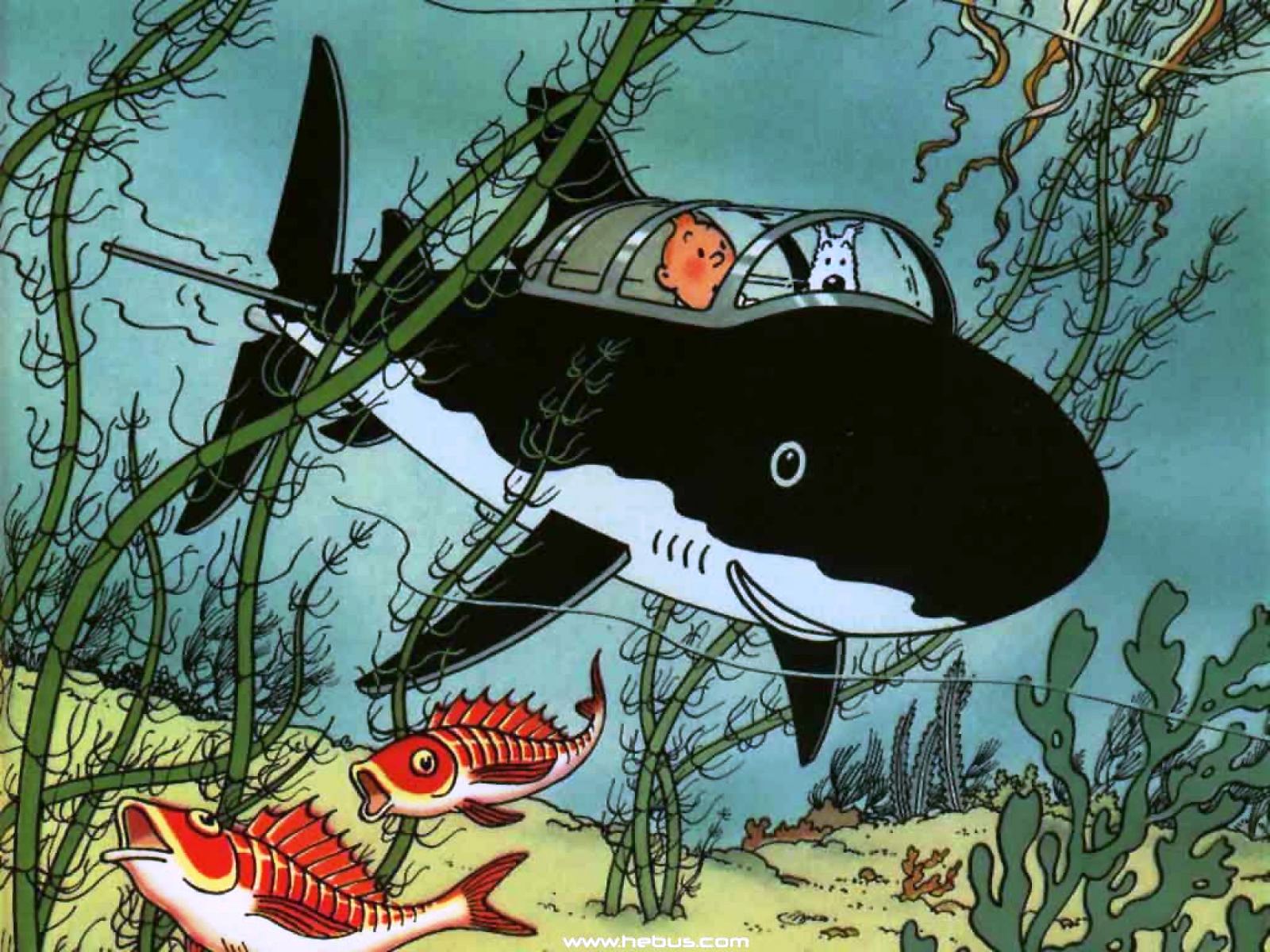
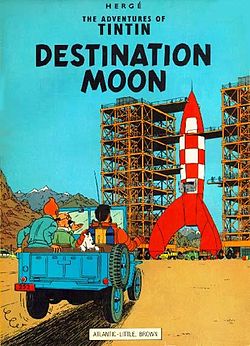
Tintin/”The Adventures of Tintin” (1929)
VIA http://www.bleedingcool.com
Tintin gets around. The Dutch comic book reporter has adventure after adventure in exotic locations ranging from the Orient to the bottom of the ocean and even the moon. He has an incredible eye for detail, has a deep knowledge of automobiles and aircraft and can take care of himself in a fist fight. In later issues, he became more of a private detective and explorer and, if we are being honest, he was rarely seen turning a story in before that, but what reporter doesn’t fantasize about their talents taking them on great adventures? Especially with no editor breathing down their neck.
Well, the first problem with this is that this list doesn’t include …
The second thing, as I’ve written here before, is that watching journalism take place isn’t interesting. Much of it is either rote or at least routine. Watching someone stare into a computer screen and then type, well, you can see that in any modern office. Interviewing people can be interesting (or not), but in truth the only people interested in watching depictions of journalism are journalists. There are no satisfying payoffs, only the next thing to cover.
The other thing is that it fails to acknowledge that journalists are not normal people. Other than TV news (which some argue isn’t really news), the best looking reporter is average looking at best. More likely reporters are ugly, fat, badly dressed, possessed of poor eating habits, drivers of poor quality vehicles, and often ill-mannered in public. The next journalist who can defend himself in a fight, or run two blocks without finding there isn’t enough air in the air, will be the first. (You’d think journalists would be bigger fans of concealed-carry for that reason.)
News takes place any time of the day or night, any day of the week; therefore it has to be covered wherever and whenever it happens. Journalists are overworked (except those who work only 40 hours a week, in which case you’re not doing enough work) and, unless your name is Matt Lauer, underpaid. A proper journalist is cynical. (The old saw goes that if your mother says she loves you, check it out. The truth is that most reporters today aren’t nearly cynical enough and spend far too much time sucking up to power.) The old joke is that newsrooms put the word “fun” in “dysfunctional.”
Consider John F. Kennedy’s assassination in 1963. Some reporters cried while reporting the story, which is inappropriate at least and appalling at worst. Some years later — notably Fort Worth newspaper reporter Bob Schieffer, now at CBS — sound strangely giddy talking about their experiences. Major breaking news is an adrenaline rush, as horrible as that sounds. (If you assume all journalists are going to Hell after this life, you’ll be right more often than not.)
So after a quarter-century of doing this, why am I still doing this? Because I figured out (and maybe it’s a case of necessity becoming a virtue) that you should not do what you love (and you should never love your job, because neither your job nor your employer love you); you should do what you’re good at doing.


 VIA
VIA  Steve Prestegard.com: The Presteblog