No comments on 52 years ago, on your CBS station
Category: media
-
-
I have started my second season of announcing college basketball. (With games on this radio station tonight and Saturday afternoon.)

At Alumni Night last year. Not being a UW-Platteville alum, I decided to dress as I could have during my UW-Madison days, channeling Don Johnson and The Terminator, or something. My first three games featured a double-overtime win and two one-point losses (the last two of which featured comebacks from double-digit deficits), so I’m already 3-for-3 in terms of exciting games to announce. (Or, if you count the one UWP football game I announced earlier this year, 4-for-4.)
Those who announce for teams know that their professional lives are better when their employer is winning. In general, though, you want to announce an exciting game, because that means people will listen and watch instead of tuning out from the last part of a blowout. (The broadcast outlet wants to make sure all the ads are run, but a close game means more listeners to those ads.)
The first and third games were sort of flashback experiences. (Without bad acid.) The first game was at Lake Forest College, where I had not been since 2001, the last time until last year I had announced college basketball on the radio. Lake Forest has a really warm gym because the gym is in front of the swimming pool and the broadcast position is near the ceiling.
I was told there hadn’t been a radio announcer there in a few years. The Midwest Conference streams its football and basketball games, using the home announcers. This gets games online, which is good, but that could subject a fan of the road team to outrageous home-team announcer bias, which I tried not to do. (In the last high school football game I did this year, my partner and I got complimented by someone in the press box for being fair to the team we weren’t covering. That also happened when I did a Lake Forest-Ripon game a few years ago.) There is also something to be said about being able to hear games on the radio, something that hasn’t happened in Ripon for more than a decade.
The last time I was at Lake Forest, with my late friend and broadcast partner, I announced the game despite feeling unwell as the game went on. (It was not the kind of unwellness that beset me during a high school football game I covered 27 years ago, when I had to leave the press box during overtime to return my lunch in the opposite direction.) Ripon College lost, and I proceeded to feel worse for several days (not because of the result) until I finally went to my doctor and was quickly diagnosed with pneumonia, a couple weeks after our oldest son had spent three days in the hospital with the RSV virus and pneumonia. I didn’t go to the hospital, and I felt just fine six weeks later. (It was just as well Ripon lost, at least from my perspective, because I probably would have been too sick to do any of their other games. My prescriptions included cough syrup with codeine, which subtracts 50 points off my IQ.)
Three nights after Saturday’s Lake Forest trip, I announced UW-Platteville against Ripon, which is one of the few times I’ve announced a team that is, to quote a former broadcast partner of mine, now “the bad guys.” (Which Ripon is not; they’re just, to quote that partner, “on the other side.”) None of the Red Hawks nor their coach were there when I last announced Ripon online and on cable TV in 2012.
(Speaking of which: My announcing games online included football games between Ripon and Beloit College. Beloit had a quarterback and wide receiver named Joe Davis, and I’m pretty sure I covered his games. I bring this up only because the Los Angeles Dodgers hired Davis to announce and possibly replace Vin Scully after he retires next year. Davis apparently announced Beloit basketball as a student while I was announcing Ripon basketball.)
Two tall freshmen stood out, and not just because they were tall. Ripon’s Maggie Oimoen won a state title in her last high school game, playing for Barneveld. So I got to announce Oimoen’s last high school game and first college game. (That was also the last game for Barneveld coach Jim Myers, the winningest high school girls basketball coach in state history. Myers now coaches the Barneveld boys; his replacement, Doug Pickarts, was two years ahead of me at Madison La Follette, and we were in the same Boy Scout troop.)
The other player provided a first as well. Thanks to my uncommon last name, and the disconnection between athletic talent on that side of my family and my announcing avocation, I never got to announce a player with my last name until UW-Platteville’s Alison Prestegaard, of Amboy, Ill., checked in, and then got a rebound, and then scored, ending up with eight points, four rebounds and five blocked shots. It was weird indeed to hear my own last name repeatedly announced accompanied by cheering. (As opposed to just hearing my last name announced in my UW Band days, a notice I had screwed up something.)
-
James Taranto comments on the latest stupid thing (which collectively would qualify for Taranto’s Longest Books Ever Written category) out of secretary of state John Kerry’s mouth:
Here, via PJMedia, is another quote expressing the same sentiment: “There’s something different about what happened from Charlie Hebdo, and I think everybody would feel that. There was a sort of particularized focus and perhaps even a legitimacy in terms of—not a legitimacy, but a rationale that you could attach yourself to somehow and say, OK, they’re really angry because of this and that. This Friday was absolutely indiscriminate. It wasn’t to aggrieve one particular sense of wrong. It was to terrorize people.”
Those words were spoken yesterday by Secretary of State John Kerry. The reference to “legitimacy” calls to mind the remark that ended the political career of Todd Akin. But although Kerry’s statement was every bit as stupid as Akin’s, it was far more evil. Not only does he rationalize the mass murder of journalists; that rationalization is a fallback from his initial, impulsive though impolitic position that those murders had “legitimacy.”
The most charitable way to sum up Kerry’s view is that he believes discrimination is a mitigating factor when it comes to terrorist attacks—that murder isn’t as bad when the victim is someone who has publicly espoused views the killer finds abhorrent. The word for a murder carried out with this sort of extreme prejudice is assassination, and it is ordinarily considered even worse than murdering at random.
The attack on Charlie Hebdo, no less than the attacks last week, were intended “to terrorize people.” But the Charlie Hebdo attacks were also intended to terrorize peopleinto silence. It was an attack on free speech as well as on freedom and Western civilization more generally. Kerry’s rationalizing of it is arguably the most un-American thing he has ever said in public—and that’s saying a lot, given that he made a name for himself slandering American military servicemen.
Kerry’s insouciance about the Charlie Hebdo assassinations also runs counter to one of the administration’s central talking points. We are given to understand that the source of the terrorists’ grievance against Charlie Hebdo was its practice of caricaturing Muhammad, the prophet of Islam; such representations are contrary to Shariah, or Islamic law. But Kerry himself went on to say “it has nothing to do with Islam.” So why would terrorists murder people over Shariah violations? What are they, compassionate progressives trying to create safe spaces?
-
Perhaps after Friday’s terrorist attacks in Paris you retweeted or posted this photo of the dark Eiffel Tower:

If you did, the Washington Post has, to quote Paul Harvey, the rest of the story:
On the night of the Paris attacks, Rurik Bradbury noticed an inevitable and tiresome trend popping up on Twitter. “I think I saw a professional news organization tweet about the lights of the Eiffel Tower being turned off in memory of the victims,” recalled Bradbury, the New York-based CMO of a software company. In the fog of war, and in the pursuit of virality, someone had mistaken the Eiffel Tower’s ordinary 1 a.m. darkness for a moving tribute.
Bradbury fired up the Twitter account of his alter ego, @ProfJeffJarvis. He used the well-known parody account, which makes fun of tech jargon and media “thinkfluencers,” to write a deadpan tweet about the icon of Paris going dark.
It was a perfect imitation of the serious tone and hastily assembled expertise that was filling Twitter all night. And it became Bradbury/ProfJeff’s most popular tweet by many orders of magnitude. By Sunday, nearly 30,000 people had retweeted his utterly fake news, which he’d written to prove that people will fall for anything.
“In general I am fascinated by the way history and fake history spreads on Twitter, such as the many ‘History in Pics’ type accounts, and the very low bar for spreading a viral meme through a credulous public,” said Bradbury in an interview. …
But this was something else. Several actual news organizations retweeted ProfJeffJarvis, even though the item was “prima facie absurd,” and the source’s avatar was an old man wearing a beer-funnel baseball cap, with a bio that labeled him a “hyperglocal thinkfluencer” who had co-founded the “Mogadishu:REinvent unconference.” He hadn’t even tweaked his Halloween Twitter handle, “Scary PJJ 2016.” He was trusted even though he begged people not to trust him.
“It should be obvious, with a pause for thought, that the lights haven’t been on continuously since 1889: that scale of lighting would not have been viable in the late 1800s (the lighting was only installed in 1925); there were two world wars in between; it would be hugely expensive to leave the lights on continuously (as one French person pointed out); there have been many tragedies since then that would justify turning off the lights in mourning, such as the Charlie Hebdo murders as recently as January this year, and so on.”
In an e-mail, Bradbury explained why the rapid sharing of anything vaguely inspiration-shaped after a tragedy was so unsettling to him.
The social media reaction to a tragedy is a spaghetti mess of many strands, some OK but most of them useless. There are positive elements (in intention, at least), such as the #porteouverte hashtag and the Facebook “Safety Check” in Paris — though it remains to be seen how many people actually gained from these, either finding a place to stay or letting relatives know they were OK. (Also, it does trouble me that Facebook scored a PR win from Paris, furthering its agenda of becoming the de facto social identity of all humans, then monetizing this monopoly: if the Safety Check becomes a default state of affairs, is Facebook then responsible in some way for emergency responses; what are the implications when someone doesn’t post their safety status on Facebook and so on)
But the part that feels the most useless to me is people’s vicarious participation in the event, which on the ground is a horrible tragedy, but in cyberspace is flattened to a meme like any other. Millions of people with no connection to Paris or the victims mindlessly throw in their two cents: performative signaling purely for their own selfish benefit, spreading information that is often false and which they have not vetted at all, simply for the sake of making noise. If people wanted to be helpful, they would either be silent, or they would put in some — even minimal — effort to be thoughtful. First, they could spread useful and vetted information. And second, they could throw support behind a viewpoint they believe in, such as speaking out against politicians using the attacks to demonize Muslims or migrants, which is exactly what the murderers responsible for the Paris attacks want to provoke.
Instead of silence or helpfulness, social media pukes out stupidity, virtue-signaling and vicarious “enjoyment” (in a psychoanalytic sense) of a terrible tragedy by people thousands of miles away, for whom the event is just a meme they will participate in for a couple of days, then let fade into their timeline.
Terresa Monroe-Hamilton adds:
When 9/11 happened, it was personal to me. I lost friends and associates that day. I have never forgotten that day and that was when I started blogging. I have been involved in the counterterrorism movement ever since and I’ll never stop fighting until my last breath. I’m sure many in France feel the same now. We are at war with radical Islam. It is a global war and not something that you can ‘socialize.’ Islam will strike again and America may be next. Whatever they do, it will be horrific. What the world needs is a leader that is unafraid to cleanse the planet of this scourge without mercy or hesitation. For all the people who have died, we owe it to them to actually fight this evil. Not just send out feel-good pics and memes.
-
As you previously read, a new Star Trek TV series of some sort is coming to CBS’ new streaming service.
I decided after noticing the length of the earlier post (about the same time as it takes for the Enterprise to get toward the Andromeda galaxy, even with the Kelvans and most of the crew reduced to tetrahedrons) that my thoughts about the next Star Trek should go into another post.
(That, and reading the Washington Post’s post’s comments, which included the unwelcome insertion of politics along with this idiocy: “I’m one to eye-roll at runaway progressivism in 2015 but it’s right at home in Star Trek. In fact, getting rid of firm genders (both physiological and psychological) all together would be a very interesting facet of the future.” The second part of that statement seems to the first assertion.)
What many people with a Star Trek opinion appear to forget is this: This is a TV series viewed by early 21st century people. The original had a ’60s sensibility because … guess what? It was written and performed by late ’60s human beings! Even if Trekkies, or Trekkers, or those who watch Star Trek are more, shall we say, utopian than the median, there are some things that will not cut it in the early 21st century. (See the idiotic statement about gender one paragraph ago.)
There is a valid argument for the Post’s post’s position of setting the new series in the mid-22nd century. Given the connection long-time Trek viewers have to the existing characters (even if it’s impossible to bring them back because the actors are dead), redoing one of the five series seems likely only to alienate Trek fans while not necessarily bringing in new fans. That means a new ship, probably, and definitely new characters. Whatever problems the successors to The Original Series have had, they weren’t really tied to the existence of new characters.
Going to the mid-22nd century, which is the setting of the last Star Trek series, “Enterprise,” would, from what I read online (and yes, we are talking about events written in the past about one or more centuries from now), be about the time the earliest iteration of Starfleet encountered both the Klingons and the Romulans.
The other thing going to the 22nd century would do is get the new series past the excessive utopianism of The Next Generation. That includes, but is not limited to, economics. Jonathan Newman points out:
With the recent successes and announcements of sci-fi movies and TV shows like The Martian, Interstellar, and new incarnations of Star Trek and Star Wars, no one can deny that we crave futurism and stretching our imagination on what advanced technology can accomplish. Many look to the example of these fictional worlds as an indication of what life might be like when technology can provide for all of our basic needs, a condition some call “post-scarcity.”
The same people call on dramatic government interventions to make sure everybody can earn a “living wage” when robots and automation do all of the producing. They say that “post-scarcity” conditions will completely overturn economies and even economics itself.
But, scarcity can never be eliminated because our infinite human wants will always outnumber the means available in this finite universe. Scarcity is found even in the shows and movies that supposedly represent worlds without scarcity.
A prime example of what is meant by “post-scarcity” and its contrast to present-day is presented in theStar Trek: The Next Generation series.
In the final episode of the first season, the Enterprise happens upon an “ancient” vessel floating through space. Lt. Commander Data and Security Officer Worf find three humans from Earth, frozen in cryonic chambers for 400 years, which gives the twenty-fourth century crew a chance to interact with people from the viewers’ time period.
One of these late twentieth-century humans, Ralph Offenhouse, was preoccupied with regaining control over what he expected to be a gigantic fortune from a 400-year-old stock portfolio. Indeed, one of the first things he asked for after being thawed and resuscitated was a copy of the Wall Street Journal.
Captain Picard informed him that “A lot has changed in the past three hundred years. People are no longer obsessed with the accumulation of things. We’ve eliminated hunger, want, the need for possessions. We’ve grown out of our infancy.”
The show paints a Marxist picture of how humans arrived at being able to warp across space with food replicators and beaming devices and all sorts of technology that renders even our early twenty-first-century scramble for scarce resources a mere curiosity.
During centuries that stretch between the crew of the Enterprise and their time capsule visitors, technology changed in such a way to abundantly provide for people’s material needs. Therefore human society phased out of capitalism and trade and into socialism, which Karl Marx predicted in his theory of history. …
Unfortunately for all of us, however, scarcity isn’t going anywhere. And the only way to maximize human want satisfaction with a limited pool of resources is with unhampered markets: private property and prices. Scarcity is a fundamental fact of our universe — we are bound to it by physical laws and logic.
Scarcity is even present in the fictional Star Trek universe, as well as self-ownership and private property. In the very same episode, Captain Picard and the crew have a tense confrontation with the Romulans, who have invaded Federation space. Both parties were investigating the destruction of some of their outposts in the “Neutral Zone.” Space is not only the final frontier, but apparently ownable. The Romulan and Federation outposts are also scarce and owned.
When Ralph Offenhouse wandered onto the main bridge during this confrontation, Captain Picard ordered security officers to “Get him off my bridge!”
We can’t even conceive of a fictional universe with no scarcity. There can be no time, space, or anything that has any limited capabilities in satisfying our desires. Such a universe would be timeless, incorporeal, and all satisfying. It’s hard to imagine a TV show based in such a universe because there could be no conflict for the characters to overcome.
What Manu Saadia and Noah Smith mean by “post-scarcity,” then, is just that some things are more abundant than before. But this prospect does not mean the end of economics, because even today many goods are more abundant than they have been in the past.
No matter what, individuals will still be making choices about how to use the resources that are scarce. We may make things relatively less scarce, but we can never repeal scarcity as a fundamental condition of our universe.
Suppose every household in the world has all of their biological needs abundantly satisfied. Food is provided by replicators like those on the Enterprise. Everybody has as at least as much shelter as they need. Super-medicines and all health services are easily provided with the touch of a button in your own home.
All this means is that people can pursue other ends besides survival, like art, entertainment, learning, or simple relaxation. Our demand for goods and services does not stop once we are at subsistence levels of consumption. This is obviously true for anybody with the means to read this article.
Also, there may be demand for food and other goods specifically made by human hands even when robots or replicators could have made something identical or more precisely machined at a lower cost. We see this today, and we are far from Star Trek.
Sometimes we like knowing something was made in a certain way, and this translates into demand for goods with a specific, usually labor-intensive, production process. Craft and hand-made trade fairs are common, even when many of the items offered are mass-produced elsewhere.
Toward the end of the episode, when Ralph Offenhouse is reeling in an existential crisis, he asks Captain Picard about the purpose of twenty-fourth-century life if it’s not “accumulating wealth”:
Captain Jean-Luc Picard: Material needs no longer exist.
Ralph Offenhouse: Then what’s the challenge?
Captain Jean-Luc Picard: The challenge, Mr. Offenhouse, is to improve yourself. To enrich yourself. Enjoy it.What Picard doesn’t realize is that improving and enriching yourself, even with the Enterprise’s mission: “to explore strange new worlds, to seek out new life and new civilizations, to boldly go where no one has gone before” involves the use of scarce, material resources, like starships, starship crews, planets to explore, communicators, teleportation machines, phasers, and warp drives.
Picard also doesn’t realize how wealthy he is. Wealth is the ability to satisfy ends, and his spot on theEnterprise makes him enormously wealthy, with all the replicators and the holodeck (environment simulator) and the instant access to top-notch medical care. For someone who rejects accumulating wealth, he has accumulated a lot of it.
Although biological needs may be abundantly satisfied, human desires outnumber the stars.
Even the Enterprise demonstrates scarcity. Robert P. Murphy demonstrates from episodes:
For example, in “The Galileo Seven,” Spock must make difficult command decisions when the shuttlecraft is stranded on a planet. Yet, the suspense in the episode derives from Galactic High Commissioner Ferris bickering with Kirk over how long they should continue searching for the landing party while the plague-ridden people of Makus III await the medical supplies the Enterprise is delivering. There is obvious conflict because of the trade-off involved: despite the wonderful ship at his command, Kirk (it seems) must choose between his stranded friend and the planet of sick strangers.
Indeed, even though the opening sequence of each episode mentions seeking out new life and civilizations, and of course “to boldly go where no man has gone before,” the Enterprisequite often is tasked with delivering physical supplies to various people. The famous episode, “Let That Be Your Last Battlefield,” with the white/black-faced men, involved a medical mission to decontaminate a planet. In the Next Generation series, the memorable episode “Brothers” involved Lieutenant Commander Data seizing control of the Enterprise when he is summoned by his creator. The situation is dire because a very sick child (accidentally placed in his predicament by his brother) cannot be cured of a parasite while on the Enterprise, and time is running out.
So we see that it is a common theme in Star Trek for people to argue over how the ship should be used, and often people will die from illness depending on whose will prevails. Whether they have a 24th-century version of Obamacare is irrelevant; there is definitely scarcity there, and it operates just like scarcity today.
Even the technology in the Star Trek universe is not a given; it is a response to incentives. For example, in the episode “Yesterday’s Enterprise,” the crew goes into a different timeline where Lieutenant Tasha Yar is still alive (she had been killed off in the first season when the actress asked to be let out of her contract). In this timeline, the Federation has been at war with the Klingons all along. At one point, Yar says, “Deflector shield technology has advanced considerably during the war. Our heat dissipation rates are probably double those of the Enterprise-C, which means we can hang in a firefight a lot longer.” Thus we see that the capabilities of the Enterprise-D — the ship commanded by Jean-Luc Picard — are themselves dependent on the preferences of the humans who own it and the associated resources.
Economics is one problem, but not the only one, with Star Trek from TNG onward. The TNG producers apparently were convinced by Roddenberry, or something, that there would be no interpersonal conflict either. That is more ridiculous than Trekonomics, for two reasons. First, it’s bad for stories. TOS featured plenty of conflict between Spock and McCoy, or between Kirk and an episode’s antagonists. The Enterprise crew was professional enough to not let the vagaries of interpersonal relations affect ship operations. (As it is, TNG, Deep Space Nine and Voyager had to import conflict from the aliens our heroes encountered.) And, obviously, if humans haven’t really changed in thousands to millions of years (depending on your views of evolution), they’re not going to change significantly in 300 years. (More than the bad economics, the moral preening of many TNG episodes made that series subpar to TOS.)
The problem with setting the new Star Trek in the early Klingon/Romulan conflict days is that it runs the risk of making the series too similar to the rebooted (and hated by Trek fans) movies, which are derided as shoot-em-ups with phasers. Independent of screwing around with what the characters should be like (Kirk was not an immature punk in TOS, and Spock was not unable to control his emotions), the science fiction in the reboot has consisted only of gadgets in the hands of the bad guys (“red matter” in the first movie and the Dreadnought in the second). No exploration, no discovery, no commentary on the human condition.
Two things make any TV series worth watching, or not — characters and stories. One facet of TOS I liked, but was used far too infrequently, was the byplay between Lt. Sulu and Ensign Chekov, who sat next to each other on the bridge. In “Amok Time” they commented on setting, and then unsetting, and then setting again course to Vulcan. In “The Deadly Years” Chekov complains about undergoing every possible medical test because he’s not aging while the rest of the landing party is. It was like watching Rosencrantz and Guildenstern in “MacBeth.”
More famously, TOS had Spock and Dr. McCoy, who spent three seasons arguing with each other. (TNG tried to duplicate that with second-season Dr. Pulaski and Data, but it didn’t work.) TNG had Data, the android trying to become human, and Geordi LaForge. The quality of the characters and their interrelationships can overcome bad stories (see the third season of TOS); arguably the best thing about TNG, particularly early, was the characters. Even the darker Deep Space 9 featured Odo the shape-shifting security chief and Quark, through whom greed flowed like blood flows through humans.
Others have noted that it was illogical (get it?) for the most valuable officers of a ship to go down to a planet and risk their lives when you’ve got junior officers to do that. Coast Guard cutter captains do not board ships they’re intercepting for whatever reason. But studios didn’t pay William Shatner, Leonard Nimoy, Patrick Stewart, Jonathan Frakes and the rest big money to portray someone sitting in a chair while lower-paid actors got to do things, fight and die. (One way to get around that issue is to make the new ship considerably smaller, perhaps like the six-person patrol ship Orion.)
Every Star Trek series to date has been seen through the eyes of its captain, beginning with TOS’ James T. Kirk. The five series have gone through the obvious gamut of diversity, from white males (Kirk and Jonathan Archer of “Enterprise”) to black male (Benjamin Sisko of “Deep Space Nine”) to woman (Kathryn Janeway of “Voyager”) to, well, bald white male with a British accent who is supposedly from France (TNG’s Jean-Luc Picard). It is possible the next captain will be an alien (that is, not from Earth), but for obvious reasons he or she will probably be recognizably human (i.e. Spock the Vulcan).
What are those obvious reasons, you ask? Simple: For the series to succeed, the viewer has to be able to put himself or herself into the shoes of at least one of the major characters. That was, for me, Kirk in TOS, first officer William Riker (because I’m neither bald nor very French) in TNG, Sisko (though, yes, I’m not black) in DS9, and first officer Chakotay (because I’m not female) in Voyager. (For scheduling reasons I didn’t watch that much Star Trek after TNG.) That is probably why the next captain won’t be gay or gender-creative, because as tolerant as someone might be, most people are not gay, and again this series is being viewed by people, some of whom may not be hard-core Trek fans, who see the aforementioned Post comment as just strange.)
Instead of hyphenation diversity, how about we explore intellectual diversity instead? Perhaps the next captain should be, if not an out-and-out cynic, then less of an idealist about the Federation, and a skeptic of whether interstellar democracy can work. (Some have claimed that Star Trek is a lefty’s Utopia in economics, health care for all, gun control, etc. Our captain might point out that there are Federation-member planets where slavery is still legal, and where people are required to commit suicide upon reaching a certain age, as with a TNG episode.) Renegades are more fun to watch if their characters are created carefully.
One reason Kirk was a more appealing captain than Picard was (is? will be?) is that Kirk was a man of action and a man of passion. (I am not referring to Kirk’s alleged womanizing, which in TOS included a woman who tried to kill him, a woman from the 1930s who looked suspiciously like Joan Collins, and two androids.) Picard thought everything through; Kirk did things, whether or not they were always the right things or the wise things. Kirk also didn’t let rules get in the way of doing the right thing, while Picard seemed to do nothing that couldn’t be justified by a Starfleet rule, or violated a Starfleet rule.
Kirk’s character was based in part on British sea captain Horatio Hornblower of C.S. Forester’s novels. (Or perhaps more like the 1952 movie starring Gregory Peck.) An excellent starting point for a new captain would be British sea captain Jack Aubrey of Patrick O’Brian’s novels, similar to Hornblower and Kirk in their ability to compel near-fanatic loyalty among their crew. Wikipedia describes Aubrey (who apparently had a real-life model) and his friend Dr. Stephen Maturin thusly:
Jack Aubrey is a large man (both literally and figuratively) with an energetic, gregarious, cheerful, and relatively simple personality and a deep respect for naval tradition. Remarkable early success earned him the nickname “Lucky Jack Aubrey” and a reputation as a “fighting captain”, a reputation which he sought to retain throughout his career. … Aubrey’s professional life of daring exploits and reverses was inspired by the chequered careers of Thomas Cochrane and other notable captains of the Royal Navy from the period.
Irish-Catalan Dr. Stephen Maturin ostensibly serves as an adept ship’s surgeon on Aubrey’s various commands. … Unlike his action-oriented friend, Maturin is very well educated with several intellectual pursuits. He is passionately fascinated by the natural world,and takes every opportunity to explore the native wildlife of his ships’ ports of call around the world. He is also deeply introspective, and frequently muses on philosophical concepts of identity and self-understanding in his ciphered personal journal. …
Despite their many differences, the pair are invaluable and indispensable companions throughout many years of adventure and danger. Reviewers have compared Aubrey and Maturin to other seemingly mismatched yet inseparable fictional duos such as Don Quixote and Sancho Panza in “Don Quixote”, Holmes and Watson in the Sherlock Holmes stories, and Kirk and Spock in the original Star Trek TV series.
Logical (Kirk and Spock predated Aubrey and Maturin, who first appeared on the literary landscape in 1969), except that Trek fans think of the Big Three — Kirk, Spock and McCoy, with Kirk’s decisions informed by Spock’s brain and McCoy’s heart. Good characters can make up for mediocre stories or even dubious premises. Bad characters, bad show.
-
Huge news was reported Monday:
CBS Television Studios announced today it will launch a totally new Star Trek television series in January 2017. The new series will blast off with a special preview broadcast on the CBS Television Network. The premiere episode and all subsequent first-run episodes will then be available exclusively in the United States on CBS All Access, the Network’s digital subscription video on demand and live streaming service.
The next chapter of the Star Trek franchise will also be distributed concurrently for television and multiple platforms around the world by CBS Studios International.
The new program will be the first original series developed specifically for U.S. audiences for CBS All Access, a cross-platform streaming service that brings viewers thousands of episodes from CBS’s current and past seasons on demand, plus the ability to stream their local CBS Television station live for $5.99 per month. CBS All Access already offers every episode of all previous Star Trek television series.
The brand-new Star Trek will introduce new characters seeking imaginative new worlds and new civilizations, while exploring the dramatic contemporary themes that have been a signature of the franchise since its inception in 1966.
So why is this not necessarily good news? Johnny Oleksinski laments:
So when a story on the CBS-run startrek.com popped up Monday with the headline “New Star Trek Series Premieres January 2017,” fans’ brains naturally exploded with excitement. And then we read on.
Everything beneath that beautiful, dreamlike headline was an epic disappointment.
First, “Star Trek” isn’t coming back to mainstream TV. No, Captain — it’s being banished to a doggone streaming service.
Sure, there’s nothing wrong with Netflix, Amazon Prime or Hulu — “Orange Is the New Black” and “Transparent” are terrific shows you can only catch on those services. And I reckon most TV watchers already subscribe to one of them.
But the final frontier is apparently something called CBS All Access. That’s where the new untitled “Star Trek” series will call home, a CBS-only streaming service no one uses that costs users a whopping $5.99 a month.
The pilot will premiere nationally on CBS, but that’s a total tease.
As the viewer and CBS are rounding second base, or second episode in this case, they’ll be forced to shell out $5.99 to keep watching on the platforms CBS All Access is compatible with: Apple TV, Android TV, Google Chromecast, Roku players and Roku TV. (No “Trek” for you, Wii owners.)
With the service, viewers will also be treated to all past seasons of other CBS shows, such as “Two and a Half Men” and “CSI,” a Trojan horse I wouldn’t wish on my worst enemies.
And then there’s the chosen executive producer, Alex Kurtzman. Kurtzman’s résumé is packed to the gills with dreadful titles like the reboot of “Hawaii Five-O” and the horrible “Star Trek Into Darkness.”
Over the years, Trekkies began looking to Ronald D. Moore, a former “Trek” writer and creator of the fantastic “Battlestar Galactica” reboot, to bring his signature grit and modern take on sci-fi to a new “Star Trek.” But CBS has instead shackled us with the dude who co-wrote “Transformers: Revenge of the Fallen.”
Nerd culture has finally escaped after-school “science fiction clubs” and worked its way into the mainstream. Everyone watches “Game of Thrones”; everyone is excited for “Star Wars”; hot guys like comic books.
These are salad days for geeks!
So why does CBS treat “Star Trek” — one of its most valuable and oldest brands — as second tier? Why are these network numbskulls giving “Star Trek” a midseason debut on a streaming service led by the guy who co-wrote “The Amazing Spider-Man 2”?
Captain Kirk wouldn’t stand for it.
The following days have compelled many to throw in their two cents on what the new Star Trek should have, such as Monkeys Fighting Robots …
With six television series, twelve films, and a myriad of books and comics, Star Trek boasts one of the most expansive fictional universes in pop culture, and no matter what path this latest Trek takes, it will have more than enough fascinating material to draw upon. Looking through the possibilities, here are five ideas for a new Star Trek television series.
Captain Worf
One of Star Trek’s most iconic characters, Worf has appeared in more episodes of the franchise than any other series regular. Throughout both The Next Generation and Deep Space Nine, the Son of Mogh provided audiences with an operatic personal journey worthy of Kahless himself. With his understated humor and unshakeable sense of honor, Worf remains one of the strongest supporting characters in the history of Star Trek, and some of the most powerful storylines of both TNGand DS9 were those which followed him in his struggle to remain loyal to both the Klingon Empire and the Federation. A Captain Worf series would also allow other great characters from the Prime Reality to return – from TNG luminaries such as Picard and Riker to captivating supporting characters from DS9 like Martok and Garak. Actor Michael Dorn himself has expressed interest in reprising the role.
The Far Future of the Prime Reality
When Star Trek successfully returned to television in 1987, it returned as a new series set one hundred years after the original show. This gave the creators of TNG a wonderfully developed backdrop of established history and ideas to play with, while also allowing them enough room to develop brand new concepts and characters. What worked once could very well work again, and with a past already richly defined by its previous television incarnations, a new series set a century after the exploits of Picard, Sisko, and Janeway could breathe fresh air into the Prime Reality, that is the prime universe in which all of Star Trek prior to the 2009 film was set.
Vanguard
The greatest of all original Trek book series, Star Trek: Vanguard was created by writer David Mack and editor Marco Palmieri back in 2005. This series followed the harrowing adventures of the crew and residents of Starbase 47, also known as Vanguard. Set during the time period of the original series, Vanguard weaved the political and military events of Kirk’s time with an intergalactic mystery that the Vanguard crew were tasked with solving. Mack and fellow series writers Dayton Ward and Kevin Dilmore created an assortment of characters more nuanced and complex than those found in any other Trek series outside of DS9. Their brilliant character work and engrossing storylines could easily sustain seven seasons of successful television.
Department of Temporal Investigations
Another interesting series from Trek literature is Christopher L. Bennett’s Department of Temporal Investigations, which takes a closer look at time travel in the Star Trek universe. Agents Lucsly and Dulmer and their fellow investigators at DTI are tasked with protecting the space-time continuum from threats past, present, and future. Together they must face devastating temporal incursions, ancient alien technology gone wrong, and the recklessness of Starfleet captains, in what amounts to Star Trek’s version of Dr. Who.
The Mirror Universe
The most iconic of all of Star Trek’s alternate timelines, the Mirror Universe presents not an optimistic future of human courage and cooperation, but rather a universe ruled by the savagery and destructive passions lurking within humankind. Introduced in the original series and expanded upon in DS9, this grim world has yet to be introduced in the New Reality, the timeline in which the new Star Trek film series takes place. A show set in the Mirror Universe of the New Reality could provide Star Trek’s rebooted franchise with an unique television counterpart, and perhaps lay the groundwork for a crossover film set in this dark corner of the Star Trek multiverse.
… and io9, which apparently did a poll, or something:
7) A post-Star-Trek-XI look at the Prime Universe…
We’ve asked you already when you’d like to see the new series set across Star Trek’s vast timeline, and this was by far the most popular choice—and there’s a reason for that. Although JJ Abrams’ Star Trek reboot largely brushed over the universe it left behind, the main continuity of Star Trek (composed of all the TV shows and movies that came before it) after the beginning of that movie is an incredibly interesting place. The Federation is slowly recovering from the fallout of the Dominion War depicted in Deep Space Nine, only to be hit with the galactic catastrophe of the seeming death of Spock and the total destruction of the Romulan and Reman homeworlds, killing billions and leaving countless beings without homes.
This is something that Star Trek Online, the franchise’s official multiplayer online role-playing game, explores in great detail—it’s set in 2409, two decades after the supernova that destroyed Romulus and Remus, and finds the Federation fractured and at war with the Klingons. This isn’t necessarily the path the new series would follow, as the game has no real say on the “canon” of the franchise. But exploring a continuity that has the legacy of past Star Trek TV shows to look back on, especially for a series being launched as part of the franchises’ 50th anniversary celebrations, is an incredibly tempting prospect.
6) … Or The Next Generation of The Reboot
But if the series does have to take place in the alternate reality established by the new movies—what little information we have about the show says it’s not directly related to Star Trek: Beyond, it could still be a part of that universe—essentially pulling a Next Generation could be equally interesting.
It’d leave the movies well in the past and out of the way of the show interfering with them, but at the same time it’d be interesting to imagine and explore what this particular version of the Star Trek universe looks like a century down the line, especially in terms of look and the technology at hand. It wouldn’t have to be a direct parallel to TNG—I definitely wouldn’t want to see an alt-Picard and crew—but something in the spirit of it, about a future crew inspired by the legacy of Kirk and the Enterprise’s five-year mission, would be a fun way to be linked to the movie without having to directly work around them.
5) A New Ship—That’s Not An Enterprise
Okay, before you really string me up, hear me out. The Enterprise and its many incarnations is one of the most iconic features of Star Trek. But like Voyager and Deep Space Nine did in the 90s, it’d be cool to see the show focus around the crew of a different kind of Federation ship.
Voyager was primarily a research vessel. The Defiant was a gunboat made for combat. The new ship could be something like that, or even of a similar size and scope to the Enterprise, which was a sort of jack-of-all-trades—but getting a new ship that’s not just the Enterprise-G or something, with a new design that is evocative of the classic ship rather than a direct emulation would be a way to keep things fresh.
4) More Boldly Going
If there’s one criticism you can level at Star Trek and Into Darkness, its that they focus on being action movies rather than Star Trek’s ideals as a show about communication, exploration, and challenging ideas. And that makes sense for a movie—but those sorts of ideas sit at the very heart of what Star Trek is about, and what makes it so beloved to many people. Some of Star Trek’s best moments haven’t been about battles and conflict, but about exploring and understanding other people.
That’s not to say you can’t have some ship battles some times, but a new series that focuses on that optimism of science and exploration, seeking out bold new worlds and civilizations would be a fitting love letter to Star Trek’s legacy more than an action-focused series. Voyager may not be the most loved or critically-appraised Star Trek show, but its aim of recapturing that sense of exploration found in the original series was a noble one.
3) Lots of weird and wonderful aliens
Star Trek has some iconic alien species—the Klingons, the Romulans, the Vulcans, and so many more. But it also has a slightly mocking reputation for having swathes of races that are little more than humans with a dab of makeup on.
Today we’re living in a world where Television can do much more with effects, both practical and CGI—we have shows like The Flash or Game of Thrones or Doctor Who giving us amazing creations and creatures born from either digital artists or prosthetics masters. It wouldn’t be Star Trek without new aliens to meet, and we’d love to see some truly amazing new species that can stand alongside the show’s icons.
2) A Diverse Cast
Star Trek is no stranger to a diverse cast of main characters. The original series broke boundaries with the addition of Uhura and Sulu to the main . It’s had a Black Captain in DS9’s Sisko, and a Female Captain in Voyager’s Janeway. So some diversity wouldn’t be new—it’d just be carrying on the Star Trek trend.
But there’s still opportunities to shake things up a little. Could we get a LGBTQ bridge officers and Captains? More ethnicities among the humans? Hell, why not more alien crew members? An alien Captain may not be entirely feasible, but it’d be an interesting prospect. As long as the cast as a whole is emblematic of Rodenberry’s original vision for Starfleet, a world where people of all classes, genders, and races were united, it’ll be great.
1) Something Really New
You might have noticed that a lot of the things I’ve focused on here emphasize either doing something new, or adding a new twist to something that Star Trekhas already done. Because even though this new show is being created as part ofStar Trek’s 50th anniversary, above all that it should be adding something new to the franchise.
In an age of Sequels and Reboots, we already have the Star Trek movies being a direct reboot of the original series. That’s all well and good for the films, but a new Trek TV show shouldn’t just be a rehash of series past. If anything, it should keep those series at arm’s length—respect them, love them, reference them, but don’t just retell them. It should be connected, but standalone, just as the shows before it were. We already saw how bad that could be when Star Trek Into Darkness revealed itself as a mild reheat of Wrath of Khan. After so many years of waiting, a new series that just did that for one of the past series would be monumentally disappointing.
I have read the LGBTQ thing brought up in numerous places. I have an alternative suggestion: How about Star Trek evolve to where people don’t identify themselves primarily by their sexual preference(s)? How about Star Trek progress to a place where who you are attracted to is no one else’s business besides your own?
Even the Washington Post got in on the You-Be-the-Next-Roddenberry act:
So it sounds like we’re getting another ship and another crew flying through space at warp speed. But that’s about all we know right now, leaving many of the tough choices about the new series to producer Alex Kurtzman, who worked on the recently rebooted “Star Trek” films. Here are a few of the biggest decisions he’ll have to make, and along with one, big recommendation: Set the new series during the Earth-Romulan War of the 2150s.
When does this “Star Trek” take place?
This is by far Kurtzman’s most difficult call, and the fate of the entire “Star Trek” franchise hangs on it. Kurtzman played key roles in making the most recent “Star Trek” films, which set up an alternate universe that’s separate from the one Gene Roddenberry created in the 1960s featuring William Shatner as Capt. James T. Kirk. It would be totally natural for Kurtzman to want to flesh out this new timeline (in which Kirk is played by Chris Pine). But if he does, he’ll likely disappoint a lot of longtime “Trek” watchers by condemning some of their favorite shows and characters — “Deep Space 9,” Capt. Jean-Luc Picard, et al. — to the historical dustbin. It would be the final nail in the coffin for that timeline, which many people appreciate for its mature handling of race, gender, ethics, economics, politics and foreign policy, among other issues.
Does this “Star Trek” embrace the golden age of television?
By now, TV watchers have shown that they’re willing to commit to season-long plot lines. This is promising for “Star Trek,” a show that did some of its best work when rolling out a two- or three-episode narrative arc. “Deep Space 9” is routinely held up as an example, at times setting the action against a high-stakes backdrop of interstellar intrigue and conflict in the Dominion War. Now is the chance to try that format out in full, telling a single story over 12 or more episodes.
Critics of the recent “Star Trek” films have complained that they reduce the franchise to an action-packed shoot-’em-up. That’s forgivable in a feature film when you have only a couple hours to spin a yarn. But by giving the series more breathing room, television will be the real test of the alternate universe, should Kurtzman choose that timeline. Which leads us to the next big decision.
Is this “Star Trek” dark or light?
The original “Star Trek,” under Kirk, painted the world as a utopia. “The Next Generation” expanded on this by introducing new technologies, such as thereplicator, which explained how humanity overcame hunger and want. But “Deep Space 9” depicted a much grimmer vision of the galaxy, one characterized by war, espionage and subterfuge. Many fans argue that this was when “Star Trek” really shone — and that the next show ought to be an equally gritty and dark spiritual successor.
With 2013’s “Star Trek Into Darkness,” the rebooted universe appeared to take a turn in this direction, offering up themes of conspiracy, betrayal and a thinly veiled critique of U.S. foreign policy. So it’s possible that Kurtzman might further expand on that, exploring the corruption within Starfleet and its struggle to define itself in its earliest years.
What new technologies will “Star Trek” give us?
“Star Trek” isn’t just a venue for discussing politics or religion. It has also inspired many people to become scientists and engineers. Technology from the show has played a pivotal role in shaping our modern-day devices, from the smartphone to the tablet to voice recognition and command software. The big question for the new “Star Trek” is, what kind of technology can Kurtzman introduce into the franchise that will give real-world people something fresh to dream about and tell us something new about the fictional universe?
Herein lies a thorny problem. Kurtzman can’t make reference to the replicator, the holodeck or any of the technologies that show up in “The Next Generation” or subsequent series. Why? Because at our current point in the alternate timeline, these technologies are still in the distant future, if they get created at all, thanks to the disruption in time that led to the events of the 2009 “Star Trek” film.
What the new “Star Trek” should really do
From all this, we look ahead to a few things. First, each episode should be part of a serialized, season-long story, rather than a forgettable standalone episode that tackles a monster of the week.
Second, in keeping with the more serious drama viewers have become accustomed to in other shows, the new “Star Trek” shouldn’t shy away from darker subjects.
Third, perhaps it should consider a setting like the 2150s-era Earth-Romulan War, a period in “Star Trek” history that’s relatively unexplored in the original timeline and completely uncharted when it comes to the rebooted universe (the events that cause the new universe to be created don’t take place until the 23rd century). While a return to the 24th-century world of “The Next Generation” would be welcome, extending the original universe even further, Kurtzman’s real-world connection to the Abrams reboots makes it hard for him to ignore the alternate timeline.
In the Romulan war, Kurtzman has the opportunity to produce new stories in his own style while avoiding divisions in fan loyalty between either universe. The war lends a dramatic backdrop to events that occur to the new ship and crew, gives them a reason to act, and places them early enough in Earth’s spacefaring history that the show’s creators could explore humanity’s initial interactions with other Federation species and the emergence of the Federation itself, along with all the messy politics, economics and diplomacy that implies.
Earth at war, but in the teething years of the Federation, could offer both darkness and light, combining the grim realities of an interstellar conflict with the hope for an enlightened, organized future when security is guaranteed by a galactic alliance of peace-loving people.
What’s more, establishing Romulans as the villain would make the show more accessible to series newcomers, many of whom will remember that it was a 24-century Romulan that served as the principal bad guy in the 2009 Star Trek film.
Prequels carry their dangers. One of the big challenges that “Star Trek: Enterprise” had, as a show that told the story of Kirk’s forbears, was that it failed to create meaningful dramatic tension. Viewers already knew from watching “The Next Generation” and “Deep Space 9” how things would turn out.
The difference here is that with Kurtzman leading the new “Star Trek” show, viewers can never be truly certain what the future timeline holds. Kurtzman may be perfectly happy to create speculation among fans as to which history he’s really writing for. In this part of the “Star Trek” timeline, Kurtzman enjoys the most creative freedom and the fewest restrictions imposed by canon.
David McElroy wrote this two years ago, and it still applies:
I went to a midnight showing of “Star Trek Into Darkness” Wednesday night and I left the theater with really mixed feelings. There were parts of it that were immensely satisfying in an emotional way. The actors do a dead-on job of recreating the original characters in a way that you’ll recognize.
In many instances, you’ll feel a sense that you really might be watching younger versions of the original characters. It’s not that they look exactly the same. It’s simply that they’ve taken care to interpret the characters in very similar ways. That’s emotionally satisfying if you already know the relationships between the characters in what will be their future.
The biggest problem for me is that these are essentially children who have been placed in senior crew positions of one of Starfleet’s flagships. In the original Star Trek series, we were told there were only 12 starships in the fleet, so we can assume there are no more than that at the point of the new films. (We can also assume there are many smaller vessels.)
Think of the modern U.S. Navy. There are hundreds of ships in the fleet, but there are only 10 active aircraft carriers and three more are under construction. A starship is roughly equivalent to a present-day aircraft carrier.
Now think about this. Can you imagine that a crew of Naval Academy cadets or recent graduates would be handed the keys to an aircraft carrier? Of course not. Young officers serve as junior officers. They get experience. The best of them get promotions and end up in command of smaller vessels and then increasingly important vessels. Eventually, the very best experienced captains in the fleet end up in command of the carriers.
If you look at science fiction books about heroes who end up in command of similar vessels, they all get experience and then move up to bigger jobs. (The Honor Harrington series is a great example.) The fact that Kirk and Spock and Co. end up crewing and controlling the Enterprise when they’re straight out of the academy is an indication that director J.J. Abrams’ conception of life is pretty close to that of my teen self who fantasized himself as the young hero to save the world.
The familiar characters in this series need to be the heroes of the movie. There’s no question about that. But the original Star Trek showed us a number of times that Kirk had a series of commands of lesser ships before he earned the right to command the Enterprise. A reasonable concept for this reboot would have been to put these characters into some small ship or setting that allows them to unexpectedly be heroes.
If Kirk, Spock and Sulu were set up as the young command crew of a 20-person ship that was old and not very important — but they managed to do something important and save the day — it would feel more real and more true to the concept of adult life. Give them increasingly better jobs as they move up successfully through a few movies. Have them longing for the day when they were in command of a starship.
That would feel like a concept for adults. The concept we’ve been given in the reboot is a concept for comic book characters who don’t live in a real world.
To me, things like this remind me all the time that the people who write, direct and produce today’s movies don’t have the life experience that writers and producers used to have.
Star Trek creator and original producer Gene Roddenberry had been a bomber pilot in the U.S. Air Force during World War II, right. After the war, he was a commercial pilot for Pan-Am and then became a police officer for the Los Angeles Police Department while he worked his way into entertainment. When you look at some of the things he injected into his fiction, you can feel the mature experience that comes from having lived a real life outside of entertainment.
What about J.J. Abrams, who is the guiding creative force for the new Star Trek? He’s never worked outside the film industry. He doesn’t have experience with what might seem like real life to the rest of us. He’s a good film director and he knows how to make a pretty film. But his work lacks the adult quality that someone such as Roddenberry brought even to his silliest work.
So what do I think of all this? Stay tuned.
-
Mike Rowe was asked …
‘Hello Mr. Rowe! What’s your take on MSNBC host Melissa Harris-Perry being offended by the phrase “hard worker”? How can such a label possibly be offensive to anyone?”
… and observed:
… there is no longer a limit to what people can be offended by.
Melissa Harris-Perry appears to be put off by the suggestion that “hard work” is too often linked with success. She doesn’t like the fact that many hard-working individuals have not enjoyed the same measure of success as Speaker Ryan, who was being acknowledged on her show for his excellent work ethic. Here is her response, in her own words…
HARRIS-PERRY: “I want us to be super careful when we use the language “hard worker.” I actually keep an image of folks working in cotton fields on my office wall, because it is a reminder about what hard work really looks like. But in the context of relative privilege, when you talk about work-life balance, the moms who don’t have health care aren’t called hard workers. We call them failures. We call them people who are sucking off the system.”
To me, it sounds as though Melissa is displaying images of slavery or drudgery in her office to remind herself of what hard work really and truly looks like. That’s a bit like hanging images of rape and bondage to better illustrate the true nature of human sexuality. Whatever her logic might be, it’s difficult to respond without first pointing out a few things that most people will find screamingly obvious. So let’s do that.
First of all, slavery is not “hard work;” it’s forced labor. There’s a big difference. Likewise, slaves are not workers; they are by definition, property. They have no freedom, no hope, and no rights. Yes, they work hard, obviously. But there can be no “work ethic” among slaves, because the slave has no choice in the matter.
Workers on the other hand, have free will. They are free to work as hard as they wish. Or not. The choice is theirs. And their decision to work hard, or not, is not a function of compliance or coercion; it’s a reflection of character and ambition.
This business of conflating hard work with forced labor not only minimizes the importance of a decent work ethic, it diminishes the unspeakable horror of slavery. Unfortunately, people do this all the time. We routinely describe bosses as “slave-drivers,” and paychecks as “slave’s wages.” Melissa though, has come at it from the other side. She’s suggesting that because certain “hard workers” are not as prosperous as other “hard workers,” – like the people on her office wall – we should all be “super-careful” about overly-praising hard work.
I suspect this is because Melissa believes – as do many others – that success today is mostly a function of what she calls, “relative privilege.” This is fancy talk for the simple fact that life is unfair, and some people are born with more advantages than others. It’s also a fine way to prepare the unsuspecting viewer for the extraordinary suggestion that slavery is proof-positive that hard work doesn’t pay off.
Obviously, I don’t see the world the same way as Melissa, but we do have something in common. Like her, I keep a picture on my office wall.

That’s me, squatting next to the most disappointing toilet I’ve ever encountered, preparing to clean it out with a garden trowel. I keep it there to remind me of what happens when you need a plumber but can’t find one.
It’s also a nice reminder that a good plumber these days has a hell of a lot more job security than the average news anchor. (With respect.)
-
At the end of September, the Global Commission for the Certification of Poliomyelitis Eradication convened in Bali and, after reviewing the reports of its member nations, declared poliovirus type 2 eradicated in the wild. This was really only a bureaucratic stamp on a fact: The last case of type 2 polio was identified in Aligarh, India, in 1999. Thanks in no small part to the initiative of the world’s Rotarians — one of those “little platoons” of which Edmund Burke was so fond — polio has been eradicated everywhere on Earth except for two places where those who would eradicate it are forbidden to operate: Afghanistan and Pakistan. That’s the Taliban’s gift to the Islamic world: paralytic polio.
Despite some recent setbacks, including funding troubles after the financial crisis and the emergence of anti-vaccine nuttery in the United States and elsewhere, measles and rubella are next on the hit list. Those diseases will almost certainly be a thing of the past a decade or two hence.
The Princeton economist Angus Dean, recently awarded the Nobel prize, has spent much of his career working on how we measure consumption, poverty, real standards of living, etc. It is thanks in part to his work that we can say that the global rate of “extreme poverty,” currently defined as subsistence on less than the equivalent of $1.90 a day, is now the condition of less than 10 percent of the human race. In the 1980s, that number was 50 percent — half the species — and as late as the dawn of the 21st century, one-third of the human race lived in extreme poverty. The progress made against poverty in the past 30 years is arguably the most dramatic economic event since the Industrial Revolution. It did not happen by accident.
Good news abroad, and good news at home: In 1990, there were 2,245 murders in New York City. That number has fallen by 85 percent. Murders are down, often dramatically, in cities across the country. The overall rate of violent crime has fallen by about half in recent decades. U.S. manufacturing output per worker trebled from 1975 to 2005, and our total manufacturing output continues to climb. Despite the no-knowthings who go around complaining that “we don’t make things here anymore,” the United States continues to make the very best of almost everything and, thanks to our relatively free-trading ways, to consume the best of everything, too. General-price inflation, the bane of the U.S. economy for some decades, is hardly to be seen. Flexible and effective institutions helped ensure that we weathered one of the worst financial crises of modern times with surprisingly little disruption in the wider economy. Despite politicians who would usurp our rights, our courts keep reliably saying that the First Amendment and the Second Amendment pretty much mean what they say. I just filled up my car for $1.78 a gallon.
The world isn’t ending.
To the economist Tyler Cowen the world is indebted for the phrase “the fallacy of mood affiliation,” which he explains:
It seems to me that people are first choosing a mood or attitude, and then finding the disparate views which match to that mood and, to themselves, justifying those views by the mood. I call this the “fallacy of mood affiliation,” and it is one of the most underreported fallacies in human reasoning. In the context of economic growth debates, the underlying mood is often “optimism” or “pessimism” per se and then a bunch of ought-to-be-independent views fall out from the chosen mood.
This is a more eloquent version of what I sometimes refer to as the black-hats/white-hats school of political analysis. Examples of that are the fact that a great many people with an interest in Israeli–Palestinian issues begin and end consideration of any particular fact by asking whose fault it is (in the case of negative developments) or who gets the credit (in the case of positive developments). You know the type: If a hurricane should come crashing into the Holy Land, the imams and the progressive columnists will find a way to blame it on the Jews.
The Right engages in a fair amount of mood affiliation: The country must have suffered ruination, because the Obama administration, abetted by the hated “Republican establishment,” can have done nothing but ruin the country. But then you visit New York City or Los Angeles or Chicago, or you drive across northern Mississippi or the Texas Panhandle and see all those splendid farms and technology companies and factories producing all the best things that mankind can dream of, and, well, it certainly doesn’t look like a ruined country. In the past few years, I’ve been to the Netherlands, Norway, Germany, Switzerland, Spain, Costa Rica, the United Kingdom, Mexico, and a few years further back India, Colombia, the Dominican Republic — it doesn’t look like ruined world. Of course there are unhappy corners: Haiti, Pakistan.
Francis Fukuyama was mocked for declaring “the end of history” as the Cold War came to a close, but he wasn’t really wrong. Haiti and Pakistan, and the territories currently held by the so-called Islamic State, do not represent the emergence of a credible competitor to liberal democracy; they are only failed states, and failure is something of which there is, alas, to be no end. Even in the case of such deeply illiberal and undemocratic regimes as the one ensconced in Beijing, the drive toward free enterprise, toward higher quality in governance, and even toward accountability (implicit rather than explicit in China) is present. China’s political situation isn’t good; it is, however, better. And, given the institutional failures we have seen in other countries when procedural democracy emerged before effective and accountable institutions — Haiti, again — it may turn out that in 100 years China’s path will, despite the many horrors associated with its rulers’ brutality, turn out to have been something closer to the right one than the alternatives we liberal democrats in Anno Domini 2015 imagined. Even within the relatively narrow world of capitalist democracies, the old debate between the social democrats and the partisans of Anglo-American liberalism includes a great deal more consensus than it did 60 years ago.
The Americans are looking at the Danes and the Danes at the Swiss and the Swiss at the Singaporeans and the Singaporeans at the Koreans and the Koreans at the Americans, and there is a just barely detectable coalescent understanding that while there will always be national and cultural differences (we have different nations and cultures in part because people have genuinely divergent preferences about how to live), the common thread seems to be that effective states are deep but narrow: strong states that can do what needs doing but do so with the understanding that this includes a limited menu of items. Local conditions may vary, but there’s no reason you can’t have free trade and a good metro rail. Works in Hong Kong, works in Copenhagen, works in Zurich. It would work in New York if that city’s Sandinista regime were interested in governmental quality rather than ersatz class warfare. The declines of such scourges as polio and famine provide no neat, satisfying answers either for us classical-liberal/libertarian conservatives or for progressives who prefer a more activist mode of government. Yes, private philanthropists really did take the lead in polio eradication, 1.2 million Rotary Club members around the world singing dopey songs at lunch meetings and raising money and dispatching volunteers all over the world — that was a big, big part of how it was done. But there were also grants and projects from central governments and their public-health agencies, international organizations such as WHO, etc. The key was that each element was permitted to work on the aspect of the problem most suited to its capabilities.
The world is healthier, wealthier, and less hungry mainly because of the efforts of millions of unknown investors, entrepreneurs, farmers, workers, bankers, etc., all working without any central coordinating authority. But the spread of those benefits to places such as India and China was the work of political actors, and the entrenchment of free enterprise will require much more from those same political actors on matters such as infrastructure and education. (Maybe you have some High Rothbardian ideas about why political actors should be irrelevant here, and maybe you aren’t wrong. But should be isn’t is, and the world in your theory relates to the actual world in approximately the same way your Dungeons & Dragons campaign relates to Europe in the Middle Ages.) Ideas are powerful and philosophy matters, but all the real problems and real solutions are terribly specific and particular and, being embedded in real conditions rather than theoretical conditions, resistant to purely ideological management. The world is getting better because real people are doing real work to make it better, not because your political preferences or mine are attached to some sort of Hegelianly inevitably capital-H History.
There is much left to do: We have unsustainable fiscal situations in the Western welfare states, irreconcilable Islamist fanatics originating in points east but spread around the world, environmental challenges, and that tenth of the human race that still needs lifting out of hardcore poverty. But we have achieved a remarkable thing in that unless we mess things up really badly, in 50 years we’ll be having to explain to our grandchildren what a famine was, how it came to be that millions of people died every year for want of clean water — and they will look at us incredulously, wondering what it must have been like to live in the caveman times of the early 21st century.
What was in Williamson’s coffee when he wrote this?
-
In the four-year history of this blog, I have written little about clothing except for athletic uniforms.
Then I read Grantland, which was inspired by the next Star Wars movie:

A long time ago, in a galaxy far, far away, dudes wore dope space jackets. Judging from the just-released and possibly final trailer for Star Wars: The Force Awakens, that tradition — like Stormtroopers that can’t shoot straight — continues. And it’s all for the good. Just because there’s a devastating galactic civil war in progress that has already involved multiple planetary genocides doesn’t mean that a man can’t look his dashing best while bull’s-eyeing womp rats in his T-16, or zipping betwixt the lumbering legs of an AT-AT in a snowspeeder, or flying an X-wing into a superweapon’s utility trench. Say what you will about those scruffy, neosocialist Rebel Alliance hippies, but they understood the important branding message of looking rad. How else are you going to get people to sign up for a suicidal war or fly the Y-wing, the scrub vehicle of the Rebel Alliance?
Cool jackets are integral to Star Wars and the wider sci-fi/fantasy realm. They’re what separates a pop-culturally important work of imaginative fiction from the Star Wars kid; make your characters look cool or they will come off like nerds. From the trailer, it appears J.J. Abrams gets the cool-jacket aspect of Star Wars absolutely right. Which is yet another reason the Episode I-III prequels were unmitigated space trash. Those movies contain zero dope jackets. Because of the overtly wack Jedi focus of those films, every dude was stuck wearing those lame-ass brown monk bathrobes and loose-fitting, rough-spun kimono tunics. Also, pro tip: When a Jedi starts wearing black robes, maybe keep an eye on that person. Just a thought. …
Now that we’re done running through what didn’t work and disqualifying these cosmic affronts to fashion, here are the definitive Star Wars jacket ratings:
1. Luke Skywalker’s Battle of Yavin Medal Ceremony Jacket, A New Hope
 LUCASFILM
This look is untouchable. Equally at home in the vast galactic void, the roller rink, or on your princess/sister’s bedroom floor, this maize-colored space-satin-and-polyester lady slayer is the jacket that started it all. Accept no substitutes.
2. Han Solo’s Cloud City Casual, The Empire Strikes Back
 LUCASFILM
Han wears this dark navy space-cotton windbreaker for basically the entirety of The Empire Strikes Back. Smart man. When you’re trying to smash with royalty, you want to look cool, of course, but equally important is looking like you don’t really give a shit if you smash or look cool. This jacket says, “I’m awesome, I know it, and so do you.” Han even wears it while being brutally tortured on Darth Vader’s rack-of-random-car-parts machine.
3. Han Solo’s Hoth Parka, The Empire Strikes Back
 LUCASFILM
Want to look fresh as uncut conflict diamonds while tucking your too-turnt best dude into the sliced-open stomach cavity of a dead bipedal pack animal? Then this military-style anorak with fur-lined hood is for you. Canada Goose — which accounts for two out of every three winter jackets in New York City — legit charges almost $1,000 for knockoffs of this coat.
4. Han Solo’s Jacket, The Force Awakens
 LUCASFILM
Old-ass Han Solo, meanwhile, is — as per usual — still rocking out with a rakish fashion sensibility even if this jacket isn’t quite as awesome as others he’s worn throughout the series.
Han always knew the value of a great jacket. And what are those three metal vials on his left breast? High-caliber bullets? Space whippets? Corellian Viagra? Whatever they are, it’s probably illicit. Smugglers gotta smuggle.
Han-related aside: My low-key favorite part of Return of the Jedi is that everyone in the rebel raiding party sent to Endor, including Luke and Princess Leia, are wearing forest-green camo ponchos and helmets — the better to blend into the sylvan woods — and Han just wears a cowboy-style duster and his regular vest-over-shirt look because, like, whatever. The whole galaxy depends on stealthily turning off the new Death Star’s energy shield? Doesn’t mean you can’t still look great. …
6. Finn’s Bomber, The Force Awakens
 LUCASFILM
Take a look at our man Finn (John Boyega) and his possibly Empire-issued leather quasi-bomber jacket, which is pretty OK from a Star Warsouterwear perspective.
Finn is giving off that vibe of like “Hey, this jacket is OK and hopefully I get a doper one for the sequel.” It actually looks cooler from the back.
 LUCASFILM
7. Bossk’s Yellow Flight Suit and Greedo’s Biker Jacket, Empire and A New Hope(Tie)
 LUCASFILM
You see Bossk for only like 30 seconds in Empire, which meant that owning his action figure was a mark of status among the neighborhood kids. Owning a Bossk figure said “I know Star Wars.” I prefer Bossk’s flight suit to the semi-wack jumper Luke wears in Empire when he goes to Dagobah. Greedo, meanwhile, doesn’t get enough credit for the two-tone biker jacket he wears under his totally unnecessary but very Star Wars–ian vest. The guy — or fish or seahorse or whatever — really knew how to accessorize his skin.
8. Lando’s “I’m a General Now” Officer’s Jacket and Cape, Return of the Jedi

I’ve always been confused at the ease with which various characters got promoted up the ranks of the Rebel Alliance. In Empire, Lando betrayed our heroes to the Empire, which got Han tortured, frozen, and hung on Jabba’s wall like a Rothko. Yes, he had little choice and felt bad about it, and he later helped Leia, Chewie, Luke, and the droids escape, but facts is facts. Then, by the middle of Return of the Jedi, Lando was not only accepted into the rebellion, but he became a general. I guess beggars can’t be choosers; if the rebellion turned away everyone who used to snitch for the Empire, who’d be left to volunteer to fly suicide missions into the new Death Star? …
10. Ponda Baba’s Orange Biker/Bomber Jacket, A New Hope
 LUCASFILM
Ponda Baba is an Aqualish pirate and thug who you may remember as the alien who tried beefing with a young Luke Skywalker only to get his arm sliced off by Obi-Wan Kenobi. Which is sad. Not because of the arm — those, as we’ve seen time and again, are easily replaced in the galaxy far, far away — but because that saber slice ruined a perfectly fly jacket.
11. Luke’s Dagobah Jacket, The Empire Strikes Back
 LUCASFILM
The Empire Strikes Back came out in 1980, so it’s kind of weird Luke so rarely wore a jacket with a poppable collar. Sadly, it’s the weakest sartorially of his non-Jedi kimono jackets, a tan canvas safari number. Which, yeah, he was in the swamp.
NON–STAR WARS SPECIAL MENTION SECTION
Two other jackets in the wider sci-fi/fantasy realm deserve attention.
Star-Lord’s crimson Han Solo–inspired space jacket:
 MARVEL STUDIOS
Jaime Lannister’s “Going to Dorne” jacket:
 HBO
HBOWhether it’s in outer space or the Seven Kingdoms, cool dudes wear cool jackets.
Or dope or wack jackets, apparently. But this is not a new development. In the real world, flight jackets date back to the first days of military flight, World War I, though they started to shorten from overcoat length toward World War II.


… World War II fliers wore what became called “bomber jackets” because the jackets were warm at high altitude in nonpressurized airplanes. That didn’t mean jackets weren’t worn in slightly inclement (as in Great Britain) weather, of course.

The weather for ground troops got dicey as well, and once the Army figured out what it had wasn’t appropriate for a worldwide war, the Army developed …

… a jacket that could be worn underneath a longer wool coat for layering. However, Gen. Dwight Eisenhower requested around the same time a jacket that looked like the British “battle jacket,” though more distinctive. So Eisenhower’s idea for a jacket became known as …

… the Eisenhower jacket, or the “Ike” jacket, in part because of Eisenhower’s popularity among his troops.
After World War II ended, police found that a waist-length jacket allowed better access to guns, batons, clubs, etc., and so police started wearing them:

Yes, that photo depicts fictional officers Malloy and Reed of “Adam-12,” but creator Jack Webb was a stickler for accuracy, much more so than others in Hollywood:

You might reasonably ask why a Navy pilot assigned to San Diego, which has arguably the nicest weather in the entire country, would wear a leather jacket. Because style, man. (There are bigger issues with “Top Gun” than what Tom “Maverick” Cruise is wearing.)
In the post-World War II days leather jackets started showing up in pop culture …

Marlon Brando in “The Wild One” 
James Dean 
Elvis Presley I have served in neither the military nor the police (bad eyesight, among other things), and I’m not an actor. But I recognize the value of a stylish, yet usable, jacket. In fact, I have managed to accumulate several leather jackets, though I don’t have the first one I purchased due to its 1970s/1980s reddish-brown color. (I purchased it with $104 of my own money in 1982. One week later for unrelated reasons my first girlfriend broke up with me while I was wearing that jacket. It’s a good thing I bought it then anyway, though, because one week after that my first employer closed its doors.) I do have a black Top Gun-style jacket with zip-liner, a beaten-up-brown bomber jacket, a black leather blazer, and a longer (though not trenchcoat-length) brown leather “car coat.”
After our oldest son was born, I found myself in Sheboygan to do a story near Sheboygan Harley–Davidson. With a bit of time to kill, I walked into the store not to look at the motorcycles, which I was not about to purchase, but in the clothing session. And there I saw a toddler-sized leather-looking biker jacket. I didn’t have a cellphone with camera at the time; I just called Mrs. Presteblog and said we have to have this. The three of us wore black leather for a family photo.
The jacket with sentimental value, though, is not leather:
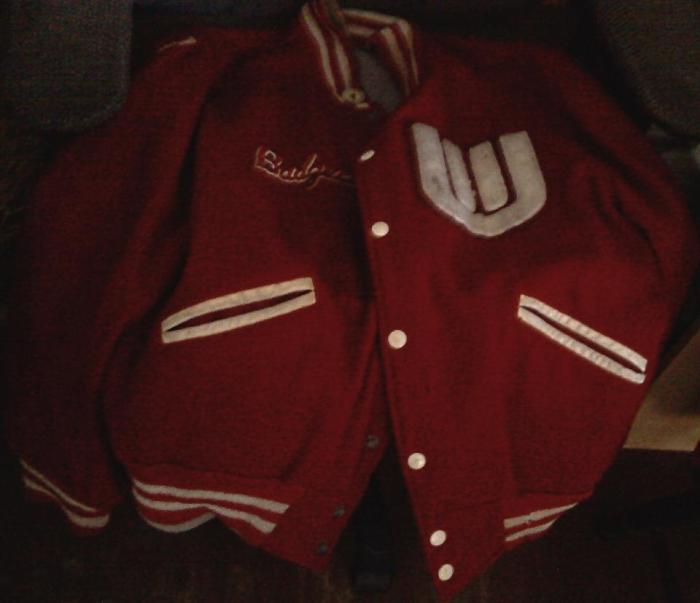
This is my UW Band jacket from my five years in the world’s greatest college marching band. It obviously is similar to a letter jacket (though reversible for going incognito), which I never got to wear because of my athletic suckage. You have to buy the jacket, but the band W goes to those who complete two years in the band, and the pin on the collar goes to three-year marchers. Obviously I have almost no opportunity or reason to wear it, but at least it fits again now that I weigh about what I did when I graduated from UW–Madison.
Back to science fiction: Stylish jackets also can be found in the Star Trek universe, though they are much harder to find …


… and elsewhere in the TV universe:

Col. Ryan’s jacket in the movie “Von Ryan’s Express …” 
… ended up on “Hogan’s Heroes” … 
… while the A2 was also worn by Steve McQueen, one of the Three Cool Steves. As for the other Steves, I found no photo of the Six Million Dollar Man, Steve Austin, wearing a leather jacket, and why would Steve McGarrett wear leather in Hawaii? 
“Voyage to the Bottom of the Sea,” where Captain Crane flies the Flying Sub while Admiral Nelson apparently is the navigator. 
Starsky and Hutch also wore leather jackets, despite the temperate weather in Los Angeles, or “Bay City.” -
The media tour of Charles Koch of The Evil Koch Brothers continues, this time interviewed by William Bennett:
America is in the midst of a labor crisis. Workforce-participation rates are near record lows; the middle class is under tremendous economic pressure; and the U.S. has slipped to 12th among developed nations in business-startup activity.
Almost 60 percent of Americans feel that the American Dream is out of reach for their children. Rightly so. Many recent college graduates saddled with student-loan debts find themselves without jobs or working in jobs with no connection to their majors. Also, surveys of college graduates tell us that many of them have jobs with no connection to a fulfilling life vision or the larger purposes of life.
Into this void steps Charles Koch, chairman and CEO of Koch Industries, and author of the new book Good Profit: How Creating Value for Others Built One of the World’s Most Successful Companies. At a time when work is becoming a down-market commodity, especially among a segment of the young male population, Koch aims to revive our belief in entrepreneurship, labor, the joys of work, and the ability of a free people to prosper, innovate, and create value for themselves and others.
He does so primarily by telling his own story — a story of Homeric achievement. He explains how he helped develop his father’s company, valued at $21 million in 1961, into the second-largest private company in America, valued at $100 billion in 2014 (about 5,000 times larger), with approximately 60,000 employees in the United States.
Koch credits much of his success to the wisdom of his father, Fred Koch, a first-generation American whom he describes as a self-made, John Wayne–type figure intent on inculcating in his children a moral compass and appetite for work.
From an early age, his father instilled in him the value of hard work and persistence. “I should regret very much to have you miss the glorious feeling of accomplishment,” the younger Koch recalls his father telling him. “Remember that often adversity is a blessing in disguise and is certainly the greatest character builder.”
In other cases his counsel was a little blunter. “I hope your first deal is a loser; otherwise you will think you’re a lot smarter than you are,” Fred Koch said when his son took over the company.
Koch will be the first to tell you that losses were plenty, and they still are today. But Koch sees losses as essential to innovation and part of a healthy system of creative destruction where businesses rise and fall on the merits of their ideas and innovation, not political connections or special deals. This is why Koch detests crony capitalism, or, as he calls it, “corporate welfare.”
These ideas manifest themselves in Koch’s central theme — the pursuit of “good profit,” which he describes as “creating superior value for our customers while consuming fewer resources and always acting lawfully and with integrity.” He explains that “Good profit comes from making a contribution in society — not from corporate welfare or other ways of taking advantage of people.”
In other words, Koch’s philosophy is not to maximize short-term profit, but rather to create and sustain value for his customers over time and to do so in an ethical manner, not through special favors. In fact, in the book, Koch takes to task CEOs who make exorbitant salaries through corporate welfare, but he defends those who earn their income through “good profit” because, as he argues, “good profit” benefits all parties involved.
Good Profit is as much a course in ethics as one in business management, and Koch is a business icon with the soul and inclination of a philosopher. For example, he attributes much of his company’s success to his Market-Based Management (MBM) system, which he spent years developing and refining. The core tenets of MBM are vision, virtue, talent, knowledge processes, decision rights, and incentives. These aren’t just a set of feel-good slogans, but a philosophy of management that pervades all of Koch Industries.
For starters, in hiring, Koch Industries chooses people on the basis of values and work ethic before talent or knowledge. In the book, Koch points out that the last four employees who succeeded him as president were educated not in the Ivy League, but rather at Murray State University School of Agriculture, Texas A&M, the University of Tulsa, and Emporia State University.
His point is that it’s not the institution or pedigree that’s important; it’s the person’s character. Koch recognizes that character is forged in the formative years, and if you are not taught values at an early age, especially the value of work, you may never acquire them. And if you are not so blessed, you may become one of those seeking dependence on the government, either through individual welfare or through crony capitalism. If everyone had someone like Fred Koch in his early life, then America’s work crisis would be a fraction of what it is today.
Now 79 years old and the CEO of a multi-billion-dollar company, Koch still works nine-hour days. Why? Not because he’s greedy or obsessed with profits, but because he believes that business pursued properly — to create value for others in an ethical manner — is one of the most rewarding and meaningful experiences in life.
This is the uplifting vision of entrepreneurship and work that America needs right now. Business leaders like Charles Koch should be applauded, not vilified by the likes of Senator Reid, President Obama, and other political opportunists. They, perhaps more than anyone else, should read Good Profit and learn what business should be and can be when led in a virtuous and wise manner.
Perhaps some liberal can explain what is so evil about “creating superior value for our customers while consuming fewer resources and always acting lawfully and with integrity.”
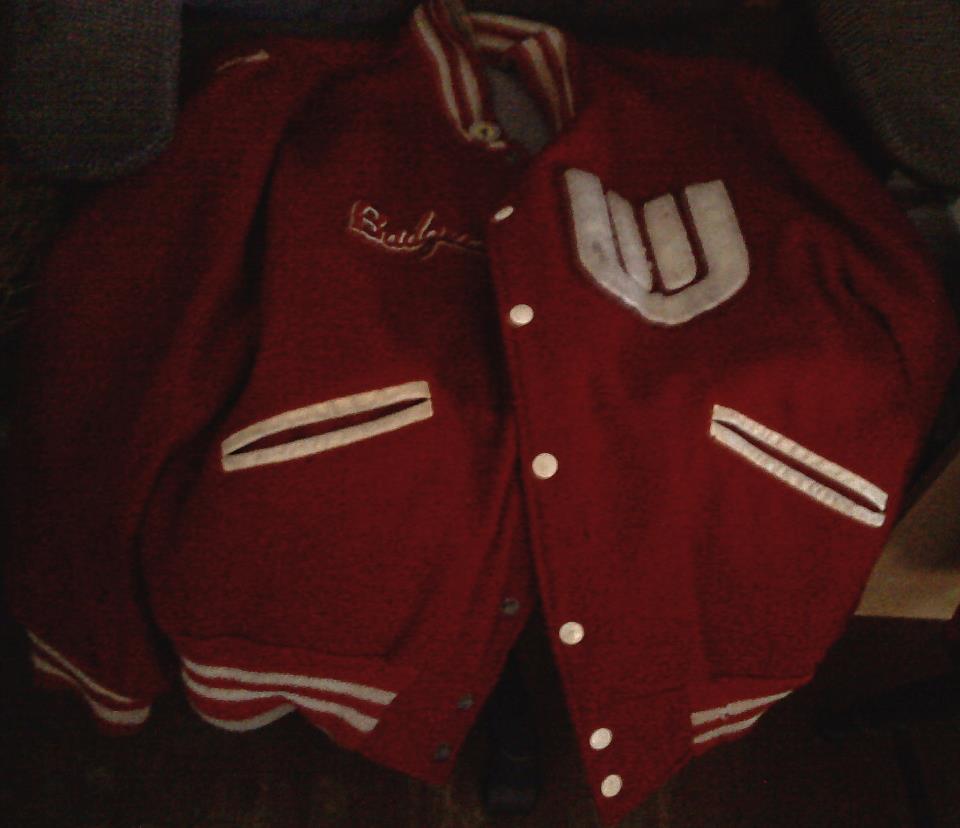
 Steve Prestegard.com: The Presteblog