A journalist must always be proud of his children’s managing to show up in other media, so read about the UW–Oshkosh Discover Firefighting Academy. (Particularly photos 10 and 16 in the slideshow.)
This probably needs music:
A journalist must always be proud of his children’s managing to show up in other media, so read about the UW–Oshkosh Discover Firefighting Academy. (Particularly photos 10 and 16 in the slideshow.)
This probably needs music:
Mollie Hemingway reports on the latest demonstration of the divide between the media and normal people:
Journalist Terry Mattingly wrote a great column back in 2006 noting the trouble many journalists have understanding the finer details of religion news. His column, “Reporters, crow’s ears and Karma Light nuns,” begins with an anecdote about how The New York Times covered the funeral of Pope John Paul II the prior year:
“The 84-year-old John Paul was laid out in Clementine Hall, dressed in white and red vestments, his head covered with a white bishop’s miter and propped up on three dark gold pillows,” wrote Ian Fisher of the New York Times. “Tucked under his left arm was the silver staff, called the crow’s ear, that he had carried in public.”
Get the joke? You see, that ornate silver shepherd’s crook is actually called a crosier (or “crozier”), not a “crow’s ear.”
Sometimes I check in on this April 4, 2005 piece to see if the Times has gotten around to correcting it. As of today, they have not! Sometimes I hope they never will.
But crozier mistakes are understandable. Less understandable? Saying Jesus is buried in the Church of the Holy Sepulchre, that Easter marks Jesus’ “resurrection into heaven,” that St. Patrick is known forbanishing slaves from Ireland, or that William Butler Yeats is the author of the Book of Hebrews.
Then there’s what New York Times political reporter Jeremy W. Peters wrote for his piece “After Orlando, a Political Divide on Gay Rights Still Stands.” Peters is a reporter who struggles to cover issues fairly. He’s known for helping Nancy Pelosi avoid questioning on her abortion stance and other instances of being almost comically partisan in his reporting.
The article is less reportage than it is fuel for what it purports to describe:
The massacre, with stunning speed, has been transformed into a political wedge, beginning with fierce disagreements over just what the crime should be called. An attack by “radical Islamic terrorists,” as Republicans insisted? A hate crime in a place seen as a safe haven by gays, as many Democrats said?
Peters highlighted, among other things, the shameful Anderson-Cooper-avoidance theater.
And then this:
A Republican congressman read his colleagues a Bible verse from Romans that calls for the execution of gays.
Come again? Wait, what? What? What in the world is he talking about? A “Bible verse” from “Romans” that calls for the “execution of gays”? Way to bury the lede there, Peters. You found something that no one else has ever found in two millenia! Though maybe you should go ahead and show your exegesis if you’re going to make such an amazing claim.
Instead he links to a Roll Call story that makes a similar claim. That one is written by one Jennifer Shutt and claims that “House Republicans at a conference meeting heard a Bible verse that calls for death for homosexuals” before a recent vote.
Another story by Shutt says it’s a verse “calling for the death of homosexuals.” The stories say that the passage “discusses what types of penalties the Bible says should be applied to those who are not heterosexual.”
If you have even a passing knowledge of St. Paul’s Epistle to the Romans, the Gospel of Jesus Christ, Christianity in general, heck, the Western canon, or Western Civilization itself, you are probably confused. If you have met a Christian in your life, ditto.
Turns out … well, it turns out that reporters and editors at these two papers apparently do not have this knowledge.
The passages Rep. Rick Allen, R-GA, read were from Romans 1 and also a few verses from the Book of Revelation. It should go without saying, but sadly doesn’t in 2016 America, that neither call for the execution of gays or for their deaths.
Some Background, In Case Members of the Media Are Reading This
In Romans, Paul is defending Christianity and its mission. It has “law” themes and “gospel” themes. The “law” themes include believers’ struggles with sin, our hardened hearts, God’s wrath against sinners, death’s reign through sin, our submission to authorities, and the love we owe one another. But that’s not all! We also learn how God declares us righteous through faith in Christ, how we are made alive in baptism, how God bestows gifts such as the forgiveness of sins upon us, and how we are united in Christ. Those are the “gospel” themes.
It’s very much a 101 type book in that it’s a great introduction to Christianity, but that doesn’t mean it’s simple. It’s very challenging, for about a million different reasons. And it’s regarded as Paul’s greatest work. In any case, Romans 1 is a favorite chapter of mine because it includes the verse I was given when I was confirmed in the faith: “For I am not ashamed of the gospel, for it is the power of God for salvation to everyone who believes, to the Jew first and also to the Greek.” (Yay, Romans 1:16!) It also has great prose such as, “Claiming to be wise, they became fools,” in verse 22.
Anywho, the member of Congress read the section on idolatry. It talks about how God is revealed in nature and how God reveals laws to His people. But the people’s hearts are hardened and they reject God. Paul writes candidly about how homosexual activity exchanges a natural desire for the opposite sex with a lust for one’s own. And yes, he really is talking about homosexual activity.
Which is funny, because when Lisa Miller wrote the Newsweek cover story mocking Christians for opposing the redefinition of marriage, she couldn’t find hardly any biblical evidence to back Christians’ stated views on marriage. (See Sola scriptura minus the scriptura.) She wrote, “The apostle Paul echoed the Christian Lord’s lack of interest in matters of the flesh.” Here’s what she had to say about the passage thatThe New York Times alleges calls for the execution of gays:
Paul was tough on homosexuality, though recently progressive scholars have argued that his condemnation of men who “were inflamed with lust for one another” (which he calls “a perversion”) is really a critique of the worst kind of wickedness: self-delusion, violence, promiscuity and debauchery. In his book “The Arrogance of Nations,” the scholar Neil Elliott argues that Paul is referring in this famous passage to the depravity of the Roman emperors, the craven habits of Nero and Caligula, a reference his audience would have grasped instantly. “Paul is not talking about what we call homosexuality at all,” Elliott says. “He’s talking about a certain group of people who have done everything in this list. We’re not dealing with anything like gay love or gay marriage. We’re talking about really, really violent people who meet their end and are judged by God.” In any case, one might add, Paul argued more strenuously against divorce — and at least half of the Christians in America disregard that teaching.
Religious objections to gay marriage are rooted not in the Bible at all, then, but in custom and tradition (and, to talk turkey for a minute, a personal discomfort with gay sex that transcends theological argument).
Isn’t that interesting? That when the push for same-sex marriage is in full heat, the media condescendingly explain that Christians are wrong to think Paul was speaking against homosexuality in any way, but when an Islamist terrorist is murdering scores of people in a gay club, the real culprit for the attack might be St. Paul?
Anway, Roll Call‘s Shutt writes:
Passages in the verses refer to homosexuality and the penalty for homosexual behavior. “And likewise also the men, leaving the natural use of the woman, burned in their lust one toward another; men with men working that which is unseemly, and receiving in themselves that recompense of their error which was meet,” reads Romans 1:27, which Allen read, according to his office.
“And even as they did not like to retain God in their knowledge, God gave them over to a reprobate mind, to do those things which are not convenient; Being filled with all unrighteousness, fornication, wickedness, covetousness, maliciousness; full of envy, murder, debate, deceit, malignity; whisperers, Backbiters, haters of God, despiteful, proud, boasters, inventors of evil things, disobedient to parents, Without understanding, covenant breakers, without natural affection, implacable, unmerciful: Who knowing the judgment of God, that they which commit such things are worthy of death, not only do the same, but have pleasure in them that do them,” read lines 28-32, which Allen also recited, according to his office.
If you’re going to do the exegesis, Right Reverend Shutt, I might recommend knowing that we don’t call verses “lines.” Also, maybe notice that the listing of sins indicts literally every single human on the planet. So if you’re thinking that Christianity calls for the execution of gays, you have to think, on the basis of the same passage, it calls for the execution of everyone. And if you’re thinking that, and you know anything at all about Christianity, maybe ponder whether everything you’ve written is embarrassingly wrong.
Instead, Shutt specifically said, falsely, that this passage “discusses what types of penalties the Bible says should be applied to those who are not heterosexual.” Wrong. Wrong. And wrong, wrong, wrong. It doesn’t discuss types of penalties. It doesn’t say penalties should be applied at all. And the passage applies to everyone.
There’s no mention of whether Shutt’s cited translation is the one Allen used, but the “worthy of death” phrase (in my Bible, it’s “deserve to die”) is simply a restating of a basic teaching of Christianity. Let’s hop on over to Romans 6:23. (But read the whole chapter because it’s amazing.)
“For the wages of sin is death, but the free gift of God is eternal life in Christ Jesus our Lord.”
This is the good news of Christianity! We’re all sinners who deserve death, but in Christ Jesus, we receive forgiveness and eternal life. If Revs. Shutt and Peters go just one verse past the “execution” passage they claim to have discovered, they would also find:
For in passing judgment on another you condemn yourself, because you, the judge, practice the very same things.
Which is important to note when considering the passages that are so offensive to people who have different sets of doctrines than traditional Christians.
Yes, Paul says God’s created order should not be corrupted and that to alter it is a result of idolatry. Remember that the book is called Romans because Paul is writing to them. Many Roman citizens thought that homosexual behavior had undermined Greek civilization. So when they hear Paul making a point about it, many would have been inclined to agree readily in a self-righteous manner. But then he “springs a trap” as my Study Bible puts it, by listing all these other things that they do. Let’s look again:
“Since they did not see fit to acknowledge God, God gave them up to a debased mind to do what ought not to be done. They were filled with all manner of unrighteousness, evil, covetousness, malice. They are full of envy, murder, strife, deceit, maliciousness. They are gossips, slanderers, haters of God, insolent, haughty, boastful, inventors of evil, disobedient to parents, foolish, faithless, heartless, ruthless.”
Now who’s got standing to be self-righteous? Not a single one of us.
The ever-changing sexual doctrines being handed down by our media and other elite institutions are at odds with many Christian teachings. On sexual distinctions, knocking boots, procreation, marriage, divorce, and much else. We may wish it weren’t so, but it is.
If we are to live in a tolerant society where people are allowed to hold views about sex that deviate from the priestly councils at the media corporations and in academia and in politics — if we are to live in a society where people are allowed to be Christian — we have to deal with that. A good training for tolerance is to understand and accurately convey the views of those sexual revolution heretics who stubbornly keep following their ancient teachings no matter how much the forces of conformity bear down.
Let’s work on that, New York Times.
Most Madisonians know Dave Zweifel as the former editor of The Capital Times, Madison’s former afternoon afternoon newspaper.
Zweifel and I have a different frame of reference, though I haven’t spoken to him since leaving Madison for good in 1988. Dave’s son, Dan, was a student–athlete at Monona Grove High School, so the Monona Community Herald covered Dan’s Monona Grove teams and the Cottage Grove American Legion baseball team. In the latter setting Dave gave me a beer on a hot night when I was covering his team.
So Dave, I think, deserves a hearing on his Capital Times column:
As former UW Athletic Director Pat Richter well knows, I wrote about the demise of the men’s varsity baseball team until I was blue in the face.
Richter had the dubious honor of ending Wisconsin’s varsity baseball program 25 years ago this spring in order to get the UW’s athletic program in compliance with Title IX. The university was under scrutiny because it had substantially more male athletes on athletic scholarships than female. Richter solved the problem by dropping five sports, including baseball.
Now, 25 years later, the UW remains the only Big Ten school without a baseball program — this in a state that has long had a love affair with the sport and is also home to a Major League baseball team.
I was appalled at the demise of baseball, as were hundreds of others in the Madison area who had supported the Badgers’ team just as basketball and football boosters have backed their teams over the years. But the decision had been made and there was no way to change it.
There have been rumbles over the past 25 years — a letter to the editor here, a talk at a service club luncheon there — but nothing managed to get legs. The big impediment now, of course, is that there simply isn’t enough money to equip a team, pay for scholarships, perhaps build or rent a diamond, and cover travel expenses.
A “club” program was formed on the Madison campus in the meantime, giving aspiring baseball players at the university a place to play even if it wasn’t Big Ten Division 1 caliber.
So it was of interest recently when Jeff Block, the coach of those two club baseball teams, put together a 14-page proposal he hopes will show the Athletic Department that restoring Big Ten baseball at the UW is financially feasible.
Block told former Cap Times sports writer Dennis Punzel, who now covers sports for the State Journal, that Big Ten baseball programs average $1.4 million a year in expenses, but Madison could do it for less by using the city of Madison’s Warner Park as its home field. Plus, Block insists, there are a number of longtime baseball supporters in the area who would be interested in funding a new campus ballpark should it come to that.
Block also pointed out that there shouldn’t be any more Title IX worries because since baseball was dropped in 1991, the Athletic Department has added three women’s sports to its mix of 23 varsity sports.
The Athletic Department’s Justin Doherty didn’t exactly give Block’s suggestions a positive response, pointing out that costs already are a concern in today’s athletic environment and the department is concentrating on the competitiveness of the sports it already has.
Nevertheless, Athletic Director Barry Alvarez has dropped hints in the past that he’d be open to at least considering a return to baseball.
The bottom line is that it still is an embarrassment that the University of Wisconsin’s flagship campus is the only Big Ten school without a baseball team.
Well, yes, it is an embarrassment because of the circumstances that led to the death of UW baseball. I don’t disagree that UW had Title IX issues, but the bigger issue was the embarrassment that was former UW football coach Don Mor(t)on, whose ineptitude and resulting plunge in football attendance and revenue nearly torpedoed the entire Athletic Department, along with the department’s poor management under Richter’s predecessors running the Athletic Department.
(To prove that the world is an unjust place: After Mor(t)on was fired one year later than he should have been — ignoring briefly the fact he should never have been hired in the first place — Mor(t)on went back to North Dakota and worked for Great Plains Software, which was purchased by Microsoft, giving Mor(t)on wheelbarrows full of money, no doubt. Mor(t)on should pay all the costs for the reinstitution of UW baseball by himself.)
Block’s and Zweifel’s claim that UW doesn’t have Title IX issues anymore doesn’t mean those issues wouldn’t return if UW brought back baseball. Lacrosse, a sport growing at the high school level in this state, would be a more logical addition than sand volleyball given what passes for spring in this state.
And that brings to mind one major problem with this proposal — what passes for spring in this state. The Division I baseball season starts in February (far south of here, for obvious reasons) and runs until the weekend before Memorial Day weekend; the Big Ten tournament, the winner of which advances to the NCAA tournament, is Memorial Day weekend. Anyone who has lived in southern Wisconsin more than one year knows what “spring” in southern Wisconsin is like — any weather from winter to summer is possible. (For similar reasons summer high school baseball, played by a diminishing number of teams, is vastly preferable to spring baseball, where thanks to Mother Nature you might go a week without games and then have to jam seven games into five days.)
Certainly the fact that Miller Park is an hour or so to the east would help. (The University of Minnesota baseball team played some games at the Metrodome, but there is no more Metrodome.) But the Badgers can’t play all their games in Milwaukee, for what $hould be obviou$ rea$on$.
Money in a general sense is less of an issue at UW these days, with the huge Under Armour contract beginning July 1 and a possible new Big Ten TV contract that would dwarf the previous deal. But even if revenue is coming in like the Mississippi River in the spring after a snowy winter, UW can’t afford to ignore finances. (Given Title IX the costs of baseball would have to include the cost of whatever women’s sport is added to offset baseball.) And as we know from Don Mor(t)on and his Veer from Victory Badgers, success (or lack thereof) leads to attendance (or lack thereof) and revenue (or lack thereof).
According to Wikipedia’s UW baseball page, from the first team in 1896 until the last team in 1991, the Badgers won about 46 percent of their games. The Badgers’ last winning season was 1988, 15–13. The Badgers got to the College World Series once, 1950. From 1965, the first year of the Major League Baseball amateur draft, 38 Badgers were drafted, including two in the first round, outfielder Mark Doran by California (then Anaheim, now Los Angeles) in 1983 and pitcher Tom Fischer by Boston. Neither played a single game in the major leagues.
According to Baseball Reference, 110 former Badgers played professional baseball, and 15 position players and 15 pitchers, including Hall of Fame pitcher Addie Joss, played in the majors. The most notable Badger baseball players probably were Joss, who had 160 wins and a 1.89 ERA in the early 1900s; Harvey Kuenn, a .303 lifetime hitter who later managed the only Brewers World Series team; Paul Quantrill; who pitched for 14 seasons; Lance Painter, who pitched for 10 seasons (including with the 2001 Brewers) despite a career ERA of 5.24; pitcher Jim O’Toole, who pitched for 10 seasons, going 19–9 for the 1961 National League champion Reds; outfielder Rick Reichardt, who played for 11 seasons, three with the White Sox, with a .261 career batting average and 116 home runs; and pitcher Rodney Myers, who pitched for the 1998 wild-card Cubs.

There weren’t enough ex-Badgers in Major League Baseball to even create much of an all-Badgers MLB team in the 116 years of UW baseball:
Starting pitchers: Joss, Quantrill, Painter, O’Toole.
Relief pitchers: Myers, Tom “The Klaw” Klawitter (better known as the long-time Janesville Parker girls’ basketball coach).
Catcher: Robert “Red” Wilson, who played in the 1950s.
First base: Frank “Pop” Dillon, who played around the turn of the previous century.
Second base: Clay Perry (played one season in Detroit, 1908).
Shortstop: Kuenn.
Third base: John Sullivan, who played in the 1940s.
Outfield: Reichardt, John DeMerit (who was on the 1957 world champion Milwaukee Braves), Milt Bocek (two seasons with the 1930s White Sox).
One feature of the UW baseball team from what I remember as a student was players from other sports, including football players Doran (a kicker) and Scott Cepicky (a punter) and Scott Sabo (a hockey player). I believe some football players run, or ran, track as well. I don’t know if football coach Paul Chryst, men’s basketball coach Greg Gard or men’s hockey coach Tony Granato would allow their players to play baseball now.
Not surprisingly given the preceding list, baseball wasn’t that popular at UW. For what it’s worth, in five years as a student I never went to a game. The sport was not promoted on campus, the team wasn’t broadcast on radio, and the only way I knew about the team was from newspaper and TV coverage of games. I don’t even recall the Daily Cardinal and Badger Herald covering the team, though they must have.
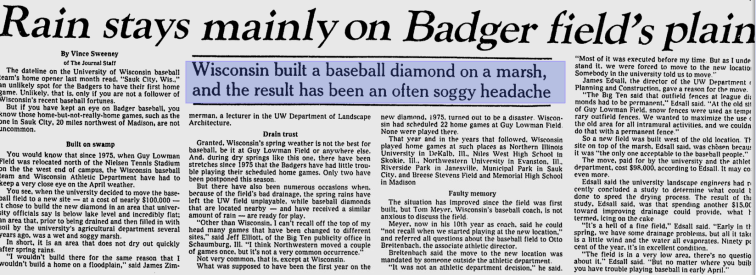
The stadium, Guy Lowman Field (to be precise, its second site), is now the site of Goodman Diamond, where the Badger softball team plays. Lowman wasn’t much of a field when UW was playing there …
… but Warner Park, which hosted the minor-league Muskies and Black Wolf and now independent-league Mallards, is in much better shape, though it is no closer to campus than it was when the Badgers and Muskies played occasional exhibition games. (Warner Park is considerably farther from campus than the Dane County Coliseum, the previous hockey home.)
In a more perfect world, a minor league team (and I’ve argued here before that greater Madison is large enough to support a Class AAA franchise) and UW would share a baseball stadium close to, but not on, campus. (Because beer.) As it is, the Badgers’ season would end before the Mallards’ season begins, so unless the Badgers hosted NCAA tournament games (see previous paragraph about their last College World Series experience), there would be no scheduling conflicts. I have serious questions about how viable UW baseball would be so far off campus at Warner Park. And there remain questions about how successful baseball would be at Wisconsin, given its previous lack of success and previous lack of fan interest.
James Taranto explains the term I made up for this blog:
The New York Times’s Timothy Egan thinks Donald Trump is a “pathological liar.” …
An additional irony is that Egan’s column appears in a newspaper that itself can fairly be characterized, in the institutional voice of its editorial board, as a pathological liar.
We base that admittedly harsh assessment on today’s editorial about Sunday’s Islamic terror attack on a gay bar in Orlando, in which the Times asserts this:
While the precise motivation for the rampage remains unclear, it is evident that [attacker Omar] Mateen was driven by hatred toward gays and lesbians. Hate crimes don’t happen in a vacuum. They occur where bigotry is allowed to fester, where minorities are vilified and where people are scapegoated for political gain. Tragically, this is the state of American politics, driven too often by Republican politicians who see prejudice as something to exploit, not extinguish.
In fact, the motivation is entirely clear. The Washington Post reports that during the attack, Mateen phoned a local TV station and told a producer: “I did it for ISIS. I did it for the Islamic State.” He told 911 operators the same thing.
Where might Mateen have developed an antipathy toward gays? On Monday we noted that after the attack his father posted on his Facebook page that “God himself will punish those involved in homosexuality.” Mateen père is not a Republican but an Afghan immigrant reportedly sympathetic to the Taliban.
The Times faults Republicans for opposing same-sex marriage, antidiscrimination laws (which the Times believes should be enforced without any exception for religious conscience) and the use of ladies’ rest rooms by persons whose “gender identity” does not match their sex. In itself, that’s fine. There is room for civilized disagreement about such matters. But falsely blaming your political adversaries for mass murder is hardly civilized.
There’s an additional irony to the Times’s post-Orlando jihad against Republicans: Trump, notwithstanding his total disregard for liberal pieties, has never, so far as we know, said anything remotely hostile to sexual minorities—in contrast with Mrs. Clinton, who opposed same-sex marriage until 2013. That was true at a time when society as a whole was far less tolerant: In his 1987 book, “The Art of the Deal,” Trump mentions the homosexuality of his late friend Roy Cohn and is totally blasé about it.
The editorial notes in passing that “Trump, unlike some other prominent Republicans, called the Orlando massacre what it was: an attack on gay people.” Actually he went further than that: In a speech Monday, he said: “Our nation stands together in solidarity with the members of Orlando’s LGBT community.”
Trump also was honest in acknowledging the ideology behind the attack: “A radical Islamic terrorist targeted the nightclub not only because he wanted to kill Americans, but in order to execute gay and lesbian citizens because of their sexual orientation.” He faulted the Obama administration’s “politically correct response”—meaning its steadfast refusal to acknowledge that Islamic terrorism is Islamic—which he said “cripples our ability to talk and think and act clearly.”
That prompted a response from the president himself that CNN calls a “tirade” and the Times, in another editorial today, calls “powerful words”:
[Obama] addressed the accusation—a fetishized Republican talking point, repeated by Mr. Trump after Orlando—that Mr. Obama is surrendering to the enemy by avoiding the label “radical Islam.” The idea that reciting those words would help magically defeat the terrorists is absurd, and worse. It plays into the desire of groups like ISIS and Al Qaeda to make the war, as Mr. Obama said, “a war between Islam and America, or between Islam and the West. They want to claim that they are the true leaders of over a billion Muslims around the world who reject their crazy notions.”
Obama and the Times are setting up a straw man. “The problem with Obama’s conduct isn’t that naming radical Islam would solve the problem,” Commentary’s John Podhoretz observes. “Of course, it wouldn’t solve the problem. The issue is that the refusal to name radical Islam is part of the problem.”
The Times’s slander against Republicans is nothing new: In 2011, as we noted, an editorial blamed “Republicans and particularly their most virulent supporters in the media” for the Tucson, Ariz., attack whose victims included then-Rep. Gabby Giffords. By the time that editorial ran, it had been established that the killer had no discernible ideological motivation.
In the Orlando case, however, the Times’s dishonesty is doubly despicable. The paper falsely blames its political adversaries for a grievous crime that was ideologically motivated, while furthering the official lie that the killer’s ideology amounts to nothing more than “crazy notions.”
For readers not in the Green Bay TV market, Tom Zalaski is an anchor at WFRV-TV (channel 5) in Green Bay.
(Irrelevant aside: Zalaski went to WFRV from WBAY-TV (channel 2) in Green Bay. WBAY was the original CBS station in Green Bay before WFRV switched in 1992 from ABC to CBS when CBS purchased WFRV in order to purchase WCCO-TV, the CBS affiliate in the Twin Cities, because WCCO and WFRV were owned by the same company. WFRV, meanwhile, was an NBC station before it switched to ABC in the late 1970s, forcing WLUK-TV (channel 11), the market’s original NBC station before it switched to ABC in 1959, to switch from ABC to NBC.)
Zalaski and I have the same tie, a bright green paisley design. He wore the tie one night on the news, and in my former life as a business magazine editor I called the station asking where he got his tie. Zalaski answered the phone and gave the answer — J.C. Penney in Oshkosh. I wear ties as infrequently as I can, but I have that tie.
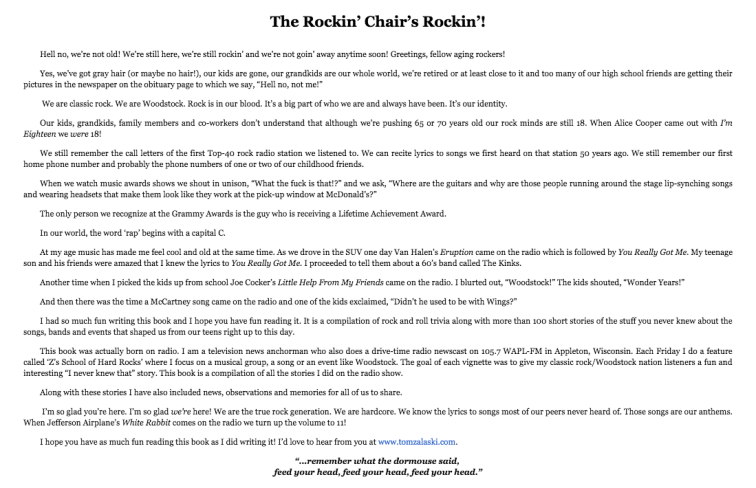
Zalaski has other talents besides TV news (for which he has a great voice). He is the author of Classic Rock Woodstock and the Bands That Saved Us from the Beatles: Lessons from Z’s Scho0l of Hard Rocks, now available through Amazon.com.
Zalaski’s introduction, which can be read on Amazon.com, notes his additional broadcast role of afternoon news on WAPL (105.7 FM) in Appleton:
Zalaski also lists songs that, growing up in Connecticut, pushed him away from the Beatles:
If you are a fan of music from the psychedelic era onward, you should get Zalaski’s book.
A long time ago, more than 20 years in fact, the Wall Street Journal published a powerful, eloquent editorial, simply headlined: “No Guardrails.”
In our time, the United States suffers every day of the week because there are now so many marginalized people among us who don’t understand the rules, who don’t think that rules of personal or civil conduct apply to them, who have no notion of self-control.
Twenty years later, that same newspaper is edging toward open advocacy in favor of Donald Trump, the least self-controlled major-party candidate for high office in the history of the republic. And as he forged his path to the nomination, he snapped through seven different guardrails, revealing how brittle the norms that safeguard the American republic had grown.Here’s the part of the 2016 story that will be hardest to explain after it’s all over: Trump did not deceive anyone. Unlike, say, Sarah Palin in 2008, Trump appeared before the electorate in his own clothes, speaking his own words. When he issued a promise, he instantly contradicted it. If you chose to accept the promise anyway, you did so with abundant notice of its worthlessness. For all the times Trump said believe me and trust me in his salesman patter, he communicated constantly and in every medium that there was only thing you could believe and trust: If you voted for Donald Trump, you’d get Donald Trump, in all his Trumpery and Trumpiness.
The television networks that promoted Trump; the primary voters who elevated him; the politicians who eventually surrendered to him; the intellectuals who argued for him, and the donors who, however grudgingly, wrote checks to him—all of them knew, by the time they made their decisions, that Trump lied all the time, about everything. They knew that Trump was ignorant, and coarse, and boastful, and cruel. They knew he habitually sympathized with dictators and kleptocrats—and that his instinct when confronted with criticism of himself was to attack, vilify, and suppress. They knew his disrespect for women, the disabled, and ethnic and religious minorities. They knew that he wished to unravel NATO and other U.S.-led alliances, and that he speculated aloud about partial default on American financial obligations. None of that dissuaded or deterred them.
And the “them” is growing. When I wrote about the Trump candidacy last fall, that candidacy was still backed only by one-third of Republicans, most typically the party’s least-affluent, least-educated, and least-churched supporters. Back then, I offered four guesses about the party’s response to Trump: beat him, steal his issues, ignore him, or change the rules to circumvent him. I under-estimated him—or possibly over-estimated them. Trump steadily added to his support, moving up-market and up in the polls. In the Oregon Republican primary of May 17, the first after his last rivals conceded defeat, Trump won 66.6 percent of all votes cast. Polls in late May show 85 percent of Republicans now supporting Trump.
Those of us who live and socialize among conservatives every day discover that another friend has—with greater or lesser reluctance—accepted the leadership of the bombastic businessman and reality-television star. To those of us who still cannot imagine Trump as either a nominee or a president, this movement toward him among our friends, relatives, and colleagues is in varying degrees baffling and sinister. Yet it is happening: an inescapable and accelerating fact.
Whatever happens in November, conservatives and Republicans will have brought a catastrophe upon themselves, in violation of their own stated principles and best judgment. It’s often said that a good con is based upon the victim’s weaknesses. Why were conservatives and Republicans so vulnerable? Are these vulnerabilities not specific to one side of the political spectrum—are they more broadly present in American culture? Could it happen to liberals and Democrats next time? Where were the guardrails?
Let’s survey the breakage, from earliest to latest, and from least to most alarming.
The first guardrail to go missing was the old set of expectations about how a candidate for president of the United States should speak and act. Here’s Adlai Stevenson accepting the Democratic nomination for president in 1952:
That I have not sought this nomination, that I could not seek it in good conscience, that I would not seek it in honest self-appraisal, is not to say that I value it the less.
There was a certain quantum of malarkey here—but it wasn’t all malarkey. From the founding of the republic, Americans have looked to qualities of personal restraint as one of the first checks on the power of office. “The aim of every political Constitution is or ought to be first to obtain for rulers, men who possess most wisdom to discern, and most virtue to pursue the common good of the society; and in the next place, to take the most effectual precautions for keeping them virtuous, whilst they continue to hold their public trust.” So argued James Madison in Federalist 57. In Federalist 68, Alexander Hamilton promised more specifically: “Talents for low intrigue, and the little arts of popularity, may alone suffice to elevate a man to the first honors in a single State; but it will require other talents, and a different kind of merit, to establish him in the esteem and confidence of the whole Union, or of so considerable a portion of it as would be necessary to make him a successful candidate for the distinguished office of President of the United States.” Through two-and-a-quarter centuries, conservative-minded Americans have worried that one change or another would obliterate the old ideals: the rise of parties in the 1800s, universal white-male suffrage in the 1830s, votes for women, television, etc. We can argue about the character of the various presidents elected along the way. Yet when Barack Obama sought the office in 2007, he sounded the familiar refrain: “I know you didn’t come here just for me, you came here because you believe in what this country can be.”
To put it mildly, that’s not the tone of the Donald Trump campaign. President Nixon said in his 1969 eulogy of former President Eisenhower, “He exemplified what millions of parents hoped that their sons would be: strong and courageous and honest and compassionate. And with his own great qualities of heart, he personified the best in America.” Donald Trump, by contrast, former Republican presidential nominee Mitt Romney lamented, exemplifies what millions of parents would fear in their sons: “the bullying, the greed, the showing off, the misogyny, the absurd third-grade theatrics.” …
The second broken guardrail is the expectation of some measure of trustworthiness in politicians.
The dark arts of politics include dissimulation, evasion, and misdirection. Days before the election of 1940, Franklin Roosevelt famously promised the mothers and fathers of America, “Your boys are not going to be sent into any foreign war.” He’d left himself a wide loophole, however, for as he explained to his speechwriter Robert Sherwood, “If somebody attacks us, then it isn’t a foreign war, is it?”
Outright lying, however, happens more rarely than you think in politics, especially in high and visible offices like the presidency. Political scientists estimate that presidents keep about three-quarters of their campaign promises. When presidents break their word, the reason is far more likely to be congressional opposition than the president’s own flip-flopping. If politicians really did lie all the time, voters would not be so outraged on those occasions where a politician is indubitably caught in untruth—and yet voters are outraged. Even where the politician did not intentionally lie, as George W. Bush did not intentionally lie about weapons of mass destruction in Iraq, important statements exposed as damagingly untrue inflict untold political damage.Donald Trump’s dishonesty, however, is qualitatively different than anything before seen from a major-party nominee. The stack of lies teeters so tall that one obscures another: lies about New Jersey Muslims celebrating 9/11, lies about his opposition to the Iraq and Afghanistan war, lies about his wealth, lies about the size of his crowds, lies about women he’s dated, lies about his donations to charity, lies about self-funding his campaign. “Whatever lie he’s telling, in that minute he believes it,” Senator Ted Cruz said of Trump in May 2016. “But the man is utterly amoral. Morality does not exist for him.”As late as March, 2016, more than half of Republicans and Republican leadersdescribed Trump as “dishonest” in a Washington Post survey. They voted for him in the primaries all the same, and by rising pluralities even as the lies accumulated. Trump’s lies weren’t overlooked—and they weren’t believed. They were condoned by Republicans who had come to believe, “everybody does it.” MSNBC host Joe Scarborough spoke for many:
Conservatives that have been betrayed by the Washington establishment for 30 years, by Republican candidates that run for office saying they’re going to balance the budget and lie. Republican candidates that run and say they’re going to overturn Obamacare and lie. Republican candidates who say vote for me and I’m going to have a humble foreign policy and lie.
But Scarborough’s list of betrayals weren’t “lies.” They were failures, failures made inevitable by the impossibility of the Republican base’s own demands. (How do you balance the budget while cutting taxes, without touching either defense or Medicare?) As one unfriendly critic noted, the Republican rank-and-file weren’t exactly innocent victims of elite deception.
Republican voters … wanted everything, and, after all, GOP leaders promised them that it was possible—even though those same leaders knew it was not.
Place the blame for that failure where you will, however, the results were glaring: radical Republican rejection of the trustworthiness of their leaders—all their leaders. What, then, was one liar more—especially if that liar were more exciting than the others, more willing to say at least some of the things that Republicans wanted said? Cynicism leads to acceptance of the previously unacceptable. Another guardrail down.
A third broken guardrail is the expectation that a potential president should possess deep—or at least adequate—knowledge of public affairs.
Donald Trump is surely the most policy-ignorant major party nominee of modern times, or perhaps of any time. As with the lies, it’s almost impossible to keep track of the revelations of gaps in his knowledge. The most spectacular may have been talk-radio host Hugh Hewitt’s exposure of the fact that Trump lacked the most basic understanding of the structure and mission of the U.S. nuclear arsenal.
It’s a fair generalization that Republicans demand less policy expertise from their national leaders than Democrats have usually expected from theirs. Ronald Reagan was less well-informed than Jimmy Carter; George W. Bush had mastered less detail than Al Gore. Yet both Reagan and Bush had at least proven themselves successful governors of important states. Both men offered clear and plausible presidential platforms, which both men implemented in their first year in office more or less as advertised.
What’s different now is the massive Republican and conservative rejection of the idea that a candidate for president should know anything substantive about governing at all. As of November, 2015, 62 percent of Republicans insisted that “ordinary Americans” would do a better job solving the country’s problems than professional politicians. While 80 percent of Democrats wanted experience in government in the next president, according to post-Super Tuesday 2016 exit polls, only 40 percent of Republicans did so. The larger share, 50 percent, preferred an “outsider.”
Over the past three cycles, Republicans have elevated a succession of manifestly unqualified people to high places in their national politics. Sarah Palin and Michele Bachmann shot to stardom in the Tea Party era. For a brief period in late 2015, Ben Carson led the Republican polls—Carson being the only candidate who made even Donald Trump look knowledgeable by comparison. Government is a complex science and a sophisticated art. Its details matter, its trade-offs reverberate into four and five dimensions. Although Republican voters in the aggregate are better informed than Democratic voters in the aggregate, their votes are guided by two more urgent and immediate feelings: bleak pessimism (79 percent of Republicans say they are on the “losing side” of most political debates, versus 52 percent of Democrats) and unyielding refusal to compromisewith opponents (while 63 percent of Democrats favor a president who’ll compromise with the other party, only 35 percent of Republicans do so). Despairing yet obdurate, Republicans have come to value willpower over intellect, combativeness over expertise. Donald Trump’s nomination culminates that evolution. A third guardrail down.
One guardrail that Trump’s opponents all assumed would hold fast was the fourth: the guardrail of ideology. Hardline conservatives would surely reject a candidate who barely understood what a principle was! Anti-compromise Republicans would certainly recoil from a candidate who advertised himself as a deal-maker! Wrong and wrong.
Trump bungled tests of orthodoxy on abortion, taxes, Obamacare, and national security. He survived unscathed. Attacks on Trump as a false conservative signally failed, whether launched by fellow-candidates or outside super PACs. As Ross Douthat of The New York Times nicely phrased it, “A party whose leading factions often seemed incapable of budging from 1980s-era dogma suddenly caved completely to a candidate who regards much of the conservative vision with indifference bordering on contempt.”
The ideology guardrail snapped because so much of the ideology itself had long since ceased to be relevant to the lives of so many Republican primary voters. Instead of a political program, conservatism had become an individual identity. What this meant, for politicians, was that the measure of your “conservatism” stopped being the measures you passed in office—and became much more a matter of style, affect, and manner. John McCain might have a perfect pro-life voting record. Mitch McConnell may have proven himself President Obama’s most effective opponent. Jeb Bush may have cut state taxes every year. But compared to Sarah Palin’s folksy attacks on big city elites … or Ron Paul’s dark allegations of conspiracy at the Federal Reserve … or Ted Cruz’s government filibusters and shutdowns–none of those real-world achievements weighed much in the balance.
The party’s once mighty social conservatives collapsed like sodden newsprint before a candidate who treated them with flagrant disrespect. The ardently pro-life Pat Buchanan belittled Trump’s mangling of the movement’s core principles: “New to elective politics, Trump is less familiar with the ideological and issues terrain than those who live there.” Trump urged evangelical leaders to “trust him” on traditional marriage. Days later, he told a reporter that he’d “move forward” on gay rights. He then resolved the contradiction by refusing to answer more questions about the issue.
John Boehner and Eric Cantor had been chased out of Congress for much smaller deviations from orthodoxy. How did Trump get away with so much more? Trump may not be much of a conservative by conviction. But he functions as a conservative in silhouette, defined by the animosity of all the groups that revile him. “SJWs will elect Trump,” warned the anti-Trump writer Rod Dreher in The American Conservative after protesters shut down a Trump rally in Chicago in March. “I am not a Trump supporter, and I reject much of his rhetoric. But he has a right to give a speech, even an obnoxious speech, without it being interrupted by demonstrators. … What those protesters have done tonight is create a lot more Trump voters out of people who are sick and tired of privileged leftists using thug tactics to silence their opponents.”“We love him most for the enemies he made,” said supporters of the anti-Tammany Democrat Grover Cleveland. The sentiment applies pretty generally in politics. As conservatism’s positive program has fallen ever more badly out of date, as it has delivered ever fewer benefits to its supporters and constituents, those supporters have increasingly defined their conservatism not by their beliefs, but by their adversaries. And those adversaries Donald Trump has made abundantly his own. Donald Trump would have been hemmed in a generation ago by a fifth guardrail: the primacy of national security concerns. Trump has no relevant experience, no military record, scant interest in the topic—and a long history of casual expressions of sympathy for authoritarian rulers. He famously explained that he gets his military advice from TV talk shows. The most recent Republican secretary of defense, Bob Gates, told Yahoo’s Katie Couric that he would not, at present, feel comfortable with Donald Trump’s finger on the nuclear button.
Trump has slighted NATO as “obsolete.” “If it breaks up NATO,” he has said of his plans to withdraw American protection from allies who don’t spend more, “it breaks up NATO.” He’s also proposed withdrawing U.S. protection from Japan and South Korea, and spoken favorably of those two countries providing for their own security by obtaining nuclear weapons, apparently unaware of the tensions between those two U.S. allies. Trump also mused open-mindedly about Saudi Arabia acquiring nuclear weapons.
There’s something more going on here than an Iraq War hangover. Trump’s foreign policy is predicated upon an apocalyptic vision of the United States as a weak and fading country, no longer able to shoulder the costs and burdens of world leadership. That view aligns with the deeply pessimistic mood of today’s Republican voters. Sixty-six percent of them say that life has gotten worse for people like them as compared to 50 years ago. (Trump voters are the most pessimistic: 75 percent of them say things are worse for people like themselves.) Half of Trump Republicans describe economic conditions in the United States as poor; almost 40 percent of them assess that American involvement usually makes global problems worse.Trump’s foreign-policy statements are so careless and so seemingly poorly considered that it’s tempting to dismiss them. If he did become president, wouldn’t he be surrounded by steadier hands, who would draw him back toward the historic norms of American policy? Perhaps. But also very likely … not. Trump’s ramshackle statements do present a coherent point of view. His instinct is always to abandon friends and allies, to smash up alliances that have kept the peace, to leave the world to fend for itself against aggressors and predators.Trump’s one significant foreign-policy address was delivered to an audience that included the Russian ambassador but no representatives of any U.S. allies. Trump’s campaign manager, Paul Manafort, worked for seven years for the kleptocratic ruler of Ukraine, Viktor Yanukovych. Trump’s online presence is strongly reinforced by pro-Putin trolls and bots. Republicans still care that their candidate be “strong.” They thrill to Trump’s rhetoric of massive violence against ISIS. What they seem no longer to care about is the larger architecture of security built since 1941 to keep America and its friends safe, prosperous, and free.
Despairing and demoralized, they lack the “energy and conviction”—in the phrase of the French Cold War writer Jean-Francois Revel—to sustain American leadership or to defend American interests in the larger world. The guardrail of conservative commitment to U.S. global leadership has smashed, ripping open a danger to the world, and a sinister opportunity to global mischief-makers.
A deep belief in tolerance and non-discrimination for Americans of all faiths, creeds, and origins also once functioned as a guardrail against destructive politics. In the words of the 1980 Republican platform: “The truths we hold and the values we share affirm that no individual should be victimized by unfair discrimination because of race, sex, advanced age, physical handicap, difference of national origin or religion, or economic circumstance.”
Disrespect for targeted groups—including the very biggest of them all, women—has been the recurring theme of the Trump candidacy. Even many Republicans who have accepted Trump are left uneasy by the candidate’s tone and associations. Trump himself is trying to retrace some ground, tweeting an image of himself eating a taco bowl and explaining to Fox’s Greta van Sustern that he’d wish to “back off” a ban on Muslim entry into the United States “as soon as possible.”
Trump has appealed to white identity more explicitly than any national political figure since George Wallace. But whereas Wallace was marginalized first within the Democratic Party, and then within national politics, Trump has increasingly been accommodated. Yes, Trump was often fiercely denounced by rivals and insiders in the earlier part of the campaign. But since effectively securing the nomination by winning the Indiana primary on May 3, that criticism has quieted—when it has not ceased altogether. One-time Trump opponents like former Bush White House spokesperson Ari Fleischer now dismiss criticism of Trump’s slurs and insults as “a Northeastern look down your nose at other people who are different …. That [criticism] is disdain for the voters.”
America in 2016 is vastly more racially diverse society than the America of Goldwater’s and Wallace’s time. At that time, an overwhelming white majority was presented with demands for equality by a long subordinated African American minority. At least as a matter of formal law, the white majority of the 1960s and 1970s acceded to that demand. Everett Dirksen, the Republican leader in the U.S. Senate, spoke for that majority when he led the fight to end the filibuster of what would become the Civil Rights Act of 1964. “The time has come for equal of opportunity in … government, in education, and in employment. It will not be stayed or denied. It is here.”
The country’s different now, and the change has brought unexpected political consequences. Whites exposed to the racial demographic shift information preferred interactions/settings with their own ethnic group over minority ethnic groups; expressed more negative attitudes toward Latinos, Blacks, and Asian Americans; and expressed more automatic pro-White/anti-minority bias. … These results suggest that rather than ushering in a more tolerant future, the increasing diversity of the nation may instead yield intergroup hostility.
That’s the summary of a set of experiments by psychologists at Northwestern University. Their work is supported by abundant evidence across the social sciences, including perhaps most famously a 2007 paper by Robert Putnam showing that increases in ethnic diversity lead to collapses in civic health. Trust among neighbors declines, as does voting, charitable giving, and volunteering.
As community cohesion weakens, moral norms change. What would have been unacceptable behavior in a more homogenous national community becomes tolerable when a formerly ascendant group sees itself at risk from aggressive new claims by new competitors. Trump is running not to be president of all Americans, but to be the clan leader of white Americans. Those white Americans who respond to his message hear his abusive comments, not as evidence of his unfitness for office, but as proof of his commitment to their tribe.
And so breaks another guardrail.
Which brings us to the last and perhaps very most ominous of the broken guardrails.
The generation that bore arms in World War II returned home with a strong—arguably unprecedentedly strong—loyalty to the nation as a whole. Never before or after did so many civilians move across state lines as in the decade of the 1940s. Then followed the great migrations from city to suburbs, of black farmworkers to northern cities, and of northern officeworkers to the booming Sunbelt.
Once fierce religious rivalries blurred into the broad categories— Protestant, Catholic, Jew–which in turn discovered new affinities for each other in a common creed of “Americanism.”
In a way unknown before, and unfamiliar since, the veterans of World War II routinely voted one way for presidents and governors, and the opposite way for members of Congress or state legislatures. Democrats won majorities of both houses of Congress in nearly every election from 1954 through 1992, with Republicans only holding the Senate for a brief stretch from 1981 to 1987. Yet voters delivered pendulum-swing-style landslide presidential victories, sometimes to Democrats (1964), sometimes to Republicans (1972, 1984).*In 1972, more than 37 million Americans cast a vote for a Democratic member of the House of Representatives: something over 52 percent of all House votes cast. Only about 29 million Americans voted for Democrat George McGovern for president that year. Ticket splitting in 1984 was only a little less dramatic: House Democrats won a combined 4.25 million more votes than House Republicans, even as Ronald Reagan beat Walter Mondale by some 17 million votes.Partisan identities have hardened since then. “Today, far larger proportions of Democratic and Republican voters hold strongly negative views of the opposing party than in the past,” observe Alan Abramowitz and Steven Webster in their paper, “All Politics is National: The Rise of Negative Partisanship.” Negative partisanship is the argument deployed to reconcile anti-Trump Republicans to their party’s nominee. Thus, defeated Senator Marco Rubio told the Today program on May 11 that, without retracting a word of criticism of Donald Trump, “I’m even more scared about her [Clinton] being in control of the U.S. government.”
Negative partisanship has softened the Wall Street Journal too. The day after Trump released a list of selections for the Supreme Court, the Journal’s editorsreassured readers: “Nothing is certain with Mr. Trump, but that’s far preferable to the certainty that Hillary Clinton would nominate a down-the-line liberal.”
Even more arrestingly, National Review editor Jonah Goldberg—one of the most forceful of the conservative “Never Trump” voices—explained on May 21 that while he would continue to speak against Trump as a danger to the conservative movement:
If the election were a perfect tie, and the vote fell to me and me alone, I’d probably vote for none other than Donald Trump because (endorsing a view presented to him by a National Review supporter) we know Hillary will be terrible, while we can only suspect Trump will be. Trump will probably do some things conservatives will like—Supreme Court appointments, etc.—while we know for a fact Hillary will not.
Once you’ve convinced yourself that a president of the other party is the very worst possible thing that could befall America, then any nominee of your party—literally no matter who—becomes a lesser evil. And with that, the last of the guardrails is smashed.
After five years of this blog, I have not gotten anywhere close to 1 million blog hits.
Apparently after five years I’ve been doing it wrong, according to Robert Stacy “The Other” McCain in 2009:
It’s the Underpants Gnome Theory of Blogging:
- Phase 1: Get a Blogspot account.
- Phase 2: ?
- Phase 3: One million visitors!
Obviously, the key here is Phase 2, which has been exceptionally disorganized. Some guys work smart. Some guys work hard. Some guys are just incredibly lucky.
The perceptive blog consumer will notice that posts here don’t have all those little thingies (Digg, etc.) the way some other blogs do. This is not because I disdain such methods of traffic enhancement, but because I’m such a primitive Unfrozen Caveman Blogger I can’t figure that stuff out. It’s the same reason I’m still on a Blogspot platform, rather than switching to a custom-designed WordPress format. Blogspot is so simple that even I can figure it out, and if they’d just offer a few more templates — hey, guys, how about a template with variable-width sidebars on both sides? — I might be able to fake that custom-designed elegance, too. I understand basic HTML, but Javascript no can do, and I’m too cheap to shell out the bucks for geek services.
McCain’s first three rules were kind of boring, so let’s skip to …
- 4. Make Some Enemies
We’ll have none of your “bipartian civility” around here, you sissy weaklings. This here is the Intertoobs, and we’re As Nasty As We Wanna Be. The fact that The Moderate Voice has turned into a reliable vessel for DNC talking points should tell you all you need to know about the fate of bipartisanship in the blogosphere.
At the same time, however, don’t confuse cyber-venom with real-world hate. Maybe Ace of Spades really would like to go upside Andrew Sullivan’s head with a baseball bat, I don’t know. But at some point you understand it’s just blogging about politics, and you start wondering if maybe it shares a certain spectator-friendly quality with pro wrestling. For all we know, Ace is spending weekends at Sully’s beach shack in Provincetown. (Next on Blogging Heads TV: Can “Bears” and Ewoks Be “Just Friends”?) …
A couple days ago, hunting around for a reason to link my friendRuss Smith’s SpliceToday, I happened upon a column by Russ’s young minion, Andrew Sargus Klein, offering a particularly insipid argument for federal arts funding. Now, having been born and raised a Democrat, and arguably having never outgrown my obnoxious youthful arrogance, I can actually relate to Klein’s insipid argument. Stupid is as stupid does, and when I was 25, I might well have written something equally stupid. But the boy will never outgrow his stupidity unless he gets whomped on the head some.
Easy as it would have been to ignore Klein, I hit upon the delightfully fun idea of laying into him in Arkansas knife-fight mode: If you’re going to cut a man, eviscerate him. So I quickly composed a hyperbolic ad hominem rant, with the thoughtfully civil title, “Andrew Sargus Klein is an arrogant elitist douchebag.” I forward-dated the post for Friday morning, and sent Russ an e-mail to the effect of, “Hey, hope you don’t mind me abusing your office help a little bit. Nothing like a flame-war to build traffic. Don’t let on to Klein that I’m just funnin’ around with him.”
I’d hoped to bait Klein himself into a response. However, before that could happen — as if intent on illustrating how to make a fool out of yourself by taking this stuff too seriously — one of Klein’s friends offered up a comment:
Andrew Klein may be arrogant and elitist but he could craft logical arguments around your bumbling hypocrisy all day and night.
Of course I never bother “craft[ing] logical arguments,” sweetheart. It’s a freaking blog. If you want logic, subscribe to a magazine or buy a book. Pardon my double-entendre, Lola Wakefield, but people come here for the cheesecake. Logical arguments are a dime a dozen on the Internet, but sexy hotness . . . well, that reminds me of Rule 5:
- 5. Christina Hendricks
Or Anne Hathaway or Natalie Portman or Sarah Palin bikini pics. Rule 5 actually combines four separate principles of blogospheric success:
- A. Everybody loves a pretty girl — It’s not just guys who enjoy staring at pictures of hotties. If you’ve ever picked up Cosmo or Glamour, you realize that chicks enjoy looking at pretty girls, too. (NTTAWWT.) Maybe it’s the vicious catty she-thinks-she’s-all-that factor, or the schadenfreude of watching a human trainwreck like Britney Spears, but no one can argue that celebrity babes generate traffic. Over at Conservative Grapevine, the most popular links are always the bikini pictures. And try as I might to make “logical arguments” for tax cuts, wouldn’t you rather watch Michelle Lee Muccio make those arguments?
- B. Mind the MEGO factor — All politics all the time gets boring after a while. Observant readers will notice that the headlines at Hot Air often feature silly celebrity tabloid stuff and News Of The Weird. Even a stone political junkie cannot subsist on a 24/7 diet of politics. The occasional joke, the occasional hot babe, the occasional joke about a hot babe — it’s a safety valve to make sure we don’t become humorless right-wing clones of those Democratic Underground moonbats.
- C. Sex sells — Back when I was blogging to promote Donkey Cons (BUY TWO!), I accidentally discovered something via SiteMeter: Because the subtitle of the book is “Sex, Crime, and Corruption in the Democratic Party,” we were getting traffic from people Googling “donkey+sex.” You’d be surprised at the keyword combinations that bring traffic to a political blogger who understands this. Human nature being what it is, the lowest common denominator is always there, even if it’ssublimated or reverse-projected as puritanical indignation, which brings us to …
- D. Feminism sucks — You can never go wrong in the blogosphere by having a laugh at the expense of feminists. All sane people hate feminism, and no one hates feminism more than smart, successful, independent women who’ve made it on their own without all that idiotic “Sisterhood Is Powerful” groupthink crap. And if you are one of those fanatical weirdos who takes that Women’s Studies stuff so seriously that you’re offended by Stephen Green’s sexist objectification of Christina Hendricks and her mighty bosom — well, sweetheart, to paraphrase Rhett Butler: “You should be offended, and often, and by someone who knows how.”
Monday Morning Quarterback has a fascinating, though long, read of the attributes of the newest NFL quarterbacks.
We talk about them the most when we talk about quarterbacks. Yet we rarely discuss where they come from, or how a passer goes about acquiring them. For many quarterbacks who end up in the NFL, this grooming process often begins all the way back in Pop Warner. But how, exactly, do you raise and mold a quarterback? And what traits make QBs rise and fall in the eyes of NFL decision-makers?
For answers, The MMQB examined the youth football careers and family backgrounds of the 15 quarterbacks who were drafted in 2016 (a record number). They are not all coach’s sons, nor are they all sons of ex-athletes. And while a certain basic requirement for arm strength unites them today, it didn’t link them when they were first handed a football as kids.
After consulting with experts in the field of training and evaluating quarterbacks, and after interviewing more than two dozen parents and coaches of these newly minted NFL passers, we identified several key life experiences that appear to be predictors of success:
• 13 of the 15 quarterbacks grew up in homes that were valued near or above the median home value in their respective state, according to public records and online real estate figures. Seven families lived in homes that were more than double the median values: Goff, Hackenberg, Carson Wentz, Connor Cook, Jeff Driskel, Kevin Hogan and Jake Rudock.
• 13 of the 15 quarterbacks in the 2016 draft spent their early childhoods in two-parent homes. (Of note, a majority of the 30 parents hold four-year college degrees.)
• On average, the 15 quarterbacks taken in the 2016 draft began playing the position at age 9, with only two having taken up the position in high school.
• At some point before high school graduation, with many paying significant fees or traveling great distances to do so, 12 of the 15 received varying degrees of individual instruction from a QB coach who was not a parent or a team-affiliated coach; 12 of the quarterbacks also participated in offseason 7-on-7 football during their high school careers. …
Many of the 15 quarterbacks selected in the 2016 draft have benefited from factors such as parental involvement, family wealth, individual instruction and offseason competition—or some combination that increased opportunity not only for personal growth, but also to be noticed by coaches and scouts along the way. It begs two obvious questions: How much do these factors separate NFL draftees from the rest of the crop? And who is being left out?
You might find this part really interesting:
At Michigan State’s pro day on March 16, Chris Cook paced nervously behind a row of bleachers assembled in the middle of Spartans’ indoor practice facility. An imposing man with a broad smile, Chris had played tight end at Indiana from 1982-84 …
Chris’ involvement in his son’s affairs and his outsized, sometimes abrasive personality were noted by several NFL evaluators as potential red flags for Connor Cook, who fell to the Raiders in the fourth round. After the Michigan State QB was drafted, screenshots of aggressive and homophobic tweets apparently published years ago by Connor’s father surfaced in media reports and provided a public glimpse of what teams had known for months. According to a source close to the Spartans’ program, Chris called coach Mark Dantonio at the beginning of last season and expressed concern that the team’s decision to not make Connor a captain would damage his draft stock. …
“A lot of it comes down to resources,” says Bruce Feldman, author of The QB: The Making of the Modern Quarterback. “The position is so nuanced, you don’t have guys showing up in college with very little experience and having success at quarterback like you see with other positions. Rarely do guys all of a sudden become quarterbacks.
“At the same time, I remember Oliver Luck telling me, you can’t force it on the kid. If they don’t really love it, they’re not going to be doing the extra work and doing all the stuff that it takes to be really, really good.” . …
What all of these quarterbacks have in common—even the outliers in this study—is empowerment. Along the way, their efforts were first validated by parents or guardians, and then by multiple people whom each athlete respected in a football sense. From California to Louisiana, parents of quarterbacks who make it this far are often described by people using the same words: devoted, intense, and very supportive. The high school coach of former Memphis quarterback Paxton Lynch, a first-round pick of the Broncos, describes David and Stacie Lynch as having been “very involved.” …
Kevin Hogan, the former Stanford QB and fifth-round pick of the Chiefs, was once ferried by his parents from a summer basketball tournament in New Jersey to a 7-on-7 tournament his high school football team was playing in at the University of Virginia—all in the same weekend. “They were just very supportive of everything Kevin did,” said Joe Reyda, Kevin’s head coach at Gonzaga High in Washington D.C.
The Dolphins’ seventh-round selection, Brandon Doughty, is a local kid who grew up in Davie, Fla. In order to get on the recruiting radar, his father took him to camps as far away as Boston College and Ohio State. “I’m gonna be honest man, my dad’s my best friend,” says the former Western Kentucky quarterback. “I don’t even know why I remember this, but we were at N.C. State when Michael Jackson died, and I just remember exactly where we were. The recruiting stuff was a bonding time with me and my dad. It’s something I’ll hold dear to my heart for the rest of my life.” …
One of the major benefits to youth quarterbacks is the progressive effect of empowerment, according to Dr. [Kevin] Elko, the sports psychologist. “All coaches are not created equal,” Dr. Elko says, “but the really good coach will show you how you’re better and convince you you’re better. That’s especially important for quarterbacks, because we know the best quarterbacks have a confidence that’s not really related to anything tangible. They just believe.”
The upshot is that these potential future NFL stars’ parents support and help them (often to financially large extent), but, unlike Cook, aren’t overbearing problems to their sons’ high school coaches. I’ve seen a fair number of overbearing problem parents. I have yet to see any of their children become professional athletes, and few end up having an impact even at the Division III college level. And once their playing days end, then what?
A sports editor I know points out it’s much easier to get an academic scholarship to a college than it is to get an athletic scholarship.
Sports Illustrated writes about the best baseball announcer of all time, Vin Scully, beginning with a commencement address at his alma mater, Fordham University:
“I’m not a military general, a business guru, not a philosopher or author,” Scully told the graduates in the adjacent Vincent Lombardi Fieldhouse. “It’s only me.”
Only me? Vin Scully is only the finest, most-listened-to baseball broadcaster that ever lived, and even that honorific does not approach proper justice to the man. He ranks with Walter Cronkite among America’s most-trusted media personalities, with Frank Sinatra and James Earl Jones among its most-iconic voices, and with Mark Twain, Garrison Keillor and Ken Burns among its preeminent storytellers.
His 67-year run as the voice of the Dodgers—no, wait: the voice of baseball, the voice of our grandparents, our parents, our kids, our summers and our hopes—ends this year. Scully is retiring come October, one month before he turns 89.
One day Dodgers president Stan Kasten mentioned to Scully that he learned the proper execution of a rundown play by reading a book written by Hall of Fame baseball executive Branch Rickey, who died in 1965. “I know it,” Scully replied, “because Mr. Rickey told me.” It suddenly hit Kasten that Scully has been conversing with players who broke into the major leagues between 1905 (Rickey) and 2016 (Dodgers rookie pitcher Ross Stripling). When Scully began his Dodgers broadcasting career, in 1950, the manager of the team was Burt Shotton, a man born in 1884.
It is as difficult to imagine baseball without Scully as it is without 90 feet between bases. To expand upon Red Smith’s observation, both are as close as man has ever come to perfection. …
I am not in search of more tributes to Scully, nor, as appreciative though he may be, is he. “Only me” is uncomfortable with the fuss about him. He blanches at the populist idea that he should drop in on the call of the All-Star Game or World Series.
“I guess my biggest fear ever since I started,” he tells me, “besides the fear of making some big mistake, is I never wanted to get out ahead of the game. I always wanted to make sure I could push the game and the players rather than me. That’s really been my goal ever since I started—plus, trying to survive. This year being my last year, the media, the ball club, they have a tendency to push me out before the game, and I’m uncomfortable with that.”
Tributes are plentiful. What I am searching for is a rarity: Scully on Scully, especially how and why he does the incomparable—a man on top of his game and on top of his field for 67 years.
Vin is America’s best friend. (“Pull up a chair….”) He reached such an exalted position not by talking about himself, not by selling himself, or, in the smarmy terminology of today, by “branding” himself, but by subjugating his ego. The game, the story, the moment, the shared experience…. They all matter more. …
I remind Vin about the home opener this year, when Koufax was among many former Dodgers greats who greeted him in a pregame ceremony on the mound.”
“I thought, Oh, wow. That’s nice,” he says. “Sandy has always been one of my favorites. Of all the players on the mound, he and I threw our arms around each other.”
Just then something magical happens.
I see it in his eyes. Vin is about to go on a trip. It’s the kind of trip that is heaven for a baseball fan: Vin is about to tell a story. For a listener, it’s like Vin inviting you to ride with him in a mid-century convertible, sun on your arms, breeze on your face, worries left at the curb. Destination? We’re good with wherever Vin wants to take us.
“Because, oh, I’m sure I’m the only person alive who saw Sandy when he tried out.”
And we’re off….
“Ebbets Field. We had played a game on kind of a gray day. Not a lovely day. And I was single, and the game was over early. I had nowhere to go, and somebody said, ‘They’re going to try out a lefthander.’ So I thought, Well, I’ll go take a look, and went down to the clubhouse. I looked over and my first thought was, He can’t be much of a player. The reason was he had a full body tan. Not what you call a truck driver’s tan, you know? Full body.
“But I did notice his back, which was unusual. Unusually broad. So I thought, I’ll go watch him, you know? And I had played ball at Fordham, so I saw some kids that could throw really hard and all of that. He threw hard and bounced some curveballs and … nice, but you know, I never thought, Wow, you’re unbelievable. Nothing like that at all. So what a scout I am.”
It’s classic Vin. He never speeds when he drives. He takes his time. He stops to note details, such as the weather and the expanse of a teenage Koufax’s back. The use of the word “so” to link his sentences, where most people use the sloppier “and,” is warm and friendly. It is one of his trademarks. He includes himself in the story, but only as a self-deprecating observer.
“His timing is impeccable,” Monday says. “He’s never in a rush. It’s like the game waits for him. We have a little joke among us. When Vin starts one of his stories, the batter is going to hit three foul balls in row, and he’ll have plenty of time to get it in. When the rest of us start one, the next pitch is a ground ball double play to end the inning.” …
From 1958 to ’68, with only a rare exception here or there, Dodgers fans in Los Angeles could see their team on television only in the nine to 11 annual games the team played in San Francisco. O’Malley blocked the national Game of the Week from the L.A. market, even when the Dodgers were on the road. Virtually the only way to “see” the Dodgers play was to hear Scully describe it—even if you were in the Coliseum. California’s booming car culture, its beautiful weather that encouraged a mobile citizenry and the early local start times for most road games made Scully’s voice ubiquitous.
After just two years in Los Angeles, the Dodgers left KMPC for KFI and a sponsorship deal with Union Oil and American Tobacco Company that paid the club $1 million annually, the game’s second biggest local media package, even with virtually no television income, behind only the Yankees. Scully was the driving force of the revenue. By 1964 the Dodgers were paying Scully more than most of their players—$50,000, which was more than three times the average player salary and almost half the earnings of Willie Mays, baseball’s highest paid player at $105,000.
“I had played six years in the major leagues,” says Monday, who grew up in Santa Monica and broke in with the Athletics in the American League. “It wasn’t until my seventh year, when I was with the Cubs and we played the Dodgers, that my own mother finally thought of me as a major leaguer. Because it wasn’t until then that she heard Vin Scully say my name during a broadcast.”
Circumstances created an ideal audience for Scully. By tone, wordsmithing and sheer talent, Scully turned that audience into generations of votaries. He became not only a Southern California star but also a national treasure, branching out to call 25 World Series on radio and television when baseball was king. (In 1953, at age 25, he was the youngest ever to call the Series; in 1955 he called the first one televised in color; and in 1986 he called the highest-rated game in history, the Mets’ Game 7 win over the Red Sox.) He was the lead announcer for CBS in the 1970s on football, golf and tennis; the lead announcer for NBC on baseball in the 1980s; and even a game-show host (It Takes Two) and afternoon talk show host (The Vin Scully Show) in the late ’60s and early ’70s. The man who called his first event, a 1949 Boston University–Maryland football game, from the roof of Fenway Park armed with a microphone, 50 yards of cable and a 60-watt bulb on a pole now can be heard worldwide by anyone with an Internet connection and an MLB.tv subscription (though, because of a cable carrier dispute, not in 70% of the Los Angeles viewing market).
“Many of the best announcers have some of the best qualities Vin may have,” says MLB Network’s Bob Costas. “The command of the English language, the terrific sense of drama, the ability to tell a story…. But it’s as if you had a golfer who was the best off the tee, the best with the long irons, the best with the short irons, the best short game and the best putting game.”
Time for another ride. Hop in. . . .“We were in the back of the auditorium,” Vin says. He is driving us back to Fordham Prep in the early 1940s. “I remember I said, ‘Larry, when we get out of here, what do you want to do?’ And he said, ‘I’d love to be a big league ballplayer.’
“And I said, ‘I wonder what those odds are.’ And then I said, ‘Well, you know, I’d like to be big league broadcaster. I wonder what those odds are.’
“And then I said, ‘How about this one for a long shot: How about you play, I broadcast, you hit a home run?’ And we said, ‘The odds, no one would be able to calculate that!’ ”
Larry was his friend, Larry Miggins. A few years later, on May 13, 1952, playing for the Cardinals, Larry Miggins hit his first major league home run. It happened at Ebbets Field against the Dodgers. On the call that inning in the broadcast booth happened to be Larry’s buddy from Fordham Prep, sharing duties with Red Barber and Connie Desmond.
“Incredible, isn’t it?” Scully says. “I mean, really, absolutely incredible. And probably the toughest home run call that I ever had to call because I was a part of it. He hit the home run against Preacher Roe, I’m pretty sure. And I had to fight back tears. I called ‘home run,’ and then I just sat there with this big lump in my throat watching him run around the bases. I mean, how could that possibly happen?”
Scully has called roughly 9,000 big league games, from Brooklyn to Los Angeles to Canada to Australia and scores of places in between. He has called 20 no-hitters, three perfect games, 12 All-Star Games and almost half of all Dodgers games ever played—this for a franchise that was established in 1890. The home run by Miggins was and remains the closest Scully ever came to breaking down behind the microphone. …
Says Costas, “He never shouts, but he has a way within a range that he can capture the excitement. If you listen to the [1988 World Series] Gibson home run…. ‘In a year that has been so improbable…’ he’s letting the crowd carry Gibson around the bases, but then he has a voice that has a tenor quality that cuts through the crowd.”
Most every other great announcer is framed by singular calls—and Scully, from the 1955 Dodgers to Koufax to Aaron to Buckner to Gibson, has a plethora of them. Such a narrow view, however, sells short his greatness. Like listening to all of Astral Weeks, not just one track, Scully is best appreciated by the expanse of his craft.
“What he truly excels at,” Costas says, “is framing moments like that and getting in all the particulars so the drama and anticipation builds. You don’t always get the payoff, but he always sets the stage. Other announcers have great calls of special moments. What he’s incredibly good at is leading up to those moments—all the surrounding details and all the little brushstrokes to go with the broad strokes.”
Here is more of what sets Scully apart: his literate, cultured mind. Scully is a voracious reader with a fondness for Broadway musicals. He doesn’t watch baseball games when he’s not broadcasting them. “No, not at all,” he says. He has too many other interests.
He once quoted from the 1843 opera The Bohemian Girl after watching a high-bouncing ball on the hard turf of the Astrodome: “I dreamt that I dwelt in marble halls.” When he appeared with David Letterman in 1990 he quoted a line from Mame. He suggested a title if Hollywood wanted to turn the 1980s Pittsburgh drug trials into a movie: From Here to Immunity. Last week, during a game against the Padres, he offered a history on the evolution of beards throughout history that referenced Deuteronomy, Alexander the Great and Abraham Lincoln.
Barber, his mentor, majored in education and wanted to become an English professor. Lindsey Nelson taught English after he graduated from college. Mel Allen went to law school. Ernie Harwell wrote essays and popular music. Graham McNamee started out as an opera singer. When Scully calls his last game—either the Dodgers’ regular-season finale on Oct. 2 in San Francisco or, if they advance, a postseason game—we lose not just the pleasure of his company with baseball but also the last vestige of the very roots of baseball broadcasting, when Renaissance men brought erudition to our listening pleasure.
“I really like to do the research,” he says. “So, in a sense, that’s a little bit in that renaissance area, the research of the game. Plus, I’ve always been—even in grammar school—always afraid to fail. So I always studied, not to be the bright guy but just to make sure that the good sisters didn’t knock me sideways, you know?”
A story: At age 88, in preparing for his 67th home opener, Scully notices a player on the opposing Diamondbacks’ roster with the name Socrates Brito. The minute he sees the name, Scully thinks, Oh, I can’t let that go! Socrates Brito! Inspired in the way of a rookie broadcaster, Scully dives into his research. So when Brito comes to the plate, Scully tells the story of the imprisonment and death by hemlock of Socrates, the Greek philosopher. Good stuff, but eloquentia perfecta asks more:
“But what in the heck is hemlock?” Scully tells his listeners. “For those of you that care at all, it’s of the parsley family, and the juice from that little flower, that poisonous plant, that’s what took Socrates away.”
It’s a perfect example of a device Scully uses to inform without being pedantic. He engages listeners personally and politely with conditionals such as For those of you that care … and In case you were wondering…. Immediately you do care and you do wonder.
Scully isn’t done with Socrates. In the ninth inning, Brito drives in a run with a triple to put Arizona ahead 3–1.
“Socrates Brito feeds the Dodgers the hemlock.”
Someone once asked Laurence Olivier what makes a great actor. Olivier responded, “The humility to prepare and the confidence to pull it off.” When Scully heard the quote, he embraced it as a most apt description of his own work. So I asked Scully, because he pulls it off with such friendliness, if he had a listener in mind when he broadcasts games.
“Yes. I think when I first started, I tried to make believe I was in the ballpark, sitting next to somebody and just talking,” he says. “And if you go to a ballgame and you sit there, you’re not going to talk pitches for three hours. You might say, ‘Wow, check out that girl over there walking up the aisle,’ or, ‘What do you think about who’s going to run for president?’ There’s a running conversation, not necessarily the game. So, that’s all part of what I’m trying to do—as if I’m talking to a friend, yes.” …
There was a moment at the end of the ceremony when the former players retreated to give Scully his own space and his moment near home plate. Gazing up on the adoring Dodger Stadium, where he has worked 55 of his 67 years in the business, Scully stood alone with his thoughts.
“I looked at him,” Monday says, “and I saw a look I never saw before. It was emotional. He never lost it, but it was wistful.”
Ralph Waldo Emerson once said, “Nothing great was ever accomplished without enthusiasm.” I remind Vin of this, and then I tell him, “You can’t be this great for this long without enthusiasm. So, for Vin Scully, what are the points of enthusiasm?”
“Well, I guess the challenge to be prepared, number one,” he says. “As soon as I have a little breakfast, I’m on the computer checking rosters to make sure that in that dramatic moment [I know if] somebody comes into the game who wasn’t on the roster three days before. Again, the fear of failing.
“And then, there’s the one thing that to me is the most important, and that’s the crowd. The enthusiasm of the crowd is enough even on those days when I think, you know, I’d rather be home sitting under a tree and reading a book or something. I’ve been asked several times now already, ‘What would you miss the most when you retire?’ I said, ‘The crowd. The roar of the crowd.’”
In keeping with my usual near-holiday appearance (the only Friday the 13th of 2016, and the first Friday the 13th of the year is Blame Someone Else Day), I am of course appearing on Wisconsin Public Radio’s Ideas Network’s Joy Cardin Week in Review Friday at 8 a.m.
You can hear me Friday on WLBL (930 AM) in Auburndale, WHID (88.1 FM) in Green Bay, WHWC (88.3 FM) in Menomonie, WRFW (88.7 FM) in River Falls, WEPS (88.9 FM) in Elgin, Ill., WHAA (89.1 FM) in Adams, WHBM (90.3 FM) in Park Falls, WHLA (90.3 FM) in La Crosse, WRST (90.3 FM) in Oshkosh, WHAD (90.7 FM) in Delafield, W215AQ (90.9 FM) in Middleton, KUWS (91.3 FM) in Superior, WHHI (91.3 FM) in Highland, WSHS (91.7 FM) in Sheboygan, WHDI (91.9 FM) in Sister Bay, WLBL (91.9 FM) in Wausau, W275AF (102.9 FM) in Ashland, W300BM (107.9 FM) in Madison, and of course online at www.wpr.org.
(Friday is, for some reason, also Leprechaun Day and Frog Jumping Day, while Saturday is National Chocolate Chip Day, Sunday is National Sea Monkey Day, and Monday is No Dirty Dishes Day.)
As long as WPR comes up, I should tout programs I’ve been listening to while driving with the house’s newest driver. Weekends between 8 and 11 p.m. WPR’s Ideas Network carries “Old Time Radio Drama.” As the adult supervisor the first night we went out I was scanning the radio and came upon this. It is quite entertaining to hear such radio as “Sherlock Holmes,” “Philip Marlowe,” “Have Gun Will Travel,” “The Lone Ranger,” “Dragnet,” “Johnny Dollar,” “Tales of the Texas Rangers,” “The Shadow” (played by pre-“Citizen Kane” Orson Welles), “Night Beat” (a Chicago newspaper reporter) and “Frontier Gentlemen” (a London Times reporter out West), theater of the mind as the night goes by. (There was even one show with a Wisconsin setting starring none other than Jimmy Stewart.)
Less entertaining, I must admit, are the comedies, which feature humor that apparently was viewed as appropriate for the 1940s and 1950s but is just corny by today’s standards. On the other hand, one night (where no driving took place due to scheduling conflicts) I listened to a “War of the Worlds”-like adaptation of a 1912 Jack London novel, “The Scarlet Plague.” It described the symptoms of my illness of the time quite well.