Today is the 58th anniversary of what I used to consider the greatest radio station on the planet in its best format:
No comments on Presty the DJ for May 2
Today is the 58th anniversary of what I used to consider the greatest radio station on the planet in its best format:
The Washington Times tries to follow the dots in the blowback from Saturday night:
The journalism biz had ink on its face after comedian Michelle Wolf’s hard-to-watch attack on Sarah Huckabee Sanders at the White House Correspondents’ Dinner, but there was no apology forthcoming from the organizer.
Margaret Talev, president of the White House Correspondents’ Association, refused Sunday to second-guess her speaker selection after Ms. Wolf reamed the White House press secretary for “lies” and took veiled shots at her appearance.
“What I told you is what I have already told Sarah Sanders, that I speak for myself and the association, and that my interest is in the spirit of unity and in the spirit of serious journalism,” said Ms. Talev on CNN’s “Reliable Sources.”
Did Ms. Wolf’s anti-Sanders screed promote unity? Maybe not, acknowledged Ms. Talev.
“My interest overwhelmingly was in unifying the country, and I understand that we may have fallen a little bit short on that goal,” said Ms. Talev, Bloomberg’s senior White House reporter. “I hope everyone will allow us to continue to work toward that goal.”
On Sunday evening, Ms. Talev issued a statement that again stopped short of an apology, saying that the program was intended to “offer a unifying message” and not “to divide people.”
“Unfortunately, the entertainer’s monologue was not in the spirit of that mission,” she said.
Ms. Talev added that she and the next WHCA president, Olivier Knox, were “committed to hearing from members on your views on the format of the dinner going forward.”
Her comments appeared jarringly out of touch with the reaction to Ms. Wolf’s routine from conservatives, administration officials and even leading journalists, who spent Sunday evaluating the damage done to the industry at Saturday’s televised dinner.
Howard Kurtz, host of Fox’s “Media Buzz,” said Sunday he had “never seen a performance like that,” adding that “she was not only nasty but she was dropping f-bombs on live television.”
The comedian herself, a contributor to “The Daily Show,” was unrepentant, insisting her Sanders jokes were “about her despicable behavior,” not her looks.
“The question now is whether comedian Michelle Wolf went too far and maybe damaged the journalism profession,” said CNN host Brian Stelter.
A number of prominent media figures — including Ed Henry of Fox News, MSNBC’s Andrea Mitchell and Mika Brzezinski, and the [U.K.] Guardian’s David Martosko — called for the WHCA to apologize.
“I think it’s long past time, hours later, for the association to put out a simple, one-sentence statement saying, ‘We do not agree with this,’ these personal, vile attacks on Sarah Huckabee Sanders, who is a good person,” said Mr. Henry on “Media Buzz.”
The former WHCA president added, “We invited her to the dinner, we should have treated her with respect.”
The Associated Press’s Meg Kinnard tweeted that the dinner “made the chasm between journalists and those who don’t trust us, even wider.”
Margaret Sullivan, columnist for The Washington Post, upped the ante by calling on journalists to cancel the dinner entirely in a Sunday op-ed headlined, “For the sake of journalism, stop the annual schmoozefest.”
She argued that the dinner “plays right into the hands of President Trump’s press-bashing,” a sentiment echoed by Jonah Goldberg, who said the event has become “an East Coast version of the Oscars.”
“As someone who has dinged President Trump often for his narcissism, the institutional narcissism that was on display last night from the correspondents’ dinner I think was a gift to President Trump,” said Mr. Goldberg on CBS’s “Face the Nation.” “The crudeness toward Sarah Huckabee Sanders was a gift to the White House.”
The president seconded the sentiment personally on Sunday night, tweeting the event was “an embarrassment to everyone associated with it. The filthy “comedian” totally bombed.”
“Put Dinner to rest, or start over!” Mr. Trump concluded.
The outrage over Ms. Wolf’s routine comes with the public’s trust in the press at what may be an all-time low amid Mr. Trump’s ongoing feud with the media.
A Quinnipiac University poll released last month found that 22 percent of those surveyed agreed that the press was the “enemy of the people,” as Mr. Trump has said, a figure that jumped to 51 percent among Republicans.
“We’ve had awkward dinners before, no question, but this is a different time,” said USA Today’s Susan Page on “Face the Nation.”
A composed but unsmiling Mrs. Sanders watched from the dais a few feet away as Ms. Wolf let loose on her and a number of other administration officials, although her anti-Sanders jabs came across as the most offensive.
“I’m never really sure what to call Sarah Huckabee Sanders. Is it Sarah Sanders? Is it Sarah Huckabee Sanders? Is it cousin Huckabee? Is it anti-Huckabee Sanders?” asked Ms. Wolf. “What’s ‘Uncle Tom’ but for white women who disappoint other white women? Oh, I know, Aunt [Ann] Coulter.”
At one point she told Mrs. Sanders that “I love you as aunt Lydia in ‘The Handmaid’s Tale,’ ” referring to the frumpy, scowling older woman who indoctrinates the handmaids in the Hulu series.
“I actually really like Sarah, I think she’s really resourceful. Like she burns facts and then uses that ash to create a perfect smoky eye,” said Ms. Wolf. “Like maybe she’s born with it, maybe it’s lies.”
The episode may well have set back press relations with the White House. While Mr. Trump pointedly was not there, headlining a rally instead in Michigan, several administration officials did attend, breaking last year’s boycott.
Not everyone in the press corps was on the same page. A number of White House reporters defended Ms. Wolf’s routine, saying critics were making too much of it.
“I think the White House Correspondents’ Association is taking sort of undue blame for this,” said Politico correspondent Eliana Johnson on “Reliable Sources.” “The country is polarized, and the dinner I think showcases that.”
Comedian Don Imus drew outrage over his skewering of President Bill Clinton at the 1996 dinner. Ten years later, Stephen Colbert delivered a searing roasting of President George W. Bush.
Jamelle Bouie, chief political correspondent for Slate magazine, was among those who called the outrage ironic, given Mr. Trump’s putdowns and vulgarities, adding that “the press’s problems of legitimacy with the public goes back decades.”
“To think something like this dinner encapsulates or represents the problem, I don’t think it’s quite true,” said Mr. Bouie on “Face the Nation.” “I agree with Jonah’s criticisms of the spectacle of it all, but this problem of press legitimacy goes back a long time.”
The Washington Post’s Amber Phillips takes a sort-of different stance:
Was she a bully or speaking truth to power? Did the Trump administration and journalists on the receiving end of her caustic jokes get what they deserve, or did she take it too far?
Everyone agrees on one thing: Inviting comedian Michelle Wolf to address journalists and politicians in Washington, D.C., on Saturday at the annual White House correspondents’ dinner did not go as planned.
The controversy around the most hyped annual event in Washington isn’t just a Washington problem: It touches on the role of the media in covering politicians, how much people like you trust the media and whether the Trump administration deserves stronger-than-usual criticism.
Here are three arguments and counterpoints about Wolf’s performance that touch on all that:
1. She gave Washington what it deserves: Americans have low opinions of Congress, of the media and of the president. It’s why “drain the swamp” was one of President’s Trump’s more memorable campaign lines. So when the creatures of Washington got dressed up, had some drinks and invited a comedian to entertain them, why were they surprised when that person opened her mouth and spit fire at everyone?
“Trump is racist, though.”
“Mike Pence is what happens when Anderson Cooper isn’t gay.”
“He’s helped you sell your papers and your books and your TV. You helped create this monster, and now you’re profiting off of him.”
But is journalism really a laughing matter right now? Journalists are under attack. The president has called journalists “the enemy of the American people,” frequently derides Pulitzer Prize-winning news organizations as fake, and has even tweeted cartoons of him tackling CNN. Outside the United States, at least nine journalists were killed on Monday in Afghanistan, targeted for doing their jobs. Politicians, love them or hate them, face dangers too.
2. She gave Sarah Huckabee Sanders and Kellyanne Conway what they deserve: If you’re one of the 70 percent of Democrats who would vote for a candidate who wants to impeach Trump, you probably thought Wolf’s jokes about pinning senior White House adviser Conway under a tree (“I’m not suggesting she gets hurt; just stuck”) or White House press secretary Huckabee Sanders being “Uncle Tom but for white women who disappoint other white women” (i.e. a sellout for women’s rights) were spot on.
But she gave Washington journalists the unhelpful perception that they are out to get Trump: The vast majority of the journalists who attend this dinner are committed to doing their jobs: attempting to hold power accountable. And yet there we were (yes, I was at the dinner) being entertained by a comedian who flat-out insulted power in some very cheap-shot ways. Meanwhile, Trump was in Michigan addressing “real” America. It was a huge PR win for the president when it comes to his war on the media and on Washington.
3. She proved why this dinner is a mess: The cocktails. The schmoozing. The coziness. Fairly or not, the White House correspondents’ dinner has the reputation of epitomizing all that’s wrong with Washington. Maybe journalists needed Wolf’s controversial performance to finally get them to realize that.
But … Actually I don’t have a good counterpoint for the dinner being a mess: The dinner’s purpose is to protect and celebrate the First Amendment and to invite politicians and celebrities to join in on that cause. That’s worthy. But journalists are kidding ourselves if we think hosting comedians to make fun of an increasingly serious state of affairs accomplishes that.
Here’s a guide to how to think about this: What if this had happened in reverse when Obama was president? Would you have been OK with that?
The Post’s Callum Borchers has an ironic observation:
Stephen Colbert insulted George W. Bush’s intelligence in 2006. Joel McHale mocked Nancy Pelosi’s face in 2014. Conan O’Brien called Pat Buchanan racist in 1995. Cecily Strong suggested Joe Biden is a groper in 2015.
Jokes at the annual White House correspondents’ dinner have often been edgy, cutting and personal, but Michelle Wolf’s comedy routine on Saturday has triggered uncommon regret among journalists. Margaret Talev, president of the White House Correspondents’ Association, went so far as to tell fellow reporters that she and incoming president Olivier Knox “are committed to hearing from members on your views on the format of the dinner going forward” — an indication that the traditional roast of Washington political figures could be scrapped in the future.
Humor is subjective, so it is impossible to say definitively whether Wolf was harsher than her predecessors. What’s clear, however, is that the current occupant of the White House is more inclined than his predecessors to weaponize any remarks that might effectively cast the media as hostile and biased. …
Other recent presidents never missed the event and never lashed out in such fashion, however sharp the barbs. …
In a strange way, Trump, who has coarsened political rhetoric, has actually raised the bar of civility for the media. Journalists now have to consider that the kinds of comedic burns that previous administrations simply absorbed, albeit grudgingly, will be used to discredit the work of the press.
In short, the White House correspondents’ dinner can’t get away with what it once did.
Colbert’s act 12 years ago, for example, was a prolonged, sarcastic takedown of Bush.
“It’s my privilege to celebrate this president,” Colbert said. “We’re not so different, he and I. We get it. We’re not brainiacs on the nerd patrol. We’re not members of the factinista.”
Bush did not appear to be amused, and neither were many journalists. In The Washington Post, columnist Richard Cohen wrote that “Colbert was not just a failure as a comedian but rude.”
Rudeness is one accusation leveled against Wolf. Some reporters have objected to her skewering of White House press secretary Sarah Huckabee Sanders, whom Wolf unflatteringly compared to the character Aunt Lydia in “The Handmaid’s Tale.”
Sanders “burns facts, and then she uses the ash to create a perfect smoky eye,” Wolf also quipped.
But reporters have expressed an additional worry, based not on principle but on possible fallout — that Wolf’s wisecracks reinforced Trump’s characterization of the media as his “opposition party.”
Meg Kinnard, an Associated Press reporter based in South Carolina, tweeted that the event “made the chasm between journalists and those who don’t trust us even wider.” She added that “those of us based in the red states who work hard every day to prove our objectivity will have to deal with it.” …
Kinnard’s concern is well-founded. All presidents complain about the media, to some degree, but Trump has made whipping up his base’s suspicion of the press a pillar of his career in politics.
Starker than any difference between Wolf and other comedians who performed at the White House correspondents’ dinner is the difference between previous presidents’ stoicism and Trump’s strategic decision to use the dinner as an anti-media talking point.
The fact is that this is an event that should not be taking place, regardless of who the president is. Media schmoozing up to people in power, described by the Post’s Eugene Scott thusly …
… the dinner is one part of a weekend filled with elaborate galas, parties and brunches, where journalists laugh and drink with the lawmakers and others that the public expects them to cover objectively. When partisans who regularly appear on cable news shows voraciously attacking the integrity of their political opponents are then seen socializing with the journalists who cover them, some Americans lose trust in the mainstream media.
… is precisely why people’s trust in the media is dropping and should be dropping, whether “power” has an R or D or no partisan label. As I wrote last week, if people in the media want a friend, they should get a dog.
As for as Trump’s being anti-media, read this space tomorrow.
Thirty years ago as a soon-to-be UW–Madison graduate, I thought I was embarking on a career that would take me into the national media, either with a byline in a big newspaper or on TV most nights.
Variety covers what I apparently missed:
On a chilly and gray Monday in D.C. a few weeks ago, President Trump was sitting on the South Lawn among a group of children during the annual White House Easter Egg Roll, when CNN’s chief White House correspondent, Jim Acosta, shouted a question at him.
“Mr. President, what about the DACA kids? Should they worry about what is going to happen to them, sir?”
Trump answered, blaming the situation on the Democrats, but Acosta persisted in a follow-up: “Didn’t you kill DACA, sir? Didn’t you kill DACA?”
Trump didn’t respond, but plenty of others did. Conservative sites were indignant, accusing Acosta of behaving “rudely.” Sean Spicer, the former White House press secretary, called him a “carnival barker,” and Brad Parscale, who is managing Trump’s 2020 reelection campaign, tweeted, “Pull his credentials for each incident.”
A few days later, in an interview with Variety, Acosta says, “Yeah, I had the audacity to ask the president a question about policy at the Easter Egg Roll. As a matter of fact, I’d done that last year and nobody took issue with that. It’s part of the environment we’re in right now where every action is going to be put through the conservative meat grinder.”
Just about any correspondent covering the White House today will tell you that the kind of tension and animus that exists between the press corps and the Trump administration is something new and different. Most reporters share a sense that covering Trump is a challenge like no other, at a time when political journalists and the First Amendment are under siege. If it isn’t the president’s frequent outbursts on Twitter, railing against one particular story, news outlet or reporter, it is the unrelenting pace of the breaking-news cycle, much of it due to Trump’s erratic, unconventional behavior and the public interest in his every move.
“There is that natural tension that exists between the press and the people we were covering, but it was never like this,” Acosta says. “We were never called ‘fake news.’ We were never called ‘the enemy of the people,’ and that just created a totally different climate and environment that we are all trying to make sense of and trying to figure out: How do we cover the news in that kind of toxic environment?”
The natural answer is, just the way they have always done it — which is to say, report the news. But that isn’t quite enough with this White House, as reporters are subjected to much greater scrutiny and demands. The stakes are higher and the criticisms more extreme, the attacks often personal.
With the easy accessibility of social media, some political reporters find themselves getting death threats. Acosta says he got “a threat of violence” following the Easter Egg Roll incident. “I probably receive more death threats than I can count. I get them basically once a week.”
April Ryan, a longtime reporter for American Urban Radio Networks and, as a CNN contributor, a recognizable figure in the daily White House briefings, says her experience has been similar. “I actively get death threats just for asking a question,” she says. “I have law enforcement on speed dial.” She recently received a threat after asking White House press secretary Sarah Huckabee Sanders whether the president had considered resigning. Sanders dismissed Ryan’s query as “an absolutely ridiculous question.” Ryan has found her contentious exchanges with the administration at times going viral.
“For the last four presidents that I have covered, there’s a thread. There’s always retaliation, but never on this scale,” says Ryan, who is writing a book — April Ryan Under Fire: On the Frontlines — on reporting in the Trump era. “If you write on something or report on something they don’t like, of course they are going to give you a call or call your bosses or come to you literally and talk to you and say, ‘It wasn’t that way. You have gotten it wrong.’ This administration, you will get a [Fake News Award], or they will call you out. They will try to disparage your name. It has gone into personal attacks.”
Among those Trump has recently targeted is Chuck Todd, the host of “Meet the Press” and a former White House correspondent.
Todd thinks the president’s insults have had an effect, because “the last time I checked, the press corps is made up of human beings. You are going to defend your work and defend your integrity.”
“There is a danger of getting caught up in it,” Todd says, warning of over-covering a story that strikes a chord within the news business. “I am as concerned about press norms being violated as anyone in the industry, but we have to be careful that we are not ignoring the impact in the rest of the country [of what’s going on in Washington] .”
» Lately, Trump has been tweeting about the “Amazon Washington Post,” flippantly saying that the paper ought to register as a lobbyist for the online retail giant. Amazon’s founder, Jeff Bezos, also owns the Post.
“I joined the Post last year, and I didn’t even get an Amazon Prime subscription,” quips Ashley Parker, White House correspondent for the Post. “There is no connection.”
“You want to be fair. You want to be accurate. You want to add context,” Parker says. “The one thing about this ‘fake news’ environment: I think one of the ways you protect yourself is by doing your job and being extra bulletproof. So if under Obama or under George W. Bush you would triple-check your work, now maybe you quadruple-check it because you don’t want to give them any excuse to call you ‘fake news.’”
Thanks to the intrepid reporting of Parker and the staff of The Washington Post, the paper won two Pulitzer Prizes on April 16 — for their investigation of Russian interference in the 2016 election and for coverage of the 2017 Senate race in Alabama.
Jonathan Karl, chief White House correspondent for ABC News, suggests that there’s nothing new about a president targeting the press. John Adams championed the passage of the Alien and Sedition Acts, under which reporters were jailed for coverage he didn’t like.
Trump, though, is like no other recent predecessor in his willingness to put his obsessive media consumption and criticism on full display. Last summer, as he was holding a joint press conference with the Romanian president, Trump called on Karl and ribbed him, saying, “Remember how nice you used to be before I ran?”
“My approach was to say, ‘Always fair, Mr. President,’ and to dive right into my question, because you cannot be distracted,” Karl says. The result was Trump responding to Karl that he would be “100%” willing to testify under oath to Special Counsel Robert Mueller to refute fired FBI director James Comey’s claims, a remark that is all the more relevant today given the latest news developments.
White House press officials did not respond to requests for comment. But Sanders, in a recent forum hosted by the White House Correspondents’ Assn., pushed back on the idea that the administration had “declared war on the press.” She said it was “a little bit far-fetched” to “lay the blame” on the president for lack of respect for the media.
“We could not be … bigger advocates of the First Amendment, but I think there is a level of responsibility that comes with being a journalist,” Sanders said. “The majority of the people that show up every day come for the purpose of good reporting, to do their job, but there are a handful of people that I don’t feel are as responsible with that information and can be very inaccurate at times and put out misleading information. I do think that is problematic.”
Trump’s relationship with the media is a bit confounding — different in public than in private. He bashes “fake news” and individual outlets and reporters but has at times called journalists from The New York Times, out of the blue, to clarify a point. He has held only one formal press conference, in February 2017, but takes questions during pool sprays, on Air Force One and on the White House lawn more than previous presidents did.
Parker says that in a “weird way,” there’s a little more transparency in that Trump’s tweets are “direct windows into what the president of the United States is thinking in that moment.” And while she call the press conference “the gold standard” of press access, she adds that Trump is more likely than his predecessors to interact with reporters.
Major Garrett, CBS News’ chief White House correspondent, says Trump cares deeply about the coverage he gets: “As was said by one of his top advisers, ‘Trump hates negative publicity unless he generates it.’”
About six weeks ago, on a Saturday, Trump railed against the mainstream media on Twitter, writing that it had gone “CRAZY.” But that evening, he appeared at the annual Gridiron Club dinner, a white-tie media tradition that dates to the 19th century, where he said to the journalists gathered, “I want to thank the press for all that you do to support and sustain democracy. I mean that.”
The event was not televised, giving it much less of a profile than the April 28 White House Correspondents’ Assn. dinner, with its mix of celebrity, biting comedy and First Amendment focus. Trump once again is breaking tradition by not attending, though Sanders will sit at the head table.
Jonathan Swan, national political reporter for Axios, says that he takes Trump’s uses of the term “fake news,” often to dismiss stories he doesn’t like, “with a large grain of salt.”
“I know that he loves the media, in the sense that he needs it. He feeds it. He understands the game,” Swan says, adding, “I’m not going to give him a huge amount of credit for accessibility. He hasn’t committed to a press conference,” with its extended period of questioning, “for a long time. He should.”
Karl says that there’s a “fundamental contradiction when it comes to President Trump and his relationship with the news media. He has had relentless attacks on the one hand, and on the other hand has had very positive relationships with reporters covering him.” During the presidential campaign, he says, Trump was “one of the most accessible, media-friendly candidates we had seen,” often holding press availabilities and one-on-one interviews.
That has stopped: The president does “far fewer interviews, and by and large, they are with friendly news outlets,” Karl says.
Trump has made little secret of his affinity for the coverage of Fox News. The administration has hired a handful of the channel’s personalities, including John Bolton, the former United Nations ambassador who is now national security adviser. Another intertwined relationship was recently revealed: Trump’s lawyer, Michael Cohen, advised Fox News host Sean Hannity as a client.
There also are differences in the dynamics of the White House daily briefing. Perhaps no other moment routinely displays the tension between the White House press corps and ⇧he administration than the Q&As with the press secretary, held in a startlingly small space in the West Wing, built atop an indoor pool.
“The press briefings serve a useful purpose,” says Acosta. “We have to ask the leader of the free world, or the representatives of the free world, what the hell is going on. … I want all of that on TV … their evasions, their lies, their falsehoods.”
The briefings are a long-standing tradition, but televising them dates only to the Clinton administration. Then-White House press secretary Mike McCurry allowed the sessions to be televised in the name of opening them up to a wider audience. “It was not an act. It was not entertainment at that time,” Ryan says. “It was about transparency and allowing the American public to see what is going on.”
The briefings took on a life of their own in the early months of the Trump administration, and with Spicer’s confrontations with reporters already the stuff of “Saturday Night Live” skits, they seemed to become part of the infotainment mix of daytime television. Things have settled down somewhat since then and are slightly less dramatic.
Sanders, Parker notes, gets less flustered than her predecessor. Still, she has complained that many cable and broadcast outlets ignore the administration’s policy messaging, such as when a cabinet secretary is brought in to take questions, while focusing on “palace intrigue.”
That isn’t so different from the complaints of previous administrations, but Sanders has suggested that it is a matter of degree. “Ninety percent of the coverage is negative — when you have that much positive news to talk about and only 10% of the time it is being covered, it is hard to argue that there shouldn’t be a level of frustration,” she said at the recent WHCA event.
Among journalists, the complaints center on what they see as evasion of questions. Sanders, who sometimes tinges her answers with sarcasm and her own attacks on the press, has been better at keeping briefings to a daily schedule, but reporters have noted the briefings have become briefer. What used to be an hour of Q&A is often on the order of 20 minutes.
“The info the White House wants [to circulate] gets dismissed in favor of whatever headline of the day there might be,” McCurry says. “However, there is something indispensable about having a senior White House official standing there every day to take questions and be held accountable for producing real answers. The only thing I would change is to take it off live TV and make it more of a working session, with less posturing on both sides of the podium.”
What most concerns many newsrooms, academics and First Amendment advocates isn’t the mechanics of the briefings or the daily accessibility of the president, but the larger picture.
Lynn Sweet, bureau chief and White House correspondent for the Chicago Sun-Times, says that “one of the most frustrating things I have ever faced as a journalist is people question things that are facts. … The unrelenting attacks on the media that happen in almost every speech do have a potentially dangerous and corrosive impact,” she says. “It is something that is a worry. The mission of journalists has not changed, and that is to just do their jobs. We have to be more mindful than ever.”
John Roberts, chief White House correspondent for Fox News, says he doesn’t think the president’s attacks have had an impact on coverage, and may have helped garner additional public attention for those who cover him. “I think to some degree his campaign to discredit the media has backfired, and he has actually sparked more interest in news,” Roberts says.
But Swan points out that “when [Trump] calls everything ‘fake news,’ it is corrosive, but it is corrosive to [the administration] too.” The reporter says it’s particularly a problem when the White House needs to identify something that’s actually wrong and needs to show that the term is not just a catchphrase.
Others note the potential negative impact in other countries, where the United States is looked on as a guidepost for free expression. Some journalists fear that Trump’s attacks at rallies or other events, while perhaps part of his shtick, will be taken much more seriously than intended by someone in the whipped-up crowd. “Fake news, by the president saying this, is not just a cute little statement for some,” says Ryan. “This has tentacles; it is reaching overseas. I am hearing from European leaders who are saying it can really destabilize democracies. They are very concerned.”
The WHCA over the past year created a committee focused on reporter security; it’s designed to be used as a means for members to connect to law enforcement resources. Margaret Talev, president of the association and senior White House correspondent for Bloomberg, says that she doesn’t want to overstate the problem — reporting at the White House is not like covering Mexican drug cartels or the government of the Philippines.
“For the most part it has been just an exacerbation of really inappropriate and occasionally violent wishes on social media,” she says. “But for a few members, there actually have been interactions that I would say are unquestionably threats, where they need to get authorities involved. That is very worrisome and troubling.
“I don’t think it is the administration’s intention to harm reporters physically,” she adds. “Particularly in a crowd setting, the risk of inciting a crowd and things getting out of control is very real. And the United States has really never been a dangerous place to be an American political reporter, and I think that is a threshold I really don’t want us to cross.”
She says that for most reporters, the job is the same — “to cover the policies, the people, the personalities; to cover the moment, the arc of the moment. All of that stuff is the same.”
The intensity is not. Earlier in the Trump administration, Karl recalls taking a day off with his daughter to visit the University of Virginia when news broke that the Obamacare repeal bill was dead in Congress. ABC News sent a live truck to the campus so Karl could do “reports while walking around the campus on a college tour.” He’s learned, no matter where he is going, to bring a jacket for the camera.
Lately, it’s gotten more intense — a recent Friday was indicative: Comey book excerpts in the morning, Michael Cohen revelations in the afternoon, Syrian air strikes in the evening.
“It is intensive, it is exhausting, it is all-consuming, it is certainly stressful,” Karl says. “But this is a great time to be a reporter. We will be looking back at this time years from now and trading stories.”
Pardon my lack of sympathy for these reporters who are paid big, big, big bucks for their work. Threats? I’ve gotten them for covering school boards for school districts with barely 1,000 students in them. At the time, I was making as much in a year as these babies make for a couple weeks’ work. I’ve been threatened by criminals. I’ve been verbally ripped apart by politicians and government types who make a multiple of my salary. I even got a Catholic bishop mad at me in a room full of people wanting to hear him speak. I’ve never whined about all of that, in print or anywhere else.
I didn’t go into this line of work to be liked, popular with power or cool. (Variety covers Hollywood. What does that say about Variety’s choice to cover this “story”?) If they did, they should find another line of work. Maybe the big national media should find reporters whose feelings don’t bruise so easily to cover the White House and other big political beats. As Harry S. Truman once said about Washington, if you want a friend, get a dog.
State Rep. Todd Novak (R–Dodgeville) has a few things to say to The C(r)apital Times:
The editorial that the Capital Times recently wrote about my bid for re-election for the 51st Assembly District has been characterized as “ridiculous,” a “sophomoric piece” and containing “no statistics or facts, just vague statements.” I couldn’t agree more. The constituent of mine who spoke up in my defense in a letter to the editor is an independent voter and represents a voice that this paper and other Madison liberals refuse to acknowledge exists. The Cap Times is dead set on promoting its own liberal agenda. Fortunately for the readers of this paper, I get to set the record straight and show all that I’ve done to prove that I’m an independent voice for a beautiful, rural area southwest of Madison.
Prior to my election to the Assembly in 2014, I was a newspaper editor for 25 years. I wrote many critical editorials, but always made sure I could back everything up with facts, something that obviously the Cap Times does not do. The Cap Times editors wrote that they could give me high marks if I could figure out how to get something done in the Legislature. But then, when I recently announced my re-election, they stated I was disingenuous in touting my accomplishments.
Do the editors of this paper consider it disingenuous that every bill I authored this session passed the Assembly unanimously or with bipartisan votes? I had several of my requests put in the state budget, including funding for 24 Alzheimer’s and dementia specialists, two new buildings at UW-Platteville and a grant for the Monroe Arts Center so it could expand and continue to be a great asset to the city of Monroe. I also was the lead author on the $100 million safety grant for school districts to upgrade their buildings. I was appointed to the speaker’s bipartisan Task Force on Foster Care, which produced several laws. This is just a partial list, but it’s hardly disingenuous to tout this record of bipartisan accomplishments, despite the opinion of this paper.
The editors also claim that I vote lockstep with Gov. Scott Walker. This is laughable considering I voted against Foxconn because I listened to so many who had concerns. I fought against the proposed changes to the open records law and public notices, and also several environmental proposals. The list could go on. Thankfully, unlike this paper, my constituents know my record.
I’m proud to be Republican but I’m also proud to stand up and fight for what I believe in. I fight for what my constituents want, even if it goes against my party. When the Wisconsin State Journal endorsed me in the last election, they wrote, “He’s one of the most independent members of either political party.” However, the Cap Times’ editorial implies the only reason I was elected is because of the money spent on my race, but at least they admit money was also spent on my opponent’s behalf.
Another fact this paper chooses to ignore: In 2016, I was the only Republican to win in the 51st Assembly District at the state and federal level. I think this is because I make it a priority to always be engaged and accessible to my constituents, regardless if they voted for me or not. In fact, several laws I authored this session came directly from constituents.
The people of southwest Wisconsin deserve a representative who is not hyper partisan and looks out for them, regardless of party. Unfortunately, the Cap Times and Madison elitists can’t accept that, believing that what the 51st Assembly District really needs is Democratic representation. But I don’t fit the stereotype that the editors want so desperately to portray. The Cap Times has an obvious agenda and this paper should at least be honest about it.
This frankly is something Republicans should do more of. It is also a reason Donald Trump’s attacks on the media increase his popularity with his supporters, even though his attacks tend to lack specificity and therefore substance.
Republicans too often duck from taking on the media, either because they’re afraid to look bad in print or on the air or because with Fox News, conservative talk radio and conservative media they can ignore the mainstream media. The First Amendment does not immunize the news media from criticism.
Too many people in my line of work act as though the First Amendment applies only to themselves. Too many people, including apparently everyone who gets a C(r)apital Times paycheck, refuse to get the non-liberal side of any political or cultural story beyond attacking, because that might legitimize conservatives as actual people with points of view that deserve respect.
The irony here is that Novak is about as diverse a Republican as can be found. Read this story, and note the source. Of course, liberals support every kind of diversity except intellectual diversity. Novak is not my state representative (I’d have to move a few miles east), but I would certainly vote for him were he in my Assembly district. (And, by the way, Dane County is not in the 51st Assembly District. That makes The C(r)apital Times’ opinion just an opinion, and you know what opinions are like.
In early March, I met up with Jeffrey Goldberg, the editor in chief of the Atlantic, at an event sponsored by the magazine at the South by Southwest conference in Austin. He had just hired me away from National Review, the venerable conservative magazine where I’d been a writer and editor for 10 years.
“You know, the campaign to have me fired will begin 11 seconds after you announce that you’ve hired me,” I told him. He scoffed. “It won’t be that bad,” he said. “The Atlantic isn’t the New York Times. It isn’t high church for liberals.”
My first piece appeared in the Atlantic on April 2. I was fired on April 5.
The purported reason for our “parting ways,” as Mr. Goldberg put it in his announcement, had nothing to do with what I’d written in my inaugural piece. The problem was a six-word, four-year-old tweet on abortion and capital punishment and a discussion of that tweet in a subsequent podcast. I had responded to a familiar pro-abortion argument: that pro-lifers should not be taken seriously in our claim that abortion is the willful taking of an innocent human life unless we are ready to punish women who get abortions with long prison sentences. It’s a silly argument, so I responded with these words: “I have hanging more in mind.”
Trollish and hostile? I’ll cop to that, though as the subsequent conversation online and on the podcast indicated—to say nothing of the few million words of my published writing available to the reading public—I am generally opposed to capital punishment. I was making a point about the sloppy rhetoric of the abortion debate, not a public-policy recommendation. Such provocations can sometimes clarify the terms of a debate, but in this case, I obscured the more meaningful questions about abortion and sparked the sort of hysteria I’d meant to point out and mock.
Let’s not equivocate: Abortion isn’t littering or securities fraud or driving 57 in a 55-mph zone. If it isn’t homicide, then it’s no more morally significant than getting a tooth pulled. If it isn’t homicide, then there’s no real argument for prohibiting it. If it is homicide, then we need to discuss more seriously what should be done to put an end to it. For all the chatter today about diversity of viewpoint and the need for open discourse, there aren’t very many people on the pro-choice side, in my experience, who are ready to talk candidly about the reality of abortion.
Which brings us back to that event at South by Southwest, where the Atlantic was sponsoring a panel about marginalized points of view and diversity in journalism. The panelists, all Atlantic writers and editors, argued that the cultural and economic decks are stacked against feminists and advocates of minority interests. They made this argument under the prestigious, high-profile auspices of South by Southwest and their own magazine, hosted by a feminist group called the Female Quotient, which enjoys the patronage of Google, PepsiCo, AT&T, NBCUniversal, Facebook, UBS, JPMorgan Chase and Deloitte. We should all be so marginalized. If you want to know who actually has the power in our society and who is actually marginalized, ask which ideas get you sponsorships from Google and Pepsi and which get you fired.
The event itself was revealing, not for the predictable banalities uttered on stage but for the offstage observations coming from the master of ceremonies: my new boss. Mr. Goldberg in private sometimes takes an amusingly ironic view of the pieties of P.C. culture. After giving the opening remarks, he joked about inflicting upon me the “wokiest” thing I’d ever suffered through and said that he himself was “insufficiently intersectional” for the event. He had a good laugh.
I couldn’t share so easily in his humor. Mr. Goldberg knows something about the power of the Twitter mob. A Jewish liberal with some hawkish foreign-policy views and a clear-eyed understanding of the problems associated with the poorly assimilated Muslim minority communities in Europe, he has been labeled everything from a perpetrator of crimes against humanity (he served in the Israeli military as a young man) to an “Islamophobe” to the intellectual author of George W. Bush’s ill-conceived war in Iraq.
But he underestimated the energy with which that mob would pursue someone like me. Mr. Goldberg sits atop one of the most celebrated magazines in our country’s history, and before that he was a star at the New York Times Magazine and the New Yorker. He can survive the occasional heresy.
I’m an unassimilated conservative from Lubbock, Texas. Much of my career for the past 20-odd years has consisted of writing pieces that tell people things they don’t want to hear. My angry critics on the left think I’m a right-wing monster; my angry critics on the right don’t like the fact that I’ve reported extensively from Trump country and haven’t thought very highly of what I’ve seen. If I’d been hired for a new job at some conservative outlet, you can be sure there would have been talk about how I pray each night for the death of the white working class.
But this time, the tsunami came from the left, as I’d predicted.
On March 22, the Atlantic announced that it had hired me and three others as contributors to its new section “for ideas, opinions and commentary.” In no time, the abortion-rights group Naral was organizing protests against me, demanding that I not be permitted to publish in the Atlantic. Activists claimed, dishonestly, that I wanted to see every fourth woman in the country lynched (it is estimated that 1 in 4 American women will have an abortion by the age of 45). Opinion pieces denouncing me appeared in the New York Times, the Washington Post, the New Republic, Slate, the Huffington Post, Mother Jones, the Guardian and other publications.
The remarkable fact about all this commentary on my supposedly horrifying views on abortion is that not a single writer from any of those famous publications took the time to ask me about the controversy. (The sole exception was a reporter from Vox.) Did I think I was being portrayed accurately? Why did I make that outrageous statement? Did I really want to set up gallows, despite my long-stated reservations about capital punishment? Those are questions that might have occurred to people in the business of asking questions. (In preparing this account, I have confirmed my recollection of what Mr. Goldberg said with Mr. Goldberg himself.)
In the seven-year history of this blog (and three years of its predecessor blog) one of the subjects I believe I’ve never written about was professional wrestling.
To get one thing clear first: No, pro wrestling is not a sport. The fact that Sports Illustrated covers pro wrestling, at least online, demonstrates the downhill spiral of SI. As Steve Allen, whose early career included pro wrestling announcing, said in an A&E special on pro wrestling, yes, pro wrestling is fake. And we wouldn’t have it any other way.
https://www.youtube.com/watch?v=Z8GcFLyUzFI
Facebook’s If You Grew Up in Madison, Wisconsin, You Remember page mentions live pro wrestling at Breese Stevens Field, presented by promoter Jimmy Demetral and apparently hosted by John Schermerhorn, who both covered sports and hosted the “Dairyland Jubilee” show on WKOW-TV in Madison.
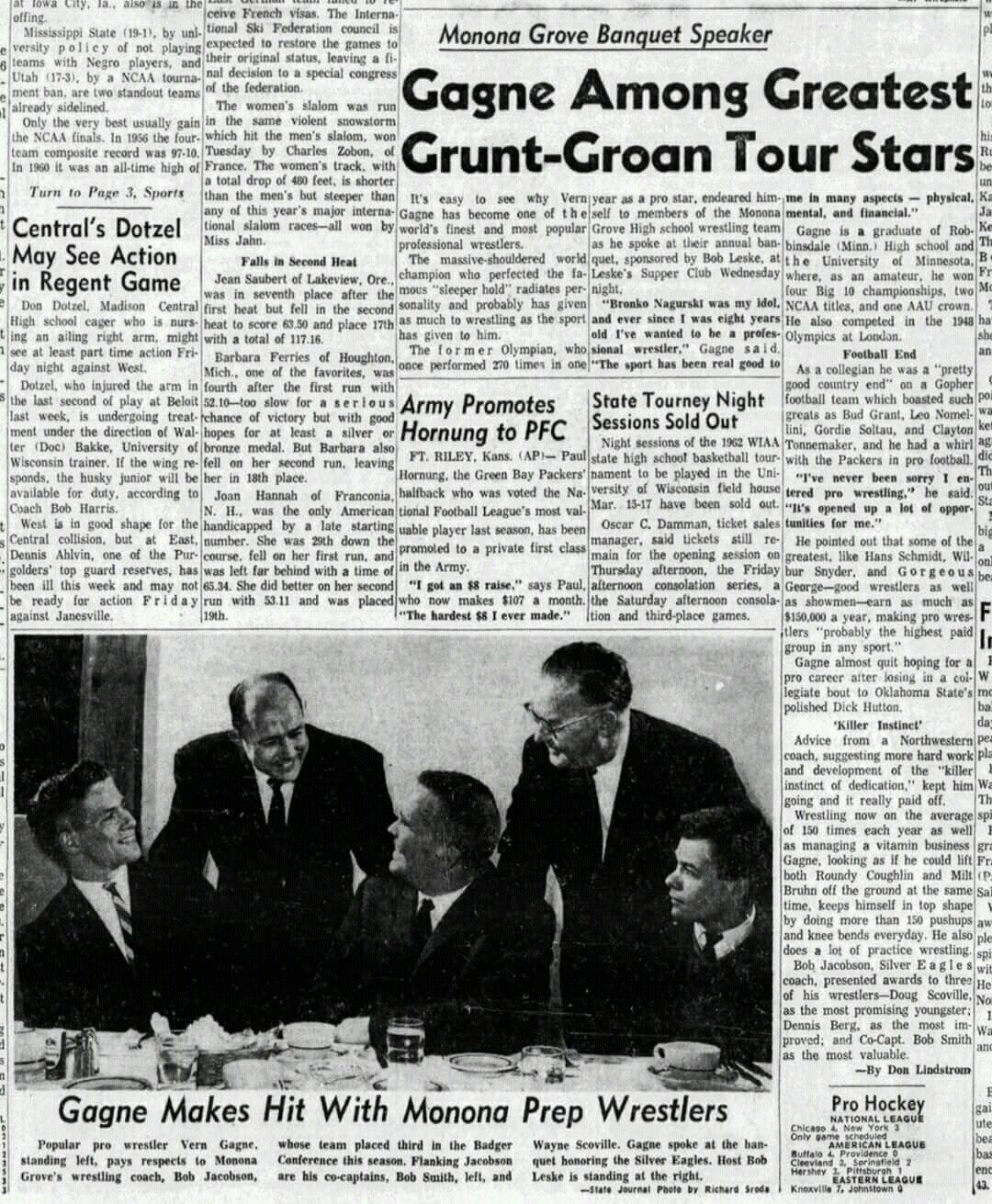
It turns out my hometown was also the hometown of one of the noted wrestiers of the 1960s, Sailor (or Seaman) Art Thomas:
https://www.youtube.com/watch?v=2-1VgzVpC7A
https://www.youtube.com/watch?v=6iJXD-MPWiM
(Those from the ’80s might remember Lou Albano in the first Cyndi Lauper video, “Girls Just Wanna Have Fun.”)
https://www.youtube.com/watch?v=4ccdF7VrLKU
https://www.youtube.com/watch?v=sQ6xcKWsqbg
I’m told WKOW carried pro wrestling, but I don’t remember watching it. The first pro wrestling I remember watching was on an Iowa TV station my grandparents got in Southwest Wisconsin. Whoever lost this particular match bled enough “blood” that it looked as though a case of ketchup had exploded. (Imagine cleaning that afterward.)
Once we got cable TV, we were able to watch, first, “All Star Wrestling” on WVTV-TV (channel 18) in Milwaukee. And our favorite wrestler was South Milwaukee’s own The Crusher:
https://www.youtube.com/watch?v=6VN02ZwqiPU
The Crusher started as a heel …
https://www.youtube.com/watch?v=evuiz7TH7Yg
… before he became a hero:
https://www.youtube.com/watch?v=wYaxc_Y2S2w
https://www.youtube.com/watch?v=MQGKmNtjbUc
The Crusher and his tag team partner, The Bruiser (former Green Bay Packer William Afflis), were even in a movie:
https://www.youtube.com/watch?v=ypwTUW9sY7k
It turns out some of The (Da?) Crusher’s contemporaries are still on the scene, though Reggie Lisowski died in 2005:
https://www.youtube.com/watch?v=wTlYJUSMEM8
https://www.youtube.com/watch?v=uX6BU8OGY50
WVTV was then taken off the cable system, replaced by WTCG-TV in Atlanta, which became WTBS, which became TBS. That replaced one hour of All Star Wrestling with two hours of Georgia/World Championship Wrestling.
https://www.youtube.com/watch?v=dVXLe1jatU4
https://www.youtube.com/watch?v=2xKT3V2K0Pc
You wonder why pro wrestling has been popular for decades? Check out this from around 1980 (and remember where the U.S. was vs. the Soviet Union in those days):
https://www.youtube.com/watch?v=u42tFhDXYYQ
Meanwhile, MSG, which carried New York Rangers hockey games, also carried the World Wrestling Federation.
And that brings up what Kyle Smith writes about:
When he first started wrestling in America, the French combatant who had been calling himself “le Géant Ferré” in Montreal needed a new handle. A midwestern promoter explained that running ads for the Giant Fairy wouldn’t fly. Why not, he asked, wrestle under your own name instead?
So was born the legend of André the Giant.
Growing up in a small town in France, the young André Roussimoff told family members, “I don’t want to live on a farm my whole life. I want to do something different.” His life turned out to be as unusual as his body, which, due to an unchecked hormonal surge (his parents and siblings were of normal size), grew up past seven feet and out to nearly 500 pounds. Not an actor, not quite an athlete, he was what the wrestling entrepreneur Vince McMahon calls him in the new HBO documentary André the Giant: “an attraction.”
Roussimoff became the cynosure of McMahon’s pro-wrestling circuit in the 1970s and early 1980s. Other wrestlers on the payroll created their characters with masks or robes or trash talk or eccentric behavior. (George “the Animal” Steele, for instance, made a habit of dining on the padding in the corners of the wrestling ring.) But André’s character was his body. All he had to do was show up. Even routine interactions became strange in his presence. One dining companion interviewed in the documentary recalls that once when he tried to pick up the check at dinner, the Giant, not having it, instead picked him up like a doll and set him on top of an armoire. The speaker relating this anecdote is Arnold Schwarzenegger.
More than any movie star, André couldn’t escape the world’s eyes, couldn’t hide under sunglasses and a hat. He was an oddity too big to ignore, and even people who didn’t know about his career play-acting violence inside the wrestling ring approached him as you would a fantastic creature. Friends, too, dehumanized him. One writer in the documentary compares his hands to a lowland gorilla’s. Fellow wrestler Terry Bollea, better known as Hulk Hogan, said he moved like a Clydesdale horse. He once played Bigfoot on a 1976 episode of The Six Million Dollar Man.
Yet director Jason Hehir finds the humanity in this superficially bestial figure. It’s pleasing to think of such a powerful man as being a gallant one, and his admirers say he was. Within the fake brutality of pro wrestling, says Hogan, André maintained civility by using real brutality. “This is not a business of tough guys,” says Hogan. “If you’re in this business, it’s to entertain. For those guys who thought they were tough guys in this business, André would straighten ’em out real quick.” Example: André despised the wrestler known as “Macho Man” Randy Savage. A clip from the documentary shows a match in which the Macho Man found his face absorbing abuse from the Giant’s gargantuan bottom. “He’s sitting right on his head!” cries an announcer. Buttocks, face, buttocks, face. That’s showbiz, kids! Maybe the true fantasy element André stirred in us was not our wish that a man-Alp could be as tender as the one he portrayed in The Princess Bride, but the longing to humiliate our annoying coworkers as proficiently as he did. Cook fish in the office microwave and an André-style response seems condign.
André had his faults, of course. His drinking was as renowned as his performing: A writer who profiled him said that on any given night, he would put away several mixed drinks, four bottles of wine, and 20 to 25 beers. That’s nothing, says another intimate, who claims he once saw André consume 106 beers. Of equal note is the Roussimoffian flatulence, which is likened sonically to incoming bad weather and would carry on for 30 seconds at a go. Once it nearly crashed a plane, or so legend has it, the aircraft’s pilots being temporarily stunned by the chemical-weapons-grade emission. Flying was excruciating for the wrestler as well: He couldn’t fit into any plane’s bathroom. Someone would have to curtain him off and bring him a bucket in which to relieve himself.
The drinking looked different to a co-star of The Princess Bride, on the set of which an ailing André needed help to catch Robin Wright’s sylphlike Buttercup. Co-star Cary Elwes tells us André drank to relieve the pain. Pro wrestling takes a serious toll on the human body, especially for someone André’s size. He suffered severe back and joint distress linked to his disorder, called acromegaly, and by the time of his valedictory bout with Hogan in 1987, his chief wrestling move was the “standing perfectly still” gambit. Hogan had to come up and allow himself to be bear-hugged for a prolonged period to provide the thrills. Roussimoff was then 40, and had been warned he wouldn’t survive into a fifth decade. The prophecy was off, but only by six years.
HBO’s documentary is riddled with gaps — the portrait of McMahon’s wrestling circus, in particular, seems unduly forgiving — because it is determined to frame André’s life as a piece of entertainment. We learn, for instance, that André left behind a daughter, but nothing about her mother or any other woman with whom he had relationships. Instead, it’s the fellas who tell us what a hit he was with the ladies. “He wore a size 24 ring, what else can I tell you?” says one of the guys. The movie is much more interested in this sort of japery than it is in showing who André really was, but then again, he was a difficult person to know. “He was not the most articulate man in the world,” observes an announcer who knew him. His ballads were in his body slams.
https://www.youtube.com/watch?v=f_jTeuajas0
Andre’s acting career included Bigfoot:
London’s Express reports, if that’s what you want to call it:
Scores of conspiracists led by self-titled Christian numerologist David Meade are certain the world will end as we know it on April 23.
The Nibiru theory, also known as the Planet X or Wormwood conspiracy, is a hoax doomsday claim which flares up online every few months.
Purveyors of the theory believe a rogue planetary system from beyond the fringes of our solar system is barrelling towards Earth.
The supposed arrival of Nibiru is meant to herald the imminent apocalypse and seal humanity’s doomed fate.
But the conspiracy theory has been circulated online hundreds of times before, and so far none of the predicted end of the world dates have come true. So why is April 23 a definite date?According to Mr Meade the apocalypse was meant to begin on October 15 last year, marking the start of a series of cataclysmic events. Fast forward several months and a planetary alignment on the night of April 23 will allegedly fulfil a prophecy from the Biblical book of Revelation 12:1-2.
The Bible passage in question reads: “A great sign appeared in heaven: a woman clothed with the sun, with the moon under her feet and a crown of twelve stars on her head.
Michael Graham of CBSNews.com watched ABC-TV so you didn’t have to:
It’s the morning after the “Comey Interview” and, believe it or not, Donald Trump is still president.
If you watched the buildup to the release of the former FBI director’s new book and his prime-time ABC interview, this fact might come as a bit of a shock. Based on the press hype—and partisan hopes—surrounding the publication of James Comey’s A Higher Loyalty: Truth, Lies and Leadership, you’d expect this insider’s expose of Trump’s shocking scandals to be, if not the end of his presidency, the beginning of the end.
To paraphrase Mark Twain, the reports of Trump’s political death continue to be exaggerated. Comey’s book is unlikely to have any impact on Trump’s presidency—other than perhaps to strengthen Trump’s standing among his supporters.
Trump haters counting on the former head of the FBI to have career-ending dirt on Donald Trump will be gravely disappointed by Comey’s book. The only “big reveal” in A Higher Loyalty is how loyal Jim Comey is to … Jim Comey. For Washington insiders who’ve been dealing with him since the George W. Bush administration, this isn’t breaking news.
Lacking evidence of actual wrongdoing—in last night’s interview, Comey yet again refused to accuse President Trump of obstruction—Comey turned instead to the petty and political. He talked about Mr. Trump’s appearance (“His face appeared slightly orange with bright white half-moons under his eyes where I assumed he placed small tanning goggles”), the size of his hands (“As he extended his hand, I made a mental note to check its size. It was smaller than mine, but did not seem unusually so.”) and he called the president “morally unfit.” It was the sort of snarky partisan punditry found on cable news 24/7.
Then again, should we be surprised? if Comey ever did see actual wrongdoing by Mr. Trump, do we really believe we’d just be hearing about it from a notoriously leak-friendly fellow like Comey?
As Nate Silver of FiveThirtyEight.com tweeted, it’s “not particularly honorable, if you have information you believe is of immediate and vital national importance, to wait 11 months to release it until you can have a giant book launch and publicity tour.” Silver—no Trump fan– calls the book “A Higher Royalty.”
Trump supporters were dismissing the fired FBI director and his message before the book even hit, putting Comey’s story in the broader context of what they believe was a partisan, pro-Clinton FBI. Comey confirmed their view when he acknowledged that his decision to speak publicly in the last days of the campaign about Clinton’s email investigation was influenced by his assumption that Hillary was going to be his new boss.
“I was operating in a world where Hillary Clinton was gonna beat Donald Trump,” he told George Stephanopolous. “And so I’m sure that it was a factor [in my decision to announce the Clinton email case was being re-opened].” He also revealed that his wife and kids wanted Clinton to win, too, though Comey said that he didn’t vote in 2016.
To many on the Right, the ABC interview sounded an awful lot like a former Clinton staffer talking to a partisan Trump hater. And for obvious reasons.
One GOP campaign operative told me Comey’s book “is a home run for us. This guy hates Trump, and he ran the FBI. If they had anything on Trump, he’d know it, and he’d tell it.”
It’s hard to call a book that talks about allegations of Moscow prostitutes and bodily functions a “home run,” but the point is that this is yet another bullet that zipped by President Trump. The Left keeps announcing Donald Trump’s doom, and yet, he keeps showing up for work.
This weekend, for example, the New Yorker ran a piece entitled “Michael Cohen and the End Stage of the Trump Presidency,” arguing that the recent raid on the law offices of the president’s personal attorney Michael Cohen mark the final phase of his time in office. This is the week we know, with increasing certainty, that we are entering the last phase of the Trump presidency, Adam Davidson wrote.
Another anti-Trump website, LawAndCrime.com, made the case that the recent attack on Syria over its use of chemical weapons could result in the impeachment of both Trump and members of his cabinet.
Impeachment would be a worthy course corrective and is entirely proper under the circumstances,” wrote Colin Kalmbacher.
I’m going to go out on a limb and say that a Congress controlled by Republicans is not going to impeach a Republican president over bombing a dictator who used sarin gas on children. But for Trump opponents who still cannot accept that he won the election, every prediction of his imminent demise is seized upon and believed.
These are the people liberal activist Tom Steyer was targeting last night when he ran a NeedToImpeach.com ad during the Stephanopolous interview. Meanwhile, the percentage of Americans who want Congress to start impeachment proceedings is declining while Trump’s approve rating is rising (slightly).
Consider this: In the month or so between the Stormy Daniels interview on “60 Minutes” and the Comey interview last night, President Trump has been hit with a nonstop stream of negative press. And yet according to the latest Washington Post/ABC poll, Trump’s approval is at 44 percent among registered voters.
Donald Trump is not going to be shamed out of office by Jim Comey, or pushed out by an angry press corps, or laughed out by late-night comics. Yes, it’s still possible he might be led out of the Oval Office in handcuffs by Special Counsel Robert Mueller, but at this point that looks like a long shot.
Which means Democrats will be forced to drive Donald Trump out of the White House the old-fashioned way: The ballot box.
What’s worse, from the perspective of Trump-hating Democrats (pardon the redundancy) is that not only is Trump polling better, but according to the Washington Post the generic-Democrat advantage in Congressional races has dropped from 12 points to four points. It is ridiculous to predict the results of elections nearly seven months in advance (seven hours might be more accurate in our turbulent times), but predictions of that blue wave might be exaggerated too.
The Nov. 6 elections might be a test of the claim of the good-government types that partisan gerrymandering (more correctly termed “incumbent gerrymandering”) guarantees that certain parties win certain seats. Given the large number of Republicans not running in November, including U.S. Rep. Paul Ryan (R–Janesville), if most of them are replaced with Democrats the gerrymandering arguments will lose considerable weight.
As you know, I am a connoisseur of both Corvettes and movies where cars play prominent roles.
One of the downsides of the latter is the dearth of quality movies with Corvettes in them. No, “Corvette Summer” does not count, nor, probably, “Last Stand”:
For whatever reason, a New York Times book excerpt popped up about probably the first Corvette made famous in entertainment, from the TV series “Route 66”:
Actor Martin Milner was one of those celebrities at whom Chevrolet aimed the 1953 Corvette. Herbert B. “Bert” Leonard was an even bigger target. Leonard had risen through television’s ranks to become an executive producer, the man who developed and ran successful and popular series shows. In late 1953 he introduced a drama starring a German shepherd and a young boy, called The Adventures of Rin Tin Tin. Milner had appeared in television’s Dragnet, and other series and films through the early and mid-1950s. Neither of them, however, was impressed enough to pay much attention to the car until they had to.
In writing schools, instructors teach young talents to “write what you know.” A slice of Leonard’s life, of what he knew from his youth, grew into a very popular series. In a 1982 interview in Emmy magazine with film writer Richard Maynard, Bert recalled a lunch with his friend, Naked City writer Stirling Silliphant in 1959 while that show was in production. As a child in New York, Leonard had a much wealthier friend who was a prep school student. Over lunch he and Silliphant imagined what it might have been like to hit the roads in his friend’s sports car. An idea gelled immediately and by the time lunch was over, they had their show name, The Searchers, and a pilot story roughed out. Leonard and Silliphant had created an idea that took another popular TV series of the mid-1950s Wagon Train into the next decade. In their proposal, they wrote:
The theme – search, unrest, uncertainty, seeking answers, looking for a way of life.
The people – are young enough to appeal to the youthful audience, old enough to be involved in adult situations.
The stories – will be about something, [Italics were Silliphant’s] will be honest, and will face up to life, look for and suggest meanings, things people can identify with, and yet there will be the romance and escape of young people with wanderlust.
The locales – the whole width and breadth of the U.S., with stories shot in the actual locations, a la Naked City. What we did for one city, we now propose to do for a country and for many of its industries and businesses.
In late 1959, Leonard and Silliphant pitched this idea to Columbia-Screen Gems. They were an acknowledged success; Naked City had established new standards for storytelling and cinematography in television. This idea, however, was different. As Screen Gems executives explained when they rejected the series initially, this was “about two bums on the road.”
The Searchers verged on late 1950s European Existentialism, a philosophy that questioned why humans exist. Because he suspected this was a bit too deep for television executives at the time, Silliphant brought it back to more comfortable territory. He concluded their pitch by promising that each episode would be “packed with at least two or three top-staged brawls (built into the character of Buz).” To demonstrate his faith in the idea, Leonard funded the pilot himself. In exchange, if Columbia bought the show, he would own 80 percent of the series.
Screen Gems execs reminded Leonard and Silliphant that New York’s Broadway had recently staged a play titled The Searchers, so the pair adopted the name of America’s emotionally-laden “mother road,” Route 66.
Regular viewers know that the 115 episodes over four years rarely found stories along U.S. Highway 66. That mattered only to those obsessed with detail. Leonard’s crew shot the pilot, called “The Wolf Tree,” in Concord, Kentucky, calling it the fictional Garth, Alabama, in February 1960. The show debuted on a Friday night, October 7, 1960, with the episode renamed “Black November.” By then the production crew was leapfrogging across the country. Leonard, Silliphant, and a production assistant scouted areas that gave them several nearby towns around which to craft two or three episodes. Four weeks later, the production caravan arrived and began filming. Silliphant sometimes wrote from hotel rooms near the locations, delivering script pages that day to the waiting cast, each story faithfully adhering to his promise to show America, its industries and its businesses, and a fist fight or two thrown in for good measure.
The premise of the show was that Tod Stiles, played by Martin Milner, had just lost his father, a New York City shipping company owner. Stiles, a junior at Yale, educated and thoughtful, well-bred and polite, came home for the funeral to discover a bankrupt business and a legacy that included nothing more than a new 1960 Corvette convertible.
“I’ve been seriously wrong about a lot of things in my life,” Milner admitted in an interview in 1998. “And I said to Bert Leonard, ‘A Corvette isn’t that exciting a car. Why don’t we do this in a Ferrari?’” Milner laughed.
“‘Well,’ Bert said to me, ‘we’ve got a pretty good chance of getting sponsorship from Chevrolet. And there’s a pretty good chance of not getting anything from Ferrari.’”
Milner related this story to documentary producer John Paget while they were completing a retrospective two-hour show tracing the actual route of Route 66. For that production Milner drove a 1960 Roman Red convertible (with white coves), which gave rise to yet another of the countless myths about the television series.
An actor Leonard had used and liked on Naked City, George Maharis, was hired even before Milner to play a dockside employee named Buz Murdoch. Maharis’ character Buz was a native of New York City’s Hell’s Kitchen, streetwise and cynical, equally quick to react or to joke. Now Buz was jobless. Suddenly uprooted in every sense, the two clean-cut handsome young men, friends from summers working on Stiles’ docks, took off to find themselves.
“Tod says,” Maharis announced in that first episode, written by Silliphant, “if we keep moving we’ll find a place to plant roots . . .. But with me, it’s fine just moving.”
Screen Gems and CBS picked up the series, and listings in publications such as TV Guide identified Milner and Maharis as the principal players. But there were four stars apparent to those who watched the show carefully: Maharis, Milner, the Corvette (often written in to Silliphant’s scripts as a character itself), and The Road Across America. As television historian Mark Alvey wrote in The Road Movie Book, “Route 66 is a tale both of search and flight, and as a serial narrative characteristic of American commercial television, its central meaning lies not in some finite goal at the end of the road, but in the discoveries made along the way.”
The show’s travels rooted much of America to their television sets every Friday for four seasons. The audience’s vicarious restlessness brought Chevrolet back year after year as principal sponsor. “See the U.S.A. in your Chevrolet,” was more than an advertising jingle for this show—it was close as existentialism was to being the show’s philosophical foundation.
Chevrolet’s advertising agency’s Los Angeles office provided Leonard a pair of Tasco Turquoise blue convertibles. As Leonard and Silliphant had promised, the show hit the road and travelled . . . and travelled. Maharis recalled recently that they covered 40,000 miles each year. Production manager Sam Manners ran a road train, as he explained to show historian James Rosin. A transporter carried the two Corvettes as well as a Chapman Crane, a truck with an arm capable of lifting the camera nearly 50 feet in the air. A station wagon supported the camera for moving front shots; a Corvair missing its front trunk lid served as camera car for rear views. Another dozen vehicles made up the convoy with portable dressing rooms, costumes, and the camera equipment, lenses, lighting gear, and generators cinematographer Jack Marta needed to get each episode on film.
For Chevrolet, it was the natural “vehicle” to promote their sports car. Similar motives attracted GM executives and viewers: There was no need to wait for a vacation to see the country in the family station wagon—hopefully a Chevy. Every week millions of individuals went on an adventure, imagining themselves as the third (or fourth or fifth) rider stuffed into the Corvette between Buz and Tod.
The show provided adventure, with Tod, Buz, and the Corvette as tour guides. Events, tumultuous and timely, befell the two young men just as they arrived in one locale or another. Silliphant, a writer profoundly in sync with America’s psyche, steered them to women’s rights, racial inequality, corporate malfeasance, land and water rights, international espionage, murder, theft, assault, marital and familial discord, war crimes, revolutionary terrorists, drug addiction and abuse, the role of the government in an individual’s rights, and the responsibilities of an individual to a town or nation. The episodes were self-contained, an anthology type of storytelling that introduced conflicts involving guest stars outside the Corvette. By the time the sleek luggage-encumbered convertible left town, all was right with the world and it was time to move on.
In an interview in Time magazine in August 1963, Silliphant said, “The meaning of Route 66 has to do with ‘a search for identity in contemporary America. It is a show about a statement of existence. If anything, it is closer to Sartre and Kafka than to anything else. We are terribly serious, and we feel that life contains a certain amount of pain.’”
The show caused some pain for cinematographer Marta, who worked hard to illuminate actors’ faces in bright sunlight against a pale blue car that reflected so much light. For the 1961–1962 season, the Campbell-Ewald agency provided the show with Fawn Beige convertibles. That darker color choice remained through 1964, when the series ended.
Some viewers picked up the difference between the tones of the cars, even filmed in black-and-white. They noticed that each year the seemingly penniless Stiles and Murdock (who often said they took jobs just for gas money) travelled in a current model Corvette. That question fit right in with, “How can they be in Maine if the show is called Route 66?”
As a title, The Searchers was not “catchy,” just as a Ferrari convertible would have been unbelievable—why wouldn’t Tod sell a car like that and go back to Yale? But Dad’s two-seat American-made Corvette enticed the two young men onto the road, letting Stiles search for roots and Murdock keep moving without taking much baggage or other passengers.
Chevrolet’s design studio began planning updates to the Corvette’s first-generation body even before introduction in 1953. Poor sales slipped the redesign back from the 1956 to 1958, when quad headlights appeared. Stylists Peter Brock, Chuck Pohlman, and others slaved away on the “next” Corvette, first called the “Q” and then nicknamed just “the next one.” In 1961 the car received a new rear end that hinted at The Next One. Quad headlights stayed through 1962 season and subsequent generations. The Sting Ray showed up for the 1962–1963 season and a new one carried on for the 1963–1964 programs.
About every 3,000 miles, Campbell-Ewald replaced the show’s cars, reconditioning them and sending them off to friendly dealers to sell as “executive” vehicles. Sam Manners remembered running though three or four cars per season. With each season’s renewal, new models arrived in time for the caravan to leave L.A. By 1963, that road show had grown to fifty vehicles on the road covering 40,000 miles each year. By then Chevrolet provided Corvettes to Milner and Maharis, Manners, and others for personal use as well.
The car shown here is not a vehicle from the show. Its white coves betray it, as does its unrestored survivor status. Pennsylvania owner Mike Nardo and his father know the history of the car and it did not include television stardom. But Nardo’s car is a survivor with 37,000 miles, a four-speed transmission, and the same factory steel wheels and wheel covers that Tod ended up with after Episode 22. In that show, “Eleven, The Hard Way,” the two men helped a small town confront the risks of gambling in order to save itself. To stake a loan to the town’s auditor in a make-or-break game of dice, Tod sold the wire wheels that drove the car through two-thirds of the premiere season.
The show itself was a gamble. There are reports that CBS didn’t care for it. Network president Jim Aubrey complained to Leonard that the show was “too downbeat,” and that he wanted more “broads, bosoms, and fun.” But, as Leonard told Mark Alvey, Chevrolet “liked the hard hitting show they bought . . . They wanted the reality, the drama, and the movement; not the sexy women and cliché characters.” GM’s marketing studies revealed that the show attracted huge audiences of young people between the age of 10 and 14, a prime target then and now. The show ran for four seasons, surviving the disappearance of co-star Maharis who was suffering with hepatitis brought on by the exhausting pace of travel and six-day shooting weeks. Milner drove on, searching for roots and meaning. The show finally slowed to a halt months after Glenn Corbett, playing Lincoln Case, replaced a still-ailing Maharis. “Linc” was more like Tod than Buz and the interplay and counterpoint that worked so well with Maharis and Milner never reappeared.
Critics have analyzed the show’s writing, its acting, and its stories. Some have compared it to beatnik author Jack Kerouac’s seminal travel story On the Road. Kerouac sued Silliphant and Leonard, accusing them of plagiarism. But as Paul Goodman explained in his book Growing up Absurd, “The entire action of On the Road is the avoidance of interpersonal conflict.” Route 66 was precisely the opposite, and viewer surveys commissioned in 1961 by Chevrolet and other sponsors learned that the audience understood the role of the stars as knights in shining armor, riding in week after week to save damsels—or entire towns—in distress. It is their co-star in this noble pursuit, their trusty steed, their white charger—well, first blue and then beige—that is the subject of this chapter.
The book is …
.jpg&h=369&w=369)
… Legendary Corvettes: ’Vettes Made Famous On Track And Screen, which I have not read, and apparently is not available through the local library system. It appears from the Amazon preview that there is only one other movie/TV Corvette in the book …
… this abomination.

The Wisconsin Newspaper Association convention is this weekend. (No, I’m not going.)
I wonder if this Politico Special Report! will get discussed:
President Donald Trump’s attacks on the mainstream media may be rooted in statistical reality: An extensive review of subscription data and election results shows that Trump outperformed the previous Republican nominee, Mitt Romney, in counties with the lowest numbers of news subscribers, but didn’t do nearly as well in areas with heavier circulation.
POLITICO’s findings — which put Trump’s escalating attacks on the media in a new context — were drawn from a comparison of election results and subscription information from the Alliance for Audited Media, an industry group that verifies print and digital circulation for advertisers. The findings cover more than 1,000 mainstream news publications in more than 2,900 counties out of 3,100 nationwide from every state except Alaska, which does not hold elections at the county level.
President Donald Trump’s attacks on the mainstream media may be rooted in statistical reality: An extensive review of subscription data and election results shows that Trump outperformed the previous Republican nominee, Mitt Romney, in counties with the lowest numbers of news subscribers, but didn’t do nearly as well in areas with heavier circulation.
POLITICO’s findings — which put Trump’s escalating attacks on the media in a new context — were drawn from a comparison of election results and subscription information from the Alliance for Audited Media, an industry group that verifies print and digital circulation for advertisers. The findings cover more than 1,000 mainstream news publications in more than 2,900 counties out of 3,100 nationwide from every state except Alaska, which does not hold elections at the county level. …
“I doubt I would be here if it weren’t for social media, to be honest with you,” Trump told Fox Business Network in October. Without it, he said at the time, he “would never … get the word out.”
POLITICO’s analysis shows how he succeeded in avoiding mainstream outlets, and turned that into a winning strategy: Voters in so-called news deserts — places with minimal newspaper subscriptions, print or online — went for him in higher-than-expected numbers. In tight races with Clinton in states like Wisconsin, North Carolina and Pennsylvania, the decline in local media could have made a decisive difference.
To assess how the decline in news subscriptions might have affected the presidential race, POLITICO made a county-by-county comparison of data from AAM. Almost all daily newspapers report their subscription numbers, print and online, to AAM for verification in order to sell to advertisers. (Some of the smallest outlets do not, though, including weekly publications.) After ranking the counties on subscription rates, POLITICO compared election results between counties with high and low subscription rates, and used regression analysis to determine the correlation between news circulation and election results.
Among the findings:
• Trump did better than Romney in areas with fewer households subscribing to news outlets but worse in areas with higher subscription rates: In counties where Trump’s vote margin was greater than Romney’s in 2012, the average subscription rate was only about two-thirds the size of that in counties where Trump did worse than Romney.
• Trump struggled against Clinton in places with more news subscribers: Counties in the top 10 percent of subscription rates were twice as likely to go for Clinton as those in the lowest 10 percent. Clinton was also more than 3.7 times as likely to beat former President Barack Obama’s 2012 performance in counties in the top 10 percent compared to those in the lowest 10 percent — the driest of the so-called news deserts.
• Trump’s share of the vote tended to drop in accordance with the amount of homes with news subscriptions: For every 10 percent of households in a county that subscribed to a news outlet, Trump’s vote share dropped by an average of 0.5 percentage points.
To many news professionals and academics who’ve studied the flow of political information, there’s no doubt that a lack of trusted local media created a void that was filled by social media and partisan national outlets. …
Starting in the 1970s, when the control of the nominating process shifted from party elites to primary-election voters, a common sight at rallies, conventions and debates was small groups of journalists, men and women, most of them having traveled in from Washington, gathering to compare observations. Together, they would decide what news had been made — which candidate handled himself better, which exchanges were the most relevant, which assertions were the most questionable.
In the days before the Internet, about a dozen news outlets dominated national political coverage. They included the major television networks, weekly news magazines, The Associated Press, and about a half-dozen newspapers. Wire services such as The New York Times News Service and The Washington Post-Los Angeles Times service sent out their articles to smaller papers across the country, guaranteeing vastly wider circulation for their stories.
There is a giant error here. (Actually more than one, but follow me for a bit.) To call an area — say, Ripon, where I used to live — a “news desert” because it doesn’t have a weekly newspaper is a gross misrepresentation. Ripon has a weekly newspaper, and an award-winning weekly newspaper at that. A lot of communities have award-winning weekly newspapers that are doing better in a business sense than the nearest daily newspaper.
In fact, across the newspaper industry weeklies are doing considerably better than dailies. Dailies face more competition for the advertising dollar (which is the majority of income for newspapers) than weeklies in smaller markets do, and often competition that relies on ad revenue for all of its revenue (radio and TV).
Dailies focus on the community whose name is in their masthead (i.e. the Milwaukee Journal Sentinel), showing up in small towns only when there’s something they think is meaty. The weekly newspaper, meanwhile, covers things that don’t get the attention of the daily, such as school events, local sports, etc. The competently run weekly newspaper doesn’t focus on state or national issues except to the extent those issues affect their readers. So if Paul Ryan comes to town, they’ll cover Ryan, but they’re not going to write about politics beyond their market every week.
Chain ownership is a reality of journalism today, as it is in many fields of business. Though there is nothing innately wrong with chain ownership in the same way there is nothing innately wrong with ownership by a publicly traded company, chain ownership hasn’t worked out so well for daily newspaper readers. Gannett owns most of the daily newspapers east of the Interstate 39 corridor. None are considered quality newspapers (other than by themselves) except for the Milwaukee Journal Sentinel (and the JS certainly has its non-fans, which is probably a growing group, given the USA Today-ization of the Journal Sentinel). Gannett newspapers outside the Journal Sentinel run a page or two of news from the previous day’s edition of USA Today (which makes those pages USA Yesterday, actually two-day-old news, which should be unacceptable for a “daily” newspaper).
Other daily newspapers have made business decisions seemingly designed to alienate their audience. The Wisconsin State Journal decided to stop covering the southwestern part of the state at the same time the Dubuque Telegraph Herald stopped printing its own newspaper. So, you ask? The issue is that the TH’s print deadlines for a morning daily newspaper are the previous early afternoon, except for page 1 stories. Both the State Journal and the TH have simultaneously cut back on sports coverage in the area where they previously had overlap, reducing readers’ daily choices from two to none. Readers stop reading, or don’t start reading, due to (in their definition) bad product.
The Internet is a difficult problem for those who are used to getting customers to pay for their product. A lot of daily newspapers started putting their work online for free, and then discovered that people don’t like paying for something they used to get for free. The online model that seems to work best is to charge for the product but include it in a print subscription package, but a lot of daily newspapers haven’t figured that out.
The State Journal is the daily newspaper I grew up reading (starting at age 2, according to my parents, which did not compel the State Journal to hire me, not that I’m bitter or anything). It has been owned by Lee Newspapers for decades. State Journal readers if asked might say that the State Journal has gone backward in quality since Lee decided it wanted to buy bigger newspapers, such as the St. Louis Post-Dispatch, that had increasing business problems. For all The Capital Times’ numerous faults, it was locally owned, and still is, though it is no longer a daily newspaper and still has those numerous faults.
Strange though this sounds, the Cap Times’ (as it calls itself now as a weekly tabloid) ending daily publication wasn’t a benefit to the State Journal’s non-liberal readers. The State Journal, both editorially and in its news coverage, has lurched leftward ever since then, while continuing to print Sunday screeds of editor Paul Fanlund and his predecessor, Dave Zweifel. The State Journal used to have a moderate-to-conservative editorial page, but that hasn’t been the case for years. (Similarly, the merger of the former Milwaukee Journal and Milwaukee Sentinel resulted in a generally slightly-less-than-liberal Journal Sentinel editorial page.)
What Politico terms “news deserts” are simply markets not large enough to support a daily newspaper. It’s pretty arrogant to assume that journalism occurs only in daily newspapers, but that’s one of the (often valid) criticisms of my line of work.
And speaking of that, David Harsanyi adds:
We’re now into our second year of theorizing about what went wrong in 2016, which is itself illustrative of the prejudice in much of political media. Most of these stories have nothing to do with Donald Trump’s policies or his behavior — topics well worth covering — and everything to do with creating the impression that the electoral process was dangerously flawed. Whether The Comey Letter swung the election or Fake News swung the election or Facebook data mining swung the election, there have been so many stories intimating that our democratic institutions have been subverted, that you sense certain people might be reluctant to accept the sanctity of the process.
I bring this up, because this week, a new Politico piece theorizes that a lack of “trusted news sources” in rural areas, rather than any particular issues, gave Donald Trump victory in 2016. It is perhaps the most unconvincing, inference-ridden, self-aggrandizing piece in the entire “What Went Wrong?” genre. The premise, basically, is that a lack of local media sources left a void that was filled by Donald Trump’s tweets and unreliable conservative sites, and that factor turned the 2016 election, “especially in states like Wisconsin, North Carolina and Pennsylvania,” where hapless Americans were unable to make educated choices without proper guidance from journalists.
“The results,” Shawn Musgrave and Matthew Nussbaum write, “show a clear correlation between low subscription rates and Trump’s success in the 2016 election, both against Hillary Clinton and when compared to Romney in 2012.” Setting aside the problem of correlational/causation and all that, every one of these stories is driven by the unstated notion that Clinton was predestined to win the 2016 election, and any other outcome means something went wrong. There’s simply no way, a year into Hillary’s presidency, that major outlets would be doing a deep dive into the viewing habits of urbanites to try and comprehend how they could have been crazy enough to elect her.
It’s true, the world is changing and also it is inarguable that places with larger populations that have the means to support local newspapers (like the scrappy New York Times) would be more inclined to vote for Clinton, while in rural areas where subscription-based outlets are more difficult to maintain, they would not not. Both these things are true. Yet, there is no data in the piece — despite nearly 4,000 words and a number of graphs to create a scientific veneer — offering any compelling evidence that the dynamics of a race would be altered if the Bedford Falls Examiner was still in business.
In the old days, we’re told, the local reliable church-going editor would run dispassionate stories from trustworthy sources.
In the days before the Internet, about a dozen news outlets dominated national political coverage. They included the major television networks, weekly news magazines, The Associated Press, and about a half-dozen newspapers. Wire services such as The New York Times News Service and The Washington Post-Los Angeles Times service sent out their articles to smaller papers across the country, guaranteeing vastly wider circulation for their stories.
For people who care about the news, larger papers and stations still exist, but they exist online. Rural Americans, like urban Americans, get most of their news online. They follow national trends in their news consumption. After decades of skewed coverage, they’ve become skeptical. But like other voters, they rarely alter their positions, and when they do seek out the news they seek our news that feeds their predominant political prejudices. You may not like that rural Republicans get their news from FOX and Sinclair rather than CNN and MSNBC, but that’s a matter of ideological taste.
It is almost also certainly true that Trump’s “relentless use of social media” had something to do with perceptions of his voters (his obsession with Hillary is another story.) But would his successful application of new media, once celebrated when the appropriate people won elections, been any less effective because there was a Washington Post wire story running in the local paper? Would Trump voters have traded in the MAGA hat for an “I’m with her” bumper sticker if they read Paul Krugman in their paper? This seems unlikely.
What’s far more plausible is that a combination of factors made Trump in 2016 a marginally more agreeable Republican candidate to rural voters than Mitt Romney in 2012. Or, perhaps, even more relevant, that Hillary Clinton was far less likeable, and had far less political acumen, than the candidate Romney faced in 2012, Barack Obama. But even without factoring in the personalities, comparing turnout and voting patterns in different years in the way Politico does is fraught with other problems. Americans are fickle, and national events, trends, local economic factors, and thousands of other variables can alter results, as well.
The idea that a lack of a local newspaper is a determinative factor in swinging enough people to turn a national election is probably a reflection of journalism’s self-importance and an inability to live with the idea that Americans could vote for Trump without being hoodwinked in some way. Because, let’s face it, Democrats never really lose an election, do they? If the Supreme Court isn’t stealing the presidency then propaganda outfits are weaponizing social media mindbots to control your vote or the Constitution is getting in the way of proper “democracy.” We’re going to keep doing this until Americans make the right choice.
Trump may or may not get reelected (or even run) in 2020. But daily newspapers have probably lost those Trump voters permanently, and that is the daily media’s own fault. Alienating vast numbers of paying customers is not a successful recipe for staying in business.
 Steve Prestegard.com: The Presteblog