Apparently this is Discovery Channel’s Shark Week. (No, I’m not watching.)
Andy Bolig writes about different kinds of sharks:
It’s easy to look at something and say whether or not you like it and why, but to create something from nothing that will have lasting, world-wide appeal is a gift given to a rare few. When speaking about Corvettes, there are several names that constantly rise to the surface as undoubtedly having that gift.
In the late-50s and early 60s, designing a car was laid squarely on the shoulders of those who wielded a pen and paper. Their thoughts and souls flowed upon the canvas, and without any assistance from computers or electronics, they fostered designs that inspired generations. Gentlemen such as Bill Mitchell and Larry Shinoda came together to bear prototypes that would lead Corvette for generations and capture the hearts and minds of enthusiasts to this day.
Bill Mitchell took over the styling department when Harley Earl retired. At the time, styling made the rules, which put Bill high atop the food chain at GM.
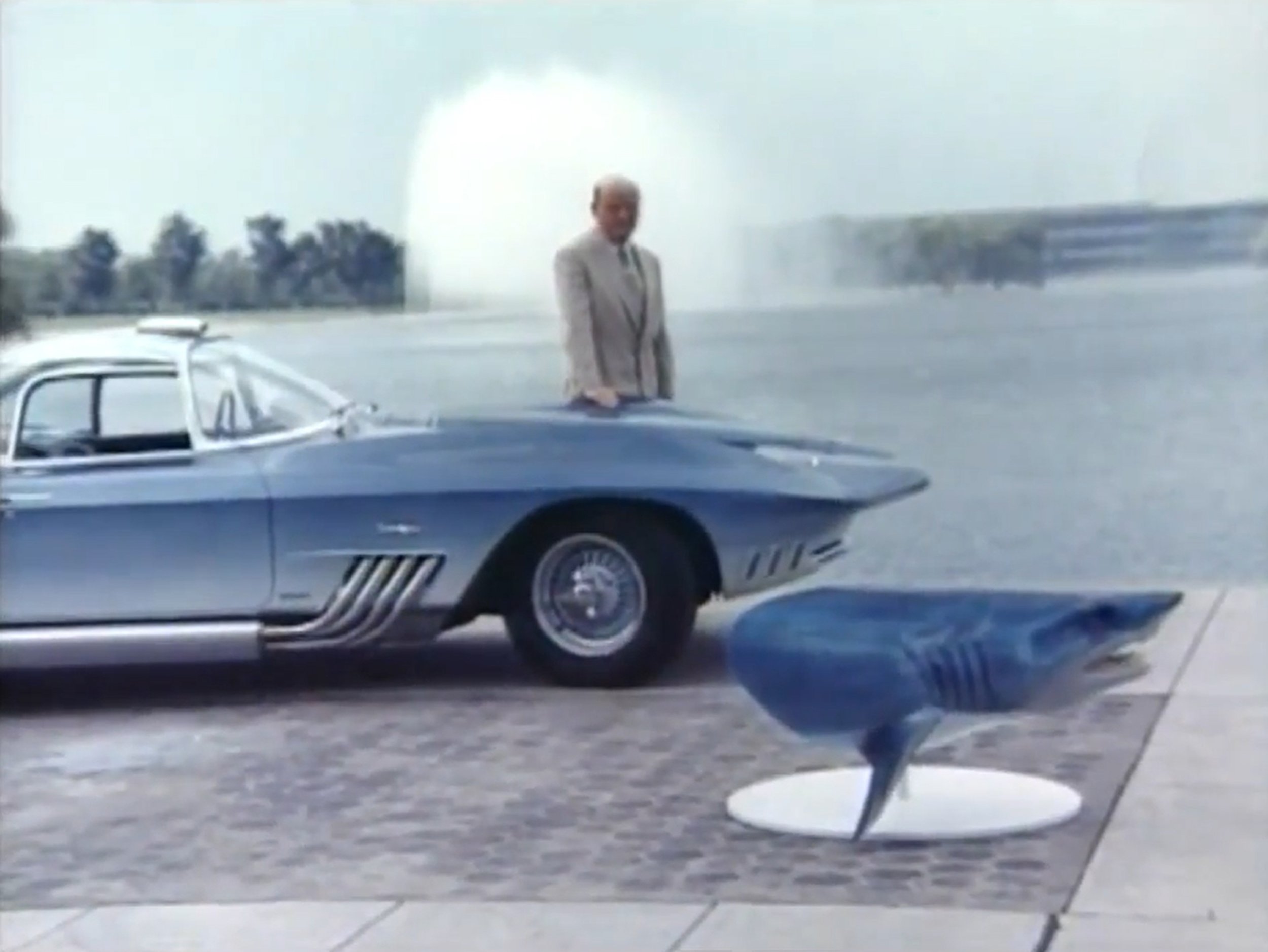
Two cars that exemplify this are the “Mako Sharks”, a duo of forward-looking vehicles that used technologies of the day to inspire and captivate enthusiasts with their futuristic design and styling. The basis for these cars, of which they both were dutifully named, has its roots in Bill Mitchell’s love for deep sea fishing, and the shark that he reportedly caught while on one such endeavor.
Bill enjoyed deep-sea fishing and cars he designed had a definite connection to the sport.
In The Beginning
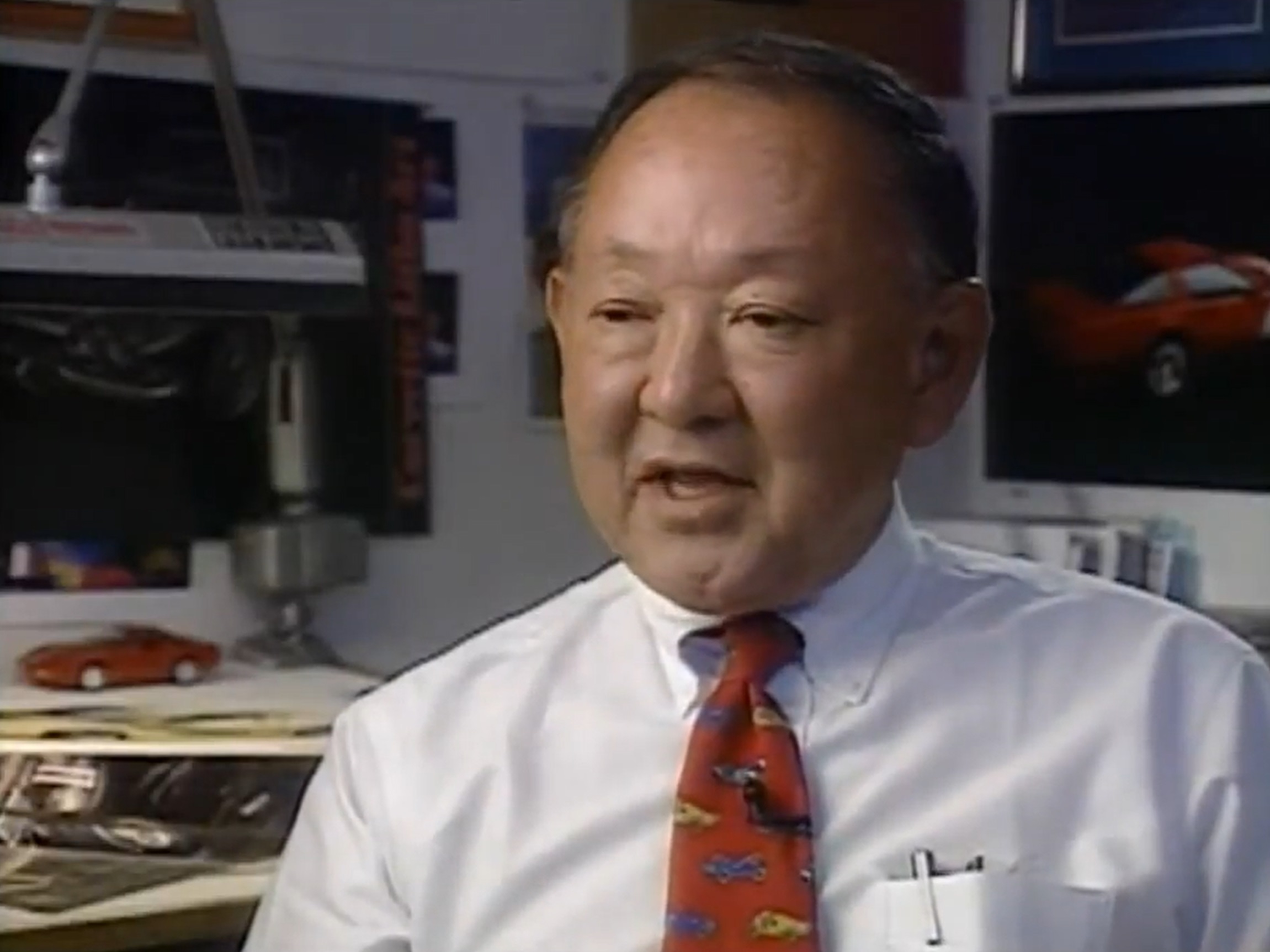
Larry Shinoda reported in an interview on more than one occasion how Mr. Mitchell caught a shark and was so enthralled in the color and shape of the animal that he used it as the design basis for the cars. He wanted to create a car that had the same appearance of speed and agility, as well as the ability. Of course, no other platform provided such a solid starting point as Corvette.
Larry Shinoda worked under Bill Mitchell and was responsible for many of the designs that rolled out of the styling department at GM. He recalls that when the paint team couldn’t match the colors of the shark that Mr. Mitchell had above his desk, they simply “borrowed” the shark and re-painted it to match the car!
In an interview with Wayne Ellwood, Corvette Designer Larry Shinoda once explained how the Mako Shark came about. The design work for the new-for-1963 Corvette was completed by 1962, and Chevrolet wanted something to help promote the new car. Larry was ordered to do some sketches that would build excitement for the new offering using cues from the new car, as well as taking some styling license with the design. After several designs, the final result was XP-755, the Mako Shark as we know it.
The first Mako Shark was as much a styling car as it was a driver. Reportedly, Bill Mitchell had as many as 50 cars specially built for his use during his tenure as design chief.
Even if anyone had seen the new 1963 Sting Ray Corvettes, they hadn’t seen anything like the Mako Shark! It’s pointy nose, flowing lines and a paint scheme that flowed from shark-skin blue to silver underneath were undeniable cues to the feared predator that shared its name.
Mako Shark II
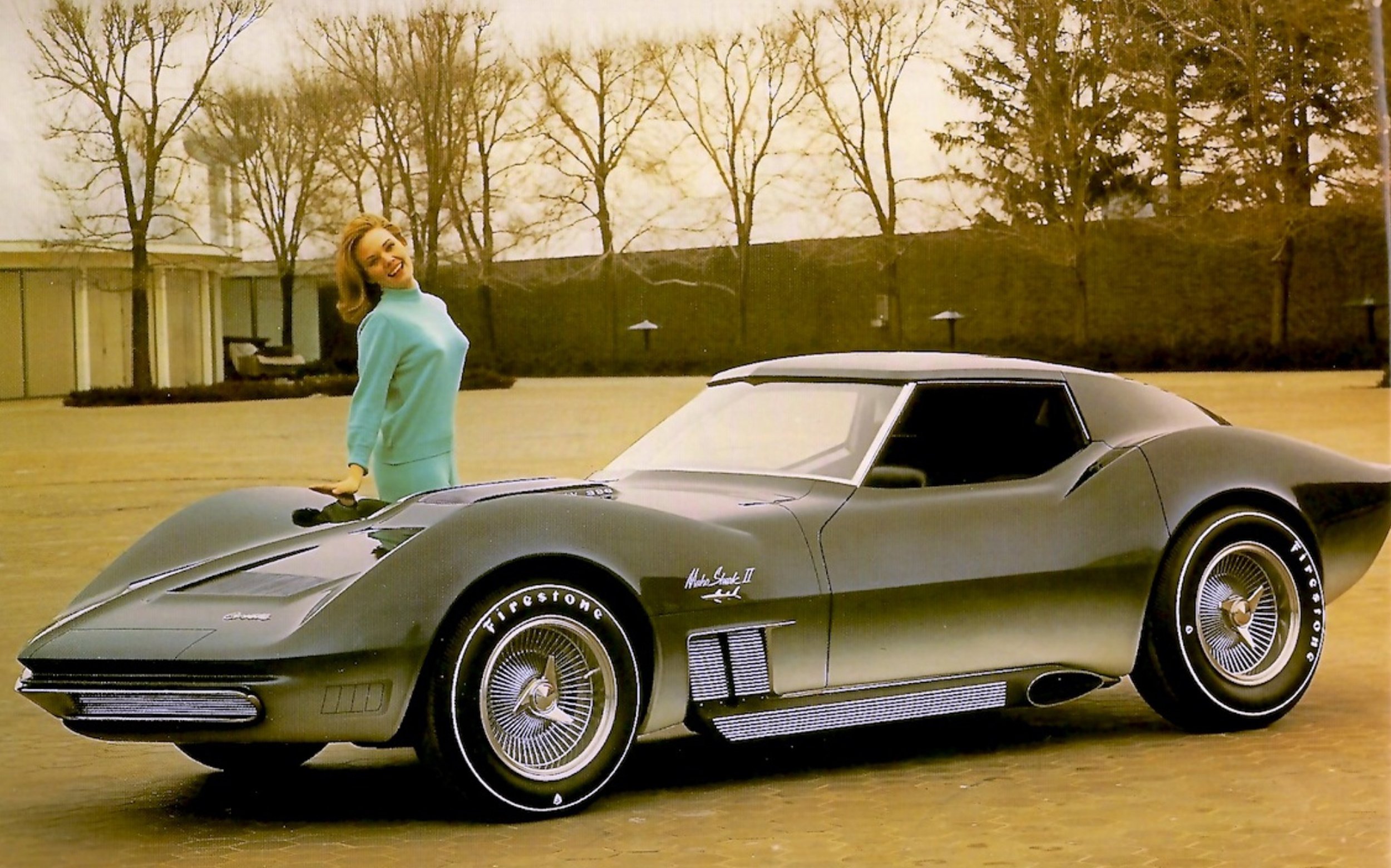
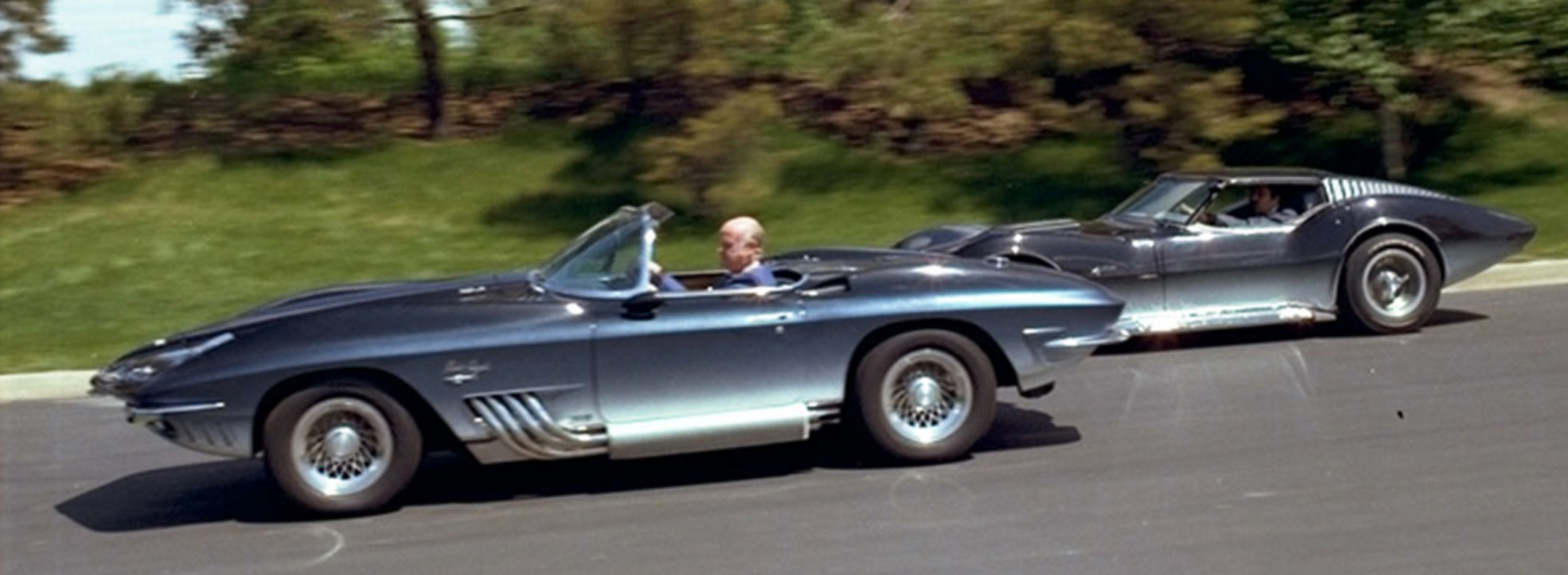
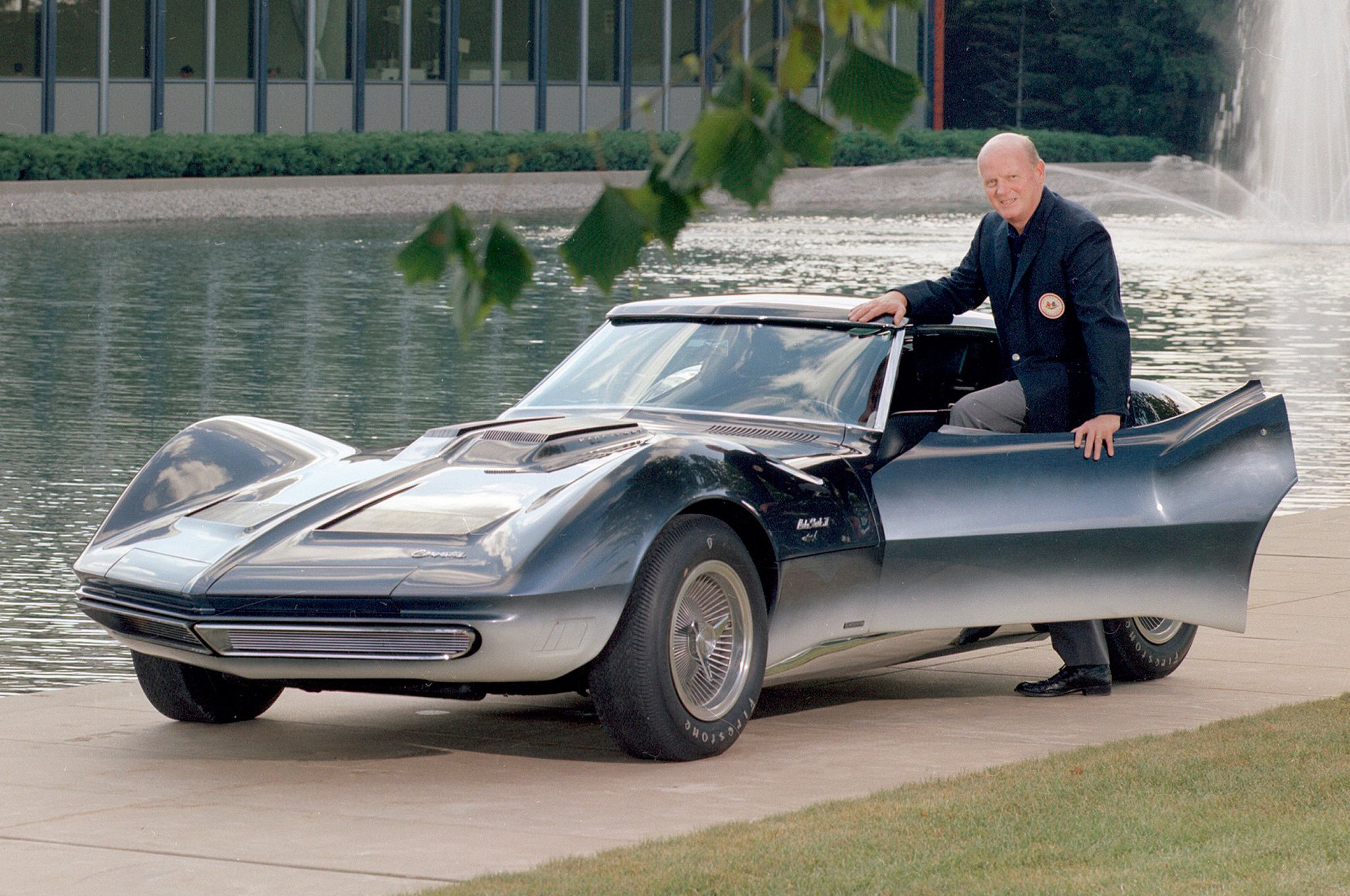
Just three years later, Chevrolet churned out the next chapter in their Mako-based Corvettes. There is some confusion surrounding this car, partly due to its transformation as it would adjust to responses that it garnered while travelling the show circuit. In fact, there are three iterations of this stylized icon; the first being a non-powered styling exercise, then a drivable version carrying the same name. Lastly, the car was updated with a revised roof line that featured a mail-slot opening as a rear window and the movable rear louvers were removed. The car was also upgraded with the new ZL-1, all-aluminum 427 engine and was now known as the Manta Ray.
In its original configuration, the Mako Shark II was a “pusher”, wearing stylized side pipes and unable to move under its own power. It DID make for a great photo though!
The Mako Shark II was first introduced to the public in 1965, at the New York International Auto Show of that year. As such, it was unmistakably all Bill Mitchell. The “coke-bottle” shape was the brain-child of Mr. Mitchell and reportedly, vexed Corvette’s Chief Engineer, Zora Duntov greatly. That is, until Zora was testing the pre-production 1968 Stingray on GM’s high-speed test track and had a tire failure. Resting the car against the wall at speed until it stopped, the concrete barrier ground the wider wheel housings down until they were even with the narrow waistline of the rest of the car’s body. Reportedly, Zora exited the car and said, “Ah, bulges SAVE Zora!”
More than simply a styling car, the Mako Shark II encompassed features that wouldn’t be seen on production cars for decades, and some that have yet to be realized. The hidden wipers made it into production quickly on the ’68 Corvette, but items like the adjustable pedals are just making it onto production lines. Other items like the motorized rear louvers never really took hold, and the pop up taillights (in Manta Ray trim), and rear spoiler may have missed their moment, or we just haven’t realized how much we need them – yet. Time will tell.
In it’s first iteration, the Mako Shark II was not intended to be driven as much as it was a styling exercise to gauge public opinion on various ideas. In this form, the car can be seen with side-pipes akin to those used on several earlier styling cars, such as the World’s Fair ’64 Corvette. As Chevrolet designers gained insight into what the public wanted to see, the car changed to a rear-exiting exhaust, albeit in stylized form.
Other changes to the car throughout the year included a more standardized round steering wheel that replace the squared-off version it originally had, and the car, originally equipped with a Mark IV (396ci) engine later received the all-aluminum ZL-1. By the time the Mako Shark II made its appearance at the Paris Auto Show in October of ’65, it was a runner.
Even with the various changes, the Mako Shark cars have proven the lasting, timeless virtue of good design. We would have to look long and hard to find another example of styling cars of that era that have made such an impact or have withstood the test of time.
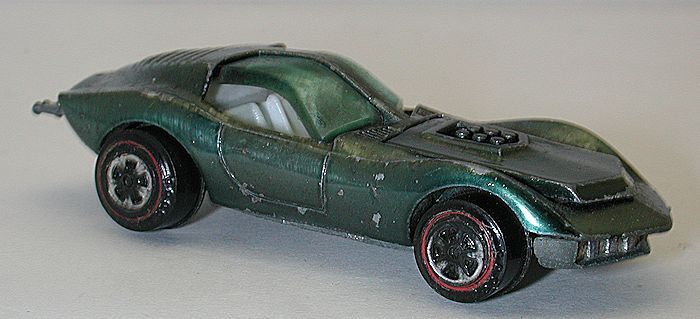
Most Corvette fans acknowledge that the C2, inspired by the Mako Shark, was a better car than the C1. Corvette fans have been split on the C3, inspired by Mako Shark II, given that it was bigger outside but smaller inside than the C2 it replaced, and had rather useless storage space. (Not that the C2’s was better, since it was not a hatchback either.)
I’ve never mentioned this before now, but I once owned a Mako Shark.
Nowadays, if you want to be an incompetent — or even corrupt — elected official, there’s a place for you to work where the risk of facing recourse is fast getting smaller: local government.
That’s because so few people are paying attention. Not only has voter participation in local elections fallen to dangerously low levels, but the health of local newspapers, traditional watchdogs for the most direct and abundant form of government in the United States, has also been deteriorating.
This is a crisis for democracy in general. But politically speaking, the Republican Party — yes, the same party whose leader derides the media as “fake news” and “the enemy of the people” — should be particularly alarmed. Because if conservatives are concerned about keeping government as efficient and local as possible, they need the hundreds of local newspapers to make the system work across the country.
Researchers have illuminated a sort of symbiotic relationship between local papers and the governments they cover. The governments provide papers with content to fill their pages; the papers, in turn, offer a healthy level accountability and make information more accessible among the electorate. If a newspaper is suddenly forced to close due to economic forces — for example, if competition from online advertising sites suddenly dries up its revenue — the government, too, becomes sick.
This isn’t just theoretical; it translates to hard dollars and cents, as illustrated by a new paper, presented this week at the Brookings Institution’s Municipal Finance Conference.
The paper, which is in the process of being peer-reviewed, looked at newspaper closures between 1996 and 2015 and found that once a newspaper goes under, it becomes more expensive in the long run for its local government to borrow money. In the three years following a closure, the study found, municipal borrowing costs for counties where newspapers closed increased by .05 to .11 percentage points. That might not sound like a lot, but when we’re talking about borrowing millions of dollars, it’s nothing to sneeze at.
Authors of the paper theorize that this is the result of less information being publicly available, resulting in poorer-quality governance. And as a result, local investors in such communities are more likely to see municipal bonds as risky, driving up interest rates.
Before you say “correlation is not causation,” consider the strong evidence that the link between newspaper closures and higher borrowing costs is causal. First, the authors compared counties where newspapers closed to neighboring counties with operating newspapers. On average, the counties where newspapers folded had bond yields that were .07 percentage points higher.
The effect was also dependent on the number of papers covering a government. Counties with multiple papers saw no significant effect if one of their papers went under. But counties with only one paper that closed did.
In fact, the authors were able to track this effect on rising borrowing costs with the expansion of Craigslist. The advertising website, which drained local newspapers of revenue from classified ads, was gradually rolled out across the country over time. They found that Craigslist-induced newspaper closures increased municipal bond yields by .04 to .06 percentage points.
All of this is to say that the health of local newspapers is intensely connected with government efficiency. And it’s not just bond markets. Newspaper closures are also linked to rising wages for government employees and to growing numbers of government employees per capita in a county. Other research shows that elected officials from areas with little local media coverage are less responsive to their constituents.
For conservatives who say they want as much government responsibility allocated to state and local governments as possible, these trends should be terrifying. We can only support a federalist political system if it is well oiled at each level, and local reporting is an invaluable grease for the machine to function.
There’s no easy solution to the decline of local newspapers. Market forces are fundamentally changing the media landscape, and it remains to be seen what will happen to small outlets that can’t so easily transition online. But one thing is for sure: The decline of the local free press is a threat to the decentralized system of government envisioned by the Founding Fathers.
That is an interesting study conclusion if it’s correct.
That study was reported last week. Earlier this week came this news reported by the New York Times:
The meeting lasted less than a minute. By the time it was over, reporters and editors at The Daily News, the brawny New York tabloid that was once the largest-circulation paper in the country, learned that the newsroom staff would be cut in half and that its editor in chief was out of a job.
In the hours that followed, journalists in various departments, from sports to metro, received formal notification that they had been laid off by Tronc, the media company based in Chicago that bought the paper last year.
“People were crying and hugging each other,” said Scott Widener, a researcher who had worked at The News since 1990. “I’ve dodged a lot bullets over the years, and I just couldn’t dodge this one.”
In its heyday, The News was a staple publication of the city’s working class, an elbows-out tabloid that thrived when it dug into crime and corruption. It served as a model for The Daily Planet, the paper that counted Clark Kent and Lois Lane among its reporters, and for the scrappy tabloid depicted in the 1994 movie “The Paper.”
With Tronc’s firing of more than 40 newsroom employees — including 25 of 34 sports journalists and most of the photo department — The News joins the ranks of walking-wounded papers at a time when readers have gravitated toward the quick-hit convenience of digital media.
Under Jim Rich, the editor who lost his job on Monday, The News positioned itself as an unapologetically liberal counterpuncher to Rupert Murdoch’s New York Post. Mr. Rich, who declined to comment for this article, transformed the front page — “the wood,” in tabloid parlance — into a venue for criticizing and often ridiculing President Trump.
Last Tuesday, The News commemorated the president’s appearance with President Vladimir V. Putin of Russia in Helsinki, Finland, with the headline “Open Treason.” Beneath the bold black letters was a cartoon of Mr. Trump holding hands with a shirtless Mr. Putin; with his other hand, Mr. Trump was firing a pistol at Uncle Sam’s head.
Hmmm. Ridiculing Trump. How has that worked out?
Tronc announced on Monday that Mr. Rich’s replacement would be Robert York, a media executive who has spent most of his career in San Diego. In 2016, Tronc named Mr. York the editor and publisher of The Morning Call, a newspaper owned by the company in Allentown, Pa.
The layoff did not come out of nowhere. The News has lost millions of dollars as it struggled to replace the revenue once reliably provided by the advertisements that fattened its papers and the readers whose morning routines included a stop at the newsstand.
“The web kind of changed the DNA of every paper,” said Joel Siegel, a former managing editor at The News who is now managing editor of the cable news channel NY1.
Grant Whitmore, an executive at Tronc, presided over the brief meeting, which took place shortly after 9 a.m. in the paper’s seventh-floor newsroom in Lower Manhattan. About 50 staff members were in attendance, a group that did not include Mr. Rich or Kristen Lee, the managing editor, who was also laid off.
Afterward, human resources workers delivered the bad news to employees, including the sports columnist John Harper, the arts reporter Joe Dziemianowicz and the City Hall reporter Erin Durkin.
“I firmly believe that today’s actions will position The Daily News for growth in the years ahead,” Mr. Whitmore said in a memo to the remaining staff members at the end of the day, “and I look forward to working with this group to capture the opportunities in front of us.” He added that Tronc remained “committed to print.” …
It is hard to fathom what the paper’s next issues will look like, given that the newsroom had shrunk significantly under its previous owner, Mortimer B. Zuckerman, the New York real estate developer and media mogul who bought the paper out of bankruptcy in 1993.
Ambitious projects like the series on New York Police Department’s abuse of eviction rules — for which The News shared a Pulitzer Prize with ProPublica in 2017 — would seem difficult to pull off with an even smaller staff. Sarah Ryley, the editor of the series, who left The News last year, said it had taken three years to complete because reporters and editors were stretched thin after the layoffs under Mr. Zuckerman.
“You used to go into the office and feel the energy,” said Frank Isola, a sports columnist at The News for nearly 25 years, who was among those laid off on Monday. “I’ve probably been in the office, I would say, maybe three times in the last three years. People tell me: ‘Don’t come in. It’s depressing.’”
Since Tronc bought the ailing tabloid from Mr. Zuckerman in September 2017 — for a reported $1; yes, one dollar — the company has been working to transform The News into something more digital.
“But we have not gone far enough,” the company said in a memo to the staff that announced its decision to reduce “the size of the editorial team by approximately 50 percent” and to shift its focus to breaking news.
Some News employees started packing last week, after the media newsletter Study Hall reported that the company planned to lay off a large portion of the staff.
Although daily print circulation had sunk to roughly 200,000, Mr. Rich breathed new life into the paper. During two stints as editor — a 13-month run that ended in 2016, and an encore that began in January — he regularly published front pages that captured the staccato energy of social media.
He was typically combative in a Twitter post on Monday: “If you hate democracy and think local governments should operate unchecked and in the dark, then today is a good day for you,” he wrote. Mr. Rich also dropped the Daily News affiliation from his Twitter bio. “Just a guy sitting at home watching journalism being choked into extinction,” it reads.
The News had a digital reach of 23 million, but it wasn’t enough. The challenge of wringing profits from page views has eluded much of the industry, and the paper proved unable to end its losing streak. According to securities filings, it lost $23.6 million in 2016. Since then, its business has continued to suffer.
In naming Mr. York as the replacement for Mr. Rich, Tronc is following a playbook that did not have success at The Los Angeles Times, when, in similar fashion, it gave the job of top editor to an outsider with a business background.
Lewis D’Vorkin, an executive at Forbes Media who specialized in broadening the company’s native-advertising offerings, was Tronc’s choice for the Los Angeles job. The newsroom greeted his appointment with skepticism, and Mr. D’Vorkin lasted two months in the role. After tensions between the newsroom employees and Tronc continued, the company sold the paper to Dr. Patrick Soon-Shiong in February for $500 million.
The longtime home of the columnists Jimmy Breslin, Dick Young and Liz Smith and the cartoonist Bill Gallo, The News reveled in its role as the voice of the average citizen. Etched into the stone above the entrance of its former home, the Daily News Building on East 42nd Street, is a phrase attributed to Abraham Lincoln: “God must have loved the common man, he made so many of them.”
“You used to see everybody reading the newspaper on the subway,” said Michael Daly, a onetime News columnist who now writes for The Daily Beast. “The News was the right size. It was the perfect size for the biggest city.”
One of its most famous headlines — “Ford to City: Drop Dead,” from 1975 — summed up President Gerald R. Ford’s refusal to send federal aid to a city on the verge of bankruptcy. Ford later said the headline had played a role in his losing the 1976 presidential election.
The News, winner of 11 Pulitzers in its 99-year history, underwent a crisis when 10 unions walked off the job in 1990. The Tribune Company, its owner since its founding in 1919, threw the paper into bankruptcy at the end of the long strike — and the man who rescued it, the British mogul Robert Maxwell, became tabloid fodder himself when his body was found floating near his yacht soon after he entered the New York media fray.
Mr. Zuckerman took control in 1993, but times were hard, even then, well before digital media threatened the business model that had produced newspaper barons, star columnists and city reporters with steady paychecks. Before rolling out the first issue under his ownership, Mr. Zuckerman laid off 170 employees. It was a sign of layoffs to come, as a bustling newsroom morphed into a workplace populated with a bare-bones staff of fewer than 100 on his watch.
You will not believe! what the Washington Examiner reports what happened next:
New York Gov. Andrew Cuomo, a Democrat, said he would put state resources behind the New York Daily News if it will help curb mass layoffs that reportedly just hit the left-leaning tabloid’s newsroom.
Cuomo said in a statement Monday that the state “stands ready to help” after the New York Times reported that the tabloid’s reporting staff would be reduced by about half.
“The Daily News, now owned by Tronc, Inc., is apparently firing a major portion of their reporting staff,” he said. “This will undoubtedly devastate many households and hurt an important New York institution and one of our nation’s journalism giants. These layoffs were made without notifying the state or asking for assistance.”
I was unaware that Mario Cuomo had bailed out the Post. That was a horrible idea, and bailing out a media outlet with government money is a hideous idea.
Little Cuomo’s tweet provoked these responses:
Governor offers to rescue a friendly media outlet. Doesn’t that muddy the concept of a free press?
I guess he thinks it’s a state-run media outlet and the state will decide whether to lay people off or use taxpayer money to prop up a failing political propaganda machine.
So former Gov Mario Cuomo “came to the aid of the New York Post when it was facing difficult financial times.” Huh. I’m SURE that didn’t affect their objectivity at all when it came to covering Cuomo, his admin, or Democrats in general.
You want state-run news? This is how you get state-run news. Your ideals are not ideals if you can’t apply them across the board (or aisle); they’re just additions to the hypocrisy of which there’s already enough.
government money mixing with the media–what could possibly go wrong?
This week, The Washington Post published an op-ed headlined “It’s not wrong to compare Trump’s America to the Holocaust.” As with similar examples of this genre, it’s a sickening display of moral relativism that belittles the suffering and murder of millions in the service of some shortsighted and crass partisan fearmongering.
Elsewhere, Politico published an opinion piece headlined “Putin’s Attack on the U.S. Is Our Pearl Harbor,” which demeaned the sacrifice of American service members by likening a military attack on American soil that brought us into the bloodiest war mankind has ever experienced to phishing.
On MSNBC, where illiterate histrionic analogies litter coverage every day, a contributor compared Donald Trump’s meeting in Helsinki with Vladimir Putin to Pearl Harbor and Kristallnacht, just to be safe.
Social media are teeming with similar hyperbole—”treason,” “traitor,” etc.—and not just from anonymous trolls. It’s difficult to accept that people with working brains actually believe this rhetoric, and they certainly don’t act like it. But if well-heeled pundits keep telling everyone the Fourth Reich is imminent before retiring to their town houses in D.C. every night, some people may actually start believing them. And if phishing and hacking are truly comparable to Pearl Harbor or Kristallnacht or the Holocaust, there’s really no reason those accepting these analogies shouldn’t also support military reprisals abroad and a coup at home.
Defenders of this hyperbole often claim that they’re not making an exact equivalence to the lives lost but rather speaking to the intent of all those attackers. All such attacks, they say, are intended to destabilize “our democracy.” Well, yes. But one aspect of similarity doesn’t make the events comparable. It would be like saying Iran’s spying on the United States—spying that resulted in our military technology’s being sold to China—was comparable to 9/11 because both sets of attackers intended to harm our democracy. If this were so, it would be treasonous to make peace with these nations and completely rational to wage war. Surely, we can find less feverish analogies.
Russia attempted to meddle in our domestic affairs, and there should be retribution and condemnation for those efforts. But our electoral system was not undermined. It withstood, as it has for many decades, Russian attempts to mess with institutions. The reaction to those hacking efforts, on the other hand, does no favors to democracy, and it certainly does no favors to Democrats who are suddenly horrified by the Putin threat.
You may remember how liberals lectured Americans after 9/11 about appropriate ways to deal with terrorists. For the most part, it amounted to saying, “Don’t kill them! That’s exactly what they want!” Well, it’s certain that this is what Putin wants. Few things destabilize democracy more than imbuing a foreign strongman from a second-rate power with the imaginary capability of deciding our elections.
Nor is Trump’s ham-fisted, misguided, and transparent Putin-coddling tantamount to sedition. For a number of reasons—including an inability or refusal to make any distinction between Russian “meddling” and attacks on the legitimacy of his election, a trait shared by many of Trump’s detractors—the president is a fan of Putin’s. Even though his administration has been tougher on Russia in many respects than the previous ones, there’s no way around the fact that the president admires strongmen.
That doesn’t make his foreign policy position an act of treason, any more than it was treason for Barack Obama to coddle the Iranians—even though the former president sided with Iran (and Hezbollah) over American law enforcement. Democrats’ hysterics make it impossible for many people to even concede that they have a point to make.
Since Trump met with Putin in Helsinki, many Republicans, including the speaker of the House and the Senate majority leader, have come out in support of the intelligence community’s assessment of Russian meddling, weakening the argument that the GOP always walks in lockstep behind the president.
There could even have been some consensus in Washington over how to move forward. Instead, we had elected Democrats spinning melodramatic political fairy tales about the Russkies controlling the GOP, about the need to start a coup and about the presence of kompromat. Earlier this week, an army of blue checkmarks was retweeting and oohing and aahing over an erroneous report about how a Russian spy had infiltrated the Oval Office, simply because the woman in question had red hair and looked vaguely similar to an accused spy.
Esquire swerves away from overpriced men’s fashion to cars:
In 1955, at the age of 24, and fresh from the success of East of Eden, actor James Dean popped down to John von Neumann’s Competition Motors in Hollywood, California to in a MG TD for a new Porsche 356 1500 Super Speedster. The sports car purveyor to the stars obliged. Weeks later, Dean entered a race in Palm Springs, and placed first in the under-1500 class. The following month he headed up to Bakersfield and won again. The Speedster threw a rod in Santa Barbara shortly thereafter. Back at Competition Motors Dean traded it in for Porsche’s latest race car, the 550 Spyder, got Von Dutch to paint “Lil’ Bastard” across the tail, and made a beautiful car iconic. After wrapping up filming of the movie Giant, Dean drove up the Central Valley toward Salinas in the 550 for another race. But he never made it.
And, yet. The glamor of racing didn’t end with Dean—in fact, it only strengthened from there, becoming part of the legend, the doomed romanticism. He died doing what he loved, and what could be more pure than that? Dean became among the first of a tradition: the actor turned gentleman driver, handsome and domineering, possessing not just the means to race but a level of dedication that transcended their stardom. He may have never driven one onscreen, but he cemented the legend: Porsche and the Hollywood connection, intertwined.
The racing image sealed it, but in the early years, Porsche’s 356 appeal was palpable—small European sports cars were hot, exactly the car to see and be seen in. James Bond may have never driven a Porsche (at least, not yet), but Sean Connery sure looked good in his 356. Janis Joplin’s 356 took on psychedelic colors (and in 2015 fetched $1.76 million at auction). In the film Bullitt, it’s McQueen’s Highland Green Mustang that gets all the glory, but Jacqueline Bisset’s Canary Yellow 356C convertible lends some balance to the film’s heavy-laden grit.
When the 911 came out in 1964, Porsche’s true potential as a sports car builder evolved: honed even further with a replacement that was faster, sharper, and more practical. Robert Redford put skis atop a 1968 Porsche 911T for the film Downhill Racer, a combination of cool made up of Alpine skiing, one of the earliest 911s, and Redford’s square-jawed magnetism. Can’t argue with that math.
And then there’s the legend of the Kings of the Mountain up on Mulholland Drive, clandestinely racing across the Hollywood Hills in hot-rodded 911s, the lights of Los Angeles on both sides below them. In 1981, Harry Hamlin starred in a film of that name, behind the wheel of a monster 356 Speedster—the movie didn’t do well, which is probably why you’ve never heard of it, but it’s a slice of old Hollywood history that we’ll continue to love nonetheless.
The Eighties arrived with a flash—a decade of excess and bright colors and car phones and Blaupunkt radios blasting Duran Duran—and Porsche symbolized that New Money glamor. They were fast, sleek, and most importantly, expensive. Witness the star turn of the Porsche 928 in Risky Business. It’s hard to imagine a more perfect moment than Tom Cruise, with Ray-Bans and a shit-eating grin, saying the unofficial Porsche tagline, “there is no substitute.”
What would Tony Montana buy? In Scarface, it was none other than a gleaming silver 928, bought to impress Michelle Pfeiffer’s character, who, understandably so, wouldn’t be caught dead in a Fifties Cadillac with tiger-skin upholstery. A fully-equipped 928 fit the bill. And in Sixteen Candles, main heartthrob Jake Ryan rolls up to Molly Ringwald’s house in a bright red 944, the perfect car for high school rich kids.
Given the brand’s rich history in racing, it’s no surprise then that Porsche became intertwined with high stakes in Hollywood too. In the 1987 movie No Man’s Land, an undercover cop infiltrates a gang of car thieves, led by Charlie Sheen, whose garage boasts an impressive number of stolen Porsches. Twenty years later, what’s the first car stolen in Gone In 60 Seconds? The hottest new 911 of the era, a silver 996 named Tina, flying out of the showroom with a bang.
Even today, Hollywood’s obsession with Porsche still feels as relevant as ever, without forgetting the decades past that made the match so natural—take the 2017 movie Atomic Blonde for example. Set in a Cold War days before the fall of the Berlin Wall, it is equal parts Soviet-drab and Western glitz, all pinks and purples and golds, a culture of fur coats and Carrera sunglasses. And for agent James McAvoy, whose amped-up flashiness belies a certain ruthlessness, his whale-tailed Porsche 964—seen evading spies throughout Berlin’s tunnels—is an indispensable part of his character, and key to the movie’s signature look.
Getty Images
That look leads us conveniently to the beginning. There’s nobody more associated with the Porsche hype than the aforementioned Steve McQueen, whose 1971 film Le Manswas a passion project, a love letter to his greatest hobby, and everything he touched in that film became imbued with a palatable cool—the Heuer Monaco wristwatches, the Gulf livery on his character’s Porsche 917K race car, and the Porsche 911 itself, his own personal Slate Gray 911S, purchased in Europe to match one he had in California.
In the opening of Le Mans, he roams across the unspoiled French countryside, no MAC trucks or soft-drink billboards along his two-lane highway. He parks the 911 in the pits. Some unremarkable human drama ensues. McQueen climbs into his other Porsche, the mighty 917K. And so it was, and so it will continue to be.
Well … keep in mind that Porsche aficionados considered neither the 944 nor the 924 to be true Porsches, since they had four-cylinder engines in front. (The 924 was originally intended for Volkswagen.) Nor did they consider the 928 to be a true Porsche, since it had a V-8 in front and an optional automatic transmission. (The 928 was intended to eventually replace the 911. The 928 is gone, and the 911 is not.)
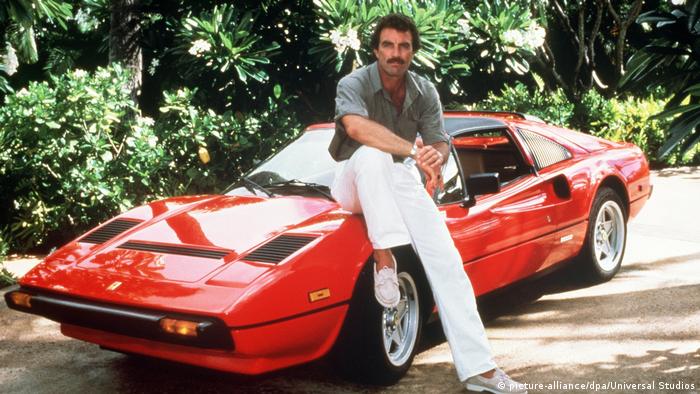
Now an aside: CBS-TV’s “Magnum P.I.” had the hero driving a Ferrari 308GTS.
Less known is the fact that the producers first considered putting Magnum behind the wheel of a 928, asking Porsche to build one with an extra-large sunroof. Apparently Porsche balked at the idea.
Certainly visually Magnum with a 928 doesn’t work. (Irrespective of the issue of Tom Selleck’s height, which forced the producers to take out the driver’s seat cushion from Magnum’s Ferrari. The famous Italian driving position is long arms and short legs.) I have driven neither (again, life is unfair), but I gather that the 928 is not the same car as the 308.
The biggest difference between a 911 and most other performance cars is its engine — a flat-six (originally air-cooled), located behind the back wheels. (Which makes it “rear-engine,” in contrast to a “mid-engine” car with the engine either ahead of the rear axle or behind the front axle.) Unlike American front-engine cars that are nose-heavy, the 911 is tail-heavy. Whereas a driver can make front-engine rear-drive car spin by punching the gas too hard (either accidentally or deliberately), they usually understeer, but not 911s. Their squirelly handling (in the opinion of those who weren’t used to driving them) was also a complaint of the Chevrolet Corvair, which had the same engine design and location.
Down the street and on the other side from the Corvettes-owning neighbor was the owner of a dark red 911. I never got to see that car except when it was driving past our house. Our next-door neighbors briefly had a boarder who had a red 914. (Not sure if it was a four-cylinder or a 914/6.) That, sitting in one at a Milwaukee car show and the vicarious experience of my eighth-grade English teacher’s Christophorus magazines (for Porsche owners, published since 1952) are the total of my own Porsche experiences. (The magazine made me aware of Porsche’s European delivery option, in which one could go to Europe, pick up the 911, drive it around Europe for a while, and then when done have it shipped to the U.S.)
One of the interesting features of the early 911s was the instrument panel.
On the far left was the fuel gauge and oil level gauge. Next was oil temperature and oil pressure. The tachometer was in the middle, with the speedometer (and turbo boost gauge) to its right and the clock on the far right. No engine temperature gauge (perhaps because the first ones were air-cooled), and no battery gauge, but a lot of focus on oil.
The ignition switch was on the left side of the dashboard, a race setup to allow the driver to start and shift immediately. (Also found on Fords back in the ignition-switch-on-dashboard days allegedly because Henry Ford was left-handed.)
There is one additional experience of sorts. Not long after I was hired to be the editor of a business magazine, my boss (one of my two favorites in my career) knew that I was a car nut. He was not, but he suggested (perhaps because it didn’t involve his own money) buying an old 911 and learning about the car by fixing whatever came up. I didn’t follow through on his suggestion (remember, I work in journalism, the land of low wages and lousy hours). Maybe I should have, though I’m guessing my ownership experience would have lasted until children started arriving, even though the back seat of a 911 will fit children and car seats.
Meanwhile, there is good news reported by Road Show …
Enthusiasts grumbled when the previous Porsche 911 GT3 hit the scene offering only a dual-clutch gearbox. Even though the sequential manual pushed the performance envelope with faster shifts for better lap times, some Porschephiles still longed for a more involving driving experience that comes with three pedals. For 2018, there’s good news for those manual transmission purists because the GT3 will once again be offered as a stick shift.
How is it? On roads throughout California’s Napa Valley region, it’s spectacular. Rowing through gears with the crisp short shifter is certainly more entertaining than flicking paddle shifters, and it makes perfect downshifts with its auto rev-matching, which can be turned off if you prefer to blip the throttle yourself.
Improvements to the 991.2 Porsche 911 GT3 don’t end with manual transmission. There’s a new 4.0-liter boxer six-cylinder engine in back cranking out 500 horsepower and 339 pound-feet of torque. That engine replaces a 3.8-liter unit making 475 horsepower and 325 pound-feet of twist. Redline remains a stratospheric 9,000 rpm.
… not that it makes me any more likely to buy a Porsche because (1) I would honestly prefer a Corvette, and (2) I can afford neither, even if I could find a Corvette cheaper than the 911 GT3’s $144,650 price.
Moore’s son, Richard, is now trying to get his father inducted into the Packer Hall of Fame. If Ray Scott, who covered the Glory Years Packers for CBS-TV, belongs in the Packer Hall of Fame (and he does and is a member), and if Jim Irwin, who replaced Moore in the booth (first working with Gary Bender, then as the play-by-play guy), belongs (and he does and is also a member), then Moore absolutely belongs. (Also in the Packer Hall of Fame is Russ Winnie, who was the announcer when WTMJ radio started carrying Packer games in 1929.)
… is, to quote our Founding Fathers, self-evident. Until 1973 the NFL prohibited games from being telecasted in the home team’s TV market, which is the Packers’ case is Green Bay and Milwaukee, due to concerns about not being able to sell out the stadium. (As if that would ever have been a worry with Lambeau Field.)
So if you lived in the eastern third of the state and you didn’t have tickets to the game at Lambeau or Milwaukee County Stadium (where fans probably should have brought a radio thanks to the fact that County Stadium was a rotten place for football due to where the seats were), you had to listen to Moore, who worked every minute of every game, preseason, regular-season and postseason (two more years than Scott did, though that was CBS’ doing by ending the team announcer arrangement, which should be brought back for TV) — and mostly by himself, as you can hear from the Ice Bowl game — including six NFL championship games (the 1962 game for NBC-TV), three other NFL playoff games, the first two Super Bowls and, for what it’s worth, two Playoff Bowls, featuring the runners-up of the NFL’s two conferences, a game infamously called by Vince Lombardi “a game for losers, played by losers.”
I don’t remember Moore doing Packer games. Bob Fox does:
I grew up in that era. It was the golden age for Packer Nation, as Lombardi’s Packers won five NFL titles in seven years, including the first two Super Bowls. The team also won an unprecedented three NFL championships in a row, a feat that has never been duplicated in the playoff era of the NFL going back to 1933. …
Scott was inducted into the Packers Hall of Fame in 2001. So were a couple of other legendary Green Bay newspaper reporters who covered the Packers back then, as both Art Daley (1993) and Lee Remmel (1996) have been enshrined as well. So was the team photographer during that time, Vernon Biever (2002).
Basically everyone who covered the Packers during the Lombardi era is in the Packers Hall of Fame. All except Moore.
Now there have been two Packer radio announcers who have been inducted into the Packers Hall of Fame. They are Russ Winnie (2016) and Jim Irwin (2003).
I expect them to be joined at some point by Moore and current radio play-by-play man, Wayne Larrivee.
I got to know Irwin pretty well at WTMJ in 1980 and 1981 when I worked there, first as an intern and then as a freelance reporter. In fact, I got to know Irwin so well, that he was the No. 1 reference listed on my résumé while I was looking for broadcasting and journalism work out of college.
Now longevity in covering the Packers does play a part in getting into the Hall of Fame for the team. Daley (68 years), Remmel (62 years) and Biever (61 years) each covered the Packers for over six decades.
Scott (10 years), Winnie (17 years) and Irwin (29 years) all covered the team for at least a decade and in Irwin’s case, almost three decades.
Moore spent 12 years broadcasting games for the Packers. And it was he who first hired Irwin.
Like I mentioned in my most recent story, the quarterback sneak by Bart Starr in the 1967 NFL title game between the Packers and the Dallas Cowboys, was one of the most iconic plays in NFL history.
“Third down and inches to go to pay dirt. 17-14, Cowboys out in front. Starr begins the count and he takes the quarterback sneak and he’s in for the touchdown and the Packers are out in front. The Green Bay Packers are going to be world champions,” Moore yelled out, as the 50,000-plus frozen faithful in the Lambeau Field stands went delirious.
The thing about Moore that is different from nearly every play-by-play announcer (including myself) today is his voice. In the days when radio voice quality mattered more than it seems to matter today (however you feel about that), Moore had a more modulated, deeper, richer voice than you generally hear today. CBS-TV’s Verne Lundquist and late NBC-TV announcer Charlie Jones don’t and didn’t sound like Moore, but those two are probably as close today voice-wise as you’d find to Moore.
The other thing about Moore is that, like announcers of that day, he came across as perhaps more booster than reporter, which again was common in those days and isn’t necessarily uncommon today. (Though it seems more obnoxious today.) It’s certainly not as if current Packer radio announcer Wayne Larrivee doesn’t want the Packers to win, but Larrivee will be critical if the Packers aren’t playing well. I gather that Moore didn’t go out of his way to be critical, though he announced bad plays if they were bad plays. That’s the way things were in those days.
Moore had the good fortune to get hired to do Baltimore Colts games in time for Super Bowl V, which was one of the worst (11 turnovers), yet closest, Super Bowls in history.
Moore also announced UW football, partnering with former Milwaukee Braves announcer Earl Gillespie, and also for a while announced Badger basketball on TV. That gave him the chance to call Magic Johnson’s last college basketball loss, when UW beat Michigan State on a buzzer-beating half-court shot by Wes Matthews. (I have that on tape somewhere.)
Moore was as much a part of the Glory Days as Scott was, and if for only that reason certainly belongs in the Packer Hall of Fame.
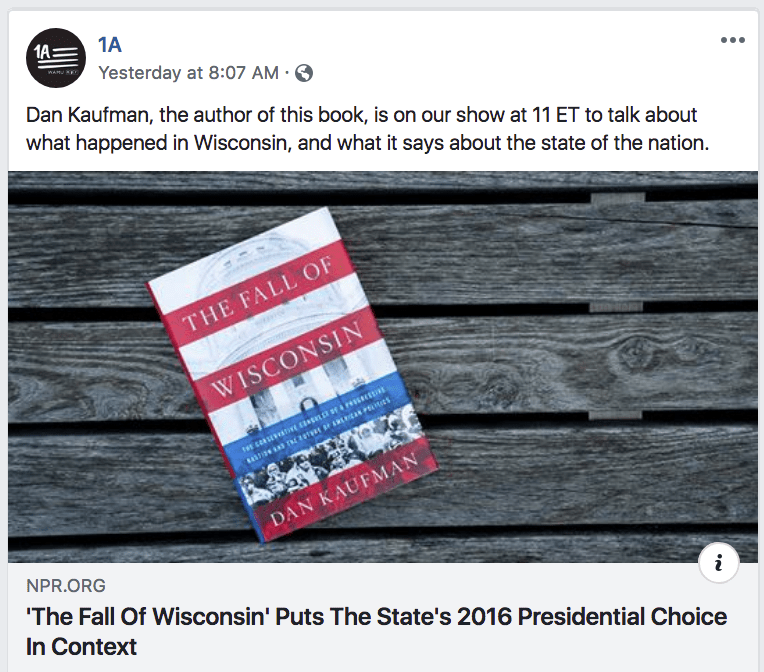
It turns out that there are a lot of people who listen to National Public Radio’s “1A.”
The list of stations that carry all, or some, of “1A,” including the Wisconsin Public Radio Ideas Network, runs from Birmingham, Ala., to Buckhannon, W.Va., the latter famous for …
… and from Concord, N.H., to Coachella, Calif., and from Miami, Fla., to Walla Walla and Yakima, Wash. It’s not on in Alaska or Hawaii, but it is on in the U.S. Virgin Islands. It’s on in states I’ve never been to, including Connecticut, Idaho, Maryland, New Hampshire, New Jersey, North and South Carolina, Oregon, South Dakota, Texas (though I was on the air once in Texarkana, Texas, broadcasting an adult amateur hockey tournament), Virginia and West Virginia, and Washington state and Washington, D.C.
That doesn’t mean that if I flew to Charlotte Amalie and asked random people if they knew me because I was on NPR on WTJX (93.1 FM) back on July 12 that they wouldn’t assume I had gotten too much sun and too much rum. I was on the BBC World Service earlier this year too, so I was theoretically on worldwide, but between the Beeb and NPR I guess I have now spoken to the biggest audience(s) in my entire life this year. As I said before, had I realized the size of the potential audience, I might have been more nervous.
The show can be heard here. It was, as is usually (but not always) the case with public broadcasting, a very civil discussion. As is always the case, there were some things I wished I had said but didn’t, and some points the other two guests made that I didn’t get to respond to, but such is the way of live radio or TV.
Read the Facebook comments on the show, and you will get an interesting look at how others (and some Wisconsinites and ex-Wisconsinites) view Wisconsin. And not favorably. I find it fascinating that there are people who base their opinion about not merely where they live, their state or the U.S., but even the state of their lives on what the government is or isn’t doing and who is or isn’t in office. (This is one reason I believe conservatism, or at least its libertarian side, is vastly superior to all the leftward “isms,” because one facet of the correct way of thinking is that government should never be the be-all and end-all of anyone’s life, even if the right people, however you define that, are in charge.) Similar statements, including some of mine, can be found on 1A’s Twitter feed.
I admit I did not get a chance to read Kauffman’s book. Charlie Sykes did:
What happened in Wisconsin should be a cautionary tale for the Left in the Age of Trump. But as this book makes clear, the Left declines to be cautioned.
According to the publisher, The Fall of Wisconsin gives “the untold story behind the most shocking political upheaval in the country.” But that story has, in fact, been told repeatedly, and author Dan Kaufman adds little to those accounts. Rather than a thoughtful critique of how progressives in a state with such a rich political tradition squandered their historical advantages, what we get is a work of ideological nostalgia, written with political rage goggles. Kaufman yearns for a return to the days of Scandinavian-style social-democratic politics, which he thinks have been defaced and degraded by a deep-pocketed and malign conservative machine.
The Fall of Wisconsin is packed with the sort of stories that progressives tell one another to account for their multiple defeats. It wasn’t anything we did, they reassure themselves; it was big money, the Koch brothers, Citizens United, voter-ID laws, gerrymandering, and a vast conservative infrastructure.
Kaufman paints a dystopian picture in which conservatives such as Governor Scott Walker (very much the villain of the book) “pitted Wisconsin citizens against one another, paving the way for the decimation of laws protecting labor unions, the environment, voting rights, and public education.” The results of those Republican victories, he writes, have been “disastrous” for just about everyone and everything, from the middle class to the environment, children, and small animals.
How awful — except that I live in Wisconsin and I can testify that, contra the title of this book, it has not “fallen.” Actually, it’s quite nice here, especially during our six weeks or so of summer. Despite his depiction of Wisconsin as a reactionary hellhole, the unemployment rate here is 2.9 percent, well below the national average; both the labor force and wages are growing; everyone in poverty is covered under Medicaid; the state has the ninth-best high-school-graduation rate in the country, and school spending is on the rise; and the state’s GDP has grown faster than that of neighboring Minnesota.
But I can certainly understand why the author and his allies on the left are rending their garments over what has happened here. Few states have flipped more decisively from blue to red, and the transformation of the state’s politics from progressivism to conservative dominance has been traumatic and disorienting.
Kaufman takes great pains to retell the story of Wisconsin’s progressive glory days and its role in pioneering progressive legislation. Wisconsin was the first state to enact an unemployment-
insurance program, the first to grant collective-bargaining rights to municipal employees, and one of the first to enact a progressive income tax. “Indeed,” he recalls, “much of Franklin Roosevelt’s New Deal, including the Social Security Act, was drafted by Wisconsinites loyal to what is called the Wisconsin Idea.”
But his history is truncated and selective, more a morality play than an attempt to chronicle the state’s idiosyncratic political history. Kaufman’s narrative sees Wisconsin locked in a decades-long battle over the question posed by its iconic former governor “Fighting” Bob La Follette: “Who shall rule — wealth or man?” In Kaufman’s telling, progressive Wisconsin Republicanism extended through the 1960s. The turning point, he writes, was the Supreme Court’s decision in Buckley v. Valeo, which removed many limits on campaign spending. From that point on, writes Kaufman, “Wisconsin’s politics started becoming more like the politics of other states.”
This fits into his preferred narrative of wealth versus people, but the result is that he glosses over quite a bit of history, including the career of Wisconsin’s red-baiting Senator Joe McCarthy. Similarly, former governor Tommy Thompson, who was elected to four terms and compiled an impressive reformist record, barely rates a mention. Nor does he spend much time analyzing the rise of Walker, suggesting at one point that he “attracted little notice during his time in the state assembly,” when in fact he was a ubiquitous presence in the local media. Kaufman devotes only a single paragraph to Walker’s improbable election as county executive in the Democratic stronghold of Milwaukee County after a pension scandal that implicated both the unions and local Democratic politicians.
And he has little to say about Walker’s deeply unpopular Democratic predecessor, Jim Doyle, except to blame the bad economy for “forcing” Doyle to ram through massive tax hikes in the midst of the financial crisis after repeatedly promising not to do so.
But Kaufman does have a great deal to say about the reactionary forces that conspired to “decimate” Wisconsin. Much of his book is devoted to documenting the “vast infrastructure conservatives [have] created over the past forty-five years,” including groups such as the Club for Growth and Americans for Prosperity. At the center of that conspiracy in Wisconsin sat the Bradley Foundation, which “distributes tens of millions of dollars in grants to think tanks, litigation centers, opposition research firms and other organizations promoting a spectrum of conservative causes such as Voter ID laws, school vouchers, the curtailing of safety net programs, and anti-union measures like right-to-work laws.” (Full disclosure: My wife formerly worked at the Bradley Foundation as director of community programs.)
Kaufman is especially troubled by the network of conservative think tanks clustered around the State Policy Network and American Legislative Exchange Council (ALEC), which allowed conservatives to share ideas and model legislation with legislators around the country. Kaufman struggles to portray the policy initiatives as sinister, highlighting, for example, the group’s support for a “Special Needs Scholarship Program Act,” which gave children with disabilities scholarships to attend schools of their choice. He quotes one Wisconsin legislator describing the ALEC-backed legislation that created education-savings accounts as “the death of public education.” You get the idea.
Not surprisingly, much of Kaufman’s account centers on the battles over Act 10, Walker’s proposal to limit the collective-bargaining powers of public employees. His account of the mass protests is nothing if not romantic, quoting speculation that the mass protests were a sign that Wisconsin was becoming the “Tunisia of collective bargaining rights” (a reference to the Arab Spring, which was then breaking out in the Middle East).
In his telling, the protesters were passionate, idealistic, and not at all to blame for their failure or subsequent electoral defeats. Reading Kaufman’s book, one would have no idea that in fact the protests backfired by alienating voters across the state.
Early polling suggested that support for Walker’s reform was soft, at best. But public opinion began to turn as the protests escalated. Demonstrators occupied and trashed the state capitol and marched on Walker’s family home in Wauwatosa, where his elderly parents lived. Others, dressed as zombies, disrupted a ceremony to honor participants in the Special Olympics. Death threats and obscene letters became commonplace, and the language of Walker’s critics was especially toxic. During one of the protests in Madison in 2011, a video captured one demonstrator repeatedly shouting the F-word at a 14-year-old girl who was speaking at a pro-Walker rally. On the floor of the state assembly a Democratic state representative turned to a female Republican colleague and shouted, “You are f***ing dead!” A progressive talk-show host mocked the state’s female lieutenant governor for having colon cancer and suggested she had gotten elected only because she had performed oral sex on talk-show hosts.
Readers won’t find any of that in Kaufman’s sanitized account and, as a result, will probably have a hard time understanding why Walker went on to be reelected twice while the GOP strengthened its hold on the legislature.
But perhaps the most revealing aspect of The Fall of Wisconsin is Kaufman’s choice of Randy Bryce as the hero. Often known as the “Iron Stache,” Bryce is an ironworker and union activist who has become something of a media/Hollywood/progressive celebrity for launching a bid to unseat U.S. House speaker Paul Ryan before Ryan announced his retirement. As it happens, even though Bryce is locally known as something of an Internet troll, perennial losing candidate, and deadbeat, Kaufman has been touting the Stache for years, including a long article featuring him in The New York Times Magazine in 2015. Even on the left, there have been growing misgivings about Bryce, for example a piece in Vice titled: “Democrats Bet Big on ‘Iron Stache.’ They May Have Made a Mistake.”
The article noted that “Bryce is perhaps more politically vulnerable than his liberal fans realize,” citing a series of failed previous campaigns and a tangled personal backstory that includes unpaid debts and multiple arrests, including a DUI. Despite that, he loaned his failed state-senate campaign $5,000 and, according to the New York Times, bought Twitter followers in 2015. He’s been dogged by reports about his offensive tweets (“If you look up the word succubus, you’ll see Ivanka Trump”) and was caught claiming nonexistent endorsements.
But Dan Kaufman has seen the future, and it is more social democracy and more Stache. “The support for Bryce,” Kaufman enthuses, “was a sign of a broader awakening.”
Perhaps not.
Two points I made more than once on the show. Coming into the 2010 election Wisconsin had a Democratic governor, Democratic-controlled Legislature, and only one Republican statewide official. All of that exactly reversed in the 2010 election, the GOP has controlled the governor’s, attorney general’s and state treasurer’s offices and, except for a few months around Recallarama, both houses of the state Legislature. Voters have four chances — the 2012 recall election and the 2012, 2014 and 2016 elections — to change that, and they have declined to do so.
Kaufman and others on his side will blame gerrymandering (which helped Walker how?), the Evil Koch Brothers, other big campaign money (which is the fault of excessive government power, which means excessive stakes in elections and the absolute need to do whatever it takes to win) or whatever boogeyman the left likes. The fact is that a majority of Wisconsin voters to this point have approved of what Walker and Republicans have done in Wisconsin, and a majority of Wisconsin voters to this point have not felt the need to restore power to Democrats. Like it or not, that is reality. And trying to shame voters for their incorrect (in the leftward opinion) views or past votes isn’t likely to make them vote correctly (in the leftward opinion) in the next election(s).
“I don’t think You’re man enough to take on a car like this.” Lightfoot (Jeff Bridges) has just walked into Pete’s Dependable Used Cars somewhere in Idaho. He eyes up a Cameo White ’73 Trans Am with a red “shaker.” “It’s a repo. Three thousand and change,” says Pete. Seconds later, the Trans Am is flying through the western countryside, stolen. Movies made the Trans Am an American legend.
Tom Glatch tells the inside story of the Trans Am’s impact on the culture (and sales) through it’s starring role in several motion pictures and TV shows. Clint Eastwood in Thunderbolt and Lightfoot drove a Cameo white ’73; John Wayne’s Brewster Green ’73 in McQ; and David Carradine’s red ’73 in Cannonball. 1977 introduced Burt Reynolds drove a black TA “Bullet” in Smokey and the Bandit, along with Hooper. “Ain’t nobody can fly a car like Hooper.” Steve McQueen drove a ’80 TA in Hunter. Steve died four months after the film was released. In the early ’80s David Hasselhoff starred in the TV series Knight Rider that featured KITT, the talking Trans Am. Tom reveals many inside details about the making of the films, how the cars were procured, and what became of them.
The book quotes many designers and engineers who had something to do with the Trans Am. Norm Inouye drew the famous flaming bird graphic based on a sketch by Pontiac Studio Chief Bill Porter. After a flaming initial rejection by Bill Michell, it finally became an option beginning in 1973. Porter recently commented, “I think it may have saved the car. In the mid-seventies, everything was going against the Firebird, and I’ll put he case forward that the Trans Am bird saved it.”
Mitchell’s Pegasus
Enzo Ferrari gave Bill Mitchell a 347 horsepower V-12 from a Ferrari Daytona 365 GT/B4 for his customized Firebird, Pegasus. The motor was a tight fit, and the author states that the firewall was moved back nine inches to accommodate the longer engine. However, you can clearly see that there were no modifications made to the interior or the wheelbase of the Pegasus. The V-12 was shoehorned in by taking up the space occupied by the stock fan and fan shroud.
1989 Turbo Trans Am
As an added bonus the author devotes several pages to the development of the 1989 Turbo Trans Am, the fastest four-seat American car of the 1980s. Pontiac built two Trans Ams in 1986 with the Buick Turbo 3.8-liter engine. But for the engine package to fit, the passenger-side fame rail was modified to make room for the exhaust downpipe. Production was not feasible, because the car would have to be re-certified at great expense to meet government crash standards. Using the standard Trans Am transmissions was also a certification issue.
The PAS team was brought in to see if production would be possible by other means. Bill Owen of Buick, the primary engineer behind the Turbo V-6 engine, came up with the idea of using the cylinder heads from the front-wheel-drive 3300 V-6 to narrow the width of the engine and make room for the transmission bracket so that the entire Grand National engine/transmission package would fit, along with the different heads. With this, the first production-ready Turbo Trans Am was born. Lloyd Reuss, executive vice president for GM’s passenger car group at the time, drove the gray-on-gray prototype and decided he wanted it to be the 30th Anniversary Trans Am.
Pretty interesting stuff. There are a lot of similar insights in the book.
By the way, in the gallery there is a shot of five ’77 TAs and a GMC motorhome that was part of the Trans Am Territory promotion. It is included in Michael Lamm’s great book, The Fabulous Firebird. One day at GM Design they picked out several TAs in the parking lot for the shot. The yellow TA was my car.
The Trans Am was named for a racing series of the same name, which included such pony cars as the Ford Mustang, Chevrolet Camaro, Dodge Challenger and AMC Javelin, each of which was limited to a 5-liter V-8 engine.
We owned very mild versions of two of these. Our first new second car was a brown 1973 Javelin with the 304 V-8 and automatic. It was the first car I, uh, legally drove. It had bucket seats and console, which was cool. It did not have power brakes, which one could get used to; it also didn’t have a parking brake indicator light, which led to a few interesting moments when one tried to drive without releasing the parking brake. It was fun to sit in the front seats of that car, but not so much in the back.
Note: Not our actual car.
Twelve years later, my mother got a red 1985 Camaro, because her oldest son kept using the 1975 Caprice, about which I have previously written. The Camaro had the 2.8 liter V-6 and automatic. It was an unusually reliable car for a GM product of the day; the only problem I recall with it was that the shifter knob kept coming apart until a recall. The problem that fit in the category of Feature, Not Bug was that that Camaro was so low that I had to put my hand on the ground first to get out.
Note: Not actual car, I think.
Between Javelin and Camaro ownership, the motorheads at my middle school (none of whom of course could legally drive) there was an ongoing argument about the Trans Am and the Corvette. The late ’70s C3 had the L-48 350 V-8 engine standard, with the L-82 350 V-8, with 40 more horsepower, optional. The standard Trans Am had a 400 V-8 with the same horsepower as the L-48, with the “T/A 6.6” V-8 adding 20 more horsepower.
Both cars are an example of 1970s taste, such as it was:
You could logically guess that I pined for the Corvette. I was a subscriber to Motor Trend magazine (motto: Every Car’s Great!), and when it reviewed the ’77 I pored over every word, including the red bubble on top of the antenna for the AM/FM/CB radio. (Don’t ask me how I remember that, good buddy.)
The reason the Trans Am became so popular in the late ’70s wasn’t just “Smokey and the Bandit” (starring ’70s icon Burt Reynolds), but because there were few other choices for a hot car. (“Hot” as in high performance, such as it was in the day, not “hot” for stolen.) Besides the Corvette (which was more expensive and lacked any back seat, as opposed to pony cars’ Back Seat in Name Only) … well, AMC killed the Javelin, and Chrysler killed the Plymouth Barracuda and Dodge Challenger. Chevy killed the Camaro Z-28 in 1975, only to bring it back in late 1977 after noticing Trans Am sales. Ford’s Mustang II was based on the Pinto, and without a V-8 until 1975, one year before Ford introduced the Cobra II package powered by a 140-horsepower V-8.
The ultimate Trans Am is the Special Edition T/A, available in black with gold bird thing on the hood or gold with black thing on the hood. According to this site, the correct combination — the T/A 6.6, 4-speed manual and T-tops — was chosen by 2,699 buyers.
I was a skinny, bookish, bespectacled, and insecure 12-year-old living in the suburbs of Chicago when I first realized what I wanted to be when I grew up: Alexander Mundy in It Takes a Thief, James West in The Wild, Wild West, and James Bond. Those men had no fear. They were confident in any situation and were comfortable in their own skin. Not me. I lived a life of perpetual embarrassment. Of course, now I know that’s how most 12-year-olds feel. At the time, all I knew was I wanted to be someone else.
The first Bond movie I saw was In Her Majesty’s Secret Service. Bond was engaged to be married to Teresa (Tracy) Draco, played by Diana Rigg. I was a huge “Avengers”‘ fan back then. (I’m talking about the English “Avengers,” not the Marvel “Avengers,” though I was an avid comic book reader as well.)
Who wouldn’t want to be engaged to Diana Rigg in 1969? She was beautiful and smart and effortlessly cool. Bond was heartbroken when (spoiler alert) Diana Rigg died. At least he avoided getting married. It was clear even to my 12-year-old self that no one wanted a married Bond—a Bond who had to change nappies and help with the dishes. They killed off his fiancé so Bond could continue to be a lady killer. This is probably just as well. Bond would have made a terrible husband and a worse father. The first time his kid spilled a Cherry Slurpee on the supple leather of his Aston Martin, Bond would have launched his tiny ass into the stratosphere with his ejector seat.
There’s no denying that being Bond has its perks. You visit all kinds of exotic places and drive unbelievable cars. You have a license to kill and because you do, you can take what you want and do what you want and no one stands in your way. Men fear you and women fall all over you. Best of all, you get to make a difference. You get to save the world.
There’s also a pretty significant downside. After all, no one really cares that much about Bond, and Bond doesn’t really care all that much about anyone else. That makes for a pretty lonely life. That’s not the worst of it. Bond isn’t willing to open himself up to love. He’s kind of an emotional coward. He isn’t willing to care deeply about someone. He’s too afraid of getting his heart broken, too afraid of experiencing loss.
Fathers face that kind of fear every day. We worry about our kids. We worry about them physically and psychologically. We worry about their futures. To me, the idea of losing a child is far more frightening than having a supervillain like Auric Goldfinger barbecue my scrotum with an industrial laser.
In the original Magnificent Seven, Charles Bronson played a gunfighter who comes to a Mexican village with six other gunmen to protect the town. He’s admired by three little Mexican boys who follow him everywhere. They worship him for his bravery and aspire to be just like him. They think their fathers are cowards in comparison. Bronson paddles their asses and gives them a speech that has always stayed with me:
Don’t you ever say that again about your fathers, because they are not cowards. You think I am brave because I carry a gun; well, your fathers are much braver because they carry responsibility for you, your brothers, your sisters, and your mothers. And this responsibility is like a big rock that weighs a ton. It bends and it twists them until finally, it buries them under the ground. And there’s nobody says they have to do this. They do it because they love you, and because they want to. I have never had this kind of courage. Running a farm, working like a mule every day with no guarantee anything will ever come of it. This is bravery.
Am I sorry I didn’t become an international super spy? Would I have enjoyed jetting around the world, dispatching super villains and romancing women with names like Pussy Galore and Holly Goodhead? Probably. Then again, when I was in junior high, I was painfully shy around girls. I was awkward, tongue-tied, and insecure. Not exactly James Bond material. By the time I hit college, I started capitalizing on the strengths I did have. Like my honesty, my empathy, and my self-deprecating humor. Besides, if I had become James Bond, I wouldn’t have had time to coach my son’s soccer team or teach him how to ride a bike. I wouldn’t have had time to take him hiking or watch “Looney Tunes” or play video games with him. I would have missed everything.
My son saw me for who I was: a combination of contradictory traits. I was klutzy and confident, bold and bashful, and I made fun of my own awkwardness. Humor was my secret weapon. He watched and learned, and had none of my bashfulness when it came to the opposite sex. He had a lot of friends who happened to be girls. He saw them as equals. He had no expectations, so he didn’t make things weird. He was honest about his feelings and didn’t play any macho games. He was a good person and girls could see that. And he was funny. That’s probably why he had a girlfriend from the time he was 12.
Maybe you don’t need a license to kill to be a hero, after all. Maybe there’s more than one way to save the world. Maybe it’s more important to be a good parent. Maybe it’s more important to raise a child with confidence and kindness.
The show calls itself “a show about a changing America. Host Joshua Johnson convenes a daily conversation about the most important issues of our time. 1A brings context and insight to stories unfolding across the country and the world. With a name inspired by the First Amendment, the show celebrates free speech and the power of the spoken word.”
I’m all for that. (Which is why I appear on every show, friendly audience or not, I’m invited to, other than the fact that I am a media ho.) In fact, I think every newspaper should change the name of its opinion page from “Opinion” or “Perspectives” or something generic like that to “The First Amendment.” (Of course, then they would actually have to respect the First Amendment, which is not currently the case for such newspapers as the New York Times.)
What is the book about? Glad you asked!
During the 20th century, Wisconsin was the embodiment of what U.S. Supreme Court Justice Louis Brandeis called a “laboratory of democracy” — an experiment in social and economic innovation, and a prospective blueprint for other states.
A bastion of progressive values, Wisconsin created the first workers’ compensation program, a progressive state income tax, stricter child labor laws, and the first unemployment insurance program. Much of FDR’s New Deal was even authored by Wisconsin natives.
How did Wisconsin go from electing Barack Obama in 2012 to Donald Trump in 2016? Dan Kaufman, author of “The Fall of Wisconsin,” assesses the state’s changing tides:
Wisconsin has gone from being a widely admired “laboratory of democracy” to a testing ground for national conservatives bent on remaking American politics. Its century-old progressive legacy has been dismantled in virtually every area: labor rights, environmental protection, voting rights, government transparency.
As Gov. Scott Walker campaigns for a third term, new polls indicate that public opinion of various economic and environmental conditions is low.
We’ll discuss how the changing political landscape has impacted life in Wisconsin — and vice versa — and what’s next for the once-progressive state.
The show originates from WAMU radio in Washington, D.C., which means I will be on a radio station in a place I’ve never been to, though as readers know that didn’t stop me from appearing on the BBC World Service earlier this year. Actually, since this is on NPR nationwide I will be on the air in a lot of places I’ve never been to. (I therefore should be nervous, I suppose.)
The show is on WAMU (88.5 FM for Washington-area listeners) from 10 a.m. to noon and 8 to 9 p.m. Eastern time. It’s on WPR from 1 to 3 p.m. Central time. Our discussion will be on WAMU live at 11 Eastern, 10 Central, and on WPR at 2 p.m. Central time, which means I guess I’ll be able to hear myself after I’m done talking.
As you might imagine — spoiler alert! — I will be taking an opposing view, or views, from the author and the third guest, a fellow Wisconsin Public Radio Week in Review alumnus who apparently suggested me for this. (I might start, perhaps, with questioning the term “once-progressive state,” which infers that most Wisconsinites bought everything the Progressives did.)
On Thursday, four journalists and one staff member of the Capital Gazette were murdered in the newspaper’s Annapolis, Maryland, office.
While the event was initially widely covered by all major news outlets, the media is likely to quickly move on from the story, just like it did with the Santa Fe High School shooting, because it doesn’t fit the right narrative. (Unlike many of the Parkland students, the Santa Fe students didn’t respond to the tragedy by calling for gun control measures.)
That in itself is a shame, not just because there is much to learn from this tragedy, but also because the inspiring courage of the surviving journalists deserves more than a single news cycle.
Why It Will Go Away Quickly
Reason No. 1: It doesn’t fit the gun control narrative.
This shooting can’t be blamed on lax gun laws. Maryland has some of the strictest gun control laws in the country, earning it an A- rating from the Giffords Law Center—one of only six states to earn above a B+ score. It has enacted almost all of the gun control measures commonly proposed by gun control advocates.
But this tragedy does fit the actual common fact pattern of mass public shootings: An individual with a long history of concerning behaviors managed to avoid a disqualifying criminal or mental health record, took a legally owned “non-assault” firearm to a gun-free zone, and picked off defenseless people in the time it took law enforcement to respond.
This reality, however, is inconvenient for pushing common gun control measures like raising the minimum purchase age to 21, imposing universal background checks, and banning “assault weapons.”
That makes it much more likely this story will quietly fade and be replaced by other stories that can be better weaponized against conservatives, like Justice Anthony Kennedy’s retirement.
Reason No. 2: Pundits immediately—and incorrectly—blamed President Donald Trump.
Within an hour of the first reports of shots fired in the Capital Gazette building, numerous media pundits took it upon themselves to blame the shooting on Trump’s rhetoric about “fake news.” A Reuters reporter accused the president of having blood on his hands, followed by similar accusations from a New York Times journalist, a White House correspondent, an investigative reporter from Politico, and other high-profile media personalities.
They were completely, unequivocally wrong.
The suspect wasn’t motivated by political ideology, but by a longstanding feud with the newspaper that predates Trump’s election by roughly four years. Had these journalists waited for the facts of the situation to come out, they could have avoided looking exactly like the “fake news” media the president has accused them of being.
Instead, they’re having to backtrack and justify irrational statements. That’s not an easy job, and often requires a bit of humility.
On the other hand, simply dropping the story as fast as possible is much more convenient.
Why It Shouldn’t Go Away Quickly
Reason No. 1: We need to face the reality of warning signs.
It’s all too common to hear people, in the aftermath of these attacks, imply that they had every reason to believe the suspect was a danger to himself or others, and yet nothing was done to keep him from possessing firearms. We must learn from these heartbreaking incidents so that we can prevent future tragedies.
The suspect has been convicted of criminal harassment, a misdemeanor that carries a maximum penalty of 90 days in jail. He served 18 months of supervised probation. But in Maryland, as in most states, this is not an offense that disqualifies a person from possessing a firearm.
Criminal stalking, harassment, and threatening behaviors need to be taken seriously as indicators of future violence. This man’s actions left a women so in fear for her life that she moved to a new location and told reporters that she still sleeps with a gun.
He became so unhinged that Capital Gazette employees reported him and his threats to two different law enforcement agencies. A former executive editor and publisher for the paper once told his attorneys that “this was a guy that was going to come and shoot us.”
The answer to these warning signs is not to impose wholesale restrictions on the constitutional rights of law-abiding citizens, or to prohibit entire categories of firearms commonly used by those law-abiding citizens for lawful purposes.
The answer is to intervene with the specific individuals who, by their actions and based on objective criteria, indicate that they present a heightened risk of danger to themselves or to others compared to the general population.
This does not mean that every single person who has ever committed a misdemeanor should be eternally, completely stripped of gun rights, either. States should pair individual restrictions for violent and violence-related misdemeanors with comprehensive, fair, and easy-to-utilize mechanisms for the restoration of an individual’s Second Amendment rights.
Reason No. 2: Maryland left the journalists defenseless.
There is no evidence that any employees of the Capital Gazette would have chosen to carry a firearm to work for self-defense. But had they been inclined to protect themselves against a person they reasonably—and correctly—believed was more than capable of carrying out his threats, Maryland makes it nearly impossible for them to do so outside of their homes.
Maryland is a “may issue” state, meaning it does not presume that residents have a right to carry concealed firearms, and only issues permits to those who sufficiently prove they have a “good and substantial reason” to carry a firearm in public. This bar is rarely met, even by law-abiding citizens such as Robert Scherr, who served honorably in the National Guard and who felt at risk because of his work as a divorce lawyer.
Fewer than 0.4 percent of Maryland adults have an active concealed carry permit. In terms of total concealed carry permits issued, Maryland outranks only Washington, D.C. (which effectively did not issue concealed carry permits until 2017); Hawaii (the only state to not issue a single gun carry permit to a private citizen in 2016); New Jersey (which notoriously issues permits almost exclusively to former law enforcement officers); and Delaware and Alaska (both of which have fewer than one-sixth of Maryland’s population).
And even if a Maryland resident is one of the lucky few authorized to carry a gun in public, she is prohibited from doing so in a wide range of places.
The reality is that, for all of Maryland’s strict gun laws, it has only succeeded in making it more difficult for law-abiding citizens to defend themselves from criminals bent on destruction.
Reason No. 3: The journalists are heroic.
The most unfortunate part of the likely imminent media retreat from this story is that the real heroes of the day won’t get the coverage they deserve.
When asked if the Capital Gazette would print a Friday edition on the heels of so horrific a tragedy, reporter E.B. Furguson III fiercely told The New York Times, “Hell, yes.” This was followed by a tweet from the Gazette’s twitter account, informing the public: “Yes, we’re putting out a damn paper tomorrow.”
The men and women of the Capital Gazette were hours removed from watching their colleagues be slaughtered simply for having the audacity to publish truthful material about a deeply troubled man. Their blood was still wet on the floors of the printing office. The pain was raw, and deep, and intense.
So they did the most courageous thing they could do.
We’ll see if Swearer is correct. For one thing, I do not consider what I do to be heroic. Journalists who think they’re heroic need to find people who actually put their lives at risk every day — the military, police officers and firefighters — which journalists do not unless they’re reporting from a war zone. Journalists who go through life with an agenda are likely to miss the lessons of this tragedy.