I will be on Wisconsin Public Radio’s Joy Cardin program Friday at 8 a.m.
Wisconsin Public Radio’s Ideas Network can be heard on WHA (970 AM) in Madison, WLBL (930 AM) in Auburndale, WHID (88.1 FM) in Green Bay, WHWC (88.3 FM) in Menomonie, WRFW (88.7 FM) in River Falls, WEPS (88.9 FM) in Elgin, Ill. (that is, the state whose finances are worse than Wisconsin’s), WHAA (89.1 FM) in Adams, WHBM (90.3 FM) in Park Falls, WHLA (90.3 FM) in La Crosse, WRST (90.3 FM) in Oshkosh, WHAD (90.7 FM) in Delafield, W215AQ (90.9 FM) in Middleton, KUWS (91.3 FM) in Superior, WHHI (91.3 FM) in Highland, WSHS (91.7 FM) in Sheboygan, WHDI (91.9 FM) in Sister Bay, WLBL (91.9 FM) in Wausau, W275AF (102.9 FM) in Ashland, W300BM (107.9 FM) in Madison, and of course online at www.wpr.org.
On the opposite side of me will be former state attorney general Peg Lautenschlager. As a part-Norwegian, part-German, part-Polish pundit, in all the years I’ve been doing media punditry, I believe this is the first time someone on a panel has had a longer last name than me.
The Independence Day holiday is not always a three-day weekend, but when it is, it’s my favorite weekend.
One reason is fireworks, one of the lesser known fields of endeavor that has seen tremendous advancements over the years.
We decided to watch, schedules and weather and so on permitting, as much in fireworks as we could get to over the next few days. There were fireworks Friday, there are fireworks Saturday through Monday, and there is even a display Tuesday night. (Which we were going to until a wave of illness and fatigue hit the house.)
Our fireworks odyssey starts with these photos Michael took at the Waushara County Fairgrounds in Wautoma Friday:
On Saturday, we went to Princeton (where we once went hoping the booms would induce labor):
On Sunday we went to Murray Park in Ripon:
On Independence Day, we saw the Fond du Lac fireworks from a distance:
Between my former and current blogs, I wrote a lot about automobiles and TV and movies. Think of this post as killing two birds (Thunderbirds? Firebirds? Skylarks?) with one stone.
Most movies and TV series view cars the same way most people view cars — as A-to-B transportation. (That’s not counting the movies or series where the car is the plot, like the haunted “Christine” or “Knight Rider” or the “Back to the Future” movies.) The philosophy here, of course, is that cars are not merely A-to-B transportation. Which disqualifies most police shows from what you’re about to read, even though I’ve watched more police video than anything else, because police cars are plain Jane vehicles.
The highlight in a sense is in the beginning: The car chase in my favorite movie, “Bullitt,” featuring Steve McQueen’s 1968 Ford Mustang against the bad guys’ 1968 Dodge Charger:
One year before that (but I didn’t see this until we got Telemundo on cable a couple of years ago) was a movie called “Operación 67,” featuring (I kid you not) a masked professional wrestler, his unmasked sidekick, and some sort of secret agent plot. (Since I don’t know Spanish and it’s not subtitled, that’s about all I can tell you.) The highlight of the movie is a duel between a 1965 Dinalpin A110 (apparently a Mexican-built Renault Alpine) and an airplane equipped with machine guns:
Unlike James Bond’s Aston Martins (apparently MI6 has more budget than whatever these guys work for), the A110 doesn’t have any special features at all, but our hero thoughtfully threw a bazooka in the trunk before he left. (Note to self: Check Army surplus store to see if they have any bazookas on clearance.)
The Dodge Challenger in “Vanishing Point” didn’t have a name, but its driver didn’t have a first name either:
(The Chevy, painted black, was driven by Harrison Ford in “American Graffiti.”)
Another early example is Eleanor, the Mustang featured in the original cult classic “Gone in 60 Seconds“:
I stumbled upon an early formula for TV series success: Cool car + cool theme music = something I’d watch. Although I didn’t watch much of this, one early example was “Mannix,” which combined the theme music of Lalo Schifrin (whose birthday was earlier this week) and, at first, the only Oldsmobile Toronado convertible and then a Dodge Dart GT convertible into a series in which the hero, by one count, was shot 17 times, knocked unconscious 55 times, and drugged 12 times:
There was a TV series, “Chase,” that ran one season on NBC in 1973. (It was repeated on USA Network one mid-1980s summer.) That show must have been a gearhead kid’s dream, because it featured (1) a souped-up Plymouth Satellite, (2) a motorcycle, (3) a helicopter and (4) a police dog. Unfortunately, other than listings of the series, there is no online evidence the series ever existed.
After “Chase” exited, Jim Rockford drove onto the scene:
Unlike a series you’re about to read about (the literary types call that “foreshadowing”), someone thought to replace Rockford’s 1974 Firebird with a 1977 Firebird when Pontiac replaced the dual round headlights with quad rectangular headlights. “The Rockford Files” was also known for epic car chases every other episode or so. (I wrote about the 10 best movie car chases for the previous blog, but that too has gone into e-heaven, it seems.)
One of the most famous series of the ’70s was “Starsky & Hutch,” which featured a red Ford Torino with a Nike-like white swoosh. I’m sure no one would have connected that car to belonging to the police, right?
In late 1976 Motor Trend did a story about the S&H Torino and, pointing out that Ford had just canceled the Torino, noted that “insiders are looking for a spectacular crash in an upcoming script,” and wondering with what the Torino would be replaced. The answer, of course, was … another Torino, something sort of noted in the “Starsky & Hutch” movie, when the Torino that was driven off a dock was replaced by … another Torino driven up by Paul Michael Glaser (whose movie part was played by Ben Stiller) and David Soul (whose movie part was played by Owen Wilson).
Speaking of movies …
(By the way: Pontiac never made a LeMans four-door convertible in 1976 or any other year.)
After Smokey drove onto the screen, along came “CHiPs”:
The coolest wheels were the motorcycles, of course. (At the time the California Highway Patrol was using Kawasakis instead of Harley–Davidsons or, apparently now, BMWs.) This was the first series, however, where I noticed that the same cars were passed every week, and the same vehicles were in the middle of each week’s epic crash. (In fact, one bad-guy car became Ponch’s car, a Pontiac Firebird with both the Trans Am shaker scoop and the Formula Ram Air scoops.) The other thing that annoyed me was the episode in which Ponch and Jon were assigned to a squad car because of bad weather, and their boss told them it was a new squad, when in fact it was about a three-year-old car. (Even though we didn’t own any Chrysler products, I could tell the difference between a full-size Dodge Monaco and a mid-sized Dodge Monaco!)
While Ponch and Jon were patrolling the freeways of southern California, Bo and Luke Duke were racing and being chased by the crooked establishment of Hazzard of some unnamed Southern state:
(Non-Wisconsinites may not know that Tom Wopat, who played Luke, is a native of Lodi. Non-Madisonians may not know that I went to high school with Tom’s cousin. And in some future blog, I may write about the incongruity of the family relationships about three cousins living with an uncle who is the father of none of them, once I figure out the Clampett family.)
The bad thing about “Dukes” (other than Bo and Luke’s several-episode departure due to a salary dispute in which they were replaced by, you guessed it, two other cousins who looked just like Bo and Duke) is the number of people who took perfectly good 1969 Dodge Chargers and ruined them by making Dukesmobiles.
And then we move to Hawaii:
What was not to like about this series? The lush scenery of Hawaii, and a charismatic star who drives a Ferrari! Add loyal friends, an amusing antagonist, mostly good stories, babes easy on the eyes (although Magnum never seemed to connect with them; perhaps that was part of his appeal too, that he was as much a klutz with women as his male viewers), and perfect targa-top-friendly weather.
Proving that imitation is the sincerest form of flattery, Magnum’s success bred several imitators, including “Hardcastle & McCormick,” with the latter … well, the first-season titles explain the premise:
Related to McCormick’s Coyote (which was actually a modified Manta Montage) was the “Hawk,” a heavily modified AMC Javelin for the miniseries “Wheels,” Arthur Hailey’s fictionalized retelling of Lee Iacocca’s battle to create the Ford Mustang. (“Wheels” should not be confused with “The Betsy,” a movie about the creation of a fuel-efficient car that was named to the 100 Most Enjoyably Bad Movies Ever Made list in The Official Razzie Movie Guide.)
Down under, Australian director George Miller was making considerably darker movies with a Ford Falcon Interceptor, “the last of the V-8s”:
I’m not sure how integral to the part the Ferraris (a 365 GTS/4 replica on a Corvette chassis and a very real Testarossa) driven by Miami–Dade Police Detective James “Sonny” Crockett were, but they certainly fit in with the series feel:
It is interesting to note that very few TV series or movies have featured America’s sports car, the Corvette. (The aforementioned Corvette-powered Daytona replica doesn’t count.) The Vette was integral to “Route 66,” of course:
Robert Conrad exported a C3 convertible to Vienna to channel his inner Rick Blaine in “Assignment Vienna“:
Just after that, before the scientific accident that turned him into the Incredible Hulk, Bill Bixby drove a white Corvette in the two-season “The Magician”:
There was the movie “Corvette Summer,” but the custom Vette is, frankly, an abomination, with asymmetrical hood scoops and, stupidly, right-hand drive:
Then you have to go all the way to a series by Jim Rockford’s creator, “Stingray,” which featured a ’65 Corvette driven by, of course, Ray:
So apparently I need to create a TV series, with Lalo Schifrin creating the theme music, where the hero drives a Corvette. (Particularly today, National Drive Your Corvette to Work Day.) That will have to be my weekend project. (Perhaps an out-of-work journalist who secretly performs feats of derring-do, rights wrongs, punishes the bad guys, and blogs? Naaaaaaahhhh ….)
Since I have neither a Teleprompter nor a UFB (earpiece), the whole thing has sort of a 1980 vibe, doesn’t it?
Ripon Charter Cable subscribers can see the Ripon Channel Report weekends on channel 97, and Charter digital subscribers in the Ripon area (including, I think, Princeton, Green Lake, Berlin, Omro and the Town of Algoma) can see the Ripon Channel Report on digital channel 986.
According to a fact sheet published on the group’s website, this is what is about to happen: “On May 21, 2011 two events will occur. These events could not be more opposite in nature, the one more wonderful than can be imagined; the other more horrific than can be imagined. A great earthquake will occur the Bible describes it as ‘such as was not since men were upon the earth, so mighty an earthquake, and so great.’ This earthquake will be so powerful it will throw open all graves. The remains of the all the believers who have ever lived will be instantly transformed into glorified spiritual bodies to be forever with God.” The rest will be “thrown out upon the ground to be shamed,” and will experience “horror and chaos beyond description.”
There will be an interim period running from 5/21/11 until 10/21/11, when Family Radio says final destruction of the Earth take place.
The Family Radio website notes that it is still accepting donations, and although its donor computer operation is said to be undergoing maintenance, the group says it has representatives on hand to process donations from call-in givers. It accepts credit or debit cards.
So any ministers reading this apparently need not bother to prepare a sermon or homily for Sunday.
I pointed out in selecting Family Radio my “Sunday Insight with Charlie Sykes” Loser of the Week that evidently Family Radio was unfamiliar with Matthew 24:36, which readeth: “But of that day and hour knows no man, no, not the angels of heaven, but my Father only.”
In the Bible a wise man is a true believer, to whom God has given a profound trust in the authority of the Bible. True believers have been in existence since the beginning of time. But the timeline of history as it is revealed in the Bible was never revealed to the hearts of the true believers. For example, throughout most of the church age it was generally believed that Creation occurred in the year 4004 B.C.
However, about 35 years ago God began to open the true believers’ understanding of the timeline of history. Thus it was discovered that the Bible teaches that when the events of the past are coordinated with our modern calendar, we can learn dates of history such as Creation (11,013 B.C.), the flood of Noah’s day (4990 B.C.), the exodus of Israel from Egypt (1447 B.C.) and the death of Solomon (93l B.C.)*
However, it was not until a very few years ago that the accurate knowledge of the entire timeline of history was revealed to true believers by God from the Bible. This timeline extends all the way to the end of time. During these past several years God has been revealing a great many truths, which have been completely hidden in the Bible until this time when we are so near the end of the world.
(The essay gets more creative from there, believe me.)
So Camping is, similar to Matthew Harrison Brady (that is, William Jennings Bryan) in “Inherit the Wind,” a believer that the Earth is only tens of thousands of years old. I am neither a scientist nor a theologian, but it seems rather presumptuous to limit God to a 24-hour day, does it not? The Episcopal Church, to which I’ve belonged for a decade, describes itself as a tricycle of Scripture (the big wheel), tradition and reason. And there is no real reason that evolution is incompatible with God’s creation.
The minister who married my wife and me claims that there is only one verse of the Bible, John 3:16, that does not require an additional verse to back it up. Matthew 24:36 has two — Mark 13:32 (“But of that day and that hour knows no man, no not the angels which are in heaven, neither the Son, but the Father”) and, from my favorite book of the Bible, Acts 1:7 (“And he said to them, it is not for you to know the times or the seasons, which the Father has put in his own power”). Moreover, the quoted words of Jesus Christ would seem to have paramount ranking as a source of information for Christians, would they not?
A Brief History of the Apocalypse has a listing of predictions of the end of the world dating all the way back to 2800 B.C. A real wave of apocalysomania took place in 1000 A.D., which I guess would have been Y1K. (I remember Y2K, when driving back home after a sumptuous not-really-millennium meal we listened to that paragon of reason, Art Bell, report about mysterious blackouts. Bell somehow neglected to mention that the University of Wisconsin football team’s going to back-to-back Rose Bowls must have been a sign of the end times.) And we’ve had predictions of the end practically every year since 1972. (No, Richard Nixon’s reelection was not one of them, but at the University of Wisconsin, Ronald Reagan’s reelection was.) Before Pat Robertson was claiming that 9/11 and hurricanes were divine retribution, he predicted the end of the world would take place in the fall of 1982. (Breaking up with my first girlfriend and losing my job in the same week seemed like the end of the world, but it wasn’t.)
I recall two specifically. In 1978, Pope Paul VI died, and then his successor, John Paul I, died a month after becoming pope. Newspapers at the time noted the legend of St. Malachy, an Irish priest who wrote down descriptions of every pope from Peter forward. When the list of popes runs out, the legend has it, our time runs out. And there is only one pope left on the list, Benedict XVI’s successor, who by the way is supposed to be the Devil incarnate. (That should make the next College of Cardinals meeting after Benedict’s death really interesting.)
The other prediction, in 1982, was not exactly a prediction of the end, but of galactic disorder caused by all the planets in this solar system lining up. Leonard Nimoy narrated an episode of “In Search Of” that warned of the calamity on the way. Nimoy’s most famous character, Mr. Spock, would have pointed out that such a theory is illogical because the planets are not all on the same plane. (To which Dr. McCoy would have contributed, “How do I know? I’m a doctor, not an astronomer!”)
The planetary alignment previously occurred Feb. 4, 1962; astrologer Jeane Dixon predicted that the Antichrist would be born the next day. (Which means the Antichrist is actress Jennifer Jason Leigh.)
Remember the earthquake that destroyed Taiwan and created the tsunami that killed millions May 11? You don’t, because the prediction of someone named Professor Wang didn’t happen. Of course, this year is less than half over, so we may still enter thePhoton Belt (no, that was not an episode of Star Trek) before the end of the year.
The next prediction of our doom is Dec. 23, 2012, according to the Mayans, whose calendar runs out on that day. (So don’t bother getting Christmas presents next year, and you can skip gassing up the snowblower, when by then gas should be about $14 a gallon.) But if that prediction isn’t accurate, there are plenty of others waiting in the wings. For instance, back in 1960, Science magazine predicted that on Nov. 13, 2026, the world’s population would reach infinity.
Judging from the reactions, I am one of the few people that, until yesterday, was not on Facebook:
OMG Hubby has finally joined Facebook. Friend him NOW!
FB will NEVER be the same
How did you do that…John still won’t!
Human sacrifice, dogs and cats living together… mass hysteria! 12/21/2012 is soon approaching! and yet another sign…Steve is on Facebook
HI! i see facebook won again…
But now I am. I found out that there was no one by my name on Facebook, so if you do a search for my name, you are guaranteed to find me. (I am also on LinkedIn, and you can see from the right side of this page that I am Presty1965 on Twitter.)
Until now I had assumed that Facebook was, well, too social for, you know, a business magazine publisher/editor/pundit. Then I was advised by someone considerably more savvy than I in social media (you know who you are, Todd, and thanks) that if it were a country, Facebook would be the third largest country in the world. (I wonder if Facebook is run any better than countries one and two … or for that matter this one.)
Since I have this blog linked to Facebook (as well as LinkedIn and Twitter), I assume all the people I have now Friended and vice versa will find out that, wow, Presty is really a right-winger. (I’ve been a proud member of Hillary Clinton’s Vast Right Wing Conspiracy since the 1990s.) The thing, however, is that (1) I am perfectly capable of not talking about politics (remember that the phrase “the personal is political” did not come from the right side of the political aisle), and (2) I have no problems arguing ideas because ideas are supposed to be argued, and the way one improves the process of delivering opinions is to debate opinions. And, now that I think of it, there is a (3): If you don’t like a blog entry, don’t read it.
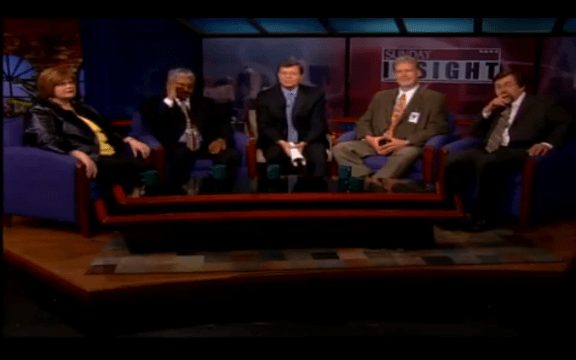
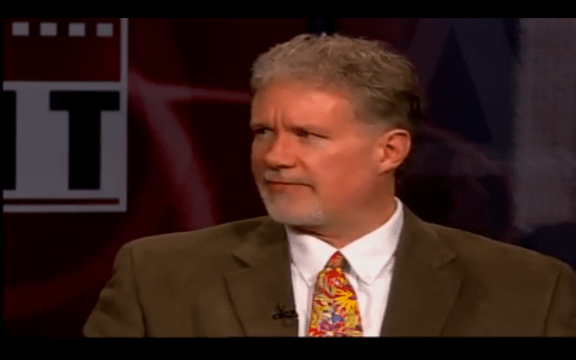
My appearance on “Sunday Insight with Charlie Sykes” on WTMJ-TV in Milwaukee can be seen here. The show featured breaking news (Herb Kohl’s upcoming retirement, which pushed school choice off the agenda) and a guest who forgot to take off his visitor name tag before the open. (That’s called a “continuity error” in film.)
The other thing is that this might be the last “Sunday Insight” show (among other things) of all time … if this guy is right. (See the Winners and Losers segment to see what I mean, or read this blog Friday.)
Monday will be the 50th anniversary of the “vast wasteland” speech Federal Communications Commission chairman Newton Minow gave to the National Association of Broadcasters. (Which must have been like criticizing the Pope for the homily at a Catholic church’s Sunday Mass.)
“The people own the air,” said Minow. “For every hour that the people give you, you owe them something. And I intend to see that your debt is paid with service.”
It is first helpful to point out to those who decry the electronic media today that their complaints are not unique in the 10-decade history of broadcasting. The Federal Radio Commission was created in the 1920s, and then supplanted by the Federal Communications Commission in the 1930s, because the airwaves are licensed by “the public” to owners of radio and TV stations.
The former FCC general counsel Erwin Krasnow thinks the model created well before World War II doesn’t and shouldn’t apply today in a country that takes the First Amendment seriously and a world of 21st-century technology. Krasnow wrote for the Media Institute:
The public-airwaves concept, particularly as it concerns the authority and mission of the Federal Communications Commission, has led to much misunderstanding and confusion. It is a mischievous notion that has been misused as a rationalization for government regulation.
Indeed, the public-ownership notion is the main reason for broadcasting’s second-class status under the First Amendment. According to the late Supreme Court Justice William O. Douglas, the argument that the government can control broadcasters because their channels are “in the public domain” — because they use air space — could be applied to regulate speech in parks, since they are also in the public domain. “Yet people who speak there do not come under government censorship.”
The radio frequency spectrum cannot be seen, touched, or heard. It has existed longer than man, and like air, sunlight, or wind, cannot be owned by anyone. Does a person who uses a windmill to grind grain or pump water owe the “public” for the use of the wind? What about the sunlight used by those who grow wheat, corn, or other crops? And what about the use of the “public’s air space” by aircraft? The list could go on and on, and in each case it can be said that someone is engaging in a business enterprise by using a “public resource.” …
The spectrum is there whether it is used or not; only when it is enhanced by the use of broadcasters and others does it have any value at all to the public. The talent, technical knowledge, and financial resources of broadcasters have added to the value of the spectrum. Without a signal supplied by the broadcaster, the spectrum is just so much empty space.
Closely related to the public-airwaves concept is the notion of scarcity. The combination of public ownership of the airwaves and scarcity has been used as the underlying raison d’etre for applying the public interest standard to regulate the programming practices of broadcasters. …
… [T] he world of media communications was analog, consisting primarily of paper, ink, and airwaves. The Internet, satellite technology, digital broadcasting, and wireless broadband have revolutionized the way Americans communicate. … There is no blinking from the fact that technological developments have advanced so far that the time has come for both Congress and the FCC to revisit and to renounce the notion of scarcity in today’s digital world.
The time has come for the FCC to take the following actions: Renounce the discredited concept of public ownership of the airwaves, bury the scarcity rationale, and adopt the approach advocated by former FCC chairman Mark Fowler, by applying a public-interest standard based on minimally regulated marketplace forces rather than content regulation. Fowler once said that whether you call the public-trusteeship model of regulating broadcasters “paternalism” or “nannyism,” it is “Big Brother,” and it must cease. Amen.
The FCC was created to first to serve as the organizer of the airwaves. Take a look at the history of most terrestrial radio stations of long standing, and you’ll find that they now operate on different frequencies and with different call letters than when they were created. The FCC stepped in to prevent, for instance, one radio station’s signals from leaking into another’s. The same applies to TV; WTMJ-TV (channel 4) in Milwaukee, the state’s first commercial TV station, started as WMJT-TV (the letters stood for “Milwaukee Journal Television”) on channel 3.
The FCC hearkens back to the days when there was only one kind of radio, AM. Then, sort of simultaneously, came FM and TV. Many radio stations were started by newspapers (such as WGN radio in Chicago, whose call letters mean “World’s Greatest Newspaper,” or so thought WGN’s parent, the Chicago Tribune), and many TV stations were started by radio station owners. (Technically, since Journal Communications purchased the Milwaukee Sentinel in 1962, Journal could be said to have started two TV stations, since the Sentinel started WISN radio and TV.) Such newspaper–radio–TV arrangements were banned by the FCC in 1975, but existing operations, such as the WTMJs, were grandfathered in. (Not many people know that the Post Corp., former owner of The Post~Crescent in Appleton, used to own WLUK-TV (channel 11), originally in Marinette but now in Green Bay.)
The airwaves are theoretically not as regulated as they used to be. (But judge for yourself.) The odious Fairness Doctrine, which required broadcast outlets to (theoretically) broadcast opposing views when covering controversial topics, went away in 1987, and has stayed away despite Democratic efforts to bring it back on the grounds that they don’t like Rush Limbaugh, Sean Hannity, Charlie Sykes, et al. The FCC also now evaluates newspaper/broadcast ownership combinations on a case-by-case basis, allows broadcast companies to own more than one AM/FM combination in a market, and allows broadcast companies to own more than one TV station in a market as long as both aren’t in the top four of that market. (The owner of WLUK-TV also owns WIWB-TV.)
Notice I typed “theoretically.” The FCC fined CBS-TV for the infamous Super Bowl Janet Jackson “Nipplegate,” which has led broadcast outlets to such dumb lengths as using seven-second delays on sporting events lest the broadcaster gets fined for a player’s opining that that last referee’s call was “Bullshit!” (Watch a UW football game on TV, and notice how you can’t hear parts of the student section serenading each other in R-rated terms when you could hear them clearly were you sitting in the stands.) The FCC mandated the V-chip (“V” standing for “Lazy Parent Substitute”) and requires TV stations to carry somewhat dubiously defined “children’s programming,” while allowing rather violent videogame advertising during TV sports that children might be watching. And yet, says the FCC:
The First Amendment, as well as Section 326 of the Communications Act, prohibits the Commission from censoring broadcast material and from interfering with freedom of expression in broadcasting. The Constitution’s protection of free speech includes that of programming that maybe objectionable to many viewer or listeners.
Maybe it’s just me, but one of those two paragraphs is not like the other. The FCC doesn’t require that stations carry news programming, but it does require that they carry children’s programming as well as the Emergency Alert System, which allows cable TV systems to interrupt broadcast station programming of, say, weather bulletins with weather bulletins for areas that may not apply to you. (That has happened several times in Ripon.)
There remains a fundamental inconsistency between how the print media is treated and how the electronic media is treated by the federal government. My friend the Ripon newspaper owner (who, disclosure requires, uses some media geek as a blogger) needs no government permits (other than follow the usual business and workplace regulations) to publish his newspaper, and he shouldn’t have to. That is a concept that goes as far back as my favorite Founding Father, Poor Richard’s Almanack publisher Ben Franklin. (For that matter, I needed no government permit for Marketplace’s three blogs, nor did I need a permit to start this blog. Nor should I need one.)
But if the publisher wanted to get into radio (there is no question which of Ripon’s two media outlets has superior ownership), he might not be able to in Ripon because he owns the newspaper, even though the public would arguably be served better. (And Ripon’s radio station at least does news; many don’t at all, or don’t do any news that could really be described as “local.”) The FCC ultimately decides who gets to own which broadcast stations on the grounds that the radio spectrum is “scarce,” a concept Krasnow debunks.
Only anti-corporate activists care about which company owns which TV or radio station. The consumer judges with his or her channel-flipper or tuning control which TV or radio station meets his or her broadcast interests. Those who complain the loudest about programming, I suspect, (1) opponents of free enterprise, and/or (2) don’t like the fact that the public’s viewing habits don’t match their own viewing habits as measured by ratings, which is to say they don’t like markets because markets make choices with which they may not agree. (The week of April 18 I watched, respectively, one and none of the top 10 over-the-air and cable TV shows as Nielsen measured.)
Moreover, thanks to the Internet, the lines between traditional forms of media are blurring anyway. All it took to figure this out was to see a candidate for a daily newspaper job shooting video for the newspaper’s website. TV station websites now can have longer-form stories, and newspaper websites can have audio and video. I think within my lifetime we will see newspapers and broadcast outlets merge to where the news consumer will be able to choose the form of news presentation — some combination of print, audio and video, accessible via whatever form PCs take in those days or mobile device.
Neither the FCC nor Congress has figured any of this out. They also have not figured out that the concept of “broadcasting” has been going away for some time, thanks to the increasing diversity of our country (demographically, ideologically and otherwise), and is not coming back. (Note that the highest rated TV show of nearly every season is the Super Bowl; sports is close to becoming the last appointment television we have anymore.) Ultimately, as has always been the case, the media that best serve their audience — whether a geographic, demographic or interest audience — will survive. The FCC should get out of the way of electronic media outlets’ serving their audiences, and the federal government should get out of the way of media outlets’ serving their audiences, period.

























 Steve Prestegard.com: The Presteblog