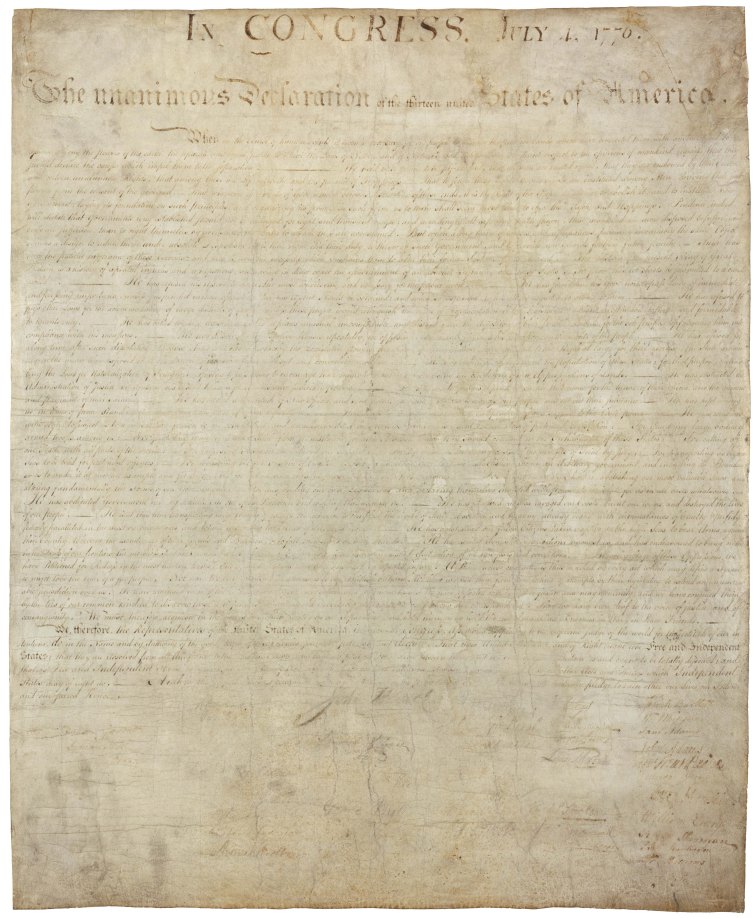
IN CONGRESS, July 4, 1776.
The unanimous Declaration of the thirteen united States of America,
When in the Course of human events, it becomes necessary for one people to dissolve the political bands which have connected them with another, and to assume among the powers of the earth, the separate and equal station to which the Laws of Nature and of Nature’s God entitle them, a decent respect to the opinions of mankind requires that they should declare the causes which impel them to the separation.
We hold these truths to be self-evident, that all men are created equal, that they are endowed by their Creator with certain unalienable Rights, that among these are Life, Liberty and the pursuit of Happiness.–That to secure these rights, Governments are instituted among Men, deriving their just powers from the consent of the governed, –That whenever any Form of Government becomes destructive of these ends, it is the Right of the People to alter or to abolish it, and to institute new Government, laying its foundation on such principles and organizing its powers in such form, as to them shall seem most likely to effect their Safety and Happiness. Prudence, indeed, will dictate that Governments long established should not be changed for light and transient causes; and accordingly all experience hath shewn, that mankind are more disposed to suffer, while evils are sufferable, than to right themselves by abolishing the forms to which they are accustomed. But when a long train of abuses and usurpations, pursuing invariably the same Object evinces a design to reduce them under absolute Despotism, it is their right, it is their duty, to throw off such Government, and to provide new Guards for their future security.–Such has been the patient sufferance of these Colonies; and such is now the necessity which constrains them to alter their former Systems of Government. The history of the present King of Great Britain is a history of repeated injuries and usurpations, all having in direct object the establishment of an absolute Tyranny over these States. To prove this, let Facts be submitted to a candid world.
He has refused his Assent to Laws, the most wholesome and necessary for the public good.
He has forbidden his Governors to pass Laws of immediate and pressing importance, unless suspended in their operation till his Assent should be obtained; and when so suspended, he has utterly neglected to attend to them.
He has refused to pass other Laws for the accommodation of large districts of people, unless those people would relinquish the right of Representation in the Legislature, a right inestimable to them and formidable to tyrants only.
He has called together legislative bodies at places unusual, uncomfortable, and distant from the depository of their public Records, for the sole purpose of fatiguing them into compliance with his measures.
He has dissolved Representative Houses repeatedly, for opposing with manly firmness his invasions on the rights of the people.
He has refused for a long time, after such dissolutions, to cause others to be elected; whereby the Legislative powers, incapable of Annihilation, have returned to the People at large for their exercise; the State remaining in the mean time exposed to all the dangers of invasion from without, and convulsions within.
He has endeavoured to prevent the population of these States; for that purpose obstructing the Laws for Naturalization of Foreigners; refusing to pass others to encourage their migrations hither, and raising the conditions of new Appropriations of Lands.
He has obstructed the Administration of Justice, by refusing his Assent to Laws for establishing Judiciary powers.
He has made Judges dependent on his Will alone, for the tenure of their offices, and the amount and payment of their salaries.
He has erected a multitude of New Offices, and sent hither swarms of Officers to harrass our people, and eat out their substance.
He has kept among us, in times of peace, Standing Armies without the Consent of our legislatures.
He has affected to render the Military independent of and superior to the Civil power.
He has combined with others to subject us to a jurisdiction foreign to our constitution, and unacknowledged by our laws; giving his Assent to their Acts of pretended Legislation:
For Quartering large bodies of armed troops among us:
For protecting them, by a mock Trial, from punishment for any Murders which they should commit on the Inhabitants of these States:
For cutting off our Trade with all parts of the world:
For imposing Taxes on us without our Consent:
For depriving us in many cases, of the benefits of Trial by Jury:
For transporting us beyond Seas to be tried for pretended offences
For abolishing the free System of English Laws in a neighbouring Province, establishing therein an Arbitrary government, and enlarging its Boundaries so as to render it at once an example and fit instrument for introducing the same absolute rule into these Colonies:
For taking away our Charters, abolishing our most valuable Laws, and altering fundamentally the Forms of our Governments:
For suspending our own Legislatures, and declaring themselves invested with power to legislate for us in all cases whatsoever.
He has abdicated Government here, by declaring us out of his Protection and waging War against us.
He has plundered our seas, ravaged our Coasts, burnt our towns, and destroyed the lives of our people.
He is at this time transporting large Armies of foreign Mercenaries to compleat the works of death, desolation and tyranny, already begun with circumstances of Cruelty & perfidy scarcely paralleled in the most barbarous ages, and totally unworthy the Head of a civilized nation.
He has constrained our fellow Citizens taken Captive on the high Seas to bear Arms against their Country, to become the executioners of their friends and Brethren, or to fall themselves by their Hands.
He has excited domestic insurrections amongst us, and has endeavoured to bring on the inhabitants of our frontiers, the merciless Indian Savages, whose known rule of warfare, is an undistinguished destruction of all ages, sexes and conditions.In every stage of these Oppressions We have Petitioned for Redress in the most humble terms: Our repeated Petitions have been answered only by repeated injury. A Prince whose character is thus marked by every act which may define a Tyrant, is unfit to be the ruler of a free people.
Nor have We been wanting in attentions to our Brittish brethren. We have warned them from time to time of attempts by their legislature to extend an unwarrantable jurisdiction over us. We have reminded them of the circumstances of our emigration and settlement here. We have appealed to their native justice and magnanimity, and we have conjured them by the ties of our common kindred to disavow these usurpations, which, would inevitably interrupt our connections and correspondence. They too have been deaf to the voice of justice and of consanguinity. We must, therefore, acquiesce in the necessity, which denounces our Separation, and hold them, as we hold the rest of mankind, Enemies in War, in Peace Friends.
We, therefore, the Representatives of the united States of America, in General Congress, Assembled, appealing to the Supreme Judge of the world for the rectitude of our intentions, do, in the Name, and by Authority of the good People of these Colonies, solemnly publish and declare, That these United Colonies are, and of Right ought to be Free and Independent States; that they are Absolved from all Allegiance to the British Crown, and that all political connection between them and the State of Great Britain, is and ought to be totally dissolved; and that as Free and Independent States, they have full Power to levy War, conclude Peace, contract Alliances, establish Commerce, and to do all other Acts and Things which Independent States may of right do. And for the support of this Declaration, with a firm reliance on the protection of divine Providence, we mutually pledge to each other our Lives, our Fortunes and our sacred Honor.
The 56 signatures on the Declaration appear in the positions indicated:
Column 1
Georgia:
Button Gwinnett
Lyman Hall
George WaltonColumn 2
North Carolina:
William Hooper
Joseph Hewes
John Penn
South Carolina:
Edward Rutledge
Thomas Heyward, Jr.
Thomas Lynch, Jr.
Arthur MiddletonColumn 3
Massachusetts:
John Hancock
Maryland:
Samuel Chase
William Paca
Thomas Stone
Charles Carroll of Carrollton
Virginia:
George Wythe
Richard Henry Lee
Thomas Jefferson
Benjamin Harrison
Thomas Nelson, Jr.
Francis Lightfoot Lee
Carter BraxtonColumn 4
Pennsylvania:
Robert Morris
Benjamin Rush
Benjamin Franklin
John Morton
George Clymer
James Smith
George Taylor
James Wilson
George Ross
Delaware:
Caesar Rodney
George Read
Thomas McKeanColumn 5
New York:
William Floyd
Philip Livingston
Francis Lewis
Lewis Morris
New Jersey:
Richard Stockton
John Witherspoon
Francis Hopkinson
John Hart
Abraham ClarkColumn 6
New Hampshire:
Josiah Bartlett
William Whipple
Massachusetts:
Samuel Adams
John Adams
Robert Treat Paine
Elbridge Gerry
Rhode Island:
Stephen Hopkins
William Ellery
Connecticut:
Roger Sherman
Samuel Huntington
William Williams
Oliver Wolcott
New Hampshire:
Matthew Thornton
Category: History
-
No comments on 240 years ago
-
Damon Root reminds those rushing to gun control after Saturday’s Orlando nightclub shooting:
“I’m alive today because of the Second Amendment and the natural right to keep and bear arms.” So declared John R. Salter Jr., the civil rights leader who helped organize the legendary non-violent sit-ins against segregated lunch counters in Jackson, Mississippi, in the 1960s. As Salter recalled it, he always “traveled armed” while doing civil rights work in the Jim Crow South. “Like a martyred friend of mine, NAACP staffer Medgar W. Evers, I, too, was on many Klan death lists and I, too, traveled armed: a .38 special Smith and Wesson revolver and a 44/40 Winchester carbine,” Salter wrote. “The knowledge that I had these weapons and was willing to use them kept enemies at bay.”
Salter was not unique among civil rights activists in this regard. Anti-slavery leader Frederick Douglass called a “good revolver” the “true remedy for the Fugitive Slave Bill.” Civil rights icon Fannie Lou Hamer said, “I keep a shotgun in every corner of my bedroom.” Rosa Parks once described her dinner table “covered with guns” while civil rights activists met for a strategy session in her home. Martin Luther King Jr. carried guns for self-protection, applied for a conceal-carry permit (denied by racist white authorities), and once declared, “the principle of self-defense, even involving weapons and bloodshed, has never been condemned, even by Gandhi.”
In the wake of this weekend’s horrific terrorist attack in Orlando, Florida, gun control advocates are pushing for greater restrictions on gun rights and for greater limits on the scope of the Second Amendment. Their arguments necessarily focus on the evil deeds done with the help of guns. But as the statements quoted above plainly demonstrate, guns have also played a profoundly noble and beneficial role in American society. As we debate the costs of the Second Amendment in the coming days, let’s not forget to tally the benefits.
-
For the five years this blog has existed, I have written about my favorite car I don’t own, the Corvette, including such minutiae as its too-rare roles on movies and TV.
(Except for “Corvette Summer,” which did obscene things to one C3, including removing the hidden headlights, installing an asymmetrical hood scoop, and converting it to right-hand drive. The horror. The horror.)
With National Corvette Day (June 30) coming up, I found these photos on Facebook:

That is, of course, Jimi Hendrix, who reportedly owned two Corvettes, a blue 1968 that he wrecked, replaced by a 1969. Hendrix and guitarist Jeff Beck reportedly drove around New York despite Hendrix’s lack of driver’s license. One wonders if Hendrix complained about …
Hendrix is by no means the most famous Corvette owner. Politically speaking there is Vice President Joe Biden …

… whose infatuation with the C7 when he got to see one …

… and brief consideration of a presidential run prompted this:

There is also U.S. Sen. John McCain (R-Arizona) …
… who was following in the footsteps of his predecessor, Barry Goldwater.
(Which is interesting in Biden’s case since his party believes human activities such as driving are ruining the climate. Biden owns a Corvette, but Biden’s party does not think you should be allowed to drive.)
What other famous people had or have the style and taste to own Corvettes? (Including this long list from A — Def Leppard drummer Rick Allen, whose Vette and arm had unfortunate demises — to Y — country singer Dwight Yoakam.) These photos are brought to you by numerous online sources:

John Wayne owned a C1, though for someone 6-foot-4 it was a long way down to get in and out.

Since the days of the Mercury missions, astronauts have been getting Corvettes for $1 per year.

It’s not clear if Steve McQueen owned this C2 or just drove it for a Sports Illustrated story (he owned an earlier Corvette until his first wife traded it in for a Lincoln Continental), but he was quite impressed with it after driving it at Riverside International Raceway in California:
Other than the Ferrari, it was the best car I drove at Riverside. And let’s face it, it went out the door at $5,500 instead of $14,000. It had the big 427-cubic-inch turbocharged engine, and the four-speed gearbox, the stiffer suspension, short steering, and they were running low-silhouette racing tires on it. No question, it’s a brute, a terribly quick car. It must be one of the fastest production engines you can buy for that kind of money.
I was doing a notch over 140 mph in it and could have gone faster.

Before actor James Garner drove around L.A. in gold Pontiac Firebirds, he raced L-88 Corvettes.

What else would Captain James T. Kirk drive?

Charlton Heston owned not merely a Corvette, but a 1990 ZR-1 with the 32-valve V-8 built by Mercury Marine. (Perhaps he’s saying here “Get your paws off my Corvette, you damn dirty ape!”)


This 1970 Corvette was built for Farrah Fawcett by car customizer George Barris. Plus points for the color and proper transmission; minus points for shag carpeting and the headlights. Imagine driving and trying to dial a number on your mobile rotary phone.

Bruce Springsteen drove not a pink Cadillac, but a black C1 in New Jersey …

… and a C2 out in Cali.

Before he was the Terminator and the Governator, UW-Superior’s most famous graduate, Arnold Schwarzenegger, owned a C3. (I wonder how he fit in it.)

Paul McCartney owns this C5 convertible. (Think he’s Hell on Wheels in it?)

Jay Leno may be Hollywood’s biggest car collector. Among the cars he owns is one powered by a World War II fighter plane engine.

This C2 is owned by actor/singer Rick Springfield. (If it breaks down do you think he tells the car that I’ve done everything for you?)

Chevrolet endorser Michael Jordan somehow fit his 6-foot-6 self into this C4.

Bruce Willis owned this 1967 convertible until it sold for $150,000.

Robert Downey Jr. owns this C2, and what an outstanding color it is.

According to Volvette this fine C3 is owned by actor Matthew McConaughey.
One of these links also links to a story about someone who has owned a C2 for 45 years. Which brings up a regret, which I regret to bring up (get it?) because regrets are generally futile, since you can’t change the past. I do wish I had gotten a Corvette sometime in my pre-child or immediate post-college years, though how much Corvette I could have afforded at any point is an open question, along with the point about the impracticality of owning a two-seat car without trunk (in C2 and most C3 years) in a state with 14-month winters. Still, the amount of time I have to ever own a Corvette is slipping away since, to quote the Gospel of Matthew, none of us knows the hour or day when we will be driven to our final destination.
I once took an online challenge of equipping a new Corvette without breaking a magic price level. Because I’m a fan of the T-top or Targa top and hidden headlights, but find practicality problems with convertibles, and because the first Corvette I remember seeing (a neighbor’s) was a 1970, my interest in Corvettes tends to start with the C3 and end at the C5. (Though I would take a ’65 or later C2, and I’m not that much of a fan of C4s due to the hideous instrument cluster, though that can be replaced by proper dials with needles.) The C3 is the Corvette I envision when someone says “Corvette,” but the C5 is more practical given its larger interior and hatchback.
It should be obvious that it must have a manual transmission. Air conditioning would be nice as long as it works. A quality sound system is essential, though that can be fixed readily enough in the aftermarket.
And I like green, perhaps since the first Corvette I ever saw, and the first Corvette I ever drove, were both dark green.

Glen Green, 1965. 
Fathom Green, 1969. 
Donnybrooke Green, 1970. 
Trojan Green, 1988. 
Fairway Green, late 1990s. -
David Horowitz has today’s Memorial Day thought:
Let’s begin with two statements on race — one that is offensive and false, the other self-evidently true. Taken together, they illuminate the toxic state of the national dialogue on race.
The false statement is that America is a racist country or, in its unhinged version: America is a “white supremacist” nation. This accusation is one that so-called progressives regularly make against a country that outlaws racial discrimination, has twice elected a black president, two black secretaries of state, three black national security advisers and two successive black attorneys general along with thousands of black elected officials, mayors, police chiefs and congressmen. In addition, blacks play dominant roles in shaping America’s popular and sports cultures, and thus in shaping the outlooks and expectations of American youth.
The claim that America is a white supremacist nation is not only deranged and racist against whites, but is an act of hostility toward blacks, who enjoy opportunities and rights as Americans that are greater than those of any other country under the sun, including every African nation and Caribbean country governed by blacks for hundreds and even thousands of years.
The self-evidently true statement about race in America is that America is not a racist country but, in fact, the most tolerant and inclusive nation embracing large ethnic minorities on earth. Yet this true statement cannot be uttered in public without inviting charges of “racism” against the speaker. Consequently, all public figures and most people generally, clear their throats before speaking about race by genuflecting to the claim that racism against blacks is still a prevalent and systemic problem even though there is no credible evidence to sustain either claim.
By contrast, the offensively false statement that America is a racist nation, is one that our current (black) president has endorsed. According to President Obama, “racism is still part of our DNA that’s passed on.” Variations of the claim are ubiquitous among self-styled liberals, progressives, so-called civil rights leaders and campus protesters. The title of a recent book by a black university professor summarizes this politically correct slander: “Democracy in Black: How Race Still Enslaves the American Soul.” The core claim of the Black Lives Matter movement — which is the chief activist force in advancing this claim, and is “strongly supported” by 46 percent of Democrats, according to a recent Wall Street Journal poll — is that America is a white supremacist nation, whose law enforcement agencies regularly gun down innocent blacks.
Contrary to Mr. Obama’s malicious assertion about his own country, the DNA of America — unique among the nations of the world — is not racism but the exact the opposite. In its very beginnings, America dedicated itself to the proposition that all men are created equal and were endowed by their Creator with the right to be free. Over the next two generations, America made good on that proposition, though this achievement is regularly slighted by “progressives” because it didn’t take place overnight.
-
Barack Obama walked right up to the line of apologizing for the U.S.’ bombing Hiroshima and Nagasaki, Japan, to force the end of World War II.
This is what Obama said, according to UPI via Breitbart:
President Barack Obama traveled to Hiroshima, Japan, on Friday, marking the first time a U.S. president has visited the site of the world’s first nuclear attack, carried out more than 70 years ago.
Obama arrived in Hiroshima Friday afternoon and along with Japanese Prime Minister Shinzo Abe, laid a wreath at the Hiroshima Peace Memorial — a UNESCO World Heritage Site that was built in 1915. Thirty years later, it was nearly decimated by the atomic bomb dropped by the United States. The structure, in fact, was the only one left standing near the bomb’s hypocenter.
The president is in Japan for the G7 Summit in Ise-Shima, following a visit to Vietnam.
“Seventy-one years ago on a bright cloudless morning, death fell from the sky and the world was changed,” Obama said at the Hiroshima Peace Memorial Park. “A flash of light and a wall of fire destroyed a city, and demonstrated that mankind possessed the means to destroy itself.”
Hiroshima was the first of two U.S. nuclear targets intended to bring an end to World War II in August 1945. Just after 8 a.m. on Aug. 6, a 393d Bombardment Squadron B-29, called the Enola Gay, dropped the bomb known as “Little Boy” on the southwestern Japanese industrial town.
The bomb contained about 140 pounds of uranium-235 and took about 45 seconds to reach its explosion altitude of 1,900 feet.
“Let all the souls here rest in peace, for we shall not repeat the evil,” the president said. “We come to ponder the terrible force unleashed in the not so distant past. We come to mourn the dead.”
Survivors in the Japanese town would later say they remembered seeing an extremely bright flash in the sky and heard a loud boom. Up to 80,000 people — about a third of Hiroshima’s population — were killed by the initial blast and firestorm. Another 70,000 were injured. Thousands more died in the decades after from radiation sickness.
Three days later, the world’s second, and most recent, atomic bombing leveled the city of Nagasaki, about 250 miles southwest of Hiroshima. Six days after the second bombing, Japan surrendered and brought World War II to an end.
Obama’s definition of “evil” was the decision to use the bombs instead of invading Japan, which, according to the military and historians, would have resulted in 1 million U.S. casualties and 2 million to 3 million Japanese casualties, both military and civilian. If you understand math, you understand that 80,000 plus 70,000 plus “thousands” plus however many casualties took place in Nagasaki are less than 2 to 3 million.
(By the way: For those who didn’t study history, this is what the Japanese did before and during World War II, including to Americans.)
Ben Shapiro adds:
On Friday, President Obama said America’s use of the A-bomb to end the threat of Japanese fascism sprang from American desire for conquest, suggested that America had ushered in an age of “atomic warfare,” and said that we could achieve a “world without nuclear weapons” if only we clapped for Tinkerbell. This came shortly after his visit to Vietnam, where his White House announced that America would start selling weapons to the communist dictatorship.
Yes, our president is a total disgrace. …
In case you were wondering, at no point did Obama mention Pearl Harbor and the dead there, or the more than 100,000 Americans who lost their lives in the Pacific theater, or the half-million to one million Americans who would have had to sacrifice themselves to storm the island of Japan using conventional means. As Noah Rothman tweets this morning, veterans were overjoyed at the use of the A-bomb, knowing it ended the war and meant they would live to see their children.
Obama noted that war is not unique in human history; he even went full moral relativist with regard to World War II itself: “the war grew out of the same base instinct for domination or conquest that had caused conflicts among the simplest tribes, an old pattern amplified by new capabilities and without new constraints.”
This is disgusting. If you can’t spot the bad guys and the good guys in World War II, of all conflicts, you’re on the side of a valueless nihilism that allows the possibility of future world wars – after all, you can’t take a strong stand against evil if it doesn’t exist. Japan was wrong. America was right. Germany was wrong. America was right. End of story. …
Obama noted that war is not unique in human history; he even went full moral relativist with regard to World War II itself: “the war grew out of the same base instinct for domination or conquest that had caused conflicts among the simplest tribes, an old pattern amplified by new capabilities and without new constraints.”
This is disgusting. If you can’t spot the bad guys and the good guys in World War II, of all conflicts, you’re on the side of a valueless nihilism that allows the possibility of future world wars – after all, you can’t take a strong stand against evil if it doesn’t exist. Japan was wrong. America was right. Germany was wrong. America was right. End of story.
But Obama continued his relativistic reverie:
How easily we learn to justify violence in the name of some higher cause. Every great religion promises a pathway to love and peace and righteousness, and yet no religion has been spared from believers who have claimed their faith as a license to kill.
Some religions are worse than others. Some ideologies are worse than others. But not according to Obama. We’re all equal in sin, according to the President of the United States – and the only solution is to destroy American nationalism, and replace it with some sort of Obama-created philosophy of peace:
The wars of the modern age teach us this truth. Hiroshima teaches this truth. Technological progress without an equivalent progress in human institutions can doom us. The scientific revolution that led to the splitting of an atom requires a moral revolution as well. That is why we come to this place….we have a shared responsibility to look directly into the eye of history and ask what we must do differently to curb such suffering again.
Here’s an answer: take pre-emptive action to stop tyrannically fascist states from starting wars and then vowing to fight them to the last man. But Obama forbids that solution expressly:
We may not be able to eliminate man’s capacity to do evil, so nations and the alliances that we form must possess the means to defend ourselves. But among those nations like my own that hold nuclear stockpiles, we must have the courage to escape the logic of fear and pursue a world without them. We may not realize this goal in my lifetime, but persistent effort can roll back the possibility of catastrophe. We can chart a course that leads to the destruction of these stockpiles. We can stop the spread to new nations and secure deadly materials from fanatics.
Obama is doing none of those things, because to deprive some nations of nuclear weapons while leaving moral nations with them would violate his code of moral equivalence. That’s why Iran will go nuclear within the next decade, why North Korea has gone nuclear, why rogue states around the world are rushing, in the absence of American power and influence, to arm up.
Obama doesn’t want realism. He wants the remaking of the world in his personal image. He wants humanity itself changed:
We must change our mind-set about war itself….we must reimagine our connection to one another as members of one human race. For this, too, is what makes our species unique. We’re not bound by genetic code to repeat the mistakes of the past. We can learn. We can choose. We can tell our children a different story, one that describes a common humanity, one that makes war less likely and cruelty less easily accepted…. Those who died, they are like us. Ordinary people understand this, I think. They do not want more war. They would rather that the wonders of science be focused on improving life and not eliminating it. When the choices made by nations, when the choices made by leaders, reflect this simple wisdom, then the lesson of Hiroshima is done.
Hiroshima was not a “mistake.” It was a wartime decision. Pearl Harbor wasn’t a “mistake.” It was an attack driven by an aggressive and imperialistic Japanese policy that also resulted in the invasion of China and the murder of 100,000 civilians there.
But Obama thinks that the way to stop war is to kill ideology altogether, not to support and strengthen proper ideologies. This is John Lennon’s Imagine on crack. And in practice, it’s meant the death of hundreds of thousands of people as Obama has pulled out of Iraq, sinking the region into total war up to and including the use of chemical weapons; the murder of thousands in Ukraine, as Obama has left the field clear for Vladimir Putin; the strengthening of the Iranian and North Korean terror regimes. Obama’s foreign policy leads to Hiroshima faster than Ronald Reagan’s peace through strength.
Obama continued, “The world was forever changed here, but today the children of this city will go through their day in peace.” Neglecting to mention that Japanese children were living in peace thanks precisely to the use of the A-bomb he was decrying, Obama concluded, “What a precious thing that is. It is worth protecting, and then extending to every child. That is a future we can choose, a future in which Hiroshima and Nagasaki are known not as the dawn of atomic warfare but as the start of our own moral awakening.”
As Jim Geraghty correctly notes at National Review, “Hiroshima and Nagasake weren’t the dawn of atomic warfare. Nobody’s used an atomic or nuclear weapon since then…How many people would have bet in 1945 that no nuclear weapons would be used in war in the next seventy years?” Also worth noting: as Max Roser shows, war deaths have declined markedly since the advent of nuclear weapons and interstate-conflict war deaths have declined most dramatically, largely because everybody knows that if things go too far, someone will push the button. According to Milton Leitenberg of Cornell University, there were somewhere between 136.5 and 148.5 million war deaths during the 20th century. “Only” 41 million of those came after 1945.
But Obama can’t acknowledge facts or history – they undercut his basic argument, which is that peace can only be achieved by unilateral surrender of American patriotism and by the rise of a borderless, nationless, valueless world.
Hiroshima happened because the world slept as fascism rose; Obama wishes to sleep on evil again (or worse, forward it), hoping that national narcolepsy becomes contagious internationally, and we share the same peaceful dreams. We don’t. If we go to sleep again, our enemies will use that reverie to rise. But Americans increasingly believe in Obamaism – more Americans now think using the A-bomb was wrong than right. The result will be more Hiroshimas after 70 years of nuclear peace.
Memorial Day ceremonies are taking place today throughout the U.S. to commemorate, among the almost 1.4 million American servicemen and servicewomen who died for their country, the 407,300 American soldiers who died in World War II. Imagine commemorating the deaths of 2.4 million Americans instead.
-
If you were born after 1958, and you are curious about the top five songs on the radio the week you were born, click here.
If you wish to make an argument one way or another about the declining quality of pop music over the years, that’s your site too.
In my case, the top in correct reverse order were …
… none of which are on my personal top five singles list.
What about the week of my high school graduation?
OK, how about my college graduation?
Apparently my life has been surrounded by sappy ballady dreck. Wedding?
Off this list of 20 top-five songs I would choose to listen to five of them … maybe. As I’ve written here before, quality and popularity are not necessarily synonymous.
There is a related website that lists the top rock, instead of pop, songs dating back to the 1980s. So let’s try (the entire year of) 1983 …
… and 1988 …
… and 1992 again:
Better.
-
The relatively new CNN broadcasted a speech by Ronald Reagan, then two months in office …
… and then about 45 minutes later …
I found out this news between classes at La Follette High School in Madison. I ran into my new girlfriend, told her the news, and, according to her, she said something uncomplimentary about Reagan, and I got mad and didn’t speak to her the rest of the day. That was an overreaction on my 15-year-old part, but it was the first time I had experienced a nearly successful presidential assassination attempt before of someone I supported to be president. (Gerald Ford was the object of two assassination attempts within a month of each other in 1975, but the would-be assassins missed.)
You may notice how rattled ABC-TV’s Frank Reynolds seemed to be. Reynolds covered John F. Kennedy’s assassination from Chicago, home of a mail-order gun dealer from which Lee Harvey Oswald purchased his rifle. Reynolds’ state of mind was likely less because of that and more because his son, Dean, was covering Reagan’s speech for United Press International. The younger Reynolds corrected an earlier mistaken report that presidential press secretary James Brady, who was shot in the head, had died, which prompted his father to yell at his coworkers, live on the air, “Let’s get it nailed down … somebody … let’s find out! Let’s get it straight so we can report this thing accurately!”
-
The April 4, 1977 Sports Illustrated reported:

To the NCAA, the networks and the Vegas odds makers, it was not an E-vent, like the basketball show in Atlanta. But for those to whom college hockey is a religion, last weekend’s NCAA tournament in Detroit’s Olympia was the true thing. Oh, there were no stunning upsets, just a couple of “almosts,” and Wisconsin, as expected, won the championship. It was how Wisconsin won that produced the excitement.
On Friday night the Badgers rallied to defeat stubborn New Hampshire 4-3 in overtime. Then on Saturday night, playing before more spectators (14,357) than had watched the NHL’s inept Red Wings in any game in the Olympia this season, Wisconsin won the title in another overtime chiller, a 6-5 defeat of Michigan. As the Badgers celebrated in the dressing room, Red Wings General Manager Ted Lindsay arrived to congratulate Coach Bob Johnson. Said Lindsay, “That’s the best team that’s been in this room all year.”
A morgue during Red Wings games, the Olympia rocked with Badger vibes both nights. Dressed up like radishes with their red-and-white T shirts and beanies, Badger fanatics made up at least half the crowd for Wisconsin’s games and made all the noise. They tormented opposing goaltenders by shouting “Sieve! Sieve! Sieve!” after every Wisconsin score. They rarely stopped chanting their fight song—”When you’ve said Wisconsin, you’ve said it all.” They relieved the souvenir hawkers of all Badger paraphernalia, and they plastered the Olympia with red-and-white signs. When Wisconsin played New Hampshire, there were 58 Wisconsin banners draped about the building—and only one for New Hampshire. The Badger-niks so overwhelmed two hotels that one couple at the Sheraton-Southfield demanded accommodations elsewhere—with a guarantee that no one from Wisconsin be allowed to register there.
The noisemakers anticipated all along that Wisconsin would win its first NCAA title since 1973. Boston University and New Hampshire? Eastern teams had won the NCAAs only six times in 29 years, and none had made it into the finals since 1972. Michigan? After losing to the Wolverines in the season opener back in October, Wisconsin had beaten Michigan five straight times.
Michigan opened the tournament by beating BU 6-4 but needed four cheap goals and a questionable referee’s call—for too many BU players on the ice—to do it. The following night, supposedly overmatched New Hampshire shut off Wisconsin’s vaunted power play and led 3-2 with less than nine minutes to go before losing in overtime.
The tension and grind of that game no doubt took its toll on Wisconsin in the finals. “We flew for about a period,” said Johnson, “then you could see us gasping for breath.” What had been a safe 5-2 third-period Wisconsin lead suddenly became 5-5 and overtime—and Michigan was flying. But just 13 seconds into sudden death, Badger Winger Tom Ulseth swept in for a stuff shot. It was blocked, but the rebound came out to Tri-Captain Steve Alley who rammed it past Goaltender Rick Palmer. “Great teams know how to win games like these,” said Johnson, “and this is a great team.”
Although Wisconsin was coming off a dismal 12-24-2 season, the Badger players thought back in October that they had a good chance to win the national championship. Last season Johnson took a sabbatical to coach the U.S. Olympic team. Alley and star Defenseman John Taft had joined him, leaving the Badgers bereft of their main men. In addition, Mark Johnson, the coach’s son, was still a high school hotshot. They all joined forces on campus this season, during which sophomore Goaltender Julian Baretta became an All-America. This, hockey fans, is the same Julian Baretta who gets to his net each period by skating backward through a lineup of his teammates, and sings Penny Lane when the puck is at the other end of the ice.
Young Johnson played center on Wisconsin’s second line and scored 36 goals, joining nine other forwards in double figures. Moreover, he became a key figure in the destructive power play that helped the Badgers to a 37-7-1 season.
New Hampshire, in fact, was the first Wisconsin opponent to survive four straight power plays without yielding a goal. In 45 games, Wisconsin had scored 93 power-play goals, converting 40% of its opportunities. Remarkably, everyone on the power-play unit was born in the U.S. Up front, Johnson had Alley, a native of Anoka, Minn., who had 31 goals at left wing; Mike Eaves, a Denver-born center, who had 81 points; and Mark Johnson, who played at the top of the right face-off circle. Back at the points were Taft and Craig Norwich.
“We just seem to be a perfect combination,” says Norwich, a junior from Edina, Minn. He is the best rushing defenseman in college hockey, a strong-skating, gambling stickhandler who had 18 goals and 65 assists. Where Norwich is smallish (5’11”, 170) and flashy, Taft, born in Minneapolis, is rangy (6’1″, 185) and consistent. Taft has spent his last five years playing for Johnson, including the year he spent as the captain of the Olympic team. Norwich and Taft played against each other in high school, and while they have contrasting styles, they both do one thing exceptionally well—pass the puck. “Since what we do on the power play is basically what a quarterback does, our power play is built around our ability to move the puck,” says Norwich. “And we’re such good friends and have such tremendous communication, we just seem to work perfectly together. It’s too bad we won’t be able to play together forever.”
… Taft’s next team may well be the Detroit Red Wings, who drafted him three years ago. “Until Lindsay took over the Red Wings, no one had even talked to me,” says Taft. What Lindsay ought to do, considering Detroit’s plight, is talk to all the Badgers.
Click here for the video and audio highlights. The TV announcer is Tim Ryan, who formerly announced hockey for NBC. The radio announcer is Paul Braun.
-
Roman Catholic Archbishop Fulton J. Sheen wrote about Judas Iscariot, who we Christians encounter tonight and on Good Friday:
His name was Iscariot; no one knows exactly what that meant. Maybe it was Sicarius, in the Greek, a dagger bearer. In this case he would have been classified as a revolutionist bent on driving the Romans out of the land of Israel. But in any case; one day a babe was born in Kerioth, a child of promise. Friends brought gifts to the parents and time went on and that babe of Kerioth grew in age and he met a babe who was born in Bethlehem who had grown in age and grace and wisdom, and at the parting of the waters, Christ chose Judas to be an Apostle. He did not choose him to be a traitor, but to be an Apostle.
Almost all studies that have been made seriously of Judas say that the principal reason that he left is because he was avaricious. There is indeed some Gospel evidence for this. For, just a week before the Passion of our Blessed Lord, the Savior was invited into the house of Simon, the Pharisee, and what the host saw brought a blush to his cheek. He looked up and saw a woman who was an intruder. Outside, friends could come and stand along the wall and listen to a conversation at table. This woman however, annoyed him to some extent. He would not have minded it if anyone else had been there; but the Rabbi, what would he think of it.
She was a woman, a sinner. Her hair was long and she did not attempt to brush it back. As she came toward the table, and in those days everyone reclined at table on the left arm leaving the right arm free to eat, she came and stood over the feet of our Blessed Lord and let fall upon the sandaled harbingers of peace, a few tears like the first warm drops of a summer rain. Then ashamed of what she had done, she attempted to wipe away the tears with her hair. All the while Simon was thinking to himself,
“If He only knew what kind of a woman she is.”
How did he know?
She took from about her neck, a small vessel. In those days women carried precious perfume about the neck in a bottle and when they attended funeral rites, they would break the bottle over the remains and then after allowing the perfume to fall upon the corpse, they would throw even the remains of the bottle onto the body. And she releases from her neck, this vessel of precious ointment but does not do what you and I do, pour it out gently drop-by-drop by drop, as if to indicate by the slowness of our giving, the generosity of our gift. She broke the vessel… gave everything. For love knows no limits.
Judas all the while got a whiff of this perfume. Oscar Wilde describes a syniac as one who knows the price of everything and the value of nothing. And he immediately fixed a price, three hundred days wages. This perfume let me tell you, was no ordinary smell #5. So Judas now becomes the defender of the social order. He breaks up the routine of the dinner by saying,
“Why wasn’t this sold; sold for three hundred pennies worth and given to the poor?”
The poor! I can imagine that he probably went on and argued in some such way as this,
“I heard you on the mount of the Beatitudes say, Blessed are the poor. Where is your love for the poor now? Have you forgotten all those fishermen sheks that are laying in the Sea of Galilee? Remember all those huts that were hugging the highway between Jerusalem and Jericho; are you mindful of those? Have you forgotten the inner city of Jerusalem; it’s slums? Where is Your love of the poor?”
The Lord answered,
“The poor you have always with you; Me, you will have not always; and what this good woman has done was done for My burial and it will be told about her around the world.”
Here is another instance of an emphasis on social justice when there is a forgetfulness of individual justice. …
Can you think of the first time that the fall of Judas is mentioned in the Gospels; the very first time? If you can recall that moment then you can have the answer to why there is a break in the priesthood. Where is the first mention of the fall of Judas? The day our Lord announced the Eucharist! When did Judas leave? The night our Lord gave the Eucharist! He broke at the announcement of the Eucharist; as a matter of fact, that was a critical moment in the life of our Blessed Lord. When He announced the Eucharist He lost the masses because He refused to be a bread King. Secondly, He lost some of his disciples; they left him and walked no more. Finally He split His Apostolic band. And here is the end of the story in the announcement of the Eucharist.
Conclusion of the 6th chapter of John,
And when the disciples withdrew and no longer went about with Him, Jesus asked the twelve,
“Do you also want to leave me?
Simon Peter answered,
“Lord to whom shall we go? Your words are the words of Eternal Life. We have faith and we know that you are the Holy One of God.” And Jesus answered, “Have I not chosen you? All twelve? Yet, one of you is a devil!” He meant Judas, the son of Simon Iscariot. He it was who would betray Him and he was one of the twelve. …
Our Blessed Lord had to live with this man for two years yet; think of it! He did not say who the devil was, He merely said, “One of you is the devil.” John, later on of course wrote the name. Now you know why we have centered this retreat on the Eucharist. There has never yet been a priest, who daily kept his faith in the Eucharist by watching an hour with the Lord who ever left him; no priest ever will! And those who are thinking of leaving… and I have many such letters in my possession about such men, from such men, who have come back because they restored their faith in the Eucharist. …
Now we come to the Last Supper and Judas leaves the priesthood. The seating arrangement of the table was one in which certainly John sat at the right. Who sat at the left? Judas! Now I will prove this to you. In the painting of Leonardo Divinci, Judas is down the table, I think about the fourth and upsetting the salt. And from that time on it became bad luck to upset the salt. He was holding his money bag but I think Our Lord always anxious to save us said to him, “Here Judas, sit near Me.” Where was Peter? On the other side of John.
Our Blessed Lord now washes the feet of His disciples. There are seven gestures mentioned; I think it is the beginning of the 13th chapter of John. As Our Lord washes the feet during supper, Jesus was well aware that the Father had entrusted everything to Him and that He had come from God and was going back to God. Now get the picture of the Incarnation here, (rose from the table as if God the Son was now prepared for the Incarnation), laid aside His garments, (the glory of His Divinity,) taking a towel which is the mark of a servant, a slave, (tying humanity about Himself, tied it round Him,) poured water into a basin, (poured out His blood,) washed His disciples feet, (cleansed us,) wiped them with a towel, (the purification of the spirit). It is interesting to compare this passage with the second chapter of Philippians, verse 6 which was a hymn in the Church, verse 6 and on in Philippians.
And Our Blessed Lord, after washing the feet of His disciples said, “You are clean, but not all. One of you is about to betray Me.” Ten said, “Is it I Lord?” In the Face of Divinity no one can be sure of his innocence. One said, “Who is it Lord?” We will come back to that later on. And one said, “Who is it Master.” St. Paul tell us that it is only by the Spirit that we can call Jesus, Lord. Eleven called Him Lord, one, Master. Now at this particular time there was whispering going on and you will understand why the seating arrangement was as it is here described.
When Our Lord said, “One of you is about to betray me, Peter always curious and inquisitive had to be in on everything; he just couldn’t bear the suspense. If he were seated next to our Lord, you may be sure that Peter would have said. “Who is it Lord?” But Peter, says the Gospel, turns to John and said, “Ask Him who it is?” He asked John to ask and John said, “Who is it Lord, who is it?” And the Lord said, “It is he to whom I will reach this bread after I have dipped it in the sauce.” That is the way toasts were paid in those days; the bread was dipped in the sauce and given to a friend, the assumption being that they who ate the same bread were one body. Our Blessed Lord at that dipped the bread and gave it to Judas and said, “What you are about to do, do quickly.” Then Satan entered into Judas and the Gospel says, “And Judas went out and it was night.” It is always night when we leave the Lord.
None of the other Apostles at table knew what was happening because the Gospel tell us that they thought Judas had gone out either to buy food for the Passover or else to give money to the poor. In other words, do not expect that anyone who is satanic looks satanic. You would never think that anyone who is going out to conduct the Liturgy, to prepare the Liturgy, was satanic. You wouldn’t think that anyone who was going out to distribute alms was satanic, but Satan was in him. Then it is after he leaves that our Blessed Lord pronounces that word “now”. “Now Father, glorify Thy Son with the glory that I had with thee before the foundation of the world was laid.”
The Lord now prepares to go down to the garden; there is only one recorded time in the life of our Blessed Lord that He ever sang and that was the night He went out to His death! They go into the garden, He thought He could depend on three, Peter, James and John; John rather loving, Peter loyal in an intense kind of way, James ready always to follow leadership, but He told them to watch and pray. “Watch!” (Look out for the external environment…that is your horizontal problem.} “Pray!”…(Vertical attachment to Heaven.) And they slept! Men who are worried do not sleep, but they slept. Three times our Blessed Lord came back to them and said, “Can you not stay awake one hour with Me?”
Now on the hill opposite the garden one can catch the sight of lanterns and a group of men, the Greek word that is used, spira, would rather suggest that there were about two hundred in this army of Judas. It is a full moon, very easy to distinguish anyone. Further more, our Lord was well known in Jerusalem, everyone saw him, at least on Palm Sunday. And as Judas leads his band of ruffians down the hill he says, “I will give you a sign, a sign. He whom I shall kiss, that is He. Lay hold of Him.” Why did he have to give a sign, a kiss? Somehow or another when we leave the Lord we never understand Him, we forget His Divinity, we forget His wisdom and we forget His love. And Judas thought our Blessed Lord, coward that He was, would run back into the olive grove hiding in the dark. And so he would have to flush Him out and in the darkness he would give them a sign, he would kiss Him. And our Lord comes forward, “Who do you seek?” ‘Jesus of Nazareth!” “I AM!” (Exodus) And they all fall backwards until He gives them strength to stand.
And Judas then throws his arms around the neck of our Blessed Lord and blisters His lips with a kiss. And the original word that is used in the Gospel is means he smothered Him with kisses. (So, books are written; I love the Church BUT!) “Hail, Rabbi,” and then he kissed Him. Why the kiss? Because Divinity is so sacred that its betrayal must always be prefaced by some mark of affection and esteem.
The Lord is arrested, led over the brook of Kedron; a story we will tell about in the last Holy Hour. And Judas had found his Lord because the Gospel tells us that our Lord was often accustomed to go there to pray. Only those who have been cradled in the sacred association of the Church know how to betray. Judas knew where to find the Lord after dark, and in all the great apocalyptic literature, Robert Hugh Benson, Soloviev, and Doesteovsky. The betrayal of Christ in His Church is always from within, not from without. In Benson, it was a Cardinal, in Doesteovsky it was a Cardinal, and in Soloviev it was a Cardinal. The title means nothing but the fact is, he was a priest. These writers made the priest one who had been at the top.
Who will ever forget Doesteovsky’s description of Christ coming to the city of Seville in about the 16th Century? The Grand Inquisitor is a wisened old Cardinal over ninety years of age. And when our Blessed Lord returns he sees a child being brought into a Church. He raises the child to life and the Grand Inquisitor reminds Him that He came to bring freedom but people did not want to be free. They really want to be slaves of something. And he said, “Tomorrow we will burn You. Leave and never come back.” And our Lord bent over and kissed the whitened cheeks of the old cardinal and for the first time in many years blood came to his cheeks. And once again he said, “Never again come back.”
Is it any wonder then that St. Peter along with Ezekiel in the Old Testament speak of the destruction of the Temple and the persecution of the Church is coming from within. Ezekiel said, “Incipite a sanctuario meo,” and St. Peter; “Begin at my sanctuary.” Begin there in the sanctuary, and that was what was first destroyed when Titus and Vespasian took over Jerusalem. And Peter said that’s the way it will be at the end.
Judas now has his money but not very much, $17.40. Divinity is always betrayed out of all proportion to its due worth, always a ridiculous figure. So when a man gives up his priesthood what does he get? He gets $500.00 in royalties for a book attacking the Church, an hour on television to make light of it and celibacy. Three thousand nights in bed and he is sick of it all. Judas was sick of it all, took back his thirty pieces of silver and sent them rolling across the temple floor and he said, “Look, you do it.” All that it was fit for was to buy a field of blood. And he might have, if he had just a spark of faith, have received pardon and forgiveness from the Lord, Who would forgive such betrayals seventy times seven.
It is interesting to make a comparison of Peter and Judas. Our Lord warned both that they would fail. They both failed, they both denied or betrayed the Lord and they both repented. But the difference in the word repent is that Judas repented unto himself and Peter repented unto the Lord. They were the same up to that point. St. Paul therefore says there are two kinds of sorrow, the sorrow of the world and the sorrow of true faith. So Judas no longer has any hope having refused to return to the Savior and he takes a rope and goes out to some rocky ground, we know not where it was.
I wonder, maybe…and here I am only speculating, up to this point I have used the Gospel. After Good Friday did he throw the rope over one of the beams of the Cross? We know he fell from the rocks and was burst asunder. That we do not know; it is mere speculation. That speculation was confirmed a few years ago when the cook of one of our bishops in China, who had been with him for about twenty five years, When the Communists came in the cook sold out to the Communists and became a sheriff and, he became the sheriff prisoner of the bishop and the bishop died on the death march. The cook, in remorse went to the Chapel of the Bishop and threw a rope over the rafter and hanged himself. He went back as it were, to the scene of his crime.
Leaving aside this speculation because that is all it is, Judas now is full of despair and he walks over the rocky ground and each rock seem just as hard and cruel as his own heart. The limb of every tree seemed like a pointing finger, “Traitor, traitor, traitor!” The knot on every tree seemed like an accusing eye. And he hanged himself and as the Acts of the Apostles tells us, his bowels burst asunder. “And he went to his own place.” That is all… his own place. Everything has its own place. You open the cage of a bird and the bird goes to its own place. You drop a stone from the hand and the stone goes to its own place. We do not know what this propriam locum was of Judas but we do know the reason of the fall and may that reason sharpen the resolution of our will so that we will not fail the Eucharist. If we could read the hearts of those who have left, faith broke, it snapped somewhere making light of the Eucharist, anything at all but no longer the sense of the invisible and the beautiful presence of Christ.
And the great tragedy of the life of Judas, one of the twelve, is that he might have been Saint Judas.
-

“Freedom is never more than one generation away from extinction. We didn’t pass it to our children in the bloodstream. It must be fought for, protected, and handed on for them to do the same, or one day we will spend our sunset years telling our children and our children’s children what it was once like in the United States where men were free.”
“We must reject the idea that every time a law’s broken, society is guilty rather than the lawbreaker. It is time to restore the American precept that each individual is accountable for his actions.”
“Republicans believe every day is the Fourth of July, but the Democrats believe every day is April 15.”
“Socialists ignore the side of man that is the spirit. They can provide you shelter, fill your belly with bacon and beans, treat you when you’re ill, all the things guaranteed to a prisoner or a slave. They don’t understand that we also dream.”
“If you analyze it I believe the very heart and soul of conservatism is libertarianism. I think conservatism is really a misnomer just as liberalism is a misnomer for the liberals — if we were back in the days of the Revolution, so-called conservatives today would be the Liberals and the liberals would be the Tories. The basis of conservatism is a desire for less government interference or less centralized authority or more individual freedom and this is a pretty general description also of what libertarianism is.”
“Democracy is worth dying for, because it’s the most deeply honorable form of government ever devised by man.”
“I’ve spoken of the shining city all my political life, but I don’t know if I ever quite communicated what I saw when I said it. But in my mind it was a tall, proud city built on rocks stronger than oceans, windswept, God-blessed, and teeming with people of all kinds living in harmony and peace; a city with free ports that hummed with commerce and creativity. And if there had to be city walls, the walls had doors and the doors were open to anyone with the will and the heart to get here. That’s how I saw it, and see it still.”