Sometime either today or Saturday, I’m going to drive to Appleton to … drive cars.
This is the weekend for my favorite fundraiser, Bergstrom Automotive’s Drive for the Cure. Bergstrom’s Victory Lane dealership will have 100 cars for test-driving, and Bergstrom will donate $1 for every mile driven to Susan G. Komen for the Cure.
Bergstrom’s Drive for the Cure began when Enterprise Motorcars hosted BMW’s Susan G. Komen event back in the 1990s. (The nicest car I’ve ever driven was from that event, a BMW 540i six-speed that was both smooth and fast.) BMW dropped the event in the late 2000s, but Bergstrom picked it up.
Breast cancer research is a personal issue for me, but it should be a personal issue for any man. Every year, Marian University’s men’s hockey team does its own breast cancer fundraiser by wearing pink uniforms for a game.
The mother of the Marian men’s coach was treated for breast cancer. As the coach put it, it doesn’t take too much thought for a man to figure out how many women are in his life. Every man has, or had, a mother and grandmothers. Some have sisters, aunts and female cousins. Many have wives or female “significant others.” Many have daughters. Most have female neighbors or coworkers. Given that and the fact that 1 in 8 women are diagnosed with breast cancer, it’s not hard to see how breast cancer will affect any man’s life.
My mother was diagnosed in 1988. Her diagnosis was a shock because she had basically none of the risk factors — no family history anyone was aware of, she wasn’t overweight, she didn’t smoke or drink to excess, and she had no diet or exercise issues. With her lymph node involvement, a doctor later told her she had a 22 percent chance of surviving five years, and that was before she was unable to finish chemotherapy because it made her too ill.
Since 1988, my mother has gotten to see her sons graduate from college, her and my father’s retirements, one of her sons get married, her three grandchildren, and their 50th wedding anniversary. (There’s a message in there somewhere about odds.) She was also the third woman (that I know of) on the street where I grew up that had breast cancer.
I’ve taken part in the Bergstrom Drive for the Cure every year I’ve been able to. Last year’s was an interesting experience because of the darkening skies to the north (at 3:30 p.m.) as I took the last car out. I imagined trying to explain huge hail dimples on this brand new Volvo station wagon, but thankfully I didn’t have to. (However, the flooding in the Bergstrom parking lot from the torrential rain demonstrated why ground clearance is useful.)
The driving takes place today and Saturday from 9 a.m. to 4:30 p.m. And free food is included.
It figures that the one subject I didn’t prepare for in my Wisconsin Public Radio appearance Friday was the riots in Great Britain. So when that was the last subject that came up, I stammered through an answer that I really did not know why riots were taking place in Britain, or in Vancouver after the Stanley Cup Finals, or on the first day of the Wisconsin State Fair.
My counterpart had an answer, although it apparently required little thought — evil Conservative governnment cutbacks, no hope for youth, the gap between the rich and the poor, etc., etc., etc.
Someone who has done more thought on both of this is Theodore Dalrymple, British physician and author:
The youth of Britain have long placed a de facto curfew on the old, who in most places would no more think of venturing forth after dark than would peasants in Bram Stoker’s Transylvania. Indeed, well before the riots last week, respectable persons would not venture into the centers of most British cities or towns on Friday and Saturday nights, for fear—and in the certainty—of encountering drunken and aggressive youngsters. In Britain nowadays, the difference between ordinary social life and riot is only a matter of degree, not of type. …
The rioters in the news last week had a thwarted sense of entitlement that has been assiduously cultivated by an alliance of intellectuals, governments and bureaucrats. “We’re fed up with being broke,” one rioter was reported as having said, as if having enough money to satisfy one’s desires were a human right rather than something to be earned.
“There are people here with nothing,” this rioter continued: nothing, that is, except an education that has cost $80,000, a roof over their head, clothes on their back and shoes on their feet, food in their stomachs, a cellphone, a flat-screen TV, a refrigerator, an electric stove, heating and lighting, hot and cold running water, a guaranteed income, free medical care, and all of the same for any of the children that they might care to propagate.
But while the rioters have been maintained in a condition of near-permanent unemployment by government subvention augmented by criminal activity, Britain was importing labor to man its service industries. You can travel up and down the country and you can be sure that all the decent hotels and restaurants will be manned overwhelmingly by young foreigners; not a young Briton in sight (thank God).
The reason for this is clear: The young unemployed Britons not only have the wrong attitude to work, for example regarding fixed hours as a form of oppression, but they are also dramatically badly educated. Within six months of arrival in the country, the average young Pole speaks better, more cultivated English than they do.
The icing on the cake, as it were, is that social charges on labor and the minimum wage are so high that no employer can possibly extract from the young unemployed Briton anything like the value of what it costs to employ him. And thus we have the paradox of high youth unemployment at the very same time that we suck in young workers from abroad.
The culture in which the young unemployed have immersed themselves is not one that is likely to promote virtues such as self-discipline, honesty and diligence. Four lines from the most famous lyric of the late and unlamentable Amy Winehouse should establish the point:
I didn’t get a lot in class
But I know it don’t come in a shot glass
They tried to make me go to rehab
But I said ‘no, no, no’
This message is not quite the same as, for example, “Go to the ant, thou sluggard, consider her ways and be wise.”
The [debt rating] downgrade and the riots are part of the same story: Big Government debauches not only a nation’s finances but its human capital, too. …
The London rioters are the children of dependency, the progeny of Big Government: They have been marinated in “stimulus” their entire lives. …
While the British Treasury is busy writing checks to Amsterdam prostitutes, one-fifth of children are raised in homes in which no adult works — in which the weekday ritual of rising, dressing, and leaving for gainful employment is entirely unknown. One tenth of the adult population has done not a day’s work since Tony Blair took office on May 1, 1997. …
The great-grandparents of these [rioters] stood alone against a Fascist Europe in that dark year after the fall of France in 1940. Their grandparents were raised in one of the most peaceful and crime-free nations on the planet. Were those Englishmen of the mid-20th century to be magically transplanted to London today, they’d assume they were in some fantastical remote galaxy. If Charlton Heston was horrified to discover the Planet of the Apes was his own, Britons are beginning to realize that the remote desert island of Lord of the Flies is, in fact, located just off the coast of Europe in the north-east Atlantic. Within two generations of the Blitz and the Battle of Britain, a significant proportion of the once-free British people entrusted themselves to social rewiring by liberal compassionate Big Government and thereby rendered themselves paralytic and unemployable save for non-speaking parts in Rise of the Planet of the Apes. And even that would likely be too much like hard work. …
This is the logical dead end of the Nanny State. When William Beveridge laid out his blueprint for the British welfare regime in 1942, his goal was the “abolition of want” to be accomplished by “co-operation between the State and the individual.” In attempting to insulate the citizenry from life’s vicissitudes, Sir William succeeded beyond his wildest dreams. As I write in my book: “Want has been all but abolished. Today, fewer and fewer Britons want to work, want to marry, want to raise children, want to lead a life of any purpose or dignity.” The United Kingdom has the highest drug use in Europe, the highest incidence of sexually transmitted disease, the highest number of single mothers, the highest abortion rate. Marriage is all but defunct, except for William and Kate, fellow toffs, upscale gays, and Muslims. …
Big Government means small citizens: It corrodes the integrity of a people, catastrophically. Within living memory, the city in flames on our TV screens every night governed a fifth of the earth’s surface and a quarter of its population. When you’re imperialists on that scale, there are bound to be a few mishaps along the way. But nothing the British Empire did to its subject peoples has been as total and catastrophic as what a post-great Britain did to its own.
There are lessons for all of us there.
There is, however, one crucial difference between Great Britain and the U.S. Unlike in Britain, thanks to the Second Amendment to the U.S. Constitution, you have the right to arm and defend yourself. Without it, the National Rifle Association’s Chris Cox says …
If you want to see what a disarmed society looks like, look no further than England.
Thousands of angry, drunk, violent thugs running wild and stealing anything they can carry. Shopkeepers and homeowners crippled with fear, unable to defend their loved ones or their property. Innocent citizens forced to watch helplessly while their life’s dreams — everything they worked so hard to build and acquire — are carried out the door, or smashed to pieces, or burned to the ground. …
The fact is, when British politicians stripped their citizens of their God-given right to self-defense, they robbed them of their freedom and their dignity.
Last week, I wrote about the Facebook page “If you grew up in Madison you remember …” which last week was attempting to take over Facebook like dandelions in your lawn.
As of today, the group, which is not even two weeks old, has more than 6,100 members and nearly 17,000 posts. Not surprisingly, the growth and post rate has slowed down since last week; otherwise it eventually would have taken over the entire Internet, not merely Facebook. It’s also getting media attention of its own, with WIBA radio (Madison’s first commercial radio station) having done a segment last Friday.
Why this popularity? Two posts on Facebook give answers:
This page brings us all back to a more simpler, carefree, happy time. Before all the “trials and tribulations” of adult life took over. And before all the pain and sorrows , that I’m sure most of us have endured. Life was pretty easy then . Such little things gave us such enormous joy. I think this is healthy reliving it all.
What’s telling is that so many people have so many fond memories of childhood in Madison. Clearly, for a lot of people, it was a great place to grow up.
One example of that “simpler, carefree, happy time” is all the movies I saw at East Towne Cinema, rated from G to R. (This entire old Madison thread started with media, as you know.) All the movies — from “Benji” to “First Blood” to “Raiders of the Lost Ark” to “The Spy Who Loved Me” — started with the funky open that you see here.
On Thursday, the subject of Tedd O’Connell, described as WISC-TV’s “hipster newsman” in a Madison Magazine article, came up. O’Connell was WISC’s City Hall reporter (and I know that because I first met him when he was in the City–County Building coffee shop during a ridealong with my Scoutmaster, a Madison police officer) and news anchor for 15 years. He left Wisconsin but returned in the mid-1990s to become the first news director at WGBA-TV in Green Bay. He died of cancer three years ago.
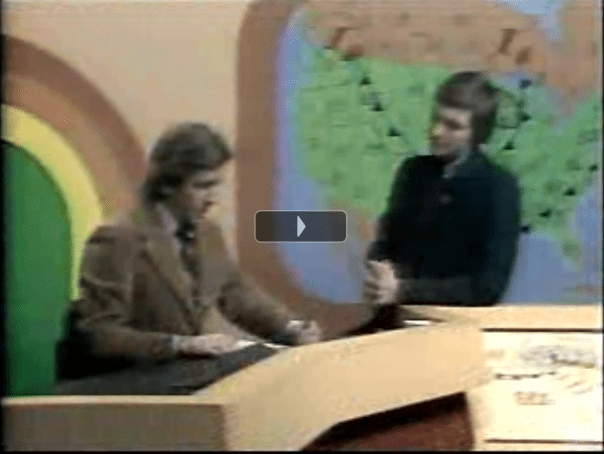
While doing a search for information on O’Connell, I came upon this video, from which come these images that brings you the ’70s in all their funky color glory, followed by the much more buttoned-down ’80s:
This is the second iteration of WISC’s checkerboard set. (O’Connell is in the middle; John Digman, who used a 1949 Cadillac antenna to do the weather, was on the right, and a sports guy, possibly Jim Miller, is on the left). The glass panels you see were originally used to superimpose graphics behind the anchors. The original set had no desk; the anchors sat on low-back chairs with their scripts in their laps.
The anchors and reporters used their signatures for graphics, the reading of which may have been a challenge for viewers of those with more illegible signatures. The original version also had a high-tempo theme once described as sounding like angry bumblebees, which was followed by a slower synthesizer-heavy theme (and you can hear a small clip in the background on the video at 6 seconds). And for those who think Casual Friday is a ’90s concept, well …
Apparently WISC decided the checkerboard set was not colorful enough, so its replacement was rainbowish. (I remember the lighter tan being more orange.) O’Connell is pictured with meteorologist Marv Holewinski (unfortunately not wearing his banana-colored suit), who can still be heard on the radio doing weather and outdoor reports.
And then came the 1980s. O’Connell is in the middle with sports director Van “Mount Horeb toppled Verona” Stoutt on the left and, I believe, meteorologist Dana Tyler, now at WFRV-TV in Green Bay, on the right.
They also did their news (or at least news updates) from the newsroom for a while; this is O’Connell’s report of the shooting at the City–County Building in which Dane County Coroner Clyde “Bud” Chamberlain was killed.
You may have concluded from reading this blog and its predecessor that I have a love–hate relationship with my hometown. That’s actually not accurate — you can love neither things nor places, since neither is capable of loving you back. (That includes jobs, by the way.) I think I had a very nice, mostly uneventful childhood in a place that really doesn’t exist anymore, or at least exist in the way I remember it.
And all I needed for evidence was a drive through my old neighborhoods on Saturday — the first house I remember, the house we built, and my old grade school and high school. Both the houses were originally green; they are now gray. (My parents ruined the house I grew up in by changing its paint from green with yellow trim to gray with red trim. Something about resale value, I think.) I had a really difficult time recognizing the older house; the present owner of the one-story one-car-garage house somehow added two more garage spaces. (Which, my wife points out, makes the house look like more garage than house.) The trees are much bigger than I remember them, because, of course, they’ve grown in the 40 years since they were planted. (So have I, of course, both vertically and horizontally.)
This is how a young mind works: There was a Meadowlark Drive south of Cottage Grove Road and a Meadowlark Drive north of Cottage Grove Road, but they didn’t connect to each other. And I always wondered why that was. (A cul de sac road ended any chance of their linking.) The Heritage Heights neighborhood apparently was developed by an Anglophile, given that the road names included Kingsbridge, Queensbridge, Knightsbridge roads and Greensbriar and Vicar lanes. (Plus Inwood Way and Open Wood Way; the mnemonic device would require you go into Inwood Way to get to Open Wood Way.)
I don’t know if those who had positive childhoods remember their hometowns in such detail (even if occasionally inaccurate) as how the “If you grew up in Madison you remember” group does. (The contrast is that my parents grew up in small Southwest Wisconsin towns and left at the first opportunity, never to return except to visit their parents. Everyone votes with their feet.) I said last week that gauzy memories suggest either we remember things as being better than they were, or things were better then than we thought they were at the time. That makes me wonder how our three children will remember their childhoods where their parents chose to raise them.
A month ago, I discovered a few old pieces of Madison media on YouTube, and posted them on this blog.
Then on Tuesday, I was trying to write Wednesday’s blog item when I checked on Facebook.
Several hours later, I decided to start writing this to make up for all the time I lost in the Facebook “If you grew up in Madison you remember” group. I think I once mentioned that most of my high school graduating class appeared to be on Facebook. Apparently everyone else who grew up in Madison the same time, or before then, is on Facebook too.
On Tuesday, the activity on this group slowed down my laptop and threatened to bring the Internet to a screeching halt more effectively than an electromagnetic pulse. It was like feeding bread to ducks, with people fighting to get their memories of Madison online.
In the four hours between when I was let into the group and when I finally turned off the email notifications, there were more than 500 posts. The group jumped over 1,000 members and 3,000 posts less than 24 hours after it was created. (As someone posted, “Hooray! We broke Facebook!”) By the end of its second day it exceeded 3,400 members and 7,500 posts. By the end of its third day it exceeded 4,600 members (and jumped over 5,000 members shortly thereafter) and 11,000 posts. WIBA (1310 AM) in Madison is doing a segment about this group today at 10:30 a.m. This site may need to be spun off of Facebook onto its own domain — maybe www.ifyougrewupinmadisonyouremember.com.
A lot of the memories, not surprisingly for Wisconsin, involved bars and drinking. (I’ll pause while you recover from the shock.) I was part of the last high school class that could legally drink at 18. One of my first mixed drinks was something called Swampwater, which was the color of antifreeze and was usually served in mason jars. I have been unable to determine what was in it. (I drank that in a campus bar where I was in more than any other campus bar; in a previous location, it was a favorite of my father’s back when he was a UW student.) There were also fond memories of Long Island Ice Teas, which, for those who can’t decide between gin, rum, vodka or whiskey, combines all four, plus triple sec, sour mixer and cola. As one poster put it, “This site is proof you can’t kill all your brain cells no matter how hard you tried.”
Many of the other memories (including the aforementioned memories involving adult beverages) undoubtedly were of the if-our-parents-only-knew variety. (The amusing point to ponder is how many of the members’ parents are also on Facebook.) The future corollary is when parents ask themselves how much of what they did when they were their children’s age would they want their own children to do.
In rough alphabetical order, what also came up included:
The A&W drive-in that sold root beer in the baby-size mugs quite inexpensively. Ask my parents, and they will tell you how on summer nights they would give their boys baths, put them in their pajamas, and take them to this drive-in, where they would order three root beers and one orange. (Guess who got the orange because he didn’t like root beer.) And the boys in the back seat would have one orange smile and one brown smile.
Arlans, a discount retailer that had a store on Milwaukee Street, and Eagle, the grocery store on the other half of the same building. Swiss Colony owned the building last time I saw it. The building is west of the “new” Madison post office, opened in Gerald Ford’s presidency.
Barnaby’s, a pizza place where numerous birthday parties were held. People placed orders and then picked them up when a light at their table informed them dinner was ready. It offered pizza-and-root beer combinations, which was fine unless you didn’t like root beer.
Bridgeman’s, a restaurant and ice cream parlour (that’s how they spelled it) that was my first employer. There was a Dairy Queen in the neighborhood before Bridgeman’s, but when Bridgeman’s arrived it blew DQ out of the water. (On the other hand, there is still a restaurant in the original DQ building, whereas the old Bridgeman’s is now, ironically, a dental office.) The best thing about working at Bridgeman’s was eating the mistakes, particularly the Tin Roof sundae (hot fudge, butterscotch and pecans, I think). Drinks were free, but food was full price unless, oops, someone made a mistake. (Perhaps that’s why it went out of business less than a decade after it opened.)
The C&P shopping center with a sloped parking lot. Most of the store was level with the west side of the lot, but there was a ramp that went from the main level to the ground level where shoppers could bring their cars and pick up their groceries. (Another thing you never see anymore.) Of course, five-year-olds loved to race down the ramp ahead of Mom’s grocery carts.
Cars we drove or owned, which were on the large side in the case of the former and were barely functioning in the case of the latter.
“Choi,” a term of approval at La Follette (I assume it’s short for “choice”), and the more superlative “choi to the max!” At the time I thought this was just an ’80s term. Based on posts, however, it appears to have been limited to only Madison. That makes one wonder who started “choi,” in the same way that La Follette alumni of the early ’80s still wonder who started the epic spring 1982 outdoor food fight.
Concerts in various venues ranging from the Shuffle Inn (Van Halen) to Headliners (Joan Jett) to Merlin’s (U2) to the Dane County Coliseum (Janis Joplin, Jimi Hendrix, the Doors, the Doobie Brothers, Elvis Presley, Cheap Trick opening for Queen, REO Speedwagon opening for every other act, Foreigner, Chicago more than once) to the Orpheum Theater (Bob Marley and the Wailers) to the Dane County Junior Fair (Rick Springfield) to the Memorial Union Terrace (the Violent Femmes) to Breese Stevens Field (Ready for the World and Sheila E) to … an East High School TWIRP (The Woman Is Required to Pay) dance, where Cheap Trick supposedly played.
Madison’s first convenience stores, Stop & Go and PDQ.
The drive between Madison and Cottage Grove, which was posted at 55 mph except for one 50-mph stretch. So much development has taken place in the intervening years that Dane County BB is now posted at 35 mph.
Department stores in the pre-mall era, including Gimbel’s, Manchester’s and Yost’s. Some offered not just clothing, but restaurants or hair styling. Similar to …
Several old drug stores, including Gerhardt’s (now a Walgreen’s) and Rennebohm’s, owned by a former governor of Wisconsin. I believe Gerhardt’s was where I purchased my first record (Rhythm Heritage’s “Theme from ‘SWAT’”). My parents remember the downtown Madison Rennebohm’s because it had a lunch counter (where I ate once before interviewing the mayor of Madison, who had just replaced the mayor who had replaced Paul Soglin.)
Our various doctors, dentists, etc. It turns out that our pediatrician, Dr. William Ylitalo of Quisling Clinic, was also the pediatrician of numerous other people in this group. (Quisling Clinic was started by two physicians who were cousins of Vidkin Quisling, who was to Norway what Vichy was to France. For running Norway for the Nazis, Vidkun was executed after the right side won.) Dr. Ylitalo’s son is in this group too, so I imagine he’s been enjoying the reading. And most of us also had in common various dental appliances to correct our overbites, underbites, or poorly spaced teeth.
The East Side Business Men’s Association festival on Milwaukee Street. Everyone who attended was of the age where they didn’t notice how rickety the Ferris wheel was. (The ESBMA building on Atwood Avenue/Monona Drive was also the site of the La Follette High School Class of 1983 post-graduation party, our final formal event as a class before the 1988 reunion. It’s now called the East Side Club.)
The early days of East Towne Mall, which in its first decade or two had fountains, smoking areas, a Burger King, County Seat (preferred source of Levi’s), the Aladdin’s Castle video arcade, a bar, a two-screen theater and the Moon Fun Shop, a head shop. East Towne also had York Steak House, where I had my first and last dates (and a few in between) with my first girlfriend.
The back road to East Towne, which before development there meant driving through a weird intersection that included a right-hand curve and a steep hill that ended at a stop sign. My brother was driving our 1975 Chevrolet Caprice to work one day when he was rear-ended at the multi-level intersection by a one-ton van. The van appeared as though a giant fist had smashed the front end. The Caprice suffered … a bent rear bumper.
The Hungry Hungry (or possibly Hungry Hungry Hungry), a drive-in I vaguely remember occasionally visiting across the street from Olbrich Park on the east shore of Lake Monona.
Ironic repositioning of store chains. What you know as Kohl’s, Wisconsin’s finest retail chain, was also a chain of grocery stores, most in buildings with curved roofs. What you know as Copps’ supermarkets also was a group of discount retail stores. The East Side had a Kohl’s grocery store and a Copps discount retail store, neither of which are in existence today. (The Kohl’s building on Monona Drive is still there, though.)
Kelly’s, a former fast-food chain in at least Madison. The difference between Kelly’s and McDonald’s was that Kelly’s had hot dogs, and its mascot was a dancing pickle reportedly named Pete.
Marc’s Big Boy, a restaurant on East Washington Avenue (the chain still exists, but not that restaurant) that featured fish in buckets wrapped with wax paper with London newspaper print, and Big Boy comic books.
Various off-brand gas stations, including Fisca, Kickapoo, Martin and Transport.
Paisan’s, which, in its fourth location, still has the best pizza in Madison.
The Pig’s Ear, a high-end restaurant (which I never went to) with garish pink walls. It is now called Talula and has gotten at least one good review.
Pizza Pit, which still runs this commercial:
Public employee strikes — the 1976 Madison teacher strike (which prompted the mediation/arbitration law), which got us two weeks off right after winter vacation for the price of (1) losing our entire spring vacation, (2) having to go to school on a Saturday, and (3) adding two days at the end of the school year) and the 1977 and 1980 Madison Metro bus strikes, which forced those who didn’t live near our middle and high schools to find alternative transportation to and from school.
Queen of Apostles High School, which was just east of Interstate 90. I didn’t go to “QAS,” but when I joined the Boy Scouts our meetings were there until it closed in the late 1970s. It’s now some kind of high-tech business.
The Catholic church many of us attended, St. Dennis, the only Catholic church in the entire La Follette attendance district. (St. Bernard was on Atwood Avenue, and Immaculate Heart of Mary were in Monona, but it still seems like poor planning to have a farther east or farther south Catholic church for the far East side’s exploding growth.) Until my senior year of high school, St. Dennis Masses were held in either a very small church, or the school gym. (For the first few years of my life, I thought every Catholic church had backboards and a scoreboard.) St. Dennis pre-adult parishioners were in two groups — those who also went to St. Dennis School between first and eighth grades, and those who attended the Madison public schools. St. Dennis didn’t have a church big enough for the enormous congregation until 1983, in a building project funded by monthly Friday fish fries in the 1970s, where I bused in exchange for free fish afterward.
Paul Soglin, when he was mayor of Madison the first time, from 1973 to 1979. And then he was mayor from 1989 to 1997. And then he was elected mayor again in April. (Perhaps when Soglin passes on they’ll just prop up his body El Cid-like in the City–County Building council chambers and have an assistant push keys on a laptop for “Motion to approve,” “those in favor say aye,” and so on.
Teachers, including former La Follette choir teacher Rod Witte (who was very popular with his singers) and Pete Olson, physical education and driver education teacher and (twice-state-championship-winning) boys basketball coach at La Follette, who now apparently can be found fishing on a lake in Vilas County. Any student or player of Olson’s knows exactly what he would have said about all this: “Not very impressive.”
Theaters, including the Cinema Theater on Atwood Avenue (where as previously noted my brother and I saw our first movie, “Lady and the Tramp”) and the Badger and Big Sky drive-ins.
The Wisconsin term for an ATM: a TYME machine, standing for “Take Your Money Everywhere.”
The old UW–Madison registration process. In the days before online registration, and even before the days you could register by phone, you were assigned a registration start time by your last name. Students at the state’s only world-class university started at the UW Stock Pavilion (just the place you want to be on a hot August day), then raced to various buildings corresponding with subject areas on campus, where the student would check with the academic department registration committee to see if any spots were available for the desired class. Repeat the process until you get your classes (if you have an early registration time), or, if not, figure out alternatives. One semester this process went so well that I had classes two days from 8:25 a.m. to 8:30 p.m., no classes at all two other days, and a morning full of classes on Friday. This is one of the excuses I have for not giving money to my alma mater.
The Vietnam War protests, well chronicled in the Academy Award-nominated documentary “The War at Home.” I had relatives outside Wisconsin who, not knowing the layout of Madison, assumed from what they saw on the evening news that their nephew and his young family was in danger of being assaulted by marauding college students. (There was no need for concern because (1) college students probably didn’t know Madison existed outside campus, and besides that (2) we were in bed by bartime.) The nadir of the antiwar movement occurred Aug. 24, 1970, when UW’s Sterling Hall was bombed by four people (one of whom disappeared shortly after the event and has never been found), killing one UW grad student. Many people remember the middle-of-the-night bombing for the sound it made and the damage it caused. I was a religious watcher of ABC-TV’s “The FBI” at the time, a show that ended with star Efrem Zimbalist Jr. doing a piece about someone on the FBI’s 10 Most Wanted list, and I remember the night those four were on.
“When we could road trip all night on $5 worth of gas!!!” And indeed you could do that, even with 11-mpg cars, because gas was less than $1 a gallon into the 1980s.
Various features of the Henry Vilas Zoo, including a polar bear that played with a bowling ball and the Mold-a-Rama machine. If that’s the polar bear I remember, I believe it came to a premature end when, after a mentally ill man jumped into the polar bear pit, Madison police shot the bear to protect the man. That led some people to suggest that the police had chosen which to shoot incorrectly. I went on a field trip with my oldest son to the zoo, and it, of course, blew my mind.
Younger readers and non-Madisonians will probably wonder what the hell these 3,000-plus people are babbling about. My prediction, however, is that you too will be reminiscing about the good old days (no matter how old you are) before you even realize it. My wife (who after her first La Follette reunion with me claimed she had more in common with my classmates than hers) recalls fondly driving around the courthouse square in Lancaster the wrong way, with her best friend screaming the whole way. (Or perhaps it was the mouse hiding in the headliner of the car — the stories sometimes get confused.)
I have no idea how many of the 3,000-plus members of the “If you grew up in Madison you remember” group still live in Madison. Based on what they remember, they, and I, grew up in a Madison that had fewer of the problems that Madison has today. (The weather, however, is unchangeable.) A number of posts included mention of going someplace by foot or on bus, by themselves, with no harm occurring, something you wouldn’t be likely to recommend doing today. So while Mad City was a good place to grow up, I don’t think it is a good place to grow up today, assuming you could even afford to live there.
These memories have also been softened, in one direction or another, by time. Distance makes us forget that, when we were in middle school, we wanted to get to high school, and when we were in high school (the giant angst factory), we wanted to get out of high school (whether “out” meant college, a job, or just out of Madison). Either we remember things as being better than they were, or things were better then than we thought they were at the time.
Most of us (certainly me) probably need to thank our parents for their contributions to the Madison in which they raised us. Many, including my parents, came to Madison from various other places, sometimes for better occupational opportunity, or perhaps because they thought Madison would be a better place to raise their kids than where they grew up. They were the people went to work every weekday (or more), paid the high taxes, took up their free time with various civic involvements, endured the institutional strangeness, and made the other sacrifices parents make for their kids. And the memories on this insanely popular Facebook page were one of the results.
The Independence Day holiday is not always a three-day weekend, but when it is, it’s my favorite weekend.
One reason is fireworks, one of the lesser known fields of endeavor that has seen tremendous advancements over the years.
We decided to watch, schedules and weather and so on permitting, as much in fireworks as we could get to over the next few days. There were fireworks Friday, there are fireworks Saturday through Monday, and there is even a display Tuesday night. (Which we were going to until a wave of illness and fatigue hit the house.)
Our fireworks odyssey starts with these photos Michael took at the Waushara County Fairgrounds in Wautoma Friday:
On Saturday, we went to Princeton (where we once went hoping the booms would induce labor):
On Sunday we went to Murray Park in Ripon:
On Independence Day, we saw the Fond du Lac fireworks from a distance:
I was trying to figure out what to write for the United States of America’s 235th birthday.
And then the answer fell from the sky onto our sidewalk.
It was a piece of fireworks, shot from a birthday party a couple houses north of ours. It was preceded by a big bang, followed by a louder boom.
Those who watched this week’s Ripon Channel Report know that state law prevents use of fireworks that launch or explode — firecrackers, Roman candles, bottle rockets and mortars — without a permit. Even though they’re legal to buy in this state, they’re not legal to use in this state.
What sort of twisted logic makes an item legal to purchase but not use? The same logic that bans smoking in all public places (including privately owned businesses), yet doesn’t ban sale of tobacco products. That same logic pervades government at every level today, and is utterly foreign to any concept the Founding Fathers intended from either the Declaration of Independence, the original Constitution or the Bill of Rights.
It is fashionable today to ignore the origins of our country because we reflect poorly on those origins. President Obama‘s comments about whether the U.S. is exceptional or not were, well, misinterpreted, which was partly either his own fault or his speechwriter’s fault. But there is no question that some supporters of Obama do believe this country is nothing exceptional, such as those who try to enforce the “right” of public employee collective bargaining using the precedent of UN resolutions.
Remember, though, that the Founding Fathers noted our “inalienable rights, that among these are life, liberty and the pursuit of happiness.” My “pursuit of happiness” was sitting in our front yard reading a World War II book (no “pursuit of happiness” in the first couple of years of the war, to be sure), while our neighbors’ pursuit of happiness was celebrating someone’s birthday.
Or perhaps they were rebelling against what you should think is a stupid law. Rebellion goes back before our existence as an independent country to the Boston Tea Party. Everyone who came (or now comes) to this immigrant country by choice came here because they thought their lives would be better here, however they defined “better,” than wherever they left.
Our founding fathers recognized the concept of Natural Law; a set of universal rights and responsibilities endowed to us by our Creator that precedes any governments we might form for the purposes of protecting and enforcing them. Numbers 5-10 of the Ten Commandments are sufficient for us to live in peace with each other, and most of us instinctively follow them, whether or not we believe in the God of the first four.
When six is the upper limit of our tolerance of things we will be told we can’t do, 2,000 pages of “shall” and “shall not” don’t stand a chance. We are Americans; we don’t do “shall.” That seems so obvious.
Americans are the perfected DNA strand of rebelliousness. Each of us is the descendant of the brother who left the farm in the old country when his mom and dad and wimpy brother told him not to; the sister who ran away rather than marry the guy her parents had arranged for her; the freethinker who decided his fate would be his own, not decided by a distant power he could not name. How did you think we would turn out?
Those other brothers and sisters, the tame and the fearful, the obedient and the docile; they all stayed home. Their timid DNA was passed down to the generations who have endured warfare and poverty and hopelessness and the dull, boring sameness that is the price of subjugation.
They watch from the old countries with envy as their rebellious American cousins run with scissors. They covet our prosperity and our might and our unbridled celebration of our liberty; but try as they might they have not been able to replicate our success in their own countries.
Why? Because they are governable and we are not. The framers of the Constitution were smart enough not to try to limit our liberty; they limited government instead. …
Those who cling to the promise of government ignore its reality. Which side of liberty are you on – the Department of Energy side, or the Internet side? Which do you trust to deliver your prosperity – yourself or the government? Who owns you?
That is the question for our time. A self-owned person is ungovernable; and ungovernable is our natural state. Liberty is our birthright, and prosperity is its reward.
Neither the Declaration of Independence nor the Constitution were perfect documents. Both were written in an era in which the term “all men are created equal” applied only to white property-owning men. And yet the presence of those five words paved the eventual path to the elimination of slavery and the extension of full rights to non-white men and to women.
I argued in the previous blog that the Constitution needs an economic Bill of Rights similar to what economist Milton Friedman proposed, limiting government spending and its ability to tax, mandating sound money, and opening borders and trade. (That last position has become increasingly unpopular since 9/11, and I wonder what Friedman would have had to say about open borders today.) Friedman believed that economic freedom was part of political freedom, and the Declaration of Independence is certainly about economic freedom as well.
Economic and personal freedom are interdependent, as Victor Davis Hansen points out:
Yet there has never been any nation even remotely similar to America. Here’s why. Most revolutions seek to destroy the existing class order and use all-powerful government to mandate an equality of result rather than of opportunity — in the manner of the French Revolution’s slogan of “liberty, equality and fraternity” or the Russian Revolution’s “peace, land and bread.”
In contrast, our revolutionaries shouted “Don’t tread on me!” and “Give me liberty or give me death!” The Founders were convinced that constitutionally protected freedom would allow the individual to create wealth apart from government. Such enlightened self-interest would then enrich society at large far more effectively that could an all-powerful state.
Such constitutionally protected private property, free enterprise and market capitalism explain why the United States — with only about 4.5 percent of the world’s population — even today, in an intensely competitive global economy, still produces a quarter of the world’s goods and services. To make America unexceptional, inept government overseers, as elsewhere in the world, would determine the conditions — where, when, how and by whom — under which businesses operate.
Individual freedom in America manifests itself in ways most of the world can hardly fathom — whether our unique tradition of the right to gun ownership, the near impossibility of proving libel in American courts, or the singular custom of multimillion-dollar philanthropic institutions, foundations and private endowments. Herding, silencing or enfeebling Americans is almost impossible — and will remain so as long as well-protected citizens can say what they want and do as they please with their hard-earned money.
That part about “herding, silencing or enfeebling Americans” would be a good description of what the instigators and participants in Protestarama would accuse the state GOP of doing to their alleged constitutional rights to hold up the taxpayers for billions of dollars — I mean, take away public employees’ collective bargaining.
(Billions of dollars, you say? Do the math: The average state employee costs the state $71,000 in salary and benefits. The state has about 69,000 FTEs. Multiply, and the state spends about $4.899 billion every year on state employee salaries and benefits.)
The recall elections are a perfect example of the political left’s contempt for our republic, as in the decisions made by our duly elected officials. (As if we’ve needed evidence for that since the Vietnam War.) Democrats swept every statewide office except one in the 2006 election, and captured control of both houses of the Legislature in 2008. What did Republicans do? They found candidates, generated money for their campaign spending, and persuaded the voters to vote most Democrats out of office in 2010. And like a petulant two-year-old, those whose side lost Nov. 2 refuse to understand that they lost and why they lost. They also fail to grasp that, should their candidates win in the recall elections in August, the GOP will certainly redouble their efforts to make their political careers last 17 months. (Two can play the same game, as Sens. Dave Hansen, James Holperin and Robert Wirch are finding out.)
However, our republican form of government does not guarantee us political happiness. It doesn’t guarantee political tranquility either. Nor does it guarantee a job, government-provided health care, nice weather, etc., etc., etc. Ben Franklin’s answer to the woman who asked what had been created — “a Republic, if you can keep it” — applies today, and it will apply tomorrow and every other day this country continues to exist. And regardless of what you may think about Protestarama, it still doesn’t rise to the level of the Federalist vs. Democratic–Republican battles, or for that matter the Civil War.
Still, after reading this, you may need evidence that America is really an exceptional place. I pass on a story from Ambassador to Tanzania Mark Green (former state legislator and Congressman from Green Bay), who tells the story of an Independence Day celebration at the embassy in 2008, when Tanzania’s Minister for Home Affairs, a Georgetown University law school graduate, spoke after Green:
After a few brief sentences thanking us for the evening and for the opportunity to speak, he scanned his audience, seeming to single out the Americans with his eyes. He paused again, and as he did, he suddenly seemed to relax . . .the formality of his position melted away.
“What I would say to you tonight is simply this: we want to have what you have. We want to be who you are.”
Several jobs ago, I wrote a sample graduation speech for a weekly newspaper graduation section. I’ve had the chance to do this speech once, and this is the middle of the college and high school graduation season, so …
Members of the Class of 20__: Let me be among the first to congratulate you on your impending graduation. This event is called “Commencement,” not “Graduation,” because, even though you are ending something today, you are supposed to begin something new after today.
I am under no misapprehension about my role here today. I fully realize that, in most cases, the only thing graduates remember about their commencement speaker is how long he or she spoke. I therefore resolve to give a speech that fits in between the two poles of speaking — between “Why did we bother inviting him if he was going to say that little?” and “Can you believe how long he talked?”. I also realize that I am one of the few people standing between you and your graduation party. So you can determine for yourselves if Shakespeare was correct in “Hamlet” when he had Lord Polonius say that brevity is the soul of wit.’
I have three pieces of advice to give you today. You are, of course, free to follow this advice, or not.
The first is to stand up and speak out. Today, fewer than half of people bother to vote, and a larger percentage than that — most people, in fact — don’t bother to express themselves on issues of the day, whether that’s in a government meeting, the letters to the editor section of the local newspaper, or on a Web site. More than 1 million American soldiers died to preserve your right to stand up and speak out, whether or not — and perhaps, especially if not — your views adhere to conventional wisdom or are politically correct. Remember the words of Edmund Burke: “All that is necessary for the triumph of evil is that good men do nothing.” It is not that those who oppose your point of view are evil, but no one listens to the silent.
My second piece of advice is something it took me a long time to learn. You may be sick of where you are right now, ready to get out of school; you may think to yourself that, if I could only get out into the work world, or if I could get a higher educational degree, then my life will really begin. And then you may find your first job out of school is not only not what you really had in mind upon graduation, but that this job of yours is clearly beneath you, and you may think to yourself, if I could only find a better job than this, then my life will really begin. Or you may be dissatisfied with your social life, and you may think to yourself, if I could only meet a special someone, then my life will really begin. Or you may not really like where you live, and you may think to yourself, if I could find a bigger and better house, then my life will really begin.
I hope you can see where this point is going. Your life is what is happening while you’re waiting for your idealized life to begin. There’s nothing wrong with self-improvement, with looking to better your circumstances. But ultimately your circumstances should not define who you are or how you feel about yourself or your life. And if you’re determining your overall level of contentment based on your job, or your status, or how much stuff you have, I predict that you will have an ultimately unfulfilling life.
Finally: Go home. (I’ll pause now while your parents recover from the shock.) What I mean by “go home” is to remember where you grew up. A lot of you may have plans to move to a bigger metropolitan area — Chicago or Minneapolis–St. Paul, for instance — with the idea in mind that you’ll have more opportunities there. You should remember, though, that your education up through high school was paid for by your parents and your neighbors, whose tax dollars footed the bill for the education you have. More to the point: If you feel any connection to the area where you were raised, you should realize that if you want to see, for instance, jobs where people of your educational level can work, and jobs where people can afford to live in the same place where they work, or vice versa, it may be up to you to provide them. There are few places in the world where that kind of opportunity exists today. This is one of them.
Congratulations, good luck, and thanks for listening.
Today starts Memorial Day weekend, the first of this year’s three three-day weekends and historically in Wisconsin, the three-day weekend of the most dubious weather.
This is the point where some commentators harrumph that Memorial Day, which is supposed to honor those who died in military service to our country, has instead become the unofficial first weekend of summer. (Which it is.) It’s not clear to me why those two things need to be mutually exclusive. It’s also not clear to me what setting Memorial Day at its old date, May 30 (which is actually Memorial Day this year), would accomplish.
The reason for Memorial Day was stated by Supreme Court Justice Oliver Wendell Holmes in 1884:
… It celebrates and solemnly reaffirms from year to year a national act of enthusiasm and faith. It embodies in the most impressive form our belief that to act with enthusiasm and faith is the condition of acting greatly. To fight out a war, you must believe something and want something with all your might. So must you do to carry anything else to an end worth reaching. More than that, you must be willing to commit yourself to a course, perhaps a long and hard one, without being able to foresee exactly where you will come out. All that is required of you is that you should go somewhither as hard as ever you can. The rest belongs to fate. One may fall — at the beginning of the charge or at the top of the earthworks; but in no other way can he reach the rewards of victory.
Memorial Day is a reminder of the cost of the reality that there are some things worth fighting for. As has been said by many others, freedom is not free. At the World Economic Forum in Switzerland in 2003, former Secretary of State Colin Powell was asked by the then-Archbishop of Canterbury whether the U.S. relied too much on “hard power,” the military, instead of “soft power,” diplomacy. Powell’s answer:
“We have gone forth from our shores repeatedly over the last hundred years and we’ve done this as recently as the last year in Afghanistan and put wonderful young men and women at risk, many of whom have lost their lives, and we have asked for nothing except enough ground to bury them in, and otherwise we have returned home to seek our own, you know, to seek our own lives in peace, to live our own lives in peace. But there comes a time when soft power or talking with evil will not work where, unfortunately, hard power is the only thing that works.”
(More from Powell on Memorial Day can be read here.)
In contrast, the live version of Bruce Springsteen’s remake of Edwin Starr’s “War” begins with these deep thoughts: “… Blind faith in your leaders, or in anything, will get you killed.” (Did he mean his wife, his family, God or whatever religion he has, too?) As for the premise stated in the song’s refrain — “War! Huh! What is it good for? Absolutely nothing!” — the survivors of several concentration camps and other victims of Nazi Germany may have a different opinion. For that matter, the fact that one-fourth of the Cambodian population was killed after the end of the Vietnam War suggests that U.S. withdrawal from Southeast Asia may not have been the best thing for Southeast Asia.
You can argue the merits of the war in Iraq, or how the Bush and Obama administrations are prosecuting the war on terror. (As if there’s a difference.) You can even argue whether World War I accomplished anything except for paving the way for World War II. The idea, however, that war is something that can be eliminated if we just all resolve to get along assumes that human nature can be defeated, and that there’s no moral difference between sides. Would pacifists be pleased with a country where the southern third of it owned slaves and no one did anything about it because all viewpoints, even a viewpoint that approved of enslaving human beings, are valid?
John Stuart Mill put it best:
War is an ugly thing, but not the ugliest of things. The decayed and degraded state of moral and patriotic feeling which thinks that nothing is worth war is much worse. The person who has nothing for which he is willing to fight, nothing which is more important than his own personal safety, is a miserable creature and has no chance of being free unless made and kept so by the exertions of better men than himself.
As with many things, the real spirit of Memorial Day can be best found in small towns. (In a general sense, those who live in small towns seem much more rooted in reality and traditional values than the big-city elites.) Back in my weekly newspaper days, I wrote an annual story previewing Memorial Day events, with members of the American Legion and Veterans of Foreign Wars visiting any cemetery in which a veteran was buried. The observance culminated in a small parade and program at the high school, where “In Flanders Fields” would be read and “Taps” would be played. (I was a bugler in Boy Scouts, so I played “Taps,” though never at a funeral.)
Our traditional Memorial Day weekend plans are to head southwest to the in-laws, so my wife can see her sister and brother and our children can see their aunts, uncles and cousins. The fourth Saturday of most months is the scheduled date for the steak fry held by the Jacob J. Berg–Albert A. Averkamp VFW Post 5276 in Potosi, across the street from the original site of the Potosi Brewery. I have been attending Potosi steak fries for 18 years, usually preceding them with a Brandy Old Fashioned, the official mixed drink of Wisconsin.
On the Sunday of Memorial Day weekend is the annual Glen Haven Fire Department Catfish Fry, with my four favorite words: “All You Can Eat.” Glen Haven is, I believe, one end of Wisconsin, just as Northport is the other end — the county highway that goes into Glen Haven dead-ends into a Mississippi River boat landing, and even though there are roads northwest and southeast out of Glen Haven, it feels like that’s the end of the state.
Memorial Day has turned into an occasion to remember not just military dead, but members of the family who have passed on as well. The weekend includes a visit to my in-laws’ section of Hillside Cemetery in Lancaster. Most years, if it works schedule-wise, I stop this weekend at Resurrection Cemetery in Madison, the gravesite of my older brother, who died of a brain tumor before his second birthday, a year before I was born. The saddest part about that is that he is buried in a section of the cemetery that was reserved in the early 1960s for babies and young children, many of whom died younger than he did. And yet there’s something about having your own children running around a cemetery — strange as it sounds, it’s a reminder that life does go on.
Resurrection Cemetery is also the final resting place of someone who grew up in Madison the same time I did, comedian Chris Farley. (I highly recommend his biography, The Chris Farley Show: A Biography in Three Acts, cowritten by his older brother. Since I read it, I’ve been trying to figure out where our paths crossed; he was born and raised in the Madison area and attended Edgewood High School, graduating one year before I graduated from La Follette High School. I think our paths might have crossed at an Edgewood–La Follette football game in 1980 or 1981; he played defensive line, and I played trumpet.)
This weekend makes one think what this nation’s military dead died for. “They died for our country” is the obvious answer, but what does that specifically mean? Joseph Campbell defined a hero as “someone who has given his or her life to something bigger than oneself,” which our military dead certainly did. In the case of this country, “something bigger” isn’t just the flag or something that symbolizes our country; it’s all the things, great and small, that make up our way of life — our right to make a living the way we want, to live where we want, to express opinions about the state of things and to express ourselves in other ways — even something seemingly mundane like three-day weekends.
Jack Buck, one of the great sportscasters, was a World War II veteran who survived the Battle of the Bulge. He visited Normandy, the site where the Allied invasion of Europe began on D-Day, and, upon seeing visitors to the cemetery in a less-than-solemn mood, penned this poem (from his autobiography That’s a Winner):
They chatter and they laugh as they pass by my grave
And that’s the way it should be.
For what they have done, and what they will do, has
nothing to do with me.
I was tossed ashore by a friendly wave
With some unfriendly steel in my head.
They chatter and they laugh as they pass by my grave
But I know they’ll soon be dead.
They’ve counted more days than I ever knew
And that’s all right with me too.
We’re all souls in one pod, all headed for God
Too soon, or later, like you.
President Benjamin Harrison gets the last word about the holiday formerly known as Decoration Day:
I have never been able to think of the day as one of mourning; I have never quite been able to feel that half-masted flags were appropriate on Decoration Day. I have rather felt that the flag should be at the peak, because those whose dying we commemorate rejoiced in seeing it where their valor placed it. We honor them in a joyous, thankful, triumphant commemoration of what they did.
According to a fact sheet published on the group’s website, this is what is about to happen: “On May 21, 2011 two events will occur. These events could not be more opposite in nature, the one more wonderful than can be imagined; the other more horrific than can be imagined. A great earthquake will occur the Bible describes it as ‘such as was not since men were upon the earth, so mighty an earthquake, and so great.’ This earthquake will be so powerful it will throw open all graves. The remains of the all the believers who have ever lived will be instantly transformed into glorified spiritual bodies to be forever with God.” The rest will be “thrown out upon the ground to be shamed,” and will experience “horror and chaos beyond description.”
There will be an interim period running from 5/21/11 until 10/21/11, when Family Radio says final destruction of the Earth take place.
The Family Radio website notes that it is still accepting donations, and although its donor computer operation is said to be undergoing maintenance, the group says it has representatives on hand to process donations from call-in givers. It accepts credit or debit cards.
So any ministers reading this apparently need not bother to prepare a sermon or homily for Sunday.
I pointed out in selecting Family Radio my “Sunday Insight with Charlie Sykes” Loser of the Week that evidently Family Radio was unfamiliar with Matthew 24:36, which readeth: “But of that day and hour knows no man, no, not the angels of heaven, but my Father only.”
In the Bible a wise man is a true believer, to whom God has given a profound trust in the authority of the Bible. True believers have been in existence since the beginning of time. But the timeline of history as it is revealed in the Bible was never revealed to the hearts of the true believers. For example, throughout most of the church age it was generally believed that Creation occurred in the year 4004 B.C.
However, about 35 years ago God began to open the true believers’ understanding of the timeline of history. Thus it was discovered that the Bible teaches that when the events of the past are coordinated with our modern calendar, we can learn dates of history such as Creation (11,013 B.C.), the flood of Noah’s day (4990 B.C.), the exodus of Israel from Egypt (1447 B.C.) and the death of Solomon (93l B.C.)*
However, it was not until a very few years ago that the accurate knowledge of the entire timeline of history was revealed to true believers by God from the Bible. This timeline extends all the way to the end of time. During these past several years God has been revealing a great many truths, which have been completely hidden in the Bible until this time when we are so near the end of the world.
(The essay gets more creative from there, believe me.)
So Camping is, similar to Matthew Harrison Brady (that is, William Jennings Bryan) in “Inherit the Wind,” a believer that the Earth is only tens of thousands of years old. I am neither a scientist nor a theologian, but it seems rather presumptuous to limit God to a 24-hour day, does it not? The Episcopal Church, to which I’ve belonged for a decade, describes itself as a tricycle of Scripture (the big wheel), tradition and reason. And there is no real reason that evolution is incompatible with God’s creation.
The minister who married my wife and me claims that there is only one verse of the Bible, John 3:16, that does not require an additional verse to back it up. Matthew 24:36 has two — Mark 13:32 (“But of that day and that hour knows no man, no not the angels which are in heaven, neither the Son, but the Father”) and, from my favorite book of the Bible, Acts 1:7 (“And he said to them, it is not for you to know the times or the seasons, which the Father has put in his own power”). Moreover, the quoted words of Jesus Christ would seem to have paramount ranking as a source of information for Christians, would they not?
A Brief History of the Apocalypse has a listing of predictions of the end of the world dating all the way back to 2800 B.C. A real wave of apocalysomania took place in 1000 A.D., which I guess would have been Y1K. (I remember Y2K, when driving back home after a sumptuous not-really-millennium meal we listened to that paragon of reason, Art Bell, report about mysterious blackouts. Bell somehow neglected to mention that the University of Wisconsin football team’s going to back-to-back Rose Bowls must have been a sign of the end times.) And we’ve had predictions of the end practically every year since 1972. (No, Richard Nixon’s reelection was not one of them, but at the University of Wisconsin, Ronald Reagan’s reelection was.) Before Pat Robertson was claiming that 9/11 and hurricanes were divine retribution, he predicted the end of the world would take place in the fall of 1982. (Breaking up with my first girlfriend and losing my job in the same week seemed like the end of the world, but it wasn’t.)
I recall two specifically. In 1978, Pope Paul VI died, and then his successor, John Paul I, died a month after becoming pope. Newspapers at the time noted the legend of St. Malachy, an Irish priest who wrote down descriptions of every pope from Peter forward. When the list of popes runs out, the legend has it, our time runs out. And there is only one pope left on the list, Benedict XVI’s successor, who by the way is supposed to be the Devil incarnate. (That should make the next College of Cardinals meeting after Benedict’s death really interesting.)
The other prediction, in 1982, was not exactly a prediction of the end, but of galactic disorder caused by all the planets in this solar system lining up. Leonard Nimoy narrated an episode of “In Search Of” that warned of the calamity on the way. Nimoy’s most famous character, Mr. Spock, would have pointed out that such a theory is illogical because the planets are not all on the same plane. (To which Dr. McCoy would have contributed, “How do I know? I’m a doctor, not an astronomer!”)
The planetary alignment previously occurred Feb. 4, 1962; astrologer Jeane Dixon predicted that the Antichrist would be born the next day. (Which means the Antichrist is actress Jennifer Jason Leigh.)
Remember the earthquake that destroyed Taiwan and created the tsunami that killed millions May 11? You don’t, because the prediction of someone named Professor Wang didn’t happen. Of course, this year is less than half over, so we may still enter thePhoton Belt (no, that was not an episode of Star Trek) before the end of the year.
The next prediction of our doom is Dec. 23, 2012, according to the Mayans, whose calendar runs out on that day. (So don’t bother getting Christmas presents next year, and you can skip gassing up the snowblower, when by then gas should be about $14 a gallon.) But if that prediction isn’t accurate, there are plenty of others waiting in the wings. For instance, back in 1960, Science magazine predicted that on Nov. 13, 2026, the world’s population would reach infinity.
Judging from the reactions, I am one of the few people that, until yesterday, was not on Facebook:
OMG Hubby has finally joined Facebook. Friend him NOW!
FB will NEVER be the same
How did you do that…John still won’t!
Human sacrifice, dogs and cats living together… mass hysteria! 12/21/2012 is soon approaching! and yet another sign…Steve is on Facebook
HI! i see facebook won again…
But now I am. I found out that there was no one by my name on Facebook, so if you do a search for my name, you are guaranteed to find me. (I am also on LinkedIn, and you can see from the right side of this page that I am Presty1965 on Twitter.)
Until now I had assumed that Facebook was, well, too social for, you know, a business magazine publisher/editor/pundit. Then I was advised by someone considerably more savvy than I in social media (you know who you are, Todd, and thanks) that if it were a country, Facebook would be the third largest country in the world. (I wonder if Facebook is run any better than countries one and two … or for that matter this one.)
Since I have this blog linked to Facebook (as well as LinkedIn and Twitter), I assume all the people I have now Friended and vice versa will find out that, wow, Presty is really a right-winger. (I’ve been a proud member of Hillary Clinton’s Vast Right Wing Conspiracy since the 1990s.) The thing, however, is that (1) I am perfectly capable of not talking about politics (remember that the phrase “the personal is political” did not come from the right side of the political aisle), and (2) I have no problems arguing ideas because ideas are supposed to be argued, and the way one improves the process of delivering opinions is to debate opinions. And, now that I think of it, there is a (3): If you don’t like a blog entry, don’t read it.




























 Steve Prestegard.com: The Presteblog