So on the last day in December, my uncle died, and the early part of January this year meant addressing that. I heard of his death from two brothers who don’t know if they believe in God, and thus had a much more difficult and uncertain time processing this death in the family. Unlike me, but like the largest proportion of young Americans in history, my brothers don’t have faith in life after death. So, rather than an opportunity for peace as it presents itself to Christians who thrill with the assurance that to be absent from this life is, for believers, to be perfected and present with Love itself, death is for them a terror. An abyss.
This is an abyss more millennials need to stare into. The truth is, we will all die some day. What then? If you never ask yourself, you can’t be ready. In that moment, you will very much want to be, and despise yourself for not having prepared. And if you have nothing to die for, you have no reason to live.
For centuries Western civilization has collectively brooded over this reality, embodied in the Latin phrase “memento mori.” It means “Remember that you will die.” Legend says the ancient Romans tasked a servant with whispering this in the ear of a victorious general as he paraded through town. This sentiment has a long tradition in not only art but festivals of the dead, such as Halloween and Los Dios de Los Muertos.
In many famous actors’ interpretations, Hamlet stares at a skull that once belonged to the king’s jester, Yorick, and says: “Here hung those lips that I have kissed I know / not how oft. Where be your gibes now? Your / gambols? your songs? your flashes of merriment, / that were wont to set the table on a roar? Not one / now, to mock your own grinning? quite chap-fallen.” He is at the point of self-discovery, something his character crucially needs to ward off tragedy.
Yet Hamlet, like millennials and a major strain of our Western ethos, is extremely self-centered and self-referential, but all his navel-gazing never lifts him out of himself into something greater, which should be the end of introspection. It’s one of his key character defects, and it contributes to the despair and mayhem that ultimately concludes the play and his life. Rather than pondering something fruitful inside his friend’s skull, at this point in the dialogue he executes a turn to foolishness to overlay his despair: “Now get you to my lady’s chamber, and tell her, let / her paint an inch thick, to this favour she must / come; make her laugh at that.” In this, Hamlet is us. Reading of his folly may help prevent our own.
A college history professor once shocked our class by noting that for centuries families used to regularly visit and picnic among cemetery grounds among their ancestors. They felt a kinship with their dead, and a sense of their reality.
We don’t do much of this anymore. I’ve been to many funerals despite a young life, because my others-oriented father taught me to “always attend weddings and funerals.” People practically tiptoe in and tiptoe out, and very quickly, although nowadays we say we don’t believe in ghosts or spooky stuff. I think it’s because we are scared to confront the truth a dead body slaps us with: Someday, that will be us. Because life is unpredictable, it could be a lot sooner than we want to think. Am I going where he’s gone? And where is that, exactly?
This came home to me on the day my younger brother died. It was also my nineteenth birthday, a cold and rainy November day that settled for me the month’s cruelty. The sudden death of a healthy boy on the cusp of manhood, a boy who had always been so alive to me, indelibly impressed on me the truth that any one of us could die at any moment.
It’s why I sometimes kiss my husband as if it were the last time, because I know it could be, and I want to remember him and his kisses forever. It’s why sometimes when he closes the front door to run out for an errand I anxiously wonder why I didn’t send a smile with him, in case his last view of me was of self-absorption rather than love.
It’s why in the evenings I go by the children’s bedrooms and softly touch the doors, trying to steel myself against the possibility that in the morning they will not all come tumbling in upon me with tousled hair, hungry bellies, and hangry arguments.
Millennials like me have had good lives. In all the statistical respects it is the best set of lives ever lived. Violent crimes against children such as child rape and kidnapping have been declining for decades and are at record lows. Never in history have there been lower infant and child mortality rates. For centuries no civilization has boasted longer life averages. No people have ever had such broad access to such a broad array of lifesaving and life-prolonging treatments. Polio is almost eradicated from the earth, for heaven’s sake!
So why are we millennials so afraid? Why are we so lame, so tentative, so stuck in utero? I think it’s partly because our easy lives have not prepared us for a good death. If we never emerge into adulthood, perhaps we’ll never have to die. Some millennials take this to ridiculous extremes by entombing themselves in infantile actions like drinking breastmilk, signing up for adult preschool, jumping in grown-up ball pits, and wearing onesies. We’re pretending we’ll be young forever, and therefore impervious to death and every other serious pursuit in life that prepares one for it.
Our ease of life sings, sweetly like Sirens, to lay down and sleep, for evil perishes in proportion to our own enlightenment. Don’t worry. Be happy. Pay no mind to the man behind the curtain. Feel no guilt over your desires or what they suggest about the human condition, for there will be no reckoning.
Yet we have this uneasy feeling that, at the end of our days, we will look back on an endless row of trips to Costa Rica and the Himalayas; journeys to find ourselves and screw any variety of exotic people, animals, and plants; self-gratifying therapy courses in and out of institutions of “higher” education; and see we have nowhere learned what it means to face death like a man or woman. We’ll find our legacy on earth is one of endless self-gratification that has meant nothing eternally good for one single other soul, not even ours. On the day this is all you have to look back on, it will bite you—ferociously. Indelibly.
[T.S.] Eliot says “I will show you fear in a handful of dust.” That handful of dust is a literary reference to each man and woman. What confers it dignity and eternal transcendence is its acknowledgement of God, and God’s claims on each person he has made. Another Eliot poem is titled “Ash Wednesday,” the day when faithful Christians attend church and the pastor wipes the sign of the cross on their foreheads in ashes, saying “Remember, O man, that you are dust, and to dust you shall return.”
Only inside Christianity are these words a sign of hope, because they tell us amid our despair that someone has saved us. To all else, they merely confirm despair. Yet these words will come to every man and woman some time or another, and always much sooner than we think and many hope, even if we have a fairy-story nightingale that can send the Grim Reaper packing for a time. Death is inescapable, and unpredictable, even for emperors.
Memento mori. Remember, millennials, and all others, that you shall die. What will your life have meant then? Who will save you when you cannot save yourselves?
Category: Culture
-
No comments on It’s later than you think
-
My favorite Martin Luther King quotes, some of which you may not read or hear on Martin Luther King Jr. Day:
A genuine leader is not a searcher for consensus but a molder of consensus.
A man who won’t die for something is not fit to live.
A nation or civilization that continues to produce soft-minded men purchases its own spiritual death on the installment plan.
All labor that uplifts humanity has dignity and importance and should be undertaken with painstaking excellence.
Freedom is never voluntarily given by the oppressor; it must be demanded by the oppressed.
He who passively accepts evil is as much involved in it as he who helps to perpetrate it. He who accepts evil without protesting against it is really cooperating with it.
Human progress is neither automatic nor inevitable … Every step toward the goal of justice requires sacrifice, suffering, and struggle; the tireless exertions and passionate concern of dedicated individuals.
Human salvation lies in the hands of the creatively maladjusted.
I have a dream that my four little children will one day live in a nation where they will not be judged by the color of their skin, but by the content of their character. … I have a dream that one day every valley shall be exalted, every hill and mountain shall be made low, the rough places will be made straight and the glory of the Lord shall be revealed and all flesh shall see it together.
If we are to go forward, we must go back and rediscover those precious values — that all reality hinges on moral foundations and that all reality has spiritual control.
Never forget that everything Hitler did in Germany was legal.
Our lives begin to end the day we become silent about things that matter.
Rarely do we find men who willingly engage in hard, solid thinking. There is an almost universal quest for easy answers and half-baked solutions. Nothing pains some people more than having to think.
Science investigates; religion interprets. Science gives man knowledge which is power; religion gives man wisdom which is control.
The function of education is to teach one to think intensively and to think critically. Intelligence plus character — that is the goal of true education.
The quality, not the longevity, of one’s life is what is important.
The ultimate measure of a man is not where he stands in moments of comfort and convenience, but where he stands at times of challenge and controversy.
Whatever your life’s work is, do it well. A man should do his job so well that the living, the dead, and the unborn could do it no better.
-
I didn’t watch the Golden Globes awards Sunday night (anything I did Sunday night would have been a better use of my time), but Facebook Friend Michael Smith did so you didn’t have to:
I always try to find something good, and if not good — of value, when reading, watching, or simply hearing about things said by good ole Meryl, Jimmy Fallon and many other progressives speaking last night from the stage who are known but to entertainment insiders and perhaps God Himself.
Hollywood is valuable in that it is a microcosm of the progressive left’s most insulated echo chamber. It is the Democrat Party, concentrated and on steroids. They were all in for Hillary and have produced two pathetic videos begging the Electoral college and Democrats in Congress to save them from TrumpHitler, just as they begged to be saved from DubHitler, DaddyBushHitler and ReaganHitler before him.
Was there any evidence last night that they learned anything from this past election season?
I learned that in spite of the self-congratulatory attitudes and the penchant for giving each other awards, if you judge by movie receipts, the general public is telling the priests and priestesses of Hollywood that they aren’t in alignment. “Miss Sloane,” the anti-gun picture made with the help of the Brady Campaign, flopped at the box-office despite having a big name, Jessica Chastain, helming it. “Miss Sloane” had a box office opening weekend total of $1.8 million — while Chastain’s “Zero Dark Thirty” retelling of getting Osama bin Laden grossed $24.4 million and a #1 ranking for movies opening in wide release that weekend. “Miss Sloane” was #11 and recorded the 79th worst ever opening in per theater average of any movie since 1982.
Hollywood tried the same thing in 2007 with an anti-war, “Bush lied, people died” barrage of movies helmed by big name stars, among them were “Lions for Lambs” — starring Robert Redford, Tom Cruise and guess who? Wait for it … Meryl Streep! LFL was joined by “In the Valley of Elah” – starring Al Gore’s college roommate, Tommy Lee Jones and Charlise Theron and “Rendition” – starring Reese Witherspoon, Jake Gyllenhaal and you guessed it — Meryl Streep — again! Meryl was busy with her outrage generation in 2007.
Remember those movies? Yeah, me neither.
I guess all but “Lions for Lambs” are still on Netflix if you want to punish yourself.
Contrast and compare the opening weekend takes of “Miss Sloane” ($1.8 million), “Lions for Lambs” ($6.7 million), “In the Valley of Elah” ($1.5 million) and “Rendition” ($4.1 million) with the total for “American Sniper”, the biopic of Chris Kyle starring Bradley Cooper. Opening weekend take — $89.3 million, 5 times more than those 4 movies combined.
Another thing I learned from it was they really, really, really hate Donald Trump. I mean viscerally and with every bone in their body — but I don’t think most the hate is not because he won, but because he won as a Republican. They clearly see him as a traitor because until he decided to run for president as a Republican, he was one of them. He had a successful TV program, he moved in the same New York orbit as they did, he supported Democrats and Democrat causes.
Trump should have been on that stage last night. He should have been nominated for best actor in a comedy, drama or a documentary for the role he has pulled off in 2015 and 2016 and they hate him for that.
A word about The Donald – I believe he IS playing a role. History says so — but I get it — I don’t really care what role he is playing as long as he keeps to his promised agenda. Just like Hollywood, I don’t have to like the star to recognize a good script and like the movie.
Progressivism is a religion and there is no place it is more fervently and rigidly practiced than its Holy City of Hollywood. Like Islamists, the Hollywood Taliban reserve a special kind of hatred for apostates and non-believers. Their hatred for all of us who have rejected them and their religion was palpable and on full display last night.
They learned nothing from 2007, so why should 2016 be any different?
The thing about Smith’s box-office observations, though, is that presumably the actors got paid, unless their pay included a percentage of the box office, which is putting your money where your mouth is.
Smith had another point to make about actors:
Hollywood absurdity on display — rich white people pretending to be downtrodden socialists, down with the struggle of minorities and the poor. The problem with actors is they never really stop acting. …
When the basis for your existence is possessing the amazing talent to become someone else, it is difficult to remember who you are. When your life is based on pretending, pretense becomes part of your toolkit, part of you.
Actors are paid to lie, con and cheat you on the stage and screen. They are most successful when they can convince you to suspend disbelief to believe them and the situations they create. Their skill is not feeling the emotions of the characters they represent, it is convincing you to share the emotions they create.
Hollywood is based on delicious deception. Why would you expect them to be any different off the stage or screen? Actors and actresses support efforts to eliminate child poverty and hunger, yet support abortion. They support climate change and have some of the largest individual carbon footprints of anyone in America. They support gun control while making violent movies with guns. They criticize rich people while being rich themselves.
Of course, everyone is entitled to their opinion and is free to express it – but we also have the right to listen, review and decide for ourselves if that opinion holds any validity.
Meryl Streep isn’t uneducated. She is the child of an upper middle class family who went to high school in a predominantly white area of upstate New Jersey. She is a Vassar graduate. She has been very successful actress … but that doesn’t grant her some special authority or moral superiority. She makes her living being someone else, not herself.
Her success is built on the very schlubs she detests buying tickets to her movies.
So why take any of them seriously, especially Meryl Streep?
-
The Wisconsin State Journal reports:
Conservative critics of higher education in Wisconsin have opened a new chapter of their long-running complaints about institutions such as UW-Madison, scrutinizing specific university courses and even a class reading they consider biased or inappropriate.
The shift is yet another sign of the divide between an increasingly conservative state government and a university system that houses programs, research and courses that some Republicans view as frivolous and liberally biased at best and hostile indoctrination at worst.
It could also foreshadow new legislation that seeks to change what many Republicans see as a lack of “intellectual diversity” on college campuses, by pushing institutions to invite more conservative speakers and hire more right-leaning faculty.
How, exactly, the Legislature would accomplish that goal remains to be seen, but the issue could emerge soon as lawmakers craft the state budget this spring and summer.
To proponents of academic freedom on and off campus, the push from state Sen. Steve Nass, R-Whitewater, and others to seek out bias in the operations of the university — and to use the prospect of budget cuts as a means to push for changes, as Nass has — is a troubling overreach.
“If you’re using the power of the purse to police certain courses, you’re really putting yourself in the position of managing the university in a way that I think elected officials should avoid,” said Donald Moynihan, director of UW-Madison’s La Follette School of Public Affairs.
Republicans have countered that they are speaking on behalf of their constituents, and say universities have drifted far to the left of mainstream opinion.
“If we can’t comment on these issues, why are they coming to the taxpayers and saying, ‘You have to fund it’?” said Mike Mikalsen, a spokesman for Nass.
Long a critic of the University of Wisconsin System, Nass has made headlines over the past six months by deriding programs and curriculum at UW-Madison.
In July he raised concerns about a reading in a sociology course that explored the sexual preferences of men using gay dating apps, calling the essay “offensive.”
In December he and Rep. David Murphy, R-Greenville, criticized a course on white identity and racism titled “The Problem of Whiteness.”
And last week Nass told his colleagues that a program in which students discuss masculinity amounted to the university declaring a “war on men.”
“They’re preaching, they’re not teaching,” Mikalsen said of UW-Madison.
In each case Nass has invoked the UW System’s funding and called for lawmakers to reform the university.
UW officials are requesting $42.5 million in new funding in the 2017-19 state budget, after recent budgets have slashed its share of public money.
While Republicans and Democrats have long sought to reshape universities through their governing boards and other means, the extent to which Nass has delved into the specific details of courses and readings is new and troubling, said Hans-Joerg Tiede, associate secretary for the Department of Academic Freedom, Tenure and Governance at the American Association of University Professors.
Democrats, faculty and others have joined in that criticism.
“The crux of the problem is Republican legislators, believing they can micromanage, attack free speech and use the budget as blackmail whenever the university espouses ideas that are even remotely challenging to conservative orthodoxy,” said Rep. Terese Berceau, D-Madison. “We are going down a very dangerous road when Republicans try to dictate what our university offers in terms of learning opportunities.”
UW-Madison officials have responded that the classes Nass has taken issue with are voluntary, and that having courses that explore controversial viewpoints is an important part of the open exchange of ideas in higher education.
Asked what message Nass wants to convey by drawing attention to courses and materials he finds objectionable, Mikalsen said he wants to show the “tremendous lack of balance” in how professors and administrators present ideas.
That has long been a Republican criticism of academic institutions, which many regard as ivory towers where overwhelmingly liberal faculty present conservative ideas unfairly or not at all.
In September Assembly Republicans identified “ideological diversity” as one of their priorities for the next session, writing that they planned to challenge UW to “ensure diverse perspectives are present and protected in our classrooms and faculty lounges.”
Speaker Robin Vos, R-Rochester, who last year called for UW institutions to invite more conservative speakers, has indicated that he wants to see the System’s funding tied to the variety of voices on campus, as part of a package of performance metrics that Gov. Scott Walker said could determine new funding for universities.
“He would like to see a metric that advances free speech and intellectual diversity when it comes to the diversity of professors and speaker invitations,” said Kit Beyer, a spokeswoman for Vos, who did not elaborate on how that diversity would be measured.
Without knowing more specifics about Vos’ idea, a spokesman for UW-Madison declined to respond to it.
Moynihan said he supports having more conservative speakers on campus, and noted that his department has brought in right-leaning intellectuals as well as Republican lawmakers — including Vos and Murphy — to speak with classes and the public in the past.
But, Moynihan said, a “checked-box approach” that calls for hiring or inviting a certain numbers right-leaning people raised problems — starting with the question of whether legislators can or should spell out in law what makes someone conservative or liberal.
“It would be impossible,” Moynihan said. “Would you start looking at people’s voting registrations, or who they had donated money to? The degree to which this would be government intrusiveness on people’s lives would be mind-boggling.”
Murphy, the chairman of the Assembly’s Committee on Colleges and Universities, said lawmakers want to “feel as if both sides of some of the stories are being told” at UW institutions.
“I don’t want to micromanage anything at the university, but I think lots of legislators feel like they would like to see a more diverse opinion at the university,” Murphy said.
“A university’s commitment to academic freedom and free speech is a commitment that allows all ideas to be presented and discussed,” Chancellor Rebecca Blank wrote in a blog post Sunday.
“Ideas should be dismissed only after research and debate proves them inadequate, rather than being dismissed out of hand without debate because they challenge perceived wisdom or offend current beliefs.”
Asked what message Nass wants to convey by drawing attention to courses and materials he finds objectionable, Mikalsen said he wants to show the “tremendous lack of balance” in how professors and administrators present ideas.
That has long been a Republican criticism of academic institutions, which many regard as ivory towers where overwhelmingly liberal faculty present conservative ideas unfairly or not at all.
In September Assembly Republicans identified “ideological diversity” as one of their priorities for the next session, writing that they planned to challenge UW to “ensure diverse perspectives are present and protected in our classrooms and faculty lounges.”
Speaker Robin Vos, R-Rochester, who last year called for UW institutions to invite more conservative speakers, has indicated that he wants to see the System’s funding tied to the variety of voices on campus, as part of a package of performance metrics that Gov. Scott Walker said could determine new funding for universities.
“He would like to see a metric that advances free speech and intellectual diversity when it comes to the diversity of professors and speaker invitations,” said Kit Beyer, a spokeswoman for Vos, who did not elaborate on how that diversity would be measured.
Without knowing more specifics about Vos’ idea, a spokesman for UW-Madison declined to respond to it.
Moynihan said he supports having more conservative speakers on campus, and noted that his department has brought in right-leaning intellectuals as well as Republican lawmakers — including Vos and Murphy — to speak with classes and the public in the past.
But, Moynihan said, a “checked-box approach” that calls for hiring or inviting a certain numbers right-leaning people raised problems — starting with the question of whether legislators can or should spell out in law what makes someone conservative or liberal.
“It would be impossible,” Moynihan said. “Would you start looking at people’s voting registrations, or who they had donated money to? The degree to which this would be government intrusiveness on people’s lives would be mind-boggling.”
Murphy, the chairman of the Assembly’s Committee on Colleges and Universities, said lawmakers want to “feel as if both sides of some of the stories are being told” at UW institutions.
“I don’t want to micromanage anything at the university, but I think lots of legislators feel like they would like to see a more diverse opinion at the university,” Murphy said.
The first observation is the “Golden Rule” definition of former UW–Stevens Point chancellor Lee Sherman Dreyfus, who later became Gov. Lee Dreyfus: “He who has the gold makes the rules.” That would be the Legislature. The second comes from Thomas Sowell, who said, “The next time some academics tell you how important diversity is, ask how many Republicans there are in their sociology department.”
As with too many people in government, Moynihan wants to have it both ways. He wants the state to give the UW System as much money as the UW System wants with no strings attached at all. As Dreyfus could have told you, that’s not how the world works.
I went to UW in the 1980s. The number of professors I knew to be conservative totaled zero. (I found out after the fact in two cases.) The number of professors I knew to be liberal was more than that. Those professors, incidentally, didn’t disrespect non-liberal points of view when brought up in class, but that’s obviously not what Nass and Murphy are concerned about. (No one should use the term “libertarian” to describe the state GOP.)
-
Kevin D. Williamson picked up on last week’s kerfuffle over how many Washington media types know pickup truck owners:
Living in Texas, I have a rarefied point of view on this. Because I have decided today to be an unbearable cliché, I am writing this column at a Starbucks (America’s leading psych ward and homeless shelter, with pretty good coffee), about five feet from a Ford F-150 and with seven other pick-ups in my immediate field of vision.
But there are pick-ups and there are pick-ups. In the nothing-but-mansions Houston neighborhood of River Oaks (Molly Ivins grew up there after her family moved to Texas from California; her salt-of-the-earth act was developed at the yacht club), the residential streets are clogged during the day with white pick-ups bearing largely Mexican work crews who keep the sprawling faux-Tudor country houses and Rococo palaces spruce and spiffy; inside the garages are more pick-ups, $60,000 and $70,000 specimens that are never used to haul anything other than grass-fed steaks from Whole Foods and never go farther off road than the gravel trail leading to the weekend “ranch,” which is what rich Texas oil guys call their country homes. …
Pick-ups are taken as an emblem of American life outside the coastal metropolises, an indicator of heartland authenticity. In reality, a pick-up truck indicates about as much connection to the farming and laboring life as the plaid flannel shirt on a Seattle barista does to the world of lumberjacks. Perhaps it is in some part aspirational or affiliation-oriented, in the same sense that most people wearing North Face gear don’t climb mountains on the weekends but would very much like to be the sort of people who do, if life weren’t so full already.
Which is to say, this is about that most mythical of places: “The Real America.”
A few years ago, Glenn Beck announced on his radio program that he was in search of a scenic barn. (I feel okay about picking on Glenn Beck: I am a big Glenn Beck fan, and my few personal encounters with him suggest that he is an extraordinary man.) He was working on a book to be called The Real America, and he wanted to take a picture of himself in front of a pretty, virtuous farmscape for the book cover. I assume this was good marketing (it would be easier to measure his book sales in tons than in units), and I get the emotional place this comes from. Farming America is, indeed, part of the real America.
But so is Broadway. So is Wall Street. So is Hollywood and Malibu and glorious Big Sur, and Chicago and Detroit and Miami and all the weird old places in America that don’t even feel like America at all, like New Orleans and Aroostook County, Maine. So is Muleshoe, Texas, and the campus of Harvard. America is a big, splendid place.
My parents and grandparents worked on farms, and I’ve done a (very) little bit of that myself. We have pick-up trucks and live in places where the economic indicators are corn and cotton prices — and, increasingly, oil and gas prices. We may be tied more directly into the physical world than are people who live and work in different environments: In the Texas Panhandle, a drought is a great deal more than an occasion to think about the nuances of climate-change rhetoric.
Russell Kirk, describing his “canons of conservative thought,” argued that to be a conservative is to appreciate genuine diversity, “the proliferating variety and mystery of human existence, as opposed to the narrowing uniformity, egalitarianism, and utilitarian aims of most radical systems.” The Left is living up to Kirk’s expectations: The increasingly sneering attitude of coastal elites toward the more conservative interior, particularly for the poor communities there, is as undeniable as it is distasteful. But conservatives are not immune to these Kulturkampf tendencies, either. No, the whole country does not need to be Williamsburg, Brooklyn. It doesn’t need to be Lubbock, Texas, either.
We instinctively understand that an economically healthy community has lots of different kinds of productive activities going on, that one-horse economies, whether in our state capitals or in Arab oil emirates, are almost always stunted in some way. And sneer all you like at Wall Street, nobody appreciates the value of effective financial services (especially commercial banking and insurance) more than an American farmer. The loan on his F-150 is hardly his most important financial obligation. But our diversity indicates more than economic health. It indicates a culture and a society that are genuinely alive and genuinely vital.Our politics is less and less about using the clumsy machinery of the state to try to mitigate the effects of this or that problem, and more and more about what kind of people we are, what kind of people we aspire to be, and — not least, never least — what kind of people we hate: effete Santa Monica liberals who don’t know where their food comes from, small-minded prairie bigots who shop at Walmart and have never visited Europe. We have a keen understanding for the vices of those who are unlike us. Their virtues, less so. But the farmers and the bankers need each other.
It is a big country, and there is room for both.
A few years ago, there was a controversial Republican political figure who spoke to this under rather more intense circumstances: “We are not enemies, but friends. We must not be enemies. Though passion may have strained, it must not break our bonds of affection.” The election of 2016 was divisive, to be sure. It wasn’t Appomattox. The Real America has been through worse.
-
If you are a subscriber of the New York Times, you may read this, from native Iowan Robert Leonard:
One recent morning, I sat near two young men at a coffee shop here whom I’ve known since they were little boys. Now about 18, they pushed away from the table, and one said: “Let’s go to work. Let the liberals sleep in.” The other nodded.
They’re hard workers. As a kid, one washed dishes, took orders and swept the floor at a restaurant. Every summer, the other picked sweet corn by hand at dawn for a farm stand and for grocery stores, and then went to work all day on his parents’ farm. Now one is a welder, and the other is in his first year at a state university on an academic scholarship. They are conservative, believe in hard work, family, the military and cops, and they know that abortion and socialism are evil, that Jesus Christ is our savior, and that Donald J. Trump will be good for America.
They are part of a growing movement in rural America that immerses many young people in a culture — not just conservative news outlets but also home and church environments — that emphasizes contemporary conservative values. It views liberals as loathsome, misinformed and weak, even dangerous.
Who are these rural, red-county people who brought Mr. Trump into power? I’m a native Iowan and reporter in rural Marion County, Iowa. I consider myself fairly liberal. My family has mostly voted Democratic since long before I was born. To be honest, for years, even I have struggled to understand how these conservative friends and neighbors I respect — and at times admire — can think so differently from me, not to mention how over 60 percent of voters in my county could have chosen Mr. Trump.
Political analysts have talked about how ignorance, racism, sexism, nationalism, Islamophobia, economic disenfranchisement and the decline of the middle class contributed to the popularity of Mr. Trump in rural America. But this misses the deeper cultural factors that shape the thinking of the conservatives who live here.
For me, it took a 2015 pre-caucus stop in Pella by J. C. Watts, a Baptist minister raised in the small town of Eufaula, Okla., who was a Republican congressman from 1995 to 2003, to begin to understand my neighbors — and most likely other rural Americans as well.
“The difference between Republicans and Democrats is that Republicans believe people are fundamentally bad, while Democrats see people as fundamentally good,” said Mr. Watts, who was in the area to campaign for Senator Rand Paul. “We are born bad,” he said and added that children did not need to be taught to behave badly — they are born knowing how to do that.
“We teach them how to be good,” he said. “We become good by being reborn — born again.”
He continued: “Democrats believe that we are born good, that we create God, not that he created us. If we are our own God, as the Democrats say, then we need to look at something else to blame when things go wrong — not us.”
Mr. Watts talked about the 2015 movie theater shooting in Lafayette, La., in which two people were killed. Mr. Watts said that Republicans knew that the gunman was a bad man, doing a bad thing. Democrats, he added, “would look for other causes — that the man was basically good, but that it was the guns, society or some other place where the blame lies and then they will want to control the guns, or something else — not the man.” Republicans, he said, don’t need to look anywhere else for the blame.
Hearing Mr. Watts was an epiphany for me. For the first time I had a glimpse of where many of my conservative friends and neighbors were coming from. I thought, no wonder Republicans and Democrats can’t agree on things like gun control, regulations or the value of social programs. We live in different philosophical worlds, with different foundational principles.
In high school I read Jonathan Edwards’ “Sinners at the Hands of an Angry God” for an English class, including such optimism as:
“The bow of God’s wrath is bent, and the arrow made ready on the string, and justice bends the arrow at your heart, and strains the bow, and it is nothing but the mere pleasure of God, and that of an angry God, without any promise or obligation at all, that keeps the arrow one moment from being made drunk with your blood.”
I’ve never been part of that faith tradition. Had you asked me 35 years ago I might have answered that people are basically good, as Anne Frank claimed before she died in her Nazi concentration camp. Perhaps in part because of my line of work, I’m more likely to say that people are inherently bad than inherently good. But whether one or the other is correct, people are only their own choices away from being good or bad. That appears to be something liberals refuse to admit, and something on which compromise really can’t take place.
Watts’ view is one option. Another is the Progressive Era opinion that man is perfectible. That is false doctrine. Man’s basic nature has not changed in, depending on whether you believe in evolution or not, thousands or millions of years, and it’s not changing based on some government program the self-styled successors of Fighting Bob La Follette might devlse.
Whichever view you adhere to, people are only their own choices away from being good or bad. That appears to be something liberals refuse to admit, and something on which compromise really can’t take place.
-
There is a rule in writing I’m sort of about to break — write about what you know.
I don’t really know, and really don’t care, about fashion, but then I read Allure, because …
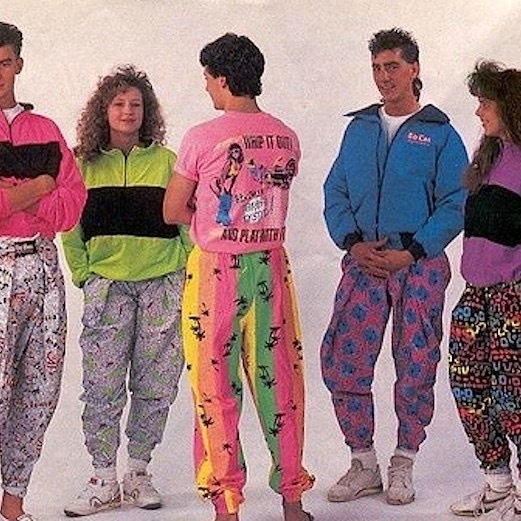
Apparently, in 2017 we’ll all be wearing 1980s-inspired clothing, at least according to two of the latest analytical forecasts of next year’s trends.
It all sort of makes a bit of sense. We’ll have a controversial celebrity turned Republican politician in the White House. Popular music is as synth-heavy as it’s ever been since that decade. People are actually excited about new Star Wars movies. Stranger Things is the most buzzed about show of the year. Makeup on men is an even bigger trend than it was during the glam rock heyday. Heck, Hollywood is even rebootingDynasty.
According to Pinterest’s in-house analytic team, the ’80s trend isn’t about to die down. The team has analyzed the trends that have seen the most year-over-year pinning growth over the past year and that seem primed to peak in 2017. Among their forecasts is the belle sleeve top silhouette taking over the off-the-shoulder look, an even more heated interest in flair (as in things like stickers and pins), and of course, more ’80s.
“Other big shifts were in political Ts (no surprise there), backless shoes—and not just the mule—and multiple earrings,” writes WWD. “That goes hand-in-hand with the popularity of Eighties-style trends, such as high-tops, peg legs and denim skirts.”
Meanwhile, retail analytic firm Edited is also forecasting trend temperatures in the ’80s as well.
“The 1980s will be huge—everything from power suits and slouchy tailored trousers for office wear, through to off-the-shoulder looks, activewear and [over-the-top] ruffles,” the report stated.
So, while there are some disagreements as to the fate of off-the-shoulder tops, both agree that ’80s are in.
Which isn’t a surprise. Designers have packed recent collections with ’80s details. Hedi Slimane’s last collection for Saint Laurent saw more dramatic shoulders since the series finale of Dynasty, and other designers followed suit with Reagan-era stylings in their spring 2017 collections.
I actually had this thought before I read this as a possible explanation for the election of Donald Trump, who achieved prominence in the ’80s. Since I am from the ’80s, I should welcome a return to Republican presidents (although I remain unconvinced Trump is more than a Republican In Name Only, and Trump is no Ronald Reagan) and a more conservative nation, if that’s what the election achieved.
If Allure is correct about returning ’80s styles, the contrast is the Sarcasm Society’s view of what won’t return:
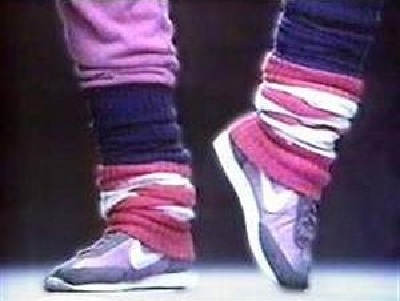
1. Slouch Socks
No one will ever wear these hideous excuses for capturing feet sweat again. Ever since the 80s people have not wanted their socks to remind them of their own bad posture.
2. Parachute Pants
Popularity of parachute pants has declined since the ’80s but since then there have been 2 recorded incidents of them being used in lieu of actual parachutes. …
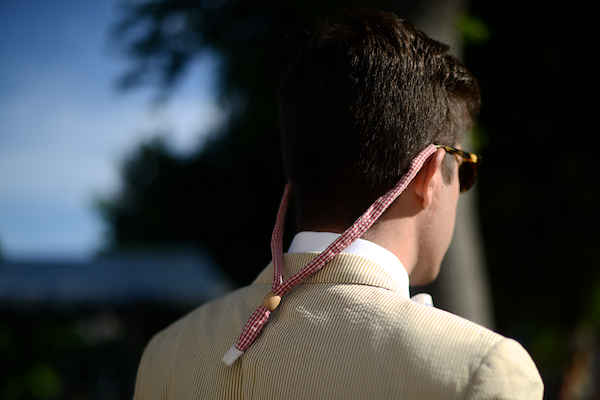
8. Croakies That Saved Your Grandmother From A Burning Building
No matter what they did for you or your family you need to turn your back on the Croakies. They aren’t coming back in style. Not in any real way. I’m sorry I had to be the one to tell you this.
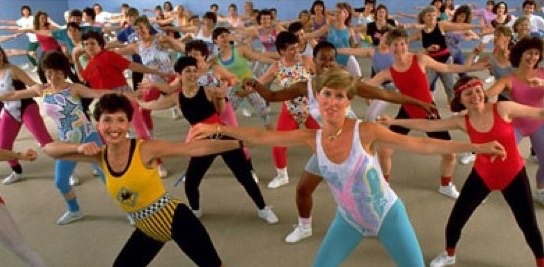
9. Spandex So Tight They Help You Feel Again
In the 80s the ability to experience any emotion became almost impossible. At a certain point spandex was worn just to make sure that you were able to still properly feel any emotion at all.
10. Scrunchie
If you’re still wearing these then you need to realize that you’re living in the past and Rubix cubes and Alf hate you.
Stylistically I may not have advanced far from the ’80s. Most days in that decade I wore:
1A. Button-down shirt.
1B. Polo shirt. (No, NOT with the collar turned up though I was accused of being a preppie.)
1C. Button-down shirt with a sweater over it.
2. Levi’s blue jeans. (I remember the first pair I got.)
3A. White sneakers.
3B. Or boots, if the weather was bad.I have only one pair of Levi’s; now I wear Wranglers and Lees, in part because of Levi’s attitude toward the Boy Scouts. I also wear khakis. I bought my first leather jacket in 1982 (it was, believe it or don’t, dark red); now I have several, to go with several non-leather blazers. My hair is shorter, in part because there is less of it (which I am reminded of every time I go outside in the summer sunshine without a hat). Other than that, what you see is what I got.
The public Trump wears nothing but suits, occasionally without a tie. I’ve never owned a double-breasted blazer, in part because I don’t button blazers and in part because I don’t spend large sums of money on clothes. (You may have been able to figure that out by now.) If you were doing an ’80s party dressing would be pretty easy: (1) button-down shirt, jeans and white sneakers, or (2) a dark suit with a red “power tie.”
I would say it would be funny if ’80s music made a comeback, except that ’80s music really has never gone away, for better or worse. The difference now is that ’80s music is being played on oldies radio, somewhat replacing ’60s music in that format.
There are a few things not worth emulating from the ’80s. The ’80s was where the sexual freedom of the ’70s ran into the incurable disease of herpes and then the then-fatal disease of AIDS. Fax machines, personal computers and cellphones got to the mass market in the ’80s, but of course none worked very well compared with now. (The first Macintosh I used for work required a floppy disk to start it; there was that little built-in memory. The screen was about the size of two Post-It notes, and of course it was black and white.)
Wisconsin sports fans probably would not like a repeat of the ’80s, because there were not many sports highlights in the 1980s:
That’s basically it.The Brewers had a few winning seasons and two playoff berths. The Packers had two winning seasons and one playoff berth in the ’80s. The Badgers had four winning football seasons and three bowl games, one of them their first bowl win. (And then both crashed, with the BADgers and pACKers combining for a 5–22 record in 1988.) The Bucks were the best team of all, but never got past either Philadelphia or Boston in the NBA playoffs.
While the ’80s produced some great music, as with every other time period in popular music, some music ranged from dreadful to who-the-hell-thought-this-was-a-good-idea. (See Murphy, Eddie, and Johnson, Don.) The nadir of ’80s music may well have been (don’t call them Jefferson or Airplane) Starship’s “We Built This City,” described by its guitarist thusly: “The song says we built this city on live music, let’s bring it back—but the music is computerized. It complains about techno pop, but it’s a techno-pop song. It exemplifies the problem it’s protesting.”
Cars of the ’80s were, to quote my state boys basketball champion coach/physical education teacher, not very impressive. The automakers had not figured out that electronic fuel injection would be the answer to stiffening fuel economy and emissions regulations, so we got the traveshamockery that was GM’s Computer Command Control (which should have been called Crappy Car Control). And there was the Yugo.
TV started changing in the ’80s thanks to the advent a few years earlier of TV signals broadcasted by satellite, which expanded our offerings beyond the three commercial networks and PBS to …
(Believe it or don’t, MTV stood for Music Television, and used to play music videos 24 hours a day.)
Another feature of the ’80s was irony and sarcasm. (As if.) This either was led by or demonstrated by the NBC-model David Letterman …
… when he was funny.
Face to Face says …
In contrast to the across-the-board sarcasm of the ’90s, teenagers in the ’80s reserved their eye-rolling for only what was pretentious. Funny as it may seem, the most visible — and audible — pioneers in this trend were the Valley girls, not proto-hipster wannabes. Some little nerdlinger presumes to ask out one of the cute popular girls: “Oh I’m like so sure!” Some aging hippie teacher tries to work her students up into a burst of cleansing synchronicity: “Ugh, get a job.
Barf me out.
Gag me with a spoon. …Those teenagers still felt enthusiasm for what truly deserved it — and not just bitchin’ camaros, bodacious bods, and totally tubular tunes. Letting your guard down and sharing your life with friends, and belonging to an active social scene, were still earnest and sincere pursuits. This distinguishes the zeitgeist from one of “kill yr idols.”
The tone of youth culture in the ’80s, then, was fundamentally one of stabilization — letting the air out of the over-inflated, while showing appreciation for what we have taken for granted.The other thing that stands out about the ’80s was the concept of conspicuous consumption, the zenith (or nadir depending on your perspective) of which was probably the syndicated TV show “Lifestyles of the Rich & Famous.” If that’s going to come back, Trump will have to do a better rescue job on the economy than Ronald Reagan did.
-
It’s hard to be a conservative UW supporter. On the one hand, the football team finishes with a better-than-expected year, wins its bowl game and doesn’t get shut out (unlike a certain Big Ten school whose name cannot be said without 0), and the basketball team knocked off archrival Indiana and is doing quite well this season.
On the other hand, reports the College Fix …
The University of Wisconsin-Madison is currently taking applications for its “Men’s Project,” a six-week program that aims to counter the alleged harmful effects of society’s masculinity paradigms and pressures and empower participants to promote “gender equity.”
“Men’s Project creates a space for critical self-reflection and dialogue about what it means to be a man and how masculinity impacts us and those around us,” organizers state in promoting the effort.
“The experience focuses on the examination of societal images, expectations, and messages around masculinity to empower men to better understand themselves, promote the advancement of gender equity, and raise consciousness in their communities,” organizers add.
It’s open only to “men-identified students” at the public university and “operates on a transformative model of social justice allyship,” according to a news release on the university’s website, which adds “by encouraging that kind of dialogue among a men-identified cohort, the goal is to create a sense of security in vulnerability throughout the six-week program.”
Participants will begin the project with a weekend retreat in February and continue meeting weekly, discussing topics such as media and pop culture, vulnerability, sexuality, hook-up culture, alcohol, relationships and violence.
The program is now in its second year and was most recently offered in fall 2016, according to its Facebook page.
In an email to The College Fix, the University of Wisconsin-Madison director of news and media relations Meredith McGlone said the project serves an important purpose.
“Recent research suggests college campuses have not effectively addressed [male students’] needs,” she stated. “Research also indicates that expectations around masculinity impact the way in which men experience college.”
McGlone suggested typical understandings of masculinity can effect male students in a negative way.
“These expectations influence the decisions men make about friendships; spending time outside of class; careers or academic majors; and sexual and romantic relationships. Men are socialized to believe they need to act a certain way to be accepted as ‘masculine’ or have what it takes to be a man,” she told The Fix.
“This can lead to self-destructive behaviors that impair their ability to complete their education,” she continued. “Research indicates that young men are less likely to enroll in and graduate from college, less likely to seek help from campus resources and more likely to engage in risky behaviors such as abusing drugs and alcohol. Research also indicates that programs such as the Men’s Project can counter these negative trends and support college men in their educational experience.”
Asked to define vulnerability in the context of the program, McGlone told The Fix it’s “one of the discussion topics related to male stereotypes. Students consider if they struggle with being vulnerable and how it might impact their relationships and actions.”
According to McGlone, there were no specific incidents which spurred the development of this program.
The first thought upon reading this swill is that (1) McGlone isn’t paid enough to parrot this bilge with a straight face, and (2) clearly there are more UW–Madison budget cuts that can be made (along with the “Problem of Whiteness” course).
David French adds:
As the College Fix notes, Wisconsin’s program is hardly unique. Programs designed to combat “toxic masculinity” are popping up across the fruited plain. Designed to end “harm, oppression, and dominance,” they look suspiciously like the same liberal critique I’ve been hearing my entire adult life. Men would be better men if only they were more like women. And “vulnerability” is the key.
It’s as if male tears water the garden of social justice. When I was younger, male vulnerability was called “getting in touch with your feminine side.” But since men don’t necessarily want to be feminine, the words shifted to the language of therapy and wellness. Strong men cry, they said. Crying is healthy, they said.
Indeed, traditional concepts of masculinity, which asked men to cultivate physical and mental toughness, to assume leadership roles in the home, in business, and on the battlefield, and to become guardians and protectors, became the “trap” or “man box,” to quote the University of Richmond’s ridiculous “authentic masculinities” site. The most destructive words a boy can hear? “Be a man,” at least according to the mandatory freshman orientation at Gettysburg College.
But here’s the problem — vulnerability isn’t a virtue. It’s a morally neutral characteristic at best and a vice at worst. Yes, some men are more naturally sensitive than others, but we now ask — no, beg — men to indulge their emotions, as if the antidote to awful male aggression is a good cry.
There are good reasons why generations of fathers have taught their sons to “man up,” and it’s not because young boys are blank canvases on which the patriarchy can paint its oppression. It’s because men in general have essential natures that are different from women. We tend to be more aggressive, more energetic, and less nurturing than women, and the fundamental challenge of raising most boys is in channeling that nature in productive ways, not in denying or trying to eradicate its existence. In other words, we need to make men more purposeful, not more vulnerable.
We are failing in that key task. Feminism has infected child-rearing and modern education so thoroughly that legions of parents and teachers are adrift and clueless. They have no idea what to do with their sons, and absent fathers compound the confusion and create yawning cultural voids. Yes, there are some pajama boys out there, the guys who embrace the feminist project (truthfully in part to hook up with feminist women), but there are countless others who reject feminism’s version of a “man box” and are instead adrift in purposeless masculinity.
Here is the key question — what better equips a man to confront a difficult and challenging world? Is it more tears? Or is it more toughness? Is it teaching men to be compassionate or to be objects of compassion? The vulnerable male’s cry is “help me.” The masculine male’s quest is to become the helper.
No matter what feminists say or do, boys will be boys. Feminists can’t change hormones and brain chemistry, and they can’t alter the fundamental biology of the human male. Boys will continue to be stronger and more aggressive than girls no matter how many peer-reviewed articles decry biologically based gender stereotyping. Campus radicals choose to deny rather than deal with reality, and in denying reality they increase human misery.
Boys will be boys, but they won’t all become men. At their best, shorthand admonitions such as “man up” or “be a man” carry with them the weight of tradition and morality that makes a simple, though difficult request: Deny self. Don’t indulge your weakness. Show courage. Avoid the easy path. Some men fall naturally into this role, for others it’s much more difficult. The proper response to those who struggle is compassion. It’s not to redefine masculinity for the minority.
For a father, there are few more rewarding things in life than helping a son become a man, to watch him test himself in productive ways and to help him cultivate and demonstrate a protective spirit. Among the great gifts a father can give a son is a sense of masculine purpose, and no that purpose isn’t a “box,” it’s a powerful force for good.
-
This may have started with a New York Times story:
Tim Spell has noticed a peculiar condition that affects Texans’ mental, physical and automotive well-being.
“I call it ‘truck-itis,’” said Mr. Spell, the former automotive editor for The Houston Chronicle. “People in Texas will buy trucks even if they’re not going to haul anything heavier than raindrops. I was interviewing one guy. He had a 4-by-4. I said: ‘You live in Houston. Why do you have this 4-by-4?’ He said, ‘Well, I own a bar, and 4-by-4s are higher, and I can climb up on the cab and change out the letters of my marquee.’”
Whether for high-up urban letter-switching or more rural and rugged purposes, pickup trucks are to Texas what cowboy boots and oil derricks are to the state — a potent part of the brand. No other state has a bigger influence on the marketing of American pickup trucks.
Texas is No. 1 in the country for full-size pickup trucks. More of them were sold in 2015 in the Dallas and Houston areas than in the entire state of California, according to the research firm IHS Markit. There is the Ford F-150 King Ranch, named for the iconic Texas ranch. And the Nissan Texas Titan, the floor mats and tailgate of which are emblazoned with the shape of Texas. And the Toyota Tundra 1794 Edition, featuring leather seats that mimic the look and feel of Western saddles, was named for the year that the JLC Ranch in San Antonio was established.
The Texas-edition truck is a product of the state’s pull on the truck world. Some truck styles are sold and marketed only in the state as Texas editions, ensuring that pickup trucks, like a lot of things in Texas, are different here than elsewhere.
The F-150 may be the truck of Texas, but as of the 2014 model year (the latest year I could find) the most popular new vehicle in Wisconsin is …

… a Chevrolet Silverado, the F-150’s main competitor. Notice it’s easier to find states where the top selling vehicle is a pickup truck than states where a car is the best-seller.
That makes what Sean Davis reports rather mystifying:
Even after a presidential election in which scores of media personalities were shown to be entirely disconnected from the country and people they report on, the liberal media bubble is alive and well. All it took to reveal the durability of that bubble was a simple question about pickup trucks.
For those who might not be aware, trucks are really popular in America and have been for decades. The Ford F-series, for example, has been the most popular line of vehicles in America for 34 years in a row. Ford F-150’s are basically the jeans of vehicles: it’s nearly impossible to find a person in America who either doesn’t own one or doesn’t know someone who owns one. The top three best-selling vehicles in America are not cars, but trucks: the Ford F-series, Chevy Silverado, and Dodge Ram. The top-selling sedan is but a distant fourth. According to a 2014 survey conducted by IHS automotive, trucks were the most popular vehicles in a whopping 34 states. A separate 2015 study found that the F-150 was the most popular used vehicle in 36 states.
Why is this important? Because research has shown that vehicle preferences and political preferences are linked. According to a 2016 survey of 170,000 vehicle buyers conducted by market research firm Strategic Vision, what you drive can reveal a great deal about which political candidates you prefer.The five most popular vehicle models among Republicans, for example, are all trucks, with the ubiquitous Ford F-150 leading the way. Among Democrats, the Subaru Outback is the most popular choice. If you drive a truck, you’re probably a Republican. If you drive a Subaru, you’re probably a Democrat. Donald Trump won every single state in which the Ford F-150 is the most popular vehicle (even Pennsylvania). He won all but four of the states in which the Chevy Silverado is the most popular vehicle, including Iowa, Michigan, Ohio, and Wisconsin. Hillary Clinton handily won the states where people prefer Subarus.
Which brings us to the simple question about truck ownership from John Ekdahl that drove Acela corridor progressive political journalists into a frenzy on Tuesday night: “The top 3 best selling vehicles in America are pick-ups. Question to reporters: do you personally know someone that owns one?”
Rather than answer with a simple “no,” the esteemed members of the most cloistered and provincial class in America–political journalists who live in New York City or Washington, D.C.–reacted by doing their best impersonation of a vampire who had just been dragged into the sunshine and presented with a garlic-adorned crucifix.
There were basically three types of hysterical response to a simple question about truck owners: 1) shut up, 2) you’re stupid and/or sexist and/or racist, and 3) whatever, liar, trucks aren’t popular (far and away my favorite delusional response to a simple question from a group of people who want you to believe they’re extremely concerned about “fake news”). It turns out that people who are paid large sums of money to opine on what Americans outside the Acela province think get very upset if you demonstrate that they don’t actually know any of the people about whom they pretend to be experts.
Click here to see the Twitter responses to which Davis refers.
The Right Scoop adds:
Like, seriously, it’s not even combative or anything. But it doesn’t matter because journalists and liberals could sniff out that if they answered honestly they’d expose themselves and their safe space echo chambers, so they lashed out at Ekdahl in smug, self-righteous, condescending anger.
Which kinda proves his point, doesn’t it? …The automotive editor for Ars Technica compares truck owning to BEING A HEROIN ADDICT BECAUSE HE’S NOT SENSITIVE ABOUT IT AT ALL:
.@JohnEkdahl plenty of heartlanders are opioid addicts. Does that mean to report on real Amerikkka you need an oxy habit?
… For as little as I know Ekdahl personally, I have no doubt he didn’t mean his question in a malicious way, but snowflake libs are terribly sensitive about their safe spaces. …
Ekdahl closed out the night with this explosive retweet:
Following up on #TruckGate… Reporters: Do you personally know anyone who owns an AR-15 or a civilian version of an AK-47?
Owning a gun is worse than worshipping Satan and heiling Hitler to most journalists, so you know they’re not gonna answer that question!!
This is as much media overreaction as I’ve seen since U.S. Rep. Sean Duffy (R–Wausau) called this state’s capital city the People’s Republic of Madison. It’s as if Ekdahl (and Duffy before him) struck a nerve with a sledgehammer, as if being equated with North Korea and people who refuse to associate with people different from themselves is a bad thing, or something.
Do I know truck owners? Since I have abandoned my hometown the People’s Republic of Madison, never to return unless unavoidable, I have been surrounded by them. In every small town I’ve lived in, the local car dealers have sold twice as many trucks as cars for years.
(If you wanted to get divisive about it, based on my observation there are three pickup truck features that separate a work truck owner — an 8-foot box instead of a shorter box, two doors instead of an extended cab or crew cab, and a manual transmission.)
One reason pickup trucks are popular is, as I’ve written here before, because of something you can no longer buy — a full-size, body-on-frame, roomy, V-8-powered car, eliminated by federal fuel economy requirements. Sport utility vehicles ranging from the Honda CR-V to the Chevy Suburban are the 21st-century equivalent of the nearly-extinct station wagon, with four-wheel drive or all-wheel drive as an added bonus. The box is handy for hauling, and you can always choose to not use capacity you have; you can’t use something you don’t have.
Some people probably own trucks because they’re popular. You may be shocked — shocked! — to discover that some people make purchasing decisions based on popularity.
-
A writer interviewed Anthony Bourdain, whose cooking show I do not watch, for Reason.com:
Bisley: What concerns you about Trump?
Bourdain: What I am not concerned about with Trump? Wherever one lives in the world right now I wouldn’t feel too comfortable about the rise of authoritarianism. I think it’s a global trend, and one that should be of concern to everyone.
Bisley: You’re a liberal. What should liberals be critiquing their own side for?
Bourdain: There’s just so much. I hate the term political correctness, the way in which speech that is found to be unpleasant or offensive is often banned from universities. Which is exactly where speech that is potentially hurtful and offensive should be heard.
The way we demonize comedians for use of language or terminology is unspeakable. Because that’s exactly what comedians should be doing, offending and upsetting people, and being offensive. Comedy is there, like art, to make people uncomfortable, and challenge their views, and hopefully have a spirited yet civil argument. If you’re a comedian whose bread and butter seems to be language, situations, and jokes that I find racist and offensive, I won’t buy tickets to your show or watch you on TV. I will not support you. If people ask me what I think, I will say you suck, and that I think you are racist and offensive. But I’m not going to try to put you out of work. I’m not going to start a boycott, or a hashtag, looking to get you driven out of the business.
The utter contempt with which privileged Eastern liberals such as myself discuss red-state, gun-country, working-class America as ridiculous and morons and rubes is largely responsible for the upswell of rage and contempt and desire to pull down the temple that we’re seeing now.
I’ve spent a lot of time in gun-country, God-fearing America. There are a hell of a lot of nice people out there, who are doing what everyone else in this world is trying to do: the best they can to get by, and take care of themselves and the people they love. When we deny them their basic humanity and legitimacy of their views, however different they may be than ours, when we mock them at every turn, and treat them with contempt, we do no one any good. Nothing nauseates me more than preaching to the converted. The self-congratulatory tone of the privileged left—just repeating and repeating and repeating the outrages of the opposition—this does not win hearts and minds. It doesn’t change anyone’s opinions. It only solidifies them, and makes things worse for all of us. We should be breaking bread with each other, and finding common ground whenever possible. I fear that is not at all what we’ve done.
Bisley: In your Brexit episode of Parts Unknown, Ralph Steadman, who illustrated Appetites eye-catching cover, said “I think human beings are still stupid.” Does that explain Trump’s election?
Bourdain: I don’t think we’ve got the [exclusive] franchise on that. If you look around the world (in the Philippines, in England), the rise of nationalism, the fear of the Other. When people are afraid and feel that their government has failed them they do things that seem completely mad and unreasonable to those of who are perhaps under less pressure. As unhappy and surprised as I am with the outcome, I’m empathetic to the forces that push people towards what I see as an ultimately self-destructive act. Berlusconi, Putin, Duterte, the world is filled with bad choices, made in pressured times.
Bisley: A few years back you were on Real Time with Bill Maher and part of the discussion was about people living inside their own bubbles. What do you think of Bill Maher?
Bourdain: Insufferably smug. Really the worst of the smug, self-congratulatory left. I have a low opinion of him. I did not have an enjoyable experience on his show. Not a show I plan to do again. He’s a classic example of the smirking, contemptuous, privileged guy who lives in a bubble. And he is in no way looking to reach outside, or even look outside, of that bubble, in an empathetic way.
Bisley: In your new cookbook, Appetites, you have a section called “Big Fucking Steak.” In Kitchen Confidential, you wrote this about vegetarians: “To me, life without veal stock, pork fat, sausage, organ meat, demi-glace, or even stinky cheese is a life not worth living. Vegetarians are the enemy of everything good and decent in the human spirit, and an affront to all I stand for, the pure enjoyment of food.”
Bourdain: I can certainly eat vegetarian food in India for a considerable period of time. They actually make good vegetarian dishes. Appetites is a representation of how I cook at home, and my personal preferences, and doesn’t pretend to be anything other than that.
That line’s the old-school French tradition I came out of. To live without any of those things would be very, very difficult for me. They’re all fundamental ingredients. I equate them with joy, pleasure: that’s the business chefs are in! We are in the pleasure business. I’m not your doctor, or your therapist. …
Bisley: You recently gave a feisty response to a long-winded San Francisco animal-rights protester who was going after you about eating meat. You said, “I like dogs. But how much worse can they be than, like, kale?”
Bourdain: At least she had the courage of her convictions. I thought her malice was misplaced. I’ve never eaten dog. She went on a little long. A sense of humor is a terrible thing to waste. And I think that’s the problem with a lot of animal activists, with whom I share a shocking amount of overlap actually. I mean, I’m against shark-finning, I take no pleasure in seeing animals hurt or suffer, I like humanely raised animals. I’m against fast food. I’m against fur, animal testing for cosmetics. What annoys me is these people are so devoid of any sense of humor or irony. And their priorities are so fucked! I mean Aleppo is happening right now. They also threaten to murder humans who piss them off with a regularity I find disturbing.
Bisley: I remember the outer islands of French Polynesia; including meeting lovely indigenous people for whom dog-eating is an occasional traditional practice.
Bourdain: Let’s call this criticism what it is: racism. There are a lot of practices from the developing world that I find personally repellent, from my privileged Western point of view. But I don’t feel like I have such a moral high ground that I can walk around lecturing people in developing nations on how they should live their lives.
I like to help where I can. If I can minimize the market for shark fin, that would be great. If I could help find a solution for traditional Chinese medicine that values Rhino horn over Viagra I would. I would donate to a fund to distribute Viagra for free in places where they think rhino horn is gonna give you a boner.
The way in which people dismiss whole centuries-old cultures–often older than their own and usually non-white–with just utter contempt aggravates me. People who suggest I shouldn’t go to a country like China, look at or film it, because some people eat dog there, I find that racist, frankly. Understand people first: their economic, living situation. I’ve spent time in the not-so-Democratic Republic of the Congo. The forests there are denuded of any living thing. It’s not because they particularly like to eat bush meat, it’s because they’re incredibly hungry, and seeking to survive.
One thing I constantly found in my travels, which is ignored by animal activism, is that where people live close to the edge, they are struggling to feed their families, and are living under all varieties of pressures that are largely unknown to these activists personally. Where people are suffering, animals who live in their orbit are suffering terribly. In cultures where people don’t have the luxury of considering the feelings of a chicken, they tend to treat them rather poorly. Dogs do not live good lives in countries where people are starving and oppressed. Maybe if we spent a little of [our] attention on how humans live, I think as a consequence many of these people would have the luxury to think beyond their immediate needs, like water to drink and wash, and food to live. A little more empathy for human beings to balance out this overweening concern for puppies would be a more moral and effective strategy.

 Steve Prestegard.com: The Presteblog