After speaking to the group as a whole, Paul Chryst conducted an impromptu meet-and-greet with individual Wisconsin players following a brief team meeting Wednesday afternoon. Some he had met before, some he was greeting for the first time.
“I had a chance to say, ‘Hey, good to see you again, good to see you got back here,’” recounted quarterback Joel Stave, who had been targeted by Chryst and former UW offensive line coach Bob Bostad during the recruiting process and agreed to walk on with the Badgers in 2011.
“I knew the kind of coach that he was from my experience with him. Obviously, I’ve never had him as a head coach. But having him as an offensive coordinator and quarterback coach (as a freshman), I got a chance to get to know him and I thought he did a tremendous job. I enjoyed playing for him.”
Stave’s freshman class included fullback Derek Watt, who was then a linebacker.
“After the meeting, he (Chryst) went out in the hall way,” Watt said, “and as every guy left the room, they had their minute or two to talk to him. All the kids he didn’t know, he’d ask, ‘Where are you from?’ to get as much information that he could in a quick, short time.
“You could tell that he definitely cares about the players. The whole meeting was all about us. He was obviously grateful for the opportunity (to coach here) but then it was about us — about the guys who play between the lines like he said (at his press conference).”
The one-on-ones, however short in length, served a valuable purpose, according to Watt. “He wanted to know where you’re from and where you’re coming from,” Watt said. “I look forward to having more football-related contact with him over the next couple of days.”
Watt did get a chance to ride over to the Kohl Center with Chryst. “And it was good to catch up with him a little bit and hear what he had to say,” Watt related. “It was small talk. But he actually asked about my exams and how I was doing in school. So I thought that was pretty cool.”
Sophomore tailback Corey Clement had the most interesting exchange with Chryst.
Upon greeting Clement, whom he bumped into during a tour of the Badgers’ facilities earlier on Wednesday, Chryst said, “Remember me?”
Clement nodded and said, “I remember you, Coach.”
In June of 2012, Clement verbally committed to Chryst and Pittsburgh. In October, he decommitted and eventually signed with Wisconsin.
On Wednesday, Clement noted, “He said, ‘You can’t run away from me forever.’”
That spawned further conversation. “That was the first thing we talked about,” Clement said. “We looked back at that moment and laughed. I did verbal to him but things do happen (in recruiting) and Wisconsin came into the picture. Now he’s got me back. This is what it was meant to be.”
What was Chryst’s recruiting pitch? “He’s a very humble guy,” Clement said. “When I was on my recruiting visit, all he did was talk about his players and how much he appreciated them. He said if I went to Pitt, I was going to be loved like I was one of his own family; it would feel like my second home.
“I remember just how welcoming he was. He was in the process of building Pitt after it had been down for a few years. And I respected him for being able to create such a positive attitude and path for the university. I wanted to be a part of that initially, but I was premature in where I really wanted to go.”
All’s well that ends well? “I wouldn’t want anybody but him now,” Clement said.
Of course, #MerryChrystMas is trending on Twitter after this news from the Wisconsin State Journal:
College football’s worst-kept secret is no longer even that.
The University of Wisconsin officially introduced Paul Chryst as its new coach Wednesday evening, just one week after Gary Andersen departed for Oregon State.
Chryst compiled a 19-19 record over the past three seasons at Pittsburgh. The Madison native played for the Badgers in the late 80s — most notably at quarterback and tight end — and was the program’s offensive coordinator from 2005-11 after serving as its tight ends coach in 2002.
“As early as I can remember, Badger football was a part of our lives,” Chryst said. “Then to be able to come back, more than once, is pretty special. I’ve flown into Madison a bunch of times, but this certainly felt different.”
UW’s offense averaged more than 40 points per game in his final two years as the offensive coordinator.
Chryst was first reported to be UW’s choice Thursday night, but the school could not officially offer the job until Wednesday.
“The first person I thought of when Gary Andersen informed me that he was leaving was Paul Chryst,” UW athletic director Barry Alvarez said. “I watched very closely from afar how he was building his program (at Pitt). The things that Paul has learned and how he’s built that team and how he has recruited some of the top players in the ACC, those are all things that resonated with me.
“He’s ready. The time is right.”
Chryst reportedly expects to bring Pitt offensive coordinator Joe Rudolph and defensive coordinator Matt House with him to Madison, but sources say House will be the Badgers’ defensive line coach.
Rudolph was a successful recruiting coordinator for UW when he was the team’s tight ends coach before leaving for Pitt with Chryst.
UW defensive coordinator Dave Aranda reportedly will not follow Andersen to Oregon State and could retain his role with the Badgers, although he has many other suitors. …
Alvarez said on his radio show Tuesday night that he promised the Badgers’ assistant coaches that the program’s new coach would “seriously” interview anyone who wanted to remain in Madison.
“We’ll be able to put together a great staff,” Chryst said. “I look forward to putting a group together but haven’t finalized anything.”
As for his “great staff”: It’s most likely not Chryst’s call, but you know, Paul, a UW graduate really should announce Badger games. And he and I are classmates (political science, 1988), and we’ve been in at least one other room together (a UW Band concert in Platteville when Chryst was introduced as coming to Madison).
UW athletic director Barry Alvarez introduced Chryst during a news conference in the Nicholas-Johnson Pavilion.
“I’m thrilled to welcome the entire Chryst family to come back to Madison, to come back home,” Alvarez said.
Alvarez said he was contacted by “a number of well-known head coaches and high-ranking assistant coaches” about the job but the first person he thought of was Chryst.
“I have great respect for him as both a football coach and a person,” Alvarez said.
Said Chryst after being introduced, “Obviously this a big moment. I couldn’t be more grateful, honored and certainly appreciative of such an opportunity.”
“There is a spirit that is undeniable here,” Chryst said. “As great a day as today is, I don’t want it to be the best day.”
He said he was looking forward to getting to work and to “truly do something special” at Wisconsin.
“I grew up in Madison,” Chryst said. “…As early as I can remember it, Badger football was part of our life.”
Chryst was asked whether Wisconsin was a “destination job” for him, after Bret Bielema and Gary Andersen left for Arkansas and Oregon State before him.
“I think that when you talk about destination job,” he said. “I think you’ve got to earn the right to stay that long.”
He cited Alvarez and UW basketball coach Bo Ryan as two examples of coaches who earned that right.
Chryst acknowledged that his late father, George, a longtime football coach, including at UW-Platteville, would be proud.
He related a talk he had with Ryan, who asked him, “What do you think George would say if he found out I was coaching the basketball team and you were coaching football?”
Ryan was a longtime basketball coach at Platteville and was there when George Chryst was the football coach.
Chryst would not say yet who he would have as assistants, but according to sources, current UW assistants Dave Aranda and Bill Busch are solid candidates to be retained. Both are in their second season at UW and both came to Madison with Andersen.
UW finished in the top 20 nationally in all four major defensive statistical categories in Aranda’s first season — sixth in scoring defense, seventh in total defense, fifth in rushing defense and 17th in passing defense.
UW this season is 13th in scoring defense, fourth in total defense, 17th in rushing defense and fifth in passing defense. The Badgers were blown out, though, in the Big Ten title game by Ohio State, 59-0.
Busch, a graduate assistant under Alvarez in 1994, works with both safeties and linebackers. He is a tenacious recruiter who recently secured an oral commitment from Dallas tailback Jordan Stevenson, who initially committed to Texas.
According to a source close to the UW program, Chryst hopes to bring offensive line coach Bob Bostad back to UW. Bostad, in his first season with the Tennessee Titans, was on UW’s staff from 2006-’11. During that time he coached tight ends and the offensive line. He also was the running-game coordinator.
“It would only make the program better if Paul brought back some of those guys,” said former UW offensive lineman John Moffitt, who started a total of 42 games from 2007-’10.
Some observers are less than enthusiastic because of Christ’s 19-19 record at Pitt. That, however, might be a major accomplishment because of Chryst’s predecessors, in chronological order:
Dave Wannstedt (yes, the ex-Bears coach): “Forced out,” to quote CBS Pittsburgh.
Mike Haywood: Hired to replace Wannstedt, but fired after one month after he was arrested on domestic abuse charges.
Todd Graham: Unlike Haywood, he actually coached the Panthers for a game. He coached the Panthers for an entire season, in fact, before he left for Arizona State.
CBS Pittsburgh reports this morning that the person who hired Chryst and his predecessors, athletic director Steve Pederson, is being fired.
This photo also showed up on Twitter:
That’s Paul and his father, George, who played football for Wisconsin and was an assistant coach before George because UW-Platteville’s athletic director and football coach. That brought the Chryst family to Platteville so that Paul could be part of Platteville High School’s first state football title, in 1983.
The reasons Chryst is the ideal choice go beyond his UW ties. (If it was about UW ties, then John Coatta, a former UW quarterback, wouldn’t have had three disastrous seasons as the Badgers coach from 1967 to 1969.) UW runs the ball first and foremost. Every defense they play knows that, and yet UW set scoring records when Chryst was the offensive coordinator, because he effectively worked in the pass and managed to disguise what the Badgers intended to do through formations and motion. Alvarez is at least intimidating to work for, but Chryst has already dealt with that. UW is an academically challenging school, but Chryst has already dealt with that too, and successfully.
Losing 59-0 in the Big Ten title game is one thing. That was a short-term setback, and it didn’t change the fact that Gary Andersen had just won the West Division and was starting to load up his roster with talented, athletic players who could continue to make his program an annual contender.
Losing another coach to what the Badgers would almost certainly view as a less-prestigious program is the bigger shot to the ego, though, and it will be the cause of some seriously difficult looks in the mirror for Barry Alvarez and his athletic department. This might well be another hurdle that can be cleared in a small time frame, but it suggests there might be more long-term issues for Wisconsin if it can’t keep its successful coaches around in a conference that appears to be back on the upswing.
No offense to Oregon State or Arkansas, but those aren’t the kinds of programs that Wisconsin would like to consider as its football peers, and yet Andersen is on his way to the former after Bret Bielema surprisingly bolted for the latter. And while it’s hard to consider Wisconsin a stepping-stone job based on what appear to be lateral moves, there seems to be something keeping it from becoming a final destination.
“The last two coaches have proven that,” Alvarez said. “It wasn’t a destination job for them, but it was for me and it is for [basketball coach] Bo Ryan. Everybody is a little bit different. I don’t worry about that.
“We’ve got a good job, we’ve got a good place, we’ve got a consistent program. We’ve got a lot to sell. I’m not trying to paint any other picture other than a very positive picture, because it is positive.”
The list of pros is indeed long for anybody who would like to come take over for Andersen, and Alvarez was expecting a long night on Wednesday with his “phone ringing off the hook” with candidates interested in leading a program that has played in five consecutive New Year’s Day bowls. There are upgraded facilities on hand, including a new weight room and an academic center. And the path to the College Football Playoff currently isn’t the most arduous around, though winning the Big Ten West isn’t exactly a cakewalk with Nebraska, Minnesota and occasionally Iowa on hand in a division that can hand out a few bruises.
But there are certainly cons that come with the Wisconsin job, from a shallower recruiting pool in its backyard to high academic standards that can potentially trim its options to fill out the roster. But those didn’t stop Andersen or Bielema from winning games, competing for championships or heading to prestigious postseason bowls. The issues in retaining those two coaches appear to be things Wisconsin actually has some control over and could change.
Is there really no room for flexibility in terms of getting in a few more recruits who might not have traditionally qualified? There’s nothing wrong with a program rigorously holding itself to tough academic standards, but that makes it tougher to put together the best possible team and to possibly keep coaches who could more easily craft a squad in their image elsewhere.
Why doesn’t Wisconsin have an assistant ranked higher than No. 77 in the nation in annual salary, according to the most recent USA Today database? There’s no cap on spending for coaches, which makes it the one commodity in which schools with title aspirations should never get thrifty.
How can Wisconsin expect to keep a coaching staff together if it doesn’t rank any higher than No. 9 in the league in combined compensation for assistant coaches, behind the likes of Maryland, Rutgers and even rival Minnesota? Bielema had already railed against the lack of financial support to keep his assistants around when he left to take over the Razorbacks.
The possible academic hurdle can’t be cleared with a checkbook, but certainly the other problem can be addressed simply by spending more money, and no school in the Big Ten can make any sort of legitimate claim that it doesn’t have cash rolling in, thanks to its television contracts. With Wisconsin’s passionate fan base filling Camp Randall Stadium, it’s also unlikely that its revenue stream is going to dry up any time soon.
With Andersen, though, dollar signs probably weren’t the tipping point; Oregon State actually checked in one spot behind Wisconsin nationally at No. 41 in payroll for assistants.
So what else is there? Perhaps the problem is with the boss, with Alvarez looming over a program he led for so many years. Given that he was able to win at a high level despite some of those limitations, might he or the athletic department be unwilling to make concessions that the game has truly changed since Alvarez was on the sideline? That question might be more difficult to answer and even more challenging to fix, given Alvarez’s iconic stature with Wisconsin.
Ward reports on Ohio State for ESPN.com, so his mentioning UW’s academic standards is a bit ironic, since Ohio State’s academic standard for admission appears to be having a pulse rate greater than zero.
The advantage of having observed UW athletics for longer than Ward (who apparently joined ESPN in 2012) is that I can correctly point out that UW did at least relax academic standards to allow such players as Brent Moss, Alvarez’s first star running back, to get in. That doesn’t mean UW doesn’t still have higher academic standards for athletes than other schools.
When this first came up a long time ago, the thought of this writer and his father, both UW graduates, was that we didn’t want our degrees cheapened by letting in lesser students to UW because of their athletic ability. My opinion has changed somewhat for two reasons. First, colleges do let in students who don’t necessarily meet base academic standards under several criteria beyond athletic ability — to name two possibilities, some minority students or, in the case of private colleges, children or grandchildren of alumni.
As a graduate of our state’s world class university who previously worked at a college not known as being academically select, I am less convinced how much this matters. Your college diploma, after all, is based on what you do in college, not high school. There are a lot of college students who got good grades in high school because they were smart, not necessarily for exerting themselves scholastically. Many of them get to college and find out the hard way that it’s a lot tougher than high school. I suspect I have gotten no more than one job in my lifetime because of my UW diploma, and that was before I actually got said diploma.
But it’s pretty obvious that UW isn’t going to relax its admission standards enough to make a significant difference. Therefore, you have to be able to succeed with what’s there, instead of trying to change things and failing. That suggests (as reported by the Milwaukee Journal Sentinel) …
According to a source close to the UW program, former UW assistant Paul Chryst, a Madison native, is poised to return to his alma mater.
“I thought this would be the scenario from Day 1,” the source told the Journal Sentinel on Thursday night. “He will put together a good staff.”
Neither Chryst nor Alvarez was available Thursday night.
“I always keep a short list,” Alvarez said Wednesday in discussing the stunning departure of Andersen to Oregon State. “And we will proceed in our search for a new head coach immediately.”
UW officials posted the job opening Thursday. According to the posting, applications must be received by Dec. 17.
Chryst, 49, is in his third season as head coach at Pittsburgh. His overall record is 19-19 but he inherited a mess from former coach Todd Graham and instituted a new offensive system. …
According to the source close to the UW program:
Alvarez, who flew to Tampa, Fla., Thursday for an Outback Bowl promotion, was able to meet with Chryst. Chryst was already in Florida, assumed to be recruiting.
The source believes Chryst could bring with him Joe Rudolph, who is the Panthers’ assistant head coach/offensive coordinator.
Rudolph was a two-time all-Big Ten offensive lineman under Alvarez and was UW’s tight ends coach from 2008-’11.
“Joe will be able to sell Wisconsin,” the source said. “That is important.”
The source also believes Chryst might be able to lure Bob Bostad back to UW. Bostad is the offensive line coach with the Tennessee Titans.
“He had the itch to coach in the NFL, but Paul and Bob are tight,” the source said.
Bostad, a native of Pardeeville, was on UW’s staff with Chryst from 2006-’11. He served as the tight ends coach, offensive line coach and running game coordinator.
Two years ago around this time came the unbelievable news that Wisconsin football coach Bret Bielema, having just won the Big Ten championship game, was leaving to coach at Arkansas.
Two years later comes the less-unbelievable, though certainly unexpected, news that Wisconsin football coach Gary Andersen, having just lost the Big Ten championship game, was leaving to coach at Oregon State.
Perhaps it’s not unexpected for two reasons. Andersen’s entire career before now had been spent out West, which does play a different kind of football than the Big T1e4n, or at least the players Andersen inherited from Bielema.
The other thing is that it can’t be easy to coach in the shadow of athletic director and former coach Barry Alvarez. That’s probably less of an issue for, say, men’s basketball coach Bo Ryan (who is unlikely to be intimidated by higher-ups) or men’s hockey coach Mike Eaves (who has his own problems right now). But Alvarez is not only the football coach’s boss, he built the program from the dregs of Don Mor(t)on and his Veer from Victory offense.
The Wisconsin State Journal’s Tom Oates has some questions:
Gary Andersen pulled a Bret Bielema on Wednesday when he was hired as the coach at Oregon State after just two years on the job at UW. Just like in 2012, when Bielema jumped ship to go to Arkansas after seven seasons at UW, no one saw it coming. Not even Alvarez.
“I was very surprised,” he said. “I had no idea this was in the works.”
Andersen’s sudden departure raises many questions, but before I take a stab at why he left and who should replace him, what first comes to mind are these questions: When did UW become a steppingstone job for coaches? And what does Andersen’s abrupt departure say about the state of the UW job?
Ever since Alvarez turned the program around in the early 1990s, UW has thought of itself as a destination job. It’s not yet time to revise that thinking, but clearly this is no longer a place coaches go to grow old.
“The last two coaches have proven that; it wasn’t a destination job for them,” Alvarez said. “But it was for me, and is for (men’s basketball coach) Bo Ryan. Everybody’s a little bit different. I don’t worry about that. We’ve got a good job. We’ve got a good place. We’ve got a consistent program. We’ve got a lot to sell.”
Whatever it was UW was selling, Andersen wasn’t buying it. Still, he left for entirely different reasons than Bielema.
Upon his departure, Bielema talked about having more money for his assistant coaches and embracing the challenge of the Southeastern Conference. Alvarez said in his press conference that Andersen told him he was leaving for family reasons. Alvarez later told the State Journal that Andersen had grown increasingly frustrated over UW’s admissions policies for recruits, which are more rigid than some of its Big Ten counterparts.
Both of those reasons make sense for Andersen.
A Utah native who came to UW after coaching four seasons at Utah State, he never looked truly comfortable in Madison; he never seemed like a particularly good fit. Although Andersen is a genuinely nice man, he was a homebody who didn’t get close to boosters or fans. Also, it seemed likely that Andersen would want to return to the West at some point after living his entire life out there.
“I thought Gary was a good fit,” Alvarez said. “There was never any talk about, ‘Someday I’d like to get back to that part of the country.’ Maybe when you’re away for a while, that kind of settles in. I don’t know that.”
It also figures that Andersen had trouble recruiting the kind of speed and athleticism to UW that he had at Utah State, and not just from the junior-college ranks. Alvarez told the State Journal he and Andersen had an ongoing discussion about Andersen’s concerns over UW’s admissions standards and pointed to Sun Prairie defensive tackle Craig Evans as an example. Evans committed to UW, then changed his mind when it became apparent he wouldn’t be admitted. He is now a freshman at Michigan State.
Asked by the State Journal if Andersen had lost potential players because they couldn’t qualify, Alvarez said, “I know the one at Sun Prairie really bothered him.”
Alvarez joked that his next hire would be his last for the football program. To make that happen, he needs to make sure his next coach really is a good fit. For entirely different reasons, neither Bielema nor Andersen were ever truly embraced by UW fans.
For their next coach, the Badgers need someone who understands the program, the school and the state so he can play to UW’s strengths. They need a coach who can develop players and outcoach people, because the level of the talent recruited hasn’t changed appreciably through three coaches and 25 years.
And, of course, they need a coach who will stick around.
“Having ties to Wisconsin is not important,” Alvarez said. “I’d like to find someone that has head coaching experience. … I think it’s important that there’s a fit. I thought Gary was a good fit.”
But while observers debate whether Alvarez should pursue a coach with UW ties — Pitt coach Paul Chryst, Seattle Seahawks offensive coordinator Darrell Bevell, Pitt offensive coordinator Joe Rudolph and UW defensive coordinator Dave Aranda come to mind — or go after a current head coach such as Al Golden of Miami (Fla.), Dave Clawson of Wake Forest or Justin Fuente of Memphis, a bigger question might be whether UW needs to change the equation in order to retain its coaches, up to and including altering its admissions policies.
Since those standards were good enough for Alvarez and Bielema to perpetuate a strong program, that seems neither prudent nor likely. Which makes it even more important that Alvarez hire someone who already knows first-hand how to operate within UW’s parameters.
It seems to me that Chryst is the ideal choice under Oates’ listed parameters. He is the best offensive coordinator UW has ever had. He was a success with less talent than other Big Ten teams because he was able to disguise UW’s usual plays through formations and pre-snap movement to an extent not even matched before or since him. He also is used to the strictures of working in Madison — namely, the academic standards and having Barry Arrogance as your boss.
Chryst replaced Dave Wannstedt, a thrice-flameout as a head coach (first Da Bears, then Miami, then Pitt), and has gotten that program to one game better than .500 and at least competitive now. He’s also likely to run an offense and defense better suited for the kinds of players UW can recruit, as opposed, perhaps, to the kinds of players Andersen wanted
One thing Chryst is not is very outgoing, unlike his father, former UW-Platteville athletic director George Chryst. (The story goes that George got Da Bears to move their training camp to Platteville by filibuster. Bears officials had planned on visiting Platteville and UW-Whitewater on the same day, and George talked so much that it got so late that the trip to Whitewater never occurred.) There is a degree of public interaction required of a big-time football coach, though I’m not sure how much Ryan gets out among the fans, and it hasn’t hurt him. Winning papers over personality issues.
The new coach will not have running back Melvin Gordon, but he will have running back Corey Clement. I’m betting the new coach will not have Andersen’s star quarterback recruit, Austin Kafentzis, although he says he’s taking a wait-and-see approach. I hope the new coach can find a quarterback, because it’s obvious there is not a Big Ten-capable quarterback on the roster. (Kafentzis, it should be pointed out, is not very tall. Neither was Russell Wilson, coached by Chryst. Wilson merely became the best quarterback in UW history based on, yes, one season.)
More on Chryst from the Milwaukee Journal Sentinel’s Jeff Potrykus:
“I thought Paul would surface here or Nebraska,” a source close to the UW program said. “What did you think when he didn’t take the Nebraska job? I think Paul knew this was in play.”
Chryst, 49, a native of Madison who played at UW from 1986-’88, was the Badgers’ tight ends coach in 2002. He worked with Riley at Oregon State in 2003 and ’04 but returned to UW in 2005 to run the offense. In his last three seasons as offensive coordinator (2009-’11), UW averaged 31.8 points, 41.5 points and a program-record 44.1 points per game.
Other candidates include North Carolina State coach Dave Doeren, the former UW defensive coordinator, who was spectacular in two years at Northern Illinois, and has had 3-9 and 7-5 teams at N.C. State, a basketball school. Then there’s Bevell, who apparently wants to become a college coach someday, but his career certainly hasn’t gone that direction. (Given the bad taste former UW basketball coach Stu Jackson left by bolting after two years to become a losing NBA coach, Bevell’s NFL experience probably hurts him at UW.)
A few names have come up that I hope don’t get the job, because there’s a reason they’re not where they used to be — Greg Schiano, who Potrykus said “bombed” at Tampa Bay after doing well at Rutgers, but is now out of coaching; Mario Cristobal, Alabama’s offensive line coach after getting fired (wrongly, many apparently claim) at Florida International; and Frank Solich, fired at Nebraska because he wasn’t Tom Osborne, but not all that successful at Ohio. As for Golden (who a member of my church, a Miami graduate, would like to leave), when you’re getting votes of confidence from your athletic director, that doesn’t make you very employable.
The next coach needs to win enough to keep fans in the seats. Football pays most of the freight for UW’s non-revenue-generating athletic programs. Neither Bielema nor Andersen were in danger of getting fired, but those coaches’ success levels are pretty much what the next coach needs to attain to keep his job.
Last week Badger fans were all atwitter because the basketball team was playing Duke in the Big Ten/ACC Challenge, and the football team was playing for the Big Ten championship and a possible football playoff berth.
Instead, the Badgers lost to Duke (though they rebounded somewhat by beating Marquette Saturday) and were annihilated by Ohio State, 59-0.
(I saw neither game because I was announcing college basketball both nights. That was certainly a better use of my time Saturday, even with the 2.5-hour bus-flat-tire delay. And on Wednesday, the team I announced for won.)
I’m not particularly bothered by the Duke loss because Duke is good, and the Badgers aren’t playing that well, even though Wednesday was their first loss. Basketball teams don’t want to peak in December, and a loss to a power like Duke doesn’t hurt you much.
A lot of people are bothered by Saturday night’s nationally televised embarrassment, as Todd Milewski chronicles:
These are not the words you want associated with your team in a championship game:
Yet that’s some of the wrath that was heaped upon Wisconsin after its worst loss in a generation, a 59-0 humbling by Ohio State in Saturday’s Big Ten championship game in Indianapolis.
It tied for the second-worst losing margin in program history, set in another 59-0 loss to Ohio State in 1979. Back then, however, the Badgers were unranked and headed for a 4-7 season under second-year coach Dave McClain while the Buckeyes were ranked sixth in the country.
(For the record, the Badgers’ worst loss was a 63-0 drubbing by Minnesota in 1890, the program’s second season.)
Vinnie Duber of CSNChicago.com: “Ohio State poured an avalanche of points on Wisconsin in a hurry to start the game, and the hole was massive by the time the Badgers could catch their breath.”
Patrick Vint of SBNation.com: “If the Big Ten West wanted to show that it belonged with its storied brethren in the East, it did not get far Saturday. The Badgers had won a de facto Big Ten West tournament over the season’s last three weeks, systematically knocking off Nebraska, Iowa and Minnesota to lock up the division title. Whether it was exhaustion from those three previous games or just another instance of Wisconsin not showing up for half of a game, it did the Badgers, and the Big Ten West, no favors.”
Selfless decision by CFP selection committee member/Wisconsin AD Barry Alvarez to instruct his school to tank and boost B1G playoff hopes.
Sports Illustrated’s Brian Hamilton: “The defense chopped Wisconsin into pieces, but in an added indignity, it saddled Melvin Gordon with the antitheses of a Heisman moment: A second-quarter fumble by the Badgers’ 2,000-yard tailback was returned for a touchdown by the Buckeyes’ Joey Bosa. That put the score at 38-0 and left Gordon to contemplate how he’ll applaud politely while Oregon’s Marcus Mariota hoists the trophy next weekend.”
This was unfortunately predictable. I thought the oddsmakers had lost their minds by making Wisconsin a favorite Saturday, regardless of whom the Buckeyes had at quarterback.
One reason I never root for Big Ten teams, and especially Ohio State and Michigan, in bowl games is because of the depressing regularity of such hammerings at the hands of the Buckeyes and Wolverines and their pond scum coaches, Woody Hayes and Bo Schembechler. That was in the days when the Big Ten was known as the Big Two and the Little Eight. Each year I hoped that the host site of the Michigan-OSU game would be nuked, and, failing that, that the Wolverines and Buckeyes would lose their bowl games and their planes would crash on the way home.
Notice that the previous paragraph includes no admission that maybe there were valid reasons for Bucky’s getting crushed by better teams — you know, better players. Those games were in the ’70s, when UW was worse than mediocre (just two winning seasons from 1970 to 1979) but not as bad as as the BADgers were in the late ’80s under Don Mor(t)on. That changed thanks to reductions in scholarship limits by the NCAA, as well as high school football players wanting to play immediately instead of waiting their turn, or never getting into a game except in garbage time.
One wonders how a defense gets to be rated second in the country when that defense gives up 59 points. (Though the defense gave up 52; the offense gave up seven on the return of Gordon’s fumble. Doesn’t that make you feel better?) As with many teams that run the ball well, the Badgers can stop the run, but pass defense is a bigger problem.
Truth be told, though, games like this between good teams happen with increasing frequency because of the increase in speed, and coaches’ being willing to exploit their offensive speed. (Time was when coaches always put their better athletes on defense, leading to a lot of boring 7-3 games.) Recall two years ago when Wisconsin blasted Nebraska 70-31 in the 2012 Big Ten championship game, or UW’s win over the Cornhuskers earlier this season.
The bigger issue to me — which exposes an issue that has been a problem for a long, long time — is how a team with a supposed Heisman Trophy candidate running back gets shut out. That suggests an inability to figure out how to move the ball down the field beyond handing off to your tailback. The fact that UW was able to beat lesser teams (other than Northwestern) and teams roughly their talent level (Nebraska and Minnesota) doesn’t mean this team doesn’t have serious deficiencies on offense. Apparently this offensive staff lacks the ability of previous offensive staffs (that is, those with Paul Chryst as the offensive coordinator) to maximize their strengths and disguise what they were doing — run the same plays but from different formations and pre-snap looks.
At the risk of offending Darlington Redbirds fans: Alex Erickson is not a number one wide receiver in the Big Ten, and he was obviously the best receiver (who played quarterback in high school) the Badgers had. As I wrote here earlier this season, the question of who should have played quarterback, Joel Stave or Tanner McAvoy, was correctly answered with one word: Neither. Neither Stave nor McAvoy should be the quarterback, though there is no guarantee that freshman D.J. Gillins or the supposedly bazooka-armed quarterback from Utah will be the answer behind center either.
Games like Saturday’s also makes you think that coach Gary Andersen’s recruiting approach isn’t working in other areas too. This year’s defense was supposed to be smaller but quicker than previous defenses. Giving up that many points means you have defensive problems. The traditionally strongest position grouping has been the offensive line, but on at least one night they couldn’t block, period, and their pass blocking has been a question beyond Saturday night.
Is this overreacting to one bad game? Or is a season like this — beat the teams you should, but never get better than that — as good as it gets at Camp Randall? The answer comes down to not wins and losses, but money. Andersen won’t be in trouble unless fans start coming up with something else to do besides go to Badger games. (Which is also why hockey coach Mike Eaves is in trouble.)
The Big Ten football championship is Saturday night, with the winner possibly getting a berth in the first Division I football playoff.
Seth Abramson explains why two-loss Wisconsin deserves a playoff berth if the Badgers beat Ohio State:
If Wisconsin beats Ohio State this coming Saturday — a premise made more likely by the season-ending injury suffered by Ohio State starting quarterback J.T. Barrett on Saturday — there will only be three teams left (Arizona, Baylor, and TCU) between Wisconsin and a berth in the first-ever four-team playoff in college football. But Arizona is almost certain to lose its game to No. 2 Oregon next week — and if it doesn’t, that win would leave Oregon out of playoff contention, thus putting the Ducks (rather than Arizona) behind the Badgers. There’s also a reasonable chance Baylor will lose next week to No. 12 Kansas State, though even if it doesn’t, the winner of next week’s Baylor-Kansas State game will be hurt — as TCU will be hurt — by the fact that the Big 12 doesn’t have a championship game. As between Baylor, Kansas State, TCU, and Wisconsin, only the Badgers (assuming a win next week) would be able to boast a Power 5 conference championship on their playoff CV.
While one team presently ranked behind Wisconsin — Georgia Tech — could still make their own case for playoff inclusion, if Georgia Tech beats No. 3 Florida State next week (which it would have to do to make the playoffs) it would, much like an Oregon loss to Arizona, put a team currently presumed to be a shoo-in for the playoffs out of the picture. In other words, No. 16 Georgia Tech beating Florida State helps the higher-ranked Badgers as much or more than it helps Georgia Tech. On a similar note, if No. 1 Alabama loses in the SEC Championship Game to No. 17 Missouri, Missouri still wouldn’t find its way into the playoffs — but Alabama might well drop out of them.
In view of the above, it seems surprising that Wisconsin hasn’t been much discussed in water-cooler conversations about the 2014 College Football Playoff. It may be that fans are waiting to see if Wisconsin can beat Ohio State; the problem, of course, is that midnight Saturday will be much too late to begin making a case to the nation and the CFB Playoff Committee whose final resolution will be determined just a few hours later. With the final CFP rankings due to be released this Sunday, if the surprisingly strong case for the Wisconsin Badgers making the College Football Playoff if they beat Ohio State is going to be made, it needs to be made right now.
The short-form summary of the case for the Badgers goes like this: a Power 5 conference champion with a top-ranked defense, likely Heisman winner, and Coach of the Year semifinalist, which also happens to be the hottest team in FBS football — assuming an Ohio State win next week, Wisconsin would have won eight straight games, with a stunning seven of those wins against bowl-eligible teams — deserves to be one of the four teams playing for a National Championship. The usual argument against the Badgers, that the Big Ten is a conference in decline, has lost its purchase since the conference began playing some of its best football in years. The Big Ten stacks up nicely against the other Power 5 conferences in almost any measure you could name. An argument more specific to Wisconsin — that it has two losses — is hindered not just by the fact that those losses came very early in the season (and the CFB Playoff Committee has emphasized recent performance), but also by the fact that one of those two losses can’t really be charged against the Badgers at all.
Here’s the somewhat elongated, six-point case for Wisconsin making the CFB Playoff:
1. The Big Ten Is Strong This Year, Which Means Its Conference Champion Should Make the Playoff. Based on the number of its teams in the CFP Top 25, the relative ranking of those teams, its FPI strength-of-schedule, and its success in non-conference games against bowl-eligible Power 5 teams (and Notre Dame), the Big Ten is either the third- or fourth-best conference in the country. If the first-ever College Football Playoff is to take a national view of the state of college football, there’s no question the top dog in the B1G needs to be in the final four-team grid.
2. No One in the Country Is Playing Better Than Wisconsin. If Wisconsin beats Ohio State, it will have won eight games in a row — tied with No. 1 Alabama and No. 2 Oregon for the second-longest streak among CFP Top 25 teams. More impressive than this, seven of those wins will have been against bowl-eligible teams, and three (in fact, three of Wisconsin’s last four games) against Top 20 opponents. During its current win streak Wisconsin has outscored its unquestionably formidable opponents 280 to 123 — an average margin-of-victory of three touchdowns.
3. Melvin Gordon and the Chevy Bad Boys. The nation wants to see its best players play on the nation’s biggest stage, and Wisconsin’s running back, Melvin Gordon, is arguably the best offensive player in the country. He’ll either win the Heisman or finish a close second in the balloting, and it’s not hard to see why: during Wisconsin’s seven-game winning streak, Gordon has carried 178 times for 1,389 yards and 14 touchdowns — an average of more than 7.8 yards per carry, and basically an entire season of rushing yards squeezed into about half a season (given how many fourth-quarter blowouts Gordon sat out). By total carries, Gordon is the fastest player to reach 2,000 rushing yards in a season. But the Badgers aren’t one-dimensional; unlike offense-only juggernauts such as Baylor and Kansas State, Wisconsin also has the second-best defense in America, led by a corps of linebackers known affectionately as the “Chevy Bad Boys.” The Badgers’ humble, no-name overachievers will win the hearts of American bowl-watchers instantly.
4. The Committee Can’t Really Consider the Badgers’ Loss to Then-No. 13 LSU. Back in August, the Badgers dominated a Top 15 SEC team for three quarters, leading 24-7 at halftime and 24-13 going into the fourth quarter. Then two things happened: the Badgers lost two-thirds of their defensive line to freak injuries — two lineman left on stretchers — and the coaching staff erroneously thought Melvin Gordon had injured himself and took him out of the game. Through the first half (and one play) of the game, Gordon ran for 147 yards on 14 carries; after that, he had 3 carries for one yard due to an administrative error. The result? LSU scored 15 unanswered points in the fourth quarter and won the game. The upshot: the Badgers didn’t lose the LSU game on the field; rather, the coaching staff, aided by two freak (but critical) injuries, were the difference between a convincing Badger road-win over a top SEC opponent and a narrow loss.
5. The Badgers’ Only “Bad Loss” Wasn’t Actually So Bad. Losing by less than a touchdown to a Big Ten team that defeated then-No. 18 Notre Dame on the road and only missed bowl eligibility in its last game of the season is no crime. After all, Northwestern looked strong for most of the season, beating Purdue and a bowl-eligible Penn State team by a combined 67-20, losing to Michigan by only one point, staying within a touchdown of No. 18 Minnesota on the road, and giving a 9-3 Nebraska team all they could handle for three quarters, only to lose the plot in the final fifteen minutes. Early losses to a mid-tier Pac-12 team (California) and a possible MAC champion (Northern Illinois) were disappointing, but paint an unfair picture of this Wildcat squad. While two losses to bowl teams — Iowa and Illinois — admittedly weren’t pretty, nothing in Northwestern’s CV suggests that Wisconsin should feel any shame for having been in a position to beat the Cats on their final drive in Evanston.
6. Wisconsin Passes the Eye Test. Arguably the best offensive player in college football? Check. A top-ranked defense? Check. The nation’s longest winning streak by any team not named Florida State, assuming a win against Ohio State? Check. A conference championship in a Power 5 conference? Again, assuming a win next week, check. Early-season quarterback issues that have now been solved, with starter Joel Stave sporting a nearly 200 Quarterback Rating in his latest game (against a Top 20 Minnesota squad)? Check. A coach who’s a semifinalist for Coach of the Year in college football? Check. A fan base known to travel as well or better than any other? Check.
Before there was “Jump Around,” there was “You’ve Said It All.”
The blasting of House of Pain’s 1992 song “Jump Around” from the loudspeakers between the third and fourth quarters at Camp Randall Stadium in Madison, Wis., and the way that 80,000 fans follow the song’s instructions and thus create the sensation of an earthquake (the press box really does shake), have become a media sensation.
“Jump Around” made its debut in its modern form, according to Barry Alvarez, the former Wisconsin football coach and current athletic director, on Oct. 10, 1998, when Wisconsin hosted Purdue and its record-setting quarterback, Drew Brees.
But two decades earlier, the Budweiser jingle “You’ve Said It All” occupied center stage, until it was thought to be too raucous and was banished to a postgame celebration now known as the Fifth Quarter.
“I came here at a time when football fortunes were pretty poor,” said Michael Leckrone, who arrived in Madison in 1969 and has directed the university’s marching band since 1975. “We tried to make it a little more showbiz.”
But he might have gone too far. The last straw, Leckrone said, came after the playing of “You’ve Said It All” during a 22-19 victory over Oregon early in the 1978 season. The stadium shook so much that Athletic Director Elroy Hirsch put a stop to it.
The song itself was an early-1970s advertising ditty composed by the jingle writer Steve Karmen. “When you say Budweiser,” it goes, “you’ve said it all.” Wisconsin fans replace “Budweiser” with “Wisconsin.”
Leckrone had begun to anchor a smaller, though still raucous, postgame celebration around “Beer Barrel Polka” — “I figured it’s Wisconsin; everyone knows how to polka,” said Leckrone, who is from Indiana — and soon several other songs were added, including “You’ve Said It All.”
Glenn Miller of The Wisconsin State Journal named the postgame festivities the Fifth Quarter, and Wisconsin put a “5” on the scoreboard after games.
These days, several thousand fans can be counted on to stay after for the band’s 20- to 30-minute performance in and near the north end zone.
Attendance varies, depending mainly on whether the Badgers won, Leckrone said. Cold and snow did not deter a sizable crowd from sticking around after last weekend’s 59-24 victory over Nebraska. That game had the coldest starting temperature, 26 degrees, of any game at Camp Randall in 50 years, the athletic department said.
The band launched into the theme from “2001: A Space Odyssey.” Dancers formed circles around other dancers, who made snow angels; only Bucky Badger, the mascot, declined, presumably not wanting to ruin his nice striped sweater.
It was difficult to make out all that was going on as the snow’s volume increased, which was probably why Leckrone conducted from the top of a step ladder, which helpers periodically moved to different points on the field. There was “Hey! Baby,” “Tequila,” “The Time Warp” and, of course, “You’ve Said It All.” The crowd stood and swayed on cue. The sousaphone players formed a line.
Mel Rush, a sophomore, said her fellow band members enjoyed the Fifth Quarter as much as the spectators did. Though choreographed, it is their most recreational activity.
“After a long week of working, going out to a game — you just take out your stress,” she said.
This held true even though she insisted she had the most difficult job: As a cymbal player, she is periodically required to perform “flips,” in which she flicks her wrists, stylishly rotating the crash cymbals, which are metal discs that cannot help brushing against her sleeve.
“It’s the hardest thing in the cold,” she said.
Let’s fill in some holes and correct a couple of things. (For one thing: Leckrone started as the marching band director in 1969.) The “Bud Song” was originally a country song, “You’ve Said It All,” the punch line of which, “When you say love, you’ve said it all,” became “When you say Bud-wei-ser, you’ve said it all,” and then of course “When you say Wis-con-sin, you’ve said it all.” (And, over at La Follette High School, “When you say La-Fol-lette, you’ve said it all.” Said song was not permitted to be played more than once per game at La Follette until the 1982 basketball postseason, when there was a state title to win.) Miller Brewing Co. did the same thing a decade later with the Oak Ridge Boys’ “American Made,” turning that into “Miller’s Made the American Way.”
YSIA became popular in the 1972-73 season as the UW hockey team was on the way to its first national championship when every other major UW sport, to put it bluntly, sucked. The aforementioned Oregon win was, unfortunately, actually a tie, but a comeback tie, propelled, legend has it, by the band’s frantically playing YSIA to the point where, indeed, the upper deck at Camp Randall Stadium started moving.
Even though a UW engineering professor reported later that the upper deck was designed to move so that more serious things wouldn’t happen, YSIA was for years not played until the Fifth Quarter, and supposedly not until the upper deck was somewhat emptied out.
Which doesn’t mean Leckrone was averse to faking out the fans. During the 1983 Homecoming show, we played the “Sabre Dance,” accompanied by an old fire truck driven onto the field. Leckrone ran up to the top of the ladder, and we played the first four measures of YSIA … followed by “On Wisconsin.” The reverse during the Fifth Quarter was to play the opening of “Varsity,” with the fans adding the usual “Sing!”, followed instead by the tuba opening of YSIA. During a concert at the Uihlein Performing Arts Center in Milwaukee, the YSIA open was followed by Miller Brewing Co.’s second attempt at a beer song, “Welcome to Miller Time.” (I think Miller wrote a big check for the concert.) There was also a chorale version, which I got a kick out of playing to see how long it would take the fans to realize what we were playing.
There were also variations. The “studio” version (once actually recorded at the UW Stock Pavilion) …
… sounds staid compared with any live version. (Notice the difference between the beginnings and ends.)
Before I got to the band, the oompah opening had been replaced by the trumpets playing a circus theme. Around 1984, an Olympic year, that was replaced by the familiar notes of “Bugler’s Dream.” Around Christmas, you could fit in “Jingle Bells,” followed by the start of “Auld Lang Syne.” (If you think that’s a lot, listen during a band show for the number of times you hear the four notes of “On Wisconsin” in unexpected places.)
By the late ’80s, Camp Randall Stadium was starting to become populated by fans dressed as empty seats due to bad football, for which coach Don Mor(t)on and poor Athletic Department management can be blamed. In those days the band and the Fifth Quarter were the only real reasons to go to games. As time went on, such songs as “Jumpin’ at the Woodside” (which usually preceded YSIA and was played after the third quarter before the House of Pain existed) and “Wipeout” faded in favor of others, though the Chicken Dance has endured, regrettably to some. (A former boss of mine said that “Dance Little Bird” was his cue to leave.)
The Fifth Quarter was legend even on the road. In 1983, we kept playing at the late Hubert H. Humphrey Metrodome after beating Minnesota 56-17 until they turned the lights out on us. The next year, at Michigan, our pregame began with the Michigan students booing us. By the Fifth Quarter, the Michigan fans were booing their own band whenever they played, and we got cheered. On our two most epic road trips — the 1984 Hall of Fame Bowl in Birmingham, Ala., and the 1986 Las Vegas trip — our Fifth Quarter was the main postgame attraction, even though the Kentucky and UNLV band were also there.
Except for the Minnesota game, every game in the previous paragraph was a Badger loss. It’s only been since 1993 that the Badger football team was worthy of the band. (Although I would argue the band is still more fun to watch. Had Leckrone been a football coach, his team would have every gadget play known to the football world, and some that aren’t.)
Twice so far at the Upshot, we’ve published maps showing where fan support for one team begins and another ends — once for baseball and once for basketball. Now we’re pleased to offer another one: the United States according to college football fans.
Unlike professional sports, the college game is much more provincial, with scrappy regional programs dominating their corners of the country. Texas and Oregon are two of the most popular teams, but together they account for only 25 percent of territory in the lower 48 states. There is no team with a level of national support that approaches that of, say, the Yankees, the Boston Red Sox or the Los Angeles Lakers. …
All told, 84 programs can reasonably claim to be the most popular college football team somewhere in the United States.
Like the other sets of maps, these were created using estimates of team support based on each team’s share of Facebook “likes” in a ZIP code. We then applied an algorithm to deal with statistical noise and fill in gaps where data was missing. Facebook “likes” are an imperfect measure, but as we’ve noted before, Facebook likes show broadly similar patterns to polls.
The most consistently loyal fans in America live in Wisconsin. More than 87 percent of fans in some Wisconsin ZIP codes support the Badgers, a level that isn’t reached anywhere else, our estimates show. That’s why the red in the map is so dark. Though the numbers aren’t nearly so high elsewhere, Wisconsin territory also stretches into Minnesota, Iowa, Illinois and Michigan.
Minnesota has won 57 games and lost 56 in its long-running battle with Wisconsin for Paul Bunyan’s Axe, but you wouldn’t know it from the map. Wisconsin, which recently went to three straight Rose Bowls, more than holds its own in its state and wins in some counties in Minnesota, including the Twin Cities; it even wins in the home ZIP code of Minnesota’s TCF Bank Stadium (also the temporary home of the N.F.L.’s Vikings). Bucky rules.
Much of this, of course, has to do with the presence of only one Division I football team in the state, as in Nebraska. There is no Wisconsin State (except in the pages of the novel Gotcha Down) to pull off fans from Wisconsin. (Though it would be nice for Marquette, or UW–Milwaukee, or UW–Green Bay to have football.) However, Badger fans deserve credit for sticking with Bucky despite decades of bad football and basketball in the 1970s and 1980s. And it’s also good to see inroads outside the state lines given the annoyance of, when I came to Southwest Wisconsin in 1988, Iowa fans in Wisconsin. (One Iowa fan in Wisconsin is one too many.)
On to the real America’s Team. The NFL Spin Zone ranked all 32 NFL teams by historic greatness (or lack thereof), and guess who won?
1. Green Bay Packers: 714 Points
Established 1921 – There is something poetic about the team from the smallest market in the NFL being atop this list. It’s an ode of sorts to the founding of the NFL; which was comprised of numerous small market teams. Canton, OH., Muncie, IN., Duluth, MN., Rock Island, IL., Kenosha, WI., all had franchises early on, too. How did the Green Bay Packers, who are owned by the fans, not only remain but make it to the top of this list as, statistically, the greatest franchise in NFL history? Well, they have had numerous periods of greatness (aka success), including their dynasty of the 1960s — which some consider the NFL’s first real dynasty. Prior to that they won a league-high nine World Championships and have won four total Super Bowl Trophies (a trophy named after their legendary coach Vince Lombardi). Their 13 NFL Championships are the most all-time. They have the second-most Hall of Fame inductees (22) and have made the playoffs 29 times. Their seven AP MVP awards do not hurt their point total either. Green Bay’s combination of ancient, modern, and current success has landed it atop this list. And they’re current roster, led by Aaron Rodgers, shows no signs of slowing down.
As everyone knows, the NFL starts and ends at the quarterback position. And the Packers’ collection of top-tier quarterbacks, namely Bart Starr, Brett Favre and Aaron Rodgers, is second to none. They are, or should I say will be, the only franchise with three Hall of Fame, Super Bowl winning, AP MVP quarterbacks. And don’t forget about Arnie Herber, a Packers quarterback from the 1930s who has a bust in Canton, too. Green Bay may not be your favorite franchise in the NFL, but there is no doubting it’s place among the NFL’s elite. Not to mention, it’s the oldest franchise to stay in one location. And that location is Titletown USA, home of Earl “Curly” Lambeau and the historic stadium built in his name. You hear that Titletown natives? It’s time to add another title to your resume as: The Greatest Franchise In NFL History…for now.
Icons: Vince Lombardi, Don Hutson, Bart Starr, Brett Favre
Which makes, incidentally, Super Bowl XLV between the Packers and Pittsburgh (ranked third, and listed as the greatest NFL team in the Super Bowl era) the greatest Super Bowl ever — two iconic franchises, both of which ownership harkens back to a simpler era. (The Packers are of course community owned, and I of course am an owner, while Art Rooney purchased the Steelers with racetrack winnings.)
On to the disappointment of the year, the Brewers, for which Rant Sports has roster suggestions:
Entering the 2015 season, much of the Milwaukee Brewers’ roster will be the same, but they are not a team without needs. The Brewers may target bats at both corner infield positions and veteran arms in the bullpen. …
4. Pablo Sandoval
With players like Kyle Lohse, Zack Greinke and Matt Garza, Doug Melvin surprised Brewers fans. If Aramis Ramirez isn’t brought back, he could surprise again with a player like Pablo Sandoval. Sandoval would not only give the Brewers a powerful lefty bat that they lack, but he also plays solid defense at third base.
3. Michael Cuddyer
Michael Cuddyer would solve a lot of problems for the Brewers at first base. While he is not a great defender, the 2013 NL batting champion hits for average and power. There are concerns about his durability, but his cheap and powerful bat would look great in Milwaukee. …
1. Adam LaRoche
If the Brewers want a left-handed bat at first, Adam Laroche is the best option. He is a weapon on offense who draws walks and gets on base, and has been a Gold Glove defender. If they were to sign LaRoche, they may finally have player who can hold his own replacing Prince Fielder.
The other two are free agents from the Brewers — closer Francisco Rodriguez and third baseman Aramis Ramirez. Each was one of general manager Doug Melvin’s better acquisitions. Rodriguez pitched pretty well this season, and Ramirez played about as well as Sandoval did for the Giants. The problem with Ramirez is his age, though that’s the same issue with Cuddyer and LaRoche. Sandoval is probably going to want more money than the Brewers are interested in paying.
Getting LaRoche would be great if for no other reason than his father — former Yankees pitcher Dave LaRoche, of the LaLob pitch:
(The clip shows Gorman Thomas striking out in a game the Brewers did win. One year later, Thomas got a base hit off LaRoche, and after going to first base proceeded to give a raspberry to the Yankees bench, which broke up.)
That blog demonstrates the Brewers’ player development weaknesses under Melvin. Developing pitching has been a problem for the entire history of the franchise, as you know, and the Brewers’ finances means the Brewers have to find someone who is affordable, which means players who are damaged goods for one reason or another. Fielder was a home-grown produce who the Brewers have never been able to replace.
I hate to end on a downer, but the last franchise on our list, the Bucks, may not be long for Milwaukee if you believe Business Insider:
In May, the NBA approved the sale of the Bucks to new owners Wesley Edens and Marc Lasry for a then-NBA record $550 million.
Shortly after the sale, Brian Windhorst and Marc Stein of ESPN.com learned that as part of the agreement, the NBA had the right to buy back the team for $575 million if a new arena was not approved, built, and ready to use by November, 2017.
This did not seem like that big of a deal at the time because there was time to build the arena and there would have been little to gain for the NBA by purchasing the franchise.
But then the Donald Sterling fiasco in Los Angeles happened and Steve Ballmer bought the Clippers for $2 billion. Now, five months later, the Bucks still don’t even have a location for a new stadium and the Bucks are worth a lot more than $575 million. …
If the Bucks can’t get a new stadium built before the deadline, the NBA could buy the team for $575 million and then turn around and sell the team to a group in Seattle for an estimated $1.6 billion. …
It would also solve the problem of putting an NBA team back in Seattle, something the NBA has made a priority in recent years.
An alternative theory proposed by [ESPN blowhard Bill] Simmons is that the NBA could agree to not buy the team if the new Bucks owners agree to not build a new arena and pony up some more money — presumably a transfer fee of a few hundred million — and they would be able to remain owners by moving the team to Seattle.
Instead of investing $550 million for a team in Milwaukee, Edens and Lasry would then have invested maybe $900 million for a team in Seattle that may be worth closer to $1.6 billion.
That’s still a pretty good deal and everybody wins. Well, except for the Bucks fans in Milwaukee.
This theory, however, is blown up by the one comment on this story:
I find the notion that because Steve Ballmer overpaid for the Clips, that Bucks are worth 1.6 billion to be laughable.
There is another problem with Simmons’ conspiracy theory. The NBA could add to its coffers by simply adding two teams, to go from 30 to 32 teams. Seattle is an obvious expansion possibility, but so is Kansas City. So is Louisville. There are also other franchises at least as likely to move as the Bucks, namely Ballmer’s Clippers, Sacramento and New Orleans. The fact that the Bucks’ new owners are bringing in local minority owners is a point in the Bucks’ favor, though not an insurmountable obstacle to a move.
Some would argue the NBA shouldn’t expand, but should relocate the aforementioned weak franchises for on-court competitive reasons. (The Clippers are apparently the NBA’s answer to the Oakland/Los Angeles/Oakland/TBA Raiders, having started life as the Buffalo Braves before moving to San Diego and then L.A. New Orleans used to have the Jazz before the Pelicans moved from Charlotte. Sacramento could move and yet still stay in California, to, for instance, San Jose or Anaheim.) The NBA being a business, however, adding two teams will bring in more money, particularly in an area hungry to get basketball back (Seattle), an area with no winter sports team to follow (Kansas City), or an area with no major pro sports team (Louisville). The NBA could add two teams and still have more areas wanting to get a franchise.
Every season since 1989 the UW Marching Band has performed at Lambeau Field. NFL Films photo
The Packer football season begins in Seattle tonight, but you knew that.
The Badger football season started in Houston Saturday night, but you knew that too.
I predicted an LSU win over Wisconsin because the Tigers are not an opponent Wisconsin is ready to play. It’s one thing to look good for a half; it’s quite another to finish, and the Badgers certainly didn’t.
The loss prompted some pretty wild sturm und drang throughout e-Badgerland. There has been speculation that running back Melvin Gordon didn’t play much in the second half because he demanded that Joel Stave replace Tanner McEvoy at quarterback. (Gordon later was reported to have a hip injury, which appears to have come as news to Gordon.) The point is moot given that Stave apparently still has an injured shoulder … except that, as we now know, Stave doesn’t have an injured shoulder; he has the football quarterback version of the golf putting “yips,” or Steve Sax Disease. (For younger readers: Sax was a second baseman who developed a strange problem throwing from second base to first. Former center fielder Dale Murphy started his career as a catcher but got moved to the outfield because he couldn’t throw the ball back to the pitcher.)
I even read a Facebook friend compare Badgers coach Gary Andersen to Don Mor(t)on, quite possibly the worst UW coach of any sport in history, if not the worst coach of any sport in history. One way Andersen does not compare to Mor(t)on is that Andersen passed up Mor(t)on’s career win mark, six, last season, and he got UW to a bowl game, something you can guess without researching that Mor(t)on was unable to do.
There is one similarity between Mor(t)on and Andersen that is potentially troubling. Mor(t)on, you’ll recall if your mind remembers traumatic things, came to Madison with the veer option offense. The option used to be the kind of offense a coach would install if he lacked players for a more conventional offense — that is, big and/or fast players. The service academies have used the option because their players are usually small (offensive line-size players don’t fit into cockpits of fighter jets), but disciplined. Mor(t)on had coached the veer (two split running backs) option at North Dakota State and for two seasons at Tulsa, and figured it would fit in just fine in the Big Ten, once he got option quarterbacks and smaller but quicker linemen.
Somewhere along the way to Mor(t)on’s master plan, UW got flattened, of course. (The fact the BADgers had terrible defensive players didn’t help. Today’s UW–Whitewater team probably would have beaten the late ’80s BADgers teams without too much trouble.) Fans forgot that former UW coach Dave McClain came from Ball State to Madison running the option, too. McClain, however, junked the option after he replaced an option quarterback, Jess Cole (who engineered wins over Michigan and Ohio State in 1981), with Notre Dame transfer Randy Wright, a drop-back passer, and went to a more conventional offense. Perhaps they figured Mor(t)on would realize the error of ways and change his mind about the veer. Mor(t)on didn’t, though he really didn’t get the chance to decide since UW chancellor Donna Shalala hit the eject button on his career after three wretched seasons.
Andersen does not run the veer, and the Badgers have been incorporating more option elements before Andersen arrived in Madison. (For evidence, look at the 2012 Big Ten championship game, Bret Bielema’s last as UW coach.) So have, for that matter, other Big Ten teams, notably Ohio State.
The fear someone still ticked off about Saturday’s game mentioned earlier this week is that Andersen will revamp the roster for players to run his kind of offense, fail and get fired, leaving behind, as when Barry Alvarez arrived in 1990, a roster full of players incapable of playing in the Big Ten. If you forgot Mor(t)on, and no one would blame you if you had, look east to Michigan, which hired Rich Rodriguez from West Virginia for his offense. Rodriguez blew up the Michigan roster, and then Rodriguez got fired after three seasons and a 15–22 record. (It’s amazing Bo Schembechler didn’t jump out of his grave and shoot Rodriguez for what Rodriguez did to Michigan football. Before Rodriguez’s first season, 2008, the last Michigan coach to have a losing record in any season was Bump Elliott, in 1967. Arguably Michigan is still recovering from Rodriguez.)
That assumes in part that the offense Andersen replaced was great. It wasn’t. UW hasn’t really recovered from the loss of former offensive coordinator Paul Chryst, who managed to confuse, through formations and motion, opposing defenses enough that the standard running plays UW has been running since Alvarez work much better. With the exception of the two seasons Scott Tolzien and Russell Wilson were UW’s quarterbacks, the forward pass has been about option number 10 in Madison for as long as anybody can measure. The Badgers have gotten decent quarterback play from Wright, Darrell Bevell, Brooks Bollinger, Jim Sorgi and John Stocco, but other than Tolzien’s and especially Wilson’s single seasons, the quarterback position should be renamed Handoff Specialist at UW. Wilson is the best quarterback UW has ever had, and he was in Madison for one season.
It’s not as if UW is ever going to emulate Texas Tech under Mike Leach. But you have to have a quarterback who can win, not merely not lose. Andersen is apparently trying to recruit two-way quarterbacks, who can run the option and throw. To me, the most important part of the quarterback position at any level is the ability to pass, not run, because there are between one and three running backs available to run at any time. There are quarterbacks who can pass well, and there are quarterbacks who can run well. Getting one who can do both well is hard enough, and well nigh impossible at Running Back U because of UW’s history of running the football to the exclusion of everything else.
The fault, of course, is not merely behind center; it is the fact that, dating back to the days of Lee DeRamus (that would be the 1994 Rose Bowl team, young fans), the Badgers have had one, and only one, capable wide receiver at a time. Apparently whoever has been successfully teaching UW offensive linemen to steamroll defenses hasn’t been teaching UW offensive linemen how to pass-block either.
I admit to having never played nor coached football, but if I were a defensive coordinator coaching against Wisconsin, my strategy would be to line up everybody between tackle and tight end(s), with the exception of one cornerback per split-out receiver, and dare UW to throw the football. That was basically LSU’s second-half strategy, and you’ll notice that after UW got its 24–7 lead, the scoreboard operator’s job was half-done for the night.
If the question is who should be the Badger quarterback, McEvoy or Stave, the correct answer is: No. Dan Dierdorf, then of ABC-TV’s Monday Night Football, once looked at the Detroit Lions’ three-quarterback shuffle and proclaimed, “If you have three quarterbacks, then you really have no quarterbacks.” And that is where UW is. Neither McEvoy nor Stave are Big Ten-quality quarterbacks. Neither, apparently, is Bart Houston, temporarily elevated to backup with Stave’s issues, and previous history suggests there’s no reason to think freshman D.J. Gillins is either.
The good news is that UW will become bowl-eligible merely by showing up the rest of the season. Eight wins is the floor for this team given its rather easy schedule the rest of the way, and they could win up to three more toss-up games — at Northwestern, home against Nebraska, and at Iowa. In most of those games it really won’t matter who lines up behind center — hand off to a running back, and UW will overwhelm whoever is in the way. That is not, however, a recipe for long-term success, once a UW opponent figures out that if you stop the run, you stop the Badgers.
Which brings us to tonight and the Packers. Readers know that there are really two separate NFL seasons — the regular season and the postseason. The postseason can wait; the regular season starts tonight with, most likely, a Packer loss, since Seattle is one of the most difficult places to play in the NFL.
The question going into this season is whether the Packers have fixed the defensive problems that have plagued them since Super Bowl XLV. Losing B.J. Raji won’t help, though getting Julius Peppers did. It’s reasonable to conclude that Peppers will be energized by playing for a winning organization and will have a good year this year, though beyond that is an open question.
The one thing that’s pretty certain is that the Packers have more than enough offense, even with questions at tight end. The upside of losing quarterback Aaron Rodgers for several games last year is that the Packers found a running game with running back Eddie Lacy. But championships are won with defense, and whether going smaller and quicker is preferable to big and slow (i.e. Raji at defensive end, Ryan Pickett) remains to be seen, and the answer may not come tonight.
I look at the schedule and see an 11–5 record. Their home schedule looks more difficult than their road schedule, with the Patriots and Falcons coming to Green Bay on consecutive weeks, vs. a likely loss in New Orleans. That will probably be enough to win the NFC North given that there are no other Super Bowl contenders out of that group.
To, presumably, stoke interest in the football season that is nearly three months away, the Wisconsin Badger Football Facebook page decided to show off Badger uniforms this week:
After home and road examples, you are saying to yourself, what’s the difference? Well …
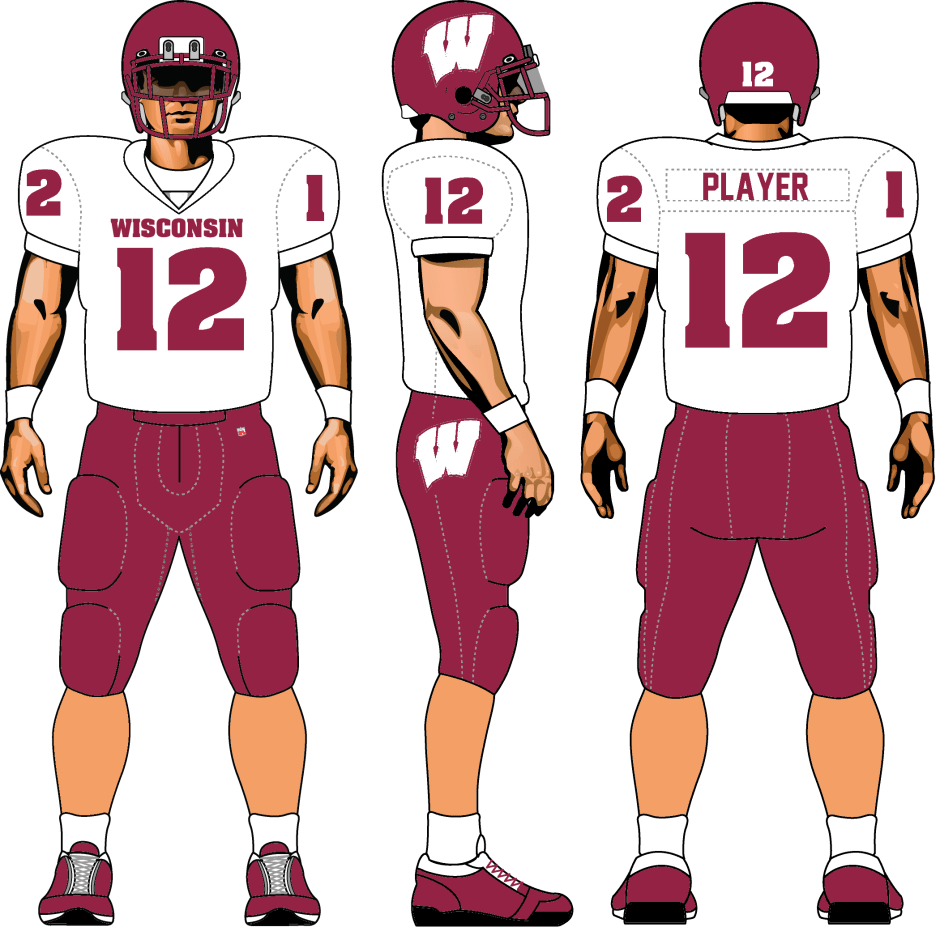
… there really isn’t much of one. There are red and white jerseys, red and white pants, and apparently three helmets — white, red with white facemasks, and red with black facemasks and trim. I’m not sure how you get to UW’s claimed 20 combinations — I count 12, although journalism is the opposite of math — and it’s unclear to me why two red helmets are needed, since the only difference between the two is the addition of black, which is not part of the phrase “cardinal and white,” the official UW colors.
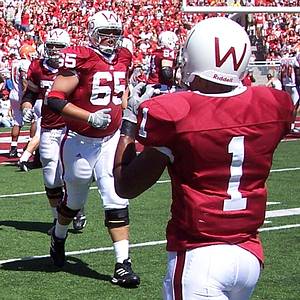
These photos do document, however, the problems with UW’s uniform design, as I have previously listed in this space. “Cardinal” should be between Ohio State’s (and now Rutgers’) scarlet and Indiana’s crimson. This red is not cardinal red. This is …
… from a throwback game commemorating the 1962 season.
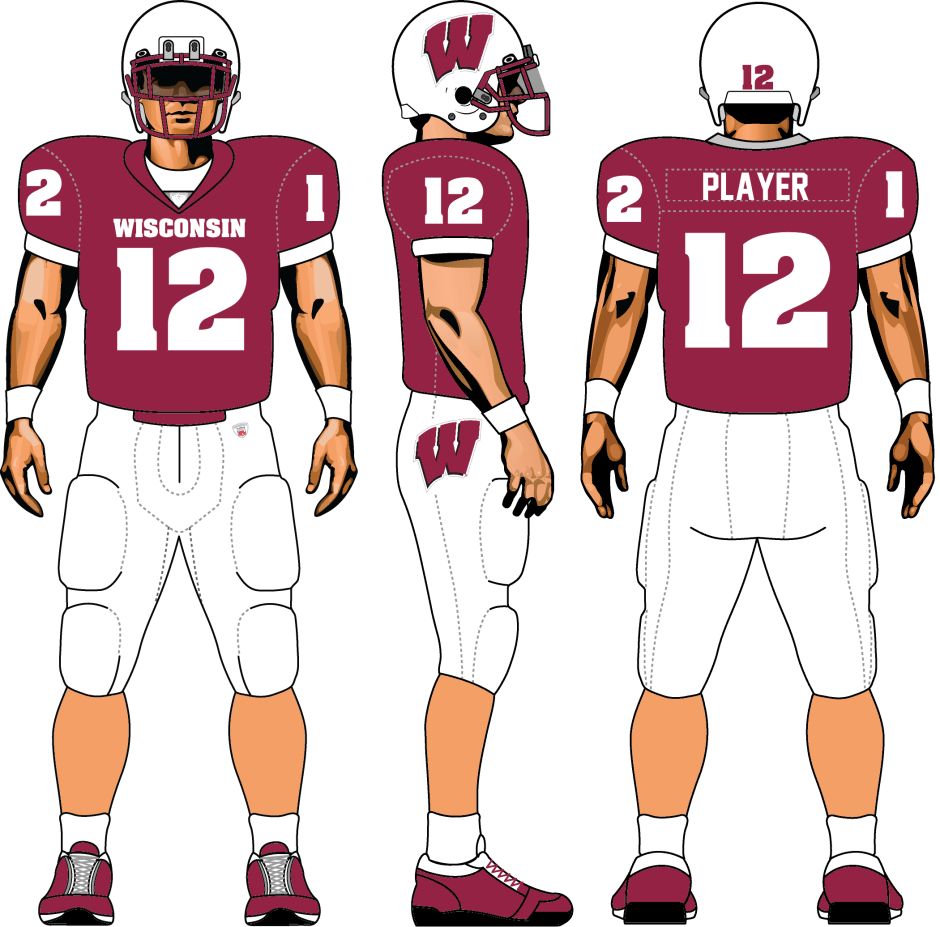
The side numbers are illegible and need to be moved to the top of the shoulders. The psuedostripe, which replaced the actual stripe because jerseys don’t have sleeves anymore, looks silly and should be eliminated.
Something like this is what the Badgers should be wearing — uniforms for home …
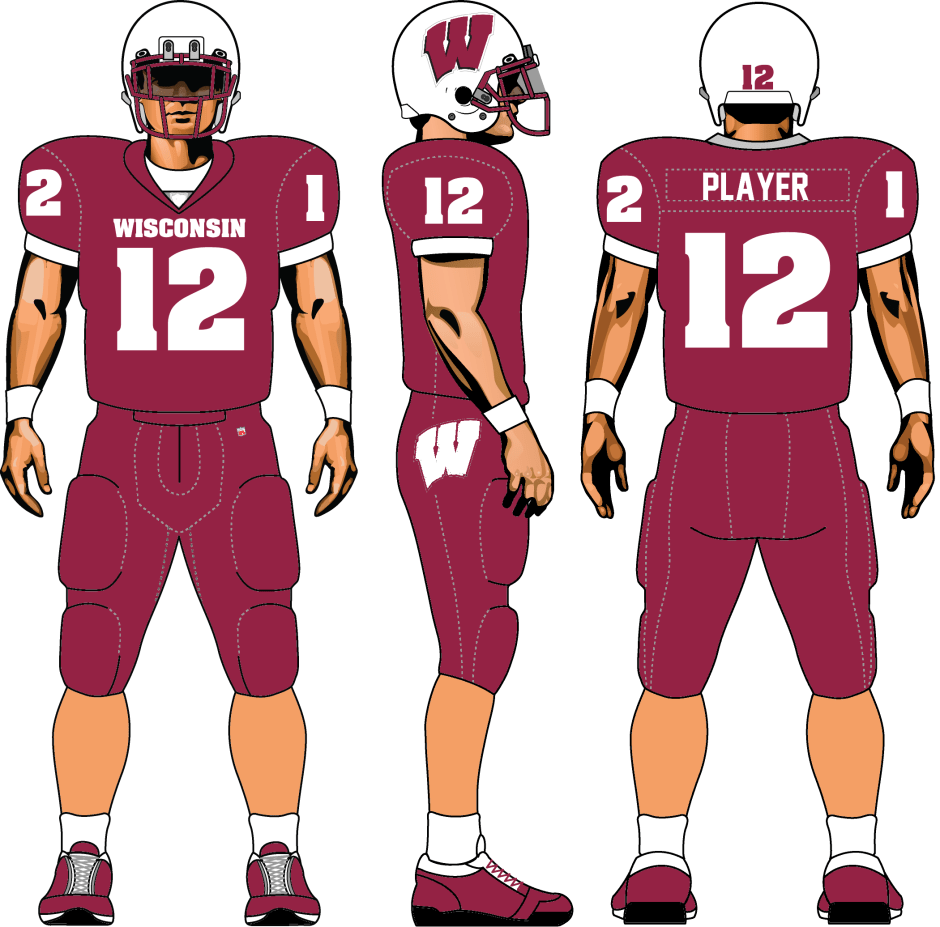
… special home games like Homecoming …
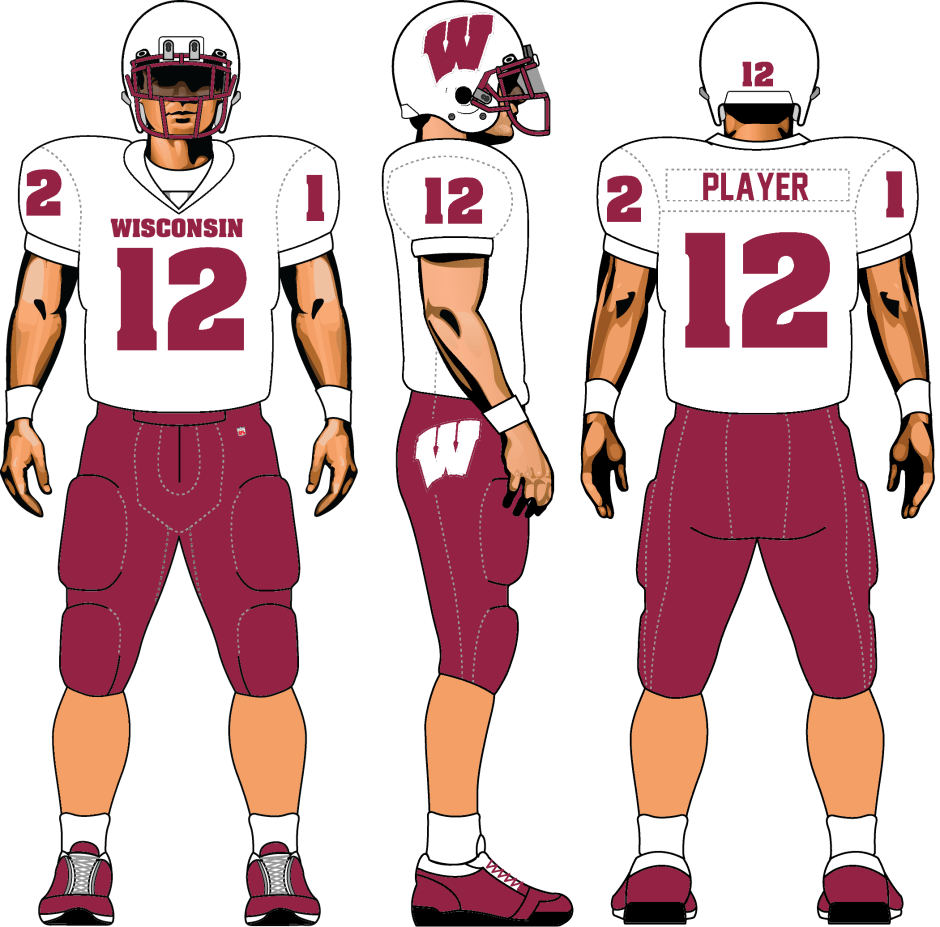
… road games where the opponent doesn’t have white or light-colored helmets …
… and road games where the opponent does have light helmets:
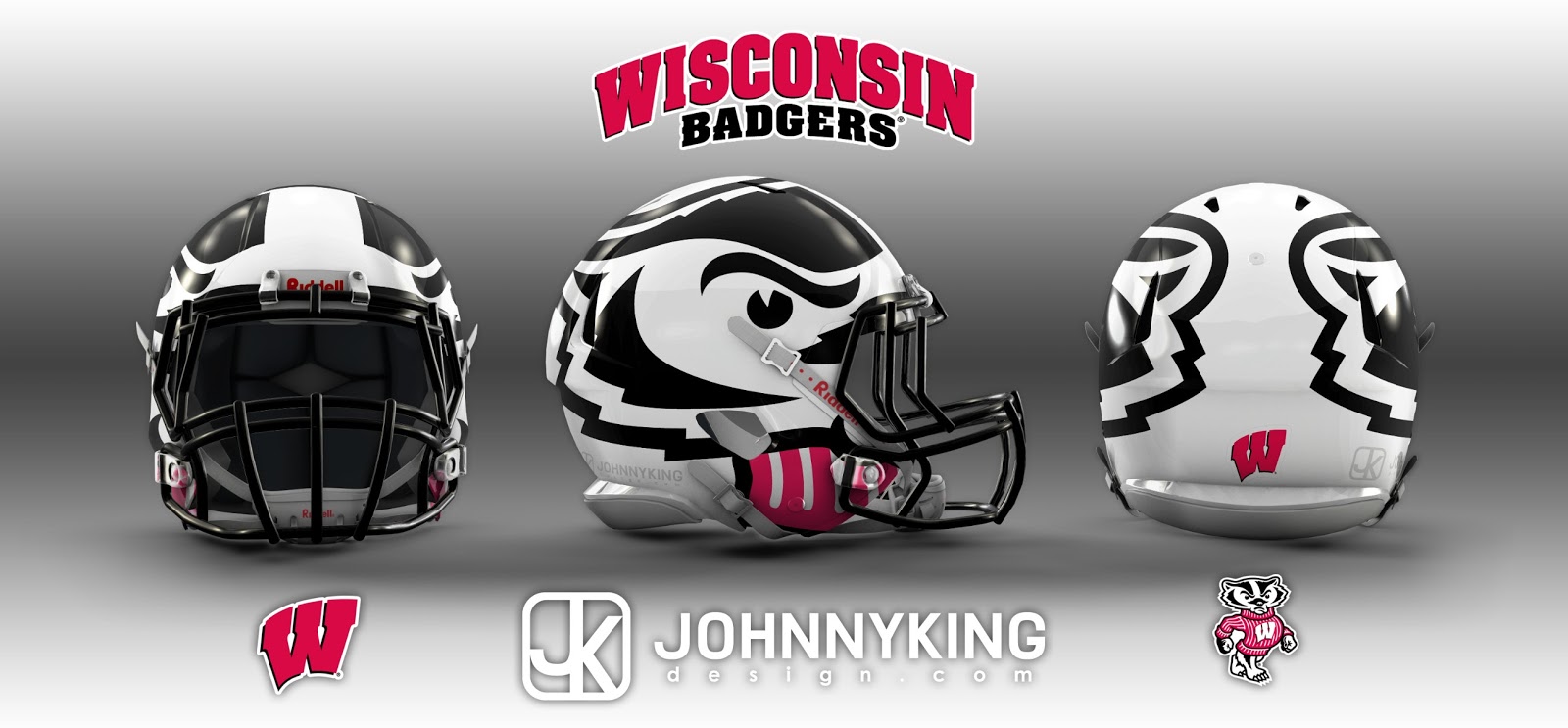
There is a design of a badger helmet floating around out there:
There is too much black in it, but that is an interesting idea to at least consider.


 Steve Prestegard.com: The Presteblog