Wisconsin Governor Tony Evers is outraged. Milwaukee Mayor Tom Barrett is outraged. Pretty much every Democrat in the state and thousands more following the ongoing saga of Wisconsin’s Spring Election are outraged. How dare Republicans endanger lives by holding in-person voting in the middle of the Coronavirus pandemic! How dare they force Wisconsinites to take their lives into their hands! How dare they…publicly say for weeks that the election must go on as scheduled and then abruptly reverse course only when members of their own party revolted against them a few days go?
They didn’t. Governor Evers did. And then he began disingenuously blaming Republicans in the Legislature for his own fecklessness.
On March 17th, the day after he issued an executive order banning public gatherings of more than ten people, he explicitly stated that he did not want to postpone the election.
“How long do we potentially leave offices not filled because we’re into July or August and we haven’t held a general election?” he rhetorically asked during a conference call with reporters.
“Moving this date is not going to solve the problem,” Evers told the Associated Press three days later. “We could move it to June, it could be worse in June. It could be worse in May.”
“Ensuring the health and safety of Wisconsinites is our top priority,” his spokeswoman added, “but the governor has said repeatedly that our democracy must continue.”
The same day, Evers issued a second executive order adding “any location or facility used as a polling location or in-person absentee voting” to the list of essential businesses that would remain open.
Even after he issued a “Safer at Home” order all but shutting down Wisconsin the following Tuesday, Evers refused to postpone the election.
A few days later, when a liberal group sued the state seeking a delay or cancellation of in-person voting, Evers even submitted a “friend of the court” brief in which he argued that “ultimately, a predominantly-by-mail election, with limited but available in-person voting, would be an achievable middle ground that would help protect Wisconsinites’ right to vote, while also helping to keep them safe.”
Only when POLITICO ran an article deeply critical of Evers’ obstinate refusal to postpone the election, the rest of the national media started piling on, and absentee ballot returns from heavily conservative counties started to flood in did he abruptly change course…five days before Election Day.
Nothing medically had changed. The virus wasn’t spreading any more rapidly than it was the day before, voting wasn’t any more dangerous than it had been, but Evers decided to deflect the blame to the Republican Legislature.
“If the governor had legitimate concerns, we could have come to a bipartisan solution weeks ago,” Assembly Speaker Robin Vos and Senate Majority Leader Scott Fitzgerald said in a joint statement on Friday. “This discussion would have happened long before today. The only bipartisan discussion we’ve had was to ensure the election would continue safely and to maximize the opportunity to vote absentee.”
Vos and Fitzgerald were open to postponing the election when Evers first started shutting down the state, but Evers refused to discuss the possibility. He was resolute in his decision to push forward.
Until, in an instant, he wasn’t. Then he was outraged, outraged that Republicans weren’t as caring and compassionate as he suddenly was. So outraged, in fact, that he felt as though he had no choice but to issue an executive order the day before the election postponing the vote for two full months.
“I cannot in good conscience stand by and do nothing,” Evers said in a news release announcing the order. “The bottom line is that I have an obligation to keep people safe, and that’s why I signed this executive order today.”
When the Wisconsin Supreme Court struck that order down a few hours later, Evers laid on the faux outrage even more thickly.
“Tomorrow in Wisconsin,” he said in a news release, “thousands will wake up and have to choose between exercising their right to vote and staying healthy and safe. In this time of historic crisis, it is a shame that two branches of government in this state chose to pass the buck instead of taking responsibility for the health and safety of the people we were elected to serve.”
In reality, the Wisconsin Supreme Court simply ruled that Governor Evers did not have the authority to unilaterally delay an election. And guess who agreed with them? Governor Evers, several days before he decided that he was outraged by it.
“We have three branches of government to ensure a system of checks and balances, and questions about our elections typically rely on all three playing a role,” he had tweeted on April First. “If I could have changed the election on my own I would have but I can’t without violating state law.”
“Folks, I can’t do this, move this election or change the rules on my own,” he added in a videotaped address two days later. “My hands are tied.”
The Supreme Court merely agreed with him, but now Evers is outraged that it did.
His faux outrage pales in comparison to that of his fellow Democrats, though, who have been working for days to convince Americans that Wisconsin Republicans—not Governor Evers—had insisted on holding the election amid the pandemic.
“Today, Wisconsin voters had to choose between making their voice heard and keeping themselves and their family safe,” tweeted former First Lady Michelle Obama. “No American should ever have to make that choice.”
“Voters Forced to Choose between Their Health and Their Civic Duty” screamed a headline in The New York Times.
“No one should have to make a choice between exercising their right to vote and staying safe during a public health crisis,” tweeted New Jersey Senator and former presidential candidate Cory Booker.
“This was a dark day for our democracy,” said Democratic National Committee Chairman Tom Perez. “In the middle of one of the worst public health emergencies in modern history, the Republican Party forced the people of Wisconsin to choose between their safety and their vote.”
Of course, no one did—at least no more than they have when they have gone to a supermarket to buy groceries, a liquor store to buy booze (since Evers allowed liquor stores to stay open), a sporting goods store to buy a basketball (since Evers allowed sporting goods stores to stay open), or a custard stand to buy a chocolate malt (yup, Evers even allowed them to stay open, too).
Voting is the only one of these activities that is a sacred right that Evers himself said “people have bled, fought, and died for…in this country.” If Coronavirus didn’t delay Wisconsinites’ ability to buy sporting goods, then why should it delay their right to vote?
No one was more hysterical in promoting the idea that Republicans were forcing voters to gamble with their lives than Milwaukee Mayor Tom Barrett (who is on the ballot facing re-election).
“Under the present circumstances, in-person voting, particularly with lines of people, is simply not safe, feasible, or responsible,” he wrote in an open letter to the Wisconsin Legislature on March 24th. “In good conscience I would not ask one of my loved ones to sit in a room for hours greeting dozens of people during this pandemic. I can’t expect citizens of my city to do that either.”
On Wednesday, he said during a conference call with reporters that it was flat out dangerous to vote in person.
“I don’t think that it’s good public policy, I think it’s dangerous during a pandemic,” The Milwaukee Journal Sentinel quoted him as saying. “And I hope that people do not go to the polls on Tuesday. As much as I want them to vote, I do not want them to put their lives in jeopardy, I don’t want them to put the health and safety of our poll workers in jeopardy.”
On Sunday, Barrett was so outraged that people would have to quite literally risk their lives to cast a ballot that he joined with other liberal mayors in Wisconsin to write a letter urging Health Services Secretary Andrea Palm to ban in-person voting.
“We need you to step up and stop the State of Wisconsin from putting hundreds of thousands of citizens at risk by requiring them to vote at the polls while this ugly pandemic spreads,” they wrote. “We believe it would be irresponsible and contrary to public health to conduct in-person voting throughout the state at the very time this disease is spreading rapidly.”
So outraged was Barrett that people would spread the disease even more rapidly by voting in person that he…voted in person himself.
On Saturday, the day before the letter was released to the public and after nearly two full weeks of Barrett venting his outrage over the specter of in-person voting, he cast his ballot in person at the Washington Park Library.
So unconcerned with the grave danger to his health and the health of the poll workers with whom he was coming into contact that Barrett didn’t bother to wear a mask, gloves, or any personal protective equipment at all.
Even though he had just ended 14 days of self-quarantine after coming into contact with someone who tested positive for Coronavirus, Barrett’s very first public action was to engage in the very behavior that he claimed was simply too risky for others.
His outrage over in-person voting was thus revealed to be rather obviously phony. It was, however, perfectly in line with the shameless political opportunism of his party. Democrats were perfectly fine with in-person voting for weeks when Evers insisted on it, and only shrieked about how dangerous it supposedly was when they could blame Republicans for it.
This is demonstrably transparent, and as disingenuous as it is cynical. If Democrats were really as concerned as they pretend to be about in-person voting spreading Coronavirus more acutely than an average Walmart, they would have criticized Barrett for voting in person and then holding a press conference at his polling place.
They were silent.
If Barrett really believed as surely as he pretended to that in-person voting was dangerous, he wouldn’t have done it himself (and certainly wouldn’t alert the press that he was going to do it).
It was all faux outrage, all of it. And it was all pre-packaged, weaponized against Republicans, amplified by a friendly media, and passed off to the public as genuine concern.
This may have been an unprecedented Spring Election in Wisconsin, but for Democrats, it was business as usual.
Month: April 2020
-
3 comments on Faux outrage
-
The Wall Street Journal writes an editorial that the Wisconsin State Journal should have, but didn’t:
Wisconsin held its election Tuesday on schedule despite coronavirus, and Democrats are blaming the Supreme Court for endangering public health. That’s not what happened. On Monday night the Justices rightly reversed a district judge’s last-minute order that would have allowed Wisconsin ballots to be cast after the election was legally over. The confusing episode is a reminder that, even in a pandemic, steps as grave as rewriting voting rules should be up to elected representatives and not freelanced by judges.
Wisconsin planned to mitigate the coronavirus threat with a large increase in vote-by-mail so fewer people would need to leave their homes. The Democratic National Committee sued to force the delay of the election outright.
Last Thursday a federal judge denied that extreme request but said vote-by-mail needed to be extended. Instead of receiving ballots by April 7, he said, clerks needed to count any ballots received by next Monday, April 13. After apparently realizing that this could distort the electoral process by allowing Tuesday’s reported results to influence votes, the judge issued another order banning the state elections board from reporting any results before April 13.
The Republican National Committee asked the U.S. Supreme Court to intervene, and five Justices agreed that the district judge was outside his authority. His remedy would “fundamentally alter the nature of the election by allowing voting for six additional days after the election,” they wrote in an unsigned opinion. By trying to muzzle election results, they added, “the District Court in essence enjoined non-parties to this lawsuit.”
The Supreme Court decision came an hour after the Wisconsin Supreme Court swatted aside Gov. Tony Evers’s effort to unilaterally postpone the election. Through March, Mr. Evers, a Democrat, had indicated the election should proceed and issued an executive order exempting polling places from his mass-gathering ban.
Yet liberal pressure built in recent days and on Monday Mr. Evers tried using his emergency powers to call off the next day’s voting. The state’s Supreme Court ruled 4-2 that he didn’t have that power—election law would need to be changed by the legislature (though in other states Governors’ emergency powers are broader). And so voting went ahead, with long lines at socially distanced polling places and a surge in absentee ballots—more than a million compared to less than a quarter million in 2016.
More than a dozen states have postponed their spring primary elections because of the virus. Yet Wisconsin’s election is more consequential than the all-but-finished Biden-Sanders primary that is the main item on the ballot in many states. A state Supreme Court seat and criminal-justice referendum are both contested. Postponing it by months could require altering the duration of elected officials’ terms.
Republicans in the Legislature didn’t show interest in postponing the election, but neither did Mr. Evers until recently. If voters are disappointed, they can hold legislators accountable in November or boot Mr. Evers in 2022.
The pandemic has disrupted much of American life and voting is no exception. But both the district judge’s jury-rigged order and Mr. Evers’s last minute 180-turn under political pressure set a bad precedent. This virus will be here for some time, and people in different states need to deal with it through the democratic process. Americans have already temporarily lost some of our freedom and we shouldn’t also toss out the rule of law.
-
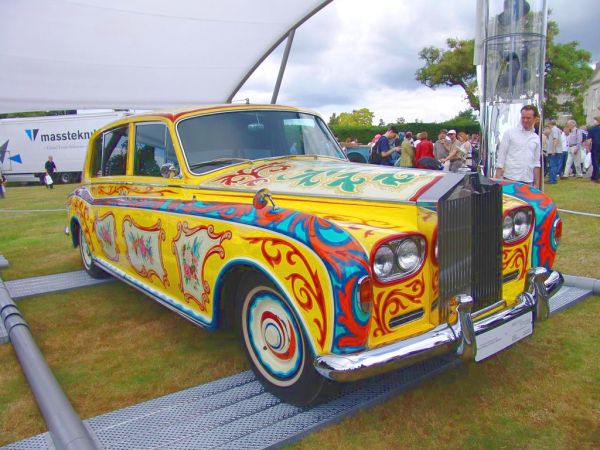
Today in 1967, John Lennon took his Rolls–Royce to J.P. Fallon Ltd. in Surrey, England, to see if it could paint the car in psychedelic colors. The result three months later:
The number one single today in 1973:
-
Michael Smith is …
Posting this as a gigantic “what if” question.The fact that I now personally know two people who fell ill and tested positive for SARS-CoV-2 from two different states TRIGGERED me.
They both reported feeling bad for about 3-4 days, were really ill for around 5-6 (said it was like the worst flu they have ever had), took about another 5 days or so to feel back to almost normal – roughly a 15 day cycle. Both had flu shots but other than that, had nothing other than natural defenses. Thankfully, those were enough to keep them out of the hospital.
So that gave rise to the “what if”.
What if, like HIV, there is no therapy of vaccine for the SARS-CoV-2 viral infection for two or three decades in the future?
Hell, the common cold doesn’t kill us – thank God — but we haven’t figured out how to stop it yet, this variant of the coronavirus might be the same.
The current assumption is that the pandemic would be far worse without the “radical steps” that have been taken — but would it? How do we know?
The reason “flattening the curve” is important is not that self-isolation and social distancing will arrest the virus, it only provides a degree of relief from over-stressing hospitals, medical staff and the supply of medical equipment — so we aren’t fighting the virus with these radical steps, we are fighting scarcity. We’re managing an economic reality, not a medical one.
As many have pointed out, self-isolation, social distancing, masks and medical grade gloves only deprive the virus of fresh skin-covered meat sacks to infect, the virus won’t just die from loneliness.
If NY Governor Nipple Piercings is to be believed, only one in five make it off the vent once they go on, so you have to wonder if putting people on vents is just so we can say we did everything we could even though we know that four out of five are likely too sick to make it.
I’m not suggesting we shouldn’t – I know if it was my family, I would want every measure taken until running out of options — but there comes a time when we learn what conditions can be reversed and which cannot. We do it all the time with cancer.
If therapies or a vaccine aren’t on the near-term horizon, continuing to isolate will only destroy the economy — and it would seem that the same number of people will die, albeit over a longer period of time.
Like I have said, there are no good answers at present, only less bad ones.
-
Today in 1956, the CBS Radio Network premiered Alan Freed’s “Rock and Roll Dance Party.”
The number one single today in 1958:
Today in 1962, Mick Jagger and Keith Richards met someone who called himself Elmo Lewis. His real name was Brian Jones.
-
Rick Esenberg:
A few observations on the election mess here in Wisconsin:
There is reason to be concerned about in-person voting but it’s not clear how much risk voting will actually present. Much of the rhetoric assumes that voters and poll workers will be facing the equivalent of a free fire zone. That’s understandable. Fear of the virus has lead all of us to feel that it is everywhere. But it’s not true. Unless the virus is largely asymptomatic or causes only mild illness, very few people are infected. There some risk in going anywhere but we’ve decided that risk is worth assuming for a variety of reasons. It’s not clear that the line must stop before voting. It is not clear that the polling places will – or have to be – more crowded than the Sendik’s grocery store I was in twice this week in which it was impossible to maintain social distancing. On the one hand, I have rarely been in a polling place for a spring election that has as many people as the typical grocery store has had during the past week. On the other hand, consolidation of polling places will presumably result in more traffic at each one. How much is unclear. Absentee ballot requests are approaching the average turnout in a typical spring election. While presidential preference primaries increase turnout, I don’t know how likely that is given that the Democrats’ race is over and there seems to be no campaign here. Having in-person voting clearly involves contact without social distancing. How much more is unclear. I guess we’ll see.
Having said that, a reasonable case could be made for a delay (although there are some problems with that case). The problem is that changing the rules in midstream is likely to disadvantage one side or the other. Republicans don’t want to go all-mail voting because they seem to believe that their voters are less likely to vote by mail and because they are concerned about voter fraud. Absentee voting creates more opportunities for fraud, particularly if not accompanied by appropriate safeguards – which the Democrats have been seeking to remove. Democrats, on the other hand, are concerned that fear of the virus is strongest in places where they are strong and that are concerned that ballot security measures discourage their voters who they believe will not or cannot navigate them. Our current election rules are a product of where the conflict between those competing views has come out. Using the virus as a way to adjust the balance that current law reflects was always going to assure that no change in the election could take place. If Democrats and Republicans wanted to delay the election, they should have agreed to do that and only that. They should have agreed that the election would be held in, say, early June without changing any other aspect of the law including the opportunity for in-person voting. Since there was apparently no appetite for that on either side – or guarantee that the situation in June would be much different, it didn’t happen.
But a delay would have presented problems. Many local offices have terms expiring in April. While the legislature could have extended the terms, it could not create incumbents to hold over where such incumbents did not exist. Legislators could hope that, for example, Chris Abele would stay on as County Executive in Milwaukee, but could not make him do it. Delaying the election was going to create vacancies during a challenging time for local government. In addition, asking local units of government to safeguard a million ballots for two months without having them misplaced, mishandled or tampered with may have been too much to expect.
The order entered by Judge Conley on Thursday accomplishes a de facto extension of the election by enjoining the requirement in state law that absentee ballots be received by 8 pm on Tuesday while not requiring that they be postmarked by election day. This extends the voting by a week, making election day April 13 for those who requested absentee ballots. While he later amended the order to prevent WEC from disclosing unofficial results, it does appear to apply to everyone who will be privy to them and, of course, will not prevent them from leaking. We are now looking at a situation where both sides will ballot harvest after voting is over and may know what they “need.” Information regarding who has returned a ballot may not be uniformly available. If the election is close, litigation – and suspicion – may break out all over.
May?
-
Richard Nixon’s attack dog, Spiro Agnew, described the late 1960s news media as ”nattering nabobs of negatives.”
Five decades later, former presidential press secretary Ari Fleischer:
If President Trump is a wartime president, does that make Washington reporters wartime correspondents?
Even before coronavirus, I often wondered if today’s press corps had covered the allied landing at D-Day in June 1944, if their stories would have led with the disastrous American landing on Omaha Beach, the paratroopers who dropped miles away from their targets and the submersible tanks that sunk to the bottom of the English Channel before ever touching land.
The media’s job is to cover all sides of a story. They are not.Indeed, if each of these genuine military setbacks had been the lead story, the American people might have lost the will to fight the rest of the war.
Which brings me to today’s press corps.
Since Vietnam and Watergate, the Washington press corps has earned its chops by taking on those in power, relentlessly questioning what they are told, particularly when they’re told it by a Republican President, and doing their best to expose mistakes, misstatements and problems. When something goes wrong, the press shines a light on it.
“It’s not news when an airplane lands” goes the old journalistic saw. “It’s only news when a plane crashes.”
This helps explains NBC reporter Peter Alexander’s now infamous clash with President Trump over the efficacy of a drug meant to treat malaria for which the president expressed hope that it might (not will, but might) be able to treat the coronavirus as well.
Reporters, who routinely publish worst-case estimates about the impact of coronavirus, took a firm stand against the president’s hopeful point of view, led by Alexander, who took particular umbrage.
“Is it possible — it possible that your impulse to put a positive spin on things may be giving Americans a false sense of hope, and misrepresenting the preparedness right now?” Alexander asked.
After the president again, even-handedly, said the drug might work and it might not, Alexander’s pessimism peaked.
“Nearly 200 dead. What do you say to Americans who are scared, though? I guess, nearly 200 dead; 14,000 who are sick; millions, as you witness, who are scared right now. What do you say to Americans who are watching you right now who are scared?”
To which the president in his usual subtle style replied, “You’re a terrible reporter.”
On March 25, the Gallup organization released a poll that was good for the President and bad for the press.
60% of the American people approve of the way President Trump is handling his response to this crisis and only 38% disapprove. But only 44% approve of the way the news media is handling its response, with 55% disapproving.
As the president’s approval goes up, several prominent columnists and talking heads have called for the televised briefings to come down. Don’t show the briefings live, cried MSNBC’s Rachel Maddow, along with the Washington Post’s Margaret Sullivan and Karen Tumulty. In WW II, the government censored reporters. Now, these reporters want to censor the government.
NBC’s Chuck Todd sunk to a new low when he asked Joe Biden on “Meet the Press” if Biden thought there was “blood on the president’s hands considering the slow response.” He caught himself mid-sentence and added, “or is that too harsh a criticism?”
In all times, reporters have a vital role to play in keeping our country free. The First Amendment gives reporters the right to ask whatever they want, however they want.
Too many journalists are fighting the last war, and they’re only hurting themselves. Many reporters do ask tough, non-accusatory questions about how to fix problems, fight the illness and get America back on its feet.
But if this becomes a fight between a president who realistically represents hope and reporters who reject it, that’s a fight the press can’t win.
-
Today in 1956, Elvis Presley signed a seven-year contract with Paramount Studios.
The movies won no Academy Awards, but sold a lot of tickets and a lot of records.
The number one album today in 1968 was the soundtrack to “The Graduate”:
-
The number one album today in 1980 was Genesis’ “Duke”:
Today in 1985, more than 5,000 radio stations played this at 3:50 p.m. Greenwich Mean Time, which is 9:50 a.m. Central time (but Standard or Daylight?):
-
Michael Smith:
There sure seems to be an undercurrent of worry that the more sparsely populated areas of this country might advance economically while the more densely populated cities languish as a result of the physical reality of disease transmission.Cities have a transmission modality that simply cannot be overcome absent a vaccine for this virus. The reality is that the only reason any “curve flattening” is happening today is that the virus is being deprived of fresh victims, that solution provides little more than a temporary respite and a false sense of security – because the underlying condition promoting spread – the population density – has not changed.
National policy is being driven by a fear that originated in our major population centers.
I get it. Nobody wants to spread this disease – but the fact is that New York state’s 2900 deaths would have to increase by 27 times to equal the 79,000 annual deaths due to heart disease and cancer the CDC reported for the state in 2017 (the latest I could find at the CDC website).
At 7900 deaths nationwide so far, this pandemic doesn’t crack the top 50 for mortality classifications in the nation.
I understand the pandemic deaths are concentrated in a short period of time and when things happen over a short period, they have more impact – but I still question the need for Kansas or Utah to be driven by situations in New York.
The real pandemic is not the SARS-CoV-2 virus, it’s fear.
Wisconsin is a perfect example of what Smith is talking about. As of Friday out of Wisconsin’s 1,916 cases, 955 are in Milwaukee County and 244 are in Dane County. Some counties have not had a single case, and other counties’ measure in the single digits. Yet state government is stupidly treating every part of Wisconsin the same, mandating, for instance, statewide school closings when school administrators could have told you that was a really bad idea.
If politicians weren’t being profiles in cowardice maybe after this ends they could figure out that the state should not treat, for instance, Milwaukee and Marathon the same. And perhaps small towns could market themselves as superior places to live over crime-plagued and now disease-riddled urban areas.
 Steve Prestegard.com: The Presteblog