Whether you’re a fan of the proposed Milwaukee Bucks arena deal announced Thursday, you have to give Gov. Scott Walker credit for coming up with a sort-of novel rationale — financial conservation:
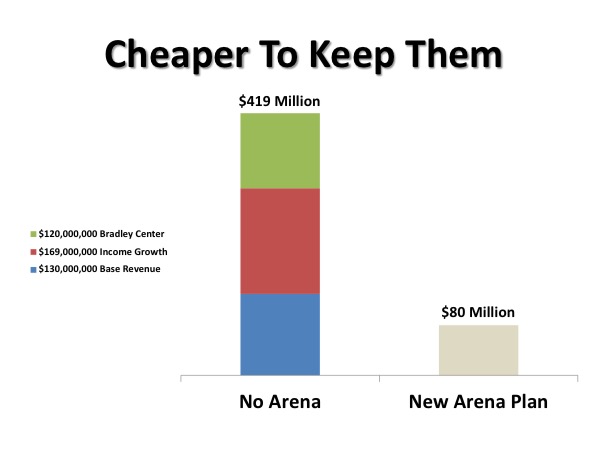
Today, Governor Scott Walker joined state and local leaders, including Speaker Robin Vos, Majority Leader Fitzgerald, Milwaukee County Executive Chris Abele, and Milwaukee Mayor Tom Barrett in announcing a plan to protect state taxpayers from a loss of approximately $419 million, if the NBA relocates the Milwaukee Bucks. The total state contribution will be capped at $80 million.
“We’ve considered the financial impacts on the state should the Bucks stay or go, and quite simply, we found it’s cheaper to keep them,” Governor Walker said. “Our plan is the result of a state and local, public and private alliance, and it is developed with the goal of ensuring a good return to our state taxpayers. Under this plan, for every dollar the state invests, state taxpayers will get a $3 return on that investment.”
In April 2014, new owners bought the Milwaukee Bucks from Herb Kohl in a deal approved by the NBA and contingent upon the construction of a new arena by 2017. If a new arena is not constructed by 2017, the NBA will buy the Bucks back from the current owners and move the team to another state.
If the team is relocated, there will be a loss to state taxpayers of at least $419 million over the next 20 years due to the loss of current revenue, future growth, and the ongoing costs to maintain the Bradley Center.
Current and former team ownership committed to fund $250 million toward funding the $500 million arena project. Under this plan, state and local governments will also fund $250 million, or half of the total project costs, toward building the new arena without tax increases or state bonding. Any cost overruns would be paid by other sources, but not the state.
Working together with local leaders, Governor Walker, Speaker Vos, and Majority Leader Fitzgerald developed a plan that will cap the total state investment in the project at $80 million over 20 years. Over a 20-year period, this plan protects $299 million in income tax revenue, including the base and projected growth.
Basically Walker is saying that the $250 million taxpayers — $80 million from the state, and $170 million from Milwaukee County and the City of Milwaukee — will be spending on the new arena will “protect” $299 million in income tax revenue, but having the Bucks leave will be a bigger loss, $417 million.

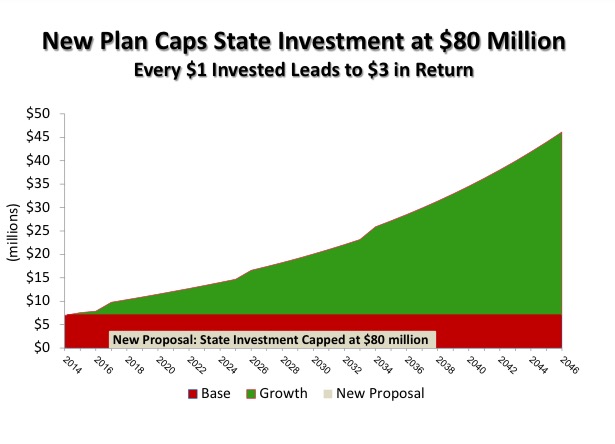
Wisconsinites, whether they are Bucks fans or not, will be on the hook for less than $1 per year for 20 years. I suppose state government has spent money on worse things over the years, though if you find it strange that a Republican is using the word “investment,” usually a Democratic tactic to justify spending tax dollars, you’re not alone. The $80 million could be thought of as a couple of years’ worth of spending by the previous governor to purchase land with absolutely zero return for taxpayers. (That would be the Knowles-Nelson Stewardship Fund, which Republicans apparently lack the guts to kill.)
The fact that state taxpayers pay less than one-third of the public-sector costs — less than one-sixth of the total cost — makes some logical sense, though whether it makes political sense remains to be seen. At least with Republicans in charge it seems the chance of taxes being raised to support this spending seems less likely.
There is an additional potential cost to the Bucks’ leaving, and I’m surprised no Bucks supporter has brought this up yet. Similar to the NFL with Los Angeles (which is reportedly being pined over by the Rams, Raiders and Chargers, all of which used to play in the same L.A. stadium), two cities are named when the subject of the potential move of NBA franchises comes up — Seattle and Kansas City, both of which used to have NBA teams. Kansas City has the Sprint Center, a new arena without a major pro sports tenant, and Seattle has the Key Arena, the former home of the former Sonics, now the Oklahoma City Thunder. If you were the NBA, wouldn’t you rather have a team in Seattle than in Milwaukee?
The additional potential cost is not just the tax revenue lost by losing the Bucks; it’s the money spent to replace the Bucks with another NBA team when political pressure ramps up to get a replacement pro sports franchise. (The Bucks are not going to be replaced by a National Hockey League team; when your current pro hockey team, the Admirals, draws only a few thousand people every night in an arena four times that size, that doesn’t say “growth market” to anyone.) In addition to Kansas City (which also lost the NHL’s Scouts to Colorado and then New Jersey) and Seattle, Buffalo had the Braves, which became the San Diego and then Los Angeles Clippers, and Cincinnati had the Royals, which became the Kansas City and then Sacramento Kings. Cincinnati is in the same boat as Kansas City, with neither an NBA nor an NHL franchise on which to get people to spend money.
It would be interesting to know how much Baltimore spent to get the Cleveland Browns to move there after the Colts left for Indianapolis, and how much Cleveland spent to get the second edition of the Browns as an NFL expansion team, not to mention how much Nashville spent to get the Houston Oilers, and how much Houston spent to get the expansion Texans. In each case, the minimum answer is: A new stadium, cost nine digits.
This is not the good old days (if that’s what you want to call them) where, for instance, when the Milwaukee Hawks left for St. Louis and the Braves left for Atlanta, the Milwaukee Arena and Milwaukee County Stadium were there waiting for new tenants. If the Bucks leave, the number one demand of a potential new team owner will be a new state-of-the-then-art stadium. As it is, without the Bucks whether the Bradley Center needs to be there is an open question. The Admirals’ apparent fan base certainly fits into the Arena, and I doubt that Marquette basketball would be a money-maker for the Bradley Center by itself, given that college teams have fewer than half the home dates of an NBA team.
The same applies to baseball. Washington lost the Senators to Minnesota in 1961, got another Senators team and lost that to Texas in 1972, and then got the Nationals from Montreal, which won’t be getting a replacement team to occupy the hideous money-sucking Olympic Stadium. Beyond the late Braves, Royals, (Kansas City) Kings and (San Diego) Clippers, the NBA’s New Orleans Jazz moved to Utah, eventually replaced by the Charlotte Hornets; Charlotte had to build a new arena for the expansion Bobcats. (More confusing, the former Hornets are now the Pelicans, and the Bobcats are now the Hornets again.)
There was a TV commercial years ago in which a mechanic touted the value of preventive maintenance by saying, “Pay me now or pay me later.” A similar metaphor probably applies to pro sports franchises as well, in that keeping a used car, including maintenance costs, is cheaper than buying a new car, including payments. Whether Walker’s numbers are correct, logic says that if the Bucks leave, replacing them will be considerably more expensive.
The bigger issue is whether or not people care about the Bucks and their leaving without a new arena. There probably were Wisconsinites in the mid-1960s who said they didn’t care about the Braves’ leaving for Atlanta. One year after the last Milwaukee Braves game, Gov. John Reynolds and the state Supreme Court chief justice, who ruled in favor of the Braves’ being able to leave (though he delayed their departure for one year), were bounced from office.
 Steve Prestegard.com: The Presteblog
Leave a comment