Today in 1956, Nat King Cole became the first black man to host a TV show, on NBC:
The number one single today in 1966:
Today in 1971, Elvis Presley performed at the Met Center in Bloomington, Minn. To get the fans to leave after repeated encore requests, announcer Al Dvorin announced, “Elvis has left the building.”
You’ll recall that Cash for Clunkers gave buyers up to $4,500 in vouchers to trade in older cars for new one. The goal was to stimulate then-lagging auto sales and hopefully get old, smog-spewing vehicles off the road for good in exchange for newer, cleaner ones.
But the Brookings Institution reports Cash for Clunkers wasn’t all that great as far as economic stimulus programs go. As noted in the Washington Post, almost any other program would have been better in that regard.
Their biggest beef is jobs created by Cash for Clunkers, and how expensive that ended up being:
[The Brookings Institution’s Ted Gayer and Emily Parker] estimate that pulling these vehicle sales forward probably boosted GDP by about $2 billion and created around 2,050 jobs. That means the program cost about $1.4 million per job created — far less effective than other conventional fiscal stimulus measures, such as cutting payroll taxes or boosting unemployment benefits.
Emphasis mine. More cost-effective ways of adding those jobs include reducing the employee and employer payroll tax and boosting unemployment aid, they say. The Post cites another study that said the 2009 Recovery Act could have been 30 percent more effective had it focused more on aid to states and payroll tax cuts.
Another issue is whether Cash for Clunkers really aided car sales in the long run. The Brookings people say Cash for Clinkers just made Americans purchase cars slightly earlier than they would have otherwise: Cumulative purchases in 2009 were basically unchanged, the report says.
Now, it’s not all doom and gloom when it comes to Cash for Clunkers, except of course for all those genuinely awesome performance cars that got junked in the process. The Post says the program was indeed successful at cutting down on carbon dioxide emissions — the equivalent of taking up to 5 million cars off the road for a year even though only 700,000 old cars were traded in. However, they say it would not have been as cost-effective as implementing a carbon tax.
Plus, there was no guarantee that buyers would get into something truly more efficient than their old cars:
The 2011 Resources for the Future study found that Cash for Clunkers increased average fuel economy in the United States by just 0.65 miles per gallon. But, similarly, that study found that there were far cheaper ways to achieve similar savings.
There are a couple reasons the savings might have been so small. For one thing, the fuel-economy requirements were relatively lax: A person could, in theory, trade in a Hummer that got 14 mpg and get a $3,500 voucher for a new 18-mpg SUV. What’s more, the gain in efficiency would be partially offset by the energy costs involved in manufacturing the new car.
It costs energy to build new cars! Shocking.
I could not care less about reducing carbon dioxide emissions. That pales in comparison to the grotesque waste of destroying functioning cars. Care to guess the repossession rate of new cars purchased by people who had “clunker” cars precisely because they couldn’t afford new cars? Meanwhile, cars that could have served as functional transportation for poor people were crushed — not even stripped for usable parts such as tires. As a result, used cars today are less affordable than they were five years ago.
Why does this matter? It was just one tiny program, after all. Yet inefficient stimulus programs add up. One recent study by economists Gerald Carlino and Robert Inman found that the 2009 Recovery Act could have been fully 30 percent more effective in boosting the economy if it had been better designed (i.e., more focused on things like aid to states and payroll tax cuts).
It would have been preferable for all of the Big Three to go out of business (which wouldn’t have happened anyway) than to have had the Cash for Clunkers abomination.
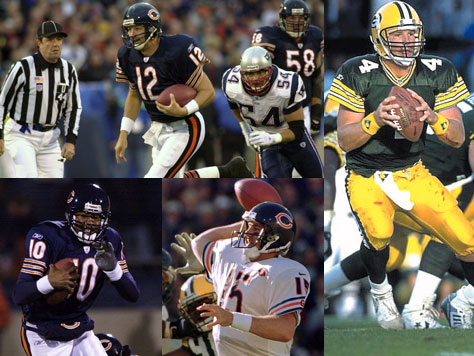
Packers News has an interactive comparison of quarterbacking between the Bears and the Packers.
The latter has had three starting quarterbacks since 1992:
Brett Favre.
Aaron Rodgers.
Matt Flynn (once when Rodgers was concussed in 2010, and once at the end of the 2011 season).
In that time span, Da Bears have had 26 starting quarterbacks …
… starting with 1992 …
… and 1998, with three Bears starters …
… followed one year later with three different Bears starters …
… and three more in 2002 …
… and three in 2003 …
… followed by four a year after that …
… and, well, you get the idea.
But this is not a recent phenomenon. Before a 2007 Sunday NIght Football game (which is to say three quarterbacks ago, which is a low count by Bears standards), Keith Olbermann hilariously chronicled the Bears’ quarterback woes dating back to the 1950s, calling it “one of the NFL’s great unrecognized traditions. With brief interruptions of stability from the likes of Jim McMahon and Billy Wade, this job has been unsettled since Sid Luckman retired. There has always been a Rex Grossman, he has always underperformed, and they have always been about to replace him.”
Olbermann pointed out that the Bears drafted, and then got rid of, Hall of Fame quarterback Bobby Layne, and told 31-year-old George Blanda he was too old to play quarterback. That was in 1958, just before Blanda went to the American Football League and won two AFL titles. That was 12 years before Blanda played quarterback for the Oakland Raiders, at age 43. The number of Bears quarterbacks who have won NFL titles since the Bears introduced the T-formation include:
Sid Luckman (four titles between 1940 and 1946).
Billy Wade (1963).
Jim McMahon (Super Bowl XX).
Grossman somehow got Da Bears to a Super Bowl, but Da Bears reverted to traditional offensive form that night and lost. Da Bears acquired Jay Cutler in an effort to fix their decades-long quarterback issues.
Tonight, Josh McCown (not to be confused with Cade McNown) starts because Cutler has a groin injury. (Insert joke here.)
Today in 1963, John Lennon showed his ability to generate publicity at the Beatles’ performance at the Royal Variety Show at the Prince of Wales Theatre in London. The Queen Mother and Princess Margaret were in attendance, so perhaps they were the target of Lennon’s comment, “In the cheaper seats you clap your hands. The rest of you, just rattle your jewelry.”
The number one single today in 1965:
The number one single today in 1972:
Today in 1990, Melissa Ethridge and her “life partner” Julie Cypher appeared on the cover of Newsweek magazine for its cover story on gay parenting.
I bring this up only to point out that Etheridge and Cypher no longer are life partners, Cypher (the ex-wife of actor Lou Diamond Phillips) is now married to another man, and Etheridge became engaged to another woman, but they split before their planned California wedding. And, by the way, Cypher had two children from the “contribution” of David Crosby, and Etheridge’s second woman had children from another man. Draw your own conclusions.
Today in 1964, a fan at a Rolling Stones concert in Cleveland fell out of the balcony. That prompted Cleveland Mayor Ralph Locker to ban pop music concerts in the city, saying, “Such groups do not add to the community’s culture or entertainment.” Kind of ironic that the Rock and Roll Hall of Fame ended up in Cleveland.
Wisconsinites know that the first radio station was what now is WHA in Madison. Today in 1920, the nation’s first commercial radio station, KDKA in Pittsburgh, went on the air.
The number one British single today in 1956 is the only number one song cowritten by a vice president, Charles Dawes:
The number one song today in 1974:
The number one British album today in 1985 was Simple Minds’ “Once Upon a Time” …
Packers–Bears is the oldest rivalry in the National Football League. I first came upon it when the Packers and Bears were at similar levels of ineptitude in the ’70s.
Then the Bears hired Mike Ditka and became one of the best teams of the 1980s.
Given their talent, the Bears probably should have won more than one Super Bowl.
I’ll have to read Rich Cohen’s new book, Monsters: The 1985 Chicago Bears and the Wild Heart of Football when it goes on sale. For one thing, the Bears’ most successful years dovetail with the years they held their training camp at UW-Platteville.
GQ has one excerpt focusing on Da Coach, Mike Ditka, as a player …
The pieces of the 1985 Bears began to come together in 1939, when Mike Ditka was born in Carnegie, Pennsylvania. His parents had emigrated from Ukraine, where the family name was Dyczko, which each uncle Americanized in his own way, Disco being the least fortunate variation. It’s hard to imagine Mike Disco becoming anything but a dancing machine; Ditka was more appropriate for a son of Aliquippa, the tough west Pennsylvania factory town where he spent his formative years. The coach’s father worked as a welder in a steel mill, “a burner” on a train that ran through the factory that employed just about everyone in town. The old man would come home with blisters on his hands, wounds of a working life. He’d been a Marine and was a strict disciplinarian. “What he said, he said, that was it,” Ditka wrote. “He didn’t spare the rod.” Ditka’s autobiography is filled with phrases like “worst beating of my life.” “If I didn’t [do what he said],” wrote Ditka, “he gave me a hard time. By a hard time, I mean he simply whipped my ass.” Such poundings usually came in response to some bit of mischief. A neighbor once described young Mike Ditka as “a high intensity boy.” On one occasion, experimenting with cigarettes, he burned down a stand of trees behind the family house. When Ditka’s father came home, he wondered what had happened “to the forest.”
“Ask your son,” his wife told him.
“I got nailed,” Ditka wrote. “He had an old leather Marine belt. It was probably the hardest whipping I ever got.”
Some people, you see a picture of them taken in third or fourth grade, you have no idea who it is. Of course, when you’re told, the features reassemble themselves in a familiar way and you think, Oh yeah, now I see my friend. But with Ditka, you know right away: the chipmunk cheeks and broad forehead, the mouth turned fiercely down, the amused glint, the peaked, bearlike hairline—it was all there from the start. And the smile. Mike Ditka has a great smile. It wrinkles his cheeks and makes his eyes vanish. It’s a cute smile, surprisingly adorable in an otherwise tough face. In fact, it’s so cute it’s scary. If a bear smiled at you, that would be scary, too. You see a thing like that in the woods, you think, I’m done. …
When the Bears drafted Ditka first in 1961, it was with another idea in mind. Halas and his assistant, George Allen, wanted to put Ditka on the offensive line. He would block on most plays but now and then skirt away from the trenches, head downfield ten or fifteen yards, turn around, and catch a pass. Winning football games is not about pitting strength against strength, speed against speed. It’s about finding a mismatch, a situation in which their little guy has to tackle your monster, or their monster has to chase your sprinter. If Ditka got downfield, he’d be covered by defensive backs half his size. It was a strategy made possible only by Ditka’s special gift: Big guys almost never had such soft hands. In this way, Halas created what has since become a dominant weapon in the NFL: Mike Ditka was the first modern tight end. “Nobody threw to the tight end back then,” he told me. “He was just another guy on the line of scrimmage, next to the tackle. Then Halas had this idea to throw me the ball. He realized it was hard for me to get off the line when I was next to the tackle, so he moved me three or four yards down. I was the first tight end to flex out.” …
Ditka had the hands but caught the ball in the untutored way of the sandlot. Turning what you’ve always done by instinct into a practice, a trade—that’s what makes you a professional. Halas brought Sid Luckman back to work with Ditka, teach him the proper way to catch. Sid was forty-four years old, gray, soft, ancient, a figure of lore. He had a method, a way to concentrate the rookie. He gathered a pile of footballs and wrote a number on each: 27, 61, 33. Ditka ran pattern after pattern. As soon as he made a catch, he had to call out the number on the ball. This would teach him the art of high focus: just you and the ball, watching it all the way into your hands. In 1961, Ditka caught 56 passes for 1,076 yards. He scored twelve touchdowns. No tight end had ever done anything like it. He was named Rookie of the Year and made the Pro Bowl, an honor he would secure in each of his first four seasons.
It was not just the statistics that earned Ditka respect—it was how he played, the fierceness of his game. He answered every challenge, returned every insult. He tore it up. In his fifth game, the Bears played the Baltimore Colts, where Ditka faced Bill Pellington, one of the toughest linebackers in football. He’d knocked the Lions’ tight end Jim Gibbons out not long before. “So all week all I heard was how tough Bill Pellington was and how he was going to knock the crap out of me,” Ditka wrote later. “Well, I lined up on the first play from scrimmage and by God they were right. He punched me right in the mouth. I wore that little, thin bar [on my helmet] that didn’t protect anything. He punched me right in the mouth and I said, ‘Oh. Boy.’ On the next play— I don’t know what the play was—didn’t matter. I didn’t even care. I don’t know if it was a pass play or a run. I just gave him a head fake, drew back and punched him as hard as I could.”
In Green Bay, Ditka battled Packers Hall of Fame linebacker Ray Nitschke on the field and off. One night, after a rough game, they ran into each other in a restaurant. They started jawing back and forth. Then Nitschke pointed a big finger in Ditka’s face and said, “I’m going to get you.”
“If you get me, you better get me good,” said Ditka. “One thing in life you’ve got to remember is if you’re trying to get somebody, you don’t get got.” …
Halas taught Ditka the game: how to play, how to coach, when to praise, when to call the boys a bunch of cunts. Watching him operate was better than ten years in school. He was a wizard, a pioneer, but it was his attention to detail that really impressed. I mean, here was this guy, a founder of the NFL, a standout for Coach Zuppke, a man who stripped the ball from Jim Thorpe, and what’s he doing at age sixty-six? Weighing every kid on the roster, standing by with a clipboard, stopwatch, and pen. “Nobody weighed anybody except him,” Ditka said. “He didn’t trust anyone. We had to do it twice a week.” It was a $23 fine for every pound over. “The most fun anybody even had was the weigh-in. They used to trick the scales. The old man would go crazy. One guy would get on and another guy would put his finger under the cheek of his ass. Another guy would get on the scale with weights in his jockstrap.”
… and the Wall Street Journal has another focusing on the dysfunctional relationship between Ditka and his defensive coordinator, Buddy Ryan:
For Mike Ditka, it must have been maddening. He was the coach of the Chicago Bears but had little control over the defense—he could talk all he wanted but didn’t have the power to fire his defensive coordinator, Buddy Ryan, who had worked out a special deal with the team’s owner, George Halas. The result was a rift between offense and defense, a rift and a rivalry.
During an epic stretch in the 1980s, when the Bears won 35 regular season games and lost just three, the offense and defense traveled on separate buses, attended separate meetings, followed separate codes.
Ditka and Ryan were often at war. It wasn’t an act: These men truly hated each other. It was the energy behind everything; it was there at halftime, at the beginning and end of each practice and game. “Every now and again, when things weren’t going well on the field, Mike would come by and make some suggestions,” Ryan said. “I’d just tell him to go blank himself, and he’d turn around and walk off.”
In an unintended way, this dysfunction helped the Bears: As their offense and defense went after each other, every practice turned into a battle and the players drove each other to the heights of ferocity. Asked to name the best team he faced in 1985, Ditka said, “the Bears.”
“When you went out for a normal practice, you wouldn’t wear as many pads,” safety Doug Plank said, “but when Mike came to town and Buddy was the defensive coordinator, you went to every practice thinking, ‘You know what? A game could break out here at any moment. I’m taking everything.’ ”
Over time, a football team takes on the personality of its head coach. If he’s strong, the team will be strong. If he’s weak, the team will be ineffectual.
But what if he’s insane?
Standing behind a podium at his postgame news conferences, Ditka looked like a bear and behaved like a bear. His forehead was domed, and his close-set eyes burned. He shifted from side to side, taking his time, deciding which reporter to next raise up and beat down. If a question struck him as stupid, he would grunt and mutter, “Next.” He could make “next” sound like a nasty word. Now and then, watching on TV, you’d see a reporter raise his hand, then, fixed in the coach’s glare, lower it a little, then a little more, then drop it altogether and stare into his lap. If challenged, Ditka assumed the flat-faced puzzled expression of a bear in a documentary, a grizzly that has caught an interesting smell in the wind, that has reared back on his hind legs, paws dangling, searching for prey. Next. He was a Kodiak rooting through trash on the edge of a national park. He was a grizzly enraged by a swarm of bees.
If asked, after a loss, “What went wrong?” he might grimace and say, “You saw it. We stink.” Following an especially bad loss, he said, “I’d be surprised if we won another game.” But if the team won, the news conference was raucous. Ditka was still a bear, only now he was a happy bear shredding through picnic baskets at an ill-tended campsite in the Adirondacks.
Ditka was an expressive man, a fist pounder, less like the cerebral masters of the game than like his father, a union boss from western Pennsylvania. He would be calm one minute, then throw a clipboard the next. He said what he thought in the no-nonsense way of the political fixer. When I spoke to Bob Avellini, a Bears quarterback who battled with Ditka, he said, “If the people only knew the truth about their hero Iron Mike: He called plays like a drunken fan.”
Of course, they did know, and that is why they loved him. Ditka personified the town and its fans, many of whom were indeed drunk.
Former Bears general manager Jim Finks once described Ditka’s method as “Ready, Fire, Aim.” …
In 1978, when he joined the Bears’ Ryan was 45, a barrel-chested, theory-stuffed genius. He wore wire-frame glasses and was constantly sticking his finger in the faces of his players, yelling, smirking or brushing the sandy hair from his fierce eyes.
He knew all the tricks of the cult leader, how to sweeten the hours of pain with a scrap of praise, a hand on the neck, a tap on the helmet. In Chicago, he was at the center of worship. Charismatic, intense. You’d follow him to the edge of your strength and sanity because you wanted to be acknowledged. It didn’t matter where you were drafted or what you got paid: Buddy made you earn your spot. Everyone started at the bottom, where you were mocked and humiliated, name-called and worked over, until he could see you had broken and were ready to submit. Then he remade you into a killer, a kamikaze who would fly into the aircraft carrier.
“Buddy operated by numbers,” Plank said. “There were no names. You were either an adjective, and not a very complimentary one, or you were the number on your jersey. I was 46. Being a number was an honor. It meant you weren’t an adjective. Here comes this master sergeant from the Korean War and he started to develop and encourage pride in being part of a special unit, a defensive squad.”
In his first years in Chicago, Ryan was coaching mostly mediocre players. On many days, the Bears were outclassed. To compete, he had to improvise. “He was experimenting with defenses,” Plank said. “He was going wild, looking for some way to generate a pass rush. You’d go into a meeting and see a bunch of crazy formations on the board. He’d go through each and say, ‘OK, here’s what we’re going to try.’ And someone would say, ‘What do you call it?’ Buddy didn’t use X’s and O’s.
“When he put things on the board, it was numbers. He named formations after the number in the center of the formation. So one morning we go in and sure enough there’s a new defense with my number in the middle: the 46.”
In the standard 4-3 defensive alignment, the offense’s center usually wasn’t “covered,” meaning no one lined up directly in front of him. This usually allowed the center to double-team a pass-rusher. But Ryan moved a linebacker to the line of scrimmage, then shifted Plank into the gap left by that linebacker. This meant none of Ryan’s rushers could be double-teamed.
On a blitz in Ryan’s defense, another linebacker or safety might creep up to the line and hide behind a big defensive end. As a result, there were often more rushers than blockers, which is why, in 1985, it often looked as if the Bears had too many players on the field. Buddy called the hidden blitzers free runners. “Confuse the offense until they have no idea where you’re coming from—that is what creates a free runner,” Plank said. “A free runner is an unblocked defensive player, and he gets to the quarterback so much faster…When a free runner hits the quarterback, the quarterback flies through the air.”
In fulfilling an age-old playground fantasy, Ryan had decided to hell with it, and seemingly sent all his guys after the quarterback with a simple mission: Nail him. Rather than try to cover everyone, Ryan decided to short-circuit the offense by taking out the quarterback. As boxers used to say: Kill the brain, and the body will follow.
“Football is chess,” Plank said. “You can capture all my pawns, but if I tip over that king, I win.”
Every fan has a favorite game. Mine was played on Sept. 19, 1985, in the third week of the season, the Bears versus the Vikings in the Metrodome, which Mike Ditka, to the annoyance of Minnesotans, referred to as the Roller Dome. The Bears had defeated New England without incident the week before, but Mac had ended up in Lake Forest Hospital, where he spent two days in traction. Fans serious enough to read injury reports would have assumed Number 9 wrenched himself while executing like a daredevil.
No one played like Jim McMahon. Most quarterbacks avoid contact; McMahon actually sought it out. He loved hitting and getting hit. Ditka described him as a quarterback who thinks he’s a linebacker. At the end of scoring plays, he’d race downfield, 20 or 30 yards, in search of a lineman to head-butt. A football kiss. “No question that he shortened his career because of the way he played,” Ditka said. “He ran, dove, hung onto the ball too long. . . . He had no regard for his body. But I couldn’t change him. It would have ruined him.” Only later did we learn the truth: McMahon had not hurt his back in the game but while sleeping on a water bed. Years ago, when I went to a neurologist complaining of numb fingers—I thought I had a brain tumor—he told me that I was suffering from a condition known as park bench palsy, a name derived from hobos who passed out on benches with one arm hooked over the top. It’s also called honeymoon palsy, as it’s common among new husbands, who, not wanting to be rude, let their brides sleep all night on their outstretched arms. Mac had suffered water bed palsy: a win over the Patriots, a drunken debauch, a stumble upstairs, a swoon into the watery waste, followed by hours of dreamless sleep in the most awkward position.
He showed up at practice in a neck brace. It was the sort of monstrous thing you wear when trying to turn a fender-bender into a life-changing lawsuit. Ditka took one look at him and said, “You’re not playing.” This was Tuesday, and the game was scheduled for prime time Thursday. McMahon did not accept Ditka’s decision. Asked about the game, he smirked and said, “There’s no possibility I’m not playing.”
“The one problem [McMahon] had was with authority,” Ditka wrote. “He had a problem with his father, he had a problem with his Brigham Young coach, and he had a problem with me. Authority figures. He was defiant just because he didn’t want to be known as a conformist, or a guy who would listen. He sure as hell didn’t care about being the All-American boy.”
Mac showed up at his next practice in street clothes and sat in the bleachers with Joe Namath, who was interviewing the Bears quarterback for ABC. McMahon would not miss a chance to hang out with Namath. This was Mac’s spirit guide. “I never was a hero-worshiper, or jock-sniffer, or autograph seeker,” McMahon wrote in his autobiography, McMahon! The Bare Truth About the Brashest Bear. “I liked Mickey Mantle, I think Jack Nicholson is super [but] if there’s one person I identify with in sports it’s Namath.”
At the end of practice, when the press asked if McMahon would play, Ditka was more emphatic than ever: Did you see him up there? No f——way. He then cited a rule in the manner of a judge citing legal precedent: “If you don’t practice, you don’t play.”
“That’s a high school rule,” said McMahon. “There’s no possibility I won’t play.”
Most of us believed the Ditka/McMahon feud was phony, ginned up for the press in the way of a subplot in professional wrestling. But when I floated this theory to Steve Zucker, then McMahon’s agent, he said, “I was the go-between. I put the fires out. Believe me. It was real. They wouldn’t talk to each other for weeks. But it was like father and son. They wouldn’t talk but they loved each other. Sort of. In a way. They respected each other. They were both very stubborn men.” …
The ABC cameras found McMahon on the sideline, and, having found him, seemed reluctant to pull away. Mac was a star—he had that on even his worst days. Frank Gifford of ABC said there was no chance McMahon would play. Ditka had characterized his role as “Catastrophe Quarterback.” Namath wasn’t so sure. Boy, I don’t know, Frank. Jim told me there’s no chance he won’t play.
The game started, then dragged. It got boring. The defense did what the defense did, but Steve Fuller, who started at QB for the Bears, could not produce. It was three and out, three and out. Most drives ended in a punt. The Bears defense began to lose faith. You could see it in the way they jogged onto the field after yet another failed possession. In the third quarter, the Bears were losing 17–9. And there seemed no prospect of putting up more points.
Meanwhile, McMahon was following Ditka up and down the sideline, talking, yelling, demanding: Put me in! Put me in!! Ditka ignored him the way a big dog ignores yapping little dog until the yapping becomes intolerable, at which point he’d respond with a few ominous big dog barks: No I won’t put you in! Do you know why? Because if you don’t practice, you don’t play! This feud was more exciting than anything happening on the field; it was a high school soap opera, the coach driven mad by the flaky quarterback.
By the middle of the quarter, McMahon had his helmet on and was playing catch on the sideline. Frank Gifford said McMahon was warming up on his own: Ditka won’t let him play. You felt just how badly Ditka wanted to win without McMahon. He hated how talent seemed to give the quarterback permission to do whatever he wanted. In the last minutes of the third quarter, Minnesota took on the air of a team mopping up. It was all over. “The offense was sputtering, doing nothing,” Ditka said. “I could see that Walter was not himself. And all of the time, as we were falling behind, McMahon was bugging the s—out of me. He was pouting down on the bench, then he was standing behind me, then he was following me around like a puppy. I turned around and almost stepped on top of him. ‘Put me in,’ he was saying, ‘I can play. I’m fine.’ ”
Ditka finally threw up his hands and said, “All right, just go.”
McMahon fastened his chin strap and ran into the game. From that moment, he would always be conflated in my mind with Shane, the reluctant gunfighter forced back into the fight, the man who, by his presence alone, changes everything. As soon as he got onto the turf, you could feel a change in the weather. “Jim rolled in like a gunfighter strutting into Dodge City,” Singletary wrote in his autobiography, Calling the Shots. “You could see the whole offense pick up.” The running backs, the linemen, the receivers—they lifted their shoulders, their chests filled with air. Believing you’re in it, that you have a chance—it makes all the difference. “Every good starting quarterback has got that confident arrogance—I’m better than everybody else,’” defensive tackle Steve McMichael wrote in his book Tales From the Chicago Bears Sideline. “When I talk about the difference between Jim McMahon and Steve Fuller, I’m not talking about athletic ability, I’m talking about presence—the kind of person who everybody knows is around. It’s like when you’re at the high school dance and the most popular girl walks in the gym, all eyes turn to her.” McMahon took a knee in the huddle, grinned, and said, “All right, boys, we’re going down that field and getting six.”
For McMahon, these few moments at the center of the world, at the still point of the spinning globe, made the rest of it—early mornings, practices, Ditka’s tantrums—tolerable. Not being sure about McMahon’s physical condition, Ditka sent him in with a conservative play: a screen pass. But when the quarterback got to the line, he noticed something. Having noticed something, he called an audible. That is, he changed the play. Ditka, on the sideline, having been turned into a spectator, cursed, threw his clipboard. McMahon stumbled as he took the snap and came very close to falling down. Later speculation attributed this stumble variously to his back, to being rusty, to the drugs that lit him like a Christmas tree, even to the aftereffects of a long night of partying. “I don’t know if I should tell this on him,” McMichael wrote, “And I don’t want [to say] anything negative about the boys in this book, but he wasn’t supposed to play, remember. So yeah, he’d been out all night. Smelled like alcohol, you know?”
McMahon righted himself, then set up in the pocket. A Vikings tackle got through and was heading for Number 9 with all the steam of a free runner. He would have ended the play, maybe the game, but, at the last moment, Payton, freelancing his way into the action, took the rusher out. This incredible block—Sweetness launching himself into the knees of a man twice his size—shows what made Payton one of the best backs in football history.
Payton had given McMahon an extra moment and he used it to find Willie Gault deep downfield. A screamer, a high flyer. Gault snagged it on the run. Just like that, Shane had picked off the first of the bad men, the leather-clad phantom hiding in the shadows on the balcony. One play, 70 yards, touchdown.
When McMahon got to the sideline, Ditka grabbed him, got in his face, and said,
“Tell me, what f—– play did I call?”
“Screen pass.”
“Then why the f— did you do that?”
“ ’Cause Willie was open.”
It was not just the offense that McMahon brought to life; it was the defense too. “I’ve never been around another quarterback that had that kind of effect,” safety Doug Plank told me. “He made everybody better, not just the receivers and tight ends, but the linebackers and safeties. He’d be head-butting the guys as they went onto the field.”
On the Vikings’ next possession, Wilber Marshall picked off a pass. A minute later, Mac was back on the field. Ditka sent in a running play. Mac saw something. He called an audible. Ditka kicked over a cooler. Mac rolled left, then hit receiver Dennis McKinnon in the chest as he crossed into the end zone. Two plays, two touchdowns. Bears 23, Vikings 17.
The Vikings came apart after that, took penalties, made mistakes. Is there a moment in the movie when some of the actors realize they’ve been cast as the bad guys? McMahon threw a perfect strike to Gault his next time on the field, but Gault dropped it. That was the rap on Gault: soft, he gave up the ball at the hint of contact. McMahon ran for a first down. “Gutsy little man, isn’t he?” said Gifford. “Pinched nerve and all.” A few plays later, McMahon found McKinnon in the end zone. He later described the audible that led to that score as “another sandlot maneuver.” If I had known then what I know now, I’d have quit watching sports that day. It was never going to get better.
I snapped a mental picture of McMahon in the fourth. He was watching from the sideline as the final seconds drained off the clock on one of the great performances: seven passes, three touchdowns, 166 yards—in seven minutes. He’d taken off his helmet and fortified himself with another plug of chew. His hair was pushed back and he looked tough, with a three-day growth of beard. You could tell that he was admired, loved and admired, the sort of guy who would dominate even those nights when he was not around; everyone would laugh when his name was invoked, smile and say, “McMahon, that crazy f—–. . . .”
[Tight end] Tim Wrightman: “Physically he doesn’t look like an athlete. He’s soft, pasty. He looks like the Pillsbury Doughboy. He couldn’t throw a spiral. Believe me, I caught lots of his passes. They never looked right. But he could read the defenses and he always found a way. He would switch the ball into his left hand on the goal line as he was getting tackled and throw it left-handed for a touchdown. He was just win at all costs. And he was smart. The guy could read defenses, and, most importantly, he was the only quarterback that could get along with Ditka.”
Ditka tried to revamp the Bears’ offense when he took over. “He came in with a scheme that was finally something other than Payton left, Payton right, Payton on the screen pass,” Moorehead told me. “That had been going on since Walter arrived. There was no diversity, no motions, everybody knew what was going to happen. It was pretty pathetic.” Ditka added deep routes and trick plays, but the offense remained woefully conservative. “It was boring,” McMahon said. “We ran the ball, not what I was used to. There wasn’t a whole lot to be successful with at quarterback for the Bears. There was nothing to do. You get to throw on third and long. If you’re lucky enough to get a first down, you keep playing. It was frustrating.”
Mac changed that: He would run Ditka’s plays only until he recognized a mismatch or a flaw in the defense, at which point he called a audible. This gave Ditka fits, but it finally made the Bears dangerous. But McMahon’s greatest contribution was leadership. Even on bad days, the team played better when he was on the field. With Number 9 in the game, they always believed they could win. “It was his personality, the fact that he’d fight,” Plank told me. “If we needed a yard, he’d go head-first. If it meant jumping off the ledge, he was going to jump off a ledge. I think the defenders looked at him and said, ‘Wow, we wish he was on our side.’ He was just one of those guys.”
“He played with total abandon and he’s not big,” said safety Gary Fencik. “He took a beating.”
“Everybody rallied around him because he was willing to do whatever it took,” said Moorehead. “Even though he only weighed 190 pounds, he was just as physical as our linemen. He would deny the plays Ditka sent in, be like, ‘Nah, that ain’t gonna work.’ Then call a play of his own. And of course everybody really wanted to make that play work. Nine times out of ten, McMahon made the right call.”
“Jim knew what he was doing,” Ditka told me. “A lot of guys with audibles didn’t. If you knew the game and studied the game, it didn’t bother me if you wanted to change something. Nobody said the play I called was the best in the world. But I called it based on what I’d seen on film and everything.”
The Bears won Super Bowl XX, and then Ryan left to become the coach of the Philadelphia Eagles. The Eagles didn’t get to the Super Bowl under Ryan. Ditka, meanwhile, left, or was pushed out of, his Bears job and eventually became coach of the New Orleans Saints. That didn’t start or end well for Ditka. Ryan went from Philadelphia to Arizona, and that also neither started nor ended well.
The Packers, of course, continued their Gory Years ineptitude into the 1990s before Ron Wolf and Mike Holmgren arrived. (McMahon ended his career with the Super Bowl XXXI Packers, as Brett Favre’s backup.) With a couple of hiccup seasons, the Packers have generally been one of the best NFL teams since then. Da Bears? Not so much. Some blame the McCaskey family, owners of the team; others blame the previous general manager, Jerry Angelo, and coach, Lovie Smith. The Packers may be the NFL’s model franchise. No one says that about the Bears.
Ditka was talking about the 1963 Bears, which won the NFL title with Ditka at tight end, but he could have been talking about the 1985 Bears, with Ditka as coach:
“Why didn’t you repeat?”
“What’s that?”
“Why didn’t your championship team repeat?”
This was me talking to Ditka over dinner one night. He sat back in his chair; his eyes glittering as he said, “Well, you see, right there, you’ve put your finger on the big question. Why’s it so hard for a team that’s won to win again? Maybe winning is the greatest thing that can happen to a team and also the biggest disaster. It’s never the same after you win.”
Besides being All Saints Day (a bigger deal in Roman Catholic-dominant countries than here, which is not), today begins Movember.
Movember is a month in which men who don’t already have facial hair should grow a mustache to indicate support of men’s health issues, including prostate and testicular cancer.
I’m not participating because I’m not clean-shaven any day of the year. This past October has been so cold that I already have my winter beard in place. But male readers should participate.
Who: You — whether you’re a seasoned novelist, novice writer, wannabe author, or a blogger up for a challenge.
What: A project in which you work toward a goal of writing a 50,000-word novel.
Where: On your laptop. At your desk. In your favorite café. Wherever inspiration strikes.
When: Kicking off this Friday, November 1, and ending at 11:59 pm on November 30.
Why: You’re creative and passionate about words. You’ve got a story to tell. You want to participate in a fun, rewarding project and push others to stretch their imaginations, too.
How: Sign up at NaNoWriMo.org, where you can plan your novel, track your progress, and join a community that offers support, encouragement, and advice —
I signed up once. I started a novel, Deadline, about the nefarious doings a small-town newspaper reporter finds. I didn’t and haven’t finished. The problem is not writing approximately 1,700 words every day — readers know writing quantity is hardly my problem — for a month, it’s writing 1,700 words every day for a month in addition to everything else (including, yes, more writing) I have to do. (“Sorry, kids, no supper tonight; I have to write my 1,700 words” would not be a popular sentence in this house.)
The bigger issue remains my inability to create an A-through-Z plot for a novel. Journalistic writing is based on what we call the “inverted pyramid” — general facts first, then more specific details as the story progresses. Fiction writing is supposed to have a beginning and, if not logical or realistic, then plausible progressions. I get hung up around plot point F, and I think it’s lazy to merely rip off a famous crime, such as the Black Dahlia murders. (Of course, that’s what the “Law & Order” franchise has done for decades, and it works for them.)
I’d like to write crime fiction, because of my interest in the subject, but I probably lack enough background to write authoritatively. Those who say “write what you know” would suggest I write fiction in a journalism setting, but fiction in a journalism setting is either uninteresting, because the journalistic process is uninteresting to watch, or becomes so exaggerated (newspaper editor solves crime and shoots criminal!) that it’s unbelievable. Journalism produces no compelling heroes — you sit at meetings, you take notes, you write — and the bad guys, however you define that, usually avoid justice. Journalists are observers, and there’s nothing interesting about watching, or even depicting, somebody observing.
Meanwhile, since Daylight Saving Time ends Sunday at 2 a.m. (is that 2 CDT or CST?), I am obligated to link my Daylight Saving Time post.
We begin with a non-music anniversary: Today in 1870, the U.S. Weather Bureau was created, later to become the National Weather Service.
Tomorrow in 1870, the first complaints were made about the Weather Bureau’s being wrong about its forecast.
Today in 1946, two New York radio stations changed call letters. WABC, owned by CBS, became (natch) WCBS, paving the way for WJZ, owned by ABC, to become (natch) WABC seven years later. WEAF changed its call letters to WNBC.




 Steve Prestegard.com: The Presteblog